
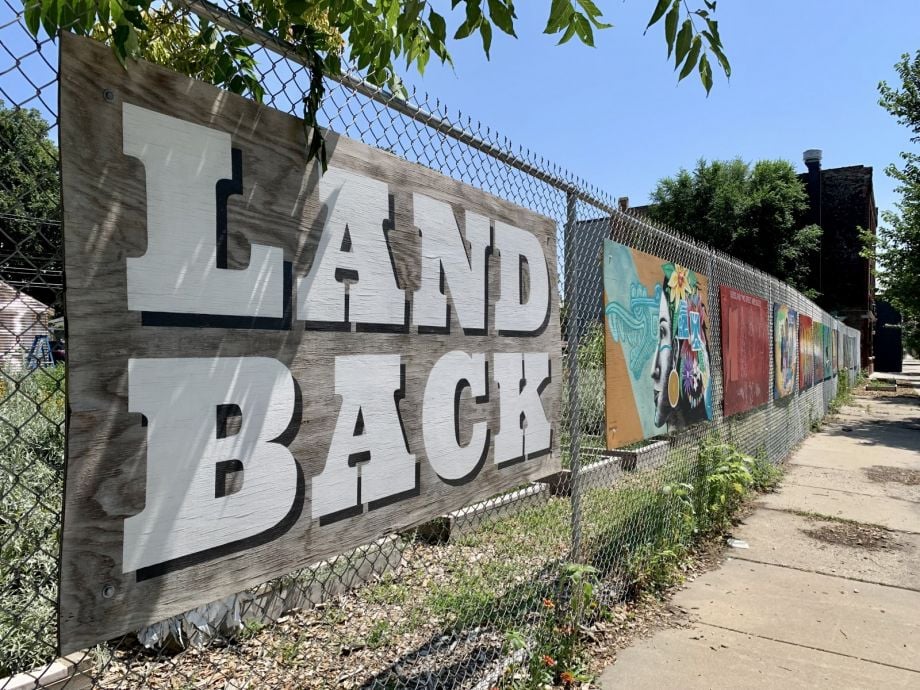
A mural outside the First Nations Garden in Chicago, developed by the Chi-Nations Youth Council on a 15,625-square-foot city-owned lot granted for their stewardship. (Photo by Gabriel Pietrorazio)
Dear Ethical Urbanist,
Does giving Indigenous communities stewardship rights to the land, but not ownership, truly count as Land Back?
Sincerely,
Righting Past Wrongs
Whether stewardship rights, such as those granted through land trusts and the like, constitute Land Back is a great question. The question and its framing are instructive of the very issues the Indigenous-led Land Back movement raises in its many and multifaceted efforts to reclaim the more than 90 million acres of Indigenous land stolen by the U.S. government.
Before we go further, though, we have to start with a qualifier.
“We’re not a monolith. Everyone has their own definitions and their own understandings of what Land Back is in respect to their own communities,” Krystal Two Bulls, executive director of Honor the Earth — an Indigenous-led nonprofit working to dismantle settler colonialism, “racial capitalism,” white supremacy and imperialism — says of the many peoples, nations and communities that constitute Indian Country.
“I have strong feelings and opinions about the way that I hold [Land Back], but I also recognize that so many other nations have their own definition.”
Some nations still have access to at least parts of their original territories; others, often those that lack federal recognition, are completely landless. Stewardship may be a step in a positive direction for tribes that don’t have access to their ancestral territories at all, but may fall far short of what others would like to see for themselves.
When it comes to grappling with whether or not stewardship counts as Land Back, Eva Cárdenas, director of organizing at NDN Collective — an Indigenous-led nonprofit working to build Indigenous power— puts it this way: “The short answer is yes. Anytime that we are seeking to return Indigenous lands to Indigenous hands, it’s a step closer to an attempt to make a wrong right.”
Read more: Are Land Trusts Part of the Land Back Movement?
Two Bulls ultimately agrees. “I started out with Land Back being very clearly and distinctly Indigenous lands being placed back in Indigenous hands. For me, co-stewardship or just having access does not equal Land Back. At the same time, I hold the reality that we live in.”
The United States is a settler colonial nation that has held property and land ownership as central to its very existence. The belief that land is a resource to be mined, drilled, farmed, fracked, and otherwise extracted from for human benefit — often to the detriment of the other life that shares this planet with us — is core to its very establishment and functioning.
“We know that the reality is that we do live under colonial systems and that sometimes buying land or being owners of land to some degree is a way that we can protect land,” Cárdenas says.
Yet having stewardship rights to land is not Land Back’s end goal. Neither is owning the land. Instead, the movement is about a return to Indigenous forms of relationship with land.
“Before contact with colonial setters, our relationship with Mother Earth was reciprocal. It was one that we benefited from, and therefore it was our responsibility, our duty, to protect and defend it. Because we understand that Mother Earth is a living being who provides,” Cárdenas explains. “When our relationship to the land shifts from that of reciprocity to a capital model of extraction, of ownership, of a transactional relationship, a shift happens.”
The contradiction that shows up in the very phrasing of the question reflects the inherent contradiction that an Indigenous movement faces while operating in a modern world.
Read more: Where Fire Back Means Land Back
Land Back comes from a place of Indigenous wisdom — which understands the land to be a relative rather than a resource — in a context that’s dominated by extractive economic and human-centric systems. Considering this reality, tactical choices that include stewardship and ownership have to be made.
These ways of understanding and relating to the land are a means to an end, not the end itself. In fact, they’re very far from it.
“At the core of it, Land Back is about reclaiming our relationship to the land,” Two Bulls says. As she speaks, she is walking to pick chokecherries from shrubs still growing in the small Montana mining town where she lives, due to lack of housing on her reservation. “For me, Land Back means reclaiming myself along with the teachings and practices that we learned from the land.”
Before colonization, Two Bulls’ people and other Indigenous communities were fully and sustainably thriving societies and economies. Indigenous education, language and ways of living all stemmed from the land. Their shelter came from the land. Their language and all of the little sounds that comprise it came from the land. Their food and medicines came from the land.
“For me, Land Back is reclaiming those things and undoing the harm and disconnection that settler colonialism caused and is still causing today,” Two Bulls says.
Cárdenas agrees: “The land’s a living being. [Land Back is about] a reciprocal relationship. The place to get back to is this relationship with the land. Ownership might be a way, but it’s not the goal.”
Land Back isn’t a binary thing determined by concepts of stewardship and ownership. Land Back is about how we understand, relate to, and live with the land and all the plant and animal relatives we share it with. Land Back is about doing away with the reductive and oppressive ways of thinking, knowing, and being that are defining characteristics of this dominant culture and its systems.
It’s about understanding that we come from the land, are sustained by the land, and that we go back to the land and, thus, our inherently intertwined relationship with the land requires us to take care of it so that we can take care of ourselves and all life on this planet.
Stewardship and ownership are mere tactical choices within a fight that’s about so much more; one that, if won, would do away with the very ideas that form this question in the first place.
This post is part of The Ethical Urbanist, Next City's reported column that explores the complex moral challenges that come up when working to make cities more liberated places. If you have a question you want us to answer, complete this form.
This post was originally published on Next City.