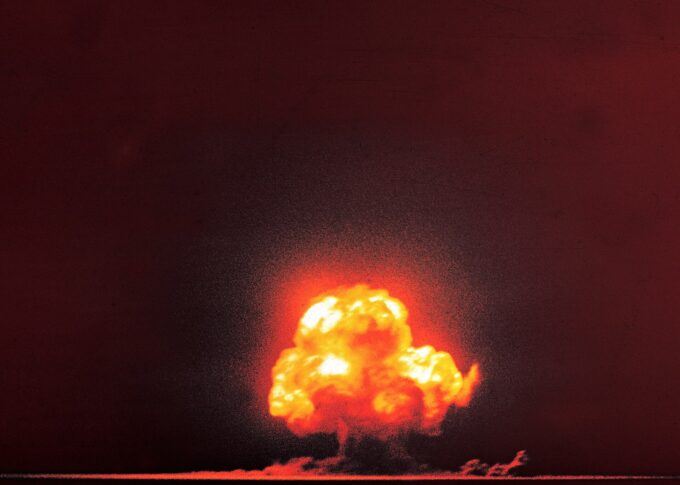


Jack W. Aeby, July 16, 1945, Civilian worker at Los Alamos laboratory, working under the aegis of the Manhattan Project – Public Domain
Donald Trump feigned ignorance about Project 2025 during the last presidential campaign. Since Trump’s election, the 900-page blueprint for a unitary presidency has decimated the federal government.
Principal authors of Project 2025, like Russell Voigt and others, populate the White House and serve as Trump’s Privy Council, slashing personnel roles and smashing executive norms.
Were Project 2025 to achieve all its goals, the legislative and judicial branches having offered little resistance to date, one of the most devastating consequences would be the resumption of explosive nuclear weapons testing, and the rejection of the Comprehensive Nuclear Test Ban Treaty, CTBT.
Since Oppenheimer et al first detonated the Trinity Test device in the New Mexico desert in 1944, the U.S. has conducted 1,054 explosive nuclear weapons tests, totaling 196.5 megatons (1 megaton equals the explosive energy of one million tons of TNT). Atmospheric nuclear weapons totaling 141 megatons were exploded above the Great Nevada Basin and over coral islands in Pacific Micronesia.
The Soviet Union, from 1949 to 1962, conducted 219 atmospheric nuclear weapons tests totaling 247 Megatons. Radioactive fallout from the Soviet and U.S. atmospheric tests poisoned test sites and spread radionuclides around the globe. Every person alive today, and for the next 5,000 years, will ingest a small but persistent contaminant, C-14, radioactive carbon.
Linus Pauling, and subsequent scientists Frank von Hippel and Andre Sakharov calculated that long-lived C-14 from atmospheric nuclear testing will cause 7 million cancers and 2.9 million cancer deaths worldwide over the next 8,000 years. Pauling predicted that C-14 would cause hundreds of thousands of neonatal deaths, and mental and physical defects annually in children over the half-life of the C-14 isotope spread by atmospheric nuclear weapons testing.
The U.S. has paid over $3 billion in radiation exposure compensation (RECA) to unwitting civilians living adjacent to its Nevada Test Site and to the Marshall Islanders. Marshall Islanders may never return to some H-bomb test sites like Bikini Atoll due to hazardous radiation levels. Other Marshall Islands are increasingly uninhabitable due to rising sea levels driven by climate change.
Global outrage over radioactive contamination from atmospheric testing and the Cuban Missile Crisis disaster drove the U.S. and the U.S.S.R. to sign and ratify the Limited Test Ban Treaty in 1962. The LTBT successfully banned all nuclear weapons testing in the atmosphere, underwater and in space.
Both nations continued their explosive nuclear tests in shafts drilled deep underground in Nevada, Kazakhstan, and the Soviet Arctic Circle Archipelago.
Facing the escalating nuclear arms race, and fearing nuclear weapons proliferation, China and Israel had developed nuclear weapons by now, non-aligned non-nuclear armed states successfully passed the Non-Proliferation Treaty, signed by 191 states. The NPT came into force in 1970.
The NPT is the foundation for subsequent nuclear weapons treaties. Non-nuclear armed states rejected development of or possession of nuclear weapons, and nuclear armed states agreed to eliminate their nuclear weapons stockpiles. Non-nuclear armed states were guaranteed the right to develop peaceful nuclear programs. The treaty is reviewed every five years, though the last three quinquennial conferences have failed to issue a consensus document; 2010 and 2015 reviews failed to agree a Middle East Weapons of Mass Destruction Zone, Israel dissenting, and in 2022 disagreement about Russia’s attacks on the Zaporizhzhia Nuclear Power Plant in Ukraine, and the failure of nuclear armed states to eliminate their nuclear arsenals ended the NPT review conference in acrimony.
The Intermediate Nuclear Forces Treaty of 1987 was the only nuclear treaty to eliminate large numbers of nuclear-capable launchers. Nuclear-capable missiles with ranges from 500km to 5,000km. were banned under the treaty. U.S. and Soviet inspectors witnessed the destruction of thousands of short and intermediate-range missiles from their adversary’s arsenals.
The U.S. accused the now Russian Federation of breaching the INF Treaty by building a medium-range missile, the SSC-8, with a range of 3000 km. Ignoring advice from NATO and China to bring Russia into compliance through negotiation, the Trump Administration withdrew from the INF in 2019. Russia immediately withdrew from the INF and has since developed a new mid-range missile, the hypersonic Oreshnik, currently deployed in Belarus.
The NewSTART (Strategic Arms Reduction Treaty) 2011, is the only remaining bilateral nuclear arms agreement between in the U.S. and Russia. It expires in five months, February 2026. Signed by U.S. President Obama and Russian President Medvedev, NewSTART reduced the number of deployed nuclear warheads of each party from 5,000 to 1,500 deployed nuclear warheads..
Russian President Putin in September 2025 proffered a one-year extension of NewSTART, saying failure to extend it “would be a grave and shortsighted mistake, with adverse implications for the Non-Proliferation Treaty”. Without the nuclear arms control of NewSTART, a new nuclear arms race between the U.S. and Russia could soon begin.
Many arms control advocates, including the Carnegie Endowment for International Peace, place blame for the erosion of nuclear weapons treaties squarely on the George W. Bush administration, which unilaterally withdrew from the Anti-Ballistic Missile Treaty in 2001.
Indeed, the allure of building an impenetrable defense against strategic nuclear missiles has thwarted numerous nuclear weapons agreements. Ronald Reagan’s worthless though costly Strategic Defense Initiative, aka SDI, aka StarWars, defeated Mikhail Gorbachev’s proposal to mutually eliminate all U.S. and Russian nuclear weapons.
Donald Trump’s iteration of Star Wars, the Golden Dome, threatens to undermine existing nuclear weapons treaties and fuel a renewed arms race. Both China and Russia have condemned the Golden Dome, while others see it as another billion-dollar boondoggle.
Were the U.S. to unilaterally resume explosive nuclear testing, as proposed in Project 2025, the teetering international nuclear arms control structure may very well collapse. Other U.S. withdrawals from nuclear treaties, like the ABM and INF and potentially NewSTART, have achieved not strategic security but global insecurity and a burgeoning trillion-dollar weapons industry.
If Project 2025’s scheme restarts explosive nuclear weapons testing and the U.S. withdraws from the Comprehensive Nuclear Test Ban Treaty, as advocated by Russell Voigt and former National Security Advisor Robert O’Brien, the CTBT would be eviscerated. The thirty-three-year-long moratorium on explosive testing would implode. The pillars of the Non-Proliferation Treaty would be undermined. The core tenet of the NPT stipulating that nuclear-weapon states must end the nuclear arms race and eliminate their nuclear weapons stockpiles will be betrayed.
There is no justification for renewed explosive nuclear weapons testing. The U.S. has accumulated far more data about nuclear explosions than any adversary. Sub-critical nuclear weapons tests yield more information about the “strategic stability” of the U.S. nuclear than does explosive testing. Brandon Williams, director of the National Nuclear Security Administration, recommended against renewed explosive testing during his confirmation hearing in April.
Without the NPT structure, many non-nuclear-weapon states could abandon nuclear non-proliferation. Countries like Japan, South Korea, and Saudi Arabia may construct their own nuclear weapons programs, including explosive nuclear weapons testing. The long-sought goal of nuclear non-proliferation and elimination of nuclear weapons, going back to the Truman Administration, would disintegrate.
Congress must call for the immediate extension of NewSTART. An end to nuclear brinksmanship should be the focus and priority of every member of Congress.
Instead of threatening withdrawal from the Comprehensive Nuclear Test Ban Treaty, signed by George H.W. Bush in 1992, the U.S. Senate should ratify it, bringing Russia and China along, and bringing the CTBT into force.
Senators must defund and defeat any measure that includes resources for renewed explosive nuclear weapons testing. Explosive testing is not the beginning of the end of arms control it is the end of nuclear arms control.
The Bulletin of Concerned Scientists, founded by Oppenheimer and Albert Einstein after the A-bombings of Japan in WWII, calculates the risk of mankind’s destruction with manmade technologies. In 2025, the Clock set at 89 seconds to Midnight, the most perilous setting on record.
Every U.S. president, both Republican and Democrat, since Harry Truman has struggled to achieve some limit on nuclear weapons and proliferation. To shatter that eighty-year history of common sense and negotiation with fantastical Golden Domes or renewed explosive testing will send shockwave around the world and reverberate and far into the future.
“The failure to achieve a ban on nuclear weapons tests would have to be classified as the greatest disappointment of any administration- of any decade- of any time and any party.”
–President Dwight D. Eisenhower, 1961
The post Explosive Nuclear Weapons Testing, the CTBT, NewSTART and the Doomsday Clock appeared first on CounterPunch.org.
This post was originally published on CounterPunch.org.