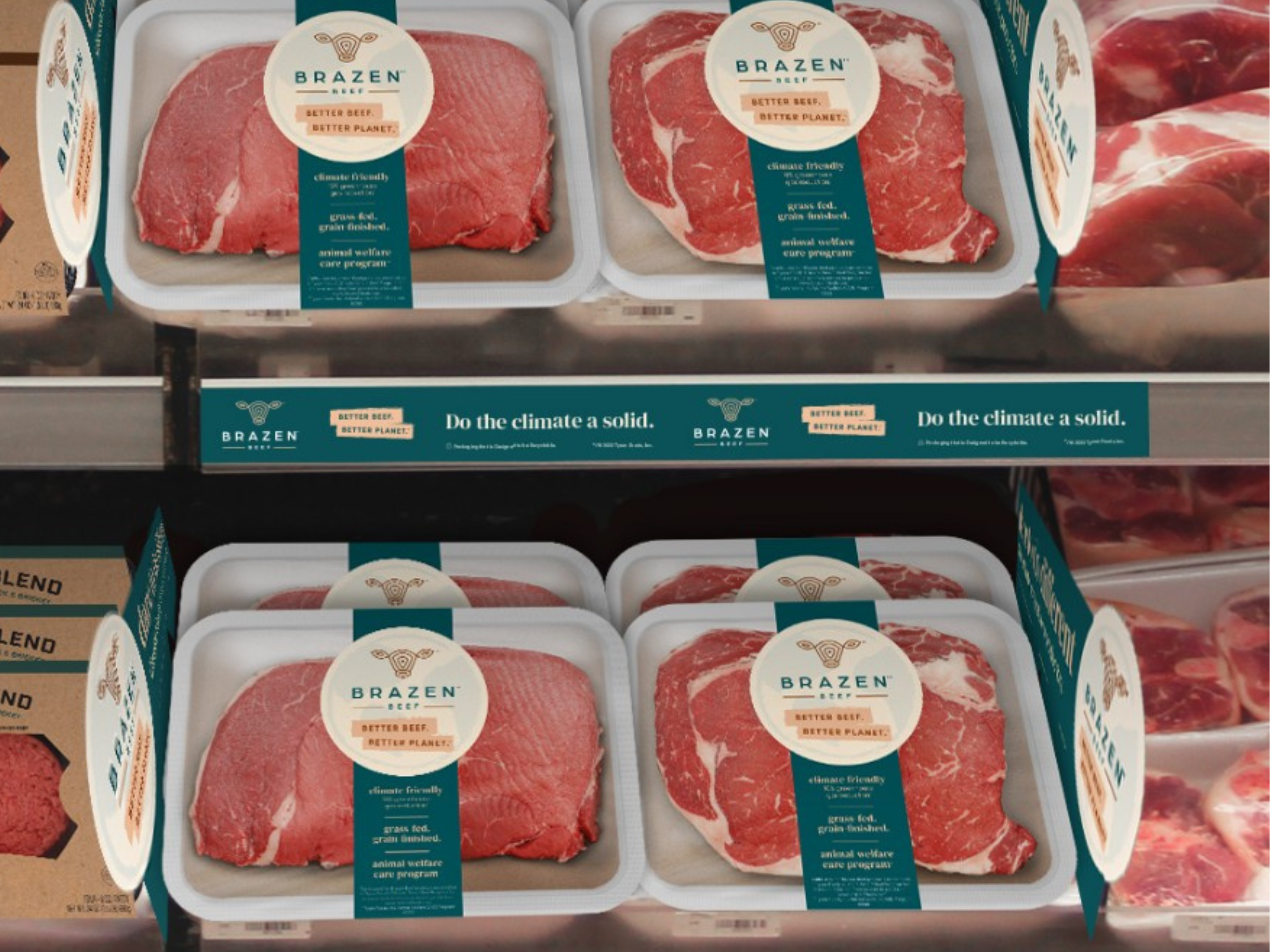
US meat behemoth Tyson Foods has settled a greenwashing lawsuit, agreeing to stop labelling its beef products as climate-friendly or claiming it will reach net zero by 2050.
A year after getting sued for marketing its beef as “climate-smart” and suggesting it will achieve net-zero greenhouse gas emissions by 2050, US meatpacker Tyson Foods has agreed to stop making these environmental claims.
The lawsuit, brought by the Environmental Working Group (EWG) last week in the DC Superior Court in September 2024, had argued that the company had no proven way of reducing the methane and nitrous oxide emissions from beef production with existing or anticipated technology, or without eliminating cattle themselves.
As part of the settlement, the company can’t make new related claims for another five years, unless a mutually agreed-upon expert concludes they are sufficiently supported.
“This settlement reinforces the principle that consumers deserve honesty and accountability from the corporations shaping our food system,” said Caroline Leary, general counsel and COO at EWG, which was represented by the Animal Legal Defense Fund, Earthjustice, Edelson PC, and FarmSTAND.
“The outcome makes clear that corporate climate pledges must be transparent, verifiable, and rooted in real change,” she added.
Tyson Foods’s claims an ‘intentional effort to capitalise’ on consumers

At the heart of the issue is Tyson’s Climate-Smart Beef Program, which led to the launch of its Brazen Beef brand, which featured the USDA’s controversial Low Carbon Beef label, suggesting that it had been produced using measures that resulted in a ‘10% greenhouse gas emissions reduction’.
However, there’s little to no information about how it achieved these reductions, EWG’s complaint had pointed out. It noted Tyson’s recognition that more consumers are “willing to pay a premium” to eat lower-emission meat, and that shifting preferences due to greater climate concerns “may adversely impact demand” for its products.
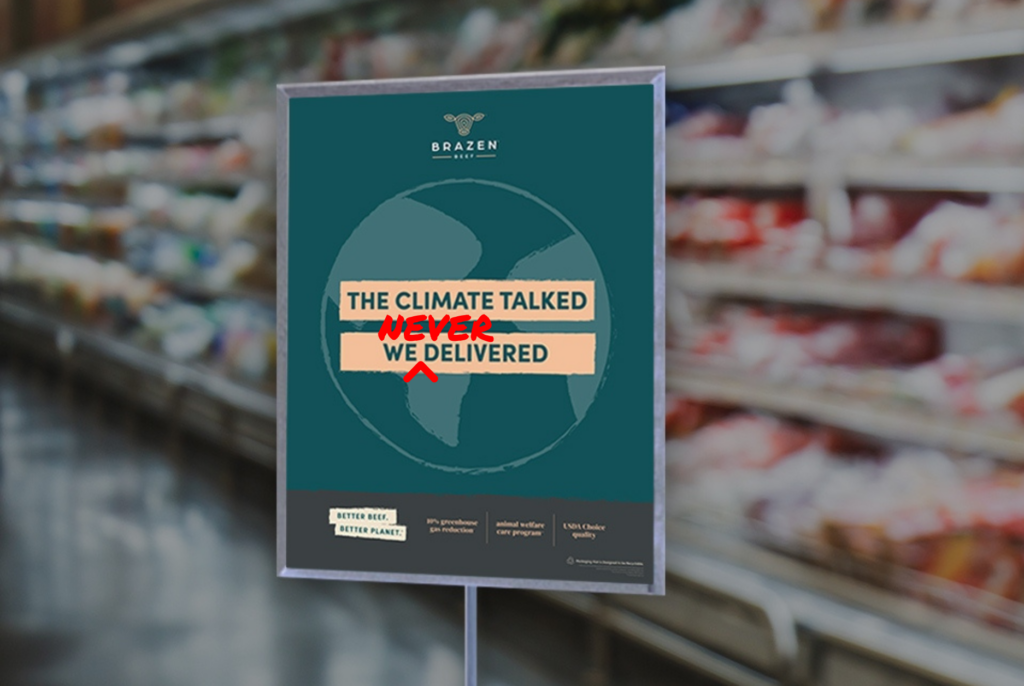
Tyson told consumers for nearly four-and-a-half years that it was committing to achieving “net-zero” emissions by 2050, and that it “sells climate-smart beef”, which EWG called “an intentional effort to capitalise on consumer preferences for sustainable options”.
But as the lawsuit alleged, the company had failed to provide any evidence to support these claims. Still, the strategy worked. A 2024 survey showed that 95% of Americans would buy products labelled ‘climate-friendly’, and 66% would pay more for them. And 15% believed ‘climate-friendly’ beef like Tyson’s has a smaller climate footprint than conventional beef, pork, chicken, and even tofu.
The reality is that beef is the most polluting food on the planet. Enteric fermentation from cattle, their natural digestive process, accounts for 18% of US methane emissions (it’s a gas 86 times more powerful than CO2 over a 20-year span), while manure management generates both methane and nitrous oxide.
Further, deforestation of land for cattle farming releases carbon dioxide and prevents efforts to sequester the gas under alternative land use scenarios. Beef production alone makes up 85% of Tyson’s climate footprint, whose overall emissions are greater than those of Austria or Greece.
In the settlement, Tyson denied all allegations made by EWG, highlighting that it has spent $65M in efforts to reduce emissions from its activities. That, however, is just over 0.1% of its annual revenue of $53B last year. Research suggests that Tyson spends more than twice as much on marketing as on its R&D projects.
Tyson and JBS settlements ‘increasingly critical’ to raise awareness
Kelsey Eberly, senior staff attorney at legal group FarmSTAND, said the resolution marked “a crucial turning point in the fight against climate greenwashing”.
“Tyson Foods is the second-largest meat and poultry producer in the world, controls a fifth of the country’s beef, pork, and chicken, and has been estimated to produce nearly as much methane pollution as major oil companies. And now, it’s pulling down its climate claims,” she remarked.
“With climate-forward policies weathering existential attacks, legal actions like this are increasingly critical to raise consumer awareness about the outsized impact conglomerates like Tyson have on our climate.”
Tyson’s settlement comes the same month JBS, the world’s largest meat company, settled a lawsuit with the New York Attorney General’s office to stop making unsubstantiated claims about reaching net zero. Together, JBS and Tyson produce about half of all the beef consumed in the country, so the two outcomes are a big win against Big Meat’s greenwashing habit.
The US government has collectively handed out over $377M in direct subsidies to these meat majors; however, it has begun clamping down on greenwashing. Last year, it updated its labelling guidelines to ensure claims like ‘climate-friendly’ and ‘humanely-raised’ on meat labels are backed up with evidence. Though the guidance uses voluntary language, those found to be in violation were warned of enforcement action.
“This settlement should be a clear signal to consumers to be cautious of major beef producers’ marketing their products as ‘climate-smart,’” said Carrie Apfel, deputy managing attorney of Earthjustice’s Sustainable Food and Farming programme.
“Industrial beef production emits vast amounts of greenhouse gases from every stage of the operation. Achieving meaningful emission reductions at this industrial scale would require corporations to make transparent, transformative changes, which we allege Tyson hasn’t shown.”
The post Tyson Foods to Stop Making ‘Climate-Smart’ Beef & Net-Zero Claims After Lawsuit appeared first on Green Queen.
This post was originally published on Green Queen.