In the aftermath of the deadly ambush shooting of two National Guard members in Washington, D.C., President Donald Trump and others in his administration immediately blamed Trump’s predecessor, Joe Biden, for failing to vet the Afghan national accused of the attack. Here, we’ll answer some questions about what we know so far about the suspect and the vetting process.
The suspect, 29-year-old Rahmanullah Lakanwal, is alleged to have driven across the country from his home in Washington state and then shooting West Virginia National Guard members Sarah Beckstrom, 20, an Army specialist, and Air Force Staff Sgt. Andrew Wolfe, 24. Beckstrom died later from her injuries, and Wolfe remains in critical condition. They were serving as part of what Trump has called a crackdown on crime in the nation’s capital.
Despite Trump’s claims that Lakanwal and other Afghans were “unvetted” and “unchecked,” there are reports that Lakanwal was vetted several times, in Afghanistan and in the U.S., most recently as part of obtaining asylum status earlier this year. Trump officials say Lakanwal may have become radicalized while living in the U.S.
Details about the shooter’s history and possible motivations are still emerging.
Who is Lakanwal?
Lakanwal is an Afghan national who is reported to have been a member of a paramilitary force that worked with the CIA during the two-decade war in Afghanistan.
Fox News Digital, citing unnamed intelligence sources, reported that Lakanwal “had a prior relationship with various entities in the U.S. government, including the CIA, due to his work as a member of a partner force in Kandahar.”
CBS News reported that in Afghanistan, Lakanwal was part of a so-called “Zero Unit,” an Afghan intelligence unit and paramilitary force that worked with the CIA.
“The units were exclusively composed of Afghan nationals and operated under the umbrella of the National Directorate of Security, or NDS, the intelligence agency established with CIA backing for Afghanistan’s previous, U.S.-backed government,” CBS News reported. “They were considered by the U.S. and its international partners to be among the most trusted domestic forces in Afghanistan.”
FBI Director Kash Patel and CIA Director John Ratcliffe both confirmed that Lakanwal worked with a “partner force” in Afghanistan that included work with the U.S. government, including the CIA.
When the country was overtaken by the Taliban after U.S. forces withdrew in 2021, Lakanwal was among the more than 190,000 Afghans who were resettled in the United States. Jeanine Pirro, U.S. attorney for the District of Columbia, said Lakanwal was living in Bellingham, Washington, with his wife and five children.
Fellow guardsmen who responded to the scene shot Lakanwal, who is “under heavy guard” at a local hospital, Pirro said on Nov. 27. On Dec. 2, he appeared before a judge via video from a hospital bed and pleaded not guilty to charges of first-degree murder, assault with intent to kill and illegal possession of a firearm.
What is Operation Allies Welcome?
Lakanwal came to the country under Biden’s Operation Allies Welcome following the U.S. military withdrawal from Afghanistan. Operation Allies Welcome was initiated via a memo from the Biden administration in August 2021 “to lead the coordination of ongoing efforts across the Federal Government to resettle vulnerable Afghans, including those who worked on behalf of the United States.”
According to a contemporaneous press release about the program from the Department of Homeland Security, those brought to the U.S. would undergo a “rigorous screening and vetting process.”
“The U.S. government is working around the clock to conduct the security screening and vetting of vulnerable Afghans before they are permitted entry into the United States, consistent with the dual goals of protecting national security and providing protection for our Afghan allies,” the press release stated. “As with any population entering the United States, DHS, in coordination with interagency vetting partners, takes multiple steps to ensure that those seeking entry do not pose a national security or public safety risk.”
DHS said it deployed 400 personnel from U.S. Customs and Border Protection, Immigration and Customs Enforcement, the Transportation Security Administration, U.S. Coast Guard, and the Secret Service to so-called “lily pad” countries — Bahrain, Germany, Kuwait, Italy, Qatar, Spain and the United Arab Emirates — to process, screen and vet Afghan evacuees in conjunction with the Departments of Defense and State.
The “multi-layered” vetting process included “biometric and biographic screenings conducted by intelligence, law enforcement, and counterterrorism professionals from DHS and DOD, as well as the Federal Bureau of Investigation (FBI), National Counterterrorism Center (NCTC), and additional intelligence community partners,” the press release said. “This process includes reviewing fingerprints, photos, and other biometric and biographic data for every single Afghan before they are cleared to travel to the United States. As with other arrivals at U.S. ports of entry, Afghan nationals undergo a primary inspection when they arrive at a U.S. airport, and a secondary inspection is conducted as the circumstances require.”
What are Trump and other administration officials saying?
“I can report tonight that based on the best available information, the Department of Homeland Security is confident that the suspect in custody is a foreigner who entered our country from Afghanistan, a hellhole on Earth,” Trump said in a video message on Nov. 26. “He was flown in by the Biden administration in September 2021 on those infamous flights that everybody was talking about. Nobody knew who was coming in.”
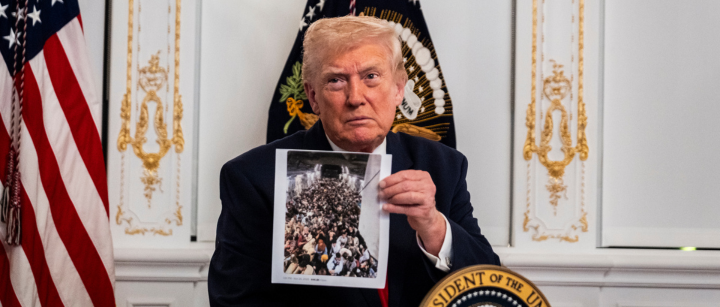
In a Thanksgiving call to military service members, Trump held up a photo of Afghans crowding onto a plane to flee their home country after its government fell to the Taliban in 2021.
Trump claimed all of the Afghan nationals brought to the U.S., including Lakanwal, were “unvetted.”
“They were unchecked,” Trump said. “There were many of them. And they came in on big planes and it was disgraceful. … They just walked in. Whoever the strongest people were physically … they got on the planes, there was no check-in. They just swamped the planes, they took off. We had no idea who they were.”
In a press conference about the shooting the same day, Pirro said, “This is what happens in this country when people are allowed in who are not properly vetted.”
“This individual is in this country for one reason and one reason alone, because of the disastrous withdrawal from the Biden administration and the failure to vet any way, in any way, shape or form this individual and countless others,” Patel said at the same press conference.
“The individual, and so many others, should have never been allowed to come here,” Ratcliffe told Fox News Digital. “Our citizens and service members deserve far better than to endure the ongoing fallout from the Biden administration’s catastrophic failures.”
Was Lakanwal vetted?
Contrary to the claims of Trump and others in his administration, the Washington Post reported that Lakanwal “underwent thorough vetting by counterterrorism authorities before entering the United States, according to people with direct knowledge of the case.”
While critics have claimed many evacuees were able to enter the U.S. without proper vetting, “Lakanwal, however, would not have been among them, according to the individuals, who requested anonymity because of the sensitivity of the investigation,” the Post reported. “One of the individuals said Lakanwal was vetted years ago, before working with the CIA in Afghanistan, and then again before he arrived in the U.S. in 2021. Those examinations involved both the National Counterterrorism Center as well as the CIA, the person said.”
According to Rolling Stone, Lakanwal “underwent more vetting than most Afghans. No one just joined the CIA’s Zero Units. Soldiers had to be recommended by a close family member or friend. The CIA then vetted each member before even offering a probationary period. The vetting process was so successful that Zero Units never suffered an insider attack — when Afghan soldiers turned against U.S. advisers.”
In addition, the Rolling Stone story said that the roughly 10,000 Zero Unit veterans who resettled in the U.S. “were vetted again” after arriving in the country and “before receiving Special Immigrant Visas, meant for Afghan and Iraqi nationals who worked for the U.S. government.”
Samantha Vinograd, a former top counterterrorism official at the Department of Homeland Security under Biden and now a national security contributor at CBS News, said on CBS’ “Face the Nation” on Nov. 30 that Lakanwal’s first vetting would have been over a decade ago by the CIA prior to beginning work in the Zero Unit, “which was a paramilitary and intelligence force that partnered with the CIA incredibly closely on some very intense missions.”
“But, to be clear, Afghan evacuees have been re-vetted since coming to the United States,” Vinograd added. “They were re-vetted under the Biden administration.”
Lakanwal also would have been vetted as part of his application for asylum, which was initiated during the Biden administration but was approved in April under the Trump administration.
Asked about the Trump administration signing off on Lakanwal’s asylum application, Trump said, “When it comes to asylum, when they’re flown in, it’s very hard to get them out. No matter how you want to do it, it’s very hard to get them out. But we’re going to be getting them all out now.”
“The vetting process … happens when the person comes into the country,” Homeland Security Secretary Kristi Noem said on NBC News’ “Meet the Press” on Nov. 30. “And Joe Biden completely did not vet any of these individuals, did not vet this individual. Waited until he got into the United States, and then that application for asylum was opened under the Joe Biden administration, when he was the president in the White House, and allowed that to go forward with the information that they provided. That’s the Biden administration’s responsibility. This is the consequences of the dangerous situation he put our country in when he allowed those people to infiltrate our country during that abandonment of Afghanistan.”
Noem said the Trump administration has since tightened the vetting process to include social media checks.
Asked if there was any vetting as part of the process to approve Lakanwal’s asylum request, Noem said, “The vetting process all happened under Joe Biden’s administration.”
On the same news program, Democratic Sen. Mark Kelly dismissed the Trump administration’s blame of the Biden administration.
“Well, this administration, they’re going to blame Joe Biden on everything,” Kelly said. “I mean, it is almost getting comical, you know, at this point. It sounds like there was some vetting done in the last administration. It sounds like they did not do enough vetting before they gave him his asylum claim. She [Noem] talked about changing the vetting process. I think that’s a good idea. I mean, when you see an issue and a process that isn’t quite working, especially after we go through an investigation on this individual, if there are things that need to be changed, we should change them.”
What concerns have been raised about vetting?
A Department of Homeland Security Office of Inspector General report issued on Sept. 6, 2022, during the Biden administration, warned that vetting of Afghan evacuees was fraught.
“After meeting with more than 130 individuals from the Department of Homeland Security, we determined DHS encountered obstacles to screen, vet, and inspect all Afghan evacuees arriving as part of Operation Allies Refuge (OAR)/Operation Allies Welcome (OAW),” the report stated. “Specifically, U.S. Customs and Border Protection (CBP) did not always have critical data to properly screen, vet, or inspect the evacuees. We determined some information used to vet evacuees through U.S. Government databases, such as name, date of birth, identification number, and travel document data, was inaccurate, incomplete, or missing. We also determined CBP admitted or paroled evacuees who were not fully vetted into the United States.”
“As a result,” the report said, “DHS may have admitted or paroled individuals into the United States who pose a risk to national security and the safety of local communities.”
DHS disputed the inspector general’s findings, saying that “the draft report does not adequately acknowledge, and account for, the interagency and multilayered vetting process that started overseas, continued at the U.S. Port of Entry (POE), and is currently ongoing with recurrent vetting.”
A subsequent Justice Department audit issued in June looked at the FBI’s role in vetting the national security risk posed by Afghan evacuees.
“According to the FBI, the need to immediately evacuate Afghans overtook the normal processes required to determine whether individuals attempting to enter the United States pose a threat to national security, which increased the risk that bad actors could try to exploit the expedited evacuation,” the audit said.
However, the review found that while 55 Afghan evacuees who made it to the U.S. were on the terrorist watchlist, as of July 2024, just nine remain on the list and were “being tracked, as appropriate.” According to the report, “The remaining 46 were removed from the watchlist for a variety of reasons, which included a determination by the FBI that the individual was no longer considered a threat to the United States.” (According to the DOJ, “Watchlist nominations are based on derogatory information, which the TSC [Terrorist Screening Center] defines as intelligence or other information that serves to demonstrate the nature of an individual or group’s association with terrorism.”)
Vinograd, the former Biden administration official, acknowledged on “Face the Nation” that while there was pressure to expedite vetting “to help our Afghan partners and bring at-risk Afghans here … protecting national security and public safety was the foremost priority. And that’s why a process was designed that vetted individuals overseas, but it was never intended to be a one-and-done. It was a multistage process with various U.S. government agencies. Afghan evacuees were vetted overseas by graphic and biometric vetting. And then there were other stages of vetting that occurred once individuals were here. So we have to put this vetting process in context.”
In an appearance on CNN on Dec. 1, Andrew McCabe, the former deputy director of the FBI, said that while some Republicans are “trying to create the presumption that the mistakes were made under the prior administration,” Lakanwal was vetted repeatedly.
“Vetting is a very imprecise, imperfect science,” McCabe said. “Vetting depends exclusively on checking someone out by accessing information that we have in our own possession or can get from the country that that person’s coming from. … Essentially we’re left with a process where the absence of any negative information equals a positive result. And that is by definition, you know, not completely reliable.”
“There is no guarantee when you look into someone’s background to grant them entry, that they’ll come here and never make a mistake or commit a crime or do something violent,” McCabe said. “This appears to be one of those instances that obviously has gone horribly wrong.”
Was lack of vetting to blame for the attack?
“At this point, we don’t have indications that the horrific tragedy was a result of a vetting failure,” Vinograd said. “Instead, the attorney general also said this morning it appears the individual was radicalized once here.
“And let’s be clear on what the vetting system is and what it isn’t,” Vinograd said. “The vetting system is a system in which an individual’s identifiers, their biographic information and biometric information, iris scans, fingerprints, facial images, are run against datasets of information about individuals with ties to terrorism and criminal history. The vetting system is not predictive of whether an individual with no derogatory information is or is not at some point going to become violent.”
On NBC’s “Meet the Press” on Nov. 30, Noem said, “We believe he [Lakanwal] was radicalized since he’s been here in this country. We do believe it was through connections in his home community and state, and we’re going to continue to talk to those who interacted with him, who were his family members, who talk to them.”
A more nuanced picture of Lakanwal has begun to emerge since the shooting. Rolling Stone quoted an Afghan veteran who fought alongside him saying Lakanwal was struggling with mental illness and an inability to financially provide for his family. The man said Lakanwal reached out to the CIA for help.
The former unit mate, who was not named in the story, said Lakanwal lost his job at a laundromat because he didn’t have a work authorization card — even though he was granted asylum. He said Lakanwal spoke of isolation and increasing desperation.
ABC News reported that the recent death of an Afghan commander revered by Lakanwal had deepened Lakanwal’s depression and compounded the stress of his financial burdens.
According to the New York Times, the units Lakanwal served with in Afghanistan “had been trained for nighttime raids targeting suspected Taliban members, and were accused by human rights groups of widespread killings of civilians.” The Times said, “The C.I.A. has denied the allegations of brutality among the units, saying they were the result of Taliban propaganda.”
CBS News obtained emails sent by a case worker who was working with Lakanwal’s family in Bellingham, Washington, which described a deterioration of Lakanwal’s mental health in the last two years.
One email described “manic episodes for one or two weeks at a time where he will take off in the family car” and other “interim” episodes in which he “tries to make amends.” According to CBS News, “The case worker, who is not a mental health professional, later said in the email that they believed Lakanwal is suffering ‘…PTSD from his work with the US military in Afghanistan.’”
“Rahmanulla was a man who was extremely proud and capable in the world he came from, who felt defeated in the world he came to,” the case worker said.
“The investigators haven’t revealed any indication that he was in touch with other radicals,” McCabe said on CNN. “But what is pretty clear is that this person, this Lakanwal, went down, really his life sort of devolved in the last year. We know that he was vetted before he was allowed to work with the CIA and our special forces folks. If there had been any indication at that time that he had contacts with known terrorists or with sympathetic to Taliban or other terrorist viewpoints, he never would have been approved to work with the U.S. military or the CIA.”
What policy has Trump proposed as a result of the shooting?
In his video message, Trump said, “We must now reexamine every single alien who has entered our country from Afghanistan under Biden, and we must take all necessary measures to ensure the removal of any alien from any country who does not belong here, or add benefit to our country.”
On X, Joe Kent, Trump’s director of the National Counterterrorism Center, also blamed poor vetting by the Biden administration. “This is why the DC attack happened,” Kent wrote. “The solution is rounding up everyone Biden let in & deporting them immediately.”
In response, U.S. Citizenship and Immigration Services announced, “Effective immediately, processing of all immigration requests relating to Afghan nationals is stopped indefinitely pending further review of security and vetting protocols.”
The State Department, meanwhile, announced on Nov. 28 that it had paused visa issuance for individuals traveling on Afghan passports.
Trump subsequently announced that he would “permanently pause migration from all Third World Countries to allow the U.S. system to fully recover.” On Dec. 2, USCIS announced in a memo it was pausing the review of all pending applications for green cards, citizenship or asylum from immigrants from 19 countries that were part of travel restrictions implemented in June.
Editor’s note: FactCheck.org does not accept advertising. We rely on grants and individual donations from people like you. Please consider a donation. Credit card donations may be made through our “Donate” page. If you prefer to give by check, send to: FactCheck.org, Annenberg Public Policy Center, P.O. Box 58100, Philadelphia, PA 19102.
The post Q&A on Vetting of Accused National Guard Shooter appeared first on FactCheck.org.
This post was originally published on FactCheck.org.