Photograph Source: Tech. Sgt. Andrew Enriquez – Public Domain
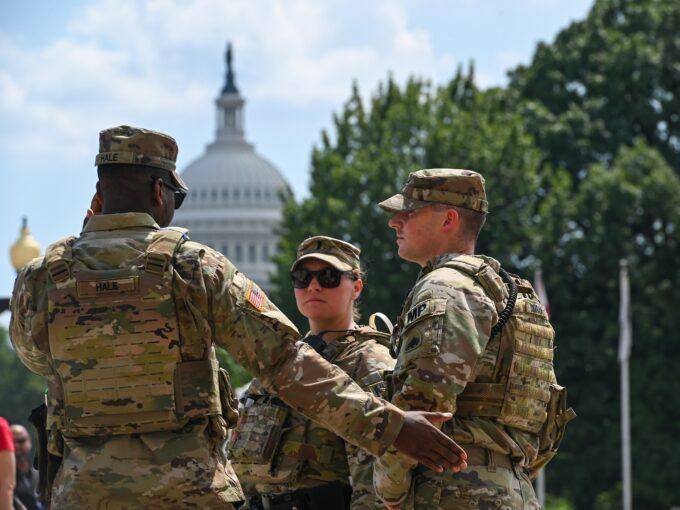
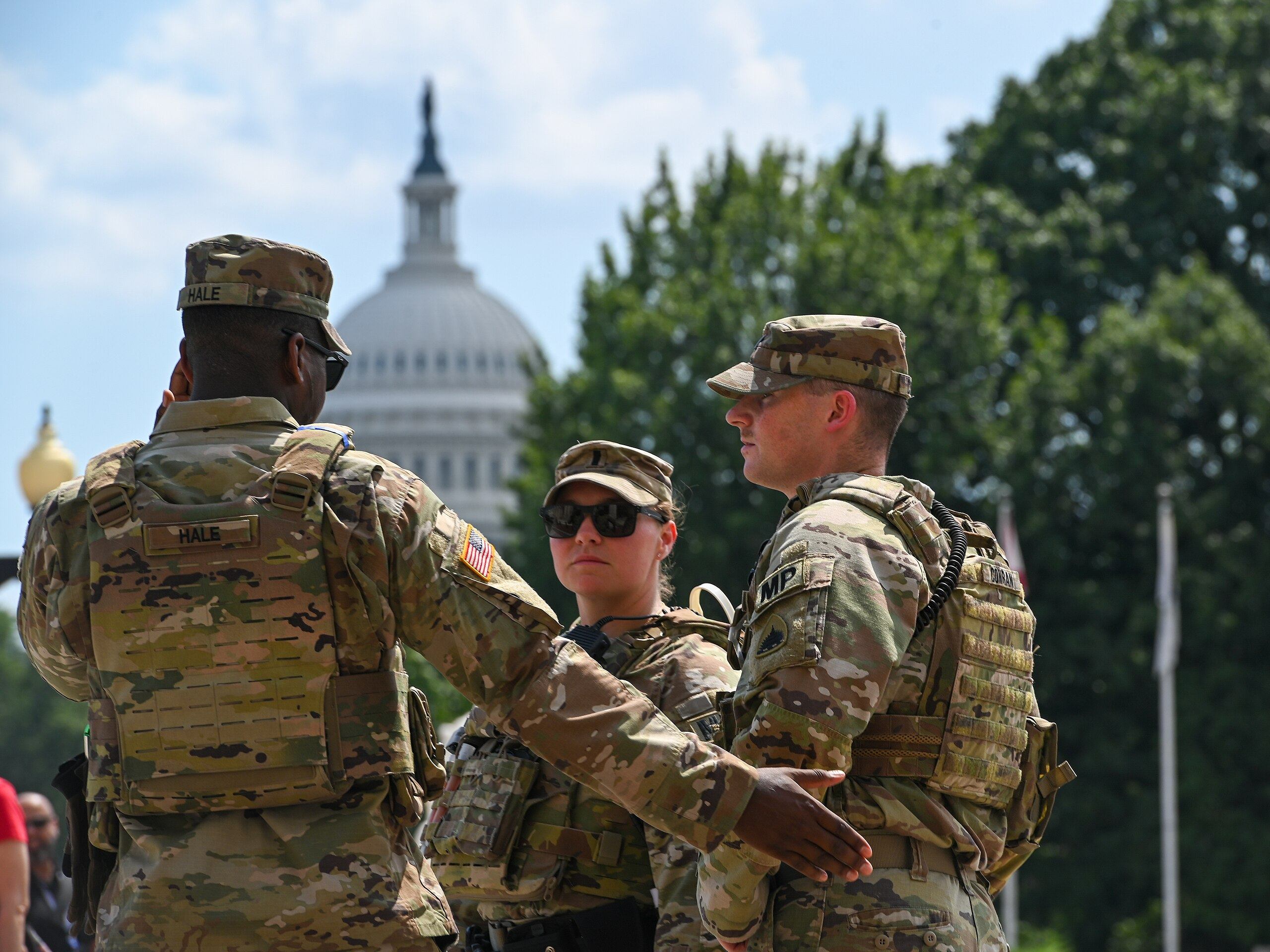
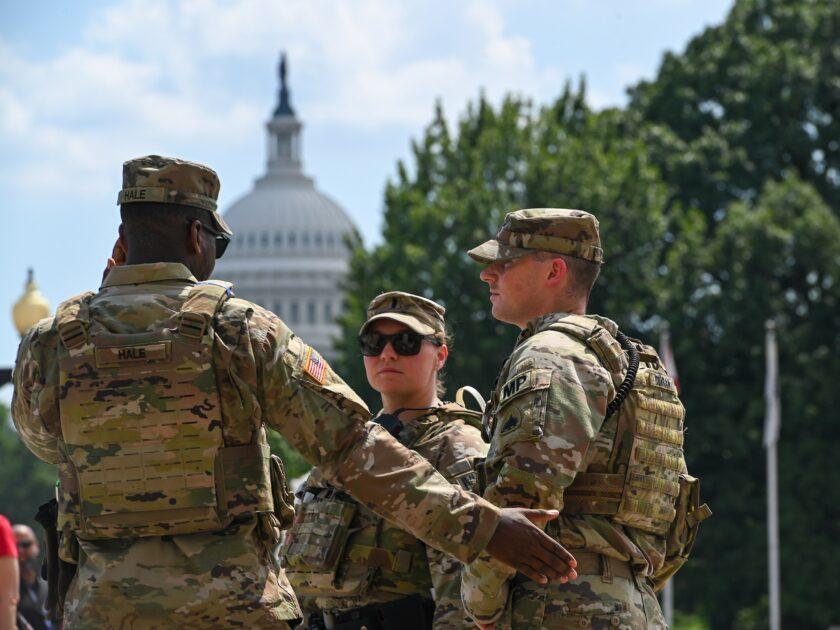
United States President Donald Trump has, not unexpectedly, overreacted to the shooting of two members of the National Guard in Washington, D.C. He is ‘permanently pausing’ all migration from developing nations, ending all government benefits to non-citizens, and will review all the asylum cases that were approved under the administration of former President Joe Biden. There will also be a “full-scale, rigorous re-examination of every green card for every alien from every country of concern.”
Now, it is reasonable to grieve the killing of anyone who was basically minding their own business – although it could be argued that National Guard members don’t necessarily fall into that category – and to take steps to prevent such deaths from occurring in the future. And while the steps Trump is taking can reasonably be argued to have no such intention or efficacy, one can tell that the Great Orange One is enraged at this event.
One visiting from another planet might mistakenly believe that this shooting was a rare occurrence, something that brings fear into the hearts of all U.S. citizens, because it is an unknown rarity. However, such is not the case. Shootings are a daily occurrence in the U.S., so common that few of them are even reported on the news.
While Trump is busy drumming up more nationalist rhetoric, let us look for a moment at a victim population that doesn’t wear a uniform: school children. And let us further see how Trump reacts to school shootings.
First, a very inconvenient fact: as of November 25 of this year, there have been 70 school shootings in the U.S. These shootings have resulted in the deaths of at least 27 people, with more than 100 injured, some of them seriously.
In October of 2024, Trump was asked a simple question: How would he explain his gun control policy to the parents of children who were murdered in their classrooms? “Trump replied that he would tell the grieving parents, ‘You wouldn’t be able to take away the guns because people need that for security, they need it for entertainment and for sports and other things.’” This callous response to school shootings is typical. While a candidate for re-election, “After a school shooting in Perry, Iowa, he told Iowans school shootings are something people have to ‘get over.’ His running mate, Senator JD Vance, has called them a ‘fact of life’ and said we need to ‘make the doors lock better’ at schools. During (then) former President Trump’s address to the NRA, he bragged about ‘doing nothing’ on guns.”
Following the school shooting at the Marjory Stoneman Douglas High School in Parkland, Florida, Trump offered ‘thoughts and prayers’. One cannot imagine this as particularly comforting to the parents of those killed or injured, or to the students, faculty and families traumatized for life. Interviews with Parkland and other survivors years later describe how the shootings altered their lives. Aalayah Eastmond, who survived the shooting by hiding under the dead body of a friend, talks about being anywhere with friends, and always checking for the exits, and thinking of how she’d escape in an emergency. Nick Walczak, shot three times and now paralyzed from the waist down, says that he and his friends have all lost normal life. Mia Page-Tretta, who survived the Sandy Hook school shooting as a ninth-grader, said that after the shooting, everything changed. She relates that when a golf cart ran over a bag of chips, causing it to ‘pop’, everyone within earshot started running. Samantha Fuentes, another Parkland survivor, says that everything was taken away from her that day.
These are only a few stories from survivors. And, of course, we can only imagine the stories and potential of those who didn’t survive.
But Donald Trump, and most elected officials, are content to offer ‘thoughts and prayers’ when some school is shot up, several students and faculty members killed, others permanently injured and hundreds traumatized for life. Yet when someone who wears a uniform is shot, there is one possible cause that will not be addressed: guns. Oh yes, let’s blame it on immigrants, when study after study shows that immigrant crime is far less than that of native-born citizens. According to the Centers for Disease Control and Prevention (CDC), in 2023, at least 47,000 people in the U.S. died from gun-related injuries. So what is Trump’s solution to gun violence, when it’s not school children, or people simply minding their own business somewhere? Deport more immigrants. If it’s not a uniformed man or woman, well, thoughts and prayers are sufficient.
This latest (as of this writing, anyway), highly publicized shooting will only strengthen the anti-immigrant sentiment that Trump and his cronies encourage. And the accused in this shooting is Rahmanullah Lakanwal, an Afghanistan man who worked with the CIA during the U.S.’s 20-year military disaster in Afghanistan. He was granted asylum this year, after being brought to the U.S. with many others who assisted the U.S. effort, and were in mortal danger because of that if they remained after the U.S. defeat. But his very name! Surely that should have alerted immigration officials that they were dealing with a shady character, one only coming to the mighty U.S. for its benefits and, of course, to commit various crimes. Some names are particularly frightening: anyone named Mohammed, of course, is obviously unable to fit in to elite, white supremacist, U.S. society, and so should never be admitted. Rahmanullah is even more frightening!
In Umberto Eco’s 14 Points of Fascism, point number 5 is ‘fear of difference’. He said: “The first appeal of a fascist or prematurely fascist movement is an appeal against the intruders.” If people aren’t white, if they wear dishdashas or kanduras (the traditional attire for men in the Gulf region), don’t worship in churches with steeples and crosses, well then, they are certainly suspect and have no business in the good ol’ USA. Trump has fostered this notion since his earliest forays into politics, and has found a base of racist, homophobic, Islamophobic and misogynist people who were willing to see someone make their ugly prejudices fashionable again.
So we will continue to see an increase in government hostility towards immigrants, and the ignoring of the epidemic of gun violence in the U.S. Trump and his ilk will scapegoat immigrants, as those same government officials put more guns into the hands of more people who should definitely not have them.
It would be incorrect to say that this ignoring of gun violence is something new in U.S. politics but, sadly, it is decades old, regardless of what party controls the White House and Congress. But the blaming of immigrants is the result of a slow evolution. We all know that a shooting committed by a white man means that he is disturbed and needs emotional and mental-health services to be reintroduced into society (exceptions, of course, for those who are accused of killing wealthy CEOs; we’re looking at you, Luigi Mangione). But if a Black man commits a shooting, he is a thug, a gangster who must be locked up for life for the benefit of society. Whites enjoy the top echelon of privilege in the U.S., people of color are on a far lower tier, so it is only a small step to put immigrants even lower, if that is even possible.
That is the U.S. today; that is the ‘land of the free and the home of the brave’, a myth that is not believed much beyond U.S. borders, and increasingly less within them. But as long as nationalism and white supremacy remain the political order of the day, nothing will change. And with a racist president and a compliant Congress, there cannot be much hope for a brighter day anytime soon.
The post Shootings, the National Guard and ‘Thoughts and Prayers’. appeared first on CounterPunch.org.
This post was originally published on CounterPunch.org.