
Australian food tech startup Eden Brew has submitted the country’s first regulatory application for a precision-fermented dairy protein, with a decision expected by November 2026.
Eden Brew, a company producing animal-free dairy proteins from microbial fermentation, has filed for novel food approval in Australia and New Zealand.
The countries’ joint regulator, Food Standards Australia New Zealand (FSANZ), has officially accepted the Melbourne-based startup’s application for assessment, a first for a precision-fermented milk protein.
The submission covers Eden Brew’s animal-free beta-casein protein preparation (BCPP1), a functional and nutritional ingredient that can be used in a range of applications in place of conventional dairy or plant proteins.
FSANZ has placed the application under its General (Level 5) Procedure, as opposed to the Major Procedure that some novel food filings have undergone. It means the process is expected to take less than a year, since it only requires one round of public consultation. Plus, it’s around A$40,000 cheaper.
Micelle platform produces nutritionally equivalent cow-free casein
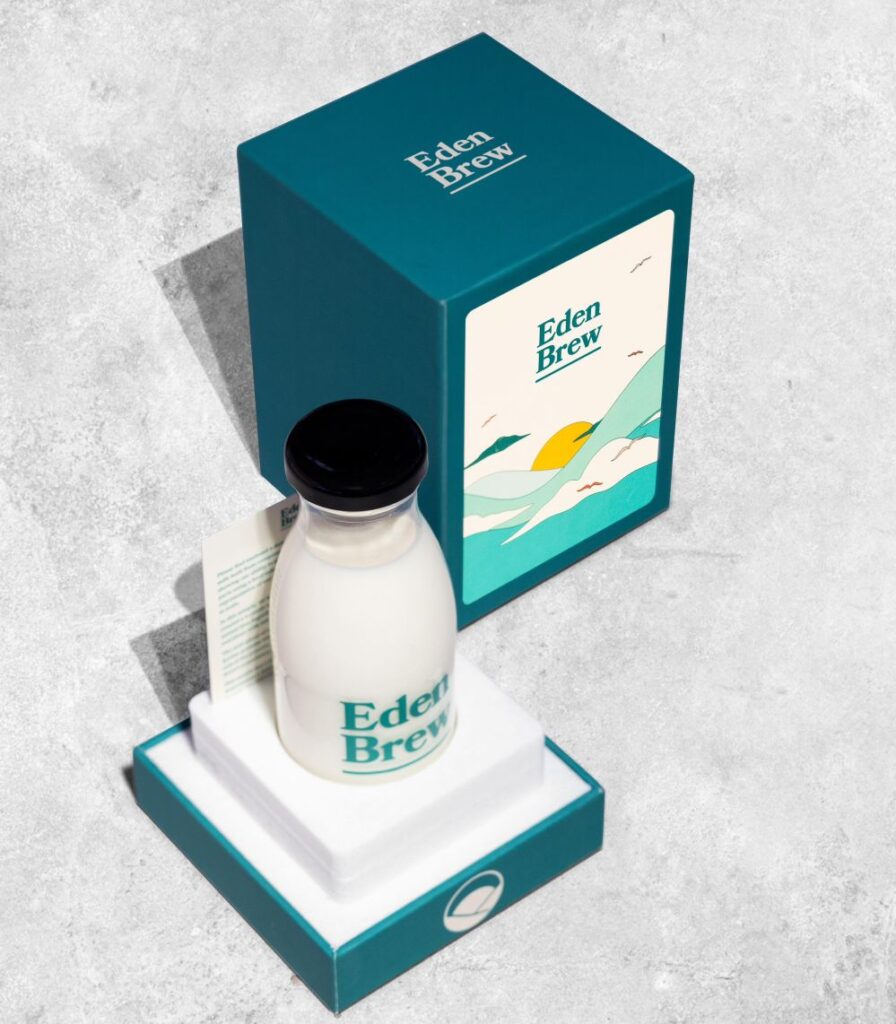
Precision fermentation involves inserting a specific DNA sequence into microbes to teach them to produce the desired molecules when fermented. In Eden Brew’s case, the resulting ingredient is casein, which accounts for 80% of the protein content in cow’s milk.
Casein is crucial to the taste and functional attributes of dairy products like cheese – it’s what makes hard cheeses melt and stretch when they’re heated, allowing water and fat to emulsify and deliver the desired mouthfeel. It’s a $2.7B market, but comes from a highly emissive, water-guzzling, land-hungry industry.
Eden Brew genetically engineers a yeast strain called Komagataella phaffii (formerly Pichia pastoris), which has an extensive history of safe use in food products, including in alternative proteins, like the heme ingredient in the Impossible Burger.
The firm claims the milk made from its recombinant casein generates 70% fewer emissions, uses only 5% of the land, and lowers water consumption by 99%, in comparison to conventional dairy. Moreover, it emits no methane, the major source of greenhouse gas emissions from cattle.
Cow’s milk contains four kinds of casein proteins that self-assemble into micelles, which are highly hydrated spherical structures that serve as a building block for the functional and nutritional attributes of dairy products.
Eden Brew’s DeepForte platform enables micelle formation to match dairy’s nutrition delivery, sensory experience and heat stability. Micelles have an enormous carrying capacity for calcium, phosphorus, protein and other nutrients, which they release slowly. The startup can further fortify the micelles with iron, magnesium and zinc.
“The protein in the BCPP1 preparation is a composite, comprising approximately 25% A2 beta-casein and 75% co-purified host cell proteins,” the company stated in its application to FSANZ.
“While the overall composition differs from purified milk protein, analysis confirms the protein quality of the entire preparation (via PDCAAS) is equivalent to conventional beta-casein.”
‘Critical step forward’ for precision fermentation in Australia

According to FSANZ’s administrative report, the scientific risk assessment of Eden Brew’s application will be followed by a round of public consultation from early April to mid-May. This will then move to the board approval stage in August, before being discussed by ministers in both countries in June. The final green light is expected in mid-November.
In a social media post, Eden Brew called it a “huge moment” for both the company and the domestic precision fermentation sector. “Acceptance into assessment signals that FSANZ is satisfied our submission meets all high-level requirements, which is a major achievement and a testament to the depth of our science, our safety data, and our team’s relentless focus,” it said.
Trade association Cellular Agriculture Australia labelled it a “major achievement”. “A significant amount of work has gone into the development and acceptance of the application, indicating that FSANZ is satisfied that it meets the high-level requirements outlined in the Application Handbook,” it stated.
“This marks a critical step forward for the precision fermentation sector in Australia, and Eden Brew’s application will also serve as a test case.”
Eden Brew has raised nearly $19M in funding from private and public investors, and is scaling up with a contract manufacturing organisation with a view to achieving price parity with conventional dairy by 2029.
It will sell its casein proteins as a B2B ingredient for use in supplements, food fortification, sports nutrition products, and the GLP-1 market. The pivot aligns with several other precision fermentation companies, which began with a goal of producing animal-free milk but shifted towards higher-value markets for initial revenue generation.
Eden Brew is one of several Antipodean startups using precision fermentation to produce dairy proteins and fats, such as All G, Nourish Ingredients, Daisy Lab, and Cauldron.
Globally, only two companies – New Culture and Fermify – have been cleared to sell animal-free casein, both in the US (and the latter firm has since filed for bankruptcy). Others in the space include Standing Ovation, Fooditive Group, and Those Vegan Cowboys.
The post Eden Brew Eyes 2026 Approval of Animal-Free Milk Protein in Australia & New Zealand appeared first on Green Queen.
This post was originally published on Green Queen.