
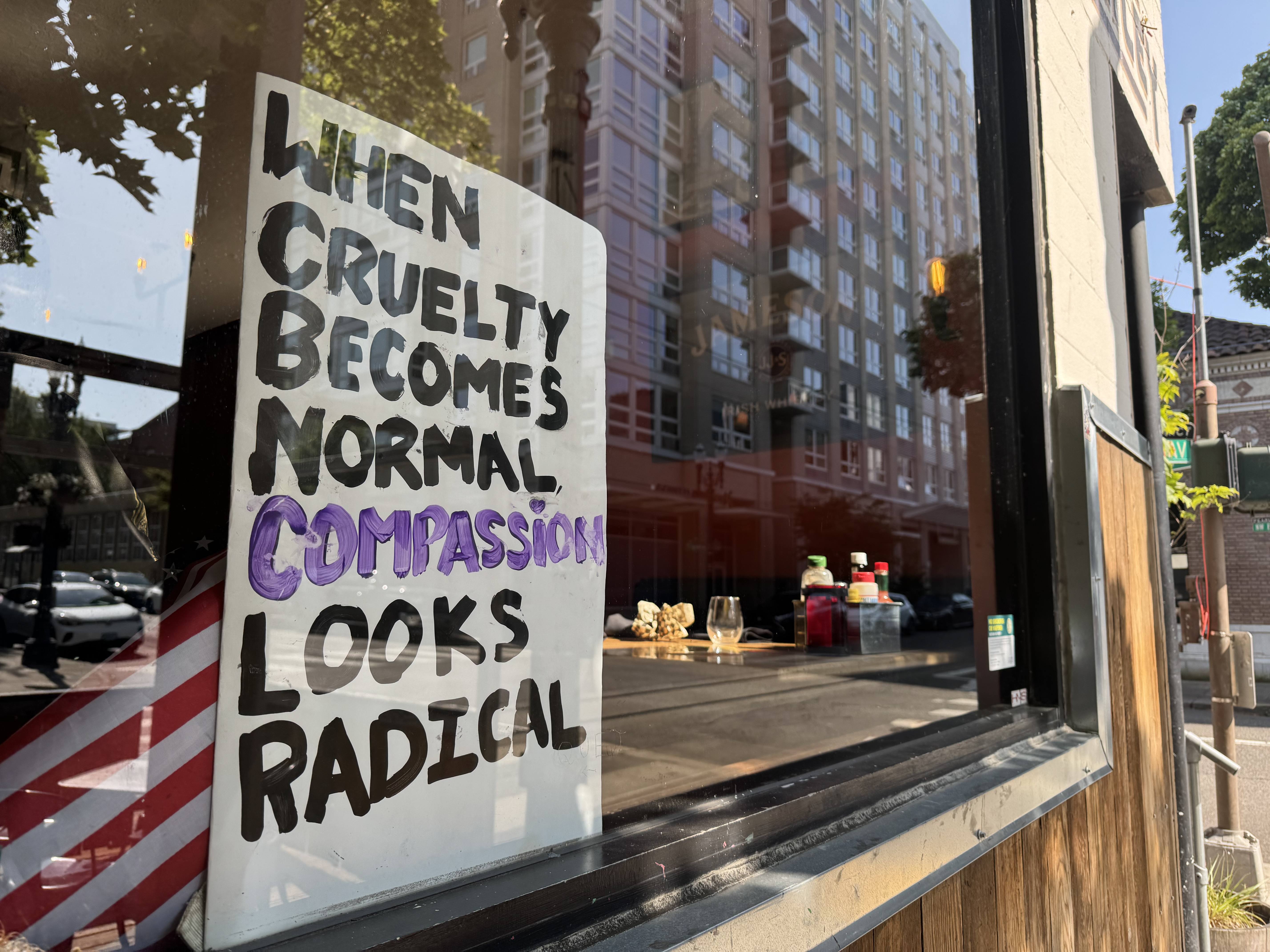


Photograph by Nathaniel St. Clair
The recent government shutdown was a stark reminder that 42 million people across the United States rely on federal food benefits. That’s 12 percent of the nation’s population that lawmakers and President Donald Trump threw under the bus, cutting off SNAP benefits in an attempt to force a deal.
The shutdown has ended, but SNAP remains in jeopardy.
SNAP benefits were already less than a fourth of the average food expenditure per person nationwide. And in 2023, Congress and the Biden administration imposed work requirements on the program as part of a deal to raise the debt ceiling.
Then, in summer 2025, Trump’s so-called “Big Beautiful Bill” deeply cut safety net programs to fund tax breaks for corporations and the rich — including the largest SNAP cut in history.
Trump expanded Biden’s work requirements, ending exemptions for veterans, immigrants with legal documents, and the unhoused. Moreover, states will have to pick up a bigger portion of SNAP’s cost. “States are gonna have to pony up beginning next October, and then that’ll only ramp up from there,” said Anya Rose, Director of Public Policy at Hunger Free Colorado.
Rose, who used to staff a food resource line, explained that SNAP is “an incredibly important anti-hunger program, and it is also so full of barriers.” And “if you talk to food banks, food pantries, they would tell you we’ve been in a crisis well before [the shutdown], with higher demand than they saw during the pandemic.”
Colorado is not alone. Nationwide, food insecurity is rising — especially among older Americans — fueled by inflation, tariffs, unemployment, and wage stagnation. But the Trump administration decided to stop measuring food insecurity altogether, dismissing the information gathering as “redundant, costly, politicized, and extraneous.”
To make matters worse, Trump’s agriculture secretary Brooke Rollins is demanding all 42 million SNAP recipients reapply for their benefits to root out alleged “fraud.” Yet the government’s own data shows how small such anomalies are. When there is overpayment, it amounts to about $10 or $11 in food vouchers per person. “The policy is largely designed around how do you keep the wrong people out rather than how do you make sure to actually solve the problem,” said Rose.
So how does one solve the problem? It sounds obvious, but if people are hungry, one can simply feed them.
To counter the sordid state of affairs at the federal level, Rose’s organization, together with numerous other community organizations in Colorado, helped pass a pair of propositions in November 2025 aimed at fully funding school lunches.
What’s powerful about Colorado’s school lunch program is that it’s universal. All children are provided with meals at school regardless of their household income. This means there’s no question of eligibility or fraud.
Moreover, the ballot measures allocate money to purchase locally grown food, which benefits farmers, and to increase wages for cafeteria workers to make healthier meals. It’s a win-win-win. To pay for universal school lunches, Colorado imposed a modest tax increase on residents making more than $300,000 a year — people whose own children will also benefit from the school lunches.
It’s a simple calculus, one that we’re seeing more of in the absence of federal action — and not just on food.
New Yorkers just elected a mayor promising universal childcare paid for by taxing the rich, similar to a program that New Mexico already enacted. Seattle residents also elected a mayor who designed a tax program aimed at large corporations, and Boston’s hugely popular mayor sailed to reelection unopposed, in part by pioneering a universal free transit program.
A majority of Americans favor raising taxes on corporations and the wealthy to pay for our basic necessities such as food, childcare, transit, etc. While people are turning to cities and states to achieve the same goal, the Trump administration is intent on doing the opposite, at its peril.
The post If People are Going Hungry, Why Can’t We Feed Them? appeared first on CounterPunch.org.
This post was originally published on CounterPunch.org.