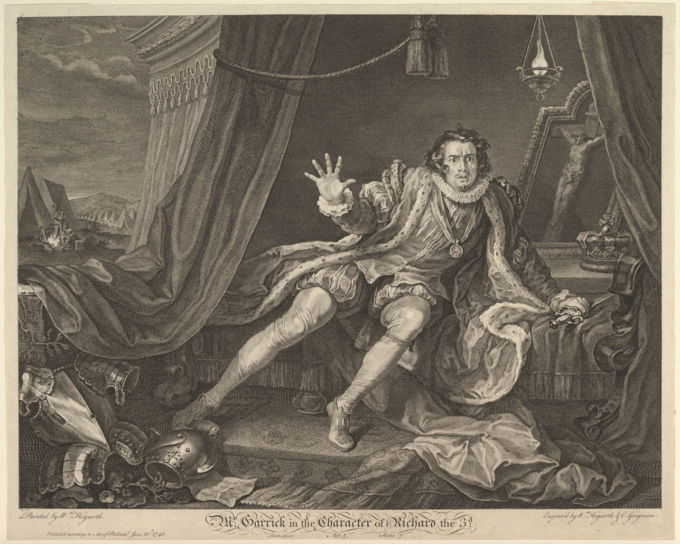
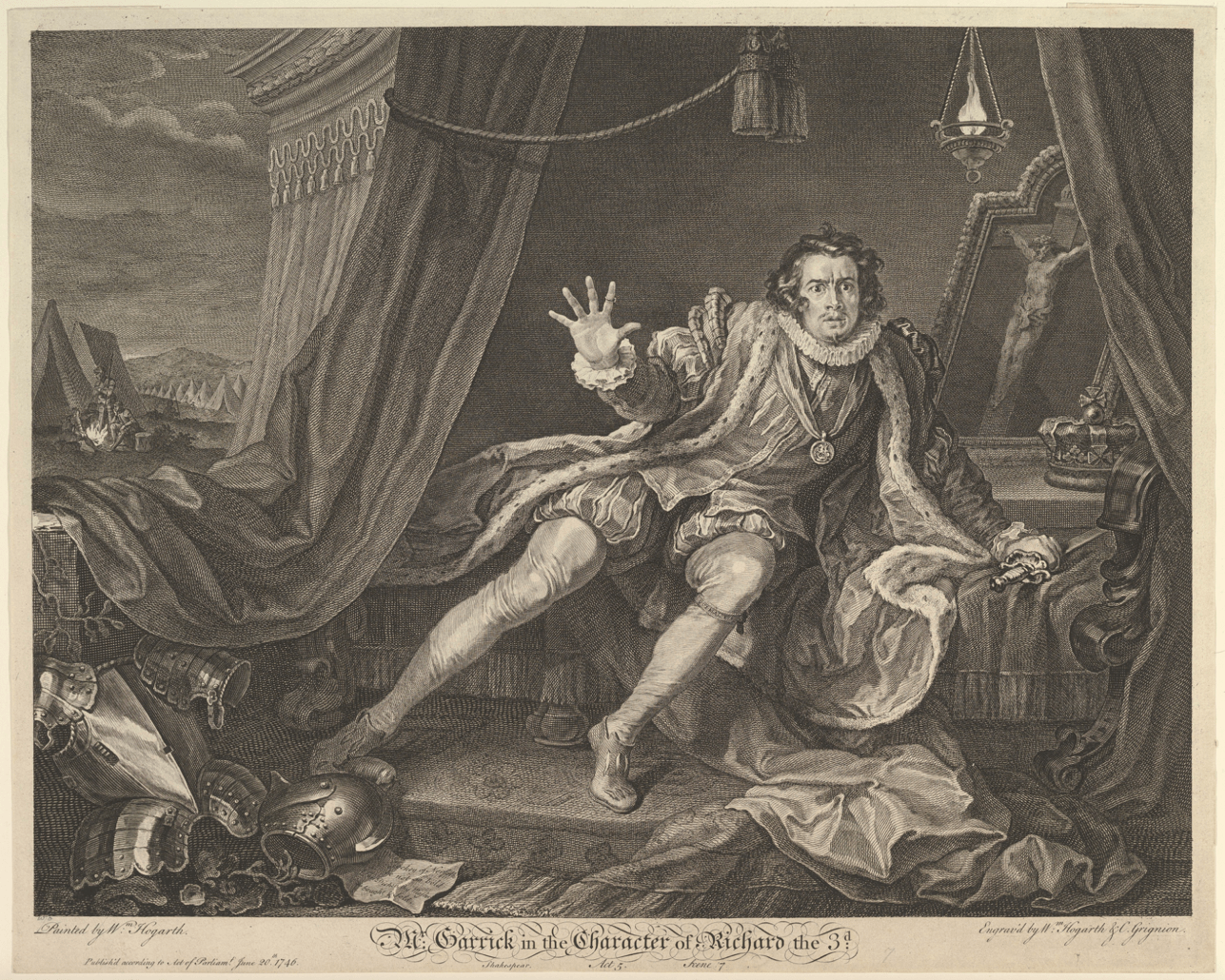
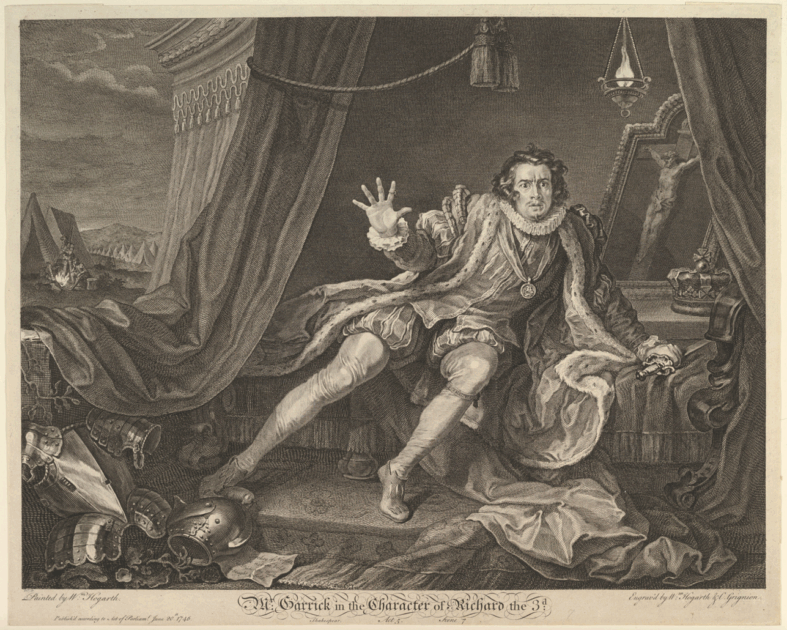
William Hogarth, Mr. Garrick in the Character of Richard III, Metropolitan Museum of Art, New York, 1746.
Roundabouts
The Thanksgiving trip from Norwich, England to the island of Anglesey in North Wales, where our daughter Molly lives, is about six hours, a long drive for a small country. It’s tedious too. The way west requires a combination of motorways, highways and small roads stitched together by dozens of roundabouts — “traffic circles” in American. These are the scourge of tourists and emigres un-used to driving on the left. As you enter the circle, you must yield to incoming from your right and dodge interlopers on your left, all while aiming your vehicle for one of as many as seven possible exits. Timorous drivers may repeat the circuit, unsure how or where to exit. Electronic tallies in some locations, rumor has it, record more drivers entering roundabouts than leaving them.
“My kingdom for a horse!”
In the U.S., my wife Harriet and I would have made a drive of similar length in one day. But here in England, poor roads and dependably bad weather make even short journeys wearying, so breaking up long ones into a couple of days feels essential. Besides, for me, still new to the country, travel is its own reward. Our plan last week was to stop for a night at Bosworth Hall, in the town of Market Bosworth, about halfway to Wales. The hotel boasts a pool, hot tub, steam room and sauna, gratification of my lifelong quest for Sybaris, the ancient Greek colony legendary for its hedonism — maybe I’d discover it in Leicestershire?
Prior to our arrival, on a winding lane between isolated brick houses and rolling green fields with sheep so still they might have been cardboard, we passed a sign reading “Bosworth Field.” Of course! Our hotel was named for the adjacent site, where in August 1485, the deciding battle in the War of the Roses was fought between Henry Tudor (Earl of Richmond), and Richard III (the King of York). The latter was killed after he came off his courser, named White Surry. But before the final, deadly blow was struck – a broad sword to the back of the head – Richard exclaimed, according to Shakespeare: “A horse, a horse, my kingdom for a horse!” (Richard III, Act 5, scene 4, line 13).
The unscrupulous Richard’s last words testify to two things: 1) the importance of the horse in early modern warfare; and 2) the uselessness of worldly wealth when facing death. Concerning the second, I thought while driving, my grandmother Bess — who knew nothing of horses or English history — would have put it differently: “Abi-gezunt,” she would have said, “So long as you got your health!” The great Molly Picon sang a song of that title in 1938:
A little bit of sun, a bit of rain
A quiet place to put your head down,
As long as you’re well, you can be happy.– Abraham Ellstein, “Abi Gezunt,” from Mamele, Jos. Green and Konrad Tom, dir.
Kind hearts and coronets
From the outside, Bosworth Hall is splendid. Built in the late 17th C., it’s a symmetrical, two-story brick building plus attic, with a central pavilion exhibiting four, fluted stone pilasters supporting a pediment containing the Dixie family crest. Early generations of Dixies were renowned for their truculence and ignorance; later ones for their dissipation. Sir Wolstan Dixie, the 4th Baronet of Market Bosworth (1700-1767), so abused the young Samuel Johnson – installed as usher at the local school — that the great writer and lexicographer was forced to flee his sinecure, forever recalling his spell at Bosworth, according to James Boswell, with “aversion and even a degree of horror.”
Like other members of the unspeakable class then and now, Wolstan fought to prevent anyone – neighbors and strangers alike – from traversing his land, even along historical footpaths. One altercation with a neighboring squire who crossed his property assumed such importance in the Baronet’s mind that it eclipsed memory of a much bigger contest. After being introducted to King George III at court, his majesty (himself no scholar) is said to have remarked to Wolstan: “‘Bosworth-Bosworth! Big battle at Bosworth, wasn’t it?’ ‘Yes, Sire. But I thrashed him.’”
By the end of the 19th Century, the Dixie family fortune, derived from the fur trade, estate income and most of all, favorable marriages, was much diminished. The 11th Baronet, Sir Alexander Beaumont Churchill Dixie, finally sold the estate in 1885 to Charles Tollemache Scott to pay gambling debts. The house’s luxurious contents, or what remained of them, were likely dispersed at that time. Bosworth Hall was sold again in 1913, and once more in 1931, this time to the County Council for use as an infirmary. Finally, the edifice was acquired in 1987 by the Brittania Hotels Group, which converted it into the present hotel.
The quality of the interior of Bosworth Hall does not match the exterior. Wall to wall carpets are tacky and worn, leather club chairs slumped, and faux Georgian wood panels faded and scratched. The hot tub churned suds and the tiled, steam room benches were slimy. I have since learned that the Britannia Hotels Group has for eleven years running been judged by a leading consumer watchdog the worst hotel chain in the country, its properties poorly maintained and unhygienic. The owner and CEO of the corporation, is 87 y.o. Alex Langsam, dubbed “the Asylum King” for profiteering from government contracts to house desperate asylum seekers. The reclusive boss has a mansion is Cheshire but is said to be domiciled in Austria for tax purposes. Though no baronet, he’s a worthy successor to the Dixie lineage.
Symposium
After opening the door to the Finnish sauna, Harriet and I hesitated before entering. There were four large men inside, talking loudly and gesticulating broadly. But one was getting up to leave, and the other three politely beckoned us inside, making space on the two tiers of wooden benches. Once we were seated, they resumed their conversation. I tried not to listen – something about bids, contracts, cladding, and poor workmanship – but since that was impossible, I joined in.
“May I assume you gentlemen are building contractors or workmen?” I asked.
“Yes, bricklar’s. I’m Stev’n.” He put out his paw, which I shook – it felt like damp sandpaper wrapped around marble.
“Stephen here, too!” I said, glad we had an immediate liaison. “You don’t sound very happy about your work life. Is that right”?
“Me work’s fine. I like buil’in’ ‘ouses. But me pay ha’n’t gone up wi’ the years, even as the prices of everythin’ else ‘ave. Plus, the qual’ty of all the trades ha’ gone down, making me job ‘arder.”
“Do you mind if I ask how much you make as a bricklayer?”
“Ahm better paid tha’ most – Ahm very good a‘t. So, ah make ‘bout 625 pounds per thousan’ bricks. Tha’ come to ‘bout 1500 a week, or 50,000 a year. Tha’s twice wha’ the new guys make. But like I say, I’m makin’ nowt than a decade ‘go!”
This seemed like a good opportunity to introduce some political economy:
“I’m sorry to hear that. One reason may be monopoly concentration in the industry. Just about half a dozen big corporations control most of work. They also bank vast swathes of real estate – so they can pretty much decide what and where to build, how much to charge and how much profit to take. That leaves central government, county councils and consumers stuck with high prices and you with bad pay.”
“Yeah, our bosses are doon well – I know’t by the cars ‘ey drive ‘n’ the fancy suits ‘ey w’ar.”
“What we need,” I said, “Is to tax the excess profits these guys collect and slap a big excise tax on land that’s hoarded. And we should let the council’s build the owses, er, houses themselves and leave the developers out of it.
Steven wrapped his thick arms around his chest and smiled broadly in apparent approval of my suggestions. Another man in the room, darker skinned, soft in the middle, and without the Leicestershire accent, piped up an objection:
“But if you tax all those guys, they will take their money and move out, leaving us with no taxes and no money for investment. We need them!”
I started to reply that many UK investors were foreign anyway, that most British billionaires wouldn’t leave, and that there are ways to prevent capital flight, when I saw Harriet gesturing that she was about to faint from the heat, and had to leave immediately. I suddenly felt light-headed too, so we both bade our new friends adieu and staggered out of the sauna.
A few minutes later, Steven entered the locker room where I was dressing and smiled broadly. I said to him:
“Do you mind if I ask you a personal question?”
“Sure.”
“What political party do you support,”
“Reform o’ c’rse! Those immigran’s art killin’ our people. We nee’ to ge’ rid of ‘em – protect our families.”
“But immigrants,” I said, “don’t commit more crimes than native Brits. And if we control for age, they are less likely to go to prison. In fact, over the last 30 years, crime in general in the UK is down 90%! And as for Reform and Nigel Farage, he’s in the pocket of the big developers. He wants to cut regulations concerning building quality and safety and opposes unions and workers’ rights.”
“Hey,” Steven said. “I don’t know nowt about it. I’m j’s’ a brickla’er!” He laughed and poked me in the ribs, confident of his understanding and unpersuaded by my arguments. He was solid for Reform.
Back in our room, flat on the bed and staring at the ceiling, I realized how little I could blame Steven for his political choice. The Tories were in power during the entire period of austerity and wage stagnation he described. Labor has done little to change things. Lib/Dems try to be all things to all people. The Greens are unknown to most voters, but that’s beginning to change with the selection of Zack Polanski as Leader. Until the public consistently hears from politicians a bold, progressive, economic populist program, the nation will continue its slide toward Reform and British neo-fascism.
Thanksgiving in Anglesey
The last part of our drive to Wales had blessedly few roundabouts, and traffic was light on the Menai Straits Bridge to Anglesey Island. The span, built in 1826 by the Scottish engineer Thomas Telford was among the first suspension bridges in the world. It’s chain-cables and cast-iron links have tremendous, tensile strength and they look it. The bridge reminds every driver that Britian’s decaying infrastructure is not an inevitability, but the consequence of a generation or more of disinvestment. And not just in roads, bridges, railroads and other utilities. U.K. families are much poorer than the European average and there’s little if any help on the horizon.
At last, we arrived in wind and spitting rain at Molly and her boyfriend Elliot’s neat cottage in the back of beyond. They greeted us warmly and prepared tea, of course. Thanksgiving isn’t a holiday in the U.K., but Molly took time away from the charity she works for, Stock Free Farming, and Elliot from the nearby sporting goods and apparel store where he works. Our meal was vegan Beef Wellington, sauteed green beans and kale, roast potatoes, roast Brussel Sprouts with garlic and lemon, and bread stuffing. I was truly thankful Molly did not make any of the dishes I grew up with: overcooked turkey, sweet potatoes with marshmallow topping, Jello-mold with dried fruit, green beans and Campbell’s mushroom soup casserole with potato sticks, and cranberry sauce a la tin can.
After dinner, Elliot walked out to the garden and prepared the hot tub for me. Under a black, starless sky, with a northwest wind and sprays of rain, I slipped into the bubbling waters up to my eyes. My Sybaris.
The post So Long as You’ve Got Your Health! appeared first on CounterPunch.org.
This post was originally published on CounterPunch.org.