

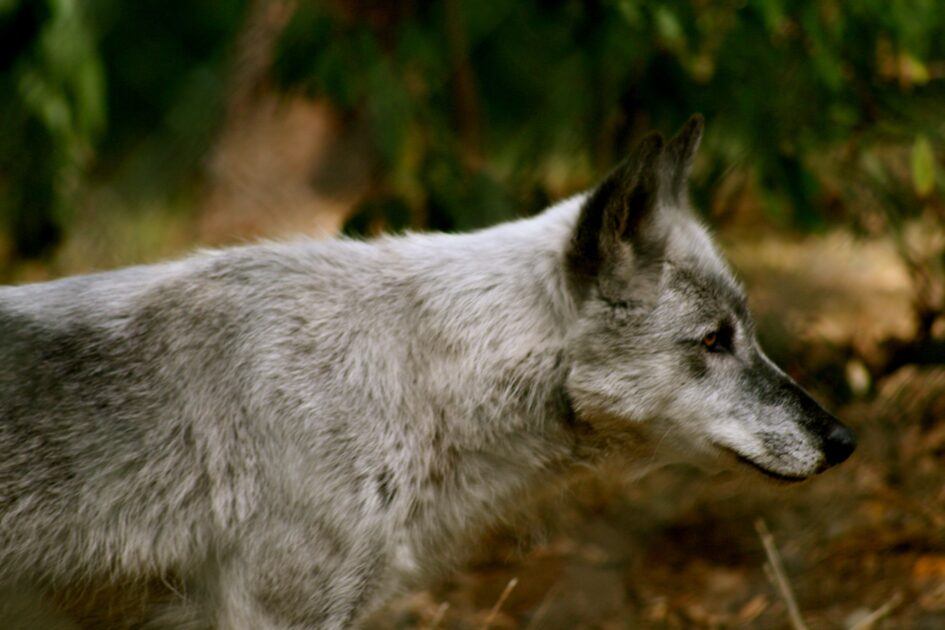


Wolf, Lamar Valley, Yellowstone National Park. Photo: Jeffrey St. Clair.
For grizzly bears, wolves, lynx, wolverine, and bison there is no “boundary” around Yellowstone National Park. The forests in this area — the Greater Yellowstone Ecosystem — extend beyond Yellowstone Park’s boundaries and provide critical habitat for threatened and endangered species. Unfortunately, some of these areas are National Forests open to commercial logging and road construction.
Despite the immense value that these public lands have for wildlife, the government recently approved a large-scale clearcutting and road-building operation right next to Yellowstone Park, which was called the South Plateau Project. In response, the Alliance for the Wild Rockies, Center for Biological Diversity, Western Environmental Law Center, Native Ecosystems Council, and Council for Wildlife and Fish took the agency to court — and we won! Because of our hard work and determination, we now have a federal court order prohibiting this illegal logging from moving forward.
In the case, the federal court found in part that the agency was breaking federal environmental laws because the agency refused to provide details on precisely where and when it would bulldoze in 56.8 miles of new logging roads to clearcut 16,462 acres (26 square miles) of National Forest. The court found that the Forest Service’s decision violated the National Environmental Policy Act because the agency failed to provide enough information to consider the potential impacts of the roads and logging on species such as grizzlies before the action takes place, as the “look before you leap” law requires.
The court also found the project violated the National Forest Management Act. Since the agency refused to specify where the project activities would occur, it was impossible to tell if the project complied with mandatory habitat protections from the agency’s own governing land management plan, known as a “forest plan.” These mandatory protections are in place to ensure that the agency appropriately balances the private profit interests of clearcutting with the need to conserve enough habitat on public land to make sure that endangered species don’t go extinct.
Additionally, the court also found the project violated the Endangered Species Act because the project was not using science as required by law. As the Court wrote: “In relying on a 10-acre patch size to define grizzly bear secure habitat in the absence of any scientific evidence showing that such acreage provides adequate habitat, the Fish and Wildlife Service’s failed to use the ‘best available science’ in violation of the Endangered Species Act.” As the court further noted: “grizzly bears in other Ecosystems have been found to need upwards of 2,000 acres of secure habitat . . . .” A plan that not only has no scientific basis, but is also contrary to all known existing science, cannot and will not conserve endangered species.
There is no doubt that the majority of Americans view the Yellowstone region as a national, natural treasure that should be protected. Our legal victory in this case is cause for celebration, but it is bittersweet. This year, Dr. David Mattson, a world-renowned grizzly bear scientist, passed away. Dr. Mattson was instrumental in our victory in this case, thanks to his compelling scientific research that explains why 10-acre habitat patches for grizzly bears are not adequate for grizzly bear conservation. We are thankful for his wise counsel, even though he cannot be here to witness the fruits of his labors.
Finally, the government will likely appeal this court order. Please make a donation so that we can hire the best lawyers to defend our victory and make sure it sticks. In addition other national forests in grizzly habitat use the same illegal definition of secure grizzly habitat but they won’t change it unless we sue them which will cost more money.
The post Conservation Groups Stop Illegal Logging Next to Yellowstone National Park appeared first on CounterPunch.org.
This post was originally published on CounterPunch.org.