A new MIT study calculates the climate impact of the live music industry, identifying fan travel and food and beverage as the biggest sources of emissions.
How audiences travel to concerts and the kind of food they’re served have the biggest impact on the live music sector’s climate footprint, according to a new study by MIT’s Climate Machine.
The research – backed by British band Coldplay, entertainment label Warner Music Group (WMG), ticketing giant Live Nation, and sustainability consultancy Hope Solutions – covered over 80,000 live shows across the UK and the US.
It captured the greenhouse gas emissions across all major impact areas, including trucking, energy, food and beverage consumption, water, waste, fan travel, artist and crew travel, accommodation, and freight.
In the UK, the live music industry emits up to 4.4 million tonnes of CO2e per year (equivalent to roughly 1% of the country’s emissions); in the US, this rises to as much as 17.3 million tonnes (or 0.2% of national emissions).
This share may be low, though the cultural reach of the sector is vast, the researchers say, noting that industry decisions around sustainability can “set trends, shape behaviour, and inspire broader climate action”.
“Live music doesn’t just entertain; it shapes culture and connects communities,” said Madeleine Smith, senior ESG director at WMG. “As we advance our sustainability efforts, we’re committed to turning insights into measurable action.”
This, she added, involved “aligning purpose with performance, building resilience across the ecosystem, and ensuring that music continues to create shared value for artists, fans, and the planet alike”.
After fan travel, food is the main source of live music’s emissions
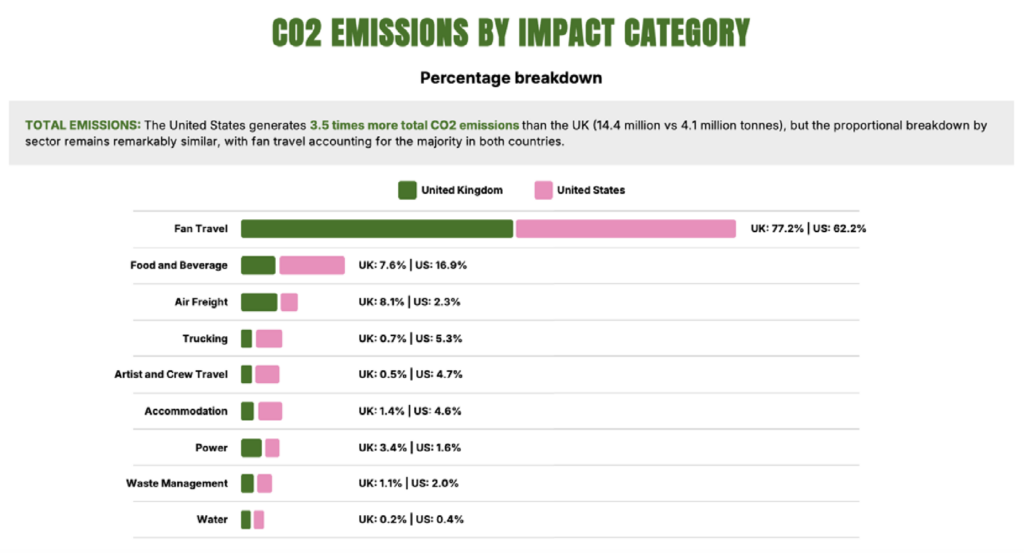
The analysis revealed that travel and food are the biggest culprits of concerts’ climate footprint. In the UK, fan travel accounts for 77% of the sector’s emissions, followed by air freight (8%) and food and drinks (7.6%).
Across the Atlantic, the modes of transport taken by audiences contribute to 62% of the industry’s emissions in the US, with food and beverage taking up a much larger share at 17%.
In fact, when discounting fan travel, food is responsible for a third of all remaining emissions in the UK’s live music space, and nearly 45% in the US. This category includes emissions from the food and drinks served at events, covering the embodied carbon of processed food, meat-based meals, and plant-based dishes.
MIT’s researchers found that meat-heavy diets, food processing, and packaging were the primary sources of these emissions. In fact, they found that meat-based dishes release over 13 times more greenhouse gases than plant-based options.
“Studies have shown that moving toward a plant-based menu, and away from a meat-based menu, can reduce emissions enormously,” the report states, calling the research literature “substantial and robust”. A transition to low-carbon menus prioritising vegan dishes could lower emissions by 40-70%, and as much as 90%, making it one of the most effective levers of emissions cuts for the live music sector.
The report argues that this shift could also encourage wider, more lasting action. “The power of music to inspire holds the key to the most important agency that stakeholders in the industry have to influence society,” it states.
“Promoting excellent low-carbon food options at live music events promises to capture the attention of hundreds of thousands and millions of music fans in the UK and US who may continue to select low-carbon, plant-based food in their daily lives, long after the music stops.”
What’s slowing the industry’s plant-based shift?
The call to move towards plant-forward menus is one of 33 recommendations MIT makes to help the live events sector curb its carbon footprint.
These include integrating emissions priorities into tours, adopting solar batteries and renewable energy microgrids, shifting equipment from air to sea freight, partnering with the public sector to ramp up low-emissions transportation, incentivising low-carbon fan travel, increasing composting facilities, and moving from tour- to venue-based supply chains.
The report argues that the climate impact of food and drinks is “well-known to the music industry, but underappreciated in its magnitude and potential for reductions”, highlighting several challenges that make a widespread shift difficult.
The researchers cite consumer preferences, multi-year vendor contracts with venues, the availability of high-quality plant-based alternatives, and the coordination of local food farm food sources and venue-based vendors as major challenges. Moreover, they bemoan the music industry’s “pervasive dominance” of “business-as-usual over innovation and adoption of alternative practices”.
Live industry sustainability non-profit A Greener Future has previously found fan travel to be the largest source of event emissions (amounting to 45%) of the total, with food and drink following closely behind (35%).
This year, the organisation analysed 40 festivals from 16 countries in 2024 to find that a fifth were fully vegan or vegetarian, up from just 8% the year before. On average, around 55% of the food at all these events was meat-free. And even after excluding fully meatless events, that share stood strong at 50%.
Artists can only do so much

Billie Eilish, a well-known vegan, directed London’s O2 Arena to serve only plant-based food during her 2022 residency and followed it up at this year’s Hit Me Hard and Soft tour, while ensuring vegan options are available at all tour venues.
As the MIT white paper notes, not all artists have the power to create green riders. And in any case, a venue will likely revert to previous practices, so a request like Eilish’s is only a short-term fix. Instead, the report suggests building strong relationships between farmers and venues so that there are local, sustainable food options.
Coldplay, which co-funded the report, hasn’t made major strides in terms of food emissions. And while its sustainability measures successfully reduced emissions from its Music Of The Spheres Tour by 59%, this didn’t account for fan travel.
One band leading the way is Massive Attack, whose Act 1.5 festival last year featured 100% plant-based catering, an electric-powered stage, free electric shuttles and extra services in partnership with rail operators, and no car park. It was later found to be the lowest-carbon concert in history, with the shift to vegan food bringing the largest emissions cuts of all measures.
“Real progress starts with shared understanding. For the first time, the live music industry has a clear picture of where our collective impact lies,” said Lucy August-Perna, sustainability head at Live Nation. “This data empowers us to continue taking smarter, more coordinated action in partnership with artists, venues, and fans to preserve a strong future for live music and the communities that support it.”
The post Fan Travel & Food the Largest Sources of Live Music’s Climate Footprint, Finds Coldplay-Backed MIT Study appeared first on Green Queen.
This post was originally published on Green Queen.