
Photograph by Michael Leonardi
In Italy, the bell that signals the start of the school day has recently sounded like a call to arms—not for war, but against it.
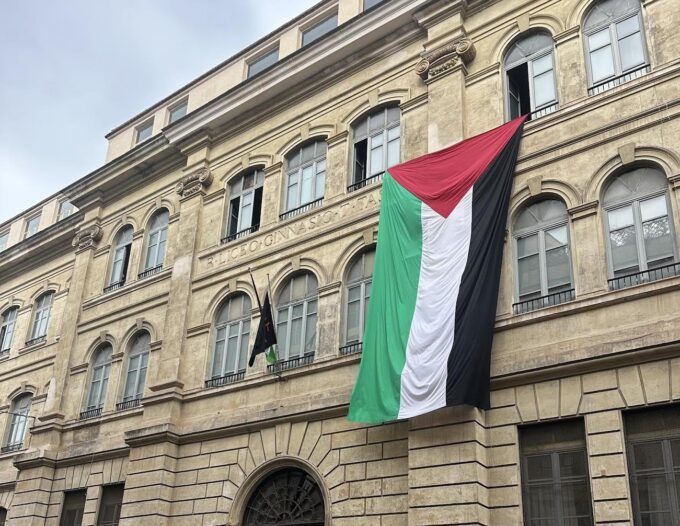
While the Italian government actively supports the geopolitical machinery enabling the genocide in Gaza, a different kind of politics is being forged in the corridors of the nation’s historic licei (high schools). From Milan to Palermo, a wave of student occupations has swept the country, reviving a deeply rooted tradition of resistance. But this time, the banners hanging from the windows don’t just demand better school funding; they demand an end to the slaughter of Palestinians and a reckoning with the West’s complicity.
The Tradition of Occupation
To understand the gravity of this moment, one must understand the unique DNA of Italian student activism. Since the “Hot Autumn” of 1969 and the movements of 1977, the occupazione has been a rite of passage. It is not merely a strike; it is an act of reclaiming space. Students physically take over their schools, sleeping in gymnasiums, replacing state-mandated curriculum with self-organized debates, and turning the institution into a fortress of political thought.
Today, that fortress is flying the Palestinian flag.
Inside the Fortress: A Visit to Occupied Tasso
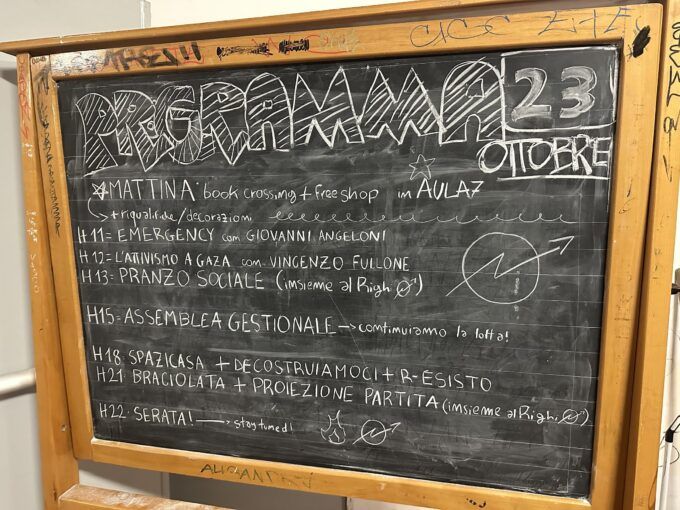
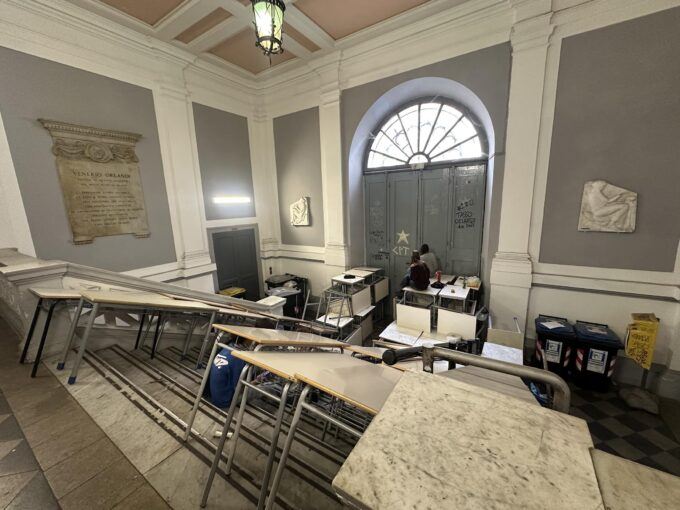
To understand the heart of this movement, one must go inside. Lara greeted me at the heavy wooden doors of the Liceo Tasso in Rome, one of the capital’s most prestigious and historic high schools. She guided me past the barricades—walls constructed from piled school desks and chairs, a physical rejection of business as usual—to introduce me to the protagonists of this uprising.
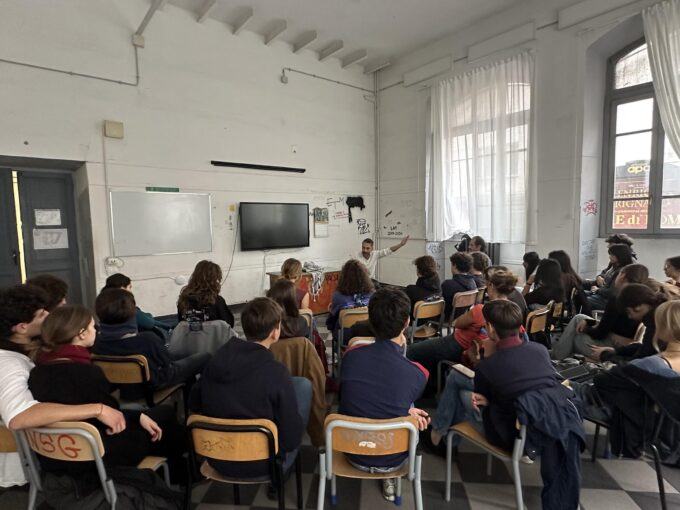
In the occupied halls, I met Salvatore, Maria, Enrico, and Marcos, the coordinators of the student committees from both Tasso and the nearby Liceo Righi. These are not the “mindless vandals” described by the right-wing press; they are articulate, fierce, and politically sophisticated.
“The government is in direct violation of the Italian Constitution,” Salvatore told me, his voice cutting through the noise of the assembly. “Article 11 states that Italy repudiates war, yet our government is a servant to the war economy, funneling arms and diplomatic cover to a genocidal regime in Gaza. They do not represent the people; they represent the defense contractors.”
Maria expanded on the intersectionality of their struggle. “You cannot separate Gaza from the class war happening here,” she explained. “The same system that enforces class stratification in Italy and ignores the climate catastrophe—the same system we fight on Fridays for Future—is the system dropping bombs on Palestine. It is a singular machinery of oppression.”
The Rejection of Mainstream Lies
What became clear in speaking with Enrico and Marcos is that the state has lost its ability to control the narrative. The students possess a sophisticated understanding of Zionism, viewing it not through the lens of European guilt, but through the clear reality of settler-colonialism.
“We don’t get our news from the mainstream media anymore,” Enrico said, dismissing the pile of establishment newspapers and mainstream TV outlets. “We know they serve the criminal war economy and the power structure. We see the reality on the ground in Gaza through direct sources. We know that anti-Zionism is not antisemitism, despite how desperate the Zionist forces are to weaponize that charge to silence us.”
Lola Serrante of Liceo Righi, a 16-year-old student activist, offered a searing diagnosis of this democratic failure in a written reflection. “Although on paper ours remains a democracy,” she writes, “the representatives of this country omit their own faults… weighing their words to confuse, cover up, and once again look away.” She concludes with a defiance that characterizes her generation: “We will not let ourselves be intimidated: we will remain on the right side of history and, if necessary, on the right side of the barricade.”
Teachers Breaking the Silence: The Example of Liceo Plinio
Crucially, the students are not alone. In a quiet but powerful act of defiance, a growing number of teachers are refusing to be neutral. Defying the chilling effect of Ministry circulars, educators are turning their classrooms into spaces of critical inquiry.
A prime example occurred at the Liceo Plinio, where teachers and students organized “Palestine Days” together. They transformed the school into a center for truth, inviting representatives of the Palestinian community, human rights lawyers, journalists, and participants from the Global Sumud Flotilla to speak about the reality of the occupation.
When critics in the community complained that these assemblies were “one-sided” and “biased,” activist and film director Michela Occhipinti, who participated in the events, delivered a devastating rebuttal: “Inviting a Zionist perspective would be like inviting a Nazi perspective during the Holocaust.”
Direct Action and the State’s Panic
This refusal to be silenced spilled into the streets of Torino during the last countrywide General Strike on the 28th of November. Students broke into the headquarters of a national newspaper called La Stampa, spray-painting slogans against the “media escort” of the genocid, for Palestinian liberation and for the freedom of a Muslim Imam who has lived in Italy for over 20 years. Mohamed Shahin has been threathened with extradition from the country by the Meloni government for having said that “October 7th was an act of resistance”. They called out the Italian press for whitewashing Israeli crimes. While President Mattarella and the media unanimously labeled them “violent criminals,” the students see themselves as truth-tellers exposing the complicity of the state and media establishment.
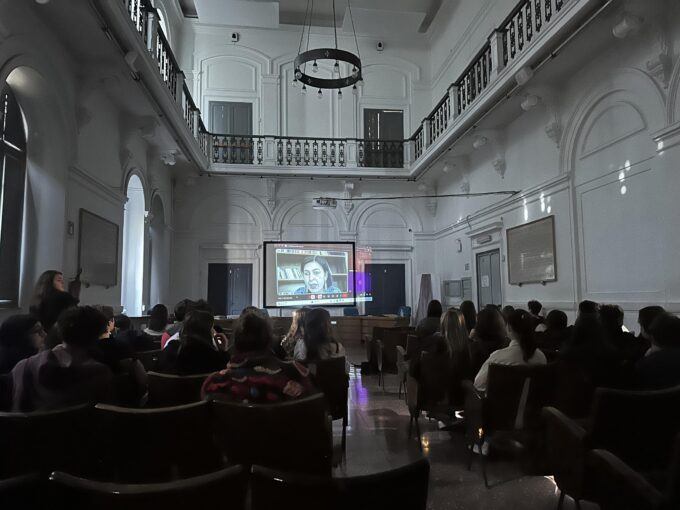
The state’s fear is palpable. While Francesca Albanese, the UN Special Rapporteur on the situation of human rights in the Palestinian territories occupied since 1967, spoke via video feed to student assemblies in recent weeks, the reaction from the Meloni government has been repressive. Giuseppe Valditara, the neofascist Minister of Education, has launched an investigation into the schools that hosted her. The government is terrified that students are learning the legal framework of genocide from a UN expert rather than accepting the propaganda of the state.
A New Resistance
The students I met—Lara, Salvatore, Maria, Enrico, Marcos and Lola —cite the Global Sumud Flotilla as a major inspiration. They see themselves as the “motor” of the movement together with, Palestinains of the diaspora, the port workers from Genova and grassroots unions like USB — the energy that drives the general strikes and the national marches.
Walking back out past the barricades of Liceo Tasso, it becomes clear that the media has it wrong. These are not naive kids. They are the moral conscience of a nation that has lost its way. They understand that when the state is complicit in genocide, the only honorable place to be is in the resistance.
The post The Classroom as a Battleground: Italy’s Students Rise Against Genocide appeared first on CounterPunch.org.
This post was originally published on CounterPunch.org.