
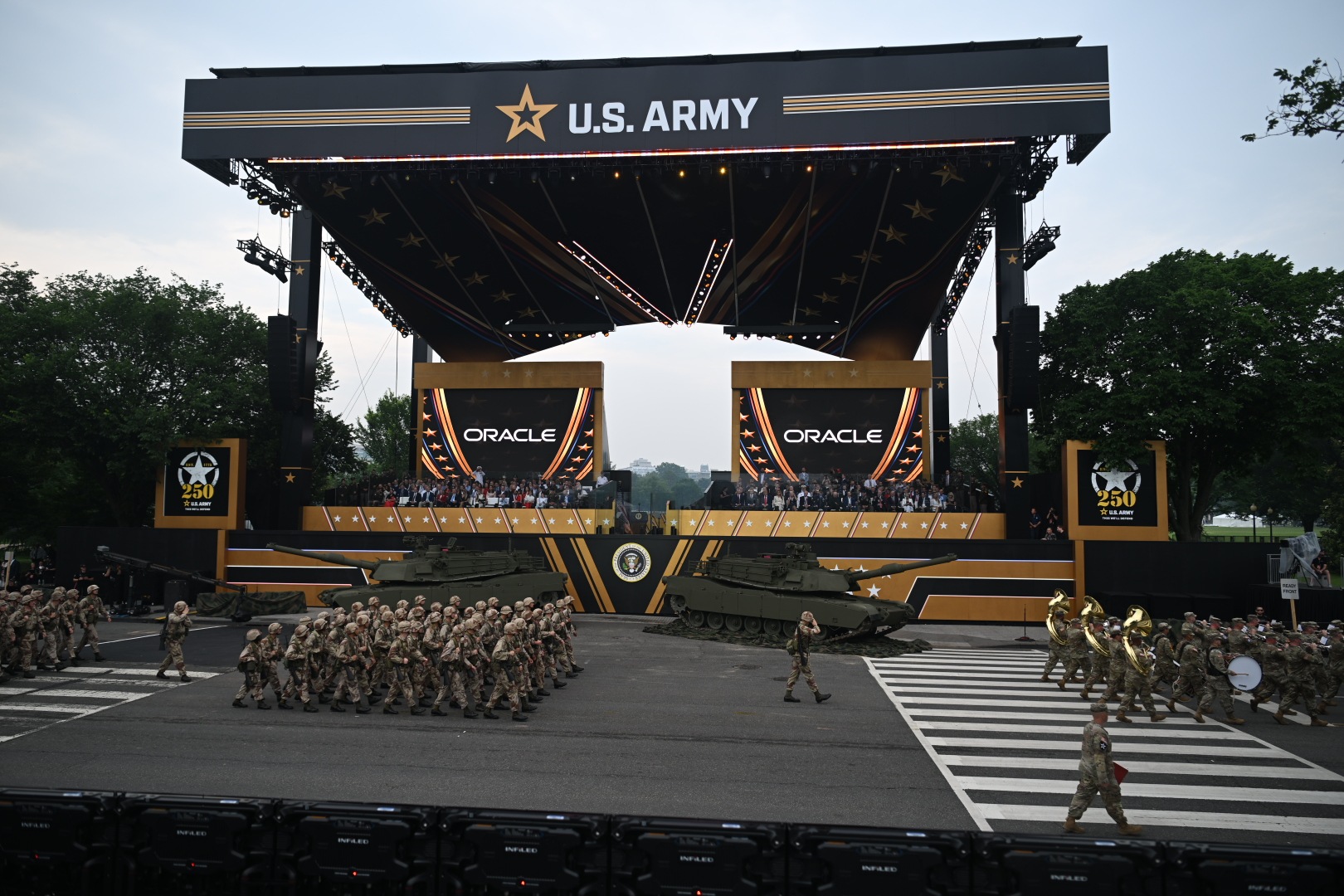


Photograph Source: U.S. Army photo by Bernardo Fuller – Public Domain
Introduction
The US army and military apparatuses are divided. This division is sharpened by the political, economic, and ideological crises in US society. One of the better ways to understand its 250th birthday celebration is to grasp the objective conditions of struggle that drove 5-8 million citizens in the streets in the No Kings protests on the same day that the President organized the birthday parade for the military on June 14, 2025. The heightened divisions in society demand that the progressive forces understand and grasp the objective conditions that drive the current split over fascistic and authoritarian tendencies. What are the ideas in combat in the army and in society? Do progressives accept that General George Washington and those who founded the continental army in 1775 were revolutionaries? When will the army take full responsibility for the genocidal wars against the First Nation Peoples? What are the strategies for change? What social forces are providing leadership? Can the ideas of white supremacy and the purge of black and brown officers maintain the present military apparatus? Can a military trained to kill create conditions for real human values whether the humans are called Blacks or whites?
It became evident after the inauguration of the 47th President on 20 January 2025, that the primary goal of the new administration was to bring back an army of whites. This resegregation of the army had occurred after World War 1 when hundreds of thousands of Black and brown soldiers and sailors died to save democracy in Europe. In that period the military bases were named after Confederate generals, and the army became the principal base for white supremacy and Jim Crow. Chad Wiliams, in the book, The Wounded World: WEB Du Bois and the First World War, has elaborated on this period. In an earlier book Williams elaborated on how, even in a foreign land, “military officials attempted to replicate the practices, customs, and hierarchies of white supremacy as closely as possible in the army.” African American soldiers who fought in World War 1 in Europe were lynched when they returned home and dared to demand full citizenship rights
After World War 1 during the capitalist depression, General Smedley Butler called war a racket. This article will highlight two periods of high racketeering by the top generals who profited from war, the period of the Revolutionary War and the period of the Civil War. In the 250 years the US army was divided over the Civil War, the Vietnam war, the wars in Afghanistan and Iraq, and presently the planning for war against the peoples of West Asia.
These plans for war in West Asia are accelerating when US imperialism has overreached in the military management of the international system to maintain the dollar as the currency of international trade. This overreach and the trillion-dollar military budget have sharpened the class and racial divisions bringing the extremist white racist forces to the center of the political stage. These extremists under the Make America Great Again (MAGA) are deploying the resources of the military for a new phase of accumulation of capital, under the guise of modernization of technology in the military.
Can there be modernization of the military when the educational system cannot produce the human, mental, and physical means to maintain an advanced industrial society? Some of the thinkers in the Artificial Intelligence (AI) sector are gung-ho on the new forms of warfare but progressive scholars are intervening to point to possibilities other than endless wars. Robert Gonzalez has followed the traditions of Seymour Melman in identifying the linkages between the industrial complex and the military with a view towards demilitarization. His scholarship is providing guidance inside the society on how “Big Tech and the Military are increasingly fused, brought together by finance, joint projects, research and infrastructure. Untying the knot will be key to prevent endless wars abroad and militarised policing at home. “
Young activists are deploying the tools and technologies of AI to forge new alliances and build new movements. The political initiative is no longer in the hands of the conservatives even when the liberal thinkers and universities have been bullied into submission by the genocidal pacts with those extending slaughter into Palestine. These wars are testing the army and accelerating conditions for a revolutionary confrontation in the United States.
It is my contention that the offensive from the MAGA forces has elicited a robust response with militant attitudes growing swiftly. These militant attitudes can be seen from the self-defense tactics in the streets of Los Angeles to the intense mobilization of the youths in New York City to beat back the forces aligned to the billionaire classes and war mongers. The victory of Zohran Mamdani in the primary for the mayoral race in New York City has pushed the electoral struggles to the point where the bourgeoisie and the billionaire classes are desperate. Mamdani’s campaign pointed to the multiethnic, multi racial, and multi religious realities of the society that the celebration of the military wants to reverse. The army was never composed solely of white men, even if the MAGA representation of history seeks to make this case. It is in the military where this confrontation with whiteness has crested.
Weak gestures towards diversity and inclusion cannot confront white nationalism in the military. Former Chairman of the Joint Chief of Staff General Loyd Austin in 2021 ordered by a one-day stand-down for the more than 2 million uniformed members of the military to deal with “extremist behaviors.” General Austin was too timid to stand up to the Heritage Foundation and the Rand Corporation who opposed discussions on white supremacy and instead contradicted the belief that the military has an extremism problem. The conservative forces assailed anti racist efforts in the military as the elaboration of ‘woke’ ideas. This is despite the openly Nazi regalia and symbols worn by active duty persons and veterans. The 6 January 2021 divisions in the General Staff exposed the divisions to a larger audience when some generals accused other generals of being liars.
The events of January 6th are only one more piece of evidence of the difficulty of the military in reconstructing its history over the past 250 years. During the Black Lives Matter (BLM) demonstrations in 2020, the Chairman of the Joint Chief of Staff General Mark Milley warned the President of the risks of trying to get soldiers to shoot peaceful demonstrators. The deployment of the military and Immigration and Customs Enforcement (ICE) agents in the streets has deeply divided all institutions in society, including the military. This split had been documented in the recent book, War, by Bob Woodward. The intellectual work of Woodward and the liberal wing of the US intelligentsia has been designed to paper over the genocidal and imperial past and present of the US military. The conclusion of this offering is that the crisis will create an implosion in the current political structures. There is already a fast pace of transformation and a radical realignment of power. The current systems we live inside of need to be radically transformed, which includes a realignment of global power. The urgent need in the USA is to create a proactive, movement-based vision instead of a reactionary one that does not interrogate the shibboleths that have deployed to maintain the US army for 250 years. If the army could not separate truth from lies and deception of 6 January 2021, it is facing even greater difficulties answering questions of its defeat in Vietnam. We will start our commentary with that reality.
Celebrating 200 years of the US army – 1975
On 14 June 1975, the United States celebrated the 200th anniversary of the US army. The celebration was muted. A month and a half earlier the army had been disgraced in Southeast Asia. The military defeat of the United States in Vietnam as witnessed in the humiliating withdrawal from Saigon on 30 April 1975, had been one of the most ignominious days in the history of the US military. Then, the US military and embassy personnel scrambled from the rooftop of the US embassy in Saigon to be helicoptered to ships waiting offshore. It was a significant blow to the historical narratives of white supremacy, bravery and invincibility. There were hushed celebrations of the 200th birthday because the military had been divided and discredited along with the government of the USA. Massive antiwar protests and the Watergate scandal had driven President Richard Nixon from office one year earlier. The collapse of dollar-gold convertibility and Bretton Woods System on which the international financial system was built imploded in August 1971.
The anti-war movement, civil rights movement and women’s movement had shaped public opinion to the point where the image of the military as a bastion of white maleness and courage had to be recalibrated. Hollywood was brought on board to pacify the population. To engage and build public support for the military apparatus, there were desperate efforts to rewrite the history of militarism in the USA from the era of the Revolutionary War of 1812, the War against Mexico, the Civil War and Westward Expansion, World War 1 and II, and Cold War to the current era of forever wars. Millions of dollars were expended in this enterprise to emphasize an apparatus reorganized and focused on technology, to the point where one day before the 250th anniversary on 13 June 2025, the Army announced the creation of Detachment 201, otherwise known as the ‘Executive Innovation Corps,’ which it describes as “a new initiative designed to fuse cutting-edge tech expertise with military innovation.”
Celebrating the 250th birthday of the army
Fifty years after the defeats in Vietnam, Afghanistan and Iraq, on 14 June 2025, the US government hosted the 250th birthday of the Army. Celebrated as one component of rewriting the history of the United States, the platforms of the military and the White House proclaimed:
“On June 14th, the nation came together in Washington, D.C. for a powerful display of patriotism and pride. Veterans, active-duty troops, wounded warriors, Gold Star Families, and Americans from across the country gathered to commemorate the U.S. Army’s enduring legacy of strength and sacrifice. President Donald J. Trump led the festivities, participating in a momentous tribute to those who have defended the nation across generations. Founded on June 14, 1775, the U.S. Army has stood at the forefront of America’s defense. From battlefield victories to pioneering technologies like radar, GPS, and wireless communications, the Army’s legacy is one of leadership, innovation, and unwavering service. The parade offered a vivid journey through time, charting the Army’s evolution from the Revolutionary War to the modern-day force it is today. Historic reenactors marched alongside advanced armored vehicles and cutting-edge military technology. Period-accurate equipment, military bands, and breathtaking flyovers created a rich narrative of 250 years of service and innovation.”
But this narrative celebrating the parade of tanks, cavalry and soldiers was overtaken by another reality, the massive opposition to militarism and authoritarianism. On the same day as the 250th anniversary of the military, millions of citizens protested the Trump administration in more than 2,100 locations and in all of the 50 states. Billed as the No Kings demonstrations, the massive outpouring was reminiscent of the anti-war demonstrations of the Vietnam era that had brought together the many layered alliance to oppose militarism, authoritarianism and what is called creeping fascism. The “No Kings” theme of the 2025 demonstrations resonated widely with activists who had been energized in a week where the US government had called out the National Guard and Marines against peaceful demonstrators in the streets of Los Angeles. Immigration and Customs Enforcement (ICE) raids and tactics intensified in order to generate a climate of fear and intimidation within immigrant communities, but there were equal resistances from communities against the Gestapo tactics of the ICE agents.
That same week, the President had given a speech at the Fort Bragg military base in North Carolina, where attending soldiers were screened according to their body weight and loyalty to the ideas of President Trump. One unit-level message bluntly said, “no fat soldiers.” Another note to troops said:
“If soldiers have political views that are in opposition to the current administration and they don’t want to be in the audience then they need to speak with their leadership and get swapped out.”
While at Fort Bragg, a base with historic links to the Ku Klux Klan and segregated communities, President Trump restored the names of Confederate generals whose names had been removed because they fought to maintain the enslavement of black people. “We are also going to be restoring the names to Fort Pickett, Fort Hood, Fort Gordon, Fort Rucker, Fort Polk, Fort A.P. Hill and Fort Robert E. Lee,” he said. “We won a lot of battles out of those forts.”
For decades millions of US citizens had opposed the celebration of confederate generals with the opposition peaking five years earlier in the massive Black Lives Matter demonstrations after the killing of George Floyd. Five years later, the size and scale of the demonstrations of 14 June 2025 rank them among the largest, if not the largest, single-day protests in American history. Estimates of total participation ranged from five to eight million. More protests took place in the U.S. territories of Guam, the Northern Mariana Islands, Puerto Rico, and the United States Virgin Islands, and in 20 foreign countries, including Canada, Japan, Mexico, and in Europe. This coalition of more than 200 organizations, including MoveOn, the American Civil Liberties Union, American Federation of Teachers and the Communications Workers of America and Indivisible, successfully punctured the narratives of the administration that the military legacy is one of “leadership, innovation, and unwavering service.”
In this struggle over the future of the United States, the history of the military now came to the centre of the battlelines. After decades of expensive public relations campaigns aided by positive images of the military from Hollywood, the US military generally enjoyed a positive public image due to its perceived role in protecting the nation, promoting global stability, and upholding values like duty, sacrifice, and professionalism. Moreover, after the fragging experiences in Vietnam, Black and brown officers had been recruited to signal how integration of the military helped break down racial barriers and challenged segregationist practices that were prevalent in other areas of society. Throughout history, supremacists deemed Black people as inferior and natural cowards who were not worthy of the same valour which white military soldiers received.
In the 250 year history of the US army there had been raging debates about the intelligence of Black people and their ability to fight. The historical record noted the military “planners viewed black military service as necessary in an emergency or as a way of reducing the number of whites who had to serve.” After the wars against the peoples of Southeast Asia, the recognition of the exploitation of Blacks in military services forced concessions in recruitment and training of officers. Over forty years ago two historians examined the history of Blacks in the US military and concluded that, ‘the general pattern of black service from the colonial period to the 1970s was the refusal by whites to use Blacks unless it was perceived as an absolute necessity to victory, minimum concessions towards favorable treatment during a crisis, and a retreat to outright oppression thereafter.” The historical rendering on “Military Service and the Paradox of Loyalty, established on the record that during the time of the War in Vietnam in 1969 ‘there was open warfare between Black and white troops.’
Black people continuously served in the military to prove their humanity and loyalty to a country that only showed them oppression and discrimination in everyday society. In the period of anti-fascism of the Second World War, the US military had worked to desegregate the armed forces. It was only after massive anti-fascist political work of the period of the Second World War and before the Korean War that President Harry Truman passed Executive Order 9981 (1948) which mandated the government to implement the banning of segregation and discrimination in the Armed Forces. Executive Order 9981 stated that “there shall be equality of treatment and opportunity for all persons in the armed forces without regard to race, color, religion or national origin”
Since the inauguration of President Trump in January 2025, there has been a deliberate effort to rewrite the history of the military with a series of Executive Orders and Presidential Actions which some military analysts described as new efforts to resegregate the military. (Executive Order 14172: “Restoring Names That Honor American Greatness, Executive Order 13958; “Establishing the President’s Advisory 1776 Commission – to promote ‘patriotic education; Executive Order 14253, “Restoring Truth and Sanity to American History; “Restoring America’s Fighting Force”; and “Ending Radical Indoctrination in K-12 Schooling). The President has been explicit in promoting a purge of senior non-white officers and women in the ranks of the military by abolishing Diversity, Equity, and Inclusion (DEI) programs and initiatives within the Department of Defense and the Department of Homeland Security. The Executive orders also mandated a review of military academy curricula.
The parade and celebration of the 250th birthday were designed to promote patriotism and national unity, instead the counter demonstrations and protests brought back attention to the history of lies, defeats, genocide and legacies of white supremacist violence in the US army. For a short while after the Vietnam war, the establishment of the all-volunteer force had brought hundreds of thousands of poor Black and brown citizens to the military. By 2020, more than 43 per cent of the military was Black and brown but only seven per cent of the General and Flag officers. The sanitized versions of DEI that had been undertaken after the Vietnam debacle recognized the history of racism in the military to the point where the military’s own four volume study acknowledged how white supremacy has influenced American military policy. One of the many challenges in grasping the full record of the US military over the past 250 years has been the exorbitant amount of funds pushed to universities, think tanks, Hollywood and foundations to cover up the genocidal history of the US army. I remember over thirty years ago when a doctoral student was dismissed from a doctoral program because he had dared to want to document the genocidal legacies of the US military.
In the twenty-first century the celebration of the army must contend with the historical reality that the foundation of the US army was built on militias, armed groups and military formations that had carried out genocide. These same military formations were engaged in deterring and suppressing slave revolts. Historical records highlighted that the ideal of the “citizen at arms” historically applied to whites only. This reality is fermenting great unease as the 250th anniversary of the army is rolled out as one component, as the push to celebrate 250 years of American Independence on 4 July 2026. The official narrative of the US Army’s history, spanning back to its founding as the Continental Army on 14 June 1775, is grounded in revolutionary birth to fight for independence from Great Britain, playing a crucial role in securing American liberty.
Hence, the No Kings demonstrations were also a celebration of the revolutionary traditions.
It is now time to critically revisit the language of the celebration of the military as the first national institution securing independence and prosperity. This commentary now turns to the links between the celebration of the 250th birthday of the army and the 250 years of independence.
An army founded on genocide and extirpation
Professor Gerald Horne has done important work in highlighting the events of 1775 and 1776 as moments of counterrevolution, not revolution. In his magnus opus, The Counter-Revolution of 1776: Slave Resistance and the Origins of the United States of America, Horne argued that the military and the independence struggles were components of a counter-revolution, a conservative movement that the founding fathers fought in order to preserve their right to enslave others. The army was founded not only on enslavement but on ecocide and genocide. John Grenier and other historians of the US military have labelled this connection as that of extirpation: a form of unlimited warfare, forced displacement, destruction of resources, and even mass killings of targeted groups and scorched earth policies. Extirpation was defeated in Vietnam but reemerged in Afghanistan and Iraq.
It is not usual for the history of the US army and counter revolution to be linked together, but John Grenier in his book, The First Way of War: American War Making on the Frontier, 1607–1814, brought out clearly the historical record of extirpation. Both Horne and Grenier have forced progressives to come to terms with extirpation but the interconnections between the universities and the military has meant that it is the scholars on US genocide that have brought out this history of the military. The Rand Corporation and other think tanks have divided up this 250-year history into convenient periods of revolution, civil war, world wars and the regrouping after Vietnam. The work of the Rand Corporation and the bevy of scholarship that deals with civil-military relations cover up the splits and divisions within the military to ensure that one section drives the accumulation of capital. In the era of MAGA even the benign analysis of mainstream scholars such as Peter Feaver on civil-military relations are now scrubbed from the web pages of the National Defense University. Peter Feaver, Moskos, Huntington, Janowitz and the military experts who produced reams of books on the US military after 1945 did not fully deal with the linkages between militarism and capital accumulation. It is to the work of Seymour Melman and those who have critiqued the Permanent War economy where it will be proficient to get a handle on how to study the 250-year history.
There are two distinct periods of this split, that of the Civil War and the Vietnam war. We draw from these to highlight this link between extirpation and accumulation. The creation of Detachment 201 at the time of the celebration of the 250th anniversary reinforces the point about lies and deception in a moment of decline.
Generals, capital accumulation and military tracts
From the outset in 1775, the United States military has served as a significant driver of capital accumulation in the USA, exemplifying the links between genocide, private property, whiteness masculinity and principles of the accumulation of capital. George Washington was a significant landowner and speculator, with holdings across various states, including New York. His involvement in land speculation was extensive, and he acquired numerous properties after organizing campaigns to massacre first nation peoples.
Military, private property, whiteness, and real estate
The MAGA (Make America Great Again) movement is associated with the myths of rugged individualism, self-sacrifice, and hard work. The current mental health crisis among veterans cries out for investments in the rehabilitation of the veterans but the domination of the society by the billionaire class ensures that in the moment of the 250th anniversary there is not much attention to the health of veterans. In fact, the opposite is the case, where the Department of Government Efficiency (DOGE) has been implementing cuts to the Veteran Administration which hit veterans especially hard. Scholarly work on the social history of the American soldier is so thin that there is a dearth of information on the class background and class allegiances of the US soldier. During the Depression, General Smedley Butler wrote a pamphlet on War as a racket. He stated,
“WAR is a racket. It always has been.
It is possibly the oldest, easily the most profitable, surely the most vicious. It is the only one international in scope. It is the only one in which the profits are reckoned in dollars and the losses in lives.”
In his conclusion he noted that there were three steps that must be taken to smash the war racket.
1. We must take the profit out of war
2. We must permit the youth of the land who would bear arms to decide whether or not there should be war.
3. We must limit our military forces to home defense purposes
It is important to underline the fact that the 250-year history of the military is that of racketeering and an institution for a springboard to capital accumulation, land acquisition, and class consolidation of white supremacy and the top echelons of the capitalist classes in the United States. The same classes deployed intellectual tools to reproduce ideas on self-reliance, personal responsibility, and minimal government intervention. This worldview was promoted by neo-conservative intellectuals, and a section of the capitalist classes shaped intellectual and cultural understanding of the military. Even within the liberal and egalitarian wing there was the celebration of the entrepreneurial homesteaders who worked hard to tame the land, build and make the United States prosperous. These entrepreneurs, mainly Europeans, are contrasted to lazy Africans, and those who depend on the state for subsidies. It is not by accident that in upstate New York, in the territory of the Haudenosaune peoples, there developed the robust scholarship on land as currency after the revolutionary war enriched the generals. Scholarship, such as that of Schein on A historical geography of central New York: Patterns and processes of colonization on the New Military Tract, 1782-1820, highlight the linkages between the generals, genocide and real estate. It is a record on real estate, zoning, land ownership and housing that has survived into the 21st century.
The example of George Washington as a land speculator is now fairly well-established. George Washington’s call for the extermination of Indigenous peoples in New York is a stark example of the violent policies towards First Nation Peoples during the early years of the United States. In 1779, Washington ordered Major General John Sullivan to lead a campaign against the Iroquois Confederacy. By the time of his death, George Washington owned over 70,000 acres across several states.
At the end of the war, when the Treasury could not pay veterans, land allocation seized from the indigenous peoples was the source of enrichment for the top officer class. The scholarship showed that officers were allocated land as follows:
At the end of the war, when the Treasury could not pay veterans, land allocation seized from the indigenous peoples was the source of enrichment for the top officer class. The scholarship showed that officers were allocated land as follows:
Major generals received 5500 acres
Brigadier Generals received 4250 acres
Colonels 2500 acres
Lt col 2500 acres
Majors and chaplains 2000 acres
Captains and residential surgeons 1500 acres
Subalterns and surgeon mates 1000 acres
Ncos and private’s 500 acres
This explicit relationship between real estate, military generals and accumulation was reinforced by the speculative activities of the emerging financial speculative activities in New York City. Following the Revolutionary War, land played a crucial and central role in the new nation’s economy and currency. While the Continental dollar, a form of paper money, became essentially worthless due to lack of backing and over-issuance, land itself was used in various ways to address financial challenges and enrich the officer classes. It established a tradition for the consolidation of the “institutionalized power of the white property owning community.”
Prominent U.S. generals were involved in economic activities that reinforced the slaveocracy. For example, Alexander Hamilton, who served as a general during the Revolutionary War and later as the first Secretary of the Treasury, was instrumental in establishing the financial foundations for the stability of the system of capitalism in the USA. Wall Street as a walled compound for the sale of slaves graduated to becoming the premier capital market in the United States after the revolutionary war. Hamilton’s policies, including the creation of the Bank of the United States and the assumption of state debts, helped to stabilize the economy and promote the growth of financial markets. The centrality of the military in financial markets and land speculation was heightened after the defeat of France in Haiti and the Louisiana Purchase.
The most explicit link between genocide, land grabbing and real estate can be grasped from the career of Andrew Jackson. That information is well represented in the popular culture to the point where presenters on the National Public Radio (NPR) can produce books such as Steve Inskeep, Jacksonland: President Andrew Jackson, Cherokee Chief John Ross, and a Great American Land Grab.
The deeper story behind the expansion of real estate and speculative capital was the fact that the military academy at West Point was organized as an engineering school to produce businessmen, surveyors and land speculators. Allen Mesch, in the book, Preparing for Disunion: West Point Commandants and the Training of Civil War Leaders, (West Jefferson: McFarland, 2018), elaborated on how many of the graduates of West Point prior to the Civil War,
“did the minimal service required and moved on to civilian life. It was said during this time that the Academy produced more businessmen and railroaders than generals. This was a product of the military of that era but almost all the high-ranking officers who fought on both sides were West Pointers. 448 commissioned General Officers in the North and South graduated from West Point. The United States Military Academy at West Point played a central role in shaping the leadership of both the Union and Confederate armies during the Civil War, with many of its graduates assuming key positions on both sides of the conflict.”
The processes of class formation and militarism were reinforced with the expansion of canals and railroads strengthening the generals who functioned as capitalists. The construction of railroads was a major economic activity that involved significant government subsidies and land grants. Generals and other senior military figures were instrumental in advocating for and overseeing these projects. For example, the federal government provided loans and land grants to railroad companies, which included vast areas of land paralleling the tracks. These grants were justified by military and postal needs, and the involvement of military leaders helped secure these subsidies.
The Civil War, hundreds of thousands killed and the profiteering by Generals
General Andrew Jackson symbolized the linkages between genocide, militarism, capital accumulation and the expansion of enslavement by the United States military. Quoting from Steve Inskeep, who zeroed in on how Andrew Jackson inspired the barbarity of the Confederacy, we know that,
“Those two symbols – Jackson’s face and the Confederate flag – have much to do with one another. It’s not merely that both were products of the South. It’s that Jackson built the heart of the South, literally clearing the way for the settlement of part or all of seven Southern states: Kentucky, Tennessee, Mississippi, Alabama, Georgia, North Carolina and Florida. Although he was no Confederate (to the contrary, he was a pre-Civil War leader who used all his power to hold the Union together), Jackson was a central figure in shaping the region that finally rebelled in 1861, and that has remained vital to American culture and politics ever since.
Most Americans don’t think of Jackson that way. In popular culture, he’s remembered as the warrior president with the wild hair; the victor of the Battle of New Orleans, where his army repelled British invaders in the War of 1812; and the first common man (not born into wealth and status) to rise to the presidency, which he did in in 1828.
It’s also well known that Jackson was involved in expelling American Indians from their homelands, which is how he made room to create so much of the modern South. But it’s not well understood why Jackson made Indian removal a central theme of his career. Jackson was making space for the spread of white settlers, including those who practiced slavery. And he was enabling real estate development, in which he participated and profited”
This summary of Andrew Jackson also sums up the history of the Generals and Flag officers of the US army. In the 250-year history of the military there is no other episode that is as significant as that of the Civil War that raged between 1861 and 1865. The United States Army had played a central role in the expansion of slavery by initiating a war against Mexico when the Mexicans abolished slavery. However, scholars on military civil relations have not begun to interrogate the centrality of African descendants in that epic moment in the history of the United States Army. In the interest of brevity, this author will refer to three seminal texts, W.E.B Du Bois (Black Reconstruction), Cedric Robinson (Black Movements in America), and Ed Baptist (The Half has never been told: Slavery and the Making of American Capitalism), for those interested in grasping the interplay of the objective and subjective conditions inside the military apparatus by the time that anti-slavery activities of the abolitionists precipitated open Civil War.
Army and Southern Military Traditions
By 1861, although the leading training school for officers was at West Point in the state of New York, the ideas about white supremacy and inferiority of nonwhites had been informed by the Southern military traditions inside the army. The army was the ultimate backstop for the slave catchers and the militias. As predators and genocidaires there was the vaunted idea that there were Southern military traditions heavily influenced by the culture of honor and chivalry that characterized the Southern slave owners. The same Southern slave masters who violated enslaved women and pillaged the lands of the First Nation peoples propagated ideas about martial prowess, personal honor, and loyalty to one’s state and region. The violence and terror of the system of slavery found its reflection in the strong militarized and violent culture, with many of the nation’s military leaders and officers coming from the South. This culture was also deeply connected to the institution of slavery, as the southern elite saw themselves as the defenders of their way of life, which included the maintenance of slavery and racial hierarchies.
The objective and subjective conditions confronting the US army in 1860
In 1860, the Southern United States had several military training colleges that played a significant role in reproducing the ideals of white supremacy, including The Citadel (South Carolina), Virginia Military Institute (Virginia), and LaGrange Military Academy (Alabama), St. Charles College (Mississippi), and the Louisiana State Seminary of Learning & Military Academy. These institutions provided military training and produced officers who supported the planter class in the South. The white planters, the capitalists from the South, Georgia, Carolinas, Virginia, Mississippi, profited from the expansion of slavery. They not only wanted the expansion of slavery, they controlled Congress, and they were dominant in the military and had economic power. The poor whites in the South were confused. They were exploited but were taught that they were superior to Black people. Poor whites were to be cannon fodder and upholders of the ideas of white supremacy. In the North, the capitalist class was against slavery because objectively, slavery held back the growth of industrial capitalism.
The objective conditions of white capitalists growing rich from industrialization
Though West Point was in New York state, it was basically an engineering school feeding the needs of the expansion of canals, railroads and surveyors. W.E.B.Du Bois, in his reconstruction of the US economy in 1860, demonstrated how King cotton was slowly being overtaken by the steel and oil industries. The growth of the steel industry supported the rise of new industries, oil industry and banking.
Every major capitalist of the twentieth century in the USA got their start from military contracts during this period. Some of the more well-known are:
Andrew Carnegie (military contracts for steel ships along with contracts for weapons, ammunition, and munitions, and coal Mines to power the trains, again Pennsylvania);
John D. Rockefeller (Oil industry and Rockefeller Standard Oil in 1862);
J.P Morgan (Banking and land, control of expansion to the West);
Grenville Dodge (Union general and chief engineer of the Union Pacific Railroad sold railroad stocks).
The richest families in this period 1850-1880 invested in railroads.
The current transformation of the US army and the pressing into service of the Executive Innovation Corps brings back the realities of how economic transformation in the society affected the army.
Ten top issues affecting the US army in 1860: Objective and subjective conditions, and the abolition of slavery
1. The fundamental contradiction between the expansion of industrial capitalism based on free labor or the expansion of agricultural capital based on bonded labor. The North and South had distinct economic systems, with the North relying on industry and manufacturing and the South relying on agriculture, particularly cotton production using slave labor.
• The population of the North was North (Union States): Approximately 23 million people.
• South (Confederacy): Approximately 9 million people, including about 4 million enslaved people.
Economic tensions arose over tariffs, trade policies, and conflicting interests. These tensions were fought out in the army and in Congress.
2. The consciousness of freedom – an ontological question. The US constitution was based on freedom and liberty, but Blacks were not considered humans. The system enslaved the bodies but could not enslave the minds. How can we enrich our understanding of the dehumanization of all of those who came under the system of slavery, and to bring to the fore the corruption of the sense of self which persists in making people less than humans. The subjective conditions of the fight for freedom and emancipation pushed by the enslaved and the radical abolitionists, such as John Brown, Harriet Tubman, and Frederick Douglass, latter two providing the intellectual and ideological leadership of the society.
3. The question of religion and the humanity of others divided the principal training colleges of the military and in turn divided all religious and educational institutions, especially the Methodist and Baptist churches.
4. Who can be humans and citizens, at the level of Law? The Supreme Court’s 1857 ruling in the Dred Scott v. Sandford case further inflamed tensions by declaring that black people, whether free or enslaved, were not entitled to citizenship, and had no rights under the Constitution. This decision heightened fears among abolitionists and strengthened the pro-slavery position in the South.
5. The expansion of capitalism based on enslavement – here attempts were made to address the growing tensions between the North and South through compromise measures, such as the Missouri Compromise of 1820, and the Compromise of 1850, ultimately proved unsuccessful. These compromises temporarily eased tensions but ultimately failed to resolve the underlying issues driving the struggles against enslavement.
6. States’ rights – Southern states asserted their rights to govern themselves and make decisions independently of the federal government. This included the right to nullify federal laws they deemed unconstitutional and the right to secede from the Union.
7. Politicized and racialized womb shown in the control over the reproductive roles of women. This comprised two basic and inseparable ingredients; the dehumanization of Black people on the basis of race and the control of Black women’s sexuality and reproduction. This involved treating the wombs of Black women as procreative vessels through policies that placed the welfare of the mother against that of her unborn child, and manipulating childbearing decisions with threats and bribes. Southern white women were integrated as accomplices of the ideas of white racism. The question was and remains: can Black women control the reproductive process and bring up their own children? This would include control over reproduction, control over skills, control over economic stake in their labor.
8. Divisions in the military between abolitionist generals and generals who defended slavery. The issue as to whether Black people could fight in the military was resolved by the General Strike of enslaved workers and Black volunteers overwhelming the ranks of the Union army, leading to the formation of Black regiments, such as the 54th Mass regiment.
9. Secession – the rights of states to secede: The election of Abraham Lincoln, who opposed the expansion of slavery into new territories, prompted several Southern states to secede from the Union, fearing that Lincoln’s presidency would threaten their way of life and economic interests. The Civil War strengthened the army and strengthened the Presidency and the Union.
10. White patriarchal supremacy, western expansion, and the taking of lands of First Nation Peoples was cemented with the completion of the genocidal process alongside the transcontinental railroad. The question of whether slavery should be allowed to expand into new territories acquired through westward expansion fueled tensions between Northern and Southern states. Debates over the extension of slavery into the Western territories intensified in the years leading up to the Civil War.
These ten issues, among others, converged to create a volatile and combustible atmosphere that ultimately led to the outbreak of the Civil War in 1861. The war would result in over 600,000 deaths and fundamentally reshape the United States politically, socially, and economically.
Has the United States learnt the lessons of the objective and subjective conditions of the Civil War?
The army and the rejuvenation of white supremacy with Jim Crow and the Klan
The difficulty in answering the question lay in the paralysis in the society after the explosion of the Klan and Jim Crow in the fight for the reconstruction of the society. W.E.B Dubois chronicled the choices for the military and society at that historical moment. Gail Buckley, in the book, American Patriots: The Story of Blacks in the military from the Revolution to Desert Storm, followed the traditional road of excluding the genocidal past and instead celebrating famous Black generals, such as Benjamin Davis (Senior and Junior) and Colin Powell. Buckley highlighted the experiences of racism in the military. Today, studies by the military on these experiences have been scrubbed.
Out of the ranks of the defeated confederate army arose the Ku Klux Klan as another force to entrench white supremacy. While the Klan marauded neighborhoods, intellectuals propagated eugenic ideas about the superiority of whites. David W. Blight, in his book, Race and Reunion: The Civil War in American Memory, brought out the struggles over historical memories in the USA. For Blight, the South lost the battle of arms but won the battle of ideas. This conclusion can be examined against the oversized influence of what was called the Dunning School of US history. The school was named after Columbia University professor William Archibald Dunning (1857–1922), whose writings and those of his PhD students, argued that the South had been hurt by Reconstruction and that American values had been trampled by the use of the U.S. Army to control state politics. The Dunning School that dominated the US academy up to the period of the Civil Rights Revolution contended that freedmen had proved incapable of self-government and thus had made segregation necessary. Dunning believed that Blacks were inferior to whites and that allowing Blacks to vote and hold office had been “a serious error.”
MAGA and the future of the US military
This idea that the 13th (abolition of slavery) and 14th amendment (giving citizenship to Blacks and birthright citizenship) of the Constitution of the United States were fundamental errors has been reawakened by the new debates in the MAGA era. These debates have been stoked by the white replacement theories, the debates on immigration and debates on what are appropriate reading materials for the army and society. The Executive Orders on Ending Radical Indoctrination in K-12 Schooling has intensified the banning of certain reading materials in the army and in conservative states such as Florida and Texas.
At the time of World War II, in 1942, the anti-fascist wave had persuaded President Franklin Roosevelt to contrast with Nazis burning books by encouraging publishers to provide reading materials for the military. The phrase “books are weapons in the war of ideas” was coined by the publisher W.W. Norton, but it was made popular by distribution of a special series of books, the Armed Services Editions (ASEs), to our service personnel during the Second World War.
“Booksellers, publishers, authors, librarians, and critics formed the Council on Books in Wartime to produce more than 122 million paperbacks for free distribution to U.S. Service Members from 1943-1947.”
After the resurgence of racism in the military, there had been efforts along with the Diversity and Inclusion initiatives to encourage a series of books for all military bases. The Book for the Military Child rallied the entire military community around reading the same book to unite and celebrate military children across the globe. This program to inspire a wider understanding of US history was met with massive opposition now manifest in banned books all across the United States. The narratives of the MAGA forces are that references to genocide, racism, enslavement and same sex relations weakens the US military, and Black authors, such as Toni Morrison and James Baldwin, should not be read in the military. Exposure to Black writers, the argument goes, undermines the mission of the military.
The current rift is shrouded in discourses on ‘wokeness’ and diversity, but these public debates conceal a deeper challenge. This is the challenge of whether Military Keynesianism can save US society. Military Keynesianism is the economic theory that posits that government spending on military and defense sectors can stimulate economic growth, create jobs, and foster technological advancements, thereby contributing to overall capital accumulation. This justifies the trillion-dollar expenditure on the military. Adam Tooze, in his study of Military Keynesianism in Germany, sought to distinguish the militarism and fascism of German military spending from that of the United States. That body of work minimizes the unity of ideas in relation to eugenics and whiteness. The experiences of military Keynesianism in the United Kingdom were that the military industries, such as Vickers, could not withstand real competition when the imperial British accumulation could not subsidize the factories that produced weapons. Will the aerospace company, Boeing, follow the same path as Vickers?
The future of the United States and the military is bound up with a confrontation with the ideas of imperialism and white supremacy. This is a long-term struggle that cannot be resolved by integrating black and brown officers into the officer corps or in the contracting gravy train. The struggle against the ideas of white supremacy is a long one. This was the experience of the war in Vietnam and the Civil Rights period when those white activists who joined the anti-racist struggles lost their white privilege. As Stokely Carmichael noted in Ready for Revolution,
“When they experienced the full force of racist hostility from Southern white politicians, police, and public opinion, compounded by the indifference or paralysis of the national political establishment, whatever class and color privileges they might have taken for granted were immediately suspended.” “In SNCC, ‘white’ folk became ‘black.”
This author is arguing for society to open up conditions for getting the best out of all humans. In this commentary we have brought out the history of genocide, land grabbing and capital accumulation. The patterns and practices of racism and violence inside the military have unleashed a culture of militarism that has taken root with the myth that military spending can be an engine for the economic health of society. The contradictions between the techniques of forces and the relations of force in the United States have matured from the Vietnam era with a clear requirement for an end to the genocidal and racist ideas that invigorated the US military apparatus. In this commentary, I sought to grasp the new conservatism of the white supremacists in the society and their base within the military and the contracting system of more than US$1trillion that is doled out to military contractors across the society. The intellectual poverty and cultural arrogance of these forces has inspired a new mass movement to oppose authoritarianism and creeping fascism.
We will conclude with the statement of Martin Luther King Jr in his opposition to the war in Vietnam:
“A nation that continues year after year to spend more money on military defense than on programs of social uplift is approaching spiritual death.”
The celebration of the 250 years of the army has reminded the society of the urgency of demilitarization and the conversion of the military industrial complex.
The post The US Army at 250: Extirpation, Genocidal Violence, Lies and Insecurity appeared first on CounterPunch.org.
This post was originally published on CounterPunch.org.