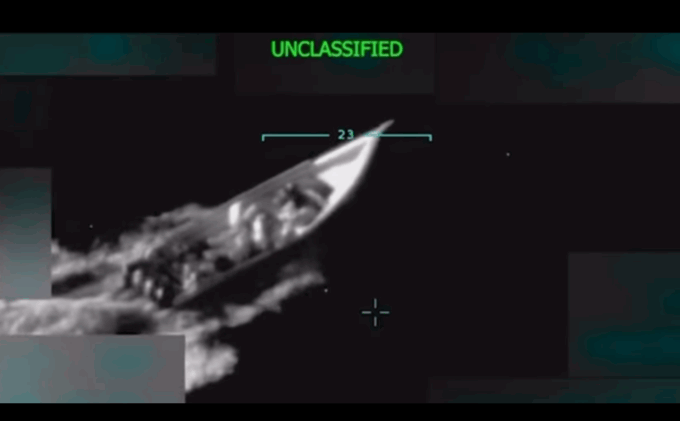
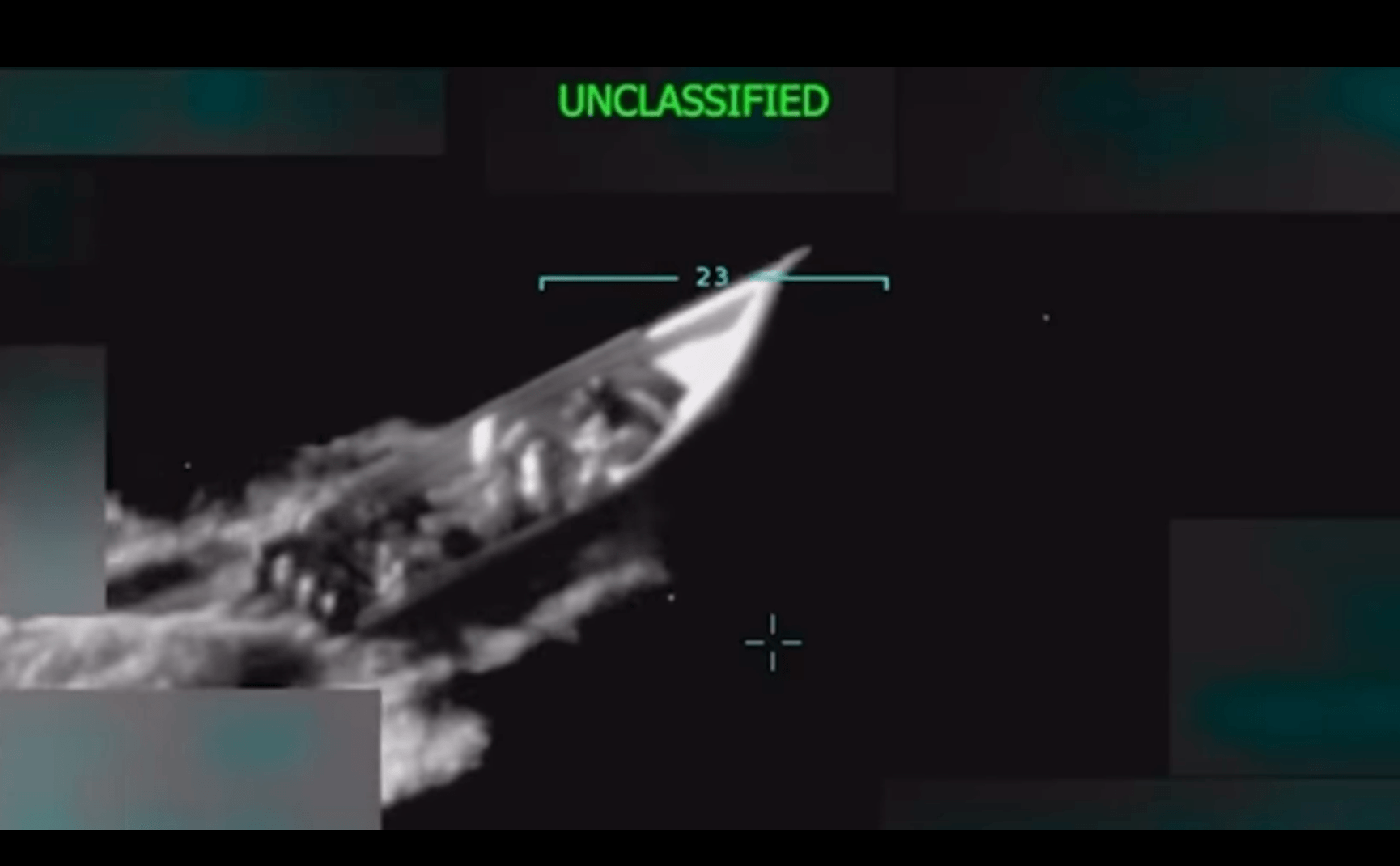
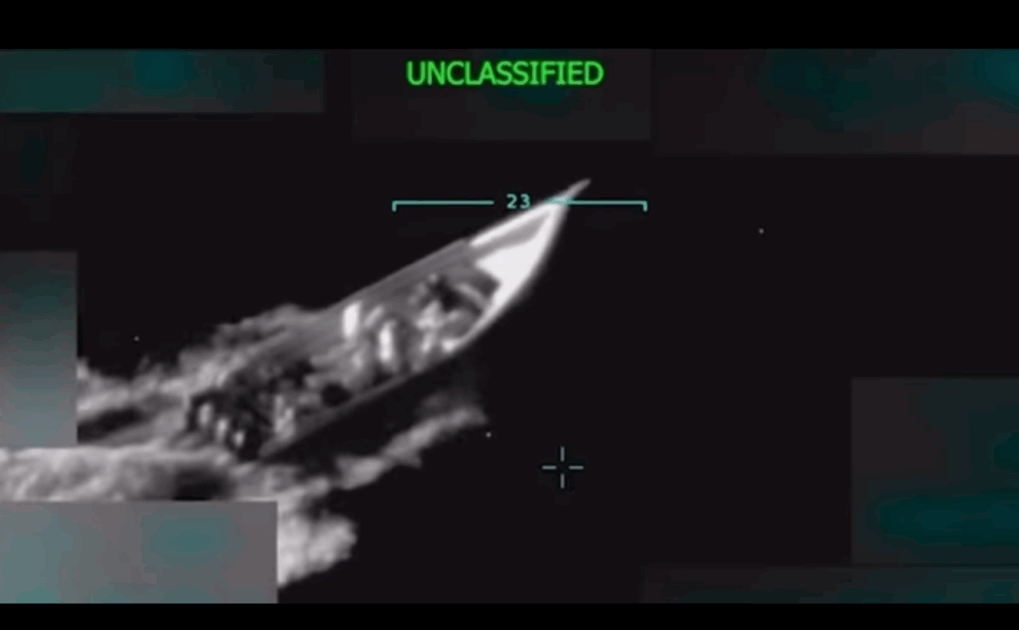
Unclassified footage of the first airstrike (1 September) – Public Domain
In the past few weeks, the US military has killed around thirty people in cold blood. The murders occurred on boats traveling in waters on both sides of Latin America and were undertaken without any warning to the crews on the boats. The rulers in Washington DC claim that those in the boats were involved in drug smuggling; they make this claim without showing any proof of smuggling or even that there were illegal drugs on the boats. Even if there were illegal drugs on the boats and the crew was involved in drug trafficking, the murders are illegal under any convention or laws. The former president of the Philippines Jose Duterte is currently in prison in the Hague after being charged with being an “indirect co-perpetrator” in the murders of hundreds of alleged drug dealers by Philippine military and law enforcement during his time in office. If we apply this same reasoning to the aforementioned murders by the US military, then Donald Trump, Marc Rubio, Pete Hegseth and others should be arrested on similar charges. Since Washington refuses to recognize the jurisdiction of the ICC, those charges should be drawn up and prosecuted by another enforcement agency.
Together with many others who have spoken publicly, I have very serious doubts that most if not all of those murdered on those boats were trafficking in drugs. It seems much more likely that they were fishermen going about their business fishing. Of course, I have no way of proving this and the Trump/Hegseth/Rubio gang has done little in the way of providing any proof; proof which would most likely be barely credible anyhow. However, even if the people on the sunk boats were involved in drug trafficking, they should have been arrested, not murdered. The mere act of Trump deciding that US efforts to control illegal drug trafficking is now a genuine war is not actually a legal rationale to attack and kill suspected drug traffickers. The fact that Congress has done nothing to prevent this military escalation in the seas near Venezuela, while not surprising, is reprehensible in that it allows the White House even more power to send US forces into combat than previously. Like the occupation of US cities by federal troops and agents, the best word to describe the White House action is dictatorial.
In the early 1970s, the Nixon administration (probably the last time the US came close to fascism until now) came up with the idea of a “war” on drugs. It’s original intention, as described by presidential advisor and convicted felon John Ehrlichman, was to go after “the antiwar left and [B]lack people. You understand what I’m saying? We knew we couldn’t make it illegal to be either against the war or Black, but by getting the public to associate the hippies with marijuana and Blacks with heroin, and then criminalizing both heavily, we could disrupt those communities. We could arrest their leaders, raid their homes, break up their meetings, and vilify them night after night on the evening news. Did we know we were lying about the drugs? Of course we did.” Over time, as the war on drugs expanded, its targets included revolutionary movements and governments opposed to US imperialism and its clients. Like the use of the war on drugs to go after domestic enemies, the US government used the war on drugs to go into other countries. In some cases, like Colombia in the 1990s and early 2000s, the local governments were partners with certain (right-wing) drug trafficking organizations and the US joined those governments in dropping herbicides on peasant crops, invading villages under the control of revolutionary forces and killing labor, peasant and student organizers. This is verified by sources too numerous to count.
With Latin America once again the scapegoat, a general fear of drugs among the US population provides an almost perfect complement to Washington’s longtime drive to end the Bolivarian revolution in Venezuela. That revolution recently suffered an electoral defeat in Bolivia, thanks to a fractured left and years of subversion by Bolivia’s right wing and US intelligence. The empire’s think tanks in the mother country seem to be convinced that now might be the perfect time to strike the final blow in Washington’s long time hybrid war against Caracas. Unfortunately for Washington, however, is the presence of a leftist government currently in power in Colombia. Its president Gustavo Petro, whom Trump recently called a drug dealer, is quite clear in his rejection of US and especially trumpist aggression in the region. Earlier this month, in regards to the US potentially using Colombia to launch an invasion of Venezuela, Petro asked, “What Colombian would help invade where their own family lives, only to see them killed like in Gaza?” From what one can tell via the US media, Petro’s ability to stay a step or two ahead of the Pentagon and its bosses will be one key to preventing further US military escalation in the region. Of course, it could also lead to an emotional reaction from Washington that would involve US military aggression not seen in the region since Teddy Roosevelt took his Rough Riders on their imperial adventure.
One thing that is important to remember is this: most Democrats support regime change in Venezuela. Many also support regime change in Cuba and I’m fairly certain that most would also support regime change in Colombia once they do their homework and realize that government is probably more left-leaning than Venezuela has been since Hugo Chavez’s death. In other words, like most of Washington’s foreign policy, the Congressional support for regime change in the Caribbean and South America is bipartisan. Likewise, the national organizers of the No Kings protests have not made opposing the murders in the waters around Venezuela or the military buildup an issue. Opposition to the continuation of the US military buildup around Venezuela, sanctions against Venezuela, Cuba and other nations, and the cold-blooded murder of people on the high seas by the US military will have to be built from the ground up. As the response from liberals to the awarding of the 2025 Nobel Peace Prize to ultra-rightwing and pro-coup Venezuelan opposition figure Maria Corina Machado makes clear, there are a lot that US residents don’t know very much about Venezuela, its politics and its political situation. Unless we can stop further escalation, they will only discover more honest facts when US troops are dying there, if then.
For more info: https://worldbeyondwar.org/venezuela-no-war/
https://afgj.salsalabs.org/nowaronvenezuela–contactyoursenatorstoday
The post True Crime: Murder on the High Seas appeared first on CounterPunch.org.
This post was originally published on CounterPunch.org.