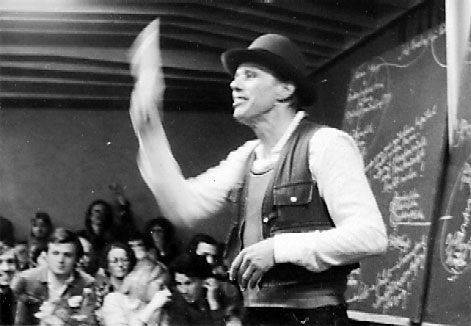

Joseph Beuys on his lecture “Jeder Mensch ist ein Künstler – Auf dem Weg zur Freiheitsgestalt des sozialen Organismus” photographed by Rainer Rappmann in Achberg, Germany, 1978. CC BY-SA 3.0
Defiant Chinese artist Ai Weiwei has lately been critical of Germany, but when he complained to Zeit Magazin that the country’s Chinese restaurants lacked culinary diversity, I was surprised. China had just overtaken the US as Germany’s biggest trading partner—take note, America—but I had expected more from an artist of his scope.
From art to politics, the West’s self-critique is consistent, if not coherent. On the other side of the Channel, the unimaginative UK Chancellor of the Exchequer Rachel Reeves was saying that leaving the EU had created more damage than expected, as if this were news too. The dynamics of this are outlined in A More Perfect Union, a new book by barrister—and Boris Johnson’s ex-wife—Marina Wheeler KC. Weirdly, Dominic Cummings was lecturing on Bismarck as the rest of the UK continued obsessing over migrant boats—its only glance towards the Continent these days. Which takes us back to Germany again.
More important than Chinese restaurants, more choppy than competing trade figures, more incisive than illegal migration when legal migration is so much bigger, is sudden German flexing over its postwar military identity. With Friedrich Merz having taken over the Chancellorship in May of this year, his policy ambitions—particularly around military expansion—signal a profound shift. I’m not even talking about his hardline controversial calls for large expulsions of migrants from German cities. Nor the fact that Merz wants 500 billion euros—like a rabbit out of a hat?—to rescue its industry.
If volunteer numbers for the German military do fall short, which could easily happen given the bullish scale of Merz’s fresh ambition, there will soon likely be conscription by lottery for young German men once they turn 18. (Conscription was suspended in 2011.) Merz aims for 260,000 personnel by 2030. To put such a figure into perspective, there are roughly 75,000 regular full-time personnel in the British Army.
Dragged into law, this type of Wehrdienst—or military service—will mean at least some young Germans literally forced into uniform. Though the draft bill emphasises voluntary service, open conscription waits menacingly in the wings. No wonder “Das Crazy” was voted German Youth Word of the Year at the recent Frankfurt Book Fair. (That’s the real headline here.) Kin are pretty anxious too. Counselling centres for conscientious objectors are reporting an increasing number of visits from worried parents.
Across the Atlantic, it also smacks of Trump, given the US president has been either wittingly or unwittingly pushing Europeans away, especially anti-populist ones. “American willingness to lead is now buckling under a politics of grievance,” as Ian Bremmer pointed out recently.
No wonder the Social Democrats (SPD), Merz’s centre-Left coalition partner, are trying hard to appeal to the young. The SPD opposes compulsory military service and hopes its stance enough to blunt the CDU/CSU bloc’s more Teutonic manoeuvres through parliament.
If the SPD fail to counter, it will not be long before we find ourselves unpacking all over again why there was always this postwar taboo about German uniforms. Younger readers may not know how unspeakable military aesthetics were. This was why Bundeswehr uniforms representing a total rejection of pre-WW2 militarism were so bland. As the historian Timothy Garton Ash hinted two years ago, Germany’s strength has always been its restraint.
With historical guilt the chief motor then, militarism had been long verboten until Merz came along. I can even recall snide remarks made by Brits and Americans in Afghanistan in 2008 when it came to German disinclinations for boots on the ground. They flew German Air Force C-130s instead. Not to mention a senior German journalist during the Balkan War telling me not to use the word “decadence”.
In postwar Europe it was always the UK and France who strutted most marchingly across the military stage. As a result, Germany was considered a sleeping giant. Scholars of patterns, however, beware. Merz’s latest plans want to make Germany the leading conventional fighting force in Europe.
So will the SPD rain on Merz’s parade? If so, he may soon be accusing SPD roots of carrying a nostalgia for Russia. He will know all about former SDP leader Gerhard Schröder‘s lasting bromance with Putin. Not that the security-focused and pragmatic defence minister Boris Pistorius (SPD), a definite hawk on Russia, is prey to any of this himself.
All party views on conscription are in flux. Not just among the three-party CDU/CSU and SPD coalition. The far-right populist AfD party have also rejected the idea of reinstating conscription. “Our children, our sons, our servicemen will never die for Ukraine. We will reject the federal government’s proposal on military service,” Alice Weidel, co-chair of the AfD, wrote on Facebook, making obvious the real reason behind Merz’s abrupt militarism.
Lt. Gen. Alexander Sollfrank, commander of the German Army’s joint force command, has declared that if Europe wants to preserve its peace and freedom, Russia must be stopped. That task, it can be added, is made no easier by a belligerent and agitated Moscow. At a time when Russia is literally assembling nuclear forces in the Arctic Circle—helped in part by the lack of clarity from Trump—Sollfrank’s position is straightforward. This, above all, lies at the heart of Merz’s plans.
With all this talk of Reise Reise at dawn (the German equivalent of the wake-up call “Reveille”), more excitable observers might start to fear the existence of some dark corner of a bleak metaphorical German forest where an old and familiar fighting machine is preparing a steely comeback. No one said the far-right didn’t like uniforms.
Or will detractors overstate a German relationship with its former Prussian military past? Indeed, whatever happened to the descendants of all those Germans at the core of so much elite military thinking? Affectionately speaking, they can’t all be managing Premier League football clubs.
Or maybe I’m just overreading all this. Even if watching Germany rehearse its old roles does feel oddly unsettling.
I’ve always had a liking for German artists. Especially Joseph Beuys, though even his ties to the Nazis showed the ‘messiness’ of World War Two and postwar Germany. However, follow Beuys all the way through and you come to a peaceful place—he founded the Green Party after all. “I believe the ailing earth must be regenerated, and I believe man must be regenerated,” he said. “Everyone an artist,” he also liked to quip.
Beuys, like filmmaker Rainer Werner Fassbinder, while representing the success of German recovery through art—make art, not war—was like few others. “In order to understand the present, what has and will become of a country,” also said Fassbinder, “one has to understand its whole history or to have assimilated it.”
Not that Ai Weiwei was being entirely facetious. Just as by ignoring its past, Germany will enable itself to move faster. In the same piece for Zeit Magazin, Ai Weiwei had said: “When public events of great consequence—such as the Nord Stream Pipeline bombing—are met with silence from both government and media, the silence itself becomes more terrifying than any atomic bomb.”
Well, Merz ain’t so silent now.
The post Das Crazy appeared first on CounterPunch.org.
This post was originally published on CounterPunch.org.