
A group of scientists have identified 10 bottlenecks hindering China’s alternative protein progress, calling for policy and investment support to overcome the barriers.
Long heralded as a leader in the green energy and mobility spaces, China is well-positioned to spearhead the alternative protein race aswell.
The country is home to eight of the top 20 patent applicants for cultivated meat, as well as the world’s largest yeast protein company. Its government has pumped millions into R&D for sustainable proteins, and recognised these foods as a bioeconomy priority. In fact, its biotech potential is so vast, it has sparked fears among some US lawmakers about their own country’s competence.
Still, China’s alternative protein economy faces major constraints, from limited foundational research and technical bottlenecks to fragmented funding and weak links between industry and academia, according to a new blue paper.
Penned by 48 leading scientists from the NeoProtein Professional Committee of the Chinese Institute of Food Science and Technology (CIFST) and ProVeg China, the report provides a system-level analysis of 10 technical gaps and several emerging opportunities in the East Asian nation’s “NeoProtein” industry.
It offers a strategic roadmap for aligning national R&D priorities, bolstering collaboration, and translating scientific breakthroughs into real-world applications to “drive China’s transition from a ‘follower’ to a ‘leader’ in NeoProtein technology” over the next decade.
“The Blue Paper is a powerful call to action for advancing the industry,” said Nicole Wu, executive director and chief representative of ProVeg China. “It will help scientists concentrate on the most impactful research areas, guide policymakers and funders on strategic resource allocation, and enable industry stakeholders to identify where collaboration can make the greatest difference.”
What’s holding back China’s alternative protein sector?
Outlining how existing plant protein extraction technologies suffer from high energy consumption and pollution, as well as protein denaturation issues, the report suggests prioritising the development of low-denaturation, green, and efficient extraction pathways, which would improve the functionality and sustainability of these foods.
Single-source plant protein still struggles to achieve good gelation, water-holding, and oil-holding properties simultaneously, so the experts advise combining biotech with physical field treatment to optimise protein structure and functionality, design specialised equipment to construct 3D protein structures, and implement structural engineering of plant-based fats.
For cultivated meat, the development of immortalised myogenic cell lines is central to scaling up, as is the establishment of serum-free culture media. The latter can be achieved through the development of plant-based or recombinant alternatives to animal inputs, integrating multi-omics data with AI algorithms, and bioreactor design with dynamic nutrient regulation tech.
The report places a major emphasis on fermentation-derived proteins. It calls for the construction of highly efficient cell factories for microbial biomass production, as well as the intelligent design of protein biomanufacturing reactors for high-density fermentation and yeast chassis cells for efficient expression of functional proteins.
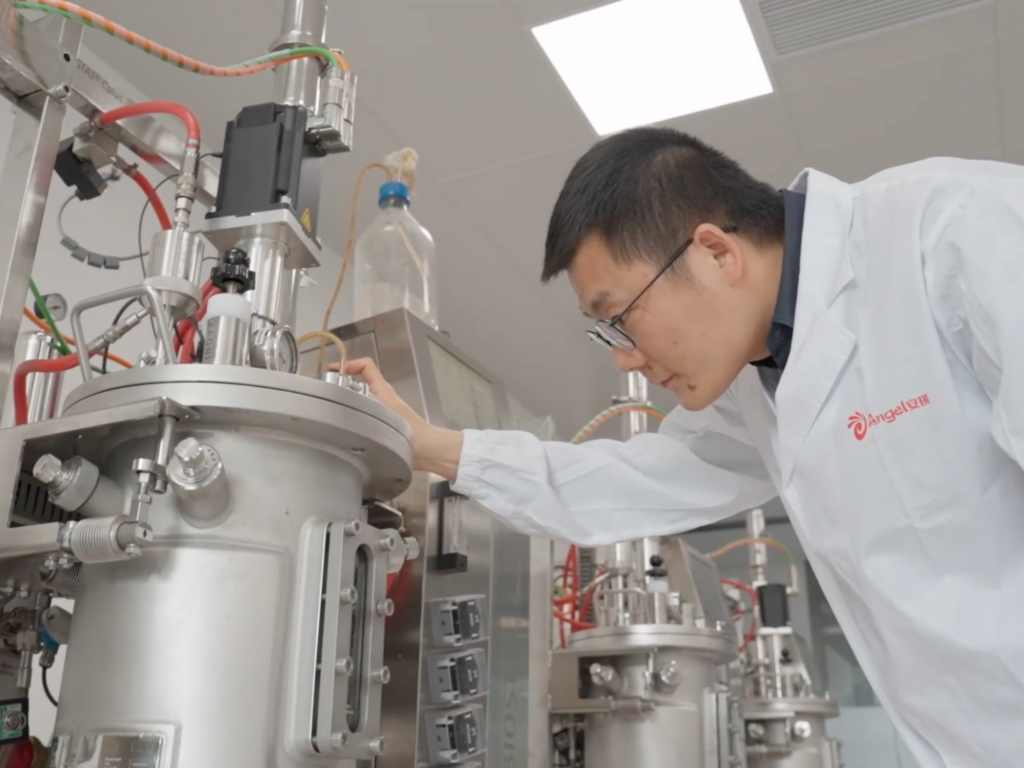
Further, as low-carbon processing is integral to the fermentation industry’s success, for which the report suggests establishing AI-optimised control systems for solid-state fermentation, systematically optimising key elements like substrate formulation and aeration rates, and integrating non-thermal methods with enzymatic modification to improve proteins.
Further, the blue paper argues that China must optimise the processability and multi-scenario application of yeast protein, championing techniques like high-pressure microjet processing and ball milling to shrink protein particles and combining proteomics with bioinformatics methods to analyse multilevel structures and post-translational modifications.
Finally, it shines a light on Fusarium venenatum, a source of mycelial protein that is nutrient-rich but whose rigid cell walls can hinder protein release and digestibility. Companies should look to employ CRISPR-based gene editing to knock out genes linked to the synthesis of key cell wall components like chitin and glucan. In addition, they should develop a multi-stage extraction process combining high-pressure homogenisation with pH shift solubilisation.
How China can clear hurdles to lead the protein transition
“The research and industrial communities must work hand-in-hand to address these key challenges and drive the high-quality development of the industry,” said Jian Li, a professor at Beijing Technology and Business University.
The report calls for a “forward-looking strategic vision” to bolster top-level policy planning and direct science and technology investments towards high-impact areas to tackle the core bottlenecks of the NeoProtein sector.

The scientists proposed six actions to help achieve “a historic leap from ‘supplementation’ to ‘substitution’, and then to ‘expansion’ and ‘irreplaceability’ within the global food system”:
- Develop a national alternative protein strategy: This roadmap should define the priorities and timeline for technological breakthroughs to guide researchers, industry, and other stakeholders toward shared objectives.
- Expand collaboration, funding and R&D support: China should introduce a collaborative innovation platform for alternative proteins, ramp up fiscal support, set up a major science and tech project dedicated to these foods, and integrate the sector into the key national R&D programme.
- Create an innovation-friendly regulatory sandbox: This system would help fast-track food safety approvals for new novel proteins and ingredients, and should be complemented with stronger certification standards to regulate market order and boost consumer confidence.
- Encourage regional action on bottlenecks: Local governments should be incentivised to incorporate the 10 barriers in industrial planning and biotech initiatives through industrial guidance funds, specialised industrial parks, and preferential access to land, energy and data to foster globally influential clusters.
- Mobilise industrial capital for future foods: It’s critical to invest boldly in R&D and pilot-scale platforms and support collaboration across sectors and disciplines. Long-term investments should accompany frontier technologies through the “valley of death” between lab discovery and commercialisation.
- Spur researchers to overcome boundaries: China can boost the sustainable protein sector by actively promoting collaboration between industry and academia to encourage researchers to jointly tackle technical bottlenecks and ensure scientific advances drive industrial scale-up.
“Significant technical gaps still exist in plant-based and related fields,” said Xiaoquan Yang, a professor at South China University of Technology. “Future efforts should prioritise staple foods and alternatives to traditional animal proteins, so that novel proteins can genuinely become part of people’s everyday diets.”
The post Leading Scientists Lay Out Roadmap to Advance China’s Alternative Protein Sector appeared first on Green Queen.
This post was originally published on Green Queen.