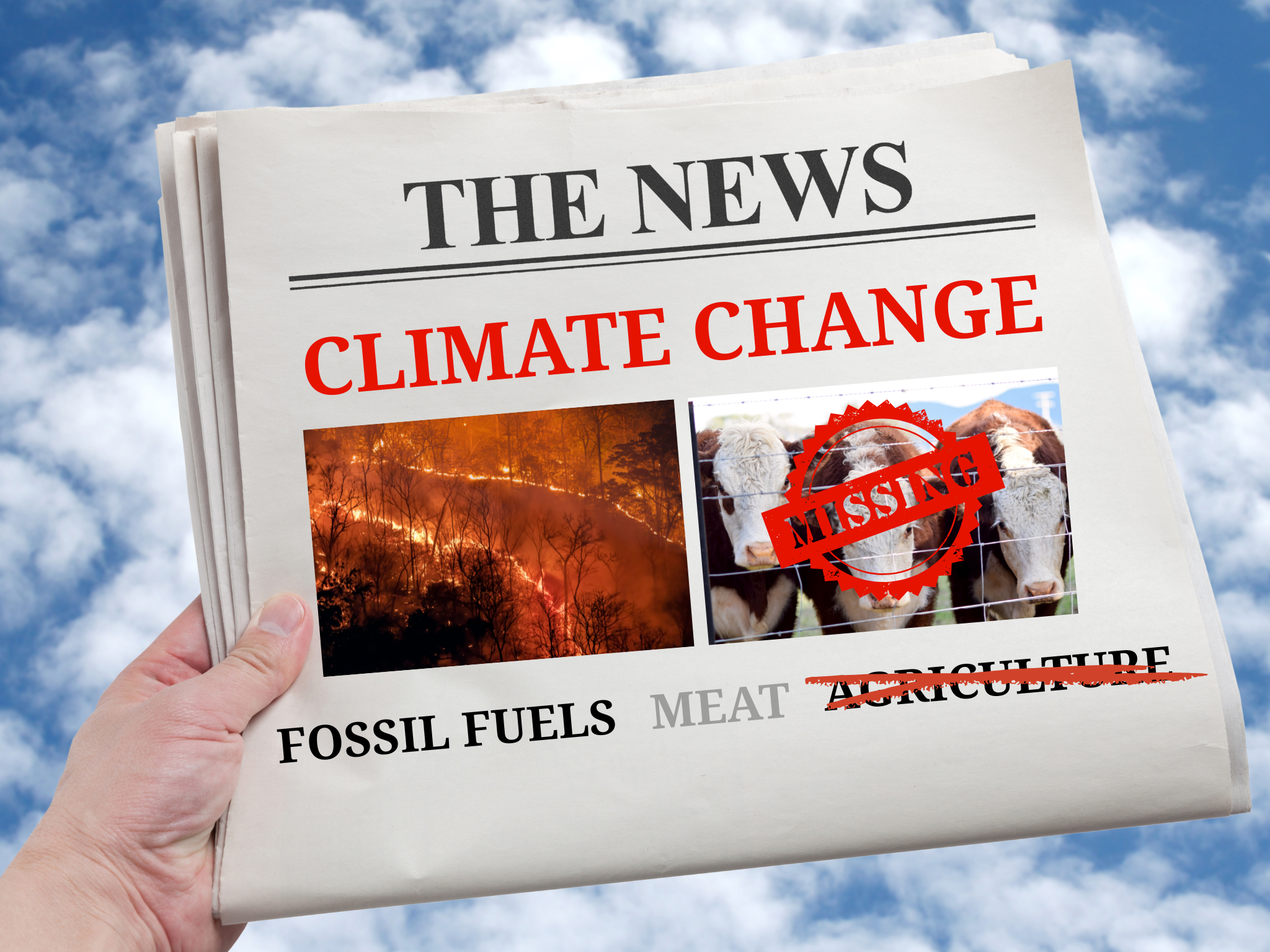
Despite sustainable diets and meat reduction being identified as key levers to mitigate the climate crisis, only a small fraction of media coverage focuses on these topics.
As scientists raise alarms about our current meat consumption levels and climate shocks put supplies and prices under pressure, the link between the food system and planetary health has never been clearer.
At least that’s what you’d think, until you look at how this connection is covered in climate journalism. The Center for Biological Diversity did just that, analysing nearly 10,700 articles from US media outlets to find that barely a fraction of stories mention sustainable diets or animal agriculture.
The findings are grim. Only 1.2% of the articles covered terms related to dietary shifts, while the broader theme of livestock farming or meat appeared in just 3.2% of them.
That’s in stark contrast to the reality of the food-climate nexus. The agrifood system accounts for a third of all global emissions, and animal agriculture alone is responsible for over 19% of the greenhouse gas output.
“It’s no wonder so many people think food isn’t a big climate issue when it’s absent from almost every news story they click on,” said Stephanie Feldstein, population and sustainability director at the Center for Biological Diversity.
“The meat and dairy industries have been enjoying their time in the shadows for too long. The media needs to shine a light on their role in driving the climate crisis and the need for policy action.”
Representation of meat needs to increase sixfold to reflect climate impact
The researchers pored over stories from 37 outlets – including the New York Times, CNN, the Wall Street Journal, the Washington Post, and Fox News – published between July 2022 and June 2025.
They found that nearly half of these climate-focused articles (46%) dealt with the fossil fuel and energy sectors, which appeared more than five times than any other topic. The next best were finance and insurance (9%) and transportation (8%).
Only 343 of the stories mentioned the livestock industry. This means that representation of the meat and dairy industry in climate journalism would have to increase about sixfold to accurately reflect its share of global emissions, totalling 2,072 articles.
Further, the researchers analysed the text of over 8,000 articles to determine the quality of the coverage and whether it aligned with each sector’s role in fuelling the climate crisis. Only 36% of the stories nodding to animal agriculture also mentioned dietary shifts.
Moreover, stories often discussed the impacts of climate change on farmers and farmworkers without identifying livestock agriculture as a source of emissions. And the reality of the latter as both a cause and victim of the climate crisis was rarely addressed.
“While it is not always reasonable to mention every cause of climate change, current coverage falls far short of accurately reflecting the nature of the problem,” the study states.
“This doesn’t suggest that coverage of the climate impacts of animal agriculture should come at the expense of coverage of the energy sector, but rather that proportional coverage would increase awareness of the need for policy responses.”
Fox News mentions meat in climate coverage more than anyone else
The research revealed that even outlets that frequently covered climate change rarely included animal agriculture, meat or dietary shifts in their reporting. The New York Times, the Washington Post and CNN published the highest number of articles mentioning livestock farming; however, they still constituted a small percentage of their overall climate coverage.
There was only one outlier in the group of publications that brought up meat in over 30% of its environmental coverage: Fox News. Though this may come as a surprise, given the network’s right-wing leanings, the reason the climate-denying outlet did so shouldn’t. Most of these mentions were to disparage diet shifts as a climate solution.
“Meat often served as a proxy for the network’s anti-climate agenda,” the report noted, pointing to a range of statements that sought to mischaracterise the science-backed potential of dietary shifts.
One of these read: “Well, how about no more heat or air conditioning or electricity or cars or wearing leather or eating meat or having children? All are sins against the climate. So, for you, it is insects, tap water and celibacy.”
That said, the report noted that the limited coverage of meat consumption, even from Fox News, “did not dispute the merits of the science around the emissions produced by animal agriculture”. In fact, when meat and animal agriculture did appear in climate coverage, they were often described in the right contexts, appearing next to terms like “less,” “consumption” and “emissions”.
Still, “agriculture” and “meat” aren’t even in the top 500 words used in climate journalism. And despite the crisis worsening, overall coverage of climate change has been on a downward slope since 2022, with the only spikes coming around the UN’s annual COP summits.
The Center for Biological Diversity’s report aligns with recent research by Sentient Media, which found animal agriculture mentioned in only 3.8% of the climate-related stories it analysed, and Madre Brava, whose research put that share at an even lower 0.4%.
“Big Ag is following in the footsteps of Big Oil when it downplays its climate impact,” said Alexandra Tey, an independent journalist who led the research effort. “Climate journalists have published excellent reporting on how the energy industry suppressed evidence of climate change, but we’re still missing out on compelling stories by overlooking food issues.”
The post Sustainable Diets Missing from 99% of Media Coverage of Climate Change: Study appeared first on Green Queen.
This post was originally published on Green Queen.