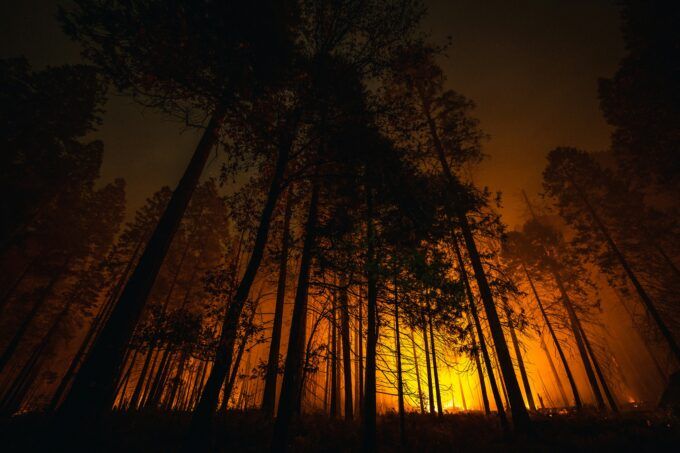
Image by Casey Horner.
How many floods, droughts, and wildfires will it take before governments and industry take the action needed to slow—let alone reverse—the catastrophe that is climate change? How many lives, homes, and communities must be lost until the deluded devotees of the fossil fuel economy are forced to wake up and alter their behaviour?
The fanatics, the petro-states, and the denialists—figures like President Trump, who has repeatedly dismissed climate change as a “hoax” – “the greatest con-job in the world”—remain wedded to a consumer-based ideology of greed and limitless growth.
Tell that to those most affected. The people of Jamaica, for example, where Hurricane Melissa recently tore buildings to pieces as it swept across the island. The 13 million displaced in Bangladesh and eastern India due to flash floods and landslides triggered by a monsoon surge that dropped up to 800 mm of rain in just five days. Or people across Europe, where the hottest summer on record saw temperatures reach 48°C (118°F).
Tell the 40,000 evacuated in central China after July’s landslides and river flooding that climate change is a “con-job,”. Tell the Japanese, who in January endured an extreme cold surge that buried parts of the country under three metres of snow—followed by sudden warming that triggered landslides, urban flooding, and collapsed buildings.
The examples are endless, the suffering immense. No region of the world is safe from the accelerating impacts of climate change. We are already at 1.3°C of warming above pre-industrial levels, and unless substantive, sustained action is taken to cut greenhouse gas emissions, the world is on track to reach 2.6°C by 2100.
And, “a world at 2.6°C means global disaster,” warns Bill Hare, CEO of Climate Analytics. At that level, major climate tipping points become increasingly likely: the collapse of key Atlantic Ocean circulation, the loss of coral reefs, long-term deterioration of ice sheets, and the conversion of the Amazon rainforest into savannah.
“That all means the end of agriculture in the UK and across Europe, drought and monsoon failure in Asia and Africa, lethal heat and humidity,” Hare explains. “This is not a good place to be. You want to stay away from that.”
By denying the reality of climate change and making incendiary, false statements, Trump and other powerful figures increase the risk of uncontrolled heating, emboldening autocrats and business leaders to ignore the science, obstruct progress, and sacrifice the future for short-term political gain—a future that, if 2–2.6°C is reached, could be apocalyptic.
If Not Now, When?
As COP30—like so many COPs before it—failed to deliver binding commitments to curb emissions, the question, ‘if not now, when?’ is more pertinent than ever.
Relentless lobbying from fossil fuel interests, the influence of petrostates such as Saudi Arabia, and a chronic lack of political will made a binding, meaningful statement impossible.
According to the Kick Big Polluters Out coalition, more than 1,600 fossil fuel lobbyists were granted access to the summit—a 12% increase on the previous UN gathering in Baku, Azerbaijan. Meaning one in every 25 COP30 attendees was a fossil fuel lobbyist.
It is outrageous that lobbyists are present at these summits at all. Their sole purpose is to pressurize country representatives to act in the interests of fossil fuels; they should be banned outright. But the scale of complicity—and the brazenness of state collusion—is staggering.
Some countries of the Global North include fossil fuel representatives within their official delegations. France brought 22 fossil fuel delegates, including five from TotalEnergies; Japan’s delegation contained 33 lobbyists, representing companies such as Mitsubishi Heavy Industries and Osaka Gas; Norway quietly included 17, including six senior executives from its national oil and gas giant, Equinor.
This absurd situation reflects a consistent pattern of human hypocrisy and moral weakness, demonstrated most loudly by political and corporate leaders.
Peace is routinely spoken of, yet nation-states manufacture and sell arms, embrace nationalism, and champion competition. We claim to value equality, yet deny minorities safety, and inflame intolerance. We speak of justice, yet build economies rooted in injustice and inequality. Democracy is lauded, yet the marginalized are excluded, and a socio-economic system rooted in division and greed is worshipped.
We abhor hunger, yet refuse to share what is in abundance, while funding industrial agriculture that devastates soils and communities. We pledge to protect the planet, yet pursue limitless growth based on unconstrained consumerism, continue to subsidize fossil fuels, and destroy ecosystems.
We abhor hunger, yet refuse to share what is in abundance, while funding industrial agriculture that devastates the land. We pledge to protect the planet, yet pursue limitless growth based on unconstrained consumerism; continue to subsidize fossil fuels, and destroy ecosystems.
On and on—the examples are many, the duplicity relentless. COP30, like summits before it, served as a stage for this contradictory and destructive pattern. It is a form of collective insanity that is poisoning the planet, destabilising its systems, and threatening the future of both the Earth and humanity.
Greed and consumerism
The men and women in power do not really want change. They seek a continuation of the status quo: to maintain control and amass even more wealth, no matter the impact on the planet or the poor and disenfranchised. They do not care in the slightest about the long-term consequences of their short-term decisions, driven as they are by the twin poisons of desire and greed.
A negotiator from a developing country told The Guardian: “In the negotiating rooms you hear people opposing the science, saying: ‘Oh, there is other science besides the IPCC,’ that the IPCC is not ‘the best available science’… We keep defending it, but they don’t listen… Or they say: ‘Oh, 1.5°C is in the past; we are already through 1.5°C; don’t talk about 1.5°C.’ But that’s not true either… Where is their humanity?”
COP30 eventually agreed to a framework for phasing out fossil fuels, but it is wholly inadequate—vague, non-binding, and far too slow. The eradication of fossil fuels is the minimum states, particularly in the Global North, should already be working towards. In addition, a pledge of $120bn a year for developing countries to “help them adapt to the impacts of extreme weather” was announced—three times the current level—but it will not come into force until 2035, and rich nations have an abysmal record of honouring such promises.
Money v environment
And this brings us to the heart of the matter. As in almost every other sphere of contemporary life, the environmental debate is governed not by the urgent question, What must we do to save the planet?—but by money, and that most corrosive human trait, complacency.
The environmental crisis is a devastating symptom of a reductive worldview built on materialism, pleasure, division, and greed. It is the most perilous expression of a web of interconnected crises, including armed conflict, rising crime, deteriorating mental health, homelessness, inequality, and hunger.
To address this unprecedented crisis, we must confront its underlying causes: limitless consumerism, greed, and selfishness. Replacing fossil fuels with renewables is essential, but unless the socio-economic paradigm itself is redesigned—and the values that sustain this destructive system are fundamentally challenged—climate change and the wider environmental catastrophe will continue unabated. Within the existing consumer-based order, and under the self-centred, divisive values it promotes, meaningful action is impossible.
The science is clear, the causes known; what is missing is political will—the moral courage to reshape society around principles of justice, sharing, and responsibility for one another and for the planet.
The wellbeing of the environment—not short-term profit or political gain—needs to guide decision-making within governments and corporations. An economy of restraint and sufficiency, in place of excess, should be embraced to reduce consumption and, with it, energy demand. With consistent stewardship, the natural world—the climate, the air, the waterways, and the ecosystems—would then have a chance to recover.
If such steps are not put in place—if the deniers and vandals continue to dominate policy and silence the common-sense majority—the future looks increasingly dark: extreme weather will become normal, agriculture devastated, vast areas uninhabitable. All because a small, powerful minority—a cabal of political and corporate interests in the Imperial North—refuse to curb their greed or loosen their grip on a failing, violent economic order.
The post Climate Breakdown: How Bad Must It Get? appeared first on CounterPunch.org.
This post was originally published on CounterPunch.org.