Love requires attention, affection, and reciprocal flow — a natural cycle of giving and receiving. Capitalism can easily commodify the first two, but the third resists the market. That’s precisely why our economic system is so determined to destroy it.
This article first appeared in the Winter 2025 issue of the German edition of Jacobin.
Each time I relocate to Germany, I buy a mug. This usually entails a trip to the nearest TK Maxx, where I purchase a €4, extra-large vessel for my herbal tea. The dainty European mugs found in my prefurnished lodgings just can’t hold the quantities I need. My criteria are simple: it must be large and sturdy. I don’t care what it looks like or who manufactured it. In Marxist terms, I’m concerned only with its use value.
If, however, I wished to seem fancy or fashionable, I could purchase a Hermès “H Déco Rouge No. 1” mug for €125. Drinking my ginger brew out of this lovely piece of porcelain might increase my social worth in the eyes of discerning tableware connoisseurs, but its use value remains the same: it holds my tea. Remaining in the vernacular of Marxism, the additional €121 that I could theoretically pay for the Hermès mug represents the difference in their exchange values as commodities.
When Karl Marx discusses the difference between use and exchange values, he refers to material objects that satisfy human wants and needs, only transformed into commodities when traded on a market. In 1857, he used the example of wheat, which
possesses the same use value, whether cultivated by slaves, serfs or free labourers. It would not lose its use value if it fell from the sky like snow. Now, how does use value become transformed into a commodity? [When it becomes a] vehicle of exchange value.
Intrinsic to capitalism as an economic system, then, is the conversion of things that have use values (which, often enough, are abundant and free) into things that have exchange values, i.e., scarce commodities that people must pay for.
Although not a material object, love also has a use value that exists outside of the social relations of exchange that govern capitalist societies. Most, if not all of us, have given and received love, often beginning as children in our families, where we feel nurtured and validated by the people around us. Giving and receiving this most vital of emotions is as essential to human flourishing as food, water, and shelter — and thus, it follows that it ought to figure prominently in any political program for socialist transformation. Yet if we want to develop a socialist analysis and subsequent politics of love, we must understand how our current economic system deprives us of the time and energy necessary to give and receive it.
To better delineate between the use and exchange values of love, I propose that “love” involves at least three distinct constituent components: attention, affection, and reciprocal flow. All of the different forms of love — romantic, platonic, filial, spiritual, and so on — involve some combination of these three components. All three have use values that exist outside of the market, but only two can be directly commodified, leaving the third, reciprocal flow, necessarily beyond the realm of exchange. Understanding how and why capitalism diminishes our ability to give and receive love hinges on its simultaneous devaluation and exploitation of the lone use value that cannot be converted into an exchange value.
Paying (for) Attention
The first component of love is attention, the almost exclusive focus of one being’s cognitive capacities on another subject or object. Human beings crave the attention of others. Our fundamental sense of belonging depends on having access to attentional resources, and our desire for them is so strong that most people prefer negative attention over no attention at all. For example, one 2015 study found that workplace ostracism was actually psychologically worse than “harassing behaviors that directly demean, insult, belittle, or humiliate someone.” Being ignored by one’s colleagues was “more negatively related than harassment to employees’ physical health and work-related attitudes and turnover over time.”
Attention clearly has a use value, given its centrality to human flourishing. Being seen and acknowledged by others is an essential psychological need, as is being listened to and validated for our thoughts and opinions. One 2010 study found that merely having a conversation partner avert their eyes induced a deep feeling of ostracism that reduced “explicit and implicit self-esteem.” Research from 2021 found that feelings of social exclusion even altered auditory perception: ignored individuals subjectively experience the world as a quieter place.
Of the three components of love I’ve identified, attention is the most obviously commodifiable. Money can buy attention, and selling one’s attention provides a legitimate way to earn a living. Therapists, life coaches, and personal trainers sell blocks of their undivided heedfulness. Tarot card readers and psychics similarly charge per session. Parents pay childcare workers to attend to their little ones, and in the United States, always at the cutting edge of commodification, a company called rentafriend.com allows users to buy and sell hours of platonic attention. We even hire robots to pay attention to us: the chat logs of popular AI programs like ChatGPT are brimming with confessional writing.
Meanwhile, corporations, algorithms, and the necessities of modern life devour vast amounts of our attentional resources, leaving us with little to spare at our discretion. Our jobs require our undivided attention for the majority of our waking hours. Social media platforms capture our remaining attention and then sell it to advertisers, leaving us depleted. As our economic system drains the ability to concentrate our attention, it grows ever scarcer, thereby increasing its exchange value. At the end of another harried day of late-capitalist hustling, even the most generous parents might half-ignore their children. Friends leave their friends on read. Lovers ghost each other.
If we get used to thinking of attention as something we can buy, we also become less inclined to share (for free) what meager attentional resources remain. Researchers at Harvard University point to a “friendship recession,” as rising living costs force people to spend more time at work and fewer hours socializing. Meanwhile, many American women (26 percent, according to a recent study) are reluctant to date men who aren’t in therapy — another way of saying that women wish to split the attentional burden imposed by romantic relationships with men, whose own social worlds are shrinking as their friends devote attention elsewhere.
As wealthier members of society purchase the attentional resources of others — whether by employing them as workers or designing lucrative distractions for them as consumers — we witness the growth of an underclass of people who enjoy little to no attention at all, fueling the global epidemic of social isolation. According to a 2025 report of the World Health Organization, one in six people globally experience loneliness, a lack of social connection that accounts for almost 900,000 excess deaths per year.
Affection and Flow
Another major component of love is affection, a capacious category that can encompass sex, touch, comfort, kind words, compliments, and any number of actions that express tenderness, passion, concern, or devotion. In his famous 1958 study, “The Nature of Love,” the American psychologist Harry Harlow observed infant rhesus monkeys provided with two inanimate surrogate mothers, the first made of wire that dispensed milk and the second covered in soft cloth but without milk. Harlow found that the baby monkeys desired what he called “comfort contact” more than food. More recently, biological anthropologists suggest that basic human touch can help mitigate the physiological stress associated with extreme environments such as low gravity, high altitudes, or excessive cold and heat. As the climate crisis further challenges the limits of human biology, affection will only increase in use value.
But as with attention, units of affection easily become commodities. In societies where the cost of living exceeds the average paycheck, overwork and anxiety leave people time-poor and exhausted, hoarding their stores of affection for necessary bouts of self-care. If we’re going to cook anyone their favorite comfort food, it will be ourselves. Relentless competition and economic instability deplete us. As affection grows scarce, its exchange value increases, and more workers rationally choose to sell their affection as a form of labor power, particularly when average wages are low.
One clear example is sex work, which existed well before the advent of capitalism but takes a plethora of more creative forms today, from “camming” to “findom.” But money buys other types of affection too. Japanese businessmen pay women in hostess clubs to make them feel desirable and esteemed through personalized compliments. Wealth can also buy a steady supply of professionalized forms of human touch: massage therapy, foot reflexology, spa treatments, beauty services, and so on. As the 1 percent populates its calendars with purchased forms of pampering, affection itself becomes a luxury good — to be hoarded, traded, and displayed, a totem of personal success in an economic system where everything has a price.
In loving relationships, the sharing of attention and affection is bound up with a third component that I call “reciprocal flow,” a natural cycle of giving and receiving. It’s a generative and productive dynamic: the more attention and affection we receive, the more we feel inspired to give, and vice versa. We find this everywhere in nature, as so beautifully captured in the writings of Potawatomi botanist Robin Wall Kimmerer. The earth nourishes trees, which drop their leaves and fruits to nourish the earth. Bees collect nectar from flowering plants, pollinating them and ensuring plant survival. Humans inhale oxygen and exhale carbon dioxide, while plants inhale carbon dioxide and exhale oxygen. Entire ecosystems rely on the constant giving-and-receiving cycles of reciprocal flow.
The use value of reciprocal flow derives from how it naturally directs these delicate ecosystems and allows for both intra- and interspecies cooperation and the maintenance of system-wide equilibria. In his travels in Siberia, the Russian geographer Pyotr Kropotkin marveled at how different animals collaborated to ensure their mutual survival in the unforgiving climate. Similarly, researchers found that human toddlers engage in cross-species altruistic behavior; they will assist dogs even when there is no hope of reciprocity.
Much of the love I’ve felt for my own canine companions over the years stems from the reciprocal flow of affection and attention that cycles between us. A 2024 study found that US military veterans reported “significantly lower PTSD symptom severity, anxiety, and depression” when paired with service canines. My university brings therapy dogs to campus during exams to reduce student stress. Studies show that petting a dog is as pleasurable for the petter as it is for the petted. A dog won’t pet you back, but the act creates an energy of mutual affection, an aura of love.
We’re All in It Together
Reciprocal flow is not the same as reciprocity. Reciprocity suggests a tally sheet where each party keeps account of the balance between giving and receiving. Reciprocal flow allows for short-term imbalances because it occurs within relationships that persist over time and in close proximity. My dogs and I have shared reciprocal flow because we lived together through the same daily routine over many years; our familiarity grew in tandem with the intensity and longevity of our connection.
Similarly, parenthood requires a certain acquiescence to this state of reciprocal flow. Young children demand an exceptional amount of attention and affection, but many parents also feel a deep sense of purpose and satisfaction from the free sharing of these resources (our species would not have survived otherwise). This reciprocal flow state is sustained by shared expectations that relationships between generations will persist for decades.
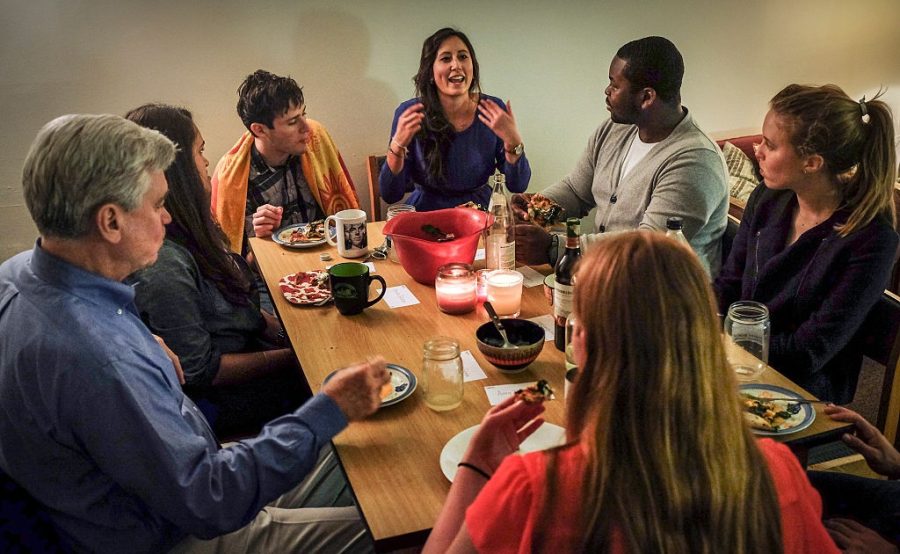
A great conversation is a microcosm of reciprocal flow. It involves spontaneous acts of thinking, speaking, listening, and responding in an easy back-and-forth where no one person dominates. We share stories, updates, ideas, observations, and ask for or offer sympathy, insight, and advice without regard to their potential exchange value.
In the creative realms, jazz jam sessions and amateur ballroom dancing rely on the shared joy of reciprocal flow. In the many summer months that I’ve lived in Freiburg im Breisgau, I always stop to marvel at those in the Tanzbrunnen near the cafeteria of the university. In the open-air basin of a fountain that the Allies bombed to pieces in World War II, couples of all ages gather on warm evenings to sway together beneath the stars just for the fun of it. Similarly, on a recent trip to Scotland, I experienced my first ceilidh, where an assortment of people bring their instruments to jam together without sheet music or prearranged set lists. It is a raucous, joyous blend of song and sound, with the musicians just riffing off of each other for the simple pleasure of playing traditional Scottish tunes.
Even in children, the highest stage and most important form of play is called “cooperative play” or “reciprocal play.” Think back to those long days in childhood when you shared imaginary worlds with your playmates, losing track of time in mutually constructed spaces of make-believe. Role-playing, dress-up, and collaborative storytelling rely on natural states of reciprocal flow between the imaginations of the young. These activities teach children to read the emotional cues of others and learn how to respond spontaneously. Child psychologists recognize that engaging in extended bouts of reciprocal play is essential for our cognitive development. Losing ourselves in shared states of reciprocal flow is how we learn the prosocial behaviors upon which our societies are built.
Albert Einstein took this argument even further in his memorable essay “Why Socialism?”, proposing that individuals and society exist within a constant state of reciprocal flow:
The individual is able to think, feel, strive, and work by himself; but he depends so much upon society — in his physical, intellectual, and emotional existence — that it is impossible to think of him, or to understand him, outside the framework of society. It is “society” which provides man with food, clothing, a home, the tools of work, language, the forms of thought, and most of the content of thought; his life is made possible through the labor and the accomplishments of the many millions past and present who are all hidden behind the small word “society.”
When it comes to friendship and romantic love, we naturally enter into reciprocal flow states with other people as a result of longevity and proximity. The reasons for entering this flow might vary (physical attraction, similar political commitments, commensurate intellectual interests, etc.), but the reciprocal flow of attention and affection grows beyond the initial impetus. Unlike with pets and most children, these adult relationships feel more precarious because at any time one of the parties might suddenly withdraw from the flow.
When these relationships falter, it can be because at least one party has abandoned the reciprocal flow state for a much more calculated form of exchange. Narcissism, greed, resentment, trauma, paranoia, or any number of psychological conditions might inhibit one’s ability to sustain a natural rhythm of giving and receiving. And some people are just jerks.
Love Is Not for Sale
The importance of reciprocal flow to our experience of love is further demonstrated by the many representations of it in music, art, literature, and cinema. The plot of almost every romantic comedy or BFF flick revolves around individuals finding their soul mates, the people with whom they most easily fall into this flow state. Other, wealthier or more attractive suitors might present themselves, but “true love” is almost always about a special and irreplaceable connection. Demonstrations of reciprocal flow can also be commodified, with eager spectators hoping to witness reciprocal flow in real time. Improv comedy is an excellent example, as are sports where individual athletes triumph by working together with their teammates. Although the ceilidhs I attended in Inverness were free to join and to watch, the audience sometimes bought beers for the musicians or threw coins into a tip bucket.
But unlike attention and affection, reciprocal flow cannot be commodified. Assigning reciprocal flow an exchange value negates its essence as a natural, rhythmic cycle of giving and receiving without the immediate expectation of a return on investment. It’s like seeing someone with a sign reading “Free Hugs” in one hand while shaking a donation can in the other. They are no longer “free” if any form of payment is solicited. Whereas the use values of affection and attention remain at least somewhat intact whether they are shared freely or sold or fall from the sky like snow, reciprocal flow loses its use value once you drag it into the market. It is predicated upon generosity, a sharing of affective resources out of care rather than self-interest. The very act of attempting to commodify reciprocal flow kills it.
This presents a problem for capitalism.
Capitalists want to recognize the value of reciprocal flow and may even agree that it cannot be assigned an exchange value. For example, family conservatives and right-wing ideologues who otherwise valorize private markets recognize that young children need to experience an abundance of affection, attention, and reciprocal flow to develop their social and cognitive skills. But traditionalists assert that providing attention and affection for young children should only be accomplished through the reciprocal flow state, and that facilitating this state is the inherent responsibility of parents, especially mothers, which the latter must do out of a “natural” and biologically rooted love for their own kids. Although ample evidence reveals that infants and young children can be well-nurtured and securely attached to a wide variety of caring adults (whether paid or unpaid), the ubiquitous idealization of the “special bond” between mother and child has the effect of excluding women’s caregiving labor from the productive economy. In a society where everything has a price, the things that get to remain “priceless” are suspiciously those things from which elites benefit.
But on the other hand, there is also an impulse under capitalism to diminish the use value of things that resist commodification. As we grow into adults, highly individualistic societies teach us to fear the risks of falling into reciprocal flow states because others might take advantage of us. Your kindness will be taken for weakness. International studies show strikingly divergent levels of social trust. Larger and more generous welfare states correlate with lower levels of suspicion. For example, Wave 7 of the World Values Survey, conducted between 2017 and 2022, asked respondents, “Generally speaking, would you say that most people can be trusted or that you need to be very careful in dealing with people?” The majority of Germans and Americans said that “you need to be very careful” when dealing with other people: 54.5 percent in Germany and a whopping 62.5 percent in the United States, compared to only 25.8 percent of respondents in Denmark and 26.9 percent in Norway.
In cutthroat capitalist societies with high levels of inequality, we learn to protect ourselves from those who take but rarely give. We are hastily encouraged to withdraw from “toxic” friendships and cut off “needy” partners. In a world where attention and affection command such high prices, it is foolish to share them freely.
Love Beyond Capitalism
More just and equal societies that prioritize citizen welfare create the necessary preconditions for reciprocal flow. It takes time and proximity to fall into reciprocal flow with others, to let go of the accounting mentality that we’ve learned, to rejoin a cycle of giving and receiving without a tally of costs and benefits. This is why we often share great conversations with our families and old friends. We no longer ask “What can this person do for me?” Or “What have they done for me lately?” We trust that the flow will equalize over time. But time is scarce, and under the constant stress of unstable markets, proximity can fuel tension more than connection.
Reciprocal flow is a key component of love, but capitalism is vanquishing it. Even the wealthiest members of our society notice its waning. The rich purchase an endless amount of other people’s attention and affection, but no amount of money can buy that experience of being fully immersed in a natural cycle of nontransactional giving and receiving because it is, in essence, nontransactional. Socialists have understood this from the very beginning.
In the Communist Manifesto, Marx and Friedrich Engels wrote that the bourgeois system creates a society where there exists “no other nexus between man and man than naked self-interest, than callous ― cash payment.” Capitalism drowns every genuine human emotion in “egotistical calculation” and resolves “personal worth into exchange value.” Consequently, “all that is holy is profaned”; our most intimate and valuable experiences are brought to market and assigned a price. In 1923, Alexandra Kollontai wrote of the “cold of inner loneliness” that people feel in economies where private property distorts our collective ideals of love. She imagined a socialist future where people would enjoy such an abundance of reciprocal flow that the loss of any one specific flow would feel less devastating.
Albert Einstein was also aware that people might mistrust the natural reciprocal flow between individuals and society. He suggested that a person may not see this as “a positive asset, as an organic tie, as a protective force, but rather as a threat to his natural rights, or even to his economic existence.” Instead, people toiling under a system where exchange values are elevated above use values are “unknowingly prisoners of their own egotism[;] they feel insecure, lonely, and deprived of the naive, simple, and unsophisticated enjoyment of life.”
If we lived in a more equitable society with higher levels of social security and time for leisure, we would gain greater capacity for genuine reciprocal flow. The spread between the use value and exchange value of attention and affection would grow smaller. This is not to say that they should not be commodified at all — at least for now, too many rely on selling them for their basic sustenance, and these workers should organize to improve their labor conditions like any other workers.
But we also need to think bigger. A more robust welfare state and better protections for workers would facilitate reciprocal flow, but these alone won’t transcend the strict limitations that centuries of capitalism have imposed on how we love ourselves and each other. We need a new politics of love — one that actively resists the logics of accumulation and profit through a renewed embrace of joy, compassion, connection, and solidarity. This kind of boundless, unalienated love will only be possible after capitalism, a system of scarcity that generates mistrust and is fundamentally at odds with the generosity upon which love depends. We must fight for a new world where we all have the resources to share the time and proximity required to enjoy the naive, simple, and unsophisticated pleasures of the natural cycle of giving and receiving.
This post was originally published on Jacobin.