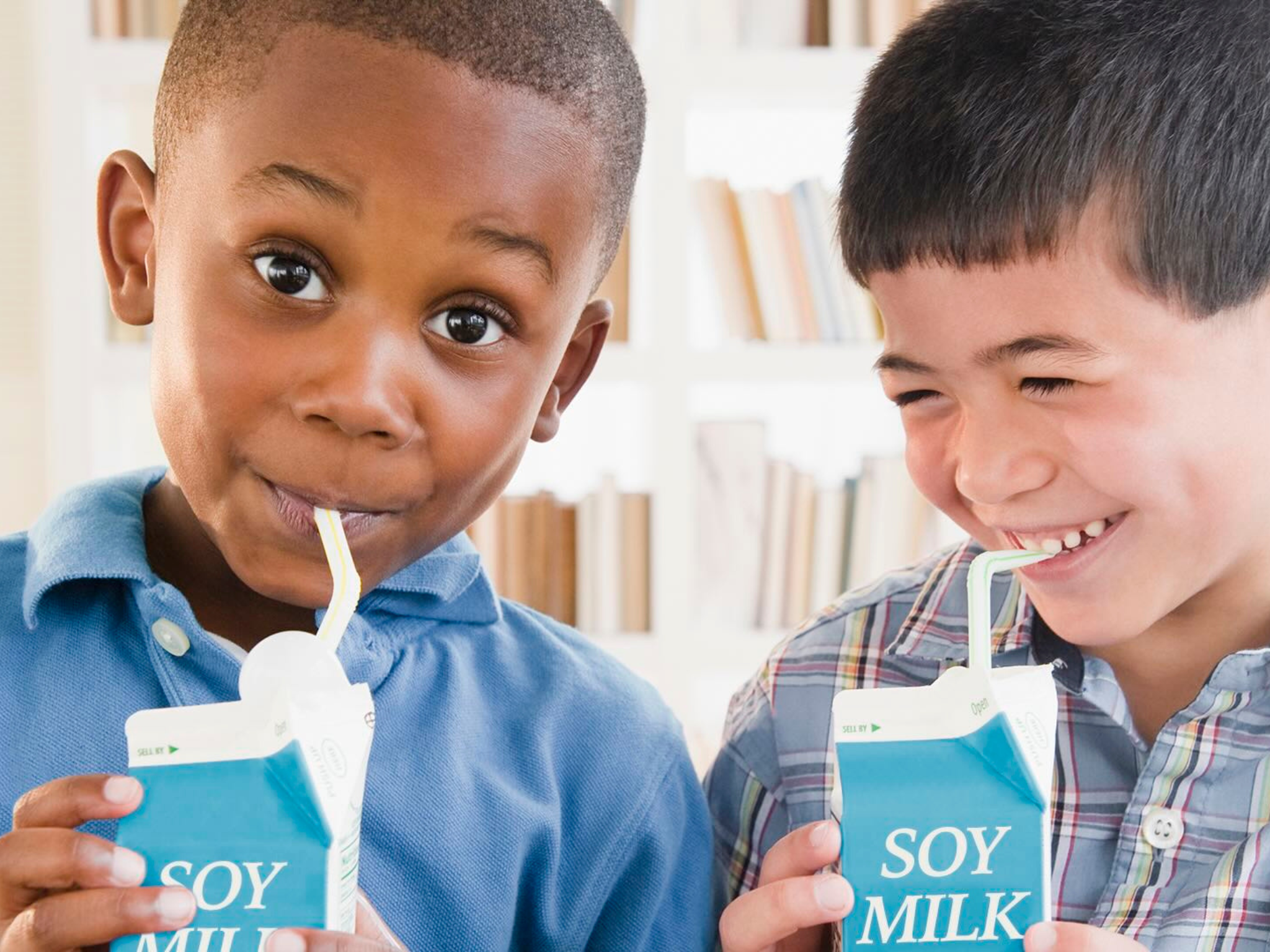
The US House of Representatives has passed the FISCAL Act to expand access to plant-based milk in school lunches. President Donald Trump is expected to sign it into law.
Plant-based milk is one step closer to being available on school lunch trays.
The US House of Representatives has voted to pass the Freedom in School Cafeterias and Lunches (FISCAL) Act, which will empower schools to offer non-dairy milk to students with a note from a parent, guardian or physician.
The measure, passed unanimously in the Senate last month, will now head to the desk of President Donald Trump. Green Queen understands that he is expected to sign it into law within the next few weeks. “I have no doubt that he’s going to sign it. Not one iota of doubt,” Wayne Pacelle, president of Animal Wellness Action and the Center for a Humane Economy, told Green Queen.
His organisations worked alongside advocacy group Switch4Good to facilitate the legislation, which is a companion measure of the Whole Milk for Healthy Kids Act.
“The dairy industry was so monomaniacally focused on getting a whole milk option available to them that they’re not focusing on the plant-based allowances that are provided for in statute now,” he said. “So there really is no major organised effort against it at this point.”
Once Trump signs the bill, it will take effect immediately. “The US Department of Agriculture will update its guidance to schools to reflect the changes, but districts do not need to wait to act,” Chloë Waterman, senior programme manager at Friends of the Earth, told Green Queen. “Schools can begin offering fortified soy milk on the lunch line to any student right away.”
The measure signals a modernisation of the 80-year-old National School Lunch Program (NSLP), scrapping the mandate requiring cows’ milk on every lunch tray.
“This is a watershed moment and a tremendous win for our kids, our planet, and the future of school nutrition,” said Dotsie Bausch, founder and executive director of Switch4Good. “By supporting the inclusion of plant-based milk in the school lunch line, the House has shown that progress, compassion, and science can triumph together.”
How the plant-based milk act will change school policy

The FISCAL Act was introduced into the House by Democratic Representative Troy Carter, who was supported by 11 co-sponsors from across the aisle and over 200 racial and dietary justice advocates and groups.
The bill was eventually merged with the whole milk bill, itself a popular bipartisan bill with 118 co-sponsors in the House. This piece of legislation seeks to overturn an Obama-era reform that prohibited full-fat and 2% milk from being part of the school lunch programme.
Current federal law only guarantees students a substitute for cow’s milk if a parent submits a physician’s note documenting a disability, and prohibits schools from proactively offering plant-based milk on the lunch line. The National School Lunch Act, meanwhile, requires kids to have cow’s milk on their trays for schools to be reimbursed by the government.
In fact, the USDA provides $1B in annual rebates for 1% and non-fat cow’s milk to institutions across the country. Under the FISCAL Act, schools would be reimbursed for non-dairy milk too.
The existing school lunch law states that schools “shall offer students a variety of fluid milk”; the FISCAL Act proposes “fluid milk” be replaced with “milk, including fluid milk and plant-based milk”.
The new legislation ties plant-based alternatives with dairy, which Pacelle indicated was necessary to expand access to the former. “You need a legislative vehicle because Congress is so dysfunctional. It rarely moves standalone legislation,” said Pacelle. “The dairy industry really wanted this vehicle, and we were able to block it and stop it until they agreed to add the plant-based milk option.”
He noted that it was only a matter of time before the whole milk allowance was going to be adopted: “This was our moment to allow plant-based milks to compete against all of those cow’s milk products.”
FISCAL Act will address health, waste and economics

One of the biggest drivers of the FISCAL Act is the prevalence of lactose intolerance in the US: it affects around half of the nearly 30 million children who benefit from the NSLP.
Lactose malabsorption rates are especially high among people of colour, with 65% of Hispanic and 75% of Black Americans suffering from the condition. That number rises to 90% for Asian Americans and 95% for Native Americans.
“It is abundantly clear that the current milk substitute system that the USDA employs is delivering detrimental impacts on students, especially for students of colour who are much more likely to be lactose intolerant,” Carter said.
“Too many children who cannot safely or comfortably consume dairy are being forced to accept containers of cow’s milk on their lunch trays.”
Moreover, the USDA estimates that 30% of milk cartons served in schools are thrown in the trash unopened. And another study found that kids discard 150 million gallons of milk per year, leading to food waste amounting to $400M in tax dollar losses.
The potential passage of the FISCAL Act will therefore help mitigate food waste, save hundreds of millions of taxpayer money, and promote dietary inclusivity.
The final measure will let schools start offering soy, almond and other non-dairy milks straightaway. “We strongly encourage districts – especially those serving high numbers of lactose-intolerant students – to take advantage of this new flexibility, which helps promote equity and reduce unnecessary barriers for families,” said Friends of the Earth’s Waterman.
“In districts that choose not to proactively offer soy milk on the lunch line, families should request a substitute directly from their school,” she added.
What this means for other plant-forward policy proposals

The FISCAL Act’s progress shortly after Democratic Congresswomen Nydia Velázquez and Alma Adams introduced the Plant Powered School Meals Pilot Act, which seeks to create a $10M grant programme to provide plant-based milk and entrées to school students.
Pacelle pointed out that the Republican Party has a narrow majority in both chambers of Congress, but you still need minority support. “You cannot get things done purely by partisanship. Our legislation is bipartisan,” he said.
“Some of the other legislation out there that addresses these really worthy goals has not been able to attract the bipartisan support that’s required. So until that threshold is met, there’ll be challenges for that legislation, but I do think that this is a very important precedent for all of those other bills.”
Could the win for non-dairy milk become a pathway for other plant-forward legislations? “The milk issue is unique,” said Pacelle. “No major animal product has this level or kind of adverse physical effect on consumers.”
“Meat is more of a chronic problem – it leads to cancers and heart disease, but those are not immediately evident. Lactose intolerance is an acute reaction; you feel it immediately, you have diarrhoea, bloating, stomach pains, or even the onset of asthma. That acute reaction is a unique vulnerability of the dairy industry.”
He called non-dairy milk the “most vibrant” category in the alternative protein market. “It’s much more successful than plant-based meats or eggs. You’ve already seen a considerable pickup in the marketplace for the plant-based milks. And I think you’ll see that transfer almost immediately into the school setting once it’s available,” he said.
“It’s just a very easy and logical choice, but you can’t make the choice if it’s not available to you.”
The post US House Passes Bill for Non-Dairy Milk in Schools, With Trump Expected to Sign appeared first on Green Queen.
This post was originally published on Green Queen.