Plant-based giant Beyond Meat has revealed the results of its latest LCA on its flagship burger and made its first carbon disclosure submission in November.
Beyond Meat has released the climate impact data of the latest iteration of its plant-based burger, reiterating its environmental superiority over conventional beef.
The Californian company unveiled its Beyond IV platform of products in early 2024, swapping canola and coconut oils for avocado oil and adding fava beans and red lentils to the formulation of its beef mince and burger.
The changes were meant to boost the taste and nutritional credentials of Beyond Meat’s alternatives, but they also altered the product’s environmental footprint.
Beyond Meat has previously released life-cycle assessment (LCA) results for the first and third versions of the Beyond Burger, the latter coming in 2023. The latest study looks at Beyond Burger IV, and reveals similar reductions in emissions, land use, and water consumption compared to beef.
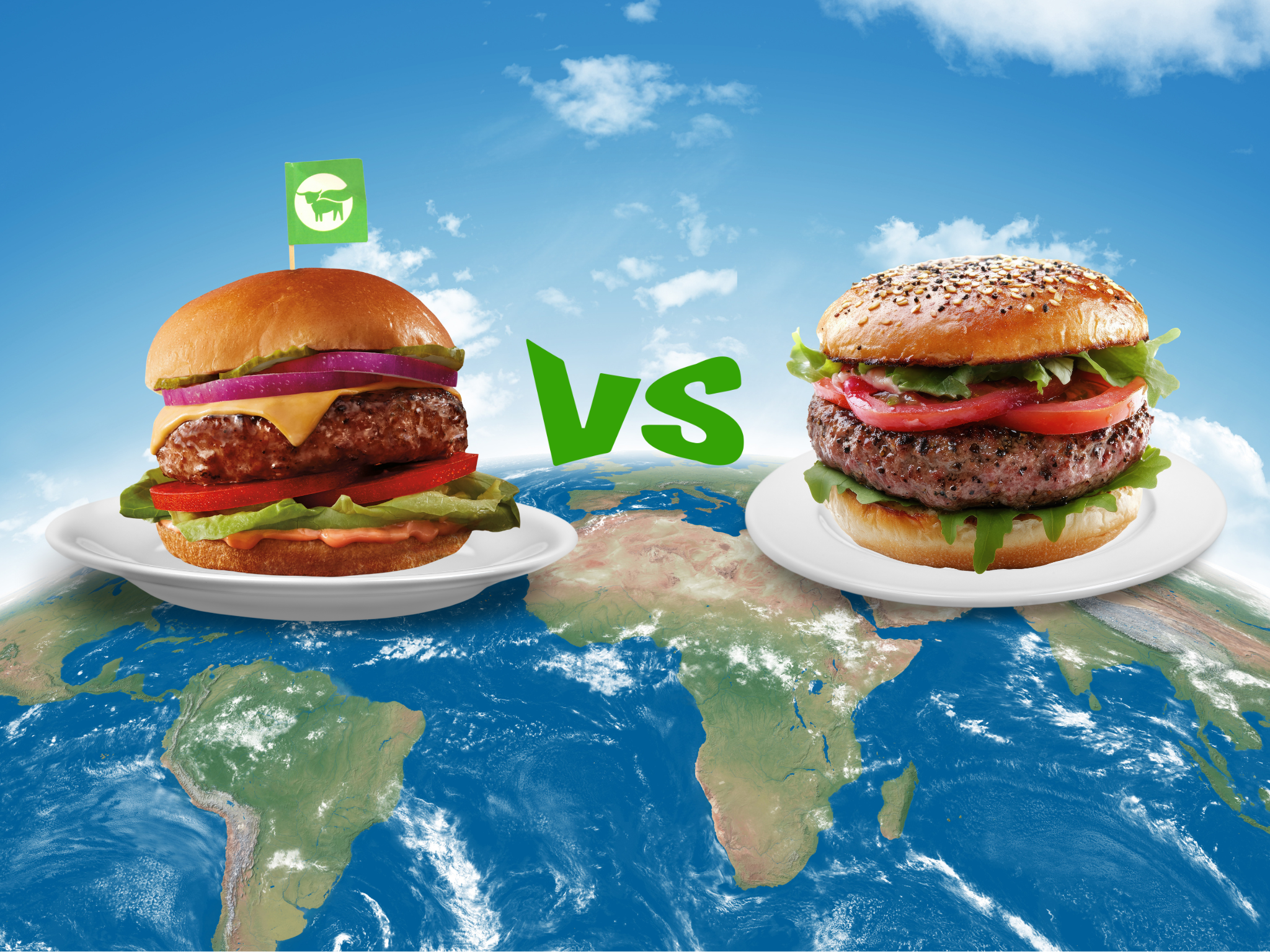
Beyond Burger vs beef: which has the worse environmental impact?
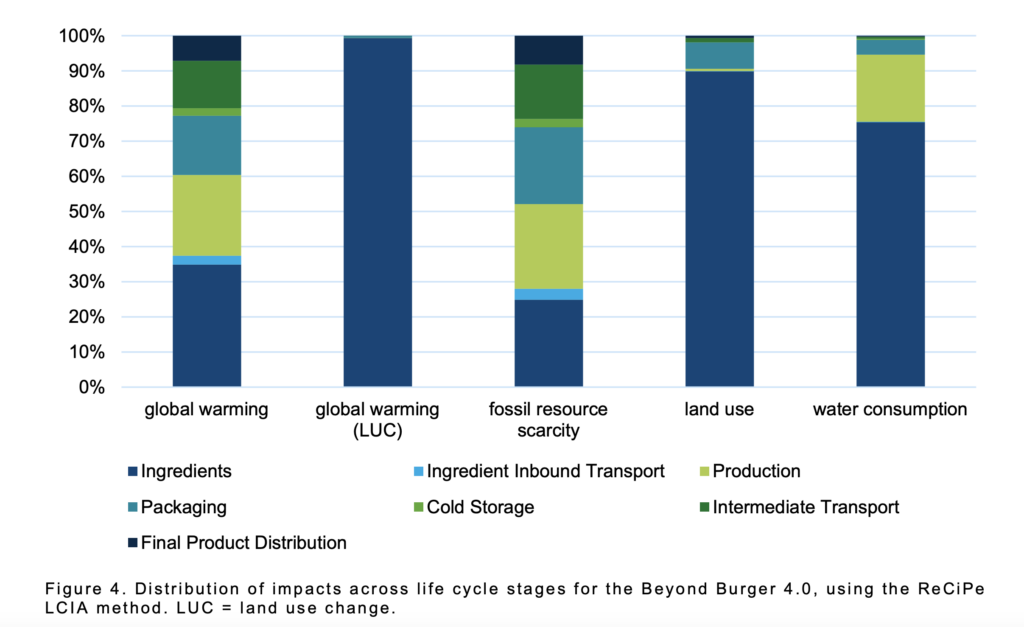
The LCA focused on global warming impact, non-renewable energy use, water consumption, and land use. The data shows that burger manufacturing is the single-largest contributor to the Beyond Burger’s greenhouse gas emissions, accounting for 18.6% of the total.
As a category, though, the production of ingredients is the main culprit responsible for the burger’s climate footprint, totalling 34.9% of its emissions, 25% of its non-renewable energy use, 90% of land use, and 75% of water consumption.
Within the ingredients, the highest impact comes from pea protein, which makes up 8.3% of its emissions, 55% of its land use impact, and 8% of its non-renewable energy use. Avocado oil leads the way in terms of water consumption (contributing to 53% of the total), and accounts for 7.7% of the Beyond Burger IV’s emissions, 12% of its land use, and 3.9% of its fossil energy consumption.
Transportation is another significant driver of the burger’s climate footprint. Refrigerated transport (including both intermediary components and final distribution) makes up 20.6% of its global warming impact and 23% of its non-renewable energy use.
The other major component of the Beyond Burger’s climate impact is packaging, affecting 16.9% of its GHG emissions, 12% of its fossil energy use (via the manufacturing of plastic trays and lids), 7% of its land use, and 4% of its water consumption.
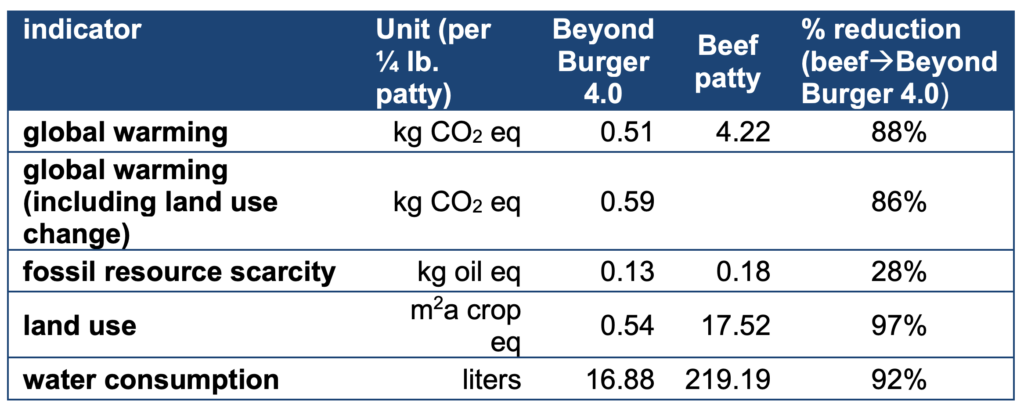
When compared to an 80/20 quarter-pound beef patty in the US, the Beyond Burger IV generates 88% fewer greenhouse gas emissions, and requires 28% less non-renewable energy, 92% less water, and 97% less land.
If the land use change emissions from the Beyond Burger supply chain are included, the vegan product produces 86% fewer greenhouse gases than conventional beef.
Beyond Meat makes carbon disclosure submission to end torrid year
The LCA is part of Beyond Meat’s 2024 Corporate Responsibility Report, which covers climate impacts, packaging, health and nutrition, supply chain management, people, and responsible leadership. The document also includes a corporate-level GHG inventory and a breakdown of the company’s US packaging materials by weight.
It reveals that Beyond Meat lowered its scope 1 emissions by 11% in 2024, compared to the year before, and scope 2 emissions by 12%. The real gain, though, comes from the scope 3 output (which covers emissions from across the supply chain) – here, Beyond Meat’s GHG emissions shrank by 31% last year.
In addition to the report’s release, the plant-based meat company said it made its first submission to CDP (formerly the Carbon Disclosure Project), the world’s largest environmental disclosure database, in November.
These developments cap the most turbulent year in Beyond Meat’s history. It has battled a continued slowdown in sales this year, amid a wider disillusionment with plant-based meat in the US – it posted a 13% revenue decline in Q3, and lowered its full-year forecast.
Its stock price has kept dipping too, starting the year at $3.85 and falling to an all-time low of 52 cents in October, thanks to a debt restructuring deal, a meme stock frenzy, and rumours of bankruptcy, which became loud enough that the company was forced to deny them.
The company has diversified its product portfolio to meet a wider set of consumers. It debuted a whole-cut steak made from mycelium, while simultaneously making a move to drop the ‘Meat’ from its branding to offer whole-food products, starting with the four-ingredient, fava-based Beyond Ground.
Speaking to analysts in Beyond Meat’s Q3 earnings call, founder and CEO Ethan Brown said: “Though category headwinds and an accompanying softer top-line continue to weigh on and reverberate throughout our current performance […], we are closing out the year with a much improved balance sheet, important transformation spadework underway, and genuine optimism and excitement regarding our future.”
The post Beyond Meat Unveils Climate Impact of Plant-Based Burger & Makes Carbon Disclosure Submission appeared first on Green Queen.
This post was originally published on Green Queen.