
Japanese cellular agriculture leader IntegriCulture has partnered with Sumitomo Riko to demonstrate production of its cultivated meat in Singapore, with a goal of filing for approval this year.
On the back of its first profitable year, Japan’s IntegriCulture is expanding its contract manufacturing capabilities and expanding its horizons internationally.
The cellular agriculture startup has so far been spotlighting its cell-based cosmetics business, which enabled it to generate $300,000 in profit last year.
Simultaneously, it has been developing its cultivated meat capabilities, starting with avian cells. The firm showcased several dishes with cultivated duck at its research base last year, and is now hoping to enter the Singapore market.
It has signed an MoU with manufacturing giant Sumitomo Riko to begin demonstrating production processes using avian cells in the city-state, with the goal of filing for regulatory approval within 2026.
The two entities will also launch a domestic contract manufacturing service for cellular agriculture. Additionally, IntegriCulture will work with Malaysian cultivated meat manufacturer Cell AgriTech to validate and launch commercial production in Singapore.
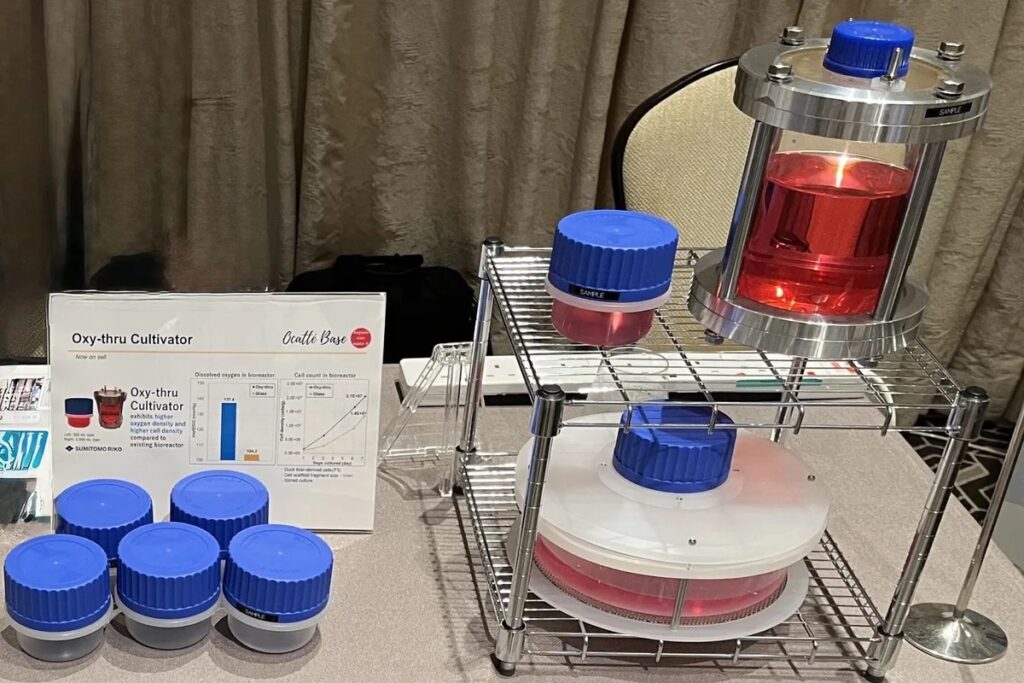
The partnerships will leverage IntegriCulture’s Oxy-thru Cultivator, a novel bioreactor for cost-effective, large-scale cultivated meat manufacturing.
“We are using the Oxy-thru Cultivator for duck liver cells and chicken cells already. We are not seeing any reasons why it does not work for other species,” founder and CEO Yuki Hanyu tells Green Queen. “This extends to plant cells, microalgae and other fermentation-relevant species.”
A novel bioreactor to plug cultivated meat’s cost and scale gaps
IntegriCulture’s strategic partnership with Sumitomo Riko builds on their joint R&D work for the former’s CulNet Consortium, which led to the development of the Oxy-thru Cultivator.
“Oxy-thru Cultivator is a packed-bed bioreactor (a bioreactor that cultures adherent cells growing on an edible scaffold) that makes a hybrid product in one go,” explains Hanyu. “From a bioprocess point of view, it is effectively ‘cell culture in a bucket’ that even the smallest institutions can implement. It can also be used for a suspension culture bioprocess.”
The oxygen-permeable bioreactor leverages Sumitomo Riko’s unique materials and precision moulding technology and IntegriCulture’s cost-effective cultivation expertise. The startup describes it as a two-litre cell-culture bag with a monthly output of 1kg of product per bag.
While it’s common for plastic and glass containers to be used for cell culture, many of these have low gas permeability, so oxygen needs to be supplied externally and the culture medium must be changed frequently.
The Oxy-thru Cultivator is made from a material with high gas permeability, enabling oxygen to be supplied from the bottom and sides of the container, and in greater concentration than external methods. It works by simply being placed inside an incubator and enables higher cell densities and harvests, enhancing the process’s productivity and cost efficiency.
This innovation enables a “scale-out” production model at a time when the cultivated meta industry is struggling to keep investors interested, hampering its efforts to expand production in a cost-effective manner.
“The Capex is much lower compared to typical bioreactors. The process is also highly simplified because cell harvest is just by decanting,” outlines Hanyu.
The bioreactor is central to IntegriCulture’s partnership with Sumitomo Riko, offering cost reduction, risk mitigation, and flexible production. The latter can mass-produce the cultivators by preparing a metal mould, Hanyu notes.
“Through co-creation with innovative deep-tech companies such as Integriculture, we have been able to develop new products in the biotechnology field – a new domain for us – by leveraging our core competence in polymer material technology,” says Satoshi Tatsumi, general manager of Sumitomo Riko’s life innovation business.
IntegriCulture goes international with launch of Singapore operations

So far, IntegriCulture has been focused on advancing its R&D in Japan, but its new collaborations mark its foray into Singapore, a signal of its global outlook for the industrialisation of cultivated meat production. “Singapore’s position in cellular agriculture is obvious, but on top of that, it was about finding the right partner,” says Hanyu.
It has collaborated with Cell AgriTech, which calls itself the world’s most affordable contract manufacturer for cellular agriculture and opened a Health Sciences Authority-compliant facility in the island nation last year.
It invests in equipment and facilities, providing shared, ready-to-use infrastructure with support for bioreactor capacities from 200ml to 5,000 litres. This enables cultivated meat companies to focus on innovation, product development, and commercialisation, lowering the capex and opex for infrastructure and skilled workforce.
As reported by Green Queen, the Malaysian company boosted its capacity last month after acquiring all equipment from cultivated seafood startup Avant’s research arm in Singapore, which wound down its operations in the Lion City.
“We are honoured to be selected as IntegriCulture’s R&D platform partner,” says David Cheng, director of Cell AgriTech Singapore. “This decision reflects their confidence in Cell Agritech’s scientific and operational approach and its ability to translate innovation into scalable outcomes.”
Cell AgriTech will utilise food-grade ingredients – including IntegriCulture’s basal medium, I-MEM 1.0 – and the Oxy-thru Cultivator to validate and scale up cultivated meat production for the Japanese startup. Data collected from these demonstrations will support the latter’s regulatory application to the Singapore Food Agency.
Industry leaders predict that up to a dozen companies are already awaiting approval for cultivated meat in Singapore, which was the first country to greenlight the sale of these proteins, back in 2020. So far, Eat Just’s Good Meat, Vow, Friends & Family Pet Food Company, and Parima have all secured the go-ahead.
IntegriCulture, meanwhile, posted sales worth $1.5M in 2025, breaking even for the first time in its decade-long history. “We see this break-even as an important milestone in building cellular agriculture that makes practical sense,” Hanyu told Green Queen. Looking ahead to 2026, he added: “We are expecting heavy depreciation, but expecting the EBITDA to be positive.”
The post IntegriCulture Teams Up with Sumitomo Riko & Seeks Singapore Approval for Cultivated Meat appeared first on Green Queen.
This post was originally published on Green Queen.