Category: Alt Protein

  • oped plant based burgers
    6 Mins Read

    Notes From the Frontlines of the Sustainable Food Movement – a new opinion column by Irina Gerry

    Critics say plant-based burgers aren’t a health food and are a false solution in the fight to reduce food emissions. Are they right?

    Plant-based meat has become the subject of increasingly intense debate. On one hand, plant-based burgers by startups like Impossible Foods and Beyond Meat are trying to make headway with meat lovers touting their beefy taste and climate credentials. On the other, the real beef fans are firing back with tradition and naturalness, undergirded by our cultural devotion to meat.

    It’s political. It’s emotional. It’s tribal. From Fox News pundits to climate scientists to ranchers, everyone is wading into the great beef debate. So, do plant-based burgers deserve our love or are they an overhyped Silicon Valley invention about to go down?

    Are they better for the environment? Yes.

    Plant-based meat alternatives beat conventional beef by a long shot. Given that beef tops the charts in emissions, land use, and fresh water use among all foods, as well as livestock farming being the leading driver of deforestation and biodiversity loss, it is not hard to see that just about any plant-based alternative would be a dramatic improvement.

    For example, compared to conventional ground beef, the Impossible Burger reduces environmental impacts across every critical category, requiring 87% less water and 96% less land, and producing 89% fewer GHG emissions and 92% less aquatic pollutants. 

    But, aren’t these burgers made from soy and other industrial monocrops, which are bad for the environment? The amount of soy protein, and other edible inputs, going into this burger are far lower than is required to produce an equivalent beef burger. 

    Raising cattle for food is incredibly inefficient. It takes 100 calories of feed to get 3 calories of beef. In the US, we use 65% more productive agricultural lands to grow crops (like corn and soy) to feed farmed animals than we do for all other foods we eat directly. There is likely more indirect soy in your beef burger than in the plant-based one. In fact, 77% of soy globally is used for animal feed, and only 7% is consumed by humans. Livestock farming, and its growing demand for soy feed, is the leading driver of deforestation in the Amazon. But wait, isn’t regeneratively grazed beef good for the planet? Many passionate ranchers promote regeneratively grazed beef as the climate solution, insisting that when done properly, grazed cattle can restore degraded soils and sequester carbon. First, this is not what people eat today, because more than 99% of beef is not regeneratively grazed. Second, regenerative agriculture lacks proper definition and standards, making it impossible to know whether beef marketed as regenerative or low carbon is actually better, or how it stacks up for measurements beyond carbon such as land use, water use, deforestation or biodiversity. Finding this magical climate friendly beef will send you scouring the internet, deciphering dubious marketing claims, and air freighting expensive beef from a handful of small farms, likely negating your effort at a lower carbon footprint. Third, even after decades of research, there is still a lot of uncertainty around the scalability, durability and overall climate impact of regenerative grazing outside of very specific degraded cropland conversion examples, making it more of a niche proposition rather than a scalable climate solution.

    Are they better for the animals? Yes.

    No matter how you view the concept of humans eating animal meat, industrialized animal agriculture is a far cry from the original hunter’s way of killing animals for food. In the US alone, we slaughter over 33 million cattle and calves annually, and 70% of them are raised in factory farms, in conditions that would make most meat lovers cringe. Nearly 99% of chickens, pigs and turkeys are raised in factory farms. There is nothing humane or natural about the way we industrially farm animals for food.
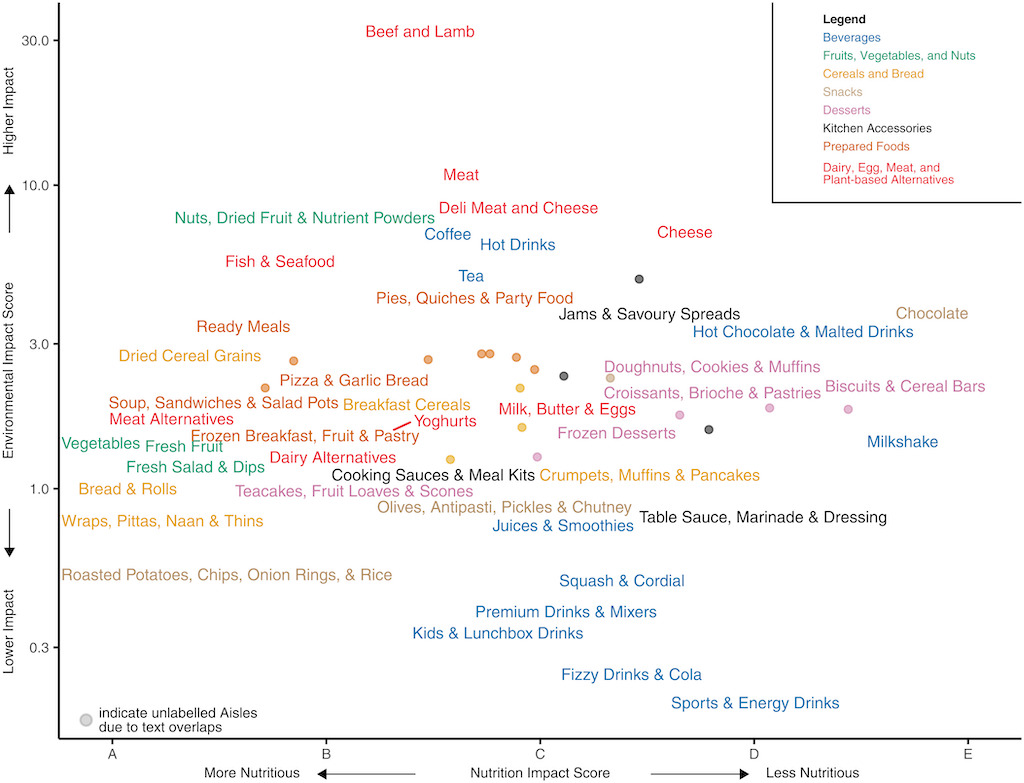
    Figure courtesy of PNAS study: Estimating the environmental impacts of 57,000 food products. Environmental impact score and nutrition impact score per 100 g of multi-ingredient food products.

    Are they better for your health? Probably.

    Consumers are gravitating towards plant-based foods primarily because of their health halo. There is no doubt that a whole-food plant-centric diet is best for our health, but most of us also love a burger once in a while.  

    The Impossible burger is plant-based. It is a savory, chewy, indulgent treat, high in calories and fat. Wonderful with fries on the side. Its healthfulness depends on your point of reference. Is it better than a kale salad? No. Better than its animal-based counterpart? Probably yes, but that doesn’t make it a health food.

    It is a processed food with a relatively long ingredient list. Whole unprocessed plant foods (veggies, legumes, nuts and fruit) are better for our health, but they just don’t deliver the same eating experience that a beef burger does, so I’m ok with a less-than-perfect option for this particular occasion, assuming this is a small part of a diet rich in whole plant foods.

    Despite the processing, I believe a plant-based burger is still a better option for my health based on initial studies and given that red meat is associated with a number of health risks, such as heart disease, diabetes and cancer. Evaluating healthfulness of any given food can be complex, and will largely depend on which specific plant-based burger you choose. For example, Impossible beef has no cholesterol, is lower in saturated fat and higher in iron, plus it contains 5g of fiber, which is critical for gut health, while matching beef on protein and vitamin B12 content. It is made with soy, which may be an issue for some. Good news is that options abound from soy-based Impossible, to pea-based Beyond, to organic minimally processed black bean options to suit any taste and dietary preference. The overall assessment of available research leads me to conclude that plant-based meat is still a better option compared to beef, especially if we cross-tabulate environmental impact with nutrient availability.

    Are they a false solution? I don’t think so.

    Wouldn’t it be better to convince people to eat more whole plant foods, instead of attempting to replicate the less-than-healthy burger? I support the effort wholeheartedly. For years, health, climate and animal rights groups have been beating the drum of whole plant foods, with limited success. Meat is so deeply ingrained in our culture and eating habits, that such a massive dietary shift has not occurred. In fact, the world keeps eating more meat. We are out of time and urgent action on climate is needed. We must reduce the massive environmental footprint of livestock immediately, and that requires deploying multiple solutions at the same time. That should include health education, subsidies and policies targeted at increasing vegetable and fruit consumption, behavioral nudging, and direct substitution with plant-based or cell-based alternatives.

    The plant-based meat innovation strategy is grounded in the belief that it is easier and faster to give people a more sustainable, high fidelity beef analogue than to drive a radical habit change. Much like it is easier to transition people to driving electric cars, than to walking, biking or taking public transport, given the habits and logistics of modern lifestyles.My hope is that a clear understanding of the full impact of beef production on climate, animals and health would lead most of us to significantly reduce our beef consumption, whether it is by choosing whole plants or plant-based meat alternatives. Because with the growing global population and the projected increase in meat demand, we have no hope of meeting the +1.5C degree global warming targets if we stay with the status quo.


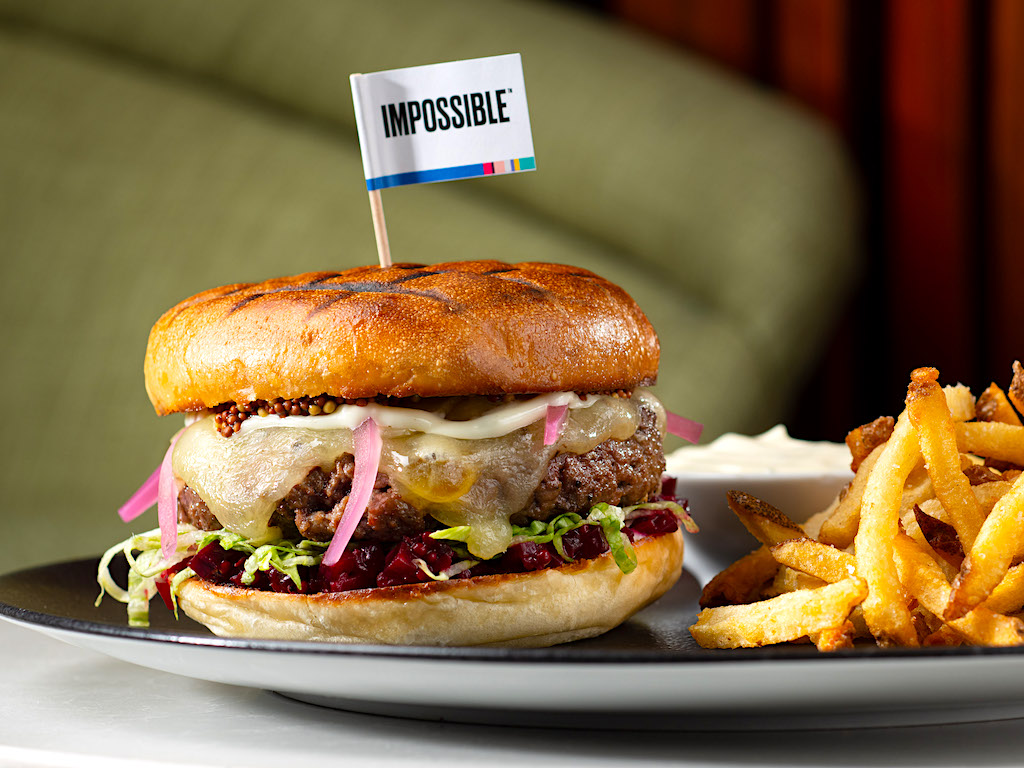
    Lead image of Impossible Foods burger courtesy of Canva.

    The post For the Love of Meat: Are Plant-Based Burgers Overhyped? appeared first on Green Queen.

    This post was originally published on Green Queen.
  • 3 Mins Read

    Rival Foods, the Wageningen University & Research spinoff working since 2019 to replicate animal meat with plants, has announced the closing of a €6 million Series A funding round.

    PeakBridge and Roquette Ventures led the funding round. Rival Foods says the funding will help expand operations and technologies while working to develop new protein sources and formulations. It expects to launch its first product by next summer.

    Novel protein development

    “The expertise and technology required to create thicker, 3D plant-based meat products that closely resemble animal commodities such as chicken breast, pork chops, and salmon fillets, is one of the major unmet needs in the alternative protein industry. There is a large market for alternative protein products,” the company said in a statement. “Whole-cut beef, which is now underutilized with alternative proteins.”

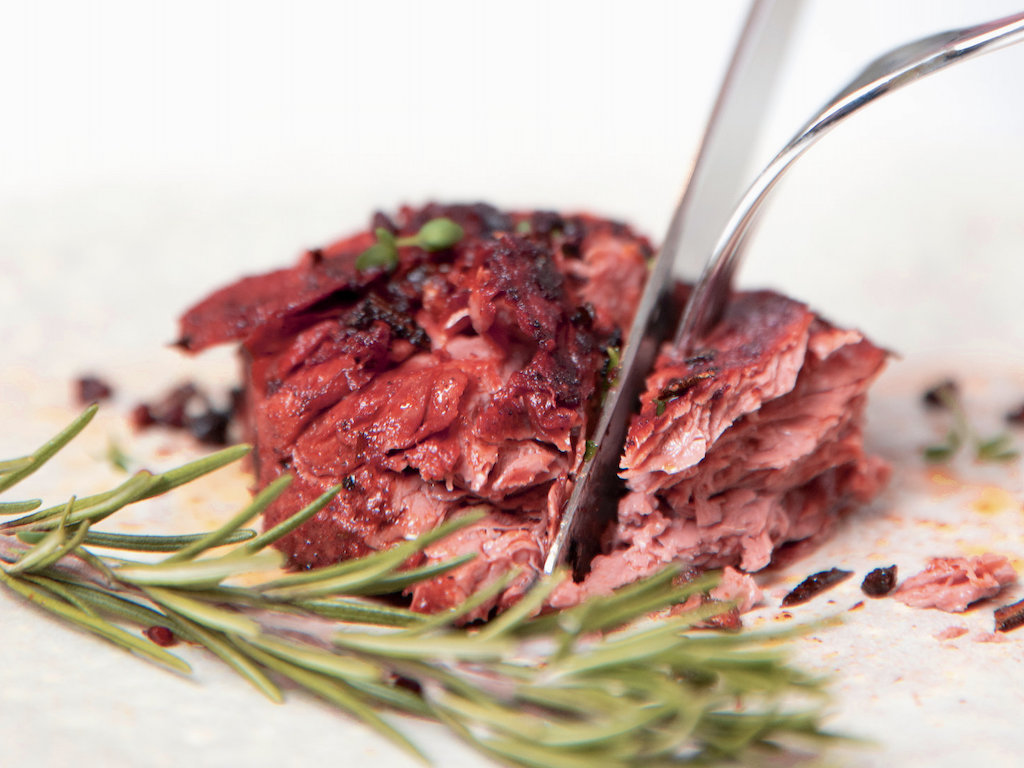
    Rival Foods Whole Cut Chicken
    Rival Foods Whole Cut Chicken | Courtesy

    Rival chose PeakBridge and Roquette Ventures for their food tech expertise and work with alternative protein upscaling. PeakBridge has funded Imagine Dairy and Supernatural, among others.

    According to Rival Foods, a big opportunity lies in producing “thicker, 3D plant-based meat products that more accurately mimic animal products like chicken breast, pork chop, and salmon filets.” It’s also angling to provide consumers with cleaner label products that are free from excess additives and fillers.

    Through its machines and technology, the company says its processes can transform a wide range of ingredients into healthy plant-based meat products with “an unparalleled fibrous texture, rich mouthfeel and juiciness.”

    Whole cut vegan meat

    Whole-cut vegan meats are the holy grail of the plant-based sector. Companies have been hard at work aiming to replicate the taste, texture, and function of whole cut meats but few have yet to perfect it.

    Earlier this month, Swiss startup Planted Foods raised $72 million for its whole-cut and skinless vegan chicken breast. U.S.-based Meati has been perfecting its whole-cut and whole-food-based mushroom meat to market. Earlier this summer it received backing from Mexican fast-casual chain Chipotle in its $150 million Series C.

    Meati mycelium steak | Courtesy

    The number of consumers identifying as flexitarian continues to rise. But according to Rival Foods, nearly half (45 percent) say they aren’t impressed with the taste and texture of current offerings. Rival

    “The sustainable future has a number of major challenges that we need to work on with society. Think of the energy and food transition. The latter focuses on the question of how we can sustainably feed the growing world population, without harming the earth. To do this, people have to switch from mainly animal proteins to more vegetable proteins, as in the past. We do not need the large amount of animal proteins that we now get from meat, and moreover it is unsustainable to produce so much meat for the climate, humans and animals. In addition, eating a lot of meat is not necessarily healthy—not to mention animal welfare,” Rival Foods co-founder Birgit Dekkers told Change.inc last year.

    “At Rival Foods, we believe that you should offer people good, tasty and affordable alternatives,” she said. “That way you can tempt them to make different choices.” 

    The post Rival Foods Raises a €6 Million Series A to Improve on Plant-Based Meat Development appeared first on Green Queen.

    This post was originally published on Green Queen.
  • Mosa Meat FBS

    3 Mins Read

    Emerging from stealth mode, the celebrity-backed Prolific Machines is about to bring down the price of cultivated meat significantly.

    Profilic Machines’ $42 million was raised a year ago and comes from a long list of seed and an oversubscribed Series A investors including Shark Tank investor Mark Cuban and model and actress Emily Ratajkowski.

    The seed was led by Arvind Gupta at Mayfield, and Breakthrough Energy Ventures led the Series A round. Funding also came from David Adelman, The Kraft Family, David Rubenstein, Michael Rubin, Breyer Capital, The SALT Fund, Purple Orange Ventures, Fred Blackford, Jake Poliskin, Matt Katz, Baruch Future Ventures, Kevin Love, Tobias Harris, Meek Mill, Ciara and Russell Wilson, Maverick Carter, Sean Feeney, Michael Schulson, Mark Bucher, and RJ Melman.

    The company is now preparing for its Series B, which will aim for $170 million to further accelerate its tech.

    Funding the future of food

    With the growing demand for sustainable protein, cultivated meat development has taken a starring role in the future of food. President Biden’s recent endorsement and funding for biotech are expected to accelerate U.S. approval for cultivated meat. But for a number of producers, cost is still an issue, often the core barrier to entry. Prolific Machines is emerging with tech it says can help scale up production and scale down costs at the same time.

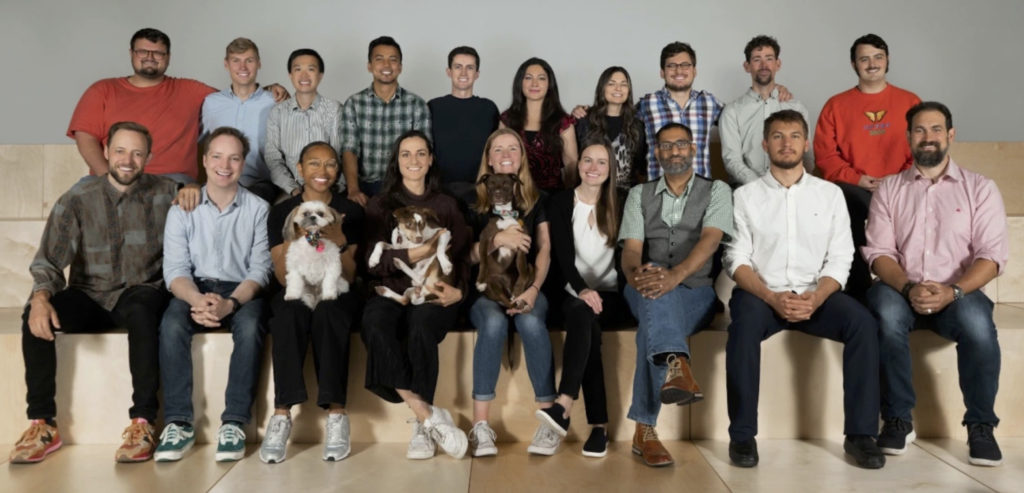
    Prolific Machines Team
    Prolific Machines Team | Courtesy

    “You have to use these growth media proteins which are some of the most expensive things — one of the proteins we are replacing is like 30,000 times more expensive than a gram of gold,” Prolific Machines co-founder and CEO Deniz Kent told TechCrunch. “It’s really hard to scale anything for this reason because you have to use these proteins.”

    Cultured meat uses cell samples taken from live animals. But from there, the cells are grown in lab settings, often bioreactors, where they’re fed a diet of nutrients. This had first been fetal bovine serum (FBS), a controversial ingredient. But a growing number of producers have supplanted the ingredient for plant-based media that’s often less expensive than FBS.

    Price parity

    Prolific Machines says its unique approach can do for cell-cultured meat what Henry Ford did for automobiles: make it cheaper.

    “Back then, nobody really owned cars apart from super-rich people. What really changed things was Ford,” Kent said.

    “They built the assembly line for cars and found a way to manufacture cars at a price that normal people could afford. That transformed the industry because then you went from hundreds of car companies to only three companies having over 70% of the market.”

    Upside Foods’ EPIC factory, Courtesy

    Its tech brings prices down and increases availability by eliminating the need for growth media entirely. It plans to bring products to market and license its tools to companies already in the space—and there are many. Data from the think tank the Good Food Institute shows more than 100 cultivated meat and seafood startups launched last year alone, a number up 25 percent from 2020.

    “I never intended to invest in another cultured meat company, but when Deniz showed me what they were doing, I was blown away by the creativity in their approach to reinvent the assembly line for food production,” Gupta said in a statement. “It is my goal to help reverse climate change by partnering with incredible teams, and I am convinced Prolific Machines will be a winner in the race for sustainable food production.”

    Prolific Machines is building a 25,000-square-foot headquarters in Emeryville, California—not far from cultivated meat producer Upside Foods ‘Epic’ facility that can produce 400,000 pounds of cultivated meat per year. The facility should be done by next spring.

    The post Mark Cuban and Emily Ratajkowski Back Prolific Machines’ $42 Million Raise to Scale (Cheap) Cultivated Meat appeared first on Green Queen.

  • Standing Ovation dairy
    3 Mins Read

    Paris-based food tech company Standing Ovation has closed an oversubscribed €12 million Series A financing round to scale its animal-free casein and alt-cheese products. The new funding was led by Astanor Ventures, with participation from Peakbridge, Seventure Partners, Big Idea Ventures, and Good Startup, among others.

    Standing Ovation’s Series A funding comes less than two years after the company launched. It’s leveraging the raise to scale its technology and output to meet the growing demand for animal-free cheese.

    ‘Tremendous potential’

    “Standing Ovation’s technology has a tremendous potential,” Frederic Paques, CEO of Standing Ovation, said in a statement. “However, bringing the products rapidly to the market requires significant resources, and substantial funding had become necessary. Astanor Ventures, which had already supported us at an earlier stage, understood it as did the other participants in this round. We would like to thank all our investor partners for their support and their confidence in the team.”

    Standing ovation cheese
    Standing ovation cheese | Courtesy

    According to Romain Chayot, Scientific Director of Standing Ovation, in only two years, the company has developed a unique and highly technological process. “We are now in a strong position to build on this momentum and transition towards more logistically intensive stages, especially scaling up,” he said.

    “Standing Ovation’s technology represents a paradigm shift for the animal-free dairy market,” Eric Archambeau, co-founder of Astanor Ventures, said. “Casein is the holy grail for the production of alternative options that match conventional products in nutrition, taste and texture yet it has remained notoriously difficult to create. The founders’ experience in biotechnology enabled them to find the key to casein development, a step ahead of many companies. We are greatly impressed by the team’s advancements over the past year both in product and process development and are excited to support them in this next step of their journey.”

    Harnessing the power of casein

    Standing Ovation says its process is “simple but innovative” and harnesses the power of casein without any animal material. Casein is what gives cheese its melting and stretching properties. It says it’s proven that its fermented casein can be combined with other products to produce “true replicas” of both fresh and soft cheese.

    Nutropy cheese | Courtesy

    Last week, another Paris-based cheese startup, Nutropy, raised €2 million in a pre-seed round for its fermented cheese.

    Both companies are targeting French cheese and the increasing demand for more sustainable options. The country has been championing sustainability in its wine production in recent years as the impact of climate change has taken a toll on wine producers.

    Livestock production makes up about 15 percent of global greenhouse gas emissions and cattle is the leading livestock producer of methane, a greenhouse gas that traps more heat than CO2.

    The post Standing Ovation Closes €12 Million Series A for Precision Fermentation Casein appeared first on Green Queen.

    This post was originally published on Green Queen.
  • 4 Mins Read

    Biotech is a priority for the Biden Administration, as the President signed an executive order earlier this week implementing support for the emergent category. Funding amounts were not disclosed but Biden says biotech holds the potential to fight cancer and make alternatives to emissions-producing products including oil-based chemicals, plastics, and textiles, as well as animal-free meat and dairy products.

    Calling it a cancer ‘moonshot’, at the John F. Kennedy Presidential Library in Boston earlier this week, he compared biotech to the former president’s moon landing initiative. Biden says he hopes to cut cancer deaths by 50 percent over the next quarter-century.

    Photo by Talha Hassan on Unsplash

    “Today I’m setting a long term goal for the Cancer Moonshot – to rally American ingenuity, we engage like we did to reach the moon, but actually cure cancers…once and for all,” Biden said. The president’s son Beau died of brain cancer in 2015 at age 46.

    “Today’s action is going to ensure that America leads the world in biotechnology and biomanufacturing, creating jobs, reducing prices, strengthening supply chains so we don’t have to rely on anywhere else in the world,” Biden said.

    Biotech revolution

    In a press call with White House staff, a senior administration official said the announcement and order come as the global industry is “on the cusp of a revolution powered by biotechnology.” 

    “Analyses and facts suggest that before the end of the decade, engineering biology holds the potential to be used in manufacturing industries that account for more than one third of global output.  That’s equivalent to almost $30 trillion in terms of value, the White House official said.

    “Living factories — cells — and biomass can be used to make almost anything that we use in our day-to-day lives, from medicines to fuels to plastics.  And this allows the U.S. to leverage innovation — this innovation — to strengthen our economy and society.”

    Photo by Alejandro Barrón from Pexels

    The administration says it’s also looking to improve food security and drive agricultural innovation, “including through new technologies that protect crops from disease, enhance seeds and fertilizers and foods made with cultured animal cells.”

    Dr. Michelle McMurry-Heath, president & CEO of the Biotechnology Innovation Organization, welcomed the move.

    “We commend the administration for launching this initiative, particularly the actions to streamline regulatory regulations for biotechnology products, expand market opportunities for biobased products, work for international alignment of regulatory standards, and invest in training and education pathways to ensure an adequate, diverse biotech workforce,” McMurray-Heath said in a statement.

    Biotech ag

    “This announcement puts in place steps that will help the soy industry continue to use soybeans to develop innovative, sustainable products that can help lower greenhouse gas emissions and create more jobs for not only agriculture but all Americans,” American Soybean Association President Brad Doyle said in a statement.

    “We are also pleased to see included measures that support agricultural biotechnology regulatory reform, along with quite a few other provisions.”

    Upside Foods’ EPIC factory, Courtesy

    The move is also expected to speed regulatory approval for cultivated meat in the U.S and around the world. The industry raised $1.38 billion last year, according to the Good Food Institute. Last year saw the launch of more than 100 cultivated meat and seafood startups—a number up nearly 25 percent over 2020. Twenty-five countries now have at least one cultivated meat company.

    U.S.-based Upside Foods, which has raised more than $600 million and is now valued at more than $1 billion, opened a $50 million California factory last year that it says can produce 400,000 pounds of cultivated meat per year. Currently, only Singapore has approved the sale of cultivated meat products for Bay Area’s Eat Just Good Meat.


    The post Biden’s Biotech Moonshot Lights the Way for Regulatory Approval of Cultivated Meat appeared first on Green Queen.

    This post was originally published on Green Queen.
  • Revo Foods product range
    3 Mins Read

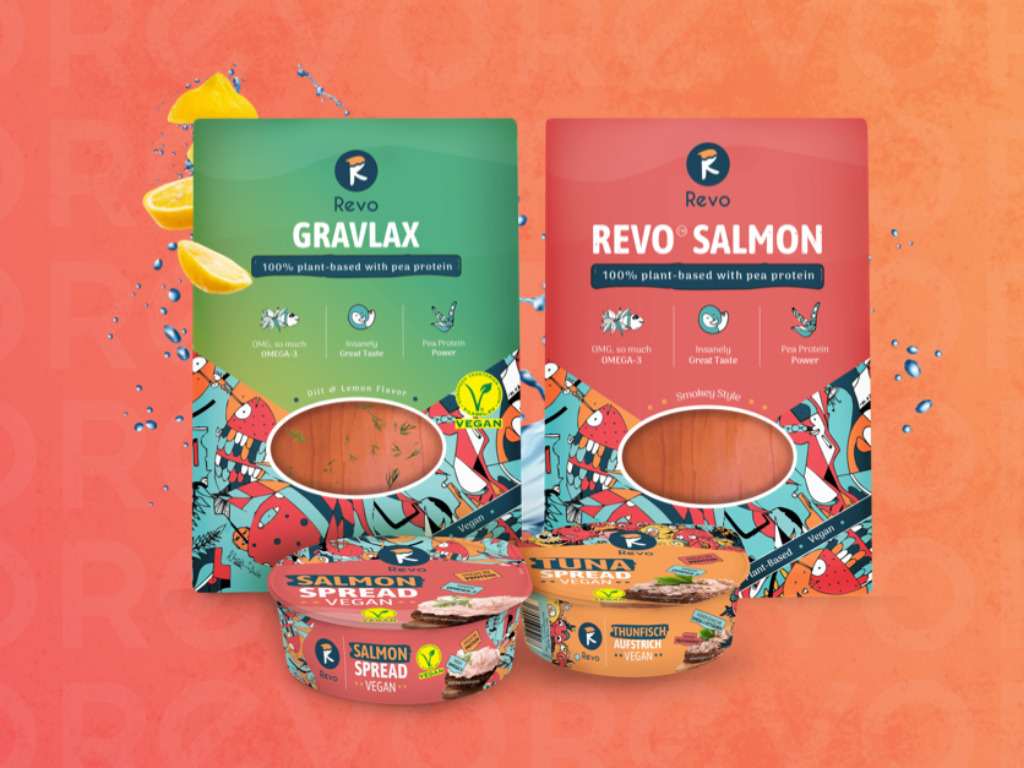
    Austria’s Revo Foods is bringing three new vegan products to market this week: Graved Salmon, Salmon Spread, and Tuna Spread. It says the Graved Salmon and Salmon Spread are new to the plant-based seafood category.

    “With the release of these 3 unique products, we reached a new milestone in the dynamic market of plant-based seafood alternatives. Not only are we the first company in the world to release a plant-based alternative to graved salmon and salmon spread, but with our more than 2500 selling points all across Europe, we are having a real impact on sustainable seafood products,” Robin Simsa, CEO of Revo Foods, said in a statement.

    Novel seafood tech

    Revo, which recently secured a €2.2 million grant from the Austrian Research Promotion Agency, is using a novel “Fiber Dispension Technology” to develop individual fiber strands in the plant protein, which mirrors the bite and mouthfeel of conventional tuna. The company says this will be used to develop more realistic seafood alternatives in the future. 

    Courtesy Revo Foods

    The new products also tap into a high protein and high omega-3 fatty acid content from microalgae oils that deliver EPA and DHA fatty acids.

    Revo is bringing its products to Austrian supermarkets with plans to expand quickly to locations throughout Germany, Denmark, and the UK.

    The new products follow Revo’s initial Salmon launch last November, which saw the startup expand to 18 countries and more than 2,500 locations across Europe where the brand quickly established itself as a category leader.

    Revo’s quick market penetration points to the category opportunity for the alt seafood sector. A recent consumer survey in the world’s leading seafood-consuming countries across Asia found consumers were more interested in alternatives to conventional seafood than ever. Much of the demand comes from an interest in avoiding heavy metals and microplastics common in both wild-caught and farmed fish.

    Vegan seafood demand

    Last week, U.S.-based vegan seafood brand Good Catch announced it was being acquired by Wicked Kitchen. Both companies were founded by chef brothers Chad and Derek Sarno. The move is expected to foster rapid growth for the seafood products that include tuna and crab cakes. Wicked Kitchen is sold in all Tesco stores in the U.K., and recently expanded its U.S. presence to Kroger and Sprouts stores, among others.

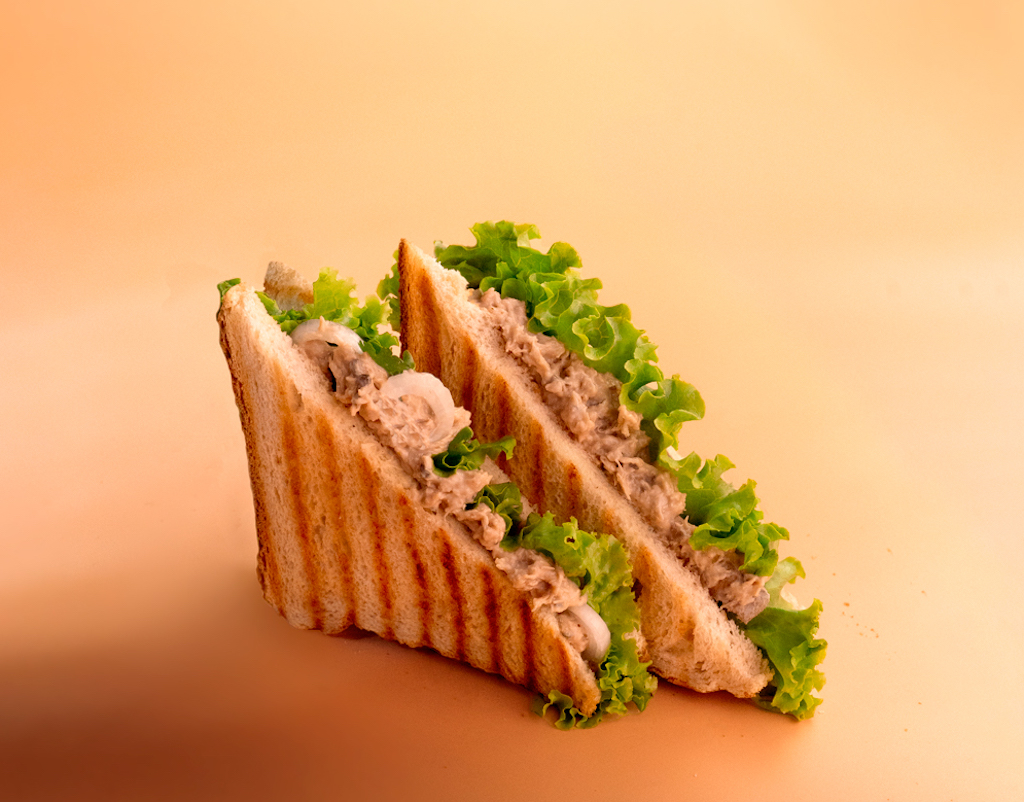
    revo foods tuna
    Revo Foods Tuna Sandwich | Courtesy

    According to recent findings by the Good Food Institute APAC, alternative seafood companies doubled their funding raises to US$175 million last year over 2020 numbers.

    “Consumers also want products that can match or exceed the nutritional value, freshness, and affordability of the conventional seafood they know and love,” Mirte Gosker, Acting Managing Director of GFI APAC, said in a statement.

    “Satisfying these demands will require substantially more investment from public and private stakeholders into open-access research and development aimed at improving the quality and cost of plant-based and cultivated seafood products,” she added.

    The post Novel Vegan Seafood Development From Revo Foods Signals a Sea Change appeared first on Green Queen.

    This post was originally published on Green Queen.
  • Magic Valley lamb meat
    3 Mins Read

    Australian food-tech company Magic Valley says it has created a prototype for the country’s first cultivated lamb meat.

    It’s a move the company says is aimed at meeting Australia’s changing dietary preferences. According to Magic Valley, more than 33 percent of Australians are looking at ways to reduce meat consumption. 

    Global lamb consumption

    While a number of food tech companies are tackling chicken, pork, and beef, lamb has seen far fewer innovations in the space. But there’s an urgent need to address lamb consumption as it is the fourth most consumed land-based meat in the world—about a quarter of the global population regularly consumes lamb, a number that’s climbed from 20 percent a decade ago. That number is only expected to rise as income levels rise in countries including China, which consumes the most lamb in the world.

    Lamb is a leading contributor to climate change due in large part to the methane emissions. A single sheep can produce about 30 litres of methane each day. Methane traps more atmospheric heat than carbon dioxide. The world’s leading climate experts say an urgent 30 percent drop in methane emissions is needed to help keep the planet from surpassing the 1.5°C temperature rise over pre-industrial levels.

    Paul Bevan, Founder and CEO, Magic Valley
    Paul Bevan, Founder and CEO, Magic Valley | Courtesy

    “By 2024, cultivated meat products will be indistinguishable from traditionally farmed meat, with the ability to enhance nutrients to positively impact the human population,” founder and CEO Paul Bevan said in a statement.

    “With the global population predicted to reach 10 billion people by 2050, the traditional methods of animal agriculture are simply inadequate to meet the protein needs of our future generations. The move away from traditional meat consumption is motivated by many different reasons for Australians, but the science has shown that if we are not feeding livestock and instead feeding ourselves, this is a viable way to nourish the human population beyond 2050,” Bevan said. 

    Making cultivated lamb meat without FBS

    The lamb cells were taken from a small skin biopsy of a lamb named Lucy, who the company says is “happily residing in a field in New South Wales.” The cells were then turned into induced pluripotent stem (iPS) stem cells that can grow in “an unlimited and scalable way”.

    These cells can also grow to produce muscle and fat. The tech allows Magic Valley to bypass the need for a growth medium like Fetal Bovine Serum (FBS)—all that’s needed is the initial tissue sample, which can be done with little harm to the animals. Magic Valley says the use of this tech marks a world’s first for lamb meat.

    Magic Valley lamb meatballs
    Magic Valley lamb meatballs | Courtesy

    According to Magic Valley, its cultivated lamb meat looks and cooks just like conventional lamb but with the potential for a healthier nutrition profile. The company is currently using cultivated lamb for burgers and tacos.

    Magic Valley says the cultivated meat market could make up more than 30 percent of the global $1.8 trillion meat market by 2040. 

    “The positive impacts cultivated meats can have not only have the potential to save over 70 billion animals per year, but also lays the groundwork for a more environmentally sustainable future by significantly reducing global greenhouse gas emissions by 92 percent,” the company said. Magic Valley anticipates bringing its products to market by 2024 pending regulatory approval and a forthcoming $5 million seed capital raise.

    Photos courtesy Magic Valley

    The post Australia’s Magic Valley Takes on the Growing Demand for Lamb With Novel Cultivated  Meat Tech appeared first on Green Queen.

    This post was originally published on Green Queen.
  • 3 Mins Read

    Nestlé announced earlier this week that it is preparing to launch a new product using Perfect Day’s precision fermentation whey. The announcement builds on the multinational food giant’s recent investments into plant-based meat and dairy products.

    Tight-lipped on what the product will be, Nestlé did say in a statement that it’s piloting a “novel” product through its new research and development accelerator program. The product is expected to launch in U.S. stores later this year.

    “As the world’s largest food and beverage company, delivering foods and beverages that are good for people and the planet is a priority,” Heike Steiling, Head of Nestlé’s Development Center for dairy products said in a statement.

    Nestlé’s vegan KitKat | courtesy

    “We are exploring emerging technologies that can lead to animal-friendly alternatives that are nutritious and sustainable, without compromising on taste, flavor, and texture. Bringing together our unmatched R&D expertise, innovation capabilities and scale, we are working to develop and test novel animal-free dairy protein-based products to complement our wide-ranging portfolio of plant-based alternatives.,” Steiling said.

    Perfect Day’s precision fermentation technology creates a dairy-identical whey without the need for raising cows. The company says its milk protein produces up to 97 percent fewer carbon emissions than traditional milk products. Animal agriculture is a leading cause of global warming accounting for nearly 15 percent of all annual emissions.

    Nestlé says it developed the product in Switzerland with its R&D team. The company says it’s “well-equipped” to deliver relevant consumer solutions in this emerging space. Most recently, Nestlé’s vegan KitKat bar expanded its placement across more than a dozen countries. The food giant also owns well-known vegan food brands Garden Gourmet and Sweet Earth, among other plant-based offerings.

    Courtesy Perfect Day

    “We are excited to pilot Nestlé’s first animal-free dairy protein-based products through our U.S. R+D Accelerator,” said Joanna Yarbrough, head of the R+D Accelerator. “While this category is still very young, we know consumers are looking for products that have a reduced environmental footprint, and we are evaluating this avenue as a future growth opportunity for our business.”

    Dairy products remain an important part of Nestlé’s portfolio, providing essential nutrients,
    especially for young children,” and contributing to the economic livelihoods of farmers globally. “Therefore, Nestlé continues to explore solutions and technologies to make dairy more climate-friendly,” the company said.

    Perfect Day has gone all-in on its high-profile partnership strategy in recent years. Earlier this year it partnered with confectionery brand Mars on a vegan chocolate bar. Last year its whey appeared in the General Mills vegan cream cheese brand Bold Cultr. It has also partnered with a number of other manufacturers including ice cream brands Brave Robot and Cool Haus.

    The post What Is Nestlé Cooking Up With Perfect Day’s Precision Fermentation Whey? appeared first on Green Queen.

    This post was originally published on Green Queen.
  • liquid death
    2 Mins Read

    With its recent $330 million raise, PowerPlant Partners’ third fund, the PPV Fund III, will shift to focus solely on growth-stage vegan companies.

    According to PPV founders Daniel Gluck and Mark Rampolla, this is the first “true growth equity fund” for the vegan industry.

    “We are thrilled to receive such strong support and commitment from our limited partners, especially during a period of increased market volatility,” Gluck said in a statement. “This new fund will allow us to deepen and grow our efforts to find, fund and scale breakthrough companies that are building a healthier, more sustainable future.”

    Expanding vision

    Rampolla says the additional capital will allow PPV to expand its team and build “an even stronger” bench of industry-leading operating advisors and partners.

    “This will enable us to continue to bring an unparalleled level of insight and support to companies and apply our experience to a wider range of businesses that put human and planetary life at the center of business,” Rampolla said.

    PowerPlant Partners founders Daniel Gluck (left) and Mark Rampolla (right) | Courtesy

    PowerPlant Partners says it’s also expanding its strategic vision beyond plant-based products to include adjacent technology, service, and enablement companies “that put human and planetary life at the center of business.”

    This shift, the company says, will enable the firm to grow its platform and offer a “more integrated network” for its portfolio companies and partners.

    The platform has already made four investments into vegan and sustainable companies including Miyoko’s Creamery, Liquid Death, Partake Brewing, and SYSTM Foods. PPV III is aiming to invest between $15-40 million in companies with $10-75 million in annual revenue.

    A changing industry

    The move away from startup investing signals a shift in the increasingly crowded plant-based and sustainable consumer packaged goods industry.

    “We have transitioned to focus on larger, more established growth companies, with a direct path to profitability in one to three years,” Gluck told Forbes.

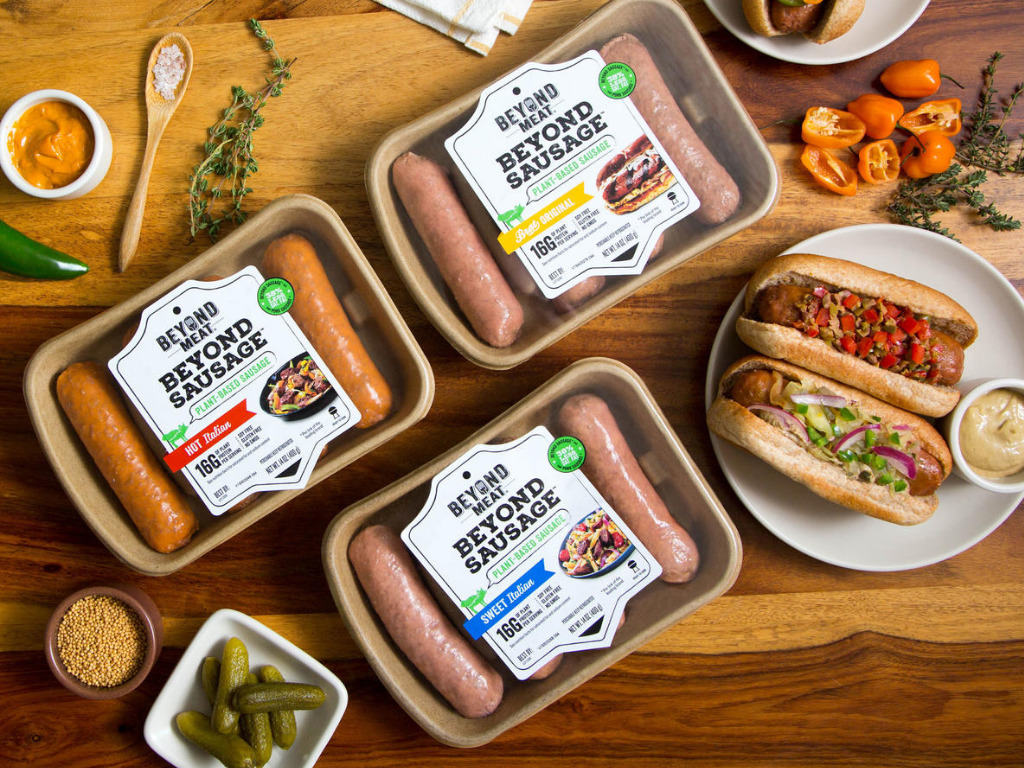
    Plant-based Beyond Meat Sausage | Courtesy

    “We have always invested in businesses that put human and planetary life at the center of business, and every single one of our portfolio companies is already embracing this theme,” Gluck said.

    “We are taking our proven platform in the consumer-wellness space, leveraging it to tangential sectors, and offering a more integrated and synergistic network for our portfolio companies and partners. Through our expansion, we will bring our portfolio companies an unparalleled level of insight and support.”


    The post PowerPlant Partners Raises $330 Million to Focus on Growth-Stage Eco Companies appeared first on Green Queen.

    This post was originally published on Green Queen.
  • forsea foods
    3 Mins Read

    Moving cell-cultured seafood “closer to nature,” Israeli newcomer Forsea Foods says it’s turning its attention to a bottleneck in the seafood industry by focusing on eel meat.

    Ashdod, Israel-based Forsea Foods says its patented organoid technology—stem cell-derived three-dimensional tissue structure—doesn’t require as many growth factors as other cell-based meat. The technology, developed by Iftach Nachman, PhD, co-founder of Forsea, is also used in developmental biology, medicine, and research.

    Self-organizing cell structures

    “While cell cultivation largely focuses on a system of directed differentiation, where cells are signaled to differentiate into a specific cell type and are then combined on a scaffold, our system grows the aggregate of the various cells already at the initial stage of the process. The cells organize themselves autonomously into their innate, purposed structure, just as in nature,” Nachman said in a statement.

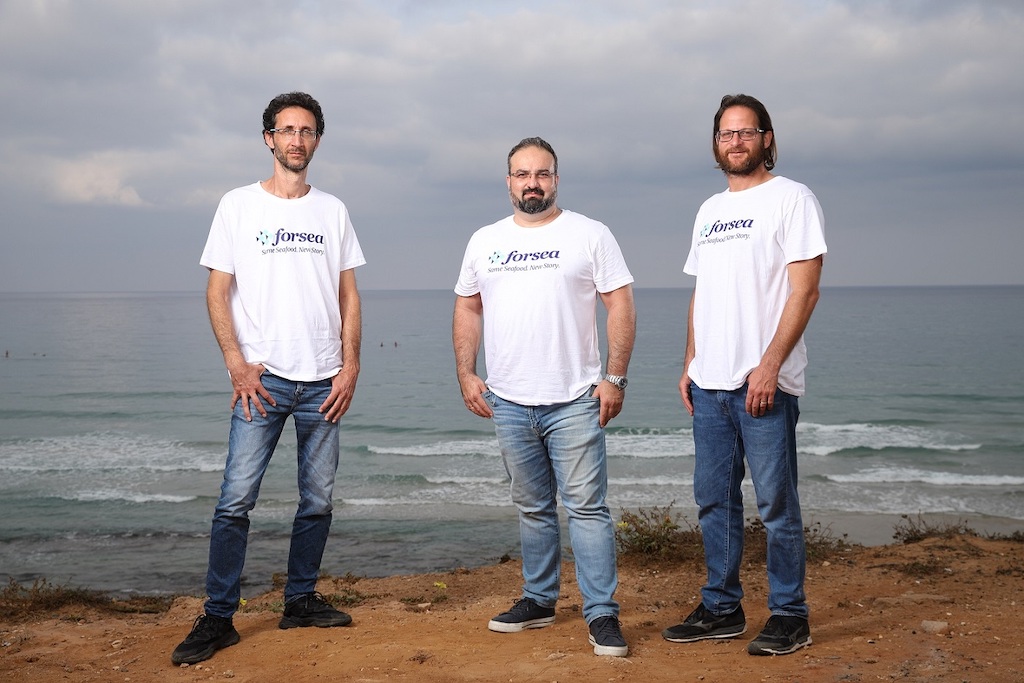
    Forsea Team - Yiftach Nachman, Roee Nir, Yaniv Elkouby copy
    Forsea Team – Yiftach Nachman, Roee Nir, Yaniv Elkouby | Courtesy

    “This is a function of how you nourish the cells,” Roee Nir, a biotechnologist and CEO and co-founder of Forsea, said.

    “There are multiple benefits to the organoid method of cell cultivating fish,” says Nir. “First, it is a highly scalable platform that bypasses the scaffolding stage and requires fewer bioreactors. This makes the process much simpler and more cost-effective. Additionally, it dramatically reduces the amount of costly growth factors needed.”

    According to Forsea, the cell-cultured eel is sustainable and succulent and performs just like conventional eel filets but is free from common contaminants such as heavy metals, chemicals, and microplastic. A recent report on changing conceptions about alternative seafood in Asia pointed to growing consumer concern over heavy metals and microplastic in conventional seafood.

    The demand for eel

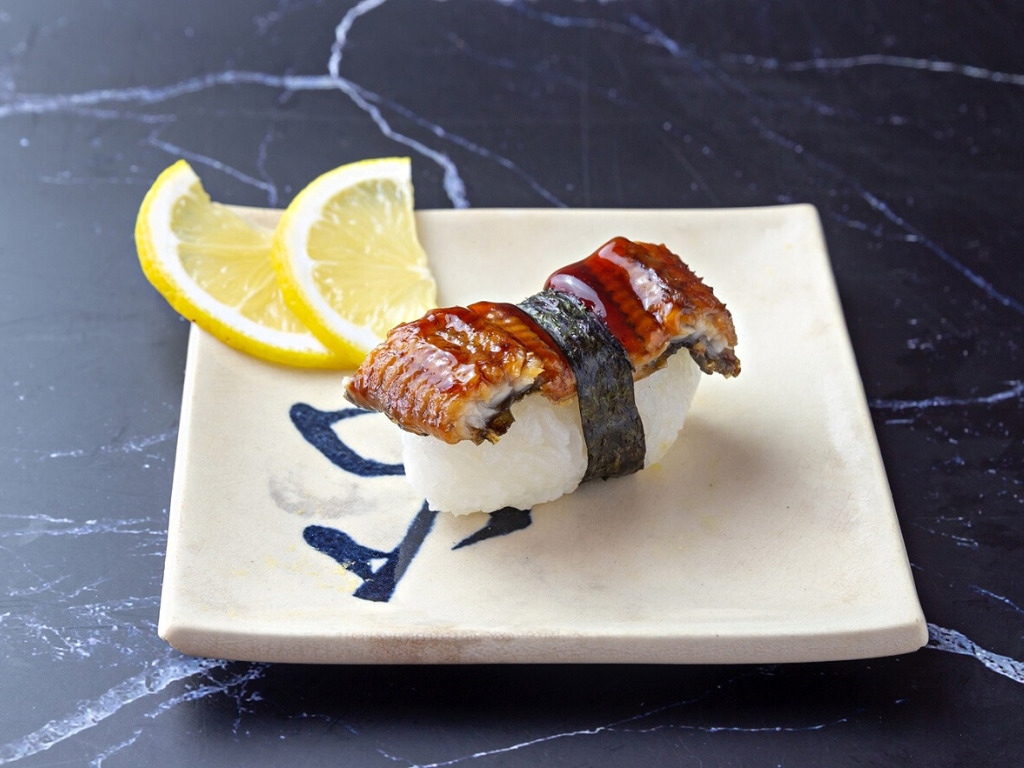
    Eel populations face an uncertain future, says Forsea. Overfishing has seen populations decline by 90 to 95 percent, pushing eel species into endangered territory and pushing market prices up to $70 per kilogram in Japan.

    The animals are considered a delicacy in East Asia, but according to Nir, they are also considered to be the ocean’s “most mysterious creatures, undergoing an unusual metamorphosis,” he said, speaking of their breeding that includes a 6,500 km migration to one of two spots on earth: the Sargasso Sea, near the Bermuda Triangle, or off Guam. Captive breeding has proven difficult for eel species.

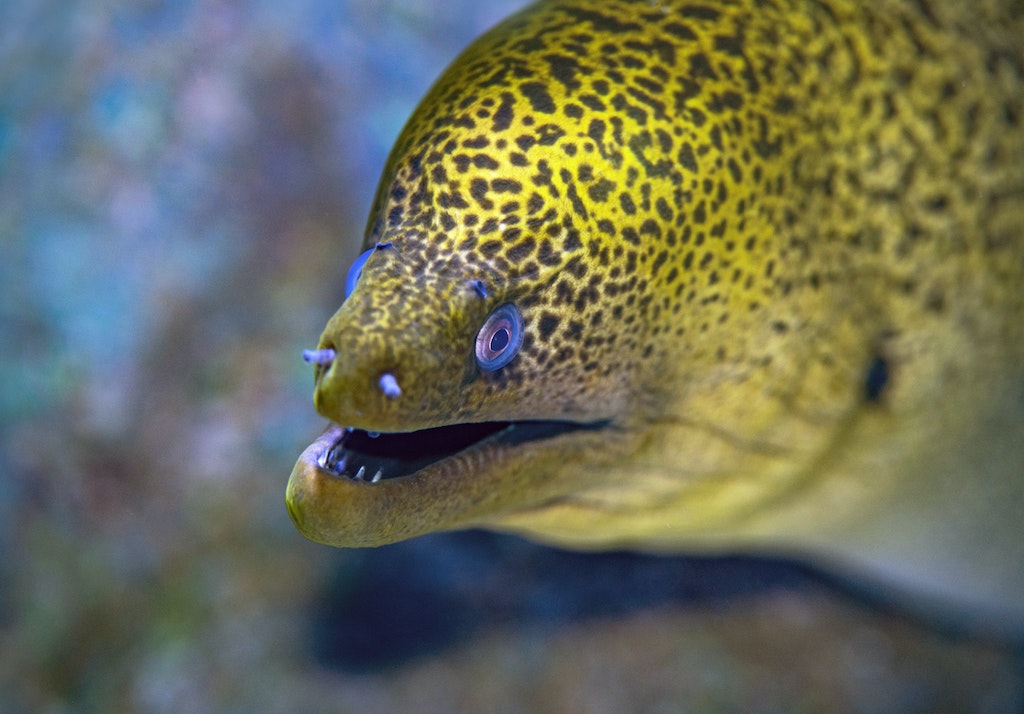
    eel
    Photo by David Clode on Unsplash

    “The market demand for eels is enormous,” adds Nir.

    In just two decades, Japan’s consumption of eel has dropped from 160,000 metric tons to around 30,000 tons today. That’s due to overfishing and rising prices and what Forsea says is a huge gap between the supply and the demand for eels. Europe has also banned the export of any type of eel product. “The market opportunity for cell-cultured eels is tremendous,” Nir says.

    Israel food tech

    Forsea joins a robust Israel food tech industry. The company launched last year with funding from the Israeli Innovation Authority (IIA) and the Strauss-Group and support from The Kitchen FoodTech Hub.

    “The demand for seafood is showing no signs of slowing down,” said Amir Zaidman, VP Business Development of The Kitchen Hub. “In fact, global demand is projected to almost double by 2050. But we are rapidly approaching the point where there will simply not be enough fish in the sea to sustain the global community.

    Zaidman says Forsea’s innovative new cultivation platform has the potential to bring “positive disruption to this paradigm” by offering a clean, nutritious, delicious, and commercially viable alternative to wild-caught seafood, “while leaving the delicate ocean ecosystem completely untouched.”


    Featured photo of Forsea Foods’ Eel | Courtesy

    The post Forsea Foods Is Taking On the ‘Tremendous’ Eel Market With Novel Cell-Cultured Tech appeared first on Green Queen.

    This post was originally published on Green Queen.
  • Dr. Amit Yaari, CEO and co-founder Biobetter,
    3 Mins Read

    Israel-based cultivated meat startup Biobetter says it has closed a $10 million Series A funding round led by Jerusalem Venture Partners and additional investment from Milk and Honey Investments, LLC, and the Israeli Innovation Authority.

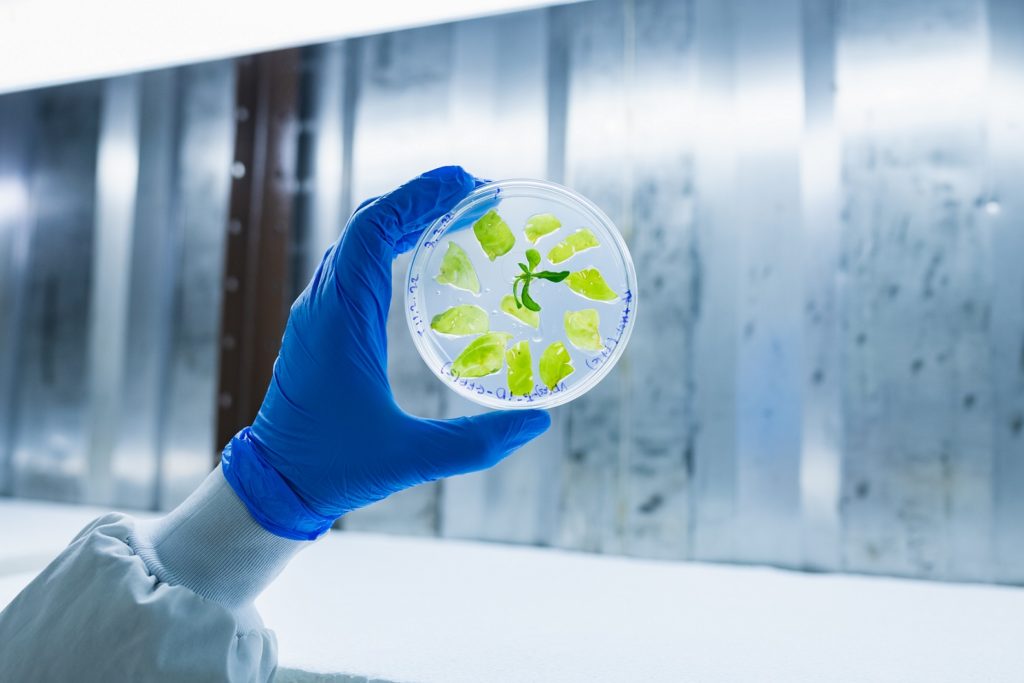
    Biobetter, which is using tobacco plants as bioreactors for its cell-based meat, says its novel tech has the potential to reduce the costs of cultured meat and help speed market entry.

    Tobacco as a growth medium

    “World population growth, combined with dwindling natural resources, are going to put incredible strain on meat supply—and the already fragile environment—in the coming decades,” Amit Yaari, PhD, CEO of Biobetter said in a statement. “Cultivated meat offers a promising solution to these problems and can ensure a more resilient supply chain with better economic and environmental returns.”

    Tobacco plant testing
    Tobacco plant testing, courtesy Biobetter

    The company’s proprietary protein manufacturing platform levies tobacco in creating the growth factors the meat cells need to develop without the need for animal-based media. “The field-grown tobacco plants offer a new, sustainable, efficient, and flexible response to the market need for more competitively priced GFs, specifically insulin, transferrin, and FGF2. These compounds are necessary to make cultivated meat commercially viable,” the company said.

    Typical growth medium costs can run between $50,000 to $500,000 per gram. But Biobetter says it can do it for one dollar per gram.

    This, says Dana Yarden, MD, co-founder of Biobetter, is positioning tobacco for a “pivotal comeback as a catalyst for bringing better food security.” Yarden says the funding will allow BioBetter to scale up production in FY2023 and be market ready by 2024.

    “Biobetter has the key to scale up production of cultivated meat, make it accessible to consumers globally and protect our planet,” said Erel Margalit, Founder & Executive Chairman of Jerusalem Venture Partners (JVP) and Margalit Startup City. “This is not only because of the sheer volumes of GFs it can produce but also by virtue of its ability to substantially reduce their cost.”

    Israel’s alt-protein boom

    “Biobetter has the potential to create global and regional impact,” said Nisan Zeevi, Director of JVP and VP of Margalit Startup City Galil.

    “Closer to home, this venture will create a significant new source of income for local farmers. As cellular agricultural expands, we will dedicate some 500 acres here in the galilee of tobacco plantations to support the industry. This also helps growers find new purpose in the burgeoning alternative protein scene following a reduction in smoking over the last decade that has left many tobacco fields idle and tobacco farmers suffering financial loss.”

    biobetter team
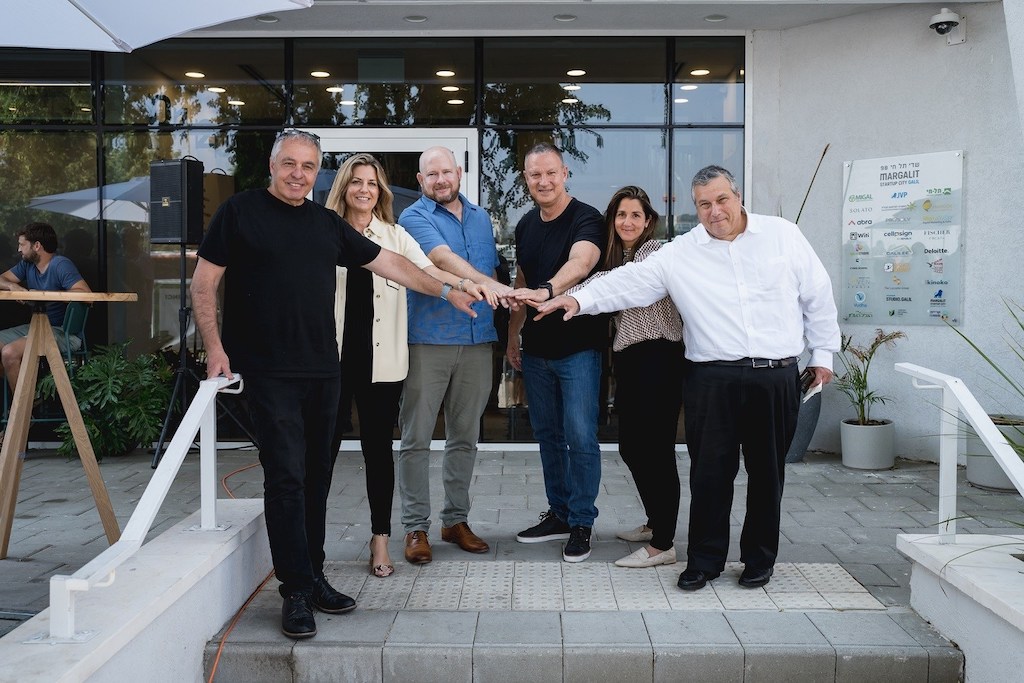
    BioBetter Lands USD10M Funding to Relieve Cultivated Meat’s Bottleneck Using Tobacco Plants (Credit: Alexander Seleznyov)

    Biobetter is part of the booming Israeli alternative protein sector. It is one of many food tech startups based out of Margalit Start-up City Galil, which is quickly becoming the country’s agri-tech hub.

    A recent report from think tank The Good Food Institute Israel highlighted Israel’s success in the alt-protein space.

    “2021 saw alternative protein placed at the forefront of [Israel’s] food-tech industry, with several massive investment rounds intended to accelerate scale-up and allow young companies to become global leaders for a better food system,” Aviv Oren, Director of Business Engagement and Innovation, GFI Israel, wrote in the group’s mid-year report.

    “This momentum draws more investors, governments and multinational companies, as it is clearer than ever that to meet climate change goals and prevent future pandemics we must leverage technology to change the way we consume our food. Israel is leading this change, with more startups and more investment in alternative protein than any country besides the U.S.”


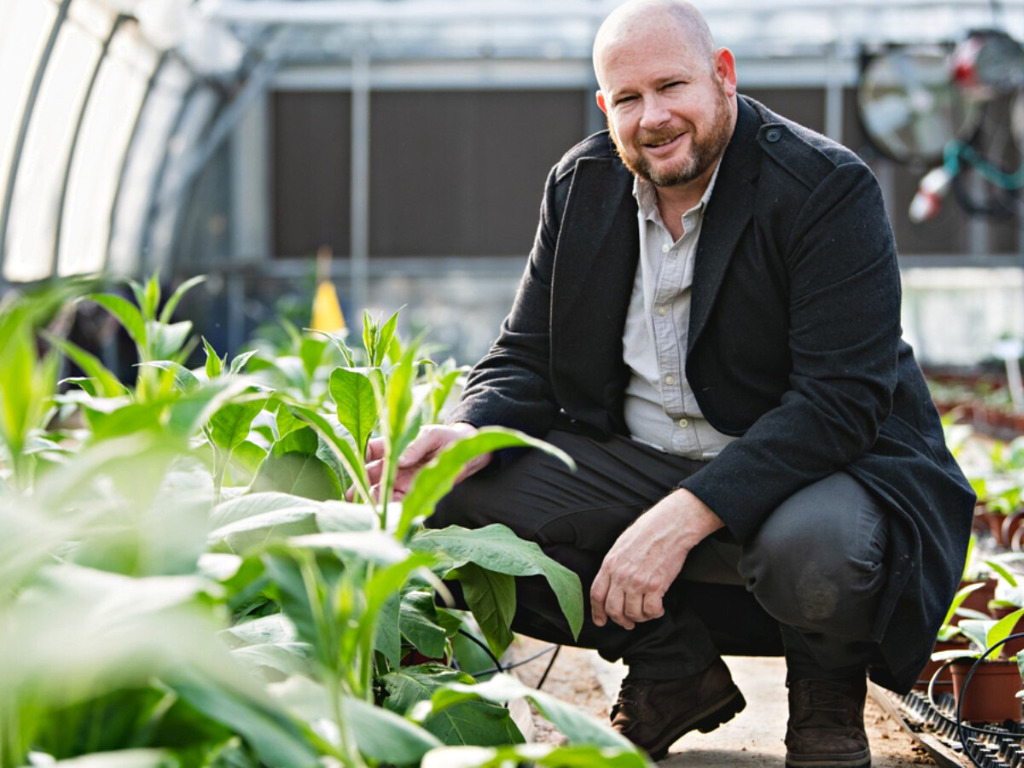
    Photo of Dr. Amit Yaari, CEO and co-founder Biobetter, courtesy Alexander Seleznyov

    The post With Its $10 Million Series A, Biobetter Brings Cultivated Meat Growth Media Down From $500,000 Per Gram to $1 appeared first on Green Queen.

    This post was originally published on Green Queen.

  • 3 Mins Read

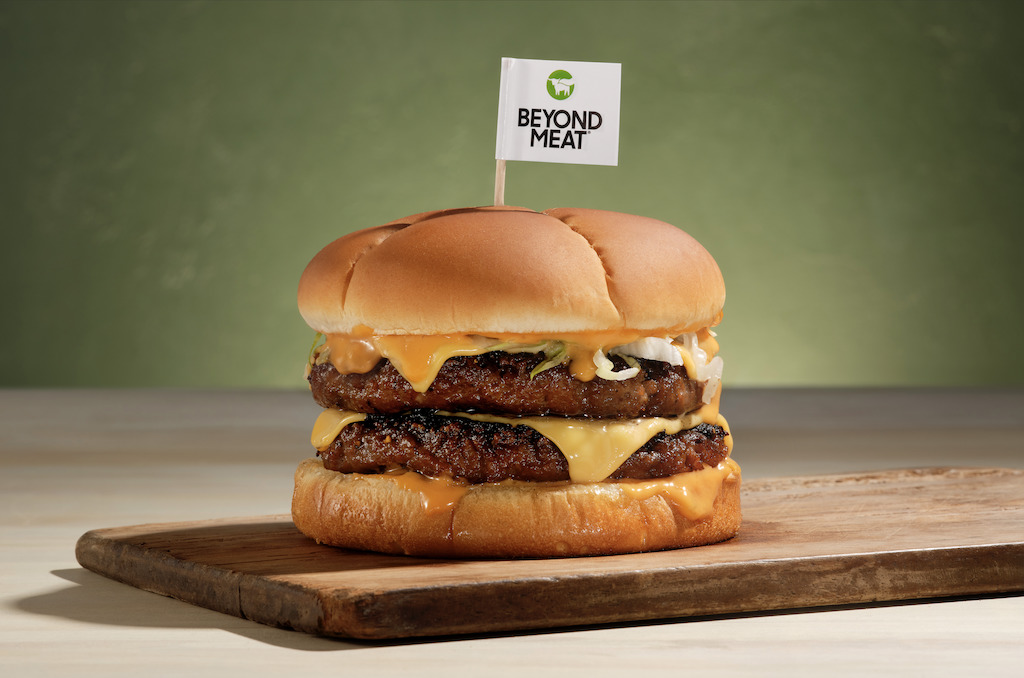
    Beyond Meat is gearing up for a Japan launch in a new partnership with United Super Market Holdings. The partnership will include both product development and distribution.

    United Super Market Holdings (USMH), one of Japan’s largest grocery store holding companies with more than 500 retail outlets in Japan including MaxValu, Maruetsu, and Kasumi, will add Beyond Meat products to its Green Growers private label brand including minced ground beef. The house labels will also feature products developed specifically to Japanese consumer tastes and preferences.

    The new partnership is part of a USMH open innovation initiative, dubbed AKIBA-Runway, that lets it partner with companies for product development.

    Beyond Meat x Asia

    The new partnership between Beyond Meat and USMH is the latest in a string of collaborations throughout Asia for the U.S.-based vegan meat brand.

    Beyond Meat bowls, courtesy

    Pizza Hut Singapore just announced it was adding Beyond Meat to its menu last week—part of a number of partnerships between the Yum Brands’ Asian locations. It’s the parent to Pizza Hut, Taco Bell, and KFC. The companies partnered in 2020 to offer Beyond Burgers at select KFC, Pizza Hut, and Taco Bell locations across the country.

    In July, Beyond’s Plant-Based Pork Patties debuted in China. The company said it specifically created Beyond Pork for the Asian market, launching its first pork product in 2020. Last year it opened its first direct-to-consumer website in China—following its 2020 announcement that it was opening a factory in China, becoming the first major foreign vegan meat producer to bring production to Chinese soil.

    Japan embraces plant-based food

    According to GourmetPro, between 2019 and 2022 Japan’s plant-based product market alone is estimated to double in size and reach a value of more than $270 million (¥36.9 billion). The Japanese government is getting involved in the market boom, showing support for plant-based and alternative proteins as part of the nation’s move to reach net-zero emissions by 2050. The Japan External Trade Organization is also working to support alternative companies inside and outside of the country.

    Beyond Meat China, courtesy

    Consumer perceptions about plant-based food are growing across Japan, even as awareness is low—about 20 percent. A survey conducted last year found that 40 percent of consumers aware of plant-based foods had tried at least one—typically dairy-free milk. Japanese consumers are largely driven by health, which would support the interest in nondairy products as at least 70 percent of Asians are lactose intolerant.

    Another recent survey by Good Food Institute APAC found interest in plant-based and alternative seafood is on the rise across Asia—also mainly for health reasons. Consumer concern about heavy metals and microplastics in seafood is driving the shift.

    The post Beyond Meat’s Asia Streak Continues As It Enters Japan appeared first on Green Queen.

    This post was originally published on Green Queen.
  • 3 Mins Read

    With its latest iteration, Impossible Foods’ plant-based ground beef now contains less saturated fat and more protein than ever, putting it on par with conventional beef.

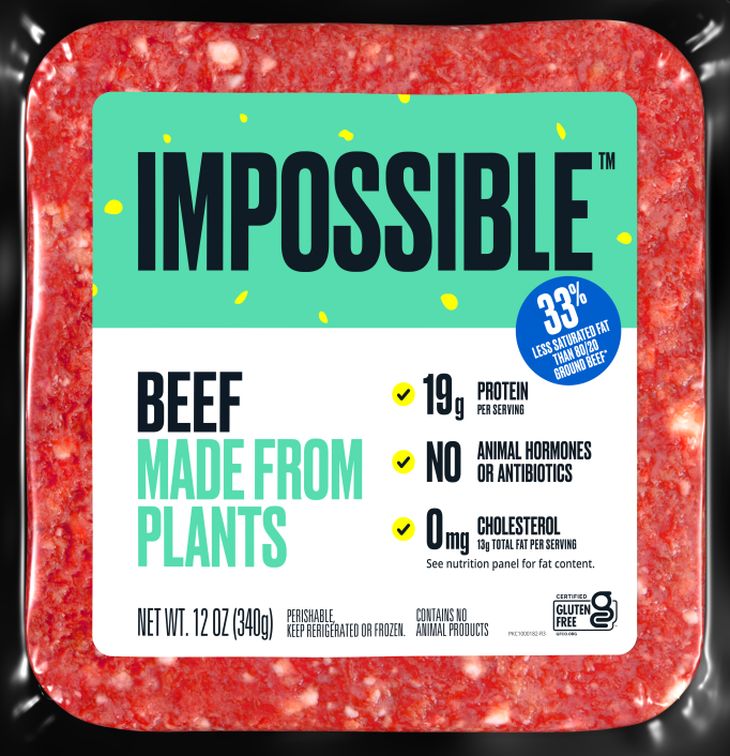
    The new Impossible Foods labels read simply: Beef Made From Plants. That’s a shift away from its use of ‘burger’ on the label—a move that’s part of the Bay Area company’s bid to appeal to the growing flexitarian demographic. And the new nutritional profile is expected to help.

    Impossible Beef

    “Our aim is not to be the best plant-based meat, which is a low bar, it’s to be the best meat,” Impossible Foods CEO Peter McGuinness told Food Navigator.

    “If you’re going to even start to displace animal products, you have to go to the next level in terms of taste, texture, flavor, and nutrition,” he said.

    Impossible beef
    Impossible beef | Courtesy

    The new beef contains 33 percent less saturated fat than conventional beef along with 19 grams of protein, zero cholesterol, and, the company says, no animal hormones or antibiotics.One serving of Impossible Beef contains 38 percent of the RDI for protein—the same as 80/20 ground beef. Saturated fat has ticked down to just six grams per serving compared to animal-based beef at nine grams.

    The leading vegan meat producer is aiming to target increasing concerns about the health claims made by the plant-based foods industry. Studies have found high levels of sodium and saturated fat in vegan meat products.

    The flexitarian market

    Consumers in the U.S. are largely opting for plant-based protein for its health benefits, further underscoring Impossible’s recent decision to tweak its formula.

    The relaunch comes as the industry sees lackluster sales, something McGuinness told Food Navigator is a competition issue, not a category issue.

    According to McGuinness, Impossible Foods is growing at a 65 percent year-on-year rate—a number he says is not just from increased distribution. “It’s a combination of new doors, new SKUs, and velocity gains.”

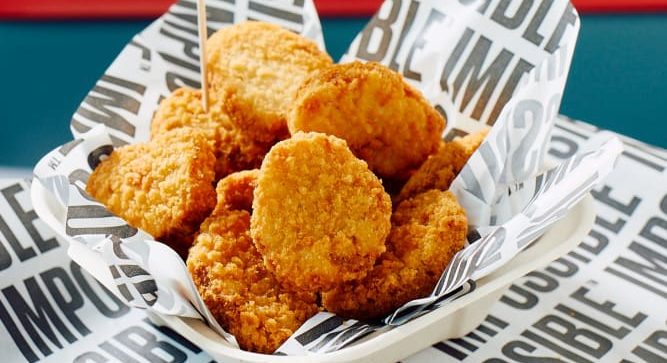
    Impossible chicken nuggets.

    Impossible says it has around a 45 percent repeat rate—meaning roughly one in two people who try the product will buy it again. “So that says awareness and trial is a gift that keeps on giving, as we only have 5 percent household penetration,” McGuinness said.

    These are important numbers as the industry is facing changes. With limited retail shelf space in refrigerated and frozen sections, consolidation is already happening in-store, and it could mean more mergers and acquisitions for companies competing too closely.

    For Impossible, its relationship with fast food chains like Burger King, which recently launched an Impossible Chicken trial in the U.S., give it leverage at retail, too. Its closest competitor, Beyond Meat, just saw its U.S. McPlant trial pulled from more than 600 stores.

    The post Impossible Foods Reworks Its Beef Nutrition to Capture the Growing Flexitarian Market appeared first on Green Queen.

    This post was originally published on Green Queen.
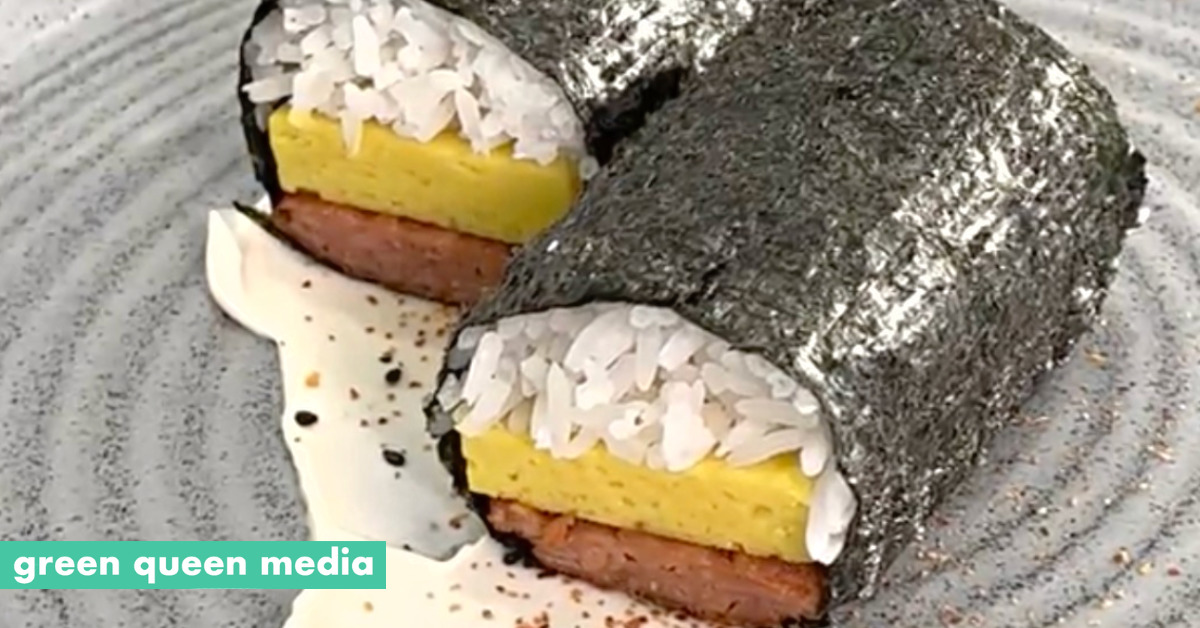
  • OnlyEg Tamagoyaki in plant-based musubi
    3 Mins Read

    Float Foods’ OnlyEg is coming to Singapore’s food service industry, marking the first time a plant-based egg Tamagoyaki is commercially available in Asia.

    The fourth produce in OnlyEg’s lineup, the Tamagoyaki is making its debut in partnership with Poke Theory at the FHA APA Theatre, Singapore EXPO, this week. The chain will launch a nationwide poke bowl featuring OnlyEg in its Caramelised Onion & Black Vinegar Tamago bowls. 

    OnlyEg

    The vegan egg joins OnlyEg’s shreds, patties, and XL omelettes as a hormone- and drug-free egg product that looks, cooks, and tastes like conventional eggs. The company says it offers a wholly natural, zero-cholesterol, fibre-rich, allergy-proof and cruelty-free egg that packs as much protein as a chicken egg.

    This is part of Float Foods’ plant-based food mission and “Food as Medicine” approach. It says it fully taps into the nutritional benefits offered by plant-based ingredients.

    OnlyEg whole egg analogue. Photo By Float Foods.

    “We build our products around the philosophy of using plants to help consumers eat clean, naturally sourced, nutrient-dense substitutes that are beneficial for their health and wellbeing,” the company said.

    According to OnlyEg, its initial products are now available in more than 20 hotels and restaurants including ShangriLa, Conrad, Cedele, Bamboo Bowls, Bangkok Jam, Love Handle, Solo Ristorante, Old Town, Warung Ijo.

    The products are earning industry accolades; OnlyEg’s white product was awarded ‘Best Health or Wellness Food’ at the World Food Innovation Awards 2022 in London. The omelette is a finalist in the ‘Best Plant-Based functional product’ category for the World Plant-Based Awards 2022 happening later this month in New York.

    Asian egg consumption

    Float Foods is working to help Asian consumers reduce their conventional egg consumption. Currently, Asians consume nearly 200 eggs per person per year, and the region produces more than 65 percent of the world’s eggs.

    The Dragon Chamber’s plant-based Cheeseburger Rolls with OnlyEg Omelette and Roasted “Kou Shui” Egg with OnlyEg Tamagoyaki

    While much of the Asian egg consumption is “onsen” style—lightly poached, runny and slightly raw, cooked eggs are in a number of dishes including omurice, fried nasi lemak egg, tamagoyaki or an omelette.

    Float Foods says an increasing number of Asian consumers are looking to reduce egg consumption for their health and climate concerns—producing a single chicken egg requires more than 240 liters of water and factory farming is a leading cause of emissions. A dozen eggs produce nealy three kilograms of heat-trapping emissions. The news follows a recent survey that looked at Asia’s increasing interest in vegan and alternative seafood.

    In addition to the Tamagoyaki at Poke Theory, OnlyEg is served in the following dishes:

    • Shangri-La Rasa Sentosa, Casserole  (OnlyEg in Assam Laksa and Nicoise Salad)
    • Conrad Centennial (OnlyEg x Impossible Wrap , OnlyEg Tamagoyaki bowl)
    • Dragon Chamber (Cheeseburger rolls with OnlyEg omelette and Roasted “Kou Shui” Egg with OnlyEg Tamago)
    • The Hainan Story at Hotel Boss (plant-based Curry Rice with OnlyEg Omelette x Tindle)
    • Three Buns (Le Smak Burger with OnlyEg Shreds and Boyz to Men burger with OnlyEg patty)
    • Warung Ijo (with local favourites including OnlyEg Nasi Lemak, Nasi Pendang, Orh Luak)
    • Old Town White Coffee (plant-based OnlyEg Classic Bee Hoon with Sweet & Sour Meat, OnlyEg Macaroni with Tomato Mushroom meatball and OnlyEg Toast with Ham, starting on Sept 1st)
    • Cedele (plant-based Kale x OnlyEg sandwich, available at Cedele WaterPoint outlet)
    • Bangkok Jam, Great World City and Plaza Singapura outlets (OnlyEg Pad Thai, kway teow, basil tofu rice, olive fried rice)
    • Singapore Food Festival:  OnlyEg is an official sponsor and will serve OnlyEg Patties in Satay Onigiri as part of Hawker Heroes by Chef Nicholas Koh from 31 Aug – 11 Sep. OnlyEg Tamago will also be served in a sushi workshop for 24 pax by Chef Martin on 11 Sep at 12noon.

    Images: courtesy

    The post Float Foods Launches Asia’s First Vegan Egg Tamagoyaki appeared first on Green Queen.

    This post was originally published on Green Queen.
  • bangers and mash

    3 Mins Read

    Is England perpetuating the climate crisis by not having a plan to reduce meat and dairy consumption? A group of activists thinks so.

    Members of the marketing campaign group Feedback filed a claim for judicial review at the High Court. The group is asking the court to force the government to take its own recommendations on climate change and formulate a strategy to address meat and dairy consumption.

    The filings

    According to the filings, the government is not taking into account the recommendations of its own climate change committee and its adviser, Henry Dimbleby. In a strategy released in June, the committee pushed for reductions in meat and dairy consumption as animal agriculture is a leading producer of greenhouse gas emissions.

    “Rather than outlining plans to support the public and farmers in making the shift to low-carbon foods as promised, the food strategy blithely ignored the meat and dairy question altogether,” Feedback’s executive director Carina Millstone said in a statement.

    british breakfast
    Photo by Deepansh Khurana on Unsplash

    Rowan Smith, a solicitor at Leigh Day, the firm representing the group said the client believes that there is “something inherently wrong with the government promising to address carbon emissions as part of its food strategy, but then omitting any action on one of the biggest contributors to the problem, namely meat and dairy.

    “The legal case focuses on the government’s failure to take into account expert and independent advice. What is the value in having that advice, if the government can effectively ignore it? Our client hopes to test these arguments in court.”

    The U.K.’s legal climate woes

    Leigh Day recently represented plaintiffs in another climate-related case. In July, a judge sided with environmental groups Friends of the Earth and the Good Law Project along with environmental activist Jo Wheatley. The judge ruled that the U.K. government’s plan on attaining net-zero emissions was unlawful as it failed to provide sufficient details on meeting its target.

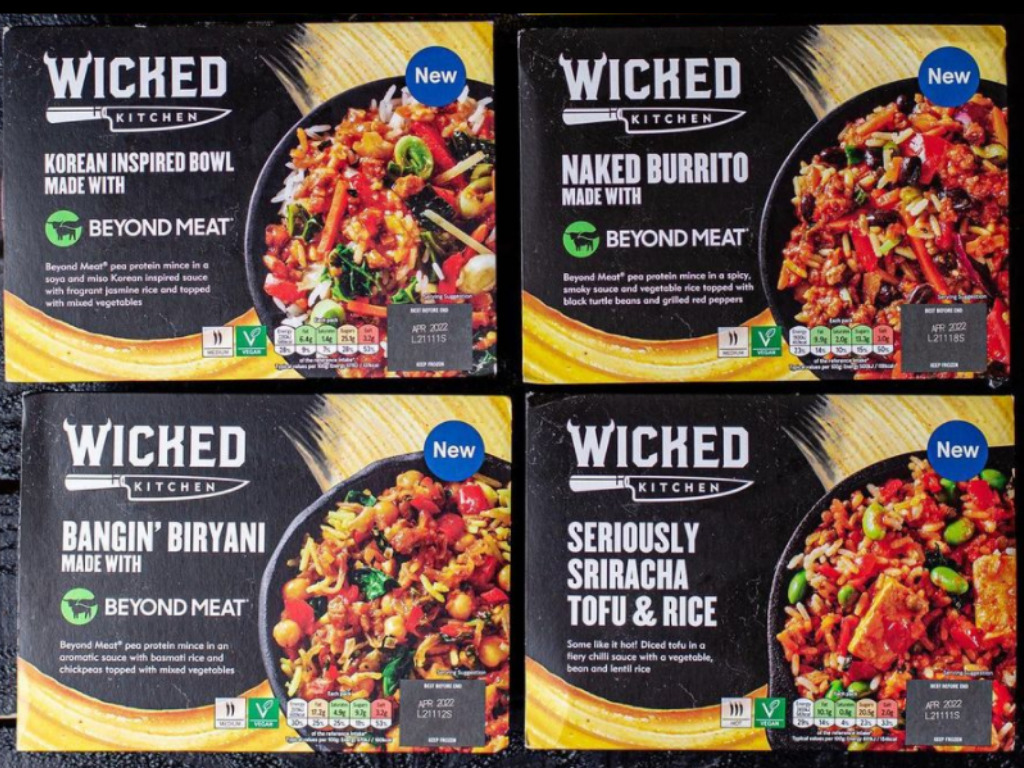
    Wicked Kitchen
    Leading plant-based brand Wicked Kitchen is sold at Tesco U.K. stores | Courtesy

    England and the U.K. are at the forefront of the alternative protein spaces, with increasing demand and offerings at all major supermarket chains and restaurants. In July, a survey found 25 percent of Brits reduced animal product consumption during the early days of the pandemic and have continued to reduce or eliminate meat and dairy from their diets.

    But a recent YouGov poll found only one-third of consumers surveyed say they’re willing to reduce animal products in their diet to help fight climate change.

    The climate committee has repeatedly urged for at least a 20 percent reduction in dairy consumption and a 35 percent reduction in meat by 2050 to help thwart climate change.


    Lead photo by Dmitry Dreyer on Unsplash

    The post Climate Activists Sue U.K. for Not Effectively Tackling Its Meat and Dairy Problem appeared first on Green Queen.

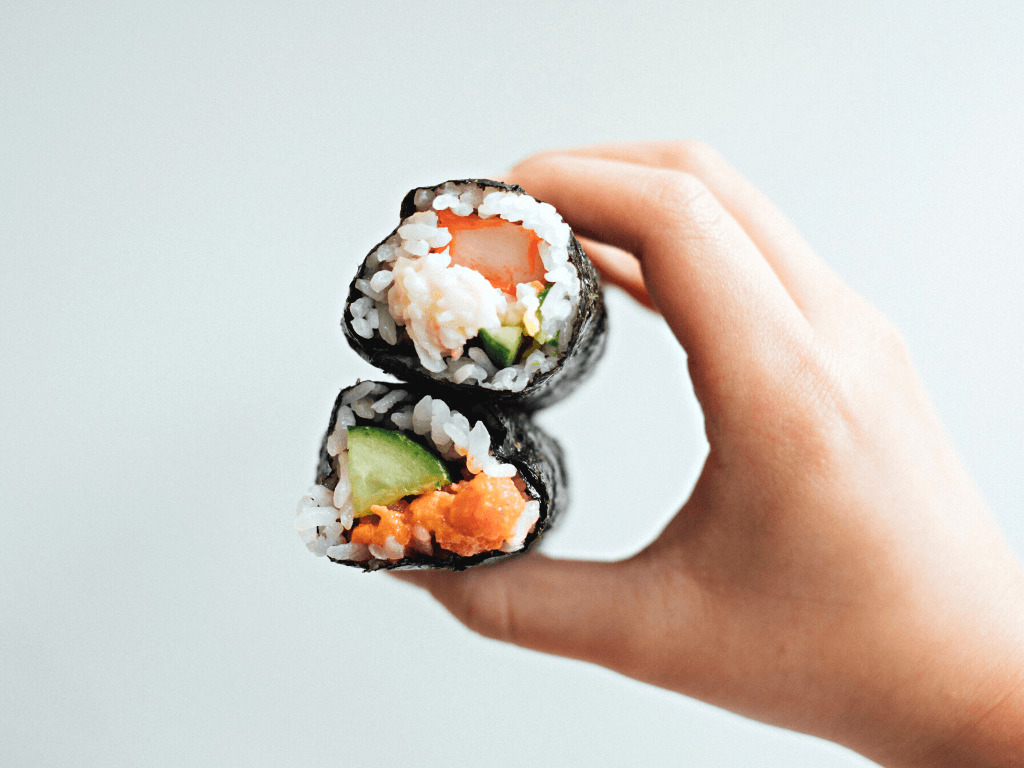
  • sushi rolls

    3 Mins Read

    In the first survey of its kind, leading protein think tank Good Food Institute APAC identified key factors sending Asian consumers toward plant-based seafood options.

    Consumers across Singapore, Thailand, Japan, and South Korea are largely excited by the potential in alternative seafood options. Specifically, they’re motivated by the absence of heavy metal and microplastic contamination says the new GFI report. There is also an increased interest in avoiding foodborne illnesses common from consuming seafood, such as Vibrio infection, norovirus, and hepatitis A.

    Deciding factors

    The interest isn’t just driven by avoiding seafood’s inherent issues, though. The survey found consumers are seeking to add more omega fatty acids into their diets; a growing number of alternatives are satisfying this demand with healthy algae oil, among other healthy sources.

    But despite the interest, consumers are still motivated by taste and texture. They will also not compormise on the health benefits even if it’s at the expense of choosing the most sustainable option, the survey found. There were also concerns over freshness and whether or not alternatives were as natural as conventional fish.

    Photo by Richard Bell at Unsplash.

    “As with all foods, taste is the single most impact factor in determining the commercial success of alternative seafood products,” Mirte Gosker, Acting Managing Director of GFI APAC, said in a statement. But, Gosker says it’s not the only deciding factor.

    “Consumers also want products that can match or exceed the nutritional value, freshness, and affordability of the conventional seafood they know and love,” she says.

    “Satisfying these demands will require substantially more investment from public and private stakeholders into open-access research and development aimed at improving the quality and cost of plant-based and cultivated seafood products,” she added.

    Alternative seafood demand

    The news comes as APAC countries are seeing an uptick in plant-based seafood offerings. According to GFI APAC, alternative seafood companies raise US$175 million last year, which is nearly double the amount raised in 2020. It says more than 120 companies are currently developing alternatives to seafood.

    Cellmeat’s Cultivated Dokdo Shrimp

    OmniFoods has been making a big splash in the region. In January, Starbucks released a plant-based fish sandwich made with OmniFoods’ vegan seafood ahead of the Chinese New Year. Earlier this month, leading seafood producer Thai Union launched plant-based shrimp, building on its recent plant-based seafood offerings.

    But it’s not just plant-based seafood that’s offering potential. The cultivated meat space is booming too, with the potential to support the changing consumer habits in Asia. In July, China’s Avant, which is working on cultivated fish, closed a $10.8 million Series A funding round. Shiok Meats recently partnered with Vietnam’s largest shrimp producer to develop cultivated seafood. Singapore’s Umami Meats announced plans to partner with MeaTech on 3D-printed cultivated seafood. In July, South Korea’s Cellmeat said its cell-based Dokdo Shrimp is market ready pending regulatory approval. 


    Lead Photo by Frank Zhang on Unsplash

    The post Heavy Metals, Microplastics, Driving Asia’s Shift to Plant-Based Seafood: Report appeared first on Green Queen.

  • Ultra Flexitarian Diet
    5 Mins Read

    ByMark Maslin, Professor of Earth System Science, UCL and the Natural History Museum of Denmark 

    There’s no denying that what we eat is intrinsically linked to the climate crisis. Is the an Ultra-Flexitarian diet the solution the planet needs?

    The food we consume has a massive impact on our planet. Agriculture takes up half the habitable land on Earth, destroys forests and other ecosystems and produces a quarter of the world’s greenhouse gas emissions. Meat and dairy specifically accounts for around 14.5% of global greenhouse gas emissions.

    So changing what we eat can help reduce carbon emissions and promote sustainable farming. But there are several “climate-friendly” diets to choose from. The best known are the completely plant-based vegan diet, the vegetarian diet, which also allows eggs and dairy, and the pescetarian diet, which also allows seafood.

    There are also “flexitarian” diets, where three quarters of meat and dairy is replaced by plant-based food, or the Mediterranean diet which allows moderate amounts of poultry, pork, lamb and beef. Deciding which diet to choose is not as simple as you might expect.

    Let us start with a new fad: the climatarian diet. One version was created by the not-for-profit organisation Climates Network, which says this diet is healthy, climate friendly and nature friendly. According to the publicity “with a simple diet shift you can save a tonne of CO₂ equivalents per person per year” (“equivalents” just means methane and other greenhouse gases are factored in alongside carbon dioxide).

    Sounds great, but the diet still allows you to eat meat and other high emission foods such as pork, poultry, fish, dairy products and eggs. So this is just a newer version of the “climate carnivore” diet except followers are encouraged to switch as much red meat (beef, lamb, pork, veal and venison) as possible to other meats and fish.

    The diet does, however, encourage you to cut down on meat overall and to choose high-welfare and local meat where possible, while avoiding food waste and choosing seasonal, local foods.

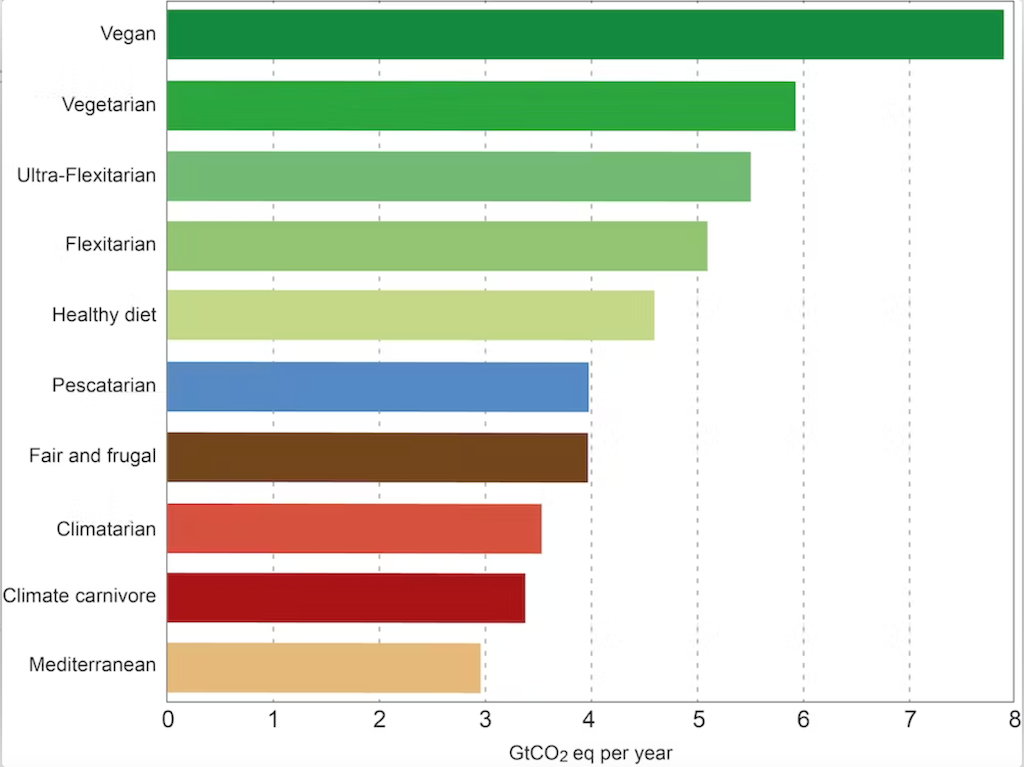
    So saving a tonne of carbon dioxide is great but switching to vegetarianism or veganism can save even more. A western standard meat-based diet produces about 7.2 kilograms of CO₂ equivalent per day, while a vegetarian diet produces 3.8 kg and a vegan diet 2.9 kg. If the whole world went vegan it would save nearly 8 billion tonnes CO₂e while even a switch to the Mediterranean diet would still save 3 billion tonnes. That is a saving of between 60% and 20% of all food emissions as which are currently at 13.7 billion tonnes of CO₂e a year.

    How much CO2e (in billions of tonnes, or Gt) would be saved if the whole world switched to each of these diets. Terms as defined by CarbonBrief. Data: IPCC, Author provided

    Water and land use must be considered too

    To save our planet, we must also consider both water and land usage. Beef, for instance, needs about 15,000 litres of water per kilo.

    Some vegetarian or vegan foods like avocados and almonds also have a huge water footprint, but overall a plant-based diet has about half the water consumption of a standard meat-based diet.

    Deforestation in Brazil (Source: Canva)

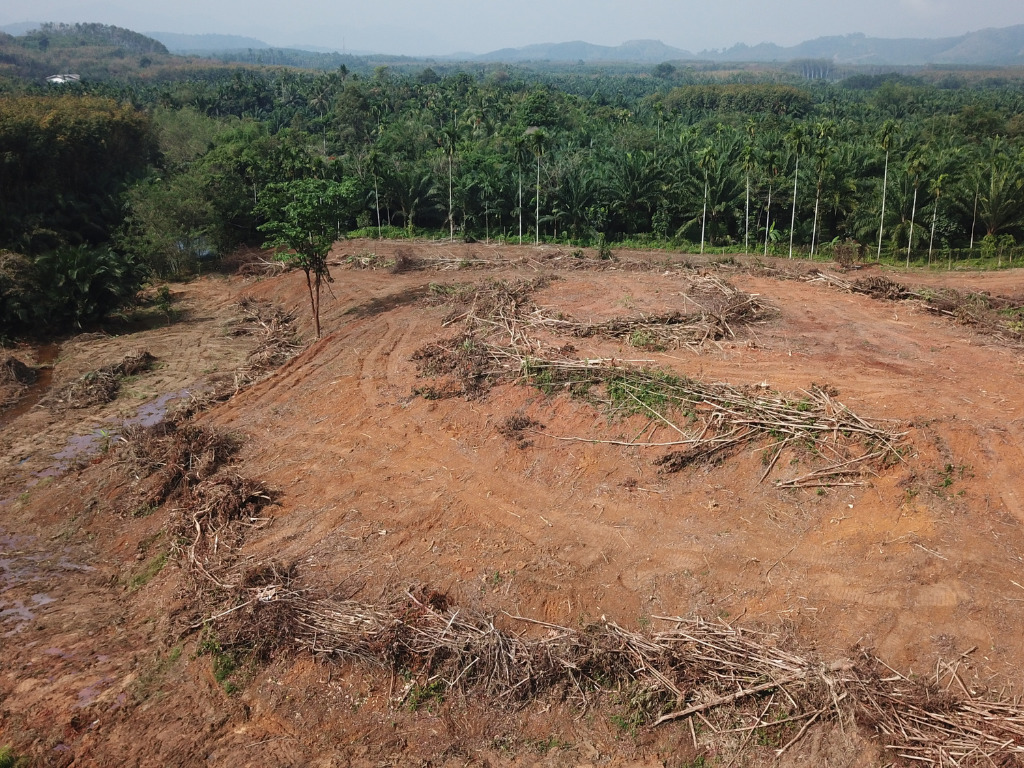
    A global move away from meat would also free up a huge amount of land, since billions of animals would no longer have to be fed. Soya, for instance, is one of the world’s most common crops yet almost 80% of the world’s soybeans are fed to livestock.

    The reduced need for agricultural land would help stop deforestation and help protect biodiversity. The land could also be used to reforest and rewild large areas which would become a natural store of carbon dioxide.

    A plant-forward diet is (mostly) healthier

    A plant based diet is also generally healthier. Meat, especially highly processed meat, has been linked to a string of major health issues including high blood pressure, heart disease and cancer.

    However, meat, dairy and fish are the main sources of some essential vitamins and minerals such as calcium, zinc, iodine and vitamin B12. A strict vegan diet can put people at risk of deficiencies unless they can have access to particular foods or take supplements. Yet both specialist food and supplements are too expensive for many people around the world and it would be hard to scale up supplements production to provide for billions of extra people.

    So a climatarian or flexitarian approach means there are fewer health risks and also allows people to still exercise choice. One study suggests a move to a global plant-based diet could reduce global mortality by up to 10% by 2050.

    We slaughter nine animals per person per year

    One of the issues that seems to be lacking in many food discussions is the ethical dimension. Every year we slaughter 69 billion chickens, 1.5 billion pigs, 0.65 billion turkeys, 0.57 billion sheep, 0.45 billion goats, and 0.3 billion cattle. That is over nine animals killed for every person on the planet per year – all for nutrition and protein which we know can come from a plant-based diet.

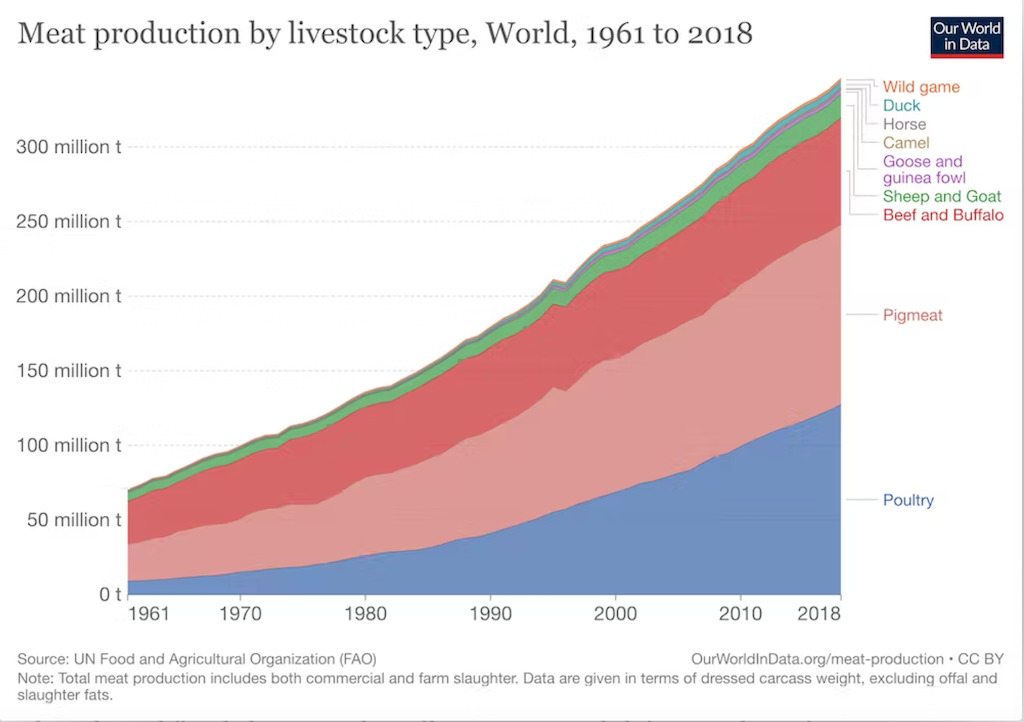
    Poultry production has almost doubled this century, as chicken has raced ahead of pork and beef. Our World In Data / data: FAOCC BY-SA

    So what is the ideal global diet to reduce greenhouse gas emissions, reduce habitat destruction and help you live longer? Well I suggest being an “ultra-flexitarian” – a diet of mostly plant-based foods but one that allows meat and dairy products in extreme moderation, but red and processed meat are completely banned. This would save at least 5.5 billion tonnes of CO₂ equivalent per year (40% of all food emissions), decrease global mortality by 10% and prevent the slaughter of billions of innocent animals.

    This article is republished from The Conversation under a Creative Commons license. Read the original article.


    Lead image courtesy of Canva.

    The post Diet & Nutrition: Should You Become An Ultra-Flexitarian? appeared first on Green Queen.

    This post was originally published on Green Queen.

  • future meat lamb
    3 Mins Read

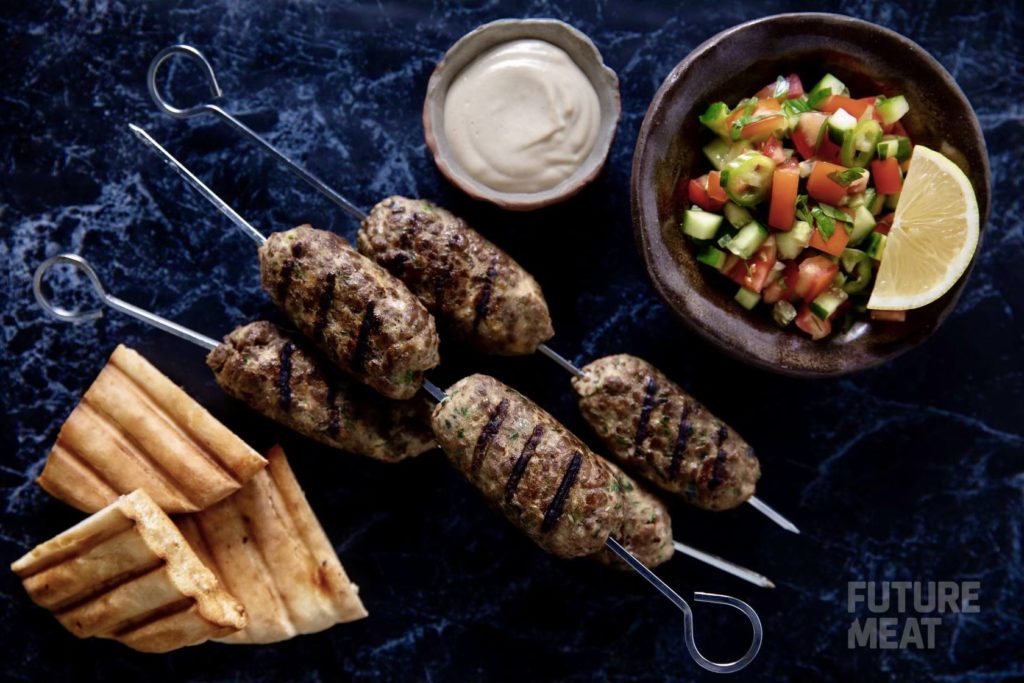
    Israel-based Future Meat Technologies has developed the world’s first cultivated ground lamb meat that it says looks, cooks, and tastes just like conventional lamb meat for use in burgers, kebabs, and other dishes.

    “In passing this milestone, Future Meat reinforces its position as a leader and pioneer in the cultivated meat industry and shows again the limitless potential of how innovation can drive sustainable solutions,” Nicole Johnson-Hoffman, CEO of Future Meat, said in a statement.

    The key learnings, Johnson-Hoffman says, will be leveraged to produce other meats, including beef and pork.

    Cultivated lamb meat

    The cultivated lamb was three years in the making for Future Meat, which says the development will help to disrupt the global lamb meat market—which spans the globe, specifically Europe, the Middle East, Northern Africa, and parts of Asia. The company says reaching this milestone with ovine cell lines means that it can now produce cultivated lamb “at scale” and “accelerate its innovation focus to expanding into even more animal species.”

    “Since lamb has a uniquely distinct flavor, it is very clear if a cultivated substitute is on or off the mark,” said Michael Lenahan, General Manager of Future Meat. “The reason Future Meat’s cultivated lamb is indistinguishable from conventional lamb is because it is, first and foremost, real meat. It sizzles, sears and tastes just like people expect—it’s amazing.”

    future meat lamb
    Future Meat uses animal fibroblasts to replicate the meat in a lab, producing a non-GMO product that is cost-effective, sustainable, and completely scalable, without harming a single animal through the process | Courtesy

    The food tech company was the first to replace Fetal Bovine Serum and all other animal components beyond the cell lines in the cultivated meat development. “Future Meat’s approach leans on the natural spontaneous immortalization of fibroblasts, rather than genetic modification,” said Prof. Yaakov Nahmias, President, Founder and Chief Science Officer of Future Meat Technologies. “This is the key to Future Meat’s cells being non-GMO.”

    Future Meat says it is gearing up to enter the U.S. market once there’s regulatory approval for cultivated meat. Currently, only Singapore allows the sale and consumption of cultivated animal products.

    Israel’s food tech hub

    Israel is a hotbed for food tech, specifically cultivated and plant-based animal products. As of the end of June, more than $320 million in investment funding had been distributed to Israel-based companies, according to the Good Food Institute Israel.

    Future Meat beef
    Future Meat beef | courtesy

    “2021 saw alternative protein placed at the forefront of the food-tech industry, with several massive investment rounds intended to accelerate scale-up and allow young companies to become global leaders for a better food system,” Aviv Oren, Director of Business Engagement and Innovation, GFI Israel, wrote in the mid-year report.

    “This momentum draws more investors, governments and multinational companies, as it is clearer than ever that to meet climate change goals and prevent future pandemics we must leverage technology to change the way we consume our food. Israel is leading this change, with more startups and more investment in alternative protein than any country besides the U.S.”

    The post Future Meat Announces the World’s First Cultivated Ground Lamb Meat appeared first on Green Queen.

    This post was originally published on Green Queen.
  • 5 Mins Read

    Notes From the Frontlines of the Sustainable Food Movement – a new opinion column by Irina Gerry

    There has been a lot of chatter lately about “Low Carbon Beef”, but does the climate math hold up?

    The United States Department of Agriculture (USDA) recently approved Low Carbon Beef label, which can now be placed on meat products in the US in order to differentiate this “more sustainably farmed beef” from conventional options, as well as to justify higher price premiums. To qualify for the label, cattle farmers must demonstrate at least 10% lower greenhouse gas emissions than the industry standard baselines. Sounds nice, right?

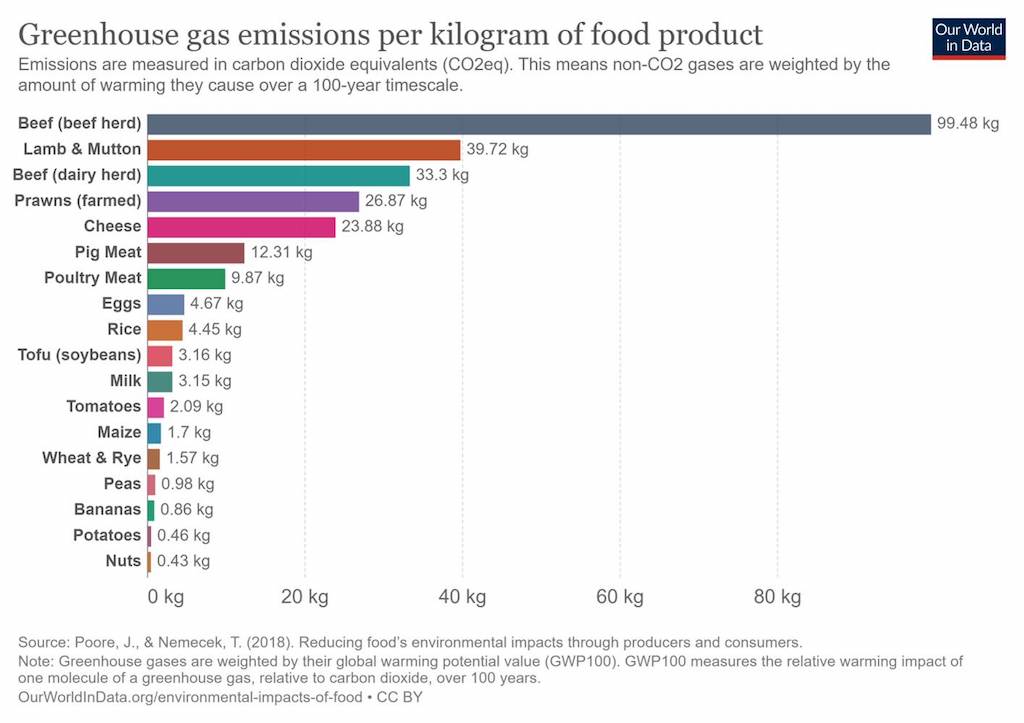
    Except, there is a problem with that. On average, producing 1kg of beef emits about 100kg of CO2e, which is by far the highest emissions of any food.

    For perspective, producing 1kg of chicken emits about 10kg of CO2e and 1kg of peas comes in at just 1kg of CO2e. That’s 100 times less.

    So, does a 10% reduction make a meaningful difference to warrant the Low Carbon Beef label?  Absolutely not.

    This is the cattle industry’s attempt to respond to consumer concerns around beef’s climate footprint, as more and more consumers seek to align their climate concerns with their food purchases. It is a pure form of greenwashing.

    At scale, animal agriculture today is responsible for 14.5% of global GHG emissions, with cattle representing a 65% share.

    While politicians avoid any conversation about reducing meat consumption like a plague, considering it a political non-starter, there are a number of initiatives underway that attempt to reduce the climate footprint of cattle. According to UN FAO, several ways of reducing emissions from livestock include:

    1. Improving feed quality, precision feeding and methane-reducing additives (seaweed feed additives only reduce cattle methane emissions by about 9%, while adding potential ecological impact of large-scale algae farming, which is far from the panacea it is hyped up to be)
    2. Animal genetics, breeding and animal health (cows that grow faster, cow vaccines)
    3. Intensifying recycling efforts (ag waste products as feed) and minimizing losses for a circular bioeconomy (manure as fertilizer, manure as biogas)
    4. Capitalizing on nature-based solutions to ramp up carbon offsets (soil carbon sequestration through regenerative grazing)

    However, even if we deploy all available strategies to reduce livestock emissions, we only get to a 30% reduction.

    We still end up with 70kgs CO2e per 1kg of beef, on average, which is still far higher than any other food.

    There is no such as thing as Low Carbon Beef, only Reduced Carbon Beef, if you like.

    While regenerative grazing advocates fervently defend beef, professing it to be the “climate savior” and even calling for grazing more cattle than we do today as a way to restore degraded soils, the reality on the ground remains starkly different from the future that “could be”. Regenerative grazing  holds a promise of carbon sequestration by implementing adaptive multi-paddock (AMP) grazing practices as a way to offset cattle emissions with soil carbon sequestration, however most studies presented to support the argument consist of small scale experiments with inconsistent methods and findings, with little consensus on net climate benefit among high quality peer-reviewed research after decades of experimentation and a lot of doubt about the scalability, durability and the magnitude of soil carbon sequestration of such systems outside of highly specific conditions.

    Most regenerative grazing benefits tend to focus on converting previously degraded croplands to pasture, which do show a temporary improvement in soil carbon sequestration during the conversion process. However, many such studies lack proper control variables of converting the same degraded lands to forests, wetlands or orchards, and reintroducing wildlife instead of farmed cattle, or applying other regenerative agriculture practices such as reduced tilling and cover crop rotations.

    Even the poster child of multi-species pasture rotations, White Oaks Pastures, can only sequester enough carbon in soil to create a greenhouse gas footprint that is 66% lower carbon footprint over conventional commodity beef, while requiring 2.5 times more land and costing 70% more (price per pound of ground beef before shipping). Don’t get me wrong, a 66% emissions reduction is commendable, and the overall system appears to be more resilient, while providing the farmers higher income, but it does not make it Low Carbon.

    In general, as unsavory as feedlots may be to those of us who care about animal welfare, industrialized systems tend to be more efficient at converting animals to food products. Regenerative grazing advocates find themselves between the rock and a hard place in trying to promote a more sustainable and kinder food system, while contending with immense resources required to produce cattle-based products, no matter the method. On one hand trying to farm animals in a way more consistent with natural grazing does sound appealing, on the other hand grass-finished beef requires 40-150% more land, increases enteric fermentation related methane emissions by 43% (cows eating grass on pasture emit more methane compared to feedlot cows on a grain diet) and produces 30% less meat as system (grass-finished beef takes longer to grow). Organic and regeneratively grazed beef does not fare much better. Given the increased land and resource requirements of the animal-based system that already occupies 77% of all agricultural land, a transition to regenerative grazing only works if we are willing to eat much less beef and are prepared to pay more for it.

    Does it mean we can’t eat beef?

    Not necessarily. I know most people simply won’t accept it, no matter the cost. There is also some argument in favor of limited regenerative grazing of cows to restore some of the degraded soils. Further, farmed animals play a crucial role in some of the poorest countries, providing income and serving as a key source of nutrition for smallholder farmers. A 100% cow-free world is neither possible, nor necessary for us to build a sustainable and equitable food system.

    My hope is that a clear understanding of the environmental impact would lead most of us who care about the future of our planet to significantly reduce our beef consumption (to the tune of 50-80% in developed countries) and if we do choose to eat it occasionally, choose the “better farmed” option. Because with the growing global population and projected increase in meat demand, we have no hope of meeting the +1.5C degree global warming targets if we stay with the status quo.


    Lead image courtesy of Canva.

    The post There is No Such Thing as Low Carbon Beef appeared first on Green Queen.

  • umami egg

    2 Mins Read

    Japan is the third-largest egg-consuming nation in the world behind China and Mexico. Now, a Tokyo-based startup, Umami United, says it has developed a vegan egg using konjac powder and enzyme technology for a more sustainable and ethical alternative to conventional eggs.

    Umami United says it’s on a mission to overcome the challenges of the current food system and “deliver an experience by uniting all at one table and creating a brighter future.”

    Vegan eggs

    Instead of fungi, Umami says it turned to enzymes to produce its vegan egg. Enzymes express specific flavors and textures, according to the company where fungi typically break down ingredients during fermentation.

    Umami egg
    Courtesy

    The company is also working to tackle allergy issues for younger generations as eggs are a top food allergen. Umami says it’s already gaining traction in Japan as consumers seek out healthy plant-based options.

    The vegan Umami egg joins a growing vegan egg category led by U.S.-based Eat Just and its mung bean Just Egg. Eat Just recently reported it surpassed the sales equivalent of 300 million eggs with help from celebrities including Serena Williams and Jake Gyllenhaal. It also recently broke ground on a factory in Singapore to meet the demand in Asian markets.

    Plant-based demand in Asia

    Umami says it’s also participating in the trade show FHA Singapore, where the company will introduce its plant-based egg in a variety of traditional Japanese and Asian dishes. It says food service is critical to its growth, “providing solutions and different recipes to catering companies,” which will introduce the concept to consumers. From there, they can then find the product on supermarket shelves.

    Just Egg
    Courtesy

    The launch also comes as Japan is seeing an uptick in plant-based food sales. In a 2019 survey, 60 percent of respondents said they were open to trying more sustainable food options that also had health benefits. A study in 2020 that looked at soy-based meat showed awareness over 70 percent. In 2020, 25 percent of respondents said they had tried vegan meat at least once, with 68 percent saying they’d cooked plant-based meat at home, while more than 40 percent said they had consumed plant-based meat while dining out.

    The post Japan’s First Vegan Eggs Are Made From Konjac Root appeared first on Green Queen.

  • scandinavian food
    3 Mins Read

    Norway’s Research Council says it will fund the development of cellular agriculture and precision fermentation to bring sustainable meat, egg, and milk products to market.

    A new five-year research project, dubbed Arrival of Cellular Agriculture-Enabling Biotechnology for Future Food Production (ARRIVAL), set to launch next year will help Norway develop the “food of the future.”

    Funded by the Research Council of Norway, the project has an annual €2 million budget. The Norwegian Institute of Food, Fisheries, and Aquaculture Research (Nofima) will spearhead the project with support from the contract research organization SINTEF Industry, Oslo Metropolitan University, the Norwegian Institute for Rural Research, the Norwegian Board of Technology, agriculture cooperative Nortura AS, and the Norwegian dairy enterprise, TINE AS.

    Cultivated meat

    Even while it’s lower than in other Northern European countries, meat production in Norway increased by nearly four percent between 2020 and 2021. The majority of consumers in Norway say they’re not overly concerned about environmental or animal welfare factors.

    But ARRIVAL’s team says this presents an opportunity to further explore alternatives.

    Mosa Meat FBS
    Cultivated meatball | Courtesy Mosa Meat

    “We can increase self-sufficiency in food in Norway, and we do not have to kill animals to produce the necessary protein in the form of meat. In Norway, we have both the expertise and the money needed to develop new technical solutions for food production, says Sissel Rønning, the ARRIVAL lead.

    “We will continue our research on how to scale up cell-based meat production and find out more about which materials are suitable to use as a framework for the muscle cells,” says Rønning.

    “Muscle cells are picky, and it is usual to use a growth medium made from parts of calf blood in current production.”

    While cultivated meat is currently only approved for sale in Singapore, Norway sees a viable future for cell-based meat. Nofima began exploring the category in 2018 with the goal of developing new technology for cultivating muscle meat with residual biomass as the growth medium. That project was the first openly accessible research in this category.

    Now, Nofima says its technology has increased “significantly.”

    “We will continue our research on how to scale up cell-based meat production and find out more about which materials are suitable to use as a framework for the muscle cells,” says Rønning.

    Courtesy iStock

    “Muscle cells are picky, and it is usual to use a growth medium made from parts of calf blood in current production.

    “This production is not very sustainable, and many people are therefore critical of this type of protein cultivation. To successfully scale these types of technologies, new, sustainable growth media must therefore be developed.”

    Precision fermentation

    The announcement comes as dairy and egg production has also increased in the Nordic country in recent years. According to recent data, the number of dairy cows has increased every year over the last decade. Egg-laying hen operations are also on the increase.

    But according to the University of Helsinki and VTT Technical Research Centre of Finland, using alternative proteins such as precision fermentation could reduce land use by nearly 90 percent compared with conventional egg production. It can also decrease greenhouse gas emissions by up to 55 percent.

    Courtesy Perfect Day

    Dairy alternatives also show the potential to significantly reduce the industry’s impact. The category leader, U.S.-based Perfect Day, cites a 97 percent reduction in emissions compared to conventional dairy.

    “Cell-based agriculture is a revolution in food production that can change agricultural production and ownership, land use, policy design, eating habits, and ethical issues,” says Rønning. “In the ARRIVAL project, we will take the research on cell-based agriculture several steps further.”


    Photo by Sigmund on Unsplash

    The post 5-Year Cellular Agriculture Project to Develop Norway’s ‘Food of the Future’ appeared first on Green Queen.

    This post was originally published on Green Queen.
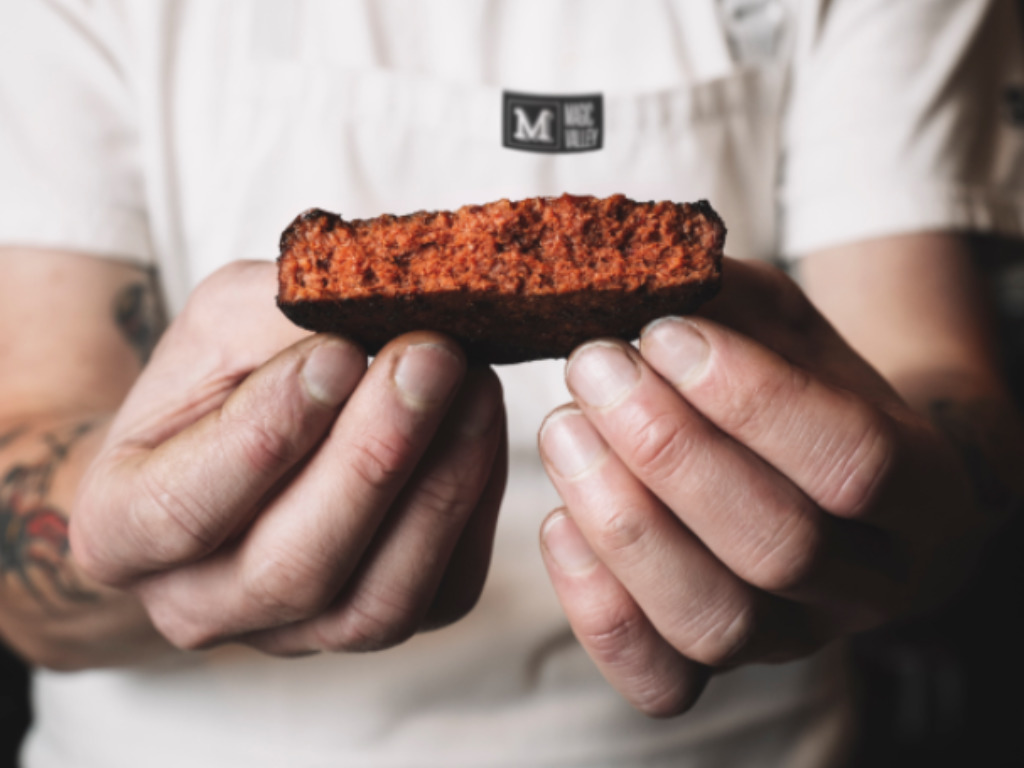
  • 4 Mins Read

    Hong Kong’s vegan meat brand Plant Sifu is bringing its products to seven Chinese restaurants across Hong Kong.

    Between August and October, Plant Sifu will showcase its vegan meat products across Hong Kong restaurants in a range of Chinese flavors and styles. “Be it the vibrant tastes in Northern cuisine, the rich flavors of Shanghainese cuisine, the spices in Szechuan dishes, or the delicacy of Cantonese cuisine, Plant Sifu will take you on a taste-first gourmet journey reimagined with plant-based meat,” the company said in a statement.

    Courtesy Plant Sifu

    Plant Sifu

    Plant Sifu is focused on recreating Chinese cuisines with plants. Its first focus is pork, the most common animal protein in Asia. Plant Sifu uses a proprietary protein blend made from konjac jelly and other plant-based ingredients to recreate the taste, texture, and function of conventional pork.

    Deng G Sichuan

    “To deliver a ‘real meaty experience’, I had to think deeply which ingredients would best match with Plant Sifu’s plant-based pork,” Deng G Sichuan, Chef Leung Yiu Yun, said. “It was fun and challenging! And among the dishes, the ‘Yi Bin Ya Cai Dandan Noodles’ tasted just like the real thing.”

    Deng G Sichuan’s menu features five dishes including Yi Bin Ya Cai Dandan Noodles with Pickled Mustard Greens; Pork Wontons with Red Chili Oil; Pan-fried Pipa Tofu with Minced Pork & Pumpkin Puree; Pan-fried Minced Pork Lotus Root Cakes; and Stir-fried Minced Pork Lettuce Wraps.

    Yè shanghai

    Yè shanghai (Tsim Sha Tsui) is offering Dandan Noodles in Peanut Sauce; Shanghainese Wontons, Ma Po Tofu; Sauteed Minced Pork with Pine Nuts Served with Sesame Pockets; Pork Slices with Chili & Spring Onions.

    “To deliver a ‘real meaty experience’, I had to think deeply which ingredients would best match with Plant Sifu’s plant-based pork,” Chef Leung Yiu Yun said. “It was fun and challenging! And among the dishes, the ‘Yi Bin Ya Cai Dandan Noodles’ tasted just like the real thing.”

    Duddell’s

    “My favorite product is their ground pork,” said Duddell’s, Executive Chef Yip Ka On. The restaurant has launched Braised Eggplants with A Touch of Salted Fish & Plant-based Pork; Deep-fried Shrimp & Plant-based Pork Rolls with Vinegar Sauce; Sauteed Seafood & Planted-based Minced Pork on Rice Crisp; and South African Five-Head Abalone & Plant-based Minced Pork Noodles. “The tender texture of the meat, plus meat-like oils and aromas add a new dimension to my cooking. Plant SifuTM has completely changed my perception on plant-based meat for the better.”

    Chung’s House

    “Whether it’s texture, aesthetic, or taste, Plant Sifu plant-based fatty pork scores high on all 3 aspects, capturing the important essence of ‘Visual, Aroma, Taste’ in Chinese food culture,” says Chung’s House, Senior Chef H. T. Wong. Its releasing six dishes, including Matsutake Stew Soup; Plant-based Pork Stuffed Bamboo Pith in Broth; Baked Truffle & Plant-based Pork with Tofu; Braised Tomato with Celtuce, Winter Melon Pearls; and Chung’s Special Plant-based Pork Fried Rice.

    Greater China Club

    At the Greater China Club, five dishes get the Sifu treatment: Deep-fried Mapo Tofu with Minced Plant-based Pork; Deep-fried Morel Mushrooms Stuffed with Minced Plant-based Pork in Spicy Salt; and Pan-fried Plant-based Pork Lotus Cakes in Tangerine Peel Black Bean Sauce. Steamed Plant-based Pork Crystal Dumplings with Basil and the Braised Plant-based Pork Lion’s Head Meatball with Rock Rice both require a pre-order one day in advance.

    Sha Tin 18

    Sha Tin 18 (Hyatt Regency Hong Kong, Sha Tin) is offering six items: Braised Scallops, Plant-Based Pork, Beancurd, Sichuan Pepper; Baked Baby Oysters, Plant-Based Pork, Egg Custard; Wok-Fried Shrimp, Minced Plant-Based Pork, Wild Mushroom, Chilli; Stir-Fried Minced Plant-Based Pork, Glass Noodles, Sichuan Pepper Powder, Coriander, Soya Sauce; Steamed Minced Plant-Based Pork, Dried Baby Turnip, Water Chestnut, Spring Onion, Soya Sauce; Wok-Fried Sliced Plant-Based Pork, Cucumber, Fungus, Sliced Carrot, Egg

    “The fun part of this collaboration is choosing the ingredients to bring out the ‘meat flavor’ of the plant-based pork. If diners couldn’t tell it’s plant-based then I won,” said Sha Tin 18, Chinese Chef de Cuisine Ho Chun Hung.

    The Chinese Restaurant

    The Chinese Restaurant (Hyatt Regency Hong Kong, Tsim Sha Tsui), is offering four dishes: Plant-Based Minced Pork, Crispy Rice Cake, Pine Nut, Pickled Long Bean; Stir-Fried Plant-Based Sliced Pork, Asparagus, Chilli Bean Sauce, Thai Basil; Plant-Based Pork Meatball Bowl, Assorted Mushrooms, Pickled Mustard Greens; Plant-Based Sliced Pork Brown Rice, Assorted Mushrooms, Shaved Black Truffle.

    “The challenge is to recreate ‘meatiness’ and ‘texture’ of real meat. Plant Sifu ground pork is remarkably similar to our conventional dim sum meat filling,” said Chef Wong Ho Kan.

    “The Chinese are veterans with vegetarian dishes, so it feels natural to integrate plant-based meat.”

    The post Plant Sifu Brings Its Vegan Pork to 7 Chinese Hong Kong Restaurants appeared first on Green Queen.

    This post was originally published on Green Queen.
  • 2 Mins Read

    Shiok Meats’ subsidiary Gaia Foods and Swiss-based deep food tech Mirai Foods, have entered into a strategic partnership to develop cultivated beef.

    Singapore is leading the world in cultivated meat approval, as the first and only country to have approved the sale and distribution of cell-based meat. In 2020, it gave California’s Eat Just the green light for its cultivated chicken meat.

    Cultivated beef

    Now, Singapore’s Shiok Foods is working to speed cultivated beef to market with one-of-a-kind bovine muscle and fat stem cells from Mirai Foods. According to the companies, these essential building blocks for cultivated beef are natural, pure, and non-genetically modified cells from premium cattle breeds. Shiok says these are hard to come by in Singapore.

    Courtesy Shiok

    Sandhya Sriram, Group CEO at Shiok Meats and Gaia Foods, says the new partnership is the result of a strong relationship developing with Mirai. “Whilst we will leverage our regulatory status and expertise to help Mirai accelerate its market entry in Singapore, we are also eyeing on potential production and distribution of our seafood products in Switzerland, a high purchasing power market with a strong first adoption mindset,” Sriram said.

    “We are excited to partner with one of the world’s leading cultivated seafood producers and their subsidiary cultivated meat company to extend the culinary choice for Singaporean consumers to premium, Swiss quality cultivated beef”, Christoph Mayr, CEO at Mirai Foods, said in a statement.

    “Partnering with a Singaporean company is particularly interesting for us given the country’s strong distribution and partnership network across the Asia Pacific region, which has been showing a growing appetite for safe, high-quality beef”, he adds.

    Cultivated seafood in Singapore

    While Mirai is providing tools to enable Shiok to speed to market, Shiok is bringing regulatory information and know-how to the Swiss food tech company.

    Late last month, Shiok partnered with Vietnam’s Minh Phu Seafood to develop a combined R&D facility to help bring cultivated seafood to Asia.

    shrimp
    Photo by Nathan Dumlao on Unsplash

    “Setting up a joint R&D facility with Minh Phu Seafood is a major milestone for us,” Dr. Sandhya Sriram, Group CEO, Chairman and Co-Founder of Shiok Meats, said in a statement. “Our vision has always been collaborating with established seafood companies and hatcheries to add variety to the portfolio and food security narrative through aquaculture innovation, research, and tech transfer. Our satellite R&D facility in Vietnam will focus on high-quality cultivated shrimp research and technology.”

    The post Shiok Meats Partners With Mirai Foods to Bring Cultivated Beef to Singapore appeared first on Green Queen.

    This post was originally published on Green Queen.
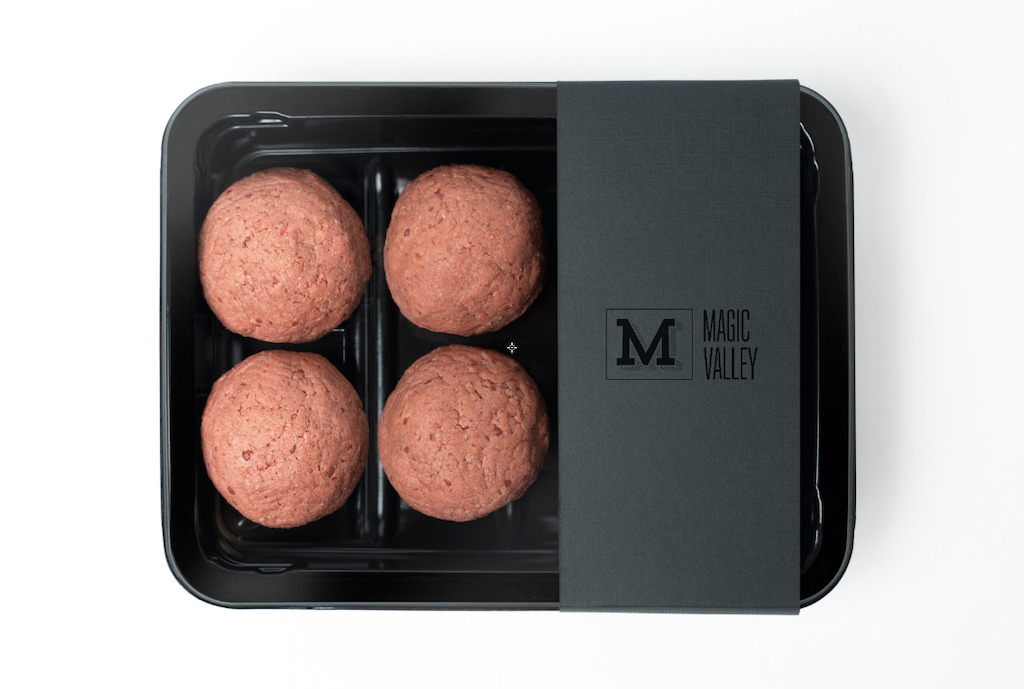
  • plant-based shrimp
    3 Mins Read

    Leading global shrimp producer Thai Union has launched a plant-based shrimp product as it expands its efforts to meet the demand for vegan seafood.

    Adding to its roster of alternative seafood, the new OMG Meat shrimp joins Thai Union’s plant-based tuna, as well as crab meat and dumplings, and fish nuggets.

    The company announced its plans to release the shrimp last year.

    “We have had consumers come to us and say, ‘I know you are an expert in seafood and shrimp – I would like to have a shrimp tempura, but not containing shrimp’,” Tunyawat Kasemsuwan, Thai Union’s innovation director said last year. “They come to us because they see we understand product quality, its functional properties, characteristics, taste, and sensory texture.”

    Plant-based shrimp

    In a statement on the Thai Union website following its vegan crab launch last year, the company says the move to seafood alternatives is aimed at meeting the “surging demand in Asia for healthy, environmental-conscious and innovative protein products.”

    Thai Union, the world’s largest tuna canner and parent of the popular Chicken of the Sea tuna brand, says it developed the shrimp at its Global Innovation Center with the goal of creating a plant-based protein that “tastes and smells like meat.”

    Thai Union scientists developing plant-based shrimp
    Thai Union scientists developing plant-based shrimp | Courtesy

    “Young consumers in Asia are increasingly adopting a more flexitarian eating style—eating a mixture of plant-based foods and meats in a more flexible manner. They are interested in exploring food for better health while also caring for the planet, with plant-based protein producing less carbon. The launch of OMG Meat supports Thai Union’s commitment to ‘Healthy Living, Healthy Oceans’,” the company said.

    While vegan seafood options including tuna, crab cakes, and fish sticks are on the rise in supermarkets and restaurants around the world, plant-based shrimp is still relatively obscure.

    Shrimp is the leading seafood product by sales in the U.S., Japan, and Europe. Globally the shrimp market size was estimated at $14.31 billion in 2021 and is expected to reach $14.77 billion in 2022.

    Earlier this year, Thai Union brought its plant-based tuna to nearly 400 supermarkets in Europe.

    Thai Union in Gourmet Market
    Courtesy

    Thai Union has been exploring options that go beyond its plant-based offerings, too. Last year, its venture fund participated in California-based cultured seafood brand BlueNalu’s Series B funding raise.

    Investing in the future of food

    In May, Thai Union invested $10 million (CAD) in Mara Renewables Corporation. It’s a leader in developing vegan omega-fatty-acid-rich algae oils that could have applications for Thai Union’s plant-based products.

    “As an industry leader in innovation and sustainability, we are committed to our Ingredients business which valorizes our co-products into natural and nutritional ingredients such as DHA-rich tuna oil,” Thiraphong Chansiri, President and CEO of Thai Union, said in a statement. 

    “Our strategic partnership with Mara further builds on this business by creating opportunities to jointly expand our product portfolios, grow our global presence, and accelerate go-to-market initiatives. We’re excited to partner with Mara and together provide nutritious and sustainably sourced DHA omega-3 fatty acids to consumers worldwide.”

    The post Leading Seafood Producer Thai Union Launches Plant-Based Shrimp appeared first on Green Queen.

    This post was originally published on Green Queen.
  • Alt Protein China
    3 Mins Read

    As domestic appetite for dairy products grows, Chinese startup Changing Biotech is making milk proteins using precision fermentation to address this burgeoning demand.

    Changing Biotech, China’s first precision fermentation dairy startup, has emerged from stealth mode and announced a record-breaking $22 million Series A led by veteran domestic agtech venture capital fund Bits x Bites. Other participants include Eight Roads Ventures, Sherpa Healthcare Partners, and Hillhouse.

    As per Green Queen‘s own reporting, this funding round would be the largest for China’s alternative protein industry after plant-based meat maker Starfield’s $100 million Series B announced this past January.

    Bits x Bites also backed Changing Biotech’s previously undisclosed $8.5 pre-Series A. According to the VC, “Changing stands out with its strong strain development and chassis construction capabilities along with in-house fermentation and purification expertise,” adding that “all of this is crucial for continuously discovering and commercializing suitable microorganisms at competitive costs at scale.”

    Founder Bin Luo, who has a background in food manufacturing and agriculture, told Sina News that the company’s five-ton test facility in Qingdao is already producing samples for customers, and they are working on designing six new 50-ton lines, with a 9,000-square-meter plant is under construction. Bits x Bites says Changing’s single-cell milk protein, which is made from a fungi strain that is classified as an edible microorganism in China, can be used for all sorts of applications, from milk to chocolate to snacks. In a separate interview, Luo said they will be applying for FDA approval this year.

    China’s Growing Appetite For Dairy

    Mere decades ago, China’s dairy consumption was almost insignificant, and it still lags far behind compared to Europe or other countries in Asia. But, this is changing. Thanks to rising incomes, rampant urbanization and campaigning by industry associations, per capita consumption of milk is increasing steadily. Over the past two years, household dairy consumption has jumped 11.8 percent year-on-year to reach 42.3 kg in 2021 according to data from the the Ministry of Agriculture and Rural Affairs. Industry associations.

    This burgeoning demand for dairy is not good news for the environment. Dairy is only second to beef when it comes to the worst food culprits for greenhouse gas emissions, which in turn is a driver of the worsening climate crisis. In addition, the dairy industry is linked to deforestation, water scarcity, antibiotic resistance and ethical concerns around animal welfare.

    Beijing is committed to carbon neutrality by 2060, and it will be difficult to achieve such a goal without rethinking the country’s food system due to the country’s growing appetite for meat and dairy.

    Fermented Protein: A Climate Crisis Solution

    Precision fermentation could be a key part of the solution. Doris Lee, CEO of GFI Consultancy, a Shanghai-based strategic partner of non-profit think tank Good Food Institute APAC told Green Queen that “few countries are as well-positioned to scale up fermentation technologies as China, which can leverage its vast range of untapped biological resources, top-tier research institutes, and unparalleled manufacturing infrastructure to do for the nascent alternative protein space what the nation is already doing for clean energy and electric vehicles.”

    In a New York times piece on the subject, leading environmentalist George Monbiot called precision fermentation “the most important environmental technology humanity has ever developed” while Time Magazine described the technology as having “the potential to change the entire food industry”.

    READ: You’re Already Eating Foods With Ingredients Made Using Precision Fermentation, So Why The Fuss About Animal-Free Dairy?

    Domestic Alt Protein Industry Gets Wings

    GFI Consultancy has just released a report titled Driving the Future of Alternative Proteins: China Fermentation Industry Report (2022), which features insights from over 30 industry experts and researchers offering a comprehensive overview of the dozens of startups, multinational companies, academic institutions, and other key stakeholders that working to create protein from microorganisms. 

    According to Lee, Beijing is supportive of using fermentation technology to buttress protein production. “China’s leaders have made clear through their five-year national plans and public statements that obtaining protein from microbes will be a key part of increasing food security and protecting against future supply disruptions, meaning that companies at the vanguard of diversifying the nation’s protein supply could have very strong wind at their backs.”


    Lead photo courtesy of Canva.

    The post China Alt Dairy Heats Up: Record Series A For First Startup Making Milk Proteins From Fermentation appeared first on Green Queen.

    This post was originally published on Green Queen.
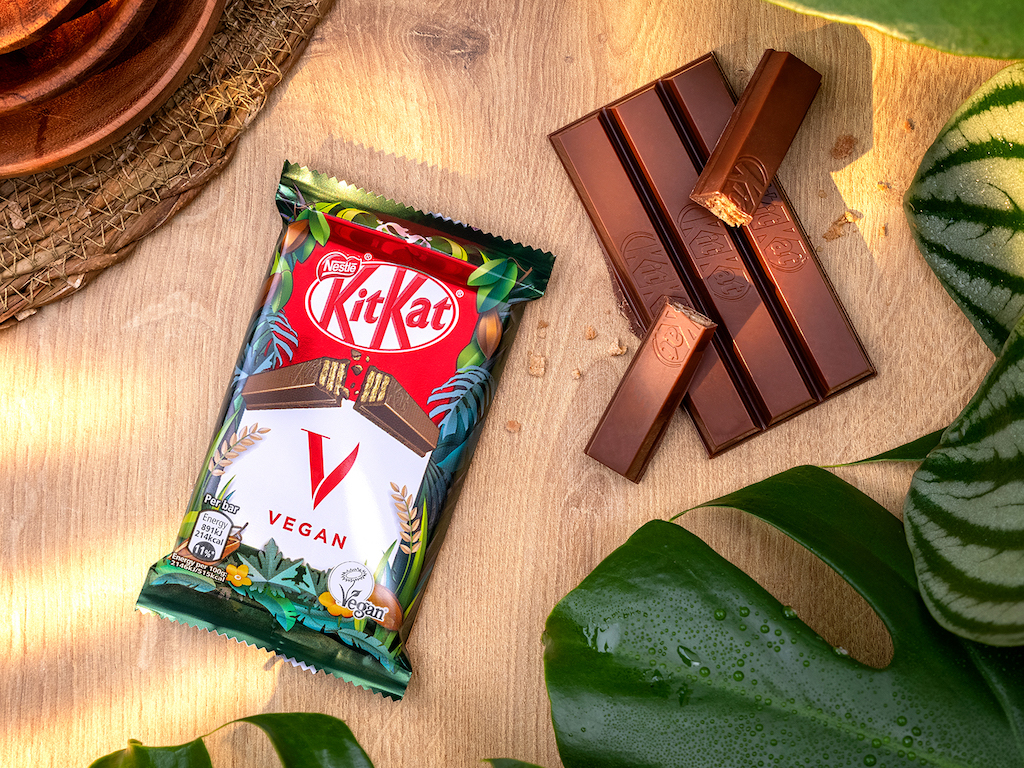
  • Oatly's tea master barista blend

    4 Mins Read

    Swedish oat milk brand Oatly is seeing strong growth in the Asian market. And with custom products like its Tea Master line, it shows no signs of slowing down.

    “We delivered strong second quarter financial results with sales growth of 22 percent, or 30 percent in constant currency, despite several headwinds including COVID-19 lockdowns in China,” Toni Petersson, Oatly’s CEO, said in the company’s second-quarter earnings report released earlier this month.

    “Profitability metrics improved compared to the first quarter of 2022 and we expect this trend to continue in the second half of the year,” Petersson said.

    Oatly's Toni Petersson
    Oatly’s Toni Petersson, courtesy

    Oatly is nothing short of a global phenomenon—U.S. coffee shops and supermarkets can’t keep up with demand even despite a recent safety recall for the Barista blend. Forty-nine percent of Gen Z consumers say they are ashamed to order dairy in public; their substitute of choice? Oat milk.

    The oat milk market is projected to reach $2.2 billion by 2026, with a CAGR of 6.2 percent. Recent category numbers collated by natural industry analytics firm SPINS show the U.S. plant-based milk sales grew by 6.4 percent to nearly $2.3 billion in the 52 weeks ending June 12, 2022, with oat milk dominating the growth, increasing by more than 50 percent in the last year, surpassing $527 million.

    Know your audience

    With its pervasive billboards and coffee shop devotees in the U.S., it certainly seems like no other market loves Oatly’s oat milk more. Enter: Asia.

    Asia is Oatly’s fastest growing region, seeing a 66 percent year-on-year revenue growth. And while sales in the U.S. are currently stronger, the volume and rate of growth in Asia are telling. Ninety-four percent of Oatly’s revenue is coming from mainland China, Hong Kong, and Taiwan.

    What’s even more telling: 82 percent of that revenue is coming from a single product—Oatly’s Barista edition, locally dubbed “Coffee Master.”

    Oatly factory line in China,
    Oatly factory line in China, courtesy

    Like the product’s success in the U.S., Asian consumers are flocking to the dairy-free alternative. There’s good reason; around 90 percent of Asian people are lactose intolerant.

    The company is now leaning into Asia’s love for tea with its Tea Master line in China, designed specifically for tea shops. “We estimate that the market size of boutique tea is twice that of boutique coffee,” Petersson said earlier this year.

    “We are full of confidence in the success of (tea master) so far. We have also received strong interest and orders from other chain brands, and hope to expand this (product) platform in 2022 and beyond,” Petersson said.

    Oatly’s Tea Master edition is now at more than 13,000 outlets and growing. The company has also rolled out smaller packaging to satisfy demand.

    “In China’s milk market, 200 ml to 350 ml portable packaging is the most popular specification, which makes us excited to provide Oatmeal Milk products with similar specifications,” Petersson said.

    Expansion and competition

    Part of Oatly’s success in Asia has been its early market entry and bringing factories to the region to compete on cost and speed distribution.

    According to Peter Bergh, chief operating officer of Oatly, the regional factories in Ma’anshan and Singapore are expected to continue to improve production capacity. “Our current expectation is that the Singapore plant will reach a stable state in the third quarter, while the Ma’anshan plant will continue to increase production capacity this year,” he said.

    oatly barista
    Courtest Oatly

    “The (factories) in Ma On Shan and Singapore enable us to launch new products, further enrich our product portfolio and achieve future growth in catering services, retail and e-commerce channels.”

    Oatly’s vision is landing with the Asian consumer, but it’s not the only dairy-free option available. There are several competitors just in the oat milk category, such as Oatoat, Oat Planet, Oakidoki, and Singapore’s Oatside, which is ramping up for major expansion following its recent $65.5 million Series A fundraise.

    For Oatly, though, it’s full steam ahead.

    “As we expand and scale our more localized production footprint while remaining disciplined in our capital allocation, we are confident in our ability to achieve much better production economics and operating efficiencies, reduce our environmental impact, and achieve profitability,” Petersson said.

    “Global consumer demand remains as strong as ever and we have a proven multi-channel strategy that we believe positions us well for long-term growth and profitability.”

    The post Oatly’s Asia Takeover Continues and Its Tea Master Line Is Proof appeared first on Green Queen.

  • Redefine Meat
    3 Mins Read

    More than $320 million in investments as of the end of June sees Israel lead the world in funding for vegan and alternative protein startups, reports the Good Food Institute Israel.

    While the U.S. total investments are higher than in Israel—more than $857 million in funding to date—by percentage, Israel is leading the world in alternative protein funding.

    “The next few years will determine the Israeli ecosystem’s long term position in the future of our global food system. Can it sustain its leadership? Will it leverage it and become an industrial leader as well, and promote Israeli national food security?” wrote Nir Goldstein, Managing Director of GFI Israel, wrote in the mid-year update to the Israel State of Alternative Protein Innovation Report.

    Alternative protein funding

    “2021 saw alternative protein placed at the forefront of the food-tech industry, with several massive investment rounds intended to accelerate scale-up and allow young companies to become global leaders for a better food system,” Aviv Oren, Director of Business Engagement and Innovation, GFI Israel, wrote in the mid-year report.

    “This momentum draws more investors, governments and multinational companies, as it is clearer than ever that to meet climate change goals and prevent future pandemics we must leverage technology to change the way we consume our food. Israel is leading this change, with more startups and more
    investment in alternative protein than any country besides the U.S.”

    Aleph Farms steak, courtesy

    Investments in alternative protein around the world totaled near $1.7 billion in June, with Israel making up 18 percent of it, according to the GFI. While Israel has also been a hub for cultivated meat development, the U.S. is still leading in funding for cultivated protein efforts. The U.S. netted $699 million for cultivated meat, followed by Israel’s $507 million. By comparison, the countries rounding out the top five in cultivated meat funding—Netherlands, Singapore, and the U.K.—raised under $150 million combined.

    Private investments in 2021 in Israel surpassed $620 million—a 450 percent YoY growth. Government funding contributed more than $13 million to early-stage startups and infrastructure. There was also the launch of the $15 million cultivated meat consortium. The country also saw 11 new companies established in the last year.

    Topping the private funding deals in Israel was the cultivated meat company Future Meat, with a $347 million Series B funding round. The company is gearing up for U.S. production facility. Other notable investments include precision fermentation company ReMilk’s $120 million Series B, cultivated meat company Aleph Farms‘ $105 million Series B, and plant-based brand Redefine Meat’s $29 million series A.

    Courtesy Remilk

    The report also notes a change in consumer habits over the two-year period from 2019-2021. Plant-based products are proving to be a significant engine for growth in the retail market, with the sector seeing 37 percent growth versus the animal sector at five percent. For meat, plant-based options grew at 21 percent versus four percent for animal meat.

    Plant-based dairy saw an even wider margin, with 63 percent growth of dairy alternatives compared to just one percent for animal-based dairy.

    The work ahead

    “However, there is still work to be done,” Oren said. “New innovative solutions, novel ingredients, and
    investment in infrastructure are required to create better products that will enable the dietary shift of flexitarians and omnivores.”

    He says GFI Israel is working to increase pipelines for new ventures, including sponsoring research and working with scientists, entrepreneurs, investors, and policymakers.

    “Just as they do in Israel’s successful cyber and fintech industry, we invite multinational corporations and
    investors to establish R&D and innovation centers here in Israel so they can enjoy the magic of our unique ecosystem and create the desired change for successful business and a better world,” Oren said.

    The post How Israel Is Leading the World In Vegan Protein Development appeared first on Green Queen.

    This post was originally published on Green Queen.
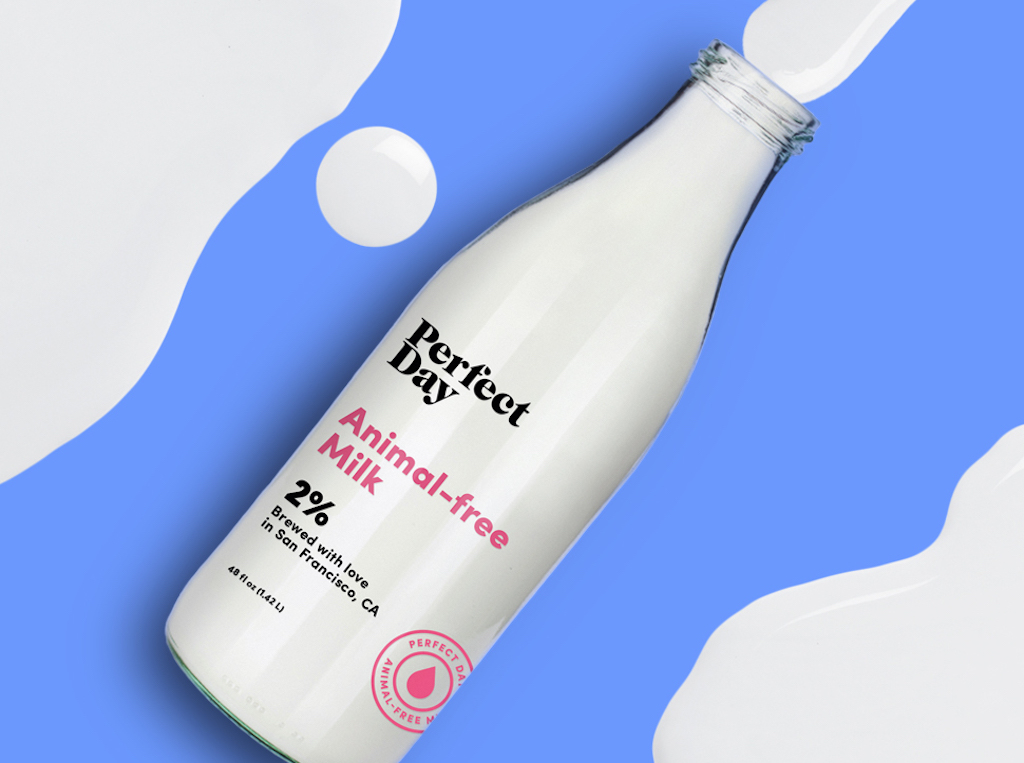
  • Novel Farms pork loin
    3 Mins Read

    Novel Farms says it has created the world’s first cultivated whole-cut pork loin that shows marbling and texture.

    “We aim to bring culinary delicacies into the future of food by crafting cultivated meats that will be hard to resist,” the Berkeley-based company says on its website. It says it’s starting with conventional pork followed by Iberian pork, which comes from pigs native to Spain and Portugal. According to Novel Farms, the Black Iberian pig “is unique in its genetic ability to produce oleic acid-rich, exceptionally marbled meat.”

    Novel Farms

    Nieves Martinez Marshall co-founded Novel Farms in 2020 alongside Michelle Lu after they met as postdoctoral scientists in the molecular and cell biology department at the University of California at Berkeley.

    Novel Farms says it has developed a proprietary microbial fermentation approach that builds the cultivated meat scaffolding to successfully, and affordably, produce whole cuts of meat.

    “There’s no other company right now doing pork loin,” Martinez Marshall told TechCrunch. Only CellX in China and Higher Steaks in London are currently working on pork belly.

    Novel Farms founders
    Novel Farms founders | Courtesy

    Whole cuts are the holy grail for both the plant-based and the cultivated meat sector. Efforts are proving successful for a number of companies in recent years. But for cultivated meat, in particular, they’re typically not being done cost-effectively, though. Novel Farms says it’s found the secret, using common and inexpensive microorganisms.

    “We just have a very good, efficient scaffold, and the cells attach very well,” Martinez Marshall said. “That’s something that nobody else has. Once we confirm and scale with a bioreactor, then we will be the most affordable of all the companies.”

    The company says it has reduced scaffolding production costs by 99.27 percent. This means it can scale production faster and hasten price parity with conventional meat—a key hurdle for the sector.

    The pork loin debut comes as Novel Farms secured $1.4 million SAFE notes including a majority stake by Big Idea Ventures, and financing from Joyance/Social Starts, Sustainable Food Ventures, Good Startup, CULT foods and strategic angel investors.

    Pork-free pork demand

    The plant-based sector is also angling toward pork products, namely bacon.

    Beyond Meat, which recently announced it’s working on a whole cut steak, says it’s also working to develop vegan bacon.

    The Natalie Portman-backed La Vie brought its vegan bacon to Burger King earlier this year. In June, it launched a virtual restaurant collaboration with OFC, the Original Food Court in France.

    Courtesy La Vie

    MyForest Foods, the vegan food spinoff of Ecovative, which is developing mycelium-based materials including leather and foam, opened what it calls the “world’s largest” vertical mycelium farm for its mycelium bacon last month.

    “The incredible progress we’ve made on Swersey Silos in just one year since breaking ground is a testament to the engineering and technological expertise on our team,” Peter Mueller, Chief Technology Officer at Ecovative, said in a statement. “MyForest Foods is now in a position to reach full market scale. It’s a tremendous milestone for one of our closest partners, and for AirMycelium technology.”

    Across Asia, OmniPork is leading the charge for traditional pork products including mince. The Hong Kong-based venture has established retail partnerships with McDonald’s and Starbucks, among others across Asia. It recently brought its vegan pork products to the U.S. and Europe.

    Lead image courtesy Novel Farms

    The post How Novel Farms Cut Costs By 99% for the World’s First Lab-Grown Pork Loin appeared first on Green Queen.

    This post was originally published on Green Queen.

  • 3 Mins Read

    Myprotein, the world’s largest online consumer sports nutrition brand, is bringing Perfect Day’s precision fermentation whey into the fold.

    Whey Forward is the first co-branded product in the MyProtein label using Perfect Day’s precision fermentation dairy. The product delivers whey consumers the taste and performance they love while also being a more sustainable, ethical product.

    A better whey

    “We’re thrilled to combine Myprotein’s leadership in creating innovative products focused on fueling performance with the unmatched nutrition and functionality of our animal-free whey protein. Whey Forward exemplifies how animal-free does not mean sacrificing taste, performance, or the future of our planet,” Ryan Pandya, co-founder and CEO of Perfect Day, said in a statement.  

    Myprotein
    Courtesy MyProtein

    Like all of Perfect Day’s products, the Myprotein Whey Forward has a significantly smaller environmental footprint than conventional dairy. According to Perfect Day, its novel technology reduces water consumption by up to 99 percent and produces 97 percent fewer greenhouse gas emissions than conventional whey production methods.  

    It achieves this through its novel precision fermentation technique that sees whey protein developed using microflora in a process similar to brewing beer. The end result is a product that works and tastes just like dairy with applications in milk, yogurt, and cheese, as well as traditional whey uses.

    “With Whey Forward, we are removing a barrier to make it even easier for people to find a protein that best suits their performance goals. Pairing Perfect Day’s technology, with our state-of-the-art production and award-winning formula, we are able to maintain the same delicious taste and texture that makes our products leaders in the category,” said Pallav Tamaskar, Managing Director, Myprotein U.S.

    Perfect collaborations

    The partnership with Myprotein is the latest collaboration for Perfect Day, but not its first. Since its first product launch in 2020, the company has been actively disrupting the dairy category with a number of brand collaborations.

    Courtesy Mars

    In June, Perfect Day partnered with leading confectionery manufacturer Mars on a chocolate bar made with its whey. Startups aimed at disrupting the dairy category are also looking to the category leader for a jumpstart. Tomorrow Farms announced its partnership earlier this year, as did Strive Nutrition.

    Last November, Perfect Day partnered with Starbucks on a test run at select locations throughout Seattle. And last year, former U.S. president Barack Obama celebrated a milestone birthday with a menu that featured vegan cheese made by Perfect Day, among other sustainable options.

    Lead image courtesy Perfect Day

    The post The World’s Largest Sports Nutrition Brand Taps Perfect Day’s Precision Fermentation Whey appeared first on Green Queen.

    This post was originally published on Green Queen.

  • 4 Mins Read

    Icelandic startup Loki Foods has raised a pre-seed $650,000 to develop a line of realistic and nutritional alternative seafood products, including a whole-cut, plant-based white fish fillet alternative. The company says their sustainable Atlantic cod analogue beats conventional fish meat on nutrition and cooks just like the real thing. The product also has the potential to help shift Iceland away from its domestic reliance on the fishing industry.

    Loki’s confirmed investors for the funding round include Sustainable Food Ventures, MGMT Ventures, VegInvest, FoodHack, Kale United and Lifely VC. The funds will be used to make operational improvements that will allow the company to tempt consumers away from conventional seafood consumption.

    Mariliis Holm, investor at Sustainable Food Ventures said of their decision to back the young company: “As the first investor in Loki Foods, we recognized a unique opportunity to build a new narrative for the future of seafood at the very heart of seafood’s global capital – Iceland. Loki Foods’ team, technology and location are truly one of a kind which allows them to produce sustainable alternative proteins in the form of seafood with completely renewable energy and pristine Icelandic water.”
    Loki Foods plant-based cod fillet

    Presenting Iceland’s first realistic cod analogue

    So far, the startup has released scant details, other than some very encouraging product shots. Loki says they are the first Icelandic alternative seafood company and that their plant-based alternative will offer superior nutritional benefits to conventional cod.

    “Loki Foods’ mission is to mature the alt-seafood market in taste, cookability, feel and nutrition so that we can attract consumers away from conventional seafood and accelerate the removal of marine life from the supply chain,” Chris McClure, Loki Foods CEO and co-founder told Green Queen

    Attention is drawn to the lack of toxins, microplastics and heavy metals, commonly found in caught seafood. The prototype fillet lays the foundation for a protein-rich final product, containing polyunsaturated fatty acids and vitamins. The company states that it will be suitable for the same preparation and cooking methodologies as regular fish.

    Co-founder and CEO Chris McClure

    The sustainable alternative to industrial fishing

    Loki states that fishing and aquaculture are two sides of the same problem: unsustainable food production. With more than half the world’s fish stocks now considered overfished and 10 percent teetering on the edge of total collapse, moving away from marine animal protein is essential. A stumbling block to allowing fish to replenish is the continued increase in demand for seafood.

    Some consider aquaculture to be a viable solution but Loki disagrees. The startup is explicit in its disapproval of biodiversity loss, discharge waste and pesticides that are all consequences of the sector. It highlights that a two-acre salmon farm produces as much waste as 10,000 people to illustrate the point. 

    Plant-based seafood, depending on its manufacturing processes, stands to be a far more sustainable route.

    According to Holm, “the future of seafood is about tastier food that also spares our oceans and their wildlife. The Loki Fillet, a plant based cod, goes above conventional white fish in nutrition, taste, and cookability, while being climate positive.”

    Photo by Jack & Bry.

    The rise of ultrarealistic vegan seafood

    The niche of plant-based seafood analogues so realistic that consumers double-check the label is growing exponentially. Plantish started the ball rolling in January when it unveiled its indistinguishable vegan salmon fillet. The Israeli startup uses legumes and algae to 3D print whole-cut fillets that caught the attention of future consumers and investors. Two months after publishing images of its development, Plantish scooped $12.45 million in seed funding. 

    Also looking to replicate the mouthfeel and flavour of white fish fillets is U.K.-based Jack & Bry. The alternative protein startup has partnered with The Cornish Seaweed Company to add nutritional density and flavour to its signature ingredient, jackfruit. The result, the company claims, is a realistic flaky fish fillet that doesn’t need to be battered – potentially a first for the alternative seafood sector.

    Fellow cod enthusiasts Sea & Believe are working to replace the endangered fish with a plant-based alternative. An Irish startup, it uses locally sourced seaweed to create its fishless fillets. The cod analogue is currently still in development, with a prototype unveiled to support ongoing fundraising efforts.


    All photos by Loki Foods, unless stated.

    The post Icelandic startup Loki Foods Unveils Sustainable Plant-Based Atlantic Cod Fillet appeared first on Green Queen.