This content originally appeared on Democracy Now! and was authored by Democracy Now!.
This post was originally published on Radio Free.
This content originally appeared on Democracy Now! and was authored by Democracy Now!.
This post was originally published on Radio Free.
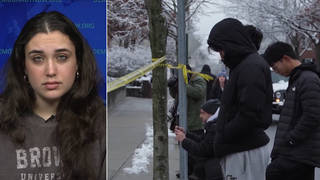
A deadly mass shooting at Brown University left two students dead and nine others injured on Saturday. One student, Mia Tretta, had survived a shooting in 2019 when she was shot in the stomach as a high school student. Her best friend was killed in the shooting, and she had selected Brown University for Rhode Island’s strong gun control laws. Now she has survived yet another school shooting. “Physically and emotionally, a school shooting takes your whole life and flips it upside down,” says Tretta, who criticizes politicians who refuse to enact meaningful gun reform. “We know that every single act of gun violence is 100% preventable.”
This content originally appeared on Democracy Now! and was authored by Democracy Now!.
This post was originally published on Radio Free.
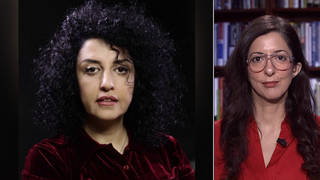
Nobel Peace Prize laureate Narges Mohammadi, one of Iran’s most prominent human rights activists, was rearrested Friday when Iranian authorities violently raided a memorial ceremony she attended at a mosque in Iran’s northeastern city of Mashhad. “She’s been seen as a huge threat to the Islamic Republic’s regime,” says Porochista Khakpour, Iranian American author and essayist. “They find her moral authority extremely intimidating.”
Mohammadi has spent more than 10 years of her life in and out of prison, most recently when she was arrested in November 2021 and accused — among other charges — of threatening Iran’s national security and spreading “propaganda” against the state for her decadeslong work fighting for human rights, women’s rights and democracy in Iran.
This content originally appeared on Democracy Now! and was authored by Democracy Now!.
This post was originally published on Radio Free.
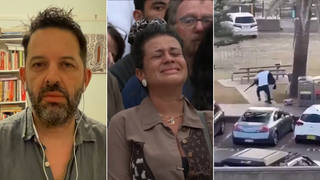
At least 15 people were fatally shot during a Hanukkah celebration at Sydney’s famed Bondi Beach this Saturday, and at least another 42 people were injured, marking Australia’s worst mass shooting in nearly three decades. Victims included a 10-year-old girl, two rabbis and a Holocaust survivor who died while shielding his wife from bullets.
After Israeli Prime Minister Netanyahu blamed Australia’s recognition of a Palestinian state for the shooting, Antony Loewenstein, member of the Jewish Council of Australia, says the shooting is “being weaponized by the worst people imaginable to support incredibly draconian policies.”
This content originally appeared on Democracy Now! and was authored by Democracy Now!.
This post was originally published on Radio Free.
This content originally appeared on Democracy Now! Audio and was authored by Democracy Now!.
This content originally appeared on Democracy Now! and was authored by Democracy Now!.
This post was originally published on Radio Free.
This content originally appeared on Democracy Now! for Broadcasters – HD MP4 and was authored by Democracy Now! for Broadcasters – HD MP4.
This post was originally published on Radio Free.
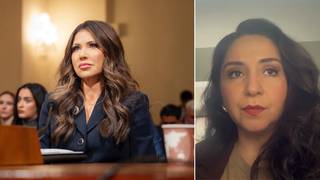
Democratic lawmakers repeatedly called on Homeland Security Secretary Kristi Noem to resign as they confronted her on Trump’s immigration crackdown during a heated House Homeland Security Committee hearing Thursday. We speak with Congressmember Delia Ramirez, who reiterated her call during the hearing for Noem to resign and announced that she would begin taking steps for her impeachment.
The Department of Homeland Security is “operating as a criminal organization” under Noem’s leadership, Ramirez tells Democracy Now! “She thinks that she is above the law as long as Republicans are in leadership. … We can’t allow her to think this is a laughable matter as people are dying under her watch.”
This content originally appeared on Democracy Now! and was authored by Democracy Now!.
This post was originally published on Radio Free.

As the Trump administration expands its immigration crackdown nationwide, President Trump is simultaneously creating new pathways for wealthy noncitizens to obtain U.S. visas. Earlier this week, Trump officially launched a program allowing affluent visitors to fast-track permission to live and work in the United States. For a $1 million payment, applicants can receive a so-called Trump Gold Card, which promises to speed up U.S. residency applications “in record time.” The administration says it will also soon offer a $5 million “Trump Platinum Card” that would allow participants to avoid paying some U.S. taxes. The announcement comes as new rules published this week would require visitors from 42 countries in the visa waiver program to submit up to five years of social media history, along with phone numbers, email addresses and biometric data.
Shev Dalal-Dheini, director of government relations at the American Immigration Lawyers Association, says the changes show that “if you’re wealthy, if you can pay to play, then you’re welcome to come to the United States. But if you’re not — if you’re coming as a tourist, or you’re coming to seek humanitarian protection — then we’re going to make it much tougher for you to come here and really put a lot of hurdles along the way in the guise of security and vetting.”
This content originally appeared on Democracy Now! and was authored by Democracy Now!.
This post was originally published on Radio Free.
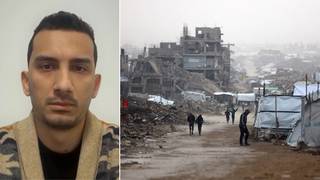
Award-winning Palestinian reporter Mohammed Mhawish, who left Gaza last year, joins us to discuss his new piece for New York magazine about Israel’s surveillance practices. It describes how Palestinians throughout the genocide in Gaza have been watched, tracked and often killed by Israeli forces who have access to their most intimate details, including phone and text records, social relations, biometric data and more.
This all-encompassing surveillance system is “reshaping how people speak, how they’re moving, how they’re even thinking,” says Mhawish. “It manufactured behavior for people, so they shrink their lives to reduce risk, they rehearse what version of themselves feels safest to present, and that creates an enormous psychological burden.”
Mhawish also describes the terror of when his family’s house was bombed, killing two of his cousins and two neighbors in an attack he says was linked to Israeli surveillance of his reporting activities. “I was being watched and tracked,” he says.
This content originally appeared on Democracy Now! and was authored by Democracy Now!.
This post was originally published on Radio Free.
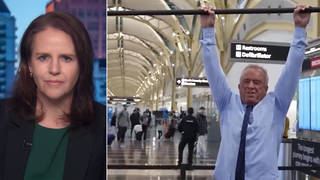
As Health Secretary Robert F. Kennedy Jr. dramatically reshapes U.S. immunization policy, we speak with Dr. Fiona Havers, a former top vaccine expert at the Centers for Disease Control and Prevention who resigned in June.
Last week, Kennedy’s handpicked advisers on a federal vaccine panel voted against universal hepatitis B shots for newborns, reversing 35 years of CDC guidance that all newborns receive the vaccine within 24 hours of birth. The Trump administration also recently altered the CDC’s website to include false claims linking autism and vaccines, in keeping with Kennedy’s spreading of vaccine misinformation going back decades. CNN is reporting the FDA is also considering putting a “black box” warning on COVID-19 vaccines.
“This administration is causing a lot of confusion and is using, basically, the CDC to spread misinformation now about vaccines,” says Dr. Havers. She also discusses her decision to resign from the CDC and the chaos the Trump administration has caused at the agency, calling RFK Jr.’s changes a “hostile takeover” to advance “anti-science views.”
This content originally appeared on Democracy Now! and was authored by Democracy Now!.
This post was originally published on Radio Free.
This content originally appeared on Democracy Now! Audio and was authored by Democracy Now!.
This post was originally published on Radio Free.
This content originally appeared on Democracy Now! and was authored by Democracy Now!.
This post was originally published on Radio Free.
This content originally appeared on Democracy Now! for Broadcasters – HD MP4 and was authored by Democracy Now! for Broadcasters – HD MP4.
This post was originally published on Radio Free.

Palestinians were battered with rain and freezing temperatures overnight as winter storm Byron hit the Gaza Strip. Soaked tents and makeshift shelters flooded, causing some mattresses to float and improvised roofs to blow away. An 8-month-old baby girl, Rahaf Abu Jazar, died from hypothermia. Moureen Kaki, an aid worker living in Gaza, says conditions at hospitals have not improved since the announcement of the so-called ceasefire. “It is not really a ceasefire,” she says. “It’s just a slower form of death.”
This content originally appeared on Democracy Now! and was authored by Democracy Now!.
This post was originally published on Radio Free.

The acclaimed academic and writer Mahmood Mamdani speaks with Democracy Now! about the rise of his son, New York City Mayor-elect Zohran Mamdani. The professor cites Zohran’s “refusal to budge, to soften his critique of the state of Israel” as a critical aspect of his rise to power. “His refusal to change his stance told the electorate that this was a man of principle, that affordability was not just merely rhetoric, that he could be taken seriously at his word,” Mahmood says.
This content originally appeared on Democracy Now! and was authored by Democracy Now!.
This post was originally published on Radio Free.
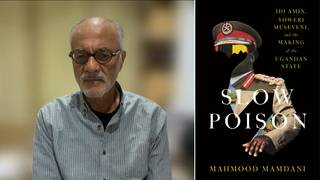
We speak with the acclaimed academic and writer Mahmood Mamdani, who has just released a new book, Slow Poison: Idi Amin, Yoweri Museveni, and the Making of the Ugandan State. Mamdani, who has taught at Columbia for decades, was raised in Uganda and first came to the United States in the 1960s to study. He and his family were later expelled from Uganda during Idi Amin’s dictatorship. The book “is about the reversal of the anti-colonial movement” in Uganda, says Mamdani. “The anti-colonial movement fought to create a nation out of a fragmented country … and I speak of slow poison as a gradual, piecemeal, step-by-step cutting up of the country so that you no longer have a single citizenship.”
This content originally appeared on Democracy Now! and was authored by Democracy Now!.
This post was originally published on Radio Free.
We speak with the acclaimed academic and writer Mahmood Mamdani, who has just released a new book, Slow Poison: Idi Amin, Yoweri Museveni, and the Making of the Ugandan State. Mamdani, who has taught at Columbia for decades, was raised in Uganda and first came to the United States in the 1960s to study. He and his family were later expelled from Uganda during Idi Amin’s dictatorship. The book “is about the reversal of the anti-colonial movement” in Uganda, says Mamdani. “The anti-colonial movement fought to create a nation out of a fragmented country … and I speak of slow poison as a gradual, piecemeal, step-by-step cutting up of the country so that you no longer have a single citizenship.”
This content originally appeared on Democracy Now! and was authored by Democracy Now!.
This post was originally published on Radio Free.

U.S. troops seized an oil tanker off the coast of Venezuela on Wednesday, a major escalation that the Venezuelan government called “international piracy.” We speak with New York University professor Alejandro Velasco about the Trump administration’s intentions in the country, which has the world’s largest known oil reserves. Though the Pentagon has claimed the conflict is aimed at combating narcoterrorism, Velasco says the violence is actually an effort “to get rid of leftist governments in the region.”
This content originally appeared on Democracy Now! and was authored by Democracy Now!.
This post was originally published on Radio Free.
U.S. troops seized an oil tanker off the coast of Venezuela on Wednesday, a major escalation that the Venezuelan government called “international piracy.” We speak with New York University professor Alejandro Velasco about the Trump administration’s intentions in the country, which has the world’s largest known oil reserves. Though the Pentagon has claimed the conflict is aimed at combating narcoterrorism, Velasco says the violence is actually an effort “to get rid of leftist governments in the region.”
This content originally appeared on Democracy Now! and was authored by Democracy Now!.
This post was originally published on Radio Free.
This content originally appeared on Democracy Now! and was authored by Democracy Now!.
This post was originally published on Radio Free.
This content originally appeared on Democracy Now! and was authored by Democracy Now!.
This post was originally published on Radio Free.
This content originally appeared on Democracy Now! Audio and was authored by Democracy Now!.
This post was originally published on Radio Free.
This content originally appeared on Democracy Now! Audio and was authored by Democracy Now!.
This post was originally published on Radio Free.
This content originally appeared on Democracy Now! Audio and was authored by Democracy Now!.
This post was originally published on Radio Free.
This content originally appeared on Democracy Now! Audio and was authored by Democracy Now!.
This post was originally published on Radio Free.
This content originally appeared on Democracy Now! for Broadcasters – HD MP4 and was authored by Democracy Now! for Broadcasters – HD MP4.
This post was originally published on Radio Free.

What are the lessons from the Montgomery bus boycott launched 70 years ago this month? The boycott, which sparked the civil rights movement, began after the arrest of Rosa Parks for refusing to give up her seat on a segregated city bus to a white man. Historian and biographer Jeanne Theoharis, author of The Rebellious Life of Mrs. Rosa Parks, argues, “Part of what her courage is, is the ability to step forward again and again, without any sense that this is going to change anything, and say, 'This is the line. And I refuse.'” Theoharis’s new piece for The Guardian is “What we get wrong about the Montgomery bus boycott — and what we can learn from it.”
This content originally appeared on Democracy Now! and was authored by Democracy Now!.
This post was originally published on Radio Free.

Nineteen-year-old Any Lucía López Belloza was detained and deported, despite a lack of removal order, when attempting to head home from Babson College in Boston to surprise her family in Texas for Thanksgiving. “This is the first arrest of its kind I’ve seen,” says her attorney, Todd C. Pomerleau, who says the student has been the victim of “character assassination.” After López Belloza “was taken down near the border on a bus, had shackles around her ankles, chain around her waist, shackles around her wrist,” her family attempted to speak out to the press about the rights violations she suffered. They are now being harassed by law enforcement, as well.
This content originally appeared on Democracy Now! and was authored by Democracy Now!.
This post was originally published on Radio Free.

Bruna Ferreira, a DACA recipient and mother of White House Press Secretary Karoline Leavitt’s nephew, has lived in the United States since she was 6 years old, but was recently arrested by ICE in her own driveway in what her attorney, Todd Pomerleau, calls a “brazen, unconstitutional arrest, a clear violation of her rights.” Ferreira was transported to a remote detention center in Louisiana following her arrest in Massachusetts, and just released Tuesday. “All of a sudden, now the Leavitts have a problem with 'criminal illegal aliens.' Yet one of them was about to marry one of their loved ones, and there was no problem,” says Pomerleau.
This content originally appeared on Democracy Now! and was authored by Democracy Now!.
This post was originally published on Radio Free.