“Speak Up Kōrerotia” — a radio show centred on human rights issues — has featured a nuclear-free Pacific and other issues in this week’s show.
Encouraging discussion on human rights issues in both Canterbury and New Zealand, Speak Up Kōrerotia offers a forum to provide a voice for affected communities.
Engaging in conversations around human rights issues in the country, each show covers a different human rights issue with guests from or working with the communities.
Analysing and asking questions of the realities of life allows Speak Up Kōrerotia to cover the issues that often go untouched.
Discussing the hard-hitting topics, Speak Up Kōrerotia encourages listeners to reflect on the issues covered.
Hosted by Dr Sally Carlton, the show brings key issues to the fore and provides space for guests to “Speak Up” and share their thoughts and experiences.
The latest episode today highlights the July/August 2025 marking of two major anniversaries — 80 years since the bombing of Hiroshima and Nagasaki in Japan, and 40 years since the bombing of the Rainbow Warrior here in Aotearoa.
What do these anniversaries mean in the context of 2025, with the ever-greater escalation of global tension and a new nuclear arms race occurring alongside the seeming impotence of the UN and other international bodies?
Anti-nuclear advocacy in 2025 Video/audio podcast: Speak Up Kōrerotia
Speak Up Kōrerotia . . . human rights at Plains FM Image: Screenshot
Guests: Disarmament advocate Dr Kate Dewes, journalist and author Dr David Robie, critical nuclear studies academic Dr Karly Burch and Japanese gender literature professor Dr Susan Bouterey bring passion, a wealth of knowledge and decades of anti-nuclear advocacy to this discussion.
Dr Robie’s new book Eyes of Fire: The Last Voyage and Legacy of the Rainbow Warriorwas launched on the anniversary of the ship’s bombing. This revised edition has extensive new and updated material, images, and a prologue by former NZ prime minister Helen Clark.
The Speak Up Kōrerotia panel in today’s show, “Anti-Nuclear Advocacy in 2025”, Dr Kate Dewes (from left), Sally Carlton, Dr David Robie, Dr Karly Burch and Susan Bouterey. Image: Screenshot
New Zealand’s police commissioner says he understands the potential impact the country’s criminal deportees have on smaller Pacific Island nations.
Commissioner Richard Chambers’ comments on RNZ Pacific Waves come as the region’s police bosses gathered for the annual Pacific Islands Chiefs of Police conference in Waitangi.
The meeting, which is closed to media, began yesterday.
Chambers said a range of issues were on the agenda, including transnational organised crime and the training of police forces.
Inspector Riki Whiu, of Northland police, leads (from right), Secretary-General of Interpol Valdecy Urquiza, Vanuatu Police Commissioner Kalshem Bongran and Northern Mariana Islands Police Commissioner Anthony Macaranas during the pōwhiri. Image: RNZ/Peter de Graaf
Across the Pacific, the prevalence of methamphetamine and its role in driving social, criminal and health crises have thrust the problem of organised crime into the spotlight.
Commissioner Chambers said New Zealand had offered support to its fellow Pacific nations to combat transnational organised crime, in particular around the narcotics trade.
Deportation policies
However, the country’s own transnational crime advisory group also identified the country’s deportation policies as a “significant contributor to the rise of organised crime in the Pacific”.
In 2022, a research report showed that New Zealand returned 400 criminal deportees to Pacific nations between 2013 and 2018.
The report from the Lowy Institute also said criminal deportees from New Zealand, as well as Australia and the US, were a significant contributor to transnational crime in the Pacific.
Te Waaka Popata-Henare, of the Treaty Grounds cultural group Te Pito Whenua, leads the Pacific Islands Chiefs of Police to Te Whare Rūnanga for a formal welcome. Image: RNZ/Peter de Graaf
When Chambers was asked about the issue and whether New Zealand’s criminal deportation policy undermined work against organised crime across the region, he said it had not been raised with him directly.
“The criminal networks that we are dealing with, in particular those such as the cartels out of South America, the CJNG [cartels] and Sinaloa cartels, who really do control a lot of the cocaine and also methamphetamine trades, also parts of Asia with the Triads,” Commissioner Chambers said.
“I know that the Pacific commissioners that I work with are very, very focused on what we can do to combat and disrupt a lot of that activity at source, in both Asia and South America.
“So that’s where our focus has been, and that’s what the commissioners have been asking me for in terms of support.”
Pacific nation difficulties
He said he understood the difficulties law enforcement in Pacific nations faced regarding criminal deportees, as New Zealand faced similar challenges under Australia’s deportation policy.
In New Zealand, the country’s returned nationals from Australia are known as 501 deportations, named after the section of the Australian Migration Act which permits their deportation due to criminal convictions.
These individuals have often spent the majority of their lives in Australia and have no family or ties to New Zealand but are forced to return due to Australia’s immigration laws.
New Zealand’s authorities have tracked how these deportees — who number in the hundreds — have contributed significantly to the country’s increasingly sophisticated and established organised crime networks over the past decade.
Chambers said that because police dealt with the real impacts of Australia’s 501 law, he could relate to what his Pacific counterparts faced.
“I understand from the New Zealand perspective [which is] the impact that New Zealand nationals returning to our country have on New Zealand, and the reality is, they’re offending, they’re re-offending.
“I suspect it’s no different from our Pacific colleagues in their own countries. And it may be something that we can talk about.”
This week’s conference was scheduled to finish tomorrow. Speakers due to appear included Interpol Secretary-General Valdecy Urquiza and Pacific Islands Forum Secretary-General Baron Waqa.
This article is republished under a community partnership agreement with RNZ.
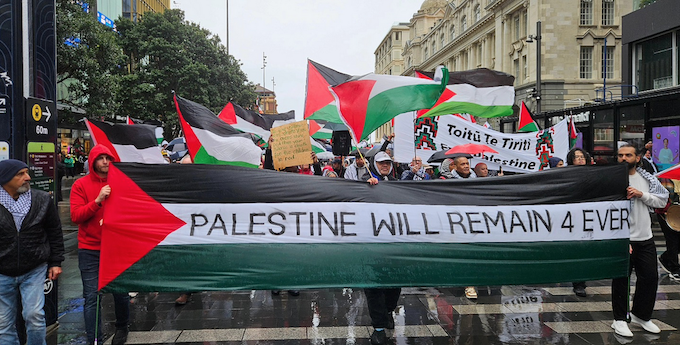
The advocacy and protest group Palestine Solidarity Network Aotearoa has condemned New Zealand’s “deliberate distraction” over sanctions against Israel and has vowed more protests against Foreign Minister Winston Peters’ “failed policy” on Gaza.
After the huge turnout of thousands in Palestine solidarity rallies across more than 20 locations in New Zealand last weekend, PSNA has announced it is joining an International Day of Action on September 6.
Rallies next weekend will have a focus on Israel’s targeted killing of journalists in Gaza.
PSNA co-chair John Minto said in a statement there was “an incredible show of marches and rallies throughout Aotearoa New Zealand for sanctions against Israel during the past weekend.”.
“But with [Foreign Minister] Peters obstinately running the Foreign Ministry, the government will ignore all expressions of public support for Palestinian rights.
“We’ll be back with even more people on the streets on the 6th.”
Shocking images
Minto said that number would have risen significantly in the past few weeks as people were seeing the shocking images of Israel’s widespread use of starvation as a weapon of war, especially against the children of Gaza.
“Around the world, governments are starting to respond to their people demanding sanctions on Israel to end the genocide.
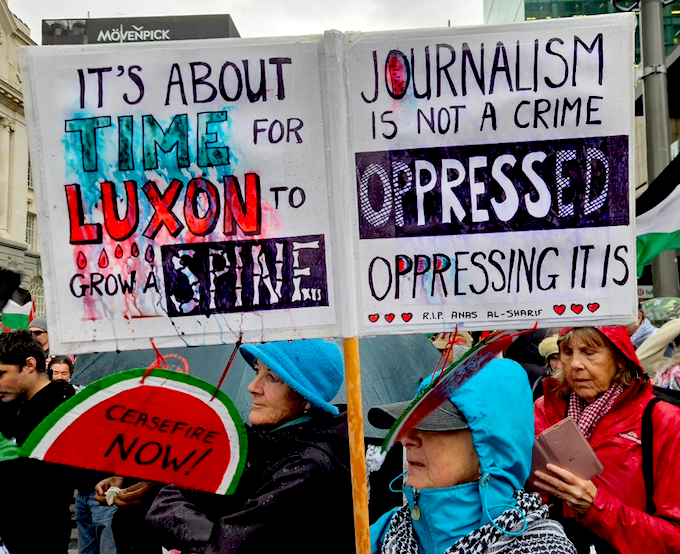
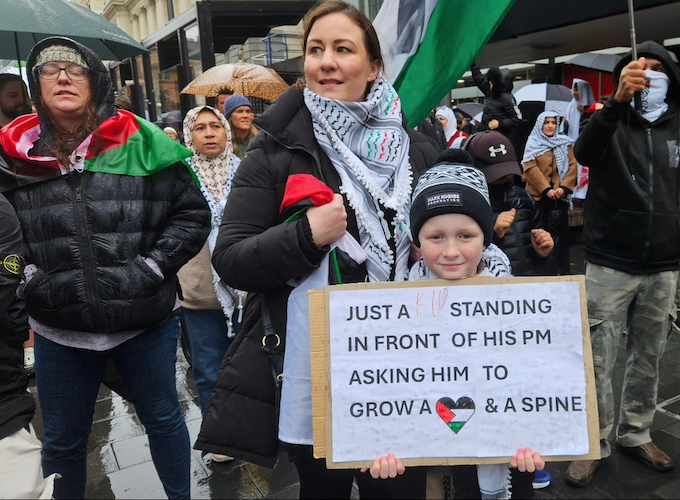
A family rugged up against the rain and cold expressing their disappointment with New Zealand’s “weak” policy over the Gaza genocide last weekend. Image: Asia Pacific Report
“Yet, Winston Peters is most reluctant to even criticise Israel, let alone take any action.”
Minto said actions were vital otherwise Israel took no notice.
“We’ve seen Israel’s arrogant impunity in increasingly violent action and showing off its military capacity and intentions,” he said.
“Not a peep from our ministers over anything.
“Just on the Occupied West Bank, there are settlers freely shooting and lynching Palestinians.
New illegal settlement plans
“Israel’s Parliament has just voted to annex the West Bank, as plans are also announced for [an illegal] new settlement strategically designed to sever it irreparably into two parts.
“In Gaza, Israeli troops are reinvading Gaza City to ethnically cleanse a million people to the south and Israeli aircraft are still terror bombing a famine-devastated community.”
“That would mean an invasion of all of its neighbours and the extinction of at least Lebanon and Jordan, which in Israeli government eyes have no right to exist.”
The New Zealand government thought that it was “responding appropriately” by going through a process of considering recognition of a Palestinian state.
“That can only be seen as a deliberate distraction from a focus on sanctions,” Minto said.
“Back in 1947, New Zealand voted in the UN for a Palestinian state in part of Palestine.
“Recognition is token now, and it was token then, because the world stood aside and let Israel conquer all of Palestine, expel most of its people and impose an apartheid regime on those who managed to stay.”
Minto said the global movement in support of Palestinian rights would not be distracted.
Comprehensive sanctions were the only way to force an end to Israel’s genocide.
Australia slams Israeli PM
Meanwhile, Al Jazeera reports that Australia has hit back at Netanyahu after the Israeli leader branded the country’s prime minister “weak”, with an Australian minister accusing the Israeli leader of conflating strength with killing people.
In an interview with Australia’s national broadcaster ABC, Minister for Home Affairs Tony Burke said that strength was not measured “by how many people you can blow up or how many children you can leave hungry”.
Burke’s comments came after Netanyahu on Tuesday launched a blistering attack on Prime Minister Anthony Albanese on social media, claiming he would be remembered by history as a “weak politician who betrayed Israel and abandoned Australia’s Jews”.
Speaking on the ABC’s Radio National Breakfast programme, Burke characterised Netanyahu’s broadside as part of Israel’s “lashing out” at countries that have moved to recognise a Palestinian state.
This content originally appeared on Asia Pacific Report and was authored by APR editor.
It’s now more than a week since Prime Minister Christopher Luxon announced his government had begun to formally consider New Zealand’s position on the recognition of a Palestinian state.
That leaves two weeks until the UN General Assembly convenes on September 9, where it is expected several key allies will change position and recognise Palestinian statehood.
Already in a minority of UN member states which don’t recognise a Palestinian state, New Zealand risks becoming more of an outlier if and when Australia, Canada and the United Kingdom make good on their recent pledges.
Luxon has said the decision is “complex”, but opposition parties certainly don’t see it that way. Labour leader Chris Hipkins says it’s “the right thing to do”, and Greens co-leader Chloë Swarbrick has called on government MPs to “grow a spine” (for which she was controversially ejected from the debating chamber).
Former Labour prime minister Helen Clark has also criticised the government for trailing behind its allies, and for appearing to put trade relations with the United States ahead of taking a moral stand over Israel’s actions in Gaza.
Certainly, those critics — including the many around the country who marched last weekend — are correct in implying New Zealand has missed several opportunities to show independent leadership on the issue.
The distraction factor While it has been open to New Zealand to recognise it as a state since Palestine declared its independence in 1988, there was an opportunity available in May last year when the Irish, Spanish and Norwegian governments took the step.
That month, New Zealand also joined 142 other states calling on the Security Council to admit Palestine as a full member of the UN. But in a subsequent statement, New Zealand said its vote should not be implied as recognising Palestinian statehood, a position I called “a kind of muddled, awkward fence-sitting”.
It is still not too late, however, for New Zealand to take a lead. In particular, the government could make a more straightforward statement on Palestinian statehood than its close allies.
The statements from Australia, Canada and the UK are filled with caveats, conditions and contingencies. None are straightforward expressions of solidarity with the Palestinian right of self-determination under international law.
As such, they present political and legal problems New Zealand could avoid.
Politically, this late wave of recognition by other countries risks becoming a distraction from the immediate starvation crisis in Gaza. As the independent Israeli journalist Gideon Levy and UN Special Rapporteur Francesca Albanese have noted, these considered and careful diplomatic responses distract from the brutal truth on the ground.
This was also Chloë Swarbrick’s point during the snap debate in Parliament last week. Her private members bill, she noted, offers a more concrete alternative, by imposing sanctions and a trade embargo on Israel. (At present, it seems unlikely the government would support this.)
Beyond traditional allies Legally, the proposed recognitions of statehood are far from ideal because they place conditions on that recognition, including how a Palestinian state should be governed.
The UK has made recognition conditional on Israel not agreeing to a ceasefire and continuing to block humanitarian aid into Gaza. That is extremely problematic, given recognition could presumably be withdrawn if Israel agreed to those demands.
Such statements are not exercises in genuine solidarity with Palestinian self-determination, which is defined in UN Resolution 1514 (1960) as the right of peoples “to freely determine their political status and freely pursue their economic, social and cultural development”.
Having taken more time to consider its position, New Zealand could now articulate a more genuine statement of recognition that fulfils the legal obligation to respect and promote self-determination under international law.
A starting point would be to look beyond the small group of “traditional allies” to countries such as Ireland that have already formally recognised the State of Palestine. Importantly, Ireland acknowledged Palestinian “peaceful self-determination” (along with Israel’s), but did not express any other conditions or caveats.
New Zealand could also show leadership by joining with that wider group of allies to shape the coming General Assembly debate. The aim would be to shift the language from conditional recognition of Palestine toward a politically and legally more tenable position.
That would also sit comfortably with the country’s track record in other areas of international diplomacy — most notably the campaign to abolish nuclear weapons, where New Zealand has also taken a different approach to its traditional allies.
French Minister for Overseas Manuel Valls is once again in New Caledonia for a four-day visit aimed at maintaining dialogue, despite a strong rejection from a significant part of the pro-independence camp.
He touched down at the Nouméa-La Tontouta Airport last night on his fourth trip to New Caledonia since he took office in late 2024.
For the past eight months, he has made significant headway by managing to get all political parties to sit together again around the same table and discuss an inclusive, consensual way forward for the French Pacific territory, where deadly riots have erupted in May 2024, causing 14 deaths and more than 2 billion euros (NZ$3.8 billion) in material damage.
On July 12, during a meeting in Bougival (west of Paris), some 19 delegates from parties across the political spectrum signed a 13-page document, the Bougival Accord, sketching what is supposed to pave the way for New Caledonia’s political future.
The document, labelled a “project” and described as “historic”, envisages the creation of a “State” of New Caledonia, a dual New Caledonia-French citizenship and the transfer of key powers such as foreign affairs from France to New Caledonia.
The document also envisions a wide range of political reforms, more powers for each of the three provinces and enlarging the controversial list of eligible citizens allowed to vote at the crucial local provincial elections.
When they signed the text in mid-July, all parties (represented by 18 politicians) at the time pledged to go along the new lines and defend the contents, based on the notion of a “bet on trust”.
But since the deal was signed at the 11th hour in Bougival, after a solid 10 days of tense negotiations, one of the main components of the pro-independence camp, the FLNKS, has pronounced a “block rejection” of the deal.
FLNKS said their delegates and negotiators (five politicians), even though they had signed the document, had no mandate to do so because it was incompatible with the pro-independence movement’s aims and struggle.
Signatures on the last page of New Caledonia’s new agreement. Image: Philippe Dunoyer/RNZ Pacific
FLNKS rejection of Bougival The FLNKS and its majority component, Union Calédonienne, said that from now on, while maintaining dialogue with France, they would refuse to talk further about the Bougival text or any related subject.
They also claim they are the only pro-independence legitimate representative of the indigenous Kanak people.
They maintain they will only accept their own timetable of negotiation, with France only (no longer including the pro-France parties) in “bilateral” mode to conclude before 24 September 2025.
French Overseas Minister Manuel Valls . . . not giving up on the Bougival project and his door remains open. Image: Outre-mer la Première
Later on, the negotiations for a final independence should conclude before the next French Presidential elections (April-May 2027) with the transfer of all remaining powers back to New Caledonia.
The FLNKS also demands that any further talks with France should take place in New Caledonia and under the supervision of its President.
It warns against any move to try and force the implementation of the Bougival text, including planned reforms of the conditions of voter eligibility for local elections (since 2007, the local “special” electoral roll has been restricted to people living in New Caledonia before 1998).
During his four-day visit this week (20-24 August), Valls said he would focus on pursuing talks, sometimes in bilateral mode with FLNKS.
The minister, reacting to FLNKS’s move to reject the Accord, said several times since that he did not intend to give up and that his door remained open.
‘Explain and convince’ He would also meet “as many New Caledonians as possible” to “explain and convince”.
Apart from party officials, Valls also plans to meet New Caledonia’s “Customary (chiefly) Senate”, the mayors of New Caledonia, the presidents of New Caledonia’s three provinces and representatives of the economic and civil society.
The May-July 2024 riots have strongly impacted on New Caledonia’s standard of living, with thousands of jobless people because of the destruction of hundreds of businesses.
Health sector in crisis Valls also intends to devote a large part of his visit to meetings with public and private health workers, who also remain significantly affected by an acute shortage of staff, both in the capital Nouméa and rural areas.
Tomorrow, Valls plans to implement one of the later stages of the Bougival signing — the inaugural session of a “drafting committee”, aimed at agreeing on how necessary documents for the implementation of the Bougival commitments should be formulated.
These include working on writing a “fundamental law” for New Caledonia (a de facto constitution) and constitutional documents to make necessary amendments to the French Constitution.
Elections again postponed to June 2026 Steps to defer once again the provincial elections from November 2025 to May-June 2026 were also recently taken in Paris, at the Senate, Valls said earlier this week.
A Bill has been tabled for debates in the Senate on 23 September 2025. In keeping with the Bougival commitments and timeline, it proposes a new deadline for provincial elections: no later than 28 June 2026.
But FLNKS now demands that those elections be maintained for this year.
On a tightrope again This week’s visit is perceived as particularly sensitive: as Valls’s trip is regarded as focusing on saving his Bougival deal, he is also walking on a tightrope.
On one side, he wants to maintain contact and an “open-door” policy with the hard-line group of the FLNKS, even though they have now denounced his Bougival deal.
On the other side, he has to pursue talks with all the other parties who have, since July 12, kept their word and upheld the document.
If Valls was perceived to concede more ground to the FLNKS, following its recent claims and rejections, parts of the pro-Bougival leaders who have signed and kept their word and commitment could well, in turn, denounce some kind of betrayal, thus jeopardising the precarious equilibrium.
The “pro-Bougival” signatories held numerous public meetings with their respective militant bases to explain the agreement and the “Bougival spirit”, as well as the reasons for why they had signed.
This not only includes pro-France parties who oppose independence, but also two moderate pro-independence parties, the PALIKA (Kanak Liberation Party) and the UPM (Union Progressiste en Mélanésie), formed into a “UNI” platform (Union Nationale pour l’Indépendance), who have, since August 2024, distanced themselves from the FLNKS.
At the same time, FLNKS took into its fold a whole new group of smaller parties, unions and pressure groups (including the Union Calédonienne-created CCAT –a field action coordination group dedicated to organising political campaigns on the ground) and has since taken a more radical turn.
Simultaneously, Christian Téin, head of CCAT, was also elected FLNKS president in absentia, while serving a pre-trial jail term in mainland France.
His pre-trial judicial control conditions were loosened in June 2025 by a panel of three judges, but he is still not allowed to return to New Caledonia.
One of the moderate UNI leaders, Jean-Pierre Djaïwé (PALIKA) told his supporters and local media last week that he believed through the Bougival way, it would remain possible for New Caledonia to eventually achieve full sovereignty, but not immediately.
Ruffenach: No intention to ‘undo’ Bougival Several pro-France components have also reacted to the FLNKS rejection by saying they did not intend to “undo” the Bougival text, simply because it was the result of months of negotiations and concessions to reach a balance between opposing aspirations from the pro-independence and pro-France camps.
“Let’s be reasonable. Let’s get real. Let’s come back to reality. Has this country ever built itself without compromise?,” pro-France Le Rassemblement-LR party leader Virginie Ruffenach told Radio Rythme Bleu yesterday.
“We have made this effort at Bougival, to find a middle way which is installing concord between those two aspirations. We have made steps, the pro-independence have made steps. And this is what allowed this agreement to be struck with its signatures”.
She said the FLNKS, in its “new” version, was “held hostage by . . . radicalism”.
“Violence will not take the future of New Caledonia and we will not give into this violence”.
She said all parties should now take their responsibilities and live up to their commitment, instead of applying an “empty chair” policy.
No credible alternative: Valls Earlier this week, Valls repeated that he did not wish to “force” the agreement but that, in his view, “there is no credible alternative. The Bougival agreement is an extraordinary and historic opportunity”.
“I will not fall into the trap of words that hurt and lead to confrontation. I won’t give in to threats of violence or blockades,” he wrote on social networks.
Last night, as Valls was already on his way to the Pacific, FLNKS political bureau and its president, Christian Téin, criticised the “rapport de force” seemingly established by France.
He also deplored that, in the view of numerous reactions following the FLNKS rejection of the Bougival text, his political group was now being “stigmatised”.
Ahead of the French minister’s visit, the FLNKS has launched a “peaceful” campaign revolving around the slogan “No to Bougival”.
The FLNKS is scheduled to meet Valls today.
The inaugural session of the “drafting committee” is supposed to take place the following day on Thursday.
He is scheduled to leave New Caledonia on Saturday.
This article is republished under a community partnership agreement with RNZ.
I unequivocally support Irish author Sally Rooney with all my heart and soul. The author risks imprisonment for donating funds from her books and the TV series based on Normal People to a Palestinian group.
Once again the United Kingdom tells Palestinians who they should support. Go figure.
In her opinion piece in The Irish Times last Saturday she said that:
“Activists who disrupt the flow of weapons to a genocidal regime may violate petty criminal statutes, but they uphold a far greater law and a more profound human imperative: to protect a people and culture from annihilation.”
Whenever the people resist or rebel they are deemed terrorists. That has been the case for indigenous people around the world from indigenous Americans to Indians in India to Aborigine and Māori, the Irish and the Scots, and the Welsh.
I went from being a “born-again” starry-eyed kibbutznik who believed in Zionism to a journalist who researched the facts and the hidden truths.
Those facts are revolting. Settler colonialism is revolting. Stealing homes is theft.
I kept in touch with some of my US-based Zionist kibbutznik mates. When I asked them to stop calling Palestinians animals, when I asked them not to say they had tails, when I asked them to stop the de-humanisation — the same de-humanisation that happened during the Nazi regime, they dumped me.
Zionism based on a myth
Jews who support genocide are antisemitic. They are also selfish and greedy. Zionists are the bully kids at school who take other kids toys and don’t want to share. They don’t play fair.
The notion of Zionism is based on a myth of the superiority of one group over another. It is religious nutterism and it is racism.
Empire is greed. Capitalism is greed. Settler colonialism involves extermination for those who resist giving up their land. Would you or I accept someone taking our homes, forcing us to leave our uneaten dinner on the table? Would you or I accept our kids being stolen, put in jail, raped, tortured.
Irish author Sally Rooney on why she supports Palestine Action and rejects the UK law banning this, and she argues that nation states have a duty not only to punish but also to prevent the commission of this “incomparably horrifying crime of genocide”. Image: Irish Times screenshot APR
The country was weird when I visited in 1982. It had just invaded Lebanon. Later that year it committed a genocide.
The Sabra and Shatila massacre was a mass murder of up to 3500 Palestinian refugees by Israel’s proxy militia, the Phalange, during Israel’s invasion of Lebanon in 1982. The horrific slaughter prompted outrage and condemnation around the world, with the UN General Assembly condemning it as “an act of genocide”.
I had been primed for sunshine and olives, but the country gave me a chill. The toymaker I worked with was a socialist and he told me I should feel sorry for the Palestinians.
It isn’t normal for a country to be ruled by the militia. Gun-toting soldiers roamed the streets. But you need to defend yourself when you steal.
Paranoia from guilt
Paranoia is a consequence of a persecutor who fails to recognise their guilt. It happens when you steal. The paranoia happens when you close doors. When you don’t welcome the other — whose home you stole.
In 2014, soldiers of the IDF — a mercenary macho army — were charged with raping their own colleagues. Now footage of the rape of Palestinian men are celebrated on national television in Israel in front of live audiences. Any decent person would be disgusted by this.
The army under this Zionist madness has committed — and continues to commit — the crimes it lied about Palestinians committing. And yes, the big fat liar has even admitted its own lies. The bully in the playground really doesn’t care now, it does not have to persuade the world it is right, because it is supported, it has the power.
This isn’t the warped Wild West where puritans invented the scalping of women and children — the sins of colonisers are many — this is happening now. We can stand for the might of racism or we can stand against racist policies and regimes. We can stand against apartheid and genocide.
Indigenous people must have the right to live in their homeland. Casting them onto designated land then invading that land is wrong.
When Israelis are kidnapped they are called hostages. When Palestinians are kidnapped they are called prisoners. It’s racist. It’s cruel. It’s revolting that anyone would support this travesty.
Far far more Palestinians were killed in the year leading up to October 7, 2023, than Israelis killed that day (and we know now that some of those Israelis were killed by their own army, Israel has admitted it lied over and again about the murder of babies and rapes).
Ōtautahi author and journalist Saige England . . . “It isn’t normal for a country to be ruled by the militia. Gun-toting soldiers roamed the streets.” Image: Saige England
Mercenary macho army
So who does murder and rape? The IDF. The proud mercenary macho army.
Once upon a time, a Palestinian kid who threw a stone got a bullet between the eyes. Now they get a bullet for carrying water, for going back to the homeground that has been bombed to smithereens. Snipers enjoy taking them down.
Drones operated by human beings who have no conscience follow children, follow journalists, follow nurses, follow someone in a wheelchair, and blow them to dust.
This is a game for the IDF. I’m sure some feel bad about it but they have to go along with it because they lose privileges if they do not. This sick army run by a sick state includes soldiers who hold dual US and Israeli citizenship.
Earlier this year I met a couple of IDF soldiers on holidays from genocide, breezily ordering their lattes in a local cafe. I tried to engage with them, to garner some sense of compassion but they used “them” and “they” to talk about Palestinians.
They lumped all Palestinians into a de-humanised mass worth killing. They blamed indigenous people who lived under a regime of apartheid and who are now being exterminated, for the genocide.
The woman was even worse than the man. She loathed me the minute she saw my badge supporting the Palestinian Solidarity Network of Aoteara. Hate spat from her eyes.
Madness.
De-brainwashing
I saw that the only prospect for them to change might be a de-brainwashing programme. Show them the real facts they were never given, show them real Palestinians instead of figments of their imagination.
It occurred to me that it really was very tempting to take them home and offer them a different narrative. I asked them if they would listen, and they said no. If I had forced them to come with me I would have been, you know, a hostage-taker.
Israel is evidence that the victim can become the persecutor when they scapegoat indigenous people as the villain, when they hound them for crime of a holocaust they did not commit.
And I get it, a little. My Irish and French Huguenot ancestors were persecuted. I have to face the sad horrid fact that those persecuted people took other people’s land in New Zealand. The victims became the persecutor.
Oh they can say they did not know but they did know. They just did not look too hard at the dispossession of indigenous people.
I wrote my book The Seasonwife at the ripe young age of 63 to reveal some of the suppressed truths about colonisation and about the greed of Empire — a system where the rich exploit the poor to help themselves. I will continue to write novels about suppressed truths.
And I call down my Jewish ancestors who hid their Jewishness to avoid persecution. I have experienced antisemitism.
Experienced cancelling
But I have experienced cancelling, not by my publisher I hasten to add, but I know agencies and publishers in my country who tell authors to shut up about this genocide, who call those who speak up anti-semitic.
I have been cancelled by Zionist authors. I don’t have a publisher like that but I know those who do, I know agencies who pressure authors to be silent.
I call on other authors to follow Rooney’s example and for pity’s sake stop referencing Hamas. Learn the truth.
Benjamin Netanyahu refused to deal with any other Palestinian representative. Palestinians have the right to choose their own representatives but they were denied that right.
What is a terrorist army? The IDF which has created killing field after killing field. Not just this genocide, but the genocide in Lebanon in 1982.
I have been protesting against the massacre of Palestinians since 2014 and I wish I had been more vocal earlier. I wish I had left the country when the Phalangists were killed. I did go back and report from the West Bank but I feel now, that I did not do enough. I was pressured — as Western writers are — to support the wrongdoer, the persecutor, not the victim.
I will never do that again.
Change with learning
I do believe that with learning we can change, we can work towards a different, fairer system — a system based on fairness not exploitation.
I stand alongside indigenous people everywhere.
So I say again, that I support Sally Rooney and any author who has the guts to stand up to the pressure of oppressive regimes that deny the rights of people to resist oppression.
I have spent a decade proudly standing with Palestinians and I will never stop. I believe they will be granted the right to return to their land. It is not anyone else’s right to grant that, really, the right of return for those who were forced out, and their descendants, is long overdue.
And their forced exile is recent. Biblical myths don’t stack up. Far too often they are stacked to make other people fall down.
Perhaps if we had all stood up more than 100,000 Palestinians would still be alive, a third of those children, would still be running around, their voices like bells instead of death calls.
I support Palestinians with all my heart and soul.
Saige England is an award-winning journalist and author of The Seasonwife, a novel exploring the brutal impacts of colonisation. She is also a contributor to Asia Pacific Report.
Journalists like Anas al-Sharif who report the truth in Gaza to the world and are targeted by Israel deserve protection, not just sympathy.
COMMENTARY:By Sara Qudah
During the past 22 months in Gaza, the pattern has become unbearable yet tragically predictable: A journalist reports about civilians; killed or starved, shares footage of a hospital corridor, shelters bombed out, schools and homes destroyed, and then they are silenced.
Killed.
At the Committee to Protect Journalists we documented that 2024 was the deadliest year for journalists, with an unprecedented number of those killed by Israel reporting from Gaza while covering Israel’s military operations.
That trend did not end; it continued instead in 2025, making this war by far the deadliest for the press in history.
When a journalist is killed in a besieged war city, the loss is no longer personal. It is institutional, it is the loss of eyes and ears on the ground: a loss of verification, context, and witness.
Journalists are the ones who turn statistics into stories. They give names to numbers and faces to headlines. They make distant realities real for the rest of the world, and provide windows into the truth and doors into other worlds.
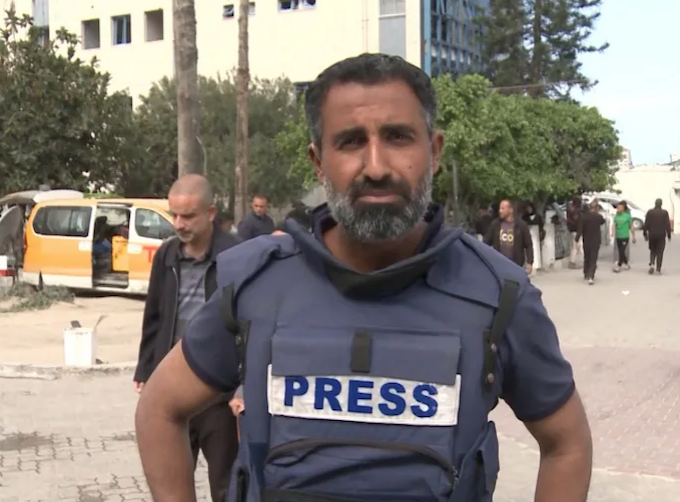
That is why the killing of Anas al-Sharif last week reverberates so loudly, not just as a tragic loss of one life, but as a silencing of many stories that will now never be told.
Not just reporting Anas al-Sharif was not just reporting from Gaza, he was filling a vital void. When international journalists couldn’t access the Strip, his work for Al Jazeera helped the world understand what was happening.
On August 10, 2025, an airstrike hit a tent near al-Shifa Hospital in Gaza City where journalists had gathered. Al-Sharif and several of his colleagues were killed.
The strike — its method, its targets, and its aftermath – wasn’t isolated. It fits a pattern CPJ and other press freedom organisations have tracked for months: in Gaza, journalists are facing not just the incidental risks of war, but repeated, targeted threats.
And so far, there has been no accountability.
The Israeli military framed its action differently: officials alleged that al-Sharif was affiliated with Hamas and that the attack was aimed at a legitimate threat. But so far, the evidence presented publicly failed to meet the test of independent witnesses; no public evidence has met the basic standard of independent verification.
UN experts and press freedom groups have called for transparent investigations, warning of the danger in labelling journalists as combatants without clear, verifiable proof.
In the turmoil of war, there’s a dangerous tendency to accept official narratives too quickly, too uncritically. That’s exactly how truth gets lost.
Immediate chilling effect
The repercussions of silencing reporters in a besieged territory are far-reaching. There is the immediate chilling effect: journalists who stay risk death; those who leave — if they even can — leave behind untold stories.
Second, when local journalists are killed, international media have no choice but to rely increasingly on official statements or third-party briefings for coverage, many with obvious biases and blind spots.
And third, the families of victims and the communities they represented are denied both justice and memory.
Al-Sharif’s camera recorded funerals and destroyed homes, bore witness to lives cut short. His death leaves those images without a voice, pointing now only into silence.
We also need to name the power dynamics at play. When an enormously powerful state with overwhelming military capability acts inside a densely populated area, the vast majority of casualties will be civilians — those who cannot leave — and local reporters, who cannot shelter.
This is not a neutral law of physics; it is the to-be-anticipated result of how this war waged in a space where journalists will not be able to go into shelter.
We have repeatedly documented that journalists killed in this war are Palestinian — not international correspondents. The most vulnerable witnesses, those most essential to documenting it, are also the most vulnerable to being killed.
So what should the international community and the world leaders do beyond offering condolences?
Demand independent investigation
For starters, they must demand an immediate, independent investigation. Not just routine military reviews, but real accountability — gathering evidence, preserving witness testimony, and treating each death with the seriousness it deserves.
Accountability cannot be a diplomatic nicety; it must be a forensic process with witnesses and evidence.
Additionally, journalists must be protected as civilians. That’s not optional. Under international law, reporters who aren’t taking part in the fighting are civilians — period.
That is an obligation not a choice. And when safety isn’t possible, we must get them out. Evacuate them. Save their lives. And in doing so, allow others in — international reporters who can continue telling the story.
We are past the time for neutrality. The use of language like “conflict”, “collateral damage”, or “civilian casualties” cannot be used to deflect responsibility, especially when the victims are people whose only “crime” was documenting human suffering.
When the world loses journalists like Anas al-Sharif, it loses more than just one voice. We lose a crucial balance of power and access to truth; it fails to maintain the ability to understand what’s happening on the ground. And future generations lose the memory — the record — of what took place here.
Stand up for facts
The international press community, human rights organisations, and diplomatic actors need to stand up. Not just for investigations, but for facts. Families in Gaza deserve more than empty statements. They deserve the truth about who was killed, and why. So does every person reading this from afar.
And the journalists still risking everything to report from inside Gaza deserve more than sympathy. They deserve protection.
The killing of journalists — like those from Al Jazeera — isn’t just devastating on a human level. It’s a direct attack on journalism itself. When a state can murder reporters without consequence, it sends a message to the entire world: telling the truth might cost you your life.
I write this as someone who believes that journalism is, above all, a moral act. It’s about bearing witness. It’s about insisting that lives under siege are still lives that matter, still worth seeing.
Silencing a journalist doesn’t just stop a story — it erases a lifetime of effort to bring others into view.
The murder of al-Sharif isn’t just another tragedy. It’s an assault on truth itself, in a place where truth is desperately needed. If we let this keep happening, we’re not just losing lives — we’re losing the last honest witnesses in a world ruled by force.
And that’s something we can’t afford to give up.
Sara Qudah is the regional director for Middle East and North Africa of the Committee to Protect Journalists. Sara on LinkedIn: Sara Qudah
Speaking from the ramparts of the Red Fort on India’s 79th Independence Day, Prime Minister Narendra Modi made an unusual declaration while discussing his government’s achievements in all sectors, from space to semiconductors, and in the strategic Operation Sindoor. He warned that there was a conspiracy to change India’s demography and that strong action would be taken against ‘ghuspethiye’ or infiltrators plotting against the nation. Without mentioning any community, the Prime Minister said, “These infiltrators are snatching away the livelihoods of our youth. These infiltrators are targeting our sisters and daughters… These infiltrators are misleading innocent tribals and seizing their lands. The nation will not endure this.”
A high-powered Demography Mission will work towards addressing the important challenge of demographic changes, especially in border areas. pic.twitter.com/aSdh07AZxL
The PM’s rhetoric comes at a time when minority groups in India, including Muslims, Bengali-speaking migrants, Christian priests and nuns and tribes in the Northeast, already bear the brunt of majoritarian muscle-flexing on a daily basis. Alt News has already documented several cases falsely peddled as ‘Love Jihad’ and instances where vigilantes have taken it upon themselves to protect cows or Sanatan Dharma. At such a time, the PM’s call to action directed at ‘infiltrators’, on a day of significant national importance, could end up legitimizing such attacks.
Rise in Attacks Against Minorities
Take the case of 21-year-old Suleiman Rahim Khan. Just four days before Modi’s speech, he was beaten to death allegedly by members of a Hindutva group in Maharashtra’s Jalgaon district on January 11, after being seen with a Hindu woman from the same village. His family was also assaulted by the perpetrators. The victim’s family alleged that some of the perpetrators also work as gau rakshaks or self-styled cow vigilantes.
A little over two weeks ago, two Catholic nuns from Kerala, Vandana Francis and Preethi Mary, and a tribal man named Sukhman Mandavi, were arrested at Chhattisgarh’s Durg railway station on charges of religious conversion and human trafficking, while they were taking three tribal women to Agra for work. The police action was triggered after a platform ticket examiner called Bajrang Dal members, who confronted the group and accused them of conversion and trafficking. In a viral video, a Bajrang Dal leader, Jyoti Sharma, was seen grilling the nuns and examining documents in the presence of police. The families of the women confirmed they were already Christians, disputing conversion allegations. Videos and statements from the women showed they travelled willingly for jobs, contradicting Bajrang Dal claims that they were being forced or trafficked. The women alleged in a counter-complaint that Bajrang Dal activists harassed and assaulted them and coerced them into making false statements.
On July 31, in West Bengal’s Durgapur district, self-styled cow vigilantes led by BJP youth leader Parijat Ganguly, assaulted, tied up, and paraded several Muslim men in Durgapur, West Bengal, accusing them of smuggling cattle. The attack, close to a police station, was widely documented in videos showing the victims being beaten, tied, and forced to chant religious slogans while the mob “rescued” cattle from their truck.
On July 10, West Bengal Leader of Opposition and BJP leader Suvendu Adhikari urged people of the state to ‘not go to Kashmir and Muslim majority areas’, citing safety concerns after the recent terrorist attack in Pahalgam. He suggested visiting other states, such as Himachal Pradesh or Uttarakhand.
Alt News, in collaboration with Bellingcat, also investigated a network of five cow vigilante groups that operate across Haryana and Uttar Pradesh, and informally work together to carry out violence against truck drivers. These groups of gau rakshaks or “cow protectors” seem to carry out charitable work such as operating ambulances for cows, feeding stray animals and distributing food to people during the day. But in the dark of the night, they chase, shoot at and beat up truck drivers they claim were “smuggling” cows for slaughter. Some of the leaders of these vigilante groups also said they were working closely with the local police.
In late May, four Muslim men in Aligarh, Uttar Pradesh, were violently assaulted by a mob linked to Bajrang Dal and Vishwa Hindu Parishad (VHP), accused of transporting cow meat. Graphic videos showed the victims badly beaten and stripped. However, lab reports later confirmed they were carrying buffalo meat, not banned cow meat. Despite this, the assailants filed a police complaint against the victims, besides allegedly demanding Rs 50,000 from the meat suppliers, looting them, and setting their vehicle on fire.
Last year, ahead of Christmas, vigilantes from Bajrang Dal and VHP disrupted Christmas celebrations in schools across India, especially in Gujarat, in what seemed like a concerted effort. Videos showed these groups removing decorations, halting festivities, and forcing schools to prioritise Hindu cultural values, including chanting slogans and reciting hymns. Several schools confirmed these disruptions, often citing fear of repercussions and directives from higher authorities, while VHP Gujarat denied official involvement and distanced itself from linked social media accounts.
These are just a few of the many instances where Right-wing activists took it upon themselves to protect their faith and community from the ‘other’. One could argue that the Prime Minister focused on the issue of infiltrators and illegal immigrants — a concern the current government has consistently prioritised — and not Muslims. But it is important to highlight that in the past few months, Bengali-speaking migrants from West Bengal, particularly Muslims, have disproportionately borne the brunt of a concerted effort to identify and deport illegal immigrants. Initiated by law enforcement agencies in several BJP-ruled states and Union territories, this ‘drive’ swiftly filtered down to fringe elements who, lacking technical knowledge of the Bengali language and its dialects, took it upon themselves to harass and assault vulnerable communities.
Interestingly, this is not the first time the Prime Minister has used the word ‘ghuspethiye‘ in his speech.
Modi’s History With Remarks on ‘Ghuspethiye’
While addressing a rally in Banswara, Rajasthan, on April 21, 2024, in the run-up to the Lok Sabha elections, Modi used the term ‘ghuspethiyon’ to target Muslims. During his address, Modi accused the Congress party of taking away people’s gold and ‘mangalsutras’.
“When they (Congress) were in power, they said Muslims had the right to the state’s properties. This means they would collect these properties and give them to those who produce more children… They will give it to the ghuspethiyo. Do you want to give away your hard-earned money to the intruders? This is what the Congress manifesto says — we will measure the amount of gold your mothers and daughters own and distribute their wealth,” he had said. He crudely used the phrase ‘those who produce more children’ to refer to Muslims.
Banswara was not an isolated instance of such rhetoric. On May 11, 2024, Modi delivered another speech in Chatra, Jharkhand, explicitly targeting Muslims. “The Congress supported the infiltrators, and as a result, the infiltrators have occupied the lands of Dalits and Adivasis”, he was heard saying while delivering an openly communal speech.
He further employed similar divisive language during speeches in multiple West Bengal constituencies. Addressing people in Mathurapur on May 29, 2024, he said: “…today these infiltrators are snatching the opportunities meant for the youth of Bengal. They are taking up your land and properties…”.
In Jhargram on May 20, he said, “They (Trinamool Congress) are accommodating ghuspethiyon (infiltrators) here, near the borders the population of the people of Bengal is reducing… TMC and Congress are trying to make it legal for infiltrators to take up space”.
Then in Medinipur on May 19, he claimed, “TMC refers to people from other states as outsiders but they find illegal ghuspethi (infiltrators) to be their own…” He also used the same rhetoric in Dumka, Jharkhand, on May 28 and Ghazipur on May 25.
When seen in context, the Prime Minister’s use of the same term in his Independence Day speech could serve as a clarion call to fringe groups targeting vulnerable communities. Worse, it almost gives them license to do so.
Demography Mission
Modi not only stoked fears of infiltrators grabbing land and targeting women, but also claimed that such outsiders were redefining the country’s demography. To counter this, he said his government would launch a ‘high-powered demography mission’.
He did not cite any data or study to back his claims and provided few details about what this demographic mission would entail. The announcement of the mission is interesting, considering the decennial Census has been delayed by four years now. Also, experts, over the years, have countered claims of Hindus being outnumbered by other communities on several occasions. They say that growth and fertility rates across communities are on a decline, and arguments that the country is facing major demographic shift stand on shaky ground and are nothing but a political tool.
But Modi’s speech made clear the BJP’s motives ahead of elections in Bihar, Assam, West Bengal, Kerala, and Tamil Nadu — that there would be some crackdown against those who are unable to furnish proof of their identities. The special intensive revision of electoral rolls in Bihar has already been dubbed a crude form of a citizenship exercise.
As Opposition leaders already highlighted, the Prime Minister’s speech on Independence Day reeked of political narrative. His hat-tip to the BJP’s parent organisation, the Rashtriya Swayamsevak Sangh, on completing 100 years, lauding the Hindutva organisation for being, possibly, the “world’s biggest NGO” made it amply clear.
Why the recognition of the State of Palestine by Australia is an important development. Meanwhile, New Zealand still dithers. This article unpacks the hypocrisy in the debate.
ANALYSIS:By Paul Heywood-Smith
The recognition of the State of Palestine by Australia, leading, it is hoped, to full UN member state status, is an important development.
What has followed is a remarkable demonstration of ignorance and/or submission to the Zionist lobby.
Rewarding Hamas Let us consider aspects of the response. One aspect is that recognising Palestine is rewarding the resistance organisation Hamas.
There are a number of issues involved here. The first issue is that Hamas is branded as a “terrorist organisation”. So much is said, apparently, by eight nations compared to the overwhelming majority of UN recognised states which do not so regard it.
That was Hamas’s objective when it fought the election against Fatah in 2006.
As an aside, it now results in the lie that it is ridiculous that the Albanese government would recognise Palestine as part of a two-state solution when Hamas rejects a two-state solution. This is just yet another attempt to demonise Hamas.
Hamas leaders have repeatedly said they would accept a two-state solution. It has only recently done so again.
On 23 July last, when Hamas responded to a US draft ceasefire framework the Hamas official, Basem Naim, affirmed Hamas’s publicly stated pledge that it would give up power in Gaza and support a two-state solution on the pre-1967 borders with East Jerusalem as the capital of an independent Palestine.
These are the very borders stipulated by international law — see hereunder.
The Palestinians constituting Hamas are residents of an illegally occupied territory. International law affords to them the right to resist: Geneva Conventions I-IV, 1949.
The hypocrisy associated with the demonisation of Hamas is massive. Much is made of hostages having been taken on 7 October 2023 — a war crime according to international law. Those militants who took the hostages might be forgiven for thinking that it was minimal compared with the seven years of non-compliance with Security Council Resolution (SCR) 2334 calling for the end of occupation and removal of settlements.
The events of October 7 are, in any event, shrouded in doubt. This follows from Israel’s suppression of evidence concerning what happened. What we do know is that the Israel Defence Force (IDF) received orders to shell Israeli homes and even their own bases on October 7.
In addition, the Hannibal Directive justified IDF slaughter of Israelis potentially being taken as hostages. It is also accepted that allegations of rape and beheading of babies by Hamas militants were false. The disinformation put out by Israel, and Israel’s refusal to allow journalists on site, or to interview participants, make it impossible to form any clear or credible understanding of what happened on October 7.
It is accepted that Hamas militants attacked three Israeli military bases, no doubt with the intention that those bases should withdraw from their positions relative to Gazan territory. Such action can be understood as consistent with an occupied citizenry resisting such illegal occupation.
Compounding the uncertainty over October 7 is the continuing conjecture, leakage, of information suggesting that the IDF had advance warning of the proposed Hamas attack but chose, for other purposes, to take no action. These uncertainties are never adverted to by our press which repeatedly attributes responsibility for all Israeli deaths on the day to the actions of Hamas militants, which actions are presented as an “abomination, barbarity”. Refer generally to P&I, November 5, 2023 (Stuart Rees) Expose and dismiss the domination Israeli narrative; P&I, January 4, 2024 Israeli general killed Israelis on 7 October and then lied about it.
The third issue, the major hypocrisy, is that Hamas is being rewarded. Consider the position of Israel. Israel is, and has been, illegally occupying Palestinian territory since 1967. This is undisputed according to international law as articulated in the following instruments:
1967 – SCR 242;
2004 – the ICJ decision concerning The Wall;
Dec. 2016 – SCR 2334, not vetoed by Obama, recognising the illegal occupation and calling for its end; and
2024 – the Advisory Opinion of the ICJ of 19 July.
Israel has done nothing to comply with any of these instruments. It is set on a programme of gradual acquisition.
The result is that now there are illegal settlements all over the West Bank and East Jerusalem. When Israel is told: the West Bank and East Jerusalem are to be part of a Palestinian state, it will scream, “But large parts are occupied by Jewish Israelis!” These are “facts on the ground”.
Supporters of Israel ignore the fact that occupation by settlers occurred in the full knowledge that international law branded such occupation as illegal. If the settlements are considered as a “done deal”, that would be rewarding knowingly illegal conduct — some might say, Israeli terrorism.
So that there can be no doubt about the import of the position it is appropriate to specify the critical parts of SCR 2334:
The Security Council
Reaffirms that the establishment by Israel of settlements in the Palestinian territory occupied since 1967, including East Jerusalem, has no legal validity and constitutes a flagrant violation under international law and a major obstacle to the achievement of the two-State solution and a just, lasting and comprehensive peace;
Reiterates its demand that Israel immediately and completely cease all settlement activities in the occupied Palestinian territory, including East Jerusalem, and that it fully respect all of its legal obligations in this regard;
Underlines that it will not recognise any changes to the 4 June 1967 lines, including with regard to Jerusalem, other than those agreed by the parties through negotiations;
Stresses that the cessation of all Israeli settlement activities is essential for salvaging the two-State solution, and calls for affirmative steps to be taken immediately to reverse the negative trends on the ground that are imperilling the two-State solution;.
Following the ICJ Advisory Opinion of July 19, the UN General Assembly in adopting the same set 17 September 2025 as the deadline for a complete Israeli withdrawal from the occupied territory.
Negotiated settlement And when Israel now says, “Recognition now is going to prevent a negotiated settlement”, it is ignoring the fact that in the six, 12, 20 months, two, three, four years until such negotiated settlement occurs, many more settlements would have been commenced, which of course, are more “facts on the ground”.
Then we have the response of the Coalition, which demonstrates how irrelevant the Opposition is in today’s Australia. That response is that the recognition will inhibit a negotiated settlement between Israel and Palestinians.
The Coalition, however, says nothing about the fact that the Israeli government has repeatedly stated that there will never be a Palestinian State. Indeed, Israel has legislated to that effect and is moreover periodically purporting to annex Palestinian land.
So how does the Coalition believe that a negotiated settlement will come about? Well, one way, over which Israel may have no say, is for Palestine to become a full member State of the UN. One UN member state cannot occupy the land of another.
Failure of our press to ask any question of pro-Israel interviewees about the end of occupation is a disgrace.
Next challenge Now for the next challenge — to bring about the end of occupation. Israel will not accede readily. Sanctions must be the first step. Such sanctions must be immediate, concrete and crippling.
They must result in the immediate suspension of trade. That can be the first step.
Watch this space.
Paul Heywood-Smith is an Adelaide SC (senior counsel) of some 20 years. He was the initial chairperson of the Australian Friends of Palestine Association, an incorporated association registered in South Australia in 2004. He is the author of The Case for Palestine, The Perspective of an Australian Observer (Wakefield Press, 2014). This article was first published by Pearls & Irritations and is republished with permission.
The New Zealand Green Party co-leader suspended over criticising government MPs over a “spineless” stance over Gaza has called for action.
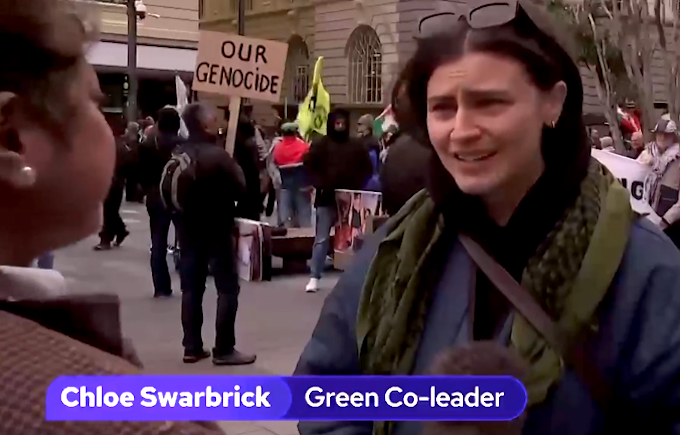
Greens co-leader Chlöe Swarbrick said in an interview with Al Jazeera that public pressure was mounting on governments to end the Israeli genocide in Gaza.
The politician continues to push for recognition of Palestinian statehood and sanctions on Israel, despite being ejected from New Zealand’s Parliament for a week for her remarks.
She refused to apologise in the House last week, telling Al Jazeera that New Zealand must “stand on the right side of history”.
“We in Aotearoa New Zealand have a long proud history of standing typically on the right side of things, whether that be our anti-nuclear stance or our stance against apartheid in South Africa,” she said.
“So it really is a question for this current government whether they are now willing to do the right thing and stand on the right side of history, and that was precisely the point that we were making last week in Parliament.”
Palau’s President Surangel Whipps Jr says it is “a missed opportunity” not to include partners at next mont’s Pacific Islands Forum (PIF) leaders’ summit.
However, Whipps said he respects the position of the Solomon Islands, as hosts, to exclude more than 20 countries that are not members the regional organisation.
The Solomon Islands is blocking all external partners from attending the PIF leaders’ week in Honiara from September 8-12.
The decision means that nations such as the United States and China (dialogue partners), and Taiwan (a development partner), will be shut out of the regional gathering.
Whipps Jr told RNZ Pacific that although he has accepted the decision, he was not happy about it.
“These are Forum events; they need to be treated as Forum events. They are not Solomon Islands events, [nor] are Palau events,” Whipps said.
“It is so important for any Pacific [Islands] Forum meeting that we have all our partners there. It is a missed opportunity not to have our partners attending the meeting in the Solomon Islands, but they are the host.”
Solomon Islands Prime Minister Jeremiah Manele with PIF Secretary-General Baron Waqa (left) at the 53rd Pacific Islands Forum Leaders Meeting in Nuku’alofa, Tonga, last year. Image: Lydia Lewis/RNZ Pacific
‘Space’ for leaders Last week, Solomon Islands Prime Minister Jeremiah Manele said the decision gave leaders space to focus on a review of how the PIF engaged with diplomatic partners, through reforms under PIF’s Partnership and Engagement Mechanism.
Solomon Islands opposition MP Peter Kenilorea Jr said that the move was about disguising the fact that the Manele administration was planning on blocking Taiwan from entering the country.
“The way I see it is definitely, 100 percent, to do with China and Taiwan,” he said.
Kenilorea said he was concerned there would still be bilateral meetings on the margins, which would be easy for countries with diplomatic missions in Solomon Islands, like China and the US, but not for Taiwan.
“There might be delegations coming through that might have bilaterials that make a big deal out of it, the optics and the narratives that will be coming out of those, if they do happen [they] are out of the control of the Pacific Islands Forum architecture, which is another hit to regionalism.”
Palau, Tuvalu and Marshall Islands are the remaining Pacific countries that have ties with Taiwan.
TheGuardian reported that Tuvalu was now considering not attending the leaders’ summit.
Tuvalu disappointed
Tuvalu Prime Minister Feleti Teo said he would wait to see how other Pacific leaders responded before deciding whether to attend. He was disappointed at the exclusion.
New Zealand Prime Minister Christopher Luxon said he was concerned.
“We have advocated very strongly for the status quo. That actually the Pacific Islands Forum family countries come together, and then the dialogue partners, who are from all over the world can be present as well.”
President Whipps said all would be welcome, including China, at the Pacific Islands Forum next year hosted in Palau.
He said it was important for Pacific nations to work together despite differences.
“Everybody has their own sovereignty, they have their own partners and they have their reasons for what they do. We respect that,” he said.
“What’s most important is we find ways to come together.”
Know the reason
Kenilorea said other Solomon Islands MPs knew the deferral was about China and Taiwan but he was the only one willing to mention it.
Solomon Islands switched diplomatic ties from Taiwan to China in 2019. In 2022 the island nation signed a security pact with China.
“If [the deferral] had happened earlier in our [China and Solomon Islands] relationship, I would have thought you would have heard more leaders saying how it is.
“But we are now six years down the track of our switch and leaders are not as vocal as they used to be anymore.”
This article is republished under a community partnership agreement with RNZ.
When Alt News studied the EC’s official responses to the allegations of irregularities in the Special Intensive Revision (SIR) in Bihar, a pattern emerged, which showed how on several occasions, the poll panel made misleading points, dished out convoluted statements and gave incomplete explanations, and passed them of as ‘fact checks’. These so-called ‘fact-checks’ often lacked actual facts, leading to further confusion and distrust among people.
Case I
News outlet Scroll reported on August 9 that the Election Commission had replaced the digital draft voter list of the SIR conducted in Bihar with its scanned copy, which makes it difficult to spot errors, as the scanned copy of the PDF does not support the search function, which was available in the earlier, digitally readable version.
Responding to this, EC put out a ‘fact-check’ in which it said that there had been no change in the draft electoral roll published on August 1, 2025. Changes will be made in it after the settlement of claims and objections by the concerned electoral registration officer.
#Factcheck – There is no change in the draft electoral roll published since 1 August 2025 . Changes will be made after disposal of claims and Objections by the concerned EROs. The draft electoral roll is available on the https://t.co/g9XgnfpkNi website. @ECISVEEPhttps://t.co/vLxc6LphZi
— Chief Electoral Officer, Bihar (@CEOBihar) August 10, 2025
In this statement, the Election Commission ‘fact-checked’ something that was not claimed in the Scroll report. The report by Scroll nowhere mentioned that there was any change in the draft electoral roll data of the Bihar SIR, rather, it presented the fact that the original PDFs have been replaced with scanned copies of those PDFs. And the search function does not work in the scanned copies of PDFs. Hence, the so-called fact check by the Commission is misleading and appears to be motivated by the purpose of confusing people and stopping reporters and political parties from analyzing the data.
The Election Commission’s tweet also received community notes, which is a form of public feedback and fact check in which people add context to the claims made in the tweet and verify the claims with sources.
Case II
A report by journalist Ajit Anjum published in July and shared by several Opposition leaders showed that booth-level officers (BLOs) in the Phulwari assembly constituency of Patna were forging the signatures of voters during the SIR exercise in Bihar. On this, the Patna administration responded on behalf of the Election Commission and claimed in a ‘fact check’ that in Anjum’s video, BLOs were verifying the names of dead/shifted voters by writing ‘dead’ or ‘shifted’ and putting in their own signatures.
— Election Commission of India (@ECISVEEP) July 17, 2025
Alt News‘ investigation found that the BLOs were not signing their own signatures but were forging the names of voters. After this fact came to light, the administration later claimed that the BLOs were marking dead persons in those forms and writing their names in place of signatures. Here too, the administration tried to play with words, because writing a person’s name in place of his signature in a form is considered a signature, but the administration deliberately used the word ‘writing the name’.
Not only that, the administration’s alleged ‘fact check’ also raised a legal question: If someone else writes a person’s name in place of his signature in an official document, it can be considered forgery as per Indian law.
After the first claim was proven dubious, the Patna district administration issued a new statement. In the second response, it claimed that the BLO had verified that both of the concerned individuals were dead by writing ‘Death’ on their forms and putting their names (the deceased person’s) in the signature column.
The change in statement further accentuated suspicions of inconsistency.
Further, the administration also claimed in the so-called fact check that all the BLOs seen in the journalist Ajit Anjum’s video report were preparing lists of deceased/shifted voters. However, Alt News confirmed that one of the persons, whose name could be spotted was alive and had not even shifted.
During a press conference on August 7, 2025, Leader of Opposition and Congress MP Rahul Gandhi presented some documentsclaiming that the names of voters Aditya Srivastava (EPIC number FPP6437040) and Vishal Singh (EPIC number INB2722288) were present in the voter lists of several states (Karnataka, Maharashtra, and Uttar Pradesh). He presented screenshots taken from the EC website on March 16, 2025, claiming duplicate registrations and fraud in the electoral rolls.
Reacting to this, the chief electoral officer (CEO) of Uttar Pradesh in a public statement on August 7, 2025, denied Gandhi’s claims, saying that when he searched the details of Aditya Shrivastava and Vishal Singh on the EC website, he had found these names only in the Karnataka list and not in the Lucknow East or Varanasi Cantt constituencies of Uttar Pradesh.
Alt News verified both the relevant Draft Roll 2025 (published on October 29, 2024) and the Final Roll 2025 (published on January 7, 2025) of Lucknow East and Varanasi Cantt by downloading them from the Election Commission website to verify Rahul Gandhi’s allegations and the statement of the Uttar Pradesh CEO.
Contrary to the claim of the CEO, Alt News found the names of both Aditya Srivastava and Vishal Singh listed in the UP voter roll for 2025, with their EPIC numbers matching the screenshot shared by Rahul Gandhi.
Apart from this, many other discrepancies were also found in the statement of the Election Commission. For example, the EC claimed in its statement that the name of Aditya Srivastava, son of S P Srivastava, (EPIC number FPP6437040) was present at serial number 1265 in the voter list of booth number 458 of assembly constituency 174 Mahadevpura of Bengaluru Urban. Whereas in reality, the name of Aditya Srivastava’s relative mentioned there is not S P Srivastava, but Ritika Srivastava.
Not only this, the Election Commission also claimed in the statement that the name of Aditya Srivastava, son of S P Srivastava, was not on the voter list of Lucknow East legislative assembly of Uttar Pradesh. Alt News investigated and found that in the Final Roll 2025, the name of Aditya Srivastava, son of S P Srivastava, was very much present in the voter list of Lucknow East. In fact, his entire details (father’s name, polling booth, serial number, age) match the screenshot shared by Rahul Gandhi, but now his EPIC number has changed.
Reacting to Rahul Gandhi’s tweet, the Election Commission put out a purported fact check in which it wrote that if Rahul Gandhi believed that what he was saying was true, he should sign a declaration/affidavit as per Rule 20(3)(b) of the Registration of Voters Rules, 1960, and submit the same to the Karnataka CEO so that necessary action can be initiated. If Rahul Gandhi did not believe what he was saying, he should stop drawing absurd conclusions and mislead the citizens of India. They called this statement a fact check.
— Election Commission of India (@ECISVEEP) August 7, 2025
While the appropriateness of the response may be a matter of debate, one thing is for sure — this was not a fact check by any stretch of imagination. One might argue that claiming to ‘fact-check’ serious allegations by the Leader of Opposition and then putting put such a statement is sure to reduce people’s trust in the independent institution.
Case V
On August 10, the Congress party wrote on X that Rahul Gandhi had exposed the modus operandi and tactics of ‘vote theft’ and the Election Commission had been found complicit in it. Sharing a list, Congress said that the list contained more than 30,000 illegal addresses — mostly “House number 0”, “00”, “000”, “-” and “#”, while most of the remaining 9,000 illegal addresses were just names of areas.
Responding to this X post, the Election Commission conducted a so-called fact check in which they issued a statement saying that Rahul Gandhi was trying to avoid a process established by law and was trying to mislead citizens. If he really believes in the list he is sharing, he should have no problem in following the legal process and responding to the CEO of Karnataka without waiting any further. Therefore, Rahul Gandhi has two options:
a) If Rahul Gandhi believes in his analysis and believes that his allegations against the election staff are correct, he should have no problem in submitting claims and objections against specific voters and signing the declaration/affidavit as per Rule 20(3)(b) of the Registration of Voters Rules, 1960.
b) If Rahul Gandhi does not sign the declaration, it will mean that he does not believe in his analysis and conclusions and he is making baseless allegations. In such a case, he should apologize to the country.
The statements made are False and Misleading #ECIFactCheck
Once again, the reader would agree that calling this statement a fact check is bizarre and nonsensical.
Fact-checking is an intensive process that involves verifying claims made publicly. It requires evaluating clear claims based on solid, irrefutable evidence, uninfluenced by bias or personal interest. A proper fact check provides verifiable facts and figures to examine specific claims and presents the findings transparently. But the Election Commission’s recent actions seem to be contrary to these principles. By passing off opinions, statements and incomplete information as fact checks, the Election Commission not only undermined its own credibility but also harmed whatever is left of its reputation as an autonomous constitutional institution.
When Alt News studied the EC’s official responses to the allegations of irregularities in the Special Intensive Revision (SIR) in Bihar, a pattern emerged, which showed how on several occasions, the poll panel made misleading points, dished out convoluted statements and gave incomplete explanations, and passed them of as ‘fact checks’. These so-called ‘fact-checks’ often lacked actual facts, leading to further confusion and distrust among people.
Case I
News outlet Scroll reported on August 9 that the Election Commission had replaced the digital draft voter list of the SIR conducted in Bihar with its scanned copy, which makes it difficult to spot errors, as the scanned copy of the PDF does not support the search function, which was available in the earlier, digitally readable version.
Responding to this, EC put out a ‘fact-check’ in which it said that there had been no change in the draft electoral roll published on August 1, 2025. Changes will be made in it after the settlement of claims and objections by the concerned electoral registration officer.
#Factcheck – There is no change in the draft electoral roll published since 1 August 2025 . Changes will be made after disposal of claims and Objections by the concerned EROs. The draft electoral roll is available on the https://t.co/g9XgnfpkNi website. @ECISVEEPhttps://t.co/vLxc6LphZi
— Chief Electoral Officer, Bihar (@CEOBihar) August 10, 2025
In this statement, the Election Commission ‘fact-checked’ something that was not claimed in the Scroll report. The report by Scroll nowhere mentioned that there was any change in the draft electoral roll data of the Bihar SIR, rather, it presented the fact that the original PDFs have been replaced with scanned copies of those PDFs. And the search function does not work in the scanned copies of PDFs. Hence, the so-called fact check by the Commission is misleading and appears to be motivated by the purpose of confusing people and stopping reporters and political parties from analyzing the data.
The Election Commission’s tweet also received community notes, which is a form of public feedback and fact check in which people add context to the claims made in the tweet and verify the claims with sources.
Case II
A report by journalist Ajit Anjum published in July and shared by several Opposition leaders showed that booth-level officers (BLOs) in the Phulwari assembly constituency of Patna were forging the signatures of voters during the SIR exercise in Bihar. On this, the Patna administration responded on behalf of the Election Commission and claimed in a ‘fact check’ that in Anjum’s video, BLOs were verifying the names of dead/shifted voters by writing ‘dead’ or ‘shifted’ and putting in their own signatures.
— Election Commission of India (@ECISVEEP) July 17, 2025
Alt News‘ investigation found that the BLOs were not signing their own signatures but were forging the names of voters. After this fact came to light, the administration later claimed that the BLOs were marking dead persons in those forms and writing their names in place of signatures. Here too, the administration tried to play with words, because writing a person’s name in place of his signature in a form is considered a signature, but the administration deliberately used the word ‘writing the name’.
Not only that, the administration’s alleged ‘fact check’ also raised a legal question: If someone else writes a person’s name in place of his signature in an official document, it can be considered forgery as per Indian law.
After the first claim was proven dubious, the Patna district administration issued a new statement. In the second response, it claimed that the BLO had verified that both of the concerned individuals were dead by writing ‘Death’ on their forms and putting their names (the deceased person’s) in the signature column.
The change in statement further accentuated suspicions of inconsistency.
Further, the administration also claimed in the so-called fact check that all the BLOs seen in the journalist Ajit Anjum’s video report were preparing lists of deceased/shifted voters. However, Alt News confirmed that one of the persons, whose name could be spotted was alive and had not even shifted.
During a press conference on August 7, 2025, Leader of Opposition and Congress MP Rahul Gandhi presented some documentsclaiming that the names of voters Aditya Srivastava (EPIC number FPP6437040) and Vishal Singh (EPIC number INB2722288) were present in the voter lists of several states (Karnataka, Maharashtra, and Uttar Pradesh). He presented screenshots taken from the EC website on March 16, 2025, claiming duplicate registrations and fraud in the electoral rolls.
Reacting to this, the chief electoral officer (CEO) of Uttar Pradesh in a public statement on August 7, 2025, denied Gandhi’s claims, saying that when he searched the details of Aditya Shrivastava and Vishal Singh on the EC website, he had found these names only in the Karnataka list and not in the Lucknow East or Varanasi Cantt constituencies of Uttar Pradesh.
Alt News verified both the relevant Draft Roll 2025 (published on October 29, 2024) and the Final Roll 2025 (published on January 7, 2025) of Lucknow East and Varanasi Cantt by downloading them from the Election Commission website to verify Rahul Gandhi’s allegations and the statement of the Uttar Pradesh CEO.
Contrary to the claim of the CEO, Alt News found the names of both Aditya Srivastava and Vishal Singh listed in the UP voter roll for 2025, with their EPIC numbers matching the screenshot shared by Rahul Gandhi.
Apart from this, many other discrepancies were also found in the statement of the Election Commission. For example, the EC claimed in its statement that the name of Aditya Srivastava, son of S P Srivastava, (EPIC number FPP6437040) was present at serial number 1265 in the voter list of booth number 458 of assembly constituency 174 Mahadevpura of Bengaluru Urban. Whereas in reality, the name of Aditya Srivastava’s relative mentioned there is not S P Srivastava, but Ritika Srivastava.
Not only this, the Election Commission also claimed in the statement that the name of Aditya Srivastava, son of S P Srivastava, was not on the voter list of Lucknow East legislative assembly of Uttar Pradesh. Alt News investigated and found that in the Final Roll 2025, the name of Aditya Srivastava, son of S P Srivastava, was very much present in the voter list of Lucknow East. In fact, his entire details (father’s name, polling booth, serial number, age) match the screenshot shared by Rahul Gandhi, but now his EPIC number has changed.
Reacting to Rahul Gandhi’s tweet, the Election Commission put out a purported fact check in which it wrote that if Rahul Gandhi believed that what he was saying was true, he should sign a declaration/affidavit as per Rule 20(3)(b) of the Registration of Voters Rules, 1960, and submit the same to the Karnataka CEO so that necessary action can be initiated. If Rahul Gandhi did not believe what he was saying, he should stop drawing absurd conclusions and mislead the citizens of India. They called this statement a fact check.
— Election Commission of India (@ECISVEEP) August 7, 2025
While the appropriateness of the response may be a matter of debate, one thing is for sure — this was not a fact check by any stretch of imagination. One might argue that claiming to ‘fact-check’ serious allegations by the Leader of Opposition and then putting put such a statement is sure to reduce people’s trust in the independent institution.
Case V
On August 10, the Congress party wrote on X that Rahul Gandhi had exposed the modus operandi and tactics of ‘vote theft’ and the Election Commission had been found complicit in it. Sharing a list, Congress said that the list contained more than 30,000 illegal addresses — mostly “House number 0”, “00”, “000”, “-” and “#”, while most of the remaining 9,000 illegal addresses were just names of areas.
Responding to this X post, the Election Commission conducted a so-called fact check in which they issued a statement saying that Rahul Gandhi was trying to avoid a process established by law and was trying to mislead citizens. If he really believes in the list he is sharing, he should have no problem in following the legal process and responding to the CEO of Karnataka without waiting any further. Therefore, Rahul Gandhi has two options:
a) If Rahul Gandhi believes in his analysis and believes that his allegations against the election staff are correct, he should have no problem in submitting claims and objections against specific voters and signing the declaration/affidavit as per Rule 20(3)(b) of the Registration of Voters Rules, 1960.
b) If Rahul Gandhi does not sign the declaration, it will mean that he does not believe in his analysis and conclusions and he is making baseless allegations. In such a case, he should apologize to the country.
The statements made are False and Misleading #ECIFactCheck
Once again, the reader would agree that calling this statement a fact check is bizarre and nonsensical.
Fact-checking is an intensive process that involves verifying claims made publicly. It requires evaluating clear claims based on solid, irrefutable evidence, uninfluenced by bias or personal interest. A proper fact check provides verifiable facts and figures to examine specific claims and presents the findings transparently. But the Election Commission’s recent actions seem to be contrary to these principles. By passing off opinions, statements and incomplete information as fact checks, the Election Commission not only undermined its own credibility but also harmed whatever is left of its reputation as an autonomous constitutional institution.
When Alt News studied the EC’s official responses to the allegations of irregularities in the Special Intensive Revision (SIR) in Bihar, a pattern emerged, which showed how on several occasions, the poll panel made misleading points, dished out convoluted statements and gave incomplete explanations, and passed them of as ‘fact checks’. These so-called ‘fact-checks’ often lacked actual facts, leading to further confusion and distrust among people.
Case I
News outlet Scroll reported on August 9 that the Election Commission had replaced the digital draft voter list of the SIR conducted in Bihar with its scanned copy, which makes it difficult to spot errors, as the scanned copy of the PDF does not support the search function, which was available in the earlier, digitally readable version.
Responding to this, EC put out a ‘fact-check’ in which it said that there had been no change in the draft electoral roll published on August 1, 2025. Changes will be made in it after the settlement of claims and objections by the concerned electoral registration officer.
#Factcheck – There is no change in the draft electoral roll published since 1 August 2025 . Changes will be made after disposal of claims and Objections by the concerned EROs. The draft electoral roll is available on the https://t.co/g9XgnfpkNi website. @ECISVEEPhttps://t.co/vLxc6LphZi
— Chief Electoral Officer, Bihar (@CEOBihar) August 10, 2025
In this statement, the Election Commission ‘fact-checked’ something that was not claimed in the Scroll report. The report by Scroll nowhere mentioned that there was any change in the draft electoral roll data of the Bihar SIR, rather, it presented the fact that the original PDFs have been replaced with scanned copies of those PDFs. And the search function does not work in the scanned copies of PDFs. Hence, the so-called fact check by the Commission is misleading and appears to be motivated by the purpose of confusing people and stopping reporters and political parties from analyzing the data.
The Election Commission’s tweet also received community notes, which is a form of public feedback and fact check in which people add context to the claims made in the tweet and verify the claims with sources.
Case II
A report by journalist Ajit Anjum published in July and shared by several Opposition leaders showed that booth-level officers (BLOs) in the Phulwari assembly constituency of Patna were forging the signatures of voters during the SIR exercise in Bihar. On this, the Patna administration responded on behalf of the Election Commission and claimed in a ‘fact check’ that in Anjum’s video, BLOs were verifying the names of dead/shifted voters by writing ‘dead’ or ‘shifted’ and putting in their own signatures.
— Election Commission of India (@ECISVEEP) July 17, 2025
Alt News‘ investigation found that the BLOs were not signing their own signatures but were forging the names of voters. After this fact came to light, the administration later claimed that the BLOs were marking dead persons in those forms and writing their names in place of signatures. Here too, the administration tried to play with words, because writing a person’s name in place of his signature in a form is considered a signature, but the administration deliberately used the word ‘writing the name’.
Not only that, the administration’s alleged ‘fact check’ also raised a legal question: If someone else writes a person’s name in place of his signature in an official document, it can be considered forgery as per Indian law.
After the first claim was proven dubious, the Patna district administration issued a new statement. In the second response, it claimed that the BLO had verified that both of the concerned individuals were dead by writing ‘Death’ on their forms and putting their names (the deceased person’s) in the signature column.
The change in statement further accentuated suspicions of inconsistency.
Further, the administration also claimed in the so-called fact check that all the BLOs seen in the journalist Ajit Anjum’s video report were preparing lists of deceased/shifted voters. However, Alt News confirmed that one of the persons, whose name could be spotted was alive and had not even shifted.
During a press conference on August 7, 2025, Leader of Opposition and Congress MP Rahul Gandhi presented some documentsclaiming that the names of voters Aditya Srivastava (EPIC number FPP6437040) and Vishal Singh (EPIC number INB2722288) were present in the voter lists of several states (Karnataka, Maharashtra, and Uttar Pradesh). He presented screenshots taken from the EC website on March 16, 2025, claiming duplicate registrations and fraud in the electoral rolls.
Reacting to this, the chief electoral officer (CEO) of Uttar Pradesh in a public statement on August 7, 2025, denied Gandhi’s claims, saying that when he searched the details of Aditya Shrivastava and Vishal Singh on the EC website, he had found these names only in the Karnataka list and not in the Lucknow East or Varanasi Cantt constituencies of Uttar Pradesh.
Alt News verified both the relevant Draft Roll 2025 (published on October 29, 2024) and the Final Roll 2025 (published on January 7, 2025) of Lucknow East and Varanasi Cantt by downloading them from the Election Commission website to verify Rahul Gandhi’s allegations and the statement of the Uttar Pradesh CEO.
Contrary to the claim of the CEO, Alt News found the names of both Aditya Srivastava and Vishal Singh listed in the UP voter roll for 2025, with their EPIC numbers matching the screenshot shared by Rahul Gandhi.
Apart from this, many other discrepancies were also found in the statement of the Election Commission. For example, the EC claimed in its statement that the name of Aditya Srivastava, son of S P Srivastava, (EPIC number FPP6437040) was present at serial number 1265 in the voter list of booth number 458 of assembly constituency 174 Mahadevpura of Bengaluru Urban. Whereas in reality, the name of Aditya Srivastava’s relative mentioned there is not S P Srivastava, but Ritika Srivastava.
Not only this, the Election Commission also claimed in the statement that the name of Aditya Srivastava, son of S P Srivastava, was not on the voter list of Lucknow East legislative assembly of Uttar Pradesh. Alt News investigated and found that in the Final Roll 2025, the name of Aditya Srivastava, son of S P Srivastava, was very much present in the voter list of Lucknow East. In fact, his entire details (father’s name, polling booth, serial number, age) match the screenshot shared by Rahul Gandhi, but now his EPIC number has changed.
Reacting to Rahul Gandhi’s tweet, the Election Commission put out a purported fact check in which it wrote that if Rahul Gandhi believed that what he was saying was true, he should sign a declaration/affidavit as per Rule 20(3)(b) of the Registration of Voters Rules, 1960, and submit the same to the Karnataka CEO so that necessary action can be initiated. If Rahul Gandhi did not believe what he was saying, he should stop drawing absurd conclusions and mislead the citizens of India. They called this statement a fact check.
— Election Commission of India (@ECISVEEP) August 7, 2025
While the appropriateness of the response may be a matter of debate, one thing is for sure — this was not a fact check by any stretch of imagination. One might argue that claiming to ‘fact-check’ serious allegations by the Leader of Opposition and then putting put such a statement is sure to reduce people’s trust in the independent institution.
Case V
On August 10, the Congress party wrote on X that Rahul Gandhi had exposed the modus operandi and tactics of ‘vote theft’ and the Election Commission had been found complicit in it. Sharing a list, Congress said that the list contained more than 30,000 illegal addresses — mostly “House number 0”, “00”, “000”, “-” and “#”, while most of the remaining 9,000 illegal addresses were just names of areas.
Responding to this X post, the Election Commission conducted a so-called fact check in which they issued a statement saying that Rahul Gandhi was trying to avoid a process established by law and was trying to mislead citizens. If he really believes in the list he is sharing, he should have no problem in following the legal process and responding to the CEO of Karnataka without waiting any further. Therefore, Rahul Gandhi has two options:
a) If Rahul Gandhi believes in his analysis and believes that his allegations against the election staff are correct, he should have no problem in submitting claims and objections against specific voters and signing the declaration/affidavit as per Rule 20(3)(b) of the Registration of Voters Rules, 1960.
b) If Rahul Gandhi does not sign the declaration, it will mean that he does not believe in his analysis and conclusions and he is making baseless allegations. In such a case, he should apologize to the country.
The statements made are False and Misleading #ECIFactCheck
Once again, the reader would agree that calling this statement a fact check is bizarre and nonsensical.
Fact-checking is an intensive process that involves verifying claims made publicly. It requires evaluating clear claims based on solid, irrefutable evidence, uninfluenced by bias or personal interest. A proper fact check provides verifiable facts and figures to examine specific claims and presents the findings transparently. But the Election Commission’s recent actions seem to be contrary to these principles. By passing off opinions, statements and incomplete information as fact checks, the Election Commission not only undermined its own credibility but also harmed whatever is left of its reputation as an autonomous constitutional institution.
When Alt News studied the EC’s official responses to the allegations of irregularities in the Special Intensive Revision (SIR) in Bihar, a pattern emerged, which showed how on several occasions, the poll panel made misleading points, dished out convoluted statements and gave incomplete explanations, and passed them of as ‘fact checks’. These so-called ‘fact-checks’ often lacked actual facts, leading to further confusion and distrust among people.
Case I
News outlet Scroll reported on August 9 that the Election Commission had replaced the digital draft voter list of the SIR conducted in Bihar with its scanned copy, which makes it difficult to spot errors, as the scanned copy of the PDF does not support the search function, which was available in the earlier, digitally readable version.
Responding to this, EC put out a ‘fact-check’ in which it said that there had been no change in the draft electoral roll published on August 1, 2025. Changes will be made in it after the settlement of claims and objections by the concerned electoral registration officer.
#Factcheck – There is no change in the draft electoral roll published since 1 August 2025 . Changes will be made after disposal of claims and Objections by the concerned EROs. The draft electoral roll is available on the https://t.co/g9XgnfpkNi website. @ECISVEEPhttps://t.co/vLxc6LphZi
— Chief Electoral Officer, Bihar (@CEOBihar) August 10, 2025
In this statement, the Election Commission ‘fact-checked’ something that was not claimed in the Scroll report. The report by Scroll nowhere mentioned that there was any change in the draft electoral roll data of the Bihar SIR, rather, it presented the fact that the original PDFs have been replaced with scanned copies of those PDFs. And the search function does not work in the scanned copies of PDFs. Hence, the so-called fact check by the Commission is misleading and appears to be motivated by the purpose of confusing people and stopping reporters and political parties from analyzing the data.
The Election Commission’s tweet also received community notes, which is a form of public feedback and fact check in which people add context to the claims made in the tweet and verify the claims with sources.
Case II
A report by journalist Ajit Anjum published in July and shared by several Opposition leaders showed that booth-level officers (BLOs) in the Phulwari assembly constituency of Patna were forging the signatures of voters during the SIR exercise in Bihar. On this, the Patna administration responded on behalf of the Election Commission and claimed in a ‘fact check’ that in Anjum’s video, BLOs were verifying the names of dead/shifted voters by writing ‘dead’ or ‘shifted’ and putting in their own signatures.
— Election Commission of India (@ECISVEEP) July 17, 2025
Alt News‘ investigation found that the BLOs were not signing their own signatures but were forging the names of voters. After this fact came to light, the administration later claimed that the BLOs were marking dead persons in those forms and writing their names in place of signatures. Here too, the administration tried to play with words, because writing a person’s name in place of his signature in a form is considered a signature, but the administration deliberately used the word ‘writing the name’.
Not only that, the administration’s alleged ‘fact check’ also raised a legal question: If someone else writes a person’s name in place of his signature in an official document, it can be considered forgery as per Indian law.
After the first claim was proven dubious, the Patna district administration issued a new statement. In the second response, it claimed that the BLO had verified that both of the concerned individuals were dead by writing ‘Death’ on their forms and putting their names (the deceased person’s) in the signature column.
The change in statement further accentuated suspicions of inconsistency.
Further, the administration also claimed in the so-called fact check that all the BLOs seen in the journalist Ajit Anjum’s video report were preparing lists of deceased/shifted voters. However, Alt News confirmed that one of the persons, whose name could be spotted was alive and had not even shifted.
During a press conference on August 7, 2025, Leader of Opposition and Congress MP Rahul Gandhi presented some documentsclaiming that the names of voters Aditya Srivastava (EPIC number FPP6437040) and Vishal Singh (EPIC number INB2722288) were present in the voter lists of several states (Karnataka, Maharashtra, and Uttar Pradesh). He presented screenshots taken from the EC website on March 16, 2025, claiming duplicate registrations and fraud in the electoral rolls.
Reacting to this, the chief electoral officer (CEO) of Uttar Pradesh in a public statement on August 7, 2025, denied Gandhi’s claims, saying that when he searched the details of Aditya Shrivastava and Vishal Singh on the EC website, he had found these names only in the Karnataka list and not in the Lucknow East or Varanasi Cantt constituencies of Uttar Pradesh.
Alt News verified both the relevant Draft Roll 2025 (published on October 29, 2024) and the Final Roll 2025 (published on January 7, 2025) of Lucknow East and Varanasi Cantt by downloading them from the Election Commission website to verify Rahul Gandhi’s allegations and the statement of the Uttar Pradesh CEO.
Contrary to the claim of the CEO, Alt News found the names of both Aditya Srivastava and Vishal Singh listed in the UP voter roll for 2025, with their EPIC numbers matching the screenshot shared by Rahul Gandhi.
Apart from this, many other discrepancies were also found in the statement of the Election Commission. For example, the EC claimed in its statement that the name of Aditya Srivastava, son of S P Srivastava, (EPIC number FPP6437040) was present at serial number 1265 in the voter list of booth number 458 of assembly constituency 174 Mahadevpura of Bengaluru Urban. Whereas in reality, the name of Aditya Srivastava’s relative mentioned there is not S P Srivastava, but Ritika Srivastava.
Not only this, the Election Commission also claimed in the statement that the name of Aditya Srivastava, son of S P Srivastava, was not on the voter list of Lucknow East legislative assembly of Uttar Pradesh. Alt News investigated and found that in the Final Roll 2025, the name of Aditya Srivastava, son of S P Srivastava, was very much present in the voter list of Lucknow East. In fact, his entire details (father’s name, polling booth, serial number, age) match the screenshot shared by Rahul Gandhi, but now his EPIC number has changed.
Reacting to Rahul Gandhi’s tweet, the Election Commission put out a purported fact check in which it wrote that if Rahul Gandhi believed that what he was saying was true, he should sign a declaration/affidavit as per Rule 20(3)(b) of the Registration of Voters Rules, 1960, and submit the same to the Karnataka CEO so that necessary action can be initiated. If Rahul Gandhi did not believe what he was saying, he should stop drawing absurd conclusions and mislead the citizens of India. They called this statement a fact check.
— Election Commission of India (@ECISVEEP) August 7, 2025
While the appropriateness of the response may be a matter of debate, one thing is for sure — this was not a fact check by any stretch of imagination. One might argue that claiming to ‘fact-check’ serious allegations by the Leader of Opposition and then putting put such a statement is sure to reduce people’s trust in the independent institution.
Case V
On August 10, the Congress party wrote on X that Rahul Gandhi had exposed the modus operandi and tactics of ‘vote theft’ and the Election Commission had been found complicit in it. Sharing a list, Congress said that the list contained more than 30,000 illegal addresses — mostly “House number 0”, “00”, “000”, “-” and “#”, while most of the remaining 9,000 illegal addresses were just names of areas.
Responding to this X post, the Election Commission conducted a so-called fact check in which they issued a statement saying that Rahul Gandhi was trying to avoid a process established by law and was trying to mislead citizens. If he really believes in the list he is sharing, he should have no problem in following the legal process and responding to the CEO of Karnataka without waiting any further. Therefore, Rahul Gandhi has two options:
a) If Rahul Gandhi believes in his analysis and believes that his allegations against the election staff are correct, he should have no problem in submitting claims and objections against specific voters and signing the declaration/affidavit as per Rule 20(3)(b) of the Registration of Voters Rules, 1960.
b) If Rahul Gandhi does not sign the declaration, it will mean that he does not believe in his analysis and conclusions and he is making baseless allegations. In such a case, he should apologize to the country.
The statements made are False and Misleading #ECIFactCheck
Once again, the reader would agree that calling this statement a fact check is bizarre and nonsensical.
Fact-checking is an intensive process that involves verifying claims made publicly. It requires evaluating clear claims based on solid, irrefutable evidence, uninfluenced by bias or personal interest. A proper fact check provides verifiable facts and figures to examine specific claims and presents the findings transparently. But the Election Commission’s recent actions seem to be contrary to these principles. By passing off opinions, statements and incomplete information as fact checks, the Election Commission not only undermined its own credibility but also harmed whatever is left of its reputation as an autonomous constitutional institution.
Seeing video evidence this week of the physical and psychological mistreatment of the great Palestinian leader Marwan Barghouti sickened me. I have written a number of articles about Marwan.
Researching and writing builds knowledge and empathy and I am one of those who believes, given the opportunity, he really could be the Palestinian Mandela. How should you and I respond to this criminality by the Israeli state?
Marwan’s wife and human rights activist Fadwa Barghouti, was shocked to see the heavy toll the Israelis had inflicted on a man legendary for his indomitable spirit.
“I didn’t recognise you or your features, and maybe part of me doesn’t want to admit everything your face and body express about what you and the prisoners have endured,” she wrote in a public message to her husband.
“They are still, Marwan, chasing you and pursuing you even after 23 years in prison and in the solitary cell you’ve been living in for two years.”
She added: “I know that the only thing that hurts you is the inability to protect Palestinian children.”
NEW: Israeli minister Itamar Ben Gvir filmed threatening Marwan Barghouti, the most prominent Palestinian prisoner, during a prison visit.
“Whoever murders our children… we will obliterate them.”
International protocols on prisoner treatment The mistreatment of prisoners like Marwan Barghouti is a crime under international law; the relevant international protocols include: Geneva Convention IV (1949) — Protection of Civilian Persons in Time of War; Common Article 3 (minimum protections including bans on torture, cruel treatment, and “outrages upon personal dignity”); UN Standard Minimum Rules for the Treatment of Prisoners (Nelson Mandela Rules).
These establish prohibitions against torture, degrading treatment, and requirements for humane conditions of detention. Look at Marwan Barghouti and weep that we support Israel, a state that has defecated on the Geneva Convention, the Genocide Convention and every memorial to the victims of the Shoah.
The Israelis, “our allies”, have committed rape-murders of prisoners (documented in their own posted videos), killed countless Palestinian leaders and hold thousands of hostages in gruesome captivity — even as they commit ethnic cleansing in the West Bank and forced starvation in Gaza.
Barghouti, who would win any free and fair elections in Palestine in a landslide, has since 2023, according to human rights organisations, been repeatedly assaulted and subjected to Abu Ghraib-style treatment, had joints dislocated and other forms of torture while our governments turn a blind eye and work day and night to provide the Israelis with the political cover needed to pursue the Greater Israel project.
Palestinian leader Marwan Barghouti has now been in prison for 23 years so far . . . he would win any free and fair elections in Palestine in a landslide, but he has been repeatedly assaulted and subjected to Abu Ghraib-style treatment by the Israelis. Image: The New Arab
Terrible news from Yousef Aljamal I also received terrible news this week that my friend Yousef Aljamal had suffered yet another horror at the hands of the Israelis: his sister Somaiya, 35; her husband Anas, 35; and their daughters Hoor, 13, and Sham, 9, had been killed in an Israeli missile attack earlier this month as they slept.
A third daughter, Noor, 14, was injured and is now the family’s sole survivor.
I interviewed Yousef in my home in Wellington a few weeks ago; it was a privilege and an education to spend time with the distinguished Palestinian writer. As I said in the subsequent article, the encounter made visceral for me that word genocide.
Sitting opposite me in my study in my serene Wellington coastal suburb, Yousef told me of the 40 members of his family who had been murdered by the Israelis. Now four more members of his family have been taken.
These are people like us, with feelings like us. They are not the Hated Others so long painted by our mainstream media as unworthy of naming, unworthy of human dignity.
The collective West is responsible under law The Israelis have turned Gaza into a hellscape that would shock Dante Alighieri. Over two million people are being tortured in the cruellest way every day and our governments refuse to intervene in powerful and meaningful ways.
According to whistleblower US Green Beret Lieutenant-Colonel (retired) Anthony Aguilar, the Israelis and the American GHF contractors use pepper spray and gunfire instead of signs to direct the human traffic. Waves of suffering humanity are tossed hither and thither on a sea of diabolical inhumanity. Nearly 2000 starving innocents have been gunned down while seeking food.
To be blunt: If the Israelis don’t want to be likened to the Nazis, they should stop acting like Nazis.
The responsibility to prevent and punish This evil is supported to astonishing lengths by the morally empty governments of Australia, New Zealand, Canada and, of course, the great arsenals of genocide the US, UK and Germany. The leaders of the powerful Western countries are fully aware of what is being done and allow it to continue — and therefore represent the moral nadir of our species.
Leaders like Anthony Albanese, Christopher Luxon and Keir Starmer make corporeal the term Banality of Evil. They calculate, they mumble and equivocate, then they comply with the Americans. “Genocide enabler” should be their sole epitaph.
Our countries are signatories to the Genocide Convention, the first Article of which states: “The Contracting Parties confirm that genocide, whether committed in time of peace or in time of war, is a crime under international law which they undertake to prevent and to punish.”
Prevent and punish. Legal scholars and the ICJ’s opinions affirm that states providing military, financial, or political support with knowledge of likely genocidal acts risk being found complicit.
Our governments have failed to reach the lowest bar of human decency or fulfil this fundamental duty. It is up to us to act. If it was right to oppose Nazism in the Second World War it is most certainly a moral imperative to oppose the brand of Nazism the Jewish State of Israel has created today. We must find the courage to oppose them.
The International Court of Justice ruled in 2007 in the ICJ Bosnia Genocide case that Serbia was guilty of breaching its duty to prevent the 1995 genocide at Srebrenica. Countries like the UK, Germany, New Zealand and Australia would likely, if international law was applied evenly, be found similarly culpable for failing to prevent genocide by Israel and the US.
This is the legal concept of erga omnes partes, the collective responsibility that signatory states share.
On January 26, 2024, the International Court of Justice ruled that Israel faces credible allegations of genocide in Gaza and imposed urgent, legally binding measures, including an obligation to allow humanitarian access and prevent genocidal acts. All our states are fully aware Israel has defied this ruling.
War crimes tribunals on the Palestine Genocide will be essential to restore international law. War criminals whether in Tel Aviv, London, Canberra or Wellington must one day face justice.
In a recent article I described Stéphane Hessel, a leading member of the French Resistance, who survived time in Nazi concentration camps, including Buchenwald. After the war he was one of the co-authors of the Universal Declaration of Human Rights (1948), a pillar of international law to this day. The Declaration affirms the inherent dignity and equal rights of all humans.
In later years Hessel (d. 2013), who was Jewish, saw the treatment of the Palestinians as an affront to this and repeatedly called Israel out for crimes against humanity.
Hessel argued people needed to be outraged just as he and his fellow fighters had been during the war. In 2010, he said: “Today, my strongest feeling of indignation is over Palestine, both the Gaza Strip and the West Bank. The starting point of my outrage was the appeal launched by courageous Israelis to the Diaspora: you, our older siblings, come and see where our leaders are taking this country and how they are forgetting the fundamental human values of Judaism.”
Imagine what action he would call for today.
Aaron Bushnell’s challenge to us So, back to the core challenge I posed at the beginning. Are we willing to do what it takes to save Marwan Barghouti, to save our brothers and sisters in Palestine?
As Aaron Bushnell, the active duty US serviceman said the day he self-immolated in front of the Israeli Embassy in Washington last year to protest the genocide against the Palestinian people:
“Many of us like to ask ourselves ‘What would I do if I was alive during slavery? Or the Jim Crow South? Or Apartheid? What would I do if my country was committing genocide?’ The answer is, you’re doing it. Right now.”
Eugene Doyle is a writer based in Wellington. He has written extensively on the Middle East, as well as peace and security issues in the Asia Pacific region. He contributes to Asia Pacific Report and Café Pacific, and hosts the public policy platform solidarity.co.nz
Author David Robie left his cabin on the Rainbow Warrior three days before it was blown up by the Directorate General for External Security (DGSE), France’s foreign intelligence agency
The ship was destroyed at Marsden Wharf on 10 July 1985 by two limpet mines attached
below the waterline.
As New Zealand soon learned to its shock, the second explosion killed crew member and photographer Fernando Pereira as he tried to retrieve his cameras.
“I had planned to spend the night of the bombing onboard with my two young sons, to give them a brief taste of shipboard life,” Dr Robie writes. “At the last moment I decided to leave it to another night.”
He left the ship after 11 weeks documenting what turned out to be the last of her humanitarian missions — a voyage which highlighted the exploitation of Pacific nations
by countries who used them to test nuclear weapons.
Dr Robie was the only journalist on board to cover both the evacuation of the people
of Rongelap Atoll after their land, fishing grounds and bodies were ravaged by US nuclear fallout, and the continued voyage to nuclear-free Vanuatu and New Zealand.
Eyes of Fire is not only the authoritative biography of the Rainbow Warrior and her
missions, but a gripping account of the infiltration of Greenpeace by a French spy, the bombing, its planning, the capture of the French agents, the political fallout, and ongoing
challenges for Pacific nations.
Dr Robie corrects the widely held belief that the first explosion on the Rainbow Warrior
was intended as a warning, to avoid loss of life. No, it turns out, the French state really
did mean to kill people.
“It was remarkable,” he writes, “that Fernando Pereira was the only person who
died.”
The explosives were set to detonate shortly before midnight, when members of the
crew would be asleep. (One of them was the ship’s relief cook, Waihekean Margaret Mills. She awoke in the nick of time. The next explosion blew in the wall of her cabin).
“Two cabins on the main deck had their floors ruptured by pieces of steel flying from
the [first] engine room blast,” writes Dr Robie.
“By chance, the four crew who slept in those rooms were not on board. If they had been,
they almost certainly would have been killed.”
Eyes of Fire author David Robie with Rainbow Warrior III . . . not only an account of the Rongelap humanitarian voyage, but also a gripping account of the infiltration of Greenpeace and the bombing. Image: Asia Pacific Report
Eyes of Fire was first published in 1986 — and also in the UK and USA, and has been reissued in 2005, 2015 and again this year to coincide with the 40th anniversary
of the bombing.
If you are lucky enough to own the first edition, you will find plenty that is new here; updated text, an index, new photographs, a prologue by former NZ prime minister Helen Clark and a searing preface by Waihekean Bunny McDiarmid, former executive director
of Greenpeace International.
As you would expect from the former head of journalism schools at the University
of Papua New Guinea and University of the South Pacific, and founder of AUT’s Pacific Media Centre, Eyes of Fire is not only a brilliant piece of research, it is an absolutely
fascinating read, filled with human detail.
The bombing and its aftermath make up a couple of chapters in a book which covers an enormous amount of ground.
Professor David Robie is a photographer, journalist and teacher who was awarded an MNZM in 2024 for his services to journalism and Asia-Pacific media education. He is founding editor of the Pacific Journalism Review, also well worth seeking out.
Eyes of Fire is an updated classic and required reading for anyone interested in activism
or the contemporary history of the Pacific.
The main problem in for Fiji retirement is that there is no law to protect the Fiji National Provident Fund, claims a leading trade unionist.
Fiji Trades Union Congress national executive board member and National Union of Hospitality Catering and Tourism Industries Employees general secretary Daniel Urai has told the FNPF 2011 Act review committee in Lautoka that a law needed to be put in place to ensure that the FNPF and its members are protected.
“Whenever something happens, a new government comes in — they will tell FNPF to remove all their investments abroad,” Urai said at the hearing on Friday.
“And that has an effect on the FNPF investment. So, I hope you will find a way to put in a law that no one just comes and directs FNPF to remove all its investments, and that has happened in the past.
“And I hope you can look at ways to ensure that it does not happen.
“Because every time that happens, FNPF loses, and the returns are not what is expected.”
Fiji Trades Union Congress national secretary and FNPF 2011 Act review committee member Felix Anthony claimed the government had interfered with FNPF’s overseas investments in 2007.
Withdrew investments abroad
“Soon after the coup, the government, actually through the Reserve Bank of Fiji (RBF), suggested that FNPF withdraw all its investments abroad,” Anthony said.
“Just so that they keep the Fijian dollar afloat, and that actually affected FNPF income and had some financial ratification on the FNPF bottom line.
“There was some consideration given whether the RBF itself should compensate FNPF for that directive, and nothing eventuated, of course, because the government had a stronghold at that time.”
The Fiji National Provident Fund is conducting a comprehensive review of the FNPF Act 2011 to ensure the law is modern, effective, and continues to meet the retirement needs of Fijians.
The public consultation continued at the Labasa Civic Centre today and will be in Suva tomorrow.
A Pacific analyst and commentator says it is unlikely that Vanuatu will agree to any exclusive rights in the new security and economic pact with Australia.
Senior ministers of both countries, including deputy prime ministers Richard Marles and Johnny Koanapo, initialled the Nakamal Agreement at the summit of Mount Yasur volcano on Tanna Island, ahead of formal sign-off next month.
The two nations have agreed to a landmark deal worth A$500 million that will replace the previous security pact that was scrapped in 2022.
Dr Tess Newton Cain of the Griffith Asia Institute said she did not believe Vanuatu would agree to anything similar to what Tuvalu (Falepili Union) and Papua New Guinea (Bilateral Security Agreement) had agreed to in recent times.
She said that the Australian government had been wanting the deal for some time, but had been “progressing quite slowly” because there was “significant pushback” on the Vanuatu side.
“Back in 2022, it took people by surprise that there was an announcement made that a security agreement had been signed while Senator Penny Wong, Australia’s Foreign Minister was in Port Vila. She and then-prime minister Ishmael Kalsakau had signed a security agreement.
“On the Australian side, they referred to it as having not been ratified. But essentially it was totally disregarded and thrown out by Vanuatu officials, and not considered to [be a] meaningful agreement.”
Analyst Dr Tess Newton Cain . . . significant process of negotiation between Vanuatu and Australian officials. Image: ResearchGate
High-level engagement
However, this time around, Dr Newton Cain said, there had been a significant process of negotiation between Vanuatu and Australian officials.
“There has been a lot of high-level engagement. We have had a lot of senior Australian officials visiting Vanuatu over the last six months, and possibly for a bit longer. So, it has been a steady process of negotiation.”
Dr Newton Cain said the text of the agreement had undergone a much more rigorous process, involving input from a wider range of people at the government level.
“And in the last few days leading up to the initialling of this agreement, it was brought before the National Security Council in Vanuatu, which discussed it and signed off on it.
“Then it went to the Council of Ministers, which also discussed it and made reference to further amendments. So there were some last-minute changes to the text, and then it was initialled.”
She said that while the agreement had been “substantially agreed”, more details on what it actually entailed remained scarce.
Vanuatu Prime Minister Jotham Napat said earlier this month that he would not sign the agreement unless visa-free travel was agreed.
Visa sticking point
Dr Newton Cain said visa-free travel between the two countries remained a sticking point.
“Prime Minister Napat said he hoped Prime Minister Albanese would travel to Port Vila in order to sign this agreement. But we know there is still more work to do — both Australia and Vanuatu [have] indicated that there were still aspects that were not completely aligned yet.
“I think it is reasonable to think that this is around text relating to visa-free access to Australia. There is a circle there that is yet to be squared.”
Australia is Vanuatu’s biggest development partner, as well as the biggest provider of foreign direct investment. Its support covers a range of critical sectors such as health, education, security, and infrastructure.
According to Dr Newton Cain, from Canberra’s point of view, they have concerns that countries like Vanuatu have “more visible, diversified and stronger” relations with China.
“As we have seen in other parts of the region, that has provoked a response from countries like Australia, New Zealand, the United States and others that want to be seen to be offering Vanuatu different options.”
However, she said it was not surprising that Vanuatu was looking to have a range of conversations with partners that can support the country.
“China’s relationship has moved more into security areas. There are aspects of policing that China is involved in in Vanuatu, and that this is a bit of a tipping point for countries like Australia and New Zealand.
“So these sorts of agreements with Australia [are] part of trying to cement the relationship [and] demonstrate that this relationship is built on lasting foundations and strong ties.”
This article is republished under a community partnership agreement with RNZ.
A Pacific analyst and commentator says it is unlikely that Vanuatu will agree to any exclusive rights in the new security and economic pact with Australia.
Senior ministers of both countries, including deputy prime ministers Richard Marles and Johnny Koanapo, initialled the Nakamal Agreement at the summit of Mount Yasur volcano on Tanna Island, ahead of formal sign-off next month.
The two nations have agreed to a landmark deal worth A$500 million that will replace the previous security pact that was scrapped in 2022.
Dr Tess Newton Cain of the Griffith Asia Institute said she did not believe Vanuatu would agree to anything similar to what Tuvalu (Falepili Union) and Papua New Guinea (Bilateral Security Agreement) had agreed to in recent times.
She said that the Australian government had been wanting the deal for some time, but had been “progressing quite slowly” because there was “significant pushback” on the Vanuatu side.
“Back in 2022, it took people by surprise that there was an announcement made that a security agreement had been signed while Senator Penny Wong, Australia’s Foreign Minister was in Port Vila. She and then-prime minister Ishmael Kalsakau had signed a security agreement.
“On the Australian side, they referred to it as having not been ratified. But essentially it was totally disregarded and thrown out by Vanuatu officials, and not considered to [be a] meaningful agreement.”
Analyst Dr Tess Newton Cain . . . significant process of negotiation between Vanuatu and Australian officials. Image: ResearchGate
High-level engagement
However, this time around, Dr Newton Cain said, there had been a significant process of negotiation between Vanuatu and Australian officials.
“There has been a lot of high-level engagement. We have had a lot of senior Australian officials visiting Vanuatu over the last six months, and possibly for a bit longer. So, it has been a steady process of negotiation.”
Dr Newton Cain said the text of the agreement had undergone a much more rigorous process, involving input from a wider range of people at the government level.
“And in the last few days leading up to the initialling of this agreement, it was brought before the National Security Council in Vanuatu, which discussed it and signed off on it.
“Then it went to the Council of Ministers, which also discussed it and made reference to further amendments. So there were some last-minute changes to the text, and then it was initialled.”
She said that while the agreement had been “substantially agreed”, more details on what it actually entailed remained scarce.
Vanuatu Prime Minister Jotham Napat said earlier this month that he would not sign the agreement unless visa-free travel was agreed.
Visa sticking point
Dr Newton Cain said visa-free travel between the two countries remained a sticking point.
“Prime Minister Napat said he hoped Prime Minister Albanese would travel to Port Vila in order to sign this agreement. But we know there is still more work to do — both Australia and Vanuatu [have] indicated that there were still aspects that were not completely aligned yet.
“I think it is reasonable to think that this is around text relating to visa-free access to Australia. There is a circle there that is yet to be squared.”
Australia is Vanuatu’s biggest development partner, as well as the biggest provider of foreign direct investment. Its support covers a range of critical sectors such as health, education, security, and infrastructure.
According to Dr Newton Cain, from Canberra’s point of view, they have concerns that countries like Vanuatu have “more visible, diversified and stronger” relations with China.
“As we have seen in other parts of the region, that has provoked a response from countries like Australia, New Zealand, the United States and others that want to be seen to be offering Vanuatu different options.”
However, she said it was not surprising that Vanuatu was looking to have a range of conversations with partners that can support the country.
“China’s relationship has moved more into security areas. There are aspects of policing that China is involved in in Vanuatu, and that this is a bit of a tipping point for countries like Australia and New Zealand.
“So these sorts of agreements with Australia [are] part of trying to cement the relationship [and] demonstrate that this relationship is built on lasting foundations and strong ties.”
This article is republished under a community partnership agreement with RNZ.
Palestinian journalists have long known Gaza to be the most dangerous place on earth for media workers, but Israel’s attack on a tent housing journalists in Gaza City last Sunday has left many reeling from shock and fear, reports Al Jazeera.
Four Al Jazeera staff members were among the seven people killed in an Israeli drone strike outside al-Shifa Hospital.
The Israeli military admitted to deliberately targeting the tent after making unsubstantiated accusations that one of those killed, Al Jazeera journalist Anas al-Sharif, was a member of Hamas.
Israeli attacks in Gaza have killed at least 238 media workers since October 2023, according to Gaza’s Government Media Office. This toll is higher than that of World Wars I and II, the Vietnam War, the war in Afghanistan and the Yugoslavia wars combined.
Al Jazeera correspondent Hani Mahmoud said in a video report about the plight of journalists this week that “press vests and helmets, once considered a shield, now feel like a target.”
“The fear is constant — and justified,” Mahmoud said. “Every assignment is accompanied by the same unspoken question: Will [I] make it back alive?”
Smears no coincidence
“It is no coincidence that the smears against al-Sharif — who has reported night and day for Al Jazeera since the start of the war — surfaced every time he reported on a major development in the war, most recently the starvation brought about by Israel’s refusal to allow sufficient aid into the territory,” CPJ regional director Sara Qudah said in the aftermath of Israel’s attack.
In light of Israel’s systematic targeting of journalists, media workers in Gaza are forced to make difficult choices.
Palestinian reporter Sally Thabet told Al Jazeera: “As a mother and a journalist, I go through this mental dissonance almost daily, whether to go to work or stay with my daughters and being afraid of the random shelling of the Israeli occupation army.”
“Journalism is not a crime . . . oppressing it is” placards at the Auckland free Palestine rally in Te Komititanga Square last weekend. Image: Asia Pacific Report
Across the street from the ruins of the School of Media Studies at al-Quds Open University in Gaza City, where he used to teach, Hussein Saad has been recovering from an injury he sustained while running to safety.
“The deliberate targeting of Palestinian journalists has a strong effect on the disappearance of the Palestinian story and the disappearance of the media narrative,” he said.
Saad argued the Gaza Strip was witnessing “the disappearance of the truth”.
While journalists report on mass killings, human suffering and starvation, they also cope with their own losses and deprivation. Photographer and correspondent Amer al-Sultan said hunger was a major challenge.
“I used to go to work, and when I didn’t find anything to eat, I would just drink water,” he said.
Palestinian journalists under fire. Video: Al Jazeera
‘We are all . . . confused’
“I did this for two days. I had to live for two or three days on water. This is one of the most difficult challenges we face amid this war against our people — starvation.”
Journalist and film director Hassan Abu Dan said reporters “live in conditions that are more difficult than the mind can imagine.”
“You live in a tent. You drink water that is not good for drinking. You eat unhealthy food …
“We are all, as journalists, confused. There is a part of our lives that has been ruined and gone far away,” he said.
Al Jazeera’s Mahmoud said that despite the psychological trauma and the personal risks, Palestinian journalists continue to do their jobs, “driven by a belief that documenting the truth is not just a profession, but a duty to their people and history”.
Al Jazeera correspondent Hani Mahmoud . . . the fear in Gaza is constant – and justified – after Israel’s targeted attack killed four colleagues. Image: Al Jazeera
Protesters staged pro-Palestinian demonstrations across Aotearoa New Zealand at the weekend, calling on the government to place sanctions on Israel for its war on Gaza.
The government announced last week it was considering whether to join other countries like France, Canada and Australia in recognising Palestinian statehood at a United Nations leader’s meeting next month.
Demonstrators took to the streets in about 20 cities and towns on Saturday in a “National Day of Protest”, waving Palestinian and other flags, holding vigils, and banging pots and pans to represent what a UN-backed food security agency has called “the worst case scenario of famine”.
They also condemned Israel’s targeted killing of journalists.
In Wellington, about 2000 protesters gathered at Te Aro Park, and formed a crowd almost a kilometre long during the march, an RNZ journalist estimated.
One demonstrator, who carried a sign which read “Palestine is in our hearts”, said the government had been “woefully silent” on what was happening in Gaza.
The Wellington Gaza protest on Saturday. Video: RNZ
It was her first protest, she said, and she intended to go to others in order to “agitate for our politicians to listen and take a stand”.
“I hope the country comes out in force today right across all of our regions, to give Palestine a voice, to show that we care, and to inspire action from our politicians — who have been woefully silent and as a result compliant in the genocide in Palestine.”
A protester’s “Palestine is in our hearts” placard at the Wellington protest. Image: Mark Papalii/RNZ News
She said she wanted to see the New Zealand government sanction Israel and take a global stand against the war in Gaza.
Another protester said the killings of four Al Jazeera journalists in Gaza this week was what had spurred him to join the crowd.
A “grow a spine Luxon!” placard at the Wellington protest in reference to Prime Minister Christopher Luxon’s “woeful” stance on the Israeli war on Gaza. Photo: Mark Papalii/RNZ
“You know hearing about the attack on the journalists, the way they were targeting just one purportedly but were willing to kill [others] just to get their man.
“It’s not right.”
Pro-Palestinian protesters condemn the killing of journalists by Israel and call for the expulsion of the Israeli ambassador as part of nationwide demonstrations. Image: Mark Papalii/RNZ
Others in the capital carried signs showing Palestinian journalist Anas al-Sharif and his three Al Jazeera colleagues who were killed by an Israeli strike on a tent of reporters in Gaza.
The IDF claimed that al-Sharif was working for the Hamas resistance — something Al Jazeera has strongly denied.
Some of the demonstrators at the Wellington protest against Israel. Image: Mark Papalii/RNZ
This content originally appeared on Asia Pacific Report and was authored by Pacific Media Watch.
This morning there is no article on the political page of The New Zealand Herald about the plight of people in Gaza, the same is the case at The Post and at RNZ. Even the 1News political page is Gaza free but what may stun you over a Sunday morning coffee is the fact that there is also no mention of Gaza on the “World Pages” of any of these so-called news organisations.
It’s not news in the world of our mainstream media journalists.
Instead, there is articles about “no deal” between Trump and Putin, 300 dead in Pakistan, Trump will meet Zelenskyy, Stone Age Humans were picky about what stones they used . . . and other things — in fact the only article in the “big ” New Zealand mainstream media “World” pages about Gaza is at Stuff and it’s a link to a three minute news video item from yesterday’s Auckland protest about Neil Finn supporting Green Party co-leader Chlöe Swarbrick.
Chlöe said the evidence is pretty clear and you don’t kill journalists for no reason when Israel laughed off claims that people in Gaza were starving.
Last night, TVNZ 1News broadcast a news item that led with Neil Finn singing “Don’t Dream it’s Over” and Simon Mercep interviewing Chlöe about her stance on an apology.
The news Chlöe would be back next week at Parliament probably shocked Duncan Garner but there was precious little coverage of what was said in protest speeches because the limitations of broadcasting news concision (a sequence of soundbites) prevent the New Zealand public from hearing too much about Gaza from our own mainstream news services.
Gordon’s action list
Over on social media many people are sharing Gordon Campbell’s article around — where he details the actions you could take and points out how the people of Gaza don’t have time for symbolic stances and the kinds of actions that might help — like sanctions and UN peacekeeping intervention on the ground.
Gordon Campbell has “a go at” the stance taken by the NZ government that “it’s not a matter of if, but when” by adding “but not now” and why not now?
One reason for “but not now” pitched by Campbell is that with Todd McClay now heading over to the US to beg for a return to 10 percent tariffs, New Zealand is stalling and playing a wait and see game — watching whether Australia will be punished for backing a Palestinian state and whether tariffs will be part of the game.
G News on yesterday’s Palestine solidarity rally in Te Komititanga Square, Auckland.
A map of the nations in the world who support a Palestinian state shows most of it in green — and the holdouts in white — with New Zealand holding out in white as we recite “Not if, but when, but not now”.
The editorial at The New Zealand Herald this morning is about how Labour MPs should have shown up and performed publicly at the Covid Circus Phase 2 Royal Commission of Inquiry in the opinion of the Herald (run by Steven Joyce and cookers from The Centrist) — because an urgent Taxpayers’ Union Poll claims 53 percent say so with a giant margin for error not even mentioned — nor how the Royal Commission has all the information it needs from the previous government but it needs the same questions answered in public.
The priorities and partisanship of The NZ Herald are on show as it campaigns hard against Labour and the left bloc even while there’s an unfolding genocide taking place in the world and it’s “World” pages are empty about this — while decent people cancel their subscriptions.
Many of us are still aghast at the way senior political correspondent Audrey Young wished Chlöe would go away when all she was doing was asking National MPs to act with their conscience and Speaker Gerry Brownlee had taken offence and dished out injustice — which now has backfired at grassroots level across the nation and media starve us all of the real content in those speeches.
Chlöe has said from the start this is not about her and she was telling people this again yesterday as folks thanked her for taking an unapologetic stand.
Green Party’s Chlöe Swarbrick has said from the start this is not about her and she was telling people this again yesterday as folks thanked her for taking an unapologetic stand. Image: Stuff screenshot APR
Who controls the spotlight? Media!
We wanted to hear from Chlöe and we wanted to hear those speeches.
I personally felt I had let down the show yesterday because my cell and sound gear seized up in the bitter cold wind and rain so I missed Chlöe’s speech and some of the other messages — Hey Now Don’t Dream it’s Over — but with no umbrella, no raincoat and standing in the rain my frozen fingers took some time to come right and I sat on a ferry in cold wet clothes like a failure afterwards but it is what it is.
My apologies for not being better prepared.
It was pointed out in speeches at the rally (there has almost been 100 of them now) how NZ journalists do not support their colleagues who are being murdered for doing their jobs in Gaza and when I got home and warmed up we discussed the way Al Jazeera is a good news channel and how crap things are in New Zealand media.
Gordon Campbell and a few other notable exceptions keep the faith and his observation “but not now” has done the thinking for many of us about the spineless government who are stalling and pretending this is complex and needs to take weeks while every day more people starve to death, get shot going for food. And it all just happens as if — it’s “a mystery” – while our government names Hamas strongly but nobody else.
Criticism of State Terror is more toned down and we care more about our US relationship than anything much else it seems — putting our own interests first and not reporting much about the facts.
RNZ has finally published “Spine and Punishment: A review of Swarbrick v Brownlee” because the media spotlight was on this local issue and the history of Speakers’ rulings versus “a new decency” because Gerry was offended and overreached.
Gerry must withdraw In my opinion, Gerry has got to withdraw and apologise or step down and any more stick about this towards Chlöe is going to further the focus on National MPs who are silent and hiding behind “But not now”.
If only six of 68 National MPs voted with their conscience and not their party “but not now” instructions then we’d be actively progressing a new law to sanction Israel — and our actions would speak louder than merely words and symbolic gestures.
The unfolding genocide in Gaza seems to be going to plan as NZ news media also lack a spine and any kind of support for their dead colleagues while this one term government clings to “Not if, but when — but not now”.
Might as well carry on starving until September.
“He’s lost the plot” – “but not now”.
Because this government and its sycophantic media need more time to argue about this very “complex” issue.
Gerard Otto is a digital creator and independent commentator on politics and the media through his G News column and video reports. Republished with permission.
A New Zealand policeman pushed over an elderly man who was doing nothing but waving a Palestinian flag at a solidarity rally in Ōtautahi yesterday.
Yes the man employed to protect the public committed a violent assault. Not a wee shove, a great big push that caused the man to fall the ground – onto hard tarmac.
It comes on top of a woman being fatally shot this week by police and her partner being shot and injured. In that case a knife was involved but it’s kind of like paper-scissors-rock, is it not?
I have experienced their brutality directly while filming their brutality. Like the Israeli Defence Force (IDF) they see journalists who film their offensive actions as the enemy.They used pepper spray against me illegally to stop me filming their perversity.
But look, it’s a hard job so they need how-not-to-be-thugs training.
Pre-trained as thugs
Some young men are already pre-trained to be thugs and they seem to be out at the front. They feel great in this mostly white gang.
I have witnessed police haul people off the pavement, beat them up, and then arrest the victims of their assaults “for assault”.
False accusations to protect themselves? Twisting the narrative completely to hide their own violence?
False arrests when they themselves should face arrest.
I think we’ve had enough.
Some of the boys in blue really really need to grow up.
They need training that teaches them that manning or womaning up (some women cops play the thug game too) doesn’t mean training to be a wanker white supremacist.
Self awareness
Good training means teaching police to be self aware, aware of thoughts and feelings, not just learning cognitive behavioural tools but applying them.
They are in the community to protect the community. They should not see people who are supporting human rights or kids attending a party as their opposition, their enemy.
These thug police need to unlearn their thuggery and learn instead, how to relate to the people. They are not defending themselves against the public. They must not view people — real human beings — as their enemy.
The thug cops are adept at dehumanising others. They need to learn to see people as individuals and this includes people attending group functions like parties or protests or club activities. People have human rights.
This includes the right to be respected and treated with dignity.
The perpetrators of violent crime are — far too often — the police. I’ve seen it happen with no provocation time and again. Too many times to count.
They don the black gloves and black sunnies and wear bullet proof vests and feel what?How do they feel when they gear up? Threatened or threatening?
Public protection
Questions need to be asked.
The public needs protection from some — not all — of our police.
And the legal system, the justice system — (I’m trying not use an ironic tone here) needs to be applied to violent crimes, including the police crims who assault members of the public.
I worry for unseen victims too. I worry for their wives and children because if they assault with no provocation on the street what do they do at home?
Do people who behave like street devils turn into angels at home?
Investigations must be held about why our police are assaulting bystanders and peaceful protesters.
Tragedy investigation
I guess there wll be an investigation into the bullets against knife tragedy. But we need other investigations too.
I know the footage of what happened to our innocent elderly protester will be posted on social media.
New footage emerges of policeman pushing partygoer (2021 1News video)
In the meantime, here’s other footage above of Christchurch police doing what they are in danger of doing best.
This footage is four years ago but this alarming, aggressive behaviour continues as demonstrated yesterday by a cop shoving to the ground an unarmed, unprotected, elderly man waving a Palestinian flag whom they then — so wrongly — charged with assault!
Saige England is an Aotearoa New Zealand journalist, author, and poet, member of the Palestinian Solidarity Network of Aotearoa (PSNA), and a contributor to Asia Pacific Report. This commentary was first published on her social media.
“Grow a spine for Palestine!” was a frequent theme among about 5000 people protesting in the heart of New Zealand’s largest city today as the protesters demanded that the coalition government should recognise the state of Palestine and stop supporting impunity for Israel.
More than 62,000 people, mostly women and children, have been killed in Israel’s war on Gaza in the past 22 months and the country’s military have doubled down on their attacks on residential areas in the besieged enclave.
Several speakers, including opposition parliamentarians, spoke at the rally, strongly condemning Israel for its genocidal policies and crimes against humanity.
Many children took part in the rally at Te Komititanga Square and the return march up Queen Street in spite of the bitterly wet and cold weather. Many of them carried placards and Palestinian flags like their parents.
One young boy carried a placard declaring “Just a kid standing in front of his PM asking him to grow a heart and a spine”. The heart was illustrated as a Palestinian flag.
Other placards included slogans such as “Wanted MPs with a spine” and “Grow a spine for Palestine”, and “They try to bury us forgetting we are seeds” with the resistance watermelon symbol.
Many placards demanded sanctions and condemned Israel, saying “Gaza is starving. Words won’t feed them — sanction Israel now”, “NZ government: Your silence is complicity with Israeli genocide” and “Free Palestine now”.
Disillusionment with leaders
One poster expressed disillusionment with both the coalition government and opposition Labour Party leaders, Prime Minister Christopher Luxon and Chris Hipkins, denouncing “apologists for genocide”.
Another poster challenged both Hipkins and Luxon over “what values” they stood for. It said:
“Our ‘leaders’ have refused to call for a ceasefire even after 10,000+ innocent civilians have been brutally murdered in their own homes, including 4000+ CHILDREN all under the name of “Kiwi values”.
“They, like a lot of other world politicians, are apologists for genocide.”
A “Palestine forever” banner at the head of the Auckland march today as it prepares to walk up Queen Street. Image: APR
Frustration has been growing among the public with the government’s reluctance to declare support for Palestinian statehood after 96 consecutive weeks of protests organised by the Palestinian Solidarity Network Aotearoa (PSNA) and other groups, not just in the largest city of Auckland and the capital Wellington, but also in Christchurch and in at least 20 other towns and communities across the motu.
The “spine” theme in chants and posters followed just days after Parliament suspended Green Party co-leader Chlöe Swarbrick following a fiery speech about Gaza when she said government MPs should grow a spine and sanction Israel for its atrocities.
She had refused to apologise to the House and supporters at the rally today gave her rousing cheers in support of her defiance.
‘We need your help’
Te Pati Māori co-leader Debbie Ngarewa-Packer told the crowd: “We need you to help her put the pressure on so that we can fight together in that place [Parliament] for our people to free, free Palestine; from the river to the sea, Palestine will be free.
“Return our dignity Aotearoa. Stand up for what is right. There is only one side to support in genocide, only one side. And Te Pati Māori will only work with those.”
When Swarbrick spoke to the crowd, she repeated her goal to find six government MPs “with a spine” to support her bill to “sanction Israel for its war crimes”.
She also said the Palestinian people were being “starved and slaughtered by Israel” in Gaza, adding that their breath was being “stolen from them” by the IDF (Israeli “Defence” Force).
“It is our duty, all human beings with breath left in our lungs, with the freedom to chant and to move and to demand action from our politicians, to do all that we can to fight for liberation for all peoples,” she said.
Other politicians speaking were Orini Kaipara, the Te Pati Māori candidate for the Tāmaki Mākaurau byelection, and Kerrin Leoni, mayoral candidate for Tamaki.
Targeted assassinations
Earlier, the targeted assassinations of six journalists by the Israeli military last Sunday — taking the toll to 272 — was condemned by independent journalist and Asia Pacific Report editor Dr David Robie. He also criticised the NZ media silence.
Noting that New Zealand journalists had not condemned the killings or held a vigil as the Media Alliance (MEAA) had done in Australia, he cited an Al Jazeera journalist, Hind Khoudary, whose message to the world was:
“We are being hunted and killed in Gaza while you watch in silence. For two years, your fellow journalists here have been slaughtered.
What did you do? Nothing.”
Green Party co-leader Chlöe Swarbrick (left) and Te Pati Māori co-leader Debbie Ngarewa-Packer at today’s rally in Te Komitanga Square, Auckland. Image: APR
A recent poll on whether New Zealanders want sanctions to be imposed on Israel, showed that of those who gave an opinion, 60 percent favoured sanctions.
The PSNA commissioned survey by Talbot Mills in July with 1216 respondents gave a similar result to one commissioned by Justice for Palestine a year ago.
Popular support for sanctions
PSNA co-chair John Minto said the numbers showed strong popular support for sanctions. The 60 percent overall rose to 68 percent for the 18–29 year category.
“The government is well out of step with public opinion and ignores this message at its peril. There is popular support for sanctions against Israel,” he said.
“People see that Israel is committing the worst atrocities of the 21st century with impunity. It is starving a whole population.
“It has destroyed just about every building in Gaza. It is assassinating journalists. It holds 7000 Palestinian hostages in its jails without charge. Its goal of occupying all of Gaza and ethnically cleansing its people into the Sudan desert, is all public knowledge.”
Minto said Israel’s “depraved Prime Minister” who was wanted by the International Criminal Court (ICJ) for war crimes and crimes against humanity, had boasting that if Israel was really committing genocide, “it could have killed everyone in Gaza in a single afternoon”.
“The poll shows New Zealand First supporters are most opposed to sanctions against Israel (59 percent of those who gave an opinion were opposed) so it’s little surprise Winston Peters is dragging the chain.”
“Just a kid” with his blunt message to Prime Minister Christopher Luxon. Image: APR
The word “Gaza” is taking on similar connotations to what the word “Auschwitz” meant to a previous generation. It signifies a deliberate and systematic attempt to erase an entire people from history on the basis of their ethnic identity.
On Monday night a five-year-old disabled child starved to death. Reportedly, he weighed only three kilograms when he died. Muhammad Zakaria Khudr was the 101st child among the 227 Palestinians now reported to have died from starvation.
Meanwhile, Prime Minister Christopher Luxon and Foreign Minister Winston Peters keep on saying that with regard to New Zealand recognising a Palestinian state, it is a matter of “Not if, but when.” Yet why is “ but not now” still their default position?
At this rate, a country that used to pride itself on its human rights record — New Zealand has never stopped bragging that this is where women won the right to vote, before they did anywhere else — will be among the last countries on earth to recognise Palestine’s right to exist.
What can we do? Some options:
Boycott all Israeli goods and services;
Engage with the local Palestinian community, and support their businesses, and cultural events;
Donate financial support to Gaza. Here’s a reliable link to directy support pregnant Gaza women and their babies;
Lobby your local MP, and Immigration Minister Erika Stanford — to prioritise the inclusion of hundreds of Gazans in our refugee programme, just as we did in the wake of the civil war in Syria, and earlier, in Sudan;
Write and phone your local MP, and urge them to support economic sanctions against Israel. These sanctions should include a sporting and cultural boycott along the lines we pursued so successfully against apartheid South Africa
Contact your KiwiSaver provider and let it be known that you will change providers if they invest in Israeli firms, or in the US, German and UK firms that supply the IDF with weapons and targeting systems. Contact the NZ Super Fund and urge them to divest along similar lines;
Identify and picket any NZ firms that supply the US/Israeli war machines directly, or indirectly;
Contact your local MP and urge him or her to support Chloe Swarbrick’s private member’s bill that would impose economic sanctions on the state of Israel for its unlawful occupation of the West Bank and Gaza. Swarbrick’s Bill is modelled on the existing Russian sanctions framework.If 61 MPs pledged support for Swarbrick’s Bill, it would not have to win a private members ballot before being debated in Parliament. Currently 21 MPs (the Greens and TPM) formally support it. If and when Labour’s 34 MPs come on board, this will still require another six MPs (from across the three coalition parties) to do the right thing. Goading MPs into doing the right thing got Swarbrick into a world of trouble this week. (Those wacky Greens. They’re such idealists.);
We should all be lobbying our local MPs for a firm commitment that they will back the Swarbrick Bill. Portray it to them as being in the spirit of bi-partisanship, and as them supporting the several UN resolutions on the status of the occupied territories. And if they still baulk ask them flatly: if not, why not?
Email/phone/write to the PM’s office, and ask him to call in the Israeli ambassador and personally express New Zealand’s repugnance at Israel’s inhumane actions in Gaza and on the West Bank. The PM should also be communicating in person New Zealand’s opposition to the recently announced Israeli plans for the annexation of Gaza City, and expansion of the war in Gaza.
Write to your MP, to the PM, and to Foreign Minister Winston Peters urging them to recognise Palestinian statehood right now. Inquire as to what further information they may need before making that decision, and offer to supply it. We need to learn how to share our outrage; and
Learn about the history of this issue, so that you convince friends and family to take similar actions.
This map showing (in white) the countries that are yet to recognise Palestinian statehood speaks volumes:
Those holdout nations in white tend to have been the chief enablers of Israel’s founding in 1948, a gesture of atonement driven by European guilt over the Holocaust.
This “homeland” for the Jews already had residents known to have had nothing to do with the Holocaust. Yet since 1948 the people of Palestine have been made to bear all of the bad consequences of the West’s purging of its collective guilt.
Conditional justice The same indifference to the lives of Palestinians is evident in the belated steps towards supporting the right of Palestinians to self-determination. Even the recognition promised by the UK, Canada, France and Australia next month is decked out with further conditions that the Palestinians are being told they need to meet. No equivalent demands are being made of Israel, despite the atrocities it is committing in Gaza.
There’s nothing new about this. Historically, all of the concessions have been made by the Palestinians, starting with their original displacement. Some 30 years ago, the Palestine Liberation Organisation (PLO) formally recognised Israel’s right to exist. In response, Israel immediately expanded its settlements on Palestinian land, a flagrant breach of the commitments it made in the Oslo Accords, and in the Gaza-Jericho Agreement.
In a 1993 exchange of letters, the Palestine Liberation Organization’s chairman, Yasir Arafat, recognized the “right of the State of Israel to exist in peace and security” and committed the PLO to peaceful negotiations, renouncing terrorism and amending the Palestinian charter to reflect these commitments. In return, Israel would merely recognize the PLO as the representative of the Palestinian people — and only “in light of” Mr Arafat’s commitments. Palestinian sovereignty remained remote; Israeli occupation continued apace.
This double standard persists:
This fundamental unfairness has informed every diplomatic effort since. The rump Palestinian government built the limited institutions it was permitted under the Oslo Accords, co-operated with Israeli security forces and voiced support for a peace process that had long been undermined by Israel. Led by then-Prime Minister Salam Fayyad, the Palestinian Authority’s statehood campaign in the 2000s was entirely based on playing the game according to rules set by Israel and the Western-dominated international community. Yet recognition remained stalled, the United States blocked Palestine’s full membership in the United Nations — and still, no conditions were placed on the occupying power.
That’s where we’re still at. Luxon, Peters and David Seymour are demanding more concessions from the Palestinians. They keep strongly denouncing the Hamas October 7 atrocities — which is valid — while weakly urging Israel to abide by the international laws and conventions that Israel repeatedly breaches.
When a state deploys famine as a strategic weapon, doesn’t it deserve to be condemned, up front and personal?
Instead, the language that New Zealand uses to address Israel’s crimes is almost invariably, and selectively, passive. Terrible things are “happening” in Gaza and they must “stop.” Children, mysteriously, are “starving.” This is “intolerable.”
It is as if there is no human agent, and no state power responsible for these outcomes. Things are just somehow “happening” and they must somehow “cease.” Enough is enough, cries Peters, while carefully choosing not to name names, beyond Hamas.
As mentioned, Israel is publicly discussing its plans for Gaza’s “voluntary emigration” and for the permanent annexation of the West Bank. Even when urged to do so by Christopher Luxon, it seems that Israel is not actually complying with international law, and is not fulfilling its legal obligations as an occupying power. Has anyone told Luxon about this yet?
Two state fantasy, one state reality At one level, continuing to call for a “two state” solution is absurd, given that the Knesset formally rejected the proposal a year ago. More than once, Israeli PM Benjamin Netanyahu has publicly denounced it while also laying Israel’s claim to all of the land west of Jordan, which would include the West Bank and Gaza.
Evidently, the slogan “ from the river to sea” is only a terrorist slogan when Hamas uses it. Yet the phrase originated as a Likud slogan.Moreover, the West evidently thinks it is quite OK for Netanyahu to publicly call for Israeli hegemony from the Jordan River to the Mediterranean Sea.
Basic rule of diplomacy: bad is what they do, good is what we do, and we have always been on Team Israel.
Over the course of the three decades since the Oslo Accords were signed, the West has kept on advocating for a two state solution, while acting as if only one of those states has a right to exist. On what land do Luxon and Peters think that a viable Palestinian state can be built?
One pre-condition for Palestinian statehood that Luxon cited to RNZ last week required Israel to be “not undermining the territorial integrity that would then undermine the two state solution.” Really? Does Luxon not realise that this is exactly what Israel has been doing for the past 30 years?
Talking of which . . . are Luxon and Peters genuinely expecting Israel to retreat to the 1967 borders? That land was agreed at Oslo and mandated by the UN as the territory needed for a viable Palestinian state. Yet on the relatively small area of the West Bank alone, 3.4 million Palestinians currently subsist on disconnected patches of land under occupation amid extreme settler violence, while contending with 614 Israeli checkpoints and other administrative obstacles impeding their free movement.
Here’s what the land left to the Palestinians looks like today:
A brief backgrounder on Areas A, B and C and how they operate can be found here. Obviously, this situation cannot be the template for a viable Palestinian state.
What is the point? You might well ask . . . in the light of the above, what is the point of recognising Palestine as a state? Given the realities on the ground, it can only be a symbolic gesture. The reversion to the 1967 borders (a necessary step towards a Palestinian state) can happen only if the US agreed to push Israel in that direction by withholding funds and weaponry.
That’s very hard to imagine. The hypocrisy of the Western nations on this issue is breath-taking. The US and Germany continue to be Israel’s main foreign suppliers of weapons and targeting systems. Under Keir Starmer’s leadership as well, the UK sales of military equipment to Israel have sharply increased.
New export licensing figures show that the UK approved licenses for £127.6 million worth of military equipment to Israel in single issue licenses between October to December 2024. This is a massive increase, with the figure in this three-month period totaling more than 2020-2023 combined.
Thanks to an explicitly enacted legal exemption, the UK also continues to supply parts for Israel’s F-35 jets.
UK industry makes 15% of every F-35 in contracts [estimated] to be worth at least £500 million since 2016, and [this] is the most significant part of the UK arms industry [relationship]with Israel . . . at least 79 companies [are] involved in manufacturing components.
These are the same F-35 war planes that the IDF has used to drop 2000 pound bombs on densely populated residential neighbourhoods in Gaza. Starmer cannot credibly pose as a man of peace.
So again . . . what exactly is the point of recognising Palestine as a state? No doubt, it would boost Palestinian morale if some major Western powers finally conceded that Palestine has a right to exist. In that narrow sense, recognition would correct a historical injustice.
There is also optimistic talk that formal Palestinian statehood would isolate the US on the Security Council (Trump would probably wear that as a badge of honour) and would make Israel more accountable under humanitarian law. As if.
Theoretically, a recognition of statehood would also enable people in New Zealand and elsewhere to apply pressure to their governments to forthrightly condemn and sanction Israel for its crimes against a fellow UN member state. None of this, however, is likely to change the reality on the ground, or prevent the calls for Israel’s “accountability” and for its “compliance with international law” from ringing hollow.
As the NYT also says:
After almost two years of severe access restrictions and the dismantling of the UN-led aid system in favour of a militarised food distribution that has left more than 1300 Palestinians dead, [now 1838 dead at these “aid centres” since late May, as of yesterday] . . . The 15 nations [at a UN meeting in late July that signed a declaration on Gaza] still would not collectively say “Israel is responsible for starvation in Gaza”. If they cannot name the problem, they can hardly hope to resolve it.
In sum . . . the world may talk the talk of Palestinian statehood being a matter of “not if, but when” and witter on about the “irreversible steps” being taken toward statehood, and finally — somewhere over the rainbow — towards a two state solution. Faint chance:
“For those who are starving today, the only irreversible step is death. Until statehood recognition brings action — arms embargoes, sanctions, enforcement of international law — it will remain a largely empty promise that serves primarily to distract from Western complicity in Gaza’s destruction.
Exactly. Behind the words of concern are the actions of complicity. The people of Gaza do not have time to wait for symbolic actions, or for sanctions to weaken Israel’s appetite for genocide. Consider this option: would New Zealand support an intervention in Gaza by a UN-led international force to save Gaza’s dwindling population, and to ensure that international humanitarian law is respected, however belatedly?
Would we be willing to commit troops to such a force if asked to do so by the UN Secretary-General? That is what is now needed.
Footnote One: On Gaza, the Luxon government has a high tolerance for double standards and Catch 22 conditions. We are insisting that the Palestinians must release the remaining hostages unconditionally, lay down their arms and de-militarise the occupied territories. Yet we are applying no similar pre-conditions on Israel to withdraw, de-militarise the same space, release all their Palestinian prisoners, allow the unrestricted distribution of food and medical supplies, and negotiate a sustainable peace.
Understandably, Hamas has tied the release of the remaining hostages to the Israeli cessation of their onslaught, to unfettered aid distribution, and to a long-term commitment to Palestinian self-rule. Otherwise, once the Israeli hostages are home, there would be nothing to stop Israel from renewing the genocide.
We are also demanding that Hamas be excluded from any future governing arrangement in Gaza, but – simultaneously – Peters told the House recently that this governing arrangement must also be “representative.” Catch 22. “Representative” democracy it seems, means voting for the people pre-selected by the West. Again, no matching demands have been made of Israel with respect to its role in the future governance of Gaza, or about its obligation to rebuild what it has criminally destroyed.
Footnote Two: There is only one rational explanation for why New Zealand is currently holding back from joining the UK, Canada, France and Australia in voting next month to recognise Palestine as a full UN member state. It seems we are cravenly hoping that Australia’s stance will be viewed with such disfavour by Donald Trump that he will punish Canberra by lifting its tariff rate from 10%, thereby erasing the 5% advantage that Australia currently enjoys oven us in the US market.
At least this tells us what the selling price is for our “independent” foreign policy. We’re prepared to sell it out to the Americans – and sell out the Palestinians in the process – if, by sitting on the fence for now, we can engineer parity for our exports with Australia in US markets. ANZAC mates, forever.
A record 34 women are standing, including 14 in the three seats reserved for women.
Former teacher Palin ran in 2020 and has wide political experience at the local level.
She spoke with RNZ Pacific.
(This transcript has been edited for brevity and clarity.)
Elizabeth Palin: I was a former chair lady in the local level government, community government, and I just resigned to contest the seat. I served in the community government and at the ward assembly system for 10 years. But prior to that I was a teacher by profession,
Don Wiseman: Being in the local level government. Is that a full time activity, is it for you?
EP: It is, yes.
DW: What does it involve?
EP: It involves chairing the local level government at the community base level, and also taking care of the five wards within the respective community government that I’m heading.
And, formally, in the first establishment of the first House of Assembly, I was the vice-chair lady. So as one of the ward members in the five wards under the urban council, urban community government. I contested the fourth House and I came second. I came back to be with the community, and then I worked with the people.
I went contested [a second election] and I became the ward member and also lobbied for the chair position, and I became the chairperson.
DW: So you want to be in the ABG [Autonomous Bougainville Government]. What is it you want to achieve there?
EP: Being in the local level government, I have experienced a lot where we do not see the link. We do not really see that link from the top level of leadership down to the local level. We do not really feel it in some sense.
Therefore, I decided that maybe I can be able to contest and get that leadership, and in experiencing my leadership at the ward level and community government level, I believe that I can be able to take that leadership and build that link from the top down to the ward assembly level, which includes the community government and vice versa, from the community government up to the top.
This is what I experienced, and that is the main reason why I am contesting the seat. Also, I believe in my leadership because I have been with the local level government, and I believe I can perform at a much higher level as well.
DW: Yes, well, you will have been campaigning now for weeks, because it’s such a long period of campaigning, isn’t it? How are people reacting to you?
EP: Oh, I have been receiving positive responses from the people, from the voters, in terms of the way I present my campaign strategy, my platform, especially.
I have so far received very positive response from the general public and the voters in the region, and from all the locations that I have conducted my campaign.
DW: Yes, I wouldn’t expect a politician to say anything else going into an election. Independence for Bougainville is, it would seem, very close. How important is it to you that it’s sorted sooner rather than later?
EP: Being a leader, a woman leader in having gone through my people’s experience in terms of fighting for their rights and for their independence, this coming independence, and what we we have been standing for as our political agenda is very, very crucial to me as with the general population of Bougainville.
I cannot say no to that. I do understand a lot of work to do in terms of getting us prepared, in terms of demonstrating the indications and so forth, that we are able to get independence and we are independently ready. But based on the fights of our forefathers and our people and having lost the 20,000 lives, I stand for that.
I believe that such a person like me, a woman with a strong voice at the political scene, in the political scene and level, I can be able to work as a team with the other leaders of Bougainville to get that independence.
But having said that, it does not really mean that that is it. We are ready. As leaders, on the ground and at the different levels of governance, we need to work, and we have this how many years that have been given within the time frame for us to work in order to show that we’re able to be an independent, sovereign state, and that is what I believe in.
In the Manukau ward, Councillor Lotu Fuli, one of three current Auckland councillors of Pacific descent, has also served on the local board and is seeking re-election.
“Currently, we only have three Pasifika councillors at the governing body table — the mayor and 20 councillors. Out of 21, only myself, Councillor Bartley and Councillor Filipaina, who Is half Samoan, sit around that very important decision-making table,” Fuli said.
She said she feels the weight of responsibility of her role.
“I know that I’m here in this space to speak up and advocate for them, because with all due respect to the mayor and to our other councillors from other areas, they don’t know what it’s like for a Pasifika person growing up in Aotearoa New Zealand — in Manukau, in Otara, in Papatoetoe, in Magele [Māngere], or Otahuhu or Maungakiekie, Glen Innes.
“They don’t know because they haven’t lived that experience.
“They haven’t lived that struggle, and so they can’t really, truly relate to it.”
One Pasifika mayoral candidate
Twelve individuals have put their names forward for the mayoralty, including current mayor Wayne Brown. Ted Johnston is the only mayoral candidate with Pasifika links.
Each Auckland ward has a set number of council seats. For example, in Manukau, there are only two seats, currently held by incumbents Alf Filipaina and Lotu Fuli.
In the Manurewa-Papakura ward, there are two seats, and in Maungakiekie-Tāmaki there is one, held by Josephine Bartley. For local board nominations, the number of seats varies.
Those elected make decisions about things like community funding, sports events, water quality, and even dog walking regulations.
Vi Hausia, one of the youngest Pacific candidates this year, is running for the Ōtara-Papatoetoe Local Board (Papatoetoe subdivision). He said he was born and raised in south Auckland.
“Growing up I’ve always had the sense of, ‘oh, it is what it is. It’s always been like that’. And then you get a bit older and you realise that actually things isn’t ‘is what it is’.
“It’s been as a result of people who make decisions in important forums, like local board.”
Strengthening youth engagement Safety and strengthening youth engagement are issues for him.
“Ensuring that when kids come out of high school there’s a strong pathway for them to get into work or into training, whether that’s a vocational training like builder apprenticeship or university, because that’s the link to ensure that our people, particularly our Pacific people, are engaged within our society, and are able to to find who they are and to be able to contribute back to society.”
He said Māori and Pasifika youth were overrepresented in the statistics of high school leavers who come out of high school and there’s quite a high number of people who go straight onto welfare.
“So we’ve got a responsibility on the local board as well as central government, to be able to understand what the issues are, and to ensure that young people are having the opportunity to be able to be the best versions of themselves.”
Another current Auckland councillor, Josephine Bartley, said it was vital that Pasifika were at the table.
“It’s important because if you look at the make-up of the city, we have a large percentage of Pasifika, and we need to be active. We need to be involved in the decision-making that affects us, so at a local board level and at a city council, at a governing body level.”
She said she was hopeful voter registrations would go up.
“It’s always difficult for people to prioritise voting because they have a lot on their plate.
“But hopefully people can see the relevance of local government to their daily lives and make sure they’re enrolled to vote and then actually vote.”
‘Stop blaming’ Pasifika Reflecting on Pacific representation in mayoral races, Ōtara-Papatoetoe Local Board chairperson Apulu Reece said the 2022 race, where Fa’anana Efeso Collins came second to now-mayor Wayne Brown, could have had a different outcome.
Apulu said it was time to stop blaming communities for low turnout and instead question the structure.
“There’s probably some value or truth in the fact that we needed to get more people out voting for Efeso and Māori and Pacific people often too busy to worry about the voting paper that they’ve left on the fridge.
“But I want to twist that and and ask: why didn’t the white people vote for Efeso? Why is it always put on us Pacific people and say, ‘oh, it’s your fault?’ when, actually, he was one of the best candidates out there.
“In fact, one of the candidates, the palagi [Pākeha] lady, dropped out so that her supporters could vote for Wayne Brown.
“So no one talks about the tactics that the palagis (Pākeha) did to not get Efeso in.
“That’s his legacy is us actually looking at the processes, looking at how voting works and and actually dissecting it, and not always blaming the brown people, but saying, ‘hey, this system was built by Pākeha for Pākeha’.”
There is a total of 12 mayoral candidates, 80 council ward candidates, 386 local board candidates and 80 licensing trust candidates.
Voting papers will be posted in early September.
This article is republished under a community partnership agreement with RNZ.
Union members of Australia’s Media, Entertainment and Arts Alliance (MEAA) have made a video honouring the 242 Palestinian journalists and media workers killed by the Israeli military since October 2023 — many of them targeted.
The death toll has been reported by the Gaza Media Office since the latest killing of six media workers last Sunday, four of them from the Qatar-based global television channel Al Jazeera.
This figure is higher than the 180 deaths recorded by the International Federation of Journalists (IFJ) and other media freedom agencies.
“While international media remains locked out of Gaza, Palestinian journalists work under fire, starvation and sickness to report the reality on the ground,” says the MEAA.
“Targeting journalists is a war crime.
“As colleagues, we remember them.”
In this video, MEAA members say the names of many Gazan journalists who have been killed by the Israeli military.
Music in the MEAA “Stop Killing Journalists” video is composed by Connor D’Netto and performed by Jayson Gillham. The video is edited by Jack Fisher and (A)manda Parkinson for MEAA and was released on YouTube yesterday.
Stop Killing Journalists Video: MEAA
This content originally appeared on Asia Pacific Report and was authored by Pacific Media Watch.
Netanyahu’s mass ethnic cleansing strategy pulls the rug out from under the West’s cherished pretext for supporting Israeli criminality: the fabled two-state solution.
ANALYSIS:By Jonathan Cook
If you thought Western capitals were finally losing patience with Israel’s engineering of a famine in Gaza nearly two years into the genocide, you may be disappointed.
As ever, events have moved on — even if the extreme hunger and malnourishment of the two million people of Gaza have not abated.
Western leaders are now expressing “outrage”, as the media call it, at Israeli Prime Minister Benjamin Netanyahu’s plan to “take full control” of Gaza and “occupy” it.
At some point in the future, Israel is apparently ready to hand the enclave over to outside forces unconnected to the Palestinian people.
The Israeli cabinet agreed last Friday on the first step: a takeover of Gaza City, where hundreds of thousands of Palestinians are huddled in the ruins, being starved to death. The city will be encircled, systematically depopulated and destroyed, with survivors presumably herded southwards to a “humanitarian city” — Israel’s new term for a concentration camp — where they will be penned up, awaiting death or expulsion.
At the weekend, foreign ministers from the UK, Germany, Italy, Australia and other Western nations issued a joint statement decrying the move, warning it would “aggravate the catastrophic humanitarian situation, endanger the lives of the hostages, and further risk the mass displacement of civilians”.
Germany, Israel’s most fervent backer in Europe and its second-biggest arms supplier, is apparently so dismayed that it has vowed to “suspend” — that is, delay — weapons shipments that have helped Israel to murder and maim hundreds of thousands of Palestinians over the past 22 months.
Netanyahu is not likely to be too perturbed. Doubtless, Washington will step in and pick up any slack for its main client state in the oil-rich Middle East.
Meanwhile, Netanyahu has once again shifted the West’s all-too-belated focus on the indisputable proof of Israel’s ongoing genocidal actions — evidenced by Gaza’s skeletal children — to an entirely different story.
Now, the front pages are all about the Israeli prime minister’s strategy in launching another “ground operation”, how much pushback he is getting from his military commanders, what the implications will be for the Israelis still held captive in the enclave, whether the Israeli army is now overstretched, and whether Hamas can ever be “defeated” and the enclave “demilitarised”.
We are returning once again to logistical analyses of the genocide — analyses whose premises ignore the genocide itself. Might that not be integral to Netanyahu’s strategy?
Life and death It ought to be shocking that Germany has been provoked into stopping its arming of Israel — assuming it follows through — not because of months of images of Gaza’s skin-and-bones children that echo those from Auschwitz, but only because Israel has declared that it wants to “take control” of Gaza.
It should be noted, of course, that Israel never stopped controlling Gaza and the rest of the Palestinian territories — in contravention of the fundamentals of international law, as the International Court of Justice (ICJ) ruled last year. Israel has had absolute control over the lives and deaths of Gaza’s people every day — bar one — since its occupation of the tiny coastal enclave many decades ago.
On 7 October 2023, thousands of Palestinian fighters briefly broke out of the besieged prison camp they and their families had endured after Israel momentarily dropped its guard.
Gaza has long been a prison that the Israeli military illegally controlled by land, sea and air, determining who could enter and leave. It kept Gaza’s economy throttled, and put the enclave’s population “on a diet” that saw rocketing malnourishment among its children long before the current starvation campaign.
Trapped behind a highly militarised fence since the early 1990s, unable to access their own coastal waters, and with Israeli drones constantly surveilling them and raining down death from the air, the people of Gaza viewed it more as a modernised concentration camp.
But Germany and the rest of the West were fine supporting all that. They have continued selling Israel arms, providing it with special trading status, and offering diplomatic cover.
Only as Israel carries through to a logical conclusion its settler-colonial agenda of replacing the native Palestinian people with Jews, is it apparently time for the West to vent its rhetorical “outrage”.
Two-state trickery Why the pushback now? In part, it is because Netanyahu is pulling the rug out from under their cherished, decades-long pretext for supporting Israel’s ever-greater criminality: the fabled two-state solution.
Israel conspired in that trickery with the signing of the Oslo Accords in the mid-1990s.
The goal was never the realisation of a two-state solution. Rather, Oslo created a “diplomatic horizon” for “final status issues” — which, like the physical horizon, always remained equally distant, however much ostensible movement there was on the ground.
Lisa Nandy, Britain’s Culture Secretary, peddled precisely this same deceit last week as she extolled the virtues of the two-state solution. She told Sky News: “Our message to the Palestinian people is very, very clear: There is hope on the horizon.”
UK Government Minister Lisa Nandy:
‘Our message to the Palestinian people is very clear. There is hope on the horizon.’
Palestinians are expected to believe words of ‘hope’ from a Minister of a government that has aided and supported Israel’s genocide against them pic.twitter.com/appizVm0QY
Every Palestinian understood her real message, which could be paraphrased as: “We’ve lied to you about a Palestinian state for decades, and we’ve allowed a genocide to unfold before the world’s eyes for the past two years. But hey, trust us this time. We’re on your side.”
In truth, the promise of Palestinian statehood was always treated by the West as little more than a threat — and one directed at Palestinian leaders. Palestinian officials must be more obedient, quieter. They had to first prove their willingness to police Israel’s occupation on Israel’s behalf by repressing their own people.
Hamas, of course, failed that test in Gaza. But Mahmoud Abbas, head of the Palestinian Authority (PA) in the occupied West Bank, bent over backwards to reassure his examiners, casting as “sacred” his lightly armed security forces’ so-called “cooperation” with Israel. In reality, they are there to do its dirty work.
Nonetheless, despite the PA’s endless good behaviour, Israel has continued to expel ordinary Palestinians from their land, then steal that land — which was supposed to form the basis of a Palestinian state — and hand it over to extremist Jewish settlers backed by the Israeli army.
Former US President Barack Obama briefly and feebly tried to halt what the West misleadingly calls Jewish “settlement expansion” — in reality, the ethnic cleansing of Palestinians — but rolled over at the first sign of intransigence from Netanyahu.
Israel has stepped up the process of ethnic cleansing in the occupied West Bank even more aggressively over the past two years, while global attention has been on Gaza — with the Israeli newspaper Ha’aretzwarning this week that settlers have been given “free rein”.
A small window into the impunity granted to settlers as they wage their campaign of violence to depopulate Palestinian communities was highlighted at the weekend, when B’Tselem released footage of a Palestinian activist, Awdah Hathaleen, inadvertently filming his own killing.
Extremist settler Yinon Levi was released on grounds of self-defence, even though the video shows him singling out Hathaleen from afar, taking aim and shooting.
Alibi gone It is noticeable that, having stopped making reference to Palestinian statehood for many years, Western leaders have revived their interest only now — as Israel is making a two-state solution unrealisable.
That was graphically illustrated by footage broadcast this month by ITV. Shot from an aid plane, it showed the wholesale destruction of Gaza — its homes, schools, hospitals, universities, bakeries, shops, mosques and churches gone.
Apocalyptic scenes in Gaza Video: ITV News
Gaza is in ruins. Its reconstruction will take decades. Occupied East Jerusalem and its holy sites were long ago seized and Judaised by Israel, with Western assent.
Suddenly, Western capitals are noticing that the last remnants of the proposed Palestinian state are about to be swallowed whole by Israel, too. Germany recently warned Israel that it must not take “any further steps toward annexing the West Bank”.
US President Donald Trump is on his own path. But this is the moment when other major Western powers — led by France, Britain and Canada — have started threatening to recognise a Palestinian state, even as the possibility of such a state has been obliterated by Israel.
Australia announced it would join them this week after its foreign minister, a few days earlier, said the quiet part out loud, warning: “There is a risk there will be no Palestine left to recognise if the international community don’t move to create that pathway to a two-state solution.”
That is something they dare not countenance, because with it goes their alibi for supporting all these years the apartheid state of Israel, now deep into the final stages of a genocide in Gaza.
That was why British Prime Minister Keir Starmer desperately switched tack recently. Instead of dangling recognition of Palestinian statehood as a carrot encouraging Palestinians to be more obedient — British policy for decades — he wielded it as a threat, and a largely hollow one, against Israel.
He would recognise a Palestinian state if Israel refused to agree to a ceasefire in Gaza and proceeded with the West Bank’s annexation. In other words, Starmer backed recognising a state of Palestine – after Israel has gone ahead with its complete erasure.
Extracting concessions Still, France and Britain’s recognition threat is not simply too late. It serves two other purposes.
Firstly, it provides a new alibi for inaction. There are plenty of far more effective ways for the West to halt Israel’s genocide. Western capitals could embargo arms sales, stop intelligence sharing, impose economic sanctions, sever ties with Israeli institutions, expel Israeli ambassadors, and downgrade diplomatic relations. They are choosing to do none of those things.
And secondly, recognition is designed to extract from the Palestinians “concessions” that will make them even more vulnerable to Israeli violence.
According to France’s Foreign Affairs Minister, Jean-Noel Barrot: “Recognising a State of Palestine today means standing with the Palestinians who have chosen non-violence, who have renounced terrorism, and are prepared to recognise Israel.”
In other words, in the West’s view, the “good Palestinians” are those who recognise and lay down before the state committing genocide against them.
Western leaders have long envisioned a Palestinian state only on condition that it is demilitarised. Recognition this time is premised on Hamas agreeing to disarm and its departure from Gaza, leaving Abbas to take on the enclave and presumably continue the “sacred” mission of “cooperating” with a genocidal Israeli army.
As part of the price for recognition, all 22 members of the Arab League publicly condemned Hamas and demanded its removal from Gaza.
Boot on Gaza’s neck How does all of this fit with Netanyahu’s “ground offensive”? Israel isn’t “taking over” Gaza, as he claims. Its boot has been on the enclave’s neck for decades.
While Western capitals contemplate a two-state solution, Israel is preparing a final mass ethnic cleansing campaign in Gaza.
Starmer’s government, for one, knew this was coming. Flight data shows that the UK has been constantly operating surveillance missions over Gaza on Israel’s behalf from the Royal Air Force base Akrotiri on Cyprus. Downing Street has been following the enclave’s erasure step by step.
Netanyahu’s plan is to encircle, besiege and bomb the last remaining populated areas in northern and central Gaza, and drive Palestinians towards a giant holding pen — misnamed a “humanitarian city” — alongside the enclave’s short border with Egypt. Israel will then probably employ the same contractors it has been using elsewhere in Gaza to go street to street to bulldoze or blow up any surviving buildings.
The next stage, given the trajectory of the last two years, is not difficult to predict. Locked up in their dystopian “humanitarian city”, the people of Gaza will continue to be starved and bombed whenever Israel claims it has identified a Hamas fighter in their midst, until Egypt or other Arab states can be persuaded to take them in, as a further “humanitarian” gesture.
Then, the only matter to be settled will be what happens to the real estate: build some version of Trump’s gleaming “Riviera” scheme, or construct another tawdry patchwork of Jewish settlements of the kind envisioned by Netanyahu’s openly fascist allies, Bezalel Smotrich and Itamar Ben Gvir.
There is a well-established template to be drawn on, one that was used in 1948 during Israel’s violent creation. Palestinians were driven from their cities and villages, in what was then called Palestine, across the borders into neighbouring states. The new state of Israel, backed by Western powers, then set about methodically destroying every home in those hundreds of villages.
Over subsequent years, they were landscaped either with forests or exclusive Jewish communities, often engaged in farming, to make Palestinian return impossible and stifle any memory of Israel’s crimes. Generations of Western politicians, intellectuals and cultural figures have celebrated all of this.
Former British Prime Minister Boris Johnson and former Austrian President Heinz Fischer are among those who went to Israel in their youth to work on these farming communities. Most came back as emissaries for a Jewish state built on the ruins of a Palestinian homeland.
An emptied Gaza can be similarly re-landscaped. But it is much harder to imagine that this time the world will forget or forgive the crimes committed by Israel — or those who enabled them.
Jonathan Cook is a writer, journalist and self-appointed media critic and author of many books about Palestine. Winner of the Martha Gellhorn Special Prize for Journalism. This article was first published Middle East Eye and republished from the author’s blog with permission.

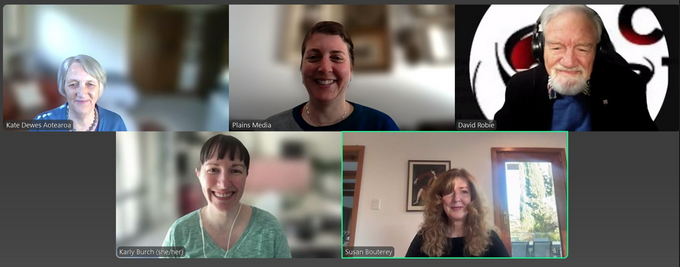


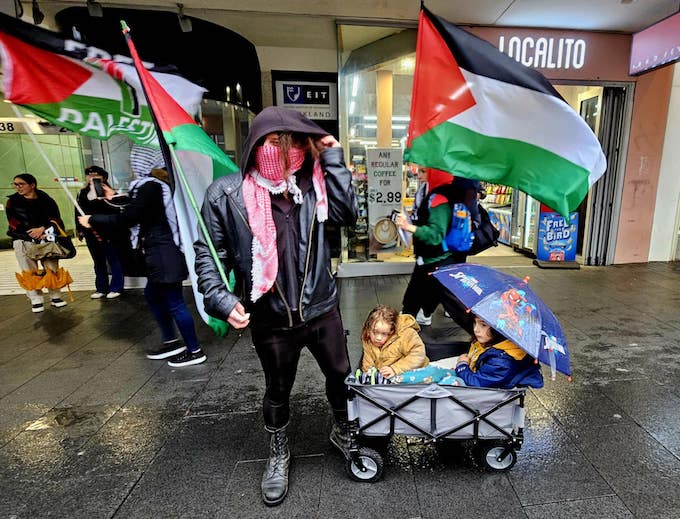


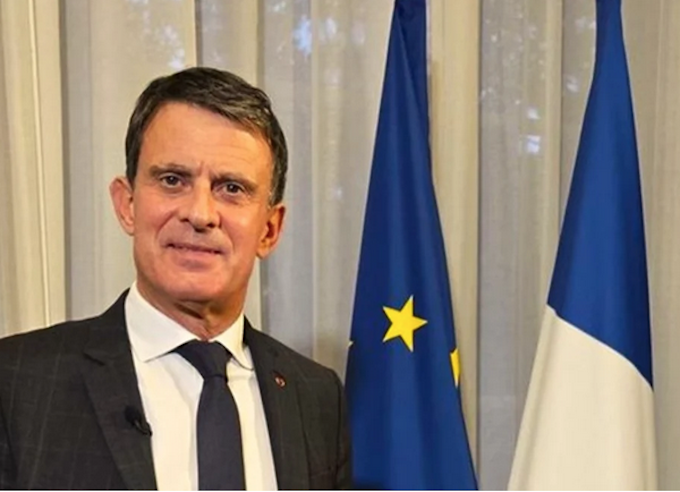
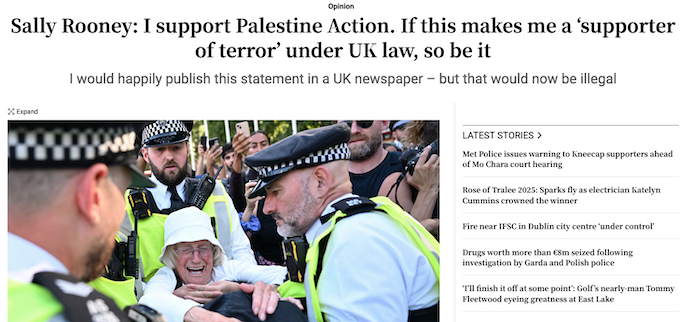
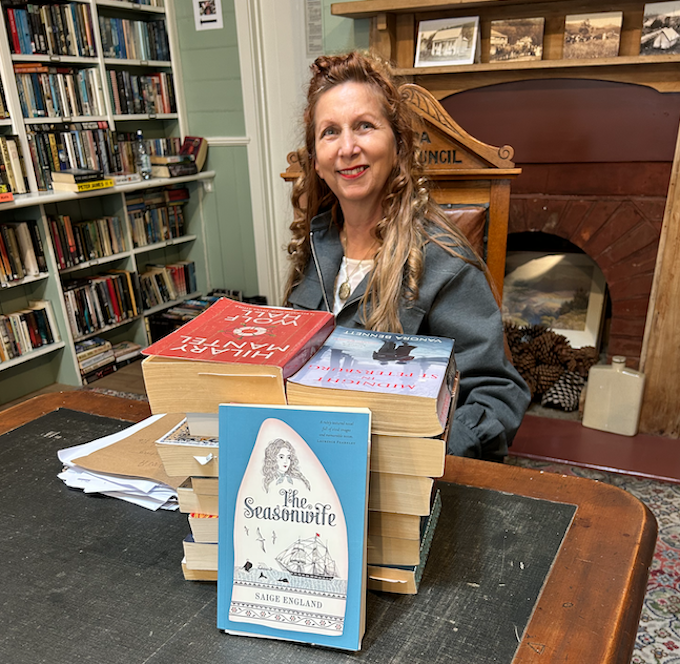

 The claims made in the video mentioned in this post are false
 You may refer to the link provided below for more details
 NEW: Israeli minister Itamar Ben Gvir filmed threatening Marwan Barghouti, the most prominent Palestinian prisoner, during a prison visit.
 First time Barghouti seen publicly in years — frail, gaunt, unrecognisable.…