Category: Featured

  • Asia Pacific Report

    Palestinian supporters and protesters against the 21 months of Israeli genocide in Gaza marched after a rally in downtown Auckland today across the Viaduct to the Greenpeace environmental flagship Rainbow Warrior — and met a display of solidarity.

    Several people on board the campaign ship, which has been holding open days over last weekend and this weekend, held up Palestinian flags and displayed a large banner declaring “Sanction Israel — Stop the genocide”.

    About 300 people were in the vibrant rally and Greenpeace Aotearoa oceans campaigner Juan Parada came out on Halsey Wharf to speak to the protesters in solidarity over Gaza.

    “Greenpeace stands for peace and justice, and environmental justice, not only for the environmental damage, but for the lives of the people,” said Parada, a former media practitioner.

    Global environmental campaigners have stepped up their condemnation of the devastation in Gaza and the occupied Palestinian territories as well as the protests over the genocide, which has so far killed almost 59,000 people, most of them women and children, according to the Gaza Health Department, although some researchers say the actual death toll is far higher.

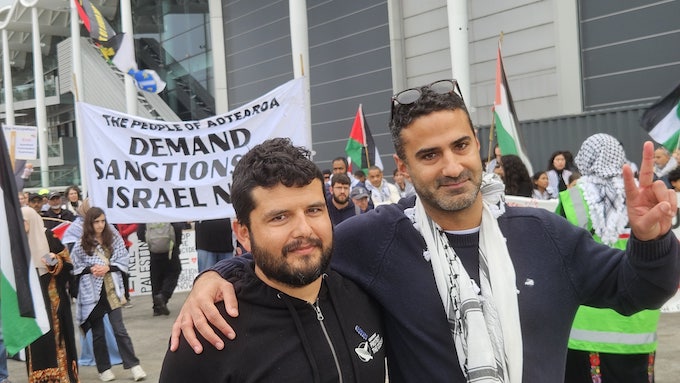
    Greenpeace campaigner Juan Parada (left) and one of the Palestine rally facilitators, Youssef Sammour, at today's rally
    Greenpeace campaigner Juan Parada (left) and one of the Palestine rally facilitators, Youssef Sammour, at today’s rally as it reached Halsey Wharf. Image: Asia Pacific Report

    Gaza war emissions condemned
    New research recently revealed that the carbon footprint of the first 15 months of Israel’s war on Gaza would be greater than the annual planet-warming emissions of 100 individual countries, worsening the global climate emergency on top of the huge civilian death toll.

    The report cited by The Guardian indicated that Israel’s relentless bombardment, blockade and refusal to comply with international court rulings had “underscored the asymmetry of each side’s war machine, as well as almost unconditional military, energy and diplomatic support Israel enjoys from allies, including the US and UK”.

    The Israeli war machine has been primarily blamed.

    The report, titled “War on the Climate: A Multitemporal Study of Greenhouse Gas Emissions of the Israel-Gaza Conflict” and published by the Social Science Research Network, is part of a growing movement to hold states and businesses accountable for the climate and environmental costs of war and occupation.

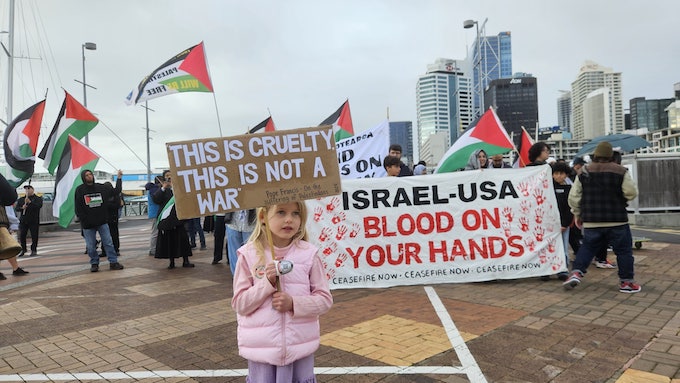
    "This is cruelty - this is not a war", says the young girl's placard on the Viaduct
    “This is cruelty – this is not a war”, says the young girl’s placard on the Viaduct today. Image: Asia Pacific Report

    Greenpeace open letter
    Greenpeace Aotearoa recently came out with strong statements about the genocidal war on Gaza with executive director Russel Norman earlier this month writing an open letter to Prime Minister Christopher Luxon and Foreign Minister Winston Peters, expressing his grave concerns about the “ongoing genocide in Gaza being carried out by Israeli forces” — and the ongoing failure of the New Zealand Government to impose meaningful sanctions on Israel.

    He referred to the mounting death toll of starving Palestinians being deliberately shot at the notorious Israeli-US backed Gaza Humanitarian Foundation (GHF) food distribution sites.

    Norman also cited an Israeli newspaper Ha’aretz report that Israeli soldiers had been ordered to deliberately shoot unarmed Palestinians seeking aid, quoting one Israeli soldier saying: “It’s a killing field.”

    Today’s rally featured many Palestinians wearing thobe costumes in advance of Palestinian Traditional Dress Day on July 25.

    This is a day to showcase and celebrate the rich Palestinian cultural heritage through traditional clothing that is intricately embroidered.

    Traditional thobes are a symbol of Palestinian resilience.

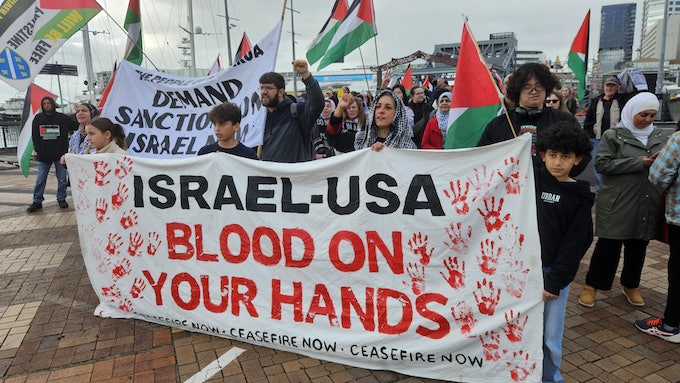
    "Israel-USA - blood on your hands" banner at today's rally in Auckland
    “Israel-USA – blood on your hands” banner at today’s rally in Auckland. Image: Asia Pacific Report

    This post was originally published on Asia Pacific Report.

  • By Giff Johnson, editor, Marshall Islands Journal/RNZ Pacific correspondent

    United States immigration and deportation enforcement continues to ramp up, impacting on Marshallese and Micronesians in new and unprecedented ways.

    The Trump administration’s directive to Immigration and Customs Enforcement (ICE) to arrest and deport massive numbers of potentially illegal aliens, including those with convictions from decades past, is seeing Marshallese and Micronesians swept up by ICE.

    The latest unprecedented development is Marshallese and Micronesians being removed from the United States to the offshore detention facility at the US Navy base in Guantánamo Bay — a facility set up to jail terrorists suspected of involvement in the 9/11 airplane attacks in the US in 2001.

    Marshall Islands Ambassador to the US Charles Paul this week confirmed a media report that one Marshallese was currently incarcerated at Guantánamo, which is also known as “GTMO”.

    The same report from nationnews.com said 72 detainees from 26 countries had been sent to GTMO last week, including from the Marshall Islands and the Federated States of Micronesia.

    A statement issued by the US Department of Homeland Security, which oversees ICE operations, concerning detention of foreigners with criminal records at GTMO said Homeland Security Secretary Kristi Noem was using “every tool available to get criminal illegal aliens off our streets and out of our country.”

    But the action was criticised by a Marshallese advocate for citizens from the Compact countries in the US.

    ‘Legal, ethical concerns’
    “As a Compact of Free Association (COFA) advocate and ordinary indigenous citizen of the Marshallese Islands, I strongly condemn the detention of COFA migrants — including citizens from the Republic of the Marshall Islands — at the US Naval Base in Guantánamo Bay,” Benson Gideon said in a social media post this week.

    “This action raises urgent legal, constitutional, and ethical concerns that must be addressed without delay.”

    Since seeing the news about detention of a Marshallese in this US facility used to hold suspected terrorists, Ambassador Paul said he had “been in touch with ICE to repatriate one Marshallese being detained.”

    Paul said he was “awaiting all the documents pertaining to the criminal charges, but we were informed that the individual has several felony and misdemeanor convictions. We are working closely with ICE to expedite this process.”

    Gideon said bluntly the detention of the Marshallese was a breach of Compact treaty obligations.

    “The COFA agreement guarantees fair treatment. Military detention undermines this commitment,” he said.

    Gideon listed the strong Marshallese links with the US — service in high numbers in the US military, hosting of the Kwajalein missile range, US military control of Marshall Islands ocean and air space — as examples of Marshallese contributions to the US.

    ‘Treated as criminals’
    “Despite these sacrifices, our people are being treated as criminals and confined in a facility historically associated with terrorism suspects,” he said.

    “I call on the US Embassy in Majuro to publicly address this injustice and work with federal agencies to ensure COFA Marshallese residents are treated with dignity and fairness.

    “If we are good enough to host your missile ranges, fight in your military, and support your defence strategy, then we are good enough to be protected — not punished. Let justice, transparency, and respect prevail.”

    There were 72 immigration detainees at Guantánamo Bay, 58 of them classified as high-risk and 14 in the low-risk category, reported nationnews.com.

    The report added that the criminal records of the detainees include convictions for homicide; sexual offences, including against children; child pornography; assault with a weapon; kidnapping; drug smuggling; and robbery.

    Civil rights advocates have called the detention of immigration detainees at Guantanamo Bay punitive and unlawful, arguing in an active lawsuit that federal law does not allow the government to hold those awaiting deportation outside of US territory.

    In other US immigration and deportation developments:

    • The delivery last month by US military aircraft of 18 Marshallese deported from the US and escorted by armed ICE agents is another example of the ramped-up deportation focus of the Trump administration. Since the early 2000s more than 300 Marshall Islanders have been deported from the US. Prior to the Trump administration, past deportations were managed by US Marshals escorting deportees individually on commercial flights.
    • According to Marshall Islands authorities, there have not been any deportations since the June 10 military flight to Majuro, suggesting that group deportations may be the way the Trump administration handles further deportations.
    • Individual travellers flying into Honolulu whose passports note place of birth as Kiribati are reportedly now being refused entry. This reportedly happened to a Marshallese passport holder late last month who had previously travel
    • led in and out of the US without issue.

    Most Marshallese passport holders enjoy visa-free travel to the US, though there are different levels of access to the US based on if citizenship was gained through naturalisation or a passport sales programme in the 1980s and 1990s.

    US Ambassador to the Marshall Islands Laura Stone said, however, that “the visa-free travel rules have not changed.”

    She said she could not speak to any individual traveller’s situation without adequate information to evaluate the situation.

    She pointed out that citizenship “acquired through naturalisation, marriage, investment, adoption” have different rules. Stone urged all travellers to examine the rules carefully and determine their eligibility for visa-free travel.

    “If they have a question, we would be happy to answer their enquiry at ConsMajuro@state.gov,” she added.

    This article is republished under a community partnership agreement with RNZ.

    This post was originally published on Asia Pacific Report.

  • COMMENTARY: By Refaat Ibrahim

    “If words shape our consciousness, then the media holds the keys to minds.”

    This sentence is not merely a metaphor, but a reality we live daily in the coverage of the Israeli aggression on Gaza, where the crimes of the occupation are turned into “acts of violence”, the siege targeting civilians into “security measures”, and the legitimate resistance into “terrorist acts”.

    This linguistic distortion is not innocent; it is part of a “systematic mechanism” practised by major Western media outlets, through which they perpetuate a false image of a “conflict between two equal sides”, ignoring the fact that one is an occupier armed with the latest military technology, and the other is a people besieged in their land for decades.

    Here, the ethical question becomes urgent: how does the media shift from conveying truth to becoming a tool for justifying oppression?

    Western media institutions promote a colonial narrative that reproduces the discourse of Israeli superiority, using linguistic and legal mechanisms to justify genocide.

    But the rise of global awareness through social media platforms and documentaries like We Are Not Numbers, produced by youth in Gaza, exposes this bias and brings the Palestinian narrative back to the forefront.

    Selective coverage . . .  when injustice becomes an opinion
    “Terrorism”, “self-defence”, “conflict” . . . are all terms that place the responsibility for violence on Palestinians while presenting Israel as the perpetual victim. This linguistic shift contradicts international law, which considers settlements a war crime (according to Article 8 of the Rome Statute), yet most reports avoid even describing the West Bank as “occupied territory”.

    More dangerously, the issue is reduced to “violent events” without mentioning their contexts: how can the Palestinian people’s resistance be understood without addressing 75 years of displacement and the siege of Gaza since 2007? The media is like someone commenting on the flames without mentioning who ignited them.

    The Western media coverage of the Israeli war on Gaza represents a blatant model of systematic bias that reproduces the Israeli narrative and justifies war crimes through precise linguistic and media mechanisms. Below is a breakdown of the most prominent practices:

    Stripping historical context and portraying Palestinians as aggressor

    Ignoring the occupation: Media outlets like the BBC and The New York Times ignored the Israeli occupation of Palestinian territories since 1948 and focused on the 7 October 2023 attack as an isolated event, without linking it to the daily oppression such as home demolitions and arrests in Jerusalem and the West Bank.

    Misleading terms: The war has often been described as a “conflict between Israel and Hamas”, while Gaza is considered the largest open-air prison in the world under Israeli siege since 2007. Example: The Economist described Hamas’s attacks as “bloody”, while Israeli attacks were called “military operations”.

    Dehumanising Palestinians
    Language of abstraction: The BBC used terms like “died” for Palestinians versus “killed” for Israelis, according to a quantitative study by The Intercept, weakening sympathy for Palestinian victims.

    Victim portrayal: While Israeli death reports included names and family ties (like “mother” or “grandmother”), Palestinians were shown as anonymous numbers, as seen in the coverage of Le Monde and Le Figaro.

    Israeli political rhetoric: Media outlets reported statements by Israeli leaders such as dismissed defence minister Yoav Gallant, who described Palestinians as “human animals”, and Benjamin Netanyahu, who called them “children of darkness”, without critically analysing this rhetoric that strips them of their humanity.

    Distorting resistance and linking it to terrorism
    Misleading comparisons: The October 7 attack was compared to “9/11” and described as a “terrorist attack” in The Washington Post and CNN, reinforcing the “war on terror” narrative and justifying Israel’s excessive response.

    Fake news: Papers like The Sun and Daily Mail promoted the story of “beheaded Israeli babies” without evidence, a story even adopted by US president Joe Biden, only to be disproven later by videos showing Hamas’ humane treatment of captives.

    Selective coverage and suppression of the Palestinian narrative
    Silencing journalists: Journalists such as Zahraa Al-Akhras (Global News) and Bassam Bounni (BBC) were dismissed for criticising Israel or supporting Palestine, while others were pressured to adopt the Israeli narrative.

    Defaming Palestinian institutions: The New York Times and The Wall Street Journal claimed the Palestinian death toll figures were “exaggerated”, ignoring UN and human rights organisations’ reports that confirmed their accuracy.

    Manipulating legal and ethical terms
    Denying war crimes: Deutsche Welle stated that Israeli attacks are “not considered war crimes”, despite the destruction of hospitals and the killing of tens of thousands of civilians.

    Legal misinformation: The BBC referred to Israeli settlements in the West Bank as “disputed territories”, despite the UN declaring them illegal.

    Double standards in conflict coverage
    Comparison with Ukraine: Western media linked support for Ukraine and Israel as “victims of aggression”, while ignoring that Israel is an occupying power under international law. Terminology shifted immediately: “invasion”, “war crimes”, “occupation” were used for Ukraine but omitted when speaking of Palestine.

    According to a 2022 study by the Arab Media Monitoring Project, 90 percent of Western reports on Ukraine used language blaming Russia for the violence, compared to only 30 percent in the Palestinian case.

    This contradiction exposes the underlying “racist bias”: how is killing in Europe called “genocide”, while in Gaza it is termed a “complicated conflict”? The answer lies in the statement of journalist Mika Brzezinski: “The only red line in Western media is criticising Israel.”

    False neutrality: Sky News claimed it “could not verify” the Baptist Hospital massacre, despite video documentation, yet quickly adopted the Israeli narrative.

    Consequences: legitimising genocide and marginalising Palestinian rights
    Western media practices have contributed to normalising Israeli violence by portraying it as “legitimate defence”, while resistance is labelled as “terrorism.”

    Deepening Palestinian isolation: By stripping them of the right to narrate, as shown in an academic study by Mike Berry (Cardiff University), which found emotional terms used exclusively to describe Israeli victims.

    Undermining international law: By ignoring reports from organisations like Human Rights Watch and Amnesty International, which confirm Israel’s commission of war crimes.

    Violating journalistic ethics . . .  when the journalist becomes the occupation’s lawyer
    Journalistic codes of ethics — such as the charter of the “International Federation of Journalists” — unanimously agree that the media’s primary task is “to expose the facts without fear”. But the reality proves the opposite:

    In 2023, CNN deleted an interview with a Palestinian survivor of the Jenin massacre after pressure from the Israeli lobby (according to an investigation by Middle East Eye).

    The Guardian was forced to edit the headline of an article that described settlements as “apartheid” after threats of legal action.

    This self-censorship turns journalism into a “copier of official statements”, abandoning the principle of “not compromising with ruling powers” emphasised by the “International Journalists’ Network”.

    Toward human-centred journalism
    Fixing this flaw requires dismantling biased language: replacing “conflict” with “military occupation”, and “settlements” with “illegal colonies”.

    Relying on international law: such as mentioning Articles 49 and 53 of the Fourth Geneva Convention when discussing the displacement of Palestinians.

    Giving space to victims’ voices: According to an Amnesty report, 80% of guests on Western TV channels discussing the conflict were either Israeli or Western.

    Holding media institutions accountable: through pressure campaigns to enforce their ethical charters (such as obligating the BBC to mention “apartheid” after the HRW report).

    Conclusion
    The war on Gaza has become a stark test of media ethics. While platforms like Al Jazeera and Middle East Eye have helped expose violations, major Western media outlets continue to reproduce a colonial discourse that enables Israel. The greatest challenge today is to break the silence surrounding the crimes of genocide and impose a human narrative that restores the stolen humanity of the victims.

    “Occupation doesn’t just need tanks, it needs media to justify its existence.” These were the words of journalist Gideon Levy after witnessing how his camera turned war crimes into “normal news”.

    If Western media is serious about its claim of neutrality, it must start with a simple step: call things by their names. Words are not lifeless letters, they are ticking bombs that shape the consciousness of generations.

    Refaat Ibrahim is the editor and creator of The Resistant Palestinian Pens website, where you can find all his articles. He is a Palestinian writer living in Gaza, where he studied English language and literature at the Islamic University. He has been passionate about writing since childhood, and is interested in political, social, economic, and cultural matters concerning his homeland, Palestine. This article was first published at Pearls and Irritations social policy journal in Australia.

    This post was originally published on Asia Pacific Report.

  • COMMENTARY: By Eugene Doyle

    Nobody has a bad word to say about the French Resistance in the Second World War, right?  Who would criticise a group confronting fascism, right?

    Yet this month the UK group Palestine Action has been proscribed as a “terrorist” organisation by their government for their non-violent direct action against UK-based industries supplying technology to fuel Israel’s destruction of the Palestinian people.

    Are they terrorists or the very best of us in the West?

    Stéphane Hessel, a leading member of the French Resistance, survived time in Nazi concentration camps, including Buchenwald. After the war he was one of the co-authors of the Universal Declaration of Human Rights (1948), a pillar of international law to this day.

    The Declaration affirms the inherent dignity and equal rights of all humans. In later years Hessel (d. 2013), who was Jewish, saw the treatment of the Palestinians as an affront to this and repeatedly called Israel out for crimes against humanity.

    Hessel argued people needed to be outraged just as he and his fellow fighters had been during the war.

    In 2010, he said: “Today, my strongest feeling of indignation is over Palestine, both the Gaza Strip and the West Bank. The starting point of my outrage was the appeal launched by courageous Israelis to the Diaspora: you, our older siblings, come and see where our leaders are taking this country and how they are forgetting the fundamental human values of Judaism.”

    In his book Indignez-vous (Time for Outrage!) he called for a “peaceful insurrection” and pointed to some of the non-violent forms of protests Palestinians had used over the years.

    Supporting Palestine Action
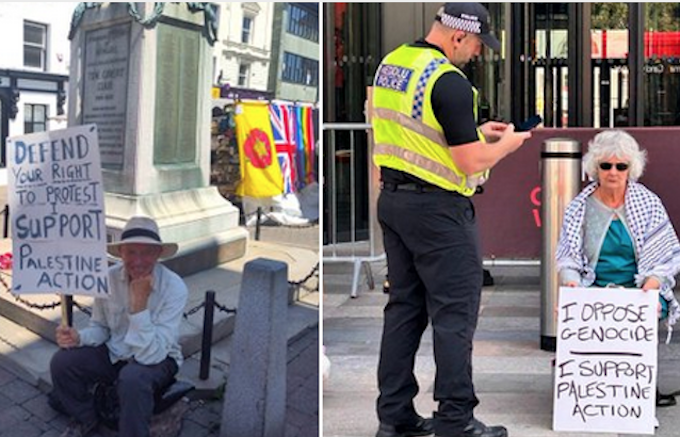
    In Kendal, UK, this fellow wasn’t arrested. In Cardiff, this woman was. Perhaps the “terrorism” isn’t saying you support Palestine Action – it’s saying you oppose genocide?! Image: Private Eye/X/@DefendourJuries

    “The Israeli authorities have described these marches as ‘nonviolent terrorism’. Not bad . . .  One would have to be Israeli to describe nonviolence as terrorism.”

    How wrong Stéphane Hessel was on this point. The British Parliament has just proscribed Palestine Action as “terrorists” despite them having never attacked anyone, never used weapons, but only undertaken destruction of property linked to the arms industry.

    Does Palestine Action really bear resemblance to Al Qaeda or ISIS, or Israel’s Stern Gang or the IDF? Or, like the French Resistance, will they eventually be recognised as heroes of our time? Will Hollywood romanticise them in their usual tardy way in 50 years time?

    In respect to the Palestinians, Hessel was clear that resistance could take many forms: “We must recognise that when a country is occupied by infinitely superior military means, the popular reaction cannot be only nonviolent,” he said.

    In his time, he lived by those words.

    Resistance – a precious band of brothers and sisters
    Here’s a statistic that should make you think.  In the Second World War less than 2 percent of French people played any active role in the Resistance.  Most people just sat back and got on with their lives whether they liked the Germans or didn’t.

    The Jews and others were dealt to, stamped on and shipped out, while most of the French could trundle on unharassed.  The heavy lifting of resistance was done by a small band of brothers and sisters who took it to the enemy.

    History salutes them, as we now salute the Suffragettes, the anti-Apartheid activists, the American civil rights groups and Irish liberation fighters. We’re living through something similar now — and our governments are the bad guys.

    I first learned that shocking fact about the composition of the Resistance from my history teacher at l’Université de Franche-Comté, in France in the 1980s.  He was the distinguished historian Antoine Casanova, a specialist on Napoleon, Corsica and the Resistance.

    Perhaps the low level of resistance is not surprising.  Most of the people who put their bodies on the line in Occupied France during the Second World War were either communists or Jews.  Good on them. Jewish people made up as much as 20 percent of the French Resistance despite numbering only about 1 percent of the population. This massive over-representation can, understandably, be explained as recognition of the existential threat they faced — but many were also passionate communists or socialists, the ideological enemies of the racist, fascist ideology of their occupiers.

    Looking at the Israeli State today, many of those same Jewish Resistance fighters would instantly recognise the racism and fascism that they opposed in the 1940s.  We should remember our leaders tell us we share values with Israel.

    For anyone not in the United Kingdom (where it is illegal to show any support for Palestine Action) I highly recommend the recently released documentary To Kill A War Machine which gives an absolutely riveting account of both the direct action the group has undertaken and the moral and ideological underpinnings of their actions.

    Having seen the documentary I can see why the British Labour government is doing everything in its power to silence and censor them.  They really do expose who the true terrorists are.  Stéphane Hessel would be proud of Palestine Action.

    This week a former Israeli Prime Minister Ehud Olmert made clear what is going on in Gaza.

    The “humanitarian city” Israel is planning to build on the ruins of Rafah would be, in his words, a concentration camp. Others have described it as a Warsaw-ghetto or a “death camp”.  Olmert says Israel is clearly committing war crimes in both Gaza and the West Bank and that the concentration camp for the Gazan population would mark a further escalation.

    It would go beyond ethnic cleansing and take the Jewish State of Israel shoulder-to-shoulder with other regimes that built such camps.  Israel, we should never forget, is our close ally.

    Millions of people have hit the streets in Western countries.  A majority clearly repudiate what the US and Israel are doing.  But the political leadership of the big Western countries continues to enable the racist, fascist genocidal state of Israel to do its evil work. Lesser powers of the white-dominated broederbond, like Australia and New Zealand, also provide valuable support.

    Until our populations in the West mobilise in sufficient numbers to force change on our increasingly criminal ruling elites, the heavy-lifting done by groups like Palestine Action will remain powerful forms of the resistance.

    I grew up in the Catholic faith.  One of the lines indelibly printed on my consciousness was: “Greater love hath no man than this, that he lay down his life for his friends.”  Palestine Action is doing that.  Francesca Albanese is doing that.  Justice for Palestine and Palestine Solidarity Network Aotearoa are doing this.

    The real question, the burning question each of us must answer is — given there is no middle ground, there is no fence to sit on when it comes to genocide — whose side are you on? And what are you going to do about it?  Vive la Resistance! Vive the defenders of the Palestinian cause!

    Rest in Peace Stéphane Hessel. Le temps passe, le souvenir reste.

    Eugene Doyle is a writer based in Wellington. He has written extensively on the Middle East, as well as peace and security issues in the Asia Pacific region. He contributes to Asia Pacific Report and Café Pacific, and hosts the public policy platform solidarity.co.nz

    This post was originally published on Asia Pacific Report.

  • The Devonport Flagstaff

    About 200 people marched in Devonport last Saturday in support of Palestine.

    Pro-Palestine flags and placards were draped on the band rotunda at Windsor Reserve as speakers, including Green Party co-leader Chlöe Swarbrick and the people power manager of Amnesty International Aotearoa New Zealand Margaret Taylor, a Devonport local, encouraged the crowd to continue to fight for peace in the Middle East.

    The Devonport Out For Gaza rally progressed up Victoria Rd to the Victoria Theatre, crossed the road, came down to the ferry terminal, then marched along the waterfront to the New Zealand Navy base.

    Swarbrick said the New Zealand government and New Zealanders could not turn a blind eye to what was happening in Palestine.

    The rally, organised by the Palestine Solidarity Network Aotearoa (PSNA), marked the 92nd consecutive week that a march has been held in Auckland in support of Palestine.

    Republished with permission from The Devonport Flagstaff.

    Call to action . . . Devonport peace activist Ruth Coombes (left) and Green Party co-leader Chlöe Swarbrick at the microphone (right). Image: The Devonport Flagstaff
    Call to action . . . Devonport peace activist Ruth Coombes (left) and Green Party co-leader Chlöe Swarbrick at the microphone (right). Image: The Devonport Flagstaff

    This post was originally published on Asia Pacific Report.

  • By Patrick Decloitre, RNZ Pacific correspondent French Pacific desk

    New Caledonian politicians who inked their commitment to a deal with France last weekend will be offered special police protection following threats, especially made on social media networks.

    The group includes almost 20 members of New Caledonia’s parties — both pro-France and pro-independence — who took part in deal-breaking negotiations with the French State that ended on 12 July 2025, and a joint commitment regarding New Caledonia’s political future.

    The endorsed document envisages a roadmap in the coming months to turn New Caledonia into a “state” within the French realm.

    It is what some legal experts have sometimes referred to as “a state within the state”, while others say this was tantamount to pushing the French Constitution to its very limits.

    The document is a commitment by all signatories that they will stick to their respective positions from now on.

    The tense but conclusive negotiations took place behind closed doors in a hotel in the small city of Bougival, near Paris, under talks driven by French Minister for Overseas Manuel Valls and a team of high-level French government representatives and advisers.

    It followed Valls’ several unsuccessful attempts earlier this year to reach a consensus between parties who want New Caledonia to remain part of France and others representing the pro-independence movement.

    Concessions from both sides
    But to reach a compromise agreement, both sides have had to make concessions.

    The pro-French parties, for instance, have had to endorse the notion of a State of New Caledonia or that of a double French-New Caledonian nationality.

    Pro-independence parties have had to accept the plan to modify the rules of eligibility to vote at local elections so as to allow more non-native French nationals to join the local electoral roll.

    They also had to postpone or even give up on the hard-line full sovereignty demand for now.

    Over the past five years and after a series of three referendums (held between 2018 and 2021) on self-determination, both camps have increasingly radicalised.

    This resulted in destructive and deadly riots that broke out in May 2024, resulting in 14 deaths, more than 2 billion euros (NZ$3.9 billion) in damage, thousands of jobless and the destruction of hundreds of businesses.

    Over one year later, the atmosphere in New Caledonia remains marked by a sense of tension, fear and uncertainty on both sides of the political chessboard.

    Since the deal was signed and made public, on July 12, and even before flying back to New Caledonia, all parties have been targeted by a wide range of reactions from their militant bases, especially on social media.

    Some of the reactions have included thinly-veiled death threats in response to a perception that, on one side or another, the deal was not up to the militants’ expectations and that the parties’ negotiators are now regarded as “traitors”.

    Since signing the Paris agreement, all parties have also recognised the need to “sell” and “explain” the new agreement to their respective militants.

    Most of the political parties represented during the talks have already announced they will hold meetings in the coming days, in what is described as “an exercise in pedagogy”.

    “In a certain number of countries, when you sign compromises after hundreds of hours of discussions and when it’s not accepted [by your militants], you lose your reputation. In our country . . . you can risk your life,” said moderate pro-France Calédonie Ensemble leader Philippe Gomès told public broadcaster NC La Première on Wednesday.

    Pro-independence FLNKS (Kanak and Socialist National Liberation Front) chief negotiator Emmanuel Tjibaou was the first to face negative repercussions back in New Caledonia.

    Tjibaou’s fateful precedent
    “To choose this difficult and new path also means we’ll be subject to criticism. We’re going to get insulted, threatened, precisely because we have chosen a different path,” he told a debriefing meeting hosted by French President Emmanuel Macron.

    In 1988, Tjibaou’s father, pro-independence leader Jean-Marie Tjibaou, also signed a historic deal (known as the Matignon-Oudinot accords) with pro-France’s Jacques Lafleur, under the auspices of then Prime Minister Michel Rocard.

    The deal largely contributed to restoring peace in New Caledonia, after a quasi-civil war during the second half of the 1980s.

    The following year, he and his deputy, Yeiwéné Yeiwéné, were both shot dead by Djubelly Wéa, a hard-line member of the pro-independence movement, who believed the signing of the 1988 deal had been a “betrayal” of the indigenous Kanak people’s struggle for sovereignty and independence.

    ‘Nobody has betrayed anybody’
    “Nobody has betrayed anybody, whichever party he belongs to. All of us, on both sides, have defended and remained faithful to their beliefs. We had to work and together find a common ground for the years to come, for Caledonians. Now that’s what we need to explain,” said pro-France Rassemblement-LR leader Virginie Ruffenach.

    In an interview earlier this week, Valls said he was very aware of the local tensions.

    “I’m aware there are risks, even serious ones. And not only political. There are threats on elections, on politicians, on the delegations. What I’m calling for is debate, confrontation of ideas and calm.

    “I’m aware that there are extremists out there, who may want to provoke a civil war . . . a tragedy is always possible.

    “The risk is always there. Since the accord was signed, there have been direct threats on New Caledonian leaders, pro-independence or anti-independence.

    “We’re going to act to prevent this. There cannot be death threats on social networks against pro-independence or anti-independence leaders,” Valls said.

    Over the past few days, special protection French police officers have already been deployed to New Caledonia to take care of politicians who took part in the Bougival talks and wish to be placed under special scrutiny.

    “They will be more protected than (French cabinet) ministers,” French national public broadcaster France Inter reported on Tuesday.

    This article is republished under a community partnership agreement with RNZ.

    This post was originally published on Asia Pacific Report.

  • ANALYSIS: By Mick Hall

    Collective measures to confront Israel’s genocide of the Palestinian people have been agreed by 12 nations after an emergency summit of the Hague Group in Bogotá, Colombia.

    A joint statement today announced the six measures, which it said were geared to holding Israel to account for its crimes in Palestine and would operate within the states’ domestic legal and legislative frameworks.

    Nearly two dozen other nations in attendance at the summit are now pondering whether to sign up to the measures before a September deadline set by the Hague Group.

    New Zealand and Australia stayed away from the summit.

    The measures include preventing the provision or transfer of arms, munitions, military fuel and dual-use items to Israel and preventing the transit, docking or servicing of vessels if there is a risk of vessels carrying such items. No vessel under the flag of the countries would be allowed to carry this equipment.

    The countries would also “commence an urgent review of all public contracts, in order to prevent public institutions and public funds, where applicable, from supporting Israel’s illegal occupation of the Palestinian Territory which may entrench its unlawful presence in the territory, to ensure that our nationals, and companies and entities under our jurisdiction, as well as our authorities, do not act in any way that would entail recognition or provide aid or assistance in maintaining the situation created by Israel’s illegal presence in the Occupied Palestinian Territory”.

    The countries will prosecute “the most serious crimes under international law through robust, impartial and independent investigations and prosecutions at national or international levels, in compliance with our obligation to ensure justice for all victims and the prevention of future crimes”.

    They agreed to support universal jurisdiction mandates, “as and where applicable in our legal constitutional frameworks and judiciaries, to ensure justice for all victims and the prevention of future crimes in the Occupied Palestine Territory”.

    This will mean IDF soldiers and others accused of war crimes in Palestine would face arrest and could go through domestic judicial processes in these countries, or referrals to the ICC.

    The statement said the measures constituted a collective commitment to defend the foundational principles of international law.

    It also called on the UN Economic and Social Council (ECOSOC) to commission an immediate investigation of the health and nutritional needs of the population of Gaza, devise a plan to meet those needs on a continuing and sustained basis, and report on these matters before the 80th session of the United Nations General Assembly in September.

    Following repeated total blockades of Gaza since October 7, 2023, Gazans have been dying of starvation as they continue to be bombed and repeatedly displaced and their means of life destroyed.

    The official death toll stands at nearly 59,000, mostly women and children, although some estimates put that number at over 200,000.

    The joint statement recognised Israel as a threat to regional peace and the system of international law and called on all United Nations member states to enforce their obligations under the UN charter.

    It condemned “unilateral attacks and threats against United Nations mandate holders, as well as key institutions of the human rights architecture and international justice” and committed to build “on the legacy of global solidarity movements that have dismantled apartheid and other oppressive systems, setting a model for future co-ordinated responses to international law violations”.

    Countries face wrath of US
    Ministers, high-ranking officials and envoys from 30 nations attended the two-day event, from July 15-16, called to come up with the measures. It is now hoped some of those attendees will sign up to the statement by September.

    For countries like Ireland, which sent a delegation, signing up would have profound implications. The Irish government has been heavily criticised by its own citizens for continuing to allow Shannon Airport as a transit point for military equipment from the United States to be sent to Israel.

    It would also face the prospect of severe reprisals by the US, as would others thinking of adding their names to the collective statement. The US is now expected to consult with nations that attended and warn them of the consequences of signing up.

    The summit had been billed by the UN Rapporteur for Human Rights in the Occupied Palestinian Territories, Francesca Albanese, as “the most significant political development of the last 20 months”.

    Albanese had told attendees that “for too long, international law has been treated as optional — applied selectively to those perceived as weak, ignored by those acting as the powerful”.

    “This double standard has eroded the very foundations of the legal order. That era must end,” she said.

    Co-chaired by Colombia and South Africa, the Hague group was established by nine nations in late January at The Hague in the Netherlands to hold Israel to account for its crimes and push for Palestinian self-determination.

    Colombia last year ended diplomatic relations with Israel, while South Africa in late December 2023 filed an application at the International Court of Justice (ICJ) accusing Israel of genocide, which was joined by nearly two dozen countries.

    The ICJ has determined a plausible genocide is taking place and issued orders for Israel to protect Palestinians and take measures to stop genocide taking place, a call ignored by the Zionist state.

    Representatives from the countries arrived in Bogota this week in defiance of the United States, which last week sanctioned Albanese for attempts to have US and Israeli political officials and business leaders prosecuted by the ICC over Gaza.

    Secretary of State Marco Rubio called it an illegitimate “campaign of political and economic warfare”.

    It followed the sanctioning of four ICC judges after arrest warrants were issued in November last year for Israel Prime Minister Benjamin Netanyahu and former defence minister Yoav Gallant, for crimes against humanity and war crimes.

    Ahead of the Bogota meeting, the US State Department accused The Hague Group of multilateral attempts to “weaponise international law as a tool to advance radical anti-Western agendas” and warned the US would “aggressively defend” its interests.

    Signs of division in the West
    Most of those attending came from nations in the Global South, but not all.

    Founding Hague Group members Belize, Bolivia, Colombia, Cuba, Honduras, Malaysia, Namibia, Senegal and South Africa attended the Summit. Joining them were Algeria, Bangladesh, Botswana, Brazil, Chile, China, Djibouti, Indonesia, Iraq, Republic of Ireland, Lebanon, Libya, Mexico, Nicaragua, Oman, Pakistan, Palestine, Qatar, Saint Vincent and the Grenadines, Uruguay, and Venezuela.

    However, in a sign of increasing division in the West, NATO members Spain, Portugal, Norway, Slovenia and Turkey also attended.

    Inside the summit, former US State Department official Annelle Sheline, who resigned in March over Gaza, defended the right of those attending “to uphold their obligations under the UN Convention on the Prevention and Punishment of the Crime of Genocide”.

    “This is not the weaponisation of international law. This is the application of international law,” she told delegates.

    The US and Israel deny accusations that genocide is taking place in Gaza, while Western media have collectively refused to adjudicate the claims or frame stories around Israel’s ethnic cleansing of the strip, despite ample evidence by the UN and genocide experts.

    Since 7 October 2023, US allies have offered diplomatic cover for Israel by repeating it had “a right to defend itself” and was engaged in a legitimate defensive “war against Hamas”.

    Israel now plans to corral starving Gazans into a concentration camp in the south of the strip, with many analysts expecting the IDF to exterminate anyone found outside its boundaries, while preparing to push those inside across the border into Egypt.

    Asia Pacific and EU allies shun Bogota summit
    Addressing attendees at the summit yesterday, Albanese criticised the EU for its neo-colonialism and support for Israel, criticisms that can be extended to US allies in the Asia Pacific region.

    Independent journalist Abby Martin reported Albanese as saying: “Europe and its institutions are guided more by colonial mindset than principle, acting as vessels to US Empire even as it drags us from war to war, misery to misery.

    “The Hague Group is a new moral centre in world politics. Millions are hoping for leadership that can birth a new global order, rooted in justice, humanity and collective liberation. It’s not just about Palestine. This is about all of us.”

    The Australian Ministry of Foreign Affairs and Trade was asked why Foreign Minister Penny Wong did not take up an invite to attend the Hague Group meeting. In a statement to Mick Hall in Context, a spokesperson said she had been unable to attend, but did not explain why.

    She said Australia was a “resolute defender of international law” and added: “Australia has consistently been part of international calls that all parties must abide by international humanitarian law. Not enough has been done to protect civilians and aid workers.

    “We have called on Israel to respond substantively to the ICJ’s advisory opinion on the legal consequences arising from Israel’s policies and practices in the Occupied Palestinian Territories.

    “We have also called on Israel to comply with the binding orders of the ICJ, including to enable the unhindered provision of basic services and humanitarian assistance at scale.”

    When asked why New Zealand’s Foreign Minister Winston Peters had failed to take up the invitation or send any of his officials, a Ministry of Foreign Affairs and Trade (MFAT) spokesperson simply refused to comment.

    She said MFAT media advisors would only engage with “recognised news media outlets”.

    Australia’s Prime Minister Anthony Albanese and New Zealand’s Prime Minister Christopher Luxon, as well as a number of his ministers, have been referred to the ICC by domestic legal teams, accused of complicity in the genocide.

    Evidence against Albanese was accepted into the ICC’s wider investigation of crimes in Gaza in October last year, while Luxon’s referral earlier this month is being assessed by the Chief Prosecutor’s Office.

    Delegates told humanity at stake
    Delegates heard several impassioned addresses from speakers on what was at stake during the two-day event in Bogota.

    Palestinian-American trauma surgeon, Dr Thaer Ahmad, told the gathering that Palestinians seeking food were being met with bullets, describing aid distribution facilities set up by the US contractor-run Gaza Humanitarian Foundation (GHF) as “slaughterhouses”. More than 800 starving Gazans have been killed at the GHF aid points so far.

    “People know they could die but cannot sit idly by and watch their families starve,” he said.

    “The bullets fired by GHF mercenaries are just one part of the weaponisation of aid, where Palestinians are ghettoised into areas where somebody in military fatigues decides if you are worthy of food or not.”

    Palestinian diplomat Riyad Mansour had urged the summit attendees to take decisive action to not only save the Palestinian people, but redeem humanity.

    “Instead of outrage at the crimes we know are taking place, we find those who defend, normalise, and even celebrate them,” he said.

    “The core values we believed humanity agreed were universal are shattered, blown to pieces like the tens of thousands of starved, murdered and injured civilians in Palestine.

    “The mind and heart cannot fathom or process the immense pain and horror that has taken hold of the lives of an entire people. We must not fail — not just for Palestine’s sake — but for humanity’s sake.”

    At the beginning of the summit, Colombian Deputy Foreign Minister Mauricio Jaramillo Jassir told summit delegates the Palestinian genocide threatened the entire international system.

    Colombian President Gustavo Petro wrote in The Guardian last week: “We can either stand firm in defence of the legal principles that seek to prevent war and conflict, or watch helplessly as the international system collapses under the weight of unchecked power politics.”

    Meanwhile, EU foreign ministers, as well as Israel’s Foreign Minister Gideon Sa’ar and Syrian counterpart, Asaad Hassan al-Shaibani, met in Brussels at the same time as the Bogota summit, to discuss Middle East co-operation, but also possible options for action against Israel.

    At the EU–Southern Neighbourhood Ministerial Meeting, EU foreign policy chief Kaja Kallas put forward potential actions after Israel was found to have breached the EU economic cooperation deal with the bloc on human rights grounds. As expected, no sanctions, restricted trade or suspension of the co-operation deal were agreed.

    The EU has been one of Israel’s most strident backers in its campaign against Gaza, with EU members Germany and France in particular supplying weapons, as well as political support.

    The UK government has continued to supply arms and operate spy planes over Gaza over the past 21 months, launched from bases in Cyprus, while its military has issued D-Notices to censor media reports that its special forces have been operating inside the occupied territories.

    Mick Hall is an independent Irish-New Zealand journalist, formerly of RNZ and AAP, based in New Zealand since 2009. He writes primarily on politics, corporate power and international affairs. This article is republished from his substack Mick Hall in Context with permission.

    This post was originally published on Asia Pacific Report.
  • Pacific Media Watch

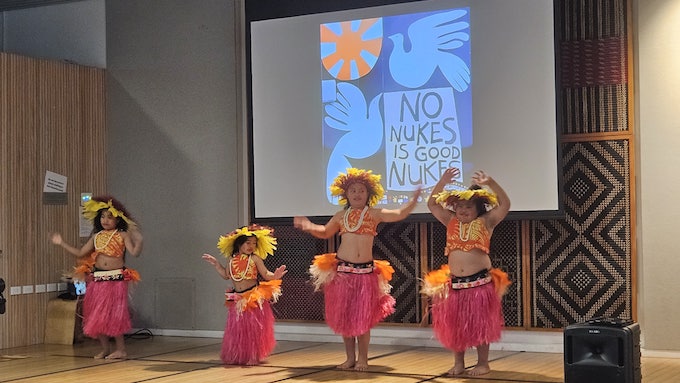
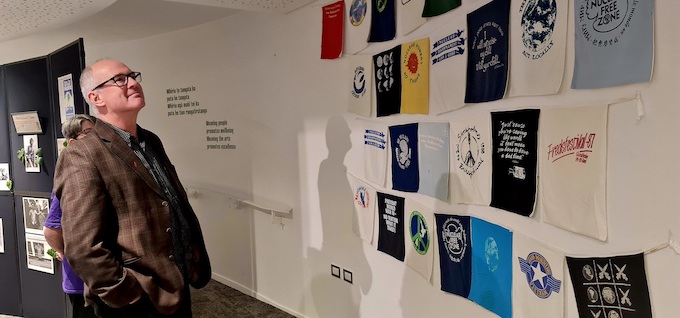
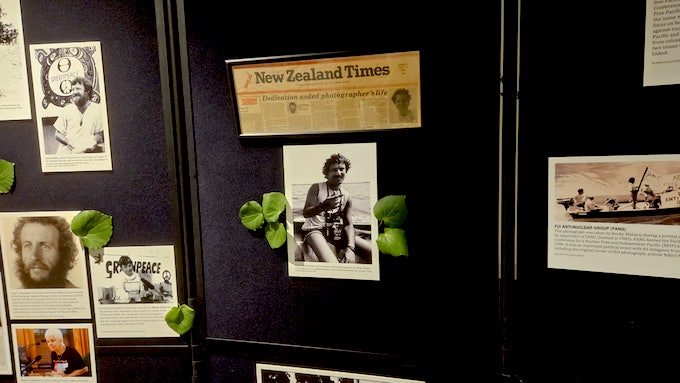
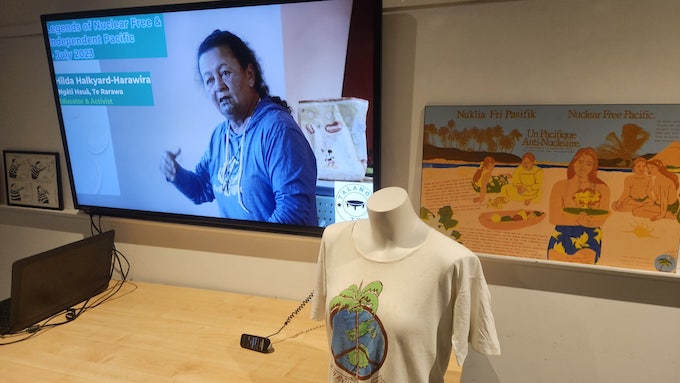
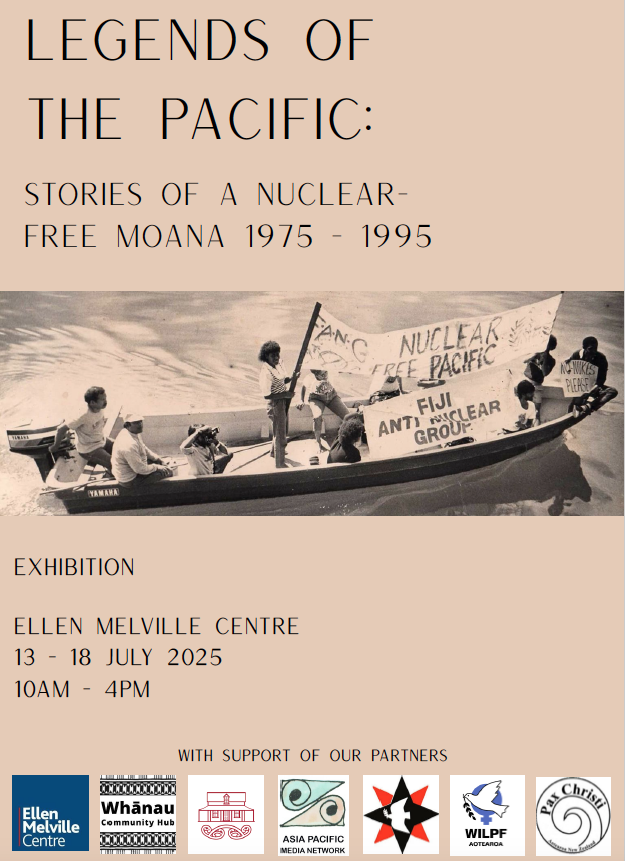
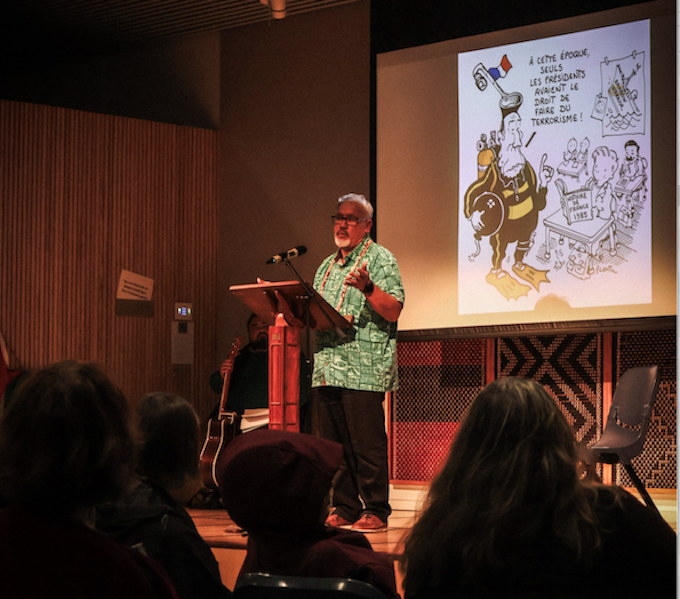
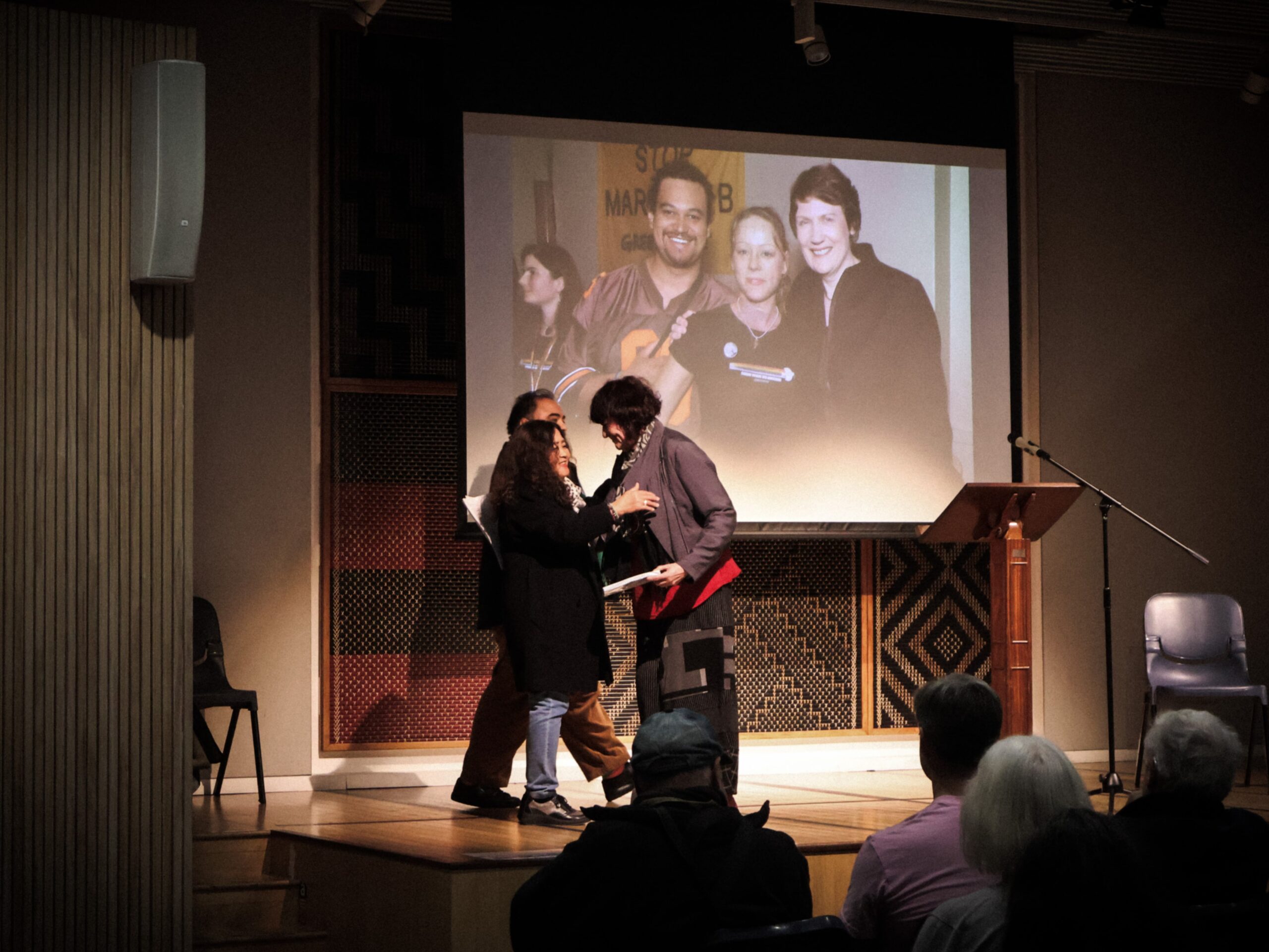
    Greenpeace pioneer and activist Susi Newborn is among the “nuclear free heroes” featured in a video tribute premiered this week in an exhibition dedicated to a nuclear-free Pacific.

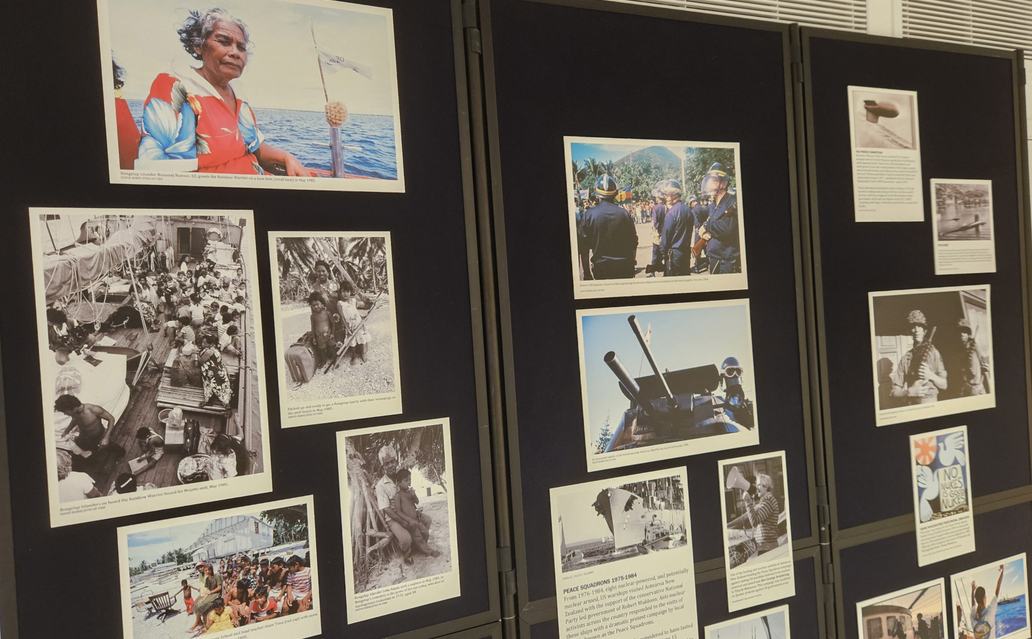
    The week-long exhibition at Tāmaki Makaurau Auckland’s Ellen Melville Centre, titled “Legends of the Pacific: Stories of a Nuclear-Free Moana 1975-1995,” closes tomorrow afternoon.

    A segment dedicated to the Nuclear-Free and Independent Pacific (NFIP) movement features Newborn making a passionate speech about the legend of the “Warriors of the Rainbow” on the steps of the Auckland Museum in July 2023 just weeks before she died.

    Newborn was an Aotearoa New Zealand author, documentary film-maker, environmental activist and a founding director of Greenpeace UK and co-founder of Greenpeace International.

    She was an executive director of the New Zealand non-for-profit group Women in Film and Television.

    Newborn was also one of the original crew members on the first Rainbow Warrior which was bombed in Auckland Harbour on 10 July 2025.

    The ship’s successor, Rainbow Warrior III, a state-of-the-art environmental campaign ship, has been docked at Halsey Wharf this month for a memorial ceremony to honour the 40th anniversary of the loss of photographer Fernando Pereira and the ship, sabotaged by French secret agents.

    Effective activists
    In a tribute after her death, Greenpeace stalwart Rex Weyler wrote: “Susi Newborn [was] one of the most skilled and effective activists in Greenpeace’s 52-year history.”

    “In 1977, when Susi arrived in Canada for her first Greenpeace action to protect infant harp seal pups in Newfoundland, she was already something of a legend,” Weyler wrote.

    “Journalistic tradition would have me refer to her as ‘Newborn’, a name that rang with significance, but I can only think of her as Susi, the tough, smart activist from London.”

    The half hour video collage, produced and directed by the Whānau Community Centre’s Nik Naidu, is titled Legends of a Nuclear-Free & Independent Pacific (NFIP).


    Legends of a Nuclear-Free and Independent Pacific.     Video: Talanoa TV

    Among other activists featured in the video are NFIP academic Dr Marco de Jong; Presbyterian minister Reverend Mua Strickson-Pua; Professor Vijay Naidu, founding president of the Fiji Anti-Nuclear Group (FANG); Polynesian Panthers founder Will ‘Ilolahia; NFIP advocate Hilda Halkyard-Harawira (Ngāti Hauā, Te Rarawe); community educator and activist Del Abcede; retired media professor, journalist and advocate Dr David Robie; Anglican priest who founded the Peace Squadron, Reverend George Armstrong; and United Liberation Movement for West Papua vice-president Octo Mote, interviewed at the home of peace author and advocate Maire Leadbeater.

    The video sound track is from Herbs’ famous French Letter about nuclear testing in the Pacific.

    “It is so important to record our stories and history — especially for our children and future generations,” said video creator Nik Naidu.

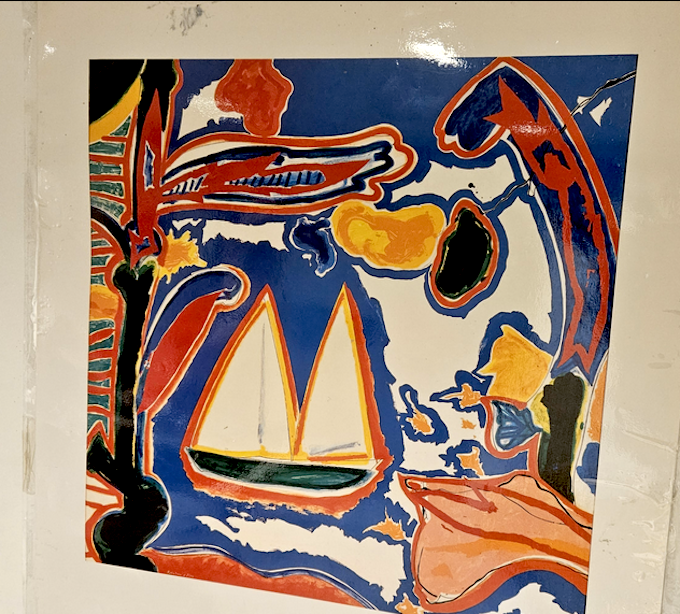
    Nuclear Free and Independent Pacific . . . an early poster.
    Nuclear Free and Independent Pacific . . . an early poster.

    “They need to hear the truth from our “legends” and “leaders”. Those who stood for justice and peace.

    “The freedoms and benefits we all enjoy today are a direct result of the sacrifice and activism of these legends.”

    The video has been one of the highlights of the “Legends” exhibition, created by Heather Devere, Del Abcede and David Robie of the Asia Pacific Media Network; Nik Naidu of the APMN as well as co-founder of the Whānau Community Hub; Antony Phillips and Tharron Bloomfield of the Heritage New Zealand Pouhere Taonga; and Rachel Mario of the Auckland Rotuman Fellowship Group and Whānau Hub.

    Support has also come from the Ellen Melville Centre (venue and promotion), Padet (for the video series), Pax Christi, Women’s International League for Peace Freedom (WILPF) Aotearoa, and the Quaker Peace Fund.

    The exhibition was opened by Labour MP for Te Atatu and disarmament spokesperson Phil Twyford last Saturday.

    The video collage and the individual video items can be seen on the Talanoa TV channel: https://www.youtube.com/@talanoatv

    Professor Vijay Naidu of the University of the South Pacific
    Professor Vijay Naidu of the University of the South Pacific . . . founding president of the Fiji Anti-Nuclear Group (FANG), one of the core groups in the Nuclear Free and Independent Pacific (NFIP) movement. Image: APR

    This post was originally published on Asia Pacific Report.
  • GENEVA, Switzerland (17 July 2025) – The Asian Forum for Human Rights and Development (FORUM-ASIA) and the undersigned organizations call on the government of Indonesia to immediately halt the ongoing legislative process to pass an amendment to the Criminal Procedure Code (“Code”) until meaningful consultations with civil society, academia, and the broader public are ensured.

    “The initiative to amend the Criminal Procedure Code must undergo a rigorous and inclusive review process, particularly on the specific provisions that have caused or could further jeopardize the people’s rights to due process of law,” said Mary Aileen Diez-Bacalso, Executive Director of FORUM-ASIA.

    We urge the Indonesian government to ensure  inclusive participation of the public in the drafting and decision making process, and to ensure that the revised Code upholds international human rights standards and strengthens mechanisms for accountability and redress.


    Development of the Draft Code 

    The initiative to amend the Code has been put on the Parliament’s agenda since 2004. However, meaningful progress has stalled since 2012. In 2025, the revision process has been prioritized, allegedly to align with the  implementation of the 2022 amended Criminal Code, which is  set to take effect in January 2026.

    On 8 July, the Civil Society Coalition for the Criminal Procedure Code Reform (hereafter “the Coalition”)  held a press conference to raise concerns  over the  rushed drafting process, which has excluded meaningful public scrutiny. Although the government claims to have held approximately 50 meetings of public consultations, the Coalition noted that key inputs from civil society were not reflected in the working draft.

    The government’s motives remain unclear, whether this process genuinely aims to address systemic weakness in the current Code or is simply an attempt to expand and consolidate powers without sufficient oversight.

    On the same day, the Ministry of Law formally submitted the List of Inventory of Issues (Daftar Inventarisasi Masalah, DIM) to the House of Representatives’ Commission on Law and Legislation, Human Rights and Security Affairs officially kick-starting the parliamentary discussion to amend the Code. Despite the document containing 1,676 issues, it is yet to be made accessible for the public. The parliament also announced that it concluded discussions on the document just two days later, on 10 July, without public oversight.

    Civil society reports indicate that the amendment is likely to be approved within the next few weeks, raising urgent concerns about its democratic legitimacy.


    Substantive and procedural Issues observed 

    The Coalition has identified nine major concerns to the government’s version of the draft namely:

    1. Lack of judicial oversight over the dismissal or inaction on individual complaints.
    2. Inadequate mechanism for victims of procedural violations to seek accountability for coercive measures (e.g. arrests, detention, search, seizure and wiretapping).
    3. Failure to adopt human rights-based approaches to coercive measures.
    4. Restricted access for legal aid providers to evidence and case files during pre-trial proceedings, undermining access to fair trials.
    5. The adoption of special investigative techniques such as entrapments for drug  cases without judicial approval  heightening risk of arbitrary arrest and detention, case fabrication, and manipulation.
    6. Problematic evidentiary standards, with overemphasis on quantity over relevance of evidence.
    7. Improper guidelines on online trials and hearings and lack of mechanism to challenge verdicts affected by technical issues.
    8. Misinterpretation of restorative justice, reducing it to case diversion rather than a  mechanism to restore the victim’s rights.
    9. Lack of clarity on responsible authorities and operational procedures for safeguarding the  rights of victims, witnesses, suspects, defendants and vulnerable groups.

    It remains unknown  whether the latest draft has addressed these concerns, due to its inaccessibility for the public. The current amendment process echoes previous trends of rushed, non-transparent lawmaking, including the passage of the amendments to the National Armed Forces Law and the Omnibus Law on Job Creation.


    The people’s resistance to the problematic legislation 

    In response ,the Coalition has released a counter-draft,challenging and resisting the government’s version, which has deviated from the principles of rule of law, human rights, and democracy.

    The counter-draft, developed collectively by numerous civil society organizations, includes  fundamental  protections for witnesses and victims, including those with disabilities, strict judicial supervision on coercive measures, strengthened access to legal aid, a restorative justice framework, , and mechanisms for objection and redress victims of abuse of power by state authorities.


    Call to action 

    The undersigned organizations below urge  the Indonesian government to immediately suspend the rushed process of amending the Code. While there is a legitimate need to reform outdated provisions, any revision must prioritize the protection of human rights and strengthen, rather than weaken, due process guarantees.

    We call on the government to ensure full transparency and inclusive participation in the legislative process, including engaging with civil society. The government must also take the  Coalition’s counter-draft into serious consideration to strengthen its own version of the Code.

    Indonesia must  ensure that any amended provisions are in full compliance with its international human rights standards. This includes commitments that Indonesia has undertaken under the International Covenant on Civil and Political Rights (ICCPR), Convention on the Elimination of All Forms of Discrimination against Women (CEDAW), United Nations Convention against Corruption (UNCAC) as well as to adhere to recommendations from the United Nations Special Mandate Holders

    “The Criminal Procedure Code is one of the most vital legal instruments, as it directly governs and regulates how state authorities  enforce the law on individuals. As a country that is supposedly guided by the principle of the rule of law, Indonesia must ensure that the revised Code does not infringe human rights, but rather, prioritizes it.” Said Mary Aileen Diez Bacalso, Executive Director of FORUM-ASIA.


    Signatories: 

    1. Asian Forum for Human Rights and Development (FORUM-ASIA)
    2. Indonesian Legal Aid Foundation (YLBHI)
    3. Alliance of Independent Journalists  (AJI)
    4. Human Rights Working Group (HRWG)
    5. Indonesia Legal Aid and Human Rights Association (PBHI)
    6. The Commission on the Disappeared and Victim of Violence (KontraS)
    7. The Institute for Policy Research and Advocacy (ELSAM)
    8. The Indonesian Human Rights Monitor (IMPARSIAL)


    For the full PDF of this statement, click here

    The post [Joint Statement] INDONESIA: Amendment of Criminal Procedure Code Must Address Existing Violations and Strengthen the Accountability and Redress Mechanisms for Victims  first appeared on FORUM-ASIA.

    This post was originally published on FORUM-ASIA.

  • By Susana Suisuiki, RNZ Pacific Waves presenter/producer, and Lydia Lewis, RNZ Pacific presenter/bulletin editor

    The New Zealand government needs to do more for its Pacific Island neighbours and stand up to nuclear powers, a distinguished journalist, media educator and author says.

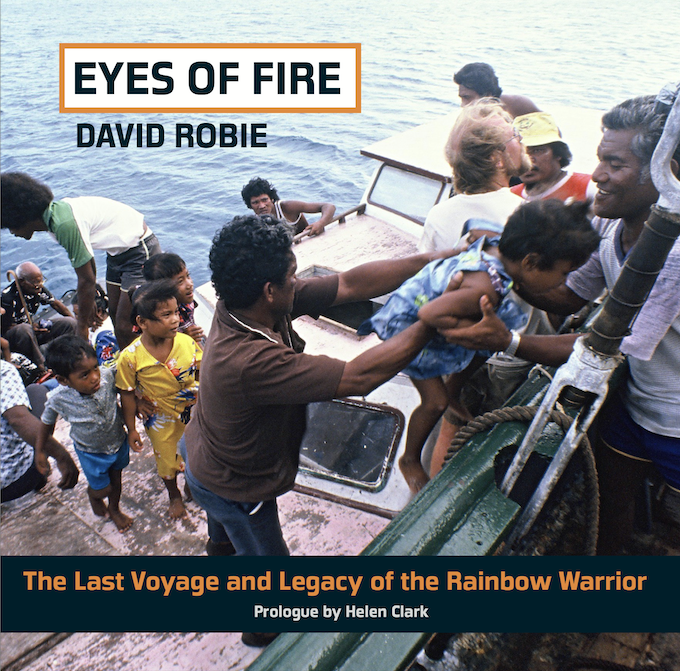
    Professor David Robie, a recipient of the New Zealand Order of Merit (MNZM), released the latest edition of his book Eyes of Fire: The last voyage and Legacy of the Rainbow Warrior (Little Island Press), which highlights the nuclear legacies of the United States and France.

    Dr Robie, who has worked in Pacific journalism and academia for more than 50 years, recounts the crew’s experiences aboard the Greenpeace flagship the Rainbow Warrior in 1985, before it was bombed in Auckland Harbour.

    At the time, New Zealand stood up to nuclear powers, he said.

    “It was pretty callous [of] the US and French authorities to think they could just carry on nuclear tests in the Pacific, far away from the metropolitan countries, out of the range of most media, and just do what they like,” Dr Robie told RNZ Pacific. “It is shocking, really.”

    The bombed Rainbow Warrior next morning
    The bombed Rainbow Warrior next morning . . . as photographed by protest photojournalist John Miller. Image: Frontispiece in Eyes of Fire © John Miller

    Speaking to Pacific Waves, Dr Robie said that Aotearoa had “forgotten” how to stand up for the region.

    “The real issue in the Pacific is about climate crisis and climate justice. And we’re being pushed this way and that by the US [and] by the French. The French want to make a stake in their Indo-Pacific policies as well,” he said.

    ‘We need to stand up’
    “We need to stand up for smaller Pacific countries.”

    Dr Robie believes that New Zealand is failing with its diplomacy in the region.

    Rongelap Islanders on board the Greenpeace flagship Rainbow Warrior travelling to their new home on Mejatto Island in 1985
    Rongelap Islanders on board the Greenpeace flagship Rainbow Warrior travelling to their new home on Mejatto Island in 1985 — less than two months before the bombing. Image: ©1985 David Robie/Eyes of Fire

    He accused the coalition government of being “too timid” and “afraid of offending President Donald Trump” to make a stand on the nuclear issue.

    However, a spokesperson for New Zealand Foreign Minister Winston Peters told RNZ Pacific that New Zealand’s “overarching priority . . . is to work with Pacific partners to achieve a secure, stable, and prosperous region that preserves Pacific sovereignty and agency”.

    The spokesperson said that through its foreign policy “reset”, New Zealand was committed to “comprehensive relationships” with Pacific Island countries.

    “New Zealand’s identity, prosperity and security are intertwined with the Pacific through deep cultural, people, historical, security, and economic linkages.”

    The New Zealand government commits almost 60 percent of its development funding to the region.

    Pacific ‘increasingly contested’
    The spokesperson said that the Pacific was becoming increasingly contested and complex.

    “New Zealand has been clear with all of our partners that it is important that engagement in the Pacific takes place in a manner which advances Pacific priorities, is consistent with established regional practices, and supportive of Pacific regional institutions.”

    They added that New Zealand’s main focus remained on the Pacific, “where we will be working with partners including the United States, Australia, Japan and in Europe to more intensively leverage greater support for the region.

    “We will maintain the high tempo of political engagement across the Pacific to ensure alignment between our programme and New Zealand and partner priorities. And we will work more strategically with Pacific Governments to strengthen their systems, so they can better deliver the services their people need,” the spokesperson said.

    The cover of the latest edition of Eyes of Fire: The Last Voyage and Legacy of the Rainbow Warrior
    The cover of the latest edition of Eyes of Fire: The Last Voyage and Legacy of the Rainbow Warrior. Image: Little Island Press

    However, former New Zealand prime minister Helen Clark, writing in the prologue of Dr Robie’s book, said: “New Zealand needs to re-emphasise the principles and values which drove its nuclear-free legislation and its advocacy for a nuclear-free South Pacific and global nuclear disarmament.”

    Dr Robie added that looking back 40 years to the 1980s, there was a strong sense of pride in being from Aotearoa, the small country which set an example around the world.

    “We took on . . . the nuclear powers,” Dr Robie said.

    “And the bombing of the Rainbow Warrior was symbolic of that struggle, in a way, but it was a struggle that most New Zealanders felt a part of, and we were very proud of that [anti-nuclear] role that we took.

    “Over the years, it has sort of been forgotten”.

    ‘Look at history’
    France conducted 193 nuclear tests over three decades until 1996 in French Polynesia.

    Until 2009, France claimed that its tests were “clean” and caused no harm, but in 2010, under the stewardship of Defence Minister Herve Morin, a compensation law was passed.

    From 1946 to 1962, 67 nuclear bombs were detonated in the Marshall Islands by the US.

    The 1954 Bravo hydrogen bomb test at Bikini Atoll, the largest nuclear weapon ever exploded by the United States, left a legacy of fallout and radiation contamination that continues to this day.
    The 1 March 1954 Bravo hydrogen bomb test at Bikini Atoll, the largest nuclear weapon ever exploded by the United States, left a legacy of fallout and radiation contamination that continues to this day. Image: Marshall Islands Journal

    In 2024, then-US deputy secretary of state Kurt Campbell, while responding to a question from RNZ Pacific about America’s nuclear legacy, said: “Washington has attempted to address it constructively with massive resources and a sustained commitment.”

    However, Dr Robie said that was not good enough and labelled the destruction left behind by the US, and France, as “outrageous”.

    “It is political speak; politicians trying to cover their backs and so on. If you look at history, [the response] is nowhere near good enough, both by the US and the French.”

    This article is republished under a community partnership agreement with RNZ.

    This post was originally published on Asia Pacific Report.
  • Occupied West Bank-based New Zealand journalist Cole Martin asks who are the peacemakers?

    BEARING WITNESS: By Cole Martin

    As a Kiwi journalist living in the occupied West Bank, I can list endless reasons why there is no peace in the “Holy Land”.

    I live in a refugee camp, alongside families who were expelled from their homes by Israel’s violent establishment in 1948 — never allowed to return and repeatedly targeted by Israeli military incursions.

    Daily I witness suffocating checkpoints, settler attacks against rural towns, arbitrary imprisonment with no charge or trial, a crippled economy, expansion of illegal settlements, demolition of entire communities, genocidal rhetoric, and continued expulsion.

    No form of peace can exist within an active system of domination. To talk about peace without liberation and dignity is to suggest submission to a system of displacement, imprisonment, violence and erasure.

    I often find myself alongside a variety of peacemakers, putting themselves on the line to end these horrific systems — let me outline the key groups:

    Palestinian civil society and individuals have spent decades committed to creative non-violence in the face of these atrocities — from court battles to academia, education, art, co-ordinating demonstrations, general strikes, hīkoi (marches), sit-ins, civil disobedience. Google “Iqrit village”, “The Great March of Return”, “Tent of Nations farm”. These are the overlooked stories that don’t make catchy headlines.

    Protective Presence activists are a mix of about 150 Israeli and international civilians who volunteer their days and nights physically accompanying Palestinian communities. They aim to prevent Israeli settler violence, state-sanctioned home demolitions, and military/police incursions. They document the injustice and often face violence and arrest themselves. Foreigners face deportation and blacklisting — as a journalist I was arrested and barred from the West Bank short-term and my passport was withheld for more than a month.

    Reconciliation organisations have been working for decades to bridge the disconnect between political narratives and human realities. The effective groups don’t seek “co-existence” but “co-resistance” because they recognise there can be no peace within an active system of apartheid. They reiterate that dialogue alone achieves nothing while the Israeli regime continues to murder, displace and steal. Yes there are “opposing narratives”, but they do not have equal legitimacy when tested against the reality on the ground.

    Journalists continue to document and report key developments, chilling statistics and the human cost. They ensure people are seen. Over 200 journalists have been killed in Gaza. High-profile Palestinian Christian journalist Shireen Abu-Akleh was killed by Israeli forces in 2022. They continue reporting despite the risk, and without their courage world leaders wouldn’t know which undeniable facts to brazenly ignore.

    Humanitarians serve and protect the most vulnerable, treating and rescuing people selflessly. More than 400 aid workers and 1000 healthcare workers have been killed in Gaza. All 38 hospitals have been destroyed or damaged, with just a small number left partially functioning. NGOs have been crippled by USAID cuts and targeted Israeli policies, marked by a mass exodus of expats who have spent years committed to this region — severing a critical lifeline for Palestinian communities.

    All these groups emphasise change will not come from within. Protective Presence barely stems the flow.

    Reconciliation means nothing while the system continues to displace, imprison and slaughter Palestinians en masse. Journalism, non-violence and humanitarian efforts are only as effective as the willingness of states to uphold international law.

    Those on the frontlines of peacebuilding express the urgent need for global accountability across all sectors; economic, cultural and political sanctions. Systems of apartheid do not stem from corrupt leadership or several extremists, but from widespread attitudes of supremacy and nationalism across civil society.

    Boycotts increase the economic cost of maintaining such systems. Divestment sends a strong financial message that business as usual is unacceptable.

    Many other groups across the world are picketing weapons manufacturers, writing to elected leaders, educating friends and family, challenging harmful narratives, fundraising aid to keep people alive.

    Where are the peacemakers? They’re out on the streets. They’re people just like you and me.

    Cole Martin is an independent New Zealand photojournalist based in the occupied West Bank and a contributor to Asia Pacific Report. This article was first published by the Otago Daily Times and is republished with permission.


    This content originally appeared on Asia Pacific Report and was authored by Pacific Media Watch.

    This post was originally published on Radio Free.

  • By Don Wiseman, RNZ Pacific senior journalist

    More than 400 candidates have put their hands up to contest the Bougainville general election in September, hoping to enter Parliament.

    Incumbent President Ishmael Toroama is among the 404 people lining up to win a seat.

    Bougainville is involved in the process of achieving independence from Papua New Guinea — an issue expected to dominate campaigning, which lasts until the beginning of September.

    Voting is scheduled to start on September 2, finishing a week later, depending on the weather.

    Seven candidates — all men — are contesting the Bougainville presidency. This number is down from when 25 people stood, including two women.

    Toroama is seeking a second term and is being challenged by his former colleague in the leadership of the Bougainville Revolutionary Army (BRA), Sam Kauona.

    Kauona is one of several contesting a second time, along with Thomas Raivet and a former holder of the Bougainville Regional Seat in the PNG Parliament, Joe Lera.

    There are 46 seats to be decided, including six new constituencies.

    Two seats will have 21 candidates: the northern seat of Peit and the Ex-Combatants constituency.

    Several other constituencies — Haku, Tsitalato, Taonita Tinputz, Taonita Teop, Rau, and Kokoda — also have high numbers of candidates.

    This article is republished under a community partnership agreement with RNZ.

    This post was originally published on Asia Pacific Report.
  • COMMENTARY: By Bruce King

    Almost two months ago, a UN special rapporteur, Dr Michael Fakhri, penned an opinion article in The Guardian newspaper warning that “if aid doesn’t enter Gaza now, 14,000 babies may die.”

    “UN peacekeepers must step in,” he added.

    Dr Fakhri is the UN Special Rapporteur for the Right to Food and an associate professor of international law at the University of Oregon.

    His article came 15 days after a long list of UN experts — including Dr Fakhri and beginning with the outspoken Special Rapporteur on the occupied Palestinian territories, Francesca Albanese — published an extraordinary joint statement declaring: “End unfolding genocide or watch it end life in Gaza: UN experts say States face defining choice.”

    The joint statement said humanity was descending into “a moral abyss”, and Dr Fakhri decried the response so far of nations as “slow and ghastly”.

    On the other hand, he praised the individuals who “mobilise and enforce international law through their own hands”, particularly the Gaza Freedom Flotillas and the land marchers attempting to reach the Rafah crossing from Egypt to Gaza.

    Dr Fakhri appears to consider the deployment by the UN General Assembly of UN Peacekeepers as the only feasible option that is practical and also fast enough and vigorous enough to properly address the gravity of the situation in Gaza.

    Many others have expressed similar sentiments. For instance, just days after The Guardian article, Ireland’s Labour Party asked the Irish government “to use every lever at its disposal to allow humanitarian aid into Gaza through a UN-mandated peacekeeping force”.


    Dr Fakhri makes his case for UN peacekeepers action.       Video: Badil Resource Centre

    As another example, DAWN, a group promoting democracy and human rights in the Middle East and North Africa has long advocated for UN Peacekeepers for Gaza and has just started a petition.

    Dr Michael Fakhri
    Dr Michael Fakhri . . . deployment by the UN General Assembly of peacekeepers is the only feasible option that is practical and fast enough for saving Gaza. Image: UN

    DAWN’s petition may have been timed to influence the “emergency summit”
    on the crisis being held today and tomorrow in Bogota, Colombia. It is co-hosted by Colombia and South Africa and will be attended by representatives from more than 30 nations and prominent actors such as Albanese.

    A crucial point is that Dr Fakhri and others have explained how the UN General Assembly can rapidly deploy a UN Peacekeeping Force for this purpose. This is important because of the widespread, but erroneous, belief that only the UN Security Council — the UN’s other main legislative organ — can authorise UN peacekeeping missions.

    Arab League calls for UN peacekeepers . . . but officials wrongly say it is up to UNSC to make the call
    Arab League calls for UN peacekeepers . . . but the subheading in this report wrongly says it is up to UNSC to make the call. Image: NYT screenshot

    An example of this falsehood being spread by the corporate news media is shown by this New York Times claim.

    Whereas all UN member states are equally represented in the General Assembly, the Security Council is dominated by its five permanent members — the United States, China, Russia, Britain, and France — with each having the power to veto all proposals.

    But the US is actively supporting Israel’s activities in occupied Palestine, and it would surely block any such peacekeeping initiative if submitted to the Security Council. This leaves it up to the UN General Assembly to organise any UN Peacekeeping Force for Gaza.

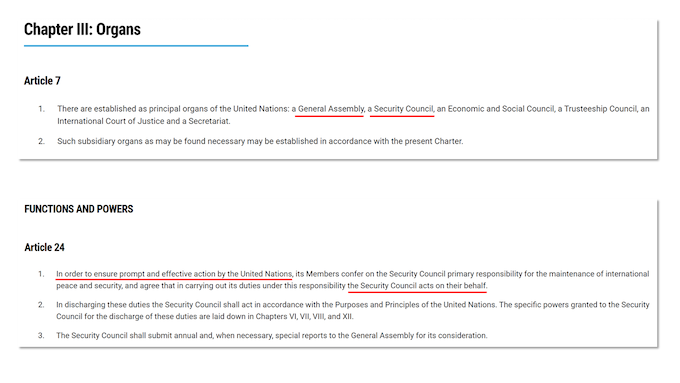
    As indicated by Dr Fakri, the founding UN Charter of 1945 provides for the General Assembly to step in to restore peace where the Security Council has failed in its primary responsibility to act.

    Relevant sections of the UN Charter.
    Relevant sections of the UN Charter.

    As shown above, primary responsibility was given to the Security Council under the UN Charter for practical reasons only, “to ensure prompt and effective action”.

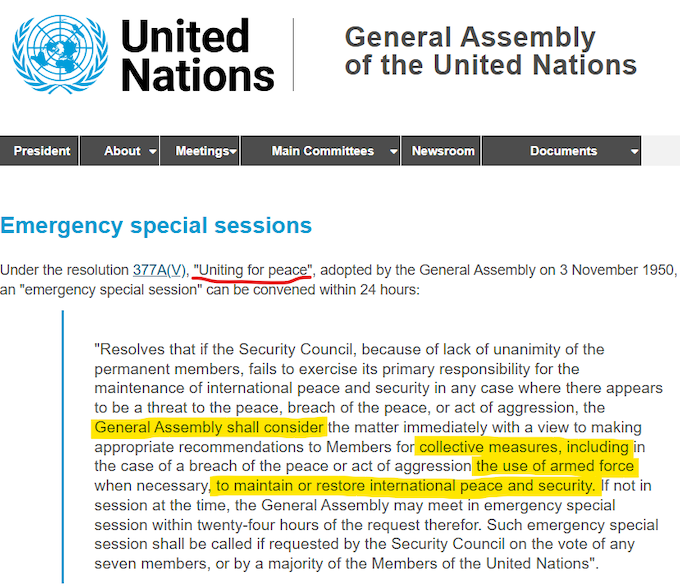
    Formal protocols for the General Assembly to take over from the Security Council were added in 1950, in what is widely referred to as the “Uniting for Peace” resolution. It explicitly provides the option of setting up an armed force, as shown below.

    The Uniting for Peace resolution.
    The Uniting for Peace resolution, 1950.

    As also shown, Uniting for Peace resolutions are addressed in Emergency Special Sessions of the UN General Assembly. These can be called within 24 hours and from a request by any member state. To be passed, a resolution requires a two-thirds majority of the states that voted either for, or against, the resolution.

    Historically, the very first UN Peacekeeping force was set up in this way in response to the Suez Crisis of 1956-7 — see below. Those UN Peacekeepers oversaw the prompt retreat from Egypt of Israel and of the Security Council permanent members, Britain and France. Eventually, in 1957 they were present for Israel’s withdrawal from Gaza itself, then a protectorate of Egypt.

    UN General Assembly resolutions setting up the first UN Peacekeeping Force in 1956.
    UN General Assembly resolutions setting up the first UN Peacekeeping Force in 1956.

    Returning to the current circumstances, Dr Fakhri says that if a UN peacekeeping force is formed then Israel’s permission is not required for its deployment in Gaza.

    The actual main impediment to the success of the plan may come from covert bullying of UN member nations by the US and Israel. As explained by prominent law professor Francis Boyle: “The US government will bribe, threaten, intimidate and blackmail all members of the UN General Assembly not to [act against] Israel.”

    Dr King is a physicist researching topics in renewable energy, with an interest in humanitarian issues.

    This post was originally published on Asia Pacific Report.
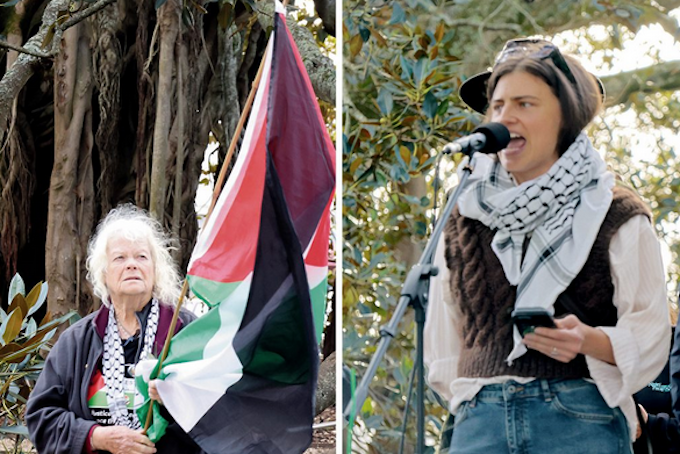
  • BANGKOK, Thailand (15 July 2025) – The Asian NGO Network on National Human Rights Institutions (ANNI) calls on the Government of the Maldives to ensure that the ongoing selection process for vacant commissioner positions at the Human Rights Commission of the Maldives (HRCM) fully complies with the Paris Principles, the internationally recognized standards that underpin the independence, effectiveness, and credibility of national human rights institutions (NHRIs).

    In June 2025, the President’s Office announced the opening of applications to fill two commissioner positions on the HRCM, as the terms of two current commissioners are set to expire. According to the Human Rights Commission Act (Law No. 6/2006), candidates are nominated by the President, approved by the People’s Majlis, and formally appointed by the President.

    However, the nomination process led by the President has not been made public, which runs contrary to international standards. The lack of transparency, marked by a closed process under full executive control, without any independent or participatory mechanism, raises serious concerns about the fairness and impartiality of the selection.

    Failure to guarantee impartial vetting of applications undermines the Commission’s integrity and independence. The Parliament Oversight Committee must play a central role in ensuring transparency and public accountability in the vetting of candidates.

    “ANNI reminds the Maldivian Government to ensure that the selection process is transparent, inclusive, and merit-based, in line with the Paris Principles,” said Mary Aileen Diez-Bacalso, Executive Director of Asian Forum for Human Rights and Development (FORUM-ASIA), the ANNI Secretariat. “This process must involve meaningful consultations with civil society and ensure that appointees are selected based on demonstrated integrity, competence, and experience in protecting and promoting human rights. Shielding the process from political interference is critical to restoring and maintaining public trust in the Commission,” added Bacalso.


    An Independent and Pluralistic Commission Is Key to Credibility

    The Paris Principles, adopted by the UN General Assembly in 1993, outline the minimum conditions for NHRIs to function effectively. These include institutional autonomy, pluralistic representation, adequate financial and operational resources, and a broad human rights mandate.

    ANNI and FORUM-ASIA jointly remind the Maldivian authorities to meaningfully engage with the civil society in the selection of new HRCM Commissioners. A key element of these standards is a selection and appointment process that is transparent, participatory, and merit-based. It must include inputs from diverse stakeholders, including civil society, academia, professional associations, and marginalized communities. Representation across gender, religion, ethnicity, and disability is not merely symbolic–it is central to the NHRI’s legitimacy, serving a diverse society.

    The HRCM was last reviewed by the Global Alliance of National Human Rights Institutions – Sub-Committee on Accreditation (GANHRI-SCA) in 2010, when it was granted B-status, indicating only partial compliance with the Paris Principles. One of the SCA’s key concerns was the legal requirement that all commissioners be Muslim, an exclusionary provision that directly contradicts the Paris Principles’ emphasis on pluralism. Notably, the Commission has not sought re-accreditation since that review.

    As the Maldives proceeds with appointing new commissioners, ANNI and FORUM-ASIA stress that this process presents an important opportunity to reinforce and not weaken the independence and legitimacy of the HRCM.

    ANNI and FORUM-ASIA urge the Government of Maldives to demonstrate its commitment to international human rights standards by ensuring the selection process is transparent, inclusive, and consistent with the Paris Principles. This includes making the process public, establishing an independent and participatory shortlisting, and ensuring that appointments reflect gender balance and are truly pluralistic. A credible appointment process will help restore public confidence in the HRCM and strengthen its ability to carry out its mandate effectively.

    Asian NGOs Network on National Human Rights Institutions (ANNI)

    The Asian NGOs Network on National Human Rights Institutions (ANNI) was established in December 2006. It is a network of Asian non-governmental organisations and human rights defenders working on issues related to National Human Rights Institutions (NHRIs). ANNI has members that are national organisations from all over Asia. ANNI currently has 33 member organisations from 21 countries or territories. The work of ANNI members focuses on strengthening the work and functioning of Asian NHRIs to better promote and protect human rights as well as to advocate for the improved compliance of Asian NHRIs with international standards, including the Paris Principles and General Observations of the Sub-Committee on Accreditation (SCA) of the Global Alliance of NHRIs (GANHRI). The Asian Forum for Human Rights and Development (FORUM-ASIA) has served as the Secretariat of ANNI since its establishment in 2006. http://l.forum-asia.org/ANNI

    The post [Statement] Maldives must uphold the Paris Principles in the Selection of HRCM Commissioners first appeared on FORUM-ASIA.

    This post was originally published on FORUM-ASIA.

  • By Margot Staunton, RNZ Pacific senior reporter

    The Fiji government looks set to pay around NZ$1.5 million in damages to the disgraced former head of the country’s anti-corruption agency FICAC.

    The state is offering Barbara Malimali an out-of-court settlement after her lawyer lodged a judicial review of her sacking in the High Court in Suva.

    Prime Minister Sitiveni Rabuka suspended Malimali from her role on May 29, following a damning Commission of Inquiry into her appointment.

    Malimali was described as “universally corrupt” by Justice David Ashton-Lewis, the commissioner of the nine-week investigation, which involved 35 witnesses.

    “She was a pawn in the hands of devious members of government, who wanted any allegations against them or other government members thrown out,” Ashton-Lewis told RNZ Pacific Waves earlier this month.

    Tanya Waqanika, who acts for Malimali, told RNZ Pacific that her client was seeking a “substantial” payout for damages and unpaid dues.

    Waqanika met lawyers from the Attorney-General’s Office in the capital, Suva, on Tuesday after earlier negotiations failed.

    Expected to hear in writing
    She declined to say exactly what was discussed, but said she expected to hear back in writing from the other party the same day.

    A High Court judge has given the government until 3pm on Friday to reach a settlement, otherwise he will rule on the application on Monday.

    “We’ll see what they come up with, that’s the beauty of negotiations, but NZ$1.5 million would be a good amount to play with after your career has been ruined,” Waqanika said.

    “[Malimali’s] career spans over 27 years, but it is now down the drain thanks to Ashton-Lewis and the damage the inquiry report has done.”

    She said Malimali also wanted a public apology, as she was being defamed every day in social media.

    “I don’t expect we’ll get one out of Ashton-Lewis,” she said.

    Adjournment sought
    During a hearing in the High Court on Monday, lawyers for the state sought an adjournment to discuss a settlement with Waqanika.

    However, she opposed this, saying that the government’s legal team had vast resources and they should have been prepared for the hearing.

    Malimali filed a case against President Naiqama Lalabalavu, Rabuka and the Attorney-General on June 13 on the grounds that her suspension was unconstitutional.

    Waqanika said the President suspended her on the advice of the Prime Minister instead of consulting the Judicial Services Commission.

    Government lawyers approached Waqanika offering a compensation deal the same day she lodged a judicial review in the High Court.

    This article is republished under a community partnership agreement with RNZ.

    This post was originally published on Asia Pacific Report.
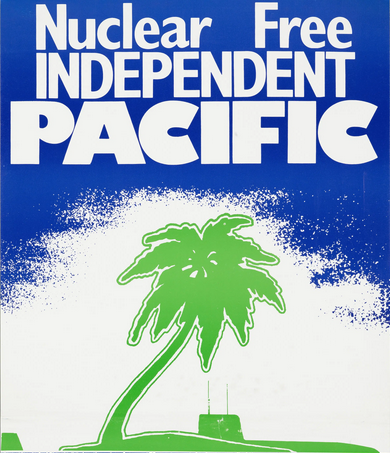
  • Pacific Media Watch

    The Palestine Solidarity Network Aotearoa has called on the New Zealand government to not follow Australia’s policy moves which would effectively criminalise the Palestine solidarity movement.

    The Australian government has announced plans to implement recommendations from its anti-semitism envoy which PSNA says creates a “hierarchy of racism” with anti-semitism at the top, while Islamophobia and anti-Palestinian racism hardly feature.

    At least some of the appalling anti-semitic attacks in Sydney have been bogus, said the PSNA in a statement.

    Co-chair John Minto said PSNA had no tolerance for anti-semitism in Aotearoa New Zealand, or anywhere else.

    “But equally there should be no place for any other kind of racism, such as Islamophobia and anti-Palestinian racism. Our government must speak out against all forms of discrimination and support all communities when racism rears its ugly head,” he said.

    “Let’s not forget the murderous attacks on the Christchurch mosques.”

    Minto said the Australian measures would “inevitably” be used to criminalise the Palestinian solidarity movement across the country.

    Trump ‘demonising’ support
    “We see it happening in the US, to attack and demonise support for Palestinian human rights by the Trump administration.  We see it orchestrated in the UK to shut down any speech which Prime Minister Starmer and the Israeli government don’t like.”

    The PSNA statement said that it agreed with the Jewish Council of Australia which has warned the Australian government adopting these measures could result in

    “undermining Australia’s democratic freedoms, inflaming community divisions, and entrenching selective approaches to racism that serve political agendas.”

    Minto said the free speech restrictions in the US, UK and Australia had nothing to do with what people usually understand as anti-semitism.

    “The drive comes from the Israeli government.  They see making anti-semitism charges as the most effective means of preventing anyone publicly pointing to the genocide its armed forces are perpetrating in Gaza,” he said.

    “The definition of anti-semitism, usually inserted into codes of ethics or legislation, is from the International Holocaust Remembrance Alliance.  The IHRA definition includes 11 examples.  Seven of the examples are about criticising Israel.”

    “It’s quite clear the Israeli campaign is to distract the community from Israel’s horrendous war crimes, such as the round-the-clock mass killing and mass starvation of Palestinians in Gaza, and deflect calls for sanctions against Israel.

    “Already we can see in both the UK and US, that people have been arrested for saying things about Israel which would not have been declared illegal if they’d said it about other countries, including their own.”

    Worrying signs
    Minto said there were already worrying signs that the New Zealand government, media and police were “falling into the trap”.

    “Just over the past few weeks, there has been an unusually wide-ranging mainstream media focus on anti-semitism,” Minto said citing:

    However, New Zealand politicians and media had been silent about:

    • An attack which knocked a young Palestinian woman to the ground when she was using a microphone to speak during an Auckland march
    • An attack where a Palestine supporter was kicked and knocked to the pavement outside the Israeli embassy in Wellington.  The accused was wearing an Israeli flag.  He was not held in custody and the Post newspaper has reported neither the arrest nor the resulting charge (this case is due in court July 15)
    • An attack on a Palestine solidarity marshal in Christchurch who was punched in the face, in front of police, but no action taken.
    • An attack in Christchurch when a Destiny Church member kicked a solidarity marshal in the chest (no action taken by police)
    • Anti-Palestinian racist attacks on the home of a Palestine solidarity activist in New Plymouth.  One supporter has had their front fence spraypainted twice with pro-Israel graffiti and their car tyres slashed twice (4 tyres in total) and had vile defamatory material circulated in their neighbourhood. (Police say they cannot help)
    • The frequent condemnation of anti-semitism by the previous Chief Human Rights Commissioner, but his refusal to condemn the deep-seated anti-Palestinian racism of the New Zealand Jewish Council and Israel Institute of New Zealand.
    • The refusal of the Human Rights Commission to publicly correct false statements it published in The Post newspaper which claimed anti-semitism was increasing, when in fact the evidence it was using was that the rate of incidents had declined.

    ‘Silence on mass killings’
    Minto said that in each of the cases above there would have been far more attention from politicians, the police and the media had the victims been Israeli supporters.

    “Meanwhile, both our government and the New Zealand Jewish Council have refused to condemn Israel’s blatant war crimes.  There is silence on the mass killing, mass starvation and ethnic cleansing of Palestinians in Gaza,” he said.

    “The Jewish Council and our government stand together and refuse to hold Israel’s racist apartheid regime to account in just about any way.

    “This refusal to condemn what genocide scholars, including several Israeli genocide academics, have labelled as a ‘text-book case of genocide’, brings shame on both the New Zealand Jewish Council and the New Zealand government.”

    “Adding to the clear perception of appalling bias on the part of our government, both the Prime Minister and Minister of Foreign Affairs have met with New Zealand Jewish Council spokespeople over the war in Gaza.

    “But both have refused to meet with representatives of Palestinian New Zealanders, or the huge number of Jewish supporters of the Palestine solidarity movement.”

    Minto said New Zealand must “stand up and be counted against genocide” wherever it appeared and no matter who the victims were.

    This post was originally published on Asia Pacific Report.
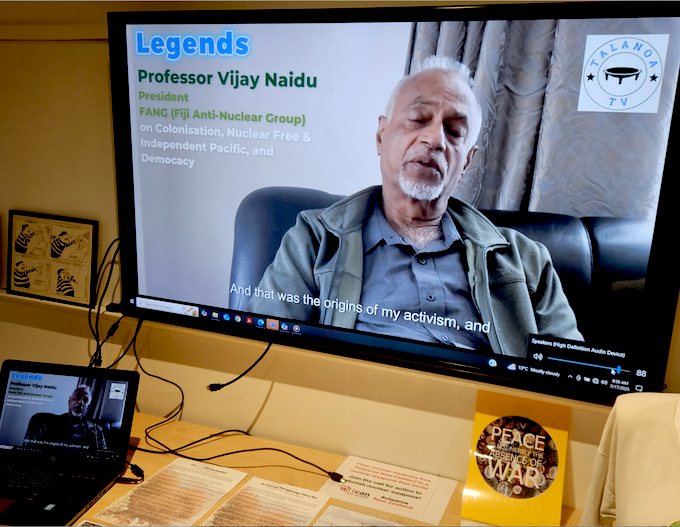
  • By Caleb Fotheringham, RNZ Pacific journalist

    New Zealand will not send top government representation to the Cook Islands for its 60th Constitution Day celebrations in three weeks’ time.

    Instead, Governor-General Dame Cindy Kiro will represent Aotearoa in Rarotonga.

    On August 4, Cook Islands will mark 60 years of self-governance in free association with New Zealand.

    It comes at a turbulent time in the relationship

    New Zealand paused $18.2 million in development assistance funding to the Cook Islands in June after its government signed several agreements with China in February.

    At the time, a spokesperson for Foreign Minister Winston Peters said the pause was because the Cook Islands did not consult with Aotearoa over the China deals and failed to ensure shared interests were not put at risk.

    Peters and New Zealand Prime Minister Christopher Luxon will not attend the celebrations.

    Ten years ago, former Prime Minister Sir John Key attended the celebrations that marked 50 years of Cook Islands being in free association with New Zealand.

    Officials from the Cook Islands and New Zealand have been meeting to try and restore the relationship.

    This article is republished under a community partnership agreement with RNZ.

    This post was originally published on Asia Pacific Report.
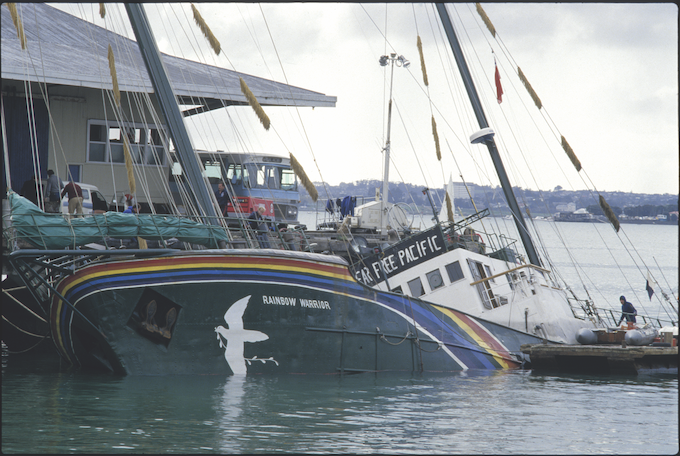
  • BEARING WITNESS: By Cole Martin in occupied West Bank

    Two young Palestinians were shot and beaten to death on their land, and 30 injured, by Israeli settlers in the occupied West Bank on Saturday.

    A large group of settlers attacked the rural Palestinian village of Sinjil, in the Ramallah governorate, beating Sayfollah “Saif” Mussalet, 20, who died from his wounds after the mob blocked medical access for several hours.

    The body of Muhammad Shalabi, 23, was recovered that evening — having reportedly bled to death while ambulances and rescuers were blocked by Israeli military as settlers roamed the Palestinian farmland for hours.

    Both young men are from the neighbouring Mazra’a Sharqiya billate, and Saif was an American citizen visiting loved ones and friends over summer. His family released a statement calling his death an “unimaginable nightmare and an injustice that no family should ever have to face”.

    They said he was a “beloved member of his community . . . a brother and a son [and] a kind, hard-working, and deeply-respected young man.”

    Saif built a widely-loved business in Tampa, Florida, and was known for his generosity, ambition, and connection to his Palestinian heritage.

    Following news of his death an overwhelming number of locals gathered at his store to share their grief and anger.

    Frequent atrocities
    Such lynchings have become a frequent atrocity across the West Bank, as settler gangs are repeatedly emboldened by the Israeli government, police, and military who protect and often facilitate violence against Palestinian communities.

    Two settlers were reportedly detained following the attacks, but released again within hours.

    Between 2005-2020, 91 percent of Palestinian cases filed with police were closed without indictment, according to the Israeli human rights organisation B’tselem, and settlers undergo trial with full legal rights and higher lenience in Israeli civil courts.

    By contrast, Palestinians are tried in Israeli military courts, established in violation of the fourth Geneva Convention and largely considered corrupt for maintaining a 95 percent conviction rate (Military Court Watch).

    Additionally, more than 3600 Palestinians are currently held in Israeli captivity without charge or trial, with all detainees facing an increase in documented physical, psychological, and sexual abuse — including children.

    A funeral was held for the young men on Sunday in Mazra’a Sharqiya village, with thousands in attendance. The killings continue a systemic pattern which alongside military incursions, has seen 153 Palestinians killed by Israeli forces in the West Bank since the beginning of 2025 (OCHA).

    UN resolution
    A UN resolution last September reaffirmed the illegality of Israel’s presence in the occupied Palestinian territories, demanding a total and unconditional withdrawal within a year.

    Ten months on, settler attacks have escalated in frequency and severity, settlement expansion has rapidly increased, and numerous Palestinian villages have been forcibly displaced after months of sustained violence.

    Communities across the West Bank are facing erasure, and as the death toll climbs pressure continues to grow for the New Zealand government to enforce stronger political sanctions, including the entire opposition uniting behind the Green Party’s Unlawful Occupation of Palestine Sanctions Bill.

    Cole Martin is an independent New Zealand photojournalist based in the Middle East and a contributor to Asia Pacific Report.

    Mourners pay their respects to the two young Palestinians killed by illegal settlers
    Mourners pay their respects to the two young Palestinians killed by illegal settlers. Image: Cole Martin


    This content originally appeared on Asia Pacific Report and was authored by APR editor.

    This post was originally published on Radio Free.

  • By Patrick Decloitre, RNZ Pacific correspondent French Pacific desk

    New Caledonia’s pro-and-anti-independence parties have committed to an “historic” deal over the future political status of the French Pacific territory, which is set to become — for the first time — a “state” within the French realm.

    The 13-page agreement yesterday, officially entitled “Agreement Project of the Future of New Caledonia”, is the result of a solid 10 days of difficult negotiations between both pro and anti-independence parties.

    They have stayed under closed doors at a hotel in the small city of Bougival, in the outskirts of Paris.

    French Minister for Overseas Manuel Valls (centre) shows signatures on the last page of New Caledonia’s new agreement
    French Minister for Overseas Manuel Valls (centre) shows signatures on the last page of New Caledonia’s new agreement. Image: RNZ Pacific/FB

    The talks were convened by French President Emmanuel Macron after an earlier series of talks held between February and May 2025 failed to yield an agreement.

    After opening the talks on July 2, Macron handed over them to his Minister for Overseas, Manuel Valls, to oversee. Valls managed to bring together all parties around the same table earlier this year.

    In his opening speech earlier this month, Macron insisted on the need to restore New Caledonia’s economy, which was brought to its knees following destructive and deadly riots that erupted in May 2024.

    He said France was ready to study any solution, including an “associated state” for New Caledonia.

    During the following days, all political players exchanged views under the seal of strict confidentiality.

    While the pro-independence movement, and its Kanak and Socialist National Liberation Front (FLNKS), remained adamant they would settle for no less than “full sovereignty”, the pro-France parties were mostly arguing that three referendums — held between 2018 and 2021 — had already concluded that most New Caledonians wanted New Caledonia to remain part of France.

    Those results, they said, dictated that the democratic result of the three consultations be respected.

    Group photo of participants at the end of negotiations
    Group photo of participants at the end of negotiations. Image: Philippe Gomes

    With this confrontational context, which resulted in an increasingly radicalised background in New Caledonia, that eventually led to the 2024 riots, the Bougival summit was dubbed the “last chance summit”.

    In the early hours of Saturday, just before 7 am (Paris time, 5 pm NZ time), after a sleepless night, the secrecy surrounding the Bougival talks finally ended with an announcement from Valls.

    He wrote in a release that all partners taking part in the talks had signed and “committed to present and defend the agreement’s text on New Caledonia’s future.”

    Valls said this was a “major commitment resulting from a long work of negotiations during which New Caledonia’s partners made the choice of courage and responsibility”.

    The released document, signed by almost 20 politicians, details what the deal would imply for New Caledonia’s future.

    In its preamble, the fresh deal underlines that New Caledonia was “once again betting on trust, dialogue and peace”, through “a new political organisation, a more widely shared sovereignty and an economic and social refoundation” for a “reinvented common destiny.”

    New Caledonia’s population will be called to approve the agreement in February 2026.

    If approved, the text would be the centrepiece of a “special organic law” voted by the local Congress.

    It would later have to be endorsed by the French Parliament and enshrined in an article of the French Constitution.

    What does the agreement contain?
    One of the most notable developments in terms of future status for New Caledonia is the notion of a “State of New Caledonia”, under a regime that would maintain it as part of France, but with a dual citizenship — France/New Caledonia.

    Another formulation used for the change of status is the often-used “sui generis”, which in legal Latin, describes a unique evolution, comparable to no other.

    This would be formalised through a fundamental law to be endorsed by New Caledonia’s Congress by a required majority of three-fifths.

    The number of MPs in the Congress would be 56.

    The text also envisages a gradual transfer of key powers currently held by France (such as international relations), but would not include portfolios such as defence, currency or justice.

    In diplomacy, New Caledonia would be empowered to conduct its own affairs, but “in respect of France’s international commitments and vital interests”.

    On defence matters, even though this would remain under France’s powers, it is envisaged that New Caledonia would be “strongly” associated, consulted and kept informed, regarding strategy, goals and actions led by France in the Pacific region.

    On police and public order matters, New Caledonia would be entitled to create its own provincial and traditional security forces, in addition to national French law enforcement agencies.

    New Caledonia’s sensitive electoral roll
    The sensitive issue of New Caledonia’s electoral roll and conditions of eligibility to vote at local elections (including for the three Provincial Assemblies) is also mentioned in the agreement.

    It was this very issue that was perceived as the main trigger for the May 2024 riots, the pro-independence movement feared at the time that changing the conditions to vote would gradually place the indigenous Kanak community in a position of minority.

    It is now agreed that the electoral roll would be partly opened to those people of New Caledonia who were born after 1998.

    The roll was frozen in 2007 and restricted to people born before 1998, which is the date the previous major autonomy agreement of Nouméa was signed.

    Under the new proposed conditions to access New Caledonia’s “citizenship”, those entitled would include people who already can vote at local elections, but also their children or any person who has resided in New Caledonia for an uninterrupted ten years or who has been married or lived in a civil de facto partnership with a qualified citizen for at least five years.

    Provincial elections once again postponed
    One of the first deadlines on the electoral calendar, the provincial elections, was to take place no later than 30 November 2025.

    It will be moved once again — for the third time — to May-June 2026.

    A significant part of the political deal is also dedicated to New Caledonia’s economic “refoundation”, with a high priority for the young generations, who have felt left out of the system and disenfranchised for too long.

    One of the main goals was to bring New Caledonia’s public debts to a level of sustainability.

    In 2024, following the riots, France granted, in the form of loans, over 1 billion euros (NZ $1.9 billion) for New Caledonia’s key institutions to remain afloat.

    But some components of the political chessboard criticised the measure, saying this was placing the French territory in a state of excessive and long-term debt.

    Group photo of participants at the end of negotiations with the signed agreement
    Group photo of participants at the end of negotiations with the signed agreement. Image: Philippe_Gomes/RNZ Pacific

    Strategic nickel
    A major topic, on the macro-economic side, concerns New Caledonia’s nickel mining industry, after years of decline that has left it (even before 2024) in a state of near-collapse.

    Nickel is regarded as the backbone of New Caledonia’s economy.

    A nickel “strategic plan” would aim at re-starting New Caledonia nickel’s processing plants, especially in the Northern province, but at the same time facilitating the export of raw nickel.

    There was also a will to ensure that all mining sites (many of which have been blocked and its installations damaged since the May 2024 riots) became accessible again.

    Meanwhile, France would push the European Union to include New Caledonia’s nickel in its list of strategic resources.

    New Caledonia’s nickel industry’s woes are also caused by its lack of competitiveness on the world market — especially compared to Indonesia’s recent rise in prominence in nickel production — because of the high cost of energy.

    Swift reactions, mostly positive

    Left to right – Sonia Backès, Nicolas Metzdorf, Gil Brial and Victor Tutugoro
    New Caledonian politicians Sonia Backès (left to right), Nicolas Metzdorf, Gil Brial and Victor Tutugoro. Image: Nicolas Metzdorf/RNZ Pacific

    The announcement yesterday was followed by quick reactions from all sides of New Caledonia’s political spectrum and also from mainland France’s political leaders.

    French Prime Minister François Bayrou expressed “pride” to see an agreement “on par with history”, emerge.

    “Bravo also to the work and patience of Manuel Valls” and “the decisive implication of Emmanuel Macron,” he wrote on X-Twitter.

    From the ranks of New Caledonia’s political players, pro-France Nicolas Metzdorf said he perceived as one of the deal’s main benefits the fact that “we will at last be able to project ourselves in the future, in economic, social and societal reconstruction without any deadline.”

    Metzdorf admitted that reaching an agreement required concessions and compromise from both sides.

    “But the fact that we are no longer faced with referendums and to reinforce the powers of our provinces, this was our mandate”, he told public broadcaster NC La 1ère.

    “We’ve had to accept this change from New Caledonia citizenship to New Caledonian nationality, which remains to be defined by New Caledonia’s Congress. We have also created a completely new status as part of the French Republic, a sui generis State”, he noted.

    He said the innovative status kept New Caledonia within France, without going as far as an “associated state” mooted earlier.

    “At least, what we have arrived at is that New Caledonians remain French”, pro-France Le Rassemblement-LR prominent leader Virginie Ruffenach commented.

    “And those who want to contribute to New Caledonia’s development will be able to do so through a minimum stay of residence, the right to vote and to become citizens and later New Caledonia nationals”

    “I’m aware that some could be wary of the concessions we made, but let’s face it: New Caledonia nationality does not make New Caledonia an independent State . . . It does not take away anything from us, neither of us belonging to the French Republic nor our French nationality,” Southern Province pro-France President Sonia Backès wrote on social media.

    In a joint release, the two main pro-France parties, Les Loyalistes and Rassemblement-LR, said the deal was no less than “historic” and “perennial” for New Caledonia as a whole, to “offer New Caledonia a future of peace, stability and prosperity” while at the same time considering France’s Indo-Pacific strategy.

    From the pro-independence side, one of the negotiators, Victor Tutugoro of UNI-UPM (Progressist Union in Melanesia) said what mattered was that “all of us have placed our bets on intelligence, beyond our respective beliefs, our positions, our postures”.

    “We put all of these aside for the good of the country.”

    “Of course, by definition, a compromise cannot satisfy anyone 100 percent. But it’s a balanced compromise for everyone,” he said.

    “And it allows us to look ahead, to build New Caledonia together, a citizenship and this common destiny everyone’s been talking about for many years.”

    Before politicians fly back to New Caledonia to present the deal to their respective bases, President Macron received all delegation members last evening to congratulate them on their achievements.

    During the Presidential meeting at the Elysée Palace, FLNKS chief negotiator Emmanuel Tjibaou (whose father Jean-Marie Tjibaou also struck a historic agreement and shook hands with pro-France leader Jacques Lafleur, in 1988), stressed the agreement was one step along the path and it allows to envisage new perspectives for the Kanak people.

    A sign of the changing times, but in a striking parallel — 37 years after his father’s historic handshake with Lafleur, Emmanuel Tjibaou (whose father was shot dead in 1989 by a radical pro-independence partisan who felt the independence cause had been betrayed — did not shake hands, but instead fist pumped with pro-France’s Metzdorf.

    In a brief message on social networks, the French Head of State hailed the conclusive talks, which he labelled “A State of New Caledonia within the (French) Republic,” a win for a “bet on trust.”

    “Now is the time for respect, for stability and for the sum of good wills to build a shared future.”

    This article is republished under a community partnership agreement with RNZ.

    Signatures on the last page of New Caledonia's new agreement
    Signatures on the last page of New Caledonia’s new agreement. Image: Philippe Dunoyer/RNZ Pacific

    This post was originally published on Asia Pacific Report.
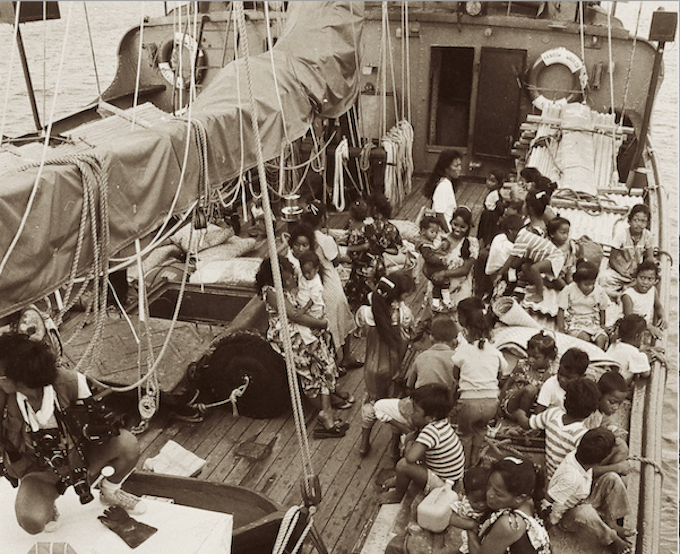
  • Asia Pacific Report

    An opposition Labour Party MP today paid tribute to the Nuclear Free and Independent Pacific (NFIP) movement, saying it should inspire Aotearoa New Zealand to maintain its own independence, embrace a strong regionalism, and be a “voice for peace and demilitarisation”.

    But Phil Twyford, MP for Te Atatu and spokesperson on disarmament, warned that the current National-led coalition government was “rapidly going in the other direction”.

    “It mimics the language of the security hawks in Washington and Canberra that China is a threat to our national interests,” he said.

    READ MORE

    “That is then the springboard for a foreign policy ‘reset’ under the current government to a closer strategic alignment with the United States and with what are often more broadly referred to as the ‘traditional partners’.

    “For that read the Five Eyes members, but particularly the United States.”

    Speaking at the opening of the week-long “Legends of the Pacific: Stories of a Nuclear-Free Moana 1975-1995” exhibition at the Ellen Melville Centre, Twyford referred to the 40th anniversary of the Rainbow Warrior bombing by French secret agents on 10 July 2025.

    “Much has been made in the years since of what a turning point this was, and how it crystallised in New Zealanders a commitment to the anti-nuclear cause,” he said.

    However, he said he wanted to talk about the “bigger regional phenomenon” that shaped activism, public attitudes and official policies across the region, and what it could “teach us today about New Zealand’s place in the world”.

    “I am talking about the Nuclear Free and Independent Pacific movement.

    The Te Vaerua O Te Rangi dance group performing at the nuclear-free Pacific exhibition opening
    The Te Vaerua O Te Rangi dance group performing at the nuclear-free Pacific exhibition opening in Auckland today. Image: Asia Pacific Report

    “Activists and leaders from across the Pacific built a movement that challenged neocolonialism and colonialism, put the voices of the peoples of the Pacific front and centre, and held the nuclear powers to account for the devastating legacy of nuclear testing.”

    The NFIP movement led to the creation of the Treaty of Rarotonga, the Pacific’s nuclear weapons free zone, Twyford said. It influenced governments and shaped the thinking of a generation.

    However, he stressed the “storm clouds” that were gathering as indicated by former prime minister Helen Clark in her prologue to journalist and author David Robie’s new book Eyes of Fire: The Last Voyage and Legacy of the Rainbow Warrior just published this week.

    Twyford said that with increasing great power rivalry, the rise of authoritarian leaders, and the breakdown of the multilateral system “the spectre of nuclear war has returned”.

    Labour's Te Atatu MP Phil Twyford admiring part of the nuclear-free Pacific exhibition after opening it in Auckland
    Labour’s Te Atatu MP Phil Twyford admiring part of the nuclear-free Pacific exhibition after opening it in Auckland today. Image: Del Abcede/APR

    New Zealand faced some stark choices about how it made its way in the world, kept their people and the region safe, and remained “true to the values we’ve always held dear”.

    The public debate about the policy “reset” reset had focused on whether New Zealand would be part of AUKUS Pillar Two, “the arrangement to share high end war fighting technology that would sit alongside the first pillar designed to deliver Australia its nuclear submarines”.

    Part of the nuclear-free Pacific exhibition honouring Fernando Pereira, the Greenpeace photographer killed by French state saboteurs
    Part of the nuclear-free Pacific exhibition honouring Fernando Pereira, the Greenpeace photographer killed by French state saboteurs when they bombed the Rainbow Warrior on 10 July 1985. Image: APR

    While the New Zealand government had had little to say on AUKUS Pillar Two since the US elections, the defence engagement with the US had “escalated”.

    It now included participation in groupings around supply chains, warfighting in space, interconnected naval warfare, and projects on artificial intelligence and cyber capabilities.

    China’s growing assertiveness as a great power was not the main threat to New Zealand.

    “The biggest threat to our security and prosperity is the possibility of war in Asia between the United States and China,” he said.

    NFIP activist Hilda Halkyard-Harawira (Ngāti Haua featured in one of the storytelling videos at the nuclear-free Pacific exhibition
    NFIP activist Hilda Halkyard-Harawira (Ngāti Haua featured in one of the storytelling videos at the nuclear-free Pacific exhibition. Image: APR

    “Rising tensions could conceivably affect trade, and that would be disastrous for us. All-out war, especially if it went nuclear, would be catastrophic for the region and probably for the planet.”

    Labour’s view was that security for New Zealand and the Pacific could be pursued through active engagement with the country’s partners across the Tasman and in the Pacific, and Asia — and be a voice for peace and demilitarisation.

    Twyford acknowledged Dr Robie’s “seminal book” Eyes of Fire, thanking him for “a lifetime’s work of reporting important stories, exposing injustice and holding the powerful to account”.

    Dr Robie spoke briefly about the book as a publishing challenge following his earlier speech at the launch on Thursday.

    Other speakers at the opening of the nuclear-free Pacific exhibition included veteran activist such as Reverend Mua Strickson-Pua; Bharat Jamnadas, an organiser of the original Nuclear-Free and Independent Pacific (NFIP) conference in Suva, Fiji, in 1975; businessman and community advocate Nikhil Naidu, previously an activist for the Fiji Anti-Nuclear Group (FANG); and Dr Heather Devere, peace researcher and chair of the Asia Pacific Media Network (APMN).

    The Te Vaerua O Te Rangi dance group also performed Cook Islands items.

    The exhibition has been coordinated by the APMN in partnership with Heritage New Zealand Pouhere Taonga, with curator Tharron Bloomfield and Antony Phillips; Ellen Melville Centre; and the Whānau Communty Centre and Hub.

    It is also supported by Pax Christi, Quaker Peace and Service Fund, and Women’s International League for Peace and Freedom (WILPF).

    The exhibition recalls New Zealand’s peace squadrons, a display of activist tee-shirt “flags”, nuclear-free buttons and badges, posters, and other memorabilia. A video storytelling series about NFIP “legends” such as Hilda Halyard-Harawira and Dr Vijay Naidu is also included.

    The Legends of the Pacific nuclear-free exhibition poster.
    The Legends of the Pacific nuclear-free exhibition poster.

    This post was originally published on Asia Pacific Report.
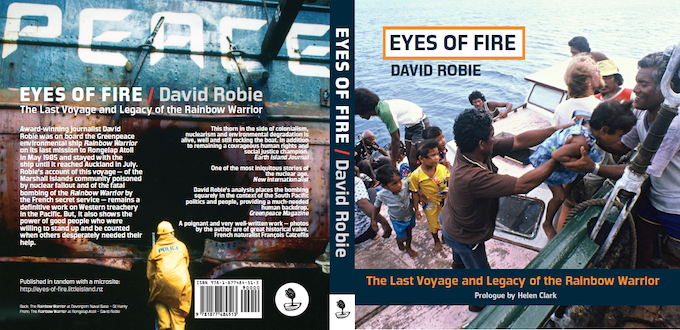
  • Azad Samaj Party chief Chandrashekhar Azad was on June 29 detained in Prayagraj Circuit House in Uttar Pradesh while on his way to meet two families — one in Isota village in Karchana police station area of Prayagraj district where an individual from the scheduled caste community had been allegedly murdered on April 13, and another in Kokhraj police station area of Kaushambi district where a minor girl had been allegedly kidnapped and gangraped some time between April 24 and 27.   

    In protest against the detention, supporters of Azad Samaj Party and Bhim Army — both founded by Azad — started a protest in Bhadewara market area in Karchana town, which soon turned violent. As many as 85 people were arrested for stone-pelting, arson and damaging public property.

    Against this backdrop, two videos went viral on social media in which police personnel can be seen walking with some men. In the first video, the hands and heads of these men are bandaged and they are limping. The other video shows a group of youths with shaved heads. Users are sharing this video and claiming that the rioting supporters of Chandrashekhar Azad received the treatment they deserved from UP Police. 

    Video I

    X user Megh Updates, who has been found sharing misinformation and communal propaganda on several occasions, shared the video and wrote, “Chandrashekhar Ravan’s supporters who rioted in Prayaggraj are getting the treatment they deserve from Yogi’s UP police.”

    X users Naveen Kumar Jindal, Bhiku Mhatre, Apoorva Singh, Om Prakash Pandey, Vini, Rajesh Singh along with other handles like @TheBahubali_IND, @FrontalForce, and @Incognito_qfs also shared the footage with similar claims.

    Click to view slideshow.

    Fact Check

    A reverse image search with frames taken from the viral video led us to the source video posted on a Facebook page named Khabar Padampur and Gramin on June 5, 2025. The post mentions that four members of an extortion gang were nabbed red-handed in Sri Ganganagar in Rajasthan. The group was demanding a sum of Rs 5 lakh from a businessman while posing as gangsters. The businessman’s accountant and his nephew were also found to be involved in the conspiracy.

    A Facebook user named NAYAK YODHA also posted this video on June 6, claiming it to be from Sri Ganganagar.


    श्रीगंगानगर में रंगदारी गैंग पकड़ी गई, 4 बदमाश रंगे हाथों गिरफ्तार!
    ➡ गैंगस्टरों के नाम पर व्यापारी से मांगी जा रही थी 5 लाख की रंगदारी
    ➡ पुलिस ने लग्जरी फॉर्च्यूनर गाड़ी में आए बदमाशों को किया गिरफ्तार
    ➡ व्यापारी का मुनीम और उसका भतीजा भी निकले साजिश में शामिल
    ➡ पुलिस ने रकम बरामद की, अन्य आरोपियों की तलाश जारी
    ➡ डीआईजी गौरव यादव के निर्देश में बड़ी कार्रवाई
    ➡ श्रीगंगानगर पुलिस की बड़ी कामयाबी – शहर में अपराधियों में हड़कंप!
    #highlightseveryonefollowers2025 #hilights #CrimeNews

    Posted by खबर पदमपुर एवं ग्रामीण on Thursday 5 June 2025


    Apart from this, Alt News also found a tweet by Ganganagar Police from June 5, containing a newspaper cutting related to this case. The four accused seen in the video were also seen in the newspaper clipping. The report states that four miscreants had been caught red-handed under a well-planned operation while extorting a reputed businessman from Sri Ganganagar and threatening to kill him. A ransom amount of Rs 5 lakh was recovered from the accused. The arrested miscreants included a employee of the businessman, and his nephew.

    News18 Rajasthan also covered the incident.

    To sum up, the viral video is not related in any way to the Prayagraj violence or the men accused of rioting.

    Video II

    The second video, as mentioned earlier, shows some men with tonsured heads being paraded publicly by police.

    X user Ocean Jain shared the video and wrote, “Look at what Baba’s police did to the hooligans of Prayagraj”. Alt News has fact-checked this user several times in the past.

    Several other X users, including Deepak Sharma, Sunanda Roy, Megh Updates and @FrontalForce also shared the footage and made similar claims while linking it to the Prayagraj violence.

    Click to view slideshow.

    Fact Check

    We noticed ‘@VIRENDRASINGH6513’ written on the frame of the viral video. On searching the username, we found an Instagram profile named ‘Virendra Singh’ where we found the original video posted on June 2. According to the information provided with the post, Baran Police in Rajasthan had arrested 12 people for planning to loot a petrol pump. 

    NDTV Rajasthan covered the incident and reported that the Baran Police in Rajasthan arrested 12 accused planning to loot petrol pumps in two different police station areas, shaved their heads, and paraded them in a crowded market to teach them a lesson.

    In addition, we came across two tweets by the official handle of the Baran Police which mentioned that weapons were also seized from the accused.

    Apart from this, the official X handle of the Prayagraj Police Commissionerate also denied the viral claim calling it misleading. They clarified that the video was from Baran.

    To sum up, the second viral video is also not related to the Prayagraj violence. It is from Baran district of Rajasthan where 12 people were arrested in early June for allegedly planning to loot a petrol pump in two different police station areas.

    The post Prayagraj arson: Old, unrelated videos shared as ‘deserving treatment’ meted out to Chandrashekhar Azad supporters appeared first on Alt News.


    This content originally appeared on Alt News and was authored by Pawan Kumar.

    This post was originally published on Radio Free.

  • Asia Pacific Report

    Nuclear-free and independent Pacific advocates are treating Aucklanders to a lively week-long exhibition dedicated to the struggle for nuclear justice in the region.

    It will be opened today by the opposition Labour Party’s spokesperson on disarmament and MP for Te Atatu, Phil Twyford, and will include a range of speakers on Aotearoa New Zealand’s record as a champion of a nuclear-free Pacific and an independent foreign policy.

    Speaking at a conference last month, Twyford said the country could act as a force for peace and demilitarisation, working with partners across the Pacific and Asia and basing its defence capabilities on a realistic assessment of threats.

    The biggest threat to the security of New Zealanders was not China’s rise as a great power but the possibility of war in Asia, Twyford said.

    Although there have been previous displays about the New Zealand nuclear-free narrative, this one has a strong focus on the Pacific.

    it is called the “Legends of the Pacific: Stories of a Nuclear-free Moana 1975-1995” and will run from tomorrow, July 13 until Friday, July 18.

    Veteran nuclear-free Pacific spokespeople who are expected to speak at the conference include Reverend Mua Strickson-Pua; Bharat Jamnadas, an organiser of the original Nuclear-Free and Independent Pacific (NFIP) conference in Suva, Fiji, in 1975; businessman and community advocate Nikhil Naidu, previously an activist for the Fiji Anti-Nuclear Group (FANG) and Dr Heather Devere, peace researcher and chair of the Asia Pacific Media Network (APMN).

    A group of Cook Islands young dancers will also take part.

    Knowledge to children
    One of the organisers, Nik Naidu, told Asia Pacific Report, it was vital to restore the enthusiasm and passion around the NFIP movement as in the 1980s.

    “It’s so important to pass on our knowledge to our children and future generations,” he said.

    “And to tell the stories of our on-going journey and yearning for true independence in a world free of wars and weapons of mass destruction. This is what a Nuclear-Free and Independent Pacific is.”

    One of the many nuclear-free posters at the exhibition
    One of the many nuclear-free posters at the exhibition. Image: APR

    The exhibition is is coordinated by the APMN in partnership with the Heritage New Zealand Pouhere Taonga, with curator Tharron Bloomfield and coordinator Antony Phillips; Ellen Melville Centre; and the Whānau Communty Centre and Hub.

    It is also supported by Pax Christi, Quaker Peace and Service Fund, and Women’s International League for Peace and Freedom (WILPF).

    It recalls New Zealand’s peace squadrons, a display of activist tee-shirt “flags”, nuclear-free buttons and badges, posters, and other memorabilia.

    Timely exhibition
    Author Dr David Robie, deputy chair of the APMN, who wrote the book Eyes of Fire: The Last Voyage and Legacy of the Rainbow Warrior just published on Thursday, and dedicated to the NFIP movement, said the the exhibition was timely.

    “It is a sort of back to the future situation where the world is waking up again to a nuclear spectre not really seen since the Cold War years,” he said.

    “With the horrendous Israeli genocide on Gaza — it is obscene to call it a war, when it is continuous massacres of civilians; the attacks by two nuclear nations on a nuclear weapons-free country, as is the case with Iran; and threats against another nuclear state, China, are all extremely concerning developments.”

    "Heroes" and "Villains" of the Pacific . . . part of the exnhibition
    “Heroes” and “Villains” of the Pacific . . . part of the exhibition. Image: APR

    This post was originally published on Asia Pacific Report.

  • Incidents of violence by so-called cow protection groups affiliated to Hindutva outfits have been on the rise in several north Indian states. Now, one such incident has come to light from the Ganjam district of Odisha where two Dalit men were brutally tortured on false charges of cow smuggling. They were allegedly beaten up, half tonsured, and forced to eat grass and drink sewer water.

    According to a report by the Indian Express, victims Bulu Nayak (52) and Babul Nayak (43), residents of Singipur village in Sanakhemundi Tehsil in Ganjam District, had bought a cow and two calves from Haripur to be given as dowry in a family wedding. While they were taking the cattle to their village in a tempo rickshaw, a group of locals stopped them.

    The group accused them of illegally transporting the cows, and snatched their mobile phones and money. They allegedly demanded Rs 30,000 to release the animals. When the duo refused, the group tied their hands and legs and brutally assaulted them. Next, they were taken to a local salon where parts of their heads were shaved. They were then made to walk on their knees for about two kilometres to Jahada village where they were allegedly forced to eat grass and drink water from a drain.

    The incident took place in broad daylight on June 22, 2025 at Kharigumma village under Dharakot block in Ganjam district. Both the victims somehow managed to escape from the spot and were provided first aid at a local hospital, after which they lodged a complaint with the Dharakote Police.

    After photos and videos of the incident went viral on social media, several social media users, including social activists and politicians, started sharing the visuals and demanding the arrest of the accused and that appropriate action be taken against them.

    On June 23, the official X handle of the Ganjam SP reported that eight accused had been arrested and one minor boy apprehended after a case had been registered under the relevant sections of the BNS and SC/ST (Prevention of Atrocities) Act.

    On June 26, the police reported that the main accused in the incident had been arrested A local news portal carried the names of the accused arrested in the case in a report dated June 25. They were identified as Sibashankar Mohanty, Satya Sahu, Bainath Bisoi, Om Gowda, Ganapati Palei, Santosh Dakua, Shankar Das, and Narayan Dakua and a minor.

    Another report published on July 3 stated that a total of 16 people had been arrested in the case so far.

    Alarming Increase in Cow-Vigilantism Violence

    It is pertinent to note that cases of violence related to cow-vigilantism have skyrocketed in the recent past. From 2016 to 2020, lynching or mob violence following suspected cow slaughter or trade has claimed at least 50 lives, according to a report by ACLED, an independent non-profit organisation that tracks and analyses data on violent conflict and protest across all countries and regions.

    ACLED recorded a sharp increase in the number of incidents of political violence related to the protection of cows in India in 2018. Compared to 2016, incidents of political violence related to cow protection increased by more than 40% in 2017 and almost doubled in 2018, with this increase in violence coinciding with the establishment of BJP-led governments in several states, including Uttar Pradesh, Assam and Jharkhand.

    The report further revealed that more than 80% of reported incidents of cow protection-related violence were carried out against civilians. The victims of these attacks were usually those involved in the cattle trade and individuals belonging to minority groups, including Muslims, Dalits or Adivasi communities.

    The post Dozens arrested in Odisha after 2 Dalit men tortured on false charges of cow smuggling appeared first on Alt News.


    This content originally appeared on Alt News and was authored by Pawan Kumar.

    This post was originally published on Radio Free.

  • Social media users recently shared a video claiming that slogans of ‘Pakistan Zindabad’ were raised by Muslims participating in a Muharram procession in Uttar Pradesh. The viral posts also contain derogatory words against the Muslim community.

    X user Deepak Sharma, who regularly shares disinformation and promotes communal propaganda, shared the video tagging the Deoria Police and wrote, “Do you hear what I am hearing? This crowd raising slogans of ‘Pakistan Zindabad’ is not in Pakistan but in India, that too in India’s Uttar Pradesh. Betrayal is in their blood.”

    Right-wing X user Sandeep Mishra and several others on other platforms like Instagram and Facebook shared the same footage with claims that ‘Pakistan Zindabad’ slogans had been raised during a Muharram procession.

    Click to view slideshow.

    Fact Check

    Alt News found that the official X handle of the Deoria Police had tweeted about this and refuted the claim about ‘Pakistan Zindabad’ slogans being raised. According to police, in the video recorded during a Muharram procession by the Five Star Club, slogans of ‘Five Star Zindabad’, and not ‘Pakistan Zindabad’ could be heard. 

    The police also mentioned that the procession was carried out peacefully in police presence.

    Alt News examined the video by playing it in slow motion. On listening carefully to the slogans being raised in the procession, it became clear that the chants were not that of ‘Pakistan Zindabad’, but ‘Five Star Zindabad’. However, due to the background noise, the slogans are not that clear.

    Apart from this, we noticed that many people participating in the procession wore green T-shirts with ‘5 STAR CLUB’ and ‘5 star’ printed on them.

    Upon further investigation, we also came across the Instagram page of 5 star club. Many videos taken during Muharram can be found on this page. Apart from these, in a post by Instagram user Israfil Ansari, too, members of the 5 Star Club can be seen participating in Muharram observation wearing the same green T-shirts in the presence of police personnel.

    To sum it up, slogans of “Five Star Zindabad” were raised in the video in question. However, some users falsely claimed that Muslims were raising ‘Pakistan Zindabad’ slogans during Muharram.

    The post No, Pakistan Zindabad slogans were not raised at Muharram rally in Deoria, Uttar Pradesh appeared first on Alt News.


    This content originally appeared on Alt News and was authored by Pawan Kumar.

    This post was originally published on Radio Free.

  • A video showing a female police volunteer pulling away a woman kneeling underneath a large wooden chariot is viral on social media with communal claims that she was offering namaz or Islamic prayers during the annual Rath Yatra in Puri, Odisha. While the clip does not clearly show namaz being offered, someone in the background can be heard asking, “Namaz porche naki?” (Are they offering the namaz?) 

    The Rath Yatra or Chariot festival is a major Hindu festival in which thousands of devotees of the Hindu god Jagannath (believed to be a form of another deity, Krishna) come to Puri. In Hindu mythology, the deity travels in a chariot to visit his aunt along with his siblings and offers blessings to all on the way. The city usually witnesses a massive surge in visitors around this time. A glimpse of this scale is also visible in the viral video.

    Social media users claim the video shows two individuals offering namaz under the holy chariot of Jagannath, and this is done to deliberately disrespect the religious sentiments of Hindus and malign the sanctity of the festival.  

    On July 2, X user BALA (@erbmjha) shared the footage, calling it blasphemous. They also tagged the Odisha police, demanding her arrest. 

    At the time of writing this, the post had over 164,000 views. Note that Alt News has fact-checked misinformation shared by this user several times. 

    The same day, on X, Sagar Kumar (@KumaarSaagar), a journalist at Sudarshan News, a pro-Right outlet, shared the same video, suggesting that offering namaz during a Hindu festival signalled a larger conspiracy at play.

    The post had over 573,000 views at the time this was written. 

    Another X user, Sameer (@BesuraTaansane), also shared the video with a provocative caption that those who hate Hindus should go to their “promised land”. 

    At the time of writing this, the post had over 781,000 views. 

    Several other social media users, whom Alt News has previously called out for amplifying misinformation, also shared the video with similar claims. These include MeghUpdates (@MeghUpdates), Squint Neon (@TheSquind), Jitendra Pratap Singh (@jpsin1), Ocean Jain (@ocjain4), and Kalpana Srivastava (@Lawyer_Kalpana). 

    Click to view slideshow.

    Fact Check

    On looking closely, we found that the viral video had a “Khabardar Live” watermark. We then found Khabardar Live’s Facebook page, which identifies itself as a local news and media website based in Odisha. On this page, we found a longer version of the viral video posted on June 28, 2025. The caption, in Odia, reads, “Why did police bring women under Jagannath’s chariot?”


    ଜଗନ୍ନାଥଙ୍କ ରଥ ତଳୁ ମହିଳାଙ୍କୁ ଘୋଷାରି ଆଣିଲେ ପୋଲିସ କାହିଁକି ? #PuriRathayatra #puri #jagannathratha #rathayatra2025

    Posted by Khabardar Live on Friday 27 June 2025


    In this video, at the 1:22-minute mark, the woman who was seen being dragged by the police volunteer can be heard protesting, “Yeh kya tareeka hai?” she says (“What kind of behaviour is this?”). To this, a man nearby responds that the idol of the Jagannath deity would soon be carried up the chariot stairs, and for that, people were not allowed to sit under the chariot. The woman then replies, “Lekin humko yahaan par bitha ke gaye the, bhaiyya..” (“But I was asked to sit here”). Pointing at the others still kneeling under the chariot, she says, “Wo bhi toh wahin khade hai” (“They are also standing there”).

    This made it clear that the woman was not sitting there defiantly, but there seemed to be some miscommunication regarding her presence there.

    Also, usually, during prayers, Muslims cover their head and use a prayer mat, which was not the case here, making us doubt that she was offering namaz. To be sure, we ran this by someone familiar with how Islamic prayers are done, and they too told us that covering the head is a customary requirement for women during namaz, and her sitting posture—with feet crossed—does not align with the posture prescribed for Salah. They added that no janamaz or prayer mat was visible, making it unlikely that she was offering namaz.

    Alt News also contacted a senior journalist from Puri who was familiar with the incident. Refuting the communal narrative being circulated, she said that the individuals were kneeling and sitting there just to get a glimpse of Jagannath’s idol. 

    To corroborate this, Alt News also reached out to Odisha Police’s officer in charge of temple security, Kaushik Nayak. When asked about the alleged video, Nayak said, “No such instance was reported.”

    Alt News also independently identified the woman in the video, but will not be divulging her name to protect her privacy. We managed to reach out to her family and acquaintances, who confirmed that she is, in fact, Hindu and a Jagannath devotee.

    These findings, put together, make it clear that the viral video shows a Hindu woman sitting under the chariot during the crowded Rath Yatra festival and not offering namaz as social media users wrongly claimed. 

    The post Video of Hindu woman kneeling at Rath Yatra in Puri viral with false claims that she was offering namaz appeared first on Alt News.


    This content originally appeared on Alt News and was authored by Ankita Mahalanobish.

    This post was originally published on Radio Free.

  • Asia Pacific Report

    A journalist who was on the Rainbow Warrior voyage to Rongelap last night condemned France for its “callous” attack of an environmental ship, saying “we haven’t forgotten, or forgiven this outrage”.

    David Robie, the author of Eyes of Fire: The Last Voyage and Legacy of the Rainbow Warrior, said at the launch that the consequences of almost 300 US and French nuclear tests – many of them “dirty bombs” — were still impacting on indigenous Pacific peoples 40 years after the bombing of the ship.

    French saboteurs had killed “our shipmate Fernando Pereira” on 10 July 1985 in what the New Zealand prime minister at the time, David Lange, called a “sordid act of international state-backed terrorism”.

    Although relations with France had perhaps mellowed over time, four decades ago there was a lot of hostility towards the country, Dr Robie said.

    “And that act of mindless sabotage still rankles very deeply in our psyche,” he said at the launch in Auckland Central’s Ellen Melville Centre on the anniversary of July 10.

    About 100 people gathered in the centre’s Pioneer Women’s Hall for the book launch as Dr Robie reflected on the case of state terrorism after Greenpeace earlier in the day held a memorial ceremony on board Rainbow Warrior III.

    “One of the celebrated French newspapers, Le Monde, played a critical role in the investigation into the Rainbow Warrior affair — what I brand as ‘Blundergate’, in view of all the follies of the bumbling DGSE spy team,” he said.

    Plantu cartoon
    “And one of the cartoons in that newspaper, by Plantu, who is a sort of French equivalent to Michael Leunig, caught my eye.

    “You will notice it in the background slide show behind me. It shows François Mitterrand, the president of the French republic at the time, dressed in a frogman’s wetsuit lecturing to school children during a history lesson.

    “President Mitterrand says, in French, ‘At that time, only presidents had the right to carry out terrorism!’

    Tahitian advocate Ena Manurevia
    Tahitian advocate Ena Manurevia . . . the background Plantu cartoon is the one mentioned by the author. Image: Asia Pacific Report

    He noticed that in the Mitterrand cartoon there was a “classmate” sitting in the back of the room with a moustache. This was none other than Edwy Plenel, the police reporter for Le Monde at the time, who scooped the world with hard evidence of Mitterrand and the French government’s role at the highest level in the Rainbow Warrior sabotage.

    Dr Robie said that Plenel now published the investigative website Mediapart, which had played a key role in 2015 revealing the identity of the bomber that night, “the man who had planted the limpet mines on the Rainbow Warrior — sinking a peace and environmental ship, and killing Fernando Pereira.”

    Jean-Luc Kister, a retired French colonel and DGSE secret agent, had confessed to his role and “apologised”, claiming the sabotage operation was “disproportionate and a mistake”.

    “Was he sincere? Was it a genuine attempt to come to terms with his conscience. Who knows?” Dr Robie said, adding that he was unconvinced.

    Hilari Anderson (right), one of the speakers
    Hilari Anderson (right on stage), one of the speakers, with Del Abcede and MC Antony Phillips (obscured) . . . the background image shows Helen Clark meeting Fernando Pereira’s daughter Marelle in 2005. Image: Greenpeace

    French perspective
    Dr Robie said he had asked Plenel for his reflections from a French perspective 40 years on. Plenel cited three main take ways.

    “First, the vital necessity of independent journalism. Independent of all powers, whether state, economic or ideological. Journalism that serves the public interest, the right to know, and factual truths.

    “Impactful journalism whose revelations restore confidence in democracy, in the possibility of improving it, and in the usefulness of counterbalancing powers, particularly journalism.”

    Secondly, this attack had been carried out by France in an “allied country”, New Zealand, against a civil society organisation. This demonstrated that “the thirst for power is a downfall that leads nations astray when they succumb to it.

    “Nuclear weapons epitomise this madness, this catastrophe of power.”

    Finally, Plenel expressed the “infinite sadness” for a French citizen that after his revelations in Le Monde — which led to the resignations of the defence minister and the head of the secret services — nothing else happened.

    “Nothing at all. No parliamentary inquiry, no questioning of François Mitterrand about his responsibility, no institutional reform of the absolute power of the president in a French republic that is, in reality, an elective monarchy.”

    ‘Elective monarchy’ trend
    Dr Robie compared the French outcome with the rapid trend in US today, “a president who thinks he is a monarch, a king – another elective monarchy.”

    He also bemoaned that “catastrophe of power” that “reigns everywhere today – from the horrendous Israeli genocide in Gaza to the Russian invasion of Ukraine, from Trump to Putin to Netanyahu, and so many others.”

    The continuous Gaza massacres were a shameful indictment of the West that had allowed it to happen for more than 21 months.

    Dr Robie thanked many collaborators for their help and support, including drama teacher Hilari Anderson, an original crew member of the Rainbow Warrior, and photographer John Miller, “who have been with me all the way on this waka journey”.

    He thanked his wife, Del, and family members for their unstinting “patience and support”, and also publisher Tony Murrow of Little Island Press.

    Eyes of Fire: The Last Voyage and Legacy of the Rainbow Warrior
    Eyes of Fire: The Last Voyage and Legacy of the Rainbow Warrior . . . published 10 July 2025. Image: David Robie/Little Island Press

    Launching the book, Greenpeace Aotearoa programme director Niamh O’Flynn said one thing that had stood out for her was how the legacy of the Rainbow Warrior had continued despite the attempt by the French government to shut it down 40 years ago.

    “We said then that ‘you can’t sink a rainbow’, and we went on to prove it.

    “When the Rainbow Warrior was bombed in Auckland harbour, it was getting ready to set sail to Moruroa Atoll, to enter the test exclusion zone and confront French nuclear testing head-on.”

    So threatened
    The French government had felt so threatened by that action that it had engaged in a state-sanctioned terror attack to prevent the mission from going ahead.

    “But we rebuilt, and the Rainbow Warrior II carried on with that mission, travelling to Moruroa three times before the French finally stopped nuclear testing in the Pacific.

    “That spirit and tenacity is what makes Greenpeace and what makes the Rainbow Warrior so special to everyone who has sailed on her,” she said.

    “It was the final voyage of the Rainbow Warrior to Rongelap before the bombing that is the focus of David Robie’s book, and in many ways, it was an incredibly unique experience for Greenpeace — not just here in Aotearoa, but internationally.

    “And of course David was a key part in that.”

    O’Flynn said that as someone who had not even been born yet when the Rainbow Warrior was bombed, “I am so grateful that the generation of nuclear-free activists took the time to pass on their knowledge and to build our organisation into what it is today.

    “Just as David has by writing down his story and leaving us with such a rich legacy.”

    Greenpeace Aotearoa programme director Niamh O’Flynn . . . “That spirit and tenacity is what makes Greenpeace and what makes the Rainbow Warrior so special to everyone who has sailed on her.” Image: APR

    Other speakers
    Among other speakers at the book launch were teacher Hilari Anderson, publisher Tony Murrow of Little Island Press, Ena Manuireva, a Mangarevian scholar and cultural adviser, and MC Antony Phillips of Heritage New Zealand Pouhere Taonga.

    Anderson spoke of the Warrior’s early campaigns and acknowledged the crews of 1978 and 1985.

    “I have been reflecting what these first and last crews of the original Rainbow Warrior had in common, realising that both gave their collective, mostly youthful energy — to transformation.

    “This has involved the bonding of crews by working hands-on together. Touching surfaces, by hammer and paint, created a physical connection to this beloved boat.”

    She paid special tribute to two powerful women, Denise Bell, who tracked down the marine research vessel in Aberdeen that became the Rainbow Warrior, and the indomitable Susi Newborn, who “contributed to naming the ship and mustering a crew”.

    Manuireva spoke about his nuclear colonial experience and that of his family as natives of Mangareva atoll, about 400 km from Muroroa atoll, where France conducted most of its 30 years of tests ending in 1995.

    He also spoke of Tahitian leader Oscar Temaru’s pioneering role in the Nuclear-Free and Independent Pacific (NFIP) movement, and played haunting Tahitian songs on his guitar.

    This post was originally published on Asia Pacific Report.
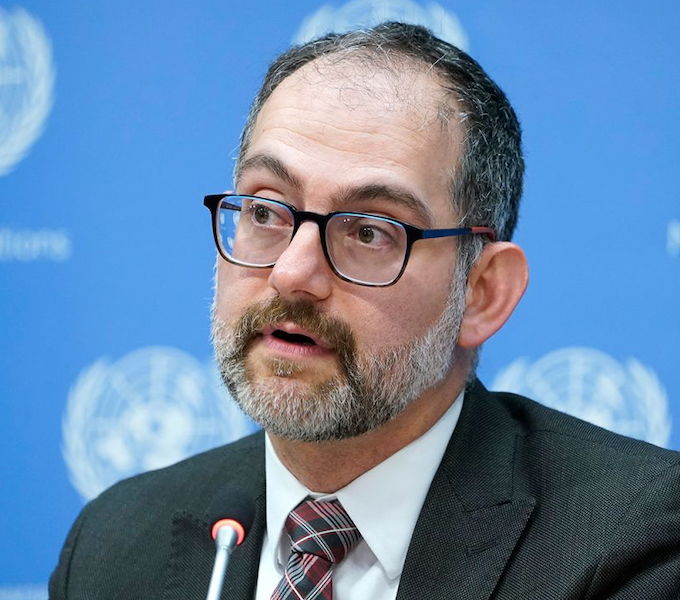
  • On July 5, 2025, the Press Information Bureau (PIB)—the official media and public relations arm of the Indian government—published a press release titled “World Bank Places India Among World’s Most Equal Societies.” Citing a World Bank report, PIB published a misleading claim that “India ranks fourth globally in income equality with a Gini score of 25.5,” after the Slovak Republic, Slovenia, and Belarus.

    Click to view slideshow.

    After PIB’s release, several media outlets, including Times of India, Moneycontrol, The Hindu, Mint, Deccan Herald, Indian Express and Republic published reports that India ranked fourth in terms of income equality, with some directly attributing it to the World Bank. Among them, The Hindu and Deccan Herald had PTI copies while Mint had an ANI copy. Largely, they all parroted the PIB release.

    Also Read | Op Sindoor: As Indian media made false, outrageous claims, PIB looked the other way

    Click to view slideshow.

    Why PIB’s Claim Is Misleading

    Comparing India’s Gini score (25.2) with the United Kingdom (32.4), the United States (41.8) and China (35.7), PIB said that India’s income equality outshone major economies.

    Source: PIB press release

    The World Bank defines the Gini as an index that measures the “extent to which the distribution of income or consumption among individuals or households within an economy deviates from a perfectly equal distribution”. A Gini score or coefficient is expressed as a percentage. The number 0 denotes a perfectly equal society (where everyone has the same level of income or consumption), while a score of 100 denotes extreme inequality (where some have nothing and the rest have all).

    Also Read | India is not the fourth-largest or a $4-trillion economy yet; NITI Aayog CEO’s claim citing IMF data misleading

    However, the PIB seems to have cherry picked some information from the World Bank report and misrepresented it.

    Here’s what the World Bank’s April 2025 Poverty & Equity Brief for India says:

    …India’s consumption-based Gini index improved from 28.8 in 2011-12 to 25.5 in 2022-23, though inequality may be underestimated due to data limitations. In contrast, the World Inequality Database shows income inequality rising from a Gini of 52 in 2004 to 62 in 2023. Wage disparity remains high, with the median earnings of the top 10 percent being 13 times higher than the bottom 10 percent in 2023-24…”

    So, there are two Ginis—one based on consumption and the other on income. Clearly, the World Bank says that India has improved in one and done worse in the other.

    But PIB has compared the consumption-based Gini score of India (where India fares slightly better in 2022-23 than 2011-12) with the income-based Gini scores of UK, US, Slovenia and Slovak Republic (where India is worse off now than before).

    The World Bank itself warns against comparing Gini coefficients of different countries for this very reason, because the underlying data used in surveys for these calculations varies. Note that the World Bank does not collect data itself; it measures inequality based on household survey data provided by governments. From the World Bank glossary:

    “Because the underlying household surveys differ in methods and types of welfare measures collected, data are not strictly comparable across countries or even across years within a country.”

    The reason such a comparison is problematic follows:

    “… Surveys can differ in many respects, including whether they use income or consumption expenditure as the living standard indicator. The distribution of income is typically more unequal than the distribution of consumption.”

    So, in comparing India’s consumption inequality with more developed countries’ income inequality, we are essentially comparing two different units. And inequality based on consumption data will, by default, appear more equal.

    Let’s understand why this is so.

    Inequality Based on Consumption vs Income

    Most developed, wealthy or high-income countries use income-based household surveys because their economies are formalised and tracking incomes is not a challenge. Developing, middle and lower-income groups use consumption-based household surveys owing to challenges with collecting data on incomes (some reasons could be a sizeable proportion of the labour force being deployed in informal sectors, more cash transactions, less access to banking, etc).

    But when we track inequality based on the two different surveys, the results are different. Countries that use income-based surveys appear to be more unequal. There are three main reasons for this:

    First, income-based surveys include all means through which one earns (such as salary, capital gains, additional earnings) whereas consumption-based surveys take account only of households’ expenditure. To put it another way, one measures a household’s potential purchasing power while the other only measures how much is actually used or spent. While those with higher incomes may consume more, they also have a greater propensity to save. So, just looking at households’ consumption data cannot give us a clear picture of their potential purchasing power.

    Let’s take an oversimplified example. A poor household spends around Rs 15,000 a month or 75% of its income, while a wealthy household spends Rs 50,000, which is 10% of its monthly income. At a glance, just based on their expenditure or consumption, it is hard to gauge the level of inequality between the two, even when there is a significant difference in their spending. But if we conflate their monthly incomes—Rs 20,000 and Rs 5 lakh, respectively—the level of inequality is stark.

    Two, according to a 2024 paper on the Gini coefficient titled “The World Bank’s New Inequality Indicator: The Number of Countries with High Inequality” (Haddad et al.) households’ incomes can sometimes be extremely low or even negative, due to unemployment, loss in business, or other temporary shocks but they would still need to maintain a basic level of consumption for sustenance. This keeps consumption levels from falling sharply. 

    Three, wealthier households have a greater propensity to save. As incomes grow, the proportion of what is spent on essentials diminishes and the proportion devoted to savings rises. For instance, a household might receive a large one-time income from investments but won’t necessarily spend all of it right away. Instead, they may save most of it for future needs or emergencies.

    Because of these differences, income and consumption inequality are not directly comparable—income can fluctuate sharply, while consumption tends to be smoother since everyone depends on at least a minimum level of subsistence.

    What PIB Got Wrong

    The Press Information Bureau took the 25.5 figure, which is the consumption-based Gini and compared it with the income-based Gini of the United States of America and the United Kingdom. It also claimed that India stands fourth globally in income equality, after the Slovak Republic, Slovenia and Belarus.

    As established earlier, income inequality is typically higher than consumption inequality. This means that when the Gini for a country is calculated using income data, it will appear more unequal and thus have a higher score than when it is calculated using consumption data.

    • For example, the United Kingdom’s score on the Gini index (calculated in 2021) is 32.40, which makes it seemingly more unequal than India’s consumption-based Gini index score of 25.5. The footnote in the World Bank data clearly states that the UK’s Gini score is based on income data.
    Click to view slideshow.
    • Similarly, the United States of America’s latest score on the Gini index (calculated in 2023) is 41.80, which is higher (and hence more unequal) than India’s consumption-based Gini index score of 25.5. US’s Gini coefficient is also based on income data.
    Click to view slideshow.

    Like we mentioned before, this is similar to comparing absolute numbers of different units. For instance, it’s like saying 100 grams is more than 50 ounces. What is comparable, however, is India’s income-based Gini, which is 62, much higher than those of the UK and the USA.

    • Similarly, the Slovak Republic, in 2022, had an income-based Gini of 24.10. When compared with India’s income-based Gini of 62, the Slovak Republic is far ahead in terms of equality.
    Click to view slideshow.
    • Slovenia, as of 2022, had an income-based Gini of 24.30. Again, income equality there is far less than in India, with a Gini of 62.
    Click to view slideshow.
    • As of 2020, Belarus had a consumption-based Gini Index of 24.40. This is comparable to India’s consumption-based Gini of 25.5. Belarus fares better than India.
    Click to view slideshow.
    • China’s Gini Index of 35.70 is comparable to that of India’s 25.5, since China also has a consumption-based Gini.
    Click to view slideshow.

    We’ve ranked the countries mentioned in the PIB press release below, distinguishing their most recent available consumption-based and income-based scores on the Gini index.

    To put things in perspective, India’s income inequality has actually risen from 2004 to 2023. The World Bank brief clearly says this. Even the improvement in consumption inequality is very marginal—from 28.8 in 2011-12 to 25.5 in 2022-23. This is hardly celebratory; it rather shows that India’s consumption is facing strain.

    Economist Surbhi Kesar, who was the first to point out PIB’s misrepresentation of World Bank data on X, writes that we might even be underestimating India’s consumption inequality due to data limitations. The 2022–23 Household Consumption Expenditure Survey introduced several changes in methodology compared to the earlier 2011–12 survey, making direct comparisons on poverty reduction unreliable.

    Also, the Gini index is one inequality indicator, just like income and consumption are a few metrics to measure inequality. Like economist Santosh Mehrotra points out in The Wire, inequality manifests in various ways such as social inequality (owing to caste, ethnicity, class, etc) and wealth-based inequality (when wealth is concentrated in the hands of a few over the years and then passed down as inheritence), which are often beyond the scope of the Gini index but crucial for developing economies like India to take into account.

    Importantly, these surveys and numbers do not highlight enough just how stark inequality is in India, in terms of wealth concentration. These issues have been widely flagged by economists and statisticians on several occasions.

    (With inputs from Diti Pujara)

    The post PIB’s claim that India is fourth most equal country citing World Bank data is misleading appeared first on Alt News.


    This content originally appeared on Alt News and was authored by Shinjinee Majumder.

    This post was originally published on Radio Free.

  • After the observance of Muharram on July 6, 2025, a video showing a man seated atop what appeared to be a stack of loudspeakers caught the attention of some news channels. The man held a large flag bearing a crescent and star motif. The footage was aired in news bulletins with the claim that the Pakistani national flag had been carried in a Muharram procession in Jamui, Bihar.

    News18 Bihar aired the video on July 6, with anchors highlighting the incident and identifying the flag as Pakistan’s national flag. Remarking that the Pakistani flag drew inspiration from the Islamic flag, News18 clarified that the video had not been independently verified by the channel. The location of the incident, was, however, identified as Pairamatihana village in Sono block of Jamui district in Bihar.

    During the bulletin, the anchors described the act as potentially problematic and turned to an on-ground reporter for an update. The reporter stated that a formal complaint had been lodged, and police had initiated an investigation. Authorities were currently reviewing the footage, and efforts were underway to identify the individual seen waving the flag, he further reported, adding, once the person was identified, appropriate legal action would be taken.

    It is worth noting that News18 Bihar has since deleted both the video and the corresponding post on X. One can watch the relevant part of the bulletin below. An archived version of the X post by the media outlet can be seen here.

    Dainik Bhaskar, on July 7, published a report on this in which the headline described the flag as an Islamic flag, but the photo caption and the story itself said it was a Pakistani flag. The story stated that on the evening of Sunday, July 6, during a Muharram procession in Sono, a man was seen waving a flag of Pakistan while being seated over the sound system. The report further claimed that Sono police station-in-charge Dharmendra Kumar acknowledged that the flag had not been noticed by officers at the time. However, he assured that efforts were underway to identify the individual, and appropriate legal action would be taken.

    Bhaskar also made a voice-over video report on this which is embedded in the above-mentioned article. At the 5-second mark, the reporter can be heard saying, “Ek yuvak Pakistani Jhandda lehrate huye dikh rahe hai” (A young man is seen waving a Pakistani flag). Again, at the 20-second mark in the video, the reporter alleges the flag in question was the Pakistani national flag. Watch it here:

    Right-wing propaganda website OpIndia published an article detailing instances of violence reported during several Muharram processions in Bihar. The article referenced the incident and claimed that the Pakistani national flag had been waved in Jamui. Although police were present at the location, they did not take any action, the article added.

    Fact Check

    Upon closer examination of the video, it becomes evident that the flag held by the man is an Islamic flag, not the national flag of Pakistan. The flag in question appears black in colour, featuring a crescent and a star, common Islamic symbols. In contrast, Pakistan’s national flag is bright green with a white vertical stripe towards the mast, also bearing a white crescent and a star.

    A visual comparison has been done below for clarity.

    Alt News reached out to the Sono police station-in-charge Dharmendra Singh, who clarified that the flag seen in the viral video was not the national flag of Pakistan, but an Islamic flag. He further stated that no formal complaint or FIR had been registered in connection with the incident. Singh also noted that the authenticity of the video’s location — whether it was indeed filmed in Sono — was still under investigation.

    To sum up, the flag waved by a man at a Muharram procession reportedly in Bihar’s Jamui was not Pakistan’s national flag; it was the Islamic flag. Several media outlets and propaganda website OpIndia misreported the incident and falsely claimed that the Pakistani national flag had been waved.

    The post Media misreport: Islamic flag waved at Muharram rally falsely described as Pakistani national flag appeared first on Alt News.


    This content originally appeared on Alt News and was authored by Ankita Mahalanobish.

    This post was originally published on Radio Free.

  • From the prologue of the 40th anniversary edition of David Robie’s seminal book on the Rainbow Warrior’s last voyage, former New Zealand prime minister Helen Clark (1999-2008) writes about what the bombing on 10 July 1985 means today.

    By Helen Clark

    The bombing of the Rainbow Warrior in Auckland Harbour on 10 July 1985 and the death of a voyager on board, Greenpeace photographer Fernando Pereira, was both a tragic and a seminal moment in the long campaign for a nuclear-free Pacific.

    It was so startling that many of us still remember where we were when the news came through. I was in Zimbabwe on my way to join the New Zealand delegation to the United Nations World Conference on Women in Nairobi. In Harare I met for the first time New Zealand Anglican priest Father Michael Lapsley who, in that same city in 1990, was severely disabled by a parcel bomb delivered by the intelligence service of the apartheid regime in South Africa. These two bombings, of the Rainbow Warrior and of Michael, have been sad reminders to me of the price so many have paid for their commitment to peace and justice.

    It was also very poignant for me to meet Fernando’s daughter, Marelle, in Auckland in 2005. Her family suffered a loss which no family should have to bear. In August 1985, I was at the meeting of the Labour Party caucus when it was made known that the police had identified a woman in their custody as a French intelligence officer. Then in September, French prime minister Laurent Fabius confirmed that French secret agents had indeed sunk the Rainbow Warrior. The following year, a UN-mediated agreement saw the convicted agents leave New Zealand and a formal apology, a small amount of compensation, and undertakings on trade given by France — the latter after New Zealand perishable goods had been damaged in port in France.

    Both 1985 and 1986 were momentous years for New Zealand’s assertion of its nuclear-free positioning which was seen as provocative by its nuclear-armed allies. On 4 February 1985, the United States was advised that its naval vessel, the Buchanan, could not enter a New Zealand port because it was nuclear weapons-capable and the US “neither confirm nor deny” policy meant that New Zealand could not establish whether it was nuclear weapons-armed or not.

    In Manila in July 1986, a meeting between prime minister David Lange and US Secretary of State George Schultz confirmed that neither New Zealand nor the US were prepared to change their positions and that New Zealand’s engagement in ANZUS was at an end. Secretary Schultz famously said that “We part company as friends, but we part company as far as the alliance is concerned”.

    New Zealand passed its Nuclear Free Zone, Disarmament and Arms Control Act in 1987. Since that time, until now, the country has on a largely bipartisan basis maintained its nuclear-free policy as a fundamental tenet of its independent foreign policy. But storm clouds are gathering.

    Australia’s decision to enter a nuclear submarine purchase programme with the United States is one of those. There has been much speculation about a potential Pillar Two of the AUKUS agreement which would see others in the region become partners in the development of advanced weaponry. This is occurring in the context of rising tensions between the United States and China.

    Many of us share the view that New Zealand should be a voice for deescalation, not for enthusiastic expansion of nuclear submarine fleets in the Pacific and the development of more lethal weaponry.

    Eyes of Fire: The Last Voyage and Legacy of the Rainbow Warrior
    Eyes of Fire: The Last Voyage and Legacy of the Rainbow Warrior . . . publication 10 July 2025. Image: David Robie/Little Island Press

    Nuclear war is an existential threat to humanity. Far from receding, the threat of use of nuclear weapons is ever present. The Doomsday Clock of the Bulletin of Atomic Scientists now sits at 89 seconds to midnight. It references the Ukraine theatre where the use of nuclear weapons has been floated by Russia. The arms control architecture for Europe is unravelling, leaving the continent much less secure. India and Pakistan both have nuclear arsenals. The Middle East is a tinder box with the failure of the Iran nuclear deal and with Israel widely believed to possess nuclear weapons. North Korea continues to develop its nuclear weapons capacity. An outright military conflict between China and the United States would be one between two nuclear powers with serious ramifications for East Asia, South-East Asia, the Pacific, and far beyond.

    August 2025 marks the eightieth anniversary of the nuclear bombing of Hiroshima and Nagasaki. A survivors’ group, Nihon Hidankyo, was awarded the Nobel Peace Prize last year. They bear tragic witness to the horror of the use of nuclear weapons. The world must heed their voice now and at all times.

    In the current global turbulence, New Zealand needs to reemphasise the principles and values which drove its nuclear-free legislation and its advocacy for a nuclear-free South Pacific and global nuclear disarmament. New Zealanders were clear — we did not want to be defended by nuclear weapons. We wanted our country to be a force for diplomacy and for dialogue, not for warmongering.

    The multilateral system is now in crisis — across all its dimensions. The UN Security Council is paralysed by great power tensions. The United States is unlikely to pay its dues to the UN under the Trump presidency, and others are unlikely to fill the substantial gap which that leaves. Its humanitarian, development, health, human rights, political and peacekeeping, scientific and cultural arms all face fiscal crises.

    This is the time for New Zealand to link with the many small and middle powers across regions who have a vision for a world characterised by solidarity and peace and which can rise to the occasion to combat the existential challenges it faces — including of nuclear weapons, climate change, and artificial intelligence. If our independent foreign policy is to mean anything in the mid-2020s, it must be based on concerted diplomacy for peace and sustainable development.

    Movement back towards an out-of-date alliance, from which New Zealand disengaged four decades ago, and its current tentacles, offers no safe harbour — on the contrary, these destabilise the region within which we live and the wide trading relationships we have. May this new edition of David Robie’s Eyes of Fire remind us of our nuclear-free journey and its relevance as a lode star in these current challenging times.

    • The 40th anniversary edition of Eyes of Fire: The Last Voyage and Legacy of the Rainbow Warrior by David Robie ($50, Little Island Press) can be purchased from Little Island Press

    This post was originally published on Asia Pacific Report.
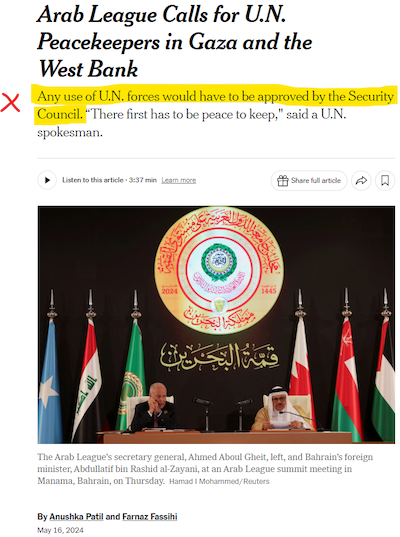
  • KATHMANDU, Nepal (10 July 2025) – The Asian Forum for Human Rights and Development (FORUM-ASIA) and Bytes for All, Pakistan condemn the Islamabad District Magistrate’s order, issued on 24 June 2025, to block 27 YouTube channels for allegedly disseminating “anti-state content” and “spreading false, misleading, and fake information.” The targeted channels, run by journalists, political commentators, and opposition voices, including those in exile, are the latest targets in Pakistan’s ongoing crackdown on dissent.

    “The censorship of journalists and political voices under the pretext of national security is a dangerous precedent,” said Mary Aileen Diez-Bacalso, Executive Director of FORUM-ASIA. “This is not a lawful regulation; it is repression disguised as cybersecurity. That global platforms, like YouTube, appear complicit only reinforces the fragility of civic space.”

    This move is part of a deepening pattern of digital authoritarianism in Pakistan, where vague and overly broad laws are used to suppress independent media, shrink civic space, and criminalise dissent both online and offline.

    PECA: A tool for systemic digital repression

    The blocking order, which was based on a request from Pakistan’s newly created National Cyber Crime Investigation Agency (NCCIA), invoked Section 37 of the Prevention of Electronic Crimes (Amendment) Act (PECA), 2025. The court accepted claims of “provoking disorder” and “defaming state institutions” without independent scrutiny or due process.

    FORUM-ASIA has consistently raised concerns about PECA and its 2025 amendments, which expand the law enforcement’s ability to surveil, censor, and criminalise online speech and expression. These laws institutionalise state control over digital civic space and violate Pakistan’s commitment to international human rights standards, including those under the International Covenant on Civil and Political Rights (ICCPR).

    PECA has been consistently weaponised to target journalists, such as in the arrest of Farhan Mallick, and to stifle media freedom. Such patterns entrench legalised censorship and erode the foundations of a free and open civic space.

    Judicial and platform complicity in a shrinking civic space

    The court’s decision to issue a blocking order, in the absence of procedural safeguards or transparent justification, risks turning the judiciary into a tool for repression. Equally concerning is YouTube’s apparent compliance, including takedown warnings that threaten removal without explanation or recourse. These actions were carried out without due process, adequate safeguards, or a meaningful opportunity for appeal against this unilateral decision. YouTube’s willingness to enforce such orders exemplifies a broader trend of corporate complicity, where platforms yield to state pressure at the expense of freedom of expression.

    Even when responding to domestic court orders, platforms retain an independent responsibility under the UN Guiding Principles on Business and Human Rights to assess whether enforcement contributes to human rights violations. Platforms are obligated to conduct human rights due diligence and reject requests that violate international law. Compliance must meet the tests of legality, necessity, and proportionality.

    “The judiciary’s uncritical acceptance of vague censorship claims, coupled with YouTube’s opaque compliance, exemplifies the dangerous convergence of state and corporate power in curtailing online freedoms,” said Shahzad Ahmad, Country Director of Bytes for All, Pakistan. “As a platform with global reach, YouTube must demonstrate human rights due diligence and refuse to enable politically motivated crackdowns. Silence and compliance are not neutral; they constitute complicity in shrinking civic space.”

    From the recently lifted long-term ban on X (formerly Twitter), to repeated internet shutdowns during protests, and growing investment in state surveillance infrastructure, Pakistan is consolidating control over digital narratives. These efforts discredit dissent, restrict public participation, and erode democratic accountability.

    Transnational Repression

    The order’s takedown direction also targets channels operated by exiled journalists and commentators, including Moeed Pirzada, Imran Riaz Khan, and Wajahat Khan, among others. U.S.-based journalist Ahmad Noorani, whose investigative platform FactFocus was previously blocked in Pakistan in May 2025,  now also finds his personal YouTube channel among the 27 listed for removal. This double targeting highlights a deliberate strategy to exhaust and erase dissenting voices from the digital sphere.

    These actions reflect a broader pattern of transnational repression, where the government pressures global platforms to remove content abroad, merely for being critical of the state. By exporting censorship extraterritorially, Pakistan undermines international standards on freedom of expression and sets a dangerous precedent for digital rights globally.

    Call to action

    FORUM-ASIA and Bytes for All urge the Government of Pakistan to immediately revoke the Islamabad District Magistrate’s blocking order and end all forms of politically motivated digital censorship. The government must repeal PECA, including its 2025 amendments, and ensure all digital laws are brought in line with Pakistan’s constitutional guarantees and its international human rights obligations, particularly under ICCPR. It must also end the use of courts, regulatory agencies, and law enforcement to target dissent, intimidate journalists, and undermine press freedom.

    We further call on YouTube and other digital platforms to uphold their responsibilities under the international human rights legal framework, including UNGPs. Platforms must resist compromising their independence or facilitating the erosion of fundamental freedoms, particularly the right to freedom of expression.

    In instances where content or channels are suspended, YouTube must ensure due process and fully disclose the basis for such decisions. This includes providing timely and specific information on the alleged violation(s), the rationale for the action, notifications to affected users, and accessible procedures for appeal.

    Above all, digital platforms must ensure their operations do not contribute to human rights violations or the ongoing shrinking of civic space.

    **


    The Asian Forum for Human Rights and Development (FORUM-ASIA) is a network of 90 member organisations across 23 countries, mainly in Asia. Founded in 1991, FORUM-ASIA works to strengthen movements for human rights and sustainable development through research, advocacy, capacity development and solidarity actions in Asia and beyond. It has consultative status with the United Nations Economic and Social Council, and consultative relationship with the ASEAN Intergovernmental Commission on Human Rights. The FORUM-ASIA Secretariat is based in Bangkok, with offices in Jakarta, Geneva and Kathmandu. www.forum-asia.org


    Bytes for All (B4A), Pakistan is a network of Information and Communication Technology (ICT) professionals and practitioners. B4A focuses on the relevance of ICTs and the implementation of ICT solutions for sustainable development and strengthening human rights movements in the country. B4A has been actively working since 2003 at the forefront of the Internet Rights movement and the struggle for democracy. B4A focuses on field projects and policy advocacy from the perspective of civil liberties, as well as on capacity building of human rights defenders (HRDs) on their digital security, online safety and privacy.


    For media inquiries, please contact:


    The post [Joint Statement] Pakistan: Blocking of YouTube Channels Exposes Court and Platform Complicity in Civic Space Repression first appeared on FORUM-ASIA.

    This post was originally published on FORUM-ASIA.