Category: Featured

  • SPECIAL REPORT: By Te Aniwaniwa Paterson of Te Ao Māori News

    Forty years ago today, French secret agents bombed the Greenpeace campaign flagship  Rainbow Warrior in an attempt to stop the environmental organisation’s protest against nuclear testing at Moruroa Atoll in Mā’ohi Nui.

    People gathered on board Rainbow Warrior III to remember photographer Fernando Pereira, who was killed in the attack, and to honour the legacy of those who stood up to nuclear testing in the Pacific.

    The Rainbow Warrior’s final voyage before the bombing was Operation Exodus, a humanitarian mission to the Marshall Islands. There, Greenpeace helped relocate more than 320 residents of Rongelap Atoll, who had been exposed to radiation from US nuclear testing.

    The dawn ceremony was hosted by Ngāti Whātua Ōrākei and attended by more than 150 people. Speeches were followed by the laying of a wreath and a moment of silence.
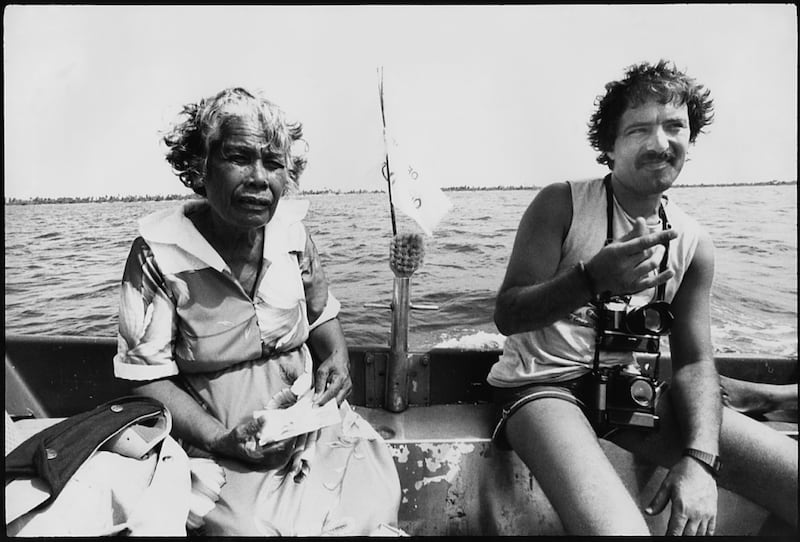
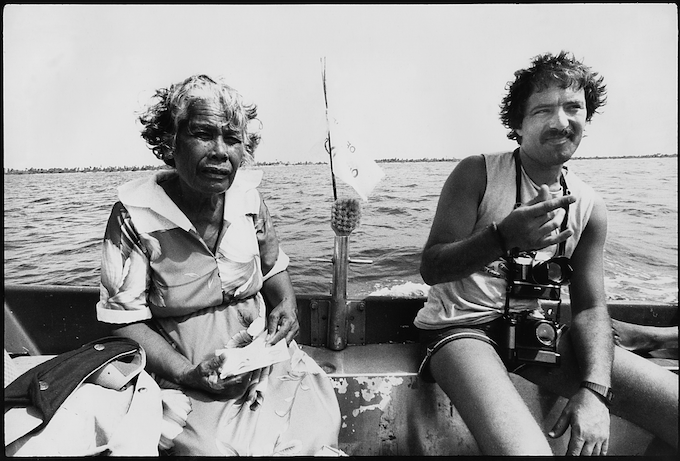
    Fernando Pereira
    Photographer Fernando Pereira and a woman from Rongelap on the day the Rainbow Warrior arrived in Rongelap Atoll in May 1985. Image: David Robie/Eyes of Fire

    Tui Warmenhoven (Ngāti Porou), the chair of the Greenpeace Aotearoa board, said it was a day to remember for the harm caused by the French state against the people of Mā’ohi Nui.

    Warmenhoven worked for 20 years in iwi research and is a grassroots, Ruatoria-based community leader who works to integrate mātauranga Māori with science to address climate change in Te Tai Rāwhiti.

    She encouraged Māori to stand united with Greenpeace.

    “Ko te mea nui ki a mātou, a Greenpeace Aotearoa, ko te whawhai i ngā mahi tūkino a rātou, te kāwanatanga, ngā rangatōpū, me ngā tāngata whai rawa, e patu ana i a mātou, te iwi Māori, ngā iwi o te ao, me ō mātou mātua, a Ranginui rāua ko Papatūānuku,” e ai ki a Warmenhoven.
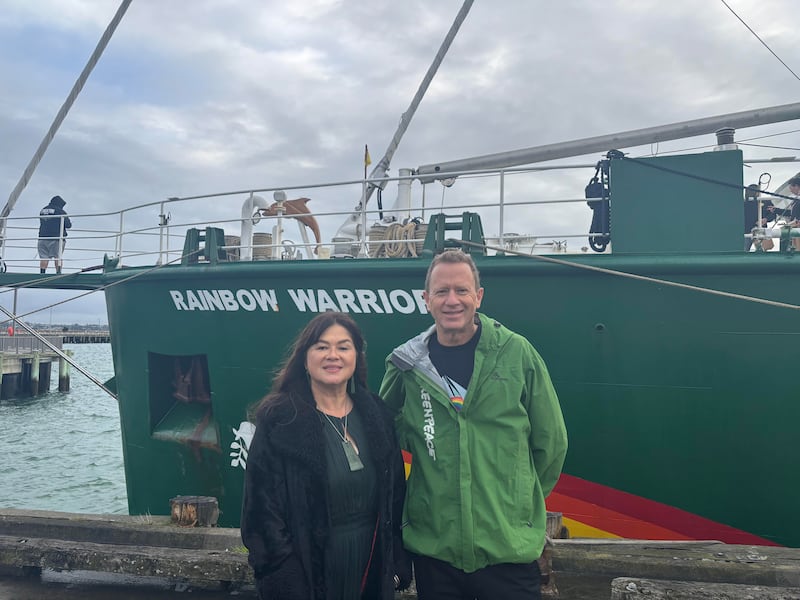
    Tui Warmenhoven and Dr Russel Norman
    Tui Warmenhoven and Dr Russel Norman in front of Rainbow Warrior III on 10 July 2025. Image:Te Ao Māori News

    A defining moment in Aotearoa’s nuclear-free stand
    “The bombing of the Rainbow Warrior was a defining moment for Greenpeace in its willingness to fight for a nuclear-free world,” said Dr Russel Norman, the executive director of Greenpeace Aotearoa.

    He noted it was also a defining moment for Aotearoa in the country’s stand against the United States and France, who conducted nuclear tests in the region.
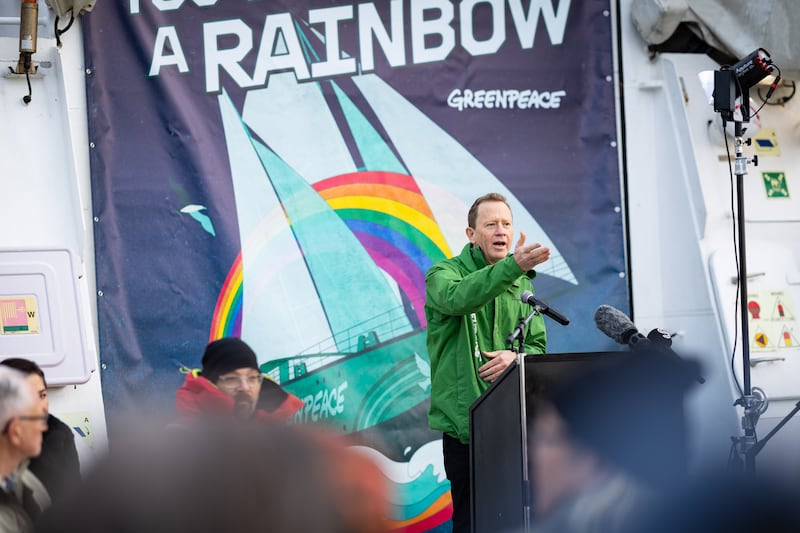
    Greenpeace Aotearoa executive director Dr Russel Norman
    Greenpeace Aotearoa executive director Dr Russel Norman speaking at the ceremony on board Rainbow Warrior III today. Image: Te Ao Māpri News

    In 1987, the New Zealand Nuclear Free Zone, Disarmament, and Arms Control Act officially declared the country a nuclear-free zone.

    This move angered the United States, especially due to the ban on nuclear-powered or nuclear-armed ships entering New Zealand ports.

    Because the US followed a policy of neither confirming nor denying the presence of nuclear weapons, it saw the ban as breaching the ANZUS Treaty and suspended its security commitments to New Zealand.

    The Rainbow Warrior’s final voyage before it was bombed was Operation Exodus, during which the crew helped relocate more than 320 residents of Rongelap Atoll in the Marshall Islands, who had been exposed to radiation from US nuclear testing between 1946 and 1958.
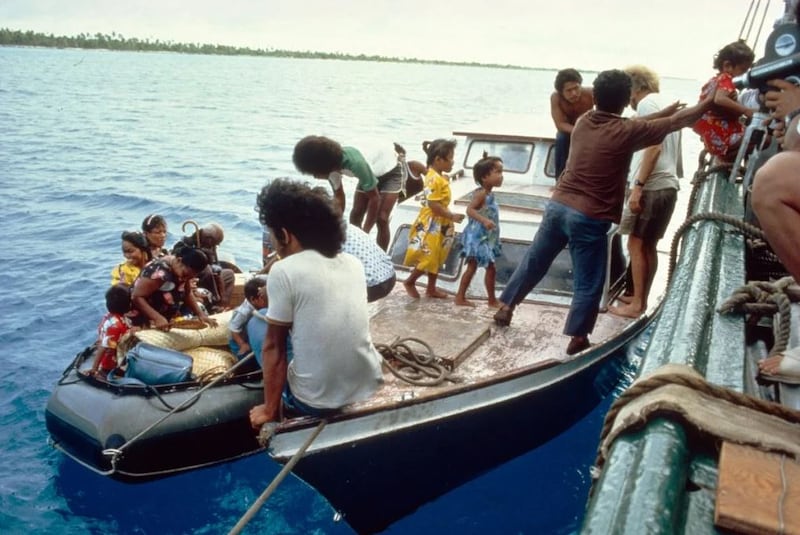
    The evacuation of Rongelap Islanders to Mejatto in 1985
    The evacuation of Rongelap Islanders to Mejatto by the Rainbow Warrior crew in May 1985. Image: Greenpeace/Fernando Pereira

    The legacy of Operation Exodus
    Between 1946 and 1958, the United States carried out 67 nuclear tests in the Marshall Islands.

    For decades, it denied the long-term health impacts, even as cancer rates rose and children were born with severe deformities.

    Despite repeated pleas from the people of Rongelap to be evacuated, the US government failed to act until Greenpeace stepped in to help.

    “The United States government effectively used them as guinea pigs for nuclear testing and radiation to see what would happen to people, which is obviously outrageous and disgusting,” Dr Norman said.

    He said it was important not to see Pacific peoples as victims, as they were powerful campaigners who played a leading role in ending nuclear testing in the region.
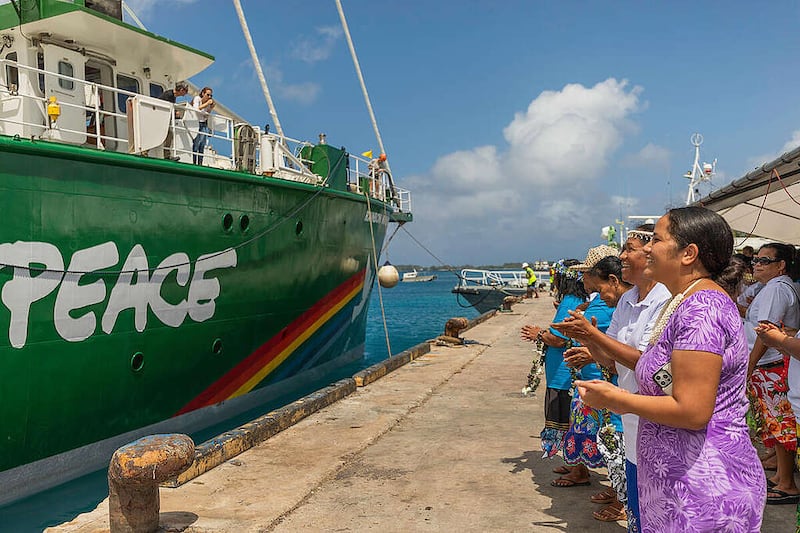
    Marshallese women greet the Rainbow Warrior in April 2025.
    Marshallese women greet the Rainbow Warrior as it arrived in the capital Majuro in March 2025. Image: Bianca Vitale/Greenpeace

    Between March and April this year, Rainbow Warrior III returned to the Marshall Islands to conduct independent research into the radiation levels across the islands to see whether it’s safe for the people of Rongelap to return.

    What advice do you give to this generation about nuclear issues?
    “Kia kotahi ai koutou ki te whai i ngā mahi uaua i mua i a mātou ki te whawhai i a rātou mā, e mahi tūkino ana ki tō mātou ao, ki tō mātou kōkā a Papatūānuku, ki tō mātou taiao,” hei tā Tui Warmenhoven.

    A reminder to stay united in the difficult world ahead in the fight against threats to the environment.

    Warmenhoven also encouraged Māori to support Greenpeace Aotearoa.
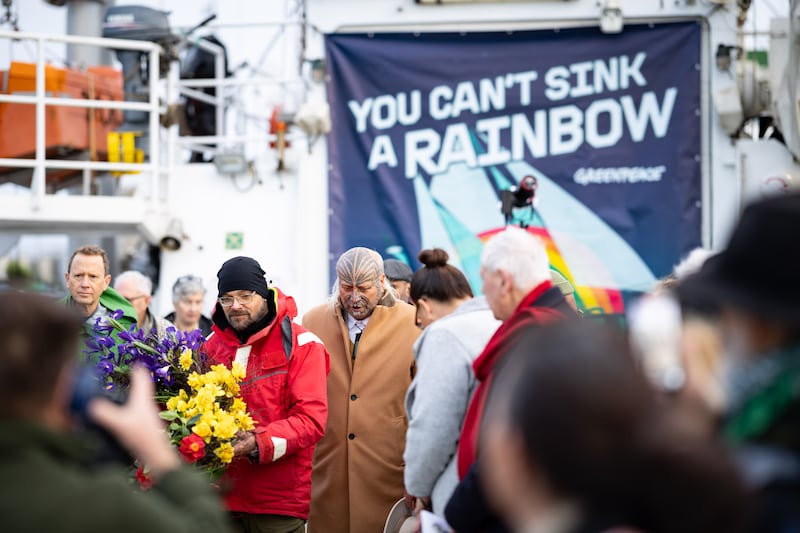
    Tui Warmenhoven and the captain of the Rainbow Warrior, Ali Schmidt
    Tui Warmenhoven and the captain of the Rainbow Warrior, Ali Schmidt, placed a wreath in the water at the stern of the ship in memory of Fernando Pereira. Image: Greenpeace

    Dr Norman believed the younger generations should be inspired to activism by the bravery of those from the Pacific and Greenpeace who campaigned for a nuclear-free world 40 years ago.

    “They were willing to take very significant risks, they sailed their boats into the nuclear test zone to stop those nuclear tests, they were arrested by the French, beaten up by French commandos,” he said.

    Republished from Te Ao Māori News with permission.

    This post was originally published on Asia Pacific Report.
  • Greenpeace

    Join us for this guided “virtual tour” around the Rainbow Warrior III in Auckland Harbour on the afternoon of 10 July 2025 — the 40th anniversary of the bombing of the original flagship.

    The Rainbow Warrior is a special vessel — it’s one of three present-day Greenpeace ships.

    The Rainbow Warrior works on the biggest issues affecting the future of our planet. It was the first ship in our fleet that was designed and built specifically for activism at sea.


    Virtual tour of the Rainbow Warrior.        Video: Greenpeace

    It also represents a continuation of the legacy of the previous two Rainbow Warriors.

    On this anniversary day we explored the ship and talked to key people about the current campaign to protect the world’s oceans.

    Programmes director Niamh O’Flynn presented the tour, starting on Halsey Wharf.

    Thanks to third mate Adriana, oceans campaigner Ellie; author David Robie, who sailed on the original Rainbow Warrior on the 1985 Rongelap relocation mission and whose new anniversary edition of Eyes of Fire: The Last Voyage and Legacy of the Rainbow Warrior is being launched tonight, radio engineer Neil and Captain Ali!

    Watch the commemoration ceremony this morning on 10 July 2025.

    More information and make donations.

    This post was originally published on Asia Pacific Report.

  • By Aui’a Vaimaila Leatinu’u of PMN News

    I didn’t know much about the surrounding context of the infamous Rainbow Warrior bombing 40 years ago on Thursday. All I knew was that we, as a country, have not forgotten.

    I was born in 1996, and although I didn’t know much about the vessel’s bombing, which galvanised anti-nuclear sentiment across Aotearoa further, the basics were common knowledge growing up.

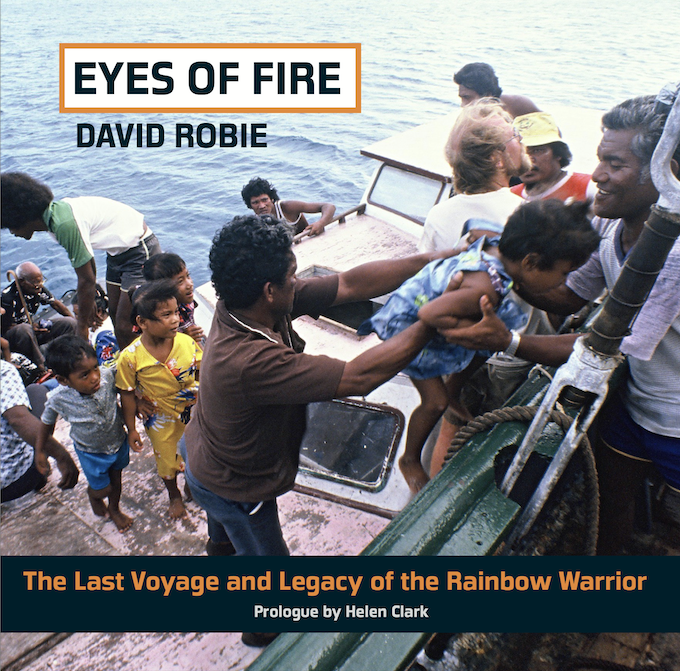
    So, when I got the opportunity to read the Eyes of Fire: The Last Voyage and Legacy of the Rainbow Warrior (40th Anniversary edition) by veteran journalist David Robie, who was on board the ship during its mission to the Marshall Islands, I dove in.

    On 10 July 1985, French secret agents destroyed the Rainbow Warrior at Marsden Wharf in Auckland, killing Portuguese-born Greenpeace photographer Fernando Pereira and sparking global outrage.

    The Rainbow Warrior protested nuclear weapons testing in the Pacific, specifically targeting French atmospheric and underground nuclear tests at Moruroa and Fangataufa atolls.

    Their efforts drew international attention to the environmental devastation and human suffering caused by decades of radioactive fallout.

    There’s plenty to learn from this book in terms of the facts, but what I took away from it most is its continued relevance since its original publication in 1986.

    The opening prologue is former New Zealand Prime Minister Helen Clark’s reflection on the Warrior’s bombing, Pereira’s death and the current socio-political climate of today in relation to back then.

    Clark makes remarks on AUKUS, nuclear weapons and geopolitical pressures, describing it all as “storm clouds gathering again”.

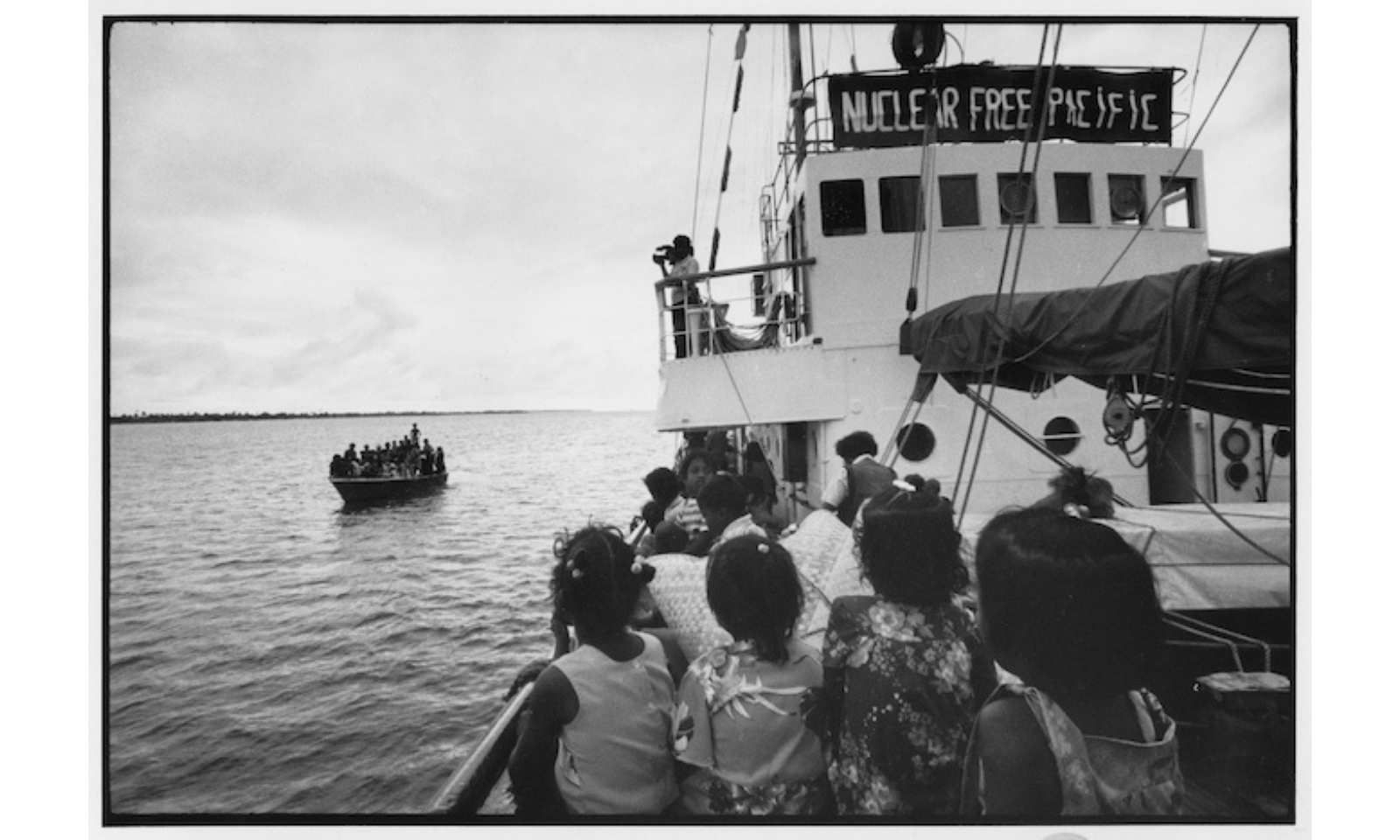
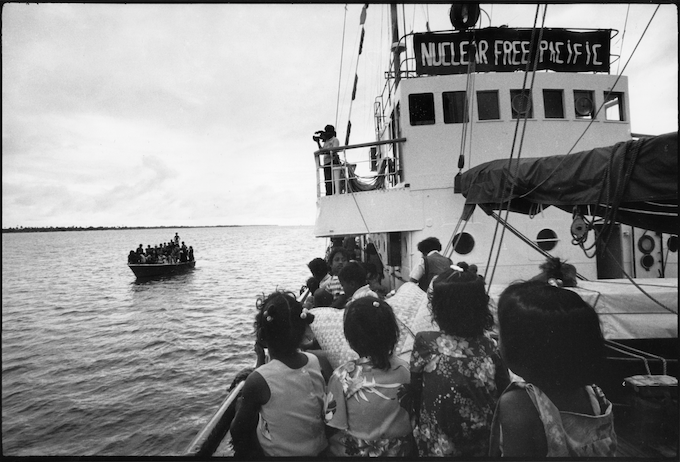
    The Nuclear Free Pacific banner on the Rainbow Warrior. Image: David Robie
    The Nuclear Free Pacific banner on the Rainbow Warrior. Image: David Robie

    Nuclear fallout
    It has been a tumultuous period for the Pacific region in the political realm, between being at the mercy of a tug-of-war between global superpowers and the impending finality of climate change to the livelihoods of many.

    With EOF’s 40th Anniversary edition, it is yet another documentation of these turbulent times for the Pacific, which have never really stopped since colonial powers first made contact.

    Between 1946 and 1958, the United States conducted 67 atmospheric and underwater tests in the Marshall Islands. Then, in 1966, the French launched 46 atmospheric tests between 1966 and 1974, followed by 147 underground bombs from 1975 to 1996 after widespread international protest and scrutiny.

    Specifically, the US 1954 Castle Bravo nuclear test, the largest atmospheric hydrogen bomb test, resulted in the fallout’s ash coating Rongelap Atoll. Though the US evacuated residents days later, they returned them in 1957, leaving them to suffer from health effects like miscarriages, cancer, and birth deformities.

    Eventually, the Rainbow Warrior helped evacuate the Rongelap people in 1985 over several trips, where the locals packed down their homes and brought them onboard.

    Throughout history to today, there’s a theme of constant disregard and dehumanisation of my people by the West.

    PMN News interview with Dr David Robie on 20 May 2025
    PMN News interview with Dr David Robie on 20 May 2025.

    When does it stop?
    A decade prior to the Rongelap evacuation, the infamous Dawn Raids occurred, where it wasn’t until 1986 that a Race Relations investigation found Pacific people comprised roughly a third of overstayers yet represented 86 per cent of all prosecutions.

    The 506-day Bastion Point protest also occurred between 1977 and 1978, where Ngāti Whātua, led by Joe Hawke, pushed back against a proposed Crown sale of that land.

    In the end, around 500 NZ police and army forcefully evicted the peaceful protestors.

    So, while this was all happening, the Pacific, specifically the Marshall Islands and French Polynesia region, were reeling from the decades of nuclear testing and consequential sickness, pain and death.

    Today, the Pacific is stuck between geopolitical egos, the fear of being used as a resource stepping stone, internal struggles, economic destabilisation and pleas for climate change to be made a priority not to save sinking islands but the world.

    Amid this “political football”, it constantly feels like Pacific and Māori end up being the ball.

    Robie’s book tells heartfelt moments with its facts, which helps connect to its story at a deeper level beyond sharing genealogy with the people involved.

    Voices within it don’t hold back their urgency or outrage towards what happened, especially how that past negligence by bodies of power continues today.

    When I read books like EOF 40th, whether it’s about my tangata Māori or Tagata Moana, I often close them and wonder: When do we get a break? When does it stop?

    I wish I had an answer, but I don’t. At least we will always have answers on what happened to the Rainbow Warrior and why.

    No matter what, it is indisputable that an informed generation will navigate the future better than their predecessors, and with EOF 40th, they’ll be well-equipped.

    Republished from PMN News with permission.

    This post was originally published on Asia Pacific Report.
  • TVNZ 1News

    The Greenpeace flagship Rainbow Warrior has sailed into Auckland to mark the 40th anniversary of the bombing of the original Rainbow Warrior in 1985.

    Greenpeace’s vessel, which had been protesting nuclear testing in the Pacific, sank after French government agents planted explosives on its hull, killing Portuguese-Dutch photographer Fernando Pereira.

    Today, 40 years on from the events on July 10 1985, a dawn ceremony was held in Auckland.

    Author Margaret Mills was a cook on board the ship at the time, and has written about her experience in a book entitled Anecdotage.

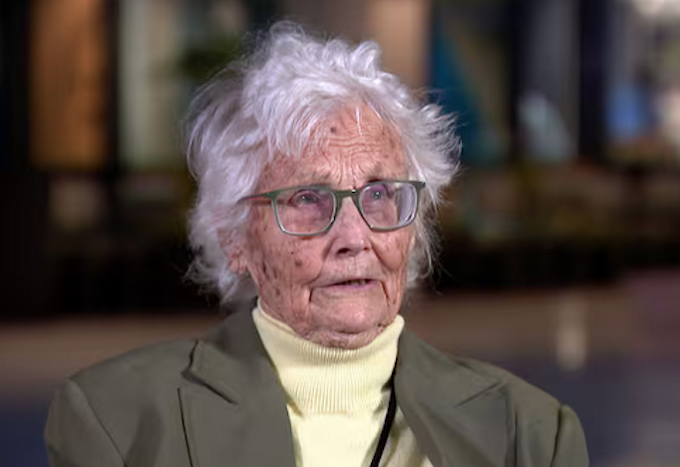
    Author Margaret Mills tells TVNZ Breakfast about the night of the Rainbow Warrior bombing 40 years ago
    Author Margaret Mills tells TVNZ Breakfast about the night of the Rainbow Warrior bombing 40 years ago. Image: TVNZ

    The 95-year-old told TVNZ Breakfast the experience on board “changed her life”.

    “I was sound asleep, and I heard this sort of bang and turned the light on, but it wouldn’t go on.

    She said when she left her cabin, a crew member told her “we’ve been bombed”.

    ‘I laughed at him’
    “I laughed at him, I said ‘we don’t get bombs in New Zealand, that’s ridiculous’.”

    She said they were taken to the police station after a “big boom when the second bomb came through”.

    “I realised immediately, I was part of a historical event,” she said.

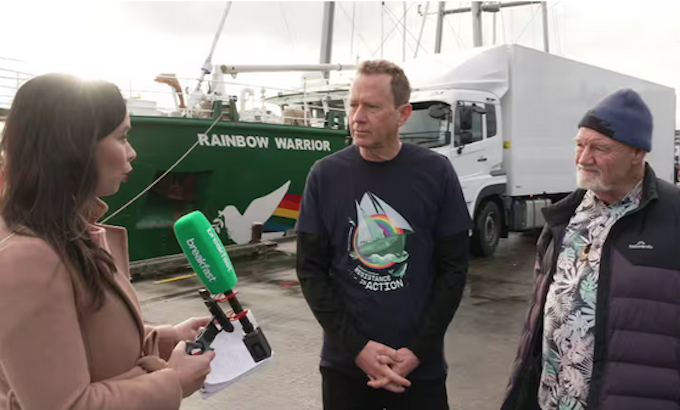
    TVNZ reporter Corazon Miller talks to Greenpeace Aotearoa executive director Russel Norman and journalist David Robie after the Rainbow Warrior memorial dawn service today
    TVNZ reporter Corazon Miller talks to Greenpeace Aotearoa executive director Russel Norman (centre) and journalist David Robie after the Rainbow Warrior memorial dawn service today. Image: TVNZ

    Journalist David Robie. who travelled on the Rainbow Warrior and wrote the book Eyes of Fire: The Last Voyage and Legacy of the Rainbow Warrior published today, told Breakfast it was a “really shocking, shocking night”.

    “We were so overwhelmed by the grief and absolute shock of what had happened. But for me, there was no doubt it was France behind this.”

    “But we were absolutely flabbergasted that a country could do this.”

    He said it was a “very emotional moment” and was hard to believe it had been 40 years since that time.

    ‘Momentous occasion’
    “It stands out in my life as being the most momentous occasion as a journalist covering that whole event.”

    Executive director of Greenpeace Aotearoa Russel Norman said the legacy of the ship was about “people who really stood up for something important”.

    “I mean, ending nuclear testing in the Pacific, imagine if they were still exploding bombs in the Pacific. We would have to live with that.

    “And those people back then they stood up and beat the French government to end nuclear testing.

    “It’s pretty inspirational.”

    He said the group were still campaigning on some key environmental issues today.

    This post was originally published on Asia Pacific Report.
  • RNZ News Nights

    Tomorrow marks 40 years since the bombing and sinking of the Rainbow Warrior — a moment that changed the course of New Zealand’s history and reshaped how we saw ourselves on the world stage.

    Two French agents planted two explosives on the ship, then just before midnight, explosions ripped through the hull killing photographer, Fernando Pereira and sinking the 47m ex-fishing trawler.

    The attack sparked outrage across the country and the world, straining diplomatic ties between New Zealand and France and cementing the country’s anti-nuclear stance.

    Few people are more closely linked to the ship than author and journalist Dr David Robie, who spent eleven weeks on board during its final voyage through the Pacific, and wrote the book, Eyes of Fire: The Last Voyage and Legacy of the Rainbow Warrior, which is being published tomorrow. He joins Emile Donovan.

    This post was originally published on Asia Pacific Report.

  • Asia Pacific Report

    A prominent academic has criticised the New Zealand coalition government for compromising the country’s traditional commitment to upholding an international rules-based order due to a “desire not to offend” the Trump administration.

    Professor Robert Patman, an inaugural sesquicentennial distinguished chair and a specialist in international relations at the University of Otago, has argued in a contributed article to The Spinoff that while distant in geographic terms, “brutal violence in Gaza, the West Bank and Iran marks the latest stage in the unravelling of an international rules-based order on which New Zealand depends for its prosperity and security”.

    Dr Patman wrote that New Zealand’s founding document, the 1840 Treaty of Waitangi, emphasised partnership and cooperation at home, and, after 1945, helped inspire a New Zealand worldview enshrined in institutions such as the United Nations and norms such as multilateralism.

    Professor Robert Patman
    Professor Robert Patman . . . “Even more striking was the government’s silence on President Trump’s proposal to own Gaza with a view to evicting two million Palestinian residents.” Image: University of Otago

    “In the wake of Hamas’ terrorist attacks in Israel on October 7, 2023, the National-led coalition government has in principle emphasised its support for a lasting ceasefire in Gaza and the need for a two-state solution to the Israeli-Palestinian conflict over the occupied territories of East Jerusalem, Gaza and the West Bank,” he wrote.

    However, Dr Patman said, in practice this New Zealand stance had not translated into firm diplomatic opposition to the Netanyahu government’s quest to control Gaza and annex the West Bank.

    “Nor has it been a condemnation of the Trump administration for prioritising its support for Israel’s security goals over international law,” he said.

    Foreign minister Winston Peters had described the situation in Gaza as “simply intolerable” but the National-led coalition had little specific to say as the Netanyahu government “resumed its cruel blockade of humanitarian aid to Gaza in March and restarted military operations there”.

    Silence on Trump’s ‘Gaza ownership’
    “Even more striking was the government’s silence on President Trump’s proposal to own Gaza with a view to evicting two million Palestinian residents from the territory and the US-Israeli venture to start the Gaza Humanitarian Foundation (GHF) in late May in a move which sidelined the UN in aid distribution and has led to the killing of more than 600 Palestinians while seeking food aid,” Dr Patman said.

    While New Zealand, along with the UK, Australia, Canada and Norway, had imposed sanctions on two far-right Israeli government ministers, Bezalel Smotrich and Itamar ben Gvir, in June for “inciting extremist violence” against Palestinians — a move that was criticised by the Trump administration — it was arguably a case of very little very late.

    “The Hamas terror attacks on October 7 killed around 1200 Israelis, but the Netanyahu government’s retaliation by the Israel Defence Force (IDF) against Hamas has resulted in the deaths of more than 56,000 Palestinians — nearly 70 percent of whom were women or children — in Gaza.

    Over the same period, more than 1000 Palestinians had been killed in the West Bank as Israel accelerated its programme of illegal settlements there.

    ‘Strangely ambivalent’
    In addition, the responses of the New Zealand government to “pre-emptive attacks” by Israel (13-25 June) and Trump’s United States (June 22) against Iran to destroy Iran’s nuclear capabilities were strangely ambivalent.

    Despite indications from US intelligence and the International Atomic Energy Agency (IAEA) that Iran had not produced nuclear weapons, Foreign Minister Peters had said New Zealand was not prepared to take a position on that issue.

    Confronted with Trump’s “might is right” approach, the National-led coalition faced stark choices, Dr Patman said.

    The New Zealand government could continue to fudge fundamental moral and legal issues in the Middle East and risk complicity in the further weakening of an international rules-based order it purportedly supports, “or it can get off the fence, stand up for the country’s values, and insist that respect for international law must be observed in the region and elsewhere without exception”.

    This post was originally published on Asia Pacific Report.
  • By Anish Chand in Suva

    How Pacific live media communications have changed in the past 21 years.

    In May 2004, the live broadcast of Ratu Sir Kamisese Mara’s funeral from Lau required a complex and resource-intensive setup.

    Fiji TV relied on assistance from TVNZ, deploying a portable satellite installation to transmit signals from Lau to a satellite up in the sky, then to Auckland, back to another satellite, and finally down to Suva.

    This set-up required approval from FINTEL.

    This intricate process underscored the technological limitations of the time, where live coverage from remote Fiji areas demanded significant logistical coordination and international support.

    Fast forward to 2025, 21 years later, and the communication and media landscape in Fiji has undergone a remarkable transformation.

    Today, I see video production houses, TV stations, radio stations, and newspaper media outlets delivering live coverage directly from Lau.

    This shows how high-speed internet, mobile networks, and portable streaming devices like Starlink has eliminated the need for cumbersome satellite relays. No approval from any authority.

    Where once international partnerships were essential, today’s media teams in Fiji can operate independently, delivering seamless live coverage of cultural, political, and social events from even the most isolated areas.

    Republished from Fiji Times managing digital editor Anish Chand’s social media post with permission. He is a former Fiji TV news operations manager.

    This post was originally published on Asia Pacific Report.
  • FORUM-ASIA and Suara Rakyat Malaysia (SUARAM) welcome the reply from the ASEAN Intergovernmental Commission on Human Rights (AICHR) regarding the cases of two Malaysian human rights advocates and other human rights defenders. 

    The response was delivered by the Chair of AICHR / AICHR Malaysia, Edmund Bon Tai Soon, following a submission made by FORUM-ASIA on 25 March 2025, concerning the judicial harassment of Mr. Sevan Doraisamy, Executive Director of Suara Rakyat Malaysia (SUARAM), and Ms. Azura Nasron, Programme Manager at SUARAM and a family member of a detainee held under Security Offences (Special Measures) Act (SOSMA). The letter also emphasised the importance of aligning domestic laws affecting freedom of expression and freedom of peaceful assembly and of association with the ASEAN Human Rights Declaration and Phnom Penh Statement. The response was based on the demand for AICHR’s involvement in the review process of SOSMA, as previously committed by Malaysia’s Prime Minister Anwar Ibrahim.

    “We sincerely thank you, in your capacity as Malaysia’s Representative and Chair of the ASEAN Intergovernmental Commission on Human Rights (AICHR), for the proactive steps taken in response to the concerns we raised. We especially appreciate your efforts to engage with relevant national agencies and consult them on this matter,” said Mary Aileen Diez-Bacalso, Executive Director of FORUM-ASIA.

    Background

    In the letter, FORUM-ASIA expressed concern over the summons issued to three human rights advocates and family members of SOSMA detainees. The summonses followed a peaceful initiative on 10 February 2025, during which the individuals  sought to engage with the Ministry of Home Affairs (MOHA), submit a memorandum, and obtain information regarding the conditions and well-being of their detained relatives. 

    The organisation also reiterated its deep concern over the continued use of several problematic laws,  including  the Communications and Multimedia Act 1998, the Sedition Act 1948, the Printing Presses and Publications Act 1984, the Online Safety Act 2024, the Societies Act 1966, and various provisions of the Penal Code.

    At the same time, FORUM-ASIA  acknowledged and welcomed the government’s announced intention to amend the Peaceful Assembly Act 2012, particularly the proposed repeal of Section 11 to better  facilitate public gatherings, as well as the moratorium imposed by the Prime Minister in February 2025 and the ongoing review of  SOSMA. 


    Response from AICHR

    On 19 June 2025, AICHR Malaysia stated in its response that the Representative had engaged with and obtained further information from relevant national agencies. It was reported that investigation files were opened regarding the cases involving the named individuals; however, these cases were later classified as “No Further Action” (NFA).

    “We view this as a positive precedent, demonstrating that AICHR, as a regional mechanism, can be responsive to complaints of human rights violations brought before it. Moving forward, such complaints must also be addressed with actionable and time-bound measures to ensure accountability to the victims,” added Bacalso.

    “We trust that, as the current Chair of AICHR, you will continue to exercise the mandate under Articles 4.7 and 4.10 of the AICHR Terms of Reference, to provide advisory services and technical assistance on human rights issues, and to request and obtain information from ASEAN Member States in relation to the promotion and protection of human rights. We would be pleased to provide additional information pertaining to these laws and reaffirm our commitment to continued engagement with AICHR on matters concerning the protection and promotion of human rights in the region,” concluded Bacalso.


    Ways Forward

    Despite this positive step toward the case and the review and reassessment of the PAA and SOSMA in upholding civil liberties, FORUM-ASIA and SUARAM would like to respectfully draw attention to the other aforementioned problematic laws, which are weaponised by the state to curtail rights to freedom of expression, peaceful assembly, association and access to information – including among human rights defenders in the country.

    FORUM-ASIA and SUARAM reiterate our call for AICHR to evolve into a more resilient, innovative, and adaptive institution, in line with the newly adopted ASEAN Vision 2045. This transformation should include developing mechanisms to enhance AICHR’s proactiveness in addressing human rights violations in the region—whether through practice or integration into its Terms of Reference, which is currently under revision


    The Asian Forum for Human Rights and Development (FORUM-ASIA)

    The Asian Forum for Human Rights and Development (FORUM-ASIA) is a network of 85 member organisations across 23 countries, mainly in Asia. Founded in 1991, FORUM-ASIA works to strengthen movements for human rights and sustainable development through research, advocacy, capacity development and solidarity actions in Asia and beyond. It has consultative status with the United Nations Economic and Social Council, and consultative relationship with the ASEAN Intergovernmental Commission on Human Rights. The FORUM-ASIA Secretariat is based in Bangkok, with offices in Jakarta, Geneva and Kathmandu. www.forum-asia.org

    Suara Rakyat Malaysia (SUARAM) is a non-governmental organisation established in 1989 to monitor and advocate for the respect of human rights in Malaysia. Through its consistent and uncompromising work, it has established itself as one of the key human rights organisations, one to which Malaysians turn for information and support.

    For media inquiries: communication@forum-asia.org


    The post [Joint Statement] Malaysia: AICHR’s responsiveness to better protect human rights defenders is crucial first appeared on FORUM-ASIA.

    This post was originally published on FORUM-ASIA.

  • RNZ Pacific

    The Bougainville election process begins today with the issuance of the writs yesterday.

    Nominations open Tuesday, July 8, and close on Thursday, July 10.

    Voting is scheduled for one week starting on September 2, allowing seven weeks of campaigning.

    Candidates will be vying for a total of 46 seats, with the autonomous Parliament agreeing earlier this year to add five additional seats.

    The seats were created with the establishment of five new constituencies: two in South and Central, and one in North Bougainville.

    “This is one of the most important democratic tasks of any nation — to conduct elections where the people exercise the ultimate power to re-elect or de-elect the representatives who have served them in the last House,” Bougainville Parliament Speaker Simon Pentanu said.

    “The elections in Bougainville have always been fair, honest, transparent, and equitable. This is a history we should all be proud of and a record we must continue to uphold,” he said.

    The region’s Electoral Commissioner Desmond Tsianai said the issuing of writs was a significant event in the electoral calendar.

    “We have delivered credible elections in the past and I assure you all that we are prepared, and we will have this election delivered at international standards of free, fair and inclusive — and most importantly, according to the law.”

    This article is republished under a community partnership agreement with RNZ.

    This post was originally published on Asia Pacific Report.
  • By Caleb Fotheringham, RNZ Pacific journalist

    The New Zealand Defence Force (NZDF) is not considering recruiting personnel from across the Pacific as talk continues of Australia doing so for its Defence Force (ADF).

    In response to a question from The Australian at the National Press Club in Canberra about Australia’s plans to potentially recruit from the Pacific Islands into the ADF, Fiji Prime Minister Sitiveni Rabuka said he “would like to see it happen”.

    “Whether Australia does it or not depends on your own policies. We will not push it.”

    RNZ Pacific asked the NZDF under the Official Information Act (OIA) for all correspondence sent and received regarding any discussion on recruiting from the Pacific, along with other related questions.

    The OIA request was declined as the information did not exist.

    “Defence Recruiting has not and is not considering deliberate recruiting action from across the Pacific,” the response from the NZDF said.

    Australia Defence Association executive director Neil James said citizenship needed to be a prerequisite to Pacific recruitment.

    Australian citizen
    “Even a New Zealander serving in the Australian military has to become an Australian citizen,” James said.

    “They can start off being an Australian resident, but they’ve got to be on the path to citizenship.

    ”They’ve got to be capable of getting permanent residency in Australia and citizenship.

    “And then you’ve got to tackle the moral problem — it’s pretty hard to ask foreigners to fight for your country when your own people won’t do it.”

    James said he thought people might be “jumping at hairs” at Rabuka’s comments.

    Unlike Samoa’s acting prime minister, who has voiced concern over a brain drain, both Papua New Guinea and Fiji have made it clear they have people to spare.

    Ross Thompson, a managing director at People In, the largest approved employer in the Pacific Australia Labour Mobility Scheme, said if the recruitment drive does go ahead, PNG nationals would return home with a wider skill set.

    ‘Brain gain, not drain’
    “This would be a brain gain, rather than be a drain on PNG.”

    He’s spoken with people in PNG who welcome the proposal.

    ”PNG, its population is over 10 million . . . We’re proposing from PNG around 1000 could be recruited every year.”

    Minister Rabuka joked Fiji could plug Australia’s personnel hole on its own.

    “If it’s open [to recruiting Fijians] . . . [we will offer] the whole lot . . . 5000,” he said, while noting that Fiji was able to easily fill its quota under the Pacific Australia Labour Mobility (PALM) scheme.

    “The villages are emptying out into the cities. What we would like to do is to reduce those who are ending up in settlements in the cities and not working, giving way to crime and becoming first victims to the sale of drugs and AIDS and HIV from frequently used or commonly used needles.”

    Thompson was also a captain in the Queen’s Gurkha Engineers of the British Army and said he was proud to have served alongside Fijians.

    Honour serving
    “I had the honour to serve with a number of Fijians while deployed overseas; they’re fantastic soldiers.

    “This is something that’s been going on since the Second World War and it’s a big part of the British Army.”

    From a recruitment perspective, he said PNG and Fiji would be a good starting point before extending to any other Pacific nations.

    ”PNG has a strong history with the Australian Defence Force. There’s a number of programmes that are currently ongoing, on shared military exercises, there’s PNG officers that are serving in the ADF now, or on secondment to the ADF.

    “So I think those two countries are definitely good to look up from a pilot perspective.”

    This article is republished under a community partnership agreement with RNZ.

    This post was originally published on Asia Pacific Report.
  • COMMENTARY:  By Eugene Doyle

    On the last voyage of the Rainbow Warrior prior to its sinking by French secret agents in Auckland harbour on 10 July 1985 the ship had evacuated the entire population of 320 from Rongelap in the Marshall Islands.

    After conducting dozens of above-ground nuclear explosions, the US government had left the population in conditions that suggested the islanders were being used as guinea pigs to gain knowledge of the effects of radiation.

    Cancers, birth defects, and genetic damage ripped through the population; their former fisheries and land are contaminated to this day.

    Denied adequate support from the US – they turned to Greenpeace with an SOS: help us leave our ancestral homeland; it is killing our people. The Rainbow Warrior answered the call.

    Human lab rats or our brothers and sisters?
    Dr Merrill Eisenbud, a physicist in the US Atomic Energy Commission (AEC) famously said in 1956 of the Marshall Islanders:  “While it is true that these people do not live, I might say, the way Westerners do, civilised people, it is nevertheless also true that they are more like us than the mice.”

    Dr Eisenbud also opined that exposure “would provide valuable information on the effects of radiation on human beings.”  That research continues to this day.

    A half century of testing nuclear bombs
    Within a year of dropping nuclear bombs on Hiroshima and Nagasaki, the US moved part of its test programme to the central Pacific.  Bikini Atoll in the Marshall Islands was used for atmospheric explosions from 1946 with scant regard for the indigenous population.

    In 1954, the Castle Bravo test exploded a 15-megaton bomb —  one thousand times more deadly than the one dropped on Hiroshima.  As a result, the population of Rongelap were exposed to 200 roentgens of radiation, considered life-threatening without medical intervention. And it was.

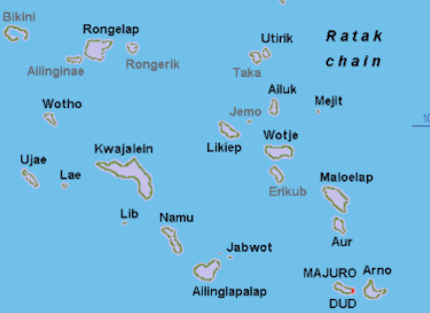
    Part of the Marshall Islands, with Bikini Atoll and Rongelap in the top left
    Part of the Marshall Islands, with Bikini Atoll and Rongelap in the top left. Image: www.solidarity.co.nz

    Total US tests equaled more than 7000 Hiroshimas.  The Clinton administration released the aptly-named Advisory Committee on Human Radiation Experiments (ACHRE), report in January 1994 in which it acknowledged:

    “What followed was a program by the US government — initially the Navy and then the AEC and its successor agencies — to provide medical care for the exposed population, while at the same time trying to learn as much as possible about the long-term biological effects of radiation exposure. The dual purpose of what is now a DOE medical program has led to a view by the Marshallese that they were being used as ‘guinea pigs’ in a ‘radiation experiment’.

    This impression was reinforced by the fact that the islanders were deliberately left in place and then evacuated, having been heavily radiated. Three years later they were told it was “safe to return” despite the lead scientist calling Rongelap “by far the most contaminated place in the world”.

    Significant compensation paid by the US to the Marshall Islands has proven inadequate given the scale of the contamination.  To some degree, the US has also used money to achieve capture of elite interest groups and secure ongoing control of the islands.

    Entrusted to the US, the Marshall Islanders were treated like the civilians of Nagasaki
    The US took the Marshall Islands from Japan in 1944.  The only “right” it has to be there was granted by the United Nations which in 1947 established the Trust Territory of the Pacific Islands, to be administered by the United States.

    What followed was an abuse of trust worse than rapists at a state care facility.  Using the very powers entrusted to it to protect the Marshallese, the US instead used the islands as a nuclear laboratory — violating both the letter and spirit of international law.

    Fellow white-dominated countries like Australia and New Zealand couldn’t have cared less and let the indigenous people be irradiated for decades.

    The betrayal of trust by the US was comprehensive and remains so to this day:

    Under Article 76 of the UN Charter, all trusteeship agreements carried obligations. The administering power was required to:

    • Promote the political, economic, social, and educational advancement of the people
    • Protect the rights and well-being of the inhabitants
    • Help them advance toward self-government or independence.

    Under Article VI, the United States solemnly pledged to “Protect the inhabitants against the loss of their lands and resources.”  Very similar to sentiments in New Zealand’s Treaty of Waitangi.  Within a few years the Americans were exploding the biggest nuclear bombs in history over the islands.

    Within a year of the US assuming trusteeship of the islands, another pillar of international law came into effect: the Universal Declaration of Human Rights (1948) — which affirms the inherent dignity and equal rights of all humans. Exposing colonised peoples to extreme radiation for weapons testing is a racist affront to this.

    America has a long history of making treaties and fine speeches and then exploiting indigenous peoples.  Last year, I had the sobering experience of reading American military historian Peter Cozzens’ The Earth is Weeping, a history of the “Indian wars” for the American West.

    The past is not dead: the Marshall Islands are a hive of bases, laboratories and missile testing; Americans are also incredibly busy attacking the population in Gaza today.

    Eyes of Fire – the last voyage of the Rainbow Warrior
    Had the French not sunk the Rainbow Warrior after it reached Auckland from the Rongelap evacuation, it would have led a flotilla to protest nuclear testing at Moruroa in French Polynesia.  So the bookends of this article are the abuse of defenceless people in the charge of one nuclear power — the US —  and the abuse of New Zealand and the peoples of French Polynesia by another nuclear power — France.

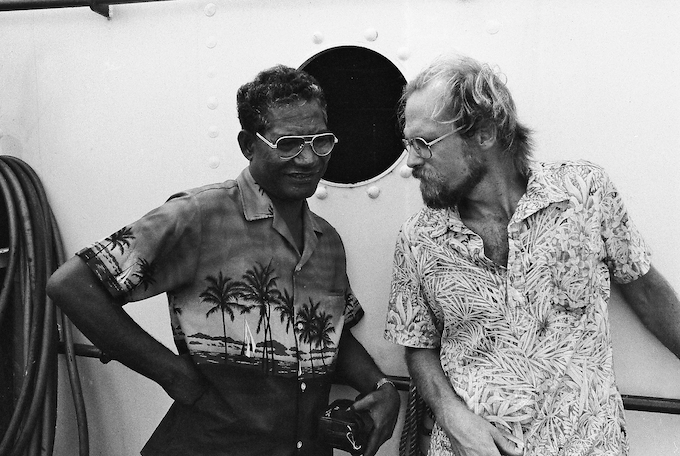
    Senator Jeton Anjain (left) of Rongelap and Greenpeace campaign coordinator Steve Sawyer on board the Rainbow Warrior
    Senator Jeton Anjain (left) of Rongelap and Greenpeace campaign coordinator Steve Sawyer on board the Rainbow Warrior . . . challenging the abuse of defenceless people under the charge of one nuclear power. Image: David Robie/Eyes of Fire

    This incredible story, and much more, is the subject of David Robie’s outstanding book Eyes of Fire: The Last Voyage and Legacy of the Rainbow Warrior, published by Little Island Press, which has been relaunched to mark the 40th anniversary of the French terrorist attack.

    A new prologue by former prime minister Helen Clark and a preface by Greenpeace’s Bunny McDiarmid, along with an extensive postscript which bring us up to the present day, underline why the past is not dead; it’s with us right now.

    Between them, France and the US have exploded more than 300 nuclear bombs in the Pacific. Few people are told this; few people know this.

    Today, a matrix of issues combine — the ongoing effects of nuclear contamination, sea rise imperilling Pacific nations, colonialism still posing immense challenges to people in the Marshall Islands, Kanaky New Caledonia and in many parts of our region.

    Unsung heroes
    Our media never ceases to share the pronouncements of European leaders and news from the US and Europe but the leaders and issues of the Pacific are seldom heard. The heroes of the antinuclear movement should be household names in Australia and New Zealand.

    Vanuatu’s great leader Father Walter Lini; Oscar Temaru, Mayor, later President of French Polynesia; Senator Jeton Anjain, Darlene Keju-Johnson and so many others.

    Do we know them?  Have we heard their voices?

    Jobod Silk, climate activist, said in a speech welcoming the Rainbow Warrior III to Majuro earlier this year:  “Our crusade for nuclear justice intertwines with our fight against the tides.”

    Nuclear-Free and Independent Pacific . . . the Rainbow Warrior
    Nuclear-Free and Independent Pacific . . . the Rainbow Warrior taking on board Rongelap islanders ready for their first of four relocation voyages to Mejatto island. Image: David Robie/Eyes of Fire

    Former Tuvalu PM Enele Sapoaga castigated Australia for the AUKUS submarine deal which he said “was crafted in secret by former Prime Minister Scott Morrison with no public discussion.”

    He challenged the bigger regional powers, particularly Australia and New Zealand, to remember that the existential threat faced by Pacific nations comes first from climate change, and reminded New Zealanders of the commitment to keeping the South Pacific nuclear-free.

    Hinamoeura Cross, a Tahitian anti-nuclear activist and politician, said in a 2019 UN speech: “Today, the damage is done. My people are sick. For 30 years we were the mice in France’s laboratory.”

    Until we learn their stories and know their names as well as we know those of Marco Rubio or Keir Starmer, we will remain strangers in our own lands.

    The Pacific owes them, along with the people of Greenpeace, a huge debt.  They put their bodies on the line to stop the aggressors. Greenpeace photographer Fernando Pereira, killed by the French in 1985, was just one of many victims, one of many heroes.

    A great way to honour the sacrifice of those who stood up for justice, who stood for peace and a nuclear-free Pacific, and who honoured our own national identity would be to buy David Robie’s excellent book.

    You cannot sink a rainbow.

    Greenpeace photographer Fernando Pereira
    Greenpeace photographer Fernando Pereira being welcomed to Rongelap Atoll by a villager in May 1985 barely two months before he was killed by French secret agents during the sabotage of the Rainbow Warrior. Image: David Robie/Eyes of Fire

    This post was originally published on Asia Pacific Report.
  • Pacific Media Watch

    West Papuan independence advocate Octovianus Mote was in Aotearoa New Zealand late last year seeking support for independence for West Papua, which has been ruled by Indonesia for more than six decades.

    Mote is vice-president of the United Liberation Movement for West Papua (ULMWP) and was hosted in New Zealand by the Green Party, which Mote said had always been a “hero” for West Papua.

    He spoke at a West Papua seminar at the Māngere Mountain Education Centre and in this Talanoa TV segment he offers prayers for the West Papuan solidarity movement.

    In a “blessing for peace and justice”, Octo Mote spoke of his hopes for the West Papuan struggle for independence at lunch at the Mount Albert home of New Zealand activist Maire Leadbeater in September 2024.

    He gave a tribute to Leadbeater and the Whānau Community Centre and Hub’s Nik Naidu, saying:

    “We remember those who cannot eat like us, especially those who oppressed . . . The 80,000 people in Papua who have had to flee their homes because of the Indonesian military operations.”

    Video: Nik Naidu, Talanoa TV


    Blessings by Octo Mote.               Video: Talanoa TV

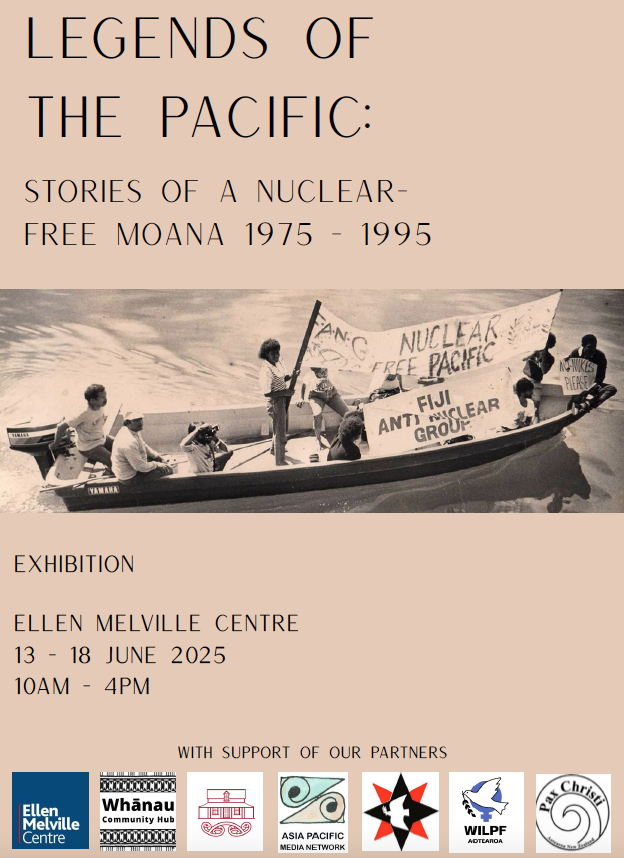
    On Saturday, 12 July 2025 Te Atatu MP Phil Twyford will open the week-long Nuclear Free and Independent Pacific (NFIP) exhibition at the Ellen Melville Centre Women’s Pioneer Hall at 3pm.

    https://www.facebook.com/events/1856900961820487/

    Poster for the Legends of the Pacific: Stories of a Nuclear-Free Moana 1975-1995 exhibition
    Poster for the Legends of the Pacific: Stories of a Nuclear-Free Moana 1975-1995 exhibition, July 13-18.


    This content originally appeared on Asia Pacific Report and was authored by Pacific Media Watch.

    This post was originally published on Radio Free.

  • Asia Pacific Report

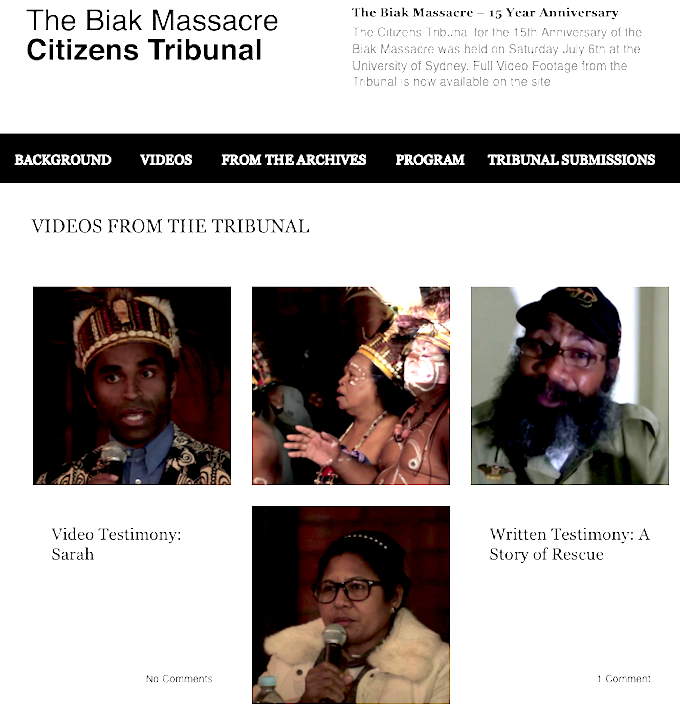
    Australian solidarity activists today marked the 27th anniversary of the Biak massacre in West Papua and have warned the human rights crisis in the Indonesian-ruled Melanesian region is deteriorating.

    No Indonesian security force member has ever been charged or brought to justice for the human rights abuses committed against peaceful West Papuan demonstrators.

    According to Elsham Papua, a local human rights organisation, eight people were killed and a further 32 bodies were found near Biak in the following days. However, some human rights sources put the death toll at about 150.

    “Twenty seven years later, the human rights situation in West Papua continues to deteriorate,” said Joe Collins of the Australia West Papua Association (AWPA) in a statement today.

    “West Papuan people continue to be arrested, intimidated and killed by the Indonesian security forces.

    “There are ongoing clashes between the TPNPB [West Papua National Liberation Army] and the Indonesian security forces with casualties on both sides.

    “As a result of these clashes, the Indonesian security forces carry out sweeps in the area, causing local people to flee in fear for their lives.

    ‘Bearing the brunt’
    “It’s the internal refugees bearing the brunt of the conflict.”

    According to the AWPA statement, 6 July 1998 marked the Biak massacre when the Indonesian security forces killed scores of people in Biak, West Papua.

    The victims included women and children who had gathered for a peaceful rally. They were killed at the base of a water tower flying the Morning Star flag of independence.

    The Biak Citizens' Tribunal
    The Citizens’ Tribunal . . . a people’s documentation and record of the Biak atrocities. Image: Citizens’ Tribunal

    As the rally continued, many more people in the area joined in with numbers reaching up to about 500 people.

    The statement said that from July 2 that year, activists and local people started gathering beneath the water tower, singing songs and holding traditional dances.

    “On July 6 the Indonesian security forces attacked the demonstrators, massacring scores of people,” said the statement.

    Internally displaced
    Human Rights Monitor
    reported in its June update that more than 97,721 people in West Papua were internally displaced as a result of armed conflict between Indonesian security forces and the TPNPB.

    Human Rights Watch in a media statement in May 2025 reported that renewed fighting between the security forces and the TPNPB was threatening West Papua civilians.

    “As the West Papuan people struggle for their right to self-determination, they face great challenges, from the ongoing human rights abuses to the destruction of their environment,” said Collins in the statement.

    “However, support/knowledge for the West Papuan struggle continues to grow, particularly in the Pacific region,” he said.

    “If some governments in the region are wavering in their support, the people of the Pacific are not.

    Pacific support ‘unwavering’
    Jakarta has been targeting Pacific leaders with aid in a bid to convince them to stop supporting the West Papuan struggle.

    Civil society and church groups continue to raise awareness of the West Papuan situation at the UN and at international human rights conferences.

    “The West Papuan people are not going to give up their struggle for self-determination,” Collins said.

    “Time for the countries in the region, including Australia, to take the issue seriously. Raising the ongoing human rights abuses with Jakarta would be a small start”.

    This post was originally published on Asia Pacific Report.
  • Asia Pacific Report

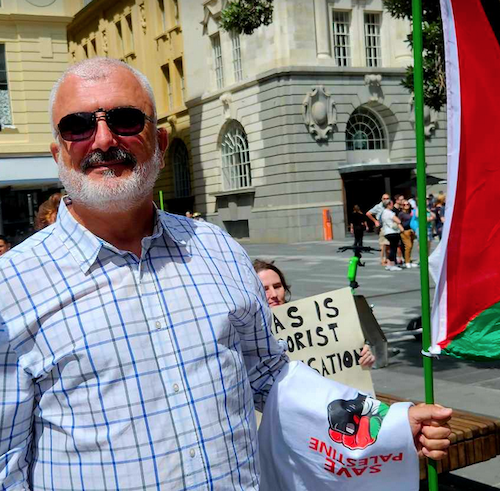
    Greenpeace Aotearoa executive director Russel Norman today recalled New Zealand’s heyday as a Pacific nuclear free champion in the 1980s, and challenged the country to again become a leading voice for “peace and justice”, this time for the Palestinian people.

    He told the weekly Palestinian solidarity rally in Auckland’s central Te Komititanga Square that it was time for New Zealand to take action and recognise the state of Palestine and impose sanctions on Israel over its Gaza atrocities.

    “From 1946 to 1996, over 300 nuclear weapons were exploded across the Pacific and consistently the New Zealand government spoke out against it,” he said.

    “It took cases to the International Court of Justice, supported by Australia and Fiji, against the nuclear testing across the Pacific.

    “Aotearoa New Zealand was a voice for peace, it was a voice for justice, and when the French government bombed the Greenpeace ship Rainbow Warrior here and killed Fernando Pereira, it spoke out and took action against France.”

    He said New Zealand could return to that global leadership as a small and peaceful country.

    New Zealand will this week be commemorating the 40th anniversary of the bombing of the Rainbow Warrior by French secret agents on 10 July 1985 and the killing of Greenpeace photographer Fernando Pereira.

    Dawn vigil on Greenpeace III
    Greenpeace plans a dawn vigil on board their current flagship Rainbow Warrior III at Halsey Wharf.

    He spoke about the Gaza war crimes, saying it was time for New Zealand to take serious action to help end this 20 months of settler colonial genocide.

    “There are millions of people [around the world] who are trying to end this colonial occupation of Palestinian land,” Norman said.

    “And millions of people who are trying to stop people simply standing to get food who are hungry who are being shelled and killed by the Israeli military simply for the ‘crime’ of being born in the land that Israel wants to occupy.”

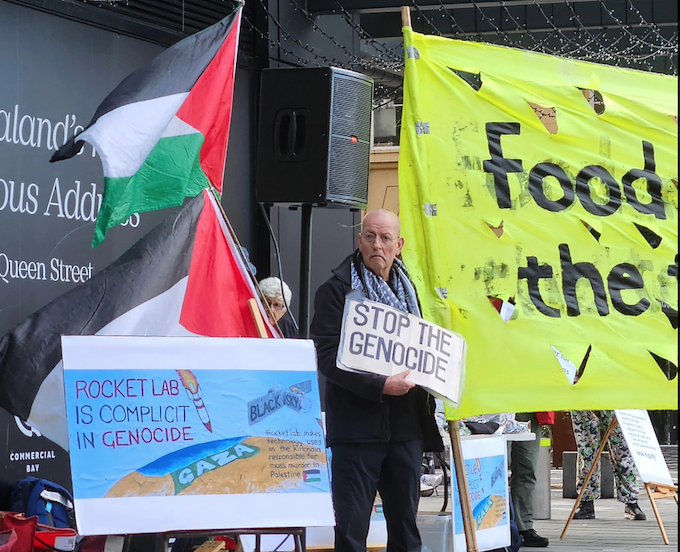
    Rocket Lab . . . a target for protests
    Rocket Lab . . . a target for protests this week against the Gaza genocide. Image: David Robie/APR

    Norman’s message echoed an open letter that he wrote to Prime Minister Christopher Luxon and Foreign Minister Winston Peters earlier this week criticising the government for its “ongoing failure … to impose meaningful sanctions on Israel”.

    He cited the recent UN Human Rights Office report that said the killing of hundreds of Palestinians by the Israeli military while trying to fetch food from the controversial new “Gaza Humanitarian Foundation” aid hubs was a ‘likely war crime”.

    “Israel’s ongoing blockade of aid to Gaza has placed over 2 million people on the precipice of famine. Malnutrition and starvation are rife,” he said.

    Israel ‘weaponising aid’
    “Israel is weaponising aid, using starvation as a tool of genocide and is now shooting at civilians trying to access the scraps of aid that are available.”

    He said this was “catastrophic”, quoting Luxon’s own words, and the human suffering was “unacceptable”.

    Labour MP for Te Atatu and disarmament spokesperson Phil Twyford also spoke at the rally and march today, saying the Labour Party was calling for sanctions and accountability.

    He condemned the failure to hold “the people who have been enabling the genocide in Gaza”.

    “It’s been going on for too long. Not just the last [20 months], but actually the last 77 years.

    “And it is time the Western world snapped out of the spell that the Zionists have had on the Western imagination — at least on the political classes, government MPs, the policy makers in Western countries, who for so long have enabled, have stayed quiet in the face of the US who have armed and funded the genocide”

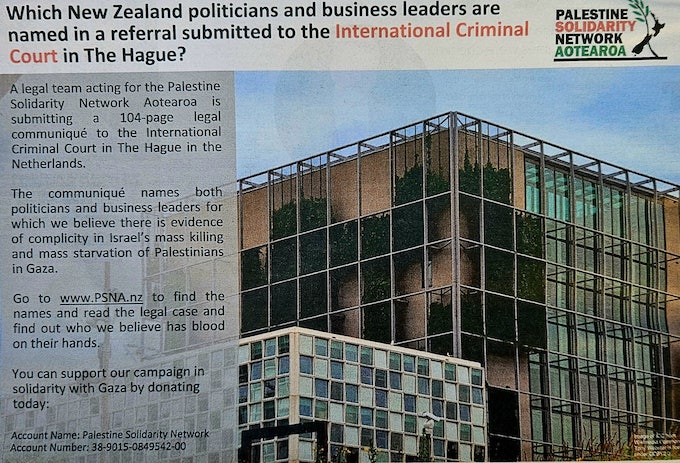
    For the Palestinian solidarity movement in New Zealand it has been a big week with four politicians — including Prime Minister Luxon — and two business leaders, the chief executives of Rocket Lab and Rakon, who have been referred by the Palestine Solidarity Network Aotearoa to the International Criminal Court (ICC) for investigation over allegations of complicity with the Israeli war crimes.

    This unprecedented legal development has been largely ignored by the mainstream media.

    On Friday, protesters picketed a Rocket Lab manufacturing site in Warkworth, the head office in Mount Wellington and the Māhia peninsula where satellites are launched.

    Amnesty International, Human Rights Watch, leading international scholars and the UN Special Committee to investigate Israel’s practices have all condemned Israel’s actions as genocide.

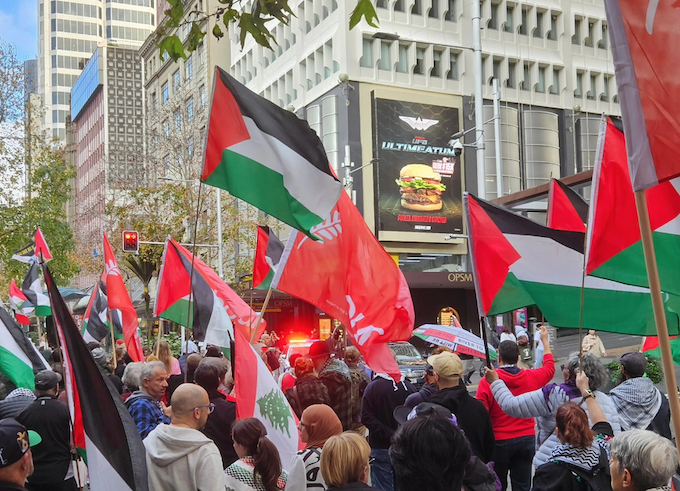
    Palestinian solidarity protesters in Auckland's Queen Street march today
    Palestinian solidarity protesters in Auckland’s Queen Street march today. Image: David Robie/APR

    This post was originally published on Asia Pacific Report.
  • GENEVA, Switzerland (5 July 2025) – The Asian Forum for Human Rights and Development (FORUM-ASIA) expresses deep  concern over the Islamic Republic of Iran’s plan to forcibly deport hundreds of thousands of Afghan refugees and undocumented migrants. The lack of individual risk assessments, legal access, or due process constitutes a grave violation of international human rights standards and the principle of non-refoulement, a cornerstone of international refugee law. This action risks exacerbating the already critical humanitarian crisis in Afghanistan.

    “We stand in full solidarity with the Afghan people and urge the Government of Iran to uphold its obligations under international human rights and refugee law. The looming threat of mass deportations is not only a humanitarian crisis in the making, it sets a dangerous precedent that risks normalizing unlawful and inhumane responses to displacement. We cannot, in good conscience, look away while the most vulnerable ones and those who fled persecution and discrimination are put at further risks back in Afghanistan”, said Mary Aileen Diaz-Bacalso, Executive Director, FORUM-ASIA

    Mass Deportations Underway Ahead of 6 July Deadline

    On 29 June 2025, Iranian authorities issued a final ultimatum: all undocumented Afghan nationals must leave the country voluntarily or face forced expulsion by the final  deadline of 6 July.  Since the escalation of tensions following the recent Israel-Iran conflict, the situation of  Afghanistan’s refugees and asylum seekers in Iran has deteriorated.

    The number of Afghan returnees from Iran has surged dramatically, increasing from approximately 5,000 returnees daily to nearly 30,000 individuals per day. Most of these returns are involuntary, with over 150,000 Afghans deported by Iranian authorities between May and early June 2025 alone.

    Although the deportation plan is framed as “voluntary”, Afghan nationals in Iran are being denied their rights and access to asylum procedures, legal representation and support, or appeal mechanisms; they are extensively being deported under coercion, harassment, and abuse by Iranian police and the public.

    The latest crackdown follows years of escalating pressure on Afghan migrants including refugees and asylum seekers in Iran.  Reports include mass arrests, home raids, tearing up passports with valid visas, withholding of prepaid mortgages, access to health services, and essential items such as bread and baby food for Afghanistan’s nationals. Anti-Afghan rhetoric and detention campaigns have intensified across major cities such as Tehran, Mashhad, Zahedan, and Kerman. In a particularly distressing case, the mutilated body of Kubra Rezaie, a young Afghan woman was discovered in Tehran on June 3, nearly 50 days after she went missing when she was going to work. In the current climate, Afghans are routinely accused of being “spies of Israel” and subjected to hate, discrimination, detention and deportation.


    Humanitarian Consequences of Deportation

    Afghan returnees face serious risks under Taliban rule, including extrajudicial killings, arbitrary arrests, and targeted persecution of former government officials, civil society members, and minority groups.  Long-term challenges such as widespread unemployment, insecurity, poverty, and psychosocial trauma compound their vulnerability. Vulnerable populations such as women, girls, and ethnic minorities, especially the Shia Hazara, continue to face systemic discrimination and violence. The UNHCR has clearly stated that Afghanistan remains unsafe for return due to ”pervasive insecurity, economic collapse, widespread repression, and lack of access to essential services”.

    According to the UN Office for the Coordination of Humanitarian Affairs (OCHA), over 29 million people in Afghanistan require humanitarian assistance in 2025. Returnees often arrive without documentation, shelter, or support, forced into overcrowded and under-resourced camps in provinces like Herat and Nimruz. In this context, returnees face imminent risks of torture, mistreatment, and death.

    Iran’s Historic Role and Current Obligations

    Over the past decades, Iran has had a long-standing role hosting millions of Afghan refugees and asylum seekers. However, in the face of ongoing pressures and recent Israel-Iran conflicts, the country faces a range of challenges. These do not justify mass expulsions that violate international obligations. Collective punishment of vulnerable populations undermines both human dignity and Iran’s longstanding role as a regional refuge and runs contrary to basic principles of humanity and human rights principles.

    FORUM-ASIA’s Urgent Call for Action

    In light of the 6 July deadline and escalating threats to Afghan migrants in Iran, FORUM-ASIA urgently calls on:

    The Government of the Islamic Republic of Iran to:

    •  Immediately halt all forced deportations of Afghan refugees and migrants, including those without documentation.
    • Revoke the July 6 deportation deadline, which places thousands at risk of irreversible harm.
    • Ensure full access to fair asylum procedures, including individual risk assessments, legal representation, and appeal mechanisms.
    • Allow the UNHCR and humanitarian partners unrestricted access to monitor detention facilities and border regions and provide assistance.

    To the international community, particularly regional actors and donor governments, to:

    • Urgently share responsibility by increasing humanitarian aid, resettlement options, and diplomatic efforts to protect Afghan refugees.
    • Support host countries like Iran in managing refugee populations, without resorting to coercive or unlawful practices.

    **


    The Asian Forum for Human Rights and Development (FORUM-ASIA)
     is a network of 90 member organisations across 23 countries, mainly in Asia. Founded in 1991, FORUM-ASIA works to strengthen movements for human rights and sustainable development through research, advocacy, capacity development and solidarity actions in Asia and beyond. It has consultative status with the United Nations Economic and Social Council, and consultative relationship with the ASEAN Intergovernmental Commission on Human Rights. The FORUM-ASIA Secretariat is based in Bangkok, with offices in Jakarta, Geneva and Kathmandu. www.forum-asia.org

    For media inquiries, please contact:


    For the PDF version of this document, click here

    The post [Statement] AFGHANISTAN: Immediately Halt Mass Deportation of Afghanistan’s Migrants from Iran first appeared on FORUM-ASIA.

    This post was originally published on FORUM-ASIA.

  • Asia Pacific Report

    Protesters against the Israeli genocide in Gaza and occupied West Bank targeted three business sites accused of being “complicit” in Aotearoa New Zealand today.

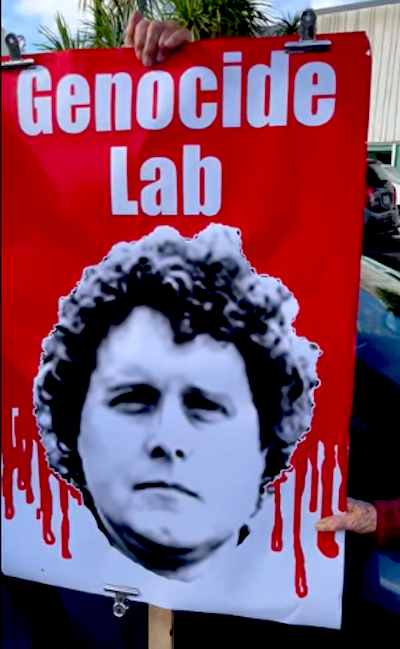
    The Palestine Solidarity Network Aotearoa’s “End Rocket Lab Genocide Complicity” themed protest picketed Rocket Lab’s New Zealand head office in Mt Wellington.

    Simultaneously, protesters also picketed a site in Warkworth where Rocket Lab equipment is built and Mahia peninsula where satellites are launched.

    In a statement on the PSNA website, it was revealed this week that the advocacy group’s lawyers have prepared a 103-page “indictment” against two business leaders, including the head of Rocket Lab, along with four politicians, including Prime Minister Christopher Luxon.

    They have been referred to the International Criminal Court (ICC) in The Hague for investigation on an accusation of complicity with Israel’s genocide in Gaza.

    Rocket Lab chief executive Sir Peter Beck is one of the six people named in the legal brief.

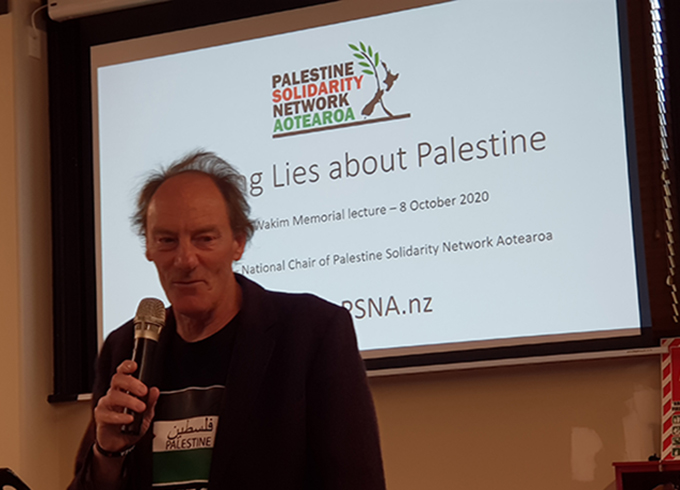
    “Rocket Lab has recently launched geospatial intelligence satellites for BlackSky Technology,” said PSNA co-chair John Minto in a statement.

    High resolution images
    “These satellites provide high resolution images to Israel which are very likely used to assist with striking civilians in Gaza. Sir Peter has proceeded with these launches in full knowledge of these circumstances”

    A "Genocide Lab" protest against Rocket Lab in Mt Wellington
    A “Genocide Lab” protest against Rocket Lab in Mt Wellington today. Image: PSNA

    “When governments and business leaders can’t even condemn a genocide then civil society groups must act.”

    The other business leader named is Rakon Limited chief executive officer Dr Sinan Altug.

    “Despite vast weapons transfers from the United States to Israel since the beginning of its war on Gaza, Rakon has continued with its longstanding supply of crystal oscillators to US arms manufacturers for use in guided missiles which are then available to Israel for the bombing of Gaza, as well as Lebanon, Syria, Yemen and Iran with consequential massive loss of life,” Minto said.

    “Rakon’s claims that it has no responsibility over how these ‘dual-use’ technologies are used are not credible.”

    Rocket Lab and Rakon have in the past rejected claims over their responsibility.

    Speakers at Mount Wellington included the Green Party spokesperson for foreign affairs Teanau Tuiono; Dr Arama Rata, a researcher and lecturer from Victoria University; and Sam Vincent, the legal team leader for the ICC referral.

    Law academic Professor Jane Kelsey spoke at the Warkworth picket.

    Amnesty International, Human Rights Watch, leading international scholars and the UN Special Committee to investigate Israel’s practices have all condemned Israel’s actions as genocide.

    Protesters against Rocket Lab's alleged complicity with Israel's genocide in Gaza
    Protesters against Rocket Lab’s alleged complicity with Israel’s genocide in Gaza today. Image: Del Abcede/APR


    This content originally appeared on Asia Pacific Report and was authored by APR editor.

    This post was originally published on Radio Free.

  • By Caleb Fotheringham, RNZ Pacific journalist

    People on Guam are “disappointed” and “heartbroken” that radiation exposure compensation is not being extended to them, says the president of the Pacific Association for Radiation Survivors (PARS), Robert Celestial.

    He said they were disappointed for many reasons.

    “Congress seems to not understand that we are no different than any state,” he told RNZ Pacific.

    “We are human beings, we are affected in the same way they are. We are suffering the same way, we are greatly disappointed, heartbroken,” Celestial said.

    The extension to the United States Radiation Exposure Compensation Act (RECA) was part of Trump’s “big, beautiful bill” passed by Congress on Friday (Thursday, Washington time).

    Downwind compensation eligibility would extend to the entire states of Utah, Idaho and New Mexico, but Guam – which was included in an earlier version of the bill – was excluded.

    All claimants are eligible for US$100,000.

    Attempt at amendment
    Guam Republican congressman James Moylan attempted to make an amendment to include Guam before the bill reached the House floor earlier in the week.

    “Guam has become a forgotten casualty of the nuclear era,” Moylan told the House Rules Committee.

    “Federal agencies have confirmed that our island received measurable radiation exposure as a result of US nuclear testing in the Pacific and yet, despite this clear evidence, Guam remains excluded from RECA, a program that was designed specifically to address the harm caused by our nation’s own policies.

    “Guam is not asking for special treatment we are asking to be treated with dignity equal to the same recognition afforded to other downwind communities across our nation.”

    Moylan said his constituents are dying from cancers linked to radiation exposure.

    From 1946 to 1962, 67 nuclear bombs were detonated in the Marshall Islands, just under 2000 kilometres from Guam.

    New Mexico Democratic congresswoman Teresa Leger Fernández supported Moylan, who said it was “sad Guam and other communities were not included”.

    Colorado, Montana excluded
    The RECA extension also excluded Colorado and Montana; Idaho was also for a time but this was amended.

    Pacific Association for Radiation Survivors (PARS) members at a gathering. Founder/Atomic Veteran Robert Celestial(holding book)
    Pacific Association for Radiation Survivors (PARS) members at a gathering . . . “heartbroken” that radiation exposure compensation is not being extended to them. Image: RNZ Pacific/Eleisha Foon

    Celestial said he had heard different rumours about why Guam was not included but nothing concrete.

    “A lot of excuses were saying that it’s going to cost too much. You know, Guam is going to put a burden on finances.”

    But Celestial said the cost estimate from the Congressional Budget Office for Guam to be included was US$560 million while Idaho was $1.4 billion.

    “[Money] can’t be the reason that Guam got kicked out because we’re the lowest on the totem pole for the amount of money it’s going to cost to get us through in the bill.”

    Certain zip codes
    The bill also extends to communities in certain zip codes in Missouri, Tennessee, Kentucky, and Alaska, who were exposed to nuclear waste.

    Celestial said it’s taken those states 30 years to be recognised and expects Guam to be eventually paid.

    He said Moylan would likely now submit a standalone bill with the other states that were not included.

    If that fails, he said Guam could be included in nuclear compensation through the National Defense Authorization Act in December, which is for military financial support.

    The RECA extension includes uranium workers employed from 1 January 1942 to 31 December 1990.

    This article is republished under a community partnership agreement with RNZ.

    This post was originally published on Asia Pacific Report.
  • We, the undersigned organisations, urgently call for the protection of the indigenous Molbog and Palaw’an communities of Bugsuk and Mariahangin Islands in Southern Palawan, Philippines. These communities are engaged in the defence of collective rights, which are being disregarded by the large-scale luxury ecotourism project developed by Bricktree Properties, a subsidiary of the Philippine multinational conglomerate San Miguel Corporation (SMC). SMC has been displacing the Molbog and Palaw’an communities from their territories with State support.

    For over a year, the Molbog Bugsuk community have faced armed intimidation, legal harassment, and systemic repression. Since April 2024, more than 80 armed personnel from JMV Security Services, allegedly contracted by Bricktree Properties, have been repeatedly deployed to the area. On 29 June 2024, community members formed a human barricade to block the landing of armed guards on Mariahangin Island. A shot was fired during the stand-off. No one was injured, but the event left deep psychological trauma in the communities. Despite urgent calls, local police initially refused to provide assistance, only acting after intervention from the Commission on Human Rights in Palawan.

    Following the incident, the community has reported continuing harassment, armed surveillance, and restricted access to their fishing grounds, violations that strike at the heart of indigenous self-determination and food security. This corporate aggression has been accompanied by a troubling pattern of impunity and criminalisation.

    On 15 May 2025, ten indigenous and non-indigenous human rights defenders, now known as the “Mariahangin 10,” were arrested and charged with grave coercion for peacefully blocking their territory to prevent the entry of the former Executive Director of the National Commission on Indigenous Peoples (NCIP) and personnel from the Department of Agrarian Reform (DAR) in June 2024. The blockade was carried out in response to concerns in the community that the NCIP-DAR group was attempting to bribe residents into relinquishing their ancestral lands for a proposed eco-luxury tourism project. Residents had also reportedly been warned by DAR staff of impending demolitions of their homes to make way for construction, prompting the community to assert their right to consultation and resist forced displacement. These arrests occurred several days before the detention of Oscar “Ka Ondo” Pelayo Jr., a respected Molbog community leader, on a revived illegal fishing charge from 2006. All individuals were released on temporary bail, but remain at risk of legal actions. Advocacy groups and legal experts widely regard these charges as trumped-up and retaliatory, and part of a broader strategy to divide, intimidate, exhaust, and silence indigenous communities defending their rights.

    These incidents are not isolated, they reflect a deeply entrenched pattern of “development aggression” in the Philippines, where state-backed or state-tolerated corporate ventures systematically displace indigenous communities in the name of investment and progress.

    The culture of profit-driven economic development and corporate impunity needs to end, and states and companies must adhere to international human rights standards and norms, including the UN Guiding Principles on Business and Human Rights and the UN Declarations on the Rights of Indigenous Peoples, on the Right to Development, and on Human Rights Defenders.

    We call on the Philippine government to:

    1. Demand Immediate Cessation of Harassment: Call for the immediate withdrawal of all armed private security personnel from Molbog ancestral lands and waters, end to all forms of intimidation and harassment against community members, and drop all charges against the human rights defenders immediately and unconditionally.
    2. Advocate for Legal Recognition and Justice: The Department of Agrarian Reform (DAR) and the National Commission on Indigenous Peoples (NCIP) must reinstate the Notice of Coverage for Bugsuk and Mariahangin, and expedite the processing and approval of the Molbog and Palaw’an Certificate of Ancestral Domain Title (CADT) applications.
    3. Ensure Accountability for Human Rights Violations: Initiate an impartial investigation into all reported human rights violations and abuses, including the arrests of community leaders on questionable charges, and hold all perpetrators, corporate as well as state actors, accountable.
    4. Promote Genuine and Meaningful Consultations and Free, Prior, and Informed Consent (FPIC): No development project should proceed on ancestral lands without obtaining free, prior, and informed consent of the affected indigenous communities, ensuring their full and effective participation in decision-making processes.
    5. Support Indigenous-Led Sustainable Development: Ensure policies and programs that support and strengthen the Molbog Bugsuk community’s traditional livelihoods and cultural practices, recognising their inherent sustainability and their right to self-determination over their ancestral territory.
    6. End development aggression and ensure corporate accountability: Fulfil your duty to regulate and oversee corporate activity by ending profit-driven development projects that violate human rights. Hold San Miguel Corporation and its subsidiaries accountable for repeated abuses against communities and human rights defenders, and take concrete steps to end the culture of corporate impunity.
    7. Uphold international human rights obligations: Fully respect and implement international human rights standards, including the UN Guiding Principles on Business and Human Rights, the UN Declaration on the Rights of Indigenous Peoples, the UN Declaration on the Right to Development, and the UN Declaration on Human Rights Defenders. As duty-bearer, the government must ensure these standards are reflected in national policies, practices, and corporate oversight.

    Signatories:

    Civicus

    Forum-Asia

    International Land Coalition

    Front Line Defenders

    The post [Joint Statement] Philippines: End Harassment and Displacement of Molbog Bugsuk indigenous community in Palawan first appeared on FORUM-ASIA.

    This post was originally published on FORUM-ASIA.

  • By Giff Johnson, editor of the Marshall Islands Journal

    Author David Robie and Little Island Press are about to publish next week a 40th anniversary edition of Eyes of Fire: The Last Voyage and Legacy of the Rainbow Warrior, a first-hand account of the relocation of the Rongelap people by Greenpeace’s flagship Rainbow Warrior in 1985.

    Dr Robie joined what turned out to be the ill-fated voyage of the Rainbow Warrior from Hawai’i across the Pacific, with its first stop in the Marshall Islands and the momentous evacuation of Rongelap Atoll.

    After completing the evacuation of the 320 people of Rongelap from their unsafe nuclear test-affected home islands to Mejatto Island in Kwajalein Atoll, the Rainbow Warrior headed south via Kiribati and Vanuatu.

    After a stop in New Zealand, it was scheduled to head to the French nuclear testing zone at Moruroa in French Polynesia to protest the then-ongoing atmospheric nuclear tests conducted by France for decades.

    But French secret agents attached bombs to the hull of the Rainbow Warrior while it was tied up at a pier in Auckland. The bombs mortally damaged the Warrior and killed Greenpeace photographer Fernando Peirera, preventing the vessel from continuing its Pacific voyage.

    The new edition of Eyes of Fire will be launched on July 10 in New Zealand.

    “This edition has a small change of title, Eyes of Fire: The Last Voyage and Legacy of the Rainbow Warrior, and has an extra 30 pages, with a new prologue by former Prime Minister Helen Clark,” Dr Robie said in an email to the Journal.

    “The core of the book is similar to earlier editions, but bookended by a lot of new material: Helen’s Prologue, Bunny McDiarmid’s updated Preface and a long Postscript 2025 by me with a lot more photographs, some in colour.”

    Dr Robie added: “I hope this edition is doing justice to our humanitarian mission and the Rongelap people that we helped.”

    He said the new edition is published by a small publisher that specialises in Pacific Island books, often in Pacific languages, Little Island Press.

    This post was originally published on Asia Pacific Report.
  • Asia Pacific Report

    Francesca Albanese, the UN Special Rapporteur on the Occupied Palestinian Territory, has called on countries to cut off all trade and financial ties with Israel — including a full arms embargo — and withdraw international support for what she termed an “economy of genocide”, reports Al Jazeera.

    Albanese made the comments in a speech to the Human Rights Council in Geneva yesterday as she presented her latest report, which named dozens of companies she said were involved in supporting Israeli repression and violence towards Palestinians.

    “The situation in the occupied Palestinian territory is apocalyptic,” she said. “Israel is responsible for one of the cruellest genocides in modern history.”

    Nearly 57,000 Palestinians have been killed by Israel since the war — now in its 22nd month — began, hundreds of thousands have been displaced multiple times, cities and towns have been razed, hospitals and schools targeted, and 85 percent of the besieged and bombarded enclave is now under Israeli military control, according to the UN.

    Al Jazeera’s Federica Marsi reports that Albanese’s latest document names 48 corporate actors, including United States tech giants Microsoft, Alphabet Inc. — Google’s parent company — and Amazon.

    “[Israel’s] forever-occupation has become the ideal testing ground for arms manufacturers and Big Tech — providing significant supply and demand, little oversight, and zero accountability — while investors and private and public institutions profit freely,” the report said.

    “Companies are no longer merely implicated in occupation — they may be embedded in an economy of genocide,” it said, in a reference to Israel’s ongoing assault on the Gaza Strip.

    In an expert opinion last year, Albanese said there were “reasonable grounds” to believe Israel was committing genocide in the besieged Palestinian enclave.

    The report stated that its findings illustrate “why Israel’s genocide continues”.

    “Because it is lucrative for many,” it said.


    Francesca Albanese v Israel’s lobby.     Video: Al Jazeera

    Military procurements
    Israel’s procurement of F-35 fighter jets is part of the world’s largest arms procurement programme, relying on at least 1600 companies across eight nations. It is led by US-based Lockheed Martin, but F-35 components are constructed globally.

    Italian manufacturer Leonardo S.p.A is listed as a main contributor in the military sector, while Japan’s FANUC Corporation provides robotic machinery for weapons production lines.

    The tech sector, meanwhile, has enabled the collection, storage and governmental use of biometric data on Palestinians, “supporting Israel’s discriminatory permit regime”, the report said.

    Microsoft, Alphabet, and Amazon grant Israel “virtually government-wide access to their cloud and AI technologies”, enhancing its data processing and surveillance capacities.

    The US tech company IBM has also been responsible for training military and intelligence personnel, as well as managing the central database of Israel’s Population, Immigration and Borders Authority (PIBA) that stores the biometric data of Palestinians, the report said.

    It found US software platform Palantir Technologies expanded its support to the Israeli military since the start of the war on Gaza in October 2023.

    The report said there were “reasonable grounds” to believe the company provided automatic predictive policing technology used for automated decision-making in the battlefield, to process data and generate lists of targets including through artificial intelligence systems like “Lavender”, “Gospel” and “Where’s Daddy?”

    [AL Jazeera]
    Companies supporting Israel. Graphic: Al Jazeera/Creative Commons
    Other companies identified in the report
    The report also lists several companies developing civilian technologies that serve as “dual-use tools” for Israel’s occupation of Palestinian territory.These include Caterpillar, Leonardo-owned Rada Electronic Industries, South Korea’s HD Hyundai and Sweden’s Volvo Group, which provide heavy machinery for home demolitions and the development of illegal settlements in the West Bank.Rental platforms Booking and Airbnb also aid illegal settlements by listing properties and hotel rooms in Israeli-occupied territory.

    The report named the US’s Drummond Company and Switzerland’s Glencore as the primary suppliers of coal for electricity to Israel, originating primarily from Colombia.

    In the agriculture sector, Chinese Bright Dairy & Food is a majority owner of Tnuva, Israel’s largest food conglomerate, which benefits from land seized from Palestinians in Israel’s illegal outposts.

    Netafim, a company providing drip irrigation technology that is 80-percent owned by Mexico’s Orbia Advance Corporation, provides infrastructure to exploit water resources in the occupied West Bank.

    Treasury bonds have also played a critical role in funding the ongoing war on Gaza, according to the report, with some of the world’s largest banks, including France’s BNP Paribas and the UK’s Barclays, listed as having stepped in to allow Israel to contain the interest rate premium despite a credit downgrade.

    Which are the main investors behind these companies?
    The report identified US multinational investment companies BlackRock and Vanguard as the main investors behind several listed companies.

    BlackRock, the world’s largest asset manager, is listed as the second largest institutional investor in Palantir (8.6 percent), Microsoft (7.8 percent), Amazon (6.6 percent), Alphabet (6.6 percent) and IBM (8.6 per cent), and the third largest in Lockheed Martin (7.2 percent) and Caterpillar (7.5 percent).

    Vanguard, the world’s second-largest asset manager, is the largest institutional investor in Caterpillar (9.8 percent), Chevron (8.9 percent) and Palantir (9.1 percent), and the second largest in Lockheed Martin (9.2 percent) and Israeli weapons manufacturer Elbit Systems (2 percent).

    New Zealand referrals to the International Criminal Court
    Meanwhile, the Palestine Solidarity Network Aotearoa yesterday released a report saying that it was referring two New Zealand businessmen along with four politicians, including Prime Minister Christopher Luxon, to the International Criminal Court for investigation over alleged policies relating to Gaza.

    The PSNA accused the six individuals of complicity in war crimes, crimes against humanity and genocide by “assisting Israel’s mass killing and starvation of Palestinians in Gaza”.

    In a statement, PSNA co-chairs John Minto and Maher Nazzal said the referral “carefully outlines a case that these six individuals should be investigated” by the Office of the Prosecutor for their knowing contribution to Israel’s crimes in Gaza.

    “The 103-page referral document was prepared by a legal team which has been working on the case for many months,” said Minto and Nazzal.

    “It is legally robust and will provide the prosecutor of the ICC more than sufficient documentation to begin their investigation.”

    Which NZ politicians and business leaders have been referred by the PSNA to the ICC?
    Which NZ politicians and business leaders have been referred by the PSNA to the ICC? Image: NZH screenshot APR

    This post was originally published on Asia Pacific Report.
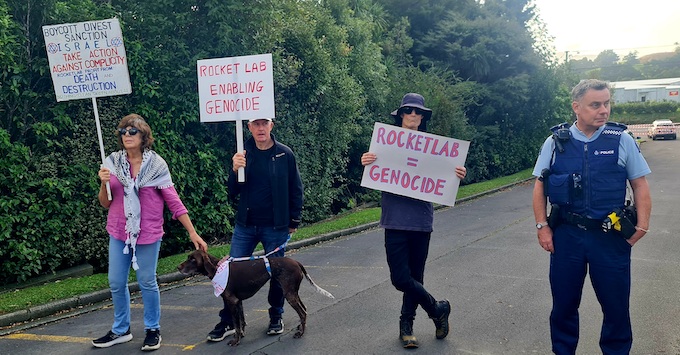
  • After defence ministers representing their countries at the Shanghai Cooperation Organisation (SCO) were unable to adopt a joint statement at the end of their talks on June 26, several rumours regarding the meeting were viral on social media. One of the viral claims is that Russia signed a joint SCO statement supporting Pakistan. Another claim suggested that a closed-door meeting was carried out without India.

    Formed in 2001, the SCO is a grouping of 10 countries including China, Russia, India, Pakistan, and Iran. The defence ministers’ meeting took place in China’s Qingdao ahead of the upcoming annual summit.

    On June 29, X user @TheDailyCPEC claimed that Russia had signed the joint SCO statement. At the time of this article being written, the post had a million views. (Archive)

    X user @NavCom24 had also shared the viral claim that Russia signed the SCO statement. However, it was later deleted. (Archive)

    Meanwhile, X user @thinking_panda claimed that China, Iran, Russia and Pakistan agreed to a closed-door SCO meeting without inviting India. (Archive

    Several other X users, including @DefenseDiplomat, @BigWayneConley and @qazafi197476, shared similar claims. (Archives: 1, 2, 3)

    Click to view slideshow.

    We also found an Instagram post, which made similar claims. The caption reads, “A high-level NSA meeting is scheduled among China, Iran, Russia, and Pakistan under the SCO framework, but India has not been invited.”


    View this post on Instagram


    A post shared by Corporate Wire (@corpwire)


    Fact Check

    According to several media reports, the SCO joint statement was not adopted because Indian defence minister Rajnath Singh refused to endorse it as it did not mention the April 22 Pahalgam terror attack, in which 26 civilians were shot dead by terrorists. India has blamed Pakistan for sheltering terrorist factions responsible for the attack. Pakistan has denied the allegations.


    According to Randhir Jaiswal, spokesperson from the Ministry of External Affairs, a joint statement was not adopted at the SCO. “Certain member countries could not reach consensus on certain issues, and hence, the document could not be finalised… India wanted concerns and terrorism reflected in the document, which was not acceptable to one particular country.”

    We found no news reports mentioning any other country, such as Russia, signing the SCO document.

    We then looked at the SCO charter available on the site of India’s Ministry of External Affairs. Article 16 on the procedures on taking decisions says that SCO decisions are taken by agreement without voting as long as no member objects. It says:

    “The SCO bodies shall take decisions by agreement without vote and their decisions shall be considered adopted if no member State has raised objections during its consideration (consensus), except for the decisions on suspension of membership or expulsion from the Organization that shall be taken by “consensus minus one vote of the member State concerned.”

    This meant that SCO statements are adopted by unanimous consensus. But to be sure, we also reached out to a journalist who has covered diplomatic and strategic affairs for over a decade to understand how countries adopt statements at the SCO. This journalist, who did not wish to be identified, clarified that the “signing” on the draft statement is only if all members agree to adopt it, which was not the case in this SCO defence ministers’ meeting. So, if one member state does not agree, there is no way that some member states sign the document and others do not. It is either adopted as a whole by all or it’s not, he reiterated.

    So, the claim that Russia ‘signed’ the joint SCO statement supporting Pakistan’s position over India is not true.

    Also, the SCO published a report on the defence ministers’ meet on June 26 in which Indian defence minister Rajnath Singh can also be seen among the representatives of the invited nations. This debunks the claim that there was a closed-door SCO meeting at which India was not invited.

    Also, one of the claims, which uses an image of the leaders of China, Pakistan, Russia and Iran is actually from a meeting in Samarkand, Uzbekistan, in 2023 and not the recent SCO meet in China.


    To sum up, the viral claims that India was not invited to a closed-door SCO meeting or that Russia signed a joint SCO statement favouring Pakistan are baseless.

    The post After SCO defence ministers’ meet, false claims of India being left out and Russia signing joint statement go viral appeared first on Alt News.


    This content originally appeared on Alt News and was authored by Prantik Ali.

    This post was originally published on Radio Free.

  • Asia Pacific Report

    In an unprecedented legal move in Aotearoa New Zealand, a national Palestine solidarity advocacy group has filed a referral against the prime minister, three other ministers in the coalition government and two business leaders, alleging complicity with Israel’s genocidal war against Gaza.

    The Palestine Solidarity Network Aotearoa (PSNA) has accused the six individuals of complicity in war crimes, crimes against humanity and genocide by “assisting Israel’s mass killing and starvation of Palestinians in Gaza”.

    The PSNA movement has led 90 consecutive weeks of protest at multiple locations across New Zealand in the country’s biggest humn rights campaign since the war began in October 2023.

    In a statement, PSNA co-chairs John Minto and Maher Nazzal said the referral “carefully outlines a case that these six individuals should be investigated” by the Office of the Prosecutor for their knowing contribution to Israel’s crimes in Gaza.

    “The 103-page referral document was prepared by a legal team which has been working on the case for many months,” said Minto and Nazzal.

    “It is legally robust and will provide the prosecutor of the ICC more than sufficient documentation to begin their investigation.”

    The six people named in the referral documentation are Prime Minister Christopher Luxon, Foreign Affairs Minister Winston Peters, Minister for Defence and Space Judith Collins, Deputy Prime Minister David Seymour, and businessmen Rocket Lab chief executive Sir Peter Beck and Rakon Limited chief executive Dr Sinan Altug.

    Spy satellites
    According to PSNA, Rocket Lab launches spy satellites from Māhia, which PSNA claims Israel uses go target civilians in Gaza, while Rakon exports military-grade crystal oscillators to the US “to be put in missiles which Israel can deploy in Gaza and elsewhere”.

    “This is a grave step which we have not taken lightly,” Minto and Nazzal said.

    John Minto
    PSNA co-chair John Minto … “This is a grave step which we have not taken lightly.” Image: PMC

    “The government’s ongoing and meaningful support for Israel, despite its horrendous war crimes, is not only egregious to most New Zealanders, but is also criminal conduct under international law.”

    The PSNA referral follows an open letter by one of the country’s largest environmental organisations two days ago that called on the government to impose sanctions on Israel amid mounting criticism in New Zealand over war crimes allegations against the state over its 20-month war.

    Greenpeace's sanctions open letter
    Greenpeace’s sanctions open letter to NZ Prime Minister Christopher Luxon. Image: Greenpeace screeshot APR

    Greenpeace Aotearoa’s executive director Dr Russel Norman, a former Green Party co-leader, said in an open letter addressed to Prime Minister Luxon and Foreign Minister Peters that he was expressing grave concerns about the “ongoing genocide in Gaza being carried out by Israeli forces, and the ongoing failure of the New Zealand government to impose meaningful sanctions on Israel.”

    Norman cited a statement by the UN Human Rights Office last week that “at least 410 Palestinians have been killed by the Israeli military while trying to fetch from controversial new aid hubs in Gaza”.

    The office said this was “a likely war crime”.

    ‘Killing field’
    He also cited Ha’aretz, a respected Israeli newspaper, quoting an Israeli soldier describing the Israeli and US-backed Gaza Humanitarian Foundation (GHC) aid hubs as a “killing field”.

    Advocate Maher Nazzal at today's New Zealand rally for Gaza in Auckland
    PSNA co-chair Maher Nazzal . . . “This has brought shame on the whole country.” Image: APR

    In March last year, Sydney law firm Birchgrove Legal referred a case to ICC Chief Prosecutor Karim Khan consisting of 92 pages of documented evidence, alleging that Australian Prime Minister Anthony Albanese and several other high level local politicians were complicit in the Gaza genocide.

    The case was lodged under article 15 of the Rome Statute and although Albanese claimed it had “no credibility”, two months later the ICC announced that it had agreed to investigate Albanese as part of its ongoing “Situation in the State of Palestine” investigation.

    In January 2015, the Palestinian government lodged a claim with the ICC regarding war crimes committed in the occupied Palestinian territories since 13 June 2014.

    Amnesty International, Human Rights Watch, leading international scholars and the UN Special Committee to investigate Israel’s practices have all condemned Israel’s actions as genocide.

    In November 2024, the ICC issued arrest warrants for Israeli Prime Minister Benjamin Netanyahu and former Defence Minister Yoav Gallant for the war crimes of starvation as a weapon and crimes against humanity.

    ‘Letter of demand’
    The New Zealand referral to the ICC followed a “letter of demand” issued to the government last year actions that a “reasonable government” would take to prevent and punish the crime of genocide, and the actions a government should take to avoid criminal complicity with Israel.

    The ICC referral document from PSNA on 3 July 2025
    The ICC referral document from PSNA against the New Zealand coalition government individuals. Image: PSNA screenshot APR

    “For 20 months these political and business leaders have supported Israel to commit crimes which have shocked the human conscience,” Minto and Nazzal said.

    “This has brought shame on the whole country.”

    It is understood that this is the first time that New Zealand political or business leaders have been referred to the ICC for investigation.

    There were no immediate responses. However, a growing number of such cases are being filed around the world.

    In July 2024, the UN’s highest global court, the International Court of Justice (ICJ) issued an advisory opinion declaring that Israel’s continued presence in the Occupied Palestinian Territory, including Gaza and East Jerusalem, was illegal.

    It called on Israel to halt all settlements and withdraw settlers from the territory. The court is also investigating Israel over a case brought by South Africa alleging genocide.

    This post was originally published on Asia Pacific Report.

  • COMMENTARY: By Eugene Doyle

    Immediately after killing Fernando Pereira and blowing up Greenpeace’s flagship the Rainbow Warrior in Auckland harbour, several of the French agents went on a ski holiday in New Zealand’s South Island to celebrate.

    Such was the contempt the French had for the Kiwis and the abilities of our police to pursue them.  How wrong they were.

    To mark the 40th anniversary of the French terrorist attack Little Island Press has published a revised and updated edition of Eyes of Fire: The Last Voyage and Legacy of the Rainbow Warrior, first released in 1986.

    A new prologue by former prime minister Helen Clark and a preface by Greenpeace’s Bunny McDiarmid, along with an extensive postscript which bring us up to the present day, underline why the past is not dead; it’s with us right now.

    Written by David Robie, editor of Asia Pacific Report, who spent 11 weeks on the final voyage of the Warrior, the book is the most remarkable piece of history I have read this year and one of those rare books that has the power to expand your mind and make your blood boil at the same time. I thought I knew a fair bit about the momentous events surrounding the attack — until I read Eyes of Fire.

    Heroes of our age
    The book covers the history of Greenpeace action — from fighting the dumping of nuclear and other toxic waste in European waters, the Arctic and the Pacific, voyages to link besieged communities across the oceans, through to their epic struggles to halt whaling and save endangered marine colonies from predators.

    The Rainbow Warrior’s very last voyage before the bombing was to evacuate the entire population of Rongelap atoll (about 320 people) in the Marshall Islands who had been exposed to US nuclear radiation for decades.

    This article is the first of two in which I will explore themes that the book triggered for me.

    Neither secret nor intelligent – the French secret intelligence service

    Jean-Luc Kister was the DGSE (Direction-générale de la Sécurité extérieure) agent who placed the two bombs that ripped a massive hole in the hull of the Warrior on 10 July 1985. The ship quickly sank, trapping Greenpeace photographer Fernando Pereira inside.

    Former colonel Kister was a member of a large team of elite agents sent to New Zealand. One had also infiltrated Greenpeace months before, some travelled through the country prior to the attack, drinking, rooting New Zealand women and leaving a trail of breadcrumbs that led all the way to the Palais de l’Élysée where François Mitterrand, Socialist President of France, had personally given the order to bomb the famous peace vessel.

    Robie aptly calls the French mission “Blundergate”. The stupidity, howling incompetence and moronic lack of a sound strategic rationale behind the attack were only matched by the mendacity, the imperial hauteur and the racist contempt that lies at the heart of French policy in the Pacific to this very day.

    Thinking the Kiwi police would be no match for their élan, their savoir-faire and their panache, some of the killers hit the ski slopes to celebrate “Mission Accompli”. Others fled to Norfolk Island aboard a yacht, the Ouvéa.

    Tracked there by the New Zealand police it was only with the assistance of our friends and allies, the Australians, that the agents were able to escape. Within days they sank their yacht at sea during a rendezvous with a French nuclear submarine and were evenually able to return to France for medals and promotions.

    Two of the agents, however, were not so lucky. As everyone my age will recall, Dominique Prieur and Alain Mafart, were nabbed after a lightning fast operation by New Zealand police.

    With friends and allies like these, who needs enemies?
    We should recall that the French were our allies at the time. They decided, however, to stop the Rainbow Warrior from leading a flotilla of ships up to Moruroa Atoll in French Polynesia where yet another round of nuclear tests were scheduled. In other words: they bombed a peace ship to keep testing bombs.

    By 1995, France had detonated 193 nuclear bombs in the South Pacific.

    David Robie sees the bombing as “a desperate attempt by one of the last colonial powers in the Pacific to hang on to the vestiges of empire by blowing up a peace ship so it could continue despoiling Pacific islands for the sake of an independent nuclear force”.

    The US, UK and Australia cold-shouldered New Zealand through this period and uttered not a word of condemnation against the French. Within two years we were frog-marched out of the ANZUS alliance with Australia and the US because of our ground-breaking nuclear-free legislation.

    It was a blessing and the dawn of a period in which New Zealanders had an intense sense of national pride — a far cry from today when New Zealand politicians are being referred to the International Criminal Court (ICC) in The Hague for war crimes associated with the Gaza genocide.

    Eyes of Fire: The Last Voyage and Legacy of the Rainbow Warrior . . . publication next week. Image: ©  David Robie/Eyes Of Fire/Little Island Press

    The French State invented the term ‘terrorism’
    I studied French History at university in France and did a paper called “La France à la veille de révolution” (France on the eve of revolution). One of the chilling cultural memories is of the period from September 1793 to July 1794, which was known as La Terreur.

    At the time the French state literally coined the term “terrorisme” — with the blade of the guillotine dropping on neck after neck as the state tried to consolidate power through terror. But, as Robie points out, quoting law professor Roger S. Clark, we tend to use the term today to refer almost exclusively to non-state actors.

    With the US and Israel gunning down starving civilians in Gaza every day, with wave after wave of terror attacks being committed inside Iran and across the Middle East by Mossad, the CIA and MI6, we should amend this erroneous habit.

    The DGSE team who attached limpet mines to the Rainbow Warrior did so as psychopathic servants of the French State. Eyes of Fire: “At the time, Prime Minister David Lange described the Rainbow Warrior attack as ‘nothing more than a sordid act of international state-backed terrorism’.”

    Don’t get me wrong. I am not “anti-French”. I lived for years in France, had a French girlfriend, studied French history, language and literature. I even had friends in Wellington who worked at the French Embassy.

    Curiously when I lived next to Premier House, the official residence of the prime minister, my other next door neighbour was a French agent who specialised in surveillance. Our houses backed onto Premier House. Quelle coïncidence. To his mild consternation I’d greet him with “Salut, mon espion favori.” (Hello, my favourite spy).

    What I despise is French colonialism, French racism, and what the French call magouillage. I don’t know a good English word for it . . .  it is a mix of shenanigans, duplicity, artful deception to achieve unscrupulous outcomes that can’t be publicly avowed. In brief: what the French attempted in Auckland in 1985.

    Robie recounts in detail the lying, smokescreens and roadblocks that everyone from President Mitterrand through to junior officials put in the way of the New Zealand investigators. Mitterrand gave Prime Minister David Lange assurances that the culprits would be brought to justice. The French Embassy in Wellington claimed at the time: “In no way is France involved. The French government doesn’t deal with its opponents in such ways.”

    It took years for the bombshell to explode that none other than Mitterrand himself had ordered the terrorist attack on New Zealand and Greenpeace!

    Rainbow Warrior III at Majuro
    Rainbow Warrior III . . . the current successor to the bombed ship. Photographed at Majuro, the capital of the Marshall Islands in April 2025. Image: © Bianca Vitale/Greenpeace

    We the people of the Pacific
    We, the people of the Pacific, owe a debt to Greenpeace and all those who were part of the Rainbow Warrior, including author David Robie. We must remember the crime and call it by its name: state terrorism.

    The French attempted to escape justice, deny involvement and then welched on the terms of the agreement negotiated with the help of the United Nations secretary-general.

    A great way to honour the sacrifice of those who stood up for justice, who stood for peace and a nuclear-free Pacific, and who honoured our own national identity would be to buy David Robie’s excellent book.

    I’ll give the last word to former Prime Minister Helen Clark:

    “This is the time for New Zealand to link with the many small and middle powers across regions who have a vision for a world characterised by solidarity and peace and which can rise to the occasion to combat the existential challenges it faces — including of nuclear weapons, climate change, and artificial intelligence. If our independent foreign policy is to mean anything in the mid-2020s, it must be based on concerted diplomacy for peace and sustainable development.”

    You cannot sink a rainbow.

    Eugene Doyle is a writer based in Wellington. He has written extensively on the Middle East, as well as peace and security issues in the Asia Pacific region. He contributes to Asia Pacific Report and Café Pacific, and hosts the public policy platform solidarity.co.nz

    This post was originally published on Asia Pacific Report.

  • By Reinhard Minong in Port Moresby

    The Catholic Church has strongly warned against Papua New Guinea’s political rhetoric and push to declare the nation a Christian country, saying such a move threatens constitutional freedoms and risks dangerous implications for the country’s future.

    Speaking before the Permanent Parliamentary Committee on Communication on Tuesday at Rapopo during the ongoing Regional Parliamentary Inquiry into the Standard and Integrity of Journalism in Papua New Guinea, Archbishop Rochus Tatamai of the Rabaul Archdiocese delivered a firm but thoughtful reflection on the issue, voicing the Catholic Church’s opposition to the notion of a legally enshrined Christian nation.

    “When talking about freedom of media and PNG, a Christian country, we must be clear,” said Archbishop Tatamai. “The claim that PNG is a Christian country is not supported by law.

    “The Catholic Church disagrees with this. It conflicts with our Constitution’s guarantee of freedom of religion and freedom of conscience.”

    The archbishop’s remarks were part of a broader presentation on the influence of evolving technology on church authority, but he took the opportunity to confront what he called one of the major topics in PNG today.

    He raised concerns about the legal, social, and theological implications of attempting to legislate Christianity into state law, stating that politicians were not theologians and risked entering spiritual territory without the understanding to handle it responsibly.

    “If we declare PNG a Christian nation,” he asked, “whose version of Christianity are we referring to? We’re not all the same.”

    Legal obligation
    He warned of a future where attending church could become a legal obligation, not a matter of faith.

    “If PNG is supposedly a Christian nation, police could walk into your village and tell you: it’s not just a sin to skip church on Sunday, it’s illegal and get you arrested.’ That’s how dangerous this path could be.”

    Archbishop Tatamai also referenced the Chief Justice, who had recently stated that if PNG were truly a Christian nation, then principles like honesty would become enforceable laws: “You should not steal. And if you do, you’re not only sinning you’re breaking the law.”

    But the archbishop warned that such a conflation of morality and legality opens up deep conflicts.

    “History has shown us the dangers of blurring the line between church and state. Blood has been spilled over this in other parts of the world. Are we ready for that?”

    He stressed that the founding fathers of PNG had been wise to embed freedom of religion and conscience into the Constitution, ensuring that the state remained neutral in matters of faith.

    “Now, we risk undoing their vision by imposing a national religion,” he said.

    Challenged Parliament
    The archbishop also challenged Parliament and national leaders to think beyond symbolism.

    “Yes, Parliament can pass declarations. Yes, politicians can make the numbers. But have they truly thought through the implications and applications of these decisions?”

    He concluded his presentation with a sharp warning against hypocrisy and selective morality under a Christian state:

    “You cannot use Christianity as a legal framework and continue with corruption. You cannot justify wrongdoing and expect forgiveness simply because now, in a confessional state, sin becomes crime and crime must have consequences.”

    Republished from the PNG Post-Courier with permission.

    This post was originally published on Asia Pacific Report.

  • Pacific Media Watch

    In July 1985, Australia’s Pacific territory of Norfolk Island (pop. 2188) became the centre of a real life international spy thriller.

    Four French agents sailed there on board the Ouvéa, a yacht from Kanaky New Caledonia, after bombing the Rainbow Warrior in Auckland, killing Greenpeace photographer Fernando Pereira.

    The Rainbow Warrior was the flagship for a protest flotilla due to travel to Moruroa atoll to challenge French nuclear tests.

    Australian police took them into custody on behalf of their New Zealand counterparts but then, bafflingly, allowed them to sail away, never to face justice.

    On the 40th anniversary of the bombing (10 July 2025), award-winning journalist Richard Baker goes on an adventure from Paris to the Pacific to get the real story – and ultimately uncover the role that Australia played in the global headline-making affair.

    The programme includes an interview with Pacific journalist David Robie, author of Eyes of Fire: The Last Voyage and Legacy of the Rainbow Warrior. David’s article about this episode is published at Declassified Australia here.

    This post was originally published on Asia Pacific Report.

  • A 55-second-long clip, purportedly showing a Dalit labourer with his hands tied and his head being shaved against his will as a crowd laughs at his plight, is viral on social media. In the second half of the clip, the man is seen speaking to the media, narrating the ordeal he was subjected to. He says his head was forcibly shaved as an act of humiliation because he refused a job, and he was then paraded in that state.

    X user Navratn Lal Yadav (@NavrtnYadav) shared the clip on June 29 with a caption in Hindi that translates to: “Now if a Yadav, Lodhi, or Dalit refuses to work as a labourer, their head is shaved, they are hung upside down and made to drink water, paraded through the entire village—this is the Taliban-like punishment of the BJP government. There is no definition for what happened in Jhansi; under the protection of the government of the dominant people, their courage is emboldened. PDA will change the government in 2027”. So far, this post has received over 163,000 views and has been retweeted nearly 2,000 times. (Archive)

    Several other users shared the same clip, claiming that the victim belongs to the Dalit community and the perpetrators are from a dominant caste. Below are a few instances.

    Click to view slideshow.

    Fact Check

    We noticed that the Jhansi police clarified, under some of the recent posts carrying the viral clip, that the video is eight months old and that both parties are from the same community.


    To know more about the incident, we broke down the viral video into several keyframes and ran a reverse image search on a few of them. This led us to a report by Aaj Tak from October 25, 2024, which carried a screengrab from the viral clip. The headline of the article said: ‘A young man was punished for not preparing fodder for the buffalo, his head was shaved and he was hung from a tree with his hands and legs tied’.

    The report mentioned that the victim, 45-year-old Baba Kabutra, was tortured by four men, who have been referred to as bullies, from the Takori village in Jhansi, Uttar Pradesh. According to the report, one of the assailants was pressuring the victim to move from the Padri village to Takori to prepare fodder and clean dung of his cattle. When the victim declined the job, four men—Vijay, Nakul, Shatrughan and Kallu—dragged him from his workplace, shoved him into a car and took him to Takori village where they shaved his head, paraded him through the village, beat him up with his hands and feet tied and hung him upside down from a tree.

    A case had been registered at the Sipri Bazar police station after the video of the victim’s head being shaven went viral on social media. The report, however, made no mention of the victim or the assailant’s castes.

    We then came across a report by Hindustan Times, also from October 25, 2024. Quoting the station officer of Sipri Bazar police station, the report mentioned that both the accused and the victim belonged to the same caste.

    A video statement by superintendent of police, Gyanendra Kumar Singh, shared on Jhansi Police’s official X account on October 26, 2024 made it clear that the victim was “Baba Kabutra”, a resident of Padri village, and the assailants, three of whom had been arrested, were also from the Kabutra community.

    To sum up, the viral clip is from October 2024, and is not an instance of caste-based violence. The victim and the assailants are from the same community.

    The post Dalit man tortured in Jhansi? Old video resurfaces; police says victim, assailants from same community appeared first on Alt News.


    This content originally appeared on Alt News and was authored by Oishani Bhattacharya.

    This post was originally published on Radio Free.

  • By Teuila Fuatai, RNZ Pacific senior journalist

    A Tongan cybersecurity expert says the country’s health data hack is a “wake-up call” for the whole region.

    Siosaia Vaipuna, a former director of Tonga’s cybersecurity agency, spoke to RNZ Pacific in the wake of the June 15 cyberattack on the country’s Health Ministry.

    Vaipuna said Tonga and other Pacific nations were vulnerable to data breaches due to the lack of awareness and cybersecurity systems in the region.

    “There’s increasing digital connectivity in the region, and we’re sort of . . . the newcomers to the internet,” he said.

    “I think the connectivity is moving faster than the online safety awareness activity [and] that makes not just Tonga, but the Pacific more vulnerable and targeted.”

    Since the data breach, the Tongan government has said “a small amount” of information from the attack was published online. This included confidential information, it said in a statement.

    Reporting on the attack has also attributed the breach to the group Inc Ransomware.

    Vaipuna said the group was well-known and had previously focused on targeting organisations in Europe and the US.

    New Zealand attack
    However, earlier this month, it targeted the Waiwhetū health organisation in Aotearoa New Zealand. That attack reportedly included the theft of patient consent forms and education and training data.

    “This type of criminal group usually employs a double-extortion tactic,” Vaipuna said.

    It could encrypt data and then demand money to decrypt, he said.

    “The other ransom is where they are demanding payment so that they don’t release the information that they hold to the public or sell it on to other cybercriminals.”

    In the current Tonga cyberattack, media reports say that Inc Ransomware wanted a ransom of US$1 million for the information it accessed. The Tongan government has said it has not paid anything.

    Vaipuna said more needed to be done to raise awareness in the region around cybersecurity and online safety systems, particularly among government departments.

    “I think this is a wake-up call. The cyberattacks are not just happening in movies or on the news or somewhere else, they are actually happening right on our doorstep and impacting on our people.

    Extra vigilance warning
    “And the right attention and resources should rightfully be allocated to the organisations and to teams that are tasked with dealing with cybersecurity matters.”

    The Tongan government has also warned people to be extra vigilant when online.

    It said more information accessed in the cyberattack may be published online, and that may include patient information and medical records.

    “Our biggest concern is for vulnerable groups of people who are most acutely impacted by information breaches of this kind,” the government said.

    It said that it would contact these people directly.

    The country’s ongoing response was also being aided by experts from Australia’s special cyberattack team.

    This article is republished under a community partnership agreement with RNZ.

    This post was originally published on Asia Pacific Report.

  • Pacific Media Watch

    When advocates and defenders of a nuclear-free Pacific condemned the AUKUS military pact two years ago and warned New Zealand that the agreement would make the world “more dangerous”,  a key speaker was Reverend Mua Strickson-Pua.

    He was among leading participants at a Nuclear-Free and Independent Pacific (NFIP) movement teachers’ wānanga, which launched a petition against the pact with one of the “elders” among the activists, Hilda Halkyard-Harawira (Te Moana Nui a Kiwa), symbolically adding the first signature.

    Speaking about the petition declaration in a ceremony on the steps of the Auckland Museum marking the 10 July 1985 bombing of the Greenpeace flagship Rainbow Warrior, Reverend Mua Strickson-Pua explained that the AUKUS agreement was a military pact between Australia-UK-US that was centred on Canberra’s acquisition of nuclear propelled submarines.

    Reverend Mua Strickson-Pua and the NFIP petition has been featured in a new video report by Nik Naidu as part of a “Legends of NFIP” series by Talanoa TV of the Whanau Community Centre and Hub.

    • This and other videos will be screened at the “Legends of the Pacific: Stories of a Nuclear-Free Moana 1975-1995” exhibition this month at Ellen Melville Centre, which will be opened on Saturday, July 12 at 3pm, and open daily July 13-18, 9.30am to 4.30pm.
    • The exhibition is organised by the Asia Pacific Media Network (APMN), Whānau Community Centre and Heritage New Zealand Pouhere Taonga.

    This post was originally published on Asia Pacific Report.