Category: Featured

  • BANGKOK, Thailand (26 March 2025) – The Asian Forum for Human Rights and Development (FORUM-ASIA) remains concerned over Hong Kong’s declining civic space and fundamental freedoms one year after the adoption of the Safeguarding National Security Ordinance. 

    The ordinance–also known as “Article 23”–expands government powers to combat dissent in the name of national security defense, reinforcing the National Security Law (NSL) that China imposed on Hong Kong in 2020.

    FORUM-ASIA is in solidarity with Hong Kong pro-democracy defenders, echoing their calls for the peaceful restoration of fundamental freedoms as well as the repeal of Article 23 and all other repressive laws.

    “Five years after the implementation of the National Security Law and a year after Article 23, fundamental freedoms in Hong Kong have significantly declined, ultimately silencing journalists, civil society organizations, and pro-democracy defenders. This has led to the exile or arrests of protesters, activists, and former opposition lawmakers. FORUM-ASIA calls on the government to immediately restore Hong Kong’s once vibrant civil society,” said Mary Aileen Diez-Bacalso, Executive Director of FORUM-ASIA.


    Charges and arrests under Article 23

    Both Article 23 and the NSL have increased the Chinese Government’s influence over Hong Kong. In fact, both laws continue to undermine the “One Country, Two Systems” framework, under which Hong Kong exercises a high degree of autonomy while preserving its own economic, social systems, and common law system. 

    Article 23 raises the maximum prison sentence for sedition from two to seven years, which could further increase to 10 years if the offense involves “collusion with an external force.” As of March 2025, five individuals have been formally charged with sedition under Article 23. Meanwhile, 11 out of the 16 arrested have been released without charges.

    The most recent charge was made against a bus technician for “knowingly publishing publications with seditious intent” on social media–between March 2024 and January 2025–with the aim of inciting “hatred, contempt, or disaffection” toward the Government of the Hong Kong Special Administrative Region, the Hong Kong Police Force, and the judiciary. He was arrested on 21 January 2025.

    Among the prominent figures arrested is Chow Hang-tung, a young human rights lawyer who served as a vice-chair for the now-disbanded Hong Kong Alliance in Support of the Patriotic Democratic Movement of China (HKA). 

    Already detained under NSL since 2021, she was among the six individuals taken into custody by the national security police in May 2024, marking the first arrests under Article 23. The arrests were linked to a Facebook group that voiced support for Chow.

    Chow Hang-tung was sentenced to multiple jail terms. In 2021 she was sentenced to 12 months in prison  under the NSL for “inciting subversion of state power” for her involvement in the 2020 Tiananmen vigil and in 2022 she was jailed for another 15 months for “inciting others to participate in an unauthorized assembly” during the 2021 Tiananmen vigil. Further, she was convicted in 2023 with other 2 pro-democracy activists, under the NSL and sentenced to 4.5 months in prison for “not complying with the requirement to provide information” regarding the HKA, following accusations that the HKA is a “foreign agent.” 

    On 6 March 2025, while still in prison  for the conviction with other 2 pro-democracy activists in 2023, the Court of Final Appeal ruled that government prosecutors had redacted key facts in the sentencing of Chow Hang-tung and other two, depriving them of a fair trial and resulting in a miscarriage of justice. The judges also dismissed the prosecution’s claim that it was not required to prove in court that the HKA (disbanded in 2021) was a foreign agent. This ruling marked a rare victory for the pro-democracy movement.

    The situation has also been dire for Hong Kong journalists 

    In September 2024, Chung Pui-Kuen–former editor of the shuttered independent news organization Stand News–was sentenced to 21 months in prison for sedition. 

    Meanwhile, Patrick Lam, the Stand News’ former editor-in-chief–received an 11-month sentence. After his conviction, Lam was later on released on health grounds. This case marked the first trial and national security-related conviction against media workers in Hong Kong.

    Around this time, many Hong Kong journalists reportedly received defamatory emails and letters at their homes and workplaces, according to the Hong Kong Journalists Association (HKJA). Private Facebook groups circulated hateful content targeting media outlets and journalists, naming at least 36 reporters and sharing their photos. Some posts included death threats, with images of journalists and HKJA members placed alongside knives and shooting targets.

    New Cybersecurity Law

    On 20 March 2025–coinciding with the first anniversary of the implementation of Article 23–the Hong Kong Legislative Council enacted the Protection of Critical Infrastructures (Computer Systems) Bill.

    The new law allows the Hong Kong Government to obtain court warrants to access computer systems and install software on critical infrastructure such as IT, financial services, and telecommunications but excluding government systems. It enables the Security Bureau to establish a Commissioner’s Office which can demand “relevant information” from private companies–even without a warrant–based on suspected offense. 

    The new law also allows the government to investigate and impose heavy compliance requirements on internet service providers, media organizations, and financial institutions. 

    All these could expand the government’s ability to restrict media freedom and increase surveillance by accessing private company data without limitations.

    Call to Action

    “There is an urgent need for democracies to take immediate and coordinated action to address the decline of fundamental freedoms in Hong Kong. The international community should pay close attention and continuously monitor Hong Kong’s human rights situation,” said Bacalso. 

    FORUM-ASIA calls on the Hong Kong Government to repeal all restrictive laws affecting fundamental freedoms and democracy in the region, including Article 23, the 2020 NSL, National Security Law and Cybersecurity Law. 

    Likewise, we urge authorities to end its  crackdown against activists, independent media, and civil society.


    The Asian Forum for Human Rights and Development (FORUM-ASIA) is a network of 88 member organisations across 23 countries, mainly in Asia. Founded in 1991, FORUM-ASIA works to strengthen movements for human rights and sustainable development through research, advocacy, capacity development and solidarity actions in Asia and beyond. It has consultative status with the United Nations Economic and Social Council, and consultative relationship with the ASEAN Intergovernmental Commission on Human Rights. The FORUM-ASIA Secretariat is based in Bangkok, with offices in Jakarta, Geneva and Kathmandu. www.forum-asia.org

    For media inquiries, please contact:


    This post was originally published on FORUM-ASIA.
  • RNZ News

    The prime ministers of New Zealand and Papua New Guinea have signed a new statement of partnership marking 50 years of bilateral relations between the two countries.

    The document — which focuses on education, trade, security, agriculture and fisheries — was signed by Christopher Luxon and James Marape at the Beehive in Wellington last night.

    It will govern the relationship between the two countries through until 2029 and replaces the last agreement signed by Marape in 2021 with then-Prime Minister Jacinda Ardern.

    Marking the signing, Luxon announced $1 million would be allocated in response to Papua New Guinea’s aspirations to strengthen public sector institutions.

    “That funding will be able to support initiatives like strengthen cooperation between disaster preparedness institutions and also exchanging expertise in the governance of state owned enterprises in particular,” Luxon said.

    In his response Marape acknowledged the long enduring relationship between the government and peoples of New Zealand and Papua New Guinea.

    He said the new statement of partnership was an important blueprint on how the two countries would progress their relationship into the future.

    “Papua New Guinea brings to the table, as far as our relationship is concerned, our close proximity to Asia. We straddle the Pacific and Southeast Asia, we have an affinity to as much as our own affinity with our relations in the Pacific,” Marape said.

    “Our dual presence at APEC continues to ring [sic] home the fact that we belong to a family of nations and we work back to back on many fronts.”

    Meeting Peters
    Today, Marape will meet with Foreign Affairs Minister Winston Peters and leader of the opposition Chris Hipkins.

    Later in the week, Marape is scheduled to travel to Hamilton where he will meet with the NZ Papua New Guinea Business Council and with Papua New Guinea scholarship recipients at Waikato University.

    James Marape is accompanied by his spouse Rachael Marape and a ministerial delegation including Foreign Minister Justin Tkatchenko, Trade Minister Richard Maru, Minister for Livestock Seki Agisa and Higher Education Minister Kinoka Feo.

    This is Marape’s first official visit to New Zealand following his re-election as prime minister in the last national elections in 2022.

    According to the PNG government, the visit signals a growing relationship between the two countries, especially in trade and investment, cultural exchange, and the newly-added Recognised Seasonal Employer (RSE) scheme that New Zealand has extended to Papua New Guineans to work in Aotearoa.

    This article is republished under a community partnership agreement with RNZ.

  • ANALYSIS: By Valerie A. Cooper, Te Herenga Waka — Victoria University of Wellington

    Of all the contradictions and ironies of Donald Trump’s second presidency so far, perhaps the most surprising has been his shutting down the US Agency for Global Media (USAGM) for being “radical propaganda”.

    Critics have long accused the agency — and its affiliated outlets such as Voice of America, Radio Free Europe and Radio Free Asia — of being a propaganda arm of US foreign policy.

    But to the current president, the USAGM has become a promoter of “anti-American ideas” and agendas — including allegedly suppressing stories critical of Iran, sympathetically covering the issue of “white privilege” and bowing to pressure from China.

    Propaganda is clearly in the eye of the beholder. The Moscow Times reported Russian officials were elated by the demise of the “purely propagandistic” outlets, while China’s Global Times celebrated the closure of a “lie factory”.

    Meanwhile, the European Commission hailed USAGM outlets as a “beacon of truth, democracy and hope”. All of which might have left the average person understandably confused: Voice of America? Wasn’t that the US propaganda outlet from World War II?

    Well, yes. But the reality of USAGM and similar state-sponsored global media outlets is more complex — as are the implications of the US agency’s demise.

    Public service or state propaganda?
    The USAGM is one of several international public service media outlets based in Western democracies. Others include Australia’s ABC International, the BBC World Service, CBC/Radio-Canada, France Médias Monde, NHK-World Japan, Deutsche Welle in Germany and SRG SSR in Switzerland.

    Part of the Public Media Alliance, they are similar to national public service media, largely funded by taxpayers to uphold democratic ideals of universal access to news and information.

    Unlike national public media, however, they might not be consumed — or even known — by domestic audiences. Rather, they typically provide news to countries without reliable independent media due to censorship or state-run media monopolies.

    The USAGM, for example, provides news in 63 languages to more than 100 countries. It has been credited with bringing attention to issues such as protests against covid-19 lockdowns in China and women’s struggles for equal rights in Iran.

    On the other hand, the independence of USAGM outlets has been questioned often, particularly as they are required to share government-mandated editorials.

    Voice of America has been criticised for its focus on perceived ideological adversaries such as Russia and Iran. And my own research has found it perpetuates stereotypes and the neglect of African nations in its news coverage.

    Leaving a void
    Ultimately, these global media outlets wouldn’t exist if there weren’t benefits for the governments that fund them. Sharing stories and perspectives that support or promote certain values and policies is an effective form of “public diplomacy”.

    Yet these international media outlets differ from state-controlled media models because of editorial systems that protect them from government interference.

    The Voice of America’s “firewall”, for instance, “prohibits interference by any US government official in the objective, independent reporting of news”. Such protections allow journalists to report on their own governments more objectively.

    In contrast, outlets such as China Media Group (CMG), RT from Russia, and PressTV from Iran also reach a global audience in a range of languages. But they do this through direct government involvement.

    CMG subsidiary CCTV+, for example, states it is “committed to telling China’s story to the rest of the world”.

    Though RT states it is an autonomous media outlet, research has found the Russian government oversees hiring editors, imposing narrative angles, and rejecting stories.

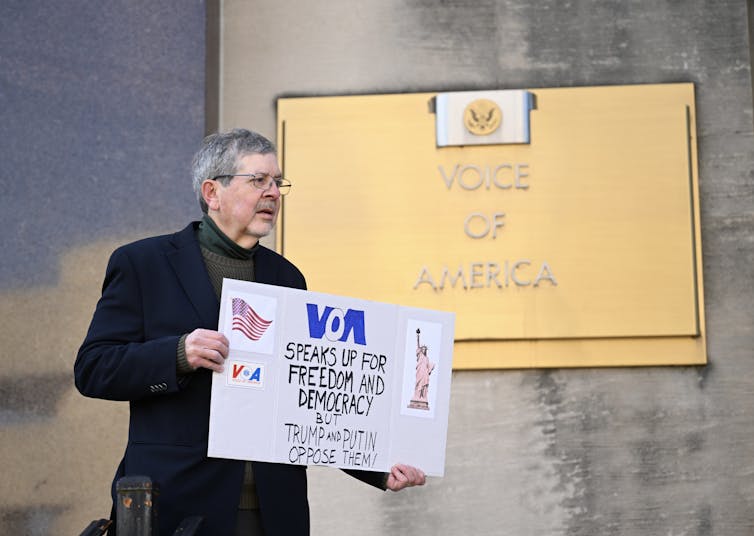
    Staff member with sign protesting in front of Voice of America sign.
    A Voice of America staffer protests outside the Washington DC offices on March 17, 2025, after employees were placed on administrative leave. Image: Getty Images/The Conversation

    Other voices get louder
    The biggest concern for Western democracies is that these other state-run media outlets will fill the void the USAGM leaves behind — including in the Pacific.

    Russia, China and Iran are increasing funding for their state-run news outlets, with China having spent more than US$6.6 billion over 13 years on its global media outlets. China Media Group is already one of the largest media conglomerates in the world, providing news content to more than 130 countries in 44 languages.

    And China has already filled media gaps left by Western democracies: after the ABC stopped broadcasting Radio Australia in the Pacific, China Radio International took over its frequencies.

    Worryingly, the differences between outlets such as Voice of America and more overtly state-run outlets aren’t immediately clear to audiences, as government ownership isn’t advertised.

    An Australian senator even had to apologise recently after speaking with PressTV, saying she didn’t know the news outlet was affiliated with the Iranian government, or that it had been sanctioned in Australia.

    Switched off
    Trump’s move to dismantle the USAGM doesn’t come as a complete surprise, however. As the authors of Capturing News, Capturing Democracy: Trump and the Voice of America described, the first Trump administration failed in its attempts to remove the firewall and install loyalists.

    This perhaps explains why Trump has resorted to more drastic measures this time. And, as with many of the current administration’s legally dubious actions, there has been resistance.

    The American Foreign Service Association says it will challenge the dismantling of the USAGM, while the Czech Republic is seeking EU support to keep Radio Free Europe and Radio Liberty on the air.

    But for many of the agency’s journalists, contractors, broadcasting partners and audiences, it may be too late. Last week, The New York Times reported some Voice of America broadcasts had already been replaced by music.The Conversation

    Dr Valerie A. Cooper is lecturer in media and communication, Te Herenga Waka — Victoria University of Wellington.  This article is republished from The Conversation under a Creative Commons licence. Read the original article.

    This post was originally published on Asia Pacific Report.

  • ANALYSIS: By Valerie A. Cooper, Te Herenga Waka — Victoria University of Wellington

    Of all the contradictions and ironies of Donald Trump’s second presidency so far, perhaps the most surprising has been his shutting down the US Agency for Global Media (USAGM) for being “radical propaganda”.

    Critics have long accused the agency — and its affiliated outlets such as Voice of America, Radio Free Europe and Radio Free Asia — of being a propaganda arm of US foreign policy.

    But to the current president, the USAGM has become a promoter of “anti-American ideas” and agendas — including allegedly suppressing stories critical of Iran, sympathetically covering the issue of “white privilege” and bowing to pressure from China.

    Propaganda is clearly in the eye of the beholder. The Moscow Times reported Russian officials were elated by the demise of the “purely propagandistic” outlets, while China’s Global Times celebrated the closure of a “lie factory”.

    Meanwhile, the European Commission hailed USAGM outlets as a “beacon of truth, democracy and hope”. All of which might have left the average person understandably confused: Voice of America? Wasn’t that the US propaganda outlet from World War II?

    Well, yes. But the reality of USAGM and similar state-sponsored global media outlets is more complex — as are the implications of the US agency’s demise.

    Public service or state propaganda?
    The USAGM is one of several international public service media outlets based in Western democracies. Others include Australia’s ABC International, the BBC World Service, CBC/Radio-Canada, France Médias Monde, NHK-World Japan, Deutsche Welle in Germany and SRG SSR in Switzerland.

    Part of the Public Media Alliance, they are similar to national public service media, largely funded by taxpayers to uphold democratic ideals of universal access to news and information.

    Unlike national public media, however, they might not be consumed — or even known — by domestic audiences. Rather, they typically provide news to countries without reliable independent media due to censorship or state-run media monopolies.

    The USAGM, for example, provides news in 63 languages to more than 100 countries. It has been credited with bringing attention to issues such as protests against covid-19 lockdowns in China and women’s struggles for equal rights in Iran.

    On the other hand, the independence of USAGM outlets has been questioned often, particularly as they are required to share government-mandated editorials.

    Voice of America has been criticised for its focus on perceived ideological adversaries such as Russia and Iran. And my own research has found it perpetuates stereotypes and the neglect of African nations in its news coverage.

    Leaving a void
    Ultimately, these global media outlets wouldn’t exist if there weren’t benefits for the governments that fund them. Sharing stories and perspectives that support or promote certain values and policies is an effective form of “public diplomacy”.

    Yet these international media outlets differ from state-controlled media models because of editorial systems that protect them from government interference.

    The Voice of America’s “firewall”, for instance, “prohibits interference by any US government official in the objective, independent reporting of news”. Such protections allow journalists to report on their own governments more objectively.

    In contrast, outlets such as China Media Group (CMG), RT from Russia, and PressTV from Iran also reach a global audience in a range of languages. But they do this through direct government involvement.

    CMG subsidiary CCTV+, for example, states it is “committed to telling China’s story to the rest of the world”.

    Though RT states it is an autonomous media outlet, research has found the Russian government oversees hiring editors, imposing narrative angles, and rejecting stories.

    Staff member with sign protesting in front of Voice of America sign.
    A Voice of America staffer protests outside the Washington DC offices on March 17, 2025, after employees were placed on administrative leave. Image: Getty Images/The Conversation

    Other voices get louder
    The biggest concern for Western democracies is that these other state-run media outlets will fill the void the USAGM leaves behind — including in the Pacific.

    Russia, China and Iran are increasing funding for their state-run news outlets, with China having spent more than US$6.6 billion over 13 years on its global media outlets. China Media Group is already one of the largest media conglomerates in the world, providing news content to more than 130 countries in 44 languages.

    And China has already filled media gaps left by Western democracies: after the ABC stopped broadcasting Radio Australia in the Pacific, China Radio International took over its frequencies.

    Worryingly, the differences between outlets such as Voice of America and more overtly state-run outlets aren’t immediately clear to audiences, as government ownership isn’t advertised.

    An Australian senator even had to apologise recently after speaking with PressTV, saying she didn’t know the news outlet was affiliated with the Iranian government, or that it had been sanctioned in Australia.

    Switched off
    Trump’s move to dismantle the USAGM doesn’t come as a complete surprise, however. As the authors of Capturing News, Capturing Democracy: Trump and the Voice of America described, the first Trump administration failed in its attempts to remove the firewall and install loyalists.

    This perhaps explains why Trump has resorted to more drastic measures this time. And, as with many of the current administration’s legally dubious actions, there has been resistance.

    The American Foreign Service Association says it will challenge the dismantling of the USAGM, while the Czech Republic is seeking EU support to keep Radio Free Europe and Radio Liberty on the air.

    But for many of the agency’s journalists, contractors, broadcasting partners and audiences, it may be too late. Last week, The New York Times reported some Voice of America broadcasts had already been replaced by music.The Conversation

    Dr Valerie A. Cooper is lecturer in media and communication, Te Herenga Waka — Victoria University of Wellington.  This article is republished from The Conversation under a Creative Commons licence. Read the original article.

    This post was originally published on Asia Pacific Report.

  • Pacific Media Watch

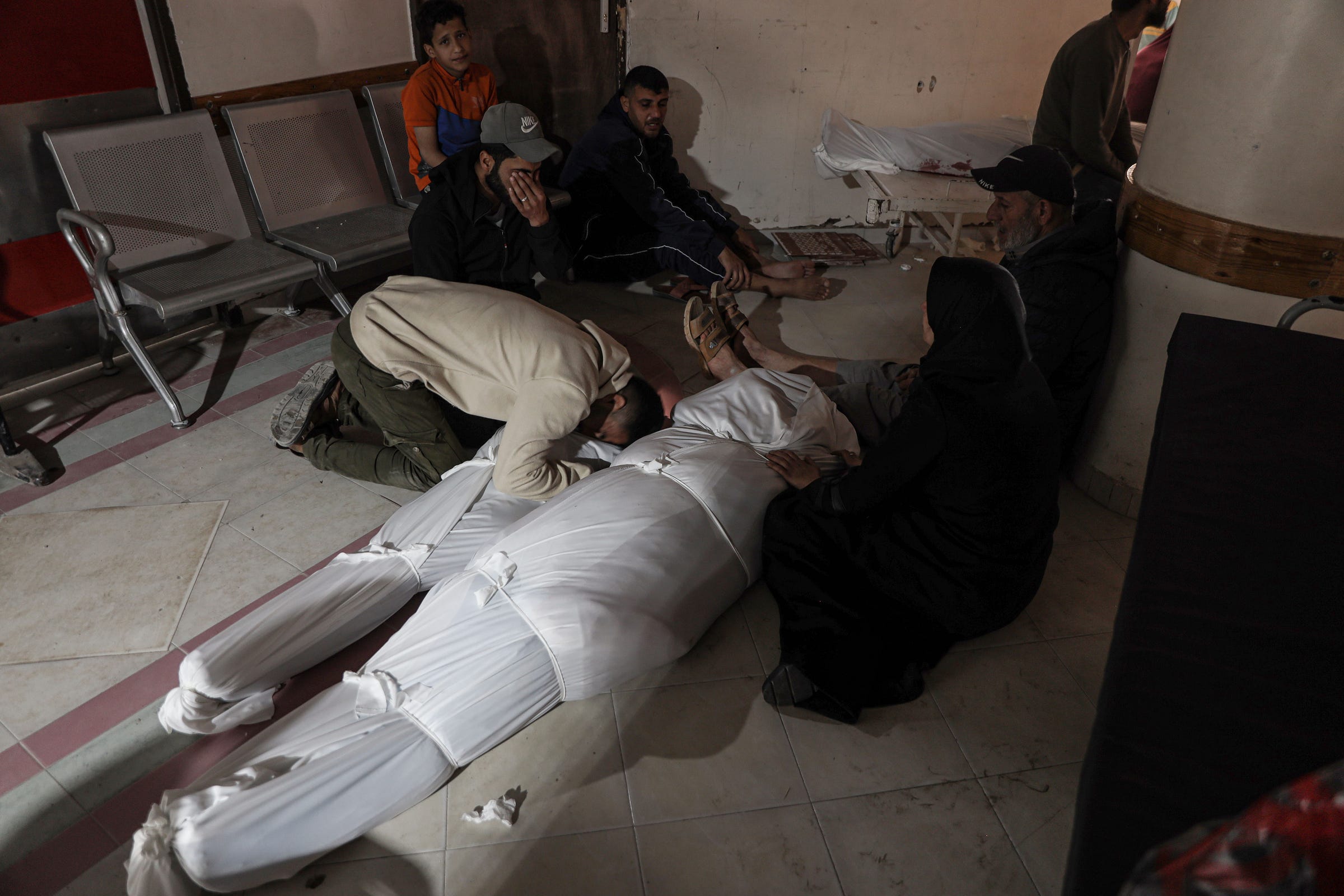
    Global media freedom groups have condemned the Israeli occupation forces for assassinating two more Palestinian journalists covering the Gaza genocide, taking the media death toll in the besieged enclave to at least 208 since the war started.

    Journalist and contributor to the Qatari-based Al Jazeera Mubasher, Hossam Shabat, is the latest to have been killed.

    Witnesses said Hossam’s vehicle was hit in the eastern part of Beit Lahiya. Several pedestrians were also wounded, reports Al Jazeera.

    in a statement, Al Jazeera condemned the killings, saying Hossam had joined the network’s journalists and correspondents killed during the ongoing war on Gaza, including Samer Abudaqa, Hamza Al-Dahdouh, Ismail Al-Ghoul, and Ahmed Al-Louh.

    Al Jazeera affirmed its commitment to pursue all legal measures to “prosecute the perpetrators of these crimes against journalists”.

    The network also said it stood in “unwavering solidarity with all journalists in Gaza and reaffirms its commitment to achieving justice” by prosecuting the killers of more than 200 journalists in Gaza since October 2023.

    The network extended its condolences to Hossam’s family, and called on all human rights and media organisations to condemn the Israeli occupation’s systematic killing of journalists.

    Hossam was the second journalist killed in Gaza yesterday.

    House targeted
    Earlier, the Israeli military killed Mohammad Mansour, a correspondent for the Beirut-based Palestine Today television, in an attack targeting a house in Khan Younis, southern Gaza.

    A fellow journalist circulated a video clip of Mansour’s father bidding farewell to his son with heartbreaking words, putting a microphone in his son’s hand and urging the voice that once conveyed the truth to a deaf world.

    “Stand up and speak, tell the world, you are the one who tells the truth, for the image alone is not enough,” the father said through tears.

    Jodie Ginsberg, the chief executive of the New York-based Committee to Protect Journalists (CPJ), condemned the killings, describing them as war crimes.

    The CPJ called for an independent international investigation into whether they were deliberately targeted.

    “CPJ is appalled that we are once again seeing Palestinians weeping over the bodies of dead journalists in Gaza,” said CPJ’s programme director Carlos Martinez de la Serna in New York.

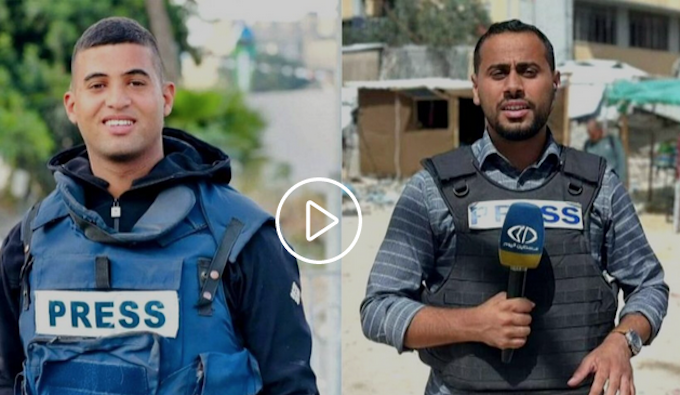
    The two latest journalists killed by Israeli occupation forces in Gaza . . . Al Jazeera’s Hossam Shabat (left) and Mohammad Mansour
    The two latest journalists killed by Israeli occupation forces in Gaza . . . Al Jazeera’s Hossam Shabat (left) and Mohammad Mansour of Palestine Today. Image: AJ screenshot APR

    ‘Nightmare has to end’
    “This nightmare in Gaza has to end. The international community must act fast to ensure that journalists are kept safe and hold Israel to account for the deaths of Hossam Shabat and Mohammed Mansour, whose killings may have been targeted.”

    Israel resumed airstrikes on Gaza on March 18, ending a ceasefire that began on January 19.

    The occupation forces continued bombarding Gaza for an eighth consecutive day, killing at least 23 people in predawn attacks including seven children.

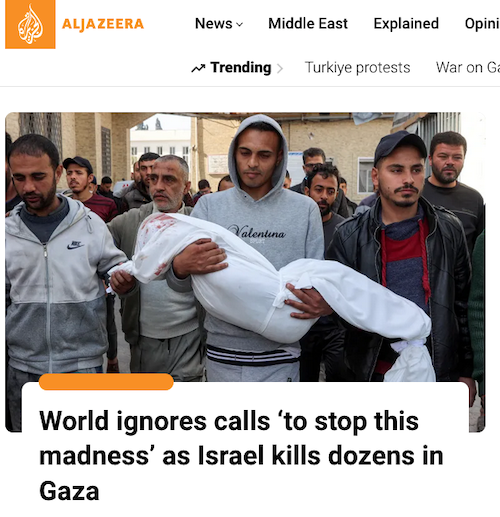
    Al Jazeera reports that the world ignores calls "to stop this madness"
    Al Jazeera reports that the world ignores calls “to stop this madness” as Israel kills dozens in Gaza. Image: AJ screenshot APR

    A UN official, Olga Cherevko, said Israel’s unhindered attacks on Gaza were a “bloody stain on our collective consciousness”, noting “our calls for this madness to stop have gone unheeded” by the world.

    Gaza’s Health Ministry said 792 people had been killed and 1663 injured in the week since Israel resumed its war on the Strip.

    The total death toll since the war started on October 7, 2023, has risen to 50,144, while 113,704 people have been injured, it said.

    West Bank ‘news desert’
    Meanwhile, the Paris-based media watchdog Reporters Without Borders (RSF) said the repression of reporters in the West Bank and East Jerusalem had intensified in recent months despite the recent ceasefire in Gaza before it collapsed.

    In the eastern Palestinian territories, Israeli armed forces have shot at journalists, arrested them and restricted their movement.

    The Palestinian Authority (PA), which governs the West Bank and East Jerusalem, has detained Al Jazeera journalists.

    RSF warned of a growing crackdown, which was transforming the region into a “news desert”.

    One of the co-directors of the Palestinian Oscar-winning film No Other Land, Hamdan Ballal, has been detained by Israeli forces. It happened after he was attacked by a mob of Israeli settlers in the occupied West Bank.

    He was in an ambulance receiving treatment when the doors were opened and he was abducted by the Israeli military. Colleagues say he has “disappeared”.

    A number of American activists were also attacked, and video on social media showed them fleeing the settler violence.

    This post was originally published on Asia Pacific Report.

  • By Scott Waide, RNZ Pacific PNG correspondent

    The Papua New Guinea government has admitted to using a technology that it says was “successfully tested” to block social media platforms, particularly Facebook, for much of the day yesterday.

    Police Minister Peter Tsiamalili Jr said the “test” was done under the framework of the Anti-Terrorism Act 2024, and sought to address the growing concerns over hate speech, misinformation, and other harmful content online.

    Tsiamalili did not specify what kind of tech was used, but said it was carried out in collaboration with the Royal Papua New Guinea Constabulary (RPNGC), the National Information and Communications Technology Authority (NICTA), and various internet service providers.

    “We are not attempting to suppress free speech or restrict our citizens from expressing their viewpoints,” Tsiamalili said.

    “However, the unchecked proliferation of fake news, hate speech, pornography, child exploitation, and incitement to violence on platforms such as Facebook is unacceptable.

    “These challenges increasingly threaten the safety, dignity, and well-being of our populace.”

    However, government agencies responsible for communications and ICT, including NICTA, said they were not aware.

    ‘Confidence relies on transparency’
    “Public confidence in our digital governance relies on transparency and consistency in how we approach online regulation,” NICTA chief executive Kilakupa Gulo-Vui said.

    “It is essential that all key stakeholders, including NICTA, law enforcement, telecommunications providers, and government agencies, collaborate closely to ensure that any actions taken are well-understood and properly executed.”

    He said that while maintaining national security was a priority, the balance between safety and digital freedom must be carefully managed.

    Gulo-Vui said NICTA would be addressing this matter with the Minister for ICT to ensure NICTA’s role continued to align with the government’s broader policy objectives, while fostering a cohesive and united approach to digital regulation.

    The Department of Information Communication and Technology (DICT) Secretary, Steven Matainaho, also stated his department was not aware of the test but added that the police have powers under the new domestic terrorism laws.

    Papua New Guinea’s recently introduced anti-terror laws are aimed at curbing both internal and external security threats.

    Critics warn of dictatorial control
    However, critics of the move say the test borders on dictatorial control.

    An observer of Monday’s events, Lucas Kiap, said the goal of combating hate speech and exploitation was commendable, but the approach risks paving way for authoritarian overreach.

    “Where is PNG headed? If the government continues down this path, it risks trading democracy for control,” he said.

    Many social media users, however, appeared to outdo the government, with many downloading and sharing Virtual Area Network (VPN) apps and continuing to post on Facebook.

    “Hello from Poland,” one user said.

    East Sepik Governor Allan Bird said today that the country’s anti-terrorism law could target anyone because “the definition of a terrorist is left to the Police Minister to decide”.

    ‘Designed to take away our freedoms’
    “During the debate on the anti-terrorism bill in Parliament, I pointed out that the law was too broad and it could be used against innocent people,” he wrote on Facebook.

    He said government MPs laughed at him and used their numbers to pass the bill.

    “Yesterday, the Police Minister used the Anti-terrorism Act to shut down Facebook. That was just a test, that was step one,” Governor Bird said.

    “There is no limit to the powers the Minister of Police can exercise under this new law. It is draconian law designed to take away our freedoms.

    “We are now heading into dangerous territory and everyone is powerless to stop this tyranny,” he added.

    This article is republished under a community partnership agreement with RNZ.

    This post was originally published on Asia Pacific Report.

  • Israel has begun the final stage of its genocide. The Palestinians will be forced to choose between death or deportation. There are no other options, writes Chris Hedges

    ANALYSIS: By Chris Hedges

    This is the last chapter of the genocide. It is the final, blood-soaked push to drive the Palestinians from Gaza. No food. No medicine. No shelter. No clean water. No electricity.

    Israel is swiftly turning Gaza into a Dantesque cauldron of human misery where Palestinians are being killed in their hundreds and soon, again, in their thousands and tens of thousands, or they will be forced out never to return.

    The final chapter marks the end of Israeli lies. The lie of the two-state solution. The lie that Israel respects the laws of war that protect civilians. The lie that Israel bombs hospitals and schools only because they are used as staging areas by Hamas.

    The lie that Hamas uses civilians as human shields, while Israel routinely forces captive Palestinians to enter potentially booby-trapped tunnels and buildings ahead of Israeli troops. The lie that Hamas or Palestine Islamic Jihad (PIJ) are responsible — the charge often being errant Palestinian rockets — for the destruction of hospitals, United Nations’ buildings or mass Palestinian casualties.

    The lie that humanitarian aid to Gaza is blocked because Hamas is hijacking the trucks or smuggling in weapons and war material. The lie that Israeli babies are beheaded or Palestinians carried out mass rape of Israeli women. The lie that 75 percent of the tens of thousands killed in Gaza were Hamas “terrorists.”

    The lie that Hamas, because it was allegedly rearming and recruiting new fighters, is responsible for the breakdown of the ceasefire agreement.

    Israel’s naked genocidal visage is exposed. It has ordered the evacuation of northern Gaza where desperate Palestinians are camped out amid the rubble of their homes. What comes now is mass starvation — the United Nations Relief and Works Agency for Palestine Refugees in the Near East (UNRWA) said on March 21 it has six days of flour supplies left — deaths from diseases caused by contaminated water and food, scores of killed and wounded each day under the relentless assault of bombs, missiles, shells and bullets.

    Nothing will function, bakeries, water treatment and sewage plants, hospitals — Israel blew up the damaged Turkish-Palestinian hospital on March 21 — schools, aid distribution centers or clinics. Less than half of the 53 emergency vehicles operated by the Palestine Red Crescent Society are functional due to fuel shortages. Soon there will be none.

    Israel’s message is unequivocal: Gaza will be uninhabitable. Leave or die.

    Since last Tuesday, when Israel broke the ceasefire with heavy bombing, over 700 Palestinians have been killed, including 200 children. In one 24 hour period 400 Palestinians were killed.

    This is only the start. No Western power, including the United States, which provides the weapons for the genocide, intends to stop it. The images from Gaza during the nearly 16 months of incessant attacks were awful.

    But what is coming now will be worse. It will rival the most atrocious war crimes of the 20th century, including the mass starvation, wholesale slaughter and leveling of the Warsaw Ghetto in 1943 by the Nazis.

    October 7 marked the dividing line between an Israeli policy that advocated the brutalisation and subjugation of the Palestinians and a policy that calls for their extermination and removal from historic Palestine. What we are witnessing is the historical equivalent of the moment triggered by the annihilation of some 200 soldiers led by George Armstrong Custer in June 1876 at the Battle of the Little Bighorn.

    After that humiliating defeat, Native Americans were slated to be killed with the remnants forced into prisoner of war camps, later named reservations, where thousands died of disease, lived under the merciless gaze of their armed occupiers and fell into a life of immiseration and despair.

    Expect the same for the Palestinians in Gaza, dumped, I suspect, in one of the world’s hellholes and forgotten.

    “Gaza residents, this is your final warning,” Israeli Minister of Defense Israel Katz threatened:

    “The first Sinwar destroyed Gaza and the second Sinwar will completely destroy it. The Air Force strikes against Hamas terrorists were just the first step. It will become much more difficult and you will pay the full price. The evacuation of the population from the combat zones will soon begin again…Return the hostages and remove Hamas and other options will open for you, including leaving for other places in the world for those who want to. The alternative is absolute destruction.”

    The ceasefire deal between Israel and Hamas was designed to be implemented in three phases. The first phase, lasting 42 days, would see an end to hostilities. Hamas would release 33 Israeli hostages who were captured on Oct. 7, 2023 — including women, those aged above 50, and those with illnesses — in exchange for upwards of 2,000 Palestinian men, women and children imprisoned by Israel (around 1,900 Palestinian captives have been released by Israel as of March 18).

    Hamas has released a total of 147 hostages, of whom eight were dead. Israel says there are 59 Israelis still being held by Hamas, 35 of whom Israel believes are deceased.

    The Israeli army would pull back from populated areas of Gaza on the first day of the ceasefire. On the seventh day, displaced Palestinians would be permitted to return to northern Gaza. Israel would allow 600 aid trucks with food and medical supplies to enter Gaza daily.

    The second phase, which was expected to be negotiated on the 16th day of the ceasefire, would see the release of the remaining Israeli hostages. Israel would complete its withdrawal from Gaza maintaining a presence in some parts of the Philadelphi corridor, which stretches along the 13 km border between Gaza and Egypt.

    It would surrender its control of the Rafah border crossing into Egypt.

    The third phase would see negotiations for a permanent end of the war and the reconstruction of Gaza.

    Israel habitually signs agreements, including the Camp David Accords and the Oslo Peace Agreement, with timetables and phases. It gets what it wants — in this case the release of the hostages — in the first phase and then violates subsequent phases. This pattern has never been broken.

    Israel refused to honour the second phase of the deal. It blocked humanitarian aid into Gaza two weeks ago, violating the agreement. It also killed at least 137 Palestinians during the first phase of the ceasefire, including nine people, — three of them journalists — when Israeli drones attacked a relief team on March 15 in Beit Lahiya in northern Gaza

    Israel’s heavy bombing and shelling of Gaza resumed March 18 while most Palestinians were asleep or preparing their suhoor, the meal eaten before dawn during the holy month of Ramadan. Israel will not stop its attacks now, even if the remaining hostages are freed — Israel’s supposed reason for the resumption of the bombing and siege of Gaza.

    The Trump White House is cheering on the slaughter. They attack critics of the genocide as “antisemites” who should be silenced, criminalised or deported while funneling billions of dollars in weapons to Israel.

    Israel’s genocidal assault on Gaza is the inevitable denouement of its settler colonial project and apartheid state. The seizure of all of historic Palestine — with the West Bank soon, I expect, to be annexed by Israel — and displacement of all Palestinians has always been the Zionist goal.

    Israel’s worst excesses occurred during the wars of 1948 and 1967 when huge parts of historic Palestine were seized, thousands of Palestinians killed and hundreds of thousands were ethnically cleansed. Between these wars, the slow-motion theft of land, murderous assaults and steady ethnic cleansing in the West Bank, including East Jerusalem, continued.

    That calibrated dance is over. This is the end. What we are witnessing dwarfs all the historical assaults on Palestinians. Israel’s demented genocidal dream — a Palestinian nightmare — is about to be achieved.

    It will forever shatter the myth that we, or any Western nation, respect the rule of law or are the protectors of human rights, democracy and the so-called “virtues” of Western civilisation. Israel’s barbarity is our own. We may not understand this, but the rest of the globe does.

    Chris Hedges is a Pulitzer Prize–winning journalist who was a foreign correspondent for 15 years for The New York Times, where he served as the Middle East bureau chief and Balkan bureau chief for the paper. He is the host of show “The Chris Hedges Report”. This article is republished from his X account.

    This post was originally published on Asia Pacific Report.

  • Asia Pacific Report

    A Fiji-based Pacific solidarity group supporting the indigenous Palestine struggle for survival against the Israeli settler colonial state has today issued a statement condemning Fiji backing for Israel.

    In an open letter to the “people of Fiji”, the Fijians for Palestine Solidarity Network (F4P) has warned “your government openly supports Israel despite its genocidal campaign against Palestinians”.

    “It is directly complicit in Israel’s genocide against Palestinians and history will not forgive their inaction.”

    The group said the struggle resonated with all who believed in justice, equality, and the fundamental rights of every human being.

    Fijians for Palestine has condemned Prime Minister Sitiveni Rabuka’s coalition government plans to open a Fijian embassy in Jerusalem with Israeli backing and has launched a “No embassy on occupied land” campaign.

    The group likened the Palestine liberation struggle to Pacific self-determination campaigns in Bougainville, “French” Polynesia, Kanaky and West Papua.

    Global voices for end to violence
    The open letter on social media said:

    “Our solidarity with the Palestinian people is a testament to our shared humanity. We believe in a world where diversity, is treated with dignity and respect.

    “We dream of a future where children in Gaza can play without fear, where families can live without the shadow of war, and where the Palestinian people can finally enjoy the peace and freedom they so rightly deserve.

    “We join the global voices demanding a permanent ceasefire and an end to the violence. We express our unwavering solidarity with the Palestinian people.

    “The Palestinian struggle is not just a regional issue; it is a testament to the resilience of a people who, despite facing impossible odds, continue to fight for their right to exist, freedom, and dignity. Their struggle resonates with all who believe in justice, equality, and the fundamental rights of every human being.

    “The images of destruction, the stories of families torn apart, and the cries of children caught in the crossfire are heart-wrenching. These are not mere statistics or distant news stories; these are real people with hopes, dreams, and aspirations, much like us.

    “As Fijians, we have always prided ourselves on our commitment to peace, unity, and humanity. Our rich cultural heritage and shared values teach us the importance of standing up for what is right, even when it is not popular or convenient.

    “We call on you to stand in solidarity with the Palestinian people this Thursday with us, not out of political allegiance but out of a shared belief in humanity, justice, and the inalienable human rights of every individual.

    “There can be no peace without justice, and we stand in unity with all people and territories struggling for self-determination and freedom from occupation. The Pacific cannot be an Ocean of Peace without freedom and self determination in Palestine, West Papua, Kanaky and all oppressed territories.

    “To the Fijian people, please know that your government openly supports Israel despite its genocidal campaign against Palestinians. It is directly complicit in Israel’s genocide against Palestinians and history will not forgive their inaction.”

    This post was originally published on Asia Pacific Report.

  • By Christine Rovoi of PMN News

    A human rights group in Aotearoa New Zealand has welcomed support from several Pacific island nations for West Papua, which has been under Indonesian military occupation since the 1960s.

    West Papua is a region (with five provinces) in the far east of Indonesia, centred on the island of New Guinea. Half of the eastern side of New Guinea is Papua New Guinea.

    West Papua Action Aotearoa claims the Indonesian occupation of West Papua has resulted in serious human rights violations, including a lack of press freedom.

    Catherine Delahunty, the group’s spokesperson, says many West Papuans have been displaced as a result of Indonesia’s military activity.

    In an interview with William Terite on PMN’s Pacific Mornings, the environmentalist and former Green Party MP said most people did not know much about West Papua “because there’s virtually a media blackout around this country”.

    “It’s an hour away from Darwin [Australia], and yet, most people don’t know what has been going on there since the 1960s. It’s a very serious and tragic situation, which is the responsibility of all of us as neighbours,” she said.

    “They [West Papuans] regard themselves fully as members of the Pacific community but are treated by Indonesia as an extension of their empire because they have all these natural resources, which Indonesia is rapidly extracting, using violence to maintain the state.”

    Delahunty said the situation was “very disturbing”, adding there was a “need for support and change alongside the West Papuan people”.

    UN support
    In a recent joint statement to the United Nations Human Rights Council, the leaders of Federated States of Micronesia, Nauru, Marshall Islands, Sāmoa and Vanuatu called on the global community to support the displaced people of West Papua.

    A Free West Papua rally.
    A Free West Papua rally. Image: Nichollas Harrison/PMN News

    Delahunty said the Pacific island nations urged the UN Council to advocate for human rights in West Papua.

    She also said West Papua Action Aotearoa wanted Indonesia to allow a visit from a UN human rights commissioner, a request that Indonesia has consistently denied.

    She said Sāmoa was the latest country to support West Papua, contrasting this with the “lack of action from larger neighbours like New Zealand and Australia”.

    Delahunty said that while smaller island nations and some African groups supported West Papua, more powerful states provide little assistance.

    “It’s great that these island nations are keeping the issue alive at the United Nations, but we particularly want to shout out to Sāmoa because it’s a new thing,” she told Terite.

    “They’ve never, as a government, made public statements. There are many Sāmoan people who support West Papua, and I work with them. But it’s great to see their government step up and make the statement.”

    Benny Wenda, right, a West Papuan independence leader, with Eni Faleomavaega, the late American Sāmoan congressman,
    Benny Wenda (right), a West Papuan independence leader, with Eni Faleomavaega, the late American Sāmoan congressman, a supporter of the Free West Papua campaign. Image: Office of Benny Wenda/PMN News

    Historically, the only public statements supporting West Papua have come from American Sāmoan congressman Eni Faleomavaega, who strongly advocated for it until he died in 2017.

    Praise for Sāmoa
    Delahunty praised Sāmoa’s support for the joint statement but voiced her disappointment at New Zealand and Australia.

    “What’s not encouraging is the failure of Australia and New Zealand to actually support this kind of joint statement and to vigorously stand up for West Papua because they have a lot of power in the region,” she said.

    “They’re the big states, and yet it’s the leadership of the smaller nations that we see today.”

    In September 2024, Phillip Mehrtens, a pilot from New Zealand, was released by West Papua rebels after being held captive for 19 months.

    Mehrtens, 39, was kidnapped by West Papua National Liberation Army fighters in February 2023 and was released after lengthy negotiations and “critical’ diplomatic efforts by authorities in Wellington and Jakarta.

    New Zealand’s Prime Minister Christopher Luxon and Foreign Affairs Minister Vaovasamanaia Winston Peters welcomed his release.

    NZ pilot Philip Mehrtens with West Papua Liberation Army
    New Zealand pilot Phillip Mehrtens was kidnapped by militants in West Papua on 7 March 2023. He was released 19 months later. Image: TPNPB/PMN News

    Why is there conflict in West Papua?
    Once a Dutch colony, the region is divided into five provinces, the two largest being Papua and West Papua. It is separate from PNG, which gained independence from Australia in 1975.

    Papuan rebels seeking independence from Indonesia have issued threats and attacked aircraft they believe are carrying personnel and delivering supplies for Jakarta.

    The resource-rich region has sought independence since 1969, when it came under Indonesia’s control following a disputed UN-supervised vote.

    Conflicts between indigenous Papuans and Indonesian authorities have been common with pro-independence fighters increasing their attacks since 2018.

    The Free Papua Movement has conducted a low-intensity guerrilla war against Indonesia, targeting military and police personnel, along with ordinary Indonesian civilians.

    Human rights groups estimate that Indonesian security forces have killed more than 300,000 West Papuans since the conflict started.

    But the Indonesian government denies any wrongdoing, claiming that West Papua is part of Indonesia and was integrated after the controversial “Act of Free Choice” in 1969.

    Manipulated process
    The Act of Free Choice has been widely criticised as a manipulated process, with international observers and journalists raising concerns about the fairness and legitimacy of the plebiscite.

    Despite the criticism, the United States and its allies in the region, New Zealand and Australia, have supported Indonesia’s efforts to gain acceptance in the UN for the pro-integration vote.

    Human rights groups, such as Delahunty’s West Papua Action Aotearoa, have raised “serious concerns” about the deteriorating human rights situation in Papua and West Papua.

    They cite alarming abuses against indigenous Papuans, including child killings, disappearances, torture, and mass displacement.

    Delahunty believes the hope for change lies with the nations of Te Moana Nui a Kiwa. She said it also came from the younger people in Indonesia today.

    “This is a colonisation issue, and it’s a bit like Aotearoa, in the sense that when the people who have been part of the colonising start addressing the issue, you get change. But it’s far too slow. So we are so disappointed.”

    Republished with permission from PMN News.

    This post was originally published on Asia Pacific Report.

  • By Patrick Decloitre, RNZ Pacific correspondent French Pacific desk

    Southern Cross, a French-hosted regional military exercise, is moving to Wallis and Futuna Islands this year.

    The exercise, which includes participating regional armed and law enforcement forces from Australia, Fiji, New Zealand, Papua New Guinea and Tonga every two years, is scheduled to take place April 22-May 3.

    Since its inception in 2002, the war games have traditionally been hosted in New Caledonia.

    However, New Caledonia was the scene last year of serious riots, causing 14 deaths, hundreds injured, and an estimated cost of 2.2 billion euros (NZ$4.2 billion)

    Southern Cross focuses on the notion of “interoperability” between regional forces, with a joint multinational command following a predefined but realistic scenario, usually in a fictitious island state affected by a natural disaster and/or political unrest.

    This is the first time the regional French exercise will be hosted on Wallis Island, in the French Pacific territory of Wallis and Futuna, near Fiji and Samoa.

    Earlier this month (March 3-5), the Nouméa-based French Armed Forces in New Caledonia (FANC) hosted a “Final Coordination Conference” (FCC) with its regional counterparts after a series of on-site reconnaissance visits to Wallis and Futuna Islands ahead of the Southern Cross 2025 manoeuvres.

    Humanitarian, disaster relief
    FANC also confirmed this year, again in Wallis-and-Futuna, the exercise scenario would mainly focus on Humanitarian Assistance and Disaster Relief (HADR) and that it would involve, apart from the French forces, the deployment of some 19 other participating countries, with an estimated 2000 personnel, including 600 regional.

    French Carrier Strike Group Exercise Clémenceau25 deployment map of operations
    A French Carrier Strike Group exercise Clémenceau25 deployment map of operations. Image: ALPACI-Forces armées en Asie-Pacifique et en Polynésie française

    Last week, still in preparation mode, a group of FANC officers travelled again to Wallis for three days to finalise preparations ahead of the exercise.

    In an interview with public broadcaster Wallis and Futuna la 1ère, FANC inter-army chief-of-staff Colonel Frédéric Puchois said the group of officers met local chiefly and royal authorities, as well as the Speaker of the local territorial assembly.

    In 2023, the previous Southern Cross exercise held in New Caledonia involved the participation of about 18 regional countries.

    “It’s all about activating and practising quick and efficient scenarios to respond mainly to a large-scale natural disaster,” Colonel Puchois said.

    “Southern Cross until now took place in New Caledonia, but it was decided for 2025 to choose Wallis and Futuna to work specifically on long-distance projection.

    “So, the Americans will position some of their forces in Pago-Pago in American Samoa to test their capacity to project forces from a rear base located 2000 kms away [from Wallis].

    “And for the French part, the rear base will be New Caledonia,” he added.

    Port Vila earthquake
    He said one of the latest real-life illustrations of this kind of deployment was the recent relief operation from Nouméa following Port Vila’s devastating earthquake in mid-December 2024.

    “We brought essential relief supplies, in coordination with NGOs like the Red Cross. And during Southern Cross 2025, we will again work with them and other NGOs”.

    However, Colonel Puchois said not all personnel would be deployed at the same time.

    “We will project small groups at a time. There will be several phases,” he said.

    “First to secure the airport to ensure it is fit for landing of large aircraft. This could involve parachute personnel and supplies.

    “Then assistance to the population, involving other components such as civil security, fire brigades, gendarmes. It would conclude with evacuating people in need of further assistance.

    “So we won’t project all of the 2000 participants at the same time, but groups of 250 to 300 personnel”.

    Cooperation with Vanuatu Mobile Force
    FANC Commander General Yann Latil was in Vanuatu two weeks ago, where he held meetings with Vanuatu Mobile Forces (VMF) Commander Colonel Ben Nicholson and Vanuatu Internal Affairs minister Andrew Napuat to discuss cooperation, as well as handling and maintenance of the French-supplied FAMAS rifles.

    For two weeks, two FANC instructors were in Port Vila to train a group of about 15 VMF on handling and maintenance of the FAMAS used by the island state’s paramilitary force.

    The VMF were also handed over more ammunition for the standard issue FAMAS (the French equivalent of the US-issued M-16).

    French Armed Forces Commander in New Caledonia (FANC) General Yann Latil speaking
    French Armed Forces Commander in New Caledonia (FANC) General Yann Latil visits Vanuatu Mobile Forces (VMF) training in French FAMAS rifles maintenance. Image: FANC Forces Armées en Nouvelle-Calédonie

    During his visit, General Latil also held talks with Vanuatu Internal Affairs Minister Andrew Napuat, who is in charge of the VMF and police.

    FANC and Vanuatu security forces are “working on a regular basis”, Vanuatu-based French Ambassador Jean-Baptiste Jeangène Vilmer said.

    The three-star general (equivalent of a lieutenant-general) flew back to Nouméa about 500 km away on March 8.

    French vessel on fishing policing mission
    At the same time, still in Vanuatu, Nouméa-based overseas support and assistance vessel (BSAOM) the D’Entrecasteaux and its crew were on a courtesy call in Luganville (Espiritu Santo island, North Vanuatu) for three days.

    After hosting local officials and school students for visits, the patrol boat embarked on a surveillance policing mission in high seas off the archipelago.

    One ni-Vanuatu officer also joined the French crew inspecting foreign fishing vessels and checking if they comply with current regulations under the Forum Fisheries Agency (FFA).

    On a regular basis, similar monitoring operations are also carried out by navies from other regional countries such as Australia and New Zealand in order to assist neighbouring Pacific States in protecting their respective Exclusive Economic Zones (EEZ) from what is usually termed Illegal Unregulated and Unreported (IUU) fishing from foreign vessels.

    Last month, the D’Entrecasteaux was engaged in a series of naval exercises off Papua New Guinea.

    Further north in the Pacific, French aircraft carrier Charles de Gaulle and its strike group wrapped up an unprecedented two-month deployment in a series of multinational exercises with Australia, Indonesia, Malaysia, Philippines, Singapore and Vietnam), where “one third of the world’s maritime trade transits every day”.

    This included its own Exercises Clémenceau25 and La Pérouse (with eight neighbouring forces), but also interoperability-focused manoeuvres with the US and Japan (Pacific Steller).

    “The deployment of this military capacity underlines France’s attachment to maritime and aerial freedom of action and movement on all seas and oceans of the world”, the Tahiti-based Pacific Maritime Command (ALPACI) said this week in a release.

    US Navy in Western Pacific activity
    Also in western Pacific waters, the US Navy’s activity has been intense over the past few weeks, and continues.

    The Virginia-class fast-attack submarine USS Vermont (SSN 792) returned on 18 March to Joint Base Pearl Harbour-Hickam, following a seven-month deployment, the submarine’s first deployment to the Western Pacific, the US Third Fleet command stated.

    On Friday, the USS Nimitz (CVN 68) Carrier Strike Group (NIMCSG) left Naval Base Kitsap in Bremerton, Washington, for a regularly scheduled deployment to the Western Pacific.

    The US Third Fleet command said the strike group’s deployment will focus on “demonstrating the US Navy’s unwavering commitment to a free and open Indo-Pacific in which all nations are secure in their sovereignty and free from coercion”.

    This article is republished under a community partnership agreement with RNZ.

    This post was originally published on Asia Pacific Report.

  • SPECIAL REPORT: By Saige England in Christchurch

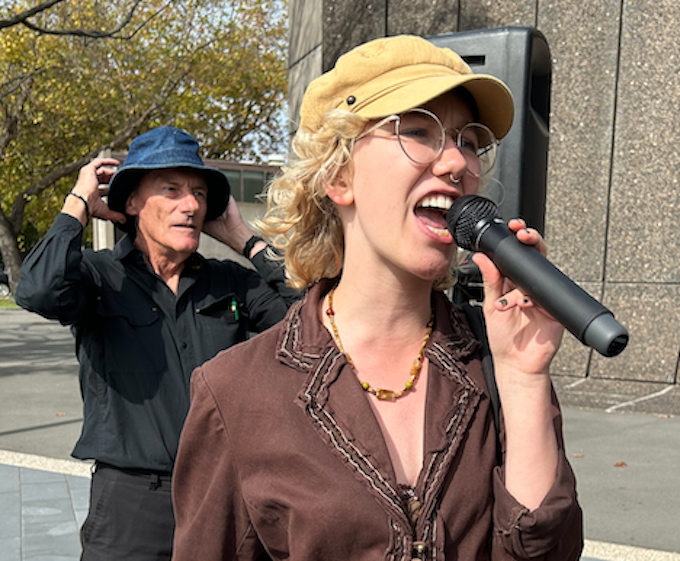
    Like a relentless ocean, wave after wave of pro-Palestinian pro-human rights protesters disrupted New Zealand deputy Prime Minister Winston Peters’ state of the nation speech at the Christchurch Town Hall yesterday.

    A clarion call to Trumpism and Australia’s One Nation Party, the speech was accompanied by the background music of about 250 protesters outside the Town Hall, chanting: “Complicity in genocide is a crime.”

    Palestine Solidarity Network Aotearoa (PSNA) co-chair John Minto described Peters’ attitude to Palestinians as “sickening”.

    Inside the James Hay Theatre, protester after protester stood and spoke loudly and clearly against the deputy Prime Minister’s failure to support those still dying in Gaza, and his failure to denounce the ongoing genocide.

    Ben Vorderegger was the first of nine protesters who appealed on behalf of people who have lost their voices in the dust of blood and bones, bombs and sniper guns.

    Before he and others were hauled out, they spoke for the tens of thousands of Palestinians who have been killed by Israeli forces in Gaza — women, men, doctors, aid workers, journalists, and children.

    Gazan health authorities have reported that the official death toll is now more than 50,000 — but that is the confirmed deaths with thousands more buried under the rubble.

    Real death toll
    The real death toll from the genocide in Gaza has been estimated by a reputed medical journal, The Lancet, at more than 63,000. A third of those are children. Each day more children are killed.

    One by one the protesters who challenged Peters were manhandled by security guards to a frenzied crowd screaming “out, out”.

    The deputy Prime Minister’s response was to deride and mock the conscientious objectors. He did not stop there. He lambasted the media.

    At this point, several members of his audience turned on me as a journalist and demanded my removal.

    Pro=Palestine protesters at the Christchurch Town Hall
    Pro=Palestine protesters at the Christchurch Town Hall yesterday to picket Foreign Minister Winston Peters at his state of the nation speech.Image: Saige England/APR

    This means that not only is the right to free speech at stake, the right or freedom to report is also being eroded. (I was later trespassed by security guards and police from the Town Hall although no reason was supplied for the ban).

    Inside the Christchurch Town Hall the call by Peters, who is also Foreign Minister, to “Make New Zealand Great Again” continued in the vein of a speech written by a MAGA leader.

    He whitewashed human rights, failed to address climate change, and demonstrated loathing for a media that has rarely challenged him.

    Ben Vorderegger was the first of nine protesters who appealed on behalf of Palestinans before being thrown out
    Ben Vorderegger in keffiyeh was the first of nine protesters who appealed on behalf of Palestinans before
    being thrown out of the Christchurch Town Hall meeting. Image: Saige England/APR

    Condemned movement
    Slamming the PSNA as “Marxist fascists” for calling out genocide, he condemned the movement for failing to talk with those who have a record of kowtowing to violent colonisation.

    This tactic is Colonial Invasion 101. It sees the invader rewarding and only dealing with those who sell out. This strategy demands that the colonised people should bow to the oppressor — an oppressor who threatens them with losing everything if they do not accept the scraps.

    Peters showed no support for the Treaty of Waitangi but rather, endorsed the government’s challenge to the founding document of the nation – Te Tiriti o Waitangi. In his dismissal of the founding and legally binding partnership, he repeated the “One Nation” catch-cry. Ad nauseum.

    Besides slamming Palestinians, the Scots (he managed to squeeze in a racist joke against Scottish people), and the woke, Peters’ speech promoted continued mining, showing some amnesia over the Pike River disaster. He did not reference the environment or climate change.

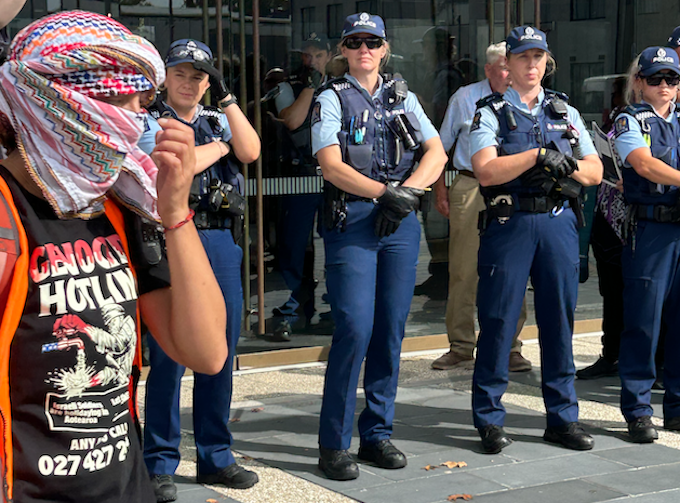
    After the speech, outside the Town Hall police donned black gloves — a sign they were prepared to use pepper-spray.

    PSNA co-chair John Minto described Peters’ failure to stand against the ongoing genocide of Palestinians as “bloody disgraceful”.

    The police arrested one protester, claiming he put his hand on a car transporting NZ First officials. A witness said this was not the case.

    PSNA co-chair John Minto (in hat behind fellow protester)
    PSNA co-chair John Minto (in hat behind fellow protester) . . . the failure of Foreign Minister Winston Peters to stand against the ongoing genocide of Palestinians is “bloody disgraceful”. Image; Saige England/APR

    Protester released
    The protester was later released without any charges being laid.

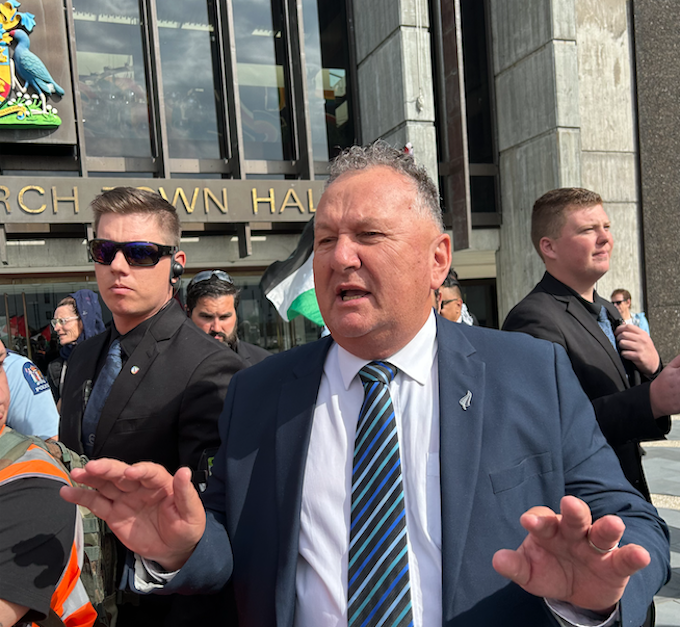
    A defiant New Zealand First MP Shane Jones marched out of the Town Hall after the event. He raised his arms defensively at protesters crying, “what if it was your grandchildren being slaughtered?”

    I was trespassed from the Christchurch Town Hall for re-entering the Town Hall for Winston Peters’ media conference. No reason was supplied by police or the Town Hall security personnel for that trespass order..

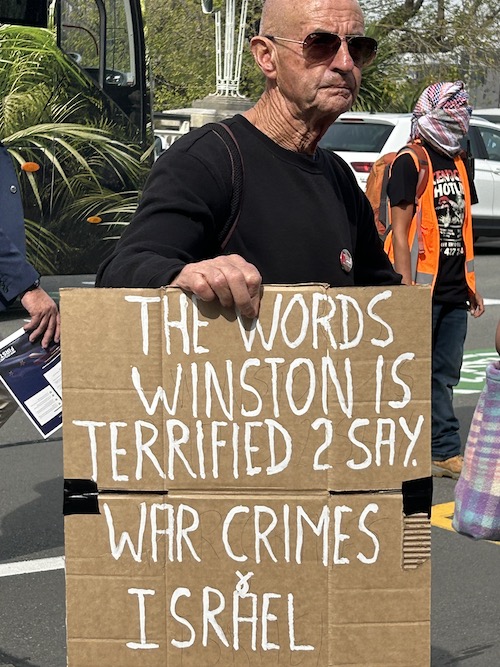
    "The words Winston is terrified to say . . . " poster
    “The words Winston is terrified to say . . . ” poster at the Christchurch pro-Palestinian protest. Image: Saige England/APR

    It is well known that Peters loathes the media — he said so enough times during his state of the nation speech.

    He referenced former US President Bill Clinton during his speech, an interesting reference given that Clinton did not receive the protection from the media that Peters has received.

    From the over zealous security personnel who manhandled and dragged out hecklers, to the banning of a journalist, to the arrest of someone for “touching a car” when witnesses report otherwise, the state of the nation speech held some uncomfortable echoes — the actions of a fascist dictatorship.

    Populist threats
    The atmosphere was reminiscent of a Jorg Haider press conference I attended many years ago in Vienna. That “rechtspopulist” Austrian politician had threatened journalists with defamation suits if they called him out on his support for Nazis.

    Yet he was on record for doing so.

    I was reminded of this yesterday when the audience called ‘out out’ at hecklers, and demanded the removal of this journalist. These New Zealand First supporters demand adoration for their leader or a media black-out.

    Perhaps they cannot be blamed given that the state of the nation speech could well have been written by US President Donald Trump or one of his minions.

    The protesters were courageous and conscientious in contrast to Peters, said PSNA’s John Minto.

    He likened Peters to Neville Chamberlain — Britain’s Prime Minister from 1937 to 1940. His name is synonymous with the policy of “appeasement” because he conceded territorial concessions to Nazi Germany in the late 1930s, fruitlessly hoping to avoid war.

    “He has refused to condemn any of Israel’s war crimes against Palestinians, including the total humanitarian aid blockade of Gaza.”

    Refusal ‘unprecedented’
    “It’s unprecedented in New Zealand history that a government would refuse to condemn Israel breaking its ceasefire agreement and resuming industrial-scale slaughter of civilians,” Minto said.

    “That is what Israel is doing today in Gaza, with full backing from the White House.

    “Chamberlain went to meet Hitler in Munich in 1938 to whitewash Nazi Germany’s takeovers of its neighbours’ lands.

    “Peters has been in Washington to agree to US approval of the occupation of southern Syria, more attacks on Lebanon, resumption of the land grab genocide in Gaza and get a heads-up on US plans to ‘give’ the Occupied West Bank to Israel later this year.

    “If Peters disagrees with any of this, he’s had plenty of chances to say so.

    “New Zealanders are calling for sanctions on Israel but Mr Peters and the National-led government are looking the other way.”

    New Zealand First MP Shane Jones marched out of the Town Hall
    New Zealand First MP Shane Jones marched out of the Town Hall after the event, dismissing protesters crying, “what if it was your grandchildren being slaughtered?” Image: Saige England/APR

    Only staged questions
    The conscientious objectors who rise against the oppression of human rights are people Winston Peters regards as his enemies. He will only answer questions in a press conference staged for him.

    He warms to journalists who warm to him.

    The state of the nation speech in the Town Hall was familiar.

    Seeking to erase conscientiousness will not make New Zealand great, it will render this country very small, almost miniscule, like the people who are being destroyed for daring to demand their right to their own land.

    Saige England is a journalist and author, and a member of the Palestine Solidarity Network Aotearoa (PSNA).

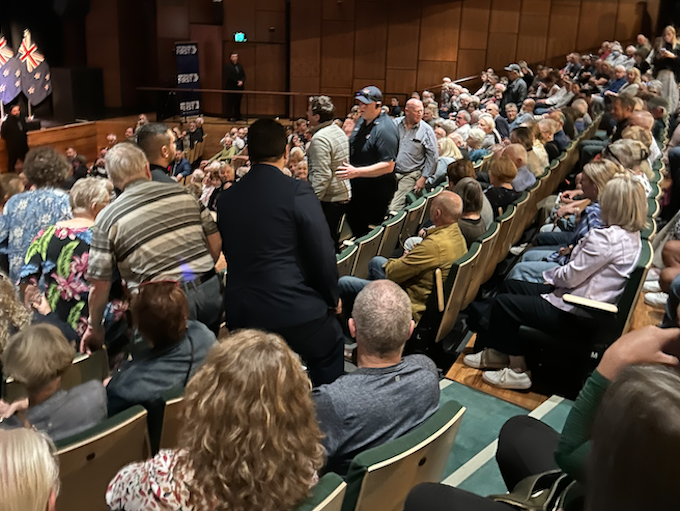
    Part of the crowd at the state of the nation speech by Deputy Prime Minister Winston Peters at the Christchurch Town Hall
    Part of the crowd at the state of the nation speech by Deputy Prime Minister Winston Peters at the Christchurch Town Hall yesterday. Image: Saige England/APR

    This post was originally published on Asia Pacific Report.

  • Asia Pacific Report

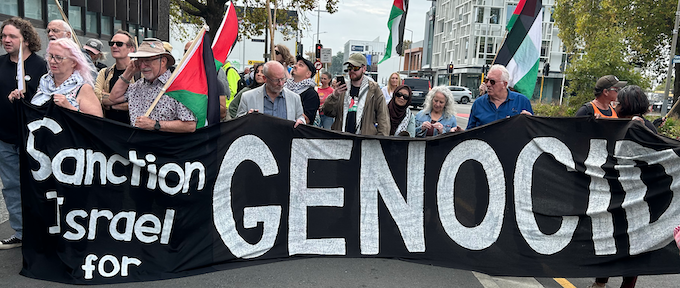
    Green Party co-leader Chlöe Swarbrick called on New Zealand government MPs today to support her Member’s Bill to sanction Israel over its “crazy slaughter” of Palestinians in Gaza.

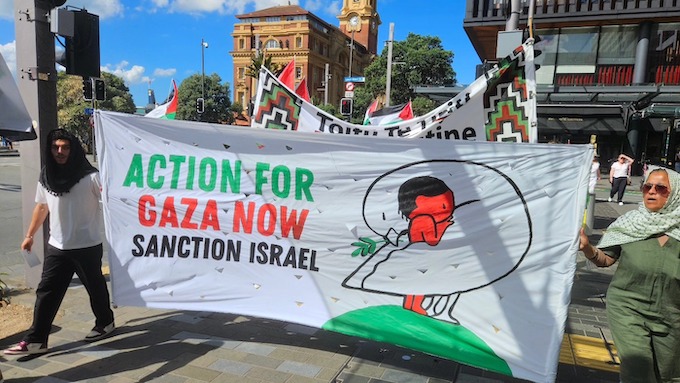
    Speaking at a large pro-Palestinian solidarity rally in the heart of New Zealand’s largest city Auckland, she said Aotearoa New Zealand could no longer “remain a bystander to the slaughter of innocent people in Gaza”.

    In the fifth day since Israel broke the two-month-old ceasefire and refused to begin negotiations on phase two of the truce — which was supposed to lead to a complete withdrawal of Israeli troops from the besieged enclave and an exchange of hostages — health officials reported that the death toll had risen above 630, mostly children and women.

    Five children were killed in a major overnight air attack on Gaza City and at least eight members of the family remained trapped under the rubble as Israeli attacks continued in the holy fasting month of Ramadan.

    Confirmed casualty figures in Gaza since October 7, 2023, now stand at 49,747 with 113,213 wounded, the Gaza Health Ministry said.

    For more than two weeks, Israel has sealed off border crossings and barred food, water and electricity and today it blew up the Turkish-Palestinian Friendship Hospital, the only medical institution in Gaza able to provide cancer treatment.

    “The research has said it from libraries, libraries and libraries. And what is it doing in Gaza?” said Swarbrick.

    ‘Ethnic cleansing . . . on livestream’
    “It is ethnic cleansing. It is apartheid. It is genocide. And we have that delivered to us by  livestream to each one of us every single day on our cellphones,” she said.

    “That is crazy. It is crazy to wake up every single day to that.”

    Swarbrick said Aotearoa New Zealand must act now to sanction Israel for its crimes — “just like we did with Russia for its illegal action in Ukraine.”

    She said that with the Green Party, Te Pāti Māori and Labour’s committed support, they now needed just six of the 68 government MPs to “pass my Unlawful Occupation of Palestine Sanctions Bill into law”.

    “There’s no more time for talk. If we stand for human rights and peace and justice, our Parliament must act,” she said.

    "Action for Gaza Now" banner heads a march protesting against Israel's resumed attacks
    “Action for Gaza Now” banner heads a march protesting against Israel’s resumed attacks on the besieged Strip in Auckland today. Image: APR

    In September, Aotearoa had joined 123 UN member states to support a resolution calling for sanctions against those responsible for Israel’s “unlawful presence in the Occupied Palestinian Territory, including in relation to settler violence”.

    “Our government has since done nothing to fulfil that commitment. Our Unlawful Occupation of Palestine Sanctions Bill starts that very basic process.

    “No party leader or whip can stop a Member of Parliament exercising their democratic right to vote how they know they need to on this Bill,” she said to resounding cheers.

    ‘No hiding behind party lines’
    “There is no more hiding behind party lines. All 123 Members of Parliament are each individually, personally responsible.”

    Several Palestinian women spoke of the terror with the new wave of Israeli bombings and of their families’ personal connections with the suffering in Gaza, saying it was vitally important to “hear our stories”. Some spoke of the New Zealand government’s “cowardice” for not speaking out in opposition like many other countries.

    About 1000 people took part in the protest in a part of Britomart’s Te Komititanga Square in a section now popularly known as “Palestine Corner”.

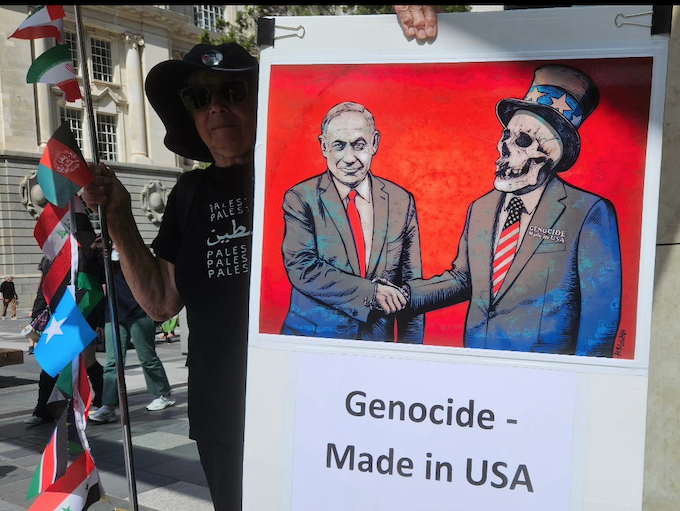
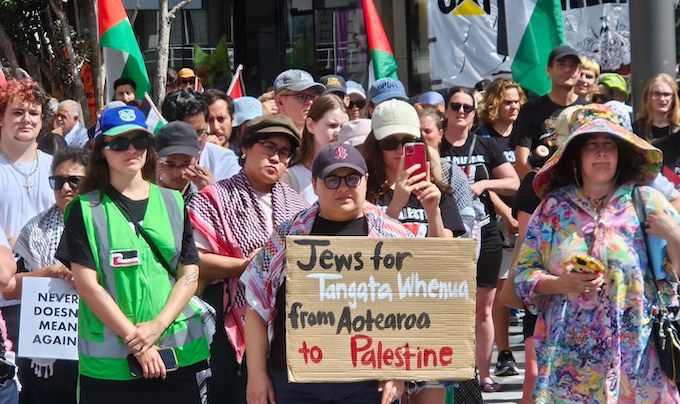
    Amid a sea of banners and Palestinian flags there were placards declaring “Stop the genocide”, “Jews for tangata whenua from Aotearoa to Palestine”, “Hands off West Bank End the occupation” , “The people united will never be defeated”, “Decolonise your mind, stand with Palestine,” “Genocide — made in USA”, and “Toitū Te Tiriti Free Palestine”.

    "Genocide - Made in USA" poster at today's Palestinian solidarity rally
    “Genocide – Made in USA” poster at today’s Palestinian solidarity rally. Image: APR

    The ceasefire-breaking Israeli attacks on Gaza have shocked the world and led to three UN General Assembly debates this week on the Middle East.

    France, Germany and Britain are among the latest countries to condemn Israel for breaching the ceasefire — describing it as a “dramatic step backwards”, and France has told the UN that it is opposed to any form of annexation by Israel of any Palestinian territory.

    Meanwhile, Sultan Barakat, a professor at Hamad Bin Khalifa University in Qatar, told Al Jazeera in an interview that the more atrocities Israel committed in Gaza, the more young Palestinian men and women would join Hamas.

    “So it’s not going to disappear any time soon,” he said.

    With Israel killing more than 630 people in five days and cutting off all aid to the Strip for weeks, there was no trust on the part of Hamas to restart the ceasefire, Professor Barakat said.

    "Jews for tangata whenua from Aotearoa to Palestine" . . . a decolonisation placard at a Palestine solidarity rally in Auckland
    “Jews for tangata whenua from Aotearoa to Palestine” . . . a decolonisation placard at today’s Palestine solidarity rally in Auckland. Image: APR


    This content originally appeared on Asia Pacific Report and was authored by APR editor.

    This post was originally published on Radio Free.

  • By Leah Lowonbu, Stefan Armbruster and Harlyne Joku of BenarNews

    The Pacific’s peak diplomatic bodies have signalled they are ready to engage with Papua New Guinea’s Autonomous Government of Bougainville as mediation begins on the delayed ratification of its successful 2019 independence referendum.

    PNG and Bougainville’s leaders met in the capital Port Moresby this week with a moderator to start negotiations on the implementation of the UN-supervised Bougainville Peace Agreement and referendum.

    Ahead of the talks, ABG’s President Ishmael Toroama moved to sideline a key sticking point over PNG parliamentary ratification of the vote, with the announcement last week that Bougainville would unilaterally declare independence on September 1, 2027.

    The region’s two leading intergovernmental organisations — Pacific Islands Forum (PIF) and Melanesian Spearhead Group (MSG) — have traditionally deferred to member state PNG on discussion of Bougainville independence as an internal matter.

    But as a declaration of nationhood becomes increasingly likely and near, there has been a subtle shift.

    “It’s their [PNG’s] prerogative but if this matter were raised formally, even by Bougainville themselves, we can start discussion on that,” PIF Secretary-General Baron Waqa told a press briefing at its headquarters in Fiji on Monday.

    “Whatever happens, I think the issue would have to be decided by our leaders later this year,” he said of the annual PIF meeting to be held in Solomon Islands in September.

    Marked peace deal
    The last time the Pacific’s leaders included discussion of Bougainville in their official communique was in 2004 to mark the disarmament of the island under the peace deal.

    Waqa said Bougainville had made no formal approach to PIF — a grouping of 18 Pacific states and territories — but it was closely monitoring developments on what could eventually lead to the creation of a new member state.

    20250316 Marape Toroama ABG .jpg
    PNG Prime Minister James Marape (second from left) and Bougainville President Ishmael Toroama (right) during mediation in the capital Port Moresby this week. Image: Autonomous Government of Bougainville/BenarNews

    In 2024, Toroama told BenarNews he would be seeking observer status at the subregional MSG — grouping PNG, Fiji, Solomon Islands, Vanuatu and New Caledonia’s FLNKS — as Bougainville’s first diplomatic foray.

    No application has been made yet but MSG acting Director-General Ilan Kiloe told BenarNews they were also keeping a close watch.

    “Our rules and regulations require that we engage through PNG and we will take our cue from them,” Kiloe said, adding while the MSG respects the sovereignty of its members, “if requested, we will provide assistance” to Bougainville.

    “The purpose and reason the MSG was established initially was to advance the collective interests of the Melanesian countries, in particular, to assist those yet to attain independence,” he said. “And to provide support towards their aim of becoming independent countries.”

    20250320 Bougainville map.jpg
    Map showing Papua New Guinea, its neighboring countries and the Autonomous Region of Bougainville. Map: BenarNews

    The 2001 peace agreement ended more than a decade of bloody conflict  known as the Bougainville crisis, that resulted in the deaths of up to 15,000 people, and laid out a roadmap for disarmament and the referendum in 2019.

    ‘We need support’
    Under the agreement, PNG retains responsibility for foreign affairs but allows for the ABG to engage externally for trade and with “regional organisations.”

    “We need countries to support us, we need to talk to those countries [ahead of independence],” Toroama told BenarNews last September.

    The referendum on independence was supported by 97.7 percent of Bougainvillians and the outcome was due to be ratified by PNG’s Parliament in 2020, but was deferred because of the covid-19 pandemic.

    Discussions by the two parties since on whether a simple or two-thirds majority vote by parliamentarians was required has further delayed the process.

    Toroama stood firm on the issue of ratification on the first day of discussions moderated by New Zealand’s Sir Jerry Mataparae, saying his people voted for independence and the talks were to define the “new relationship” between two independent states.

    Last week, the 15 members of the Bougainville Leaders Independence Consultation Forum issued a statement declaring PNG had no authority to veto the referendum result and recommended September 1, 2027 as the declaration date.

    20250311 BOUG_FORUM_STATEMENT_jpg.jpg
    Bougainville Leaders Consultation Forum declaration setting September 1, 2027, as the date for their independence declaration. Image: AGB/BenarNews

    “As far as I am concerned, the process of negotiating independence was concluded with the referendum,” Toroama said.

    Implementation moderation
    “My understanding is that this moderation is about reaching agreement on implementing the referendum result of independence.”

    He told Marape “to take ownership and endorse independence in this 11th Parliament.”

    PNG’s prime minister responded by praising the 25 years of peace “without a single bullet fired” but warned Bougainville was not ready for independence.

    “Economic independence must precede political independence,” Marape said. “The long-term sustainability of Bougainville must be factored into these discussions.”

    “About 95 percent of Bougainville’s budget is currently reliant on external support, including funding from the PNG government and international donors.”

    Proposals to reopen Rio Tinto’s former Panguna gold and copper mine in Bougainville, that sparked its civil conflict, is a regular feature of debate about its economic future.

    20250315 Post Courier front page bougainville EDIT.jpg
    Front page of the Post-Courier newspaper after the first day of mediation on Bougainville’s independence this week. Image: Post-Courier/BenarNews

    Marape also suggested people may be secretly harbouring weapons in breach of the peace agreement and called on the UN to clarify the outcome of the disarmament process it supervised.

    “Headlines have come out that guns remain in Bougainville. United Nations, how come guns remain in Bougainville?” Marape asked on Monday.

    “You need to tell me. This is something you know. I thought all guns were removed from Bougainville.”

    PNG relies on aid
    By comparison, PNG has heavily relied on foreign financial assistance since independence, currently receiving at about US$320 million (1.3 billion kina) a year in budgetary support from Australia, and suffers regular tribal violence and massacres involving firearms including assault rifles.

    Bougainville Vice-President Patrick Nisira rejected Marape’s concerns about weapons, the Post-Courier newspaper reported.

    “The usage of those guns, there is no evidence of that and if you look at the data on Bougainville where [there are] incidents of guns, it is actually very low,” he said.

    Further talks are planned and are due to produce a report for the national Parliament by mid-2025, ahead of elections in Bougainville and PNG’s 50th anniversary celebrations in September.

    Republished from BenarNews with permission.

    This post was originally published on Asia Pacific Report.

  • Pacific Media Watch

    Israel’s most revered jurist, former Supreme Court president Aharon Barak, says that he fears the Netanyahu government’s latest actions, including moves to fire the Shin Bet secret service chief and attorney-general, are steering the country toward civil war.

    Speaking to the Ynet news site shortly before Prime Minister Benjamin Netanyahu convened the cabinet that voted unanimously to fire Bar, Barak said that “the main problem in Israeli society is . . .  the severe rift between Israelis”.

    “This rift is getting worse and in the end, I fear, it will be like a train that goes off the tracks and plunges into a chasm, causing a civil war,” he said.

    In another interview, with Channel 12, when asked why he thought Israel was close to civil conflict, Barak said it was “because the rift in the people is immense, and no effort is being made to heal it.

    “Everyone is trying to make it worse.

    “Today there are demonstrations, then a car drives through them and runs over someone,” he said, referring to an incident at an anti-Netanyahu protest in Jerusalem on Wednesday when a driver rammed into a protester, injuring him.

    “But tomorrow there will be shootings, and the day after that there will be bloodshed,” Barak continued.

    Overturned sacking
    Barak also told Channel 12 he would have overturned a government decision to fire Shin Bet chief Ronen Bar if he were serving on the bench today.

    The former chief justice explained he believed the ousting of Bar from the role in the middle of his term was illegitimate because the position of Shin Bet chief was not a “role of confidence” with the political echelon.

    Instead, the person in the job was meant to carry out the role as it was explicitly written in legislation.

    “There is authority to dismiss, but no grounds for dismissal,” he elaborated, saying he would also strike down the firing of Attorney-General Gali Baharav-Miara, another top official whom the government is seeking to oust.

    When asked about the prime minister’s tweet on Wednesday night alleging the existence of a “leftist deep state” in Israel that was working to thwart Netanyahu’s government, Barak replied: “I don’t know what a deep state is.”

    “We’re not the United States, we don’t have a deep state here. We have loyal public servants here, and they do things according to the law,” he added.

    Barak also appealed directly to Netanyahu, urging him to halt the process of firing Bar and Baharav-Miara, and other policies the former justice considers destructive, and said he thinks Netanyahu should be offered and should take a plea deal in his criminal trial.


    ‘Israel feels like it is on the brink of civil war.’   Video: France 24

    ‘Right for his legacy’
    “I think that it is right for Netanyahu. It is right for his legacy. And it is right for the State of Israel. And I think it is possible,” he said.

    “Otherwise, the trial will continue. The rift between [those] for Bibi and against Bibi will continue,” he added, using Netanyahu’s nickname.

    Asked by the interviewer what he would say to Netanyahu if he could talk to him, Barak answered: “This is your policy, I am completely against it. I ask you, don’t implement it beyond what you have done today. Stop. Stop.”

    “Don’t take the rift beyond where it already is,” he concluded.

    Responding to Barak, Foreign Minister Gideon Sa’ar issued a terse statement on X, simply posting: “There will be no civil war.”

    Education Minister Yoav Kisch, a member of Netanyahu’s Likud party, said in a post on X that Barak was “threatening a civil war” with his warning, and promised that “these threats will not deter” the government from implementing its policies.

    MK Almog Cohen of the far-right Otzma Yehudit party said that Barak is “a reckless and irresponsible man,” who was “sent to issue a Sicilian mafia-style threat of blood in the streets and civil war.”

    Retired Israeli Supreme Court president Aharon Barak
    Retired Israeli Supreme Court president Aharon Barak . . . “We’re not the United States, we don’t have a deep state here.” Image: ICJ

    Well-respected internationally
    Barak served as a Supreme Court justice from 1978 to 1995. He was then elected as the court’s president. He retired from the bench in 2006.

    Despite Barak being a vocal critic of Netanyahu and his policies, the premier chose him to represent Israel as an ad-hoc judge at the International Court of Justice (ICJ) for the genocide case that was brought against Israel by South Africa amid the war in Gaza.

    Barak removed himself from the court last June for personal reasons.

    Barak, a Holocaust survivor, is well-respected internationally and is seen as Israel’s preeminent jurist.

    Within Israel, he long has been seen by Netanyahu and other right-wing leaders as a leftist “activist,” who is to blame for many of the issues with Israel’s judicial system that the government’s controversial judicial overhaul plans aim to rectify.

    This post was originally published on Asia Pacific Report.

  • Asia Pacific Report

    A joint operation between the Fiji Police Force, Republic of Fiji Military Force (RFMF), Territorial Force Brigade, Fiji Navy and National Fire Authority was staged this week to “modernise” responses to emergencies.

    Called “Exercise Genesis”, the joint operation is believed to be the first of its kind in Fiji to “test combat readiness” and preparedness for facing civil unrest, counterinsurgency and humanitarian assistance scenarios.

    It took place over three days and was modelled on challenges faced by a “fictitious island grappling with rising unemployment, poverty and crime”.

    The exercise was described as based on three models, operated on successive days.

    The block 1 scenario tackled internal security, addressing civil unrest, law enforcement challenges and crowd control operations.

    Block 2 involved humanitarian assistance and disaster relief, and coordinating emergency response efforts with government agencies.

    Block 3 on the last day dealt with a “mid-level counterinsurgency”, engaging in stabilising the crisis, and “neutralising” a threat.

    Flash flood scenario
    On the second day, a “composite” company with the assistance of the Fiji Navy successfully evacuated victims from a scenario-based flash flood at Doroko village (Waila) to Nausori Town.

    “The flood victims were given first aid at the village before being evacuated to an evacuation centre in Syria Park,” said the Territorial Brigade’s Facebook page.

    “The flood victims were further examined by the medical team at Syria Park.”

    Fiji police confront protesters during the Operation Genesis exercise in Fiji
    Fiji police confront protesters during the Operation Genesis exercise in Fiji this week. Image: RFMF screenshot APR

    On the final day, Thursday, Exercise Genesis culminated in a pre-dawn attack by the troops on a “rebel hideout”.

    According to the Facebook page, the “hideout” had been discovered following the deployment of a joint tracker team and the K9 unit from the Fiji Corrections Service.

    “Through rigorous training and realistic scenarios, the [RFMF Territorial Brigade] continues to refine its combat proficiency, adaptability, and mission effectiveness,” said a brigade statement.

    Mock protesters in the Operation Genesis security services exercise in Fiji
    Mock protesters in the Operation Genesis security services exercise in Fiji this week. Image: RFMF screenshot APR

    It said that the exercise was “ensuring that [the brigade] remains a versatile and responsive force, capable of safeguarding national security and contributing to regional stability.”

    However, a critic said: “Anyone who is serious about reducing crime would offer a real alternative to austerity, poverty and alienation. Invest in young people and communities.”

    This post was originally published on Asia Pacific Report.

  • By Alex Willemyns for Radio Free Asia

    The Trump administration might let hundreds of millions of dollars in aid pledged to Pacific island nations during former President Joe Biden’s time in office stand, says New Zealand Foreign Minister Winston Peters.

    The Biden administration pledged about $1 billion in aid to the Pacific to help counter China’s influence in the strategic region.

    However, Trump last month froze all disbursements of aid by the US Agency for International Development (USAID), for 90 days pending a “review” of all aid spending under his “America First” policy.

    Peters told reporters on Monday after meetings with Trump’s USAID acting head, Peter Marocco, and his national security adviser, Mike Waltz, “more confident” about the prospects of the aid being left alone than he was before.

    Peters said he had a “very frank and open discussion” with American officials about how important the aid was for the Pacific, and insisted that they “get our point of view in terms of how essential it is”.

    TVNZ's 1News and Kiribati
    NZ Foreign Minister Winson Peters . . . . “We are looking ahead with more confidence than when we arrived.” Image: TVNZ 1News screenshot RNZ

    “In our business, it’s wise to find out the results before you open your mouth, but we are looking ahead with more confidence than when we arrived,” Peters said, pushing back against claims that the Trump administration would be “pulling back” from the Pacific region.

    “We don’t know that yet. Let’s find out in April, when that full review is done on USAID,” he said. “But we came away more confident than some of the alarmists might have been before we arrived.”

    Frenzied diplomatic battle
    The Biden administration sought to rapidly expand US engagement with the small island nations of the Pacific after the Solomon Islands signed a controversial security pact with China three years ago.

    The deal by the Solomon Islands sparked a frenzied diplomatic battle between Washington and Beijing for influence in the strategic region.

    Biden subsequently hosted Pacific island leaders at back-to-back summits in Washington in September 2022 and 2023, the first two of their kind. He pledged hundreds of millions of dollars at both meets, appearing to tilt the region back toward Washington.

    The first summit included announcements of some $800 billion in aid for the Pacific, while the second added about $200 billion.

    But the region has since been rocked by the Trump administration’s decision to freeze all aid pending its ongoing review. The concerns have not been helped by a claim from Elon Musk, who Trump tasked with cutting government waste, that USAID would be shut down.

    “You’ve got to basically get rid of the whole thing. It’s beyond repair. We’re shutting it down,” Musk said in a February 3 livestreamed video.

    However, the New Zealand foreign minister, who also met with Secretary of State Marco Rubio on Tuesday, said he held out hope that Washington would not turn back on its fight for influence in the Pacific.

    “The first Trump administration turned more powerfully towards the Pacific . . .  than any previous administration,” he said, “and now they’ve got Trump back again, and we hope for the same into the future.”

    Radio Free Asia is an online news service affiliated with BenarNews. Republished from BenarNews with permission.

    This content originally appeared on Asia Pacific Report and was authored by APR editor.

  • By Don Wiseman, RNZ Pacific senior journalist

    The parties involved in talks aimed at resolving an impasse over Bougainville’s push for independence are planning to meet several more times before a deadline in June.

    The leaders of Papua New Guinea and Bougainville have been meeting all week in Port Moresby, with former New Zealand Governor-General Sir Jerry Mateparae serving as moderator.

    The question before them hinges on the conditions for tabling the results of the 2019 Bougainville referendum in the PNG Parliament, in which there was overwhelming support for independence.

    PNG wants an absolute majority of MPs to agree to the tabling, while Bougainville says it should be a simple majority.

    Bougainville says changes to the PNG Constitution would come later, and that is when an absolute majority is appropriate.

    Bougainville’s President Ishmael Toroama has suggested a solution could be reached outside of Parliament, but PNG Prime Minister James Marape has questioned the readiness of Bougainville to run itself, given there are still guns in the community and the local economy is miniscule.

    Sources at the talks say that, with the parties having now stated their positions, several more meetings are planned where decisions will be reached on the way forward.

    Burnham key to civil war end
    One of those meetings is expected to take place at Burnham, New Zealand.

    It was preliminary talks at Burnham in 1997 that led to the end of the bloody 10-year-long civil war in Bougainville.

    Sir Jerry Mataparae. 17 March 2025
    Sir Jerry Mataparae . . . serving as moderator in the Bougainville future talks. Image: RNZ Pacific

    Bougainville is holding elections in September, and the writs are being issued in June, hence the desire that the process to determine its political future is in place by then.

    Last week, Bougainville leaders declared they wanted independence in place by 1 September 2027.

    This article is republished under a community partnership agreement with RNZ.

    This post was originally published on Asia Pacific Report.

  • Pacific Media Watch

    Earthwise presenters Lois and Martin Griffiths of Plains FM96.9 radio talk to Dr David Robie, editor of Asia Pacific Report, about heightened global fears of nuclear war as tensions have mounted since US President Donald Trump has returned to power.

    Dr Robie reminds us that New Zealanders once actively opposed nuclear testing in the Pacific.

    That spirit, that active opposition to nuclear testing, and to nuclear war must be revived.

    This is very timely as the Rainbow Warrior 3 is currently visiting the Marshall Islands this month to mark 40 years since the original RW took part in the relocation of Rongelap Islanders who suffered from US nuclear tests in the 1950s.

    After that humanitarian mission, the Rainbow Warrior was subsequently bombed by French secret agents in Auckland Harbour on 10 July 1985 shortly before it was due to sail to Moruroa Atoll to protest against nuclear testing.

    A new edition of Dr Robie’s book Eyes of Fire The Last Voyage of the Rainbow Warrior will be released this July. The Eyes of Fire microsite is here.

    Lois opens up by saying: “I fear that we live in disturbing times. I fear the possibility of nuclear war, I always have.

    “I remember the Cuban missiles crisis, a scary time. I remember campaigns for nuclear disarmament. Hopes that the United Nations could lead to a world of peace and justice.

    “Yet today one hears from our media, for world leaders . . . ‘No, no no. There will always be tyrants who want to destroy us and our democratic allies . . . more and bigger, deadlier weapons are needed to protect us . . .”

    Listen to the programme . . .


    Nuclear free Pacific . . . back to the future.    Video/audio: Plains FM96.9

    Broadcast: Plains Radio FM96.9

    Interviewee: Dr David Robie, deputy chair of the Asia Pacific Media Network (APMN) and a semiretired professor of Pacific journalism. He founded the Pacific Media Centre.
    Interviewers: Lois and Martin Griffiths, Earthwise programme

    Date: 14 March 2025 (27min), broadcast March 17.

    Youtube: Café Pacific: https://www.youtube.com/@cafepacific2023

    https://plainsfm.org.nz/

    Café Pacific: https://davidrobie.nz/

    This post was originally published on Asia Pacific Report.

  • JOINT STATEMENT


    Indonesia: Rejection of the Problematic and Rushed Amendments to Law No. 34/2004 on the Indonesian National Armed Forces (TNI Law)

    Jakarta, 17th March 2025 – Civil society organizations strongly reject the proposed amendments to Law No. 34/2004 on the Indonesian National Armed Forces (TNI Law), which pose a serious threat to democracy, civilian supremacy over the military, and human rights in Indonesia. 

    Following the fall of President Suharto’s “New Order” regime in 1998, Indonesia undertook reforms to dismantle the dual function (dwifungsi) of the Indonesian National Armed Forces (TNI), which allowed military personnel to be involved in government, political affairs, and law enforcement, extending their influence far beyond their traditional defense functions. These reforms were intended to restore civilian supremacy over the military, strengthen democratic governance, and improve human rights protections. A key milestone in this process was the enactment of the Law No. 34/2004 on the TNI (TNI Law), which sought to ensure the neutrality of the military in politics and governance.

    However, Indonesia’s military reform has not only stalled, it has actually regressed. Under the administration of President Prabowo Subianto, the government is actively pushing for a controversial revision of the 2004 TNI Law, that would allow active military personnel the authority to hold 16 governmental positions and significantly expand the military’s non-combat roles. In particular, Commission I (DPR RI) member Tubagus (TB) Hasanuddin, has indicated that the proposed amendments would allow the military to engage in non-combat operations, including direct involvement in drug interdiction. 

    This proposed amendment raises serious concerns. Giving the military a role in civilian law enforcement – particularly in cooperation with the National Narcotics Agency (BNN) and the police –  creates legal and political ambiguities reminiscent of  the “war on drugs” approach, that have often been associated with human rights abuses. Moreover, increased military involvement in civilian affairs directly undermines the principle of civilian supremacy over the military, a fundamental tenet of Indonesia’s security sector reform.

    The proposed revision has met with strong and widespread opposition from civil society groups, as it not only fails to advance the TNI’s reform agenda but also significantly reverses its progress. 

    First, Article 47 of the circulating draft of the TNI Bill, obtained by our organizations, states that active TNI personnel may hold positions in ministries or other institutions that require their expertise, in accordance with the presidential policy. This provision creates legal uncertainty and potentially undermines the law enforcement role of the military. While both the military and the police are classified as civil servants (ASN) in Indonesia, they operate under different ethical codes and enforcement mechanisms. Unlike police officers, TNI personnel are subject to the jurisdiction of the military courts. If active military personnel in ASN positions commit crimes, they would still be tried in a military court – which is known to have little to no transparency – rather than in a civilian court. If the House of Representatives and the government are truly committed to upholding the mandate of reform, civilian supremacy, democracy, and  human rights, their priority should be to revise the Military Tribunal Law rather than to amend the TNI Law. Instead, the Indonesian House of Representatives (DPR-RI) has failed to take up the long-overdue revision of the Military Tribunal  Law.

    Second, the proposed revision of the TNI Law includes a troubling expansion  of the military’s authority in “operations other than war” (OMSP) to address cyber threats, including those that target cognitive and virtual dimensions such as social manipulation and information pollution. This vague and overly broad mandate risks militarizing  cyberspace, effectively granting the TNI a role in policing online activities.  Such an expansion, however, is highly susceptible to abuse. By framing cyber threats  as existential threats – or even classifying them as cyberwarfare – the government could justify coercive measures, including censorship, mass and intrusive surveillance, and restrictions on online freedom of expression, which severely undermine fundamental human rights. 

    Third, the revision of the TNI Law has been rushed through with minimal public participation and a severe lack of transparency in the drafting process. This is in direct contradiction to  the principle of meaningful and worthwhile public participation in lawmaking. On 14 – 15 March 2025, the government and the DPR-RI held a closed-door meeting at the Fairmont Hotel in Jakarta to expedite the discussion of the TNI Bill. This directly contradicts an earlier statement by DPR Deputy Speaker, Adies Kadir, who stated that the bill would not be passed before the 2025 Eid holiday – the House of Representatives recess period – and that its approval  could only take place in the next parliamentary session. Instead of following a transparent legislative process,  the Government and the DPR chose to discuss the bill behind closed doors at a luxury hotel over the weekend, raising serious concerns about the lack of transparency and public accountability, and the absence of evidence-based policymaking.

    This blatant disregard for transparency  violates Article 25 of the International Covenant on Civil and Political Rights (ICCPR) – to which Indonesia is a state party– which guarantees the right to participate in public affairs, including legislative processes. Additionally, it contravenes the commitments Indonesia made in the 4th cycle of the Universal Periodic Review in 2022, where the government pledged to enhance meaningful and inclusive dialogues with the national human rights institution, civil society organizations, academia and other stakeholders. Such secrecy casts doubt on the legitimacy of the process and raises alarms over the motives behind these amendments. A lack of transparency in legislative processes often correlates with efforts to limit criticism and oversight, which are essential functions of the press.

    Furthermore, the government’s rush to amend the TNI Law stands in stark contrast to its prolonged inaction on other critical human rights commitments. Despite pledging for over a decade, Indonesia has failed to ratify key international human rights treaties, including the International Convention for the Protection of All Persons from Enforced Disappearance (ICPPED), the Optional Protocol to the Convention Against Torture (OP-CAT), the Genocide Convention, and the Rome Statute – all of which are crucial for the protection and enforcement of human rights.

    Adding to these concerns, activists who have voiced their opinions and concerns over the proposed revision to the TNI Law have faced escalating intimidation and harassment. Colleagues from The Commission for the Disappeared and Victims of Violence (KontraS) have reported anonymous threats, visits from unidentified individuals, and even police summons for “clarifications” from the Greater Jakarta Metropolitan Regional Police (Polda Metro Jaya). These incidents followed a peaceful intervention by KontraS members on 15 March 2025, when they entered the Fairmont Hotel meeting room to peacefully urge lawmakers to halt the closed-door deliberation. 

    In light of the concerns raised, the undersigned civil society organizations: 

    1. STRONGLY REJECT the rushed and deeply flawed process of the TNI Law revision.
    2. URGE the Indonesian Commission I of the House of Representatives to immediately suspend all  discussions on the TNI Bill until a transparent, inclusive, and accountable process is established, and that no further steps are taken toward its passage until legal reforms are made to safeguard civilian supremacy, accountability and human rights.
    3. DEMAND  that the Indonesian Government  guarantee comprehensive protection of human rights defenders, activists and civil society organizations who have expressed  concerns over the problematic revision of the TNI Law and who face intimidation or harassment for their participation in this democratic process.


    Sincerely,

    • Action by Christians for the Abolition of Torture (ACAT) Germany 
    • ACAT Belgique Belgium België
    • Accountability Counsel
    • Advocacy Forum Nepal
    • Aksi Kamisan New York City
    • All Arakan Students’ & Youths’ Congress – AASYC
    • AMAN Indonesia
    • Amnesty International Chapter UNNES
    • Amnesty International Indonesia
    • Arus Pelangi
    • ASEAN Youth Forum (AYF)
    • ASEAN Civil Society Conference/ASEAN People’s Forum Philippine Process
    • Asia Citizen Future Association (ACFA), Taiwan
    • Asia Development Alliance 
    • Asia Alliance Against Torture (A3T)
    • Asia Democracy Network (ADN)
    • Asia Justice and Rights (AJAR)
    • Asian Federation Against Involuntary Disappearances (AFAD)
    • Asian Forum for Human Rights and Development (FORUM-ASIA)
    • Association Of Indonesian Migrants  
    • Asosiasaun Chega! Ba Ita (ACbit)
    • Association of Human Rights Defenders and Promoters (HRDP)
    • Athan – Freedom of Expression Activist Organization
    • Aung San Suu Kyi Park Norway
    • Banglar Manabadhikar Suraksha Mancha (MASUM) 
    • Blood Money Campaign (BMC)
    • Alliance of Independent Journalists (AJI) Indonesia
    • BALAOD Mindanaw, Philippines
    • Beranda Perempuan Indonesia- Jambi
    • Bullyid Indonesia
    • Bumi Setara
    • Cambodian Center for Human Rights (CCHR)
    • Center for Legal and Social Studies (CELS), Argentina
    • Center for Indonesia’s Strategic Development Initiatives (CISDI)
    • Center of AI and Tech Innovation for Democracy (PIKAT)
    • Center on Sexuality Studies (SGRC UI)
    • Chin Community in Norway
    • CIVICUS: World Alliance for Citizen Participation
    • Civil Society Coalition against Organized Crime (the Coalition) 
    • Community Resource Center (CrC) Thailand
    • Cross Cultural Foundation (CrCF) Thailand 
    • CRPH Support Group, Norway and members organizations 
    • Collective Campaign for Peace (COCAP), Nepal
    • Collectif des Associations Contre l’Impunité au Togo (CACIT)
    • Commission for Disappeared and Victims of Violence (KontraS Aceh)
    • Community Legal Aid Institute (LBH Masyarakat)
    • Confederation of Indonesia People Movement (KPRI)
    • Defence of Human Rights and Public Services Trust Pakistan
    • Defence of Human Rights, Pakistan
    • Defend Myanmar Democracy (DMD)
    • Democratic Party for a New Society, Norway
    • Digital Democracy Resilience Network (DDRN)
    • Doctors Without Stigma (DTS) 
    • Down Syndrome Care Foundation Indonesia(YAPESDI)
    • East Timor and Indonesia Action Network (ETAN/U.S.)
    • ECPM – Together Against the Death Penalty 
    • Equality Myanmar (EQMM)
    • Extinction Rebellion Indonesia (XR.id)
    • FAIR Law Firm
    • FAMM Indonesia 
    • Federal Association of Vietnamese Refugees in the Federal Republic of Germany
    • Federasi Serikat Buruh Persatuan Indonesia (FSBPI)
    • FIAN Indonesia
    • FIAN International
    • Forum Cik di Tiro
    • Foundation for Labour and Employment Promotion, Thailand
    • Free Hearts
    • Generation Wave (GW)
    • Generations’ Solidarity Coalition of Nationalities (GSCN) 
    • Gerakan Media Merdeka (Geramm)
    • Girl Up Institut Teknologi Sepuluh Nopember
    • GRAM (Gerakan Megamendung)
    • Harm Reduction International (HRI)
    • Health Opportunity Network (HON), Thailand 
    • Hadomi Timor, Timor Leste
    • HAYAT, Malaysia
    • Human Rights Foundation of Monland (HURFOM)
    • Human Rights Journalists Network Nigeria 
    • Human Rights Law Centre, Australia
    • Human Rights Law Chambers, Sri Lanka
    • Human Rights Myanmar
    • In Defense of Human Rights and Dignity Movement (iDEFEND)
    • India for Myanmar 
    • Indonesia Budget Center
    • Indonesia Corruption Watch (ICW)
    • Indonesian Legal Aid Foundation (YLBHI)
    • Indonesian Legal Aid and Human Rights Association (PBHI)
    • Indonesian Mental Health Association (IMHA)
    • Indonesian Planned Parenthood Association – Bengkulu (IPPA – Bengkulu)
    • Indonesian Planned Parenthood Association – Special Region of Yogyakarta (IPPA – Yogyakarta)
    • Indonesian Planned Parenthood Association – Aceh (IPPA – Aceh)
    • Institute of Research and Advocacy (Link-AR Borneo)
    • Indonesia Association of Human Rights Lecturer (SEPAHAM-Indonesia)
    • International Women’s Rights Action Watch Asia Pacific (IWRAW AP)
    • International NGO Forum on Indonesian Development (INFID)
    • Irish Council for Civil Liberties
    • International Rehabilitation Council for Torture Victims (IRCT)
    • JCYCN, Nepal
    • Jaringan Advokasi Nasional untuk Pekerja Rumah Tangga (JALA PRT)
    • Jaringan Akademisi Gerakan Anti Kekerasan Terhadap Perempuan (JARAK)
    • Just Access e.V.
    • Justice & Equality Focus (JEF)
    • Jong Columbia (Indonesian students at Columbia University)
    • K’cho Ethnic Association( Europe)
    • Kachin Association Norway
    • Keng Tung Youth
    • Kyae Lak Myay
    • Kyauktada Strike Committee (KSC) 
    • Kalyanamitra
    • Kampoeng Tjibarani
    • KIPP Indonesia
    • Kenapa Harus Peduli
    • Kenya Human Rights Commission (KHRC)
    • Komite Independen Pemantau Pemilu (KIPP) Indonesia
    • Komite Pemilih Indonesia
    • Koalisi Perempuan Indonesia 
    • Konsorsium Pembaruan Agraria
    • Konfederasi Persatuan Buruh Indonesia (KPBI)
    • Kolektif Sanggar Puan
    • Korean House for International Solidarity(KHIS), South Korea
    • Lab Demokrasi
    • LaporIklim
    • LaporSehat
    • Legal Dignity
    • Lentera Gayatri
    • Lembaga Bantuan Hukum (LBH) Jakarta
    • Lingkar Keadilan Ruang
    • Lintas Feminist Jakarta (Jakarta Feminist)
    • Liyang Network
    • Magway Region Human Right Network 
    • Maldivian Democracy Network (MDN)
    • Manushya Foundation 
    • Media and Creative Industry Workers Union for Democracy (SINDIKASI) Yogyakarta
    • MEDICAL ACTION GROUP Inc., Philippines
    • Melbourne Bergerak
    • Mexiro A.C. 
    • Migrant CARE Indonesia
    • #MilkTeaAlliance Calendar Team
    • #MilkTeaAlliance Friends of Myanmar
    • Movement for Alternatives and Solidarity in Southeast Asia (MASSA) 
    • Myanmar Catholic Community In Norway
    • Myanmar Community in Norway
    • Myanmar Hindu Union
    • MyaYar Knowledge Tree
    • New Myanmar Foundation
    • NLD Organization Committee (International) Norway
    • Norway Matu Community
    • Norway Rvwang Community
    • Nyan Lynn Thit Analytical (NLTA) 
    • Needle n’ Bitch
    • Network for Human Rights Documentation Burma (ND Burma)
    • Olive organization 
    • Omega Research Foundation
    • Open Contracting Partnership 
    • Pakistan Development Alliance 
    • Programme Against Custodial Torture & Impunity (PACTI) 
    • Progressive Muslim Youth Association (PMYA)
    • Progressive Voice (PV)
    • Palasara Widya Indonesia Foundation
    • ProgreSIP.id Media Kelas Pekerja
    • PeaceGeneration Indonesia 
    • People’s Voter Education Network. 
    • Perkumpulan Lintas Feminis Jakarta (Jakarta Feminis)
    • Perpustakaan Jalanan D.I.Y
    • Platform C, South Korea 
    • Protection International
    • Psychological Responsiveness  NGO, Mongolia
    • Public Virtue Research Institute
    • Pusat KOMAS
    • Pusat Pembangunan Rakyat Mandiri (MANDIRI), Malaysia
    • Queers of Burma Alternative (QBA)
    • Refugee and Migratory Movements Research Unit (RMMRU), Bangladesh
    • Relawan Edukasi Antihoax Indonesia (REDAXI)
    • Remotivi
    • Right to Life Human Rights Center, Sri Lanka 
    • Robert F. Kennedy Human Rights
    • Réseau des Organisations de la Société civile pour l’Observation et le Suivi des Élections en Guinée – ROSE 
    • Rohingya Community in Norway
    • Rohingya Maìyafuìnor Collaborative Network (RMCN)
    • Sadar Setara
    • Samsara
    • Shan MATA 
    • Sisters2Sisters 
    • Sitt Nyein Pann Foundation
    • Southern Initiative 
    • Save All Women and Girls
    • SHARE, center for Sexual rigHts And Reproductive justicE (South Korea)
    • Sindikasi Pemilu dan Demokrasi (SPD)
    • Southeast Asia Freedom of Expression Network (SAFEnet)
    • South East Asia Collaborative Policy Network (SEA CPN)
    • Solidaritas Perempuan
    • Solidarity for People’s Education and Lifelong Learning (SPELL)
    • Southeast Asia Public Interest Lawyers (SEAPIL)
    • Suar Perempuan Lingkar Napza Nusantara Foundation (SPINN), Indonesia 
    • Suara Rakyat Malaysia (SUARAM)
    • Sukaar Welfare Organization
    • Students For Liberty (SFL) Indonesia
    • Studi Agama Kritis
    • Support Group and Resource 
    • TAPOL, UK
    • Task Force Detainees of the Philippines (TFDP)
    • The Commission for the Disappeared and Victims of Violence (KontraS)
    • The Indonesian Centre for Law and Policy Studies (PSHK Indonesia)
    • The Indonesian Human Rights Monitor (IMPARSIAL)
    • The Legal Resources Centre, South Africa
    • The May 18 Foundation, South Korea
    • The People Participation, Initiative and Partnership Strengthening Foundation (YAPPIKA)
    • The PRAKARSA
    • The Sunny Center Foundation Usa Inc.
    • Think Centre, Singapore 
    • Think Path Indonesia Legal Office
    • Transparency International Indonesia
    • Transitional Justice Asia Network (TJAN)
    • Transitional Justice Working Group (TJWG) South Korea
    • Trend Asia  
    • Terra-1530
    • Viet Tan
    • WCC Mawar Balqis
    • WITNESS
    • Weaving Women’s Voices in Southeast Asia (WEAVE)
    • Women Lead Resource Center
    • Women’s Legal Centre, South Africa
    • Women Study Center Solo/Pusat Kajian Perempuan Solo (PUKAPS)Watch Indonesia! e.V.
    • Workers And Families  (KABAR BUMI)
    • World Organisation Against Torture (OMCT) 
    • Yayasan Lembaga Bantuan Hukum Keadilan Banten (LBH Keadilan)
    • Yangon Deaf Group
    • Youth Empowerment
    • Youth for Democratization of Myanmar (UDM)
    • ZINE THINK
    • Zomi Christian Fellowship of Norway
    • Zomi Community Norway
    • 2030 Youth Force Indonesia
    • ယိမ်းနွဲ့ပါး
    • သမိုင်းသယ်ဆောင်သူများ

    This post was originally published on FORUM-ASIA.

  • By Russell Palmer, RNZ News political reporter

    Green Party co-leader Chlöe Swarbrick says the need for Aotearoa New Zealand to impose sanctions against Israel has grown more urgent after airstrikes on Gaza resumed, killing more than 400 people.

    Swarbrick lodged a member’s bill in December and said that with all opposition parties backing it, the support of just six backbench government MPs would mean it could skip the “biscuit tin” and be brought to Parliament for a first reading.

    “I feel as though every other day there is something else which adds urgency, but yes — I think as a result of the most recent round of atrocities and particularly the public focus, attention, energy and effort that is being that has been put on them, that, yes, parliamentarians desperately need to act.

    Swarbrick claimed there were government MPs who were keen to support her bill, saying it was why her party was publicly pushing the numbers needed to get it across the line.

    “We have the most whipped Parliament in the Western world,” she said. “We would hope that parliamentarians would live up to all of those statements that they make about their values and principles when they do their bright-eyed and bushy-tailed maiden speeches.

    “The time is now, people cannot hide behind party lines anymore.

    “I know for a fact that there are government MPs that are keen to support this kaupapa.”

    Standing order allowance
    Standing Order 288 allows MPs who are not ministers or undersecretaries to indicate their support for a member’s bill.

    If at least 61 MPs get behind it, the legislation skips the “biscuit tin” ballot.

    If answered, Swarbrick’s call would be the first time this process is followed.

    Labour confirmed its support for the bill last week.

    A coalition spokesperson said the government’s policy position on the matter remained unchanged, including in response to Swarbrick’s bill.

    New Zealand has consistently advocated for a two-state solution to the Middle East conflict.

    Swarbrick pointed to New Zealand’s support — alongside 123 other countries — of a UN resolution calling for sanctions against those responsible for Israel’s presence in the occupied Palestinian territories, including in relation to settler violence.

    Conditional support
    The government’s support for the resolution was conditional and included several caveats — including that the 12-month timeframe for Israel to withdraw from the occupied territories was “unrealistic”, and noted the resolution went beyond what was initially proposed.

    None of the other 123 countries which supported the resolution have yet brought sanctions against Israel.

    “Unfortunately, in the several months following that resolution in September of last year, our government has done nothing to fulfil that commitment,” Swarbrick said.

    The Ministry of Foreign Affairs’ permanent representative to the UN Carolyn Schwalger in September noted that the Resolution imposed no obligations on New Zealand beyond what already existed under international law, but “New Zealand stands ready to implement any measures adopted by the UN Security Council”.

    New Zealand ambassador to the UN Carolyn Schwalger speaking at the UN General Assembly after voting in favour of a resolution calling for a humanitarian truce in the Israel-Gaza conflict.
    NZ ambassador to the UN Carolyn Schwalger speaking at the UN General Assembly . . . “New Zealand stands ready to implement any measures adopted by the UN Security Council.” Image: Screenshot/UN General Assembly livestream/RNZ

    Prime Minister Christopher Luxon in December said the government had a long-standing position of travel bans on extremist Israeli settlers in the occupied territories, and wanted to see a two-state solution developed.

    Israel’s Prime Minister Benjamin Netanyahu said its military pressure against Hamas was to secure the release of the remaining hostages taken by Hamas during the October 7 attack, and “this is just the beginning”.

    Israel continues to deny accusations of genocide, war crimes and crimes against humanity.

    South African genocide case against Israel
    However, South Africa has taken a case of genocide against Israel to the International Court of Justice (ICJ) and the trial remains ongoing with 14 countries having confirmed that they are intervening in support of South Africa.

    The attack on Israel in 2023 left 1139 people dead, with about 250 hostages taken.

    UN Secretary General António Guterres said in a tweet he was “outraged” by the Israeli airstrikes.

    “I strongly appeal for the ceasefire to be respected, for unimpeded humanitarian assistance to be re-established and for the remaining hostages to be released unconditionally,” he said.

    This article is republished under a community partnership agreement with RNZ.

    This post was originally published on Asia Pacific Report.

  • COMMENTARY: By Eugene Doyle

    Today I attended a demonstration outside both Aotearoa New Zealand’s Ministry of Foreign Affairs and Trade and the Israeli Embassy in Wellington.

    The day before, the Israelis had blown apart 174 children in Gaza in a surprise attack that announced the next phase of the genocide.

    About 174 Wellingtonians turned up to a quickly-called protest: they are the best of us — the best of Wellington.

    In 2023, the City made me an Absolutely Positively Wellingtonian for service across a number of fronts (water infrastructure, conservation, coastal resilience, community organising) but nothing I have done compares with the importance of standing up for the victims of US-Israeli violence.

    What more can we do?  And then it crossed my mind: “Declare Wellington Genocide Free”.  And if Wellington could, why not other cities?

    Wellington started nuclear-free drive
    The nuclear-free campaign, led by Wellington back in the 1980s, is a template worth reviving.

    Wellington became the first city in New Zealand — and the first capital in the world — to declare itself nuclear free in 1982.  It followed the excellent example of Missoula, Montana, USA, the first city in the world to do so, in 1978.

    These were tumultuous times. I vividly remember heading into Wellington harbour on a small yacht, part of a peace flotilla made up of kayakers, yachties and wind surfers that tried to stop the USS Texas from berthing. It won that battle that day but we won the war.

    This was the decade which saw the French government’s terrorist bomb attack on a Greenpeace ship in Auckland harbour to intimidate the anti-nuclear movement.

    Also, 2025 is the 40th anniversary of the sinking of the Rainbow Warrior and the death of Fernando Pereira. Little Island Press will be reissuing a new edition of my friend David Robie’s book Eyes of Fire later this year. It tells the incredible story of the final voyage of the Rainbow Warrior.

    "Eyes of Fire: the Last Voyage of the Rainbow Warrior"
    Eyes of Fire: the Last Voyage of the Rainbow Warrior” . . . a new book on nuclear-free activism on its way. Image: Little Island Press

    Standing up to bullies
    Labour under David Lange successfully campaigned and won the 1984 elections on a nuclear-free platform which promised to ban nuclear ships from our waters.

    This was a time when we had a government that had the backbone to act independently of the US. Yes, we had a grumpy relationship with the Yanks for a while and we were booted out of ANZUS — surely a cause for celebration in contrast to today when our government is little more than a finger puppet for Team Genocide.

    In response to bullying from Australia and the US, David Lange said at the time:  “It is the price we are prepared to pay.”

    With Wellington in the lead, nuclear-free had moved over the course of a decade from a fringe peace movement to the mainstream and eventually to become government policy.

    The New Zealand Nuclear Free Zone, Disarmament, and Arms Control Act 1987 was passed and remains a cornerstone of our foreign policy.

    New Zealand took a stand that showed strong opposition to out-of-control militarism, the risks of nuclear war, and strong support for the international movement to step back from nuclear weapons.

    It was a powerful statement of our independence as a nation and a rejection of foreign dominance. It also reduced the risk of contamination in case of a nuclear accident aboard a vessel (remember this was the same decade as the Chernobyl nuclear disaster in Ukraine).

    The nuclear-free campaign and Palestine
    Each of those points have similarities with the Palestinian cause today and should act as inspiration for cities to mobilise and build national solidarity with the Palestinians.

    To my knowledge, no city has ever successfully expelled an Israeli Embassy but Wellington could take a powerful first step by doing this, and declare the capital genocide-free.  We need to wake our country — and the Western world — out of the moral torpor it finds itself in; yawning its way through the monstrous crimes being perpetrated by our “friends and allies”.

    Shun Israel until it stops genocide
    No city should suffer the moral stain of hosting an embassy representing the racist, genocidal state of Israel.

    Wellington should lead the country to support South Africa’s case against Israel at the International Court of Justice (ICJ), end all trade with Israel, and end all intelligence and military cooperation with Israel for the duration of its genocidal onslaught.  Other cities should follow suit.

    Declare your city Nuclear and Genocide Free.

    Eugene Doyle is a writer based in Wellington. He has written extensively on the Middle East, as well as peace and security issues in the Asia Pacific region. He hosts the public policy platform solidarity.co.nz and is a frequent contributor to Asia Pacific Report.

    This post was originally published on Asia Pacific Report.

  • Asia Pacific Report

    At least 400 people have been killed after a surprise Israeli attack on Gaza in the early hours of Tuesday.

    The Israeli government vows to continue escalating these military attacks, claiming it is in response to Hamas’ refusal to extend the ceasefire, which has been in place since January 19.

    But is this the real reason for pre-dawn attack? Or is there a much more cynical explanation — one tied to the political fate of Prime Minister Benjamin Netanyahu?

    This week, New Zealand journalist Mohamed Hassan, host of the Middle East Eye’s weekly Big Picture podcast, speaks to Daniel Levy, the president of the US/Middle East Project and a former Israeli peace negotiator.


    Ceasefire broken: Netanyahu is exposed.   Video: Middle East Eye

    This post was originally published on Asia Pacific Report.

  • RNZ News

    New Zealand opposition Labour leader Chris Hipkins is accusing the prime minister of reversing a long-held foreign policy during his current trip to India to help secure a free trade agreement between the two countries.

    “It seems our foreign policy is up for grabs at the moment,” he said, citing Prime Minister Christopher Luxon’s seeming endorsement of India’s bid to join the Nuclear Suppliers Group despite New Zealand’s previous long-standing objection.

    “I think these are bad moves for New Zealand. We should continue to be independent and principled in our foreign policy.”

    Hipkins was commenting to RNZ Morning Report on a section of the joint statement issued after Luxon met with India’s Prime Minister Narendra Modi on Monday.

    It included a reference to India’s hopes of joining the Nuclear Suppliers Group.

    Christopher Luxon and Indian PM Narendra Modi at Sikh temple Gurdwara Rakab Ganj Sahib
    NZ Prime Minister Christopher Luxon and Indian PM Narendra Modi at the Sikh temple Gurdwara Rakab Ganj Sahib . . . “both acknowledged the value of India joining the Nuclear Suppliers Group (NSG).” Image: RNZ

    “Both leaders acknowledged the importance of upholding the global nuclear disarmament and non-proliferation regime and acknowledged the value of India joining the Nuclear Suppliers Group (NSG) in context of predictability for India’s clean energy goals and its non-proliferation credentials,” the statement said, as reported by StratNews Global.

    The NSG was set up in 1974 as the US response to India’s “peaceful nuclear test” that year. Comprising 48 countries, the aim was to ensure that nuclear trade for peaceful purposes does not contribute to the proliferation of atomic weapons, the report said.

    India is not a signatory of the Nuclear Non-Proliferation Treaty which is one of the pre-requisites of joining the NSG.

    NZ objected to India
    In the past New Zealand has objected to India joining the NSG because of concern access to those nuclear materials could be used for nuclear weapons.

    “So it’s a principled stance New Zealand has taken. Christopher Luxon signed that away yesterday,” Hipkins said.

    “He basically signed a memo that basically said that we supported India joining the Nuclear Suppliers Group despite the fact that India has consistently refused to sign the Non-Proliferation Treaty.”

    It was “a reversal” of previous policy, Hipkins said, and undermined New Zealand’s nuclear-free stance.

    But a spokesperson for Foreign Minister Winston Peters denied there had been a change.

    “New Zealand’s position on the Nuclear Suppliers Group has not changed, contrary to what Mr Hipkins claims. The joint statements released by the New Zealand and Indian Prime Ministers in 2016 and 2025 make that abundantly clear,” he said.

    “If Mr Hipkins or his predecessor Jacinda Ardern had travelled to India during their six years as Prime Minister, the Labour Party might understand this issue and the New Zealand-India relationship a bit better.”

    Opposed to ‘selling out’
    Peters was also Foreign Minister during the first three years of the Ardern government.

    On a possible free trade deal with India, Hipkins said he did not want to see it achieved at the expense of “selling out large parts of New Zealand’s economy and potentially New Zealand’s principled foreign policy stance” which would not be good for this country.

    “The endorsement of India joining the Nuclear Suppliers Group is a real departure.”

    Comment has been requested from the Prime Minister’s office.

    This article is republished under a community partnership agreement with RNZ.

    This post was originally published on Asia Pacific Report.

  • Israel says President Donald Trump green lit a scorched-earth bombing of Gaza that wiped out entire families and killed dozens of infants and other children.

    By Abubaker Abed in Deil Al-Balah, Gaza, and Jeremy Scahill

    The US-backed Israeli government resumed its intense genocidal attacks on Gaza early yesterday morning, unleashing a massive wave of indiscriminate military strikes across the Strip and killing more than 410 people, including scores of children and women, according to local health officials.

    The massacre resulted in one of the largest single-day death tolls of the past 17 months, and also killed several members of Gaza’s government and a member of Hamas’s political bureau.

    The Trump administration said it was briefed ahead of the strikes, which began at approximately 2 am local time, and that the US fully supported Israel’s attacks.

    “The sky was filled with drones, quadcopters, helicopters, F-16 and F-35 warplanes. The firing from the tanks and vehicles didn’t stop,” said Abubaker Abed, a contributing journalist for Drop Site News who reports from Deir al-Balah, Gaza.

    “I didn’t sleep last night. I had a pang in my heart that something awful would happen. At 2 am, I tried to close my eyes. Once it happened, four explosions shook my home. The sky turned red and became heavily shrouded with plumes of smoke.”

    Abubaker said Israel’s attacks began with four strikes in Deir al-Balah.

    “Mothers’ wails and children’s screams echoed painfully in my ears. They struck a house near us. I didn’t know who to call. I couldn’t feel my knees. I was shivering with fear, and my family were harshly awakened,” he said.

    ‘My mother couldn’t breathe’
    “My mother couldn’t take a breath. My father searched around for me. We gathered in the middle of our home, knowing our end may be near. That’s the same feeling we have had for the 16 months of intense bombings and attacks.

    “The nightmare has chased us again.”

    The Israeli attacks pummeled cities across Gaza — from Rafah and Khan Younis in the south to Deir al-Balah in the center, and Gaza City in the north, where Israel carried out some of the heaviest bombing in areas already reduced to an apocalyptic landscape.

    Since the “ceasefire” took effect in January, more than half a million Palestinians returned to the north and many of them have been living in makeshift shelters or on the rubble of their former homes.

    Hospitals that already suffer from catastrophic damage from 16 months of relentless Israeli attacks and a dire lack of medical supplies struggled to handle the influx of wounded people, and local authorities issued an emergency call for blood donations.

    Late Tuesday morning, Dr Abdul-Qader Weshah, a senior emergency doctor at Al-Awda Hospital in Al-Nuseirat camp in central Gaza, described the situation.

    “We’ve just received another influx of injuries following a nearby strike. We’ve dealt with them. We are just preparing ourselves for more casualties as more bombings are expected to happen,” he told Drop Site News.

    ‘Horrified . . . awoke to screams’
    “Since the morning, we were horrified and awoke to the screams and pain of people. We’ve been treating many people, children and women in particular.”

    Weshah said they have had to transfer some of the wounded to other hospitals because of a lack of medical supplies.

    “We don’t have the means. Gaza’s hospitals are devoid of everything. Here at the hospital, we lack everything, including basic necessities like disinfectants and gauze. We don’t have enough beds for the casualties.

    We don’t have the capacity to treat the wounded. X-ray devices, magnetic resonance imaging, and simple things like stitches are not available. The hospital is in an unprecedented state of chaos.

    “The number of medical crews is not enough. Overwhelmed with injuries, we’re horrified and we don’t know why we are speaking to the world.

    “We’re working with less than the bare minimum in our hands. We need doctors, devices and supplies, and circumstances to do our job.”

    Al-Shifa hospital director Muhammad Abu Salmiya told Al Jazeera Arabic: “Every minute, a wounded person dies due to a lack of resources.”

    The Indonesia Hospital morgue
    The Indonesia Hospital morgue in Beit Lahia, Gaza on March 18, 2025. Image: Abdalhkem Abu Riash/Anadolu

    Rising death toll
    Dr Zaher Al-Wahidi, the Director of the Information Unit at the Ministry of Health in Gaza, told Drop Site Tuesday afternoon that 174 children and 89 women were killed in the Israeli attacks. [Editors: Latest figures are 404 killed, including many children, and the toll is expected to rise as many are still buried beneath rubble.]

    Local health officials and witnesses said that the death toll was expected to rise dramatically because dozens of people are believed to be buried under the rubble of the structures where they were sleeping when the bombing began.

    “We can hear the voices of the victims under the rubble, but we can’t save them,” said a medical official at Al-Shifa Hospital in Gaza City.

    Video posted on social media by Palestinians inside Gaza portrayed unspeakable scenes of the lifeless bodies of infants and small children killed in the bombings.

    Zinh Dahdooh, a dental student from Gaza City, posted an audio recording she said was of her neighbours screaming as their shelter was bombed, trapping them in the destruction.

    “Tonight, they bombed our neighbors,” she wrote on the social media site X. “They kept screaming until they died, and no ambulance came for them. How long are we supposed to live in this fear? How long!”

    According to local health officials, many strikes hit buildings or homes housing multiple generations of families.

    ‘Wiped out six families’
    “Israel in its strikes has wiped out at least six families. One in my hometown. The others are from Khan Younis, Rafah, and Gaza City. Some families have lost five or 10 members. Others have lost around 20,” Abubaker reported.

    “We talk about families killed from the children to the old. The Gharghoon family was bombed today in Rafah. The strikes have killed the father and his two daughters. Their mom and grandparents along with their uncles and aunts were also murdered, erasing the entire family from the civil registry.

    “We are talking about the erasure of entire families. Among Israel’s attacks in Deir al-Balah, Israel bombed the homes of the Mesmeh, Daher, and Sloot families.

    “More than 10 people, including seven women, from the Sloot family were killed, wiping them out entirely. The same has happened to the Abu-Teer, Barhoom, and other families.

    “This is extermination by design. This is genocide.”

    On Tuesday, Palestinian Islamic Jihad confirmed that “Abu Hamza,” the spokesman of its military wing, Al Quds Brigades, had been killed along with his wife and other family members.

    A hellish scene
    Israeli officials said they had been given a “green light” by President Donald Trump to resume heavy bombing of Gaza because of Hamas’s refusal to obey Trump’s directive to release all Israeli captives immediately.

    “All those who seek to terrorise not just Israel but also the United States of America, will see a price to pay,” White House spokesperson Karoline Leavitt said on Fox News.

    “All hell will break loose.”

    Prime Minister Benjamin Netanyahu released a statement asserting that “Israel will, from now on, act against Hamas with increasing military strength”.

    Israeli media reported that the decision to resume heavy strikes against Gaza was made a week ago and was not in response to any imminent threat posed by Hamas.

    Israel, which has repeatedly violated the ceasefire that went into effect January 19, has sought to create new terms in a transparent effort to justify blowing up the deal entirely.

    “This is unconscionable,” said Muhannad Hadi, the UN Humanitarian Coordinator for the Occupied Palestinian Territories.

    “A cease-fire must be reinstated immediately. People in Gaza have endured unimaginable suffering.”

    Compounding the crisis in Gaza’s hospitals, Israel recently began blocking the entry of international medical workers to the Strip at unprecedented rates as part of a sweeping new policy that severely limits the number of aid organisations Israel will permit to operate in Gaza.

    Plumes of smoke from central Gaza just as Israel began its heavy bombing
    Plumes of smoke from central Gaza just as Israel began its heavy bombing on Monday night. Image: Abubaker Abed/Drop Site News

    Editor’s note: Due to the ongoing Israeli attacks, Abubaker Abed relayed his reporting and eyewitness account to Jeremy Scahill by phone and text messages. This article is republished from Drop Site News under Creative Commons.

    This post was originally published on Asia Pacific Report.

  • Asia Pacific Report

    A West Papuan liberation advocacy group has condemned the arrest of 12 activists by Indonesian police and demanded their immediate release.

    The West Papuan activists from the West Papua People’s Liberation Movement (GR-PWP) were arrested for handing out pamphlets supporting the new “Boycott Indonesia” campaign.

    The GR-PWP activists were arrested in Sentani and taken to Jayapura police station yesterday.

    In a statement by the United Liberation Movement for West Papua (ULMWP), interim president Benny Wenda, said the activists were still “in the custody of the brutal Indonesian police”.

    The arrested activists were named as:

    Ones M. Kobak, GR-PWP leader, Sentani District
    Elinatan Basini, deputy secretary, GR-PWP Central
    Dasalves Suhun, GR-PWP member
    Matikel Mirin, GR-PWP member
    Apikus Lepitalen, GR-PWP member
    Mane Kogoya, GR-PWP member
    Obet Dogopia, GR-PWP member
    Eloy Weya, GR-PWP member
    Herry Mimin, GR-PWP member
    Sem. R Kulka, GR-PWP member
    Maikel Tabo, GR-PWP member
    Koti Moses Uropmabin, GR-PWP member

    “I demand that the Head of Police release the Sentani 12 from custody immediately,” Wenda said.

    “This was an entirely peaceful action mobilising support for a peaceful campaign.

    “The boycott campaign has won support from more than 90 tribes, political organisations, religious and customary groups — people from every part of West Papua are demanding a boycott of products complicit in the genocidal Indonesian occupation.”

    Wenda said the arrest demonstrated the importance of the Boycott for West Papua campaign.

    “By refusing to buy these blood-stained products, ordinary people across the world can take a stand against this kind of repression,” he said.

    “I invite everyone to hear the West Papuan cry and join our boycott campaign. No profit from stolen land.”

    Source: ULMWP

    The arrested Sentani 12 activists holding leaflets for the Boycott for West Papua campaign
    The arrested Sentani 12 activists holding leaflets for the Boycott for West Papua campaign. Image: ULMWP

    This post was originally published on Asia Pacific Report.

  • By Caleb Fotheringham, RNZ Pacific journalist

    Papua New Guinea being declared a Christian nation may offer the impression that the country will improve, but it is only “an illusion”, according to a Catholic priest in the country.

    Last week, the PNG Parliament amended the nation’s constitution, introducing a declaration in its preamble: “(We) acknowledge and declare God, the Father; Jesus Christ, the Son; and Holy Spirit, as our Creator and Sustainer of the entire universe and the source of our powers and authorities, delegated to the people and all persons within the geographical jurisdiction of Papua New Guinea.”

    In addition, Christianity will now be reflected in the Fifth Goal of the Constitution, and the Bible will be recognised as a national symbol.

    Father Giorgio Licini of Caritas PNG said that the Catholic Church would have preferred no constitutional change.

    “To create, nowadays, in the 21st century a Christian confessional state seems a little bit anachronistic,” Father Licini said.

    He believes it is a “cosmetic” change that “will not have a real impact” on the lives of the people.

    “PNG society will remain basically what it is,” he said.

    An ‘illusion that things will improve’
    “This manoeuvre may offer the impression or the illusion that things will improve for the country, that the way of behaving, the economic situation, the culture may become more solid. But that is an illusion.”

    He said the preamble of the 1975 Constitution already acknowledged the Christian heritage.

    Father Licini said secular cultures and values were scaring many in PNG, including the recognition and increasing acceptance of the rainbow community.

    “They see themselves as next to Indonesia, which is Muslim, they see themselves next to Australia and New Zealand, which are increasingly secular countries, the Pacific heritage is fading, so the question is, who are we?” he said.

    “It looks like a Christian heritage and tradition and values and the churches, they offer an opportunity to ground on them a cultural identity.”

    Village market near christian church building, Papua New Guinea
    Village market near a Christian church building in Papua New Guinea . . . secular cultures and values scaring many in PNG. Image: 123rf

    Prime Minister James Marape, a vocal advocate for the amendment, is happy about the outcome.

    He said it “reflects, in the highest form” the role Christian churches had played in the development of the country.

    Not an operational law
    RNZ Pacific’s PNG correspondent Scott Waide said that Marape had maintained it was not an operational law.

    “It is something that is rather symbolic and something that will hopefully unite Papua New Guinea under a common goal of sorts. That’s been the narrative that’s come out from the Prime Minister’s Office,” Waide said.

    He said the vast majority of people in the country had identified as Christian, but it was not written into the constitution.

    Waide said the founding fathers were aware of the negative implications of declaring the nation a Christian state during the decolonisation period.

    “I think in their wisdom they chose to very carefully state that Papua New Guineans are spiritual people but stopped short of actually declaring Papua New Guinea a Christian country.”

    He said that, unlike Fiji, which has had a 200-year experience with different religions, the first mosque in PNG opened in the 1980s.

    “It is not as diverse as you would see in other countries. Personally, I have seen instances of religious violence largely based on ignorance.

    “Not because they are politically driven, but because people are not educated enough to understand the differences in religions and the need to coexist.”

    This article is republished under a community partnership agreement with RNZ.

    This post was originally published on Asia Pacific Report.

  • Asia Pacific Report

    A national Palestinian advocacy group has called on the Aotearoa New Zealand government to immediately condemn Israel for its resumption today of “genocidal attacks” on the almost 2 million Palestinians trapped in the besieged Gaza enclave.

    Media reports said that more than 350 people had been killed — many of them children — in a wave of predawn attacks by Israel to break the fragile ceasefire that had been holding since mid-January.

    The renewed war on Gaza comes amid a worsening humanitarian crisis that has persisted for 16 days since March 1.

    This followed Israeli Prime Minister Netanyahu’s decision to block the entry of all aid and goods, cut water and electricity, and shut down the Strip’s border crossings at the end of the first phase of the ceasefire agreement.

    “Immediate condemnation of Israel’s resumption of attacks on Gaza must come from the New Zealand government”, said co-national chair John Minto of the Palestine Solidarity Network Aotearoa (PSNA) in a statement.

    “Israel has breached the January ceasefire agreement multiple times and is today relaunching its genocidal attacks against the Palestinian people of Gaza.”

    Israeli violations
    He said that in the last few weeks Israel had:

    • refused to negotiate the second stage of the ceasefire agreement with Hamas which would see a permanent ceasefire and complete withdrawal of Israeli troops from Gaza;
    • Issued a complete ban on food, water, fuel and medical supplies entering Gaza — “a war crime of epic proportions”; and
    • Cut off the electricity supply desperately needed to, for example, operate desalination plants for water supplies.

    ‘Cowardly silence’
    “The New Zealand government response has been a cowardly silence when the people of New Zealand have been calling for sanctions against Israel for its genocide,” Minto said.

    “The government is out of touch with New Zealanders but in touch with US/Israel.

    “Foreign Minister Winston Peters seems to be explaining his silence as ‘keeping his nerve’.

    Minto said that for the past 17 months, minister Peters had condemned every act of Palestinian resistance against 77 years of brutal colonisation and apartheid policies.

    “But he has refused to condemn any of the countless war crimes committed by Israel during this time — including the deliberate use of starvation as a weapon of war.

    “Speaking out to condemn Israel now is our opportunity to force it to reconsider and begin negotiations on stage two of the ceasefire agreement Israel is trying to walk away from.

    “Palestinians and New Zealanders deserve no less.”

    A Netanyahu "Wanted" sign at last Saturday'pro-Palestinian rally in "Palestinian Corner", Auckland
    A Netanyahu “Wanted” sign at last Saturday’s pro-Palestinian rally in “Palestinian Corner”, Auckland . . . in reference to the International Criminal Court arrest warrants issued last November against the Israeli Prime Minister and former defence minister Yoav Gallant. Image: APR

    ‘Devastating sounds’
    Al Jazeera reporter Maram Humaid said from Gaza: “We woke up to the devastating sounds of multiple explosions as a series of air attacks targeted various areas across the Gaza Strip, from north to south, including Jabalia, Gaza City, Nuseirat, Deir el-Balah and Khan Younis.”

    “The strikes hit homes, residential buildings, schools sheltering displaced people and tents, resulting in a significant number of casualties, including women and children, especially since the attacks occurred during sleeping hours.

    The Palestinian Ministry of Health in Gaza said at least 232 people had been killed in today’s Israeli raids.

    The Palestinian resistance group Hamas called on people of Arab and Islamic nations — and the “free people of the world” — to take to the streets in protest over the devastating attack.

    Hamas urged people across the world to “raise their voice in rejection of the resumption of the Zionist war of extermination against our people in the Gaza Strip”.

  • ANALYSIS: By Robert Patman

    New Zealand’s National-led coalition government’s policy on Gaza seems caught between a desire for a two-state diplomatic solution to the Israeli-Palestinian conflict and closer alignment with the US, which supports a Netanyahu government strongly opposed to a Palestinian state

    In the last 17 months, Gaza has been the scene of what Thomas Merton once called the unspeakable — human wrongdoing on a scale and a depth that seems to go beyond the capacity of words to adequately describe.

    The latest Gaza conflict began with a horrific Hamas terrorist attack on Israel on 7 October 2023 that prompted a relentless Israel ground and air offensive in Gaza with full financial, logistical and diplomatic backing from the Biden administration.

    During this period, around 50,000 people – 48,903 Palestinians and 1706 Israelis – have been reported killed in the Gaza conflict, according to the official figures of the Gaza Health Ministry, as well as 166 journalists and media workers, 120 academics,and more than 224 humanitarian aid workers.

    Moreover, a fragile ceasefire between Israel and Hamas, signed in mid-January, seems to be hanging by a thread.

    Israel has resumed its blockade of humanitarian aid to Gaza and cut off electricity after Hamas rejected an Israeli proposal to extend phase 1 of the ceasefire deal (to release more Israeli hostages) without any commitment to implement phase 2 (that envisaged ending the conflict in Gaza and Israel withdrawing its troops from the territory).

    Hamas insists on negotiating phase 2 as signed by both parties in the January ceasefire agreement

    Over the weekend, Israel reportedly launched air-strikes in Gaza and the Trump administration unleashed a wave of attacks on Houthi rebel positions in Yemen after the Houthis warned Israel not to restart the war in Gaza.

    New Zealand and the Gaza conflict
    Although distant in geographic terms, the Gaza crisis represents a major moral and legal challenge to New Zealand’s self-image and its worldview based on the strengthening of an international rules-based order.

    New Zealand’s founding document, the 1840 Treaty of Waitangi, emphasised partnership and cooperation between indigenous Māori and European settlers in nation-building.

    While the aspirations of the Treaty have yet to be fully realised, the credibility of its vision of reconciliation at home depends on New Zealand’s willingness to uphold respect for human rights and the rule of law in the international arena, particularly in states like Israel where tensions persist between the settler population and Palestinians in occupied territories like the West Bank.

    New Zealand’s declaratory stance towards Gaza
    In 2023 and 2024, New Zealand consistently backed calls in the UN General Assembly for humanitarian truces or ceasefires in Gaza. It also joined Australia and Canada in February and July last year to demand an end to hostilities.

    The New Zealand Foreign Minister, Winston Peters, told the General Assembly in April 2024 that the Security Council had failed in its responsibility “to maintain international peace and security”.

    He was right. The Biden administration used its UN Security Council veto four times to perpetuate this brutal onslaught in Gaza for nearly 15 months.

    In addition, Peters has repeatedly said there can be no military resolution of a political problem in Gaza that can only be resolved through affirming the Palestinian right to self-determination within the framework of a two-state solution to the Israeli-Palestinian dispute.

    The limitations of New Zealand’s Gaza approach
    Despite considerable disagreement with Netanyahu’s policy of “mighty vengeance” in Gaza, the National-led coalition government had few qualms about sending a small Defence Force deployment to the Red Sea in January 2024 as part of a US-led coalition effort to counter Houthi rebel attacks on commercial shipping there.

    While such attacks are clearly illegal, they are basically part of the fallout from a prolonged international failure to stop the US-enabled carnage in Gaza.

    In particular, the NZDF’s Red Sea deployment did not sit comfortably with New Zealand’s acceptance in September 2024 of the ICJ’s ruling that Israel’s continued presence in the occupied Palestinian territory (East Jerusalem, the West Bank and Gaza) was “unlawful”.

    At the same time, the National-led coalition government’s silence on US President Donald Trump’s controversial proposal to “own” Gaza, displace two million Palestinian residents and make the territory the “Riviera” of the Middle East was deafening.

    Furthermore, while Wellington announced travel bans on violent Israeli settlers in the West Bank in February 2024, it has had little to say publicly about the Netanyahu government’s plans to annex the West Bank in 2025. Such a development would gravely undermine the two-state solution, violate international law, and further fuel regional tensions.

    New Zealand’s low-key policy
    On balance, the National-led coalition government’s policy towards Gaza appears to be ambivalent and lacking moral and legal clarity in a context in which war crimes have been regularly committed since October 7.

    Peters was absolutely correct to condemn the UNSC for failing to deliver the ceasefire that New Zealand and the overwhelming majority of states in the UN General Assembly had wanted from the first month of this crisis.

    But the New Zealand government has had no words of criticism for the US, which used its power of veto in the UNSC for more than a year to thwart the prospect of a ceasefire and provided blanket support for an Israeli military campaign that killed huge numbers of Palestinian civilians in Gaza.

    By cooperating with the Biden administration against Houthi rebels and adopting a quietly-quietly approach to Trump’s provocative comments on Gaza and his apparent willingness to do whatever it takes to help Israel “to get the job done’, New Zealand has revealed a selective approach to upholding international law and human rights in the desperate conditions facing Gaza

    Professor Robert G. Patman is an Inaugural Sesquicentennial Distinguished Chair and his research interests concern international relations, global security, US foreign policy, great powers, and the Horn of Africa. This article was first published by The Spinoff and is republished here with the author’s permission.


    This content originally appeared on Asia Pacific Report and was authored by APR editor.

    This post was originally published on Radio Free.

  • Columbia Journalism School

    Freedom of the press — a bedrock principle of American democracy — is under threat in the United States.

    Here at Columbia University Graduate School of Journalism we are witnessing and experiencing an alarming chill. We write to affirm our commitment to supporting and exercising First Amendment rights for students, faculty, and staff on our campus — and, indeed, for all.

    After Homeland Security seized and detained Mahmoud Khalil, a recent graduate of Columbia’s School of Public and International Affairs, without charging him with any crime, many of our international students have felt afraid to come to classes and to events on campus.

    They are right to be worried. Some of our faculty members and students who have covered the protests over the Gaza war have been the object of smear campaigns and targeted on the same sites that were used to bring Khalil to the attention of Homeland Security.

    President Trump has warned that the effort to deport Khalil is just the first of many.

    These actions represent threats against political speech and the ability of the American press to do its essential job and are part of a larger design to silence voices that are out of favour with the current administration.

    We have also seen reports that Immigration and Customs Enforcement is trying to deport the Palestinian poet and journalist Mosab Abu Toha, who has written extensively in the New Yorker about the condition of the residents of Gaza and warned of the mortal danger to Palestinian journalists.

    There are 13 million legal foreign residents (green card holders) in the United States. If the administration can deport Khalil, it means those 13 million people must live in fear if they dare speak up or publish something that runs afoul of government views.

    There are more than one million international students in the United States. They, too, may worry that they are no longer free to speak their mind. Punishing even one person for their speech is meant to intimidate others into self-censorship.

    One does not have to agree with the political opinions of any particular individual to understand that these threats cut to the core of what it means to live in a pluralistic democracy. The use of deportation to suppress foreign critics runs parallel to an aggressive campaign to use libel laws in novel — even outlandish ways — to silence or intimidate the independent press.

    The President has sued CBS for an interview with Kamala Harris which Trump found too favourable. He has sued the Pulitzer Prize committee for awarding prizes to stories critical of him.

    He has even sued the Des Moines Register for publishing the results of a pre-election poll that showed Kamala Harris ahead at that point in the state.

    Large corporations like Disney and Meta settled lawsuits most lawyers thought they could win because they did not want to risk the wrath of the Trump administration and jeopardize business they have with the federal government.

    Amazon and Washington Post owner Jeff Bezos decided that the paper’s editorial pages would limit themselves to pieces celebrating “free markets and individual liberties.”

    Meanwhile, the Trump administration insists on hand-picking the journalists who will be permitted to cover the White House and Pentagon, and it has banned the Associated Press from press briefings because the AP is following its own style book and refusing to refer to the Gulf of Mexico as the Gulf of America.

    The Columbia Journalism School stands in defence of First Amendment principles of free speech and free press across the political spectrum. The actions we’ve outlined above jeopardise these principles and therefore the viability of our democracy. All who believe in these freedoms should steadfastly oppose the intimidation, harassment, and detention of individuals on the basis of their speech or their journalism.

    The Faculty of Columbia Journalism School
    New York

    This post was originally published on Asia Pacific Report.

  • By Koroi Hawkins, RNZ Pacific editor

    A Fijian academic believes Prime Minister Sitiveni Rabuka’s failed attempt to garner enough parliamentary support to change the country’s 2013 Constitution “is only the beginning”.

    Last week, Rabuka fell short in his efforts to secure the support of three-quarters of the members of Parliament to amend sections 159 and 160 of the constitution.

    The prime minister’s proposed amendments also sought to remove the need for a national referendum altogether. While the bill passed its first reading with support from several opposition MPs, it failed narrowly at the second reading.


    Video: RNZ Pacific

    While the bill passed its first reading with support from several opposition MPs, it failed narrowly at the second reading.

    Jope Tarai, an indigenous Fijian PhD scholar and researcher at the Australian National University, told RNZ Pacific Waves that “it is quite obvious that it is not going to be the end” of Rabuka’s plans to amend the constitution.

    However, he said that it was “something that might take a while” with less than a year before the 2026 elections.

    “So, the repositioning towards the people’s priorities will be more important than constitutional review,” he said.

    This article is republished under a community partnership agreement with RNZ.

    This post was originally published on Asia Pacific Report.