The critics are utterly beside themselves in trying to understand the bruising odds and turns of Donald J. Trump, the reality showman and business tycoon who became US president twice. One particular group that have become prominent are the aggrieved and estranged. Former employees who were given their marching orders after brief spells in Trump’s administration have made a career in podcasting and punditry on the man whose bilious orbit they seemingly cannot escape. A common theme to their recent criticism is that of mental health. Trump, we are told, is unhinged, a true nutter.
The aggrieved, war loving John Bolton, who had spells in the administration of George W. Bush and a brief one as Trump’s national security advisor, has been particularly noisy in pushing the illness hypothesis. When asked by CNN’s Kaitlan Collins whether Trump’s claim that Russia’s Vladimir Putin was not a dictator could be seen as a negotiating ploy, Bolton would have none of it. “I think it’s an indication his mind is full of mush, and he says whatever comes into it. He believes Vladimir Putin is his friend, and you know, you don’t call your friends [Ukrainian President Volodymyr Zelensky] a dictator.”
Bolton also falls for the old, almost laughable mistake when trying to understand Trump: that facts necessarily matter in that world. When Trump met the current Chair of the Joint Chiefs of Staff, Lieutenant General Dan Caine, in Iraq during his first term, the president offered a rather different account to that of Bolton’s. The former claimed that Caine had told him that the campaign against the ISIS group could be “finished in one week”, that he sported a Make America Great Again hat, and claimed he would “kill” for the president.
Bolton, who accompanied Trump on that visit, was adamant: “There was no chance that Trump had a conversation with General Caine that bore any resemblance to what he’s described. I never saw Caine wear a MAGA hat.” (In a tossup between who to trust between these men, Bolton might just prevail.)
Another former employee who had reiterated similar points of mental decline is Anthony Scaramucci, who spent a mere 11 days in the first Trump administration as communications director before being sacked. After being a firm loyalist, the born again commentator and financier known as the Mooch could confidently claim to Vanity Fair in 2019 that Trump was “crazy, everything about him is terrible”.
Having failed in spectacular fashion, along with fellow pundits, to read the premonitory signs of a Trump victory over Kamala Harris, he has returned to the theme of the mad man, or at least the ill man. Some of these views were expressed just prior to a visit to the White House by UK Prime Minister Keir Starmer. In the Off Air… with Jane and Fi podcast, Scaramucci took it as given that “Trump’s obviously got something wrong with him. I would say to Keir Starmer the guy is unwell and he’s surrounded by willing sycophants that want to pretend he’s not unwell.” One did not need to be “a rocket scientist to know that something’s wrong”.
While it did not come from one of the estranged or aggrieved, the most telling remark on Trump’s health was offered by Democratic political consultant and strategist James Carville. In a posted video, Carville felt speculatively adventurous after the turbulent February 28 meeting between the US president and his Ukrainian counterpart, President Zelensky. “I want to seek the possibility that maybe I had a point considerably earlier than this when I pointed out on this very channel that Trump had red splotches on his hand which I was told by a number of medical professionals that when you see that condition the first thing you suspect is syphilis.” There you have it. Analysis can end, there and then.
Many of these criticisms stem from dross from the first Trump administration, when opinion pieces questioning the man’s faculties and sanity became a feature. Often, they were slipshod and lazy, seduced by the Trump canard. Trump derangement syndrome is, after all, a hard thing to shake. His effect on US politics and its analysis has been so profound as to turn critics and commentators into replicates of his dislike of factual analysis. Just as book reviewers, as Cyril Connolly remarked, are bound to have their critical faculties blunted by the poor quality of books available for review, Trump as both subject and method has cut through the undergrowth of sensible discourse. The illness hypothesis is yet another example of this.
Embracing such a proposition avoids the more fundamental point about Trump: that he does know more than you think about what he wants and how he wants to achieve it. He is most certainly a disturbed human being, infantilised, insecure, and prone to hazes of narcissism, but he can hardly be dismissed as a person without certain cerebral functions.
With a vengeful conviction lacking in his first iteration, he is shaping aspects of US government that are both remarkable and disconcerting. On the international stage, he has finally stripped bare the cant pursued by the liberal and neoconservative internationalists who insist on a policing role for Washington in the name of “rules”. For them, the messianic role of the United States will guard the world against such nasties as rule-bending autocrats. The MAGA philosophy has its dangers and problems, but the mental illness of its chief proponent is not one of them.
[M]ost people do not need to worry about getting the bird flu, and since there’s not yet evidence of human-to-human contact, there’s no immediate danger of a new bird flu pandemic.
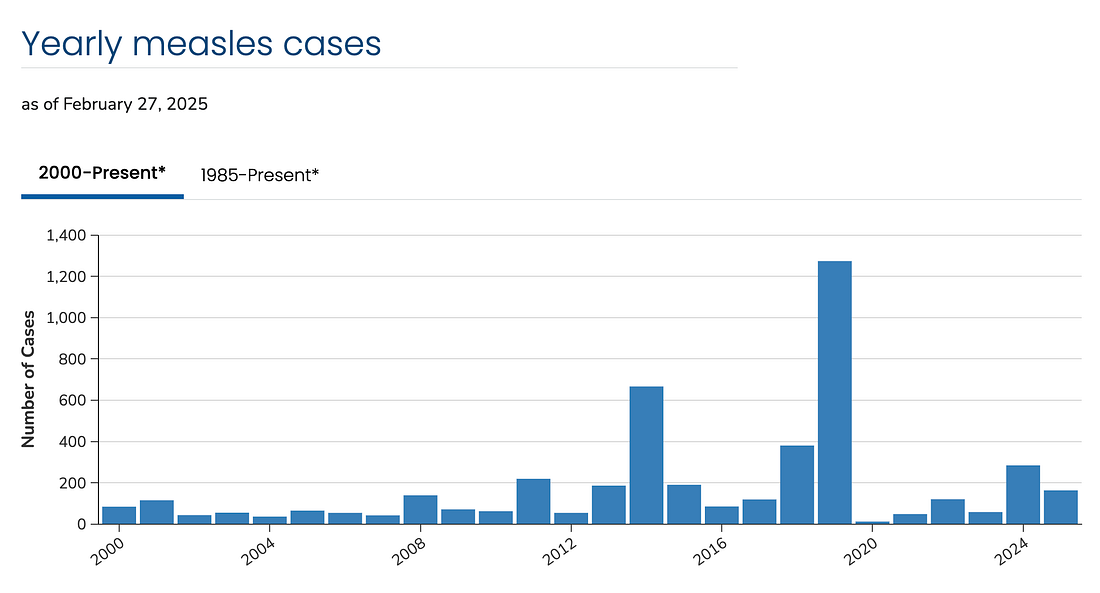
Measles was declared eliminated from the United States in 2000 due to a lack of continuous disease spread for more than 12 months (CDC). This was considered an outstanding achievement, and the CDC credited a highly effective vaccination program, with improved measles control in the Americas region. The truth is that almost as soon as measles was “eliminated” from the USA, once again outbreaks began to occur.
Measles will most likely never be eradicated or eliminated in the USA or worldwide, even though it fits the criteria for a disease that theoretically could be eliminated. Scientists and public health agencies like to tout that the measles virus is relatively stable, animal reservoirs are not considered to exist (although debatable, as some primates have a significant minority of animals with antibodies against measles), and it is relatively easy to diagnose. Unfortunately, eliminating the measles virus globally is not as simple as it seems.
Measles is a highly infectious disease. Therefore, in order to achieve herd immunity by dosing with the currently available leaky vaccines, it is estimated that there would need to be 95% vaccine coverage worldwide; currently, low-income countries have about 68% of their population vaccinated.
The MMR vaccine is officially said to have a failure rate of around 5% among vaccinated individuals. While this may seem like a small percentage, it translates to roughly 3 million children aged 1-17 in the USA who are presumed to be protected but are probably not. Like many diseases, a mild case of measles after vaccination can be asymptomatic, which means individuals can spread the disease without knowing that they are infected (PubMed).
There is documented evidence that the MMR vaccine has a much higher failure rate than stated above, and that would mean many more children are not protected than previously thought.
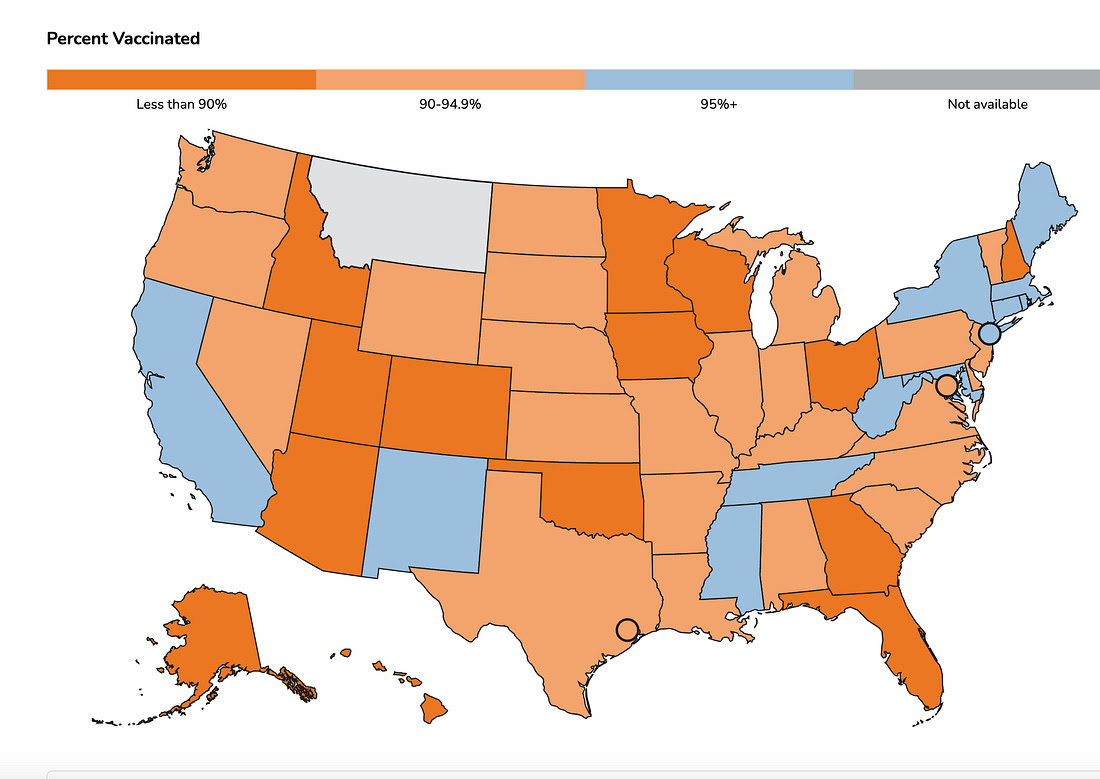
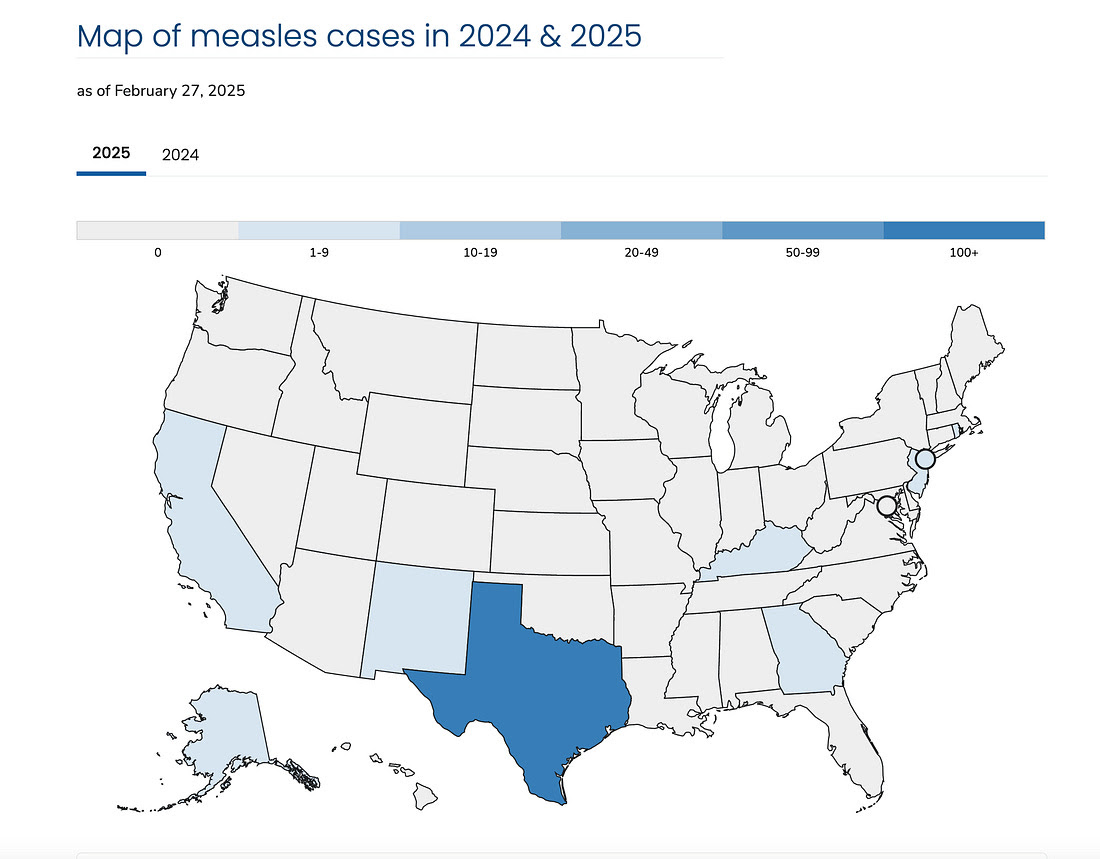
Millions of people travel in and out of the U.S. yearly, so the USA will continue to experience more outbreaks, as the rate of measles infections in low-income countries is much higher. Due to regional variations in vaccine acceptance and the fact that there are concentrated locations where international travelers land, including due to the influx of economic migrants from regions where measles is endemic, these outbreaks will most likely be concentrated in specific areas. The chart below demonstrates that this has happened with the latest outbreak.
Families are capable of evaluating the risks and benefits of getting vaccinated.
Every medicine has risk. Beyond whether vaccines cause autism, serious adverse events from vaccination are not unheard of. Although current data are not definitive, largely due to underreporting, it is almost impossible to ascertain how many serious adverse events occur after measles-mumps-rubella vaccination. Parents have every right to be cautious about vaccinating their child, particularly after the jab disaster of the CovidCrisis.
A personal risk-benefit analysis regarding vaccination, informed by fully transparent access to relevant data, and the freedom to act on that analysis is something that every parent and patient should have the right to undertake.
This is what informed consent and freedom of choice are all about.
Secretary Kennedy is not the cause of this current outbreak.
One narrative currently being promoted in various left-wing legacy (dead) media that Secretary RFK Jr is somehow responsible for the current outbreak of measles is nothing more than political propaganda. There is no merit to this – it is intentional slander with no factual basis. But there are fact-based hypotheses that clarify the real factors that appear to be contributing to what is likely to be a self-limited outbreak based on similar recent measles group infection events.
One fascinating hypothesis that recently came my way is that herd immunity against measles in the U.S. is decreasing yearly. But not for the reasons mentioned above. Immunity in the USA against measles is declining because older citizens, who have lifelong immunity to measles, are aging out of society (Casaris, 2014). The USA now has a predominantly MMR-vaccinated population, which has less immunity than those who were exposed to the disease, typically in childhood. The implication is that vaccine-resistant cases of measles are and will become more commonplace.
Secondary vaccine failure occurs when an individual initially develops an adequate immune response to vaccination, but this protection wanes over time, leaving them susceptible to infection. This is referred to as a lack of vaccine “durability”.
Vaccine-induced immunity from the measles vaccine is less long-lasting than immunity from natural infection. One study found that 20% of measles vaccinated individuals lacked detectable anti-measles IgG compared to only 6% of those with a history of measles infection (Bianchi, 2020).
However, the continued headline hysterics over a few hundred cases yearly only leads to more fear and confusion.
The bottom line is that as international travel increases and the vaccine failure rate of the MMR vaccine increases over time, there will be more measles cases and outbreaks in the USA. This problem won’t be solved with more mandates for the vaccination of school-aged children.
China went from one of the poorest countries in the world to global economic powerhouse in a mere four decades. Currently featured in the news is DeepSeek, the free, open source A.I. built by innovative Chinese entrepreneurs which just pricked the massive U.S. A.I. bubble.
Even more impressive, however, is the infrastructure China has built, including 26,000 miles of high speed rail, the world’s largest hydroelectric power station, the longest sea-crossing bridge in the world, 100,000 miles of expressway, the world’s first commercial magnetic levitation train, the world’s largest urban metro network, seven of the world’s 10 busiest ports, and solar and wind power generation accounting for over 35% of global renewable energy capacity. Topping the list is the Belt and Road Initiative, an infrastructure development program involving 140 countries, through which China has invested in ports, railways, highways and energy projects worldwide.
All that takes money. Where did it come from? Numerous funding sources are named in mainstream references, but the one explored here is a rarely mentioned form of quantitative easing — the central bank just “prints the money.” (That’s the term often used, though printing presses aren’t necessarily involved.)
From 1996 to 2024, the Chinese national money supply increased by a factor of more than 53 or 5300% — from 5.84 billion to 314 billion Chinese yuan (CNY) [see charts below]. How did that happen? Exporters brought the foreign currencies (largely U.S. dollars) they received for their goods to their local banks and traded them for the CNY needed to pay their workers and suppliers. The central bank —the Public Bank of China or PBOC — printed CNY and traded them for the foreign currencies, then kept the foreign currencies as reserves, effectively doubling the national export revenue.
One major task of the Chinese central bank, the PBOC, is to absorb the large inflows of foreign capital from China’s trade surplus. The PBOC purchases foreign currency from exporters and issues that currency in local yuan. The PBOC is free to publish any amount of local currency and have it exchanged for forex. … The PBOC can print yuan as needed …. [Emphasis added.]
Interestingly, that huge 5300% explosion in local CNY did not trigger runaway inflation. In fact China’s consumer inflation rate, which was as high as 24% in 1994, leveled out after that and averaged 2.5% per year from 1996 to 2023.
How was that achieved? As in the U.S., the central bank engages in “open market operations” (selling federal securities into the open market, withdrawing excess cash). It also imposes price controls on certain essential commodities. According to a report by Nasdaq, China has implemented price controls on iron ore, copper, corn, grain, meat, eggs and vegetables as part of its 14th five-year plan (2021-2025), to ensure food security for the population. Particularly important in maintaining price stability, however, is that the money has gone into manufacturing, production and infrastructure. GDP (supply) has gone up with demand (money), keeping prices stable. [See charts below.]
The U.S., too, has serious funding problems today, and we have engaged in quantitative easing (QE) before. Could our central bank also issue the dollars we need without triggering the dreaded scourge of hyperinflation? This article will argue that we can. But first some Chinese economic history.
From Rags to Riches in Four Decades
China’s rise from poverty began in 1978, when Deng Xiaoping introduced market-oriented reforms. Farmers were allowed to sell their surplus produce in the market, doors were opened to foreign investors and private businesses and foreign companies were encouraged to grow. By the 1990s, China had become a major exporter of low-cost manufactured goods. Key factors included cheap labor, infrastructure development and World Trade Organization membership in 2001.
Chinese labor is cheaper than in the U.S. largely because the government funds or subsidizes social needs, reducing the operational costs of Chinese companies and improving workforce productivity. The government invests heavily in public transportation infrastructure, including metros, buses and high-speed rail, making them affordable for workers and reducing the costs of getting manufacturers’ products to market.
The government funds education and vocational training programs, ensuring a steady supply of skilled workers, with government-funded technical schools and universities producing millions of graduates annually. Affordable housing programs are provided for workers, particularly in urban areas.
China’s public health care system, while not free, is heavily subsidized by the government. And a public pension system reduces the need for companies to offer private retirement plans. The Chinese government also provides direct subsidies and incentives to key industries, such as technology, renewable energy and manufacturing.
After it joined the WTO, China’s exports grew rapidly, generating large trade surpluses and an influx of foreign currency, allowing the country to accumulate massive foreign exchange reserves. In 2010, China surpassed the U.S. as the world’s largest exporter. In the following decade, it shifted its focus to high-tech industries, and in 2013 the Belt and Road Initiative was launched. The government directed funds through state-owned banks and enterprises, with an emphasis on infrastructure and industrial development.
Funding Exponential Growth
In the early stages of reform, foreign investment was a key source of capital. Export earnings then generated significant foreign exchange reserves. China’s high savings rate provided a pool of liquidity for investment, and domestic consumption grew. Decentralizing the banking system was also key. According to a lecture by U.K. Prof. Richard Werner:
Deng Xiaoping started with one mono bank. He realized quickly, scrap that; we’re going to have a lot of banks. He created small banks, community banks, savings banks, credit unions, regional banks, provincial banks. Now China has 4,500 banks. That’s the secret to success. That’s what we have to aim for. Then we can have prosperity for the whole world. Developing countries don’t need foreign money. They just need community banks supporting [local business] to have the money to get the latest technology.
China managed to avoid the worst impacts of the 1997 Asian Financial Crisis. It did not devalue its currency; it maintained strict control over capital flows and the PBOC acted as a lender of last resort, providing liquidity to state-controlled banks when needed.
In the 1990s, however, its four major state banks did suffer massive losses, with non-performing loans totaling more than 20% of their assets. Technically, the banks were bankrupt, but the government did not let them go bust. The non-performing loans were moved on to the balance sheets of four major asset management companies (“bad banks”), and the PBOC injected new capital into the “good banks.”
In a January 2024 article titled “The Chinese Economy Is Due a Round of Quantitative Easing,” Prof. Li Wei, Director of the China Economy and Sustainable Development Center, wrote of this policy, “The central bank directly intervened in the economy by creating money. Seen this way, unconventional financing is nothing less than Chinese-style quantitative easing.”
In an August 2024 article titled “China’s 100-billion-yuan Question: Does Rare Government Bond Purchase Alter Policy Course?,” Sylvia Ma wrote of China’s forays into QE:
Purchasing government bonds in the secondary market is allowed under Chinese law, but the central bank is forbidden to subscribe to bonds directly issued by the finance ministry. [Note that this is also true of the U.S. Fed.] Such purchases from traders were tried on a small scale 20 years ago.
However, the monetary authority resorted more to printing money equivalent to soaring foreign exchange reserves from 2001, as the country saw a robust increase in trade surplus following its accession to the World Trade Organization. [Emphasis added.]
This is the covert policy of printing CNY and trading this national currency for the foreign currencies (mostly U.S. dollars) received from exporters.
What does the PBOC do with the dollars? It holds a significant portion as foreign exchange reserves, to stabilize the CNY and manage currency fluctuations; it invests in U.S. Treasury bonds and other dollar-denominated assets to earn a return; and it uses U.S. dollars to facilitate international trade deals, many of which are conducted in dollars.
The PBOC also periodically injects capital into the three “policy banks” through which the federal government implements its five-year plans. These are China Development Bank, the Export-Import Bank of China, and the Agricultural Development Bank of China, which provide loans and financing for domestic infrastructure and services as well as for the Belt and Road Initiative. A January 2024 Bloomberg article titled “China Injects $50 Billion Into Policy Banks in Financing Push” notes that the policy banks “are driven by government priorities more than profits,” and that some economists have called the PBOC funding injections “helicopter money” or “Chinese-style quantitative easing.”
Prof. Li argues that with the current insolvency of major real estate developers and the rise in local government debt, China should engage in this overt form of QE today. Othercommentators agree, and the government appears to be moving in that direction. Prof. Li writes:
As long as it does not trigger inflation, quantitative easing can quickly and without limit generate sufficient liquidity to resolve debt issues and pump confidence into the market.…
Quantitative easing should be the core of China’s macroeconomic policy, with more than 80% of funds coming from QE…
As the central bank is the only institution in China with the power to create money, it has the ability to create a stable environment for economic growth. [Emphasis added.]
Eighty-percent funding just from money-printing sounds pretty radical, but China’s macroeconomic policy is determined by five-year plans designed to serve the public and the economy, and the policy banks funding the plans are publicly-owned. That means profits are returned to the public purse, avoiding the sort of private financialization and speculative exploitation resulting when the U.S. Fed engaged in QE to bail out the banks after the 2007-08 banking crisis.
The U.S. Too Could Use Another Round of QE — and Some Public Policy Banks
There is no law against governments or their central banks just printing the national currency without borrowing it first. The U.S. Federal Reserve has done it, Abraham Lincoln’s Treasury did it, and it is probably the only way out of our current federal debt crisis. As Prof. Li observes, we can do it “without limit” so long as it does not trigger inflation.
Financial commentator Alex Krainer observes that the total U.S. debt, public and private, comes to more than $101 trillion (citing the St. Louis Fed’s graph titled “All Sectors; Debt Securities and Loans”). But the monetary base — the reserves available to pay that debt — is only $5.6 trillion. That means the debt is 18 times the monetary base. The U.S. economy holds far fewer dollars than we need for economic stability.
The dollar shortfall can be filled debt- and interest-free by the U.S. Treasury, just by printing dollars as Lincoln’s Treasury did (or by issuing them digitally). It can also be done by the Fed, which “monetizes” federal securities by buying them with reserves it issues on its books, then returns the interest to the Treasury and after deducting its costs. If the newly-issued dollars are used for productive purposes, supply will go up with demand, and prices should remain stable.
Note that even social services, which don’t directly produce revenue, can be considered “productive” in that they support the “human capital” necessary for production. Workers need to be healthy and well educated in order to build competitively and well, and the government needs to supplement the social costs borne by companies if they are to compete with China’s subsidized businesses.
Parameters would obviously need to be imposed to circumscribe Congress’s ability to spend “without limit,” backed by a compliant Treasury or Fed. An immediate need is for full transparency in budgeted expenditures. The Pentagon, for example, spends nearly $1 trillion of our taxpayer money annually and has never passed a clean audit, as required by law.
We Sorely Need an Infrastructure Bank
The U.S. is one of the few developed countries without an infrastructure bank. Ironically, it was Alexander Hamilton, the first U.S. Treasury secretary, who developed the model. Winning freedom from Great Britain left the young country with what appeared to be an unpayable debt. Hamilton traded the debt and a percentage of gold for non-voting shares in the First U.S. Bank, paying a 6% dividend. This capital was then leveraged many times over into credit to be used specifically for infrastructure and development. Based on the same model, the Second U.S. Bank funded the vibrant economic activity of the first decades of the United States.
In the 1930s, Roosevelt’s government pulled the country out of the Great Depression by repurposing a federal agency called the Reconstruction Finance Corporation (RFC) into a lending machine for development on the Hamiltonian model. Formed under the Hoover administration, the RFC was not actually an infrastructure bank but it acted like one. Like China Development Bank, it obtained its liquidity by issuing bonds.
The primary purchaser of RFC bonds was the federal government, driving up the federal debt; but the debt to GDP ratio evened out over the next four decades, due to the dramatic increase in productivity generated by the RFC’s funding of the New Deal and World War II. That was also true of the federal debt after the American Revolution and the Civil War.
A pending bill for an infrastructure bank on the Hamiltonian model is HR 4052, The National Infrastructure Bank Act of 2023, which ended 2024 with 48 sponsors and was endorsed by dozens of legislatures, local councils, and organizations. Like the First and Second U.S. Banks, it is intended to be a depository bank capitalized with existing federal securities held by the private sector, for which the bank will pay an additional 2% over the interest paid by the government. The bank will then leverage this capital into roughly 10 times its value in loans, as all depository banks are entitled to do. The bill proposes to fund $5 trillion in infrastructure capitalized over a 10-year period with $500 billion in federal securities exchanged for preferred (non-voting) stock in the bank. Like the RFC, the bank will be a source of off-budget financing, adding no new costs to the federal budget. (For more information, see https://www.nibcoalition.com/.)
Growing Our Way Out of Debt
Rather than trying to kneecap our competitors with sanctions and tariffs, we can grow our way to prosperity by turning on the engines of production. Far more can be achieved through cooperation than through economic warfare. DeepSeek set the tone with its free, open source model. Rather than a heavily guarded secret, its source code is freely available to be shared and built upon by entrepreneurs around the world.
We can pull off our own economic miracle, funded with newly issued dollars backed by the full faith and credit of the government and the people. Contrary to popular belief, “full faith and credit” is valuable collateral, something even Bitcoin and gold do not have. It means the currency will be accepted everywhere – not just at the bank or the coin dealer’s but at the grocer’s and the gas station. If the government directs newly created dollars into new goods and services, supply will grow along with demand and the currency should retain its value. The government can print, pay for workers and materials, and produce its way into an economic renaissance.
After decades of a prostate cancer epidemic and a refusal to screen Black men, who suffer a 60% higher incidence than White men, the highest in the industrialized world, physicians are now advocating refusal to screen ALL men.
The American Cancer Society writes, “Prostate cancer is the most common cancer in men in the US. It’s also the second leading cause of cancer death. About 1 in 8 men will get prostate cancer in their lifetime.” Knowing these facts about the cancer epidemic, The American Family Physician (AFP) has just published an editorial that calls on physicians to STOP screening men for prostate cancer. “Rather than treating the PSA (prostate specific antigen) as an elective test…primary care physicians should go back to discouraging its use.”
The 2018 US Preventative Services Task Force stated, “Screening offers a small potential benefit of reducing the chance of death from prostate cancer in some men.”
“More aggressive screening strategies particularly those that use a lower PSA threshold …., provide the greatest potential reduction in death from prostate cancer.”
A report in the respected New England Journal of Medicine in 2020 reported that the benefit of PSA screening …“is qualitatively similar to recommendations supporting breast cancer screening.”
While acknowledging that PSA screening saves lives the USPSTF does NOT call for universal screening for prostate cancer. The National Cancer Institute, 4/10/19, The American Cancer Society 3/11/16, and the American College of Physicians, 4/9/13, none of these organizations call for universal prostate cancer screening.
Now the AFP opines that not ALL men should be screened. In face of a cancer epidemic screening tests should be improved not discouraged, and denied.
Why is this happening?
Men do NOT get universal prostate screening because of priorities and money.
The PSA test is “a hugely expensive public health disaster”. “As Congress searches for ways to cut costs in our health care system, a significant savings could come from changing the way the antigen is used to screen for prostate cancer.” “Americans waste an enormous amount of money on an inaccurate test for prostate cancer.
The political priorities are obvious: Trillions of dollars in tax cuts for corporations and the rich, and trillions in dollars for the military–war machine.
Should we accept the decision to place more value on profits and war than on the people’s health and welfare?
Waking up, day after day, and seeing continuous disasters visited upon the Palestinian people forecasts a day of facing the light at an increasingly dark level. It is impossible to be unaware of the genocide; yet an entire nation reinforces it. The American people are disposed to the sufferings its government inflicts upon others.
Election of an authoritarian to the highest office, who appoints cabinet positions with qualifications that require little experience in government affairs and extensive experience in extramarital affairs, completes the mystification. Elise Stefanik, selected as America’s representative to the United Nations, agrees to the proposition that “Israel has a biblical right to the West Bank.” Shuddering! Doesn’t qualification for a cabinet position require knowledge that the bible does not determine right and that the Earth is round and not flat? Hopefully, UN security guards will bar entry of her and other vocal terrorists into the UN building.
Maintaining the Declaration of Independence and Constitution will be a battle. Refusing to have the Old Testament on a night table and the Ten Commandments on the living room wall will be challenging . Knowing that America is in a dystopia, “livin’ a vida loca,” will be difficult to absorb. These are not the principal problems that prevent America from being great again. The principal problem in the United States is a government that has been unable to resolve its problems. For decades, a multitude of problems have surfaced, talked about, and been ignored. Suggestions for solutions are cast aside as empty words ─ U.S. governments are only interested in donor offerings and contributing lobbyists; attention to the people’s problems is time consuming and not remunerative.
Look at the extensive record of problems, which has been growing for decades and have some obvious solutions. After these crisp answers, I might elaborate on them in forthcoming articles.
(1) Social Security
The ready to collapse Social Security system has present earners paying for retired workers and closely resembles a national pension plan. Instead of having workers and corporations pay FICA taxes, why not collect revenue from income and corporation taxes and finance a real national pension plan?
(2) Gun Violence
Decades of gun violence and shootings in schools have been succeeded by decades of gun violence and shootings in schools. An idea ─ get rid of the guns; nobody will miss them.
(3) Climate Change
In the 1964 presidential contest between Senator Goldwater and President Johnson, Goldwater posed as the “war hawk,” ready to pounce on the North Vietnamese. Johnson’s famous phrase was, “I’ll not have American boys do what Vietnamese boys should do.” After Johnson won the presidency and had “American boys do what Vietnamese boys should do,” Goldwater voters reminded everyone, “They told me if I voted for Goldwater our military intervention in Vietnam would greatly increase. I voted for Goldwater and they were correct.”
In all elections, voters are reminded that voting Republican enhances global warming. In all elections that the Democrats won, those who voted Republican noted that global warming continued to increase.
(4) Government debt
Mention government debt and blood boils ─ another of those internalized issues, courtesy of the mind manipulators. Government debt is the result of problems and not the problem. The problems are (1) Income taxes are too low to finance meaningful government projects; (2) The military spending is too high and; (3) The economy runs on debt and government debt rescues a faltering economy. Give attention to the real problems and government debt will be greatly reduced.
(5) War
Since its official inception in 1789, the United States has attached itself to war in almost every day of its existence. Not widely mentioned and not widely apparent, U.S. forces are still shooting it up in Iraq, Syria, Yemen, and parts of Africa. U.S. arms explode throughout the world. U.S. involvement in the genocide of the Palestinian people is inescapable. Americans do not know they prosper on the degradation of others and they survive well because others do not survive at all. While intending to end all wars, President Trump may learn that the U.S. cannot progress without war; war is a preventive for economic and social collapse in all 50 states.
(6) Immigration
Immigration to the United States has become a political football. Political correctness, catering to voters, and ultra-Right nationalism vs. ultra-Left internationalism have strangled an intelligent and objective analysis of a major issue, which is not immigration. The major issue is that the U.S. has supported oligarchies in Latin American nations. These oligarchies have created significant social and economic problems, which the disenfranchised relieve by fleeing to America’s shores. Uncontrolled emigration to the United States skews nations from their natural growth and conveniently deters them from seeking approaches to resolve their problems. The U.S. contributes to the emigration problem and should resolve the problem and not perpetuate it. Wouldn’t it be beneficial for all countries, including the United States, if the Latinos did not have the urge to emigrate?
(7) International terrorism
The September 11, 2001 attack – the first aerial bombings on American soil – compelled the United States government to wage a War on Terrorism. After more than twenty years of this battle, the U.S. has neither won the war nor totally contained terrorism; just the opposite ─ terrorism has grown in size, geographical extent, and power. Observe Afghanistan, Syria, Pakistan, and all of North Africa. One reason for this contradiction is obvious; the initial source of international terrorism is Israel’s terrorism in the West Bank and Gaza. The U.S. blends its battle against terrorism with preservation of American global interests. Each blended component contradicts the other and creates confusing missions in the U.S. War on Terrorism.
(8) Economy
A roller coaster American economy of accelerated growth and gasping recessions flattened itself with slow but steady growth in the Democratic administrations that succeeded the George W. Bush recession. Now we have Donald J. Trump, who claims he had the greatest economy ever, when all presidents had, in their times, the greatest economy ever, and previous administrations had more rapid growth and captured much more of world production. By proposing lower taxes, lower interest rates, and blistering tariffs, Trump is heading the U.S. into massive speculation, heightened debt, increased inflation, a falling dollar, and a return to a 19th century economy of robber barons, boom-and-bust, financial bankruptcies, and a drastic “beggar thy neighbor” policy. His sink China policy will sink the United States. America will no longer have friendly neighbors and might become the beggar.
(9) Racism
The United States consists of a mixture of several cultures and has no unique culture. People feel comfortable in their own culture and attach themselves to others and to institutions that reflect that culture. In a competitive society, this extends to gaining economic advantage and security by dominating other cultures. Social, political, and economic agendas use racism to promote this strategy and maintain domination.
Competition between cultures, manifested as racism, is built into the American socio-economic system. Political, legal, and educational methods have ameliorated racism and have not abolished its corrosive effects. Slow progress to an integrated and unified culture, decades away, might finally resolve the problem of racism.
(10) Health Care
Health care is posed as a financial problem, insufficient funds to treat all equally. Health care is a socio-economic problem, where statistics show that nations having the most unequal distribution of income have the most maladjusted health care. More equal distribution of income is a key to adequate health care for all.
(11) Political Divide
Connie Morella, previous representative from Maryland’s 8th congressional district, enjoyed saying, “I sit and serve in the people’s house,” a phrase echoed by many congressionals. No people or sitters exist in the “people’s house.” Representatives stand for the special interest groups, Lobbies, and Political Action Committees (PAC) that donate to their campaigns and assure their return to office. The two political Parties stand united against the wants of the other and the political divide leads to political stagnation. Whatever Gilda wants, Gilda does not get. America coasts on a frictionless surface of contracting previous legislation and inaction, which is its preferred method of government.
(12) Foreign Policy
All administrations, the present included, have had foreign policies driven by two words, “empire expansion.” Until now, the U.S. has sought markets and resources and financed the expansion from its own banks. Donald trump seeks expansion by real estate maneuvers and seeks to have foreign sources finance the expansion. This emperor has no clothes and will bankrupt the U.S. in the same manner as he bankrupted his real estate enterprises.
(13) Drug Addiction
The epidemic drug addiction problem summarizes the attention given to most other national problems — despite a century of organized efforts to subdue the problem, “New numbers show drug abuse is getting worse across the country and in every community. Overdose deaths have never been higher and opioids and synthetic drugs are major contributors to the rising numbers.” President Nixon popularized the term “war on drugs,” but his administration’s Comprehensive Drug Abuse Prevention and Control Act of 1970 had an antecedent in the Harrison Narcotics Tax Act of 1914.
Blaming China for supplying fentanyl ingredients to Mexican manufacturers, only one part of the total drug economy, does not change the source of the drug addiction and provides no resolution to the problem. Looking elsewhere, at nations where drug addiction is minor or has been alleviated is a start. Japan has a “strong social stigma against drug use, and some of the strictest drug laws globally; Iceland responded to high rates of teen substance abuse with “a comprehensive program that included increased funding for organized sports, music, and art programs, as well as a strictly enforced curfew for teens;” Singapore’s “notoriously strict drug laws have resulted in some of the lowest addiction rates in the world, including a zero-tolerance approach to drug use and trafficking, with mandatory death penalties for certain drug offenses;” Sweden “combines strict laws with a comprehensive rehabilitation approach in a ‘caring society’ model that emphasizes treatment and social support over punishment. Time Magazine recommends another approach.
…history exposes the truth: the drug war isn’t winnable, as the Global Commission on Drug Policy stated in 2011. And simply legalizing marijuana is not enough. Instead only a wholesale rethinking of drug policy—one that abandons criminalization and focuses on true harm reduction, not coercive rehabilitation—can begin to undo the damage of decades of a misguided “war.”
Skewing the GDP
Replacing a building destroyed in a catastrophe augments the Gross Domestic Product (GDP) in four ways — housing and helping those affected by the catastrophe, responding to mitigating the catastrophe, tearing down the destroyed home, and building a new home. The GDP benefits from the continual and unresolved problems.
Opioid cases generated a cost estimated at $1.5 trillion in the United States for the year 2010.
Gun violence generates over $1 billion in direct health care costs for victims and their families each year.
Climate change during 2011-2020 decade cost $1.5T in losses (Ed: might be debatable).
Health care costs are almost 20 percent of GDP.
The Defense budget for 2025 is $850 billion.
In the disturbing world that is characterizing the United States, a combination of political stagnation, misdirection action, and low level of intellect and knowledge prevents solutions to recurring problems. American nationalists boast about having the highest GDP, not realizing that the boast uses tragedy to disguise more significant tragedies — moral, political, and economic decay of the once mighty USA.
Upside, inside, out
She’s livin’ la vida loca
She’ll push and pull you down
Livin’ la vida loca
Her lips are devil red
And her skin’s the color of mocha
She will wear you out
Livin’ la vida loca
Our teeth are our only permanent body part, so it makes sense that they must be cared for if you are going to live a long, healthy life. Unlike the rest of our body, once formed, they are not continually rebuilt through routine metabolism. Teeth are, under healthy conditions, essentially indestructible, as demonstrated by fossil records and forensic medicine. Yet, as we go about our daily lives, microorganisms constantly assault our teeth. This battle results in dental infections, a universal affliction of humankind — the discomfort caused by these infections and their enormous cost. Dental infections rank third in medical expenses in the United States, right behind heart disease and cancer. Furthermore, dental disease is closely linked to the development of a variety of heart diseases.
Beginning in the 1940s, a consensus emerged (particularly in the United States) that the risks and consequences of dental disease could be prevented mainly by ensuring that children consume adequate levels of a chemical called “fluoride” in their diet so that it would then be incorporated into their developing teeth. Based on this belief, most US municipal water systems began injecting fluoride into drinking water. In 2014, three-quarters of the US population on the public water supply received fluoridated water, representing two-thirds of the total US population. Despite this intervention, dental disease remains near the top of US health cost drivers. It is time to revisit the mid-20th century consensus on fluoride supplementation. The metadata indicates that the mandated intervention is not curing the problem.
Recent scientific study data, including a comprehensive evaluation by the US HHS National Toxicology Program, indicate that “higher levels of fluoride exposure, such as drinking water containing more than 1.5 milligrams of fluoride per liter, are associated with lower IQ in children.” This finding underscores a couple of central principles of pharmacology and toxicology – first, all substances (including generally beneficial supplements) are toxic at some dose. Secondly, there is no substitute for long-term studies in the species of interest (humans) because cumulative effects may not be revealed in short-term analyses. Sound familiar? Basic principles.
The key is to understand and dose according to the “therapeutic window,” and to control exposure so that toxic levels are avoided while maintaining therapeutic levels. The issue with injecting fluoride into municipal water supplies are twofold. First, there no practical informed consent option has been available for what is essentially a medical treatment. We are just told to “trust the experts.” Second, the overall dosing of fluoride is uncontrolled- the mineral is present in various ingested materials (including toothpaste!), and people (including children) consume variable amounts of water. These new findings demonstrate that the therapeutic window for fluoride dosing is much narrower than previously believed. In sum, recent US HHS analyses demonstrate that fluoride is toxic at levels consistent with currently supplemented municipal water supplies.
If you actually “follow the science,“ it is time to rethink the consensus public health policy position on municipal water fluoridation. We have discovered another example of “Groupthink” among public health policy “experts.” Have we (and our children) once again become unwitting “victims” of this phenomenon?
Outside North America, water fluoridation was adopted in some European countries, but in the late 1970s and early 1980s, Denmark and Sweden banned fluoridation when government panels found insufficient evidence of safety, and the Netherlands banned water fluoridation when “a group of medical practitioners presented evidence” that it caused negative effects in a percentage of the population.
The American Dental Association (ADA) does not mention the dangers of fluoride in its fluoride promotion literature. Likewise, the American Association of Family Practitioners (AAFP) – does not disclose the neurodevelopment issues with fluoride. Both of these organizations are primarily acting to reinforce outdated public health “consensus” rather than keeping practitioners and the public fully informed of recent findings in a balanced and transparent fashion.
Informed by these recent findings, HHS Secretary nominee Robert F Kennedy Jr. has stated that “the Trump White House will advise all U.S. water systems to remove fluoride from public water” on Inauguration Day has prompted widespread attacks from mainstreammedia and public health officials who appear to be unaware of the changes in understanding the toxicology of fluoride. Once again, widely quoted “experts in public health” are being revealed as reflexively strident defenders of outdated groupthink consensus and are gaslighting, demeaning, and attempting to delegitimize others who are more up-to-date with recent findings. Sound familiar?
Cavities have caused tooth pain and systemic human disease for millions of years. Fossils from the Australopithecus species reveal some of the earliest dental caries from 1.1 million to 4.4 million years ago. Mesolithic skulls (8,000 years BC) also show signs of cavities. Two leading factors contributing to increases in dental caries appear to be the consumption of plant-based foods containing carbohydrates and rice cultivation between 7,000 BC and 5,500 BC. This led to the development of the first cavity treatments in Pakistan in around the same era. In the 11th century, the appearance of sugar cane led to an increase in reported cavities.
Humans existed for millennia without supplemental fluoride. Are there better, more effective options other than functionally mandating uncontrolled treatment of children with fluoride and consequently risking cognitive damage? The short answer is surprisingly simple and hauntingly familiar to those who have “followed the science” of COVID early treatment protocols: reduce exposure to refined sugar and simple carbohydrate-rich diets and ensure adequate Vitamin D levels.
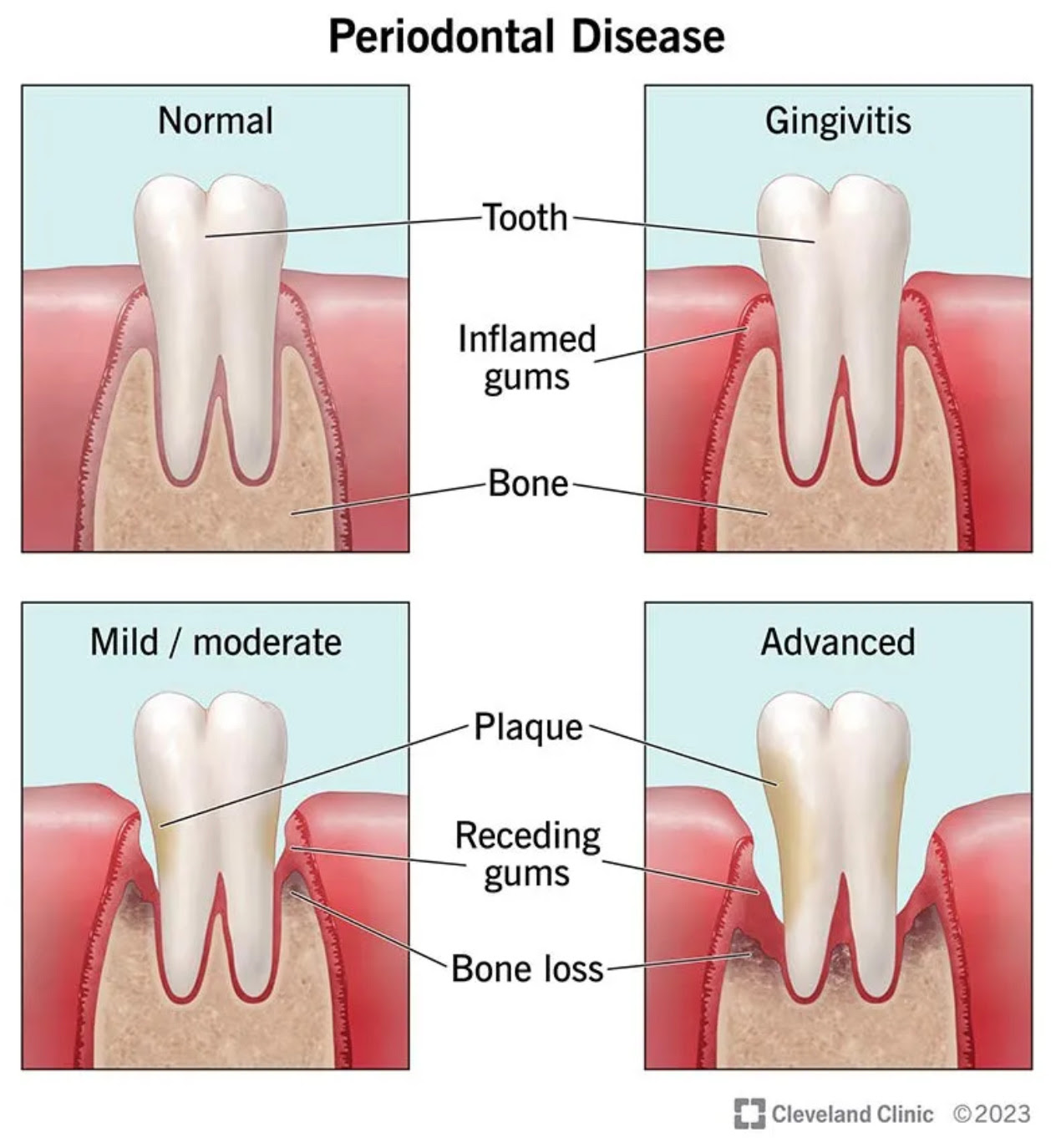
Caries (tooth decay) and periodontal disease are the two most prevalent oral health conditions, affecting millions worldwide. The impact of these diseases extends beyond oral health; they have profound implications for overall well-being, quality of life, and healthy functioning of many other parts of the body, including the heart. The mouth, particularly the junction between tooth and gum, is a common portal of entry for a range of pathogens, mainly bacteria and fungi. Our mouths are typically colonized by 200 to 300 bacterial species, but only a limited number of these species participate in dental decay (caries) or periodontal disease.
The main bad actors are the bacteria Streptococcus mutans, and the fungus Candida albicans. These two species cooperate with each other to form biofilms, which create a protected microenvironment that covers teeth and gums. You can think of this as like an umbrella that protects these two from assault by your oral immune system. The biofilms then enable the two species (and other camp followers) to manipulate that protected space to support their own metabolic needs – at the expense of underlying teeth and gums. All of this is greatly facilitated by dietary simple sugars and carbohydrates, which Streptococcus and Candida consume as food. But what is the biofilm “umbrella” protecting these opportunists from? Our oral (mucosal) immune system.
The oral immune system is a complex network of defense mechanisms that work together to protect the oral cavity from pathogens and maintain oral health. A key component of mucosal immunity, the oral immune system plays a vital component of the body’s defense against pathogens and other foreign substances. It plays a crucial role in protecting the oral cavity, including the teeth, gums, tongue, and lips, from infection and inflammation. The oral immune system has four major components. Innate immunity: The oral epithelium and resident immune cells (e.g., macrophages, dendritic cells) recognize and respond to pathogens through pattern recognition receptors (PRRs) and Toll-like receptors (TLRs). Adaptive immunity: T-cells and B-cells recognize and respond to specific oral antigens, leading to the production of cytokines and antibodies. Cytokine networks: The oral immune system relies on complex cytokine networks, including IL-1β, IL-6, IL-8, TNF-α, and IFN-γ, to coordinate the immune response. Saliva: Saliva contains antimicrobial factors, such as lysozyme, lactoferrin, and histatin, which help to neutralize pathogens and maintain oral health.
We have briefly summarized the emerging consensus on the narrowing therapeutic window for fluoride, as well as the role of sugar, simple carbohydrates, biofilms, bacteria and yeast in promoting tooth decay. But what about vitamin D?
The following is an AI-generated summary of the current state of vitamin D deficiency in American children and adults:
“A more comprehensive analysis using NHANES data from 2001 to 2018 found that 2.6% of Americans have severe vitamin D deficiency (<25 nmol/L) and 22.0% have moderate deficiency (25-50 nmol/L. Some studies report higher rates, with one estimating that 41.6% of US adults are vitamin D deficient.”
“9% of the pediatric population, representing 7.6 million US children and adolescents, were vitamin D deficient (defined as 25(OH)D levels <15 ng/mL). 12.1% of children in a sample of healthy infants and toddlers were vitamin D deficient (defined as ≤20 ng/mL). Approximately 15% of children ages 1 through 11 and 14% of children and teens ages 12 through 19 are estimated to be vitamin D deficient.”
Adequate vitamin D levels are essential for immunologic function and health. The oral immune system plays a crucial role in protecting oral health and resisting the development of dental caries and periodontal disease. So, it is reasonable to ask whether vitamin D has any role in protecting against dental disease.
The short answer is absolutely yes!The emerging data suggest that adequate levels of Vitamin D3 provide huge benefits in preventing dental disease in both adults and children.
References on Vitamin D3, dental caries in adults and children, and periodontal disease.
Al-Jubori, S. H., M. A. Al-Murad, and F. A. Al-Mashhadane. “Effect of Oral Vitamin D3 on Dental Caries: An in-Vivo and in-Vitro Study.”Cureus 14, no. 5 (May 2022): e25360. https://dx.doi.org/10.7759/cureus.25360.
Aim: Vitamin D3 plays an important role in affecting the overall remineralization process of the dentition. The use of supplements help to keep the levels at optimum and thus reduce the chances of treating very early lesion of caries. Hence the aim was to investigate the indirect effects of oral vitamin D3 on microhardness and elemental weight percentage of Calcium (Ca) and Phosphorous (P) in enamel surface with an artificially initiated carious lesion.
Results: For all specimens, there was a significant decrease in both (Ca and P weight %) after demineralization and then they significantly increased after receiving vitamin D3. The microhardness and elemental analysis provide confirmed results that were represented as a statistically significant difference at (P≤ 0.05) between groups that received vitamin D3 and those without vitamin D3 dosage.
Conclusions: Oral vitamin D3 has a significant potential in motivating remineralization of early lesions on the enamel surfaces representing improved surface microhardness and minerals content (Ca and P weight %) of demineralized tooth surfaces.
References on Vitamin D3, dental caries in adults and children, and periodontal disease.
Behm, C., A. Blufstein, J. Gahn, A. Moritz, X. Rausch-Fan, and O. Andrukhov. “25-Hydroxyvitamin D(3) Generates Immunomodulatory Plasticity in Human Periodontal Ligament-Derived Mesenchymal Stromal Cells That Is Inflammatory Context-Dependent.” Front Immunol 14 (2023): 1100041. https://dx.doi.org/10.3389/fimmu.2023.1100041.
Conclusion: These data indicate that 25(OH)D3 influences the immunomodulatory activities of hPDL-MSCs. This modulatory potential seems to have high plasticity depending on the local cytokine conditions and may be involved in regulating periodontal tissue inflammatory processes.
Blufstein, A., C. Behm, B. Kubin, J. Gahn, X. Rausch-Fan, A. Moritz, and O. Andrukhov. “Effect of Vitamin D(3) on the Osteogenic Differentiation of Human Periodontal Ligament Stromal Cells under Inflammatory Conditions.” J Periodontal Res 56, no. 3 (Jun 2021): 579-88. https://dx.doi.org/10.1111/jre.12858.
Objectives: Vitamin D3 is known to activate osteogenic differentiation of human periodontal ligament stromal cells (hPDLSCs). Recently, inflammatory stimuli were shown to inhibit the transcriptional activity of hPDLSCs, but their effect on vitamin D3-induced osteogenic differentiation is not known. The present study aimed to investigate whether the effects of 1,25-dihydroxvitamin D3 (1,25(OH)2D3) and 25-hydroxvitamin D3 (25(OH)D3) on the osteogenic differentiation of hPDLSCs are also altered under inflammatory conditions. Furthermore, the expression of osteogenesis-related factors by hPDLSCs under osteogenic conditions was assessed in the presence of inflammatory stimuli.
Conclusion: The results of this study indicate that inflammatory stimuli also diminish the 1,25(OH)2D3-induced expression of osteogenesis-related factors in hPDLSCs under osteogenic conditions, while having no effect on the osteogenic differentiation.
Buzatu, R., M. M. Luca, and B. A. Bumbu. “A Systematic Review of the Relationship between Serum Vitamin D Levels and Caries in the Permanent Teeth of Children and Adolescents.” Dent J (Basel) 12, no. 4 (Apr 22 2024). https://dx.doi.org/10.3390/dj12040117.
Abstract: This systematic review critically evaluates the association between serum Vitamin D levels and dental caries incidence in the permanent teeth of children and adolescents. The search strategy comprised three databases (PubMed, Scopus, Embase), up to November 2023, targeting studies on the correlation between Vitamin D and dental caries in permanent dentition. The eligibility criteria focused on observational studies involving children and adolescents aged 12 to 19 years with permanent dentition. The screening process, guided by the PRISMA guidelines and the Newcastle–Ottawa Scale for quality assessment, resulted in the inclusion of eight studies conducted across various global regions from 2013 to 2023. The analysis revealed that Vitamin D insufficiency and deficiency were prevalent among the study populations, ranging from 17.3% to 69.4%. Specifically, children and adolescents with Vitamin D insufficiency (<50 nmol/L) were found to have significantly higher odds of developing caries, with odds ratios (ORs) ranging from 1.13 to 2.57. Conversely, two studies indicated a protective effect of higher Vitamin D levels, with an OR of 0.80 and 0.59, respectively, for caries among children and adolescents with serum levels ≥ 50 nmol/L, suggesting an inverse relationship between Vitamin D status and caries risk. The results indicate both the protective role of adequate serum levels of Vitamin D above 20 ng/mL and the increased risk associated with insufficient levels below this threshold. However, the variations in study quality, methodologies and geographic settings underscore the challenges in drawing universal conclusions. Despite these limitations, our review suggests that improving Vitamin D status could be a beneficial component of preventive strategies against dental caries in children and adolescents, warranting further research to clarify the clinical significance of our findings.
Dietrich, T., K. J. Joshipura, B. Dawson-Hughes, and H. A. Bischoff-Ferrari. “Association between Serum Concentrations of 25-Hydroxyvitamin D3 and Periodontal Disease in the Us Population.” Am J Clin Nutr 80, no. 1 (Jul 2004): 108-13. https://dx.doi.org/10.1093/ajcn/80.1.108.
Background: Periodontal disease (PD) is a common chronic inflammatory disease and an important risk factor for tooth loss. Vitamin D might affect periodontal disease risk via an effect on bone mineral density (BMD) or via immunomodulatory effects.
Objective: The objective was to evaluate whether serum 25-hydroxyvitamin D3 [25(OH)D3] concentrations are associated with PD in the third National Health and Nutrition Examination Survey.
Design: We analyzed data on periodontal attachment loss (AL) and serum 25(OH)D3 concentrations from 11 202 subjects aged ≥20 y. Mean AL was modeled in a multiple linear regression with quintile of serum 25(OH)D3 concentration as an independent variable. The model was stratified by age and sex and was adjusted for age within age groups, race or ethnicity, smoking, diabetes, poverty income ratio, body mass index, estrogen use, and gingival bleeding.
Results: 25(OH)D3 concentrations were significantly and inversely associated with AL in men and women aged ≥50 y. Compared with men in the highest 25(OH)D3 quintile, those in the lowest quintile had a mean AL that was 0.39 mm (95% CI: 0.17, 0.60 mm) higher; in women, the difference in AL between the lowest and highest quintiles was 0.26 mm (0.09, 0.43 mm). In men and women younger than 50 y, there was no significant association between 25(OH)D3 and AL. The BMD of the total femoral region was not associated with AL and did not mediate the association between 25(OH)D3 and AL.
Conclusions: Low serum 25(OH)D3 concentrations may be associated with PD independently of BMD. Given the high prevalence of PD and vitamin D deficiency, these findings may have important public health implications.
Dura-Trave, T., and F. Gallinas-Victoriano. “Dental Caries in Children and Vitamin D Deficiency: A Narrative Review.” Eur J Pediatr 183, no. 2 (Feb 2024): 523-28. https://dx.doi.org/10.1007/s00431-023-05331-3.
Dental caries represents one of the most prevalent health problems in childhood. Numerous studies have assessed that vitamin D deficiency is highly related to dental caries in primary and permanent teeth in children. The aim of this study is to elaborate a narrative review about proposed mechanisms by which vitamin D deficiency interacts with dental caries process in children. Vitamin D deficiency during pregnancy may cause intrauterine enamel defects, and through childhood is accompanied by insufficient activity of antibacterial peptides, decreased saliva secretion, and a low level of calcium in saliva.
Conclusion: In conclusion, vitamin D deficiency would increase the risk of caries in the primary and/or permanent dentition. Relationship between vitamin D deficiency and dental caries is evident enough for vitamin D deficiency to be considered as a risk factor for dental caries in children. Optimal levels of vitamin D throughout pregnancy and childhood may be considered an additional preventive measure for dental caries in the primary and permanent dentition.
Govindharajulu, R., N. K. Syed, B. Sukumaran, P. R. Seshadri, S. Mathivanan, and N. Ramkumar. “Assessment of the Antibacterial Effect of Vitamin D3 against Red Complex Periodontal Pathogens: A Microbiological Assay.” J Contemp Dent Pract 25, no. 2 (Feb 1 2024): 114-17. https://dx.doi.org/10.5005/jp-journals-10024-3642.
Kalra, G., Y. Kumar, C. Langpoklakpam, T. Chawla, T. Thangaraju, and R. Singhania. “Relationship between Maternal Prenatal Vitamin D Status and Early Childhood Caries in Their Children: A Cross-Sectional Survey.” Int J Clin Pediatr Dent 17, no. 8 (Aug 2024): 860-63. https://dx.doi.org/10.5005/jp-journals-10005-2836.
Li, Z., X. Wei, Z. Shao, H. Liu, and S. Bai. “Correlation between Vitamin D Levels in Serum and the Risk of Dental Caries in Children: A Systematic Review and Meta-Analysis.” BMC Oral Health 23, no. 1 (Oct 19 2023): 768. https://dx.doi.org/10.1186/s12903-023-03422-z.
Liu, K., H. Meng, R. Lu, L. Xu, L. Zhang, Z. Chen, D. Shi, X. Feng, and X. Tang. “Initial Periodontal Therapy Reduced Systemic and Local 25-Hydroxy Vitamin D(3) and Interleukin-1beta in Patients with Aggressive Periodontitis.” J Periodontol 81, no. 2 (Feb 2010): 260-6. https://dx.doi.org/10.1902/jop.2009.090355.
Patil, V. S., R. S. Mali, and A. S. Moghe. “Evaluation and Comparison of Vitamin D Receptors in Periodontal Ligament Tissue of Vitamin D-Deficient Chronic Periodontitis Patients before and after Supplementation of Vitamin D3.” J Indian Soc Periodontol 23, no. 2 (Mar-Apr 2019): 100-05. https://dx.doi.org/10.4103/jisp.jisp_173_18.
Pu, R., M. Fu, N. Li, and Z. Jiang. “A Certain Protective Effect of Vitamin D against Dental Caries in Us Children and Youth: A Cross-Sectional Study.” J Public Health Dent 83, no. 3 (Jul 2023): 231-38. https://dx.doi.org/10.1111/jphd.12571.
Sahin, M., and I. R. Toptanci. “Evaluation of Serum Levels in Children with Delayed Eruption.” BMC Oral Health 24, no. 1 (Nov 21 2024): 1418. https://dx.doi.org/10.1186/s12903-024-05210-9.
Tapalaga, G., B. A. Bumbu, S. R. Reddy, S. D. Vutukuru, A. Nalla, F. Bratosin, R. M. Fericean, C. Dumitru, D. C. Crisan, N. Nicolae, and M. M. Luca. “The Impact of Prenatal Vitamin D on Enamel Defects and Tooth Erosion: A Systematic Review.” Nutrients 15, no. 18 (Sep 5 2023). https://dx.doi.org/10.3390/nu15183863.
Wang, Q., X. Zhou, P. Zhang, P. Zhao, L. Nie, N. Ji, Y. Ding, and Q. Wang. “25-Hydroxyvitamin D(3) Positively Regulates Periodontal Inflammaging Via Socs3/Stat Signaling in Diabetic Mice.” Steroids 156 (Apr 2020): 108570. https://dx.doi.org/10.1016/j.steroids.2019.108570.
Wojcik, D., A. Krzewska, L. Szalewski, E. Pietryka-Michalowska, M. Szalewska, S. Krzewski, E. Pels, and I. Ben-Skowronek. “Dental Caries and Vitamin D3 in Children with Growth Hormone Deficiency: A Strobe Compliant Study.” Medicine (Baltimore) 97, no. 8 (Feb 2018): e9811. https://dx.doi.org/10.1097/MD.0000000000009811.
Wojcik, D., L. Szalewski, E. Pietryka-Michalowska, J. Borowicz, E. Pels, and I. Ben-Skowronek. “Vitamin D(3) and Dental Caries in Children with Growth Hormone Deficiency.” Int J Endocrinol 2019 (2019): 2172137. https://dx.doi.org/10.1155/2019/2172137.
Zameer, M., S. Wali Peeran, S. Nahid Basheer, S. Ali Peeran, G. Anwar Naviwala, and S. Badiujjama Birajdar. “Molar Incisor Hypomineralization: Prevalence, Severity and Associated Aetiological Factors in Children Seeking Dental Care at Armed Forces Hospital Jazan, Saudi Arabia.” Saudi Dent J 36, no. 8 (Aug 2024): 1111-16. https://dx.doi.org/10.1016/j.sdentj.2024.06.003.
Zhang, C., K. Liu, and J. Hou. “Extending the Vitamin D Pathway to Vitamin D(3) and Cyp27a1 in Periodontal Ligament Cells.” J Periodontol 92, no. 7 (Jul 2021): 44-53. https://dx.doi.org/10.1002/JPER.20-0225.
Zhang, P., W. Zhang, D. Zhang, M. Wang, R. Aprecio, N. Ji, O. Mohamed, Y. Li, Y. Ding, and Q. Wang. “25-Hydroxyvitamin D(3) -Enhanced Ptpn2 Positively Regulates Periodontal Inflammation through the Jak/Stat Pathway in Human Oral Keratinocytes and a Mouse Model of Type 2 Diabetes Mellitus.” J Periodontal Res 53, no. 3 (Jun 2018): 467-77. https://dx.doi.org/10.1111/jre.12535.
Would the below statements from the American Family Physician (11/2024) be true if, after 40 years of a prostate cancer epidemic, it was White men, not Black men who have been suffering and dying?
“Black men: Compared with White men, Black men have a more than 60% higher incidence of prostate cancer, an earlier age at diagnosis, a higher rate of metastatic cancer at the time of diagnosis, and a two to three-fold higher rate of prostate cancer mortality. Unfortunately, none of the large prostate cancer screening trials included adequate numbers of Black men to determine any specific recommendations for screening.”1
Black men in the U.S. have the highest rate of prostate cancer in the industrialized world. It is a leading cause of death for all men and Black men die from this cancer at over twice the rate of White men. The cancer in Blacks often spreads more quickly if not aggressively treated.
Over the last forty years, at least 30,000 Black men have died yearly from prostate cancer. Screening with the Prostate Specific Antigen (PSA) blood test can find this cancer early.
The 2018 US Preventative Services Task Force (USPSTF) report stated: “Screening offers a small potential benefit of reducing the chance of death from prostate cancer in some men.” “More aggressive screening strategies particularly those that use a lower PSA threshold …., provide the greatest potential reduction in death from prostate cancer.”
While acknowledging that PSA screening saves lives the USPSTF does NOT call for universal screening of Black men for prostate cancer. The National Cancer Institute, 4/10/19, The American Cancer Society 3/11/16, and the American College of Physicians, 4/9/13, none of these organizations call for universal prostate cancer screening for Black men.
Why?
Black men do NOT get universal prostate screening because of priorities and money.
The PSA test is “a hugely expensive public health disaster”. “As Congress searches for ways to cut costs in our health care system, a significant savings could come from changing the way the antigen is used to screen for prostate cancer.”2
Americans waste an enormous amount of money on an inaccurate test for prostate cancer.
Even a blind man can see that Black men are not a priority.
The political priorities are obvious: Trillions of dollars in tax cuts for corporations and the rich, and trillions in dollars for the military–war machine.
We are in some of the darkest days of this genocide. The Israeli military is currently carrying out a systemic extermination campaign in north Gaza, committing massacre after massacre while completely cutting off humanitarian aid and banning UNRWA.
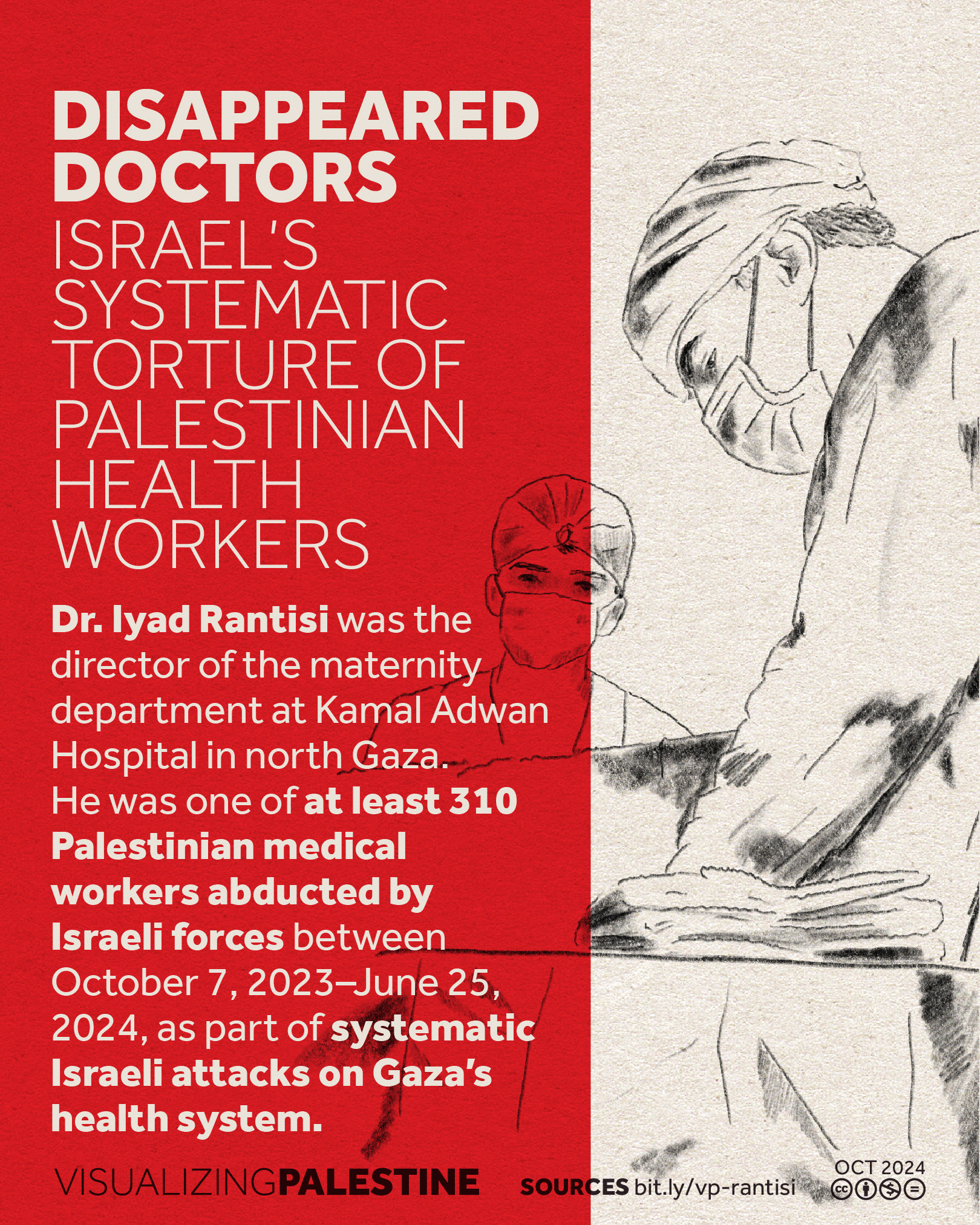
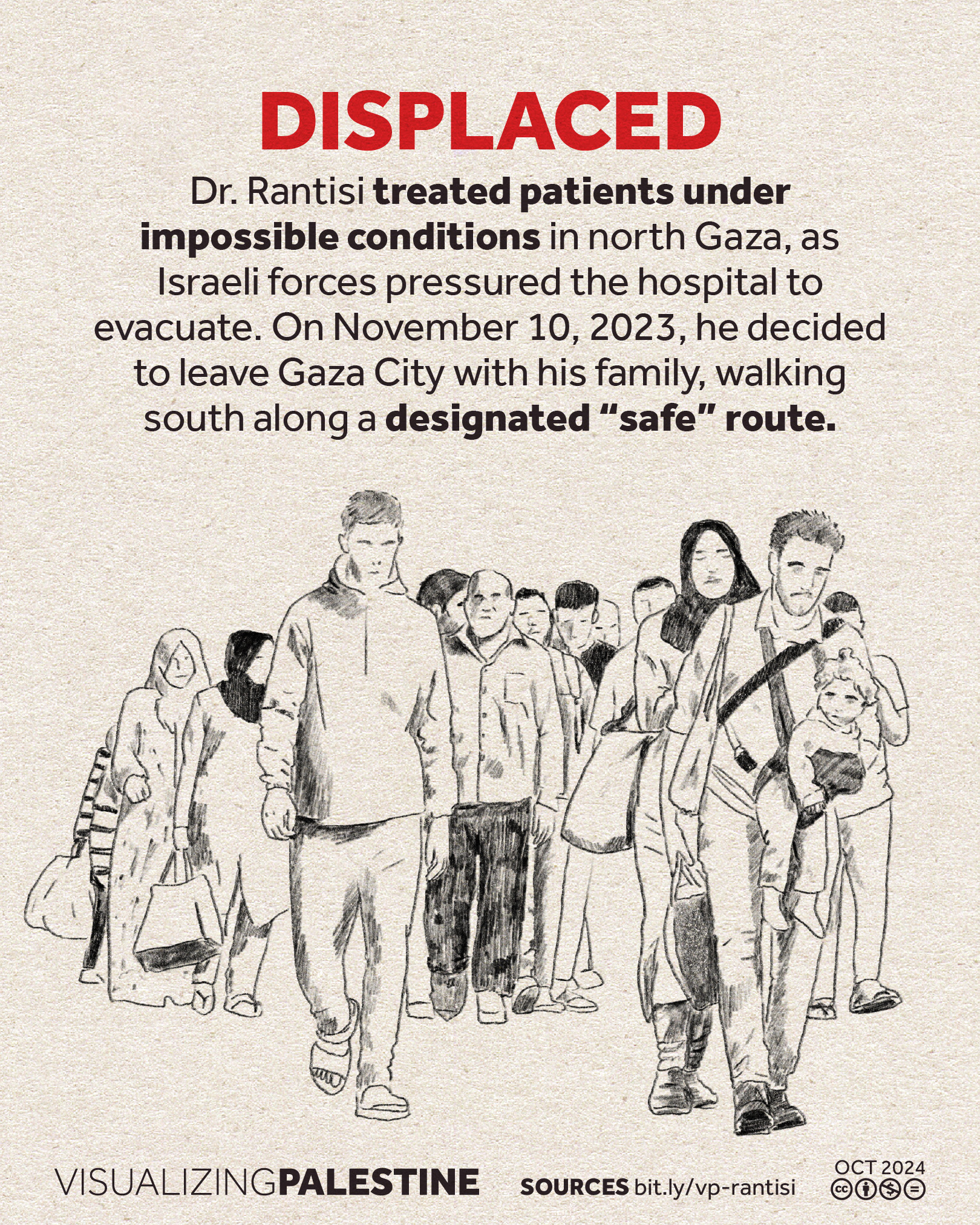
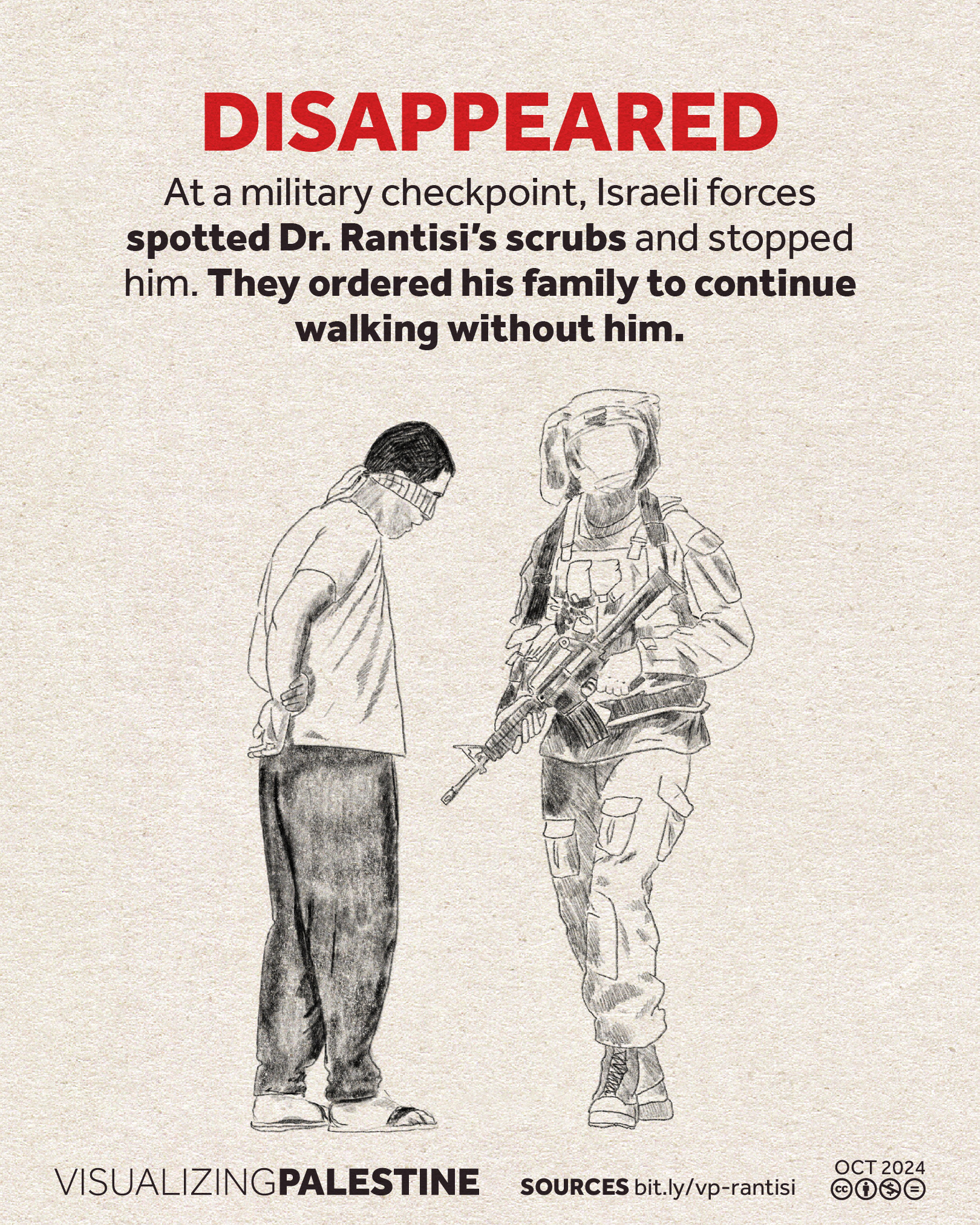
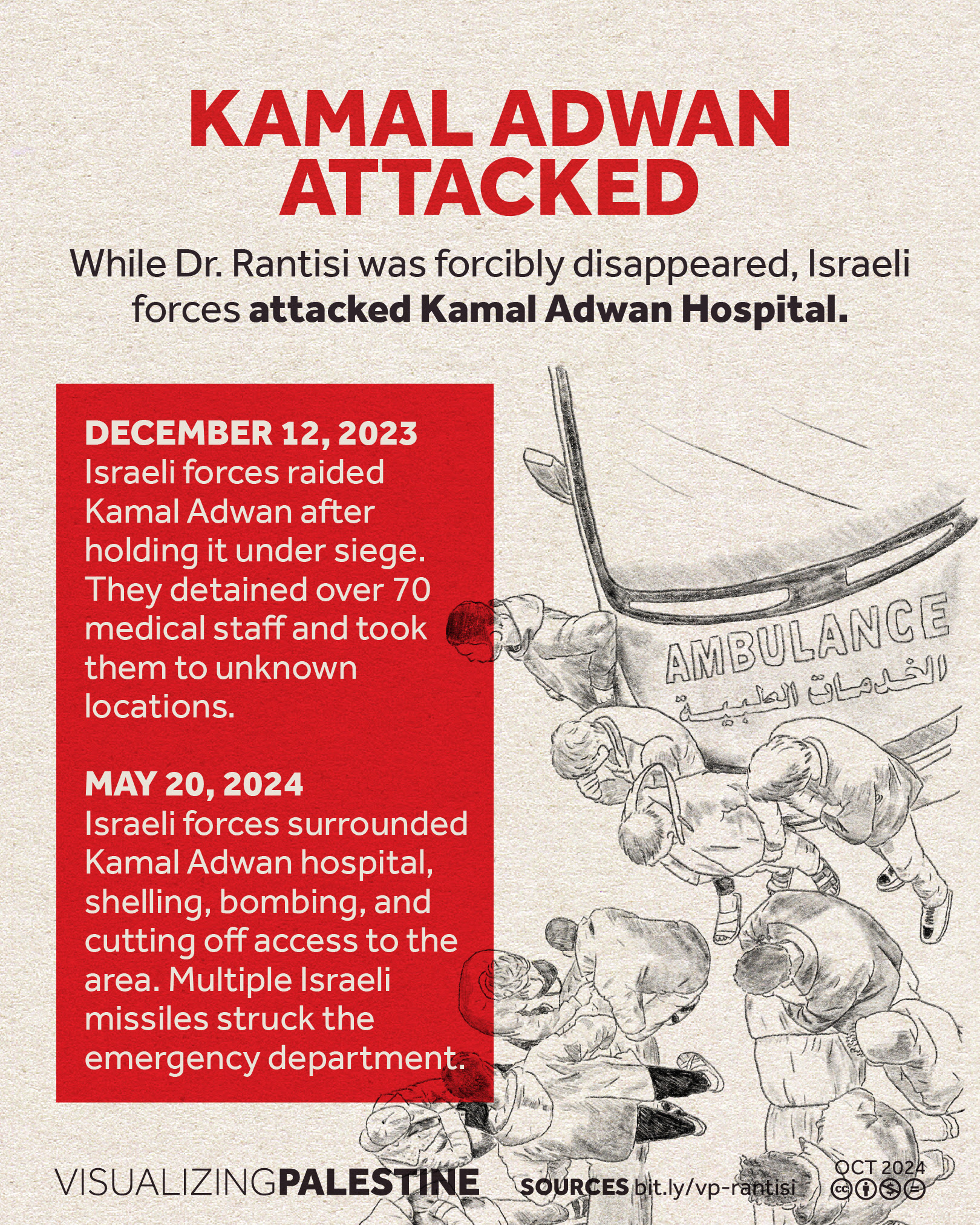
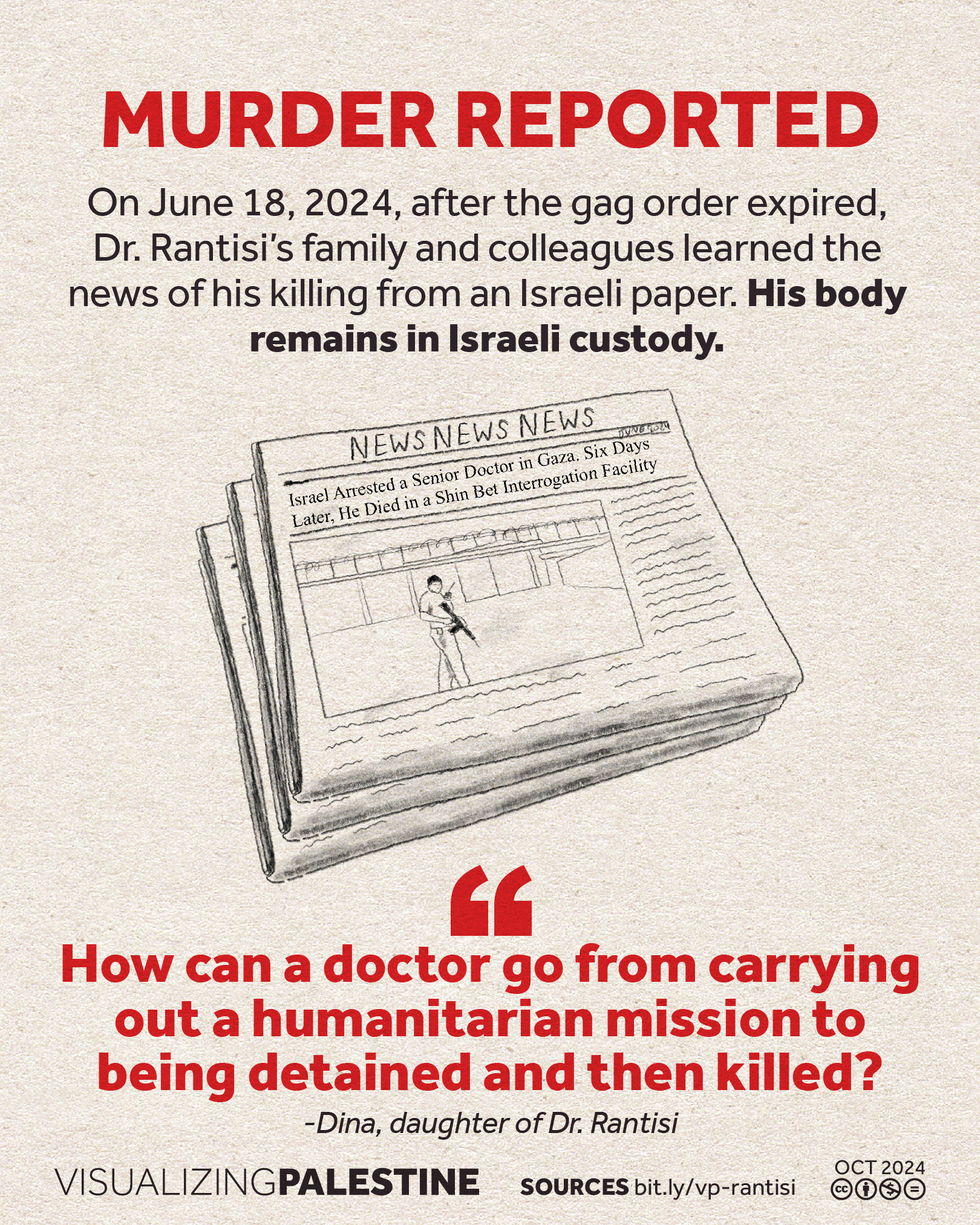
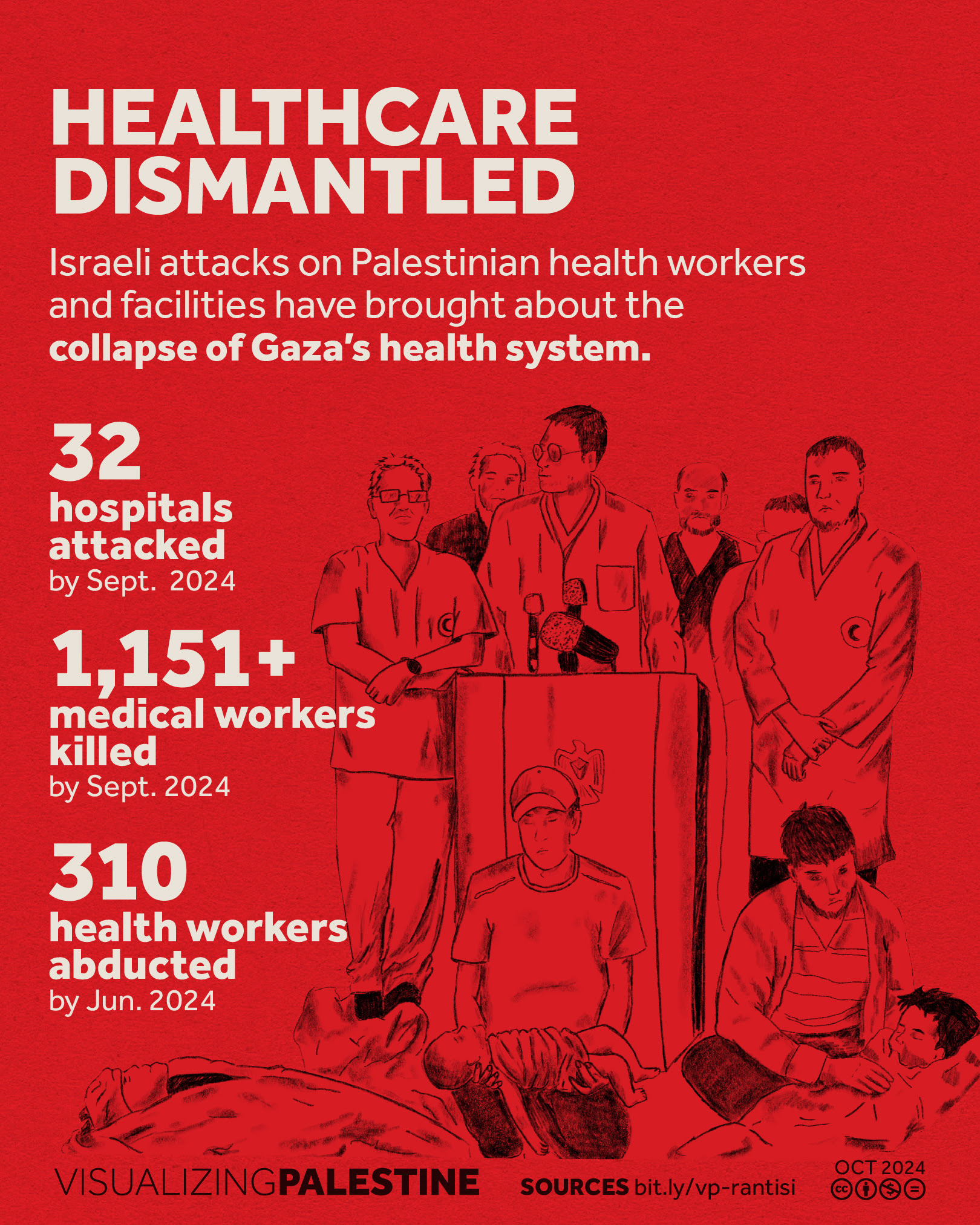
On October 29, 2024, an Israeli airstrike killed 93 Palestinians in Beit Lahia, north Gaza. Those injured in the massacre have no access to medical care, because on October 26, 2024, Israeli forces attacked Kamal Adwan Hospital and abducted 44 of its 70 staff. Our latest visual highlights the continuous targeting of Palestinian healthcare workers and facilities by Israeli forces in Gaza, focusing on the enforced disappearance, torture, and murder of Dr. Iyad Rantisi, the director of the maternity department at Kamal Adwan Hospital.
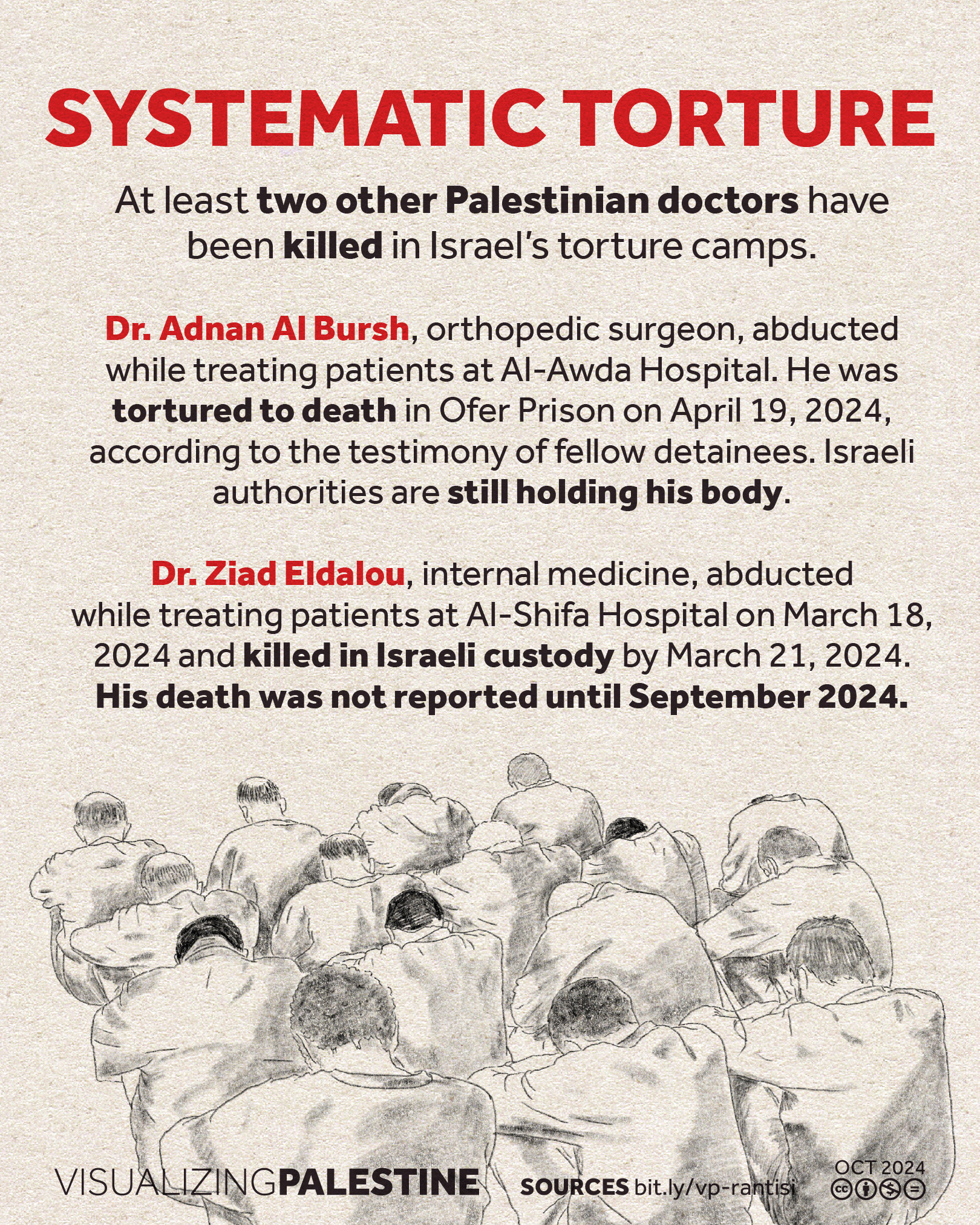
Dr. Rantisi is one of at least three Palestinian doctors murdered in Israeli custody since October 2023. Israeli attacks on hospitals and health workers, which initially shocked and outraged the world in 2023, have now become a constant, routine feature of this genocide. By devastating the health system in Gaza, Israeli forces are “deliberately inflicting on the group conditions of life calculated to bring about its physical destruction in whole or in part,” as described by the genocide convention. In these conditions, those who are not immediately killed by direct violence are more likely to die slowly due to lack of access to medical services, denial of humanitarian aid, mass starvation, untreated traumatic injuries, and disease.
This is the third visual in a series raising awareness about Israel’s practices of mass incommunicado detention and torture of Palestinians. Our first visual illustrates the testimony of Fadi Bakr, a law student from Gaza City, who was captured by Israeli soldiers in early January and spent more than 30 days in Sde Teiman, part of a network of Israeli torture camps. The second visual captures the testimony of Palestinian women from Gaza who were arbitrarily detained and held incommunicado by Israel.
To all the five-year-old children from 1983-1987: I apologize. You thought I was a futuristic barbarian from the Eternian Tribe and that together we were fighting for justice and adventure? I was a marketing ploy for C-Suite brand managers.
Sure, Mattel already had Barbie, but after the colossal success of the Star Wars action figure lines, they demanded to reverse engineer a boy’s toy. As the Masters of the Focus Group, my catchphrase was meticulously crafted. The most commonly argued-over word of little boys? Power. “No, I have the power!” “No, it’s my power.” My cartoon show He-Man and the Masters of the Universe was created solely to sell the toys. And by Grayskull, I did it—becoming one of the highest-grossing pieces of articulated plastic of my decade, at a record peak of $400 million dollars in 1986.
If I had known 30 years later that millions of men would suffer muscle dysmorphia and eating disorders, I would have at least offered to chip in for insurance coverage. Look, it was the steroidal boom of the 1980s, and shrink-wrapped male torsos were selling all kinds of products like vacuum cleaners and Diet Coke. How was I to know that consuming thousands of images of dehydrated muscles would influence impressionable five-year-olds? To all you men who are cutting carbs to maintain your six-pack, then binging on Funfetti Oreo’s, I owe you an apology.
I promised you transformation—from a whiny privileged punk into a proud humble warrior. Except I didn’t really transform. As Prince Adam I clearly had bulging muscles underneath my skin-hugging shirt. So why did I act so cowardly? Even my voice and haircut stayed the same. The only thing that happened when I raised the glowing Sword of Eternia? Some lightning bolts popped my shirt off. That was it. Everything else was the same. You know what I really should have done with the Power Sword? Cut those bangs.
To those little striplings who now do angry, heavy skull-crushers at the YMCA at 9 p.m. on a Friday night thinking they are sculpting their triceps, bettering themselves, transforming themselves—yeah, that was my bad. I created a generation of ruthless shirt poppers that now includes presidential candidates. You were all chasing my Coridite Crystal curated body—but you know that study that if Barbie were a real human, she’d collapse after six steps due to a waist that couldn’t support a liver or bones? Well, if my ultra-muscularity and near zero bodyfat were also real, you’d be constantly cold, tired, hungry, sick, unmotivated, asexual, depressed, and far too weak to go fifteen rounds with Skeletor (because the kind of low lipids [under 5%] associated with peak bodybuilding shape, if prolonged, results in brittle bones and muscle breakdown). Then again, don’t listen to me. Without a normal range of bodyfat (at least 6-11% for elite athletes, or 15-20% for average healthy males), I’m in a perpetual brain fog. Why am I suddenly scaling Snake Mountain right now?
And yes, even Cringer, my fearful feline was forced into my machishmo scam-a-cadabra, becoming Battle-Cat in a fit of ripped mas-cat-linity. So I guess I should apologize to your pets. I assume they too run on a treadmill at the highest incline to work off the two dozen Auntie Anne’s pretzels they binged all night?
For my crimes against traditional masculinity, I offer to throw myself into the Sea of Eternia. Or at least put a shirt on and eat some bread.
Don’t panic. The supermarket doors had just locked while I was standing in the checkout line. “Everyone stay exactly where you are. We have an amber alert for a lost child.”
Head down, act natural, Justin.
Looking down, there was nothing natural about my shopping basket, packed with the most ultra-processed food on the planet. As an American, you can proudly call me the number one consumer of snack foods worldwide (Japan is number two, Canada number six). They say only two-thirds of daily calories for American children and teens come from ultra-processed food. I say we can do 100%! And so what if the latest and largest study of over 10 million people showed that consuming ultra-processed food was associated with 32 health problems, especially heart disease-related deaths, Type 2 diabetes, and common mental health issues like anxiety and depression?
Standing in the checkout line that evening while they searched for a lost kid, I didn’t register any anxiety. Like my childhood hero, He-Man, I had the powerrrrrr . . . to disassociate. Besides, I looked completely trustworthy. I just came from the gym, wearing my hoodie—hood up—and baggy workout pants. At 25 years old, I stood 6’3”, scraggly scruff, vacant furtive eyes, plus my aura of anger.
Pay no attention to my shopping basket loaded with kid-friendly junk food. Because when you’re as numb as I am, one little box of animal crackers won’t soothe the raging belly beast. I had the frilly stuff, like Rice Krispie treats, party-size bags of gummi bears, and Funfetti Oreos. Which by the way, why are there so many flavors of Oreos today? Growing up we had two. I remember the first time I ate double-stuff Oreos. They’re like MDMA crème sandwiches—Oreos make me want to hug you and do more.
I basically had enough sugared treats to dose a small child into a cotton-candy coma and everyone saw it. Even the store manager was coming at me. I dropped my basket to the floor and prepared to scream: “Wait! It’s not me! I’ve been doing paleo and skipping carbs!”
And then the doors unlocked. They found the kid wandering the produce section.
After my exit, I should have been thinking: maybe I have a problem. That night of the amber alert, my food compulsions almost got me on a registry because some kid didn’t know their way around lettuce. Where was my red dye 40 alert? Something to let me know about the link between ultra-processed food and obsessive overeating; or that processed food hooks us through an endless combination of addictive chemical seasonings.
Instead, I threw myself back into the Food Lion’s den to take on their “patisserie” aisle. By the way, South Burlington isn’t Paris, just call it a bakery. You’re a grubby fluorescent chain store peddling chemically-injected corn and soy widgets. Over seventy percent of packaged food options are ultra-processed, containing excessive levels of salt, sugar and fat. Still, I couldn’t resist their latest concoction. Chunky chocolate-chip cookies with rainbow sprinkles, straddling a thick layer of stable cream puff, and each one the size of my sasquatch fist. I must have them all.
A nice, older woman with graying, curled hair delicately packed four in a fancy box. As if two minutes from now I wasn’t going to shred the box, shove that crimped gold ribbon under my car seat, and pop those sprinkled sugar bombs whole like a sad circus pelican. “Oh, your little boys are going to love them,” she winked at me, handing me the box. I must have looked puzzled because she repeated it. “You must have little boys at home waiting for these.”
What the hell was she talking about? No, I didn’t have any children at home. I was just a grown-ass single man who hadn’t done any therapy.
And so I became a Funfetti guerrilla, vanilla frosting smeared under the eyes, deploying Seal Team Six cover strategies.
I was an OB—Original Binger. Before self-checkout kiosks existed, I tried to “Bury the Order,” e.g., buy enough regular but non-perishable groceries like boxes of pasta, dish soap, canned beans, and then strategically mix in all of the real items I required: potato chips, chocolate doughnuts, Pop-Tarts, Cool Ranch Dorito’s, etc.
And yes, I more than once invoked the nuclear cover option. After watching The Big Lebowski, I donned a bathrobe and slippers. Then I shuffled through the sliding doors very un-Dude like. No sunglasses or confident chit-chat. I was a Keebler chameleon. A conveyor belt full of my favorite junk foods and nothing else. Not a single can of concealer beans. My slacked jaw and empty gaze to nowhere, the long trench-coat style fleece bathrobe . . . even the fuzzy slippers. No one looked at me. I felt invisible at last, like I could rob a bank. I mean, in a bathrobe and slippers, so the getaway might be tricky.
Eventually, I survived my processed food addiction through the William Blake method: “You never know what is enough, unless you know what is more than enough.”
If you see me grocery shopping in a tattered bathrobe—it’s okay. I heard Oreo’s is coming out with a new salted caramel ecstasy flavor. After all, progress not perfection.
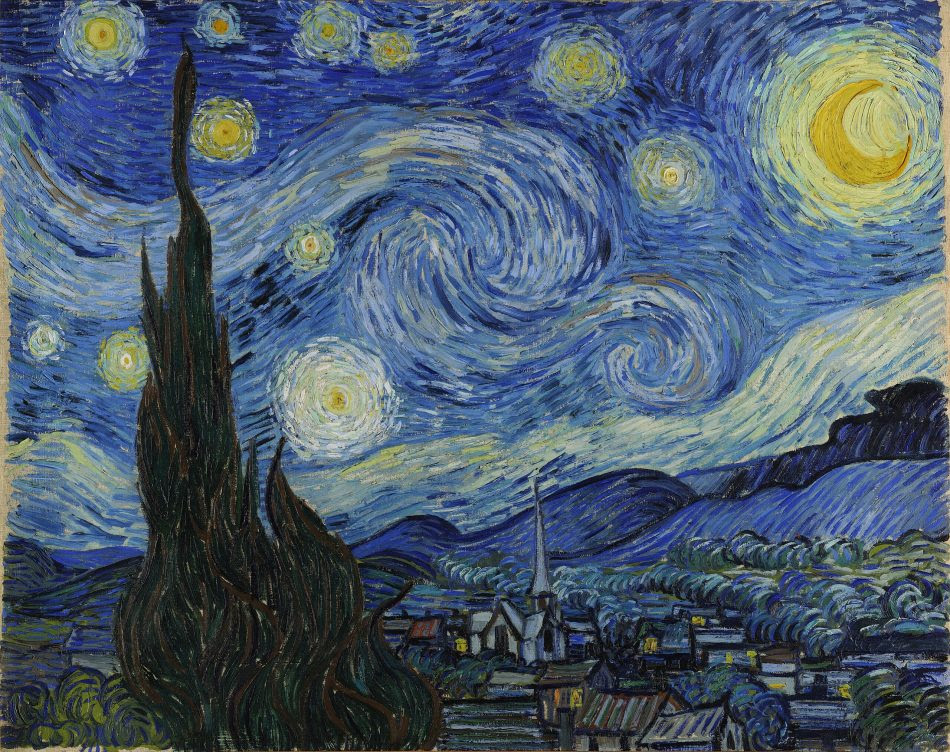
Vincent van Gogh (Netherlands), The Starry Night, 1889.
In 1930, Clément Fraisse (1901–1980), a shepherd from France’s Lozère region, was confined in a nearby psychiatric hospital after he tried to burn down his parents’ farmhouse. For two years, he was held in a dark, narrow cell. Using a spoon, and later the handle of his chamber pot, Fraisse carved symmetrical images into the rough, wooden walls that surrounded him. Despite the inhumane conditions in these psychiatric hospitals, Fraisse made beautiful art in the darkness of his cell. Not far from Lozère is the monastery of Saint Paul de Mausole in Saint-Rémy-de-Provence, where Vincent van Gogh had been confined four decades earlier (1889–1890) and where he completed around 150 paintings, including several important works (among them The Starry Night, 1889).
Ex OPG, Naples (Italy), 2024.
I was thinking about both Fraisse and Van Gogh when I visited the old Ospedale Psichiatrico Giudiziario (OPG) in Naples (Italy) in September for a festival that took place in this former criminal asylum, which once held those who had committed serious offences and were deemed to be insane. The vast building, which sits in the heart of Naples on the Monte di Sant’Eframo, was first a monastery (1573–1859), then a military barrack for the Savoy regime during Italy’s unification in 1861, and then a prison set up by the fascist regime in the 1920s. The prison was closed in 2008, and then, in 2015, occupied by a group of people who would later form the political organisation Potere al Popolo! (Power to the People!). They renamed the building Ex OPG – Je so’ pazzo, ‘ex’ meaning that the building is no longer an asylum, and Je so’ pazzo referring to the favourite song of the beloved local singer Pino Daniele (1955–2015), who died around the time the building was occupied:
I’m crazy. I’m crazy.
The people are waiting for me.
….
I want to live at least one day as a lion. Je so’pazzo, je so’ pazzo. C’ho il popolo che mi aspetta. …. Nella vita voglio vivere almeno un giorno da leone.
Today, the Ex OPG is home to legal and medical clinics, a gym, a theatre, and a bar. It is a place of reflection, a people’s centre that is designed to build community and confront the loneliness and precarity of capitalism. It is a rare kind of institution in our world, one in which an exhausted society is increasingly isolated and individuals, encaged in a prison house of frustrated aspirations, nonetheless hope to use their meagre tools (a spoon, the handle of a chamber pot) to carve out their dreams and to reach for the starry sky.
Anita Rée (Germany), Self-Portrait, 1930.
Rée (1885–1933) killed herself after the Nazis declared her work to be ‘degenerate’.
Even the World Health Organisation (WHO) does not have sufficient data on mental health, largely because the poorer nations are unable to maintain an accurate account of their populations’ immense psychological struggles. As a result, the focus is often limited to the more affluent countries, where such data is collected by governments and where there is greater access to psychiatric care and medications. A recent survey of thirty-one countries (mostly in Europe and North America, but also including some poorer nations such as Brazil, India, and South Africa) shows a shifting attitude and increased concern about mental health. The survey found that 45% of those polled selected mental health as ‘the biggest health problems facing people in [their] country today’, a significant increase from the previous poll, conducted in 2018, in which the figure was 27%. Third in the list of health challenges is stress, with 31% selecting it as the leading cause of concern. There is a significant gender gap in attitudes towards mental health amongst young people, with 55% of young women selecting it as one of their primary health concerns, compared to 37% of young men (reflecting the fact that women are disproportionately impacted by mental health issues).
While it is true that the COVID-19 pandemic heightened mental health problems across the world, this crisis predated the coronavirus. Information from the Global Health Data Exchangeshows that in 2019 – before the pandemic – one in eight, or 970 million, people from around the world had a mental disorder, with 301 million struggling with anxiety and 280 million with depression. These numbers should be seen as an estimate, a minimum picture of the severe crisis of unhappiness and maladjustment to the current social order.
There are range of ailments that go under the name of ‘mental disorder’, from schizophrenia to forms of depression that can result in suicidal ideation. According to the WHO’s 2022 report, one in 200 adults struggle with schizophrenia, which on average results in a ten- to twenty-year reduction in life expectancy. Meanwhile, suicide, the leading cause of death amongst young people globally, is responsible for one in every 100 deaths (bear in mind that only one in every twenty attempts results in a death). We can make new tables, revise our calculations, and write longer reports, but none of this can assuage the profound social neglect that pervades our world.
Adolf Wölfli (Switzerland), General View of the Island Neveranger, 1911.
Wölfli (1864–1930) was abused as a child, sold as an indentured labourer, and then interned in the Waldau Clinic in Bern, where he painted for the rest of his life.
Neglect is not even the correct word. The prevailing attitude to mental disorders is to treat them as biological problems that merely require individualised pharmaceutical care. Even if we were to accept this limited conceptual framework, it still requires governments to support the training of psychiatrists, make medications affordable and accessible for the population, and incorporate mental health treatment into the wider health care system. However, in 2022, the WHO found that, on average, countries spend only 2% of their health care budgets on mental health. The organisation also found that half of the world’s population – mostly in the poorer nations – lives in circumstances where there is one psychiatrist to serve 200,000 or more people. This is the state of affairs as we witness a general decline of health care budgets and of public education about the need for a generous attitude toward mental health problems. The most recent WHO data (December 2023), which covers the spike in pandemic-related health spending, shows that, in 2021, health care spending in most countries was less than 5% of Gross Domestic Product. Meanwhile, in its 2024 reportA World of Debt, the United Nations Conference on Trade and Development (UNCTAD) shows that almost a hundred countries spent more to service their debts than on healthcare. Though these are foreboding statistics, they do not get at the heart of the problem.
Over the course of the past century, the response to mental health disorders has been overwhelmingly individualised, with treatments ranging from various forms of therapy to the prescription of different medications. Part of the failure to deal with the range of mental health crises – from depression to schizophrenia – has been the refusal to accept that these problems are not only influenced by biological factors but can be – and often are – created and exacerbated by social structures. Dr. Joanna Moncrieff, one of the founders of the Critical Psychiatry Network, writes that ‘none of the situations we call mental disorders have been convincingly shown to arise from a biological disease’, or more precisely, ‘from a specific dysfunction of physiological or biochemical processes’. This is not to say that biology does not play a role, but simply that it is not the only factor that should shape our understanding of such disorders.
In his widely read classic The Sane Society (1955), Erich Fromm (1900–1980) built on the insights of Karl Marx to develop a precise reading of the psychological landscape in a capitalist system. His insights are worth re-considering (forgive Fromm’s use of the masculine use of the word ‘man’ and of the pronoun ‘his’ to refer to all of humanity):
Whether or not the individual is healthy is primarily not an individual matter, but depends on the structure of his society. A healthy society furthers man’s capacity to love his fellow men, to work creatively, to develop his reason and objectivity, to have a sense of self which is based on the experience of his own productive powers. An unhealthy society is one which creates mutual hostility, distrust, which transforms man into an instrument of use and exploitation for others, which deprives him of a sense of self, except inasmuch as he submits to others or becomes an automaton. Society can have both functions; it can further man’s healthy development, and it can hinder it; in fact, most societies do both, and the question is only to what degree and in what directions their positive and negative influence is exercised.
Kawanabe Kyōsai (Japan), Famous Mirrors: The Spirit of Japan, 1874.
Kyōsai (1831–1889) was shocked, at the age of nine, when he picked up a corpse and its head fell off. This marked his consciousness and his later break with ukiyo-e traditional painting to inaugurate what is now known as manga.
The antidote to many of our mental health crises must come from re-building society and forming a culture of community rather than a culture of antagonism and toxicity. Imagine if we built cities with more community centres, more places such as Ex OPG – Je so’ pazzo in Naples, more places for young people to gather and build social connections and their personalities and confidence. Imagine if we spent more of our resources to teach people to play music and to organise sports games, to read and write poetry, and to organise socially productive activities in our neighbourhoods. These community centres could house medical clinics, youth programmes, social workers, and therapists. Imagine the festivals that such centres could produce, the music and joy, the dynamism of events such Red Books Day. Imagine the activities – the painting of murals, neighbourhood clean-ups, and planting of gardens – that could emerge as these centres incubate conversations about what kind of world people want to build. In fact, we do not need to imagine any of this: it is already with us in small gestures, whether in Naples or in Delhi, in Johannesburg or in Santiago.
‘Depression is boring, I think’, wrote the poet Anne Sexton (1928–1974). ‘I would do better to make some soup and light up the cave’. So let’s make soup in a community centre, pick up guitars and drumsticks, and dance and dance and dance till that great feeling comes upon everyone to join in healing our broken humanity.
In questions of power then, let no more be heard of confidence in man, but bind him down from mischief by the chains of the Constitution.
—Thomas Jefferson
Public trust in the government to “do what is right” understandably remains at an all-time low.
After all, how do you trust a government that continuously sidesteps the Constitution and undermines our rights? You can’t.
When you consider all the ways “we the people” are being bullied, beaten, bamboozled, targeted, tracked, repressed, robbed, impoverished, imprisoned and killed by the government, one can only conclude that you shouldn’t trust the government with your privacy, your property, your life, or your freedoms.
Consider for yourself.
Don’t trust the government with your privacy, digital or otherwise. In the more than two decades since 9/11, the military-security industrial complex has operated under a permanent state of emergency that, in turn, has given rise to a digital prison that grows more confining and inescapable by the day. Wall-to wall surveillance, monitored by AI software and fed to a growing network of fusion centers, render the twin concepts of privacy and anonymity almost void. By conspiring with corporations, the Department of Homeland Security “fueled a massive influx of money into surveillance and policing in our cities, under a banner of emergency response and counterterrorism.”
Don’t trust the government with your property. If government agents can invade your home, break down your doors, kill your dog, damage your furnishings and terrorize your family, your property is no longer private and secure—it belongs to the government. Hard-working Americans are having their bank accounts, homes, cars electronics and cash seized by police under the assumption that they have allegedly been associated with some criminal scheme.
Don’t trust the government with your finances. The U.S. government—and that includes the current administration—is spending money it doesn’t have on programs it can’t afford, and “we the taxpayers” are being forced to foot the bill for the government’s fiscal insanity. The national debt is $35 trillion and growing, yet there seems to be no end in sight when it comes to the government’s fiscal insanity. According to Forbes, Congress has raised, extended or revised the definition of the debt limit 78 times since 1960 in order to allow the government to essentially fund its existence with a credit card.
Don’t trust the government with your health. For all intents and purposes, “we the people” have become lab rats in the government’s secret experiments, which include MKULTRA and the U.S. military’s secret race-based testing of mustard gas on more than 60,000 enlisted men. Indeed, you don’t have to dig very deep or go very back in the nation’s history to uncover numerous cases in which the government deliberately conducted secret experiments on an unsuspecting populace—citizens and noncitizens alike—making healthy people sick by spraying them with chemicals, injecting them with infectious diseases and exposing them to airborne toxins. Unfortunately, the public has become so easily distracted by the political spectacle out of Washington, DC, that they are altogether oblivious to the grisly experiments, barbaric behavior and inhumane conditions that have become synonymous with the U.S. government, which has meted out untold horrors against humans and animals alike.
Don’t trust the government with your life: At a time when growing numbers of unarmed people have been shot and killed for just standing a certain way, or moving a certain way, or holding something—anything—that police could misinterpret to be a gun, or igniting some trigger-centric fear in a police officer’s mind that has nothing to do with an actual threat to their safety, even the most benign encounters with police can have fatal consequences. The number of Americans killed by police continues to grow, with the majority of those killed as a result of police encounters having been suspected of a non-violent offense or no crime at all, or during a traffic violation. According a report by Mapping Police Violence, police killed more people in 2022 than any other year within the past decade. In 98% of those killings, police were not charged with a crime.
Don’t trust the government with your freedoms. For years now, the government has been playing a cat-and-mouse game with the American people, letting us enjoy just enough freedom to think we are free but not enough to actually allow us to live as a free people. Freedom no longer means what it once did. This holds true whether you’re talking about the right to criticize the government in word or deed, the right to be free from government surveillance, the right to not have your person or your property subjected to warrantless searches by government agents, the right to due process, the right to be safe from militarized police invading your home, the right to be innocent until proven guilty and every other right that once reinforced the founders’ belief that this would be “a government of the people, by the people and for the people.” On paper, we may be technically free, but in reality, we are only as free as a government official may allow.
Whatever else it may be—a danger, a menace, a threat—the U.S. government is certainly not looking out for our best interests, nor is it in any way a friend to freedom.
Remember the purpose of a good government is to protect the lives and liberties of its people.
Unfortunately, what we have been saddled with is, in almost every regard, the exact opposite of an institution dedicated to protecting the lives and liberties of its people.
“We the people” should have learned early on that a government that repeatedly lies, cheats, steals, spies, kills, maims, enslaves, breaks the laws, overreaches its authority, and abuses its power at almost every turn can’t be trusted.
So what’s the answer?
For starters, get back to basics. Get to know your neighbors, your community, and your local officials. This is the first line of defense when it comes to securing your base: fortifying your immediate lines.
Second, understand your rights. Know how your local government is structured. Who serves on your city council and school boards? Who runs your local jail: has it been coopted by private contractors? What recourse does the community have to voice concerns about local problems or disagree with decisions by government officials?
Third, know the people you’re entrusting with your local government. Are your police chiefs being promoted from within your community? Are your locally elected officials accessible and, equally important, are they open to what you have to say? Who runs your local media? Does your newspaper report on local events? Who are your judges? Are their judgments fair and impartial? How are prisoners being treated in your local jails?
Finally, don’t get so trusting and comfortable that you stop doing the hard work of holding your government accountable. We’ve drifted a long way from the local government structures that provided the basis for freedom described by Alexis de Tocqueville in Democracy in America, but we are not so far gone that we can’t reclaim some of its vital components.
Local government is fundamental not so much because it’s a “laboratory” of democracy but because it’s a school of democracy. Through such accountable and democratic government, Americans learn to be democratic citizens. They learn to be involved in the common good. They learn to take charge of their own affairs, as a community. Tocqueville writes that it’s because of local democracy that Americans can make state and Federal democracy work—by learning, in their bones, to expect and demand accountability from public officials and to be involved in public issues.
To put it another way, think nationally but act locally.
As I make clear in my book Battlefield America: The War on the American People and in its fictional counterpart The Erik Blair Diaries, there is still a lot Americans can do to topple the police state tyrants, but any revolution that has any hope of succeeding needs to be prepared to reform the system from the bottom up. And that will mean re-learning step by painful step what it actually means to be a government of the people, by the people and for the people.
Alaa Jamal’s pain and suffering is wound so tightly around her heart that it shields it from all the horrors she’s lived through. So even though she’s in the crosshairs of Netanyahu’s hatred’s sights, her heart beats unceasingly, in defiance of what the Occupation has done to her. Otherwise, she wouldn’t be able to keep the remnants of her family alive: a one year old son named Eid and a three year old daughter named Sanaa. Alaa calls her daughter Princess, an apt nickname for Alaa’s life has always been a fairytale, just one punctuated by war every two to four years. Birth, war. School, war. Adolescence, war. Friendship, war. Family, war. University, war.
Then, when she was eighteen, Mohammed came, and Alaa forgot about the wars. Instead, she says, “A great love story arose.” Handsome, smart, and strong, Alaa knew they were meant for each other. He was a civil engineer, and she, a future architect. He proposed on Eid-al-Adha, the Feast of Sacrifice. Alaa’s parents agreed, and the lovebirds married. In photographs they’re the quintessential couple. He’s sharp in casual clothes, she’s dazzling demure in repose.
“I was so happy dressed in white,” she says, reminiscing about her wedding.
And for a moment, I could see Alaa, smiling with the groom in the midst of her fairytale. Two children later, it would end. Now, the only white garments worn in Gaza are shrouds for the dead.
When the war began, Alaa was at the hospital with her infant son. Eid had been born with an enlarged heart and needed close supervision whenever he was ill. Now, Alaa found herself trapped with him, as fighting raged on all around her. Israeli soldiers raided the hospital and dragged people out of their beds to kidnap or kill. Terrified, Alaa grabbed her son, ripped out the IV in his arm and ran out the back of the hospital, covered in his blood.
Alaa ran all the way home, but when she arrived, things got worse. The neighborhood children were playing in the street in front of her house. A missile landed on the next block, and a large piece of shrapnel was sent reeling from the resulting explosion towards the children, decapitating Mohammed’s 12-year-old cousin Badr as Alaa watched. Mohammed’s father was next.
Alaa was still in shock when the Israelis dropped leaflets ordering them to go south. She left first, taking the children. Mohammed was supposed to follow a few days later. In the meantime, their neighborhood was destroyed one block at a time. Dozens of Alaa’s friends and relativesweremartyred—wedded to the land they loved in the ultimate sacrifice. Day-by-day, hour-by-hour, with each new message, Alaa learned of their deaths. And it was there, among the hordes of refugees walking south along the sea of Gaza, that Alaa’s fairytale life finally came to an end:
“My brother Bahaa was volunteering to drive refugees trapped in the fighting to safety. Mohammed was with him, when the Occupation shot up the car they were in. My brother was wounded, and Mohammed tried to drag him to safety. That’s when they shot my husband in the face. Somebody called an ambulance, but the Israeli soldiers wouldn’t let the paramedics through. They bled out for charity.”
Alaa began to weep.
“The Occupiers refused to let anyone collect the bodies for burial. My beloved husband and brother became food for stray dogs and crows.”
Alaa didn’t have time to properly mourn. Even after reuniting with her remaining relatives, things continued to get worse. As the days and weeks rolled by, they faced a lack of clean water, food and medical care. Winter came, and they had nothing to keep them warm. Everyone was malnourished and sick.
Eid and Sanaa went to the hospital to get treated for starvation with a nutrient IV drip. The elderly had no such luck. Three different times Alaa woke up on a cold morning to find one of her aunts dead. Their bodies simply couldn’t produce enough heat with so little food to eat. I wondered about her own health.
“How much weight have you lost since October 7th?” I asked.
“Thirty pounds,” she said.
I wanted to know more, but Alaa steered the conversation back to her children.
“My daughter Sanaa lost her ability to speak after her father died. She was in shock, depressed, and fell seriously ill. I tried to comfort her. Then one day she began to sing: ‘When I die, I will go to Heaven to be with my father.’”
Sanaa’s understanding of the afterlife allowed her to be a child again.
By April, when I met Alaa, the food situation had improved. But in May, Sanaa contracted hepatitis C and wouldn’t eat. The hospital fed her through another IV. In June, Eid got a bacterial skin infection on his face. Day-by-day I watched it spread in photographs Alaa sent me. The hospital in Deir al-Balah wanted one hundred dollars for the medication. One hundred more than what was reasonable. I used my connections in Gaza to get a charity to pay for it. But Alaa wouldn’t leave her children alone to retrieve the medicine. She was afraid she’d come back to find them dead. Her father went instead. Just in time too, because the skin on Eid’s face began to rot as it decayed. With all his other health issues, it could have been the end of him.
Eventually, Alaa realized that she needed to make a future for her children. She began to study online to finish her degree. She’s already started on her senior project: designing a rehabilitative mental health center for healing from PTSD. She wants to build it as soon as the war stops. It’s part of her overall plan: “I want to make Gaza beautiful again.”
In the meantime, she’s desperately trying to raise money to buy a tent. It’s crowded and unstable the way she lives, always shuffling around between her remaining relatives. Whenever I try to get a charity to help her, she asks if she can work for them. How can she simultaneously work, mourn, study, raise children and survive? Her life is one of incomprehensible contradictions.
“I hope God will compensate Alaa for her loss,” one of her relatives told me.
I concur, if things go well. If they don’t, Alaa tells me what will happen next: “I am an ambitious person, and I love life very much. But I know that one day my blood, and the blood of my children, will water this land.”
WHO Director-General Dr Tedros Adhanom Ghebreyesus has determined that the upsurge of mpox in the Democratic Republic of the Congo (DRC) and a growing number of countries in Africa constitutes a public health emergency of international concern (PHEIC) under the International Health Regulations (2005) (IHR).
On July 23, 2022, the WHO Director General Tedros Adhanom Ghebreyesus went against the majority vote of the WHO expert committee (9 against 6 in favor): The committee was AGAINST the calling of a Public Health Emergency of International Concern (PEIC).
During his four years as President of the United States, Donald Trump was remarkably active and often successful in sabotaging the health and safety of the nation’s workers.
Trump, as the AFL-CIO noted, targeted Medicare and Medicaid for $1 trillion in funding cuts, eroded the Affordable Care Act (thereby increasing the number of Americans lacking health insurance coverage by 7 million), and “made workplaces more dangerous by rolling back critical federal safety regulations.” Trump’s administration not only refused to publicly disclose fatality and injury data reported to the U.S. Occupational Safety and Health Administration (OSHA), but slashed the number of federal workplace safety inspectors and inspections to the lowest level in that agency’s 48-year history. According to one estimate, with these depleted numbers, it would take 165 years to inspect every worksite in the United States.
Furthermore, the administration repealed rules requiring employers to keep and report accurate injury records, proposed eliminating the U.S. Chemical Safety Board, and cut workplace safety research and training programs. The Trump administration also proposed revoking child labor protections, weakened the Mine Safety and Health Administration’s enforcement of mine safety, and reversed a ban on chlorpyrifos, a toxic pesticide that causes acute reactions among farmworkers and neurological damage to children.
In April 2019, the Trump Department of Agriculture’s Food Safety and Inspection Service put into place a rule to allow an unlimited increase in the line speeds for hog slaughter. In an industry already notorious for endangering workers―with more than 4,700 occupational injuries and more than 2,700 occupational illnesses per year―this was a sure-fire recipe for undercutting worker safety. Even so, the Trump administration completely ignored the impact on workers’ safety and health before issuing the rule.
Downplaying workplace hazards, the administration scrapped new rules on styrene, combustible dust, infectious diseases, and silica dust―a mineral that can cause silicosis, an incurable and often fatal lung disease carrying an increased risk of lung cancer. Eager to reduce business expenditures, it also canceled a requirement for training shipyard and construction workers to avoid exposure to beryllium, a known carcinogen. In addition, the administration delayed and proposed a rollback of the Environmental Protection Agency’s chemical risk management rule, thus increasing health dangers for workers, the public, and first responders.
The Trump administration’s callous disregard for the health and safety of workers became particularly apparent during 2020, as the coronavirus pandemic swept through American workplaces. Trump refused to issue binding rules requiring businesses to institute safety measures to protect nurses, bus drivers, meatpacking and poultry workers, and other particularly vulnerable workers. Quite the contrary, in April 2020 Trump issued an executive order to require the nation’s meat production plants to stay open. This fact, plus an April 2020 authorization by Trump’s Department of Agriculture for 15 large poultry plants to increase their line speed, led by September to the sickness of more than 40,000 meat and poultry workers and to the deaths of hundreds.
Other groups of workers were also hard-hit by the absence of key Trump administration health and safety measures during the pandemic, including its failure to use the Defense Production Act to expand production of personal protective equipment for endangered workers. According to National Nurses United, by September 2020 more than 250,000 health care workers had come down with the Covid-19 virus and at least 1,700 of them had died from it. In addition, according to Purdue University’s Food and Agriculture Vulnerability Index, 147,000 agricultural workers had contracted Covid.
By that fall, although more than a thousand meatpacking, food-processing, and farming facilities had reported cases of Covid-19, Trump’s OSHA had managed to cite only two of them for violations of health and safety regulations. JBS (the biggest meat-processing company in the world, with annual revenues of over $51 billion) was ordered to pay a fine of just $15,615, while Smithfield (owned by the WH Group, the largest pork company in the world, with more than $25 billion in annual revenue) was ordered to pay only $13,494 (about $10 per worker sick with Covid). Both companies refused to pay the fines. Meanwhile, Trump’s OSHA remained ineffective and rudderless, with an acting director yet to be named.
Even in the ostensibly “good” years before the onset of the pandemic, the absence of adequate health and safety measures contributed to an appalling number of work-related deaths in the United States. According to the U.S. Bureau of Labor Statistics, the annual number of worker deaths on the job rose between 2016 (the last year of the Obama administration) and 2019 (the last pre-Covid year of the Trump administration) to 5,333. In addition, an estimated 95,000 American workers died in 2019 from occupational diseases.
Moreover, occupational deaths during the Trump era were dwarfed by occupational injuries and illnesses. As the AFL-CIO reported: “In 2019, nearly 3.5 million workers across all industries, including state and local government, had work-related injuries and illnesses that were reported by employers.” Furthermore, added the union federation, “due to limitations in the current injury reporting system and widespread underreporting of workplace injuries, this number understates the problem. The true toll is estimated to be two to three times greater—or 7.0 million to 10.5 million injuries and illnesses a year.”
The grim fate of millions of American workers―crushed by dangerous machinery, riddled with carcinogenic chemicals, or gasping their last breaths with Covid-19―apparently did not matter enough to Donald Trump, as President, to safeguard their health and safety. But it might be of greater concern to Americans when they go to the polls this November.
During his four years as President of the United States, Donald Trump was remarkably active and often successful in sabotaging the health and safety of the nation’s workers.
Trump, as the AFL-CIO noted, targeted Medicare and Medicaid for $1 trillion in funding cuts, eroded the Affordable Care Act (thereby increasing the number of Americans lacking health insurance coverage by 7 million), and “made workplaces more dangerous by rolling back critical federal safety regulations.” Trump’s administration not only refused to publicly disclose fatality and injury data reported to the U.S. Occupational Safety and Health Administration (OSHA), but slashed the number of federal workplace safety inspectors and inspections to the lowest level in that agency’s 48-year history. According to one estimate, with these depleted numbers, it would take 165 years to inspect every worksite in the United States.
Furthermore, the administration repealed rules requiring employers to keep and report accurate injury records, proposed eliminating the U.S. Chemical Safety Board, and cut workplace safety research and training programs. The Trump administration also proposed revoking child labor protections, weakened the Mine Safety and Health Administration’s enforcement of mine safety, and reversed a ban on chlorpyrifos, a toxic pesticide that causes acute reactions among farmworkers and neurological damage to children.
In April 2019, the Trump Department of Agriculture’s Food Safety and Inspection Service put into place a rule to allow an unlimited increase in the line speeds for hog slaughter. In an industry already notorious for endangering workers―with more than 4,700 occupational injuries and more than 2,700 occupational illnesses per year―this was a sure-fire recipe for undercutting worker safety. Even so, the Trump administration completely ignored the impact on workers’ safety and health before issuing the rule.
Downplaying workplace hazards, the administration scrapped new rules on styrene, combustible dust, infectious diseases, and silica dust―a mineral that can cause silicosis, an incurable and often fatal lung disease carrying an increased risk of lung cancer. Eager to reduce business expenditures, it also canceled a requirement for training shipyard and construction workers to avoid exposure to beryllium, a known carcinogen. In addition, the administration delayed and proposed a rollback of the Environmental Protection Agency’s chemical risk management rule, thus increasing health dangers for workers, the public, and first responders.
The Trump administration’s callous disregard for the health and safety of workers became particularly apparent during 2020, as the coronavirus pandemic swept through American workplaces. Trump refused to issue binding rules requiring businesses to institute safety measures to protect nurses, bus drivers, meatpacking and poultry workers, and other particularly vulnerable workers. Quite the contrary, in April 2020 Trump issued an executive order to require the nation’s meat production plants to stay open. This fact, plus an April 2020 authorization by Trump’s Department of Agriculture for 15 large poultry plants to increase their line speed, led by September to the sickness of more than 40,000 meat and poultry workers and to the deaths of hundreds.
Other groups of workers were also hard-hit by the absence of key Trump administration health and safety measures during the pandemic, including its failure to use the Defense Production Act to expand production of personal protective equipment for endangered workers. According to National Nurses United, by September 2020 more than 250,000 health care workers had come down with the Covid-19 virus and at least 1,700 of them had died from it. In addition, according to Purdue University’s Food and Agriculture Vulnerability Index, 147,000 agricultural workers had contracted Covid.
By that fall, although more than a thousand meatpacking, food-processing, and farming facilities had reported cases of Covid-19, Trump’s OSHA had managed to cite only two of them for violations of health and safety regulations. JBS (the biggest meat-processing company in the world, with annual revenues of over $51 billion) was ordered to pay a fine of just $15,615, while Smithfield (owned by the WH Group, the largest pork company in the world, with more than $25 billion in annual revenue) was ordered to pay only $13,494 (about $10 per worker sick with Covid). Both companies refused to pay the fines. Meanwhile, Trump’s OSHA remained ineffective and rudderless, with an acting director yet to be named.
Even in the ostensibly “good” years before the onset of the pandemic, the absence of adequate health and safety measures contributed to an appalling number of work-related deaths in the United States. According to the U.S. Bureau of Labor Statistics, the annual number of worker deaths on the job rose between 2016 (the last year of the Obama administration) and 2019 (the last pre-Covid year of the Trump administration) to 5,333. In addition, an estimated 95,000 American workers died in 2019 from occupational diseases.
Moreover, occupational deaths during the Trump era were dwarfed by occupational injuries and illnesses. As the AFL-CIO reported: “In 2019, nearly 3.5 million workers across all industries, including state and local government, had work-related injuries and illnesses that were reported by employers.” Furthermore, added the union federation, “due to limitations in the current injury reporting system and widespread underreporting of workplace injuries, this number understates the problem. The true toll is estimated to be two to three times greater—or 7.0 million to 10.5 million injuries and illnesses a year.”
The grim fate of millions of American workers―crushed by dangerous machinery, riddled with carcinogenic chemicals, or gasping their last breaths with Covid-19―apparently did not matter enough to Donald Trump, as President, to safeguard their health and safety. But it might be of greater concern to Americans when they go to the polls this November.
Jeffrey Sachs joins The Grayzone’s Max Blumenthal and Aaron Maté to discuss the investigation into the origins of Covid-19. As chair of the Lancet COVID-19 commission, Sachs alleges that SARS-CoV2 originated from dangerous gain of function experiments sponsored and conducted by US biotech institutions. He alleges a vast cover-up of Covid origins, including by former members of his commission, and details the personal attacks he has incurred for speaking out.
Ismail Haniyeh during a video statement marking the 34th anniversary of the founding of the Hamas movement, December 2021. (Hamas Chief Office)
Hamas announced early Wednesday that Ismail Haniyeh, the head of the Palestinian faction’s political wing, was assassinated in Tehran, where he was present for the inauguration of the new Iranian president.
The assassination, in Iran no less, marks a major escalation that will likely have regional ramifications and came hours after Israel bombed Lebanon on Tuesday evening, killing three civilians, according to Lebanese state media. Israel claimed that it killed a senior Hizballah figure in the strike, but the Lebanese resistance group had not issued a statement on the matter at the time of publication.
Israel killed multiple members representing multiple generations of Haniyeh’s family in Gaza since October. Several leaders of Hamas have been assassinated by Israel before Haniyeh, only to be replaced and for the organization’s capabilities to grow.
In January, Saleh al-Arouri, the deputy head of Hamas’ politburo, was killed in a strike in Beirut along with several other cadres and commanders with the group.
Two weeks ago, Israel claimed to have killed Muhammad Deif, the secretive head of Hamas’ armed wing, in a strike in Gaza that killed at least 90 Palestinians in an area it had unilaterally declared as a humanitarian zone.
Israel continued to wage attacks across Gaza by air, land and sea amid heavy fighting and ground incursions on Tuesday.
The Palestinian health ministry in Gaza said on Tuesday that 37 people had been killed in Israeli attacks over the past 24 hours, bringing the death toll to 39,400 since early October.
The actual number of fatalities is likely much higher, with thousands of people missing under the rubble or their bodies not yet recovered from Gaza’s streets.
The Israeli military withdrew from eastern Khan Younis, the largest city in southern Gaza, on Tuesday following an incursion lasting eight days and forcing another wave of mass displacement from the area.
Palestinians returned to Khan Younis to find evidence of what the government media office in Gaza described as “horrific massacres” for which it demanded international accountability.
“Palestinian rescue workers and civilians collected dead bodies from the streets of the abandoned battle zone, bringing corpses wrapped in rugs to morgues in cars and donkey carts,” Reuters reported.
The government media office said that the bodies of 255 people had been recovered and more than 30 others were missing.
During the incursion, the Israeli military fired on 31 homes with their residents inside, as well as more than 300 other homes and residential buildings.
The military also razed the cemetery in Bani Suheila and its surroundings on the eastern outskirts of Khan Younis:
Israel meanwhile issued new forced displacement orders in al-Bureij, central Gaza, “launching strikes there in apparent preparation for a new raid,” according to Reuters.
“Medics said an Israeli air strike in nearby al-Nuseirat killed 10 Palestinians as they fled from Bureij on Tuesday, and another strike killed four other Palestinians inside Bureij,” the news agency added.
More than 85 percent of the territory of Gaza is under an Israeli so-called evacuation order, the UN agency for Palestine refugees (UNRWA) said on Monday.
But there is no safe place for people to go, and no assurance of protection for civilians who choose to stay or are unable to evacuate from designated areas.
Repeated displacement is also making it increasingly difficult for organizations, already contending with Israel’s near-total blockade, to provide aid and services to those who were forced to leave their homes with next to nothing.
Palestinians return to eastern Khan Younis, southern Gaza Strip, after Israeli forces pulled out on 30 July (Omar AshtawyAPA images)
The Palestinian health ministry in Gaza said that it was no longer able to restore the functionality of the Gaza European Hospital in Khan Younis after an Israeli evacuation order was issued on 27 July.
The Palestinian Civil Defense warned that overcrowding among displaced people in Gaza, who have insufficient access to water and sanitation, was leading to the proliferation of diseases, including conditions affecting children’s skin.
By early July, the World Health Organization had recorded nearly a million cases of acute respiratory infection, while other illnesses such as diarrhea, acute jaundice and cases of suspected mumps and meningitis, as well as scabies and lice, skin rashes and chicken pox are spreading among the population.
The UN health agency said on Tuesday that it was very likely that polio has infected Palestinians in Gaza after the health ministry in the territory declared a polio epidemic across the coastal enclave on Monday.
Detection of the virus in sewage samples collected in Gaza represents “a setback” against efforts to completely eradicate the disease worldwide, Christian Lindmeier, a World Health Organization official, said on Tuesday.
Al Mezan, a Palestinian human rights group based in Gaza, warned that more than one million children in the territory “are at risk of dying if not vaccinated” for the highly infectious virus.
“To prevent thousands of deaths, the international community must ensure Israel immediately ends its genocide, including the weaponization of water and sanitation facilities,” the rights group added.
According to WHO, the disease mainly affects children under the age of 5 and one in 200 infections “leads to irreversible paralysis.” Five to 10 percent of those paralyzed die “when their breathing muscles become immobilized.”
Collapse of essential systems
With the collapse of Gaza’s solid waste management system, conditions are ripe for the disastrous spread of diseases transmitted through contamination such as polio and hepatitis A – there have been 40,000 diagnosed cases of the latter since October.
Israel’s military campaign in Gaza has seen a drop in polio vaccination rates in Gaza from 99 percent to 89 percent, according to a UNICEF spokesperson. The director of the World Health Organization announced that it was sending more than a million polio vaccines to Gaza to be administered to children “in the coming weeks,” UN Newsreported.
The virus, “transmitted by person-to-person spread mainly through the fecal-oral route,” according to WHO, is less frequently transmitted through contaminated water or food.
The “can emerge in areas where poor vaccination coverage allows the weakened form of the orally taken vaccine virus strain to mutate into a stronger version,” UN News added.
The vaccine-derived poliovirus type 2 “had been identified at six locations in sewage samples collected last month from Khan Younis and Deir al-Balah – two Gaza cities left in ruins by nearly 10 months of intense Israeli bombardment.”
The spread of disease and epidemics is a predictable result of Israel’s genocidal military campaign, if not the intention.
In yet another case of Israeli soldiers destroying civilian infrastructure for no military purpose, soldiers recently recorded themselves detonating Canada well, the main water facility in Rafah, southern Gaza.
The Tel Aviv daily Haaretzreported on Monday that the facility “was destroyed last week with the approval of the commander of the soldiers … but without the approval of senior officers.”
But blaming lower-ranking soldiers may be an attempt to deter international courts scrutiny of more senior military personnel, while the pattern of behavior on the ground indicates that troops are ordered to destroy essential civilian infrastructure for no military purpose – a war crime.
Destroying water treatment plants is a war crime in its own right. Doing so in full knowledge that it will contribute to the spread of polio is evidence of genocidal intent. https://t.co/38PkBD4043
Younis Tirawi, writing for Dropsite News, recounted that Giora Eiland, an adviser to Israel’s defense minister Yoav Gallant, described in October a strategy to destroy the ability of Palestinians in Gaza to pump and purify water within Gaza.
Monther Shoblak, the head of the water utility in Gaza, told Tirawi that the Canada well facility had remained functional until Israel’s ground invasion of Rafah in early May, as solar panels allowed it to operate despite Israel cutting off the supply of electricity to the territory in October.
Israel destroyed 30 water wells in the south this month alone, and displaced people have been forced to shelter in overcrowded conditions without suitable hygiene infrastructure or access to sufficient clean water, fuel, food and medicine.
The international charity Oxfam said earlier this month that “Israel damaged or destroyed five water and sanitation sites every three days since the start of this war,” reducing the amount of water available in Gaza by 94 percent to a mere 4.74 liters per person – “less than a single toilet flush.”
Israel attacks Beirut
Israel bombed southern Beirut on Tuesday, with its military claiming that it targeted Fuad Shukr, a senior Hizballah commander. Israel said that Shukr was killed but Arabic-language media said his fate remained unknown late Tuesday.
The area around Hizballah’s Shura Council in the Haret Hreik neighborhood of the Lebanese capital was also hit, that country’s state news agency reported.
Lebanon’s health ministry said that a woman and two children were killed, though “the search for more missing persons under the rubble continues.”
The apartment building in south Beirut has been decimated by what is said to be 3 missiles from an IDF drone. The strike that killed Hamas' deputy chairman Saleh al-Arouri in January left the building standing. This was meant to destroy it and take everybody with it. pic.twitter.com/OzSSD2ER3n
The Beirut strike took down a whole residential building, and the scale of destruction may have been intended to reinforce the threats made by Israeli leaders to inflict the same genocidal violence in Lebanon that it has in Gaza.
+The strike in Beirut on Tuesday was an anticipated “retaliation” from Tel Aviv after a projectile killed 12 children at a sports field in Majdal Shams, a city in the Israeli-occupied Syrian Golan Heights on Saturday. Israel blamed Hizballah but the Lebanese resistance group denied having any connection to the deadly blast.
Yoav Gallant, Israel’s defense minister, accused Hizballah of crossing a red line, though it is highly unlikely that the Lebanese resistance group would have deliberately targeted Majdal Shams.
A building targeted in an Israeli strike in the southern suburb of Beirut, 30 July (Bilal JawichXinhua News Agency)
Amal Saad, an expert on Hizballah, said that since 8 October, the group “has refrained from targeting Israeli civilians, much less Syrian Druze.”
“The strong support for the resistance movement among this community, which lives under Israeli occupation, makes it illogical for Hizballah to risk striking in this vicinity,” she added.
Targeting civilians, whether Syrian or Israeli, “wouldn’t be strategically beneficial for Hizballah when it would inevitably lead to all out war – a war which Hizballah has been very keen to avoid as demonstrated by its sub-threshold responses to Israeli strikes on Beirut and on civilians” in Lebanon, according to Saad.
She added the group has been careful to “avoid giving Israel any pretext for waging war” but “it’s entirely expected” that Israel would exploit the tragedy “in order to deflect attention away from its daily massacres of Palestinian children” in Gaza.
Not “a single drop of blood”
Majdal Shams residents chanted “murderer, murderer” at Israeli Prime Minister Benjamin Netanyahu when he attempted to visit the site of the deadly strike on Monday.
After Netanyahu left Majdal Shams, local residents verbally attacked the head of the municipality, who invited Netanyahu to the town. People yelled at him "traitor, dog" and more. https://t.co/RIbUrWnZ7A
Syrians reeling from the unprecedented mass casualty event in Majdal Shams issued a statement rejecting “that a single drop of blood be shed under the name of revenge for our children.”
After the deaths in Majdal Shams, Israeli media reported that Netanyahu canceled the exit of around 150 children from Gaza for medical treatment in the United Arab Emirates “for fear of public backlash,” the human rights group Gisha said.
In response to a petition from human rights groups, Israel’s high court on Sunday ordered the government “to inform it of its progress toward implementing a permanent mechanism for the medical evacuation of sick and injured Gazans,” The Times of Israel [reported]((https://www.timesofisrael.com/high-court-gives-government-7-days-to-come…).
Tedros Adhanom Ghebreyesus, the head of the World Health Organization, announced that “85 sick and severely injured people,” including 35 children, were evacuated from Gaza to Abu Dhabi for specialized care on Tuesday.
“It is the largest medical evacuation since October 2023,” he said, adding that “63 family members and caregivers accompanied the patients.”
The Palestinian Center for Human Rights said on Sunday that the ongoing closure of Gaza’s crossings, preventing “the travel of urgent and lifesaving cases,” makes clear “Israel’s commission of genocide against the people of the Gaza Strip.”
“Those who have not been killed by Israel’s war machine are not spared by the complete Israeli siege and closure on Gaza,” the rights group added, “leaving thousands of wounded and sick doomed to certain death.”
Death is all but guaranteed due to Israel’s “deliberate destruction and collapse of the healthcare system and the weakening of its remaining lifesaving resources,” according to PCHR.
Around 14,000 sick and injured patients, most of them children and older people, require care that is not available in Gaza.
PCHR estimates that hundreds of ill people have already died due to lack of access to medical treatment but there are “no statistics available in this regard due to disruptions in official medical monitoring and documentation systems.”
Palestinians walk along a street covered with stagnant wastewater near tents sheltering displaced people in Deir al-Balah, central Gaza Strip, 22 July. Omar AshtawyAPA images)
As Prime Minister Benjamin Netanyahu traveled to Washington, where he will deliver a speech to Congress on Wednesday, the Israeli military massacred Palestinians throughout Gaza and forced a new wave of mass displacement in the south of the territory.
The World Health Organization meanwhile warned that there was a high risk of the polio virus spreading within and beyond Gaza due to the public health crisis borne of Israel’s destruction and siege.
The highly infectious virus, mainly affecting children under the age of 5, “can invade the nervous system and cause paralysis,” according to Reuters.
“There is a high risk of spreading of the circulating vaccine-derived polio virus in Gaza, not only because of the detection but because of the very dire situation with the water sanitation,” Ayadil Saparbekov, an official with WHO, said on Tuesday.
“It may also spill over internationally, at a very high point,” Saparbekov added.
WHO director Tedros Adhanom Ghebreyesus said on Friday that “no paralytic cases have been detected” so far in Gaza. Prior to Israel’s current offensive, “polio vaccination rates in Gaza were optimal,” he added.
He warned, however, that the “decimation of the health system” in the territory, as well as the “lack of security, access obstruction, constant population displacement, shortages of medical supplies, poor quality of water and weakened sanitation are increasing the risk of vaccine-preventable diseases, including polio.”
A group of Israeli public health professors called for a ceasefire to allow for a “multi-pronged, coordinated and comprehensive” response to stop the disease from spreading, with babies in Gaza and Israel who have not completed their vaccinations at greatest risk.
The detection of remnants of the polio virus in sewage samples tested in Gaza is only the latest indicator of the severe deterioration of public health conditions in the territory.
The catastrophic situation is a predictable if not intentional outcome of Israel’s actions in Gaza. In an op-ed published in Ynet in November, Giora Eiland, a former Israeli military operations chief and head of the National Security Council who is currently serving as an adviser to defense minister Yoav Gallant, called for the deprivation of life essentials in Gaza as a means of biological warfare.
The official death toll in Gaza since 7 October surpassed 39,000 this week, including 16,000 children, though the actual number is likely much higher.
Israeli forces have killed at least 16,000 Palestinian children in Gaza since October 7, according to the latest update from the Governmental Media Office. At least 34 children have starved to death, and the true death toll is feared to be much higher. pic.twitter.com/5SZwYgsL9x
— Defense for Children (@DCIPalestine) July 23, 2024
Thousands of Palestinians remain missing in the rubble or in the streets, or their deaths as a result of secondary mortality such as hunger, thirst and disease resulting from Israel’s military campaign are not reflected in the fatality count.
In a letter published by The Lancet earlier this month, three public health experts conservatively projected “that up to 186,000 or even more deaths could be attributable to the current conflict in Gaza.”
Death and displacement in Khan Younis
Israeli tanks rolled back into Khan Younis on Monday and at least 70 Palestinians were killed and 200 injured in artillery shelling and airstrikes in the eastern areas of the southern Gaza district.
Israel had ordered nearly half a million Palestinians in parts of Khan Younis to leave the area, “forcing residents to flee under fire,” Reuters reported. One survivor told the news agency that the situation was “like doomsday” with many “dead and wounded on the roads.”
New evacuation orders today in Khan Younis mean more suffering and displacement. Families had to pack what is left of their belongings and run, amid bombardment, and with nowhere safe to go.
Nasser Medical Complex, the largest hospital in southern Gaza, struggled to cope with the influx of casualties, warning of dire conditions at the facility and issuing an urgent appeal for blood donations.
The new Israeli orders encompassed part of the so-called “safe zone” that the military had unilaterally declared in al-Mawasi, a coastal area west of Khan Younis where some 1.7 million people displaced from other areas of Gaza are currently concentrated.
This is yet another example of what Special Rapporteur @FranceskAlbs calls ‘humanitarian camouflage’: Israel's use of IHL terminology—such as ‘evacuation orders’ and ‘humanitarian area’—subverting their protective purpose and legitimising genocidal violence in #Gaza. https://t.co/vhwSbCv0Wy
The new evacuation orders showed the “safe zone” to now be around 50 square kilometers, down from just under 59 square kilometers, reducing the area by some 15 percent.
“As of 22 July, nearly 83 percent of the Gaza Strip has been placed under evacuation orders or designated as ‘no-go zones’ by the Israeli military,” the UN Office for the Coordination of Humanitarian Affairs stated.
The office added that the “frequent evacuation orders and relentless hostilities continue to further devastate Gaza’s health system and make it increasingly difficult for repeatedly displaced populations to access essential services, particularly people suffering from chronic diseases.”
Only 60 dialysis machines are available to more than 1,500 patients requiring kidney dialysis in Gaza. “As a result, patients are undertaking only two dialysis sessions of two hours per week, instead of the required treatment of three four-hour sessions a week,” the UN office said.
Meanwhile, only eight partially functioning hospitals and four field hospitals are currently “providing maternal services with more than 500,000 women in reproductive age lacking access to antenatal and postnatal care, family planning and management of sexually transmitted infections,” the UN office added.
Israel tightens vise on Gaza’s north
The UN Human Rights Office condemned the latest displacement of Palestinians in Khan Younis, saying that the new evacuation order “was issued in the context of ongoing attacks … and gave no time for civilians to know from which areas they were required to leave or where they should go.”
“The evacuation order also covered parts of Salah al-Din Road, which has been one of two main routes vital for the transport and distribution of aid,” the UN office added, “raising concerns that delivery and provision of desperately needed humanitarian assistance will be further reduced or prevented.”
The office said that the supposed “safe zone” in al-Mawasi “has little or no infrastructure to support the masses of civilians who have been already displaced there” and has been repeatedly subjected to Israeli artillery fire and airstrikes.
The Israeli military killed at least 90 Palestinians in al-Mawasi on 13 July, in one of the single deadliest incidents in Gaza since October, while claiming to target Hamas’ military chief Muhammad Deif.
The supposed assassination attempt on Mohammed Deif was, as so many Israeli massacres in Gaza are, a test balloon to see how the West would respond to another encroachment on supposed red lines. Now, even the humanitarian zone is getting openly invaded. None of it matters. https://t.co/vYLWgzsDOi
Israel launched a ground offensive in Khan Younis earlier this year, ordering residents out of the area and wreaking widespread destruction. At that time, many people fled Khan Younis to Rafah, which came under evacuation orders in early May.
Meanwhile, “the Israeli military is escalating its targeting of all aspects and basic elements of life in the Gaza [City] and North Gaza governorates, in an attempt to render them uninhabitable and force their citizens to evacuate to the southern governorates,” the Euro-Med Human Rights Monitor said on Saturday.
The group added that on Saturday morning, “the Israeli army opened fire on several women who were cooking and filling water containers in their home” in the Zarqa neighborhood in northern Gaza, killing 28-year-old Noura al-Sabbagh and injuring several others, one critically.
Earlier in the month, on 2 July, 10 Palestinians including a child and a disabled person were killed by Israeli artillery fire while they gathered to fill water containers in al-Zaytoun, south of Gaza City.
And in late June, three Palestinians were killed when Israel attacked a group of vendors in downtown Gaza City, according to the Euro-Med Monitor.
Journalist killed, UN vehicles hit by live fire
Also on Monday, an Israeli airstrike hit a tent used by journalists in the grounds of Al-Aqsa Hospital in Deir al-Balah, central Gaza, killing one and injuring two others. The deadly strike brought the number of Palestinian journalists killed in Gaza since 7 October to 163, according to the government media office in the territory.
On Tuesday, two UN-marked vehicles were hit with live fire while waiting at a holding point near a checkpoint in Gaza, causing no casualties.
“They were en route to reunite five children, including a baby, with their father,” said Adele Khodr, a regional director with the UN children’s fund.
“This is the second shooting incident involving UNICEF cars on humanitarian duty in the past 12 weeks and on both occasions, the humanitarian consequences could have been severe, for both our teams and the children they serve,” Khodr added.
On Sunday, Israeli forces opened fire toward a UN convoy heading to Gaza City in the north, piercing a UN-marked armored vehicle carrying UNRWA spokesperson Louise Wateridge five times while it was stopped at a checkpoint, causing no casualties.
#Gaza Heavy shooting from the Israeli Forces at a UN convoy heading to Gaza city. While there are no casualties, our teams had to duck and take cover.
This took place yesterday. The teams were traveling in clearly marked UN armoured cars & wearing UN vests.
More than 200 UN staff members are among the at least 278 aid workers killed in Gaza since October.
On Monday, a bill declaring UNRWA, the UN agency for Palestine refugees, to be a terrorist organization passed a first reading in Israel’s parliament, the Knesset.
Two other bills aimed at preventing UNRWA’s ability to conduct its work already passed the first of three votes required by the Knesset before being enshrined in law.
I am not sure how many other countries have designated through parliamentary law a UN agency as a “terrorist organization” and thus a legitimate military target. This is also the agency that keeps Gaza survivors alive, so genocidal intent is being inscribed in national law. https://t.co/QayABaEBVq
Israel has long sought to shut down the agency, which provides government-like services to millions of Palestinian refugees in Gaza, the West Bank, Jordan, Lebanon and Syria.
Several donor countries halted funding to UNRWA in late January after Israel made unsubstantiated allegations that a handful of its staff in Gaza were involved in the 7 October attack led by Hamas.
Francesca Albanese, the UN special rapporteur on the West Bank and Gaza Strip, warned at the time that countries defunding UNRWA could be doing so in violation of the Genocide Convention.
Yemen
While some countries have defunded UNRWA, the organization with the largest humanitarian footprint in Gaza, groups in Yemen and Lebanon upped the pressure on Israel in their support for the Palestinian people and resistance.
On Sunday, Israel said that it had shot down a missile fired from Yemen, where Ansarullah, the resistance group also known as the Houthis, said it had fired several projectiles toward the port city of Eilat.
Israel bombed the Yemeni port of al-Hudayda on Saturday, killing six people, all of them reportedly civilians, and injuring dozens more, after a drone launched by Ansarullah on Friday hit a building in Tel Aviv, killing one.
Breaching Israel’s air defenses and hitting the heart of Tel Aviv marks a major achievement for the Yemeni armed forces and a severe failure for Israel. It served as a reminder that if a drone fired from some 1,400 miles away could target Israel’s economic capital undetected, then the capabilities of Lebanese resistance group Hizballah are likely to be far more lethal.
The exchange of attacks represents an escalation in the regional spillover from Israel’s military offensive in Gaza.
For months, Ansarullah has maintained a maritime blockade disrupting global trade to pressure Israel to end the genocide in Gaza.
The US had launched strikes on Yemen in response to the Red Sea blockade but the Israeli attack represents the first direct hit by Tel Aviv in response to Ansar Allah.
The Yemeni strike on Tel Aviv comes after Hizballah pledged to ramp up military deterrence against Israel.
During a speech marking the annual Shia commemoration of Ashura, Hasan Nasrallah, the secretary-general of Hizballah, threatened to strike areas deeper in Israel than it has previously reached.
“If Israeli tanks come to Lebanon, they will not only have a shortage in tanks but will never have any tanks left,” Nasrallah said.
Following days of deadly strikes in southern Lebanon, Nasrallah said that Hizballah, which has so far carefully calibrated its response to avoid a full military confrontation with Israel, would respond more forcefully than it has in the past if the attacks continued.
“The resistance missiles will target new Israeli settlements that were not targeted before,” he said.
UN Secretary-General Antonio Guterres was “deeply concerned about the risk of further escalation in the region and continues to urge all to exercise utmost restraint,” the office of his special envoy for Yemen stated after the exchange of fire between Israel and Ansarullah.
But Amal Saad, an expert on Hizballah, observed that the Houthis – as Ansarullah are also known – “are not constrained in the same way other actors in the Resistance Axis are, nor do they subscribe to the same rules of engagement or red lines as Iran or Hizballah.”
“Their retaliation will potentially target non-military sites in Israel, mirroring Israel’s targeting of civilian infrastructure today,” she said on Saturday.
If #Israel doesn't reach a ceasefire deal soon, it will face significant attacks on several fronts. The "support front" to #Gaza is about to end and is expected to turn into a "full front".
Important context :#Yemen’s targeting of #TelAviv today is independent of #Hezbollah, which has yet to carry out its own response/retaliation to the three assassinations yesterday. But, there is also a deeper message being sent to the Israelis, to the effect that the axis is in…
On Monday, Israel declared dead two Israelis, including a Polish dual national, who were taken captive during Hamas’ military operation on 7 October and held in Gaza ever since.
Some 120 captives are believed to remain in Gaza after around 100 were released during a week-long truce and prisoner exchange in November.
Around one-third of the captives remaining in Gaza have been declared dead by Israel in absentia.
Netanyahu met with the families of Israelis being held in Gaza while in Washington on Monday, telling them that “the conditions to get them back are ripening, for the simple reason that we are applying very, very strong pressure, very strong, on Hamas.”
According toThe Times of Israel, “Netanyahu indicated that he would like more time to squeeze Hamas further in order to improve Israel’s negotiating position.”
That should be understood as Netanyahu wanting more time to massacre Palestinian civilians in the absence of a battlefield victory in order to maximize pressure on Hamas, which seeks guarantees that a truce and exchange of captives would lead to a permanent ceasefire – conditions that the Israeli prime minister rejects.
Mati Dancyg, the son of one of the Israeli men declared dead in absentia on Monday, said that his father Alex “didn’t just die – he died for the sake of [Benjamin] Netanyahu’s government of destruction.”
Dancyg accused Netanyahu of sabotaging “any chance for a deal” in order “to save his rotten government,” adding that the “sacrificing of the hostages out of political motives is a much, much greater failure than the failure of 7 October.”
Noa Argamani – an Israeli woman who was freed by the Israeli military along with three other captives in a raid that killed at least 274 Palestinians – told Netanyahu during a meeting on Monday that those remaining in Gaza “must be brought home as quickly as possible, before it is too late.”
She reportedly told the Israeli prime minister that “the hardest moment I had in captivity was when I listened to the radio and heard you say the war will be long.”
“I thought, ‘I won’t get out of here.’ It was a breaking point for me,” she said, according to Israeli media.
While Netanyahu is expected to meet US President Joe Biden this week, and a delegation from Tel Aviv is due to arrive in Cairo to resume talks on Wednesday evening, a senior Hamas official said that the Israeli prime minister “is still stalling and he is sending delegations only to calm the anger of Israeli captives’ families.”
A Palestinian man mourns a boy killed in an Israeli attack, Deir al-Balah, central Gaza, 9 July. 2024 (Ali HamadAPA images)
Palestinians in Gaza marked another grim milestone as Israel’s genocide entered its 10th month, with no end in sight, and as public health experts warned of a massive wave of secondary mortality even in the event of an immediate ceasefire.
On Tuesday, Israeli airstrikes hit people sheltering outside a school in eastern Khan Younis in the southern Gaza Strip, killing at least 29.
Israel claimed to have targeted a Hamas fighter with a “precise munition” in the deadly strike but video broadcast by Al Jazeera shows the area filled with civilians enjoying a game of football at the time of the attack:
?HORRIBLE: Footage shows the final moments of displaced people at Abasan School in eastern Khan Younis/south #Gaza Strip , playing football in the schoolyard before the Israeli army bombed them, resulting in a horrific massacre that killed dozens and injured hundreds. pic.twitter.com/tyXN2hJI48
In central Gaza, Israeli strikes killed 60 Palestinians and wounded dozens of others, according to the government media office in the territory.
Israeli tanks pushed into an already battered Gaza City on Tuesday following renewed intense attacks. The Palestine Red Crescent said that it had received dozens of distress calls but the intensity of the bombing made it impossible for them to help.
The armed wings of the Palestinian resistance groups Hamas and Islamic Jihad said they were battling “Israeli forces with machine guns, mortar fire and anti-tank missiles and killed and wounded Israeli soldiers” on Gaza City’s front lines, Reuters reported.
The fresh Israeli attacks in Gaza City caused a new wave of mass forced displacement and Hamas said it may derail protracted negotiations towards a ceasefire and prisoner swap.
Hamas had in recent days reportedly attenuated its position that Israel end the war as a precondition to any agreement but was seeking guarantees that negotiations would lead to a permanent ceasefire.
Israel once again indicated that it would reject any deal that would leave Hamas as the de facto governing authority in Gaza. On Sunday, Prime Minister Benjamin Netanyahu reiterated his position that he would only accept an agreement that would “allow Israel to return and fight until all the goals of the war are achieved.”
That position appears guaranteed, if not explicitly intended, to ensure that no deal is possible.
Meanwhile, Israel’s Channel 12 news reported on a recent military assessment finding that “much of Hamas’ tunnel network is still in a ‘good functional state’ in many parts of Gaza.”
The resistance group is still able to launch raids near boundary with Israel “and possibly even cross it,” according to the assessment, as reported by The Times of Israel. The military chiefs reportedly recommended in their assessment that Israel reach a negotiated deal with Hamas, even if it ends the war, in order “to get back the hostages.”
In his first video appearance in weeks, Abu Obeida, the pseudonymous spokesperson for the armed wing of Hamas, said on Sunday that all 24 of the Qassam Brigades battalions were intact and had recruited thousands of new fighters.
No relief as journalists killed
With ceasefire talks seemingly fated to reach another impasse, there is little sign of relief for Palestinians in Gaza who have endured relentless attacks, trauma and grief, and now increasing hunger and disease.
Between 4 and 6 July, six Palestinian journalists, one of them a woman, were killed in three incidents in Gaza City and Deir al-Balah, bringing to 158 the number of journalists killed since 7 October, according to the government media office in the territory.
The following day, the bodies of three Palestinians who were apparently executed with their hands cuffed were recovered from the area of Kerem Shalom crossing in southern Gaza.
“Abdel-Hadi Ghabaeen, an uncle of one of the deceased, said they had been working to secure the delivery of humanitarian aid and commercial shipments through the crossing,” the AP news agency reported.
“He said he saw soldiers detain them on Saturday, and that the bodies bore signs of beatings, with one having a broken leg.”
The government media office in Gaza announced that Ihab Ribhi al-Ghussein, an engineer and deputy labor minister, was killed in an Israeli airstrike on a school in Gaza City on Saturday.
The media office said that al-Ghussain’s wife and daughter were killed previously in an Israeli strike on a house they were sheltering in after being displaced from their home in Gaza City.
Also on Saturday, Israel carried out an airstrike targeting a United Nations-run school in central Gaza’s Nuseirat refugee camp, claiming that it was being used as a command center by Hamas operatives.
It is unclear why Israel thinks this would be a credible excuse when even its military admits that Hamas operates out of an extensive underground infrastructure that remains functional, largely intact and beyond reach.
The government media office in Gaza said that at least 16 Palestinians were killed and more than 75 were injured in the attack on the Nuseirat school, which the UN said was being used as a shelter for nearly 2,000 displaced people.
UNRWA, the UN agency for Palestine refugees, said that 190 of its facilities in Gaza “have been hit, some multiple times, some directly” since 7 October, killing 520 people and injuring 1,600.
The Euro-Med Human Rights Monitor said that by targeting UN schools used as shelters, Israel was demonstrating “a deliberate policy intended to prevent security across the entire Gaza Strip and deny displaced Palestinians stability or shelter, even if that shelter is only temporary.”
Gaza City evacuation orders
The Israeli military ordered tens of thousands of Palestinians in central and western Gaza City to immediately evacuate on Sunday and Monday.
On Sunday, Israel ordered residents of five blocs in Gaza City to evacuate to the western part of the city, only for that area to be ordered evacuated the following day, with Israel instructing people to move to Deir al-Balah in central Gaza.
The areas affected by the new evacuation orders “encompass 13 health facilities that were recently functional, including two hospitals, two primary healthcare centers and nine medical points,” according to the UN Office for the Coordination of Humanitarian Affairs.
“In addition, four hospitals are located in close proximity to the evacuation zones,” the UN office added.
Two health facilities – the al-Ahli Baptist hospital and the Patients Friends Association Hospital – evacuated “in fear of intensified military activities that would render them inaccessible or non-functional,” according to the UN.
?Breaking : Al-Ahli Baptist Hospital in #Gaza : The Israeli army forced us to shut down the hospital after attacking its surroundings with drones, forcing the civilians and patients to leave hence endangering their lives. @QudsNen pic.twitter.com/kHAwPdNFM5
Critical care patients were transferred to the Indonesian and Kamal Adwan hospitals in northern Gaza, which the director of the World Health Organization said “are suffering [a] shortage of fuel, beds and trauma medical supplies.”
The lack of fuel has forced the suspension of kidney dialysis services at Kamal Adwan Hospital, the director of the facility announced on Sunday, and has placed “the lives of newborns in the neonatal department and critical patients in the intensive care unit at risk,” OCHA said.
Following the hasty evacuation of the European Gaza Hospital in Khan Younis on 2 July, three hospitals have become non-functional since the beginning of the month, “leaving only 13 out of 36 hospitals in the Gaza Strip partially functional at present,” according to OCHA.
Life saving care has disappeared from Gaza, obliterated by Israel’s mix of “evacuation” orders, systematic targeting of all medical facilities (none excluded), denial of fuel and medical aid as part of its siege. All this under carpet bombing and starvation. A genocidal policy. https://t.co/TbKGmJjlYs
Doctors Without Borders warned on Friday that its teams at Nasser Medical Complex in Khan Younis were at a breaking point and were “running on emergency medical stocks” to treat an overwhelming number of patients.
The medical charity said that the facility is the “main site for field hospitals to sterilize their equipment.” Should Nasser Medical Complex lose electricity, “sterilization becomes difficult, and the care provided at several field hospitals will come to a stop.”
Doctors Without Borders added that Israel denied entry of trucks carrying the organization’s medical supplies on 3 July. The charity said it hasn’t been able “to bring any medical supplies into Gaza since the end of April.”
Meanwhile, the Euro-Med Human Rights Monitor warned that the ongoing closure of Gaza’s crossings amounts to a death sentence for more than 26,000 sick and wounded people needing life-saving care outside the territory.
Only 21 sick and wounded patients have been evacuated out of Gaza since Israel closed Rafah crossing on 7 May.
Efforts to increase aid “wiped out”
A senior UN official said last week that a recent Israeli evacuation order affecting one-third of Gaza’s territory in southern Rafah and Khan Younis had “wiped out” efforts towards improving the humanitarian situation in the Strip.
Meanwhile, within Gaza, “insecurity, damaged roads [and] the breakdown of law and order” have also hampered the delivery of fuel and aid needed to sustain humanitarian operations, according to UN OCHA. This has caused food and other supplies to spoil during extremely high temperatures.
The lack of fuel has forced bakeries to close once again, including the largest bakery in Gaza, located in Gaza City. Only seven out of the 18 bakeries supported by its humanitarian partners, all of them located in Deir al-Balah, remain operational, according to the UN office.
Community kitchens are also struggling to stay open amid a lack of fuel and food supplies, “resulting in a reduced number of cooked meals prepared throughout Gaza,” OCHA added.
No commercial trucks have entered northern Gaza for months, according to the UN, resulting “in a near total lack of protein sources (e.g. meat and poultry) on the local market and only a few types of locally produced vegetables available at unaffordable prices.”
Palestinians flee the eastern area of Gaza City following Israeli military evacuation orders, 7 July 2024 (Hadi DaoudAPA images)
Meanwhile, ongoing military operations have caused people to leave their agricultural land untended and the destruction of greenhouses have harmed the ability of Palestinians in Gaza to produce their own food.
Assessments undertaken by OCHA and other groups at 10 sites hosting new waves of internally displaced people “show critical levels of need across all sectors,” the UN office said, noting a particular “dire need for safe drinking water” and access to emergency services.
On Friday, the Euro-Med Human Rights Monitor accused Israel of using water as a weapon of war through the “persistent, systematic and widespread targeting of the Gaza Strip’s water sources and desalination plants.”
The group said that “as a result of the genocide, the per capita share of water in the Strip has decreased to between three and 15 liters per day, while in 2022 it was approximately 84.6 liters per day.”
The World Health Organization says that “between 50 and 100 liters of water per person per day are needed to ensure that most basic needs are met and few health concerns arise.”
The Gaza Municipality regrets to inform you that the ongoing water crisis affecting large areas of the city is due to the damage to the "Mekorot" water line caused by the continued incursion of Israeli occupation in the eastern part of the city.… https://t.co/00jR8lgRZu
— ????? ??? – Municipality of Gaza (@munigaza) July 9, 2024
People displaced in northern Gaza, including from Shujaiya and other areas around Gaza City, lack safe shelters.
UN OCHA said that “many were found sleeping amid solid waste and rubble, with no mattresses or enough clothing, and some had sought shelter in partially destroyed UN facilities and residential buildings.”
Visiting northern #Gaza's Jabalia refugee camp, our colleague, Sara Al-Saqqa, describes horrifying destruction amid overflowing sewage, piles of solid waste, and lack of clean water, food and health care.
“There is no life at all,” a returning resident told her.
With nine out of 10 people in Gaza currently displaced, most of them forced to move multiple times, people are “compelled to reset their lives repeatedly without any of their belongings or any prospect of finding safety or reliable access to basic services,” the UN office added.
“What’s happening in Gaza since last night is a return to the first month of genocide,” Dr. Mustafa Elmasri, a psychotherapist in Gaza, wrote on X (formerly Twitter), on Monday.
“Under relentless bombing, people are forced to wander aimlessly, driven south to be slaughtered there. These are the darkest and most dangerous days of the war,” Elmasri added.
What's happening in Gaza since last night is a return to the first month of genocide. Under relentless bombing, people are forced to wander aimlessly, driven south to be slaughtered there. These are the darkest and most dangerous days of the war.
Sally Abi Khalil, the Middle East director for the global charity Oxfam, said that “pushing hundreds of thousands more people into what is essentially a death trap, devoid of any facilities, is barbaric and a breach of international humanitarian law.”
She added that the areas unilaterally declared by Israel as safe zones are in fact “the polar opposite, leaving families with the horrific choice between staying in an active combat zone or moving somewhere that is already desperately overcrowded, dangerous and unfit for human existence.”
Gaza deaths vastly undercounted
The Lancet, an independent medical journal based in London, published an article by three public health experts stating that Gaza fatalities are vastly undercounted.
“Collecting data is becoming increasingly difficult for the Gaza health ministry due to the destruction of much of the infrastructure,” according to the Lancet article, which observes that the ministry “is the only organization counting the dead.”
“The ministry has had to augment its usual reporting, based on people dying in its hospitals or brought in dead, with information from reliable media sources and first responders. This change has inevitably degraded the detailed data recorded previously,” the authors added.
Not all identifiable victims of airstrikes and other forms of direct violence are are included in the health ministry’s list of fatalities. The some 10,000 people missing under the rubble of destroyed buildings amid the widespread destruction in Gaza are also not reflected in the official fatality figure of nearly 37,500 as of 19 June.
On Sunday, the Euro-Med Human Rights Monitor called for international pressure on Israel to “bring in trucks, special equipment and sufficient fuel, given the urgent need to clear the debris, locate bodies, and recover them with special procedures to identify and bury them in marked graves.”
The group said that the presence of decaying bodies “poses a threat to public safety” amid a spread of epidemics, jeopardizing the coastal enclave’s “long-term environmental health … to the point of ecocide, rendering the Gaza Strip unfit for human habitation.”
Even higher than the number of victims of direct violence are those who lose their lives “from causes such as reproductive, communicable and non-communicable diseases” resulting from the conflict, according to the authors of the Lancet article.
These deaths are a result of destroyed health and sanitation infrastructure, malnutrition and lack of access to clean water, repeated displacement and the loss of funding to UNRWA, the organization with the largest humanitarian footprint in Gaza.
“There will continue to be many indirect deaths in the coming months and years,” according to the authors of the Lancet article, who conservatively estimate “that up to 186,000 or even more deaths could be attributable to the current conflict in Gaza.”
That represents approximately 8 percent of Gaza’s population of around 2.3 million Palestinians.
Journalist Hossam Shabat, based in northern Gaza, said that he knows from personal experience that “deaths are way higher” than what is being reported.
Israel’s “goal is annihilation and that’s what they are achieving,” Shabat said.
For someone who has been documenting every day, I absolutely can confirm the deaths are way higher than being reported . Whole cities have been wiped out, most buildings and houses were bombed, most with residents inside. Every day when I walk into the schools for the displaced,… pic.twitter.com/NYHKlHpiHh
Israel’s “goal is annihilation and that’s what they are achieving,” Shabat said.
UN experts declare widespread famine
On Tuesday, a group of independent UN human rights experts warned that “the recent deaths of more Palestinian children due to hunger and malnutrition leaves no doubt that famine has spread across the entire Gaza Strip.”
At least three children in central Gaza, where medical treatment is available, have died in recent weeks, leaving “no doubt that famine has spread from northern Gaza into central and southern Gaza,” the experts said.
They added that “Israel’s intentional and targeted starvation campaign against the Palestinian people is a form of genocidal violence and has resulted in famine across all of Gaza.”
The experts called for the prioritization of delivery of humanitarian aid through land crossings “by any means necessary” and called for an end to Israel’s siege and for a ceasefire.
Power struggles between the two sides of the brain
In Part I of this article, I compared the left to the right side of the brain across many categories. One of the most interesting prospects in Iain McGilchrist’s great book The Master and His Emissary, is that the two sides of the brain functions do not work in a harmonious manner all the time. There is a power struggle between them. Just as we have accepted Freud’s depiction of the psyche as composed of a struggle between the id and the superego and just as many of us have accepted that working class people are conflicted between a class-in-itself and a class-for-itself identity, so might the two sides of the brain be involved in working at cross-purposes. John Milton’s Paradise Lost seems to be a precisely profound exploration of the divided human brain.
Rise of the left side of brain in Western history
Over the course of Western history, the left side of the brain has gotten more powerful. But at least initially, as Karl Jaspers demonstrated in his book The Axial Age, the shift to the left-side of the brain has happened not just in the West, in Palestine and Greece, but also in the East in China and India. As we shall see, this power struggle is further externalized in the material world in Western history when we examine the differences between the Renaissance and the Reformation, between the Enlightenment and Romanticism and between capitalism and socialism. They will also show themselves in the commonalities between the Reformation, the scientific revolution of the 17th century, the Enlightenment and the Industrial Revolution.
The Ancient Worlds of the Greeks Lack of faces in Egypt and Mesopotamia
The right hemisphere is crucial in interpreting faces and evaluating facial reactions. The right hemisphere was also important for aesthetic judgments in art. In his book Faces: the Changing Look of Mankind, Milton Brener points out that there are no individual facial portraits in prehistoric art. The earliest drawings, especially in the Neolithic Age, lack of spatial orientation or a clear relationship between the parts and the whole. The faces in Bronze Age Egypt and Mesopotamia are inexpressive gazes. Artistic subjects are mainly animals. If humans appear at all, it is only the parts of the body, the pelvis or buttocks, that are shown most frequently. Human figures are headless. When faces do appear as with aristocrats or kings, they are expressionless, and non-individualized. Lack of faces shows the lack of right brain involvement.
Right brain presence in ancient Greece
In Archaic Greece at the time of the Iliad and the Odyssey, the right brain was clearly operating in the sustained, unified theme that produced a single coherent narrative over a long stretch of time. The degree of empathy and insight into characters show the mark of the right hemisphere. A change to portraits came about in the 6th century BCE. Brener says the Greek subjects in this period are more individualized, varied, emotionally expressive and empathic. Emotions include pride, hate, bodily gesture, envy, anger, pity and love. There is yet to be a separation between the body and the mind, matter and the soul. He posits it is the right hemisphere that creates and understands expressive poetry and uses metaphors in oral discourse and in writing.
Left brain in Greece and the commercial spirit (600-400 BCE)
Prometheus is the god of technical skill where the left side shows prominence over the right. The god Prometheus is said to bring numeracy and literacy to the Greeks while inventing weights and measures.
The invention of money is an indicator of the same neuropsychological development. As Marx pointed out, historically the use of money went from a means for exchanging commodities to developing an independent existence.
In his book Money and the Early Greek Mind, Richard Seaford points out that monetary currency is the prime mover of a new, more abstract kind of philosophy. Before the development of currency (whether barter or gift) there is an emphasis on reciprocity in exchange. With currency, reciprocals relationships become static, based on equivalence with and the emphasis placed on utility and profit sustaining the community. Money is homogenous. It flattens its objects, eroding their uniqueness. Money is impersonal and weakens the need for bonds. Just as money freezes reciprocity between humans and objects, so too the mind becomes abstracted from its relationship with the body. The disembodied mind – noos – emerges, a mind separate from the body in about the 4th century. Bruno Snell discusses a fascinating history of this in his book Discovery of the Mind.
Legal constitutions, bodies of laws, formalized geography and study of maps
By the time of Socrates, the respect for the testimony of the senses had been slipping and the importance of metaphor was forgotten. For Plato, poets are to be banished from The Republic. In art again we return to the depiction of parts of the body: heads sprung without necks; arms wandered without their shoulders. The left hemisphere seems to be in control again, but then this changed back. The 4th to the 2nd century was a high point of expressiveness of portraits in painting and sculpture with the most extraordinary attention given to individual expression. The left and right together produced the development of a legal constitution and a body of laws, studies of history, formalization of geography and the study of maps.
The Romans
As for the Roman world, McGilchrist tells us most of the great legacy of Rome’s literature belongs to the first century BCE with Virgil, Horace and Ovid’s Metamorphoses. All three suggest an alliance between the right and left hemisphere. Until the end of the 3rd century, portraiture had sought to convey a lifelike individuality.
However, a fundamental change took place after the third century in the depiction of the face. Portraits of stone began to show a particularly abstract, distant gaze no longer concerned with the real world. McGilchrist points out that the features suddenly stiffen in an expressive Medusa-like mask. There is a movement away from life-like nature to an abstract type; from plastic articulation to conceptual generalization; from the corporeal to the symbolic. Natural objects lose their liveliness and idiosyncrasy. In art an abrupt marionette-like movement predominates. A mechanical order is imposed on the objects from above and pressed into horizontal lines that are symmetrical, just like soldier to his rank-and file. With Roman military and administrative success, a bureaucracy grows and the left hemisphere begins to duplicate itself without regulation in the material world. In drama McGilchrist says there also is a possible parallel to the left hemisphere being out of control with the influence of Theophrastus character types.
Middle Ages
From this point through the Middle Ages the face and body are symbolic only. Individualized portraits of the emperor disappear and they become alike in the same way as the saints are depicted. Myth and metaphor are no longer semi-transparent but opaque. At best myth and metaphor or superficial ornaments – at worst lies and superstitions.
The Renaissance
Intensity in the rise of self-consciousness and individualism
The Renaissance was the next great flowering of the right-left hemispheres at their best. In this period, human dignity lay in our unique capacity to choose our own destiny, not simply be the plaything of fate as it was with the Greeks. This resulted in the importance attributed to the recording of individual lives in the rise of biography and autobiography. There seems to be this standing back, an even more self-conscious reflection than the Greeks in the 6th century. There is also a demand for abstraction and generalization, favoring the left hemisphere in the same time period.
The plays of Shakespeare
McGilchrist says drama has come to the fore at those points in history when we have achieved necessary distance but not yet so detached that we are inappropriately objective or alienated from one another. The plays of Shakespeare constitute one of the most striking testimonies to the rise of the right hemisphere during this period. There is a complete disregard for theory and categorization which might come about with the predominance of the left hemisphere. Everywhere, Shakespeare reveled in opposites, seeing life as a mix of good and bad. He did this instead of standing outside or above his creation and telling us how to judge his character. In music, there was the amazing efflorescence of polyphony and complex harmony throughout the Renaissance.
The Reformation
Attacks on image and metaphor
The Reformation is a great example of a religious movement driven by the left side of the brain gone haywire. The Reformation is the first great expression of the search for certainty in modern times. It attacks the visual image, the vehicle par excellence of the right hemisphere. McGilchrist points out that the decapitation of statues by the Reformers took place because both lay and clergy could not handle the confrontation between the animate form with an inanimate image. They could make sense of them together if the image could be understood as a metaphor for the real object. For the Protestants, either the statue is a god or an idolatrous thing, with nothing in between. During the Reformation there was a decline in metaphoric understanding of ceremony and ritual. Instead, they understood the repetition of empty procedures. In Protestant circles, words acquired the status of things. The word freezes into a kind of idol itself. The Reformation replaces the immediate presentation of an unmediated mystical experience in the Renaissance with a representation through the Bible. The way to get the meaning across for the Protestants was to repeat words endlessly, drumming and drilling it into the mind. This is something the left hemisphere would attempt. In the Reformation the sacred space centerpiece is no longer on the image on the altar, but on the pulpit.
Mechanization of sacred space
McGilchrist points out that the Catholic Church encouraged and incorporated movement, walking and processions into its ceremonies. Not the Protestants. Koerner, in his book The Reformation of the Image draws attention to the bureaucratic categorization that springs up from the Lutheran church. People are neatly placed in symmetrical ranks on the floor of the Church which are laid out like graph paper in a typical left hemisphere materialization. The congregation is seated neatly in rows of obedient, mechanical subjects.
The Seventeenth Century
Philosopher of science Stephen Toulmin says 17th century science was a secular version of what the Protestants had done religiously. It was the reversal in Renaissance values. This can be seen in literature to philosophy in the movement:
From Pantagruel to that of Pilgrim’s Progress
From Shakespeare to Racine
From Montaigne to Descartes
From the reciprocal oral mode to fixed and unidirectional written mode
From Eliot’s unified sensibility to dissociation
Descartes and Madness
Descartes is one of the first and greatest exemplars of the left hemisphere philosophy in the 17th century. He has problems with the very idea of temporal continuity. Descartes thought that reliance on the body, the senses and the imagination would lead not only to error, but to madness. Yet as we have seen in Part I of this article, it is an excess of rationality that can lead to schizophrenia. In fact, Descartes had many of the same characteristics as schizophrenics: excessively detached, hyper-rational, an intense self-awareness, a disembodied and alienated condition. McGilchrist tells us Descartes describes looking out of his window seeing what he knows to be people passing by as seeming to him like machines. Descartes was not even sure he had a body at all. This is the rationality to which he was committed. This devitalization results in a need for certainty. The analytical geometry which he founded is a disciplined application of left-brain thinking.
The Enlightenment
Symmetry and balance
McGilchrist says the true relationship between the left and right side of the brain is that reason is the constitutive foundation of functioning and rationality plays a regulatory role. The relationship between reason and rationality is developed in some detail in Part I of my article. However, Kant reversed the relationship between reason and rationality. He imprisoned reason within the closed system of rationality, including his space, time and causality categories. Reason in the Enlightenment was static, not dynamic. Reason means holding tensions that are incompatible in a balanced symmetry meaning equal measure. Beauty in the Enlightenment is holding tensions symmetrically. Symmetry was also the ultimate guiding aesthetic principle of the Enlightenment typified in music by Hayden.
In any scientific procedure on a natural object, if the scientist leaves it unchanged s/he is admired. The butterfly is skewered and unmoving, a specimen in the collector’s cabinet. This is what McGilchrist says captures the Enlightenment’s sense of nature. The changing, evolving nature of individual things or beings had to wait until the 18th century revolution in biology. Unlike the Reformation, the Enlightenment did not attack metaphor and imagination frontally. However, they trivialized it as nothing more than a playful ornament, an extra, not something that helps us to understand reality.
The all-seeing eye
There were serious political consequences to the discovery of optics. As Foucault has pointed out, the all-powerful, all-surveying and all-capturing eye achieved its ultimate form in Jeremy Bentham’s Panopticon, a prison in which the authorities can see every prisoner while the authorities are invisible to the prisoners and the prisoners cannot see each other. This monstrous imaginary prison could only be hatched by the left brain. McGilchrist argues that Bentham has many of the features that would suggest a mild degree of autism and defects in right hemisphere functioning. Bentham was socially awkward, and probably never talked to a woman at all except to his cook and housemaid. He had a contempt for the British common law tradition which was much more right-brain law tradition.
The problem with sight, as Herder points out, is its tendency to meet the depth, breadth and volume of the world with the cool rebuff of a planar surface, a representation. In the romantic period, Herder and Winckelmann both praised sculpture for its depth, volume, fullness and complex curvature, transcending the rectilinear flatness of a single plane of vision which would be consistent with the left side of the brain. Wordsworth spoke of what he called the tyranny of the eye.
The uncanny
The uncanny is a psychological state which results from a loss of the distinction between the living and the purely mechanical. Koerner makes the point that iconoclasm of the Reformation granted so much uncanny powers to images that it came close to idolatry. McGilchrist criticizes the violence of the French Revolution by pointing out it was not saints made of wood images that were attacked by the revolutionaries but kings and dukes themselves that were decapitated. In the book The Female Thermometer: 18th Century Culture and the Invention of the Uncanny Terry Castle explores the elements of phantasmagoria, the grotesque, carnivalesque travesty, hallucination reveries, paranoia and nightmarish fantasy doubles, dancing dolls automata, waxwork figures, mirror selves and spectral emanations.
These are all related to schizophrenia as we saw in Part I. Living things are experienced as mechanisms. The living body becomes an assemblage of independently moving fragments. Interest in the uncanny resulted in the book Frankenstein by Mary Shelley. Here in the person of the mad Dr. Frankenstein, the left hemisphere of Dr. Frankenstein assembles the dead body parts and breathes life into it through lightning. However, the result is not a human whole which is more than its parts, but a monster that is no more than the sum of the enlivened body parts, a monster. Remember, for the Enlightenment after all, nature is a whole equal to the sum of the parts. Later on, the Romantic William Blake contrasted the single-minded, limiting, measuring mechanical, the god of Newton, to the many-minded liberating power of the creative imagination the God of Milton.
Romanticism and the Right Side of the Brain
Depth and mystery
In the first wave of Romanticism in the early 19th century, we find a return to cultural expressions of the right brain. McGilchrist points to the work of Claude Lorain. He has been said to be the greatest landscape painter ever. His paintings have depth, both spatial and temporal, and a deep perspective with steeply angled buildings. Light and color suggest not just distance as such, but a succession, a progression of distances.
For the Romantics, half-light and transitional states have a multitude of affinities with complexity. The romantics are attracted to fog, haze, moonlights and mist. They love unfinished sketches, the half-light of dawn, music heard far off, and mountains where the top is obscured by mist. The right hemisphere is at home with blurry, fleeting, half-lite form. The romantics were convinced that one might learn more from half-light than full light. As many of you know, Hegel imaginatively said that the owl of Minerva, goddess of wisdom, only flew at dusk. For the Romantics there was a longing for the innocent unselfconscious both in a historical and personal past. It is with the right hemisphere that we recall our childhood memories. Distance in time and place expands the soul. Fusion with nature included fusion with the body. The fusion of body, soul and spirit were never more keenly aspired to than with romantic pantheism.
The Industrial Revolution: Making the World in the Likeness of the Left Brain
Who but a political economist and a class of people with the left side of the brain in overdrive could imagine that through the selfishness of individuals a harmonious social whole could result? Without care or compassion a whole is supposed to spontaneously emerge. “Liberty” for the left side of the brain is the laisse faire of Adam Smith’s version of capitalism.
The mechanization of work spaces, commodities, and workers under capitalism
In the next century, McGilchrist says the most daring assault of the left hemisphere on the world was the industrial revolution. It was creating a world in the left hemisphere’s own likeness. Whether it is the mechanics of the production of the factory, production of commodities or the production and reproduction of workers, they are broadly similar.
In the early days of the factory, skilled workers still controlled the pace of production and took breaks as they needed them. In the second half of the 19th century family capitalists joined in larger corporate entities and the organization of the factory changed. Now rectilinear grids of machines make identical surfaces and shapes. In the machine of factories, capitalists want to know three things;
how much it could do?;
how quickly can it do it?; and,
with what degree of precision?
In the case of commodities, they were mass produced cheaply for a national market. Quantity replaces quality. Gone are the handicrafts, each of which is different and bears the creativity of the artisan who made them. Workers are the makers of commodities but due to alienation from their work they no longer understand that commodities are a means to an end. Rather commodities become ends in themselves. As Marx says, things are in the saddle. People become enslaved to the things that they make.
Whether it is on the assembly line itself, the production of commodities or the life of the worker in the factory, the parts of the machine were just, equally interchangeable units of their categories. It is here that the inner structure of the human organism, the left side of the brain, externalizes and multiplies in ever increasing measure into the material world, transforming it along the way. The innate structure of the left hemisphere through capitalist technology is being incarnated in the world it has now come to dominate.
Socialism as a return of the right brain to the industrialization process
One the other hand it was through Marx and the socialist movement that the attempt was made to change these conditions. Socialists want to redesign factories so that artificial intelligence serves to relieve workers of rote movement and allow them to work less. Socialists want to produce commodities for use-value, not exchange value and restore the production of pre-capitalist production modes. They want to appreciate commodities as a means to an end, not an end in itself. But socialists seek to achieve this on a higher level. Lastly, socialists strive to overcome alienation of workers on the job and the specialization of labor where a worker does one activity over and over again. Instead, as Marx wrote, in a communist society people will fish in the morning, raise cattle in the afternoon and criticize society in the evening. The entire socialist program can be understood as a collective movement to reinstate the projects that are expressions of the right side of the brain.
Modernity From 1880 to Mid 20th Century
Time and space contraction
In Anthony Giddens’ book, Modernity and Self-Identity he described the characteristic disruption of space and time that is required by globalization as a necessary context of industrial capitalism. This means the intrusion of distant events into everyday consciousness.
The features of modernity include:
mobility which insures a permanent population with no attachment to place;
a high pace of change in the physical environment; and,
the need for convenience in physical transport.
These disruptions in time undermine traditions which are either discarded, marginalized or reinvented (Eric Hobsbawm’s Invention of Tradition). Attachments to others are weakened radically.
In the 20th century the Vienna Circle of logical empiricism involved another philosophical-scientific attempt by the left brain movement in its grasping for certainty, which was even more formal, and exact than the one of Descartes. But this had psychological implications. Louis Sass calls the result hyper-consciousness where everything gets dragged into the full glare of consciousness. This is typified in Robert Musil’s novel Man Without Qualities.
On the other hand, in the United States the pragmatic movement of William James, John Dewey and Charles Sanders Pierce were right-brain attempts to make philosophy practical and down to earth. Also, the emergence of Process philosophy in the work of Whitehead and Samuel Alexander is an attempt to link a dynamic science of complexity to a dynamic philosophy.
Conclusion: What the Left Hemisphere Becoming Dominant Would Look Like:
increased specialization;
it would substitute information for knowledge;
keep refining experiments in detail;
increase in both abstraction and reification;
expansion of bureaucracy;
morality based on utility, calculation and enlightened self-interest;
paranoia;
panoptical control;
individuals as interchangeable parts of mechanical system;
altruism is seen as suspicious;
lack of common sense;
anger and aggression would be more common;
loss of insight;
pathos becomes shameful;
boredom drives towards sensationalism and novelty;
conceptual art lacks depth and distorted and bizarre perspectives;
dance is solipsistic rather than communal; and,
despoilation of the natural world.
Psychological surveys show increased unhappiness in the Anglo-American Empire. Iain McGilchrist fears we are at risk of being trapped by the I-it world. On the other hand, the factor that explains the most in happiness in humanity is the breadth and depth of our social connections. McGilchrist writes that the fallout into this left brain world is the story of Adam and Eve being turned out of Paradise. McGilchrist tells us that the quest for certainty is the greatest of all illusions. It is what the ancients meant by hubris and this is what the Western world is currently trapped in.
Left Brain-Right Brain in Human History
Left Hemisphere
Hemisphere of the Brain
Right Hemisphere
No portraits in prehistoric art including Egypt, Mesopotamia
Egypt, Mesopotamia, Greece
Portraiture in 6th
century Greece
Prometheus—technical skills
Numeracy, literacy, weights and measures
Money/Plato’s theory of forms
Legal constitutions, bodies of laws; formalization of geography; study of maps
4th century Greece
With Roman military and administrative success, bureaucracy in the left hemisphere begins to freewheel
Early Roman Empire
Rome—first century BCE
with Virgil, Horace and Ovid
Portraiture until end of the 3rd century
Portraits of stone began to show a particularly abstract form
Distant gaze of disengagement with the real world
The features of the face suddenly in a Medusa-like mask
Late Roman Empire
Body and face as symbols
Middle Ages
Reformation–Quest for certainty
Literal vs metaphor and ritual
Destruction of images
Representation
Words are the new idols
Pulpit replaces altar
Mechanization of sacred space
(rows in church)
Renaissance vs Reformation
Renaissance
Perspective unites the world and the individual
Love of imagery
Presentation—magical and
Mystical experience
Efflorescence of polyphony and complex harmony
Rise of biography and autobiography
Shakespeare – Individuality, not types
Mechanical nature
Quest for certainty
Hydraulic force, mechanical pressure
17th century
Organic Nature
Descartes
The body, the senses and the imagination lead not only to error, but to madness
Analytical geometry
Types
Racine’s plays
End of sensibility (Eliot)
Ideal is rational
Symmetrical balance
Enlightenment/Romanticism
Claude Lorain
Paintings with spatial and temporal depth
Deep perspective
All seeing eye
Panopticon
Jeremy Bentham
The Uncanny: confusing inanimate with animate
Mist, foggy, mystery
Artisan handicrafts
Timeless, permanent
Laissez faire
Adam Smith capitalism
Time dependent
Mechanization of the factory
Mass production of commodities
Turning workers into interchangeable parts
Industrial Revolution
Socialism
Artificial Intelligence makes work less rote, relieves workers of long hours
Making commodities for use-value
Overcoming the specialization of labor with well-rounded work day
Pointillism, Cubism
Late 19th Early 20th century Paintings
The movement towards aestheticism has been seen as the last flowering of Romanticism
William Morris
Disharmony in music
Schoenberg
Music
Harmony in music causes changes in the automatic nervous system with a slowing of the heart