Category: Leading Article

  • A person in a blue suit Description automatically generated
    A person in a blue suit Description automatically generated

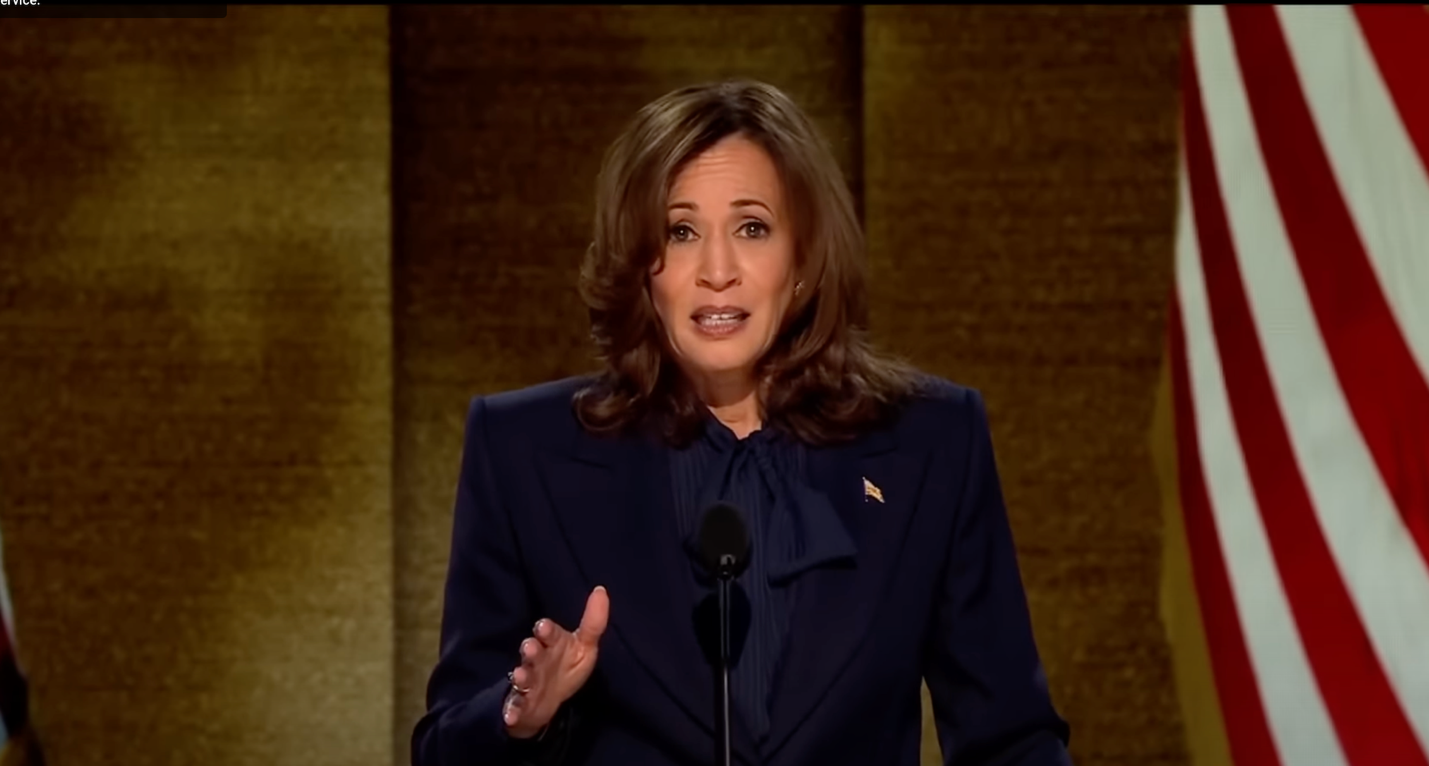
    Vice-President Kamala Harris speaking at the Democratic National Convention, August 22, 2024, Canadian Broadcasting Company (Screenshot).

    The not-so-good ones

    The just concluded Democratic National Convention at the United Center in Chicago was by most accounts a success. On Monday, the first night, Joe Biden gave his valedictory address, after which the audience breathed a sigh of relief. Not just because the long, self-indulgent peroration was over, but because Biden was finally out: one geezer down, one more to go. Two days later, state delegates conducted a celebratory roll-call vote, formally designating Kamala Harris and Tim Walz the Democratic Party nominees for president and vice-president.

    On Tuesday, there were not-so-good speeches by their Royal Majesties the Obamas and Clintons. Michelle spoke glowingly and interminably about her mother and all mothers. (Like dogs, there are no bad mothers.) But she also delivered the best zinger of the convention. Reminding listeners of Trump’s gaffe at the conference of the National Association of Black Journalists, she said: “Who’s gonna tell him that the job he is currently seeking might just be one of those ‘Black jobs’”. Barak’s address, which immediately followed his wife’s, was ponderous and unfocussed. (He should study the cadences and inflections of Pennsylvania Governor Josh Shapiro.) His only attention-getting line concerned Trump’s peculiar (not to say “weird”) preoccupation with comparing his crowd size to Harris’s. At one point, Obama brought his hands close together to indicate Trump’s comparatively small size. He undercut the punch line by embarrassment at his own vulgarity.

    Bill Clinton was avuncular but confusing – no more “Secretary of “Splainin’ Stuff”, as Obama called him in 2012. Hilary was pompous as expected and mangled her metaphors: “As vice president, Kamala sat in the situation room and stood for American values.” Did anybody hold the veep’s chair as she did all that sitting and standing? “Together,” Hilary continued, self-referentially and prayerfully, “we put a lot of cracks in the highest, hardest glass ceiling.” She went on in the same vein: “Tonight, we are so close to breaking through, once and for all.” And still more: “I want to tell you what I see through all those cracks. I see freedom.” Why did she need to look through the cracks to see it? Was the glass dirty – didn’t anybody tell her about Windex? But Hilary wasn’t done: Kamala could finally “break through” at which point she’d be “on the other side of that glass ceiling.” Was it the sitting down and quickly standing up – and bumping her head — that finally broke the ceiling? Who repaired he floor above, and can you please get me his number? It’s hard to fine good contractors.

    Oprah spoke with earnestness but little substance. She emphasized unity and decried those who would “divide and conquer us.” She spoke in favor of books, abortion rights, and “adult conversations” in place of ridiculous tweets. She wound up being the only person in the five days to mention animal rights, when she said: “When a house is on fire, we don’t ask about the homeowner’s race or religion, we don’t wonder who their partner is or how they voted. No, we just do the best we can to save them. And if the place happens to belong to a childless cat lady, well, we try to get that cat out too.”

    Former House Speaker Nancy Pelosi, another Democratic grandee, gave a six-minute address highlighting Biden and the Democrats’ achievements during the previous four years including the Inflation Reduction Act, Infrastructure Bill and legislative and executive actions on behalf of veterans, seniors and students. It was boilerplate, memorable for just one thing: the rapturous ovation Pelosi received on her way to the podium. The diminutive, 84-year-old legislator from the Bay Area was, by all accounts, the person most responsible for giving Joe the boot. No amount of “Thank you Joes” will wash away the stain of that act of political benevolence.

    Two other disappointing performances were delivered by the leading Democratic Party progressives, 34-year-old Representative Alexandria Ocasio-Cortez and 82-year-old Senator Bernie Sanders. The former thanked Biden, blessed Harris, and energetically cut the air with hands and index fingers. She spoke euphemistically, at first, like American politicians do, about the American middle-class. Just as there are no bad mothers, there’s no American working class, only a middle class stifled in its aspiration to become…middle class. (In fact, nearly 70% of the U.S. population is working class; excluding home ownership, they have no other assets than their wages.) AOC then confusingly shifted gears and began speaking about the American working class, but never got beyond generalities. United Auto Workers President Shawn Fain was more direct and more internationalist in his short address. He began it by saying: “Good evening to the people that make this world move, the working class!” I half expected him to sing the Internationale.

    Bernie was better than AOC, though plodding – he sounds less and less, these days, like Larry David’s impersonation of him. As usual, Sanders spoke in lists, calling for an activist government that increased the minimum wage, expanded Medicare and Medicaid, and increased Social Security payments to the elderly. He also supported legislation to increase union membership, create public financing of elections, and raise taxes on corporations and the billionaire class. One reason the address was so boring, paradoxically, is that these positions are now uncontroversial among Democratic voters and politicians. That they remain aspirational however, reveals the gap between party rhetoric and Democratic legislative priorities.

    I might have missed somebody, but so far as I could tell, the only artist or literary figure given time at the convention podium was Amanda Gorman. At the Biden inauguration in 2021, she performed a sentimental and much-lauded hip-hop poem titled “The Hill We Climb.” For the DNC, she read “This Sacred Scene,” which began: “We gather at this hallowed place because we believe in the American Dream.” The United Center? The only deity she could be invoking is Michael Jordan, whose Bulls won six NBA championships between 1991 and 1998. But if Jordan is God, I worry for Harris and Walz; the Bulls finished 9th in their division in 2023-4.

    The better speeches

    The best speeches at the convention, in my view, were not given by the A-listers, but the B-listers. Senator Raphael Warnock started his address by saying that Georgia made history on Jan. 5, 2020, by electing him, a Black man, and Jon Ossoff, a Jewish man, as U.S. Senators; but that history was tarnished the next day by a Trump-inspired insurrection to overturn the results of the presidential election. He meandered a bit in the middle of his 15-minute speech – there was the inevitable and deflating encomium for Biden — but Warnock regained his groove when he said: “Donald Trump is a plague on the American conscience.” That was a new epithet. Then he launched into a series of claims – would that they were true — that the Democrats were quickly moving forward on reproductive rights, worker’s rights, and voting rights. Then he spoke about the kindness of fathers, in particular his own, now deceased, “a preacher and a junkman who, Monday through Fridays lifted old broken cars and put ‘em on the back of an old rig. But on Sunday morning, the man who lifted broken cars lifted broken people…and told them they were God’s somebody.” He followed up by saying: “I’m convinced we can lift the broken even when we climb…we can heal sick bodies, we can heal the wounds that divide us, we can heal a planet in peril….” Great stuff from a preacher turned senator.

    In his brief but rousing address, Pennsylvania Governor Josh Shapiro invoked Philadelphia, his state’s biggest city and site of the first, Continental Congress (1774-81), to tell a story of continued American progress in the advancement of freedom and justice. All that was thwarted, he said, by Donald Trump in his single term in office and would be again if he was elected once more. Trump and the Republicans, Shapiro said, wrap themselves up in the rhetoric of freedom, but undermine it at every turn. “It’s not freedom to tell our children what books to read” he said, with Obama’s former cadence and a Black English inflection. “And it’s not freedom to tell women what they can do with their bodies.” Pausing briefly for cheers from the audience, he tightened his lips and shook his head, adding “No, it’s not.”

    Then, mixing the rhetoric of the Baptist preacher–Shapiro is Jewish – and the union leader, he continued, pointing at the camera: “And hear me on this, it’s sure as hell not freedom to say: ‘You get to vote, but he picks the winner.” “Real freedom” he continued, is “when a child can walk to and from school and get home safely to her mama.” Shapiro then expertly deployed what rhetoricians call anaphora. He repeated the phrase “real freedom is” followed by a series of positive liberties: the freedom to “join a union,” marry “who you love”, start a family “on your own terms,” “breath clean air, drink pure water…and live a life of purpose in which [you] are respected for who [you are].” Shapiro understood that an effective speaker doesn’t pause after applause, but speaks over it, building up to a crescendo. Though he treated anti-Israeli protesters on Pennsylvania campuses shamefully, he sure gives a good speech.

    And finally, there was Kamala Harris’s acceptance speech. On the plus side, it was short and well-delivered. She began by discussing her mother Shaymala, an Indian immigrant and later, cancer researcher. Harris said little about her father, the prominent, Jamaica-born Marxist economist Donald J. Harris, except that he and her mother created a home environment of love and support. After saying that she proudly accepted her party’s nomination for president, she went on to describe the fundamental characteristics of a good president, including common sense and the ability to listen, and said that she possessed them, while Donald Trump lacked them.

    From there, like the prosecutor she was, Harris proceeded to build the case for her presidency block by block. In the courtrooms of Oakland, she stood up against predators who abused women and children. As California Attorney General, she “took on” the banks that were illegally foreclosing on poor tenants and homeowners, and supported laws protecting consumers. She however omitted from her story the fact that as prosecutor and AG, she defended manifestly wrongful convictions, supported the forensic work of lab technicians convicted of corruption, upheld the death penalty, opposed a bill requiring state investigations of police shootings, and challenged a law mandating correct use of police body cameras.

    Harris spent the middle of her address attacking Trump – there’s no need to recite the litany here – and then moved to close the argument in favor of her own election. To be sure, the case is for me open and shut. But there were several passages in her speech, that should temper everyone’s enthusiasm for her candidacy. The first was her strong support for the “bipartisan border security law” proposed by Biden and backed by leading Republicans until it was nixed by Trump – it might rob him of his signature issue. She said she would bring it back to Congress and when passed, sign it into law. The bill is a sop to the far right; it would among other things, set arbitrary caps on asylum claims in contravention of existing U.S. and international law.

    The second was her unconditional support for Israel’s security, regardless of its leadership or policies. She spoke about Gaza in the passive voice, as if the genocide were a natural disaster: “At the same time, what has happened in Gaza over the past ten months is devastating. Too many innocent lives lost. Desperate, hungry people fleeing for shelter again and again, the scale of suffering is heartbreaking.” But her answer to the travesty is simply to follow the same path to peace that has been blocked again and again by Israeli president Netanyahu and his war cabinet. She did not propose simply following U.S. law – the Leahy Amendment – that denies U.S. weapons and supplies to any regime that violates human rights with impunity. She did not support the International Criminal Court in its pursuit of arrest warrants for both Israeli and Hamas leaders.

    The third utterance that made me cringe – leaving aside the bromides about American exceptionalism — was the following: “We must be steadfast in advancing our values and our security abroad….As Commander-in-Chef, I will ensure that America always has the strongest, most lethal fighting force in the world.” That the U.S. has the most lethal military in the world is beyond question. But that’s the problem, not the solution to global violence. The genocide of Native Americans, the wars against Korea and Vietnam, and the military interventions in Afghanistan, Iraq and a dozen other nations have killed millions. The wars currently wars fought in Ukraine and Gaza have the stamp of U.S. incompetence, indifference and profiteering all over them.

    Paeans to America’s “military might” are by now reflexive. All candidates repeat them to appear strong and attract votes. But that reflexivity is, to repeat the formulation above, the very problem that a good president must tackle. By repeating the oath to lethality and war so prominently in a speech seen by 30 million Americans – way more than Trump’s acceptance speech, but who’s counting – Harris risks making her promise self-fulfilling. Is she already, even before her possible (now likely) election, sowing the seeds of her own political demise, just as Lyndon Johnson did in 1968 with Vietnam and Biden did in 2024 with Gaza?

    The post Make America “Lethal” Again: a Review of Some Speeches at the DNC appeared first on CounterPunch.org.

    This post was originally published on CounterPunch.org.

  • UNRWA school in Gaza being used as a shelter by Palestinian refuges, bombed by Israelis. Photo: UNRWA.

    State Terrorism in the Age of Killing Zones

    What sets Israel’s war on Gaza apart is not only its violent military operations, marked by the indiscriminate killing of women and children, but also its relentless assault on dissent, criticism, and even the mildest opposition to its internationally condemned human rights violations and war crimes. Israel’s ongoing and brutal military campaign, coupled with its “policies of extreme inhumanity against the Palestinian people,” is inextricably linked to a state-sanctioned effort to legitimize and normalize its actions in Gaza.[1] This includes waging an ideological war of censorship and defamation against any challenge—no matter its source—to what Kenneth Roth, co-founder of Human Rights Watch, condemns as “Israel’s system of apartheid,” [2]  and what Aryeh Neier, Holocaust survivor and co-founder of Human Rights Watch, describes as “genocide against Palestinians in Gaza.” [3]

    The full scope of Israel’s assault on Gaza is revealed through its relentless military actions, characterized by indiscriminate violence against women, children, the elderly, and non-combatants. According to the Euro-Med Human Rights Monitor, the scale of destruction imposed on Gaza is not only devastating but ethically unimaginable. Since the start of the war, and as of the end of November 2023, Israel has reportedly dropped over 25,000 tons of explosives on the Gaza Strip, a force equivalent to two nuclear bombs. This means that the destructive power of the explosives dropped on Gaza in just over two months exceed that of the bomb dropped on Hiroshima.[4] According to the Rome Statute of the International Criminal Court, the use of such highly destructive bombs in residential areas constitutes a war crime.

    The consequences of these bombings were tragically displayed on August 10, 2024, when Israel bombed the Tab’een School in Gaza, a distressingly common occurrence. The school had provided shelter to nearly 2,500 people fleeing demolished areas, many of whom were children. The Israeli bombs targeted a prayer hall at dawn, where hundreds were praying. According to an investigation by Euro-Med Monitor, “over 100 Palestinians were killed, including several [entire] families.” The bombs’ immense destructive power reduced victims’ bodies to shredded and burned remains, leaving numerous others with severe injuries.[5] CNN reported that Fares Afana, director of Ambulance and Emergency Services in northern Gaza, stated that all those targeted “were civilians—unarmed children, the elderly, men, and women.”[6] Euro-Med Monitor found no evidence that the school “was being used for military objectives.”[7] Despite the documented evidence of Israel’s ongoing killings, abductions, forced starvation, and torture of Palestinians, including children,[8] Netanyahu and his cabinet members have astonishingly claimed that Israel has “the most moral army in the world.”[9]

    Israel has killed over 40,000 Palestinians. Save the Children reports that “more than 15,000 children are estimated to have been killed by Israel’s relentless assault on the strip [while estimating]that up to 21,000 are missing.”[10]  The overall number of deaths may be vastly understated. Rasha Khatib, Martin McKee, and Salim Yusuf, three health officials, stated in The Lancet, a prestigious peer-reviewed British medical journal,  that as a result of deaths caused by indirect rather than direct violence it is likely that the actual number of deaths is closer to 186,000.[11] Andre Damon writing on the World Socialist Web Site observes that Israel is waging a war of extermination against the Palestinian people and its aim is to not only “…massacre tens of thousands but also to destroy all aspects of civilization in Gaza, contributing to the deaths of tens of thousands through malnutrition, communicable diseases and lack of healthcare.”[12]  The egregious horror of this violence is underscored by its engagement in acts of profound brutality, including the bombing of schools, the torture of prisoners,[13] the use of starvation as a weapon, and the targeting of hospitals and a large part of Gaza’s health facilities, among other barbarous policies.

    Such acts have been condemned as genocide by legal groups like the Center for Constitutional Rights, over 50 governments including South Africa, and various United Nations agencies and non-governmental organizations.[14]Additionally, the International Criminal Court (ICC) is considering a request by the court’s prosecutor, Karim Khan, to issue arrest warrants against Prime Minister Benjamin Netanyahu and Israeli Defense Minister Yoav Gallant for committing “war crimes against humanity in the Gaza Strip.”[15] Khan has also requested similar arrest warrants for certain Hamas leaders.

    As Jewish scholar Judith Butler points out, Israel’s far-right leaders have been both public and unapologetic about their eliminationist plans following the Hamas attack on October 7th. Their goal has been to systematically undermine “the livelihood, the health, the well-being, and the capacity [of the Palestinians] to persist” amidst Israel’s vengeful and disproportionate military assault. [16] After the surprise Hamas terrorist attack, Israeli Defense Minister Yoav Gallant called for a complete siege of Gaza, declaring, “There will be no electricity, no food, no fuel, everything is closed. We are fighting human animals, and we act accordingly.” [17] Some Israeli ministers have called for the dropping of an atomic bomb on Gaza.[18]

    In a statement that defies moral and legal boundaries, Israel’s finance minister, Bezalel Smotrich, claimed that “no one in the world will allow us to starve 2 million people, even though it might be justified and moral in order to free the hostages.”[19] Smotrich’s remark not only trivializes the suffering of millions but also overlooks a critical fact: the deliberate starvation of civilians is unequivocally a war crime. This is the language of fascist politicians who speak with the weight of corpses in their mouths and blood on their hands. Such dehumanizing rhetoric doesn’t merely target Hamas fighters; it extends to the entire population of Gaza, effectively labeling all Palestinians as terrorists and less than human. By dehumanizing an entire group, this rhetoric facilitates and legitimizes Israel’s oppression of all Palestinians, justifying the denial of basic human needs and the commission of war crimes.

    The ultimate aim of Israel’s war in Gaza appears to be the eradication of any possibility of a Palestinian state and the eventual expulsion of Palestinians from their land. This is evident in the “complete siege” taking place in  Gaza, and Netanyahu’s explicit opposition to the future existence of a Palestinian state. Given Israel’s current assault on Gaza, which has nearly obliterated the daily survival prospects of its inhabitants, this aim becomes clearer.  Sharon Zhang underscores this point by noting that Netanyahu has explicitly stated his intent “to quash any hope of the existence of a Palestinian state in its entirety.” [20] She writes:

    “Advocates for Palestinian rights have said that this has been Israeli officials’ plan all along, as Israeli forces slaughter Palestinians en masse in Gaza while working to erase evidence that Palestinians ever existed in the region. However, this is one of the clearest statements yet from Netanyahu himself amid the current siege, suggesting his confidence that he will be able to carry it through with help from allies like the U.S.[21]

    In a number of articles, Kenneth Roth has written eloquently about Israel’s violations of international law.[22] He argues that none of Hamas’s actions, however horrific, justify Israel’s violation of the laws of war. He states that “that the Israeli government has repeatedly violated international humanitarian law in ways that amount to war crimes.” He points to Israel’s attack on civilian structures including schools, museums, and libraries. He cites Haaretz’s claim that “Israel has created ‘kill zones’ where soldiers shoot anyone who enters, armed or not.” He points to Israel’s destruction of hospitals, its torture of detained Palestinians and how some detainees “have died in military custody [while others] have reportedly needed to have their limbs amputated due to injuries sustained from prolonged handcuffing. He argues that the Israeli government has “imposed enormous obstacles to the delivery of aid, particularly food—a policy that amounts to using starvation as a weapon of war.”[23] What Roth makes clear and what many Western nations have ignored is that Israel is a rogue state guilty  of horrendous war crimes and has repeatedly violated international law.

    War crimes do more than destroy bodies; they erode morality, memories, and the deeply rooted habits of public consciousness. The brutality of Israel’s military actions in Gaza is painfully evident in the images of children’s bodies, torn apart amidst bombed mosques, hospitals, and schools. These atrocities are often justified by a discourse of dehumanization and self-defense—a state-sanctioned narrative as morally appalling as the suffering it enables, particularly among the most vulnerable. What is frequently overlooked, especially by mainstream media, is that Israel’s war on Gaza is not just a physical assault but an attack on history, memory, and cultural institutions. This erasure is a calculated effort to obscure its war crimes, brutal violence, and history of settler colonialism, all cloaked “under the security of the blanket of historical amnesia.”[24]

    Scholasticide as a Structural and  Ideological War

    Genocide manifests itself  not only in the creation of “kill zones,” where soldiers indiscriminately shoot Palestinians and in the use of lethal force against non-military targets such as hospitals and schools but also in the systematic destruction of Gaza’s entire intellectual, cultural, and civic infrastructure.[25] This calculated erosion seeks to eliminate the very fabric of Gaza’s society, extending beyond physical violence to the obliteration of its historical and cultural identity.[26]

    The ongoing and increasingly meticulous documentation of Israel’s war crimes not only exposes the horrific realities on the ground but also sheds light on the broader implications of these violations. The unfolding crisis extends beyond the immediate brutality and physical destruction in Gaza, revealing a deeper, insidious form of violence that transcends the battlefield. This violence is rooted in an ideological agenda that legitimizes such barbarism while systematically attacking any form of  education and criticism that seeks to expose it. This assault manifests as both a soft and hard war on education, history, critical inquiry, and any viable movement of dissent. Karma Nabulsi of the University of Oxford called this “war on education” a form of scholasticide and argued that it would affect generations of Palestinian children.[27] At the heart of this war on dissent and education are repeated attempts by Israel’s right-wing government to dismiss all critiques of Israel’s war on Gaza as a form of antisemitism. For example, when the war on Gaza is occasionally contextualized and historicized in reports, the Israeli government and its defenders swiftly weaponize the charge of antisemitism against critics, especially Palestinians, but also Jews. Historian Ilan Pappe highlights how this accusation is wielded by Israel’s far-right government to silence not only critics of the war but any narrative that exposes its five-decade-long campaign by “occupational forces to inflict persistent collective punishment on the Palestinians… exposing them to constant harassment by Israeli settlers and security forces and imprisoning hundreds of thousands of them.”[28]

    The expansive, indiscriminate, and staggering violence unleashed on Gaza by Israel demands not only a new vocabulary but also a deeper understanding of the politics of education and the education of politics. It also requires a redefined comprehension of what constitutes a war crime, coupled with a mass international movement resisting the far-right Israeli government’s deliberate and brutal attacks on the Palestinian people and their quest for freedom and sovereignty. Additionally, it is crucial to recognize that this violence in its multiple forms, includes a  less visible form of violence that is often overlooked. This form of violence, frequently obscured by the genocidal slaughter and annihilation unfolding in Gaza, is the violence of organized forgetting—the systematic erasure of dangerous memories, histories, and collective remembrance.

    This is the violence of “scholasticide.” This type of violence seeks to erase the Nakba from history, to destroy institutions that preserve the memory of the forced removal of 700,000 Palestinians from their land, and to enforce historical amnesia as a means of preventing future generations from learning about Palestinian resistance against colonial violence, dispossession, and erasure that has persisted for decades. Isabella Hammad, British-Palestinian author, rightly expresses outrage on how the pedagogical incubators of soft scholasticide work to condemn Palestinian protesters and cover up crimes of genocide. She is worth quoting at length:

    “Israel’s war in Gaza targets not only memory, knowledge, and critical inquiry but also extends to the destruction of educational institutions where history exposes past crimes and the movements for liberation and resistance. This is a war waged not just against bodies but also against history itself—against memories, legacies of cruelty, schools, museums, and any space where a people’s history and collective identity are preserved and transmitted to present and future generations. This assault on historical consciousness, remembrance, critical ideas, and the enduring history of settler colonialism represents a form of ideological violence that strategically underpins the tangible, bloody war that destroys Palestinian lives and the institutions safeguarding vital memories. In this context, the concept of “scholasticide” emerges, signifying the deliberate destruction of educational spaces that pass on essential knowledge, memories, and values, becoming a central element in Israel’s broader war against the Palestinian people.[29]

    As a form of historical, political and social amnesia, scholasticide works through what Rob Nixon calls “slow violence” — a gradual, incremental, and often less visible form of harm. In this context, scholasticide manifests through verbal contortions marked by diversions, lies, fear, threats, and intimidation. Language, images, and sensationalized tsunamis of hate across various media outlets and platforms are used to distract people from the crimes taking place in Gaza. As a result, scholasticide works to normalize the bloody war on Gaza and suppress free speech. However, it is crucial to recognize that scholasticide also takes on a more brutal and immediate expression in what I call the “savage structural violence of scholasticide.” This form of scholasticide targets the destruction of schools, universities, and museums while systematically repressing dissenting scholars, students, and others. It involves real weapons of mass destruction, attacking not just bodies and minds but also the institutions that sustain intellectual life.

    In what follows, I will analyze the brutal structural violence of scholasticide taking place in Gaza, where educational institutions are systematically targeted and destroyed. I will then examine the ideological violence of scholasticide, characterized by the suppression of free speech and academic freedom, increasingly enforced through state mechanisms of surveillance, job losses, and other punitive measures, including detention. These two forms of scholasticide are not isolated; they reinforce each other, serving a larger project of imposing a repressive state in Israel. This analysis will also reveal how these practices signal a broader, insidious trend in the West, where censorship, repression, and various forms of pedagogical terrorism are aggressively deployed to suppress dissent and critical thought, leading to a brutal global trajectory of intellectual and academic oppression. These two forms of scholasticide—ideological and structural—are deeply interconnected. The ideological assault on free speech and academic freedom lays the groundwork for the physical destruction of institutions essential to critical education as a practice of freedom and liberation. In this way, the ideological forces of scholasticide act as a precursor and precondition for the eventual annihilation of the very foundations of emancipatory education.

    Scholasticide in Gaza

    Israel’s brutal war in Gaza not only targets bodies but also attacks the preservation of history, knowledge, and critical thought. By destroying educational institutions, it aims to erase narratives of past crimes and Palestinian movements for liberation. This is a war against history itself—against memories, legacies of resistance, and the institutions that safeguard a people’s collective identity for future generations. The repression of historical consciousness and the history of settler colonialism is a form of ideological violence that fuels the ongoing conflict devastating Palestinian lives and erasing vital memories. This deliberate destruction of educational institutions, spaces, and history, known as “scholasticide,” is central to Israel’s broader war against the Palestinian people. Chandni Desai, writing in The Guardian, describes scholasticide as an act of ethical savagery and pedagogical repression, noting: “It obliterates the means by which a group—in this instance, Palestinians—can sustain and transmit their culture, knowledge, history, memory, identity, and values across time and space. It is a key feature of genocide.” [30]

    The structural violence of scholasticide in Gaza since the horrific October 7th Hamas attack is undeniable and practically unthinkable. The world has witnessed Israel’s deliberate targeting of schools, universities, and other cultural sites in Gaza. As Sharon Zhang notes, “It is a war crime to target civilian infrastructure in war, but Israel has a long history of flagrantly violating international law with impunity — including targeting educational institutions that preserve Palestinian history, identity, and culture.”[31] According to the UN, 90 percent of Gaza’s schools have been destroyed, and all 12 universities have been bombed, damaged, or reduced to rubble. Chandni Desai reports that “approximately 90,000 Palestinian university students have had their studies suspended; many will be driven to forced displacement through genocide, as Gaza has become uninhabitable.”[32]  It gets worse. UN officials and the Palestinian ministry of education report that Israeli military operations have killed at least 5,479 students, 261 teachers, and 95 university professors in Gaza, including deans, university presidents, award-winning physicists, poets, artists, and prominent activists. [33]

    Schools in Gaza faced significant challenges even before the war, including overcrowding, double shifts, a shortage of buildings, and restricted access to construction materials and school supplies. As Stephen McCloskey highlights, “in June 2022, Save the Children reported that 80 percent of children in Gaza were ‘in a perpetual state of fear, worry, sadness, and grief.”[34] The war has only exacerbated these issues, leaving Gaza’s youth to grapple with repeated traumas, mental health crises, and the constant threat of death or injury. These hardships are compounded by extreme poverty, continuous violence, forced displacement, and inadequate health care.

    Moreover, the brutal realities extend beyond the battlefield. It is well-documented that many children held without charge in Israeli detention centers have been subjected to physical, sexual, and mental abuse. Save the Children has collected testimonies from children that reveal increasing levels of violence, particularly since October, when stricter rules were implemented that block visits from parents or lawyers. Some children have reported broken bones and beatings, highlighting the severe abuse occurring in these detention centers.”[35] Amid such a dire humanitarian crisis, Palestinian children and their parents are left with an agonizing choice: “between dying of exposure, disease, bombs, starvation, infectious disease, or leaving.” [36] This grim reality underscores that the destruction of Gaza’s education system is part of a broader campaign by Israel to render the region unlivable.

     Israel’s war on education and culture extends further, targeting the very fabric of Gaza’s identity. The bombing and destruction of numerous libraries, archives, publishing houses, cultural centers, activity halls, museums, bookstores, cemeteries, monuments, and archival materials illustrate a systematic effort to erase Palestinian heritage. [37] Various news outlets and social media have provided stories and images confirming that Israeli soldiers are not only destroying but also stealing archeological artifacts. In one particularly egregious instance reported on social media, stolen artifacts from the Gaza Strip were openly displayed in a small showcase in the Israeli parliament, known as the Knesset. [38]

    Israel’s policy of scholasticide, aimed at destroying Palestinian education, especially its less violent methods, are not limited to Gaza. They also extend to students, faculty, and other critics of the war within Israel.  Israeli scholar, Professor Maya Wind, argues that Israel’s universities have become centers of military research, propaganda, and repression.[39] For instance, she notes . that “academic disciplines, degree programs, campus infrastructure, and research laboratories   service Israeli occupation and apartheid.”  She is worth quoting at length:

    “Hebrew University, among others, are training intelligence soldiers to create target banks in Gaza. They are producing knowledge for the state… which is state propaganda, or legal scholarship to help thwart attempts to hold Israel accountable for its war crimes, such as the case brought to the ICJ by South Africa. And they are, in fact, actually granting university course credit to reserve soldiers returning from Gaza to their classrooms. So, Israeli universities are deeply complicit in this genocide.[40]

    Writing  in The New York Review of Books In addition, Neve Gordon and Penny Green reported that Shalhoub-Kevorkian, a Palestinian citizen of Israel, who is the Lawrence D. Biele Chair in Law at the Hebrew University of Jerusalem was arrested for signing a petition titled “Childhood Researchers and Students Calling for Immediate Ceasefire in Gaza.”[41] She was one of many Palestinian educators intimidated by the far-right Netanyahu government for criticizing the war.[42] The reach of Israeli state censorship and punishment also includes Jewish faculty members such as the renowned Professor Peled-Elhanan subjected to a disciplinary hearing because she sent messages on a staff WhatsApp that was deemed supportive of Hamas.

    Gordon and Green also noted that  “in the three weeks following Hamas’s attack, well over a hundred Palestinian students in Israel, nearly 80 percent of them women, faced disciplinary actions for private social media posts that supported the end of the siege on Gaza… expressed empathy with Palestinians in the Strip, or simply included memes about suffering Palestinian children.”[43] Attempts by the Israeli state to destroy education in Palestine is part of a broader project to destroy any vestige of a liberation movement in Palestine. Wind notes this is obvious not only in terms of the repression of Palestinian critics in Gaza and Israel, but also in the West Bank, including West Jerusalem. She states that Palestinian universities are routinely raided  by the IDF. She adds:

    “Student activists and organizers in over 411 Palestinian student groups and associations that have been declared unlawful by the Israeli state are routinely abducted from their campus, from their homes in the middle of the night. They are subjected to torture. They are held in administrative detention without charge or trial for months. And so, what we’re really seeing is a systemic attack of the Israeli military and the Israeli military government on Palestinian higher education, and particularly on Palestinian campuses as sites of organizing for Palestinian liberation.[44]

    Conclusion 

    What stands out regarding Israel’s policy of scholasticide is not only the visceral killing, suffering, and terror inflicted upon the Palestinian people in Gaza but also the calculated effort to obliterate institutions that preserve Palestinian history, educate current and future generations, and forge links between the past and a future of freedom and justice. This is not just an assault on memory; it is an attack on the very essence of education as a liberating force—indispensable for a society where informed judgment, civic courage, and critical agency are essential to upholding the ideals of freedom and justice through mass resistance.

    It is crucial for critical educators and anti-war activists to acknowledge that this war on education in Gaza parallels the ongoing assault on higher education in the United States and other authoritarian regimes, revealing a disturbing global alignment in the attack on intellectual freedom and historical truth. The strategy of scholasticide is both a violent structural project and a calculated ideological and pedagogical effort to silence dissent within and outside of higher education, particularly dissent that holds Israel’s genocidal war and its apparatuses of ideological indoctrination and repression accountable. The horrors unfolding in Gaza represent the extreme endpoint of a broader, insidious campaign aimed at crushing dissent across universities in the United States, Europe, and beyond, including nations like Hungary. In the U.S., schools and cultural institutions may not be bombed, but they are systematically defunded and turned into fortresses of academic repression. Books are banned, student protesters face police brutality, faculty are purged, and history is whitewashed. Meanwhile, billionaire elites and administrative enforcers ruthlessly work to “engineer the intellectual, social, and financial impoverishment of the educational sector,” silencing anyone who dares to challenge their pursuit of national and ideological conformity.[45]

    Scholasticide is a modern form of McCarthyism that intensifies from silencing opposition to the outright destruction of academic and cultural institutions that enable both individual and collective resistance. It begins by targeting informed judgment, historical memory, and dissent, and then escalates to obliterating civic infrastructures like schools and museums. In its wake, it leaves a trail of bloodshed, broken limbs, wounded women and children, and a chilling legacy of violence, mass deaths, and ethical emptiness. Scholasticide is the canary in the coal mine, signaling an imminent and grave threat to academic freedom, free speech, critical education, and democracy itself.

    Notes.

    [1] Gerald Sussman, “The US-Israeli Regime of Despair,” Counter Punch (July 21, 2024). Online: https://www.counterpunch.org/2024/07/21/the-us-israeli-regime-of-despair/

    [2] Kenneth Roth, “Crimes of War in Gaza” The New York Review of Books [July 18, 2024]. Online: https://www.nybooks.com/articles/2024/07/18/crimes-of-war-in-gaza-kenneth-roth/

    [3] Aryeh Neier, “Is Israel Committing Genocide?” The New York Review of Books[June 6, 2024]. Online: https://www.nybooks.com/articles/2024/06/06/is-israel-committing-genocide-aryeh-neier/

    [4] HuMedia, “Israel hits Gaza Strip with the equivalent of two nuclear bombs,” Euro-Med Human Rights Monitor (November 2, 2023). Online: https://euromedmonitor.org/en/article/5908/Israel-hits-Gaza-Strip-with-the-equivalent-of-two-nuclear-bombs#:~:text=Geneva%20%2D%20Israel%20has%20dropped%20more,a%20press%20release%20issued%20today

    [5] Editorial, “Initial Euro-Med Monitor investigation finds no evidence of military presence at site of Tab’een School massacre in Gaza,” Countercurrents.org (August 24, 2024). Online: https://countercurrents.org/2024/08/initial-euro-med-monitor-investigation-finds-no-evidence-of-military-presence-at-site-of-tabeen-school-massacre-in-gaza/

    [6] Irene Nasser, Abeer Salman, Ibrahim Dahman, Mohammed Tawfeeq, Lex Harvey and Allegra Goodwin, “Israeli strike on mosque and school in Gaza kills scores, sparking international outrage,” CNN World (August 11, 2024).  Online: https://www.cnn.com/2024/08/10/middleeast/israeli-school-strike-gaza-intl-hnk/index.html

    [7] HuMedia, “Initial Euro-Med Monitor investigation finds no evidence of military presence at site of Tab’een School massacre in Gaza,” Euro-Med Human Rights Monitor (August 11, 2024). Online: https://euromedmonitor.org/en/article/6432/Initial-Euro-Med-Monitor-investigation-finds-no-evidence-of-military-presence-at-site-of-Tab%E2%80%99een-School-massacre-in-Gaza

    [8] Miranda Cleland, “Why Israel can torture detained Palestinian children with impunity,” Middle East Eye (December 1, 2023). Online: https://www.middleeasteye.net/opinion/israel-palestine-war-torture-detained-palestinian-children-impunity

    [9] Greg Shupak, “Israel may have the least ‘moral army’ in the world: The rate of civilian death during Israel’s assault on Gaza has few precedents this century,” Canadian Dimension (February 17, 2024). Online: https://canadiandimension.com/articles/view/israel-may-have-the-least-moral-army-in-the-world

    [10] Arwa Mahdawi, “Nearly 21,000 children are missing in Gaza. And there’s no end to this nightmare” The Guardian [June 27, 2024]. Online: https://www.theguardian.com/global/commentisfree/article/2024/jun/27/gaza-missing-children

    [11] Rasha Khatib, Martin McKee, Salim Yusuf, “Counting the dead in Gaza: difficult but essential” The Lancet [July 5, 2024]. Online: https://www.thelancet.com/journals/lancet/article/PIIS0140-6736(24)01169-3/fulltext

    [12] Andre Damon, “Lancet warns Gaza death toll could be over 186,000,” World Socialist Web Site (July 7, 2024). Online: https://www.wsws.org/en/articles/2024/07/08/xgqe-j08.html

    [13] Press Release, “UN report: Palestinian detainees held arbitrarily and secretly, subjected to torture and mistreatment,” United Nations Human Rights (July 31, 2024). Online: https://www.ohchr.org/en/press-releases/2024/07/un-report-palestinian-detainees-held-arbitrarily-and-secretly-subjected

    [14] Gerald Imray, “Genocide case against Israel: Where does the rest of the world stand on the momentous allegations?,” Associated Press (January 14, 2024). Online: https://apnews.com/article/genocide-israel-palestinians-gaza-court-fbd7fe4af10b542a1a4e2c7563029bfb;

    [15] Mike Corder, “International Criminal Court judges mulling arrest warrants consider legal arguments on jurisdiction,” Associated Press(August 9, 2024). Online: https://apnews.com/article/israel-palestinians-icc-court-warrants-jurisdiction-12df89805cf654df030a56264ad38bb8#:~:text=THE%20HAGUE%2C%20Netherlands%20(AP),attacks%20by%20Hamas%20in%20Israel.

    [16] Amy Goodman, “Palestinian Lives Matter Too: Jewish Scholar Judith Butler Condemns Israel’s “Genocide” in Gaza.”  Democracy Now[October 26, 2023]. Online: https://www.democracynow.org/2023/10/26/judith_butler_ceasefire_gaza_israel

    [17] Sanjana Karanth, “Israeli Defense Minister Announces Siege On Gaza To Fight ‘Human Animals’,” The Huff Post (October 9, 2023). Online: https://www.huffpost.com/entry/israel-defense-minister-human-animals-gaza-palestine_n_6524220ae4b09f4b8d412e0a

    [18] Patrick Kingsley, “Top U.N. Court Decision Adds to Israel’s Growing Isolation”  New York Times [May 24, 2024]. Online: https://www.nytimes.com/2024/05/24/world/middleeast/icj-israel-rafah-isolation.html

    [19] Guardian Staff and Agencies, “Israel minister condemned for saying starvation of millions in Gaza might be ‘justified and moral’,” The Guardian (August 8, 2024). Online: https://www.theguardian.com/world/article/2024/aug/08/israel-finance-minister-bezalel-smotrich-gaza-starve-2m-people-comments

    [20] Sharon Zhang, “Netanyahu Says Israel’s Goal Is to Wipe Out All Possibility of Palestinian State,” Truthout (January 18, 2024). Online: https://truthout.org/articles/netanyahu-says-israels-goal-is-to-wipe-out-all-possibility-of-palestinian-state/#:~:text=War%20%26%20Peace-,Netanyahu%20Says%20Israel’s%20Goal%20Is%20to%20Wipe%20Out%20All%20Possibility,amid%20Israel’s%20genocide%20in%20Gaza.&text=Honest%2C%20paywall%2Dfree%20news%20is,a%20donation%20of%20any%20size.

    [21] Ibid.

    [22] Kenneth Roth, “Crimes of War in Gaza” The New York Review of Books [July 18, 2024]. Online: https://www.nybooks.com/articles/2024/07/18/crimes-of-war-in-gaza-kenneth-roth/; See also, an interview with Roth in Carolyn Neugarten, “The Right Fight” The New York Review [July 27, 2024]. Online: https://www.nybooks.com/online/2024/07/27/the-right-fight-kenneth-roth/

    [23] All of the quotes in this paragraph are from  Kenneth Roth, “Crimes of War in Gaza” The New York Review of Books [July 18, 2024]. Online: https://www.nybooks.com/articles/2024/07/18/crimes-of-war-in-gaza-kenneth-roth/

    [24] Donalyn White, Anthony Ballas, “Settler Colonialism and the Engineering of Historical Amnesia” Counter Punch [July 11, 2024]. Online: https://www.counterpunch.org/2024/07/11/settler-colonialism-and-the-engineering-of-historical-amnesia/

    [25] See, Kenneth Roth, “Crimes of War in Gaza” The New York Review of Books [July 18, 2024]. Online: https://www.nybooks.com/articles/2024/07/18/crimes-of-war-in-gaza-kenneth-roth/. A brilliant, critical, and encompassing analysis of Israel’s war crimes can be found in Jeffrey St. Clair’s Gaza Dairy Archives published in CounterPunch.

    [26] Gaza Academics and Administrators, “Open letter by Gaza academics and university administrators to the world.” Al Jazeera [May 29, 2024]. Online: https://www.aljazeera.com/opinions/2024/5/29/open-letter-by-gaza-academics-and-university-administrators-to-the-world

    [27] Faisal Bhabha, Heidi Matthews, Stephen Rosenbaum, “OPEN LETTER FROM NORTH AMERICAN ACADEMICS CONDEMNING SCHOLASTICIDE IN GAZA” Google Docs [April 2024]. Online: https://docs.google.com/forms/d/e/1FAIpQLSc7_K7qybzbeiBAg7sYTxbp1VOyYBrYPaxRf8jvHuBa0kQHlg/viewform?pli=1

    [28] Ilan Pappe, “Why Israel wants to erase context and history in the war on Gaza.” Al Jazeera [November 5, 2023]. Online: https://www.aljazeera.com/opinions/2023/11/5/why-israel-wants-to-erase-context-and-history-in-the-war-on-gaza

    [29] Isabella Hammad, “Acts of Language” The New York Review of Books [June 13, 2024]. Online: https://www.nybooks.com/online/2024/06/13/acts-of-language-isabella-hammad/

    [30] Chandni Desai, “Israel has destroyed or damaged 80% of schools in Gaza. This is scholasticide” The Guardian [June 8, 2024]. Online: https://www.theguardian.com/commentisfree/article/2024/jun/08/israel-destroying-schools-scholasticide

    [31] Sharon Zhang, “Israel Bombs Girls’ School in Gaza, Killing 30 and Wounding Over 100,” Truthout (July 29, 2024). Online: https://truthout.org/articles/israel-bombs-girls-school-in-gaza-killing-30-and-wounding-over-100/

    [32] Ibid. Chandni Desai.

    [33] Chris Hedges, “Israel destroyed my university. Where is the outrage?” The Real News [February 9, 2024]. Online: https://therealnews.com/israel-destroyed-my-university-where-is-the-outrage

    [34] Stephen McCloskey, “Israel’s War on Education in Gaza” Z Network [January 8, 2024]. Online: https://znetwork.org/znetarticle/israels-war-on-education-in-gaza/

    [35] News Release, “Palestinian children in Israeli military detention report increasingly violent conditions,” Save the Children (February 29, 2024). Online: https://www.savethechildren.net/news/palestinian-children-israeli-military-detention-report-increasingly-violent-conditions

    [36] Chris Hedges, “Israel destroyed my university. Where is the outrage?” The Real News [February 9, 2024]. Online: https://therealnews.com/israel-destroyed-my-university-where-is-the-outrage

    [37]  Ibid. Chandni Desai.

    [38] Palestine Chronicle Staff, “Israeli Forces Display Stolen Gaza Artifacts in Knesset,” The Palestine Chronicle (August 14, 2024). Online: https://www.palestinechronicle.com/israeli-forces-display-stolen-gaza-artifacts-in-knesset-reports/

    [39] Maya Wind, Towers of Ivory and Steel: How Israeli Universities Deny Palestinian Freedom (New York: Verso, 2024).

    [40] Amy Goodman, “”Towers of Ivory and Steel”: Jewish Scholar Says Israeli Universities Deny Palestinian Freedom” Democracy Now[March 15, 2024]. Online: https://www.democracynow.org/2024/3/15/maya_wind_towers_of_ivory_and

    [41] Neve Gordon and Penny Green, “Israel’s Universities: The Crackdown” The New York Review of Books [June 5, 2024]. Online: https://www.nybooks.com/online/2024/06/05/israel-universities-the-crackdown/

    [42] Ibid. Maya Wind.

    [43] Ibid. Neve Gordon and Penny Green.

    [44] Amy Goodman, “Maya Wind: Destruction of Gaza’s Universities Part of Broader Israeli Project to Destroy Palestinian Liberation” Part 2. Democracy Now [March 15, 2024]. Online: https://www.democracynow.org/2024/3/15/maya_wind_part_2

    [45] Ruth Ben-Ghiat, “How Authoritarians Target Universities,” Lucid  (July 11, 2023). Online: https://lucid.substack.com/p/from-fascism-to-hungary-and-the-us

    The post Scholasticide: Erasing Memory, Silencing Dissent, and Waging War on Education from Gaza to the West appeared first on CounterPunch.org.


    This content originally appeared on CounterPunch.org and was authored by Henry Giroux.

    This post was originally published on Radio Free.

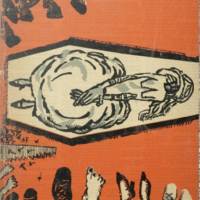
  • Detail from the Penguin Modern Classics cover of As I Lay Dying.

    “When something is new and hard and bright, there ought to be something a little better for it than just being safe, since the safe things are just the things that folks have been doing so long they have worn the edges off and there’s nothing to the doing of them that leaves a man to say, That was not done before and it cannot be done again.”

    – William Faulkner, As I Lay Dying

    Usually, when I get sick, I wake up that way, as if legions of infectious bugs had secretly invaded my defenses at night. Not this time. This time I fell apart in the afternoon. All at once. While watching Wolf Blitzer. It hit me like an ambush. Suddenly, everything hurt: joints, neck, tongue, back, toenails, head. Even my eyeballs. Especially them.

    My throat was raw, my lungs had filled with green gunk, and my ears were clogged so thick with oozing wax that I couldn’t hear myself scream at the screen, the way I normally do this time of day. The light of August grew dim, as my eyes crusted over. I had COVID for the second time. The FLiRT variant, which was supposed to be mild, flirtatious even, had knocked me on my ass.

    I spent the next four days in bed, wheezing, hacking, and feeling like Aqualung on a bender. I was judiciously locked in a bedroom so as not to spread my contagion among the household. Food, pills and water were slipped into my cell twice a day. Other than the nightly monotony of the Democratic National Convention, my only distraction was a battered copy of As I Lay Dying that I hadn’t read in 45 years. Though a fan of Faulkner, I hadn’t much cared for this fractured southern gothic back in my 20s, when I presumed myself immune to such intimations of mortality. But now on the edge of the grim abyss, it called my name.

    “It takes two people to make you, and one people to die. That’s how the world is going to end.”

    I remembered that a professor of mine had considered this slim novel Faulkner’s version of Joyce’s Ulysses, only shorter and not as dirty, though there’s plenty of dirt if you know where to look. So I dove in looking for the dirty parts and soon found myself caked in Mississippi mud, which was a relief given that my skin felt aflame.

    Faulkner cribbed the title from a passage in the Odyssey when Odysseus entered the Underworld. I guess everyone should visit Hell at least once before they take up permanent residence, even if resembles a convention center in Chicago. Faulkner cribbed a lot, but broke it up and put it back together in ways most nobody recognized. Kind of like ChatGPT but in reverse.

    As Odysseus is doing field recordings with some of the luminaries of Hades, who should show up but the rapist of Troy, Agamemnon himself, a new arrival to the Underworld, who was shivved shortly after coming home to Mycenea from his Middle East war. Agamemnon warns Odysseus against the evils of women, saying his own wife struck the fatal blow, as he lay dying from her lover’s sword, and then she even refused to close his eyes: “So true is it that there is nothing more dread or more shameless than a woman who puts into her heart such deeds, even as she too devised a monstrous thing, contriving death for her wedded husband. Verily I thought that I should come home welcome to my children and to my slaves; but she, with her heart set on utter wickedness, has shed shame on herself and on women yet to be, even upon her that doeth uprightly.” Which reads like a manifesto of the New Masculinity movement led by the likes of JD Vance, Andrew Tate and Matthew Walsh. Semper Fi, dudes.

    Agamemnon didn’t mention what exactly set Clytemenstra off. What she’d been brooding about for more than ten years. Odysseus knew. He was there. He might even have been complicit. But he doesn’t say either. He doesn’t mention that Agamemnon had slit the throat of his own daughter to summon the winds that would blow him to Troy, where he could loot their gold and rape their women. Sometimes stories are told like that, leaving off the key parts, that you have to fill in for yourselves, if you can. That’s politics, even in the afterlife.

    Of course, Faulkner doesn’t tell this story straight. He might not even tell it right. A lot of folks don’t seem to get it and I’m not sure I do, because my mind is befogged by Covid. But it seems to be about the dynamics of the American family under capitalism, a story that starts out as a tragic thing and becomes a comic thing, even though a lot of bad things happen to good people and good things to bad people along the way.

    “It’s like a man that’s let everything slide all his life to get set on something that will make the most trouble for everybody he knows.”

    Of course, if Faulkner had told this story straight what he called his “tour de force” would have been purged off the shelves in schools and libraries from Tallahassee to Tulsa. He understood that America holds itself in too high regard to talk straight about the things that matter most: the harm you suffer and the harm you cause, the deaths that afflict you and the deaths you inflict. This is even truer in politics than it is in literature.

    Faulkner has 15 people tell how Addie Bundren died and her family tried for 9 days to find a place to bury her. Some of them might not tell it true, which can often be the truest way to tell a story, especially in America. One of the people ain’t even alive when she starts her telling, but since most of the story is about being dead or getting there, she speaks with more authority than many of the others, especially her husband Anse who can barely speak at all, intelligibly, anyhow, which is often the case with husbands.

    “A man ain’t so different from a horse or a mule, come long come short, except a mule or a horse has got a little more sense.”

    As with the DNC, it’s sometimes hard to tell who to believe the most or disbelieve the least. The most rational storyteller in As I Lay Dying will prove to be insane. Or at least deemed as such by his own father, brother and sister and thrown into an asylum. There’s probably a difference. I don’t know whether he runs into Hannibal Lechter there or not. Typically, the reticent Faulkner doesn’t say.

    “It’s like there was a fellow in every man that’s done a-past the sanity or the insanity, that watches the sane and the insane doings of that man with the same horror and the same astonishment.”

    Over the interminable sleepless nights, the speeches in Chicago and the run-on sentences of the novel seemed to blend together and it became increasingly difficult to tease out one from the other and which one was written by Faulkner or Jon Meachem, which is why I finally flicked the mute button on the DNC convention and watched it with the sound off, for the spectacle alone.

    “How often have Ι lain beneath rain on a strange roof thinking of home.”

    It’s July in Mississippi and it’s hot. Not as hot as it is now. But it’s getting there or starting to. Faulkner wrote this book in six weeks on an overturned wheelbarrow in the middle of the night at the power station on the campus of the University of Mississippi, where he worked shoveling coal into the furnace. So he helped, damn him.

    There’s no air conditioning, as Addie sits by the window during her last night on earth, watching her firstborn son Cash build a coffin. Her coffin. Addie’s dying. We don’t know from what. Having so many children or being married to Anse or the unforgiving heat. She may be old for her age, but she’s still dying young, which was then and is now the American way of death, by which I mean premature. So premature in Addie’s case that she hasn’t performed her post-menopausal duty of caring for the grandchildren, because there ain’t any. Not yet anyway, though one may be coming, wanted or not.

    “That’s the one trouble with this country: everything, weather, all, hangs on too long. Like our rivers, our land: opaque, slow, violent; shaping and creating the life of man in its implacable and brooding image.”

    Addie doesn’t speak until she’s dead. And then what she says doesn’t make much sense at the time she’s saying it but does later when some, but not all, of the blanks have been filled in. But what she says is that she doesn’t want to be buried here on Anse’s farm, in this patch of bad earth that like as not killed her, in spirit if not in body. In this book, as in history, the dead make more sense than the living. Addie wants to be buried with her kinfolk, even though we know she was abused by them, thirty miles away in Jefferson, which those of us in the know understand is actually Oxford.

    “I learned that words were no good; that words don’t even fit what they’re trying to say at it.”

    This is a story about poor people who become poorer when things they can’t control make them do things they can’t afford, like bury a wife and mother. It’s 30 miles to Jefferson but the Bundrens take 9 days to get there. They spend much of that time going back and forth over the same ground, reversing the progress they’d made the day before, a kind of incrementalism most Americans are familiar with in the time of neoliberalism. This morbid odyssey leads to all sorts of misery and mayhem: two drowned mules, a busted leg set in cement, a burned barn, a stolen horse, a lost fish who transforms into a corpse, a botched abortion and a question of paternity.

    “It’s like it ain’t so much what a fellow does, but it’s the way the majority of folks is looking at him when he does it.”

    Everything the Bundrens own is mortgaged, even the tools they use to pay back the banks and loan sharks. For them and most of the rest of us the promise of America is a promissory note. The family is so destitute that two of Addie’s sons, Darl and Jewel, take off to work on a neighbor’s farm while Cash saws and planes the boards for their mother’s coffin. They return with $3 between them for two day’s hard labor, which was considered an honest wage 100 years ago and slowly inflated to $7.50 an hour and remains so today.

    “Those rich town ladies can change their minds. Poor folks can’t.”

    The problem is that Addie died while they toiled and their wages can’t get them to Jefferson. Not after the heavens opened and a thousand-year flood that happens once a decade now came down to swell the rivers and wash away the bridges. It’s easy to die, but hard to be buried in an economic system where the only cash you have is a son who’s good with tools.

    “Life wasn’t made to be easy on folks: they wouldn’t ever have any reason to be good and die.”

    Jewell will nearly get stabbed outside Jefferson, after he called a white man he mistook for a black man a “son of a bitch.” Jewell said this after he had begun to “turn black” himself, charred by the barn fire his brother Darl had set. Cash was also turning black, after his father had insisted on setting his broken leg–fractured while trying took take the corpse-laden wagon across a flooded ford in the raging river–in concrete because he couldn’t afford a doctor. The makeshift cast cut off the flow of blood to his leg and foot. Nearly everybody in this book begins to turn black eventually. Just like Kamala in Donald Trump’s imagination.

    “Once I waked with a black void rushing under me.”

    I’m not sure how old Addie’s daughter Daisy Dell is. But she’s old enough to fool around or be fooled around with. So she’s probably at least 14. And she does so with predictable consequences that are just as predictable in at least 27 states today. Daisy Dell is pregnant and wants an abortion and can’t get one. This isn’t obvious in the beginning but becomes clearer as the funeral cortege makes its circuitous way to Jefferson.

    “Then it wasn’t and she was, and now it is and she wasn’t.”

    There’s another son named Vardaman, just a boy of five or six. Vardaman sees events metaphorically. He sees the meaning of things that others miss, because the roughness of the world has worn away that kind of insight. I begin to see the novel and the convention through Vardaman’s eyes. Vardaman doesn’t think his mother died. There was no reason for her to die. She was too young to die. So he drills holes into the coffin to let whatever’s in there breathe. Then everybody else begins to breathe the air of decay.

    “Because a fellow can see every now and then that children have more sense than him. But he don’t like to admit it to them until they have beards.”

    Vardaman thinks his mother is a fish and Jewell’s mother is a horse, even though they have the same mother, as far as we know, but not the same father, which we don’t know at the beginning but find out near the end. Like many American kids, Jewell’s father turns out to be the local preacher, Reverend Whitfield. Praise the lord.

    “If there is a God what the hell is He for?”

    Events get a little hazy in my mind now.

    People take different turns sitting on the coffin. First, there was Cash with his broken leg, set in concrete and turning black. Then Miss Hillary, dressed in white, waving her arms like Bill’s pants were on fire. Again. Then the buzzards landed. Up in the rafters near the MSNBC booth. Nancy Pelosi didn’t sit on the coffin, even though she drew up some of the plans for it. They say Joe don’t cotton to her anymore. And a cat, but Vardaman chased it away, thinking it might eat the fish, which was his mother. Every party needs a cat and cat lady, I reckon. Then Obama sat on it for a while and preened. Obama thinks his mother is Ronald Reagan. Or Nancy. I can’t remember which. Then Michelle chased him off, saying his yacht was waiting on the Gold Coast of Lake Michigan, and he was late. Given her convention speech, AOC must think her mother is Hillary Clinton. Nobody inside seemed to mind the smell. Or even notice it. Not the smell of the casket or the smell outside, which nearly everyone else was gagging from.

    “It was as though, so long as the deceit ran along quiet and monotonous, all of us let ourselves be deceived, abetting it unawares or maybe through cowardice, since all people are cowards and naturally prefer any kind of treachery because it has a bland outside.”

    Kamala has a daddy who she doesn’t mention for reasons most everybody knows but can’t say. But her daddy is tonight Joe Biden, though it used to be Willie Brown. And her momma is Nancy Pelosi. And Biden and Pelosi fight. So they can’t be together in the same room. Kamala isn’t Daisy Dell. But she might have been once, no one’s quite sure. FoxNews is trying to find out. Now she’s nobody’s mother, which makes her suspect for many. An unproductive grifter, I guess, who won’t have any function at all in her post-menopausal years, which are fast approaching, if they haven’t yet arrived. Watch those nuclear codes.

    “She has had a hard life, but so does every woman.”

    Daisy Dell’s lover is Lafe (or Laugh). Lafe gives Daisy $10 to abort the fetus he has planted in her. He tells her she can get abortion pills at the pharmacy. Two months later pills. The first druggist she finds threatens to call the police. The next one swindles her. He gives her a glass of turpentine water and a box of talcum powder pills and then takes her down into the cellar and does something unspeakable to her, which JD Vance might call an “inconvenience.”

    “I think that if nothing but being married will help a man, he’s durn nigh hopeless.”

    When the shattered Daisy finally emerges from the cellar, she encounters her father Anse, who swipes her $10 and buys himself a shiny white pair of dentures, because Medicare didn’t cover dental. Still don’t. And with those teeth, Anse got him a new wife, too. A new Mrs. Bundren or is it Harris? Cause a family without a wife, just ain’t a family. Is it JD?

    “Why do you laugh? Is it because you hate the sound of laughing?”

    That’s pretty much the end, though something is missing from this story. Something that’s there because it’s not. If you’ve read Faulkner you might know what it is. There are no Native Americans in As I Lay Dying, not even a mention of them in passing, I suspect because the culture in his mind has already been killed off and died out and even their ghosts, the ghosts of Sam Fathers and Ikkemotubbe, who in The Sound and the Fury Faulkner described as “a dispossessed American king,” have begun to fade. Their absence seems to pervade and haunt the story as the odyssey of the Bundrens and the casket and the body of Addie wander across the rivers and fields and woods of the Chickasaw and Choctaw. Death is in the air, even if no one wants to talk about it. The way another expanding absence, unmentioned by general agreement, envelops the United Center in Chicago, where anyone impolite enough to point it out is deemed crazy and hauled away to god knows where like brother Darl.

    “The reason you will not say it is, when you say it, even to yourself, you will know it is true: is that it? But you know it is true now.”

    We don’t know until the end, and even then it’s just a hint, which is, of course, the strongest kind of revelation, that Darl had been in the war and didn’t come back from France the same. Maybe that’s why he saw things clearer than the others and had to be locked away. Because whatever was in the casket that the Bundrens were trying to keep a lid on was more than just the decaying corpse of Addie Bundren, rotting in the July heat like the fish Vardaman is sure she’s been transformed into. It’s a burden of history, a burden of those lost in war, a burden of an economy that works for the owners and the confidence artists but works almost everybody else to an early grave, even if some of them can afford a scrap of earth to be planted in.

    “Any old fool should be able to dig a hole.”

    The question for America is: When do you stop digging? When have you dug yourself in so deep that you can’t dig yourself out?

    The post As I Lay Coughing: Watching the DNC With Covid and Faulkner appeared first on CounterPunch.org.

    This post was originally published on CounterPunch.org.

  • Barack and Michelle at the DNC.

    When and if the republic ever gets around to amending the Constitution so that Clarence Thomas can chip in for his million-dollar, private-jet vacations to Komodo (Indonesia) now paid by “In-the-year-2025” influence peddlers, the framers might add a few clauses banning former presidential families from speaking at political conventions, so that in the future we’re spared more orations from Barack and Michelle Obama, if not the Clintons (“In deception we trust”) .

    As a warm-up band for the Kamala Harris coronation tour, the Obamas were trotted on stage this week at the Democratic National Convention in Chicago’s United Center (the House that Michael Jordan built), and for close to an hour—if you add in some Bruce Springsteen working-class sound tracks—the country was reminded why one legacy of the Obama presidency was a Tea Party ascendancy in 2010 and, more recently, the Donald Trump Horror Show.

    Had the Democrats acquiesced to President Joe Biden Jr.’s own goal nomination, we still might have been subjected to speeches by the self-satisfied Obamas, but at least the tone (knowing that Biden was shipping more water than the Titanic) could have been a touch less about the importance of being Barack.

    Now with Vice President Harris in perfect lockstep with a Hope & Change restoration, there was nothing standing in the way of yet another Obama duet, more singing songs of themselves. Whether such lullabies of self-congratulation will elect Democrats in the 2024 election remains to be seen.

    * * *

    In case you had other things to do on a summer evening than to watch an Obama rerun on cable, Michelle went first, dressed in an armless black number (her abs as a national monument) and speaking in the solemn tones of a street detective (Sergeant Joe Friday?) or perhaps a prosecutor at a National Grievance Trial.

    Otherwise, her point was that Kamala is a Michelle doppelgänger, and that while you might want Mrs. Obama to run for president, the best you can do this time is to vote for Harris. Michelle intoned:

    My girl, Kamala Harris, is more than ready for this moment. She is one of the most qualified people ever to seek the office of the presidency. And she is one of the most dignified—a tribute to her mother, to my mother, and to your mother too. The embodiment of the stories we tell ourselves about this country. Her story is your story. Its my story. Its the story of the vast majority of Americans trying to build a better life.

    Insert the name Michelle for each mention of Kamala, and the meaning of her remarks is clear.

    * * *

    Otherwise, Michelle’s speech was just one long guest appearance on The View during which she recounted for the live studio audience (what’s left of the Democratic Party) the sadness of her mother’s passing or how Barack was “the love of her life”.

    To open her remarks, Michelle said:

    But, to be honest, I am realizing that until recently, I have mourned the dimming of that hope. And maybe youve experienced the same feelings—its that deep pit in my stomach, a palpable sense of dread about the future. And for me, that mourning has also been mixed with my own personal grief. The last time I was here in my hometown was to memorialize my mother, the woman who showed me the meaning of hard work and humility and decency. The woman who set my moral compass high and showed me the power of my own voice. Folks, I still feel her loss so profoundly. I wasnt even sure if Id be steady enough to stand before you tonight, but my heart compelled me to be here because of the sense of duty that I feel to honor her memory and to remind us all not to squander the sacrifices our elders made to give us a better future.

    It was a heartfelt passage, delivered in a somber monotone, and no doubt it tugged at the heartstrings of the 50,000 delegates, supporters, and donors who clogged the United Center, but it didn’t address the question of why Kamala Harris might be qualified to lead the nation.

    Michelle added:

    You see, my mom in her steady quiet way, lived out that striving sense of hope every single day of her life. She believed that all children, all people have value. That anyone can succeed if given the opportunity. She and my father didnt aspire to be wealthy—in fact, they were suspicious of folks who took more than they needed. They understood that it wasnt enough for their kids to thrive if everyone else around us was drowning.

    Perhaps someday when the Obama girls are remembering their own mother, one of them might say, in the same vein:

    My parents honed the art of the common man down to a T, posing as community organizers (although I doubt many travel around on private planes) and the peoples’ choice in the White House, while it was all a schtick to hold up Random House for $65 million in book advances and Netflix for another $60 million—to tell the world everything they had been saying on talk shows and at press conferences for ten years.

    * * *

    Since the Obamas are a package deal (as were The Osmonds and The Jackson Five), Barack followed Michelle to the stage, which seemed to float above the convention delegates, more a stairway to heaven than a soap box that once might have supported William Jennings Bryan.

    Barack started out by saying, “Chicago—its good to be home. It is good to be home,” as if maybe after his speech he might drop in at a constitutional law class at the University of Chicago, for old time’s sake, or sleep over at his Greenwood Avenue starter mansion, that which he paid for, in part, with easy money from Tony Rezko (a Chicago bagman for many politicians, including Barack, who went up the river to the big house when Obama went to the White House).

    Since that time that Obama paid $1.65 million for his Greenwood Avenue house (it looks like a failed savings bank), his Chicago real estate ambitions have grown now to include a pyramidal holding in Jackson Park along Lake Michigan, where for a cool $830 million the Obama Presidential Center will rise from the ashes (and cut down oak trees) of several softball fields.

    The Obama Center will have a digitized (privately owned, for all you community organizers keeping score at home) library and conference hall, but mostly it’s a presidential crypt with a gift shop, for which the city of Chicago donated 19 acres of prime city parkland and Democratic fats cats ponied up the $800 million (soon to exceed $1 billion) for a burial site worthy of Halicarnassus (whose mausoleum was an ancient wonder of the world).

    * * *

    I know that Obama is one of the greatest political orators since Pericles and Demosthenes, but to me his speeches are cringeworthy, one long song of himself delivered at times in falsetto tones and accompanied by more hand affectations than those performed by a Dallas Cowboys cheerleader with pom-poms.

    The pantomime suggesting that Trump has a small penis (accompanied by the Obama phrase, “Theres the childish nicknames, the crazy conspiracy theories, this weird obsession with crowd sizes…”, with the trouser snake hand gesture delivered on the word “sizes”) was unworthy not just of a former president, but any politician above the rank of Shakespearean court jester.

    Equally disingenuous and self-serving was Obama’s faux love song to the discarded Joe Biden. Obama said, almost weepily:

    History will remember Joe Biden as an outstanding President who defended democracy at a moment of great danger. And I am proud to call him my President, but I am even prouder to call him my friend.

    A more accurate telling might well be something Biden could have whispered in the quiet of the White House residence, or maybe at his Delaware beach house, along these lines:

    Barack needed me in 2008 to win over the white political establishment, not to mention the Senate and working class Catholics of the Scranton variety. He needed me in 2020 to take down Bernie’s L.L. Bean socialism. And he even needed me in 2024 (against my better judgement) when it looked as though Trump would run the table in the House and Senate if the prickly Harris were the nominee. But then he, helped by Mother Superior Nancy Pelosi, decided that I was a doddering fool and pushed me over the side while I had covid, when it suited his ego and the donors for whom he shills. Thanks for everything, Barry.

    * * *

    To hear Obama recount the eight years of his presidency, you might well conclude that he talked tough to the corporations (who in 2008 otherwise bankrupted the country but still managed to bail themselves out with public money and avoid jail time for their chairmen), stood toe-to-toe with Vladimir Putin and the Russians (who in case you’ve forgotten during the Obama years waltzed unopposed into Crimea), and extended health insurance to all Americans (even though some 26 million citizens remain without health coverage).

    With rhetorical flourish Obama intoned,

    Well, we have a broader idea of freedom. We believe in the freedom to provide for your family if youre willing to work hard. The freedom to breathe clean air and drink clean water and send your kids to school without worrying if theyll come home. We believe that true freedom gives each of us the right to make decisions about our own life, how we worship, what our family looks like, how many kids we have, who we marry. And we believe that freedom requires us to recognize that other people have the freedom to make choices that are different than ours. Thats okay.

    Who would not sign up for that…except that, if you lived through the Obama years, what in fact happened is: he allowed (by passive behavior bordering on supine) the Republicans later to pack the Supreme Court with the likes of Brett Kavanaugh and Amy Coney Barrett; he fought forever wars all over the Middle East; he did nothing to advance gun control, especially of all the semiautomatic weapons that were turned loose on school children; and then, when all the dust settled and Trump was president, he cashed in his man-of-the-people street credentials and Nobel Peace Prize for a $12 million beach house on Martha’s Vineyard and private-jet vacations with the likes of George Clooney and Richard Branson.

    * * *

    Perhaps the most glaring exceptions from Obama’s convention speech were any mention or passing allusion to the genocide in Gaza or the war in Ukraine and how the next president should deal with these haunting issues. Instead he settled for this warmed-over pabulum:

    We shouldnt be the world’s policeman and we cant eradicate every cruelty and injustice in the world. But America can be and must be a force for good: discouraging conflict, fighting disease, promoting human rights, protecting the planet from climate change, defending freedom, brokering peace.

    I guess that sounds better than: “I looked the other way when Sisi staged his coup in Egypt, sent troops to Afghanistan for reasons that today I cannot remember, and sucker punched the Russians by staging coups in Syria and Libya. Oh, and I gave Israel $38 billion to buy cluster bombs. What could I do? It’s what my donor base (all of you here in this hall!) wanted.”

    * * *

    At the end of his speech—well, just before, Obama too, publicly mourned the passing of his mother-in-law—the former president well full on Ronald Reagan, practically declaring that it’s “morning in America” with Kamala Harris on the ticket. Obama said:

    But heres the good news, Chicago: All across America, in big cities and small towns, away from all the noise, the ties that bind us together are still there. We still coach Little League and look out for our elderly neighbors. We still feed the hungry in churches and mosques and synagogues and temples. We share the same pride when our Olympic athletes compete for the gold. Because the vast majority of us do not want to live in a country thats bitter and divided. We want something better. We want to be better. And the joy and the excitement that were seeing around this campaign tells us were not alone.

    Omitted from the closing stanzas, as from the rest of the speech, was any mention of the Supreme Court, runaway inflation, the insufficient minimum wage, genocide in Gaza, climate destruction, monopolistic corporations, or the tilted wheels of most markets. Instead we’re all out there coaching Little League and feeding the homeless.

    Obama used the same empty imagery in 2010 when he lost the House to the deranged Tea Party, and in 2016, when he tried to gift the presidency to the compromised Hillary Clinton. In 2020, he put his thumb on the democratic wheels to deny the nomination to Bernie Sanders, just as in 2024 he deep-sixed Biden and elevated Harris—without so much as a straw poll.

    Maybe by now the country should be on to the continental divide between Obama’s words and deeds?

    The post The Obamas Sing Songs of Themselves appeared first on CounterPunch.org.

    This post was originally published on CounterPunch.org.

  • Gov. Tim Walz, Youtube screengrab.

    This week, Minnesota Governor Tim Walz will be officially endorsed as the 2024 Democratic Party nominee for Vice President at the Democratic National Convention. Since being named the VP pick by the Harris campaign, Walz has received extensive praise for his military background and ‘folksy’ personality (read: midwestern white male); and for his accomplishments as Minnesota Governor, including signing bills that provide free school lunches for children, and set a 100% carbon-free electricity standard. Social media has exploded with memes positioning Walz as a Midwestern folk hero, that dad who “puts $20 in your back pocket so you won’t run out of gas,” or drops everything to dig your car out of a snowbank. Media outlets and nationally known left-leaning activists and commentators have fully embraced this narrative around Walz. As it turns out, Governor Walz and his team have been carefully cultivating this media narrative for nearly two years, the deployment of a long and strategic political calculus befitting of someone who clearly harbors major political ambitions.

    For those of us who have had a front row seat to some of Walz’s machinations and political decision-making in Minnesota for the past several years, reconciling the current media narrative around Walz with what we’ve seen with our own eyes has been disorienting. For our own part, we are scientists who frequently came up against the Walz administration as we worked to join the broad and Indigenous-led movement to stop “Line 3”, an enormous tar sands oil pipeline owned by the fossil fuel giant Enbridge that now runs through 300 miles of sensitive northern ecosystems and sovereign treaty territories of Indigenous people in Minnesota. Tar sands oil is some of the dirtiest fuel on the planet; greenhouse gas emissions from the oil running through Line 3 is equivalent to that of 50 coal plants annually, more than the entire state of Minnesota emits alone. This pipeline crosses the headwaters of the Mississippi River, and oil spilled from the pipeline would devastate native flora and fauna, including wild rice, a threatened and sacred food of the Ojibwe people in Minnesota. In the heat of the current political climate, as Tim Walz is being highlighted by some as a “climate champion” and a “true progressive,” our years fighting his administration’s approval of this pipeline leaves us with quite a different understanding of his political choices and gamesmanship.   

    His actions also influence our perspective on Walz during his first Gubernatorial campaign, his responses during the uprising of 2020 following the murder of George Floyd by police in Minneapolis and in 2021 following the murder of Daunte Wright by police in Brooklyn Center, Minnesota, as well as his role in the progressive legislative agenda recently enacted at the Minnesota state capitol. 

    Tim Walz originally decided to run for office as a Democrat after being denied entry to a George W. Bush rally in 2004. He flipped a longtime red Congressional District in 2006, and then proceeded to be one of the most conservative Democrats in the U.S. Congress, ironically aligning himself with many of the Bush Administration policies. He had an ‘A’ rating from the NRA, voted for the Keystone XL tar sands oil pipeline, supported the big agriculture industry, and was obviously pro-military after serving in the Minnesota National Guard for 24 years.

    When Walz ran for Governor in 2018, he was facing several progressive challengers within the Democratic party including current Minnesota Senate Majority Leader and former director of the Minnesota Nurses Union, Erin Murphy. To win the party endorsement (first losing in the convention nomination process, and then going on to win in the primary election), Walz started to lean more progressive, asking White Earth Band of Ojibwe member Peggy Flanagan to join his ticket to up his credibility. During the run-up to his campaign for Governor, Walz began to make statements about Line 3. Initially, he claimed to strongly oppose the pipeline, saying it was a “non-starter.” 

    After winning the election, Walz became increasingly noncommittal on Line 3. Facing strong pressure from Indigenous and environmental groups immediately after he won the election, the Walz Administration initially decided to support a legal challenge to the pipeline originally filed by the previous Dayton Administration. However, Walz began to make vague promises that decisions about the pipeline should “follow the science” and “follow the process”. As scientists who were part of a broad social movement for climate justice, we were clear that climate science, economics and treaty law indicated there was absolutely no justification for new expansion of tar sands oil pipelines through indigenous treaty territory. However, when a second opportunity arose to continue ongoing legal challenges against the pipeline, the Walz Administration declined to participate, subsequently, it made decision after decision that ultimately led to the pipeline’s approval.

    Once elected, Governor Walz appointed the Commissioners of the Minnesota Pollution Control Agency (MPCA), the Minnesota Department of Natural Resources (DNR), and the Minnesota Public Utilities Commissions (PUC), agencies that played pivotal roles in regulatory decisions that led to pipeline approval. Several of these commissioners had corporate or pro-industry backgrounds. For example, Walz’s appointment to the Minnesota Pollution Control Agency, the primary environmental regulatory agency in the state, was former Best Buy CEO and major Democratic party donor Laura Bishop. All three state agencies went on to issue permits for Enbridge to allow for the construction of Line 3. In protest, a supermajority of the MPCA’s recently formed Environmental Justice Committee – citizens tasked with advising the agency on environmental justice policies and outcomes – resigned, citing their refusal to “legitimize and provide cover for the MPCA’s war on black and brown people.”

    The Walz-appointed Commissioners would later play a ‘hot potato’ blame game to shirk responsibility for their devastating decision to approve the pipeline, each claiming that agencies other than their own were responsible for key decisions that led to pipeline approval. Their ringleader, by this time known to the pipeline resistance movement as ‘Tar Sands Tim’ Walz, always avoided any questions about this. Walz also actively refused to use any executive power to stop the pipeline, arguing that such a move would be overstepping his executive authority. 

    Governor Walz also appointed Republican John Tuma to the Public Utilities Commission, one of the primary agencies with regulatory oversight over the pipeline. While approving Line 3, the PUC required Enbridge to reimburse law enforcement agencies for all expenses incurred while policing protests against the pipeline. Tuma stated that the “whole idea came to me thanks to Enbridge.” During construction of Line 3 in 2020-2021, nearly 100 different law enforcement agencies from around Minnesota received a combined $8.6M from Enbridge. They made over 1000 arrests of protestors who were peacefully opposing the pipeline.  While making these arrests, law enforcement deployed physical violence, chemical weapons, ‘pain compliance’ torture techniques, LRAD noise devices, K9 units, and had a border patrol helicopter descend on a protest of over one thousand, rotor washing everyone in potentially harmful drilling dust.

    It should come as no surprise that two of the biggest recipients of this law enforcement funding were the Minnesota State Patrol (MSP), and the DNR. The subsequent approval of pipeline permits by DNR constituted a major conflict of interest.

    This isn’t a single-issue critique though. Walz’s record on political issues beyond Line 3 deserves further scrutiny as well. The distressing lean into state-sponsored violence and oppression we witnessed around Line 3 was echoed during other pivotal moments during Walz’s tenure as Governor. For example, in 2020, the Minnesota State Patrol and DNR law enforcement officers invaded Minneapolis, along with the Minnesota National Guard, at the behest of Walz in order to crack down on the racial justice uprising following the murder of George Floyd by Minneapolis Police. Along with Minneapolis police, they exhibited violent behavior while specifically targeting journalists and medics. This violence was reflected in Walz’s disturbingly authoritarian rhetoric:

    In 2021, Walz had the Minnesota State Patrol join Brooklyn Center police in aggressively deploying chemical weapons and munitions near the homes of families in Brooklyn Park, Minnesota to violently suppress protesters after the police murdered Daunte Wright. Walz once again looked to his former colleagues at the Minnesota National Guard and verbally retaliated against working class union members for not allowing the military members and humvees at their Union Hall in St. Paul:

    This also wasn’t the only time Walz went against the labor movement. During the 2022 Minneapolis Teachers strike, he turned his back on them, not supporting the strike despite himself being a former teacher, and later coordinating with management. Then in 2023, he exempted the State’s largest hospital from union-backed nurse staffing and safety legislation. Finally, in 2024, Walz vetoed legislation that would have raised the minimum wage for rideshare drivers.

    In 2020, Walz loosened COVID-19 restrictions in Minnesota too early, before the curve was flattened, and failed to implement adequate measures to mitigate the second wave of COVID later in the year and into the following years. Conveniently, Line 3 oil pipeline workers were exempt from COVID restrictions to begin with. Like most of the Democratic party, Walz also supports the U.S. arming Israel with billions of dollars in weapons, even as the Israeli military carries out a genocide in Gaza.

    A year into Walz’s second term as Governor in 2023,  Democrats won full party control of all three houses of state government for only the second time in 30 years. With this momentum, organizers, state reps and senators worked incredibly hard and built upon years of community organizing to have an historic session where they passed bill after progressive bill. Walz did sign most of these bills, but the reframing of Walz as a progressive champion is a rewrite of the history of incredible work done by frontline communities and locally elected representatives to move a progressive agenda through the statehouse. 

    Furthermore, a coalition of Minnesota environmental groups recently called out the Walz administration for their lack of action of environmental justice issues, and specified many examples on their web page: https://peoplenotpolluters.com/

    Undoubtedly, our democracy is facing a crisis, up against the ever-looming embodied specter of fascism promoted by Trump, and also, as ever, against the pillars of systemic racial, economic, and environmental injustice on which this country has historically been built. But should elections be fundamentally about narratives and vibes? Does the truth matter? Who gets to tell it? If the only real power to affect social change comes from people power, we believe it is important to move forward collectively and strategically with an understanding of history, including the history of those in power and how they have interfaced with movements for social change. We need to know what we’re up against, so we can determine how best to deploy our own power. 

    So if this is our telling of how we have observed Tim Walz in relation to social movements, what does it mean? We believe it means that Walz, like most major Democratic party candidates, is unlikely to lead the way towards progressive victories, especially if it requires taking political risk or putting some skin in the game. Regarding the existential crisis of climate change, Walz is emblematic of most Democratic leaders who might take two steps forward with renewable energy legislation only to take more than two steps backward by greenlighting new fossil fuel projects. The pollution and climate impact of these projects continue to be borne disproportionately by black and brown people in this country and around the world. Likewise, Tim Walz and other Democrats are implicated and must be held responsible for state-sponsored repression of peaceful protestors by militarized law enforcement, as well as for their ongoing roles in U.S. support for military occupation and genocide around the world, such as the current massive genocidal attack against Palestine by the U.S. supported regime in Israel. 

    The connections among all of these phenomena are political institutions and leaders who continue to prioritize corporate wealth, resource extraction and imperialist control over social justice, environmental protection, and the rights of people to exist on their own lands. Changing this trajectory will require continued collective work by the grassroots communities and organizations. Politicians will not lead us through the portal into the world we want to live in. Our work is to make our demands for a better world into reality.

    This piece is published in collaboration with Science for the People.

    The post The Whitewashing and Greenwashing of Gov. Tim Walz appeared first on CounterPunch.org.

    This post was originally published on CounterPunch.org.

  • Photo by Li Yang

    It’s always better to do business with people than to pick fights with them. But this piece of common sense seems to have dropped out of the brains – if they have them – of American congressional and white house leaders. During his presidential tenure, Donald “The Tariff Man” Trump slapped tariffs on washing machines, aluminum, steel, solar panels and other goods, totaling $380 billion worth of trade from China, the U.S.’s third biggest trading partner. That amounted to a tax increase of $80 billion. Not to be outdone in the stupidity sweepstakes, Joe “Copycat” Biden added his tariffs. They affected batteries, steel, aluminum, semiconductors, solar cells, electric vehicles, critical minerals and more.

    As election campaigns kicked off, the candidates outdid each other on who could be tougher on China economically. Let’s hope Kamala “Advised by Black Rock” Harris eschews these idiotic soundbites. They do nothing besides offend Beijing. And you don’t want to offend Beijing. It is America’s second biggest creditor, and when Washington’s rulers make hostile, Sinophobic noises, Beijing dumps U.S. Treasuries. Other countries follow suit. This, while treasury secretary Janet Yellen already has her hands full, trying to unearth buyers for American debt. She doesn’t need, China, Saudi Arabia and who knows who else ditching billions of dollars worth of USTs.

    And that’s merely finance and taxes. Just as bad, maybe worse, are all the economic prohibitions the last two administrations have slapped on trade. Biden sez no chips to China. Well, that boomeranged fast. China boosted a homegrown chip industry and it just had a huge breakthrough: Huawei’s Mate 60 smartphone features a seven-nanometer chipset. The manufacturer, SMIC, “achieved seven nanometers in two years from the conventional fourteen nanometers without access to foreign technology,” reported Foreign Policy Research Institute June 28. So China is well on the way to semi-conductor self-sufficiency, which will “alter the global chip supply chain and raise geopolitical security concerns…” Nothing like sanctions and tariffs to make America Third-Rate Again.

    And they backfire in lots of ways. Again, take Biden’s semiconductor sanctions against China. Back in July 2023, Beijing struck back: it announced export controls on two rare earth minerals, gallium and germanium, indispensable for U.S. satellites, semiconductors and solar cells. Given that China has 60 percent of the world’s supply of rare earth minerals, with the other 40 percent in locations of dubious accessibility, Beijing’s move alarmed ceos at American tech corporations, who feared they portended more to come.

    In fact, honchos at Nvidia and Intel begged the Biden bumblers to ease semiconductor sanctions against China. But it was too late, according to Shaun Rein, founder of China Market Research Group. These idiotic sanctions already made American companies lose billions. “Chinese semiconductor companies have emerged. China won’t trust U.S. politics again, so will buy domestic. Biden shot the U.S. in the leg.” More recently, Beijing announced “export limits on antimony and related elements due to national security concerns,” the Sirius Report tweeted August 15. “Antimony is used in military applications such as ammunition, infrared missiles, nuclear weapons and photovoltaic equipment etc. etc.” Washington sanctions Beijing and gets sanctioned in return. Brilliant move on the part of a nation, namely the U.S., utterly dependent on foreign supplies of parts, minerals and just about anything else you can think of.

    Given how interdependent Chinese and American economies are, this prolonged white house attempt to decouple them resembles a surgeon using a chainsaw instead of a scalpel: it’s disastrous. Take soybeans. The U.S. is the world’s biggest soybean producer and China the biggest soybean consumer. But the U.S. has lost the Chinese market due to the foolish American trade war, which helped shift China to buying soybeans from Latin America. At the higher end of trade products, consider the U.S. ban on Chinese software in autonomous cars. Developing these vehicles relies on global cooperation, Sputnik reported August 6, “as the sector has a relatively large ecosystem and high costs for research and development.” But team Biden aims to propose a rule prohibiting “Chinese software in vehicles in the U.S. with level 3 automation and above and effectively ban testing on U.S. roads of autonomous vehicles produced by Chinese companies.” And that ain’t all.

    Vehicles with “Chinese-developed wireless communication” would be booted off U.S. highways, and their producers were compelled to prove that “none of their connected vehicles or advanced autonomous vehicle software was developed in a ‘foreign entity of concern,’ like China.” This proposed ban is all of a piece with Biden’s trade policies. Indeed, less than three months ago, the mega-minds in the white house decided on more tariffs on Chinese EVs.

    So these Beltway geniuses insist on their dangerous tariffs (which cost Americans a fortune), sanctions and other prohibitions, which get us nowhere. Remember “the ruble will be rubble”? Well, it wasn’t. It’s doing great, and so’s the Russian economy, which is now ranked fourth richest in the world. Sanctions and stealing foreign financial assets don’t work. All they do is convince foreign money managers to flee U.S. banks – and the dollar, which ultimately hurts Americans. But hey, since when did Washington sachems ever factor pain for Americans into their calculations? Never forget the financial policies of Barack “Evict the Homeowners” Obama.

    Unfortunately, there’s no end in sight to this Inside the Beltway imbecility regarding China. Former Trump national security advisor Robert O’Brien pontificated back in June that if reelected, Trump should cut all economic ties with China. For good measure, O’Brien added, in a Foreign Affairs article June 18, that Trump should start live nuclear-weapons testing and ponder deploying ALL marines to Asia. “As China seeks to undermine American economic and military strength, Washington should return the favor…should in fact, seek to decouple its economy from China’s,” O’Brien wrote. According to the Taipei Times June 19, O’Brien claims to be in “regular contact” with Trump and “O’Brien gave a copy [of the Foreign Affairs article] to Trump campaign adviser Susan Wiles.” She reportedly showed it to Trump, but this was denied by his campaign. This was a wise move: ramping up military and economic hostilities with yet another country, that is, China, is not a winning campaign platform.

    Specifically, O’Brien urged “that the 60 percent tariffs on China that Trump has floated should only be the first step, followed by tougher export controls ‘on any technology that might be of use to China…’” Because that’s gone so well lately. Those export controls, aka sanctions, have hiked homegrown tech industries in China, thrown Beijing and Moscow into an economic, political and military embrace and made American industries,’ including weapons producers’ reliance on global supply chains very dicey.

    Not that I’m complaining: if Lockheed Martin can’t obtain needed parts or software from China due solely to moves by the Einsteins in Washington, that’s fewer bombs and guns in the world and fewer corpses in places like Eastern Europe, the Middle East, the far East and Africa. But these moronic policies don’t just affect armaments production. They damage all sorts of industries on which ordinary people depend. Like it or not, the world is economically interwoven, and it is the height of folly to burn these global bridges without even a scintilla of a plan for kick-starting homegrown industries. And there’s no plan, because such industries ain’t happening, for the simple reason that that doesn’t interest our oligarchs.

    American corporate overlords like cheap wages in Bangladesh, Myanmar, Vietnam, Mexico and, yes, China. They have no intention of spending money to plant new industries in the U.S., whose workers might unionize, or already be unionized and thus threaten the wealth on which their aristocratic privilege rests. Until political bigwigs start talking about how we’ll re-industrialize here in America, all these insults aimed at Beijing are worse than hot air: they’re economic suicide.

    The post Economic War with China is a Losing Proposition appeared first on CounterPunch.org.

    This post was originally published on CounterPunch.org.

  • Hanford’s tanks. Image courtesy of Dept. of Energy.

    Last week, the Department of Energy, which oversees the aging nuclear site in Hanford, Washington, reported that a tank containing high-level radioactive waste was leaking.  This is currently the third tank we know of that’s releasing deadly nuclear waste into the soil above the groundwater that feeds the nearby Columbia River. This is not a new problem for Hanford, which has 177 of these huge underground tanks that contain 55 million gallons of radioactive leftovers from the US’s nuclear weapons operation. These waste tanks were only supposed to hold up twenty-thirty years, and we’re now going on six decades. Below is an excerpt from my book Atomic Days, which details the site’s sordid history and its extremely problematic future. Sadly, leaks at Hanford are nothing new, nor are the lies surrounding them. It’s a looming nuclear danger that’s bubbling in our own backyard, and I’m scared. You should be too.  – Joshua Frank

    +++

    The first sign of legitimate danger at Hanford, at least when it came to the US public’s attention, occurred in June 1973, when a massive storage unit called 106-T at the complex’s tank farm was confirmed to have leaked 115,000 gallons of boiling radioactive goop into the sandy soil surrounding its underground hull. An investigation by the contractor Atlantic Richfield tried to calm nerves by asserting the atomically charged liquid did not make it into the groundwater supply. “It was predicted that the leaked waste would be retained by the dry sediment above the water table,” the report stated. “The greatest depth to which this liquid waste penetrated is about twenty-five meters below the ground surface, or about thirty-seven meters above the water table.” While the science indicated the contaminants did not leak into the groundwater or into the nearby Columbia River, the incident showed that another such accident, and one of an even greater magnitude, could happen at one of Hanford’s other storage tanks.

    What was perhaps most alarming about the 1973 event was that not a single person could say exactly how long 106-T had been leaking or what had caused the tank to crack in the first place. In fact, when administrators eventually realized what was going on, they weren’t even sure what was inside 106-T. There was no panic. No major alert to workers, and not even a pithy press release warning the community about what administrators did or did not know. The secretive culture at Hanford was still alive and flourishing.

    Workers had first noticed the problem on a Friday, June 8, 1973. But it wasn’t until Saturday, June 9, that administrators began thumbing through their reports and read-outs in an attempt to uncover what was actually missing from 106-T. Even though pages and entire sections were nowhere to be found, the investigating team was able to piece together what they believed had occurred. For a full fifty-one days, an average of 2,100 gallons of gunk had seeped out of 106-T every twenty-four hours.

    In total, 151,000 gallons emptied into the soil, which included forty thousand curies of cesium-137, four curies of plutonium, fourteen curies of strontium-90 and other, slightly less toxic sludge. There had also been numerous leaks at Hanford in the early years. In 1958, fifteen different tanks leaked some 422,000 gallons of a similar nuclear waste by-product. Yet the 106-T was an entirely different animal. The 1973 accident was the largest single radioactive waste disaster in the history of Hanford, if not the United States, and unlike the incidents recorded in 1958, newspapers were finally covering it.

    MOUNTING PUBLIC CONCERN

    The Atomic Energy Commission (AEC), which oversaw overseeing operations in 1973, came under scrutiny in the press for the alleged mismanagement of Hanford’s tank farm. “The scope of the problem is staggering,” read a Los Angeles Times investigative piece. “It has been estimated, for example, that there is more radioactivity stored at the single Washington (Hanford) reservation than would be released during an entire nuclear war.”

    The 106-T disaster also impacted public perception of the safety of the United States’ nuclear technology. AEC commissioner Clarence E. Larson tried to downplay the accident and his agency’s role in the mess, as well as the “implications that large masses of people are endangered.” Larson, and a governmental report that followed, laid much of the blame on the contractor Atlantic Richfield and a few bad apples inside the AEC.

    “The bungling attributed to Atlantic Richfield (which has declined to comment on the report) would be unbecoming for a municipal sewage plant, to say the least of the nation’s main repository for nuclear waste,” wrote nuke critic Robert Gillette in an August 1973 issue of Science, two months after the leak was discovered. He continued:

    The problem, according to the report, was that the operators who took the readings did not know how to interpret them; and a day shift supervisor in charge of half of Hanford’s tanks … let six weeks worth of charts and graphs pile up on his desk because of “the press of other duties” he said later, and never got around to reviewing them; and consequently a “process control” technician elsewhere at Hanford, who was supposed to be reviewing the tank readings for “longterm trends” received no data for more than a month. The technician … waited until 30 May to complain about the delays, but he nevertheless emerges as the hero in this dismal story. Fragmentary readings of fluid levels in 106-T arrived in his hands on Thursday 7 June, but it was enough to show that something was amiss. The technician put out the alarm, the supervisor confirmed the leak the next morning after checking his records and promptly resigned. All of this, the report says, led to the discovery that AEC officials had previously failed to notice or fully appreciate.

    It was the first time the public became starkly aware of how Hanford’s tank farms were a tragedy in waiting, not only because the tanks were old and unfit to store massive amounts of toxic waste, but because the agency and the contractors assigned to monitor them had failed to do their job. But it wasn’t just humans who had failed. The tanks themselves were unsettling and foreboding. One hundred and fifty of these gigantic underground silos were built on a dusty plateau just seven miles from the Columbia River and only a few feet below ground. Hanford’s early history and conceptions around nuclear power, waste, and safety is imperative to understanding the disaster that lay ahead. A 1948 AEC report foresaw a future fraught with problems associated with these tanks, the way they were built, and their location:

    Hundreds of thousands of dollars have been spent and are currently being spent for providing holding tanks for so-called “hot wastes,” for which no other method of disposal has yet been developed. This procedure … certainly provides no solution to a continuing and overwhelming problem. The business of constructing more and more containers for more and more objectionable material has already reached the point both of extravagance and of concern.

    In other words, the tanks were a short-term fix to a problem with no long-term solution. They knew they couldn’t just dump the waste into the Columbia River, so piping the stuff into hulking underground tanks seemed the obvious choice to the engineers of the 1940s. The waste was so hot it would boil, not for hours or days or even months, but for decades to come. Engineers hoped a better remedy would reveal itself down the road. Such are the pitfalls of nuclear waste, and over the years Hanford’s reactors produced unfathomable amounts of this steaming radioactive soup.

    When the AEC took control of Hanford after the end of World War II, they knew they had to do something to curtail a potential tank waste fiasco, so they developed a system that would keep the tank contents cool, designing contraptions to stir the waste so the hot gunk wouldn’t settle and end up leaking out the bottom. This workaround was imperfect at best. The public first learned of the 1958 tank malfunction in 1968 after a secret Joint Committee on Atomic Energy report was released. But the government knew there had been plenty more. From 1958 to 1965, administrators recorded mishaps at nine different units, and these tanks would continue to spring leaks throughout the 1970s. Some leaks were small, but others were quite large: in total, upwards of 55,000 to 115,000 gallons of scalding atomic waste escaped, followed by the 106-T incident. The tanks were also emptied on occasion to make room for new waste. Between 1946 and 1958, nearly 130 million gallons of waste had been discharged into the soil. Much of this waste went untreated, leaving behind an estimated 275,000 metric tons of chemicals and sixty thousand curies of radioactivity, a portion of which polluted local aquifers.

    Image courtesy Dept. of Energy.

    In retrospect, the ongoing pattern of leaks, workarounds, and government secrecy ought to have been alarming to anyone who understood the risks. Hanford’s storage tanks were not constructed to last forever, or even a fraction of the lifespan of their contents, and Hanford contractors were well aware of this fact. They knew all too well that an accident did not have to happen immediately. A leak could occur at any moment in the extensive life of the atomic waste the tanks were tasked with holding.

    Let’s put it all in perspective. An isotope of plutonium (Pu-239), for example, has a half-life of over twenty-four thousand years. This means that after twenty-four thousand years, half of all the plutonium that leaks out of one of these shoddy tanks will still be as virulent as the day it was first released. Hanford had another big problem. They didn’t have enough tanks to hold all the already existing waste, or the waste they would continue producing. Yet in 1959, despite the lack of storage, the AEC denied a request to build new storage units. It was not until 1964, after additional pleas, that the AEC finally gave the go-ahead to construct new tanks.

    Before these new tanks were finally approved, more and more waste was pumped into the older units, creating a host of problems, the most serious of which was that more nuke waste meant more heat and an increased risk of a serious accident. There were no new tanks to which to transfer existing waste had one of the tanks failed. This could have led to a disaster—a narrowly avoided catastrophic event.

    By the mid-1960s, Hanford’s lack of tank storage had become a serious conundrum. In the fall of 1963, a nine-year-old unit known as 105-A began to ooze radioactive sludge from a split seam, which stopped leaking when salt was added to its internal mixture. The AEC continued to utilize the tanks even after identifying the cause of the leak, because they didn’t have any extra tanks to house its contents. They subsequently added more waste to 105-A, to a dangerous 10 percent over its recommended capacity. No single tank had ever been filled with so much radioactive effluent. In January 1965, as a result of too much waste, steam began to pour out of 105-A, and the ground surrounding the tank began to quake. It must have been a shocking development, but without new tank construction there was nothing to be done but wait and watch.

    Fortunately, the rumbling wasn’t catastrophic and 105-A held. A 1968 comptroller general report noted that only a small amount of radioactivity bubbled out and into the soil. 105-A wasn’t the only case of a leaky tank at Hanford in the 1960s. A contractor report from 1967 disclosed that ten more tanks were leaking and fourteen others were struggling from “structural stress and corrosion.” By the time the public learned about the problem with 106-T, twenty-five additional tanks were decommissioned by the AEC due to suspected leaking. Reports on the storage tanks’ various issues had long been classified due to the secrecy of the Manhattan Project. One such report by the United States Geological Survey (USGS), completed in 1953 and not released for another twenty years, warned that Hanford would have major problems if a better solution wasn’t found for the disposal of toxic processing materials. The study noted the tanks were a “potential hazard” and that their structural lifespan was not known. Hanford supervisors brushed aside such concerns. In a 1959 Congressional testimony, Herbert M. Parker, who served as a manager of the tank farm, said he had no reason to believe the underground storage units would not hold up for many “decades” to come. When asked if there had ever been a problem in the past, Parker replied, “We are persuaded that none has ever leaked.”

    It was nonsense, of course. A secret Government Accounting Office (GAO) report from 1968 revealed Parker had lied, and that for years officials had withheld information from the public about potentially disastrous issues with Hanford’s tanks. The GAO report noted that at least 227,000 gallons of waste had bled into the soil from ten different units, the first of which, an alarming thirty-five thousand gallons, occurred six months prior to Parker’s congressional testimony. It was a leak he most certainly knew about. While the AEC was in the habit of dismissing such incidents, they were also keen on ignoring unsavory advice from independent observers. Outside experts continually alerted the AEC that the tanks were not up to snuff. “Current analysis by the Illinois Institute of Technology (IIT) have revealed that the self-boiling tank structures are being stressed beyond accepted design limits,” read one such report. It also put the life expectancy of the tanks at two decades and, in some cases, even less. Yet the AEC ignored these distress signals in the name of anti-communism. Instead of being reevaluated, Hanford’s processing plants ran nonstop, churning out thousands of gallons of atomic waste every single day to challenge the United States’ Soviet nemesis. The waste had to go somewhere. A crisis as volatile as the scalding sludge itself was cooking at Hanford.

    WIND, WATER, AND SHAKY GROUND

    While leaks during this period had the potential to be fatal, administrators continued to downplay risks, particularly those posed to the area’s freshwater supply. Hanford operation manager Thomas A. Nemzek told the Los Angeles Times in a 1973 interview that not only had none of the leaked waste made it into the groundwater, but that even if it did, it would take upward of one thousand years to reach the Columbia River, by which time its effects would be inconsequential. Essentially, Nemzek asserted, stop worrying so damn much. But not everyone bought Nemzek’s dismissive rationale. A study by the National Academy of Sciences, the aforementioned comptroller general’s report and other geological surveys all countered Nemzek’s claim. These reports further noted that aside from the groundwater issue and depending on the scale of the leak, radioactive particles could go airborne, which would result in immediate and potentially nationwide impacts.

    Aside from radioactivity blowing in the wind, there was another big issue: Hanford sat on shaky ground. As early as 1955, the National Academy of Sciences’ National Resource Council put together a committee, Geological Aspects of Radioactive Waste Disposal, to look into AEC operations. What they found was startling. The committee was not convinced that leaving radioactive waste to sit in the dirt was a particularly bright idea. When looking at two of the United States’ nuclear weapon sites, Hanford and the National Reactor Testing Station (NRTS) in southeastern Idaho, the committee noted that “at both sites it seemed to be assumed that no water from the surface precipitation percolates downward to the water table, whereas there appears to be as yet no conclusive evidence that this is the case.”

    Like the tanks releasing waste into Hanford’s soil, shallow underground pipes at Idaho’s NRTS had released nuke waste into the ground, and as with Hanford, the AEC assured everyone that it wasn’t worth the worry. In their echoes of Herbert M. Parker’s congressional testimony, the AEC was either lying or belligerently naive. Later a 1970 report by the Federal Water Quality Administration proved as much, noting that a leak had indeed sprung from pipes at NRTS, and nuclear waste had made its way into Idaho’s groundwater supplies. Another accident at NRTS, in 1972, discharged 18,600 gallons of “sodium-bearing waste” during a transfer from one holding tank to another. In this instance, an estimated 15,900 curies of strontium-90, a radioactive isotope, also leaked. As of 2006, the accident was still having a negative impact, and groundwater near the site exceeded drinking water standards for strontium-90 (twenty-eight-year half-life), iodine-129 (sixteen-million-year half-life), and technetium-99 (211,000-year half-life), along with other radioactive particles. To make things worse, the DOE’s Idaho branch released a startling report in April 2006 warning that groundwater in the Snake River Plain would “exceed drinking water standards for strontium-90 until the year 2095.” In addition, the DOE cautioned, soil that was used as backfill around NRTS’s tank farm was so laced with cesium-137 that it posed a severe risk to workers as well as the environment. Could the same happen with Hanford’s tank waste?

    While not publicly admitting these obvious, well-documented dangers, by 1973, the AEC recognized the long-term necessity of properly disposing of Hanford’s tank waste. The initiated a program to turn the radioactive muck into a solid substance in as little as three years, and according to the AEC, the program appeared promising. The tanks would be emptied and the waste would be solidified and safely stored, not unlike filling up a liquid ice tray, placing it into the freezer, and forgetting about it. At least how the AEC portrayed it to a naive public. Yet there were two big hurdles. One was funding; the other was that converting the tanks’ contents into a stable substance was a hell of a lot more difficult than making ice. In fact, doing so proved virtually impossible, which is why the tanks were filled up in the first place. By 1985, despite $7 billion spent over the previous ten years, no progress had been made in ridding the aging tanks of their contents. Even  so, the storage tank mess was just one of several atomic troubles facing the remote nuclear site.

    The post Of Leaks and Lies: A Looming Nuclear Catastrophe Threatens the Pacific Northwest appeared first on CounterPunch.org.

    This post was originally published on CounterPunch.org.

  • Carnegie caricatured by “Spy” for the London magazine Vanity Fair, 1903 – Public Domain

    Defenders of ruling elites have seldom been satisfied with the argument that the rich deserve their wealth because of their grudging willingness to provide jobs for everyone else. Very commonly, the tendency is to celebrate the rich and powerful as being different kinds of people from the rest of us—suggesting that they built their gigantic companies up from scratch by their own almost miraculously superior knowledge, relentless drive, and willingness to make tough calls.

    The works of Herbert Spencer, for example, were the Bible of the Gilded Age millionaire industrialists and financiers. Some- times called the Marx of the rich, Spencer claimed to extend to society the scientific insights of Charles Darwin, whose theory of evolution through processes of natural selection had revolutionized biology. Darwin claimed that competition by organisms for the scarce resources of survival meant the preferential reproduction of organisms well-suited to their natural environment, leading to the incredible variety of adaptations to every niche in the living world today.

    Spencer claimed to apply this watershed insight to social analysis. But rather than organisms evolving by passing on traits suited to changing ecosystems, Spencer claimed in the competitive economy human individuals also had to fight for scarce resources, and those who became rich were the best-suited to life. And not just best-suited, it also turned out the rich were better people too, why just look at their elegant estates and their many luxurious pos- sessions and their fine diction.

    Andrew Carnegie, the great Gilded Age steel monopolist, wrote, “While the law [of natural selection] may be sometimes hard for the individual, it is best for the race, because it insures the survival of the fittest in every department,” although he frankly ad- mitted capitalism was creating “rigid castes” and called the wealth gap “the problem of our age.”6 Danny Dorling draws out the unflattering implications of these views in Inequality and the 1%: “It is remarkable . . . to have to acknowledge that some people really do believe that some of us are actually of ‘better stock’ than others. They don’t say this out loud, of course. Animal breeding metaphors are hardly acceptable as a way to talk about fellow citizens.”7

    More concretely, a paper for the Peterson Institute for Inter- national Economics found that while “the superrich in the United States are more dynamic than in Europe,” still “just over half of European billionaires inherited their fortunes, as compared to one- third in the United States.”8 That’s still a lot of inheritance going on, and for billions of dollars of wealth that are desperately needed by so many people.

    But what research we have does not suggest the rich are superior to us, and in fact their wealth-drenched lives seem to lead in the opposite direction. There is a common, and institutionally encouraged, pattern of carefully hoarding wealth and keeping it within the family, and putting personal relationships, even marriage, beneath economic imperatives.

    The heiress Abigail Disney wrote for the Atlantic about her inheritance and how she was “Taught from a Young Age to Protect My Dynastic Wealth,” especially once she came into the money at the age of twenty-one. She was “taught certain precepts as though they are gospel: Never spend the ‘corpus’ (also known as the capital) you were left. Steward your assets to leave even more to your children, and then teach them to do the same. And finally, use every tool at your disposal within the law” to keep the money from the government, which will only waste it on health care for poor people. She also learned to “marry people ‘of your own class’ to save yourself the complexity and conflict that come with a broad gulf in income, assets, and, therefore, power.”9 She adds, “Having money—a lot of money—is very, very nice . . . I have wallowed in the less concrete privileges that come with a trust fund, such as time, control, security, attention, power, and choice.”

    And more specifically, we can turn to the body of rigorous social science research on the rich, which tends to reveal that they are assholes. A group of psychologists at the University of California conducted an impressive series of lab and field tests to probe the moral fiber of wealthier people and published the results in the highly prestigious Proceedings of the National Academy of Sciences. They found “upper-class individuals behave more unethically than lower-class individuals,” being in particular “more likely to break the law while driving, relative to lower-class individuals,” and in the lab “were more likely to exhibit unethical decision-making tendencies,” as well as to lie, cheat, and take goods from others.10 The first two studies involved assessing the class signals of oncoming cars at a California traffic intersection, and recording whether the driver obeyed traffic laws and allowed a waiting car to pass or in- stead cut them off. The second study replaced the second car with a pedestrian, with both studies finding that after controlling for other factors like sex, age, traffic conditions, and the time of day, “upper-class drivers were the most likely to cut off other vehicles” and “were significantly more likely to drive through the crosswalk without yielding to the waiting pedestrian.”

    In the lab, participants were given a survey to state their subjective view of their personal social and economic standing, and given a well-established exercise to heighten class feeling, by comparing themselves to people with more or less money, education, and better or worse jobs. They then participated in simple lab activities to gauge behavior—being offered candy from a jar that the subject is told will later be given to a room full of children, meaning the more the subject takes, the less remains for kids. Richer subjects took more candy than lower-ranked subjects. Asked to privately roll a die and told the highest-total roller would receive a cash prize, upper-class subjects were more likely to lie to the experimenter and report a higher total roll (all rolls were pre- determined to sum up to twelve).

    The psychologists then ask rhetorically, “Is society’s nobility in fact its most noble actors?” You can guess their conclusion. They chalk up the shitty behavior of the rich to their increased independence, both from economic need and from regard for others’ opinions, as well as having the resources to cope with any costs of their unethical behavior.

    You can be high-class and pretty classless.

    The post The Best Families: Enduring Ruling-class Alibis appeared first on CounterPunch.org.

    This post was originally published on CounterPunch.org.

  • Photograph by Nathaniel St. Clair

    Despite the countless atrocities, assassinations and violations of humanitarian and international law, American politicians and the corporate media recite ad infinitum the accepted talking point that Israel has a “right to defend itself.” From their distorted perspective, only the aggressor deserves that prerogative.

    Israel’s claim to self-defense is never questioned.  Although it has one of the strongest modern militaries (581 aircraft, including F-15, F-16 and advanced stealth F-35 fighter jets), possesses the latest air defense systems, stockpiles 400 nuclear weapons with delivery systems, and has the United States, the world’s largest military power, standing ready to protect it, we are to believe that Israel is in physical danger.

    On the other hand, the Palestinians, most in need of defense, are denied that right.  They are told to accept colonized lives in the Gaza concentration camp, to accept marginalization, injustice and humiliation forever; that they have no right to resist the Israeli apartheid regime.  And the United States and its Western proxies threaten the Islamic Republic of Iran, Hezbollah in Lebanon and others in the Palestinian Resistance for daring to challenge Israel’s genocidal war on Gaza.

    Even though the Islamic Resistance Movement (Hamas), Palestinian Islamic Jihad and smaller groups have no organized modern military, no air force, navy, air defense systems, nuclear weapons and no Western allies to defend them from Israeli terrorism, we are to believe that they are a threat.

    In addition, the U.S.-Israeli narrative concerning Palestinians and their regional allies is rife with contradictions.  The United States and Israel can choose their allies, while Iranians and Palestinians cannot without controversy.

    Israel is hardly the victim it portrays itself to be.  Its colonial expansion through the use of force began when it destroyed over 500 Palestinian towns and violently dispossessed over 750,000 Palestinians to establish an exclusive Jewish state in 1948.  It broadened with the 1967 Arab-Israel War, which led to Israel’s occupation of Palestinian land in the Gaza Strip and West Bank, including East Jerusalem, as well as control over the Egyptian Sinai Peninsula and Syrian Golan Heights.

    The historical record reveals that for many years prior to 1967 Israel intended to seize the West Bank and Golan Heights.  There was no military threat or safety concerns. The war was fought out of a desire to demonstrate Israel’s power and to achieve territorial gains.

    Israel continues to seize Palestinian land and escalate expansion.  Currently, as many as 700,000 Jewish “settlers” live in 150 illegal “settlements” and 128 outposts across occupied Palestine.

    The mainstreamed popular Israeli myth of a small David defending against an Arab Goliath was shattered by the Gaza prison break of 7 October.  A fantasy President Joe Biden and many in the American political class grew up on and continue to embrace.

    The reality of Israel’s brutal siege of Gaza and the West Bank has also forced many Jews in the diaspora to recognize that Israel has not been their defender.  To the contrary, the mixing of Judaism with Zionism—religion and bellicose nationalism—has fueled antisemitism.

    To become a regional nuclear Goliath, Israel has violated countless international and humanitarian laws.  Tel Aviv has yet to confront a law it has been willing to obey or a country’s sovereignty it felt compelled to respect.

    The UN Charter of 1945 and the body of international law enshrined in its conventions, treaties and standards were created to govern relations and to usher in comity among nations, and to insure the horrors of the Second World War were never repeated.

    The Charter, for example, strictly prohibits the acquisition of territory by force.  Israel, however, began violating it soon after it proclaimed statehood and again in its preemptive 1967 War.

    As a consequence of the Arab-Israel wars of 1948-49 and 1967, Israel permanently occupied the land it captured and has not allowed the Palestinians made refugees by the wars to return to Palestine and to their homes.  Occupation is by definition temporary until conditions are such that the territory can be returned to its original sovereign.

    Flagrantly, Israel has violated one of the most important principles established under modern international law: an occupying power cannot, under any circumstances, acquire the right to annex or gain sovereignty over any territory under its occupation.

    Furthermore, Article 49 of the Fourth Geneva Convention of 1949 states: “The Occupying Power shall not deport or transfer parts of its own civilian population into the territory it occupies” and prohibits the “individual or mass forcible transfers, as well as deportation of protected persons from occupied territory.”

    Significantly, two principles of international law regarding the use of force are especially important to weigh with regard to 7 October and its aftermath.

    For Palestinians, international law recognizes that resistance, by all available means, including armed struggle, is a legitimate right for people under illegal occupation (Additional Protocol 1 to the 1977 Geneva Conventions).

    For Israel, when an occupation is in place, as it is in the West Bank and Gaza, the occupier (Israel) cannot use militarized force in response to an armed attack; it can only use police force to restore order (1949 Geneva Convention, respecting the Laws and Customs of War on Land).

    Essentially, international law leaves little doubt—Israel is an illegal occupant.  The International Court of Justice on 19 July 2024 said just that.  In its advisory opinion it ruled that Israel should end its illegal occupation and that “settlers” be removed from all of occupied Palestine.

    Repeated United Nations condemnations, reports and resolutions have not stopped Israel from defying the rules and norms which other members of the international community are bound to observe.  The United States and its proxies have enabled it to become the rogue state it is today.  And in the process, they have made Israel’s  genocidal war in Gaza possible.

    Oddly, while Israel escalates its violent behavior in the Middle East, the United States has warned Iran and other Palestinian allies not to escalate.

    In addition, in August, Washington approved an additional $20 billion in new arms transfers (F-15 fighter jets, missiles, tens of thousands of mortar and tank shells); thereby, giving Israel the green light to continue its war in Gaza and to regional escalation.

    In this and in many other actions, the American administration has made its defense of Israel unequivocal.

    Since the assassination late last month of Hezbollah and Hamas leaders in Beirut and Tehran, Israel has anticipated a retaliatory attack.  To mitigate that, the United States initiated on 15 August renewed negotiations for a ceasefire.

    To sabotage the talks, Israel escalated the war by bombing Gazans sheltering in ruined schools and living in tents.  Provocatively, Israeli ultranationalists marched on the Al-Aqsa Mosque courtyard, reserved for Muslim worship, in occupied Al-Quds (Jerusalem).

    Israeli Prime Minister Benjamin Netanyahu, as he has done for 20 years, continues to relentlessly pursue his dream of dragging the United States into a war against Iran.

    Interestingly, Iran, through its Mission to the United Nations, has stated that it would support a ceasefire recognized by Hamas.  It has, however, also maintained its legitimate right to respond to the assassination of Ismail Haniyeh, Chairman of Hamas’ Political Bureau, and to Israels violation of its national security and sovereignty. Iran is also keenly aware that if the assassination on its soil is left unanswered, it simply “whets the appetite of the Israeli occupation for more transgressions and aggression.”

    It is illogical to describe Israel’s actions in Gaza over the last ten months as defensive.  Unfortunately, that is what many in the American corridors of power and Israeli-backed media have been doing.

    The narrative has finally begun to shift.  Voices have grown increasingly louder demanding that Palestinians have a right to defend themselves, to resist occupation and to seek liberation.  The worn-out “defense” trope used to protect Israel no longer persuades.   It is time for it to be jettisoned.

    The post Does Any Other Country Besides Israel Have the Right to Defend Itself? appeared first on CounterPunch.org.

  • A person sitting outside smiling Description automatically generated

    Bolivian journalist Fernando Molina on the racist roots of Bolivia’s right-wing 2019 coup and how the country’s movements defended democracy from the streets.

    A person sitting outside smilingDescription automatically generated

    Journalist Fernando Molina in La Paz, Bolivia. Photo by Benjamin Dangl.

    Armored trucks and rogue military officers filled La Paza’s central Plaza Murillo once again this past June in a failed coup attempt against Bolivian President Luis Arce. This right-wing effort at seizing power harkened back to 2019, when another coup successfully overthrew the government of President Evo Morales, leading to massacres and widespread repression. The 2019-2020 coup government of Jeanine Áñez was ultimately defeated by the country’s social movements and the Movement Toward Socialism (MAS).

    Throughout those events and up today, Bolivian journalist and analyst Fernando Molina has written incisive commentary and journalism that helps readers navigate the country’s tumultuous times. Molina is the author of numerous books including Racismo y Poder en Bolivia and El pensamiento boliviano sobre los recursos naturales. In 2012, he won the King of Spain’s Ibero-American Journalism Award. He regularly writes for El País and Nueva Sociedad on current events in the region.

    In this interview, Molina discusses the classist and racist roots of the 2019 coup against the Evo Morales government, how MAS party defeated the coup government at the ballot box, and how the country’s social movements defended democracy from the streets.

    Benjamin Dangl: To begin with, how do you explain Áñez’s support and the movement against Evo and the MAS in 2019-2020? Can you explain what sectors participated and why?

    Fernando Molina: I call it a counter-revolutionary insurrection by the bourgeoisie, although it’s not the bourgeoise per se but rather what replaces the bourgeois in countries like Bolivia, which is a more politicized, more educated middle class.

    These groups begin to distance themselves from Evo Morales from the very beginning, even if some voted for him in order to punish neoliberalism (precisely, Sánchez de Lozada). But it quickly becomes evident that there’s a division between a popular, working-class, Indigenous majority that supported the changes and a group that pollsters called ‘the scared ones,’ those scared of change, as I said, even if some of them had voted for Morales.

    The core of this group is in Santa Cruz, because for different reasons the area has an elite holding a hegemonic control of the region, based on the identity of cruceños. They don’t feel Indigenous at all, rather, they’re pretty racist. Cruceños feel they’re different from the rest of Bolivians, that they are direct descendants of the Spaniards, and that the mixing has been absorbed by what is Spanish. They feel whiter and more Western than us. That elite has also gotten richer, especially since 1952 [when the National Revolution took place], and is at the core of this Bolivian middle class. This conglomerate radically opposed Evo Morales more and more as his politics unfolded.

    Morales enjoyed an economic bonanza, so the opposition remained rather silent, but two things were always present. One, a sense of national tragedy because we called ourselves plurinational, that is, Indigenous, and for them this was tragic; they felt they weren’t included in that country, that it was not theirs anymore because they were losing the power they always had. They were expecting Morales to be similar to other processes like the 1952 Revolution, which after a while allowed the elite to join.

    But Morales came from below; even if there were spaces where the elite were allowed in and did business, in general terms they were not able to fully enter. So, they lost a political space of ideological, cultural, educational capital they had which was the State. This was very useful to carry out their business; they also made business through the State.

    The Plurinational State was a tragedy for them, and they also had a feeling of losing relevance. So, they became more anti-MAS and more explicit about their racism, which used to be more hidden, it wasn’t an issue, or rather it was a private issue, but Morales makes it a public one, so it generates a lot of reactions.

    The ‘scared ones’ go from being 25-30%, who sometimes voted for MAS, to becoming a stronger opposition; they’re never homogenous, and they’re always fragmented. Finally, Morales makes the mistake of giving them a space as he’s trying to get reelected again [through a 2016 national referendum]. These groups win the referendum in 2016, as they had grown enough; they’re also lucky – they did a better campaign than Evo.

    And back then the country was in a pretty good balance, but when Evo tries to get reelected [in 2019]… Uff! Things change. That is, the popular movement in the left loses strength and cohesiveness due to those mistakes, and certain groups break away, like the miners from Potosí, sectors from the COB [Bolivian Workers’ Central, a national union], teachers… That mistake generated the conditions for Áñez’s arrival, and of course those who supported her were from Santa Cruz, and the elites of all the departments.

    During the coup it became serious; there were patrols against Indigenous people. They returned to power and kicked the Indigenous out. This translated into a brutality against the MAS, because of all the previous years without being able to take revenge against what they supposedly suffer. What do they want? What was the counterrevolution for? To eliminate the Plurinational State and return to the Republic, that is, a monocultural government, and to return to neoliberalism as much as possible.

    Racism plays a fundamental role. It’s because racism disconnects the elite from the MAS groups—since they’re very different realities—that they feel they’ve lost their space in the country. And so, the first thing they do is to offend the Indigenous population. Áñez’s attacks against the MAS were also attacks against the Indigenous people so they would ‘learn their lesson.’

    BD: Regarding the MAS and this period, could explain why and how MAS Presidential candidate Luis Arce and Vice President David Choquehuanca won in the 2020 general election?

    FM: When Áñez came to power, a racist, corrupt, and authoritarian and violent leader—not only against the MAS but also its bases—there emerged a fantastic phenomenon of cohesion. It was a time of courage and struggle. That was Arce’s victory; the popular bloc came back and that is now a bigger sector than the elitist. There was again a cohesive movement, as happened in neoliberal times.

    Another factor was that they did a good campaign because they had a very good candidate for the time, which was a period of economic crisis due to the pandemic. Arce was an economist [in the Morales administration] and he’s been in good times, economically speaking. So, they did a good campaign. At that time something stronger than Morales happened, which was a punishment vote against the elite, ‘we don’t want this again’, and so [MAS] obtained 55% of votes.

    BD: What was the role of the movements demanding elections in August of 2020?

    FM: Yes, the thing is that, as it happens a lot in Bolivia, [Áñez’s] was a transitional government, but first it tried to re-found neoliberalism in Bolivia. They had three months and tried to re-found the nation, right? And above all they wanted to do business, to get offices, etc. So then the pandemic comes…

    The pandemic gave Bolivia the chance to look at [the Áñez administration] for a year as they were governing. The pandemic gives the MAS the opportunity to consolidate as an alternative to what was happening, which was a disaster. Áñez and her ministers want to take advantage of this and make up the fact that the elections were going to kill one million people due to COVID, so they could keep delaying them.

    That’s when the August blockades came. I think Áñez’s desire to keep delaying [elections] as much as possible is easy to prove, there are many declarations. She was already a candidate, but there was always a chance of her not wining, so she tried to continue being president as much as possible. Obviously, there were ministers like [Interior Minister Arturo] Murillo who were stealing and wanted to keep doing it.

    Now, the August blockades are interesting because, given the context it should’ve been a peasant massacre. We had two previous massacres against pro-Evo protests [in 2019]. The [Áñez government] had no scruples, they controlled the Army, and did with it what they did. And then the social base of Añismo was hysterical.

    And why did the press align with Áñez? It wasn’t the money; it was an ethnic-racial issue. The press begins to try to prosecute the protesters.

    The logical thing—and this is what I expected—was for Murillo to crush the protests by fire and sword. There’s no proof of this but some say that Murillo told the Army to stop the blockades (this would necessarily be with violence), and they refused. Why? Because the blockades were very strong. The strength of the blockades was impressive, it was full of rocks from one town to another. Every town organized blockades. The blockade was really important, really impressive. […] Thanks to this, the elections were moved forward.

    Note: This interview was translated from Spanish to English by Nancy Piñeiro and has been edited for clarity and length.


    The post Defending Democracy from the Streets in Bolivia appeared first on CounterPunch.org.

    This post was originally published on CounterPunch.org.

  • Migrant farmworkers, domestic workers and their supporters march and rally at the Federal Building to call for passage of the Registry Bill, which would allow undocumented people to gain legal immigration status. The march was organized by the Northern California Coalition for Just Immigration Reform. It was the third day of a three day march from Petaluma to San Francisco. Copyright David Bacon.

    On August 17, a group of committed migrant activists set forth on a three-day march from Silicon Valley to San Francisco, highlighting the choices for progressive candidates in the coming November election. Should their campaigns amplify the hysteria about an immigration “crisis,” or should they speak the truth to the American people about the border and the roots of migration? Even more important, these marchers are providing a practical way for activists and political leaders to advocate for rights as they work to defeat the threat of MAGA racism.

    The question at hand is whether to support the compromise immigration enforcement bill negotiated between centrist Democrats and Republicans last year, and to campaign against Donald Trump from the right, attacking him for undermining Republican support for the enforcement measures it contained.

    In that bill, President Joe Biden agreed that he would close the border to asylum applicants if their number rose beyond 5,000 per day, while making it much harder to gain legal status for those even allowed to apply. Biden said he would cut short the time for screening asylum applicants by asylum officers, which would make winning permission to stay much more difficult.

    To keep people imprisoned while their cases are in process, instead of releasing them, Biden proposed an additional $3 billion for more detention centers, a euphemism for immigrant prisons. There are already over 200, according to the group Freedom for Immigrants. Under a law signed by President Obama, Congress required that 34,000 detention beds be filled every night. At the end of 2023, those beds held 36,263 people, and another 194,427 were in “Alternatives to Detention,” which required wearing the hated ankle bracelets that bar travel for more than a few blocks. Over 90 percent of these jails are run for profit by private companies like the Geo Group, (formerly the Pinkerton Detective Agency).

    These proposals respond to a media-driven frenzy that constantly refers to an immigration “crisis” and calls the border “broken.” That media coverage, and the response by centrist Democrats and Republicans, treats migrants as criminals, as an enemy. Political operatives in Washington then take polls, announce that the public wants draconian enforcement, and advise candidates that going against this tide will lead to election losses.

    Yet this accepted political “wisdom” in Washington is not actually based on facts.

    Let’s Look at the Numbers

    Department of Homeland Security statistics show that over the decades the number of people crossing the border, and subject to deportation, rises and falls, while displacement and forced migration remain constant. In 2022, about 1.1 million people were expelled after trying to cross, and another 350,000 deported. In 1992, about 1.2 million were stopped at the border and 1.1 million deported. Over a million people were deported in 1954 during the infamous “Operation Wetback.” Arrests at the border have totaled over a million in 29 of the last 46 years.

    Last year the number arrested at the border was higher: about 2.5 million. But the reality is that the migration flow has not stopped and will not stop anytime soon. What, then, is the “crisis”? New York Times reporter Miriam Jordan says, “In December alone, more than 300,000 people crossed the southern border, a record number.” They all believe, she says, that “once they make it into the United States they will be able to stay. Forever. And by and large, they are not wrong.”

    In fact, the number of refugee admissions in 2022 was 60,000. In 1992, it was 132,000. According to Jordan, applicants are simply released to live normal lives until their date before an immigration judge. That will certainly be news to families facing separation and the constant threat of deportation. But this is what Republicans and anti-immigrant Democrats call an “invasion” and threaten to “shut the border.”

    Criminalizing the Undocumented

    Should Trump win election in November, he promises to reinstitute the notorious family separation policy. Children who survive the crossing might easily be lost, as so many were, in the huge detention system. Senator James Lankford (R-OK) wants to reintroduce the “Remain in Mexico” policy, under which people wanting asylum were not allowed to enter the United States at all, to file their applications. The Mexican government was forced to set up detention centers just south of the border to house them while they waited.

    Trump and other Republicans would imprison all migrants who face a court proceeding that allows them to apply to stay or stop a deportation. Pending cases now number in the millions, because the immigration court system is starved for the resources for processing them.

    Texas Governor Abbott has pushed through a law that makes being undocumented a state crime. Republicans in Congress last year proposed to build more border walls, create barriers to asylum, force the firing of millions of undocumented workers, and permit children to be held in detention prisons with their parents. Centrist Democrats are very willing to agree to modified proposals like these.

    No money, running from something or someone, trying to keep a family together and give it a future, or just needing a job at whatever wage—these are the commonalities of the thousands who arrive at the U.S. border every year. Winning public understanding of immigration is the only way to decisively defeat this anti-immigrant hysteria, rather than caving into its illogic, and to the media frenzy and the onslaught of Republicans and MAGA acolytes.

    Roots of Migration

    President Obama made some acknowledgement of the poverty and violence that impels people to come but drew the line at recognizing this migration’s historical roots, much less any culpability on the part of the U.S. government. President Biden sent Vice President Kamala Harris, now the Democratic candidate for president, to Central America in his first year in office with a similar message—don’t come.

    So far, the new presidential campaign of Vice President Kamala Harris has not taken a different direction. In Arizona she gave a speech recommitting to the Biden-brokered compromise and criticizing Trump for killing it. In a new TV ad, she promised to hire thousands of additional border patrol agents. The three enforcement arms of the Department of Homeland Security—the Border Patrol, Customs and Border Protection, and Immigration and Customs Enforcement today account for 52,300 officers, making it the largest law enforcement agency in the country.  The numbers mushroomed by 22,000 in the past 20 years; the Border Patrol alone tripled from 2,700 to 8,200.

    The rationale for this huge increase is that immigrants must be met with deterrence and enforcement to stop them from coming. Today an unwillingness to look at U.S. responsibility for producing displacement and migration is starkest in relation to Haitians and Venezuelans, who have made up a large percentage of the migrants arriving at the Rio Grande in the last two years.

    After Haitians finally rid themselves of the U.S.-supported Duvalier regime and elected Jean Bertrand Aristide president, the United States put him on an outbound plane in 2004, as it did with Miguel Zelaya in Honduras. A string of U.S.-backed corrupt but business-friendly governments followed, which pocketed millions while Haitians went hungry and homeless by the tens of thousands after earthquakes and other disasters. The treatment of Haitian migrants is a form of institutionalized racism.

    Survival in Venezuela became impossible for many as its economy suffered body blows from U.S. political intervention and economic sanctions. If the United States moves further to increase sanctions in response to the recent elections, it will produce even more migration.

    These interventions produce migrants and then criminalize them. In 2023, the Border Patrol took 334,914 Venezuelans into custody, along with 163,701 Haitians. And while promoting military intervention in Haiti and regime change in Venezuela, the Biden administration put people on deportation flights back home, in the hope that this would discourage others from starting the journey north.

    The disconnect is obvious to anyone born south of the Mexican border. Sergio Sosa, a Guatemalan exile who heads the Heartland Workers Center in Omaha, observes: “People from Europe and the U.S. crossed borders to come to us, and took over our land and economy. Migration is a form of fighting back. We’re in our situation, not because we decided to be, but because we’re in the U.S.’s backyard.”  While President Clinton was the author of many anti-immigrant measures, he did recognize this historic truth, and apologized to the Guatemalan people for the U.S. support of the military dictatorships that massacred thousands.

    The Democrats have to tell people the truth, and political campaigns are the times when this is most important. Agreeing with Trump that immigrants are the enemy to be detained at the border, and then only disagreeing on the numbers and methods, contradicts any commitment to a fact-based policy, while making immigrant communities scapegoats.

    As they march from Silicon Valley, immigrant rights campaigners are reminding the Democratic Party of this truth and are calling for a commitment to the welfare of the 11 million people already in the United States who lack legal immigration status. That commitment has been all but lost in the border “crisis” hype.

    An Alternative Approach

    The goal of these marchers is to win support for a bill that could make a profound difference in the lives of millions of people. Today, anyone who entered the United States without a visa before January 1, 1972, can apply for legal permanent residence. From 2015 to 2019, however, only 305 people received legal status this way because over 90 percent of undocumented immigrants came after that date. As the years go by, ever fewer numbers qualify.

    Known as the Registry Bill, HR 1511 would allow anyone in the country for seven years to apply for legal status. Emma Delgado, a leader of Mujeres Unidas y Activas (United and Active Women) in San Francisco says, “I haven’t seen my children in many years because there is currently no way for me to apply for legal residency.” She called the family separation produced by current immigration law “immoral.”

    Angelica Salas, director of the Coalition for Humane Immigration Reform in Los Angeles, challenges the idea that Democrats can’t campaign for it during an election year, and that a Republican majority in the House dooms it. “Think of all the millions of U.S. citizens who have immigrant parents,” she urges, “and how many have had their fathers or mothers deported. All over the country. Immigrant workers are a big part of the workforce. They’re all part of a base that can force change. We can’t depend on political winds or what people tell us is possible.”

    No matter how many walls and migrant prisons the government builds, people will come. Over the years they will become part of communities here, and with progressive immigration policies, eventually voting citizens. Democrats need a long-term vision that sees the future in organizing and defending them, in turning those old anti-immigrant arguments around, rather than reinforcing them.

    This first appeared on FPIF.

    The post Treating Migrants as the Enemy Provides No Vision for the Future appeared first on CounterPunch.org.

    This post was originally published on CounterPunch.org.

  • More often than not, the dead do not return to rejoin the living but rather to lead them into some dreadful snare, entrapping them with disastrous consequences [… What] haunts are not the dead, but the gaps left within us by the secrets of others.

    Nicolas Abraham

    I was about six when I learned the word decapitated. Behind one of the two hotels in the main street of my hometown, Angaston, there was an abandoned quarry with a cave where two men lived. This place was totally out of bounds, so it was irresistible as a shortcut on the route from school to my best friend’s home. We skirted the cave, taking a track around the top of the quarry. We knew the men were there but, in our perfect town, named after a philanthropic founder, George Fife Angas, they didn’t exist. No one spoke of them until they died in a fire one night and, even then, perfunctorily. That was when I heard the word, apparently referring to one of the men. That’s how the word itself remained, decapitated from any real man or meaning. Who was he? Why was he living in a cave with another man? Why was he decapitated? Why? Why? Why? They were questions that could never be asked, let alone answered. They were silenced, together with other throttled questions arising from anything that cast even a shadow of doubt on the pristine image that had been carefully constructed for our settler colonial town.

    I was reminded of the two men when PJ, a childhood friend, phoned the other day for a bit of a gossip. One of her friends had seen a 50-year-old from the town, enjoying a night out while his wife was in labour with their first child. The grapevine operated. PJ’s friend told her, and PJ told me. What a jerk! It wasn’t surprising but par for the course of what I know about his family. The conversation got around to the Angas Park dried fruit company, with which this man is indirectly connected. I realised then that I don’t know much about it or where I grew up. I mean I only knew the story we’d been fed, which is why decapitated unsettle(re)d me because it didn’t fit the narrative.

    What I know now, after digging around in the town’s history, points to the importance of secrecy in underpinning social attitudes that maintain hierarchies and privilege. The biggest secret belongs to the town’s myth of origin. The words “settler colonialism” are never uttered. Since this is a system of murder and dispossession there must be victims, but they can’t be allowed to exist in physical form or concept. Otherwise, there’d be a counter-story. The victims’ story. The word “settlement” is comfier when “colonialism” has been decapitated from it. Then, in the void thus created, a new narrative, airbrushing and promoting settler interests, could be constructed to ensure that we, the townspeople, unquestioningly accepted our part in the real story by remaining ignorant or keeping mum about it. Unlike personal secrets in the realm of a right to privacy, secrets of the public domain are systemic. Controlling how they’re produced, presented, and suppressed is one of the “keys to power, indeed of social relations in their entirety”.

    When I was at primary school, the town and the Barossa Valley where it was located had been settled for just over a hundred years by a few British families in the early 1840s, followed by large groups of Germans they imported. We were taught about the feats of those hundred years, about the foresight of George Fife Angas, a director of the South Australian Company. This commercial enterprise was essential in initiating immigration to the colony. There was never any hint that immigration of some meant expulsion of others. In 1839, Colonel William Light, South Australia’s first Surveyor General, sold George Fife Angas 28,000 acres where Angaston (now covering 19,772 acres) is located for £1 an acre. In 1843, with the settlement underway, he sent his son John Howard Angas to manage his recently acquired bit of empire. It all sounded very visionary. The place called Angaston was purged of any history before that.

    Angas, still residing in England, founded the colony of South Australia as a commercial venture. But the South Australian Company, this private, convict-free initiative within Britain’s penal colony in Australia, had to be blessed by law. His Majesty required conditions, including the sale of £35,000 in land, to ensure that his realm would not be financially disadvantaged. So, Angas founded and chaired the South Australian Company, with ten directors whose names are liberally immortalised in the street names of the South Australian capital, Adelaide. Angas invested £40,000 (nearly £6 million today) in 102 lots of land of 135 acres, 13,770 acres of prime town and country real estate, and the right to rent another 220,160 acres of pastured land. How did he raise this huge amount? It’s a good question because it’s also asking about the secret origins of the colony of South Australia and its banking system.

    In the person of George Fife Angas, these origins extend beyond London to British Honduras (now Belize), from which Angas was bringing mahogany for his furniture- and coach-making father after establishing his own shipping business in 1824. Once “discovered”, Belize had been taken after 1577 by British buccaneers as an operative bolthole in waters where there was fierce competition from French and Spanish corsairs. By the end of the seventeenth century, they’d moved into the logging business, first seizing logwood cut by Spaniards, then felling bloodwood trees and, later, rainforest mahogany in such quantities that they needed a workforce. They therefore introduced a particular system of chattel slavery. On the outward journey, Angas shipped European luxury goods and plenty of alcohol for the slavers. With a riff on Marx in The Poverty of Philosophy, the Australian historian Humphrey McQueen writes, “Without chattel slaves, the Angases have no mahogany to import and no market for their exports; without those profits they have no hoard. It is chattel-slavery which gives the South Australian Company its founding philanthropist. Thus, slavery is an economic category of the greatest importance for free settlement.”

    So, a good part of George Fife Angas’s fortune came from “his family’s wage-slaves who crafted furniture out of Honduran mahogany harvested by chattel-slaves” and the Atlantic trade that serviced the slave economies. But the huge sum required to set up the South Australian Company came from compensation after the Slavery Abolition Act of 1833 was passed, freeing British “property” of 800,000 African slaves. Less well-known is the fact that the Act (British taxpayers) provided for financial compensation of slave owners for the loss of said “property”. Angas collected £6,942 in 1835, acting as an agent for slave-owners in London. For him, this felicitously coincided with the fact that once the Caribbean “was no longer a place to make a fortune, descendants of slaveowners chose [Australia] as the next frontier of empire.” Abolition coincided with a restructuring of the East India Company to become the proxy government of India. This upheaval in the western and eastern halves of Empire led to a surge in the colonisation of Australia and what more respectable way to go about it than to apply colonial enthusiast, Edward Gibbon Wakefield’s principles of land commodification, wage-labour, and forced migration, dressed up as philanthropy where possible?

    With the green light of the colonial Act, Angas met Pastor August Ludwig Kavel who was aiding (mainly Silesian) Lutherans being persecuted by Kaiser Friedrich Wilhelm and arranged for them to emigrate. One websiteadds, letting out the secret that George Fife Angas’s help to the Silesian immigrants wasn’t entirely disinterested, that by 1850, “encouraged by the income he was receiving from his German tenants” (who called him Your Honour), George Fife Angas had emigrated to Australia. Eventually, the Angases from the Collingrove and Lindsay Park homesteads accrued a pastoral empire covering 12 million acres of South Australia (about 5% of the total). Their dynastic power is recognised in Adelaide where the High Court, the Federal Court and the South Australian Police headquarters are all established in Angas Street.

    But rectitude had to be bastioned. In 1862, Robert Harrison was asked to write a history of that “virtuous territory which should be palatable to certain classes of a small community”. But describing George Fife Angas, he wrote that his aim in life, “was to accumulate cash, study the principles of banking and investment, with a little theology read backwards to lull him into the pleasing belief that he was eminently adapted for a celestial sphere”. This was most unpalatable, so “every copy available was purchased and destroyed by the Angas family”.

    The biggest unspoken lie of my childhood was a resounding absence. Absence of the people who’d given beautiful toponyms to the surrounds of Angaston: the Angas homestead, Tarrawatta (plenty of water); the town of Nuriootpa (Nquraitpa, a meeting place); town of Tanunda (waterhole); town of Kapunda (leaping water or spring). But there was no sign of the people who’d been disconnected from them. They didn’t exist in physical presence or in school history books. They were simply cleared away for, unlike what happened in other parts of Australia, this land hadn’t been decreed terra nullius. The only sign of them a hundred years later was the place names they’d left behind, now decapitated words hinting at something too shameful to speak of. With all the German names—Heuzenroeder, Feibiger, Schmidt, Roesler, and many more—connected to people, our neighbours, and the desolate absence of other people, mutely wailed by the Aboriginal toponyms, it was evident even to a child that there was some kind of lethal equation: get rid of some people and replace them with others.

    The original Peramangk, Kuarna, and Ngadjuri people hadn’t been directly massacred, as happened to many other First Peoples of Australia, but they were dispossessed of their traditional land, which is one way of murdering people who are so united to place. They were dispersed, confined on missions, and died of introduced diseases, mainly smallpox, syphilis, tuberculosis, influenza, measles, tuberculosis, bronchitis, pneumonia, diarrhoea, and dysentery. The places they’d named for their qualities were given the stamp of empire with new names denoting quantifiable possession. Angaston street names—Fife, Murray, French, Dean, Sturt, and Hodder (after George Fife Angas’s hagiographer), for example—ratified the settlers’ land grabs in the town’s public spaces.

    Today, one of the Angaston “Heritage” websites has a politically correct “Acknowledgement of Country”: “The land that today we call Angaston has been the spiritual and physical home of the Peramangk, Nadjuri and Kaurna people since the dawn of time. We acknowledge this ongoing connection, and pay our respects to their Elders past, present and emerging.” Needless to say, information about Angaston and its surrounds as a “spiritual home” or how it was snatched from people who’d been there since the “dawn of time” is absent. Like the people.

    Settler colonial claims to and uses of the land require permanence, which means “notional” as well as “actual elimination” of the First People. An early account by George French Angas, in Savage Life and Scenes in Australia and New Zealand (1847, pp. 215-216) is filtered through the entrepreneurial worldview of the South Australian Company, just a few years after his father George Fife expelled the Peramangk, Ngadjuri and Kaurna people: “The settlers’ homesteads frequently display an air of comfort quite inviting: the white buildings peeping through the trees, and the lazy cattle reposing beneath the shade of some umbrageous eucalyptus”. He rejoices that the hills around Angaston “abound in minerals: chalcedony, opal, iron, marble, copper. And an almost endless variety of mineral substances … [that] will undoubtedly become of great value, and increase in quality as they are worked below the surface”. The once sacred land is now pastured and ripped open. It eventually yields a cave-in-a-quarry-where-a-man-was-decapitated.

    Returning to the present, there are enduring ideological as well as physical effects of this settlement, partly resulting from strategies of elision and euphemism used to cover slave trade profits. Thanks to the abolitionist humanitarian discourse favoured by George Fife Angas, it became démodé to justify subordination and dispossession of Black people on grounds of innate racial inferiority. Deemed too primitive to be proper inhabitants (users) of the land, their “backwardness” was the excuse for wrenching them from their non-capitalist traditions and subjecting them to the civilising regime of missions, which were actually reserves with little or no government control. There, they would die unnoticed and unremembered. For descendants of those First People who survived, the result of all this is undermining of identity, outsider status, and inequalities of health and wellbeing through to the present day.

    Essentially unchallenged, the secret Angaston history of exploitation eventually boomeranged back to the Americas. Angas Park, the famous dried fruit company established in 1911, was acquired in 1987 by racehorse breeder Colin Hayes (so exploitation of and cruelty to horses, also enter the story of Angaston’s success) and his son-in-law, Paul Mariani. Then, it was described as a $40 million company. Hayes, whose racing associates included Dubai’s Sheik Hamden and Sheik Mohammed bin Rashid al Maktoum, owned the most prestigious of the Angas properties, Lindsay Park, bought from George Fife Angas’s grandson, Sir Keith Angas in 1965. Together with Tarrawatta, it now belongs to a Hong Kong billionaire. In 2000, Hayes and Mariani sold Angas Park to Chiquita for $53 million. The deal was praised as a “win-win situation” in the South Australian Legislative Council on 31 May 2000 by Liberal (conservative) party member Caroline Schaefer, who quotes Mariani: “…it is good for our shareholders, good for our employees and management, all of whom will remain, and it’s good for the local community and South Australian industry as well.” Good for the community? There’s nothing “community” about Chiquita.

    The United Fruit Company, founded in 1899, later became United Brands Company in 1970, and then Chiquita in 1990. It was notorious for grave crimes in Latin America and, in particular, the 1928 “Banana massacre” in Ciénaga, Colombia, which Gárcia Márquez famously fictionalised in A Hundred Years of Solitude. It was famous for an advertising campaign called The Great White Fleet, with cruise liners that took American adventurers—also encouraged to wear white—to Central America to show them its plantations (where conditions for dark-skinned workers actually presented a “clear overtone of slavery”). In Guatemala, where the government of President Jacobo Árbenz had introduced land reform measures, United Fruit, joined by the CIA, orchestrated a coup in 1954, which ushered in 40 years of violence called the Guatemalan Genocide in which an estimated 200,000 people were murdered. None other than US Secretary of State, John Foster Dulles had negotiated the 1930 United Fruit land grab in Guatemala (and Honduras) and, prior to the coup, the company had been able to persuade President Dwight D. Eisenhower to pressure and threaten Árbenz. Eisenhower and many other prominent US government officials had considerable stock in United Fruit.

    The name changed but the tactics remained the same. Chiquita is notorious for mistreating workers on its Central American plantations, pollution, cocaine trafficking, bribery of foreign officials, and illegal land transactions. In the 1990s and early 2000s, around the time it came to “be good for the local community” of Angaston, Chiquita (and other corporations like Fresh Del Monte Produce, and Hyundai) were paying the Colombian far-right paramilitary and drug trafficking group United Self-Defense Forces of Colombia (AUC). This didn’t remain so secret as, in 2007, a federal jury in South Florida ordered the company to pay more than $38 million in damages to families of AUC victims. It was the first of many wrongful death and disappearance lawsuits.

    If you uncover one secret, it usually leads you to more. Chiquita also uses aerial spraying of hazardous pesticides without warning workers or providing them with protection. As if Guatemala weren’t castigated enough by the company’s activity, Chiquita has been sued for continuing to poison its villages with “pesticide showers”. Genocide, crimes against humanity, and grave human rights abuse come hand in hand with ecocide so, to return to the source of George Fife Angas’s wealth, Belize, his success has shaped the country’s culture through settler control of large areas of forest and uncontrolled logging of certain species, especially with the change of logwood to mahogany, which requires a large labour force and significant capital outlay. Hence a small wealthy class established the country’s “unique slave system”, which means that few people have engaged in smallholder agriculture. By 2014 Belize had lost 40% of its forest cover. Large sugar cane, corn, citrus, and banana plantations, using huge amounts of agrochemicals and mercury, are damaging the soil and polluting rivers and coastal zones.

    Three and four generations on from George Fife Angas, Hayes and Mariani introduced Chiquita and its human rights and environmental crimes into Angaston as “good for the local community”. Well, at least it fitted neatly enough with the hidden slave-based foundational story. One aspect of secrets about abuse is that they not only enable more abuse, but they also cause social breakdown because, unable to see any difference between lies and truth, people don’t know right from wrong, so they’ll go along with anything that seems not to affect them directly. But it’s not only people and environments in Australia, in Belize, in Guatemala, and Colombia, to start with, who are affected. Once recent indication of a global emergency, showing yet again that everything is interconnected, is monkeypox, but problems like this will never be solved until questions about their real origins are answered. No wrong can be righted until the true nature of the wrong is known.

    Dostoevsky’s Grand Inquisitor knew all too well that humans find Miracle, Mystery, and Authority easier to accept than the moral responsibilities required by knowledge of harsh truths: “Did we not love mankind when we admitted so humbly its impotence and lovingly lightened its burden and allowed mankind’s weak nature to sin so long as it was with our permission.” Late capitalism, decked out in its delusive miracle, mystery, and authority, gives permission to any sin that benefits it and, wantonly ignoring its own secrets, the ones it imposes so it can keep exploiting, is destroying the planet that sustaines it, together with its people (except, perhaps, a few billionaires in bunkers), creatures, land, air, and seas.

    Postscript

    I grew up playing with fourth-generation Angas kids, visited their houses, knew their families. The secrets were palpable enough in all the rules entailed by socialising with them (in one family, the temperature of the bathwater was taken by a nurse before the kids could get in the tub). But I didn’t know then that they were secrets. It was more like an asphyxiating atmosphere. There was a big secret in my own family too. My father, who expressed socially acceptable anti-Semitic views and said he was Catholic, was Jewish on his mother’s side. I only found out when he died. He’d turned his back on his family. I know very little about them, but this wasn’t so unusual in a newish settler colony in which many people, some 20%, are descended from transported convicts and keen to hide their criminal ancestry, even while wittingly or unwittingly perpetuating the work of bigger criminals by accepting their secrets. In Angaston (for me, Angstown) there are many things you can’t talk about. If you give voice to them, you pay the price. I was eventually disinherited and declared “feral” by my family when I started trying to articulate the “gaps left within us by the secrets of others”. The break is hard but being feral, in a wild state after escape from domestication, is fine. And I still have my childhood friends, like PJ.

    I bucked against secrets without knowing what they were. I still don’t know a lot of them. Just enough to understand that if a crime against human rights is kept secret, it will continue to be committed in new forms and with new names, including philanthropy. These crimes are not decapitated instances, cut off from general society, because they’ll eventually affect everyone, even while today’s oligarchs are trying to keep secret what its system has wrought, and what it’s doing to the planet.

    The post Secret Histories appeared first on CounterPunch.org.

    This post was originally published on CounterPunch.org.

  • As former President Barack Obama prepared to speak at the Democratic National Convention in Chicago on the evening of August 20, pro-Palestine protestors outside the Consulate General of Israel were arrested. Over sixty-six arrests were reported, including press members—photos by Steel Brooks.

    Photo by Steel Brooks.

    Photo by Steel Brooks.

    Photo by Steel Brooks.

    Photo by Steel Brooks.

    Photo by Steel Brooks.

    Photo by Steel Brooks.


    The post Numerous Pro-Palestine Protestors Arrested Outside Consulate of Israel Chicago appeared first on CounterPunch.org.

    This post was originally published on CounterPunch.org.

  • An observation from George Orwell — “those who control the present, control the past and those who control the past control the future” — is acutely relevant to how President Biden talked about Gaza during his speech at the Democratic convention Monday night. His words fit into a messaging template now in its eleventh month, depicting the U.S. government as tirelessly seeking peace, while supplying the weapons and bombs that have enabled Israel’s continual slaughter of civilians.

    “We’ll keep working, to bring hostages home, and end the war in Gaza, and bring peace and security to the Middle East,” Biden told the cheering delegates. “As you know, I wrote a peace treaty for Gaza. A few days ago I put forward a proposal that brought us closer to doing that than we’ve done since October 7th.”

    It was a journey into an alternative universe of political guile from a president who just six days earlier had approved sending $20 billion worth of more weapons to Israel. Yet the Biden delegates in the convention hall responded with a crescendo of roaring admiration.

    Applause swelled as Biden continued: “We’re working around-the-clock, my secretary of state, to prevent a wider war and reunite hostages with their families, and surge humanitarian health and food assistance into Gaza now, to end the civilian suffering of the Palestinian people and finally, finally, finally deliver a ceasefire and end this war.”

    In Chicago’s United Center, the president basked in adulation while claiming to be a peacemaker despite a record of literally making possible the methodical massacres of tens of thousands of Palestinian civilians.

    Orwell would have understood. A political reflex has been in motion from top U.S. leaders, claiming to be peace seekers while aiding and abetting the slaughter. Normalizing deception about the past sets a pattern for perpetrating such deception in the future.

    And so, working inside the paradigm that Orwell described, Biden exerts control over the present, strives to control narratives about the past, and seeks to make it all seem normal, prefiguring the future.

    The eagerness of delegates to cheer for Biden’s mendaciously absurd narrative about his administration’s policies toward Gaza was in a broader context — the convention’s lovefest for the lame-duck president.

    Hours before the convention opened, Peter Beinart released a short video essay anticipating the fervent adulation. “I just don’t think when you’re analyzing a presidency or a person, you sequester what’s happened in Gaza,” he said. “I mean, if you’re a liberal-minded person, you believe that genocide is just about the worst thing that a country can do, and it’s just about the worst thing that your country can do if your country is arming a genocide.”

    Beinart continued: “And it’s really not that controversial anymore that this qualifies as a genocide. I read the academic writing on this. I don’t see any genuine scholars of human rights international law who are saying it’s not indeed there. . . . If you’re gonna say something about Joe Biden, the president, Joe Biden, the man, you have to factor in what Joe Biden, the president, Joe Biden, the man, has done, vis-a-vis Gaza. It’s central to his legacy. It’s central to his character. And if you don’t, then you’re saying that Palestinian lives just don’t matter, or at least they don’t matter this particular day, and I think that’s inhumane. I don’t think we can ever say that some group of people’s lives simply don’t matter because it’s inconvenient for us to talk about them at a particular moment.”

    Underscoring the grotesque moral obtuseness from the convention stage was the joyful display of generations as the president praised and embraced his offspring. Joe Biden walked off stage holding the hand of his cute little grandson, a precious child no more precious than any one of the many thousands of children the president has helped Israel to kill.


    The post Biden’s Convention Speech Made Absurd Claims About His Gaza Policy appeared first on CounterPunch.org.

    This post was originally published on CounterPunch.org.

  • Photograph Source: redoxkun – CC BY-SA 2.0

    Spanish officials reassuringly heralded a “new era” for the country after May 2024 elections. Catalonian pro-independence parties had lost the parliamentary majority that had enabled them to govern their region since 2015, and for the first time in decades, had failed to secure a majority of seats in regional parliament. Spain’s ruling Socialists meanwhile managed to emerge as Catalonia’s largest party.

    Madrid’s political focus on Catalonia has intensified since 2017. After holding what was deemed by Spanish authorities an illegal independence referendum, Catalonia’s president and other officials fled to Belgium, prompting a diplomatic crisis. Spain then imposed direct rule over the region, with the EU backing the decision and citing the need for constitutional approval for referendums. In the aftermath, local support for Catalonia’s independence declined, offering Madrid a way in.

    Spain’s separatist and autonomous movements are among Europe’s most well-known, and its management of them is watched closely across the continent. Many other European nations, particularly in larger countries, have autonomous movements seeking devolution, self-government, or outright independence. The perceived failure of the EU, international diplomacy, and integration efforts to resolve these issues has led countries to maintain their own policies. Although few movements are considered serious threats, attempts to assert themselves often provoke direct interventions by national governments—when these governments have the capacity to do so.

    Many of Europe’s once-distinct regional identities have only waned in recent times. The rise of nationalism in Europe in the 1800s led to unitary states that integrated peripheral regions with the capitals, a trend known as “capital magnetism.” Additionally, increasing urbanization in other large cities weakened traditional ties to local communities and support systems.

    Integration and assimilation pressure was also exerted on regional identities to create more national identities. At the time of Italy’s unification in 1861, for example, less than 10 percent of Italians spoke the Tuscan dialect which began to be promoted as standard Italian. Steadily, its use in public and administrative life, mass media, and other methods led to a decline in the use of other regional dialects and languages. Similarly, French policies promoted the Parisian dialect as standard French, and the German Empire promoted High German.

    Modern EU states face greater limitations on language suppression. The framework provided by the EU’s “post-sovereign” system implores member states to uphold minority language protections and other rights. Nonetheless, national governments have modernized their approaches to establishing national uniformity. Proficiency in majority languages is often a prerequisite for education, media, and employment opportunities, while immigration favors majority language learners. As a result, dozens of minority European languages are on the brink of extinction.

    Nonetheless, autonomous movements in Europe do wield political power. Political networks like the European Free Alliance, a group of pro-independence political parties, operate in the EU parliament and serve as political outlets for separatist movements, using democratic processes.

    Italy is constantly attempting to more effectively tie to itself its autonomous regions of Sicily, Sardinia, and several northern regions. The transformation of the regional political party Lega Nord into a national one, Lega in 2018, demonstrated some success. The autonomy movements, however, are similarly adaptive. Other northern Italian parties recently rallied to vote to approve legislation approving them greater autonomy in June 2024. South Tyrol, Italy’s German-speaking region, brings the added challenge of receiving support from Austria. Austrian leaders have repeatedly proposed granting Austrian passports to German speakers, and, in January 2024, voiced support for further autonomy reforms, drawing a reflexive rebuke from Rome.

    Hungary’s disputes with its neighbors are even more notable. The 1920 breakup of the Austro-Hungarian Empire left significant Hungarian communities across Romania, Slovakia, and Ukraine. Today, the Hungarian government supports these communities by funding cultural institutions, providing financial aid, and fostering solidarity, which has sparked tensions with these countries. However, as a smaller nation, Hungary struggles to exert significant influence, especially in EU member states like Romania and Slovakia, and has also found limited success in Ukraine.

    Nonetheless, EU countries generally tend to avoid interfering in others’ separatist movements. This has helped France to consolidate its rule over its mainland territory. However, it hasn’t yet done so over the Mediterranean island of Corsica, purchased by the French in 1768. The rollback of the French Empire after World War II reignited historical tensions, further inflamed by the arrival of many French people and Europeans in Algeria to Corsica in the 1960s. Though violence largely subsided in Corsica after the 1970s, a ceasefire was not reached until 2014, and pro-separatist riots in 2022 show the situation remains tense.

    Following the unrest, French President Macron raised the possibility of granting Corsica greater autonomy. Previously, in 2017, as tensions were building in neighboring Spain over Basque separatism, France raised the administrative autonomy of its own Basque territory by granting it single community status, unifying several local councils under one regional authority. Contrastingly, the merger of the region of Alsace in 2016 with two other French areas reduced its autonomy and integrated it more into the national apparatus. The different approaches demonstrate the diverse policies used by national governments to manage their regions.

    Germany, the most populous country in the EU, administers several regions with aspirations for greater autonomy. However, its federal system, which grants states greater authority over areas such as education and language, has helped temper separatist sentiment and reduced the need for management from Berlin.

    A federal system has not resolved the challenges faced by Belgium. The country’s Flemish-speaking and French-speaking regions have sought greater autonomy, with some advocating for unification with a greater Dutch or French-speaking state. While increasing regional autonomy has been part of the solution, the regions remain interconnected through the capital, Brussels, and its wider role as the capital of the EU.

    That has not deterred breakup advocates from proposing a similar “Velvet Divorce” between Belgium’s regions, like the peaceful split between the Czech Republic and Slovakia in 1992. Polls indicated a victory in June 2024 for Vlaams Belang, a party whose leader ran on reaching an agreement to dissolve the country or declaring Flanders’s independence. But their shock defeat ensured Belgium’s continuity and thus the stability of the EU.

    Outside the EU, Europe’s autonomy issues are also in flux. In the late 1990s, the UK granted greater autonomy to Scotland, Northern Ireland, and Wales. Scottish independence efforts were then disrupted after a failed 2014 referendum and the UK’s subsequent EU departure two years later. The Scottish National Party established a Brussels office to maintain EU connections, as did the European Friends of Scotland Group, founded in 2020. The Scottish Independence Convention plans to hold a convention in Edinburgh in October 2024 featuring more than a dozen European groups to coordinate their independence initiatives, though the participation of separatist movements within EU countries may limit the extent of EU involvement.

    Brexit also reignited secessionist sentiment across the UK, particularly in Northern Ireland, but also in Wales. Even in England, regional parties like CumbriaFirst, the East Devon Alliance, and Mebyon Kernow advocate for their own regions’ autonomy, and devolution within England has been increasingly discussed in recent years. While London has struggled to counter these movements since Brexit, it has succeeded in preventing a resurgence in paramilitary activity since it ended it in Northern Ireland in the 1990s.

    Western Europe’s relative success in reducing armed conflicts over the last few decades contrasts with its resurgence in Eastern Europe. The region’s fragile borders and the emergence of weak states in the wake of the collapse of Yugoslavia and the Soviet Union have seen separatist movements gain increasing power.

    The EU and NATO played a pivotal role in the collapse of Yugoslavia and the emergence of new states, often at the expense of Serbia. In response, ethnic Serbian separatism has surged across Bosnia and Kosovo, with supporters citing the EU’s and NATO’s support for separatist movements in the 1990s as justification for their actions.

    Russia has also inflamed separatism in parts of the former Yugoslavia and the former Soviet Union to counter EU and NATO expansion or to incorporate these regions into it. Beyond supporting Serbian interests in the Balkans, Russia has utilized, to varying degrees, separatist movements in Ukraine, Moldova, Georgia, Armenia, and Azerbaijan to advance its interests.

    Russia has long performed outreach to separatist movements in the West, including inviting representatives to conferences like the Anti-Globalization Movement of Russia, though largely consisting of fringe groups. Russia itself has its own separatist and autonomy movements, however, including in Chechnya, Tatarstan, and elsewhere. These have found support from Western actors, including through the launch of the Free Nations of Post-Russia Forum. Turkey has also supported Russian separatist movements, and Turkish President Recep Tayyip Erdoğan meanwhile recently celebrated the 50-year anniversary of the Turkish invasion of EU member state Cyprus in 1974 in support of local Turkish separatists.

    Most separatist movements in Europe lack the infrastructure to become independent states without external support, but persist in their pursuit of independence, nonetheless. And European countries with territories outside of Europe, such as France with New Caledonia or Denmark with Greenland, must manage their burgeoning independence movements. Access to the EU may be influential in convincing them to remain, but external factors, such as Azerbaijan’s recent support for New Caledonia’s independence, could potentially play a stronger role.

    A new concern for national governments may emerge closer to home. In the Baltic States, the tension between Russian minorities and national governments remains evident, and the situation faces uncertainty amid the war in Ukraine. The rise of the Alternative für Deutschland political party in East Germany has in turn highlighted the enduring divides within the country less than 40 years after reunification, and how new political entities can emerge to exploit such sentiments.

    Yet the most pressing issue appears to be emerging in Western Europe’s major cities. French President Emmanuel Macron, aiming to address concerns over what French authorities describe as “parallel societies” of Muslim immigrants and their descendants, proposed a law in 2023 to disrupt the education, finances, and propaganda networks of radical Islam, often from foreign countries. Macron labeled this phenomenon as “separatism.” He was referring to marginalized communities on the outskirts of major French cities in the famed banlieues, which are increasingly beyond state control and driven by domestic grievances and dissatisfaction with French foreign policy. While France’s situation appears the most severe, such sentiment is common across Western Europe.

    The EU’s handling of autonomous and separatist movements has frequently faced criticism from nationalist governments, and balancing separatism with nationalism remains a sensitive challenge. However, major countries like Germany and smaller ones like Denmark demonstrate it is possible to manage these issues within national frameworks. Switzerland, a non-EU state, shows similar success in keeping itself together. Clearly, despite nationalist policies, centuries-old communities are resilient and difficult to absorb and erase, even without outside support. Managing these long-standing issues, as well as emerging movements, will require continual adaptation.

    This article was produced by Economy for All, a project of the Independent Media Institute.

    The post The Status of Europe’s Autonomous Movements appeared first on CounterPunch.org.

    This post was originally published on CounterPunch.org.

  • Town Hall with Ralph Nader and Phil Donahue (1996).

    Phil Donahue passed away Sunday night, after a long illness. He was beloved by those who knew him and by many who didn’t.

    He started as a local reporter in Ohio, was a trailblazer in bringing social issues to a national audience as a daytime broadcast TV host, and then he was pretty much banished from TV by MSNBC because he – accurately, correctly and morally – questioned the horrific U.S. invasion of Iraq.

    In the 1970s, Phil took progressive issues and mainstreamed them to millions through his syndicated daytime show. He was a pioneer in syndication. He also pioneered on the issues; his most frequent guests on his daytime show were Ralph Nader, Gloria Steinem and Rev. Jesse Jackson. They appeared dozens of times as Phil boosted civil rights, women’s rights, and consumer rights. He regularly hosted Dr. Sidney Wolfe warning of the greedy pharmaceutical industry and unsafe drugs. Raised a Catholic, he also featured advocates for atheism.

    Mainstream media obits will likely focus on his daytime TV episodes that included male strippers or other titillation, but Phil was serious about the issues – and did far more than most mainstream TV journalists to address the biggest issues.

    I was a senior producer on Phil’s short-lived MSNBC primetime show in 2002 and 2003. It was frustrating for us to have to deal with the men Phil called “the suits” – NBC and MSNBC executives who were intimidated by the Bush administration and resisted any efforts by NBC/MSNBC to practice journalism and ask tough questions of Washington before our young people were sent to Iraq to kill or be killed. Ultimately, Phil was fired because – as the leaked internal memo said – Donahue represented “a difficult public face for NBC at a time of war.”

    But before we were terminated, we put guests on the screen who were not commonly on mainstream TV. We offered a full hour with Barbara Ehrenreich on Labor Day, 2002, a full hour with Studs Terkel, Congress members Bernie Sander and Dennis Kucinich, columnist Molly Ivins, experts like Phyllis Bennis and Laura Flanders, Palestinian advocates including Hanan Ashrawi.

    No one on U.S. TV cross-examined Israeli leaders like Phil did when he interviewed then-Israeli Foreign Minister Shimon Peres, and later, former Prime Minister Ehud Barak. They seemed stunned – never having faced such questioning from a U.S. journalist.

    But “the suits” ruined our show when they took control and actually mandated a quota system favoring the right wing: If we had booked one guest who was anti-war, we needed to book two that were pro-war. If we had one guest on the left, we needed two on the right. When a producer suggested booking Michael Moore – known to oppose the pending Iraq war – she was told she’d need to book three rightwingers for political balance.

    Three weeks before the Iraq war started, and after some of the biggest antiwar mobilizations the world had ever seen (which were barely covered on mainstream TV), the suits at NBC/MSNBC terminated our show.

    Phil was a giant. A huge celebrity who supported uncelebrated indy media outlets. He loved and supported the progressive media watch group FAIR (which I founded in the mid-1980s.)

    Phil put Noam Chomsky on mainstream TV. He fought for Ralph Nader to be included in the 2000 presidential debates. He went on any TV show right after 9/11 that would have him to urge caution and to resist the calls for vengeful, endless warfare that would pointlessly kill large numbers of civilians in other countries. He opposed active wars and the Cold War with the Soviet Union. He supported war veterans and produced an important documentary on the topic: “Body of War.”

    Phil Donahue made his mark on our society. He fought for the underdog. He did it with style and grace and a wonderful sense of humor. He changed my life. And others’ lives.

    He was inspired by the consciousness-raising groups he saw in the feminist movement and he sought to do consciousness-raising on a mass scale . . . using mainstream corporate TV. He did an amazing job of it.

    The post Phil Donahue Changed My Life and Millions of Others appeared first on CounterPunch.org.

    This post was originally published on CounterPunch.org.

  • Photograph Source: Al Jazeera English – CC BY-SA 2.0

    Daily reports of Palestinians killed in Gaza focus on deaths from Israeli bombs and missiles, now exceeding 40,000.  Yet the famine stalking the Strip today threatens  the lives of many times that number. Already children in North Gaza are dying of malnutrition. Like canaries in coal mines, they signal mass starvation to come. Sadly, the major media has largely ignored the accelerating famine conditions in Gaza.

    On June 25, the Integrated Food Security Phase Classification Report (IPC) on Gaza  found that “96% of the population is facing acute food insecurity at crisis level (Category 3) or higher, with almost half a million people in catastrophic (Category 5) conditions.”  Partnering with experts from U.N. agencies, governments and major aid groups, the IPC applies scientific standards to evaluate food insecurity levels.   The  IPC observed that “many in Gaza go entire days and nights without eating.” The World Food Program said the IPC report “paints a stark picture of ongoing hunger.”

    On October 9, 2023, Defense Minister Yoav Gallant declared “I have ordered a complete siege on the Gaza Strip. There will be no electricity, no food, no fuel, everything is closed. We are fighting human animals….”  On August 6, CNN quoted Israeli Finance Minister Bezalel Smotrich, who said in a speech that “it may be just and moral” to starve 2 million Gaza residents until Israeli hostages are returned. While some, but grossly inadequate, amounts of food aid continue to enter Gaza, the continuing IDF attacks in north, central, and south regions restrict distribution efforts.

    The Genocide Convention of 1948 includes as a genocidal act “Deliberately inflicting on the group conditions of life calculated to bring about its physical destruction in whole or in part.” This would seem to include the use of mass starvation as a war tactic, already recognized as a war crime. In January, the International Court of Justice (ICJ), responding to South African allegations that Israel has used starvation as a war tactic, found that the use of starvation against Gazans is a “plausible” violation of the Genocide Convention.

    Meanwhile, Palestinians in Gaza are increasingly falling ill and dying from diseases that are abetted by malnutrition, a lack of clean water, unsanitary conditions, repeated evacuations and untreated war injuries. The United Nations Office for the Coordination of Humanitarian Assistance reported in June that 67% of Gaza’s water and sanitation system has now been destroyed. On July 24 the New York Times reported that hepatitis B has infected more than 100,000 Gazans and that other diseases, including polio, are now threatening fragile civilians.

    As we saw with the 1981 Irish hunger strikers, proper health conditions and adequate hydration can delay death by starvation to sixty or more days.  In Gaza people who are severely weakened by malnutrition, will likely die much earlier from disease or exhaustion. Starvation begins with a skipped meal, followed by a prolonged period without food. The third and fatal stage occurs when all stored fats have been depleted and the body turns to muscle and bones as sources of energy.

    Alex de Waal, a professor and head of the World Peace Foundation at the Fletcher School of Law and Diplomacy at Tufts University, is a leading scholar of famine.  His 2018 book entitled Mass Starvation, The History and Future of Famine, makes two important points: (1) that modern famines are caused by a political decision (not crop failure) which he terms “famine crime;” and (2) that the best way to fight famine is to combat the political leaders who made the decision to starve a population. In requesting arrest warrants against the Israeli Prime Minister and Defense Minister, the International Criminal Court (ICC) Prosecutor cited among the alleged war crimes “starvation of civilians as a method of warfare.”  According to de Waal, “A first-degree famine crime is committed by someone determined to exterminate a population through famine.” He notes that “mass atrocities” of famine “are closely associated with war, and ending war goes far in reducing” the starvation of civilians. He calls for tougher laws to criminalize mass starvation.

    In Gaza today, it seems likely that famine will continue to spread and kill until there is a ceasefire. Given current political realities in Israel, a ceasefire is unlikely until the United States halts its recurring transfers of lethal weapons to the IDF.

    The post The Starving of Gaza appeared first on CounterPunch.org.

    This post was originally published on CounterPunch.org.

  • Image by Ian Hutchinson.

    In Baghdad, the colonnaded streets and labyrinthine alleys of the old downtown are ghostlike by night. Here and there in the sprawling suburbs, hordes of depoliticized consumers swarm around neoliberal monuments of worship, parking their “cool” four-by-fours along Vegas-like avenues for an over-priced dinner of junk food from whatever spot social media influencers decide is in vogue.

    At clogged crossroads, haggard children wipe windshields for a penny, unseen. Soldiers, concrete slabs, and images of dead militiamen are the paraphernalia of war and yesteryear’s security regimes, here for a latent state of emergency that lurks underneath a carefully manicured spectacle of a malformed, vulgar Iraqi renaissance.

    Twenty-one years since the American-led invasion and occupation of Baghdad, this traumatizing mise-en-scène of a defeated city is a theatre where the obscenities of the corrupt and the nouveau riche play out, a soaring class wound incised deep in society after decades of patronage politics and theft articulating the unannounced.

    The war raging far away in Palestine’s Ghezzeh seems like a distant, almost irrelevant phenomenon. A New York Times reporter with a questionable understanding of the region said that, although Iraqis are sympathetic with Palestinians, they “still feel overwhelmed by the aftermath of Iraq’s own conflicts.”

    True, Iraqis may seem to be following the news of Palestine and their own country in silence, finding in sarcasm a momentary refuge from the countless indignities of everyday life, the slow death of their beloved cities, and the televised carnage Israel inflicts on the bodies, and abodes of the people of Ghezzeh.

    The forced quietude of the Arab street has become a mirror for the Palestinian genocide. Yet in Iraq, this supposed resignation has less to do with an inward-looking, bruised nation than the appropriation and monopolization of every manifestation of solidarity by Shia armed and political factions.

    The memories of sectarian violence and concomitant Palestinian cleansing, the state grab, and encroachment over the public sphere by these groupings have pushed Palestine solidarity to an ephemeral cyber sphere and bourgeois emporiums.

    George Galloway and other supposed allies of the white Western “left” need to take heed.

    In Baghdad, Cairo, Amman, and even Riyadh, years of warfare and decades-long political and security backing from the West have left organized opposition wounded, at loss. In both the urban and digital spheres they find a sleepless panopticon. Yet people have nevertheless spent years daring security apparatuses to find effective means of solidarity and peaceful expression.

    “If the Muslim world was a real thing,” Galloway wrote on X, after the recent massacre of some 100 worshippers in Ghezzeh, “politically speaking, the massacre of over one hundred worshipers reading [sic] their Fajr prayer in Gaza this morning would be the last straw.”

    “Where is the Ummah,” Myriam François, an outspoken journalist, wrote in another absurd X post in Arabic. Does the Palestinian cause concern Muslims alone?

    Not only are the specificities of the Arab context made irrelevant, it seems that solidarity in an increasingly Right-leaning West has become an exercise in gaslighting.

    Much ink was spilled on the “heroics” of American students and scholars in support of Palestine, less so on their Arab peers. Carrion-eaters in the western hemisphere have turned Ghezzeh, as the entire Arab world beforehand, into a career. Meanwhile, to the members of the tourist club of “Middle East correspondents,” it remains business as usual. There exists no urge to pen an op-ed against a biased, anti-Palestinian industry. Others pen bland columns, blabber on talk shows, and cash in by assuming the spokesman/woman-ship for the Palestinian wound abroad.

    But what would it take to listen to, rather than speak over, Palestinians today?

    Unrecognizable limbs, more limbs, a bag of charred human flesh and faces of shell-shocked children decorate the social media pages of famed influencers like a prized commodity hanged for legitimation. “How many more headless babies does it take!” goes the disingenuous cry. Aside from the harm inflicted by this guilt-driven urge to do something, white savorism, it seems, remains infectious.

    Meanwhile, some diaspora artists and academics went as far as cheering on the “Iraqi Resistance” from the comfort of Berkley and London, leaving Iraqis wondering if these arm-chair revolutionaries would abandon their lives for tenure in Kufa, where they would surely join the downtrodden in future uprisings against the militias of this state-in-violation. Assuming their fluency in Arabic, perhaps they would file vicious tirades to the local press, too, brushing aside fears of a spectacular reprisal.

    While Palestinians’ path of resistance is clear, the story is tad different in Iraq. For it is in the very nadir from which militia’s anti-imperialist rhetoric comes that the blood of their victims was spilled before and after the October Uprising of 2019, when thousands of Iraqis rose against two-decades of a lethally-failing US-installed, Iran-dominated political (dis)order.

    Alas, it is the South West Asian and North African populations, those who are reduced to exotic objects of seasonal academic inquiry, and whose lands are haunted by the political decisions of diaspora communities, including Muslim voters and loyal state-department servants, who are to blame.

    The Arab street has become a testing ground for the latest weaponry, a dream destination for the uninvited experts of America’s Middle East/Arab Operations (sorry, Studies) elite programs, and lastly, a site where a pampered “left” now projects its own impotence.

    Leftists in Arab-authoritarianism have their own fights to undertake on their own terms, at the forefront of which is wrestling Palestine off the mediocre discourse of their rulers. They wait for no directives from an aloof “left”, let alone academics, in the West. Spare them your condescension.

    The post When Western Solidarity Becomes an Exercise in Gaslighting appeared first on CounterPunch.org.

    This post was originally published on CounterPunch.org.

  • Photograph by Nathaniel St. Clair

    As the very public face of genocide has raged throughout Palestine these past ten months, Columbia University has opened a domestic front in its own war against dissent. In the name of “public safety,” Columbia has sought to silence protest and speech be it by suspension, expulsion or arrest.  Utilizing an academic star chamber stoked by outside investigators and inside sham, by pretext and intimidation, it has invented an academic crisis and then marched to punish students and faculty who wish nothing more than to express ideas.

    Columbia’s talismanic incantation of “public safety” is so transparent, so pretextual, it is laughable. Yet, isolated it is not. For Columbia University never misses the chance to be on the wrong side of history and academic freedom. On October 1, 1917, it “fired two faculty members for alleged ‘disloyalty’ regarding U.S. involvement in World War I. Both were vocal opponents of the war. There were, of course, no hearings regarding their views.”[1]

    In the 1950s, while publicly boasting how the University protects its faculty from the intimidations of the House un-American Activities Committee (HUAC), then President Grayson Kirk capitulated to political pressure and terminated a well-regarded 17-year professor, Gene Weltfish, who had been labeled a “communist” because she had the temerity to suggest that the United States should not use chemical weapons. Eerily similar to its most recent betrayal of academic dissent to the bullying of Zionist funders, Israeli lobbyists, and their elected agents, it was all done by pretext. The professor was never publicly accused of being a communist by the University. Instead, the President quietly changed the employment criteria so as to disqualify her. At day’s end, Columbia managed to serve up a “communist” to HUAC without damaging its bogus progressive, liberal brand. And while Columbia University presidents and trustees maintained throughout the Cold War that the university protected its professors from McCarthyism, the case of Gene Weltfish proves otherwise. In 1952, Weltfish was called in front of the House un-American Activities Committee, and a few months later the university dismissed her under a shady rule recently created by University President Grayson Kirk and the trustees. Her case shows how, when faced with a professor who spoke publicly about views that aligned with communism, the University gave into the same sort of McCarthyist tendencies it publicly criticized. Worst still, President Kirk did so under the guise of “academic freedom,” stating with a straight face that the Weltfish dismissal protected academic freedom.

    At Columbia, the pattern repeats itself time and time again.  While publicly championing civil rights, the University evicted hundreds of mostly African American tenants from their Harlem homes so the school could build “Gym Crow”, a segregated facility with separate entrances for the mostly white college students and the mostly Black Harlem residents. When confronted with this design flaw, instead of fixing it, the University obfuscated, temporized and outright lied creating such resentment in the community that the project was halted. Beginning in 1959, the University initiated plans to build a gymnasium for Columbia College students that would sit on two acres of public land just inside Morningside Park. The New York Legislature approved Columbia’s gymnasium plans, which included limited community access, in 1960. Fundraising delays held up the construction of the building for several years. By the mid-1960s, the University’s allocation of public land for the project provoked increasingly negative feelings among government officials, community groups and Columbia students. Those opposed to the gym were particularly critical of its design.  The building provided access to the University community at the top of Morningside Park along its western boundary, while residents of the surrounding Harlem community would enter on the basement level, along the eastern edge of the park, where they would have access to only a small portion of the building. Separate and unequal access to the facilities prompted cries of segregation and racism. Almost immediately after Columbia began construction on the gym in February 1968, demonstrating Columbia students and neighborhood residents descended on the site in protest.[2]

    In 1959, Columbia joined the five-year-old Institute for Defense Analyses (IDA), and University president Grayson Kirk became Columbia’s representative on the IDA board.  IDA served as a forum where leading research universities and government agencies that funded military research could discuss issues of mutual interest. Although IDA did not issue contracts for military research and development, participating members were given de facto priority. Columbia acknowledged its membership in IDA when questioned by SDS in the mid-1960s, but proved less forthcoming about the extent of defense-related secret research conducted at the University.  President Kirk refused to consider allowing the faculty to vote on the issue of withdrawal from the IDA when other universities, including Princeton and the University of Chicago, were doing just that. In response to growing criticism of Columbia’s involvement in IDA Kirk created the Henkin Committee in January 1968 to investigate the University’s ties to the defense industry.

    Again, in the 1960s, when its policies supporting the Vietnam War were challenged, the University deliberately misinformed its faculty, students and the public about its long-term membership in the Institute for Defense Analyses (IDA). This of course contributed to the 1967 anti-war, anti-militarism protests and the months-long crisis thereafter. Beginning, in February 1967, eighteen members of SDS staged Columbia’s first sit-in in Dodge Hall – in protest of CIA recruitment on campus. Still, other demonstrations centered around opposition to the University’s unauthorized submission of student class rankings to Selective Service Boards, military recruitment on campus, and University involvement in the Institute for Defense Analyses (IDA).

    And, yet again in the 1980s, when its investments propping up the apartheid regime in South Africa were challenged, instead of recognizing the moral imperative and divesting immediately it took months of protests to finally yield a reluctant change in policy. And, even then, after publicly announcing a divestiture policy the University dithered and took years to fully divest. Although the Coalition for a Free South Africa (CFSA) had begun protesting Columbia’s economic support for Apartheid South Africa years before through efforts to pass motions for divesture in the University Senate composed of students, faculty, and administration, real practical change was stalled until April 4, 1985, when seven student members of CFSA chained closed the doors to Columbia’s administrative building, Hamilton Hall, and sat on the steps, blockading the entrance. They were there to protest the University’s investments in corporations that operated in Apartheid South Africa. Soon after, a march coordinated by other members of CFSA passed by Hamilton Hall. When the marchers saw the small blockade on the steps, they rushed to join in. Within two hours, the seven initial protesters had seen their number grow to more than 250. The blockade drew immediate news attention both for its visibility and the strong campus participation. The school immediately responded by threatening to expel CFSA leaders and dozens more received disciplinary notices within the next few days. The University continued, despite a restraining order issued by a sympathetic judge preventing police action, to point out the various civil and criminal violations made by the student protesters. The blockade, however, continued eventually growing to some 1,000 students sitting on the steps of Hamilton Hall at various times. Several months later Columbia’s Trustees proceeded to divest the University of their investments with South African connections.

    Even this brief walk down the pathway of Columbia’s political history puts the lie to its public brand of a progressive institution committed to diversity of thought and action. In reality, Columbia is in practice a conservative, reactionary institution that all at once seeks to maintain a public brand of enlightenment while committed to repressive doctrinaire policies that over the decades have proven so intertwined with the government that it is practically an arm of the state. Today is no different.

    Over these past 10 months, I have represented numerous students at Columbia… those actually charged with violation of various University regulations and others who have been swept up into a grand inquisition process that has used the pretext of “public safety” as a lever to explore student thoughts, association and aspiration.  Not long before the first University invitation to NYC police to raid the campus to silence dissent with batons and beatings, the university targeted a “teach-in” which was held in a basement of “Q House” an on-campus residence that is home to some 15 students.  Initially scheduled at URIS Hall at Columbia, it was next moved to the Center for Research on Women at Barnard and then at the last minute to Q House.  Told that other venues were unavailable, the move to Q House occurred after several residents reached out to housemates to determine whether they had any opposition to the teach-in being held there.

    Named “Resistance 101” the teach-in was organized to provide historical context of the plight of Palestinians and the various crossroads of resistance they have endured and undertaken over these many decades. By no means a secretive gathering, online registration for the one-and-a-half-hour educational event was available to any and all interested students who wished to participate in-person or virtually through a posted link.[3] Structured as a series of mini-lectures to be followed by a brief question-and-answer period, Resistance 101 had a speakers’ panel of 5 including Nerdeen Kiswani, JD, an organizer with “Within Our Lifetime” a Palestinian-led community organization that has been building support for Palestine in NYC for some ten years.

    Ultimately some 30-40 students live-participated in what was very much an informative historical teach-in about Palestine that has since been described by various academic scholars who have seen the video, as akin to a graduate lecture/course on Palestine and the Middle East with real potential for framing as an advanced thesis on the region and its historical travails. Although there was an exchange of ideas and specific questions and points raised among the presenters and the student attendees, it was not extensive nor framed as an organizing strategy for going forward on campus or off.  None of the participants had weapons of any sort, nor at any time urged violence at any place or time. Nothing expressed during Resistance 101 crossed the line from protected speech to either criminal incitement or prohibited conduct.  Nor were plans discussed to undertake any acts of violence anywhere, or to break criminal laws or university regulations. Like classes across the country, and at Columbia, the content of this lecture while uncomfortable for some, was empowering if not thrilling for others. That’s the marketplace of ideas. That’s speech in all its intended glory. After an hour and a half, the teach-in ended with some students returning to their rooms in Q house, or elsewhere, and others to campus activities or classes.

    Inexplicably, several days after the teach-in, Columbia pressed the political panic button over what, on the record before it, was very much a non-violent pure academic assembly and lawful exchange of information in an isolated area of a group residence among several dozen university students, and nothing more. Despite this, Columbia’s recently appointed CEO, Cas Holloway, issued a statement which, in relevant part, announced that after learning of the teach-in “we immediately notified law enforcement and engaged an outside firm led by experienced former law enforcement investigators to conduct an investigation.”

    Citing undefined “public safety” concerns, not long thereafter, and but some 4 weeks before the semester’s end, the CEO sent a series of threatening emails [4] to some sixteen students ordering them to appear before private investigators to answer questions about Resistance 101 or to face suspension from Columbia which necessarily included not just the loss of student housing, employment, and medical care but credit for the semester’s work which to many and their families ran into some thirty-thousand dollars in tuition. Although to date, it remains unknown why these particular students were targeted for investigation, most were simply residents of Q House and several others active in the pro-Palestinian community of Columbia University and New York City. Among those threatened with suspension, were students who did not attend the event or play any role in organizing or publicizing it. None of the targeted students has a criminal record of any sort. None has ever been accused of possessing or owning a weapon or committing an act of violence anywhere or threatening another person; be they a classmate, family member or acquaintance. None has been ejected from a classroom, or administrative office or previously been suspended by Columbia or any other school they have attended.

    Citing a nebulous public safety concern, a week or so after the teach-in Columbia imposed a highly intrusive compulsory interrogation process upon more than a dozen of its students. Although, at times, a legitimate end when established, on campus or off, a public safety alarm is not a vague run-of-the-mill escape valve that swallows well-defined rights without a specific showing of exigence.[5]Under the circumstances present here no such necessity was met by Columbia when it compelled these “interviews” at the risk of suspension.

    And what of these interrogations?  Triggered, we are told, by a genuine public safety concern, based on the information shared and questions asked, the coerced interviews proved to be little more than a Columbia witch-hunt without a witch. While investigators did ask a few generic questions as to what was discussed at the teach-in and whether any violence was promoted or generated fear among its participants, immediate student denials of any such concerns led to a sweeping series of questions that focused not on Resistance 101 but campus activism in general.

    Thus, almost all students were asked what groups and or organizations they belonged to. What the purpose of such groups was; who the group leaders were; how and where the groups met and what the process was for prioritizing group activities. Others were asked what kinds of clubs met at Q House, for what reason and how the events were undertaken; and how people could access Q House. In particular the investigators were interested in Students for Justice in Palestine (SJP) and Jewish Voice for Peace (JVP) asking if any residents of Q House belonged to either group or shared their public releases. Questions were also asked about how students communicate with one another on campus about events, or share group notices about such activities; whether permission was required for events and, if so how; whether they had hosted any event or club meeting and if so where, how and why. All students were shown photos of two women who attended Resistance 101 and asked if they could identify them and if they recognized two posters that had been placed on campus announcing the event at several different locations. They were also asked to provide the names of any persons they saw at the event or as they left it.

    Most disturbing of all was the impermissible overreach by investigators through their focus on campus Palestinian groups and pro-Palestinian activists. For example, they asked numerous detailed questions that focused specifically on such Palestinian support groups as Within Our Lifetime, the Palestine Solidarity Working Group, DAR Palestine, Columbia Students for Justice in Palestine, and Columbia University Apartheid Divest (CUAD). They also asked questions about a different virtual teach-in, Palestine10, which included a renowned Columbia history professor, Rashid Khalidi.

    Entirely disconnected from Resistance 101, this race and national-origin-based line of inquiry lost any vestige of legitimacy as it clearly trespassed from irrelevant examination to discriminatory inquisition arguably in violation of Title VI of the Civil Rights Act of 1964, the primary education law that protects students from discrimination on the basis of race, color, or national origin in any program or activity that receives Federal funds or other Federal financial assistance.

    The students intimidated into impermissible interrogation, and the group that refused, represents the best and the brightest among the generation that is preparing to take our place in all positions of society. They committed no crimes, urged no violence, and posed no danger. Yet absent any definable misstep, let alone evidence of such, they were threatened with suspension unless they immediately surrendered certain fundamental rights to the baseless talisman of public safety.

    While public safety is very much a cornerstone of the social compact, an agreement where citizens, including students, surrender certain individual freedoms in exchange for collective benefit, it is not a pretext that permits a seizure of individual rights.

    A plain read of the so-called safety sweep ordered and undertaken by Columbia University established that it was a mere ploy to gain prohibited access to the hearts, minds, souls and beliefs of students to which neither the state nor the university is lawfully entitled. At its core, this effort was little more than an intrusive intelligence-gathering operation that leveraged a peaceful, perhaps unsanctioned, event to gain information beyond the legitimate need and necessary reach of Columbia.

    The absurdity of throwing students out of school for attending a non-violent teach-in on the most compelling issue of the day or for refusing to participate in the inquisition about it which followed is worthy of Kafka. Perhaps the leadership of Columbia University would do well to study the writings of the great legal thinker molded at Columbia Law School 100 years ago, William O Douglas. Having served 37 years on the Supreme Court, Justice Douglas wrote hundreds of opinions, but two statements, one legal and the other pedagogical, are especially applicable to this case.

    “a function of free speech under our system of government is to invite dispute. It may indeed best serve its high purpose when it induces a condition of unrest, creates dissatisfaction with conditions as they are, or even stirs people to anger. Speech is often provocative and challenging. It may strike at prejudices and preconceptions and have profound unsettling effects as it presses for acceptance of an idea. That is why freedom of speech, though not absolute, is nevertheless protected against censorship or punishment, unless shown likely to produce a clear and present danger of a serious substantive evil that rises far above public inconvenience, annoyance, or unrest.” Terminiello v. City of Chicago, 337 U.S. 1,4 (1949)(internal citation omitted). [6]

    Notes.

    [1]See, https://todayinclh.com/?event=columbia-university-fires-two-disloyal-faculty.

    [2] See https://exhibitions.library.columbia.edu/exhibits/show/1968/causes/gym

    [3] The event was recorded and posted without redaction publicly on X (formerly Twitter) which was apparently shared among a quarter of a million followers of the platform as of March 24, 2024.

    [4] In addition to emails, private investigators suddenly appeared at the doors of two targets asking to interview them after somehow obtaining entrance to buildings that were otherwise secured and required a swipe of a student ID card for entry,

    [5]  It is of course well settled that words and words alone no matter how disturbing do not create a risk to public safety or constitute a breach of criminal law. See, Brandenburg v. Ohio, 395 U.S. 444 (1969)(upholding the right of the Ku Klux Klan to meet, demonstrate and even spew hateful speech, in announcing a test that remains good law today, the Supreme Court found the statute under which Brandenburg was prosecuted ignored whether or not the advocacy it criminalized actually led to imminent lawless action. See, also, Texas v. Johnson, 491 U.S. 397 (1989)(The fact that an audience takes offense to certain ideas or expression does not justify prohibitions of speech); Street v. New York, 394 U.S. 576,592 (1969)(“It is firmly settled that under our Constitution the public expression of ideas may not be prohibited merely because the ideas are themselves offensive to some of their hearers”). Cf. People v. Tolia, 214 A.D.2d 57,64 (1st. Dept. 1995)(Brandenburg protection not applicable where “defendant’s intentional actions posed a “clear and present danger” which led to violent, tumultuous behavior engaged in by 10 or more people. Indeed, this is not a case of a few poorly chosen words that led to unintended consequences … Rather, it is a case of steadily deteriorating circumstances worsened by defendant’s relentless calls for the crowd to use force to resist and stop the police from ending the concert, at which police officers were greatly outnumbered.”).

    [6]  See, also, An Almanac of Liberty New York: Doubleday, Douglas, William O., p. 363 (1954) (“The most important aspect of freedom of speech is freedom to learn. All education is a continuous dialogue-questions and answer that pursue every problem to the horizon. That is the essence of academic freedom and scientific inquiry”.).

    The post Columbia University…Where the Only Ivy is Poison appeared first on CounterPunch.org.

    This post was originally published on CounterPunch.org.

  • Photograph Source: Saleh Najm and Anas Sharif – CC BY 4.0

    It is almost as if the Israeli army is trying to gather as many Palestinians as possible in one place and then kill them all. Ahmed Abed and his family fled the Dalal al-Maghribi school in early August after an Israeli airstrike displaced them. That airstrike killed 15 Palestinians who had taken refuge there after Israel had bombed their homes in the Ash Shujaiyeh neighborhood of Gaza City. The family arrived at the al-Taba’een school, a private school with an attached mosque, that sheltered 2,500 people. Since the Israelis began their most recent bombardment of Gaza in October 2023, Palestinians have taken refuge in private schools and in schools run by the United Nations (UN). The UN reports that in the Gaza Strip, the Israeli attacks have damaged 190 of their facilities, most of them schools. There are few sanctuaries left in Gaza. These schools—whether private or UN—are the only places that were seen as relatively safe.

    At 4:30 a.m. on August 10, Israeli jet fighters flew over Gaza City and dropped U.S.-made GBU-39 250-pound bombs on the al-Taba’een school and mosque. During that time, a large number of the inhabitants had lined up at the mosque to go for the Fajr or dawn prayer. The bombs hit the people near the mosque, killing at least 100 Palestinians. It is a grotesque massacre that took place just when the United States decided to rearm Israel with these kinds of weapons. Sarah Leah Whitson, former Middle East and North Africa division director for Human Rights Watch, wrote that the arms sales to Israel by the United States on the day of this bombardment demonstrated a “Pavlovian conditioning for a feral army.”

    The United States, despite occasional statements about withholding weapons, has consistently armed Israel during this genocidal war. Since 1948, the United States has provided $130 billion worth of weapons to Israel. Between 2018 and 2022, 79 percent of all weapons sold to Israel came from the United States (the next was Germany, which supplied 20 percent of Israel’s arms imports). The U.S. arms sales have come in deliberately small bunches of under $25 million per sale so that they do not require the scrutiny of the U.S. Congress, and therefore public debate. From October 2023 through March, the U.S. approved 100 of these small sales, which amount to over $1 billion in weapons sales, including the GBU-39. It is important to know that the bomb, created in the United States, was likely loaded onto an Israeli fighter jet by a U.S. technician seconded to the Israeli bases.

    A Pattern of Targeting Schools

    Mahmoud Basal, the spokesperson for Gaza’s civil defense unit, said that the medics who got to the scene at the al-Taba’een school, many of them already veterans of this kind of violence, were confounded by what they found. “The school area is strewn with dead bodies and body parts,” he said. “It is very difficult for paramedics to identify a whole dead body. There’s an arm here, a leg there. Bodies are ripped to pieces. Medical teams stand helpless before this horrific scene.” At least 40,000 Palestinians have been killed by the Israeli bombings since last October, and 2 million Palestinians have been displaced from their homes.

    In the lead-up to the attack on al-Taba’een school, the Israeli forces have been escalating their bombings of schools in Gaza that serve as shelters. In July, the Israeli military struck 17 schools in Gaza, killing at least 163 Palestinians. In the week before August 10, Israel hit the Khadija and Ahmad al-Kurd schools in Deir al-Balah killing 30 Palestinians (July 27), the Dalal Moghrabi school in Ash Shujaiyeh killing 15 Palestinians (August 1), the Hamama and Huda schools in Sheikh Radwan killing sixteen Palestinians (August 3), the Hassan Salame and Nasser schools in al-Nassr killing 25 Palestinians (August 4), and the al-Zahraa and Abdul Fattah Hamouda schools killing 17 Palestinians (August 8).

    This sequence of attacks on schools came before the August 10 bombing, which shows that there is a pattern of targeting civilians who are seeking shelter in schools. The massacre at al-Taba’een is the 21st attack by Israel against a school that has been serving as a shelter since July 4. Ahmed Abed lost his brother-in-law Abdullah al-Arair in the massacre at al-Taba’een. “There is nowhere else to go,” he said. “Every place in Gaza is a target.”

    Israeli Denials

    Israel accepted that it had bombed these schools but denied that it had killed civilians. In fact, Israel no longer names these places such as al-Taba’een and Dalal Moghrabi as schools; it calls them “military facilities.” The Israeli military said that it had killed at least 20 “terror operatives” since it is reported to have claimed to have hit an “‘active’ Hamas and Palestinian Islamic Jihad command room embedded within a mosque.” The Israeli authorities released the names of at least 19 people who they claimed were senior operatives of Hamas and Islamic Jihad.

    The EuroMed Human Rights Monitor, an independent organization based in Switzerland, studied the claims made by Israel’s military and found them to be factually wanting. The Monitor’s staff went to the school, did a survey of the survivors, and reviewed the Israeli-controlled civil registry for the names. The team’s “preliminary investigation found that the Israeli army used names of Palestinians killed in Israeli raids—some of whom were killed in earlier raids—in its list.” The three people killed earlier, but whose names appeared in the Israeli lists, include Ahmed Ihab al-Jaabari (killed on December 5, 2023), Youssef al-Wadiyya (killed on August 8, 2024), and Montaser Daher (killed on August 9, 2024). The Israeli list also had three elderly civilians who have no connection to any militant group, including Abdul Aziz Misbah al-Kafarna (a school principal) and Yousef Kahlout (an Arabic language teacher and deputy mayor of Beit Hanoun). The list also includes six civilians, “some of whom were even Hamas opponents.”

    It is remarkable that even in their own statements the Israeli officials seem unsure about their claims. Rear Admiral Daniel Hagari of the Israeli military said that “various intelligence indications” show that there was a “high probability” that Ashraf Juda, a commander of the Islamic Jihad’s Central Camps Brigade, was in al-Taba’een school. But the Israelis could not confirm it. So, the Israelis killed 100 civilians even though they were not certain if their target was in the facility at that time.

    The Israeli army has set up a pattern for its genocidal campaign. It first bombs civilian neighborhoods, sending terrified people into shelters such as schools and hospitals. Then, it announces blanket evacuation orders from an entire area, forcing people in these shelters to live in fear since many of them do not have the wherewithal to leave them for other places (indeed, “There is nowhere else to go,” said Ahmed Abed). Having made these evacuation orders, Israel then bombs the protected shelters, including hospitals and schools, with the argument that these are military targets. This formula was enacted in Gaza City and in other parts of Gaza.

    Now, Israel has announced forced evacuation orders for people in Khan Younis, a city in central Gaza. Alongside these orders, Israeli forces have begun aerial and artillery attacks at the eastern edge of Khan Younis. We will now see these kinds of attacks on schools and hospitals that are shelters for desperate people in the center of Gaza, with every building seen by the Israelis as a legitimate target.

     This article was produced by Globetrotter.

    The post Every Place in Gaza—Including Schools—Is a Target appeared first on CounterPunch.org.

    This post was originally published on CounterPunch.org.

  • Robert Roberson and his daughter Nikki. Photo courtesy of the Roberson family.

    In 2002, Robert Roberson raced his two-year-old daughter, Nikki, to a hospital emergency room in the east Texas town of Palestine.  Nikki was limp, her skin blue.  Roberson told the emergency room doctors and nurses that the two had been sleeping when he awoke and found Nikki on the floor, having fallen off the bed. The child was unresponsive. Nikki Curtis never regained consciousness and died a few days later.

    From the beginning, the doctors and nurses didn’t believe Roberson’s story, which was that Nikki had been frequently sick from chronic ear infections and that she’d recently had a high fever and pneumonia-like conditions. Not knowing (or caring) that Roberson was autistic, they considered his demeanor too passive, even disinterested, for the circumstances. He didn’t display the right emotions. “He’s not getting mad, he’s not getting sad, he’s just not right,” Brian Wharton, the lead detective in the case, recalled being told.

    Moreover, the medical team concluded that it didn’t seem possible that a child could have suffered the kinds of injuries Nikki displayed–“brain bleeding, brain swelling and bleeding in the eyes”–from such a minor fall. They suspected child abuse and suggested to the police that Nikki had been killed by being violently shaken, causing fatal “contra-coup” injuries to her small brain. In other words, a case of Shaken Baby Syndrome, then a frequent cause of death in family thrillers on the Lifetime Channel. More crucially, Shaken Baby Syndrome had also become a way for prosecutors to criminalize otherwise inexplicable deaths of infants, many of whom, it later turned out, had died from natural causes.

    Roberson was arrested, charged with capital murder and put on trial. During the trial, the prosecution called a nurse who testified that she’d seen what she thought were signs of sexual abuse on Nikki’s body, even though none of the doctors or other medical personnel recorded any documentation of this and a sexual assault kit failed to turn up any evidence to corroborate her claims. The nurse who offered her strident views on the nature of pedophiles claimed before the jury to be a Sexual Assault Nurse Examiner (SANE) but had never received any certification as a SANE expert. There was no evidence that Roberson ever sexually abused Nikki or anyone else.

    Roberson was swiftly convicted and sentenced to death. Then five days before his scheduled execution in 2016, the Texas Court of Criminal Appeals stepped in, halting the execution and sending his case back for a rehearing. In the intervening years, the science behind shaken baby syndrome had changed. So had Texas law. In 2013, the state enacted a Junk Science Law, which allows trial courts to overturn convictions stemming from discredited scientific testimony.

    Disputed cases of “infant trauma” (shaken baby syndrome), which has been used to wrongly convict hundreds of parents and babysitters over the years, were one of the key reasons for the passage of the law. Since then, seven other states have passed similar laws, including Illinois, where it was used to get Jennifer Del Prete released from prison after she was convicted based on specious “shaken baby syndrome” evidence.

    By then, even Dr. Norman Guthkelch, the doctor who first advanced the shaken baby syndrome hypothesis, had disavowed his own theory. In 2012, Dr. Guthkelch argued that all shaken baby convictions should be reviewed, saying, “I am frankly quite disturbed that what I intended as a friendly suggestion for avoiding injury to children has become an excuse for imprisoning innocent people. We went badly off the rails.” According to the National Registry of Exonerations, there have been 32 people convicted on Shanken Baby Syndrome evidence who have been exonerated since 1989.

    A few weeks ago, the Michigan Supreme Court set aside overturned a 2006 murder conviction for the death of an infant, ruling that the defendant deserved a new trial. The court found that the defendant’s expert witnesses, including a doctor who had testified for the prosecution at her original trial, had offered enough new evidence during the appeal to raise reasonable doubts about her guilt.

    Roberson’s new defense team went to work. They offered six expert witnesses to testify that the shaken baby syndrome theory used to convict Roberson had been thoroughly discredited and that there was “no evidence that a homicide” had occurred. In fact, the experts testified that Nikki had died as a result of a combination of factors, including an undiagnosed case of pneumonia, medications for her ear infections and an accidental fall.

    “The condition of Nikki’s lung tissue cannot be reconciled with the conclusion that her death was caused by blunt force head injuries, inflicted or otherwise,” wrote lung pathologist, Francis Green, in a habeas petition Roberson’s lawyers filed seeking a new trial.

    All to no avail. The judge in the case, Deborah Evans, rejected the defense testimony, swallowed the prosecution’s dubious original theory of the case and reaffirmed the bogus conviction.

    “You have a law, but no matter what you do, you can’t satisfy the burden the court has created,” said Gretchen Sween, one of Roberson’s lawyers. “The judicial system has totally failed him.”

    Even the lead detective in the case has changed his mind and now believes that Roberson is innocent. Bryan Wharton told the New York Times last month that there is “unassailable doubt” as to whether Roberson could have killed Nikki: “No other possibilities for [Nikki’s] injuries were considered. I regret deeply that we followed the easiest path.”

    Robert Roberson is a sympathetic character. He’s a working-class, white Southerner. But he still can’t get a break in a legal system that is geared to punish at whatever cost and where hired gun scientists are paid to put people away, even into the death chamber.

    Roberson’s prospects for a new trial grew dim last October when the Supreme Court rejected a writ of certiorari to hear his case, the same Supreme Court where at least two sitting justices (Thomas and Alito) have repeatedly argued that innocence is no defense against a death sentence. They’re even dimmer now that the state of Texas has once again set a date for his execution, two months from now on October 17, despite overwhelming evidence that he is an innocent man sent to the Texas death house under the debunked shaken baby syndrome (SBS) scam science, including newly disclosed evidence that Nikki’s medical records, hidden by the prosecution, showed she suffered a serious case of pneumonia. His fate rests in the unforgiving hands of Texas Governor Greg Abbott, whose zeal for retributive justice is so rigid that he pursues it for his political gain even the criminal justice system itself admits it made a mistake.

    Nikki Curtis wasn’t killed by her father who, in fact, tried to save her life. She didn’t die from being shaken to death so savagely that her brain bled out. Nikki died the way so many other children do here, from a mercenary medical system that makes it almost impossible for poor people, even children, to get the care for chronic illnesses they need before it is too late.

    Rob Roberson wasn’t consigned to death row based on facts or empirical evidence but pseudo-science engineered to explain the inexplicable and make someone pay the price. He was convicted because he was poor, he was different and he didn’t react to an unspeakable tragedy the way people thought he should, because he couldn’t, because he just wasn’t wired that way.

    But it’s America that’s truly shaken, shaken senseless by a criminal justice system so callous that it remains determined to take a still-grieving father’s life, instead of redressing the systemic flaws and political, as well as financial, incentives that sent an innocent man to death row.

    Sign this petition asking Texas Governor Greg Abbot to grant Rob Roberson clemency.

    The post Scam Science and the Death Penalty: the Case of Robert Roberson appeared first on CounterPunch.org.

    This post was originally published on CounterPunch.org.

  • Image by Unsplash+ and Getty Images.

    California Governor Gavin Newsom appears to be taking climate change seriously, at least when he’s in front of a microphone and flashing cameras. His talk then is direct and tough. He repeatedly points out that the planet is in danger and appears ready to act. He’s been called a “climate-change crusader” and a leader of America’s clean energy revolution.

    “[California is] meeting the moment head-on as the hots get hotter, the dries get drier, the wets get wetter, simultaneous droughts and rain bombs,” Newsom typically asserted in April 2024 during an event at Central Valley Farm, which is powered by solar panels and batteries. “We have to address these issues with a ferocity that is required of us.”

    These are exactly the types of remarks many of us wish we had heard from so many other elected officials addressing the climate disaster this planet’s becoming, the culprits behind it, and how we might begin to fix it. True, Big Oil long covered up internal research about how devastating climate change would be while lying through its teeth as its officials and lobbyists worked fiercely against any kind of global-warming-directed fossil-fuel legislation. It’s also correct that the issue must be addressed immediately and forcefully. Yet, whatever Governor Newsom might say, he’s also played a role in launching a war on rooftop solar power and so kneecapping California just when it was making remarkable strides in that very area of development.

    Consider California’s residential solar program (its “net-metering“), which the governor has all but dismantled. Believe it or not, in December 2022, the California Public Utilities Commission (CPUC) voted 5-0 to slash incentives for residents to place more solar power on their homes. Part of the boilerplate justification offered by the CPUC, Newsom, and the state’s utility companies was that payments to individuals whose houses produce such power were simply too high and badly impacted poor communities that had to deal with those rate increases. They’ve called this alleged problem a “cost-shift” from the wealthy to the poor. It matters not at all that the CPUC, which oversees consumer electric rates, has continually approved rate increases over the years. Solar was now to blame.

    It’s true that property owners do place those solar power panels on their roofs. What is not true is that solar only benefits the well-to-do. A 2022 study by Lawrence Berkeley Labs showed that 60% of all solar users in California then were actually low- to middle-income residents. In addition, claiming that residential solar power is significantly responsible for driving the state’s electricity rates up just isn’t true either. Those rates have largely risen because of the eternal desire of California’s utility companies to turn a profit.

    Here’s an example of how those rates work and why they’ve gone up. Pacific Gas & Electric Company (PG&E), whose downed power lines have been responsible for an estimated 30 major wildfires in California over the past six overheating years, was forced to pay $13.9 billion in settlement money for the damage done. The company has also been found guilty of 84 felony counts of involuntary manslaughter for deaths in the devastating 2018 Camp Fire in Butte County. In response to those horrific blazes and the damages they inflicted, the company claims it must now spend more than $5.9 billion to bury its aging infrastructure to avoid future wildfires in our tinder-box of a world. Watchdog groups suggest that it’s those investments that are raising electric bills across the state, not newly installed solar power.

    In short, large utilities make their money by repairing and expanding the energy grid. Residential solar directly threatens that revenue stream because it doesn’t rely on an ever-expanding network of power stations and transmission lines. The electricity that residential solar power produces typically remains at the community level or, better yet, in the home itself, especially if coupled with local battery storage. Not surprisingly then, by 2018, 20 transmission lines had been canceled in California, mainly because so many homes were already producing solar power on their own rooftops, saving $2.6 billion in total consumer energy costs.

    A recent Colorado-based Vibrant Clean Energy analysis confirmed the savings rooftop solar provides to ratepayers. Their report estimated that, by 2050, rooftop panels would save California ratepayers $120 billion. That would also save energy companies from spending far more money on the grid (but, of course, that’s the only way they turn a profit).

    “What our model finds is that when you account for the costs associated with distribution grid infrastructure, distributed energy resources can produce a pathway that is lower cost for all ratepayers and emits fewer greenhouse gas emissions,” said Dr. Christopher Clack of Vibrant Clean Energy. “Our study shows this is true even as California looks to electrify other energy sectors like transportation.”

    However, such lower costs also mean less profits for utility companies, so they have found an ingenious workaround. They could appease climate concerns while making a bundle of money by building large solar farms in the desert. In the process, nothing about how they generated revenue would change, energy costs would continue to rise, and little would stand in their way, not even a vulnerable forest of Joshua trees.

    Solar Panels vs. the Joshua Tree

    “Why Razing Joshua Trees for Solar Farms Isn’t Always Crazy,” a troubling Los Angeles Times headline read. Sammy Roth, an intrepid environmental reporter who has written insightfully and cogently on the way humanity is altering the climate, was nonetheless all in on uprooting thousands of Joshua trees in California’s Kern County to make space for that giant solar farm. The “Aratina Solar Project,” a sprawling 2,300-acre installation in the heart of the Mojave Desert, would transfer electricity to wealthy coastal areas, powering more than 180,000 homes. As Roth reported, “There are places to build solar projects besides pristine ecosystems. But there’s no get-out-of-climate-change-free card… Hence the need to accept killing some Joshua trees in the name of saving more Joshua trees. I feel kind of terrible saying that.

    He should feel terrible. Roth believes that tearing up Joshua trees, already in great jeopardy due to our warming climate, is the price that must be paid to save ourselves from ourselves. But is sacrificing wild spaces — and, in this case, also threatening the habitat of the desert tortoise — truly worth it? Is this really the best solution we can come up with in our overheating world? There do appear to be better options, but they would also upend the status quo and put far less money in the pockets of utility shareholders.

    Here’s how Californians could think outside the box or, in this case, on top of it. A single Walmart roof averages 180,000 square feet. In California, there are 309 Walmarts. That’s 55,620,000 square feet or 1,276 acres of rooftop. Home Depots? There are 247 of them in California and each of their roofs averages 104,000 square feet, totaling 25,668,000 square feet, or around 589 acres. Throw in 318 Target stores, averaging 125,000 square feet, and you have over 39,750,000 square feet or another 912 acres. Add all of those up and you have 2,777 acres of rooftops that could be turned into mini-solar farms.

    In other words, just three big box stores in California cities ripe for solar power would provide more acreage than the 2,300-acre Joshua-tree-destroying solar installation in Kern County. And that doesn’t even include all the Costcos (129), Lowes (111), Amazon warehouses (100+), Ikeas (8), strip malls, schools, municipal buildings, parking lots, and so much more that would provide far better options.

    You get the picture. The potential for solar in our built environment is indeed enormous. Throw in the more than 5.6 million single-family homes in California with no solar panels, and there’s just so much rooftop real estate that could generate electricity without wrecking entire ecosystems already facing a frighteningly hot future.

    In 2014, it was estimated that solar power from California homes produced 2.2 gigawatts of energy. Ten years later, that potential is so much greater. As of summer 2024, the state has 1.9 million residential rooftop solar installations capable of churning out 16.7 gigawatts of power. It’s estimated that 1 gigawatt can conservatively power 750,000 homes. This means that the solar generation now installed on California’s roofs could theoretically, if stored, power 12,525,000 homes in a state with only 7.5 million of them. Already, in 2022, it’s believed that the state wasted nearly 2.3 million megawatt-hours worth of solar-produced electricity.

    And mind you, this isn’t just back-of-the-napkin math. A 2021 geospatial analysis of rooftop solar conducted by researchers at Ireland’s University of Cork and published in Nature confirmed what many experts have long believed: that the U.S. has enough usable rooftop space to supply the entire country’s energy demands and, with proper community-based storage, would be all we would need to fulfill our energy production demands — and then some! If properly deployed, the U.S. could produce 4.2 petawatt-hours per year of rooftop solar electricity, more than the country consumes today. (A petawatt-hour is a unit of energy equal to one trillion kilowatt-hours.) The report also noted that there are enough rooftops worldwide to potentially fully feed the world’s energy appetite.

    If residential solar has succeeded exceptionally well and has so much possibility, why are we intent on destroying desert ecology with massive, industrial-scale solar farms? The answer in Gavin Newsom’s California has much more to do with politics and corporate avarice than with mitigating climate change.

    Profit-Driven Utilities

    Despite what Governor Newsom and the California Public Utilities Commission have claimed, electric rates have increased not because of solar power’s massive success but because of old-school capitalist greed.

    “Rooftop solar has value in avoiding costs that utilities would have to pay to deliver that same kilowatt-hour of energy, such as investments in transmission lines and other grid infrastructure,” reports the solar-advocacy group, Solar Rights Alliance. “Rooftop solar also reduces the public health costs of fossil-fuel power plants and the costs to ratepayers of utility-caused wildfires and power shut-offs. Rooftop solar also provides quantifiable benefits through local economic development and jobs. It preserves land that would otherwise be used for large-scale solar development. When paired with batteries, rooftop solar helps build community resilience.”

    Nonetheless, blaming rooftop solar for California’s increased electricity rates has been a painfully effective argument. So, here’s a question to consider: Why does it seem like Newsom is working on behalf of the utilities to limit small-scale rooftop solar? Could it be related to the $10 million Pacific Gas & Electric donated to his campaigns since he first ran for office in San Francisco in the late 1990s? Or could it be because key members of his cabinet are tight with PG&E executives? (Dana Williamson, his current chief of staff, was a former director of public affairs at PG&E.)

    Then, consider the potential conflict of interest when the law firm O’Melveny & Myers, which previously worked for PG&E, was tasked by Newsom with drafting wildfire legislation to save the company from bankruptcy. PG&E would, in fact, end up hammering out a deal with CPUC to pass on the costs of the bailout, a staggering $11 billion, to ratepayers over a 30-year period.

    It all worked out well for the company. In 2023, PG&E, which serves 16 million people, raked in $2.2 billion in profits, nearly a 25% jump from 2022.

    “The coziness between Gavin Newsom and [PG&E] is unlike anything we’ve seen in California politics… Their motive is profit, which is driven by Wall Street,” says Bernadette Del Chiaro, executive director of California Solar & Storage Association, who has over a decade of experience monitoring the industry. “[The utility companies] have to keep posting record profits, quarter after quarter. It’s a perversity that nobody is really thinking about.”

    It’s pretty simple really. Growth means more money for California’s utilities, so they’ve gone all in on expansive and destructive solar farms. Ultimately, this means higher bills for consumers to cover the costs of a grid they are forced to rely on as home solar systems become increasingly expensive.

    (More) Bad News for the Climate

    Newsom’s war on rooftop solar has had another detrimental impact: it’s threatened the state’s clean energy goals. And the governor hasn’t said a word about that. The California Energy Commission estimates that, to meet its climate benchmarks, the state must add 20,000 megawatts of rooftop solar electricity by 2030. At this pace, they’ll be lucky to install 10,000 megawatts. With such a precipitous decline in home solar installations, the 20,000 megawatts goal will never be reached by that year, even when you include all large-scale solar developments now in the works.

    The Coalition for Community Solar Access estimates that 81% of solar companies in the state fear they’ll have to close up shop. Bad news for the solar industry also means bad news not just for California, the nation’s leader in solar energy production, but for the climate more generally.

    A rapid decline in new solar installations also means massive job losses, possibly 22% of the state’s solar gigs, or up to 17,000 workers. In addition to such bleak projections, disincentivizing rooftop solar will also hurt the Californians most impacted by warming temperatures and in need of relief — those who can’t afford to live along the state’s more temperate coast.

    “Rooftop solar is not just the wealthy homeowners anymore,” State Senator Josh Becker, a San Mateo Democrat, recently told CalMatters. “Central Valley people are suffering from extreme heat. The industry has been making great strides in low-income communities. This [utilities commission decision] makes it harder.”

    The slow death of new residential solar installations is likely to mean that most of California’s electricity will continue to be made by burning natural gas and sending more fossil fuel emissions into the atmosphere. All of this may also be a sign that rooftop solar across the country is in peril. Utility companies and those hoping to gut residential solar programs in Arkansas, Florida, Georgia, Nevada, and North Carolina are already humming Newsom’s “cost-shift” tune.

    “They [the big utilities] know it’s a pivotal time,” Bernadette Del Chiaro tells me, with a sense of urgency and deep concern for what lies ahead. “They are fighting really hard, and they are fighting hardest in California because where California goes, there goes the nation.”

    This piece first appeared on TomDispatch.

    The post Gavin Newsom’s War on Rooftop Solar Is a Bad Omen for the Country appeared first on CounterPunch.org.

    This post was originally published on CounterPunch.org.

  • Joe Biden did the right thing by ending his bid for a second term. Now, he needs to go a step further.

    “May I ask you, Mr. President, for one more brave and bold action?” writes filmmaker Michael Moore.

    “Kamala Harris will be in a much stronger position to win if she can run as the President of the United States. As the incumbent President. This will give the country a chance to see her in action — as the most powerful person in the world. She will have three and a half months (as they say, ‘an eternity in politics’) to show the American people her smarts, her strengths, her heart.”

    Moore’s political instincts are famously good. He defied pundits and pollsters in 2016, yelling at the top of his lungs that Hillary Clinton was in danger of losing his home state of Michigan – and the election – to Donald Trump. And now, to prevent Trump’s return, Moore is calling on Biden to resign.

    That’s a call I echo, albeit for a different reason.

    Netanyahu’s Wars

    As I write these words, the Middle East is terrifyingly close to erupting into a wider war primarily because of Israel’s belligerence. Yet Biden is unable to rein Israel in, even though doing so requires little more than conditioning US weapons transfers to our satellite. No ceasefire in Gaza? No US weapons for Israel.

    Sure, Prime Minister Benjamin Netanyahu talks a big game about carrying on with or without US support. But beneath the bluster he knows that Israel is toast without the US. Even with Biden’s full backing over the past ten months, Israel has been unable to destroy Hamas, a penned-in militant group completely under Israel’s thumb.

    Now Netanyahu is clamoring for war with Hezbollah, a far superior fighting force than Hamas. For Israel, a country already coming apart at the seams, a mano-a-mano war against Hezbollah in Lebanon may well prove its undoing. That’s why Netanyahu is desperate to bring the US directly into the mix. And the surest way to do this is by provoking an attack from Hezbollah’s sponsor, Iran.

    Even in the face of Israel’s extraordinary provocations, however, Iran has demonstrated remarkable restraint. So Netanyahu keeps upping the ante, never more so than on July 31.

    Rather than kill Hamas’ political leader Ismail Haniyeh at his home in Qatar, Israel chose to assassinate him in Iran, just hours after that country swore in a moderate as president. By publicly humiliating Iran – Haniyeh was a diplomatic guest staying at a secure site in Iran’s capital city when he was killed – Netanyahu is goading Iran into retaliating.

    “[Israel] appears to have decided to pursue a strategy of escaping forward, if you will,” analyst Mouin Rabbani told Drop Site News. “Faced with failure in the Gaza Strip, it has decided to expand its war regionally. And it seems particularly keen to draw Iran directly into this conflict.”

    As Netanyahu sows chaos in order to keep himself in power (and out of jail), Biden merely mutters diplomatic niceties, while occasionally indicating he’s oh-so upset with his longtime friend. But Biden’s words matter less than his actions, and he keeps greenlighting Netanyahu’s warring by providing him with billions in weapons.

    Biden does this even though a wider war will endanger thousands of US troops at bases scattered throughout the Middle East. They’re “sitting ducks for local militias,” said Erik Sperling of Just Foreign Policy.

    Some of these troops have already become casualties. Since October – when Israel launched its assault on Gaza in response to Hamas’ October 7 terrorist attack – at least 145 US military personnel in the region have been wounded or killed in attacks by Iranian proxy forces, Nick Turse reported for The Intercept.

    This comes as a wave of anti-American sentiment sweeps the region thanks to US support for Israel’s leveling of Gaza. That’s according to US State Department officials, who warn that Israel’s war has been a boon for terrorist groups’ recruitment.

    Despite the increasing threat to US troops, Biden is placing more of them in harm’s way as he sends warships, fighter jets and a submarine to the region to assist Israel in the event that war breaks out. With each passing day, the chances that things spiral out of control only seem to grow.

    Lenin famously said something to the effect of, “There are decades where nothing happens, and weeks where decades happen.” Right now feels like the latter. And with the Middle East on a knife’s edge, it’s terrifying to think of Biden — in cognitive free fall — remaining in office for another five months, stubbornly clinging to Israel.

    President Harris

    When it comes to Israel, President Kamala Harris is unlikely to blaze a very different path. At the same time, if only for her own political self-interest, Harris is likely to be less obsequious to Netanyahu. And hopefully that approach would buy enough time and goodwill to lower the temperature in the region and avert a wider war.

    If Harris can follow that up by brokering a ceasefire in Gaza, she’s likely to steamroll Trump in November. On the other hand, “if Israel pulls the U.S. into a war in the Middle East,” former State Department official Annelle Sheline wrote in The New Republic, “the Democrats are almost certain to lose the election.”

    The post To Avert Wider War in the Middle East, Biden Should Resign appeared first on CounterPunch.org.

    This post was originally published on CounterPunch.org.

  • Photograph by Nathaniel St. Clair

    In the wake of his huge defeat on June 30, 2024, when 80 percent of voters rejected French “centrist” President Emmanuel Macron, he said he understood the French people’s anger. In the UK, Conservative loser Rishi Sunak said the same about the British people’s anger, as Labor leader Starmer now says as the anger explodes. Of course, such phrases from such politicians usually mean little or nothing and accomplish less. Such leaders and their parties just keep calculating how best to regain power when they lose it. In that, they are like the U.S. Democrats after Biden’s performance in his debate with Trump and like the U.S. Republicans after Trump’s loss in 2020. In both parties, a small group of top leaders and top donors made all the key decisions and then organized the political theater to ratify those decisions. Even surprises like Harris replacing Biden are temporary departures from resuming politics as usual.

    However, unlike Trump, the others missed opportunities to identify with an already organized mass base of angry people. Trump stumbled into that identification by saying loudly and crudely what traditional politicians treated as publicly unspeakable about immigrants, women, NATO, and traditional political taboos. That set the tone for Trump then doubling down by insisting he had won the 2020 election but had been cheated out of it. The mass anger of populations feeling victimized in their workaday lives found a spokesperson loudly claiming parallel victimizations. Trump and base grasped that together they might victimize their victimizers.

    Whether or not they can politically exploit voters’ anger, no mainstream leader in the collective West, including Trump, seems actually to “understand” it. They mostly see only as far as what they can plausibly blame on their opponents in the next election. Biden blamed Trump for a “bad” economy in 2020, while Trump reversed the same blame over the last year and will shortly adjust to blaming Harris. Presidential opponents blame the other for the “immigration crisis,” for inadequately protecting U.S. industry from Chinese competition, government budget deficits, and job exports.

    No mainstream leader “understands” (or dares to hint or suggest) that mass anger these days might be something more and different from any collection of specific complaints and demands (about guns, abortion, taxes, and wars). Even the demagogues who like to speak about “culture wars” dare not ask why such “wars” are hot now. Angry “Make America Great Again” (MAGA) folks are notably vague and poorly informed as their critics enjoy exposing. Rarely do those critics offer persuasive alternative explanations for MAGA anger (explanations that are neither vague nor poorly informed).

    In particular, we ask, might the anger that the MAGA movement enrolls express a genuine mass suffering that has not yet understood its cause? Might that cause be nothing less than the decline of Western capitalism and all it represents? If ideological taboos and blinders preclude admitting it, might that decline’s results—anxiety, despair, and anger—focus instead on suitable scapegoats? Are Trump and Biden, Macron and Sunak, and so many others competitively choosing scapegoats to mobilize an anger they misunderstand and dare not explore?

    After all, Western capitalism is no longer the world’s colonial master. The American empire that succeeded the European empires has now followed them into decline. The next empire will be Chinese or else the era of empires will give way to genuine global multipolarity. Western capitalism is likewise no longer the world’s dynamic growth center as that has moved eastward. Western capitalism is clearly losing its former position as the self-confident, unified, ultimate power behind the World Bank, United Nations, International Monetary Fund, and the U.S. dollar as world currency.

    In terms of global economic footprints as measured by national GDPs, the United States and its major allies (G7) comprise a total, aggregated GDP now that is already significantly less than the comparable aggregated GDPs of China and its major allies (BRICS). The footprints of the two global economic power blocs were roughly equal in 2020. The difference between the two footprints has been widening ever since and continues to do so. China and its BRICS allies are increasingly the world economy’s richest bloc. Nothing prepared the populations of Western capitalism for this changed reality or its effects. Especially the sections of those populations already forced to absorb the costly burdens of Western capitalism’s decline feel betrayed, abandoned, and angry. Elections are merely one way for some of them to express those feelings.

    Western capitalism’s rich, powerful, and small minority practices a combination of denial and adjustment to its decline. Prevailing politicians, mainstream media, and academics continue to orate, write, and act as if the collective West were still globally dominant. For them and their ways of thinking, their global dominance in the second half of the last century never ended. The wars in Ukraine and Gaza testify to that denial and exemplify the costly strategic mistakes it produces.

    When not denying the new reality, significant portions of Western capitalism’s corporate rich and powerful are adjusting their preferred economic policies away from neoliberalism toward economic nationalism. The chief rationale for that adjustment is that it serves “national security” because it may at least slow “China’s aggressiveness.” Domestically, the rich and powerful in each country use their positions and resources to shift the costs of Western capitalism’s decline onto the mass of their middle-income and poorer fellow citizens. They worsen income and wealth inequalities, cut governmental social services, and harden police behaviors and prison conditions.

    Denial facilitates the continued decline of Western capitalism. Too little is done too late against problems not yet admitted. Deteriorating social conditions flowing from that decline, especially for the middle income and the poor, provide opportunities for the usual right-wing demagogues. They proceed to blame the decline on immigrants, foreigners, excessive state power, the Democrats, China, secularism, abortion, and culture war enemies, hoping thereby to assemble a winning electoral constituency. Sadly, left-wing commentary focuses on refuting the right’s claims about its chosen scapegoats. While its refutations are often well-documented and effective in media combat against right-wing Republicans, the left too rarely invokes explicit, sustained arguments about mass anger’s links to declining capitalism. The left fails sufficiently to stress that government regulators, however well-intentioned, have been captured by and subordinated to specifically private capitalist profiteers.

    The mass of people therefore became deeply skeptical about relying on the government to correct or offset the failings of private capitalism. People grasp, often just intuitively, that today’s problem is the merger of capitalists and government. Left and right increasingly feel betrayed by all the promises of center-left and center-right politicians. More or less government intervention has changed too little in the trajectory of modern capitalism. To growing numbers, politicians of the center-left and center-right seem equally docile servants of the capitalist-government merger that constitutes modern capitalism with all its failures and flaws. Thus today’s right succeeds if, when, and where it can portray itself as not centrist, its candidates explicitly anti-centrist. The left is weaker because too many of its programs seem still linked to the idea that government interventions will correct or offset capitalism’s shortcomings.

    In short, mass anger is disconnected from declining capitalism in part because left, right and center deny, avoid, or neglect their link. Mass anger does not translate into or yet move to explicit anti-capitalist politics in part because too few organized political movements lead in that way.

    Thus, Rachel Reeves, the Chancellor of the Exchequer in Britain’s new Labour Party government—its top financial officer—blithely announces, “There is not a lot of money there.” She prepares the public—and preemptively excuses the new government—for how little the new government will even try to do. She goes further and defines her key goal as “unlocking private investment.” Even the words she chooses mirror what the old Conservatives want to hear and would themselves say. In declining capitalisms, electoral changes can and often do serve to avoid or at least postpone real change.

    Chancellor Reeves’s words assure major corporations and the 1 percent they enrich that Starmer’s Labour Party will not heavily tax them. This matters since it is precisely in major corporations and the rich that “a lot of money” is located. The wealth of the top 1 percent could easily fund a genuinely democratic rebuilding of a seriously depleted post-2008 UK economy. In stark contrast, the typical Conservative programs prioritizing private investment are what got the UK to its present sad state. They were the problem; they are not the solution.

    The Labour Party was once socialist. Socialism once meant a thoroughgoing critique of the capitalist system and advocacy of something totally different. Socialists sought electoral victories to win government power and use it to transition society to a post-capitalist order. But today’s Labour Party has thrown that history away. It wants to administer contemporary British capitalism just a bit less harshly than Conservatives do. It works to persuade the British working class that “less harsh” is the best they can hope and vote for. And British Conservatives can indeed smile and condescendingly approve such a Labour Party or else quibble with it over how much harshness today’s capitalism “needs.”

    Macron, also once a socialist, plays a similar role in France.  Indeed, so do Biden and Trump in the United States, Justin Trudeau in Canada, and Olaf Scholz in Germany. All offer administrations of their contemporary capitalisms. None have programs aimed at solving modern capitalisms’ basic, accumulated, and persistently unsolved problems. Solutions would require first admitting what those problems are: cyclically recurring instability, increasingly unequal distributions of income and wealth, monied corruption of politics, mass media, and culture, and increasingly oppressive foreign policies that fail to offset a declining Western capitalism. Insistent denial across the collective West precludes admitting those problems, let alone fashioning solutions to them woven into programs for real change. Alternative governments administer; they dare not lead. Would a Kamala Harris-Tim Walz regime break with this pattern?

    Their administrations will experiment with and perhaps oscillate between free-trade and protectionist policies—as past capitalist governments often did. In the United States, recent GOP and Democrat steps toward economic nationalism remain vote-seeking exceptions to still widespread commitments to neoliberal globalization. Western megacorporations, including many based in the United States, welcome China’s new role as the global champion of free trade (even as it retaliates moderately against tariffs and trade wars initiated by the collective West). Support remains strong for negotiations to shape generally acceptable global divisions of trade and investment flows. The latter are seen as profitable as well as a means to avoid dangerous wars. Elections will continue to include clashes between capitalism’s free-trade and protectionist tendencies.

    But the more fundamental issue of 2024 elections is mass anger in the collective West aroused by its historic decline and the effects of that decline on the mass of average citizens. How will that anger shape the elections?

    The more extreme right wing recognizes and rides the deeper anger without, of course, grasping its relationship to capitalism. Marine Le Pen, Nigel Farage, and Trump are all examples. They all mock and deride the center-left and center-right governments that merely administer what they depict as a sinking ship that needs new, different leadership. But their donor base (capitalist) and long-standing ideology (pro-capitalist) block them from going beyond extreme scapegoating (of immigrants, ethnic minorities, heterodox sexualities, and foreign demons).

    The mainstream media likewise cannot grasp the relationship of mass anger to capitalism. Thus they dismiss the anger as irrational or caused by inadequate “messaging” from mainstream influencers. For many months, mainstream economic pundits have bemoaned the “strange” coexistence of a “great economy” and polls showing mass disappointment at the “bad” economy. By “strange” they mean “stupid” or “ignorant” or “politically-motivated/dishonest”: sets of words often condensed into “populist.”

    The left is jealous of the extreme right’s significant mass base now in working-class areas. In most countries, the left has spent the last many decades trying to hold on to its working-class base as the mainstream’s center-left movement pulled it away. That meant a greater or lesser shift from communist and anarchist to ever more “moderate” socialist and democratic affiliations. That shift included downplaying the goal of a comprehensively different post-capitalism in favor of the immediate goal of a state-fostered softer, humane capitalism where wages and benefits were greater, taxes more progressive, cycles more regulated, and minorities less oppressed. For that left, what mass anger it could recognize flowed from failures to achieve such a state-fostered softer capitalism, not from Western capitalism’s decline.

    As capitalism’s dynamic center moved to Asia and elsewhere in the global South, decline set in among its old, more-or-less abandoned centers. Old center capitalists participated in and profited greatly as the system relocated its dynamic center. Capitalists, both state and private, in the new centers profited even more. In the old centers, the rich and powerful shifted the burdens of decline onto the masses. In the new centers, the rich and powerful gathered the new capitalist wealth there mostly into their hands but with enough trickling down to satisfy large portions of their working classes. That’s how capitalism works and always has. For the mass of employees, however, the ride upwards when capitalism’s dynamic center is where they work and live is far more pleasant and hopeful than when decline sets in. The ride down provokes depression and traumas. When they fester without admission or discussion, they often morph into anger.

    The post Capitalism, Mass Anger and the 2024 Elections appeared first on CounterPunch.org.

    This post was originally published on CounterPunch.org.

  • Photograph Source: Jamelle Bouie – CC BY 2.0

    April 29, 1992: I am in Harlem, preparing for my AAU basketball team practice in Riverside Church’s basement. As I am warming up, my coach suggests I leave immediately. He had heard unrest was likely to erupt on 125th Street after the acquittal of the police who brutally beat Rodney King in Los Angeles (LA). Harlem did not ignite that night but unrest ripped through LA.

    I was eighteen at the time and vividly remember the troubling TV images of LA on fire. I thought something was drastically wrong with America. Despite our ideals of equality, freedom, and democracy for all, we were an intensely segregated nation filled with contradictions tied to our legacy of racial discrimination and inequality.

    Fast forward to August 9, 2014. People took to Ferguson’s streets following the tragic police killing of an unarmed, Black young man, Michael Brown. A white police officer shot Brown multiple times for jaywalking and allegedly stealing some cigars. In impoverished Southeast Ferguson, folks converged from across the St. Louis region to mourn Brown’s death and protest unjust police actions. The Ferguson revolt was the start of the Black-led rebellions that rocked America between 2014 and 2020. The police killings of African Americans like Michael Brown, Freddie Gray, George Floyd, and Breonna Taylor triggered one of the largest Black-led revolt movements in American history.

    Today is the ten-year anniversary of Michael Brown’s death and a critical moment to reflect on the uprisings. While some view these contemporary revolts as solely driven by police aggression, our modern unrest narrative is more complex. Through interviews for my new book Slow and Sudden Violence, Ferguson and Baltimore community leaders identified police brutality as a cause of the uprisings, but they also voiced other significant frustrations. They felt the uprisings originated not just from sudden antagonistic police actions but from ongoing housing and community development policies that facilitated Black segregation, dispossession, displacement, and gentrification. These policies of slow violence were critical to creating the racially unequal environments; the pockets of Black poverty where police brutality disproportionately impacts the lives of low-income African Americans.

    Black poverty was pushed to Ferguson by ongoing violent urban renewal policies that consistently destroyed and re-segregated Black communities in the St. Louis region. The destruction of historic Black communities like Mill Creek Valley, Pruitt-Igoe, the Ville, and Kinloch forced Black redevelopment refugees to suburban Ferguson. Many of Southeast Ferguson’s families with low incomes live in affordable Low Income Housing Tax Credit (LIHTC) supported units with Housing Choice Voucher rent subsidies. These urban redevelopment and affordable housing policies facilitated Black displacement and advanced neighborhood poverty.

    The systematic destabilization of Black communities leads to a displacement pain, what I have coined chronic displacement trauma, among many low-income African Americans. The displacement trauma gets suppressed as people cope and carry on their everyday lives to survive. But sometimes another trauma, police violence, can release generational frustrations. The tragic police killings of African Americans triggered the release of deep-seated frustrations from ongoing policies that displaced people and segregated them in new poverty pockets where they are aggressively policed. Uprisings result from cumulated frustrations tied to violent urban restructuring and policing.

    Since 2014, have we addressed aggressive police practices, invested in impoverished Black communities, stopped Black displacement, and signaled with our policy reforms that Black lives, and communities, matter?

    No. Of course, following the massive uprising movement, we investigated some police departments, removed the names of known racists from some public schools, and toppled some Confederate monuments; however, our metropolitan landscapes are still racially unequal and filled with aggressively policed Black ghettos.

    To tackle the underpinnings of unrest, we must change the community context in which policing occurs. We must minimize racialized spaces of poverty and invest in communities of color to bring greater stability to people in an ongoing cycle of state-sanctioned segregation, dispossession, displacement, and gentrification.

    How can we do this? I offer a few policy suggestions. Of course, we need to reform policing, but we must also change our community and housing development policies. We must promote equitable growth that economically improves depleted communities without triggering displacement. We must reinstate one-for-one replacement for demolished public housing units. We must reform the LIHTC and Housing Choice Voucher programs so families displaced from gentrified spaces can find affordable housing in opportunity neighborhoods. We must reduce metropolitan level neighborhood inequality.

    In 1992, I drove home from Harlem to a “safe” NYC suburb. In 2014, Michael Brown never made it home. He was killed in “dangerous” Ferguson not solely by the police but by the ongoing harmful American policies that “placed” his family, and many other Black families, in segregated environments where concentrated poverty and aggressive policing co-exist. If we are to ever fulfill the American ideals of equal opportunity, we must reform discriminatory policies that perpetuate racially unequal neighborhood conditions and the context for unrest.

    This post was originally published on the University of California Press blog and is reprinted here with permission.

    Derek Hyra is a professor in the Department of Public Administration and Policy and founding director of the Metropolitan Policy Center at American University. His research focuses on processes of neighborhood change, with an emphasis on housing, urban politics, and race. Slow and Sudden Violence: Why and When Uprisings Occur is his latest book.

    The post Ten Years After the Death of Michael Brown, the Conditions That Led to the Uprisings Remain appeared first on CounterPunch.org.

    This post was originally published on CounterPunch.org.

  • Photo by Ronan Furuta

    The recent collapse of nuclear weapons talks between China and the United States in July 2024, followed the withdrawal by the U.S. and Russia from long-established nuclear weapons treaties, like the Anti-Ballistic Missile Treaty, (ABM) Intermediate-Range Forces Treaty (INF), and The Iran Nuclear Deal (JPCOA). Nuclear tensions have regressed to dangerous levels not seen since the Cold War.

    China suspended nuclear weapons negotiations with the U.S.  in Geneva, blaming high levels of arms sales from the U.S. to Taiwan. Earlier nuclear weapons meetings in November 2023 turned accusatory as the U.S. complained of China’s “lack of transparency” and a failure to agree on “risk reduction strategies” while rebuffing the PRC’s offer of a No First Use agreement. China has expanded its nuclear arsenal to 500 warheads, predicted to reach 1000 warheads by 2030. The U.S. contends this arms buildup is inconsistent with China’s No First Use offer.  The U.S. currently deploys 1770 warheads and keeps over 5000 warheads in reserve.

    The U.S. says China’s proffer of a No First Use agreement is disingenuous because China is constructing hundreds of new ICBM silos in the northwest region of the country. Apace, the U.S. is replacing 400 launch silos in the American northwest to house the new $140 billion Sentinel ICBM fleet.

    China blames the U.S. for violating the Non-Proliferation Treaty (NPT) provision to “reduce and eliminate nuclear weapons” by maintaining a huge nuclear arsenal and for threatening the first nuclear strikes to protect its allies under the American “nuclear umbrella”. Japan, South Korea, Australia and New Zealand are now protected by U.S. nuclear weapons through mutual defense treaties. White papers from think tanks like The Atlantic Council recommend the inclusion of Taiwan as well under the U.S. nuclear umbrella increasing the geo-political friction surrounding U.S. / China nuclear negotiations.

    Ironically, all five permanent members of the UN Security Council (P5) are nuclear-armed countries. However, China remains the only permanent member of the UN Security Council, to adopt the No First Use of nuclear weapons. The other four permanent members, the U.S. U.K., France, and Russia are nuclear-armed states but with nuclear postures that include launching nuclear first strikes.

    Lost in this dissonant diplomacy confounding nuclear negotiations seems to be the bedrock principle of nuclear deterrence as a defense.  Modern nuclear weapons are so lethal that no aggressor would risk a nuclear first strike understanding nuclear retaliation would be inescapable and would inflict unacceptable loss.

     The macabre calculus of mutually assured destruction, MAD, plus abundant good luck, have prevented nuclear attacks since 1945. No First Use achieves the same security balance through mutually agreed verifiable treaties without building diabolical weapons systems.

    Past presidents mulling the option of ordering a nuclear first strike during difficult military situations have all determined that the international opprobrium and political isolation following a nuclear first strike by the U.S. would far outweigh any military advantage on the battlefield.

    The sheer revulsion wrought in the A-bombing of Hiroshima and Nagasaki has impeded their further use to this day. A “nuclear taboo” (see Tannenwald) has restrained military leaders from launching nuclear attacks: in Korea (Truman, 1950) in the Taiwan Straits (Eisenhower, 1958), Cuba, (Kennedy 1962), Vietnam, (Nixon 1969), Iraq, (both Bushes), and probably more.

    Recent predictions by U.S. Air Force generals of an inevitable nuclear war between the U.S. and China, “by 2025”, have not helped nuclear weapons negotiators’ work to build trust. Curbing bellicose threats and enhancing shared goals for a future secure from nuclear attack should be the policy of any administration and its military leaders.

    If Kamala Harris is elected president, she should finally include No First Use of nuclear weapons in her Nuclear Posture Review, something both Presidents Obama and Biden had promised to do, but failed to deliver.

    No First Use of nuclear weapons provides the only assurance that the first use of nuclear weapons will not degenerate into general nuclear war. Princeton’s Science and Security Lab predicts such a scenario.  In the Lab’s simulations, Russia targets massing NATO troops with a small tactical nuclear weapon, i.e. 12 kilotons, the destructive power of the Hiroshima A-bomb. NATO responds with its own tactical nukes. Within three hours both belligerents trade multiple nuclear salvos and suffer millions of deaths and casualties. The carnage cannot stop here, though; the long-dreaded mare of nuclear war spirals out of control.

     Russia, Europe and the U.S. escalate, targeting each other’s cities with evermore powerful strategic thermo-nuclear weapons. Within minutes, 80 million souls are dead.

    As ghoulish as this scenario sounds it would only be the beginning of the end of a nuclear war started with a single nuclear “warning shot”.  Radio-active fallout from the bombing would poison fields, forests, rivers, lakes, and oceans for decades and even centuries.

    “Nuclear winter” (see Robock) caused by plumes of dust and debris blasting into the atmosphere, would drop the Earth’s temperature below freezing for decades and potentially kill most of life on Earth.

    No militarist or nuclear weapons proponent can prove full-scale nuclear cataclysm will not result from the first use of nuclear weapons. The hazards of a nuclear first strike cannot be managed and are not worth the risks. Implicit in the posture of nuclear deterrence is that no nuclear strike is worth the ensuing counter-attack.

    Strategic security can be attained by a verifiable No First Use treaty. The great majority of the world’s states and their people agree with NFU policies. Nuclear powers have already committed not to use nuclear weapons against non-nuclear armed countries, the vast majority of states on Earth. Nuclear Weapons Free Zones comprising 40 percent of the world’s population, have been excluded from nuclear target lists.

    The Non-Proliferation Treaty governing nuclear weapons came into force in 1970 with over 190 countries now signatories. Explicit in the NPT is the agreement by nuclear weapon states to reduce and eliminate their nuclear arsenals. Refusal by these nuclear weapon states to fulfill their responsibilities, curtail their nuclear “modernization” programs (costing trillions of dollars),  reduce the number of nuclear weapons in their arsenals, and to agree to a No First Use of nuclear weapons has caused the quinquennial NPT Review Conferences to fail over the last fifteen years. The oldest and most significant nuclear weapons treaty currently in effect is fraying.

    No First Use of nuclear weapons was first promoted by a large contingent of scientists working on the Manhattan Project even before the A-bombing of Hiroshima and Nagasaki on August 6 and 9, 1945. Leo Szilard, who patented nuclear fission in 1933, and who along with Albert Einstein urged President Roosevelt to fund the production of the first atomic bombs, also petitioned President Truman in early 1945, to delay using the atomic bomb because of moral and ethical concerns.

    Though the Szilard Petition was quashed by Robert Oppenheimer and never reached Truman, Szilard and Einstein, aghast at the destructive power of the nuclear weapons they had helped create, founded the Emergency Committee of Atomic Scientists that to this day promotes nuclear disarmament and No First Use of nuclear weapons. Einstein regretted his letter to FDR propelling the Manhattan Project, as “the one great mistake of my life”. He worked for world peace for the remainder of his life. He even consulted Sigmund Freud perplexed by the seeming “death wish” compelling humankind to perpetual war.

    As the “hibakusha”, survivors of the A-bombing of Japan, die away, will their warnings against nuclear weapons fade with them?  Whether the “nuclear taboo” and hideous memories of the A-bombings of Japan remain strong enough to discourage new generations of war leaders from nuclear weapons folly is hoped for but should not be relied upon.

    The history of nuclear weapons negotiations since 1945 is marked by missed opportunities and distrust. The United Nations itself was founded expressly to avoid nuclear war, with the establishment of its First Committee.  In 1946 the Soviet Union offered to ban all nuclear weapons, the U.S. countered with its Baruch Plan, freezing the U.S. and USSR nuclear weapons stockpiles at current levels; 7 U.S. nukes and no USSR nukes. The U.S. proposed the new International Atomic Energy Commission to regulate fissile materials instead.  The Soviets called the Baruch Plan “U.S. nuclear hegemony” and proceeded with their nuclear weapons development.

    Great debate occurred within the Truman Administration on whether to develop the fusion hydrogen bomb after the Soviets conducted their first fission A-bomb test in 1949. David Lilienthal, Dean Acheson, Robert Oppenheimer and others advised the U.S. to halt the development of the exponentially more destructive hydrogen bomb Truman rejected their reports, convinced by “technological fanatics” i.e. Edward Teller, to build and test a thermo-nuclear weapon, “The Super”, whose only purpose, according to Lilienthal, was genocide.

    In Reykjavik, Iceland, in 1986 Soviet leader Michele Gorbachev proposed to U.S. President Ronald Reagan the elimination of all nuclear weapons. The U.S. declined, instead funding Reagan’s fabulist Strategic Defense Initiative, aka SDI, aka Star Wars, aka a trillion dollars wasted.

    Decades of distrust, paranoia and the chimera of nuclear weapons security have spawned a new nuclear arms race today. The current decline of nuclear weapons control negotiations, augurs ill for our future. If “man has war in his heart” and if peace remains beyond human capacity, at least nuclear weapons should be forsworn. Codifying No First Use of nuclear weapons agreements will be a first step back from the brink (see Back from the Brink) of looming nuclear disaster.

    The post No First Use of Nuclear Weapons: Rejecting Nuclear Annihilation appeared first on CounterPunch.org.

    This post was originally published on CounterPunch.org.

  • Photo by Yohan Marion

    From Havana Syndrome to Russian warships, major media outlets in recent years have sparked and fanned the flames of hysteria when it comes to Cuba.

    The latest boogeyman: “China spy bases.”

    There is no evidence any such base exists on the island.

    But who needs evidence when you have anonymous U.S. officials?

    The Journal “Breaks” the China Spy Base Story

    In June 2023, D.C.-based journalists Warren P. Strobel and Gordon Lubold authored a front-page story in the Wall Street Journal with the headline: “China Plans Spy Base in Cuba.”

    The article stated that Cuba and China had “reached a secret agreement” for China to set up an eavesdropping facility on the island in exchange for several billion dollars. The reporters cited the 1962 Cuban Missile Crisis and stated that the spy base would “represent an unprecedented new threat” to the United States.

    Their only apparent sources were anonymous “U.S. officials.”

    The Cuban embassy in Washington called the story “mendacious.”

    A spokesperson for China’s Foreign Ministry denied knowledge of the bases, calling the U.S. government “an expert on chasing shadows and meddling in other countries’ internal affairs.”

    The White House said the WSJ article was “inaccurate.”

    Two days later, after a flurry of media coverage and bipartisan outrage on Capitol Hill, White House officials speaking on background (meaning they could not be cited by name) told reporters that China had already been operating “intelligence collection facilities” in Cuba for years.

    No evidence was provided outside of vague statements from these unnamed officials. That did not stop “China Spy Base in Cuba” from becoming major headlines.

    Intelligence is by its nature secret, so it’s not surprising that sources insist on anonymity and hard evidence is difficult to come by. But when a journalist bases their reporting entirely off statements of unnamed officials, a healthy dose of skepticism is in order.

    The Society of Professional Journalists’ Ethics Committee urges journalists to identify sources whenever feasible and to always question the motives of anonymous sources. It’s not clear the Wall Street Journal and other media outlets who have run with the story have done either.

    Not a New Story

    Alarmist, evidence-free reporting on China spy bases in Cuba is nothing new.

    In 2000, El Nuevo Herald reported (without providing any sources) that China had “an important listening station base” in the small town of Bejucal, Cuba, and two years later published a piece asserting that China had built spy bases in Cuba in two other locations (also without sources).

    While debating Donald Trump in the 2016 Republican Primary, Sen. Marco Rubio called on Cuba to kick out the “Chinese listening station” in Bejucal, Cuba. Rubio provided no evidence such a listening station existed – nor did CNN moderator Jake Tapper ask him for it.

    Google has also joined in, pointing its finger at another U.S. adversary. A military installation in Bejucal is referred to as “China and Russia Intelligence Base” on Google Maps. Not even the Wall Street Journal’s anonymous sources claim that Russia is a co-conspirator in operating “spy bases” in Cuba.

    Rumors and Speculation

    The latest iteration of the “China spy base” story was revived last month when the Center for Strategic and International Studies (CSIS), a prominent D.C. think tank, released a report entitled “Secret Signals: Decoding China’s Intelligence Activities in Cuba.” The report was created by CSIS’s Hidden Reach program, which focuses on revealing China’s influence around the world.

    CSIS’s media relations team did not respond to requests for interviews with the report’s authors.

    The CSIS report used satellite imagery to identify four locations “where China is most likely operating” its alleged spy bases. It provided no evidence – not even from unnamed officials – that China is operating spy bases in Cuba.

    “That’s bad analysis,” said Fulton Armstrong, a former CIA analyst who also served as the nation’s top intelligence officer on Latin America. “The report pulls the rumors and speculation in only one direction – to support its preordained conclusion that Chinese intelligence capabilities are expanding in ways threatening to U.S. interests, with Cuba’s full support.”

    The CSIS report identified four locations – three near Havana and one near Santiago de Cuba, the island’s second largest city – that “could” be used by China to conduct signals intelligence (SIGINT).

    According to the report, images of the location near Santiago de Cuba showed the recent construction of a circularly disposed antenna array (CDAA), which it explained are “highly effective at determining the origin and direction of incoming high-frequency signals.”

    This sounds impressive except for the fact that CDAAs have become largely obsolete. The report itself acknowledges that Russia and the United States have abandoned most of their CDAAs.

    “The report looks at old Cold War technology and makes it seem like it’s cutting edge,” said Armstrong. “Nowadays SIGINT is not that dependent on geography. It’s all about fiber optics and satellites. You don’t need these great big antenna farms.”

    On The Ground in Cuba

    Belly of the Beast journalists tried to go to the three sites near Havana identified in the CSIS report, in the towns of Wajay, Bejucal and Calabazar.

    All three appear to be facilities run by the Cuban military or Interior Ministry.

    Wajay is on the outskirts of Havana less than two miles from José Martí International Airport.

    The facility there is surrounded by residential neighborhoods and its antennas are in plain view from adjacent public streets.

    The CSIS report claimed that “security fencing and two guard posts strongly suggests that the site is intended for military or other sensitive activities.”

    When our journalists visited the site in Wajay, the guard posts appeared abandoned. Part of the facility’s perimeter was lined with a rusty fence. Another part was bordered by trees.

    At the main entrance, the security guard was an elderly woman who was an unarmed civilian employed by Cuba’s Vigilance and Protection Corps (CVP), a state agency that provides security services at schools, hospitals, stores and hotels.

    One neighbor said that the facility had once been robbed.

    Nearby at Calabazar, antennas draped in ivy and a dirt-covered satellite dish could be seen from the street.

    “That’s laughably old technology,” said Armstrong after viewing video footage of the Wajay and Calabazar facilities. “It’s sort of an insult to the Chinese if you’re going to say that this is the future of their intel collection against the United States.”

    A no trespassing sign blocked access to the Bejucal facility. Locals said the base had existed for years and was Cuban, not Chinese or Russian.

    A Pretext to Tighten the Screws on Cuba

    Could any of these facilities in fact be a China spy base?

    “Impossible,” said Carlos Alzugaray, a retired Cuban diplomat who lives in Havana. “The only foreign military installation that exists in Cuba is American: the Guantanamo Naval Base.”

    The facilities near Havana identified in the CSIS report are Cuban and have been there for years, according to Hal Klepak, an expert on the Cuban military who was an advisor to the foreign and defense ministers of Canada.

    “There is not the slightest evidence that China has paid, or is planning to pay, Cuba billions of dollars for anything, much less spy facilities which would be only very marginally useful and would set off unwelcome alarm bells in the U.S.,” said Klepak. “None of my sources on the island have suggested there is minor new construction at any of these installations, much less major.”

    “This is obvious fake news,” said Alzugaray. “They want to show aggressive intent so they can tighten the screws against Cuba. This is obviously what these right-wing people are doing, trying to magnify the supposed Cuban threat.”

    It would not be the first time unsubstantiated rumors and media hysteria were used by the U.S. government to justify a hard-line policy against Cuba.

    In 2017, alleged “sonic attacks” on U.S. spies and diplomats in Havana, reported on uncritically and inaccurately by major media outlets, were used by the Trump administration to shut down the U.S. embassy and intensify sanctions against Cuba. As it turns out, audio recordings made by U.S. officials to document the “attacks” revealed that the sounds were made by short-tailed crickets.

    Since then, media outlets have suggested that U.S. officials were “attacked” by microwave – not sonic – weapons.

    No evidence has been presented to corroborate the existence of a microwave weapon capable of causing the symptoms reported by U.S. officials. Multiple U.S. intelligence agencies also found no evidence of an “attack” by a foreign adversary. A National Institute of Health study showed that none of the U.S. embassy personnel who reported symptoms suffered from brain or physical injuries.

    “At some point it’s fair to look at the motivation of the people who are doing all of the hyperventilation about these supposed spy bases,” said Armstrong. “Is there a real threat here? Or is it really an opportunity for certain people to build another case against Cuba, another case against China, to build up these very aggressive policies that we have in place against these two countries, instead of engaging, for example, as we did with Cuba in the normalization that began under President Obama.”

    Mudslingers Control the Narrative

    So what could be happening at the four locations identified in the CSIS report?

    According to Armstrong, there are multiple plausible explanations that have nothing to do with China spying on the United States, such as accessing satellite networks, tracking space missions, operating telecommunications inside Cuba and running radars to help catch drug traffickers.

    “It probably also makes sense that when [Cuba] wants to buy technology that it cannot produce itself, it would buy technology from China,” he said. “China produces a lot of affordable electronic technology, but that’s far different from saying that China is running SIGINT bases out of Cuba.”

    If Cuba is running SIGINT operations from its own territory, this would be routine and unsurprising, according to Armstrong.

    “You can’t really fault Cuba for collecting signals intelligence for their own national security purposes given that we have posed a threat to Cuban national security for many, many years,” he said.

    The challenge in questioning unsubstantiated claims is that it’s all but impossible to prove something doesn’t exist.

    “You can’t prove a negative, so mudslingers control the narrative,” said Armstrong.

    Tempest in a Teapot

    Perhaps the more important question is: If China is gathering intelligence from Cuba, does it even matter?

    “It’s a tempest in a teapot,” said Peter Kornbluh, director of the Cuba Documentation Project at the D.C.-based National Security Archives. “If China is using Cuba as a location to spy on the U.S., it does not represent a serious threat.”

    Nearly every government in the world uses its diplomatic missions as “listening posts” to seek information on their host states or nearby states, according to Klepak.

    “Even if China is doing some intelligence gathering in Cuba, just as it does in every other part of the world, including in its diplomatic posts in the United States, this would neither be surprising nor necessarily threatening,” he said.

    Klepak said that the Wall Street Journal’s warning of “an unprecedented new threat” is “absurd beyond words.”

    “The [U.S.] Department of Defense has been consistent for at least 29 years in saying Cuba poses no security threat,” he said. “There are real threats out there and China using some facilities in Cuba to gain access to intelligence from the United States would not be one of them.”

    The post China Spy Bases: Rumors, Speculation and Bad Analysis appeared first on CounterPunch.org.

    This post was originally published on CounterPunch.org.

  • Bret Stephens.

    The New York Times has always favored Israel in its editorial writings, but no Times’ columnist compares to Bret Stephens, whose writings are chauvinistic and bellicose.,  Stephens, a former editor of the Jerusalem Post and a supporter of all Israeli policies, left the Wall Street Journal to join the Times in 2017 because he believed Israel was not getting a fair hearing in the mainstream media.  In doing so, he joined other Jewish columnists at the Times (Thomas Friedman, David Brooks, Paul Krugman, and Roger Cohen).  However, these men brought some objectivity to America’s Israel problem.  Stephens has no limits in his support of Israel.

    Last week, Stephens’ column “Israel’s Five Wars” supported any Israeli military option that “advanced Israel’s national interests on all fronts.”  In a talk at the Harvard Kennedy School in May, Stephens agreed with Prime Minister Benjamin Netanyahu that it would be “foolhardy to strike any deal” for a cease fire with Hamas that didn’t include the “complete dismantling of Hamas.”  At Harvard, Stephens argued that “taking out most, but not all, of Hamas is not enough.”  Netanyahu and Stephens are at odds with leading members of the Israeli national security community, who don’t believe that the defeat of Hamas is possible and favor a cease fire to get the return of Israeli hostages.

    Stephens never refers to the genocidal campaign that Israel is waging in Gaza and to a degree on the West Bank, where land has been appropriated by Orthodox Jews on a daily basis.  Just a day before Stephens’ column appeared, the British Guardian reported that more than 500 Gaza health workers have been killed and more than 300 remain in Israeli detention.  Some Palestinian doctors, who have been released, reported that they were tortured in Israeli jails. One of the doctors who died in Israeli custody was the head of orthopedics at Al-Shifa Hospital; he died at Ofer Prison on the West Bank, which is known for the torture and abuse of Palestinians civilians. The Israeli bombing campaign against Gaza’s hospitals and health infrastructure is one of the worst aspects of Israel’s genocidal campaign.  Stephens never mentions this.

    Like Netanyahu, Stephens dismisses those who protest Israeli actions as “Iran’s useful idiots” and antisemites.  Stephens defends the war against antisemitism, arguing that “hatred of Jews will always find a convenient explanation or excuse; Israel is the latest, but hardly the first.”  He criticizes Jewish protestors for “providing moral cover and comfort to Israel’s enemies.  Israel considers any criticism of Israeli policy a form of antisemitism, and this has stifled legitimate criticism of Israeli actions.

    In his most recent column, Stephens turned his attention to the United States, supporting increases to the defense budget that will assure “global primacy,” maintaining that it was “worth the price, sometimes paid in blood.”  The United States already commits as much money and resources to the defense budget as the rest of the world combined, and the lessons of Vietnam, Iraq, and Afghanistan should teach us something about the misuse of military power.  Stephens wants to invest in the modernization of our strategic capabilities, despite the overkill capability that currently exists.  He targets Vice President Kamala Harris because she said in 2020 that “I unequivocally agree with the goal of reducing the defense budget and redirecting funding to communities in need.”  

    Meanwhile, the Washington Post offers its own support for continued warfare in the Middle East, and ignores the hundreds of political appointees and Congressional staff members who have criticized the war and U.S. complicity.  Members of more than 40 government agencies have written to Biden to protest his support for Israel’s war, to demand that Israel allow humanitarian aid into the territory, and to make the case for an immediate cease fire.  More than 1,000 officials at the Agency for International Development have petitioned AID administrator Samantha Power to do the same.  

    That Power has to be petitioned is ironic in view of her book, “A Problem from Hell: America and the Age of Genocide, which won a Pulitzer Prize in 2003 and was read by President Barack Obama.  Obama said that the book led him to contact Power personally and offer her a job in his administration.  Her book was a study of the failure of American leaders to summon the will to stop genocide, such as President Bill Clinton’s unwillingness to counter the genocide in Rwanda in the early 1990s.  Today, we find the Biden administration unable to summon the will and the power to stop Israeli war crimes.  In other words, the Biden administration’s self-proclaimed commitment to the rule of law is hypocritical.

    The mainstream media does not seem to recognize that Netanyahu is trying to drag the United States into a disastrous war in the Middle East and the Persian Gulf.  The United States military intervened in Lebanon in an ill-fated effort to pull Israeli chestnuts out of the fire they had created. Several hundred Marines died as a result of that intervention.  It was Secretary of State Alexander Haig who gave Israeli Defense Minister Ariel Sharon the green light to invade.

    Israelis wanted the United States to use military force against Syrian and Iranian facilities in the recent past, and—in the case of Syria—Israel conducted its own bombing campaign.  A bombing campaign against Iran would be far more dangerous, and the U.S. deployment of naval ships to the Mediterranean moves the United States closer to taking part in a larger war.  Recent U.S. military moves include the deployment of additional fighter jets, and sending the USS Abraham Lincoln aircraft carrier to the region to replace the USS Theodore Roosevelt.  Air Force F-22 fighter jets are en route to a military base in the region from their home station in Alaska.

    The United States has never been willing to use the only leverage that they have with Israel, which is the vast amount of sophistical military weapons that it provides at no cost.  As my colleagues at the Center for International Policy have argued, the Biden administration “even appeared to sidestep U.S. law in doing so.”  It’s futile to expect any change in U.S. policy toward the Middle East in an election year, but at some point an American administration must find a way to get out of the briar patch that a series of Democratic and Republican administrations have created.

    The post Mainstream Media’s Leading Warmonger: NYT Columnist Bret Stephens appeared first on CounterPunch.org.

  • Photograph by Nathaniel St. Clair

    As the French economist Thomas Piketty most recently exposed, capitalism, across time and space, has always tended to produce ever-greater economic inequality. Oxfam, a global charity, reported that 2022’s 10 richest men together had six times more wealth than the poorest 3.1 billion people on earth. The lack of democracy inside workplaces or enterprises is both a cause and an effect of capitalism’s unequal distribution of income and wealth.

    Of course, inequality predates capitalism. Powerful feudal lords across Europe had blended autocracy with unequal distributions of wealth on their manorial estates. In fact, the largest and most powerful among the lords—the one named king—was usually also the richest. Although revolts against monarchy eventually retired most kings and queens (one way or another), similarly rich dictators reemerged inside capitalist enterprises as major shareholders and CEOs. Nowadays, their palaces imitate the grandeur of kings’ castles. The fortunes of kings and top CEOs are similarly extreme and attract the same kind of envy, adulation, and reverence. They also draw the same criticism. Inequalities that marked the economy, politics, and culture of European feudalism reappeared in capitalism despite the intentions of many who revolted against feudalism. The problem: the employer/employee relationship is far less a break from the master/slave and lord/serf relations of production than capitalism’s champions had hoped for, assumed, and promised in order to secure mass support for their revolutions against slavery and feudalism.

    The employer/employee relationship that defines capitalism has created staggering inequality by allowing the employer full control over production’s surplus. In the past, inequality provoked references to rich capitalists, variously, as “robber barons” or as “captains of industry” (depending on the public’s feelings about them). Today, they’re referred to as “the rich” or sometimes “the superrich.”

    Is it true that everyone is free in a capitalist system? The answer depends on what is meant by “free.” Compare the freedom of Elon Musk, Jeff Bezos, or other rich capitalists with your freedom. Capitalism distributes some income to you and some to Musk, Bezos, and the other rich capitalists. However, to say that capitalism makes each of you free ignores the reality that capitalism’s unequal distribution of wealth makes you unfree relative to Musk, Bezos, and the other rich capitalists.

    Freedom was never only about keeping the government from bothering you; it was always also about being able to act, choose, and make a life. To call us all free, to use the same word for everyone, erases the very real differences in our access to resources, opportunities, and choices needed for life. Musk is free to enjoy life, going wherever he likes and doing almost anything you could imagine. He may work but need not. The financial cost of anything he might want or need is totally irrelevant to him. The overwhelming majority of Americans have nothing remotely like such freedom. To say that in capitalism, all are free, like Mr. Bezos is nonsense. His freedom depends on the resources at his disposal. You lack the freedom to undertake all sorts of actions and choices because those resources are not at your disposal.

    The freedom of the rich is not just different; their freedom negates the freedom of others. Unequal income and wealth always provoke anxiety among the rich. They fear the envy their wealth excites and invites. To protect their positions as systemically privileged recipients of income and, thus, accumulators of wealth, the rich seek to control both political and cultural institutions. Their goal is to shape politics and culture, to make them celebrate and justify income and wealth inequalities, not to challenge them. We turn now to how the rich shape culture to their benefit.

    Unequal access to culture is a feature of capitalism. Culture concerns how people think about all aspects of life—how we learn, make, and communicate meanings about the world. Our culture shapes what we find acceptable, what we enjoy, and what we come to decide needs changing. In European feudalism, access to culture for most serfs was shaped chiefly by what the church taught. In turn, the church carefully structured its interpretation of the Bible and other texts to reinforce feudal rules and traditions. Lords and serfs funded the church to complete the system. In modern capitalism, secular public schools undertake formal education alongside or instead of churches and other private schools. In today’s world, school education celebrates and reinforces capitalism. In turn, the state taxes employers and mostly employees to fund public schools and subsidizes private schools (which also charge students).

    Writers like Howard Zinn and Leo Huberman have penned histories of the U.S. showing that much of what standard school U.S. history textbooks lacked were accounts of the many class struggles against capitalism. Instead, rags-to-riches stories about people like Horatio Alger were popularized. Examinations of the roots of revolt and rebellion against low wages, bad working conditions, and all manner of hardship imposed on the workers of America, however, were not.

    In capitalism, mainstream media sources are themselves mostly organized as capitalist enterprises. They depend on, understand, and support profit maximization as the driving force of their enterprises. Their CEOs can and do make all sorts of definitive decisions about what is aired, how events are interpreted, whose careers blossom, and whose end. CEOs hire and fire, promote and demote. On mainstream radio, TV, and film, we almost never see exciting dramas about anti-capitalist revolutionaries who win the day by successfully persuading employees to join them. Rags-to-capitalist-riches dramas are, in comparison, routine storylines in countless mainstream media productions.

    In capitalism, culture is constrained to reinforce that system. Even individuals who privately criticize capitalism learn early in their careers to keep such criticisms private. Periodically, ideological battles can and do break out. If and when they coalesce with anti-capitalist upsurges elsewhere in society, cultural criticism of capitalism has been, and can again be, a powerful revolutionary force for systemic change. That is why defenders of the capitalist system instinctually and ceaselessly shape politics, economics, and culture to reinforce that system.

    Capitalism has often undermined democracy and equality because doing so has reinforced and actually strengthened the capitalist organization of the economy. As an example of capitalism’s corruption of democracy and equality, we consider the mid-American town of Kalamazoo, Michigan.

    As in so many other U.S. cities, Kalamazoo’s corporations and its rich have used their wealth and power to become richer and more powerful. By donating to politicians, threatening to take their businesses elsewhere, and hiring better lawyers than the city could afford, the rich reduced the amount of taxes they needed to pay to the local government. The rich funded costly, broadly targeted anti-tax campaigns that found a receptive audience among the already-overtaxed average citizens. Once deprived of the tax revenue from the rich, local politicians either (1) shifted more of the tax burden onto average citizens, (2) cut public services in the short run, and/or (3) borrowed money and thereby risked having to cut public services in the longer run to service city debts. Among those they borrowed from were sometimes the same corporations and the rich whose taxes had been reduced after they funded successful anti-tax campaigns.

    Eventually, the city saw an accumulation of resident complaints about steadily cut public services (uncollected garbage, neglected streets, and deteriorated schools), alongside rising taxes and government fees. This litany is familiar in many U.S. cities. Eventually, upper- and middle-income residents started to leave. That worsened the existing set of problems, so even more people left. Then, two of Kalamazoo’s wealthiest and most powerful capitalists—William U. Parfet and William D. Johnston—developed a solution they promoted to “save our city.”

    Parfet and Johnston established the “Foundation for Excellence in Kalamazoo.” They contributed, according to reports, over $25 million annually to it. Since such foundations usually qualify for tax-exempt status at federal, state, and local levels of government, the two gentlemen’s contributions lowered their personal tax bills. More importantly, the two could wield outsize local political influence. They would have much to say about how their foundation funded public services in Kalamazoo. In this city, the old democratic notion of everyone paying taxes to share in funding the public well-being was replaced by private charity. Public, reasonably transparent accountability was replaced by the less transparent, murkier foundation activities. Public accountability faded as the private whims of private foundations took over.

    What used to be called a “company town” (when a major employer substituted its rule for any democratic town rule) often amounted, in the words of PBS, to “slavery by another name.” In their modern form, they appear as “foundation cities.” Old company towns were rejected nearly everywhere across U.S. history. But, as the Kalamazoo example shows, they have returned with names changed.

    While capitalism’s general tendency is toward ever-greater inequality, occasional redistributions of wealth have happened. These moments have come to be called “reforms” and include progressive taxation of income and wealth, welfare entitlements, and minimum wage legislation. Redistributive reforms usually occur when middle-income and poor people stop tolerating deepening inequality. The biggest and most important example in U.S. history was the Great Depression of the 1930s. The New Deal policies of the federal government then drastically reduced the inequality of wealth and income distribution. Yet employers and the rich have never ceased their opposition to new redistributions and their efforts to undo old ones. U.S. politicians learn early in their careers what results when they advocate for redistributive reforms: an avalanche of criticism coupled with shifts of donors to their political opponents. Thus, in the U.S., after the end of World War II in 1945, the employer class changed the policies of the federal government. Over the past 80 years, most of what the New Deal won has been undone.

    Corporations and the rich hire accountants skilled in hiding money in foreign and domestic places that evade reporting to the U.S. Internal Revenue Service. Called “tax havens,” those hiding places keep funds that remain untouched by tax collectors. In 2013, Oxfam published findings that the trillions stashed away in tax havens could end extreme world poverty—twice over. Yet since the revelation of this shocking statistic, the inequality of wealth and income has become more extreme in nearly every nation on earth. Tax havens persist.

    Conflicts over income, wealth distribution, and wealth redistribution are thus intrinsic to capitalism and always have been. Occasionally they become violent and socially disruptive. They may trigger demands for system change. They may function as catalysts for revolutions.

    No “solution” to struggles over income and wealth redistribution in capitalism was ever found. The reason for that is a system that increasingly enriches a small group. The logical response—proposing that income and wealth be distributed more equally in the first place—was usually taboo. It was thus largely ignored. The French revolutionaries of 1789, who promised “liberty, equality, and fraternity” with the transition from feudalism to capitalism, failed. They got that transition, but not equality. Marx explained the failure to achieve the promised equality resulted from capitalism’s core structure of employer and employee preventing equality. In Marx’s view, inequality is inseparable from capitalism and will persist until the transition to another system.

    This adapted excerpt from Richard D. Wolff’s book Understanding Capitalism (Democracy at Work, 2024) was produced by Economy for All, a project of the Independent Media Institute.

    The post Capitalism’s Unequal Distribution Deprives You of True Freedom appeared first on CounterPunch.org.

    This post was originally published on CounterPunch.org.