Category: Libya

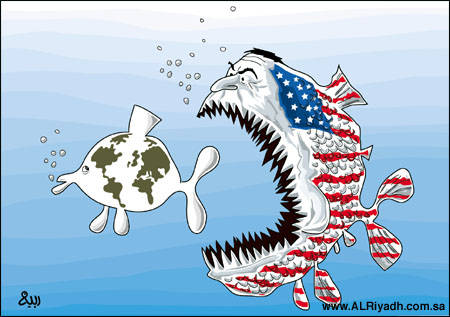
  • Sanctions and asset seizures are not neutral tools. They are weapons of empire. Venezuela and Russia stand at the center of this economic warfare, but they are not alone. From Iraq to Libya, nations have been stripped of their wealth, their citizens punished, and their sovereignty undermined. What emerges is a global system where confiscation and coercion replace dialogue and democracy.

    Venezuela’s Stolen Gold

    At the Bank of England, more than 31 tonnes of Venezuelan gold — worth over $1.5–2 billion — remain frozen in a legal battle between President Nicolás Maduro’s government and opposition figure Juan Guaidó. Maduro sought to use this gold to fund health services during the COVID‑19 crisis, but access was denied.1 Similar disputes extend to European banks, where Venezuelan reserves are locked away, preventing the government from addressing humanitarian needs.2

    This is not law; it is strangulation. Sovereign wealth has been transformed into hostage property.

    Russia and Venezuela: Assets Denied, Infrastructure Crippled

    Both nations face frozen reserves abroad, resources that could sustain hospitals, schools, and public works. Instead, billions sit idle in foreign vaults, while ordinary citizens endure shortages and collapsing infrastructure. Sovereign wealth is held hostage, denied to the very populations it was meant to serve.

    Turning Citizens Against Their Own Governments

    In Venezuela, sanctions and propaganda campaigns redirect public anger toward domestic leadership rather than external interference. Scarcity is weaponized, creating the illusion that the government alone is responsible for hardship. This is democracy eroded under the guise of humanitarian concern.

    Exile and Regime Change Narratives

    Exiled Venezuelans, backed by foreign powers, lobby for intervention and overthrow. Their rhetoric of “liberation” masks the reality of destabilization and bloodshed. The pattern echoes Iraq and Libya, where external actors used exile communities to justify intervention.

    Historical Parallels: Iraq and Libya

    Iraq (1990–2003): UN sanctions barred trade, froze assets, and devastated civilian life. Surveys estimated between 227,000 and 500,000 excess child deaths under the age of five during the sanctions era.34

    Libya (2011–present): Sanctions froze the assets of the Libyan Investment Authority (LIA), Africa’s largest sovereign wealth fund. More than $68 billion remains frozen globally, unable to be reinvested for the Libyan people.5 Other reports suggest the total frozen assets may exceed $200 billion.6

    These precedents show how sanctions and asset seizures are preludes to deeper destabilization, often justified by humanitarian rhetoric but resulting in humanitarian catastrophe.

    Sanctions as Collective Punishment

    Sanctions imposed by multiple countries extend beyond governments to entire populations. Livelihoods are restricted, futures constrained, and sovereignty undermined. The supposed moral high ground of sanctions collapses under the weight of their human toll.

    Stirring the Flames of Global Conflict

    Asset seizures and sanctions ripple outward, stoking tensions across continents. Economic warfare bleeds into military confrontation, pushing the world toward perpetual conflagration. What emerges is not stability, but a planet perpetually on fire.

    Conclusion: The Human Cost of Hostage Property

    When sovereign assets are seized, they become hostage property. Locked away in foreign vaults, they are denied to the very people who need them most. It is not presidents or elites who suffer from these sanctions — it is the poor, the marginalized, the mothers who cannot find medicine for their children, the workers whose wages collapse, the elders whose pensions vanish into thin air.

    Sanctions do not kill presidents. They do not wound the wealthy, nor silence the powerful. Instead, they starve the powerless, punish the innocent, and deepen inequality.

    This is the cruel paradox: sanctions are justified as tools of justice, yet they inflict injustice on those least able to bear it. They are proclaimed as instruments of democracy, yet they erode the very foundations of democratic life.

    If humanity is to reclaim conscience, it must reject this system of collective punishment. Sovereign wealth must serve the people, not be held hostage. And the world must remember sanctions burn the poor, not the powerful.

    Endnotes:

    The post Hostage Property and the Global Firestorm first appeared on Dissident Voice.
    1    BullionStar: Venezuela’s 31 tonnes of seized gold at the Bank of England.
    2    Venezuela Solidarity Campaign: Factsheet on why the Bank of England refuses to return Venezuela’s gold, estimated at $2 billion.
    3    BMJ Global Health: Analysis of child mortality under Iraq sanctions, estimates up to 500,000 excess deaths.
    4    Geneva International Centre for Justice: Documentation of humanitarian catastrophe under Iraq sanctions.
    5    The European Magazine: Libyan Investment Authority’s $68 billion assets frozen globally since 2011.
    6    Al‑Estiklal Newspaper: Reports suggest Libya’s frozen assets may total $200 billion.

    This post was originally published on Dissident Voice.

  • A new trove of documents obtained by The Grayzone through freedom of information (FOI) requests provide unprecedented insight into Britain’s little-known military and intelligence censorship board. The contents lay bare how the secretive Defence and Security Media Advisory (DSMA) Committee censors the output of British journalists, while categorizing independent media as “extremist” for publishing “embarrassing” stories. The body imposes what are known as D-Notices, gag-orders systematically suppressing information available to the public.

    The post Files Expose Britain’s Secret D-Notice Censorship Regime appeared first on PopularResistance.Org.

    This post was originally published on PopularResistance.Org.

  • For decades, Washington has sold the world a deadly lie: that “regime change” brings freedom, that U.S. bombs and blockades can somehow deliver democracy. But every country that has lived through this euphemism knows the truth—it instead brings death, dismemberment, and despair. Now that the same playbook is being dusted off for Venezuela, the parallels with Iraq and other U.S. interventions are an ominous warning of what could follow.

    As a U.S. armada gathers off Venezuela, a U.S. special operations aviation unit aboard one of the warships has been flying helicopter patrols along the coast. This is the 160th Special Operations Aviation Regiment (SOAR) — the “Nightstalkers” — the same unit that, in U.S.-occupied Iraq, worked with the Wolf Brigade, the most feared Interior Ministry death squad.

    Western media portray the 160th SOAR as an elite helicopter force for covert missions. But in 2005, an officer in the regiment blogged about joint operations with the Wolf Brigade as they swept Baghdad detaining civilians. On November 10, 2005, he described a “battalion-sized joint operation” in southern Baghdad and boasted, “As we passed vehicle after vehicle full of blindfolded detainees, my face stretched into a long wolfish smile.”

    Many people seized by the Wolf Brigade and other U.S.-trained Special Police Commandos were never seen again; others turned up in mass graves or morgues, often far from where they’d been taken. Bodies of people detained in Baghdad were found in mass graves near Badra, 70 miles away — but that was well within the combat range of the Nightstalkers’ MH-47 Chinook helicopters.

    This was how the Bush–Cheney administration responded to Iraqi resistance to an illegal invasion: catastrophic assaults on Fallujah and Najaf, followed by the training and unleashing of death squads to terrorize civilians and ethnically cleanse Baghdad. The UN reported over 34,000 civilians killed in 2006 alone, and epidemiological studies estimate roughly a million Iraqis died overall.

    Iraq has never fully recovered—and the U.S. never reaped the spoils it sought. The exiles Washington installed to rule Iraq stole at least $150 billion from its oil revenues, but the Iraqi parliament rejected U.S.-backed efforts to grant shares of the oil industry to Western companies. Today, Iraq’s largest trading partners are China, India, the UAE, and Turkey—not the United States.

    The neocon dream of “regime change” has a long, bloody history, its methods ranging from coups to full-scale invasions. But “regime change” is a euphemism: the word “change” implies improvement. A more honest term would be “government removal”—or simply the destruction of a country or society.

    A coup usually involves less immediate violence than a full-scale invasion, but they pose the same question: who or what replaces the ousted government? Time after time, U.S.-backed coups and invasions have installed rulers who enrich themselves through embezzlement, corruption, or drug trafficking—while making life worse for ordinary people.

    These so-called “military solutions” rarely resolve problems, real or imaginary, as their proponents promise. They more often leave countries plagued by decades of division, instability, and suffering.

    Kosovo was carved out of Serbia by an illegal US-led war in 1999, but it is still not recognized by many nations and remains one of the poorest countries in Europe. The main U.S. ally in the war, Hashim Thaçi, now sits in a cell at the Hague, charged with horrific crimes committed under cover of NATO’s bombing.

    In Afghanistan, after 20 years of bloody war and occupation, the United States was eventually defeated by the Taliban—the very force it had invaded the country to remove.

    In Haiti, the CIA and U.S. Marines toppled the popular democratic government of Jean-Bertrand Aristide in 2004, plunging the country into an ongoing crisis of corruption, gang rule, and despair that continues to this day.

    In 2006, the U.S. militarily supported an Ethiopian invasion of Somalia to install a new government—an intervention that gave rise to Al Shabab, an Islamic resistance group that still controls large swaths of the country. U.S. AFRICOM has conducted 89 airstrikes in Al Shabab-held territory in 2025 alone.

    In Honduras, the military removed its president, Mel Zelaya, in a coup in 2009, and the U.S. supported an election to replace him. The U.S.-backed president Juan Orlando Hernandez turned Honduras into a narco-state, fueling mass emigration—until Xiomara Castro, Zelaya’s wife, was elected to lead a new progressive government in 2021.

    Libya, a country with vast oil wealth, has never recovered from the U.S. and allied invasion in 2011, which led to years of militia rule, the return of slave markets, the destabilizing of neighboring countries and a 45% reduction in oil exports.

    Also in 2011, the U.S. and its allies escalated a protest movement in Syria into an armed rebellion and civil war. That spawned ISIS, which in turn led to the U.S.-led massacres that destroyed Mosul in Iraq and Raqqa in Syria in 2017. Turkish-backed, Al Qaeda-linked rebels finally seized the capital in 2024 and formed a transitional government, but IsraelTurkey, and the U.S. still militarily occupy other parts of the country.

    The U.S.-backed overthrow of Ukraine’s elected government in 2014 brought in a pro-Western leadership that only half the population recognized as a legitimate government. That drove Crimea and Donbas to secede and put Ukraine on a collision course with Russia, setting the stage for the Russian invasion in 2022 and the wider, still-escalating conflict between NATO and Russia.

    In 2015, when the Ansar Allah (Houthi) movement assumed power in Yemen after the resignation of a U.S.-backed transitional government, the U.S. joined a Saudi-led air war and blockade that caused a humanitarian crisis and killed hundreds of thousands of Yemenis—yet did not defeat the Houthis.

    That brings us to Venezuela. Ever since Hugo Chavez was elected in 1998, the U.S. has been trying to overthrow the government. There was the failed 2002 coup; crippling unilateral economic sanctions; the farcical recognition of Juan Guaido as a wannabe president; and the 2020 “Bay of Piglets” mercenary fiasco.

    But even if “regime change” in Venezuela were achievable, it would still be illegal under the UN Charter. U.S. presidents are not emperors, and leaders of other sovereign nations do not serve “at the emperor’s pleasure” as if Latin America were still a continent of colonial outposts.

    In Venezuela today, Trump’s opening shots—attacks on small civilian boats in the Caribbean—have been condemned as flagrantly illegal, even by U.S. senators who routinely support America’s illegal wars.

    Yet Trump still claims to be “ending the era of endless wars.” His most loyal supporters insist he means it—and that he was sabotaged in his first term by the “deep state.” This time, he has surrounded himself with loyalists and sacked National Security Council staffers he identified as neocons or warhawks, but he has still not ended America’s wars.

    Alongside Trump’s piracy in the Caribbean, he is a full partner in Israel’s genocide in Gaza and the bombing of  Iran. He has maintained the global empire of U.S. military bases and deployments, and supercharged the U.S. war machine with a trillion dollar war chest—draining desperately needed resources out of a looted domestic economy.

    Trump’s appointment of Marco Rubio as Secretary of State and National Security Advisor was an incendiary choice for Latin America, given Rubio’s open hostility to Cuba and Venezuela.

    Brazilian President Lula made that clear when he met Trump in Malaysia at the ASEAN conference, saying: “There will be no advances in negotiations with the United States if Marco Rubio is part of the team. He opposes our allies in Venezuela, Cuba, and Argentina.” At Lula’s insistence, Rubio was excluded from talks over U.S. investments in Brazil’s rare earth metals industry, the world’s second largest after China’s.

    Cuba-bashing may have served Rubio well in domestic politics, but as Secretary of State it renders him incapable of responsibly managing U.S. relations with the rest of the world. Trump will have to decide whether to pursue constructive engagement with Latin America or let Rubio corner him into new conflicts with our neighbors. Rubio’s threats of sanctions against countries that welcome Cuban doctors are already alienating governments across the globe.

    Trump’s manufactured crisis with Venezuela exposes the deep contradictions at the heart of his foreign policy: his disastrous choice of advisers; his conflicting ambitions to be both a war leader and a peacemaker; his worship of the military; and his surrender to the same war machine that ensnares every American president.

    If there is one lesson from the long history of U.S. interventions, it’s that “regime change” doesn’t bring democracy or stability. As the United States threatens Venezuela with the same arrogance that has wrecked so many other countries, this is the moment to end this cycle of imperial U.S. violence once and for all.

    The post “Regime Change” in Venezuela Is a Euphemism for U.S.-Inflicted Carnage and Chaos first appeared on Dissident Voice.

    This post was originally published on Dissident Voice.

  • Accusations of violent interceptions and human rights violations levelled at EU-funded Libyan services by NGOs

    More than a dozen NGO rescue vessels operating in the Mediterranean have suspended communication with the Libyan coastguard, citing escalating incidents of asylum seekers being violently intercepted at sea and taken to camps rife with torture, rape and forced labour.

    The 13 search-and-rescue organisations described their decision as a rejection of mounting pressure by the EU, and Italy in particular, to share information with the Libyan coastguard, which receives training, equipment and funding from the EU.

    Continue reading…

    This post was originally published on Human rights | The Guardian.

  • Readers respond to Omid Djalili’s article defending his decision to perform at an event organised by the repressive Saudi regime

    In his recent article, Omid Djalili makes a case for the power of comedy to effect incremental cultural change, and this forms a part of his justification for performing at the Riyadh comedy festival (I have been criticised for being part of the Riyadh comedy festival. This is why I did it, 8 October).

    This may be so, though such a power will be minuscule, filtered not only by official censorship but by the knowledge that any truly challenging topic will not be broached. The understanding is that performers will not rock the boat, so it seems uncompelling to justify participation on the basis that the boat might be slightly rocked in vague and inoffensive ways.

    Continue reading…

    This post was originally published on Human rights | The Guardian.

  • Faramarz Farbod speaks with Yves Engler, a Canadian activist and author of 13 books, including most recently Canada’s Long Fight Against Democracy and Stand on Guard for Whom? (A People’s History of Canadian Military). The conversation explores Canada’s role in the world, its relationship with US capitalism and imperialism, Canada’s policies toward Iran and Cuba, misperceptions of Canada in the US, and the concept of Canadianism.

    The post Faramarz Farbod in Conversation with Yves Engler on Canada, the US, and Imperialism first appeared on Dissident Voice.

    This post was originally published on Dissident Voice.

  • A plan reportedly under consideration by the Trump administration to send up to one million Gazans to the divided country of Libya was met with criticism on Friday and Saturday, with several observers calling it part of a plan to carry out ethnic cleansing. On Friday, NBC News reported that the Trump administration has broached the plan with Libya’s leadership, though no final agreement has…

    Source

    This post was originally published on Latest – Truthout.

  • A federal judge has placed a hold on the U.S. government’s plans to deport a number of immigrants to Libya, following allegations from immigrants, their families and their lawyers that Immigration and Customs Enforcement (ICE) officials told them they would soon be sent to that country. The injunction placed by U.S. District Judge Brian Murphy states that the Trump administration’s actions…

    Source

    This post was originally published on Latest – Truthout.

  • The non-existent Iranian bomb has lesser importance to the existing bombs that threaten the world. United States (US) demands that Iran promise to halt pursuit of nuclear weapons and ballistic missile developments distract from the real intent of US actions — deter other nations from establishing more friendly relations with Iran and prevent them from gaining a correct perspective on the causes of the Middle East crises.

    The Joint Comprehensive Plan of Action (JCPOA) created a potential for extensive political, economic, and social engagements of the international community with Iran. The investments would lead to attachments, friendships, and alliances and initiate a revitalized, prosperous, and stronger Iran. A new perspective of Iran could yield a revised perspective of a violent, unstable, and disturbed Middle East. Israel and Saudi Arabia would finally receive attention as participants in bringing chaos to the Arab region. Economies committed to Iran’s progress and allied with its interests could bring pressure on Israel and Saudi Arabia to change their destructive behaviors.

    Because arguments with Iran could have been approached in a less provocative and insinuating manner, the previous demands were meant to provoke and insinuate. Assuredly, the US wants Iran to eschew nuclear and ballistic weapons, but the provocative approach indicated other purposes — alienate Iran, destroy its military capability, and bring Tehran to collapse and submission. For what reasons? Accomplishing the far-reaching goals will not affect the average American, lessen US defense needs, or diminish the continuous battering of the helpless faces of the Middle East. The strategy mostly pleased Israel and Saudi Arabia, who engineered it, share major responsibility for the Middle East turmoil, and consistently try to use mighty America to subdue the principal antagonist to their malicious activities. During the 2016 presidential campaign, contender Donald Trump said, “Many nations, including allies, ripped off the US.” President Donald Trump has verified that statement.

    Noting the history of US promises to leaders of other nations – give up your aggressive attitudes and you will benefit – the US promises make the Ayatollahs skeptical. The US reneged on the JCPOA, sent Serbian President Slobodan Milosevic to the World Court and eventual death (although his personal compromises were the key to the Dayton Accords that ended the Yugoslavian conflict), directly assisted NATO in the overthrow of subdued Libyan leader, Muammar Gaddafi, pulverized Iraq after sanctions could not drive that nation to total ruin, rejected the Iranian pledge of $560 million worth of assistance to Afghanistan at the Tokyo donors’ conference in January 2002, and, according to the U.S. envoy to Afghanistan, Richard Dobbins, disregarded Iran’s “decisive role in persuading the Northern Alliance delegation to compromise its demands of wanting 60 percent of the portfolios in an interim government.” Tehran has always sensed it is in a no-win situation. Regardless of its decisions and directions, the U.S. intends to pulverize the centuries old Persian lands.

    If the US honestly wants to have Iran promise never to pursue nuclear and ballistic missile weapons, it will approach the issues with a simple question, “What will it take for you (Iran) never to pursue these weapons?” Assuredly, the response will include provisions for the US to withdraw support from a despotic Saudi Kingdom in its oppression of minorities and opposition and propose that the US eliminate financial, military and cooperative support to Israel’s theft of Palestinian lands, oppressive conditions imposed on Palestinians, daily killings of Palestinian people, and expansionist plans. The correct question soliciting a formative response and leading to decisive US actions resolves two situations and benefits the US — fear of Iran developing weapons of mass destruction is relieved and the Middle East is pointed in a direction that achieves justice, peace, and stability for its peoples.

    Despite the August 2018 report from Trump’s U.S. Department of State’s Iran Action group, which “chronicle Iran’s destructive activities,” and consists of everything from most minor to most major, from unsubstantiated to retaliatory, from the present time to before the discovery of dirt, Iranians will not rebel in sufficient numbers against their own repressive state until they note the end of hypocritical support by western powers of other repressive states. Halting international terrorism, ameliorating the Middle East violence, and preventing any nation from establishing hegemony in the Arab world starts with Trump confronting Israel and Saudi Arabia, two nations whose records of injustice, aggression, oppression, and violation of human rights exceed that of the oppressive Iran regime.

    Otherwise, it will occur on a Sunday morning; always occurs in the early hours on the day of rest. It will come with a roar greater than the sum of all shrieks and screams ever uttered by humankind, rip across fields and cities, and burn through the flesh of a part of the world’s population.

    The post The Non-explosive Iranian Bomb first appeared on Dissident Voice.

    This post was originally published on Dissident Voice.

  • On 7 April, a Mondoweiss headline ran as “Trump announces surprise Iran talks during Netanyahu meeting.”

    United States president Donald Trump had met with Israeli prime minister Benjamin Netanyahu to discuss “Gaza, tariffs, and the alleged nuclear threat of Iran.” As for the latter, Trump said that the US is having direct talks with Iran on nuclear weapons and announced that there would be a “very big meeting” with important officials on April 12.

    Said Trump: “I think everybody agrees that doing a deal would be preferable to doing the obvious.”

    What is the obvious? If one abhors war and wants to avoid it, then it seems the obvious thing to do is to stop bullying Iran, stop provoking it, and stop issuing threats and engaging in belligerent rhetoric.

    Trump continued: “And the obvious is not something that … we’re going to see if we can avoid it. But it’s getting to be very dangerous territory.”

    Dangerous? How so? Just on Trump’s say-so? One would presume that Iran having nuclear arms is what Trump considers dangerous. If so, then what is the nuclear-armed Israel that Trump openly courts, funds, and fetes compared to Iran whose supreme leader Ali Khamenei issued a never-rescinded fatwa against acquiring nuclear weapons decades ago? How dangerous is Iran, which has avoided war for several decades, in comparison to Israel which is perennially provoking and at war with its neighbors, and is in the midst of a scaled-up genocide? Professor Gideon Polya writes of the “the US-backed, Zionist Israeli mass murder of about 0.6 million Indigenous Palestinian[s]” — a number elided by legacy media. Why has Trump not described Israel as “dangerous”? And why isn’t the US dangerous since it has been constantly at war since its inception, and it is the only country that has used nukes against another nation?

    Trump: “If the talks aren’t successful with Iran …”

    But US nuclear talks with Iran already were successful. The Obama administration already achieved what constitutes a successful nuclear deal with Iran — the Joint Comprehensive Plan of Action (JCPOA) — since the deal was agreed to by both sides. It was the Trump administration which scuttled the deal, i.e., reversed a success. So the current situation exists because Trump undermined a previous deal, and the very fact that a deal was reached should be considered a success.

    “… I think Iran is going to be in great danger,” Trump continued. “And I hate to say it, great danger, because they can’t have a nuclear weapon. You know, it’s not a complicated formula. Iran cannot have a nuclear weapon. That’s all there is.”

    That is hardly a compelling argument. Because Trump says so. He may point to the Nuclear Nonproliferation Treaty (NPT), but the US is also non-compliant with article 6 of the NPT.

    Which nation is dangerous?

    It is Israel and the US that are committing genocide in Gaza; Iran is not committing a genocide. Moreover, if you try to stop the genocide, then Trump will bomb you, civilian housing or not, as is the case in Yemen.

    It is Israel murdering paramedics, covering up its crime, and lying about it.

    It is Trump and Netanyahu’s aggressive moves toward Iran that are dangerous.

    Indeed, an Israeli official said that Netanyahu wants “the Libya model” in Iran, which would require a complete tearing down of Iran’s nuclear program.

    What was the outcome of the Libya model? Libya was disarmed, and the US and its Nato followers destroyed Africa’s wealthiest country, turning it into a dysfunctional state. That is likeliest the result that Israel wants for Iran.

    Is the world to be based on inequality among its nations? If not, then a progressivist principle holds that each nation has an inalienable right to self-defense. One way to avert war is to balance the power. North Korea knows what happened to Libya. It is now nuclear armed and this serves as a deterrent to aggressive nations who might otherwise attack it. Iran knows this as well. Ask yourself: if Iran was nuclear armed would Israel and the US be foolish enough to attack Iran?

    The post Danger in Trump’s Mind first appeared on Dissident Voice.

    This post was originally published on Dissident Voice.

  • With Trump’s recent tongue-lashing of Zelensky at their meeting in Washington DC, social media is now flooded with anguished cries about Ukraine’s sovereignty and how the U.S. must stand up to Russia’s empire-building invasion. The “consensus” claims Russia’s violation of Ukraine’s sovereignty cannot be tolerated and must be punished.

    Respect for sovereignty? Are these well-intentioned but completely misguided folks incapable of remembering the not so distant past?

    Did America respect Korea’s sovereignty when it canceled free and open elections there in 1950, instigating an unnecessary, brutal war? Over 2 million Koreans were killed.

    Did America respect Vietnam’s sovereignty when it decided Vietnam could not have a Communist government there and slaughtered 3 million people? Vietnam is communist now. I’ve lived there. It does just fine.

    Did America respect Serbia’s sovereignty when it bombed Belgrade for 79 days and finally carved out Kosovo so it could build what was for years the largest NATO base in Eastern Europe?

    Did America respect Afghanistan’s sovereignty when it refused to work with the Taliban when they offered to hand over Osama bin Laden, but chose instead to invade and launch a 22-year war? We killed tens of thousands of Afghanis, lost the war. The Taliban is still in power.

    Did America respect Iraq’s sovereignty when it lied about weapons of mass destruction and invaded, killing, and displacing hundreds of thousands of Iraqi citizens?

    Did America respect Libya’s sovereignty when it and its NATO puppets destroyed the richest country in Africa and killed its revered leader, Muammar Gaddafi? Libya is a broken country now with a dysfunctional economy and open slave markets.

    Did America respect Syria’s sovereignty when it funded terrorists to topple the government of Assad and eventually built bases in the country to choke off the food supply of the Syrian people and “steal their oil”?

    Did America itself respect Ukraine’s sovereignty when it engineered the Maidan coup in 2014, toppled the democratically elected president, and installed a US puppet regime in power?

    I could go on. But I’ll mention one last one, keeping in mind the Russiagate hoax where Russia was falsely accused of meddling in US elections …

    Did America respect RUSSIA’S SOVEREIGNTY when it funded the re-election campaign of Boris Yeltsin in 1996, because we knew he would do our bidding?

    Sovereignty, eh? If any of our leaders can even spell ‘sovereignty’, they sure as hell have no idea what it means.

    The post Sovereignty first appeared on Dissident Voice.

    This post was originally published on Dissident Voice.

  • The “take no prisoners” philosophy and “slash and burn” techniques of the Trump deadministration has its partisans, eager to release their suppressed fury at a glorified past that is being barred from the future. A new world order of rich, powerful, and self-absorbed supremos#2 replaces the previous “carefully constructed fake world,” where rich, powerful, and self-absorbed supremos#1 conspired with the media to delude the public by cheeky references to caring and sharing, while global exploitation, instability, and violence directed their lives. Quoting others, “The entire liberal deep state command and control system is broken.” Quoting nobody, “An anti-liberal deep state command and control system is being constructed to replace the broken liberal model.”

    Seems disturbing, electrifying, and paralyzing. Ho hum. Welcome to the world that is, has always been, and will be until the mushroom cloud signifies resolution of the problem. Started in the Garden of Eden, prophesized by Jesus of Nazareth, emphasized by the Manichaeism of Mani in Persia, eloquently expressed by Voltaire’s Candide, and staged by Anthony Newley in his 1966 musical, Stop the world, I want to get off, the battle between good and evil oscillates the world between low ground and lower ground. Those who gather their extensive knowledge and politely convey to the masses the absurdities of the institutions that govern them are accorded the adjectives of “mad dog,” “berserk,” “enemy of the people,” and a multitude of other kindly expressions. The smartest of all, the eminent Karl Marx, expressed it correctly, “The ruling ideas of each age have ever been the ideas of its ruling class.” The lord of the manor guides the way and the sheep in the manor blindly follow.

    It is difficult to characterize the events or specify the day that the nation’s mood changed from acceptance of neoliberalism to rejection, from supporting American “representative” democracy to pondering that it might be a delusion. It is not difficult to characterize what prompted some of the collective to modify approval of the established government. History has shown that, even if the U.S. military prevailed, engagement in a Vietnam War had no benefit to the United States. A war, conducted with no more reason than to slaughter Vietnamese, started the doubt that the will of the people prevailed. The violent execution of Libyan leader, “mad dog” Muammar Gaddafi, on 20 October 2011, during Barak Obama’s administration, finalized the doubt. As the truth of the events leading to NATO’s intervention in the Libyan civil war and the horrific facts of Gaddafi’s execution became known, a more aware public departed ways with Obama’s Democratic Party and 2016 presidential candidate, Hillary Clinton, the sponsors of U.S. favoring the NATO attack on Gaddafi’s Libya. Several times in the campaign, the attachment of former Secretary of State Hillary Clinton to the intervention was vigorously discussed. Difficult to prove that the war against Libya played a decisive role in the close 2016 election; not difficult to show the issue persuaded a number of voters to elevate Donald Trump to the highest office and established a modified psyche in the America of today.

    Barack Obama entered the presidential office with an appearance of protecting the Palestinians from Israeli oppression and allying with those who sought peace, stability, and freedom for the world’s dispossessed. President Barack Obama remained a system subordinate and betrayed those who supported him. Unlike Citizen Jimmy Carter, who used his knowledge and prestige to fight for the rights of others, Citizen Barack Obama has played it safe, maybe for personal reasons; other black leaders have been assassinated.

    The man, in whose assassination Obama played a decisive role, the much maligned Muammar Gaddafi, had scare resemblance to the coordinated media descriptions of him. Someone I met, who had been stationed at Wheelus Air force base in Libya, told me he was walking through Tripoli in 1970, noticed a man sitting on the sidewalk, and immediately recognized him as Colonel Muammar Muhammad Abu Minyar al-Gaddafi, Libya’s new leader who had, in the previous year, overthrown the monarchy in a bloodless coup. The solitary person of deep thought and avant-garde behavior in action and dress, is the Gaddafi I sensed from his rhetoric, accomplishments, and interviews. The usual simplified description of an antagonist to U.S. policy as a terrorist, madman, tyrant, and executioner has negligible verification; mostly slanted stories or original fiction from the U.S. Stateless Department and Unintelligence agencies who have issues with revolutionary thoughts and deeds.

    As moral, spiritual, and undoubtedly defacto leader in the governing of Libya, Gaddafi used his nation for one of the boldest experiments in participatory democracy. Claiming, as many have, that representative democracy is manipulated, that “in western parliamentary democracies, special interests compete for and gain power without representing the people,” the Libyan leader established a grassroots approach to government ─ a series of Popular Conferences and People’s Committees worked together to propose and a higher elected authority served to dispose. In Gaddafi’s words: “The final step is when the new socialist society reaches the stage where profit and money disappear. It is through transforming society into a fully productive society, and through reaching in production a level where the material needs of the members of society are satisfied. On that final stage, profit will automatically disappear and there will be no need for money.”

    The military colonel turned social and economic prophet may have been derivative and naïve in his approach and dictatorial in forcing the grandiose experiment upon a people not prepared for its implementation. Gaddafi later recognized the dilemma by admitting that people subjected to colonialism may not have acquired the required resources, knowledge, and capability for the extraordinary leap to the socialist ideal; adopting the doctrines in his Green Book needed a more advanced nation. In 2003, despite Libya having the highest GDP/capita and standard of living in Africa, he admitted defeat and pursued more conventional free enterprise economic policies for the Libya nation. The U.S. invasion of Iraq and demise of Saddam Hussein may have contributed to Gaddafi’s decision.

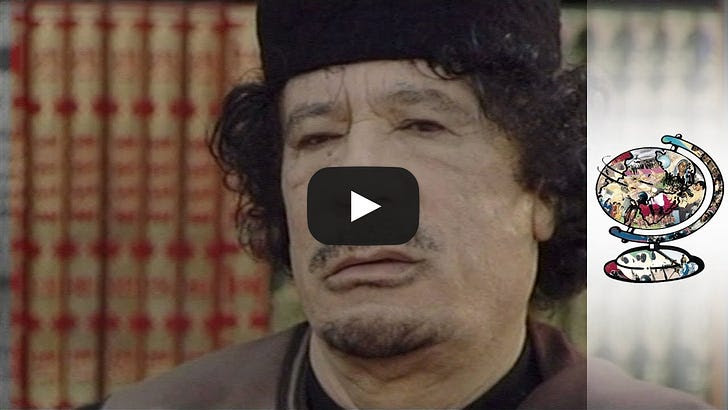
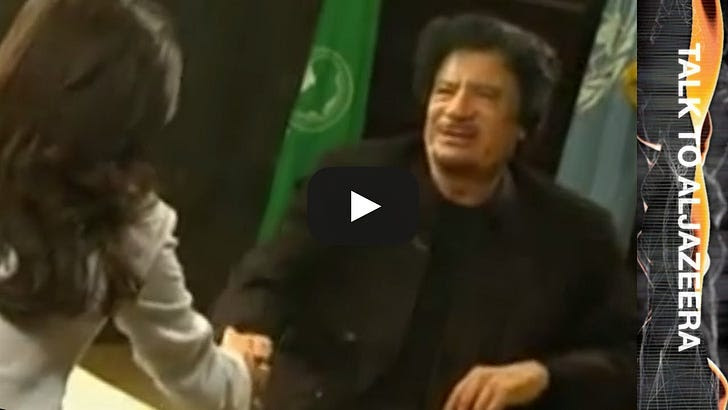
    Interviews available at

    and at

    reveal Gaddafi as a purposively deceptive person, who had knowledge of all issues, intentionally responded quietly and succinctly, controlled emotions, played down his abilities, and strategically placed the “gotcha” questioners into a “gotcha retreat.” These interviews do not show the persona Gaddafi, who is better described in a speech to the Libyan people at

    where he displays a forceful personality and ability to speak extemporaneously.

    Note: May have to click a few times.

    Prophetic Gaddafi admired Barak Obama, principally due to the American president’s African and Muslim heritage, which, according to Gaddafi, enabled Obama to think more as an African and not as a “Yankee.” Gaddafi missed a beat in wanting the person most responsible for his vicious execution to remain in office for eternity. Obama missed more than a beat by listening to the absurd rhetoric that brought the United States to join a NATO-led collation, which, on March 19, 2011 began a military intervention into the ending Libyan Civil War and implemented United Nations Security Council Resolution 1973 (UNSCR 1973). The Resolution demanded “an immediate ceasefire” and authorized the international community to “establish a no-fly zone and to use all means necessary short of foreign occupation to protect civilians.”

    Principal reason given for the UN Resolution — Gaddafi was prepared to massacre at least 100,000 of his opponents, a 1000 times exaggeration and an obvious impossibility. President Barack Obama addressed the issue with the statement: “Gaddafi declared that he would show ‘no mercy’ to his own people. He compared them to rats, and threatened to go door to door to inflict punishment.”

    Reuters reporting demonstrated large differences between Gaddafi’s remarks and President Obama’s careless interpretation: Gaddafi Tells Rebel City, Benghazi, ‘We Will Show No Mercy, March 17, 2011.

    Muammar Gaddafi told Libyan rebels on Thursday his armed forces were coming to their capital Benghazi tonight and would not show any mercy to fighters who resisted them. In a radio address, he told Benghazi residents that soldiers would search every house in the city and people who had no arms had no reason to fear. He also told his troops not to pursue any rebels who drop their guns and flee when government forces reach the city.

    Logic tells us that few Benghazi residents had guns to hide, and Gadhafi’s forces were too limited to carry out any large-scale purge. Gadhafi’s comment (much different than Obama’s presentation) was only meant to create fear. No leader would tell his people he intended to kill masses of them. If so, they had nothing to lose by fighting. Why encourage them?

    The next morsel of food for thought is that the civil war was no threat to any NATO nation. The clincher – the western nations had not considered any changes in Libya’s future. Suddenly, with no plan, no knowledge of the rebel forces’ constituencies, and no idea as to where the interference would lead, NATO attacked Libya.

    Martin Aliker a senior adviser to Yoweri Museveni President Yoweri Museveni of Yoweri, in his memoir, “The Bell is Ringing: Martin Aliker’s Story,” recites his opinion.

    They were only interested in “killing Gaddafi, killing Gaddafi, and killing Gaddafi.” Gaddafi was quoted as saying that what the enemies of Libya did not understand was that if they changed his regime the next one would be of Islamic extremists and al-Qaeda.

    He said that Libya was the Great Wall which, if broken, would lead to a flood of illegal immigrants into Europe, some of whom would die on the water but some would survive and reach Europe. He said he was ready to talk to the rebels but that the rebels were not ready to talk.

    Gaddafi proved to be omniscient and intentionally vilified. On March 17, he directly addressed the rebels of Benghazi: “Throw away your weapons, exactly like your brothers in Ajdabiya and other places did. They laid down their arms and they are safe. We never pursued them at all.”

    The duplicitous attack on Muhammar Gaddafi and his nation, promoted by then Secretary of State, Hillary Rodham Clinton, contributed to her loss in the 2016 presidential election and the entrance of real estate magnate, Donald Trump, into the highest office in the coast-to-coast U.S. mainland.

    The 2024 presidential election, and its immediate aftermath may have proved Gaddafi correct ─ representative democracy could be a delusion.

    Stop the world, I want to get off.

    The post How Did We Get to Donald Trump first appeared on Dissident Voice.

    This post was originally published on Dissident Voice.

  • China went from one of the poorest countries in the world to global economic powerhouse in a mere four decades. Currently featured in the news is DeepSeek, the free, open source A.I. built by innovative Chinese entrepreneurs which just pricked the massive U.S. A.I. bubble.

    Even more impressive, however, is the infrastructure China has built, including 26,000 miles of high speed rail, the world’s largest hydroelectric power station, the longest sea-crossing bridge in the world, 100,000 miles of expressway, the world’s first commercial magnetic levitation train, the world’s largest urban metro network, seven of the world’s 10 busiest ports, and solar and wind power generation accounting for over 35% of global renewable energy capacity. Topping the list is the Belt and Road Initiative, an infrastructure development program involving 140 countries, through which China has invested in ports, railways, highways and energy projects worldwide.

    All that takes money. Where did it come from? Numerous funding sources are named in mainstream references, but the one explored here is a rarely mentioned form of quantitative easing — the central bank just “prints the money.” (That’s the term often used, though printing presses aren’t necessarily involved.)

    From 1996 to 2024, the Chinese national money supply increased by a factor of more than 53 or 5300% — from 5.84 billion to 314 billion Chinese yuan (CNY) [see charts below]. How did that happen? Exporters brought the foreign currencies (largely U.S. dollars) they received for their goods to their local banks and traded them for the CNY needed to pay their workers and suppliers. The central bank —the Public Bank of China or PBOC — printed CNY and traded them for the foreign currencies, then kept the foreign currencies as reserves, effectively doubling the national export revenue.

    Investopedia confirms that policy, stating:

    One major task of the Chinese central bank, the PBOC, is to absorb the large inflows of foreign capital from China’s trade surplus. The PBOC purchases foreign currency from exporters and issues that currency in local yuan. The PBOC is free to publish any amount of local currency and have it exchanged for forex. … The PBOC can print yuan as needed …. [Emphasis added.]

    Interestingly, that huge 5300% explosion in local CNY did not trigger runaway inflation. In fact China’s consumer inflation rate, which was as high as 24% in 1994, leveled out after that and averaged 2.5% per year from 1996 to 2023.


    https://www.macrotrends.net/global-metrics/countries/CHN/china/inflation-rate-cpi?form=MG0AV3

    How was that achieved? As in the U.S., the central bank engages in “open market operations” (selling federal securities into the open market, withdrawing excess cash). It also imposes price controls on certain essential commodities. According to a report by Nasdaq, China has implemented price controls on iron ore, copper, corn, grain, meat, eggs and vegetables as part of its 14th five-year plan (2021-2025), to ensure food security for the population. Particularly important in maintaining price stability, however, is that the money has gone into manufacturing, production and infrastructure. GDP (supply) has gone up with demand (money), keeping prices stable. [See charts below.]


    https://tradingeconomics.com/united-states/money-supply-m2Gross Domestic Product for China (MKTGDPCNA646NWDB) | FRED | St. Louis Fed


    Gross Domestic Product for China (MKTGDPCNA646NWDB) | FRED | St. Louis Fed

    The U.S., too, has serious funding problems today, and we have engaged in quantitative easing (QE) before. Could our central bank also issue the dollars we need without triggering the dreaded scourge of hyperinflation? This article will argue that we can. But first some Chinese economic history.

    From Rags to Riches in Four Decades

    China’s rise from poverty began in 1978, when Deng Xiaoping introduced market-oriented reforms. Farmers were allowed to sell their surplus produce in the market, doors were opened to foreign investors and private businesses and foreign companies were encouraged to grow. By the 1990s, China had become a major exporter of low-cost manufactured goods. Key factors included cheap labor, infrastructure development and World Trade Organization membership in 2001.

    Chinese labor is cheaper than in the U.S. largely because the government funds or subsidizes social needs, reducing the operational costs of Chinese companies and improving workforce productivity. The government invests heavily in public transportation infrastructure, including metros, buses and high-speed rail, making them affordable for workers and reducing the costs of getting manufacturers’ products to market.

    The government funds education and vocational training programs, ensuring a steady supply of skilled workers, with government-funded technical schools and universities producing millions of graduates annually. Affordable housing programs are provided for workers, particularly in urban areas.

    China’s public health care system, while not free, is heavily subsidized by the government. And a public pension system reduces the need for companies to offer private retirement plans. The Chinese government also provides direct subsidies and incentives to key industries, such as technology, renewable energy and manufacturing.

    After it joined the WTO, China’s exports grew rapidly, generating large trade surpluses and an influx of foreign currency, allowing the country to accumulate massive foreign exchange reserves. In 2010, China surpassed the U.S. as the world’s largest exporter. In the following decade, it shifted its focus to high-tech industries, and in 2013 the Belt and Road Initiative was launched. The government directed funds through state-owned banks and enterprises, with an emphasis on infrastructure and industrial development.

    Funding Exponential Growth

    In the early stages of reform, foreign investment was a key source of capital. Export earnings then generated significant foreign exchange reserves. China’s high savings rate provided a pool of liquidity for investment, and domestic consumption grew. Decentralizing the banking system was also key. According to a lecture by U.K. Prof. Richard Werner:

    Deng Xiaoping started with one mono bank. He realized quickly, scrap that; we’re going to have a lot of banks. He created small banks, community banks, savings banks, credit unions, regional banks, provincial banks. Now China has 4,500 banks. That’s the secret to success. That’s what we have to aim for. Then we can have prosperity for the whole world. Developing countries don’t need foreign money. They just need community banks supporting [local business] to have the money to get the latest technology.

    China managed to avoid the worst impacts of the 1997 Asian Financial Crisis. It did not devalue its currency; it maintained strict control over capital flows and the PBOC acted as a lender of last resort, providing liquidity to state-controlled banks when needed.

    In the 1990s, however, its four major state banks did suffer massive losses, with non-performing loans totaling more than 20% of their assets. Technically, the banks were bankrupt, but the government did not let them go bust. The non-performing loans were moved on to the balance sheets of four major asset management companies (“bad banks”), and the PBOC injected new capital into the “good banks.”

    In a January 2024 article titled “The Chinese Economy Is Due a Round of Quantitative Easing,” Prof. Li Wei, Director of the China Economy and Sustainable Development Center, wrote of this policy, “The central bank directly intervened in the economy by creating money. Seen this way, unconventional financing is nothing less than Chinese-style quantitative easing.”

    In an August 2024 article titled “China’s 100-billion-yuan Question: Does Rare Government Bond Purchase Alter Policy Course?,” Sylvia Ma wrote of China’s forays into QE:

    Purchasing government bonds in the secondary market is allowed under Chinese law, but the central bank is forbidden to subscribe to bonds directly issued by the finance ministry. [Note that this is also true of the U.S. Fed.] Such purchases from traders were tried on a small scale 20 years ago.

    However, the monetary authority resorted more to printing money equivalent to soaring foreign exchange reserves from 2001, as the country saw a robust increase in trade surplus following its accession to the World Trade Organization. [Emphasis added.]

    This is the covert policy of printing CNY and trading this national currency for the foreign currencies (mostly U.S. dollars) received from exporters.

    What does the PBOC do with the dollars? It holds a significant portion as foreign exchange reserves, to stabilize the CNY and manage currency fluctuations; it invests in U.S. Treasury bonds and other dollar-denominated assets to earn a return; and it uses U.S. dollars to facilitate international trade deals, many of which are conducted in dollars.

    The PBOC also periodically injects capital into the three “policy banks” through which the federal government implements its five-year plans. These are China Development Bank, the Export-Import Bank of China, and the Agricultural Development Bank of China, which provide loans and financing for domestic infrastructure and services as well as for the Belt and Road Initiative. A January 2024 Bloomberg article titled “China Injects $50 Billion Into Policy Banks in Financing Push” notes that the policy banks “are driven by government priorities more than profits,” and that some economists have called the PBOC funding injections “helicopter money” or “Chinese-style quantitative easing.”

    Prof. Li argues that with the current insolvency of major real estate developers and the rise in local government debt, China should engage in this overt form of QE today. Other commentators agree, and the government appears to be moving in that direction. Prof. Li writes:

    As long as it does not trigger inflation, quantitative easing can quickly and without limit generate sufficient liquidity to resolve debt issues and pump confidence into the market.…

    Quantitative easing should be the core of China’s macroeconomic policy, with more than 80% of funds coming from QE

    As the central bank is the only institution in China with the power to create money, it has the ability to create a stable environment for economic growth. [Emphasis added.]

    Eighty-percent funding just from money-printing sounds pretty radical, but China’s macroeconomic policy is determined by five-year plans designed to serve the public and the economy, and the policy banks funding the plans are publicly-owned. That means profits are returned to the public purse, avoiding the sort of private financialization and speculative exploitation resulting when the U.S. Fed engaged in QE to bail out the banks after the 2007-08 banking crisis.

    The U.S. Too Could Use Another Round of QE — and Some Public Policy Banks

    There is no law against governments or their central banks just printing the national currency without borrowing it first. The U.S. Federal Reserve has done it, Abraham Lincoln’s Treasury did it, and it is probably the only way out of our current federal debt crisis. As Prof. Li observes, we can do it “without limit” so long as it does not trigger inflation.

    Financial commentator Alex Krainer observes that the total U.S. debt, public and private, comes to more than $101 trillion (citing the St. Louis Fed’s graph titled “All Sectors; Debt Securities and Loans”). But the monetary base — the reserves available to pay that debt — is only $5.6 trillion. That means the debt is 18 times the monetary base. The U.S. economy holds far fewer dollars than we need for economic stability.

    The dollar shortfall can be filled debt- and interest-free by the U.S. Treasury, just by printing dollars as Lincoln’s Treasury did (or by issuing them digitally). It can also be done by the Fed, which “monetizes” federal securities by buying them with reserves it issues on its books, then returns the interest to the Treasury and after deducting its costs. If the newly-issued dollars are used for productive purposes, supply will go up with demand, and prices should remain stable.

    Note that even social services, which don’t directly produce revenue, can be considered “productive” in that they support the “human capital” necessary for production. Workers need to be healthy and well educated in order to build competitively and well, and the government needs to supplement the social costs borne by companies if they are to compete with China’s subsidized businesses.

    Parameters would obviously need to be imposed to circumscribe Congress’s ability to spend “without limit,” backed by a compliant Treasury or Fed. An immediate need is for full transparency in budgeted expenditures. The Pentagon, for example, spends nearly $1 trillion of our taxpayer money annually and has never passed a clean audit, as required by law.

    We Sorely Need an Infrastructure Bank

    The U.S. is one of the few developed countries without an infrastructure bank. Ironically, it was Alexander Hamilton, the first U.S. Treasury secretary, who developed the model. Winning freedom from Great Britain left the young country with what appeared to be an unpayable debt. Hamilton traded the debt and a percentage of gold for non-voting shares in the First U.S. Bank, paying a 6% dividend. This capital was then leveraged many times over into credit to be used specifically for infrastructure and development. Based on the same model, the Second U.S. Bank funded the vibrant economic activity of the first decades of the United States.

    In the 1930s, Roosevelt’s government pulled the country out of the Great Depression by repurposing a federal agency called the Reconstruction Finance Corporation (RFC) into a lending machine for development on the Hamiltonian model. Formed under the Hoover administration, the RFC was not actually an infrastructure bank but it acted like one. Like China Development Bank, it obtained its liquidity by issuing bonds.

    The primary purchaser of RFC bonds was the federal government, driving up the federal debt; but the debt to GDP ratio evened out over the next four decades, due to the dramatic increase in productivity generated by the RFC’s funding of the New Deal and World War II. That was also true of the federal debt after the American Revolution and the Civil War.


    One chart that tells the story of US debt from 1790 to 2011

    A pending bill for an infrastructure bank on the Hamiltonian model is HR 4052, The National Infrastructure Bank Act of 2023, which ended 2024 with 48 sponsors and was endorsed by dozens of legislatures, local councils, and organizations. Like the First and Second U.S. Banks, it is intended to be a depository bank capitalized with existing federal securities held by the private sector, for which the bank will pay an additional 2% over the interest paid by the government. The bank will then leverage this capital into roughly 10 times its value in loans, as all depository banks are entitled to do. The bill proposes to fund $5 trillion in infrastructure capitalized over a 10-year period with $500 billion in federal securities exchanged for preferred (non-voting) stock in the bank. Like the RFC, the bank will be a source of off-budget financing, adding no new costs to the federal budget. (For more information, see https://www.nibcoalition.com/.)

    Growing Our Way Out of Debt

    Rather than trying to kneecap our competitors with sanctions and tariffs, we can grow our way to prosperity by turning on the engines of production. Far more can be achieved through cooperation than through economic warfare. DeepSeek set the tone with its free, open source model. Rather than a heavily guarded secret, its source code is freely available to be shared and built upon by entrepreneurs around the world.

    We can pull off our own economic miracle, funded with newly issued dollars backed by the full faith and credit of the government and the people. Contrary to popular belief, “full faith and credit” is valuable collateral, something even Bitcoin and gold do not have. It means the currency will be accepted everywhere – not just at the bank or the coin dealer’s but at the grocer’s and the gas station. If the government directs newly created dollars into new goods and services, supply will grow along with demand and the currency should retain its value. The government can print, pay for workers and materials, and produce its way into an economic renaissance.

    The post “Quantitative Easing with Chinese Characteristics” first appeared on Dissident Voice.

    This post was originally published on Dissident Voice.

  • Waking up, day after day, and seeing continuous disasters visited upon the Palestinian people forecasts a day of facing the light at an increasingly dark level. It is impossible to be unaware of the genocide; yet an entire nation reinforces it. The American people are disposed to the sufferings its government inflicts upon others.

    Election of an authoritarian to the highest office, who appoints cabinet positions with qualifications that require little experience in government affairs and extensive experience in extramarital affairs, completes the mystification. Elise Stefanik, selected as America’s representative to the United Nations, agrees to the proposition that “Israel has a biblical right to the West Bank.” Shuddering! Doesn’t qualification for a cabinet position require knowledge that the bible does not determine right and that the Earth is round and not flat? Hopefully, UN security guards will bar entry of her and other vocal terrorists into the UN building.

    Maintaining the Declaration of Independence and Constitution will be a battle. Refusing to have the Old Testament on a night table and the Ten Commandments on the living room wall will be challenging . Knowing that America is in a dystopia, “livin’ a vida loca,” will be difficult to absorb. These are not the principal problems that prevent America from being great again. The principal problem in the United States is a government that has been unable to resolve its problems. For decades, a multitude of problems have surfaced, talked about, and been ignored. Suggestions for solutions are cast aside as empty words ─ U.S. governments are only interested in donor offerings and contributing lobbyists; attention to the people’s problems is time consuming and not remunerative.

    Look at the extensive record of problems, which has been growing for decades and have some obvious solutions. After these crisp answers, I might elaborate on them in forthcoming articles.

    (1) Social Security
    The ready to collapse Social Security system has present earners paying for retired workers and closely resembles a national pension plan. Instead of having workers and corporations pay FICA taxes, why not collect revenue from income and corporation taxes and finance a real national pension plan?

    (2) Gun Violence
    Decades of gun violence and shootings in schools have been succeeded by decades of gun violence and shootings in schools. An idea ─ get rid of the guns; nobody will miss them.

    (3) Climate Change
    In the 1964 presidential contest between Senator Goldwater and President Johnson, Goldwater posed as the “war hawk,” ready to pounce on the North Vietnamese. Johnson’s famous phrase was, “I’ll not have American boys do what Vietnamese boys should do.” After Johnson won the presidency and had “American boys do what Vietnamese boys should do,” Goldwater voters reminded everyone, “They told me if I voted for Goldwater our military intervention in Vietnam would greatly increase. I voted for Goldwater and they were correct.”

    In all elections, voters are reminded that voting Republican enhances global warming. In all elections that the Democrats won, those who voted Republican noted that global warming continued to increase.

    (4) Government debt
    Mention government debt and blood boils ─ another of those internalized issues, courtesy of the mind manipulators. Government debt is the result of problems and not the problem. The problems are (1) Income taxes are too low to finance meaningful government projects; (2) The military spending is too high and; (3) The economy runs on debt and government debt rescues a faltering economy. Give attention to the real problems and government debt will be greatly reduced.

    (5) War
    Since its official inception in 1789, the United States has attached itself to war in almost every day of its existence. Not widely mentioned and not widely apparent, U.S. forces are still shooting it up in Iraq, Syria, Yemen, and parts of Africa. U.S. arms explode throughout the world. U.S. involvement in the genocide of the Palestinian people is inescapable. Americans do not know they prosper on the degradation of others and they survive well because others do not survive at all. While intending to end all wars, President Trump may learn that the U.S. cannot progress without war; war is a preventive for economic and social collapse in all 50 states.

    (6) Immigration
    Immigration to the United States has become a political football. Political correctness, catering to voters, and ultra-Right nationalism vs. ultra-Left internationalism have strangled an intelligent and objective analysis of a major issue, which is not immigration. The major issue is that the U.S. has supported oligarchies in Latin American nations. These oligarchies have created significant social and economic problems, which the disenfranchised relieve by fleeing to America’s shores. Uncontrolled emigration to the United States skews nations from their natural growth and conveniently deters them from seeking approaches to resolve their problems. The U.S. contributes to the emigration problem and should resolve the problem and not perpetuate it. Wouldn’t it be beneficial for all countries, including the United States, if the Latinos did not have the urge to emigrate?

    (7) International terrorism
    The September 11, 2001 attack – the first aerial bombings on American soil – compelled the United States government to wage a War on Terrorism. After more than twenty years of this battle, the U.S. has neither won the war nor totally contained terrorism; just the opposite ─ terrorism has grown in size, geographical extent, and power. Observe Afghanistan, Syria, Pakistan, and all of North Africa. One reason for this contradiction is obvious; the initial source of international terrorism is Israel’s terrorism in the West Bank and Gaza. The U.S. blends its battle against terrorism with preservation of American global interests. Each blended component contradicts the other and creates confusing missions in the U.S. War on Terrorism.

    (8) Economy
    A roller coaster American economy of accelerated growth and gasping recessions flattened itself with slow but steady growth in the Democratic administrations that succeeded the George W. Bush recession. Now we have Donald J. Trump, who claims he had the greatest economy ever, when all presidents had, in their times, the greatest economy ever, and previous administrations had more rapid growth and captured much more of world production. By proposing lower taxes, lower interest rates, and blistering tariffs, Trump is heading the U.S. into massive speculation, heightened debt, increased inflation, a falling dollar, and a return to a 19th century economy of robber barons, boom-and-bust, financial bankruptcies, and a drastic “beggar thy neighbor” policy. His sink China policy will sink the United States. America will no longer have friendly neighbors and might become the beggar.

    (9) Racism
    The United States consists of a mixture of several cultures and has no unique culture. People feel comfortable in their own culture and attach themselves to others and to institutions that reflect that culture. In a competitive society, this extends to gaining economic advantage and security by dominating other cultures. Social, political, and economic agendas use racism to promote this strategy and maintain domination.

    Competition between cultures, manifested as racism, is built into the American socio-economic system. Political, legal, and educational methods have ameliorated racism and have not abolished its corrosive effects. Slow progress to an integrated and unified culture, decades away, might finally resolve the problem of racism.

    (10) Health Care
    Health care is posed as a financial problem, insufficient funds to treat all equally. Health care is a socio-economic problem, where statistics show that nations having the most unequal distribution of income have the most maladjusted health care. More equal distribution of income is a key to adequate health care for all.

    (11) Political Divide
    Connie Morella, previous representative from Maryland’s 8th congressional district, enjoyed saying, “I sit and serve in the people’s house,” a phrase echoed by many congressionals. No people or sitters exist in the “people’s house.” Representatives stand for the special interest groups, Lobbies, and Political Action Committees (PAC) that donate to their campaigns and assure their return to office. The two political Parties stand united against the wants of the other and the political divide leads to political stagnation. Whatever Gilda wants, Gilda does not get. America coasts on a frictionless surface of contracting previous legislation and inaction, which is its preferred method of government.

    (12) Foreign Policy
    All administrations, the present included, have had foreign policies driven by two words, “empire expansion.” Until now, the U.S. has sought markets and resources and financed the expansion from its own banks. Donald trump seeks expansion by real estate maneuvers and seeks to have foreign sources finance the expansion. This emperor has no clothes and will bankrupt the U.S. in the same manner as he bankrupted his real estate enterprises.

    (13) Drug Addiction
    The epidemic drug addiction problem summarizes the attention given to most other national problems — despite a century of organized efforts to subdue the problem, “New numbers show drug abuse is getting worse across the country and in every community. Overdose deaths have never been higher and opioids and synthetic drugs are major contributors to the rising numbers.” President Nixon popularized the term “war on drugs,” but his administration’s Comprehensive Drug Abuse Prevention and Control Act of 1970 had an antecedent in the Harrison Narcotics Tax Act of 1914.

    Blaming China for supplying fentanyl ingredients to Mexican manufacturers, only one part of the total drug economy, does not change the source of the drug addiction and provides no resolution to the problem. Looking elsewhere, at nations where drug addiction is minor or has been alleviated is a start. Japan has a “strong social stigma against drug use, and some of the strictest drug laws globally; Iceland responded to high rates of teen substance abuse with “a comprehensive program that included increased funding for organized sports, music, and art programs, as well as a strictly enforced curfew for teens;” Singapore’s “notoriously strict drug laws have resulted in some of the lowest addiction rates in the world, including a zero-tolerance approach to drug use and trafficking, with mandatory death penalties for certain drug offenses;” Sweden “combines strict laws with a comprehensive rehabilitation approach in a ‘caring society’ model that emphasizes treatment and social support over punishment. Time Magazine recommends another approach.

    …history exposes the truth: the drug war isn’t winnable, as the Global Commission on Drug Policy stated in 2011. And simply legalizing marijuana is not enough. Instead only a wholesale rethinking of drug policy—one that abandons criminalization and focuses on true harm reduction, not coercive rehabilitation—can begin to undo the damage of decades of a misguided “war.”

    Skewing the GDP
    Replacing a building destroyed in a catastrophe augments the Gross Domestic Product (GDP) in four ways — housing and helping those affected by the catastrophe, responding to mitigating the catastrophe, tearing down the destroyed home, and building a new home. The GDP benefits from the continual and unresolved problems.

    • Opioid cases generated a cost estimated at $1.5 trillion in the United States for the year 2010.
    • Gun violence generates over $1 billion in direct health care costs for victims and their families each year.
    • Climate change during 2011-2020 decade cost $1.5T in losses (Ed: might be debatable).
    • Health care costs are almost 20 percent of GDP.
    • The Defense budget for 2025 is $850 billion.

    In the disturbing world that is characterizing the United States, a combination of political stagnation, misdirection action, and low level of intellect and knowledge prevents solutions to recurring problems. American nationalists boast about having the highest GDP, not realizing that the boast uses tragedy to disguise more significant tragedies — moral, political, and economic decay of the once mighty USA.

    Upside, inside, out
    She’s livin’ la vida loca

    She’ll push and pull you down
    Livin’ la vida loca

    Her lips are devil red
    And her skin’s the color of mocha
    She will wear you out
    Livin’ la vida loca

    Livin’ la vida loca
    She’s livin’ la vida loca.

    The post Livin’ La Vida Loca first appeared on Dissident Voice.

    This post was originally published on Dissident Voice.

  • Arrest of Osama Najim puts spotlight on pact with Italy amid claims he used detained migrants in ‘a form of slavery’

    A Libyan general wanted for alleged war crimes and violence against inmates at a prison near Tripoli has been arrested in the northern Italian city of Turin.

    Osama Najim, also known as Almasri, was detained on Sunday on an international arrest warrant after a tipoff from Interpol, a source at the prosecutors office for the Piedmont region confirmed.

    Continue reading…

    This post was originally published on Human rights | The Guardian.

  • Largest known deportation of people back to Niger to date comes as EU is accused of outsourcing cruelty to reduce Mediterranean crossings

    More than 600 people have been forcibly deported from Libya on a “dangerous and traumatising” journey across the Sahara, in what is thought to be one of the largest expulsions from the north African country to date.

    The International Organisation for Migration (IOM) confirmed 613 people, all Nigerien nationals, arrived in the desert town of Dirkou in Niger last weekend in a convoy of trucks. They were among a large number of migrant workers rounded up by the authorities in Libya over the past month.

    Continue reading…

    This post was originally published on Human rights | The Guardian.


  • This content originally appeared on The Grayzone and was authored by The Grayzone.

    This post was originally published on Radio Free.

  • On July 31, Chairman of the Hamas Political Bureau Ismail Haniyeh attended the inauguration of Iranian President Masoud Pezeshkian. Hours later, he was reported killed in an “Israeli strike” along with his bodyguard in Tehran.

    Simultaneously, Israel claimed it had killed senior Hezbollah commander Fuad Shukr in an airstrike in Lebanon’s capital, Beirut, and that its intelligence had confirmed that another top Hamas leader Mohammed Deif was also killed in a July 13 Israeli strike in Khan Younis, Gaza.

    The reason the manipulative Zionist regime cunningly plotted to assassinate Ismail Haniyeh during his visit to Iran is two-fold. Firstly, the Islamic Republic over the years has established the reputation of being the torchbearer of the Palestine cause, particularly in the Islamic World.

    While the craven Arab autocracies, under the thumb of duplicitous American masters enabling the Zionist regime’s atrocious genocide of unarmed Palestinians, were pondering over when would be the opportune moment to recognize Israel and establish diplomatic and trade ties, the Iran-led resistance axis, comprising Iraq, Syria, Hezbollah in Lebanon and Ansarallah in Yemen, has claimed stellar victories in battlefields against Israel.

    It’s worth pointing out, however, that Hamas’ main patrons are private donors in oil-rich Saudi Arabia, the Gulf States and Egypt, not Iran, as frequently alleged by the mainstream disinformation campaign. In fact, Hamas as a political movement is the Palestinian offshoot of the Egyptian Muslim Brotherhood. And by mainstream media’s own accounts, the Shiite leadership of Iran and Hezbollah weren’t even aware of the Sunni Palestinian liberation movement Hamas’ October 7 assault.

    Secondly, the treacherous murder of Ismail Haniyeh in Tehran was clearly designed to inflame the sectarian conflict. Lately, it has become a customary propensity of Orientalist apologists of Western imperialism to offer reductive historical and theological explanations of Sunni-Shi’a conflict in the Middle East region in order to cover up the blowback of ill-conceived Western military interventions and proxy wars that have ignited the flames of internecine conflict in the Islamic world.

    Some self-anointed “Arabists” of the mainstream media posit that the sectarian division goes all the way back to the founding of Islam, 1400 years ago, and contend that the conflict emerged during the reign of the fourth caliph, Ali bin Abi Talib, in the seventh century A.D. Even though both sects of Islam peacefully coexisted during the medieval era in the Middle East, Central Asia and the Mughal India, where several provinces, particularly the glorious State of Awadh, were governed by benevolent Shiite nawabs.

    One wonders what the Western-led war on terror’s explanation would be of such “erudite historians of Islam” – that the cause of purported “clash of civilizations” between Christians and Muslims is to be found in the Crusades when Richard the Lionheart and Saladin were skirmishing in the Levant and exchanging courtesies at the same time.

    Fact of the matter is that in modern times, the Sunni-Shi’a conflict in the Middle East region is essentially a political conflict between the Gulf Arab autocrats and Iran for regional dominance which is being presented to lay Muslims in the veneer of religiosity.

    Saudi Arabia, which has been vying for supremacy as the leader of the Sunni bloc against the Shi’a-led Iran in the regional geopolitics, was staunchly against the invasion of Iraq by the Bush Administration in 2003.

    The Baathist regime of Saddam Hussein constituted a Sunni Arab bulwark against Iran’s meddling in the Arab world. But after Saddam was ousted from power in 2003 and subsequently when elections were held in Iraq which were swept by Shi’a-dominated politico-religious parties, Iraq has now been led by a Shi’a-majority government that has become a steadfast regional ally of Iran. Consequently, Iran’s sphere of influence now extends all the way from territorially-contiguous Iraq and Syria to Lebanon and the Mediterranean coast.

    Moreover, during the invasion of Iraq in 2003, the Bush Administration took advantage of the ethnic and sectarian divisions in Iraq and used the Kurds and Shi’as against the Sunni-led Baathist regime of Saddam Hussein. And during the occupation years from 2003 to 2011, the once dominant Sunni minority was politically marginalized which further exacerbated ethnic and sectarian divisions in Iraq.

    The Saudi royal family was resentful of Iran’s encroachment on the traditional Arab heartland. Therefore, when protests broke out against the Shia-led Syrian government in the wake of the Arab Spring uprisings of 2011, the Gulf States along, with their regional Sunni allies, Turkey and Jordan, and the Western patrons gradually militarized the protests to dismantle the Iran-led resistance axis, comprising Iraq, Syria, Hezbollah in Lebanon and Ansarallah in Yemen.

    Similarly, during the Libyan so-called “humanitarian intervention” in 2011, the Obama administration provided money and arms to myriads of tribal militias and Islamic jihadists to topple the Arab-nationalist Gaddafi government. But after the policy backfired and pushed Libya into lawlessness, anarchy and civil war, the mainstream media pointed the finger at Egypt, UAE, Saudi Arabia and Russia for backing the renegade general, Khalifa Haftar, in eastern Libya, even though he had lived for more than two decades in the US right next to the CIA’s headquarter in Langley, Virginia.

    Regarding the Western powers’ modus operandi of waging proxy wars in the Middle East, since the times of the Soviet-Afghan jihad during the eighties, it has been the fail-safe game plan of master strategists at NATO to raise money from the oil-rich emirates of Saudi Arabia, Qatar, UAE and Kuwait; then buy billions of dollars’ worth of weapons from the arms markets in the Eastern Europe; and then provide those weapons and guerilla warfare training to the disaffected population of the targeted country by using security agencies of the latter’s regional adversaries. Whether it’s Afghanistan, Libya or Syria, the same playbook was executed to the letter.

    More to the point, raising funds for proxy wars from the Gulf Arab States allows Western executives the freedom to evade congressional scrutiny; the benefit of buying weapons from unregulated arms markets of Eastern Europe is that such weapons cannot be traced back to Western capitals; and using jihadist proxies to achieve strategic objectives has the advantage of taking the plea of “plausible deniability” if the strategy backfires, which it often does. Recall that al-Qaeda and Taliban were the by-products of the Soviet-Afghan jihad, and the Islamic State and its global network of terrorists were the blowback of the invasion of Iraq in 2003 and the proxy war in Syria.

    Apart from Syria and Iraq, two other flashpoints of Sunni-Shi’a conflict in the Middle East region are Bahrain and Yemen. When peaceful protests broke out against the Sunni monarchy in Bahrain by the Shi’a majority population in the wake of the Arab Spring uprisings in 2011, Saudi Arabia sent thousands of troops across the border to quell the uprising.

    Similarly, as the Arab Spring protests toppled longtime dictators of the Arab World, including Ben Ali in Tunisia and Hosni Mubarak in Egypt, Yemenis also gathered in the capital’s squares demanding removal of Ali Abdullah Saleh.

    Instead of conceding to protesters’ fervent demand of holding free and fair elections to ascertain democratic aspirations of demonstrators, however, the Obama administration adopted the convenient course of replacing Yemen’s longtime autocrat with a Saudi stooge Abdrabbuh Mansur Hadi.

    Having the reputation of a “wily Arabian fox” and being a Houthi himself, Ali Abdullah Saleh wasn’t the one to sit idly by and retire from politics in ignominy. He colluded with the Houthi rebels and incited them to take advantage of the chaos and political vacuum created after the revolution to come out of their northern Saada stronghold and occupy the capital Sanaa in September 2014. How ironic that Ali Abdullah Saleh was eventually killed by Houthis in December 2017 because of his treacherous nature.

    Meanwhile, a change of guard took place in Riyadh as Saudi Arabia’s longtime ruler King Abdullah died and was replaced by King Salman in January 2015, while de facto control of the kingdom fell into hands of inexperienced and belligerent Crown Prince Mohammad bin Salman.

    Already furious at the Obama administration for not enforcing its so-called “red line” by imposing a no-fly zone over Syria after the false-flag Ghouta chemical weapons attacks in Damascus in August 2013 and apprehensive of security threat posed to the kingdom from its southern border along Yemen by Houthi rebels under the influence of Iran, the crown prince immediately began a military and air warfare campaign against Houthi rebels with military assistance from the crown prince of Abu Dhabi and de facto ruler of UAE, Mohammad bin Zayed al-Nahyan, in March 2015.

    Mindful of the botched policy it had pursued in Libya and Syria and aware of the catastrophe it had wrought in the Middle East region, the Obama administration had to yield to the dictates of Saudi Arabia and UAE by fully coordinating the Gulf-led military campaign in Yemen not only by providing intelligence, planning and logistical support but also by selling billions of dollars’ worth of arms and ammunition to the Gulf States during the conflict.

    Now, when the fire of inter-sectarian strife is burning on several different fronts in the Middle East and the Sunni and Shi’a communities are witnessing a merciless slaughter of their brethren in Syria, Iraq, Yemen and Bahrain, then it would be preposterous to look for the causes of the conflict in theology and medieval history. If the Sunni and Shi’a Muslims were so thirsty for each other’s blood since the founding of Islam, then how come they managed to survive as distinct sectarian groups for 1400 years?

    Fact of the matter is that in modern times, the phenomena of Islamic radicalism, jihadism and consequent Sunni-Shi’a conflict are only as old as the Soviet-Afghan jihad during the 1980s when the Western powers with the help of their regional allies trained and armed Afghan jihadists to battle the Soviet troops in Afghanistan.

    More significantly, however, the Iran-Iraq War from 1980 to 1988 between the Sunni and Baathist-led Iraq and the Shi’a-led Iran after the 1979 Khomeini revolution engendered hostility between the Sunni and Shi’a communities of the region for the first time in modern history.

    And finally, the conflict has been further exacerbated in the wake of the Arab Spring uprisings in 2011 when the Western powers and their regional client states once again took advantage of the opportunity and nurtured militants against the Arab nationalist Gaddafi government in Libya and the Baathist-led Assad administration in Syria.

    The post Was Hamas Leader Killed in Iran to Inflame Sectarian Conflict? first appeared on Dissident Voice.

    This post was originally published on Dissident Voice.

  • The unique post-World War II economic and military power of the United States prevented military and foreign policy errors from becoming overpowering disasters. Military adventures in Vietnam, Afghanistan, and Iraq upended America’s political system and wounded its psyche. Other than the 2001 attacks on American soil, physical destruction was foreign, appearing as images on television screens. Oil price rises, inflation, increasing debt to finance military costs, and social upheavals temporarily perturbed the US socioeconomic system. A powerful America overcame the impediments and continually extended its power until the Asian Tigers, a rejuvenated China, and progressive Latin leaders appeared on the global stage. America’s hegemony declined and the decline became confirmed by the Russian/Ukraine conflagration, Israel’s invasion of Gaza, and a subsequent attack on protesting students at the UCLA campus. No nation with unique power and in control of that power would have permitted these horrific happenings.

    The US is sliding into a mediocre existence. Heard that before? Hear it again. Four words describe those who have brought the United States to a sorrowful state ─ treachery, treason, tyranny, and traitor ─ harsh words that will be met with smiles, sneers, and derisions. They are correct words and backed by a long list of treacherous, treasonous, tyrannical, and traitorous actors in the American public. The description of the “tyranny in America” is not a repetitious overkill; it is a necessary refrain that punctuates the alarm ─ America is led by pseudo patriots who have betrayed its ideals and Americans must regain its inspiring freedom, liberty-loving, and peaceful aspirations.

    Domestic treachery, treason, tyranny, and traitors

    Running for president of the USA are two traitors ─ Donald Trump and Joe Biden.

    Donald Trump is accused of provoking and aiding the Jan 6, 2021 attack on the US capitol and pursuing an insurrection against the US government. Treason.

    Donald Trump is accused of keeping US government top secrets in his home in locations where they could be revealed to others. He is guilty of violating US espionage laws. Treason.

    Donald Trump solicits Evangelical vote and financial assistance by supporting Israel, a foreign nation, in its genocide of the Palestinian people. Treachery.

    Joe Biden said, “Because even where we have some differences, my commitment to Israel, as you know, is ironclad. I think without Israel, there’s not a Jew in the world who’s secure. I think Israel is essential.” Besides the nonsensical statement that condemns Biden for not knowing that Israel is the only country in the world where Jews have continually suffered from fatal attacks, claim insecurity that seeks security, and exhibit excessive prejudice toward one another — Ashkenazi against Mizrahi, both against Yemeni and Falasha, and secular against ultra-orthodox — Biden admits he has failed to protect the most well-off Americans ─ Jewish citizens (from what??). Treachery.

    By having said, “My commitment to Israel, as you know, is ironclad,” Joe Biden betrayed US interests, which should have a flexible foreign policy. He has allied the US people with genocide. Traitor.

    Hunter Biden had financial dealings with adversaries of the US government. Joe Biden should have known his son’s arrangements and prevented accusations of influence peddling. Joe Biden is guilty of violating his oath of office. Treachery.
    Biden, similar to Trump, brought classified documents to his home and left them scattered in places open to revelation. Despite the Justice Department not pressing charges, Biden is guilty of violating US espionage laws. Treason.

    The US Justice Department (DOJ) indicted several Russians and Chinese who infiltrated America, gathered information, and lobbied for a foreign nation. The US Justice Department has not indicted one of tens of thousands of Israelis (could be one of hundreds of thousands), who have performed similar duties for Israel. Lobbying is only a small part of the damage to Americans done by these miscreant infiltrators, sent by Israel to foreign shores to do their mischief. From the almost one million Israelis living in the United States, hundreds of thousands may have become citizens, voted, and changed a highly contested election. In a coming election in Westchester, New York, Westchester Unites urged Jewish voters in the district  (not non-Jewish voters??) to request ballots so they could vote before the June 25 Democratic primary battle between New York Rep. Jamaal Bowman, who criticizes Israel, and challenger, Westchester County Executive George Latimer, an avid supporter of apartheid Israel’s genocide. Campaign organizers say they will spend up to $1 million to boost voter turnout.

    I’m not privy to the manipulations of the American public performed by the mass of Israeli infiltrators. One example is the declarations by Rabbi Ammiel Hirsch, the senior rabbi of Manhattan’s Stephen Wise Free Synagogue. His contrived Amplify Israel Initiative “aims to breathe new life into the principles we’ve been committed to for decades, with an array of programs aimed at bolstering support for Israel and aligning Zionism with liberal ideology.” In clearer words, “influence every man, woman, and child that nationalist, militarist, oppressive, and apartheid Israel is a benevolent country.”

    Who is Rabbi Hirsch? Ammiel Hirsch went to high school in Israel, served as a tank commander in the IDF, and was formerly the director of the Association of Reform Zionists of America, the Israeli arm of the North American Reform movement. In a response to a letter, in which 93 rabbinical and cantorial students harshly criticized Israeli actions in the hostilities between Israel and Hamas, Rabbi Hirsch wrote:

    For the record, the Reform movement is a Zionist movement. Every single branch of our movement — the synagogue arm (Union for Reform Judaism), the rabbinic union (Central Conference of American Rabbis), and our seminary (HUC-JIR) — every organization separately, and all together, are Zionist and committed ideologically and theologically to Israel.

    Why did Rabbi Ammiel Hirsch, after receiving training in Israel, come to the United States to guide the Reform movement, which, in previous decades, had been against Zionism, and define it in Israel’s image? By not investigating the actions of multitudes of Israelis residing, the US Justice Department betrays the US people.

    In an espionage scandal involving Lawrence Franklin, a former United States Department of Defense employee, who passed classified documents to AIPAC officials, which disclosed secret United States policy towards Iran, Franklin pleaded guilty and, in January 2006, was sentenced to nearly 13 years of prison. He served ten months of house arrest. The DOJ dropped espionage charges against the AIPAC officials — Steve Rosen and Keith Weissman. Reason (which was treason) — the Department claimed court rulings had made the case unwinnable and the trial would disclose classified information (which can apply to almost every trial for treason). Despite the previous espionage charges and knowledge that un-American AIPAC is a lobby for apartheid Israel, the DOJ has not indicted AIPAC for being an unregistered lobby and has permitted its cadre of Israel firsters to wander the halls of Congress and shake palms with dollar bills. Traitors.

    US representatives know that AIPAC lobbies for an apartheid Israel that is committing genocide and drags US citizens into accusations of aiding the genocide. Politicians accept contributions from individuals allied with AIPAC and vote in accordance with AIPAC’s preferences. The power of the contributions and fear that disregarding AIPAC poses a danger to remaining in office was highlighted in 1984. For voting to permit Boeing to sell AWACS aircraft to Saudi Arabia and for suggesting there were Palestinians and they had “rights,” AIPAC marked as undesirable the popular Senate Foreign Relations Committee Chairman, Charles Percy, who had always favored Israel. Paul Simon wrote in his autobiography that Bob Asher, an AIPAC board member, called him to run for Senator from Illinois. Simon unseated the admired and respected Charles Percy who was only 98% pure in his support for Israel. Treachery.

    The US government and local governments favor laws, such as the Antisemitism Awareness Act, which can suppress free speech and free actions that contend Israel’s genocidal policies, and H.R. 3016, Anti-Boycott Act, which “bars U.S. citizens from participating in boycotts of U.S. allies if those boycotts are promoted or imposed by foreign countries.” Federal and local governments tyrannize the US people. Tyranny.

    The Los Angeles (LA) Police Department stood by for hours before halting attacks on peaceful UCLA students and then arrested dozens of student protesters and not any of the vigilantes who represented a foreign power and attacked the students. The LA Police Department supported a group representing a foreign government and failed to protect American citizens. Treason.

    The House of Representatives has had numerous one-sided hearings on campus anti-Semitism that feature callous remarks against Jews from relatively few of the protestors. In none of the hearings has a Committee invited the student protestors to testify; maybe, because they might say, “These students do not represent the protestors. They are angry and frustrated individuals who see Israel identify itself as a Jewish state and note that a great number of American Jews approve of Israel and its genocide of the Palestinian people. They realistically equate Jews with the genocide.” The truth of these hearings is they are more concerned with fictional Jewish feelings than factual Palestinian lives. Let’s face it, these hearings are organized by Israel’s advocates who seek to prevent the US public from gaining awareness of the genocide and shift the protest arguments to a spurious charge of anti-Semitism in America. Elected officials adhere to a foreign nation’s request to stifle American citizens from exercising their right to protest and move dialogue from the horrific victimization of Gazans to an artificially created Jewish victimhood. College presidents committed a huge error by not responding to the committees’ fabricated charges of campus anti-Semitism with a simple statement, “There is no campus anti-Semitism and you are attempting to divert the impact of these demonstrations that criticize Israel policies into a false charge that indirectly enhances Israel’s image.” By representing a foreign power and censoring American students from their right to protest, these elected officials are guilty. Treason.

    Foreign policies exhibit the same treachery, treason, tyranny, and traitors.

    North Vietnam
    President Lyndon Johnson’s reciting a dubious attack by North Vietnamese patrol boats on the USS Maddox in international waters cajoled Americans into accepting an increased US military involvement in the Vietnamese civil war. Global strategists also mentioned the Domino Theory, where if one country falls to communism, then adjacent nations also become communist. A non-functioning Southeast Asia Collective Defense Treaty (SEATO) tied these fabrications into a call for action. Result was 58,148 uniformed Americans killed, 200,000 wounded, and 75,000 severely wounded. Ho Chi Minh’s followers won the war and none of the neighboring SEATO nations became communist. Secretary of Defense Robert McNamara, the leading prophet of the Domino Theory, confessed, “I think we were wrong. I do not believe that Vietnam was that important to the communists. I don’t believe that its loss would have led – it didn’t lead – to Communist control of Asia.” Treachery.

    Six-day war
    During the 1967 war between Israel and its neighbors, Israeli torpedo boats and airplanes attacked the intelligence ship USS Liberty in international waters, killed 34, and wounded 171 American service personnel. President Johnson refused to respond to this assault, an insult to all Americans. Treason.

    Yom Kippur war
    In the 1973 Yom Kippur War, President Nixon’s administration supplied arms to Israel and reversed the course of the war. Arab nations responded with an oil embargo that caused huge inflation in the United States, punished the American consumer, and harmed the American economy. Treachery.

    Afghanistan-1980s
    President Ronald Reagan’s CIA covertly assisted Pakistan intelligence in providing financial and military assistance to Osama bin Laden during the Soviet incursion into Afghanistan. In effect, the US played an essential role in creating the al-Qaeda network. Treason.

    International Terrorism and 911
    After Ronald Reagan helped create and popularize Osama bin Laden, later presidents did not heed Osama bin Laden’s warnings. The arch-terrorist clarified his position in the infamous  Osama bin Laden’s “Letter to the American people,” which has been conveniently sidetracked to ensure Americans do not get infected with terrorism germs. It should be titled, “How the United States made me a terrorist.” It is difficult to agree with bin Laden but his statements are not easily contended.

    You have starved the Muslims of Iraq, where children die every day. It is a wonder that more than 1.5 million Iraqi children have died as a result of your sanctions, and you did not show concern.

    Thus the American people have chosen, consented to, and affirmed their support for the Israeli oppression of the Palestinians, the occupation and usurpation of their land, and its continuous killing, torture, punishment and expulsion of the Palestinians. The American people have the ability and choice to refuse the policies of their Government and even to change it if they want.

    You have destroyed nature with your industrial waste and gases more than any other nation in history. Despite this, you refuse to sign the Kyoto agreement so that you can secure the profit of your greedy companies and industries.

    William J. Clinton was president during the period that Bin Laden raged his fury at the United States. If Bill Clinton had considered some of bin Laden’s grievances his considerations might have prevented the later 9/11 attack on American soil. Treason.

    George W. Bush and American security officials permitted 19 co-conspirators to enter the country and take preparatory flying lessons in full view of authorities. His DOJ did not pursue information that connected the Saudi royal family with the bombers. Treason.

    Afghanistan-2001
    Without exhausting all means to have Osama bin Laden extradited from Afghanistan and knowing that the Taliban was not directly involved in the 9/11 attacks, President George W. Bush invaded Afghanistan in a military adventure that had no defined purpose and accomplished nothing. In a war that lasted 20 years, the United States had 2,459 military deaths and 20,769 American service members wounded in action. Twenty years of a useless war that only brought the Taliban back to power. Treachery.

    Iraq
    George W. Bush’s uncalled-for war against Saddam Hussein’s Iraq (Operation Iraqi Freedom) is the best example of sacrificing U.S. lives to advance Israel’s interests. The cited reason ─ destroying Hussein’s weapons of destruction ─ whose evidence of developments the U.S. based on spurious intelligence and was a farce that no sensible person could believe. This “made for consumption” and fabricated story detracted from the real reason for the U.S. invasion of Iraq — to prevent Iraq from becoming the central power in the Middle East and able to threaten Israel. Neocons succeeded in pressuring President George W. Bush to sacrifice American lives and, by military action, remove Saddam Hussein from power. Discarding the nonsensical assertion that Saddam Hussein, who had no nuclear material, no technology to develop a nuclear weapon, and no ICBMs to deliver a bomb, threatened the United States, and needed to be immediately stopped from turning bubble gum into a mighty weapon solicits a more acceptable reason for the U.S. attack on Iraq. The U.S. Department of Defense casualty website has the US military suffering 4,418 deaths and 31,994 wounded in action during the Iraq War. No coincidence that Iraq was a long-time adversary of Israel and it was in Israel’s interests to have Iraq become militarily impotent. Treason.

    Libya
    NATO declared it intervened in the 2011 Libyan Civil War “to protect civilians and civilian populated areas under threat of attack.” President Barack Obama remarked, “Gaddafi declared that he would show ‘no mercy’ to his own people. He compared them to rats, and threatened to go door to door to inflict punishment.”

    Reuters report demonstrated significant differences between Gaddafi’s remarks and President Obama’s rendition: Gaddafi Tells Rebel City, Benghazi, ‘We Will Show No Mercy,’ March 17, 2011.

    Muammar Gaddafi told Libyan rebels on Thursday his armed forces were coming to their capital Benghazi tonight and would not show any mercy to fighters who resisted them. In a radio address, he told Benghazi residents that soldiers would search every house in the city and people who had no arms had no reason to fear. He also told his troops not to pursue any rebels who drop their guns and flee when government forces reach the city.

    Logic tells us that few Benghazi residents could even have guns to hide, and Gadhafi’s forces were too limited to carry out any large-scale purge.

    The U.S. vacillated, and Secretary of State, Hillary Clinton, convinced President Obama to join NATO in removing Gaddafi. NATO eliminated Gaddafi, Islamic extremists gained partial power, discarded armaments were shipped to al-Qaeda “look-alikes” throughout North Africa and soon the Jama’at Nusrat al Islam wal Muslimin (JNIM) coalition, Boko Haram, and Islamic State in West Africa (ISWA) were creating havoc throughout North Africa. The US gained nothing in removing Gaddafi and created more Islamic extremist organizations with which to contend. Treachery.

    UN Vetoes

    As of December 18, 2023, the U.S. vetoed resolutions critical of Israel 45 times. Each time, the Secretary of State offered the excuse that the resolution would not advance the cause of peace, and each time vetoing the resolution did not advance the cause for peace. Why do Americans give deference to Israelis when Israel insults American leaders, uses Americans to die in wars that advance Israel’s interests, causes havoc that brings injury to U.S. relations with other nations,  and sucks money ($3.1 billion annually) from U.S. taxpayers to support its apartheid and oppressive policies?

    Some mentioned reasons, which have changed during the decades, are:

    • Israel was aligned with the US during the Cold War.
    • The US needs a Western-style pistol-packing mama in the Middle East.
    • Israel has an excellent intelligence-gathering network that shares information.
    • The two countries collaborate on the joint-development of sophisticated technologies.

    Pundits confuse support for Israel with support for this Israel. The United States, for military and geopolitical reasons, can support Israel, as it does Columbia, but there is no reason to support and assist this Israel in the destruction of the Palestinians. The Washington establishment and foreign policymakers have incorrectly calculated the tradeoffs between supporting this Israel in its denial of Palestinian rights and in satisfying the Palestinian cause.

    • Israel is no longer dependent on the United States and seeks its own alliances.
    • Israel will not scratch a finger to help the US in any conflict; just the opposite, it convinces the US to fight for Israel.
    • Israel intelligence provides the CIA with intelligence concerning nations that are adversarial to the US due to its close ties with Israel. No close ties, none of these adversaries, and no need for intelligence.
    • Israel has used US and Russian engineers for its technical achievements. No Israel, and the Russian and American engineers will go to work in Silicon Valley.

    Just for money and votes, U.S. politicians sell out their commitment to the American people, follow the dictates of a foreign nation, and make Americans party to the destruction of innocent people. TREASON!!

    Conclusion

    Americans have, at times echoed grievances against their government’s policies and demonstrated their despair, well, some Americans, a small minority of the US population. The rest of the population has been naïve, complacent, and manipulated. Due to America’s intrinsic wealth — natural resources, abundant farmland, temperate climate, rivers, valleys, streams, hard-working population, ocean barriers to foreign incursions —  the treachery, treason, tyranny, and traitors temporarily slowed but did not stop the roaring engine. The roaring engine is beginning to sputter.

    America’s posture as the leading defender of democracy and human rights is hypocritical; its economic system is challenged; its united states are disunited; its pluralistic political system is an epic fantasy; its legislative bodies are divided; and its courts are agenda-seeking rather than law-abiding. Democracy recedes and polarization of citizens widens. Americans are increasingly divided in their aspirations and express increasing fears of one another. An almost self-sufficient economic system proceeds with debt financing imports, trade imbalances, and growth, an unruly situation that can continue until debt hits a financial wall and repaying the debt becomes intolerable.

    Hopefully, more Americans will take cognizance of the failed leadership, meet the challenges they pose, gather the resources, form the organizations, shout much louder, push much stronger, and succeed in disposing of the treachery, treason, tyranny, and traitors that have made the Statue of Liberty weep.

    The words of Patrick Henry, “These are the times that try people’s souls,” are heard again in the cities and villages of a disunited United States of America.

    The post Call for Alarm first appeared on Dissident Voice.

    This post was originally published on Dissident Voice.

  • By not responding to decades of Israel’s provocations with an attack on Israeli soil, Iran displayed patience. The Islamic Republic rulers realized the provocations were becoming harsher, more damaging, and without stopping; it was time to respond. Their response was notable; a mild rebuke that showed power and unwillingness to harm civilians, unlike the offensive attacks by Israel’s military and intelligence that have killed Iranian civilians and military personnel.

    Israel’s worldwide propaganda mechanism omits the tens of previous illegal and damaging attacks inflicted upon Iran and charges Iran with cruel and threatening behavior that requires a strong reply. Already, members of England’s parliament (MP) obeyed the Zionist call for action with outrageous pleas to assist Israel against “Iran’s genocidal actions,” and “attempt to interrupt the peace.”

    One person is injured and that is genocide. Tens of thousands of Gazans killed and no reference to genocide. Mayhem in the Middle East since the first Zionist set foot in Palestine and one relatively harmless attack disturbed the peace. Are these MPs real people or artificial intelligence? How can they run for office and be elected?

    A common thread exists in US actions of aggressive behavior toward nations that have not threatened the security of the United States, such as 21st-century Iraq and Iran. The common thread weaves nations that were or are antagonists of apartheid Israel. All, except Iran, have been subdued by the U.S. What Israel wants, Israel gets, and Israel convinced the United States to eliminate the foes of the Zionist Republic. Americans died and Americans paid for efforts that had scarce benefits to U.S. citizens. Iran is now the last nation standing and Israel is coercing the U.S. to perform its usual duty — get rid of Iran. Look at the record.

    Sudan

    Deposed Sudan leader, Omar al-Bashir, made it clear. “Israel is our enemy, our number one enemy, and we will continue calling Israel our enemy.” Israel also made its relationship with Bahir clear by destroying a Sudanese arms factory suspected of producing chemical weapons for Hamas. Times of Israel reports that “Over the years, there have been reports of the Israelis continuing to aid South Sudanese rebels during Sudan’s second civil war, which lasted from 1983 to 2005.” Israel’s assistance to the rebels enabled South Sudan to secede and weaken Bashir. The Times of Israel also reports that “Miniature Israeli flags hang from car windshields and flutter at roadside stalls, and at the Juba souk in the city’s downtown, you can buy lapel pins with the Israeli flag alongside its black, red and green South Sudanese counterpart.”

    Link of a car bomb at the World Trade Center in New York to Osama bin Laden, who resided in Sudan, prompted the US State Department to add Sudan to its list of state sponsors of terrorism. In October 1997, the U.S. imposed economic, trade, and financial sanctions on Sudan. These sanctions occurred despite none of the extremists engaging in terrorist activities while in Sudan. Bashir offered extradition or interviews of arrested al-Qaeda operatives and allowed access to the extensive files of Sudanese intelligence. According to a CIA source, reported in the Guardian, Sept 30, 2001, “This represents the worst single intelligence failure in this whole terrible business. It is the key to the whole thing right now. It is reasonable to say that had we had this data we may have had a better chance of preventing the attacks.”

    The U.S. Congress heightened the insurrection in Sudan’s Darfur province by passing amendment H.Con.Res.467 — 108th Congress (2003-2004), amended 07/22/2004, which “States that Congress declares that the atrocities unfolding in Darfur, Sudan, are genocide, and urges the Administration to refer to such atrocities as genocide.” The amendment gathered world opinion against the Sudanese government. Although the public accepted the figure of 400,000 killings of people in Darfur, this genocide had no verification of the number of killings, no displayed mass graves, and no images of a great number of bodies.

    Before he left the U.S. State Department, former US Deputy Secretary of State Robert Zoellick stated on ABC News online, November 9, 2005, “It’s a tribal war. And frankly I don’t think foreign forces want to get in the middle of a tribal war of Sudanese.”

    A peace agreement ended the second Sudanese civil war in 2005. On July 9, 2011, South Sudan became independent and reduced Sudan to a pipeline for South Sudan oil. After Sudan became a diminished state, barely able to survive, the United States lifted economic and trade sanctions. Independent South Sudan fared worse — involved in its civil war, human rights violations, and social and economic turmoil. Human Rights Watch (HRW) claimed [South Sudan] “Government security forces and armed groups perpetrated serious human rights abuses, including killings, acts of sexual violence, abductions, detention, torture and other ill-treatment, the recruitment and use of children, and destruction of civilian property.” The U.S. government did not criticize the human rights violations of the friend of Israel.

    On October 23, 2020, Israel and Sudan agreed to normalize relations
    On April 6, 2021, the Sudanese cabinet approved a bill abolishing the 1958 law on boycotting Israel.

    The once wealthy Sudan, flowing with minerals and gushing with oil had the possibility of becoming a strong and vibrant African nation. US policies of countering terrorism, assisting South Sudan rebels, and interfering in the Darfur civil war contributed to preventing that outcome and provided Israel with a friendly Sudan that no longer assisted the Palestinians.

    Libya

    Libya’s leader, Mohammar Qadhafi, has been quoted as saying on April 1, 2002, “Thousands of Libyans are ready to defend the Palestinian people.” In that speech he called for a Pan-Arab war against the state of Israel’s existence and demanded “other Arab leaders open their borders to allow Libyans to march into Palestine, to join the Palestinian uprising.” In the speech, Gaddafi claimed he would not recognize Israel as a state.

    The United States used Gadhafi’s support for radical revolutions as a reason to have strained relations with Libya. Sanctions soon followed. In March 1982, the U.S. Government prohibited imports of Libyan crude oil into the United States and expanded the controls on U.S. originated goods intended for export to Libya. Licenses were required for all transactions, except food and medicine. In April 1985, all Export-Import Bank financing was prohibited.

    On April 14, 1986, the United States launched air strikes against Libya in retaliation for “Libyan sponsorship of terrorism against American troops and citizens.” Five military targets and “terrorism centers” were hit, including Gadhafi’s headquarters.

    After Libya halted its nuclear program, renounced terrorism, accepted responsibility for inappropriate actions by its officials, and paid appropriate compensation to the victims’ families for the bombing of a US commercial airplane over Lockerbie, Scotland, the United Nations (UN) lifted sanctions, the U.S. terminated the applicability of the Iran and Libya Sanctions Act to Libya, and President Bush signed an Executive Order terminating the national emergency, which ended economic sanctions.  All was going well until 2011.

    Despite the lack of clarity of the 2011 rebellion against Gadhafi and specious reasons for NATO and US roles to defend the rebels, the U.S. government cut ties with the Gadhafi regime, sanctioned senior regime members, and, together with several European and Arab nations, managed to convince the UN Security Council to authorize intervention in the conflict. The intervention demolished the Gadhafi regime and enabled the rebels to obtain victory, another fallen nation that was an outspoken antagonist of Israel, and, still, in 2024, an embattled nation.

    Egypt

    On October 6, 1973, Egypt and Syria launched a surprise attack on Israel to reclaim territories they had lost in the Six-Day War. With Israeli troops seriously outnumbered and facing near-certain defeat at the hands of the Soviet-backed nations, President Nixon ordered an emergency airlift of supplies and materiel. “Send everything that will fly,” Nixon told Henry Kissinger. The American airlift enabled Israel to launch a decisive counterattack that pushed the Egyptians back across the Suez Canal.

    In a briefing,  Scuttle Diplomacy: Henry Kissinger and Arab-Israeli Peacemaking, by Salim Yaqub, Woodrow Wilson Center, Dr. Yaqub argued that “Kissinger’s pivotal role as the intermediary allowed him to feign neutrality while secretly supporting the Israelis, and to turn the peace negotiations into a long series of small confidence building steps which would give the appearance of progress that Egypt required to come to an agreement with Israel, but which would allow Israel to keep most of the Syrian and Palestinian land gained after the 1967 Six-Day War.”

    Prime Minister of Egypt, Anwar Sadat, signed a peace treaty with Israel, and the U.S. normalized relations with previously combative Egypt. The most populous and leading nation of the Arab world, the principal defender of Arab rights, which had waged several wars with Israel, no longer posed a threat to Israel and became a weakened observer to the hostilities affecting the Middle East.

    Syria

    Israel and Syria battled from day one of the UN 181 Proclamation that recommended partition of the British Mandate.

    The U.S. never favored the Assad regime and cut relations. After the September 11, 2001 attacks on U.S. soil, the Syrian Government tried limited cooperation with the U.S. War on Terror. Syrian intelligence alerted the U.S. of an Al-Qaeda plan to fly a hang glider loaded with explosives into the U.S. Navy’s Fifth Fleet headquarters in Bahrain. Syria was also a destination for U.S. captives outside of its borders in its rendition program. According to U.S. officials, as reported by Nicholas Blanford, in a Special to The Christian Science Monitor, May 14, 2002, ”Syrian information was instrumental in catching militant Islamists around the world.”

    Syria’s descent into near oblivion started with its civil wars, in which foreign fighters (ISIS and al-Nusra) entered Syria from NATO’s Turkey (no retribution to Turkey for allowing ISIS to enter Syria), and a multitude of insurgents fought with and against one another until Assad, with assistance from Russia, Iran, and Hezbollah, overcame the insurgencies. WikiLeaks, in 2011, released diplomatic cables between the U.S. embassy in Damascus and the State Department, which revealed the U.S. had given financial support to political opposition groups and their related projects through September 2010.

    ISIS is defeated and a limping Assad government barely survives as a splintered nation. Bombed almost daily by Israeli missiles and planes, the hopelessly weak Syria cannot retaliate. With assistance from the U.S., Syria’s threat to Israel has been neutralized.

    Iraq

    Justifying the U.S. invasion of Iraq with a spurious reason that Saddam Hussein had weapons of mass destruction and needed to be silenced was so absurd that another reason was sought. Security school scholars argued a joint threat of Iraq’s weapons of mass destruction and links to terrorist groups. Hegemony school scholars argued preservation and extension of U.S. hegemony, including the spread of liberal democratic ideals. When in doubt bring in liberal democratic ideals.

    The interventionists conveniently forgot that Saddam Hussein was a restraint to Iran and a deterrent to Radical Islamists. With Hussein removed, Iran lost its restraint. Bordering on Iraq and spiritually attached to Iraq’s Shi’a population, Iran became involved in the commercial, economic, and political future of Iraq, an event that U.S. strategists should have known.

    The invasion of Iraq and disposal of a Saddam Hussein regime, which had prevented al-Qaeda elements from establishing themselves, exposed Iraq’s porous borders to Radical Islamic fighters. Founded in October 2004, al-Qaeda in Iraq (AQI) emerged from a transnational terrorist group created and led by Abu Musab al-Zarqawi. His cohorts entered through Jordan, while al-Qaeda forced out of Waziristan in Pakistan found a haven in Iraq. Meanwhile, fighters trained in and wandering through the deserts of Saudi Arabia hopped planes to Istanbul and Damascus and worked their way across Syria into Iraq. Disturbed by the U.S. invasion and military tactics, Ibrahim Awwad Ibrahim al-Badri al-Samarrai, later known as Al Baghdadi, founder of the Islamic Caliphate, transformed himself from a fun-loving soccer player into a hardened militant and helped found the militant group Jamaat Jaysh Ahl al-Sunnah wa-l-Jamaah (JJASJ), which countered the U.S. military in Iraq.

    Spurious reasons and obvious counterproductive results leave doubts that the original explanation and rationales for the invasion were correct. A more valid reason involves the neocons in the Bush administration who were closely identified with Israel in the Pentagon, Paul Wolfowitz and Douglas Feith, and the office of the vice president, Lewis ‘Scooter’ Libby, who aggressively advanced the case for the invasion. Some backups to that theory,

    Haaretz, Apr 03, 2003, “White Man’s Burden,” Ari Shavit, “The war in Iraq was conceived by 25 neoconservative intellectuals, most of them Jewish (ED: Avid Israel supporters), who were pushing President Bush to change the course of history.”

    In The Road to Iraq: The Making of a Neoconservative War, Muhammad Idrees Ahmad echoes the case.

    The road to Iraq was paved with neoconservative intentions. Other factions of the US foreign policy establishment were eventually brought around to supporting the war, but the neocons were its architects and chief proponents.

    Ahmad quotes a remark attributed to British Foreign Secretary Jack Straw. “It’s a toss-up whether Libby is working for the Israelis or the Americans on any given day.” He also quotes former New Republic editor Andrew Sullivan who contended, “The closer you examine it, the clearer it is that neoconservatism, in large part, is simply about enabling the most irredentist elements in Israel and sustaining a permanent war against anyone or any country who disagrees with the Israeli right.”

    A 1996 report, Clean Break, A New Strategy for Securing the Realm, prepared by neoconservatives at the Jerusalem-based think tank, Institute for Advanced Strategic and Political Studies, many of whom held vital positions in the George W. Bush administration, lends substance to the charge that the invasion of Iraq served Israel’s interests.

    We must distinguish soberly and clearly friend from foe. We must make sure that our friends across the Middle East never doubt the solidity or value of our friendship….Israel can shape its strategic environment, in cooperation with Turkey and Jordan, by weakening, containing, and even rolling back Syria. This effort can focus on removing Saddam Hussein from power in Iraq — an important Israeli strategic objective in its own right — as a means of foiling Syria’s regional ambitions.

    Israel can make a clean break from the past and establish a new vision for the U.S.-Israeli partnership based on self-reliance, maturity and mutuality — not one focused narrowly on territorial disputes. Israel’s new strategy — based on a shared philosophy of peace through strength — reflects continuity with Western values by stressing that Israel is self-reliant, does not need U.S. troops in any capacity to defend it, including on the Golan Heights, and can manage its own affairs. Such self-reliance will grant Israel greater freedom of action and remove a significant lever of pressure used against it in the past.

    Participants in the Study Group included Richard Perle, American Enterprise Institute, Study Group Leader, James Colbert, Jewish Institute for National Security Affairs, Charles Fairbanks, Jr., Johns Hopkins University/SAIS, Douglas Feith, Feith and Zell Associates, Robert Loewenberg, President, Institute for Advanced Strategic and Political Studies, Jonathan Torop, The Washington Institute for Near East Policy, David Wurmser, Institute for Advanced Strategic and Political Studies, and Meyrav Wurmser, Johns Hopkins University.

    Richard Perle, Douglas Feith, and David Wurmser later served in high positions in the George W. Bush administration at the time of the Iraq invasion. The others were allied with organizations that promoted Israel’s interests.

    Two observations:
    (1)    Why were Americans prominent in an Israeli Think Tank and why were they advising a foreign nation?
    (2)    Note that the thrust of the report is to advise Israel to have a “clean break from the past and establish a new vision for the U.S.-Israeli partnership based on self-reliance, maturity, and mutuality.” This has been the modus operandi of the Netanyahu administrations.

    Another ember that warmed the neocon’s heartfelt devotion to Israel; The Project for the New American Century urged an invasion of Iraq throughout the Clinton years. “Bombing Iraq Isn’t enough. Saddam Hussein must go,” William Kristol and Robert Kagan, PNAC neocon directors wrote in the 1998 New York Times.

    No “smoking gun” firmly ties the neocons devoted to Israel together with using the United States military to eliminate another Israel antagonist. The argument is based upon it being the best, most factual, and only reason the war could have been wanted.

    Iran – Last Nation Standing

    The Islamic Republic may not be an exemplary nation, but there is no evidence or reason for the U.S. accusations that Iran is a destabilizing, expansionist nation, or leading sponsor of international terrorism. Why would it be – there are no external resources or land masses that would be helpful to Iran’s economy, Iran has not invaded any nation, and its few sea and drone attacks on others are reactions from a perception that others have colluded in harming the Islamic Republic and its allies. Ayatollah Khomeini’s vision of expanding his social ideology never got anywhere and died with him. Subsequent leaders have been forced to reach out to defend their interests and those of their friends, but none of these leaders has pursued an expansionist philosophy or wants the burden that accompanies the task — enough problems at home.

    No matter what Iran does, the US perceives Iran as an enemy and a threat to not only the Middle East but to world order. All this hostility, despite the facts that (1) the Iranians showed willingness to create a new Afghanistan by pledging $560 million worth of assistance, almost equal to the amount that the United States pledged at the Tokyo donors’ conference in January 2002, (2) according to the U.S. envoy to Afghanistan, Richard Dobbins, played a “decisive role in persuading the Northern Alliance delegation to compromise its demands of wanting 60 percent of the portfolios in an interim government,” (3) Iran arrested Al-Qaeda agents on its territory and, because Al-Qaeda linked the Shiite Muslims, represented by Iran and Hezbollah, with Crusaders, Zionists, and Jews as its most bitter enemies, had ample reason to combat terrorist organizations, and (4) Iran has no reason for or capability of attacking the U.S .or its western allies.

    Being vilified for inadequate reasons is followed by Iran not being praised for significant reasons. President Trump, in his January 8, 2020 speech, argued the U.S. had been responsible for defeating ISIS and the Islamic Republic should realize that it is in their benefit to work with the United States in making sure ISIS remains defeated. Trade the U.S. with Iran and Trump’s speech would be correct.

    The U.S. spent years and billions of dollars in training an Iraqi army that fled Mosul and left it to a small contingent of ISIS forces. Showing no will and expertise to fight, Iraq’s debilitated military permitted ISIS to rapidly expand and conquer Tikrit and other cities. Events energized Iraq’s Popular Mobilization Forces, which, with cooperation from Iran and leadership from its Major General Qasem Soleimani, recaptured Tikrit and Ramadi, pushed ISIS out of Fallujah, and played a leading role in ISIS’ defeat at Mosul. Iran and Soleimani were key elements in the defeat of ISIS.

    What reward did Solemani receive for his efforts? When his convoy left Baghdad airport, a drone strike, perpetrated by U.S. military, assassinated Major General Solemani and nine other innocent people on January 3, 2002. UN’s special rapporteur on extrajudicial killings, Agnes Callamard, reported the U.S. had not provided sufficient evidence of an imminent threat to life to justify the attack.

    As usual, Israel used the U.S. to satisfy its desires. “Israel was going to do this with us, and it was being planned and working on it for months,” President Trump said about the coordination to kill Gen. Qassem Soleimani, the head of Iran’s Quds Force. “We had everything all set to go, and the night before it happened, I got a call that Israel will not be participating in this attack. I’ll never forget that Bibi Netanyahu let us down. We were disappointed by that. Very disappointed…But we did the job ourselves, with absolute precision … and then Bibi tried to take credit for it.”

    Why do these protectors of the realm want Iran destroyed — they fear Iran may act as a deterrent to their future aggression. Iran cannot win a war with a nuclear weapon or any weapons; it can only posture and threaten use of nuclear weapons as a deterrent. Its principal antagonists, Israel, United States, and Saudi Arabia have elements that shield themselves from a nuclear attack by Iran. Israel’s small size makes it likely that fallout from a nuclear weapon will endanger the entire region, especially Iran’s allies. Any nuclear strike on Israel will be countered with a torrent of nuclear missiles that will completely wipe large Iran off the map and without fallout causing harm to neighboring nations. With little to gain and everything to lose, why would Iran engage in nuclear aggression?

    Netanyahu’s scenario follows a pattern of using American lives and clout to further Israel’s interests and decimate its adversaries. Survey the record — destruction of Iraq, destruction of Sudan, destruction of Libya, destruction of Egypt, destruction of Syria. and now Iran. Only Saudi Arabia and the Gulf countries will be left standing, remaining in that position as long as they show no threat to Israel.

    The destructions visited upon the described nations have done little to advance US security and economy. Therefore, the reason for the actions and US support of Israel must be political —politicians coopted by catering to the religious right community and other Israel defenders. US administrations are willing to sacrifice American lives and give exorbitant financial assistance to Israel in trade for electoral support from Israel’s backers.

    The present confrontations between Iran and Israel have escalated. Those who believe Israel’s few drones over Isfahan concluded retaliation for Iran’s excessive number of missiles and harmless result in the attack on Israel might be mistaken. The drones may have only tested Iranian defensive capability. More, much more provocations may happen.

    Due to US aggressive tactics, the antagonists to Israel have fallen and Iran is the last nation standing.

    The post Last Nation Standing ─ Iran first appeared on Dissident Voice.

    This post was originally published on Dissident Voice.

  • This February, France’s Minister of the Interior Gérald Darmanin unveiled plans for a large-scale military operation against migrants in Mayotte. The island chain hosts a major French naval base in the Indian Ocean. Since France converted Mayotte from a “territorial collectivity” to an overseas department in 2011, authorities have deported thousands of undocumented residents. Most come from the…

    Source

    This post was originally published on Latest – Truthout.


  • Premise

    Consider this paradox: without the Soviet Union (U.S.-designated nemesis since 1917), the United States would have never succeeded at placing the planet under its unilateral grip—often referred to by U.S. imperialists as the “new world order”. Or, rephrased differently, a world whereby the U.S. wants to rule unchallenged. This how it started: first, forget the Soviet Politburo—Mikhail Gorbachev practically annulled its role as the supreme decision-maker body of the Soviet Communist Party before proceeding to dismantle the Soviet state. In sequence, he, his foreign minister Eduard Shevardnadze, other anti-communists in his inner circle, and the Yeltsin group were the material instruments in the downfall of the USSR thus leading to U.S. success.

    By a twist of events, with its unrelenting policy of economic, geopolitical, and military pressure to submit the new Russia to its will, the United States effectively forced it to intervene in Ukraine many years later. After 33 years from the dismantling the Soviet Union (first by Gorbachev’s contraptions of perestroika and glasnost, and then by Yeltsin’s pro-Western free-marketers), Russia is now breaking up the monstrous American order it helped create. Today, it seems that Russia have reprised its founding principles in the world arena—not as an ideologically anti-imperialist Soviet socialist republic, but as an anti-hegemonic capitalistic state.

    The process for the U.S. world control worked like this: taking advantage of Gorbachev’s dismantlement of the socialist system in Eastern Europe and his planned breakup of the USSR, the United States followed a multi-pronged strategy to assert itself as the sole judge of world affairs. The starting point was the Iraqi occupation of Kuwait. With the success of its two-stage war to end that occupation (Operations: Desert Shield, 1990, and Operation: Desert Storm, 1991) the United States achieved multiple objectives. Notably, it removed the USSR completely from the world scene even before it was officially dismantled, and it put Iraq and the entire Arab world under its effective control, and it tested its new world order.

    Far more important, with a considerably weakened Russia taking the seat of the USSR at the Security Council, the United States finally completed its takeover of the United Nations. Although the hyperpower is known for routinely operating out of the international norms and treaties, and has myriad methods to enforce its influence or control over foreign nations, it is a fact that whoever controls the Security Council can use its resolutions—and their ever-changing interpretations— as authorization for military interventions in the name of so-called collective international legality.

    Still, it is incorrect to say that the United States has become the omnipotent controller without considering the other three permanent members of the Security Council:  Britain, France, and China. First, aside from being the two states with a known history of imperialism and colonialism, Britain and France are NATO countries. As such, they pose no threat to U.S. authority. This leaves China. (For now, I shall briefly discuss China’s role vis-à-vis the U.S. taking control of the Security Council after the demise of the USSR, while deferring its relevance to U.S. plans in Ukraine to the upcoming parts)

    China has been rising as world power since the early 1990s onward. That being said, China’s world outlook has been consistently based on cooperation and peace among nations. China is neither an imperialist nor expansionist or interventionist state, and its claim on taking back Taiwan is historical, legal, and legitimate. That being said, China’s abstention from voting on serious issues is seriously questionable. Interpretation: China seems primarily focused on building its economic and technological structures instead of antagonizing U.S. policies that could slow its pace due to its [China] growing integration in the global capitalistic system of production. Consider the following two Western viewpoints on China’s voting practices:

    • The Australian think tank, Lowy Institute, states, “China used its UN Security Council rotating presidency in August … China did not veto any UN Security Council resolutions between 2000 and 2006.”

    Observation: but the period 2000–2006 was the post-9/11 Orwellian environment in which the United States broke all laws of the U.N. and turned the organization into its private fiefdom. Does that mean China had caved in to U.S. pressure and subscribed to its objectives? Based on its history, ideals, stated foreign policy principles, and political makeup, my answer is no. Yet, we do know that China has often been moving alongside U.S. objectives—by remaining silent on them. Examples include the U.S. 13-year blockade of and sanctions on Iraq (starting in 1990 and theoretically ending after the U.S. invasion in 2003), as well post-invasion occupation that is lasting through present by diverse ways and methods.

    • Wikipedia (Caveat: never take anything printed on this website seriously unless you verify content rigorously) stated the following on China, “From 1971 to 2011, China used its veto sparingly, preferring to abstain rather than veto resolutions not directly related to Chinese interests. China turned abstention into an “art form”, abstaining on 30% of Security Council Resolutions between 1971 and 1976. Since the outbreak of the Syrian Civil War in 2011, China has joined Russia in many double vetoes. China has not cast a lone veto since 1999.”

    Observation: by abstaining, China seems playing politics and patently taking sides with Washington on critical issues. Is china conspiring, in some form, with the U.S. for selfish reasons? Are there other reasons?

    No science is needed to prove that China is neither fearful of the United States nor subservient to it or uncertain about its own great place in the world. Simply, China favors dialogue over confrontation and patience over nervous impulses. Although such conduct may unnerve some who want to see China stand up to the hyper-imperialist bully, the fact is, China is no hurry to play its cards before the issue of Taiwan is resolved. Still, by its own problematic actions at the Security Council, China is not a dependable obstacle to U.S. plans. Of interest to the anti-imperialist front, however, is that China’s voting record on Iraq, Libya, and Yemen has left dire consequences on those nations.

    Russia’s Intervention in Ukraine: Dialectics 

    Russia’s intervention in Ukraine was calculated and consequential. It was calculated based on symmetric response to U.S. long-term planning aiming at destabilizing it. The consequentiality factor is significant. Russia’s action did not precede but followed a protracted standoff with Ukraine following U.S.-organized coup in 2014. Not only did that coup topple the legitimate government of Viktor Yanukovych, but also veered Ukraine’s new rulers toward a fanatical confrontation with Russia and ethnic Russians—a sizable minority in Donbass.

    Could comparing U.S. and Russian reactions to each other’s interventions shed light on the scope of their respective world policies? How does all this apply to Ukraine? First, Ukraine is not a conflict about territory, democracy, sovereignty, and all that jargon made to distract from the real issues and for the idle consumption of news. Second, to understand the war on Ukraine, we need to place Russia’s intervention in Ukraine in a historical context that —at least since the dismantlement of the USSR.

    Premise 

    The study of reactions by political states to military interventions and wars is an empirical science. By knowing who is intervening, who is approving, and who is opposing, and by observing and cataloging their conduct vis-à-vis a conflict, we can definitely identify pretexts, motives, and objectives. For example, when Iraq invaded Iran in 1980, the reaction of the United States, key European countries, Israel, Arab Gulf states, Egypt, and Jordan were unanimously approving—and supporting with instigation, money, weapons, and logistics. The Soviet Union on the other hand, called for dialogue, negotiation, and other ways to end the conflict.

    In the Iraq-Iran War, the U.S., Europe, and Israel wanted the war to continue so both would perish by it. Henry Kissinger the top priest of U.S. Zionism simplified the U.S. objective with these words, “The ultimate American interest in the war (is) that both should lose”. Consequently, Western weapons sales to both contenders skyrocketed—war is business. The Arab Gulf states, for example, financed and wanted Iraq to defeat Iran—its revolutionary model threatened their feudal family systems of government. They also looked for surgical ways to weaken Iraq thus stopping its calls for the unification of Arab states.

    It turned out, when the war ended after eight years without losers and winners, that U.S. and Israel’s objective evolved to defeat Iraq that had become, in the meanwhile, a regional power. The opportunity came up when Iraq, falling in the U.S. trap (April Glaspie’s deception; also read, “Wikileaks, April Glaspie, and Saddam Hussein”) invaded Kuwait consequent to oil disputes and debts from its Gulf-U.S.-instigated war with Iran. As for Iran, it became the subject of harsh American containment and sanction regimes lasting to this very date.

    Another example is the Israeli invasion of Lebanon in 1982. While the USSR, China, Arab States, and countless others only condemned but did nothing else as usual, Ronald Reagan, on the other hand, approved and sent his marines to break up the Palestinian Resistance and expel it from Lebanon, which was an Israeli primary objective.

    United States: Reaction to the Russian Invasion of Afghanistan

    When the USSR intervened in Afghanistan in 1979, that country became an American issue instantly. Cold war paradigms played a paramount role in the U.S. response. Not only did the U.S. (with Saudi Arabia’s money) invent so-called Islamist mujahedeen against the Russian “atheists” (operation Cyclone), but also created ad hoc regional “alliances’—similar to those operating in Ukraine today—to counter the Soviet intervention.

    Russia: Reaction to U.S.’s many interventions and invasions 

    When Lyndon Johnson invaded the Dominican Republic (1965), when Ronald Reagan mined the Nicaraguan ports (1981-85), and when George H.W. Bush invaded Panama (1989) and moved its president to U.S. prisons, the USSR reacted by invoking the rules of international law—albeit knowing that said law never mattered to the United States. The Kremlin of Mikhail Gorbachev stated that the invasion is “A flagrant violation of the fundamental principles of the United Nations Charter and norms of relations among states”.

    But did he do anything to hold the U.S. accountable? Gorbachev knew well that words are cheap, and that from an American perspective such charter and norms are ready for activation only when they serve U.S. imperialist purpose. The U.S., of course, did not give a hoot to Gorbachev’s protestation—and that is the problem with Russian leaders: they avoid principled confrontation with the futile expectation that the United States would refrain from bullying Russia. One can spot this tendency when Russian leaders kept calling U.S. and European politicians “our partners” while fully knowing that the recipients are probably smirking in secret.

    Another catastrophic example is Gorbachev’s voting (alongside the United States) for the U.N. Resolution 678 to end Iraq’s occupation of Kuwait by January 15, 1991. According to my research, that was the first time in which a resolution came with a deadline. Meaning, the United States (and Gorbachev) were in a hurry to implement Bush’s plan for world control.

    Not only did the Gorbachev regime approve Resolution 678, but also approved all U.S. resolutions pertaining to Iraq since the day it invaded Kuwait on August 2, 1990. The statement is important. It means that Gorbachev’s role was structurally fundamental in allowing the United States to become the de facto “chief executive officer” of world affairs. At the same time, his role was also the material instrument in turning Russia into a U.S. vassal for over two decades since the dissolution of the USSR. [After becoming a former president of a superpower, Gorbachev made a living by taking commissioned speeches at various U.S. universities and think tanks]

    From attentively reading Resolution 678, it is very clear that the objective was not about the withdrawal of Iraq from Kuwait. Decisively, it was about the disarming of Iraq for the sake of the Zionist entity in Palestine. In fact, the U.S. bombing of Iraq in 1991 was never meant just to end that occupation by dislodging Iraqi forces from Kuwait. It was enacted to destroy Iraq’s civilian structures and infrastructures, its army, and its nascent military industry including its nuclear capabilities.

    The point: Gorbachev as a convert from communism to capitalism closed his eyes to U.S. objectives in Iraq and the world—these were unimportant to his plan since he obviously tied a deeply altered USSR to the wheel of U.S. imperialism while thinking he and his regime still mattered. With that, he doomed future Russia to protracted hardship and the world to suffer at the hands of U.S. violent imperialists and Zionists.

    The Example of Libya: Zionist hyper-imperialist Barack Obama bombed Libya in 2011. [For the record, the Jerusalem Post (top publication in the Zionist state) called Obama, “An insider’s view: Eight years watching the first Jewish US president”. (Describing Obama as Jewish is irrelevant. He was a Zionist at the service of Israel via a constructed career powered by opportunism and sycophancy) Obama’s bombing of Libya is testimony to Russia’s betrayal of just causes when that suits its calculations.

    Russia of Dmitry Medvedev (and Putin as his prime minister) explicitly accepted the U.S. plan by not vetoing UNSC 1970, and UNSC Resolution 1973 that declared the whole of Libya a No-Fly Zone. Once the resolution was passed, the U.S. (and NATO) transformed it at once into a colossal bombing of that country. (Debating whether Russian’s general conduct toward U.S. tactics was an expression of pragmatism, concession, collusion, or weakness goes beyond the scope of this work. I reported on Lavrov’s statement on the Libyan issue further down in this series.)

    As for the United States, a fascist Hillary Clinton disguised as an “intelligent diplomat” epitomized the U.S. role for government change in Libya as follows. Referring to the brutal murder of former Libyan leader Muammar Gaddafi, Obama’s Secretary of State said, “We came, we saw, he died”. Aside from theatrically debasing Mark Anthony’s famous victory exclamation with her crazed laughter, Clinton’s “WE” confirmed the basics: Odyssey Dawn was a code name, not for a romantic beginning for Libya but for Obama’s imperialist war to conquer its oil and depose its leader.

    Two other events are significant for their long-term implications: U.S. invasions of Afghanistan (2001) and Iraq (2003). Regardless of U.S. pretexts, Russia reacted to each invasion differently. In the case of Afghanistan, it sided with the United States in spite of the fact that Afghanistan under the rule of the Taliban had nothing to do with the still very much suspicious attack on the United States on September 11, 2021. It is imperative to recall what Tony Blair said prior to the Anglo-American invasion. Media and public records of the British government can confirm that Blair thundered to the Taliban, “Surrender Bin Laden, or lose power”. The Taliban offered to comply if the U.S. could prove that Bin Laden was behind the attack. The U.S. never responded—it just invaded.

    In the case of Iraq, Russia, together with France and Germany, vehemently opposed the planned invasion but only within the realm of the UNSC. The U.S. and Britain invaded nevertheless. Aside from protesting, however, neither Russia nor any other country took any punitive action against the top two imperialist powers. More than that, Russia of the first Putin presidency sent neither weapons nor money to Iraq and Afghanistan to help them fight the invaders. Germany and France did the same. Was that for “solidarity” with invaders or fear from U.S. retribution?

    What is worse, Russia and China had even accepted the U.S.‑imposed U.N. resolution 1483 that crowned the United States and Britain as the occupying powers of Iraq. That acceptance is a moral, historical, and legal blunder that the passing of time will never erase. This how it should be interpreted politically: with the passing of that resolution, Russia and China had not only legalized the U.S. imperialist occupation of Iraq, but also lent international legitimacy to the invasion and it is false motives.

    A question: why did not the United States and Britain try to declare themselves as the occupying powers of Afghanistan? The answer is prompt: look no farther than the Zionist Israeli project to re-shape and control Iraq and other Arab countries via the United States. Accordingly, Afghanistan is not relevant to this scheme.

    To close, I’m not suggesting that interventions by any country are tolerable as long as “A” can do whatever “B” does or vice versa, or, as long as they do not stand in the way of each other. That would void the struggle for a just world system where natural states could enjoy independence and security. Rather, to address persistent questions on the current configuration of the world order, we must tackle first the issue of exclusive entitlement. That is, we like to know according to what rule Russia, China, or any other country should remain mute while the dictatorial, violent hyper-empire continues staking its claim to arrange the world according to its vision? If this rule turns out to be by means of fire, death, and printed money, then we may finally understand the miserable situation of the world today and find all possible means to end it.

    It is no small matter, but the “indispensable nation” [Madeleine Albright’s words] seems to think it deserves this exclusivity. American biblical preachers, hyper-imperialists, multi-term politicians, think tanks, proselytes of all types, military industry, and neophyte politicians seeking promotions within the system, and, before I forget, Zionist neocon empire builders often declare that the U.S. is predestined to rule over others. Biden, a self-declared Zionist has recently re-baptized the notion of U.S. ruling over others when he declared that the U.S. must lead the new world order.

    Another Subject: American ideologues of permanent wars persistently talk about what appears to be a fixed target: Ukraine must win and Russia must lose. What hides behind such frivolous theatrics? First off, why Ukraine must win and Russia must lose? Stating so because Russia intervened in Ukraine is non sequitur. The United States, Britain, France, and Israel have been punching the world with invasions for decades without anyone being able to stop them. Ineluctably, therefore, there should be fundamental reasons for wanting to see Russia lose.

    To begin, U.S. tactics to frame wars in terms of winning and losing is at the very least childish and makes no sense. Further, whereas waging wars of domination are built on a hypothetical model that ends with “we win they lose”, the resulting indoctrination paradigm is invariably translated into an ideological construct whereby winning is a sign of power and losing is a sign weakness. Again, that makes no sense. One could lose not out of weakness or could win not out of strength. In endless situations, winning or losing in any field is a function of varied dynamic and static forces leading to either outcome by default.

    In real context, the fabricated philosophy pivoting around the must-win scenario while discarding potential devastating reactions by a designated adversary is of paramount significance to understand the dangerous mindset of American politicians and war planners. As they prepare pretexts for a war by choice, they completely jump over the possibility that an opposite response could devastate them. How does the process work?

    Read Part 1 and 2.

    The post Imperialism and Anti-imperialism Collide in Ukraine (Part 3 of 16) first appeared on Dissident Voice.

    This post was originally published on Dissident Voice.

  • In first such admission, previously secret document says Danish aircraft participated in attacks linked to civilian deaths

    Denmark’s defence ministry said it would launch a review after evidence emerged showing its air force participated in airstrikes on Libya that killed 14 civilians in 2011, the first time any of the 10 countries involved in the Nato bombing campaign has acknowledged a possible link to non-combatant casualties.

    Documents released under freedom of information show the Danish air force had concluded privately as long ago as 2012 that two F-16 attacks were connected to civilian casualty reports compiled by the UN, media and human rights groups.

    An airstrike on Surman, nearly 40 miles west of Tripoli, on 20 June 2011 that killed 12 civilians, including five children and six members of one family. A surviving family member said the target was solely a residential compound, owned by a retired Libyan government member, but Nato said at the time it was “a legitimate military target”, despite reports of non-combatant deaths.

    The bombing of an apartment block in Sirte, central Libya, on 16 September 2011 that killed two, a man and a woman who was five months pregnant. Although there were unconfirmed reports of snipers on the rooftop, questions were raised in the aftermath over whether an attack would have been proportionate, given civilians were killed.

    Continue reading…

    This post was originally published on Human rights | The Guardian.

  • It is crucial to re-examine Samantha Power’s actions and decision-making during the Ebola epidemic in relation to the broader historical context of President Barack Obama and AFRICOM (Africa Command)’s covert Scramble for Africa.

    AFRICOM is the brainchild of Dick Cheney who, after his energy task force identified African oil as ripe for the picking, conspired with Donald Rumsfeld to create Africa Command. (1) However, African governments wanted nothing to do with AFRICOM. South African officials in particular criticized the US for attempting to impose AFRICOM to undermine China’s growing influence on the continent. (2) Mao Zedong deserves credit for masterminding China’s original “pivot to Africa” in the sixties, sending engineers and guerrilla warfare instructors to coach aspiring revolutionaries in Zambia, Rhodesia, and Zanzibar. (3) Following the Berlin Wall’s fall in 1989 and the USSR’s dissolution in 1991, China’s engagement with Africa focused strictly on trade. By 2006, Sino-African trade skyrocketed to $55.5 billion—a very worrying development for Washington policymakers anxious about China’s rapid  ascendency to superpower status. The US was getting “lapped” (to borrow athlete Samantha Power’s phrase) by the Asian Dragon in Africa and AFRICOM seemed like a solution. But American foreign policy was a public relations catastrophe due to the Iraqi and Afghan quagmires. Everyone knew why the US courted Africa and it had little to do with disaster relief. Material benefits tempted poorer African nations to welcome AFRICOM bases, but Colonel Muammar Ghaddafi quickly cajoled them back into line. (4)

    Whether you admire or despise him, Ghaddafi was nothing if not consistent in his anti-imperialist foreign policy. Within a year of ousting the British-backed King Idris during the 1969 Libyan Revolution, Ghaddafi dismantled the US Wheelus Air Base and expelled all foreign military personnel. The US never forgave this defiance and endeavoured to destroy Libya via protracted proxy wars. In 1978, a nearly decade long conflict erupted between Libya and Chad’s rulers. One of whom, Hissène Habré, “the creation of the Americans in no small measure”, was convicted of war crimes in 2015 for murdering 40,000 people. (5) While Cuban troops inflicted humiliating defeats on US-backed South African apartheid armies in Namibia and Angola, the Libyans, after a string of victories in the early eighties, were eventually booted out of northern Chad by 1987, outmatched by combined US and French firepower. Yet Ghaddafi ‘s regime lived to fight another day, and he sprang into action once again as the spectre of American imperialism returned to haunt Africa in the form of AFRICOM.

    By 2008, the US offered massive sums of money to African governments in return for hosting US military bases. In response, Ghaddafi doubled the money so that African nations withdrew from the bargain —a tactic which paid-off handsomely when the African Union rejected AFRICOM. Moreover, Ghaddafi was a staunch pan-Africanist who aimed to terminate Africa’s reliance on Western finance. The African Investment Bank based in Libya, whose goal was to fund African development at no interest, could have posed a serious challenge to the IMF’s domination if the regime had survived. In short, as Dan Glazebrook argues, Ghaddafi’s Libya, for all its faults, represented the last line of defence for Africa’s political and economic independence. Libya’s descent into anarchy, piracy, terrorism, and modern-day slavery in the wake of Ghaddafi’s execution cleared the way for AFRICOM’s stealth invasion of Africa. (6)

    Shortly after NATO’s destruction of Libya left the continent exposed to unprecedented levels of US meddling, the Obama administration ignored African hostility to AFRICOM and imposed a US military hardware “superhighway” in the Horn of Africa. As Nick Turse observed, “operations in Africa have accelerated far beyond the limited interventions of the Bush years”. (7) From Chabelley base in Djibouti to Camp Gilbert in Ethiopia, the latter replete with modern gyms and video game parlours, AFRICOM’s tentacles slithered deeper into the continent by 2012. The US hired mercenaries or contractors to man surveillance-aircraft jetting out of Entebbe in Uganda as hundreds of US commandos shared bases with Kenyan soldiers in Manda Bay. US marines trained recruits in the Burundi National Defence Force, while AFRICOM oversaw fourteen major joint-training exercises with armed forces in Morocco, Botswana, Lesotho, Senegal, and South Africa in a single year. Before drones took headlines by storm, cumbersome reconnaissance planes flying out of Ouagadougou in Burkina Faso dotted the skies above Mali and Mauritania like parched vultures scouring for prey. A new era of colonial misadventure and exploitation was well and truly underway in Africa. (8)

    Less than a year before she purportedly saved the world from Ebola, Samantha Power set her sights lower and saved the civil-war ridden Central African Republic in December 2013. Dreading that another Rwandan genocide was in the offing as Muslim Seleka insurgents and Christian militias threatened to hack each other to pieces, Power begged the international community and the US in particular to intervene before it was too late. (9) By April 2014, Power got her wish. The UN Security Council authorized the deployment of thousands of US-backed African Union peacekeeping troops into the CAR. (10) Within three years, the US “provided more than $800 million to fund humanitarian assistance, peacekeeping operations, peacebuilding and reconciliation programs”. (11)

    AFRICOM already established a foothold in the CAR before Power’s intervention, nominally hot on the heels of the deranged Lord’s Resistance Army (LRA) leader Joseph Kony lurking in the thick jungles straddling the border between Uganda and the CAR. (12) Curiously, according to the Washington Post, US advisors tasked with bringing Kony to the ICC (International Criminal Court) weren’t keen on completing their mission. Locals in the southern CAR region of Obo grew fearful of their new American visitors, while Ugandan and Congolese officers wondered why US Special forces soldiers, equipped with the latest high-tech gadgets and satellite imagery, never bothered to pursue Kony into the forests. (13) In fact, Kony, the Osama Bin Laden of sub-Saharan Africa, is still on the run today.

    This is pure speculation, but it is doubtful capturing Kony was the real reason why AFRICOM ventured into the CAR. It’s even harder to believe US officials claiming they were driven by the goodness of their hearts to prevent ethnic cleansing:  “I mean [CAR] is not a strategic target. Outside of “never again”, why else would we have gotten involved?” (14) Aside from the fact the CAR is renowned for harbouring vast diamond, gold, copper, uranium, and timber reserves, virtually all neighbouring states like Chad, Sudan, the DRC, and even South Africa took turns vying for control of the CAR’s resources for forty years by sponsoring violent coups and rebellions. (15) Was the US any nobler in its intentions? Evidence is scant at this time, but history and common sense suggest otherwise.

    Samantha’s soft power posturing in the CAR, wittingly or not, was part and parcel of the Obama administration’s scramble for Africa. The old-fashioned, fire-and-fury, full-spectrum dominance-styled interventionism of the Bush/Cheney era was inconceivable and unpopular both at home and abroad. Therefore, Obama and Power looked elsewhere to legitimize US imperialism in Africa. They settled on a new doctrine centred around “human security”, a term borrowed from Global Health Governance lingo.

    Maryam Deloffre defines this relatively novel doctrine thusly: “human security broadens the notion of security to focus on the individual and then considers things such as poverty, pandemics, and climate-change disasters…as security threats”. (16) This doctrine sounds reasonable in theory. Who can deny that deadly viruses like Ebola or Covid are a danger to our collective human security? But the practical application of this doctrine is problematic. As Shahrbanou Tadjbakhsh argues, the developing world sees no noticeable difference between “human security” and traditional interventionist agendas like R2P (Responsibility to Protect- the thesis of Samantha Power’s book A Problem From Hell). For the Global South, “human security” policies are code for brutal interventions. (17) Nefarious actors like the US military are much too likely to instrumentalize “human security” to further the interests of corporations on the lookout for resources to plunder.

    The weaponization of global health has been the bedrock of AFRICOM’s “human security” doctrine since the organisation’s inception. Stephen Harrow, former director of the Africa program at the Centre for Strategic and International Studies, stated in 2008 that AFRICOM would strive to gain a foothold on the continent via “rising commitments with respect to global health in Africa”. Dr Dan Henk at the US Air War College stressed that military planners in AFRICOM focused on health, infrastructural rehabilitation, environmental renewal, and human security to interfere in Africa nations. (18) In 2009, reports at the Department of Defence’s Global Health Engagement programme recommended the creation of “an overall global health security plan that combines civilian and military disease surveillance capabilities”. In February 2014, Assistant Secretary of Defence Jonathan Woodson emphasised once again that the US military had to expand its global health engagement strategy. (19) Clearly, AFRICOM planned to use “human security” crises as justifications to intervene in whatever natural disaster African nations will suffer next. The Ebola epidemic happened to be that opportunity.

    By September 2014, both President Obama and Samantha Power spoke fluent “human security” parlance in speeches warning of the existential threat that Ebola posed to the world. Obama likened Ebola to ISIS terrorists and declared “ This is an epidemic that is not just a threat to regional security…it’s a potential threat to global security if these countries break down…” (20) At the UN Security Council Power echoed her boss and announced “…we have declared the current outbreak a threat to international peace and security”. (21) The rhetoric worked like a charm. Swept up by fear, confusion, and panic, 130 nations co-sponsored UN Resolution 2177 on Ebola Relief, guaranteeing the militarization of medical and humanitarian responses to the pandemic—much to the delight of AFRICOM. Power’s behind-the-scenes schmoozing at the UN, to get member states to back the bill, certainly was a “significant achievement”— it gave the West and the US military carte blanche to “intervene anywhere in the developing world”. (22) Power didn’t save the world from Ebola, but she definitely made it easier for the US to conquer it.

    As Jacob Levich noted, “the Ebola crisis offered a useful cover for a substantial escalation in US military presence” in West Africa. The White House authorized the transfer of 3,000 troops to Guinea, Liberia, Sierra Leone, Nigeria, and Senegal under AFRICOM command by September 2014. Another US military base was constructed in Monrovia during this deployment as well. (23) If the Bush administration spent years courting, flattering, and hosting dictators like Teodoro Obiang of Equatorial Guinea in return for oil, Obama jettisoned the pleasantries and let the military swoop right into West Africa. (24) Lest there be any lingering doubt about Washington’s true objectives in the region, consider this: war game simulations at the Pentagon imagined a terrorist attack in New York would be the perfect excuse to invade Mauritania. (25)

    For West Africans on the ground, US military aid was no different to an occupation. Cartoon sketches in Monrovian newspapers joked that Liberians should prepare themselves for the day US soldiers come barging into homes with guns akimbo shouting “ KNOCK KNOCK !! HUMANITARIAN AID!! Alongside the US, the UK, Canada, Germany, France, and African Union states all sent troops to pacify the virus. China was the only nation to deploy mostly medical personnel. (26) Marouf Hasain Jr contends that the overwhelming militarization and securitization of social life in West Africa during the epidemic remains one of the most defining memories for survivors and witnesses today. (27) Medical anthropologist Adia Benton concedes that local armies and police were guilty of repressing certain segments of their own people, while foreign troops were generally well-behaved but indifferent to local populations. (28) As Mark Honigsbaum observed in his analysis of the WHO’s initial mismanagement of the Ebola pandemic, many Liberians, Guineans, and Sierra Leonians did not think highly of foreign medical or military staff, who often only treated Westerners airlifted to Europe or the US, while Africans were left to die in abysmal hospitals. (29)

    This blatantly colonial conduct and rhetoric (Airforce Colonel Clint Hinote compared Ebola to ideological contamination and encouraged public health workers to employ counter-insurgency measures) is jarring, given that the CIA is largely responsible for ruining Liberia as a functioning democracy. (30) Three decades worth of CIA destabilization campaigns doomed Liberia’s healthcare system long before Ebola struck—an inconvenient truth everyone in mainstream media avoided like the plague.

    Historian Jeremy Kuzmarov argues that, had the CIA never conspired to topple President William Tolbert in 1980, Liberia may have avoided the disastrous fate so many African nations now endure. Despite immense pressure from Jimmy Carter to relinquish Liberia’s sovereignty, Tolbert refused to allow another US base to deface his country. He liberalized Liberia’s political system, advocated for African economic independence, and introduced universal healthcare and free education. Much like Ghaddafi, Tolbert paid the ultimate price for his heresy. He was killed by US-backed rebels led by Samuel Doe, who allowed US embassy staff to dictate policy in every Liberian ministry. Doe embraced neoliberalism, worked closely with the IMF to privatize industries, and granted US military personnel unlimited access to local airports to funnel weapons to anti-communist “contras”.

    The CIA tired of Doe as well and schemed to replace him with Charles Taylor, who plunged Liberia into a devastating civil war throughout the nineties. The US, hedging its bets, backed Taylor’s rebels who were “advised…on how to carry out the conflict in Liberia”, while President Bill Clinton helped fund the West-African peacekeeping force allied with Doe’s loyalists. Following years of atrocities, Taylor emerged victorious after winning elections in 1997. Clinton and, bizarrely, Jesse Jackson warmed up to Taylor until George Bush ruined the party. Taylor resigned as president of Liberia in 2003 after the ICC convicted him of war crimes, only to be succeeded by another US embassy favourite, Ellen Johnson Sirleaf. (31) The Harvard-educated and Nobel Peace Prize-winning Sirleaf presided over a capital where none of its citizens could access running water for six years during her tenure as president. She surrendered the countryside to bands of rampaging warlords and paramilitaries, proved powerless to prevent Liberian death squads from collaborating with a French army that killed thousands in the Ivory Coast, and is the only leader on the continent to offer AFRICOM Liberian territory to build a base. (32)

    With such a long record of unspeakable poverty, criminal leadership, and CIA wrongdoing, is it any wonder Liberia was ill-equipped to face Ebola? Western media hardly mentioned this history when lamenting woefully understaffed and ramshackle West African hospitals. Not a hint of sympathy for these public health systems can be found in the US press. Journalists from Medical Daily heaped praise on authoritarian corporate entities instead, like the Firestone Rubber company , whose innovative managers took it upon themselves to do the job governments and socialised healthcare proved incapable of doing. (33) We are told Firestone spared no expense to protect its approximately 80,000 strong workforce. Accomplishments included training medical personnel, using bribes and bullying to acquire resources, and the construction of makeshift quarantine shelters. Yet not a word about Firestone’s appalling human rights record and working conditions tantamount to “the modern equivalent of slavery”. (34)

    None of this bothered the head honchos at AFRICOM. It didn’t matter that most Ebola Treatment Units (mainly large tents filled with cheap plastic mattresses) the US military erected in West Africa remained empty for the duration of the epidemic. It didn’t matter that even the Washington Post admitted Obama’s militarized aid intervention made little discernible impact on halting the spread of Ebola. The disease had already subsided before the ETUs were set-up. (35) What did matter was that the “human security” doctrine Obama trumpeted and Samantha Power legitimized at the UN had become reality. The White House kicked one nasty intervention habit, only to pick up a “healthier” one. AFRICOM solidified its stranglehold further via partnerships like APORA (African Partner Outbreak Response Alliance), which sees the US Armed Forces Health Surveillance Centre “help improve African militaries’ ability to effectively support civilian authorities to identify and respond to a disease outbreak”. (36) African nations like Rwanda are now cooperating with APORA in some capacity. (37) Mission accomplished.

    Here is a summary of the numerous AFRICOM military installations and operations which proliferated throughout Africa since the Ebola epidemic:

    • In 2014 the US built a gargantuan drone base in Agadez, Niger, to spy on or eliminate various Islamic groups, born out of the chaos of NATO’s disastrous regime change war in Libya, scattered across the Sahel region in Mauritania, Chad, and Sudan. (38)
    • One of AFRICOM’s permanent bases at Camp Lemonnier in Djibouti has exponentially grown in size as more drones and military hardware flood the Horn of Africa.
    • Airports in Entebbe, Uganda, have been especially active since 2014, as the US military helps ship “equipment and soldiers to the Central African Republic in support of the African Union’s effort to confront destabilizing forces and violence”. (39) (referring to the ongoing civil war between Christians and Muslims in the CAR—a quagmire which Russia is now embroiled in)
    • The US now frequently leads joint military exercises with the island nation of São Tomé and Príncipe in the Gulf of Guinea—to keep a sharp eye on the safe passage of Nigerian oil tankers to the US. The “official” justification for this military presence is, according to Ghanaian socialist groups, to suppress the Boko Haram insurgency in Nigeria. (40)
    • For over a decade, the US has trained the DRC (Democratic Republic of the Congo)’s army—a relationship which deepens with each passing year. A separatist Ugandan rebel group called the Allied Democratic Forces (ADF) is keeping US military advisors, along with their Congolese and Ugandan counterparts, extremely busy in the oil-rich Lake Albert region. (41)
    • AFRICOM even acts as the European Union’s informal customs officer. Since EU nations have quietly moved their borders from the Mediterranean sea all the way down to the southern reaches of the Sahara Desert, US and French bases in Mauritania and Chad keep watch on masses of refugees desperately trying to escape uninhabitable weather conditions and incessant warfare. (42)
    • In 2016, Hillary Clinton’s State Department was caught granting waivers for military aid to the South Sudanese military, despite its employ of child soldiers. (43)
    • In 2018, geographer Adam Moore noted Air Forces Africa intended to construct 30 permanent or temporary bases in four African nations. Vice News alleged the US military set-up six new facilities in Somalia alone, while smaller “contingency” bases were present in Cameroon and Mali. A contingency outpost in Gabon was soon converted into a forward command centre. (44)
    • In 2018, the US roped Ghana into its sphere of influence by persuading Plagiariser-in-chief Nana Akufo-Addo to sign a 20 million dollar “Status of Forces” agreement, which allows US military personnel to carry arms, grants them immunity if accused of crimes, and heavily implies a base will eventually be built on Ghanaian soil. The President lied to protesters opposing this capitulation, promising US bases would stay away from Ghana.
    • In 2021, Nigerian President Muhammadu Buhari pleaded with the US to relocate AFRICOM from Stuttgart, Germany, to somewhere in Africa so as to coordinate attacks against Islamic militants. Once upon a time, Nigeria was one of AFRICOM’s most vociferous critics.
    • Finally, AFRICOM is sending attachés and consultants to the African Union’s meetings, arousing fears that the AU’s security and response framework is being slowly co-opted to benefit American corporate and military interests at the expense of member states. (45)

    Samantha Power served her purpose, intentionally or not, as an agent of US empire. One might file her actions under the heading ‘benevolent imperialism’. The US’ militarized response to the Ebola epidemic precipitated AFRICOM’s far from benign incursions into West Africa—and Power was there to see it through.

    END NOTES

    (1) Horace G. Campbell, “Obama in Africa”, (26/6/2013),

    (2) Abel Esterhuyse, “The Iraqization of Africa? Looking at AFRICOM from a South African Perspective”, Strategic Studies Quarterly, (2008), pp. 111-115.

    (3) Julia Lovell, Maoism: A Global History (London,2019), pp. 185-223.

    (4) A. Carl LeVan, “The Political Economy of African responses to the US Africa Command”, Africa Today (2010), p. 2.

    (5) Jeremy Kuzmarov, “How the CIA Helped Ruin Liberia”, (30/7/2021).

    (6) Dan Glazebrook, “NATO’s War on Libya is an Attack on African Development”, (6/9/2011).

    (7) Nick Turse, “Obama’s Scramble for Africa”, (12/7/2012),

    (8) Ibid.

    (9) Bate Felix and Pascal Fletcher, “Ghost of Rwanda” haunts as US envoy visits Central African Republic”, (19/12/2013).

    (10) Andrew Katz, “UN Authorizes Peacekeeping Mission to Central African Republic”, (9/4/2014).

    (11) Charles J. Brown, “The Obama Administration and the struggle to prevent atrocities in the Central Republic December 2012-September 2014”, (November 2016), p. 7.

    (12) Nick Turse, “Obama’s Scramble for Africa”, (12/7/2012).

    (13) Sudarsan Raghavan, “In Africa, US troops moving slowly against Joseph Kony and his militia”, (16/4/2012).

    (14) Brown, “The Obama Administration…”, p. 8.

    (15) Henry Kam Kah, “History, External Influence, and Political Volatility in Central African Republic (CAR)”, (2014), pp. 18-20.

    (16) Jacob Levich, “The Gates Foundation, Ebola, and Global Health Imperialism”, The American Journal of Economics and Sociology (September 2015), p. 726.

    (17) Shahrbanou Tadjbakhsh, “Human Security twenty years on”, (June 2014).

    (18) Esterhuyse, “The Iraqization of Africa?…”, pp. 115-116.

    (19) Thomas Cullison, Charles Beadling, Elizabeth Erickson, “Global Health Engagement: A Military Medicine Core Competency”, (1/1/2016).

    (20) Cheryl Pellerin, “Obama: UN will Mobilize Countries to fight Ebola Outbreak”, (25/9/2014).

    (21) Samantha Power, “Remarks by Ambassador Samantha Power at an Emergency Security Council Meeting on Ebola”, (18/9/2014).

    (22)  Levich, Ibid, pp. 726-727.

    (23) Ibid, pp. 724-725.  

    (24) Vijay Prashad, “A New Cold War Over Oil”, (11/8/2007).

    (25) Nick Turse, “The US will Invade West Africa in 2023 After an attack in New York—According to Pentagon War Game”, (22/10/2017).

    (26) Adia Benton, “Whose Security?: Militarisation and Securitisation During West Africa’s Ebola Outbreak”, in The Politics of Fear: Médecins sans Frontières and the West African Ebola Epidemic, edited by Michiel Hofman and Sokhieng, (2017), pp. 28-30.

    (27) Marouf Hasain Jr, Decolonizing Ebola Rhetorics Following the 2013-2016 West African Ebola Outbreak (2019).

    (28) Benton, Ibid, pp. 26-27.

    (29) Mark Honigsbaum, “Between Securitisation and Neglect: Managing Ebola at the Borders of Global Health”, Medical History Journal, (2017), p. 286.

    (30) Levich, “The Gates Foundation…”, pp. 722-723.

    (31) Kuzmarov, “How the CIA Helped Ruin Liberia”.

    (32) Thomas Mountain, “Nobel for President, No Water for Citizens”, (12/10/2011).

    (33) Levich, “The Gates Foundation..”, p. 723. See Susan Scutti, “Firestone keeping Ebola Away From Employers In Liberia through Low-tech Intervention program”, (13/10/2014).

    (34) Levich, “The Gates Foundation…”, pp. 722-723.

    (35) Ibid, p. 725.

    (36) Thomas Cullison et al.

    (37) MOD Updates, “RDF Hosts Seventh African Partner Outbreak Response Alliance (APORA 2019)”, (20/5/2019).

    (38) Socialist Movement of Ghana’s Research Group, “Defending Our Sovereignty: US military Bases in Africa and the Future of the African Union”, (8/7/2021).

    (39) Captain Christine Guthrie, “Uganda troops support US airlift missions”, (22/1/2014).

    (40) Socialist Movement of Ghana, Ibid.

    (41) Ibid.

    (42) Ibid.

    (43) Nick Turse, “Hillary Clinton’s State Department Gave South Sudan’s Military a Pass for its Child Soldiers”, (9/6/2016).

    (44) Nick Turse, “US military says it has a “light footprint in Africa. These documents show a vast network of bases”, (1/12/2018).

    (45) Socialist Movement of Ghana, Ibid.

    The post Samantha Power, Ebola, and Obama’s Scramble for Africa first appeared on Dissident Voice.


    This content originally appeared on Dissident Voice and was authored by Jean-Philippe Stone.

    This post was originally published on Radio Free.

  • Human rights campaigners say ‘responsibility to protect’ principle and ambition to prevent genocides have diminished

    Human rights activists say that the international community has given up on intervention efforts to stop mass atrocities, leading to fears that such occurrences may become the norm around the world.

    The warnings come on the 75th anniversaries this weekend of the Genocide Convention and the Universal Declaration of Human Rights, both signed in the aftermath of the Holocaust in the hope that the world would act in concert to prevent a repeat of such mass slaughter.

    Continue reading…

    This post was originally published on Human rights | The Guardian.

  • It may be time to reconsider the use of such words as “humanitarian” and “humanitarianism”.  There has been little of that sort evidenced in the Israel-Hamas War, marked by industrial-mechanised atrocities, enforced deprivation and starvation, orders to evacuate (read expulsion and banishment), preceded by massacres most haunting and visceral.  Its constant evocation by various sides of the conflict have given it a diminishing quality, leaving international relations stirring with cant.

    Mind you, the term humanitarian had already been pipped and emptied of any solid meaning in the aftermath of the Cold War.  Humanitarian intervention became a vicious, evangelised concept, enchanting such figures as the former British Prime Minister Tony Blair with its near biblical promise of saving souls and punishing the wicked in NATO’s Kosovo War.  “I saw it as essentially a moral issue,” he claimed in his memoirs.  He would also go on to claim that war was “never civilised” but could be “necessary to uphold civilisation.”

    In justifying the use of heavy weaponry under the cover of humanitarianism, civilian populations could be attacked, ostensibly to prevent a manic despot or genocidal tyrant from imposing his will.  It was used repeatedly in the wars connected with the breakup of Yugoslavia, but it made a boisterous, full-throated showing in NATO’s 1999 bombing campaign, when jets became priests administering death to the unwashed and unbelieving.

    The use of sinisterly named “smart bombs” and select targeting became the expressions of a war waged in order to protect a select ethnic group (in this case, the Kosovar Albanians) despite the crude destruction of Serbian critical infrastructure, the crippling of the economy, and the killing of journalists who, for the most part, did not necessarily agree with the government of the day.  Along the way, it also meant that NATO could provide exculpatory cover for the violence of the Kosovo Liberation Army against those pedestal-placed nasty Serbs who had fallen behind the very train of history that had venerated them in 1914 and 1941.  That’s humanitarianism for you.

    Little wonder, then, that the right of a state to intervene in the affairs of another citing humanitarian grounds was turned on its head by that cunning, monstrous conceit we now know as the Responsibility to Protect.  Its dumpling, soft character was outlined by the Canadian-sponsored International Commission on Intervention and State Responsibility co-chaired by former Australian Foreign Minister Gareth Evans and Algerian diplomat Mohamed Sahnoun.

    The commission kneaded the brutal, self-interested formula of force into a saccharine, floury mix that could be sold to bleeding hearts and stony neoconservatives.  “The Commission is of the view that the debate about intervention for human protection purposes should focus not on ‘the right to intervene’ but on the ‘responsibility to protect’.”  Politicians, smelling votes and a place in posterity, could feel good about killing again.

    R2P, as it came to be known by the technically minded and those sweetly watered by the conference set, has had an abysmal record.  A good argument can be made that it needs urgent retirement, if not calm, steady euthanising.  It was tried, and failed, with disastrous results in the Libyan intervention of 2011 that did, at least initially, have Security Council approval.  Those applying force to protect a select, carved out number of civilians from the ghoulish, eccentric Colonel Muammar Qaddafi (the US, France, the UK) eventually decided that regime change – the very thing injuncted against in such interventions – might not be such a bad idea after all.  It was.

    The Israel-Hamas War is already heralding the demise of such doctrines.  The gloves are off; the weapons are being applied generously; the civilians are dying with sanguinary promptness.  Hair-splitters ponder whether human shredded remains can fall within, or without, the laws of war.  Dead babies rarely have much of a say at the roundtables of international law, but the Israeli Defence Force never shies away from a chance in pretending to believe that they do, especially when they are Israeli.

    In such a situation, other weasel-words have made their way into regular usage, keeping company with the stretchy concepts of “terrorism” and the like.  The latest is the idea of a “humanitarian pause,” a truly cynical howler that is Washington’s preference to an actual ceasefire that would suspend hostilities.  One could only draw the conclusion that humanity’s existence is viciousness stalled by such pauses.

    A ceasefire was certainly the preference of the majority who voted for it in the UN General Assembly on October 27.  Resolution A/ES-10/L.25 titled “Protection of civilians and upholding legal and humanitarian obligations” is also part of the General Assembly’s demand for what it terms a “humanitarian truce”.  From those who voted, 120 were in favour, 14 against, with 45 abstentions.

    Israel’s representative, Gilad Menashe Erdan, heatedly denounced the UN as no longer having “even one ounce of legitimacy or relevance”.  The US representative, Linda Thomas-Greenfield, expressed exasperation that Hamas and hostages had been omitted from the resolution.  “It is outrageous that this resolution fails to name the perpetrators of the 7 October terrorist attack.”  These were “omissions of evil.”

    Perhaps the most interesting observation and view in this volcanic splurge and splutter came from Pakistan’s representative, who called the resolution a “humanitarian” (that word again) text.  Attempts made by Canada to return the focus to Hamas as the cause of the whole bloody affair ignored the issue of Israel’s historical role and its occupation of Palestinian territory.  “Name both or name either.”

    For Israel’s backers, an actual cessation of hostilities is frowned upon because it, according to US Secretary of State Antony Blinken, would simply allow Hamas to regroup.  This is a view pushed along by a number of Israel’s standard bearers.  It shows that the Palestinian cause is a dead feature, a deletion in the debate.  The result: massacre unrestrained.

    Having decided that Hamas must be destroyed, rather than treated as a protean, ineradicable presence that alters in the face of a vicious policy that refuses to acknowledge Palestinian ills (that policy being territorial, ethnonationalist, religious, and historical), Blinken can then pretend the Biden administration cares about the slaughter of innocents and the mass expulsion of a population.

    To make a distinction between combatant and non-combatant, the molten fired freedom fighter and the mindful parent, is one of those fictional games that entertains the classroom of undergraduate fantasy but proves impossible to apply in battle.  The agenda here is unmistakable: Israel, with the assistance and encouragement of the United States, is intent on burying any toothy, sprightly, worthy Palestinian resistance for the next generation.  Should they succeed, they will only do so for a few years, if that.

    This post was originally published on Dissident Voice.

  • Storm Daniel was recorded as one of the most lethal Mediterranean cyclones in the history of the world. It initially formed as a low-pressure event in early September 2023, significantly flooding Greece, Bulgaria and Turkey. The pressure system then developed into a tropical storm and moved toward Libya’s coast where it caused disastrous flooding. Daniel’s severe rainfall led to flooding that…

    Source

    This post was originally published on Latest – Truthout.


  • This content originally appeared on International Rescue Committee and was authored by International Rescue Committee.

    This post was originally published on Radio Free.

  • Shefa Salem al-Baraesi (Libya), Drown on Dry Land, 2019.

    Three days before the Abu Mansur and Al Bilad dams collapsed in Wadi Derna, Libya, on the night of September 10, the poet Mustafa al-Trabelsi participated in a discussion at the Derna House of Culture about the neglect of basic infrastructure in his city. At the meeting, al-Trabelsi warned about the poor condition of the dams. As he wrote on Facebook that same day, over the past decade his beloved city has been ‘exposed to whipping and bombing, and then it was enclosed by a wall that had no door, leaving it shrouded in fear and depression’. Then, Storm Daniel picked up off the Mediterranean coast, dragged itself into Libya, and broke the dams. CCTV camera footage in the city’s Maghar neighbourhood showed the rapid advance of the floodwaters, powerful enough to destroy buildings and crush lives. A reported 70% of infrastructure and 95% of educational institutions have been damaged in the flood-affected areas. As of Wednesday 20 September, an estimated 4,000 to 11,000 people have died in the flood – among them the poet Mustafa al-Trabelsi, whose warnings over the years went unheeded – and another 10,000 are missing.

    Hisham Chkiouat, the aviation minister of Libya’s Government of National Stability (based in Sirte), visited Derna in the wake of the flood and told the BBC, ‘I was shocked by what I saw. It’s like a tsunami. A massive neighbourhood has been destroyed. There is a large number of victims, which is increasing each hour’. The Mediterranean Sea ate up this ancient city with roots in the Hellenistic period (326 BCE to 30 BCE). Hussein Swaydan, head of Derna’s Roads and Bridges Authority, said that the total area with ‘severe damage’ amounts to three million square metres. ‘The situation in this city’, he said, ‘is more than catastrophic’. Dr Margaret Harris of the World Health Organisation (WHO) said that the flood was of ‘epic proportions’. ‘There’s not been a storm like this in the region in living memory’, she said, ‘so it’s a great shock’.

    Howls of anguish across Libya morphed into anger at the devastation, which are now developing into demands for an investigation. But who will conduct this investigation: the Tripoli-based Government of National Unity, headed by Prime Minister Abdul Hamid Dbeibeh and officially recognised by the United Nations (UN), or the Government of National Stability, headed by Prime Minister Osama Hamada in Sirte? These two rival governments – which have been at war with each other for many years – have paralysed the politics of the country, whose state institutions were fatally damaged by North Atlantic Treaty Organisation (NATO) bombardment in 2011.

    Soad Abdel Rassoul (Egypt), My Last Meal, 2019.

    The divided state and its damaged institutions have been unable to properly provide for Libya’s population of nearly seven million in the oil-rich but now totally devastated country. Before the recent tragedy, the UN was already providing humanitarian aid for at least 300,000 Libyans, but, as a consequence of the floods, they estimate that at least 884,000 more people will require assistance. This number is certain to rise to at least 1.8 million. The WHO’s Dr Harris reports that some hospitals have been ‘wiped out’ and that vital medical supplies, including trauma kits and body bags, are needed. ‘The humanitarian needs are huge and much more beyond the abilities of the Libyan Red Crescent, and even beyond the abilities of the Government’, said Tamar Ramadan, head of the International Federation of the Red Cross and Red Crescent Societies delegation in Libya.

    The emphasis on the state’s limitations is not to be minimised. Similarly, the World Meteorological Organisation’s Secretary-General Petteri Taalas pointed out that although there was an unprecedented level of rainfall (414.1 mm in 24 hours, as recorded by one station), the collapse of state institutions contributed to the catastrophe. Taalas observed that Libya’s National Meteorological Centre has ‘major gaps in its observing systems. Its IT systems are not functioning well and there are chronic staff shortages. The National Meteorological Centre is trying to function, but its ability to do so is limited. The entire chain of disaster management and governance is disrupted’. Furthermore, he said, ‘[t]he fragmentation of the country’s disaster management and disaster response mechanisms, as well as deteriorating infrastructure, exacerbated the enormity of the challenges. The political situation is a driver of risk’.

    Faiza Ramadan (Libya), The Meeting, 2011.

    Abdel Moneim al-Arfi, a member of the Libyan Parliament (in the eastern section), joined his fellow lawmakers to call for an investigation into the causes of the disaster. In his statement, al-Arfi pointed to underlying problems with the post-2011 Libyan political class. In 2010, the year before the NATO war, the Libyan government had allocated money towards restoring the Wadi Derna dams (both built between 1973 and 1977). This project was supposed to be completed by a Turkish company, but the company left the country during the war. The project was never completed, and the money allocated for it vanished. According to al-Arfi, in 2020 engineers recommended that the dams be restored since they were no longer able to manage normal rainfall, but these recommendations were shelved. Money continued to disappear, and the work was simply not carried out.

    Impunity has defined Libya since the overthrow of the regime led by Muammar al-Gaddafi (1942–2011). In February–March 2011, newspapers from Gulf Arab states began to claim that the Libyan government’s forces were committing genocide against the people of Libya. The United Nations Security Council passed two resolutions: resolution 1970 (February 2011) to condemn the violence and establish an arms embargo on the country and resolution 1973 (March 2011) to allow member states to act ‘under Chapter VII of the United Nations Charter’, which would enable armed forces to establish a ceasefire and find a solution to the crisis. Led by France and the United States, NATO prevented an African Union delegation from following up on these resolutions and holding peace talks with all the parties in Libya. Western countries also ignored the meeting with five African heads of state in Addis Ababa in March 2011 where al-Gaddafi agreed to the ceasefire, a proposal he repeated during an African Union delegation to Tripoli in April. This was an unnecessary war that Western and Gulf Arab states used to wreak vengeance upon al-Gaddafi. The ghastly conflict turned Libya, which was ranked 53rd out of 169 countries on the 2010 Human Development Index (the highest ranking on the African continent), into a country marked by poor indicators of human development that is now significantly lower on any such list.

    Tewa Barnosa (Libya), War Love, 2016.

    Instead of allowing an African Union-led peace plan to take place, NATO began a bombardment of 9,600 strikes on Libyan targets, with special emphasis on state institutions. Later, when the UN asked NATO to account for the damage it had done, NATO’s legal advisor Peter Olson wrote that there was no need for an investigation, since ‘NATO did not deliberately target civilians and did not commit war crimes in Libya’. There was no interest in the wilful destruction of crucial Libyan state infrastructure, which has never been rebuilt and whose absence is key to understanding the carnage in Derna.

    NATO’s destruction of Libya set in motion a chain of events: the collapse of the Libyan state; the civil war, which continues to this day; the dispersal of Islamic radicals across northern Africa and into the Sahel region, whose decade-long destabilisation has resulted in a series of coups from Burkina Faso to Niger. This has subsequently created new migration routes toward Europe and led to the deaths of migrants in both the Sahara Desert and the Mediterranean Sea as well as an unprecedented scale of human trafficking operations in the region. Add to this list of dangers not only the deaths in Derna, and certainly the deaths from Storm Daniel, but also casualties of a war from which the Libyan people have never recovered.

    Najla Shawkat Fitouri (Libya), Sea Wounded, 2021.

    Just before the flood in Libya, an earthquake struck neighbouring Morocco’s High Atlas Mountains, wiping out villages such as Tenzirt and killing about 3,000 people. ‘I won’t help the earthquake’, wrote the Moroccan poet Ahmad Barakat (1960–1994); ‘I will always carry in my mouth the dust that destroyed the world’. It is as if tragedy decided to take titanic steps along the southern rim of the Mediterranean Sea last week.

    A tragic mood settled deep within the poet Mustafa al-Trabelsi. On 10 September, before being swept away by the flood waves, he wrote, ‘[w]e have only one another in this difficult situation. Let’s stand together until we drown’. But that mood was intercut with other feelings: frustration with the ‘twin Libyan fabric’, in his words, with one government in Tripoli and the other in Sirte; the divided populace; and the political detritus of an ongoing war over the broken body of the Libyan state. ‘Who said that Libya is not one?’, Al-Trabelsi lamented. Writing as the waters rose, Al-Trabelsi left behind a poem that is being read by refugees from his city and Libyans across the country, reminding them that the tragedy is not everything, that the goodness of people who come to each other’s aid is the ‘promise of help’, the hope of the future.

    The rain
    Exposes the drenched streets,
    the cheating contractor,
    and the failed state.
    It washes everything,
    bird wings
    and cats’ fur.
    Reminds the poor
    of their fragile roofs
    and ragged clothes.
    It awakens the valleys,
    shakes off their yawning dust
    and dry crusts.
    The rain
    a sign of goodness,
    a promise of help,
    an alarm bell.

    This post was originally published on Dissident Voice.

  • International scientists announced Tuesday that an event like the extreme rain that led to deadly flooding in Libya earlier this month “has become up to 50 times more likely and up to 50% more intense compared to a 1.2°C cooler climate,” or the preindustrial world. Those were among the findings of a World Weather Attribution (WWA) analysis of torrential rainfall in several countries across the…

    Source