Category: Opinion

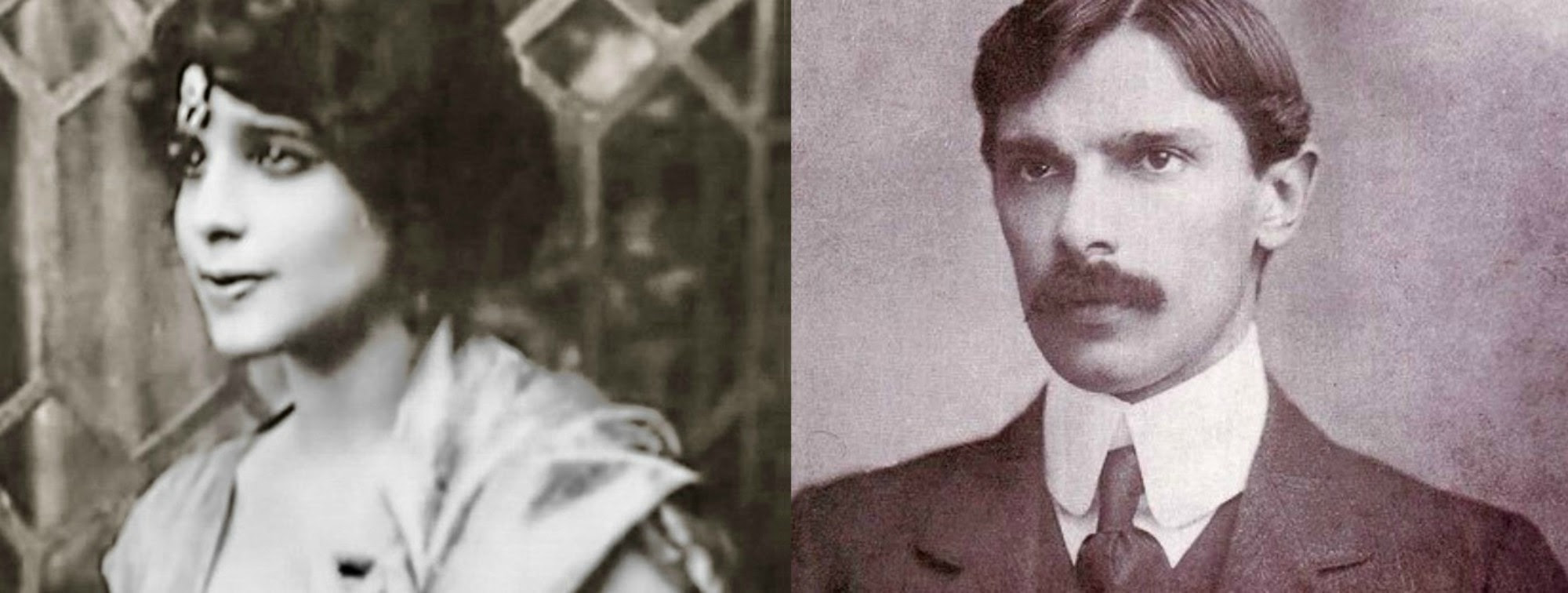
  • Ruttie Jinnah and M.A. Jinnah IMAGE/Dawn

    Read Part 1
    .

    Drugs

    Ruttie’s rush to dash off to Paris was to get drugs. Mrs. Naidu’s letters from Paris and New York to Padmaja make that clear.

    While in Paris in 1929, Mrs. Naidu incidentally discovered from a princess (cousin of queen of Italy), who knew Ruttie, the reason for her visits to Paris. She said that “Madam Zhinna” had been getting drugs through “the long needle,” that is, morphine since her Paris visit in 1924. The concerned princess informed Mrs. Naidu that she had warned Ruttie: “she was ruining her life with drugs and how all her beauty was being destroyed.” (Reddy, p. 314-15.) But Ruttie was in no mood to listen; she just wanted to cope with the crisis, chaos, and commotion that were destroying her from the inside.

    Incidentally, Mrs. Naidu was told the same thing by another person, Princess Journevitch (wife of a famous Russian sculptor), with whom she had lunch in New York in 1929 who said that years ago in Paris Madam “Zhinna’s” drug habit was playing havoc with her gorgeousness and life. (Reddy, p. 364-65.)

    In the US, Mrs. Naidu learned from Syud Hossain that Ruttie was taking drugs while she was in the US. Hossain alerted her of the harmful effects. (For religious violation, Gandhi had ejected Hossain out of India, see note <9> below.)

    That means halfway through their marriage, Ruttie started taking drugs the kamikaze way, i.e., carelessly taking drugs and ignoring warnings of their harmful effects on her mental and physical health. It must have been depressing to watch such a brilliant person travel over 4,000 miles to find solace in drugs.

    Moved out

    On January 4, 1928, Ruttie and Jinnah got down from the train at Bombay’s Victoria train station. They came back after attending the Muslim League session in Calcutta. Mrs. Naidu was on the same train too. Ruttie informed Jinnah that she’s moving to Taj Mahal Hotel. She left with Mrs. Naidu and got a room next to hers. Jinnah went to South Court alone. Kanji helped Ruttie in moving her belongings. Mrs. Naidu’s letter to her daughters:

    “It is extraordinary how few people have even an inkling of what has happened in the very heart of Bombay. Fortunately, everyone is so used to seeing her [Ruttie] here at all hours [that is, in Mrs. Naidu’s room] that no one suspects her being here with her cats and he at home alone.”

    Reddy, p. 333.

    Ruttie and Jinnah’s separation had disturbed Mrs. Naidu more than the couple who got separated, as is obvious the way she put it to her friend Syud Hossain: “The really tragic part of it is that both seem so relieved.” (Ibid, p. 336.)

    An old Parsee friend tried to reunite them. Jinnah shouldered the blame:

    “It is my fault: we both need some sort of understanding we cannot give.”

    In April, Ruttie, joined by her mother Dinbai Petit, left for Europe. Jinnah was already in London with his friend Chaman Lal who had gone to Geneva to attend the ILO (International Labour Organization) Conference.

    Chamanlal then went to Paris. Upon learning of Ruttie’s illness, he headed to the Champs Elysee clinic where Ruttie was bedridden and had 106 degree fever. Ruttie handed him a book of poems by Oscar Wilde and requested him to read. Chamanlal:

    “When I came to the closing lines of The Harlot’s House:

    ‘And down the long and silent street,
    The dawn, with silver-sandalled feet,
    Crept like a frightened girl.’

    “I looked up and Ruttie was in coma.”

    Chamanlal’s impression of Ruttie:

    “… I had always admired Ruttie Jinnah so much: there is not a woman in the world today to hold a candle to her for beauty and charm. She was a lovely, spoiled child, and Jinnah was inherently incapable of understanding her. …”

    Ritu Marwah, Jinnah’s daughter, India Currents.

    Chaman Lal informed Jinnah that Ruttie wasn’t feeling well. Jinnah, who was in Ireland, rushed to Paris where he booked a room at George V. Jinnah went to the clinic as Chaman Lal waited for him at a nearby cafe. Jinnah returned after three hours in a relaxed mood and informed him Ruttie was to be transferred to a new clinic with a new medical adviser.

    Money was no deterrent. Jinnah held constant vigil by her side. He stayed with Ruttie at the clinic for over a month. He took care of her and even shared the clinic food with her. She recovered and left for Bombay but without Jinnah.

    Could any one have saved their marriage?

    Interceder

    The thought that crosses one’s mind when reading Ruttie and Jinnah’s story is they needed intercession and someone should have mediated to save their marriage. Was there anyone who could have saved their marriage? The only person who had such credentials and could have gotten any success in reconciling Jinnah and Ruttie was Sarojini Naidu — a devoted friend of Jinnah and a mother figure to Ruttie. And she, in fact, did try to mediate.

    Actually, it was the pitiable state of Ruttie that had prompted Mrs. Naidu to make an effort. Mrs. Naidu’s letter to Padmaja:

    “Well, Ruttie has only us really. Her own people are strangers to her. Her poor mother loves her but drives her distracted … She loves us and trusts us and so she comes to me for sanctuary., poor child. She feels safe here. Safe in her soul.”

    Reddy, p. 335-6.

    It was her genuine love for Ruttie that led Mrs. Naidu to talk to her very good friend Jinnah. Mrs. Naidu continues:

    “Jinnah has grown so dumb. No one can even approach him. I think he is hurt to the core because she left him like that, almost without warning. In any case no one can interfere with him. He is too hard and proud and reserved for even an intimate friend to intrude beyond a certain point. All he says is, ‘I have been unhappy for ten years. I cannot endure it any longer. If she wants to be free I will not stand in her way. Let her be happy. But I will not discuss the matter with anyone. Please do not interfere.’ And he is I suppose like a stone image in his loneliness and Ruttie is, although reveling in what she believes to be the beginning of liberty for her–liberty costs too dear sometimes and is not worth the price.”

    Ibid, 336.

    Mrs. Naidu was writing to her elder daughter but her younger Leilamani was not far from her mind. She continued:

    “I am writing a line to Papi today. Poor child. She must like Ruttie be clamouring for ‘freedom.’ This freedom!!”

    Ibid.

    The only person whose mediation could have bore some fruit, failed. If Mrs. Naidu couldn’t, then probably no one could.

    Author Sheela Reddy believes Ruttie should have consulted Gandhi.

    Could Gandhi have played the savior?

    Reddy (p. 271.) writes: “… Ruttie, without sharing Jinnah’s animus against Gandhi, turned away from the one man who might have saved her.”

    Ruttie, as far as her own life or marriage were concerned, was a very private person. She never mentioned the inner turmoil she was going through or her marital problems even to Kanji, one of her best friends. With Mrs. Naidu and her daughter Padmaja, she was close in that regard and would vent her exasperation and would tell them her problems and frustrations.

    Gandhi and Ruttie met a few times. They did correspond sometimes. Once Ruttie donated money to his fund for Jallianwala Bagh memorial. Jinnah didn’t know about it — not that Ruttie was hiding it from him, it was an spontaneous act. Gandhi wrote in his newspaper column:

    “Mrs Jinnah truly remarked when she gave her mite to the fund, the memorial would at least give us an excuse for living.”

    Reddy, p.230.

    Gandhi’s April 30, 1920, letter to Ruttie asked her to cajole Jinnah to learn Gujarati and Hindustani (a mix of Hindi/Urdu):

    “Please do remember me to Mr. Jinnah and do coax him to learn Hindustani or Gujarati. If I were you, I should begin to talk to him in Gujarati or Hindustani. There is not much danger of you forgetting your English or your misunderstanding each other, is there? … Yes, I would ask this even for the love you bear me.”

    (Kanji was another person to be reminded by Gandhi that his mother tongue was Gujarati. See the letter written in 1947 here. ( https://pennds.org/doing-research/exhibits/show/dwarkadas/gandhi )

    In a June 28, 1919 letter to Jinnah, Gandhi had urged him to learn those languages:

    “I have your promise, that you would take up Gujarati and Hindi as quickly as possible. May I then suggest that like Macaulay you learn at least one of these languages on your return voyage? You will not have Macaulay’s time during the voyage, i.e., six months, but then you have not the same difficulty that Macaulay had.”

    Unlike Ruttie, Jinnah’s background was that of a middle class family from Gujarat and spoke Kuchchhi and Gujarati “beautifully,” per Chagla. His Hindustani was not that good. Both Jinnah and Ruttie were comfortable speaking English. Gandhi knew his letter was unnecessary, but couldn’t resist playing politics.

    (For Jinnah’s Gujarati handwriting, see “Rare Speeches and Documents of Quaid-E-Azam,” compiler, Yahya Hashim Bawany (Karachi: Mr. Arif Mukati, 1987, p. 39. Jinnah was answering questions for a Gujarati monthly Vismi Sadi or Twentieth Century in 1916. The questions were about favorite author, flower, etc. Jinnah is known as Quaid-E-Azam that translates to a Great Leader. See also Dr Muhammad Ali Shaikh, “History: Becoming Jinnah,” Dawn,)

    In the above letter, Gandhi also asked Jinnah to inform Ruttie,

    “Pray tell Mrs Jinnah that I shall expect her on her return to join the hand-spinning class that Mrs Banker Senior and Mrs Ramabai, a Punjabi lady, are conducting.”

    Ruttie never joined the spinning classes. (Her mother Lady Petit had joined and she used to go to those classes).

    In 1924, Gandhi wanted Ruttie to convince Jinnah to boycott British and all other foreign goods. Ruttie didn’t see any political wisdom or practicality in such actions. (Dwarkadas, p. 18. Kanji had similar ideas as Ruttie and he elaborated those in an interview to the Evening News of India May 1924. Ibid. p. 19-20.)

    The question remains: would Gandhi have been the right person to save Ruttie?

    Looking at Gandhi’s

    • married life,
    • his views on sex,
    • his relations with several women (including philosopher/poet Rabindranath Tagore’s niece Sarala Devi Chaudhurani, an educationist and political activist, and
    • young, golden-haired, blue-eyed Danish beauty,” Esther Faering1, a devout Christian missionary), and
    • his mistreatment of his wife Kasturba,
    • his constant juggling to please and/or to save his girls/women friends from Kasturba’s justified wrath,
    • his experiments of sleeping with young girls to control his sexual urge,
    • his idea of restricting sexual activities to just procreation without any element of pleasure,
    • asking husbands and wives to consider each other as brothers and sisters,
    • and his so many other eccentricities don’t seem the right qualities to qualify him for that role.

    Here is one of the Gandhi advices to Indians:

    “It is the duty of every thoughtful Indian not to marry. In case he is helpless in regard to marriage, he should abstain from sexual intercourse with his wife.”

    B. R. Gowani, “Was Gandhi Averse to climax?”

    Very strange and unhealthy advice, indeed. The institution of marriage was and, to a great extent, is still a legal outlet for most people to relieve themselves of troublesome hormones.

    And what was the guarantee that Gandhi, a hardcore politician, wouldn’t have played Ruttie’s request for help to further humiliate Jinnah?2

    Ruttie was a very reserved person when it came to her personal life and so would have never allowed Gandhi to play any role in resolving any of her problems. Gandhi’s intervention wouldn’t have solved anything but could have had detrimental outcome.

    Let’s assume that Ruttie had approached Gandhi for help. (Jinnah would not have stopped Ruttie from approaching Gandhi.) The most Gandhi could have done was to convince Ruttie to join his Ahmadabad ashram where, undoubtedly he would have given her special treatment (as he had offered to Motilal’s daughter Vijaya Lakshmi Pandit who was sent there to wean her away from her Muslim husband). For Ruttie, the stay there would have been worse than the “slave” like life with Jinnah. She was a free bird and thus couldn’t be caged — not only she would have flown out of the ashram in no time but would have probably persuaded many other ashramites to flee with her.

    Another thing Gandhi would have done was to assign Ruttie some social or political work to keep her busy and thus caused her to forget her depression and other problems. But then, she was already doing some of those things with Kanji, but it seems that she didn’t stay too long in those ventures. Dewan Chamanlal had asked her to join trade union but she declined that.

    The final letter

    On a ship back to India, Ruttie poured out her torment and hurt in her letter to Jinnah:

    S. S. Rajputana.
    Marseilles 5 Oct 1928.

    Darling – thank you for all you have done. If ever in my bearing your over tuned senses found any irritability or unkindness – be assured that in my heart there was place only for a great tenderness and a greater pain – a pain my love without hurt. When one has been as near to the reality of Life – (which after all is Death) as I have been dearest, one only remembers the beautiful and tender moments and all the rest becomes a half veiled mist of unrealities. Try and remember me beloved as the flower you plucked and not the flower you tread upon.

    I have suffered much sweetheart because I have loved much. The measure of my agony has been in accord to the measure of my love.

    Darling I love you – I love you – and had I loved you just a little less I might have remained with you – only after one has created a very beautiful blossom one does not drag it through the mire. The higher you set your ideal the lower it falls.

    I have loved you my darling as it is given to few men to be loved. I only beseech you that our tragedy which commenced with love should also end with it.

    – Darling Goodnight and Goodbye

    Ruttie

    I had written to you at Paris with the intention of posting the letter here – but I felt that I would rather write to you afresh from the fullness of my heart. R.

    Shagufta Yasmeen, “Ruttie Jinnah: Life and Love” (Islamabad: Shuja Sons, no date, p. 71-2, for the original letter in Ruttie’s handwriting). For online, see Letters of Note.

    Final months

    Ruttie left Paris just a few days before Mrs. Naidu arrived on October 10. Mrs. Naidu wrote to Padmaja:

    “I think Jinnah tried very hard to get her to come back.” “But Ruttie is, so I am told, beyond all appeal. Her health is still very precarious. But I have had no talk with Jinnah as yet.”

    Reddy, p. 348-9.

    She met him the next day and discussed the political situation in India where politicians were waiting for Jinnah’s arrival and response to Nehru Report.

    Once in India, he got busy. On December 28, at the All-Parties Convention in Calcutta, Jinnah’s demand for 33% Muslim representation in the central legislature was met with derision. One of the Congress leaders Sir Tej Bahadur Sapru ridiculed him and said give whatever this “spoilt child was asking for and be finished with it.” (Wolpert, p. 100.) M. R. Jayakar, spokesman for the Hindu Mahasabha, a communal outfit, said Jinnah represents “a small minority of Muslims.” (Ibid. p. 101.) (The Muslim population was around 25%. Jinnah wanted some kind of parity to secure Muslims with the majority Hindu population.)

    Jinnah calmly requested:

    “… Minorities cannot give anything to the majority….Believe me there is no progress of India until the Musalmans and Hindus are united, and let no logic, philosophy or squabble stand in the way of coming to a compromise and nothing will make me more happy than to see a Hindu-Muslim union.”

    Ibid.

    He also said:

    “We are all sons of the soil. We have to live together… If we cannot agree, let us at any rate agree to differ, but let us part as friends.”

    A. G. Noorani, “Assessing Jinnah,” Frontline ( https://frontline.thehindu.com/the-nation/article30205988.ece )

    Jinnah’s plea fell on deaf ears; he failed miserably. (This is a universal problem, the majority lacks a genrous spirit to concede something concrete to the minority which could make it feel secure.)

    All through January and February 1929, Ruttie remained ill which in turn made her depressed.

    Depression was not restricted to Ruttie, it affected many of her friends in her age group or younger, Reddy notes (p. 352). Mrs. Naidu’s son Ranadheera was addicted to alcohol and so was his sister Leilamani who was teaching in Lahore and surviving as a single woman. Their older brother Jaisoorya was in a Berlin sanatorium, the city where he was studying medicine. Padmaja drowned in melancholy at her own problems. (Years later, Padmaja had a live-in relationship with Prime Minister Jawaharlal Nehru.) The only difference between the Naidu children and Ruttie was that the former had their father Dr. Govindarajulu Naidu who was a source of great support to their children while Ruttie didn’t have that kind of continuous help. Lady Petit’s visits to Ruttie were not helpful either. Sarojini Naidu was in North America. In February, Jinnah was off to Delhi for government work. Only Kanji was around who tried his best to give Ruttie as much time as possible.

    Jinnah regularly visited Ruttie in the evenings where Kanji was present too. Their discussions reminded Kanji of the good old days when all three of them used to meet, eat, and discuss politics.

    Ruttie who loved going out, had almost confined herself indoor except for short walks with Kanji. Theosophist Krishnamurti and his secretary came for tea on February 1 at Ruttie’s place. Kanji was there too. Krishnamurti then invited Ruttie at Kanji’s friend’s place for dinner which she attended with Kanji. Around February 11, Jinnah had to leave for Delhi. A couple of days later, Ruttie, Kanji’s wife, and Kanji went for a night show movie.

    On 16 and 17 February, Kanji was on night duty as an honorary magistrate due to the riots in Bombay. On the 17th morning, Kanji picked Mrs. Besant from the train station and had lunch with her. After that he went home for a little while where Ruttie showed up “terribly depressed and unhappy.” (Dwarkadas, p. 56.)

    After four hours he went to drop Ruttie at her place where she served him tea. (Kanji was supposed to have tea with Mrs. Besant.) Kanji stayed there till 7pm due to Ruttie’s “terrific depression,” and left with a promise to return back at 10:15. Mrs. Besant understood and asked him to take care of Ruttie. Upon his return, Kanji was horrified to find Ruttie unconscious but was able to revive her.

    On the 18th morning, Ruttie called and told him to drop by on the way to his office. Her state of depression hadn’t disappeared yet; he did his best to cheer her up. Before leaving, he said: “I’ll see you to-night.” Ruttie’s gloomy reply:

    “If I am alive. Look after my cats and don’t give them away.”

    Dwarkadas, p. 57.

    Kanji writes: “These were the last words Ruttie spoke to me.” Kanji stopped by at 11:15 at night but Ruttie was asleep. He left as he hadn’t slept for two nights. A telephone call on the 19th afternoon informed Kanji that Ruttie had lost consciousness and her surviving chances are minimal. Right away he went to her place but couldn’t find her. (Dwarkadas, p. 57.)

    Ruttie no more

    Jinnah was in Delhi for the Budget Session of the Assembly. On the night of 20 February, 1929, Chamanlal was in Jinnah’s Western Court house in Delhi when Jinnah received a trunk call about Ruttie’s illness. He told Chaman Lal:

    “Rati is seriously ill. I must leave tonight.” “Do you know who that was? It was my father-in-law. This is the first time we have spoken to each other since my marriage.”

    Dewan ChamanLal, “The Quaid-i-Azam As I Knew Him” in Jamil-ud-din Ahmad compiled “Quaid-I-Azam as Seen by his Comtemporaries” (Lahore: Publishers United Ltd., 1966, p. 172.)

    Actually, his father-in-law had communicated the sad news of Ruttie’s death to Jinnah. She had passed away in the evening.

    One hundred and thirty eight days after her last letter, Ruttie died of an overdose – exactly on her 29th birthday. The clutches of sickness, insomnia, drugs, inner anguish, piecemeal companionship instead of constant comradery, inability to cope with life, and anxiety had gotten to the resplendent Ruttie.

    Mrs. Naidu’s January 1928 letter to Padmaja had mentioned about Ruttie’s previous attempt at suicide, “… as I have only now learned–how difficult have been those ten years,” “and how she even tried to put an end to herself deliberately …” (Reddy, p. 335.)

    Ruttie must have thought death was the only way out; so she annihilated herself.

    Funeral

    On the morning of 22nd February, Kanji with Col and Mrs. Sokhey picked up Jinnah from the Grant Road station.

    Mohammad Ali Jinnah, Kanji Dwarkadas, M. C. Chagla, and a good many people (both men and women) had gathered at Arambagh, a Shia Muslim cemetery in Mazgaon (Bombay), for the burial ceremony.

    Jinnah sat next to Kanji during the five hour long rites, and gave an impression that he was alright. After a while, he broke the silence and started talking hastily how he assisted Vittalbhai Patel, speaker of the Assembly, who had gotten himself in a tight corner with the government. He also talked about his work in the Assembly.

    But when the process of placing Ruttie’s body in her final abode began, Jinnah couldn’t maintain the facade of stoicism any longer. Kanji described the scene:

    “Then, as Ruttie’s body was being lowered into the grave, Jinnah, as the nearest relative was the first to throw the earth on the grave and he broke down suddenly and sobbed and wept like a child for minutes together.”

    Dwarkadas, p. 58.

    Jinnah was followed by Kanji:

    “I followed Jinnah and looking for the last time through sorrowful and tearful eyes at the mortal remains of the lovely and beautiful immortal soul, I promised to Ruttie that one day I would write her full story….”3

    Ibid.

    M. C. Chagla described it thus:

    “She was buried on February 22 in Bombay according to Muslim rites. Jinnah sat like a statue throughout the funeral but when asked to throw earth on the grave, he broke down and wept. That was the only time when I found Jinnah betraying some shadow of human weakness. It’s not a well publicised fact that as a young student in England it had been one of Jinnah’s dreams to play Romeo at The Globe. It is a strange twist of fate that a love story that started like a fairy tale ended as a haunting tragedy to rival any of Shakespeare’s dramas. ”

    Darwaish, “The Softer Side of Mr. Jinnah” (Globeistan.com).

    Religion restricts, politics prohibits

    her parents would have consigned her
    to a
    Tower of Silence
    she wanted to be cremated
    but as Jinnah’s wife
    she was caged underground

    religion restricts
    politics prohibits

    Mahbano, Masoumeh, and Morvarid
    are to be left at dakhma
    Manisha, Manorama, and Menka
    are destined to be burned
    Mariam, Mahjabin, and Mominah
    are to be imprisoned 6 feet under …

    religion is like a life sentence,
    freedom or parole are hard to come by

    Jinnah meets Kanji

    Next evening, Jinnah met Kanji to know about her final days. Kanji:

    “Never have I found a man so sad and so bitter. He screamed his heart out, speaking to me for over two hours, myself listening to him patiently and sympathetically, occasionally putting a word here and there. Something I saw had snapped in him. The death of his wife was not just a sad event, nor just something to be grieved over, but he took it, this act of God, as a failure and a personal defeat in his life. I am afraid he never recovered right till the end of his life from this terrible shock.”

    Dwarkadas, p. 58.

    Jinnah and Kanji received condolence messages from India’s Viceroy Lord Irwin, Sarojini Naidu (who was in North America at that time), Jiddu Krishnamurti, and others.

    Could anyone be blamed?

    We know about Ruttie’s pain and suffering through her correspondence with Mrs. Naidu and her two daughters, Leilamani and especially Padmaja. and the exchange of letters between the Naidu women. Also Ruttie’s friendship with and her constant need for Kanji throws some light on her sadness and depression. But from Jinnah’s side we know almost nothing of his intense sorrow except for a few sentences spoken to his close friends here and there on rare occasions.

    Thirty nine years after Ruttie’s passing, Kanji was interviewed by an Urdu writer from Pakistan Syed Shahabuddin Dosnani in February 1968, in his apartment in Bombay. Acording to Kanji, sleeping pills were always by Ruttie’s bedside and she ended her life with it. Kanji:

    “She [Ruttie] chose to die on her birthday.

    Reddy, p. 358.

    It is very tragic that such a wonderful person went to waste and met an untimely death.

    Years later, Jinnah told a friend’s wife:

    “She was a child and I should never have married her. The fault was mine.”

    Reddy, p. 362.

    Let us suppose Ruttie was born in 1880. and was in her mid thirties at the time of their marriage, would it have made their married life more workable? That is doubtful. The problems of time, attention, intimacy, and communication would have cropped up even with a spouse of same age group whether it was with Ruttie or some other person. It was not Ruttie’s age but her passion to live life to fullest and her need for companionship that would have created problems. The marriage would have worked whether the spouse was a “child” or same age person if that person was of a quiet and introverted nature, and not as needy.

    One could say that with Ruttie, Jinnah’s was a second marriage — in a sense that Jinnah was already wedded to politics and was committed to it. But then one has to take into account the fact that Ruttie was almost cut off from her family and from her community (Parsis). Also, Ruttie’s age and her vulnerability made her dependent on Jinnah for all kinds of support, so Jinnah was somewhat right at the assessment.

    To be fair to Jinnah, Ruttie also caused, consciously or unconsciously, immense pain to Jinnah. It is almost impossible to find any of Jinnah’s contemporaries with similar tolerance power as him. One wonders who would have tolerated in the 1920s India, hundred years ago, that his wife was living alone in Paris for months while he was paying the expenses. And his door was open for her upon her return. Jinnah was a very liberal person, ahead of his time. What needed was a bit less solemnness and a little more fun on part of Jinnah which his serious personality and commitments didn’t permit. It was unfortunate.

    When Ruttie was in Paris for a long period, she had met Bhikaiji Rustom Cama (1861 – 1936), a friend of Hamabai Petit, Ruttie’s aunt. Madam Cama, as she was known, was a wealthy Parsi woman who had separated from her husband in India and was residing in Paris and was involved in women’s rights and Indian freedom movement. Upon learning from Ruttie about her nightclub visit with some nobleman whose overdrinking caused a car collision on their way back, Madam Cama flared-up:

    “When such a remarkable man has married you, how could you go to a nightclub with a tipsy man?”

    Reddy, p. 272.

    Madam Cama’s admonishment was harsh but could be overlooked because she was unaware of what Ruttie was going through.

    Ruttie’s was a restless soul full of energy, ideas, curiosity, intellect, bravado, knowledge, literary treasure, and more. She was a romantic but was unable to instill similar feelings in Jinnah, after a couple of years into their marriage, because of his heavy involvement with his professional and political engagements.

    Her illness and reliance on drugs cut her life prematurely short. If she would have gotten more attention from Jinnah, the multi-talented Ruttie could have utilized her potential to the maximum and could have lived longer. She would have been Pakistan’s First Lady if death had not brutally snatched her. And who knows, after Jinnah’s death, she may have been a governor of a state in Pakistan like her contemporaries Vijaya Laxmi Pandit and Padmaja Naidu were in India- or an ambassador, or she would have represented her country at United Nations or would have become a renowned poet/author. Sadly, it was not to be so.

    Two and a half decades after her death, people in Bombay reminisced about Ruttie to Hector Bolitho in these words:

    “Ah, Ruttie Petit! She was the flower of Bombay.” “She was so lively, so witty, so full of ideas and jokes.”

    Hector Bolitho, Jinnah: Creator of Pakistan (London: John Murray, 1954, p.74)

    Dr. Muhammad Ali Shaikh in his article “The Women in Jinnah’s Life” puts the blame on Ruttie,

    “While Jinnah was purpose-oriented and wanted to accord adequate attention and time to his causes in life, Rattanbai wanted to continue living a fairytale romance.”

    Shaikh is entitled to his opinion. However, Ruttie was young and may have gotten over the romantic phase, like most do, and channeled her vigor on issues that were important to her. As we have seen, Ruttie was active at women’s issues, animal welfare, etc. Her intellectual curiosity, her interest in varied subjects, and her prolific reading wouldn’t have permitted her to be in the romantic state for too long. Who knows, she could have been a great writer, poet, or activist.

    The time and company she was not getting from Jinnah, she was looking or begging from Mrs. Naidu and Kanji. At the end of April 1927 Ruttie and Mrs. Naidu met in Lahore. Ruttie begged her to spend a few days with her. Ruttie’s troubled state prompted Mrs. Naidu to accompany her till Rawalpindi but she couldn’t part due to Ruttie’s insistence and went to Kashmir. Upon Mrs. Naidu’s departure, Ruttie wept. Mrs. Naidu to Padmaja:

    “Poor child!” “How she cried when I left. How she pleaded for me to stay and for me to bring you in June. …”

    Reddy, p. 326.

    It was indeed a tragic end.

    Cruel contrast

    Jinnah founded a nation; Ruttie didn’t even manage to find herself.

    Post Ruttie

    Jinnah was heart broken.

    All Ruttie’s books, jewelry, clothes, and other items were packed and put aside.

    Religion had been used in India before but Gandhi exploited it on a national scale. Post three Round Table Conferences between the British government and Indian politicians (November 1930 to December 1932), achieved nothing of significance, Jinnah, attended the first one.

    Jinnah decided to settle in Hampstead, an area in London, where he bought a house in September 1931. He was joined by his daughter Dina and his sister Fatima, who had quit her dental practice in Bombay. She devoted the rest of her life to Jinnah. Dina joined a school and Jinnah started his practice at Privy Council.

    The Manchester Guardian had in 1931 described various groups’ perception of Jinnah at the Round Table Conference:

    “Mr. Jinnah’s position at the Round Table Conference was unique. The Hindus thought he was a Muslim communalist, the Muslims took him to be pro-Hindu, the princes deemed him to be too democratic. The Britishers considered him a rabid extremist-with the result that he was everywhere but nowhere. None wanted him.”

    In 1934, when prominent Indian Muslim League leaders begged him to come back and take over the party leadership, Jinnah returned to India. Dewan Chamanlal also wanted him back in politics. Jinnah took over the leadership of Muslim League, which didn’t do very well in the 1937 provincial elections. In Bombay and UP (the United Provinces), the Congress refused Muslim League a place in the cabinet unless they switched over to Congress. Jinnah’s plea for a “united front” of Muslim League and Congress was rejected by arrogant Pandit Jawaharlal Nehru and the Congress Party, including Gandhi. (A. G. Noorani, “Why Jinnah became defiant,” Frontline, August 21, 2013.

    Aijaz Ahmad points out Congress leaders’ folly in refusing Jinnah’s offer.

    “Few realized that such acts of generosity were necessary if the Congress was to win the confidence of those who felt threatened by the size of its victory; if Jinnah was capable of seeking a ‘united front’ he was also capable of whipping up hysteria on the charge that the ‘Hindu party’ which had taken over was refusing to share with the Muslims any part of its power.”

    Ahmad, p. 14.

    The Congress Party perceived itself as a vast umbrella which wanted all the groups belonging to different castes, ethnicity, and religions to be a part of it.

    So Jinnah used his religious card, vehemently.

    “… The Hindus and Muslims belong to two different religious philosophies, social customs, and litterateurs. They neither intermarry nor interdine together and, indeed, they belong to two different civilizations which are based mainly on conflicting ideas and conceptions. … To yoke together two such nations under a single state, one as a numerical minority and the other as a majority, must lead to growing discontent and final destruction of any fabric that may be so built for the government of such a state.”

    Banglapedia, “Two Nation Theory.”

    (Jinnah was not the first to propound the two-nation theory; several Hindu leaders, including Vinayak Damodar Savarkar, had offered such plans, as far as 1860s. See Shamsul Islam, “Guilty men of the two-nation theory: A Hindutva project borrowed by Jinnah,” Sabrang, 16 May, 2018.)

    In 1936, Jinnah’s daughter Dina fell in love with Neville Ness Wadia, a Christian. (Wadia’s father was born in a Parsee family but had converted to Christianity.) Later on, Neville Ness Wadia converted to Zoroastrianism. Dina had her maternal grandmother’s approval but not of Jinnah.

    Dina countered Jinnah:

    “Why don’t you grant me the freedom which you had in choosing your lifepartner.”

    Saadat Hasan Manto, “Mera Sahab” at Rekhta in both Devanagari & Urdu scripts.

    Jinnah’s reason for insisting Dina marry a Muslim man was a political one because by this time he was deep into the religious swamp. Dina went ahead with the marriage and their relationship got strained.

    Jinnah was a tough person but once in a while he was overcome with memories of Ruttie and Dina so he would order a trunk with Ruttie’s and Dina’s clothes and would reminisce over them; his eyes would get wet.

    (Great Urdu short story writer Saadat Hasan Manto got the above and many other tidbits from Jinnah’s driver Mohammad Hanif Azad. See Manto’s Mera Sahab at Rekhta which has it in both Devanagari & Urdu scripts. Azad4 has narrated the incidents in an interesting manner.)

    Memory Lane has nothing but agonies

    in the middle of the night
    when darkness and loneliness commingled
    the heart wept in whispers
    the mind strolled down memory lane
    there is no joy or bliss
    only pain, sorrow, and agony
    solace is urgently needed–
    it’s the necessity of the moment
    the ship-shaped trunk was ordered to be opened
    Ruttie and Dina’s clothes were spread out
    Jinnah stared at those clothes

    recreating the happy family moments
    remembering the two beautiful women
    one a wife, other a daughter
    one no more, other estranged

    like a dead man standing,
    heart’s pain expressed through tears
    monocle removed, tears wiped off

    After sometime the daughter-father reconciled. Dina and Jinnah corresponded regularly. In 1943, Dina and Neville divorced.

    [Jinnah’s (1939) Will also had Dina and her children as beneficiaries. Jinnah didn’t make any changes to the Will. The Will in its entirety is in Khwaja Razi Haider, “Ruttie Jinnah: The Story Told and Untold” (Karachi: University of Karachi, Appendix IV, p. 155-7.)]

    In August 1947, before departing for Karachi, Jinnah visited Dina and her two children. He gave the Karakul cap he was wearing to his grandson Nusli Wadia. Jinnah also stopped by Ruttie’s grave to say goodbye.

    IMAGE/Dr Muhammad Ali Shaikh/National Archives Islamabad/Dawn/Duck Duck Go

    The love between Ruttie and Jinnah was never lost and they always had it in their hearts till the end.

    Jinnah never got married or had an affair with any one. Ruttie was close to Kanji and she could have found loving comfort in his company if she wanted too, but she never did. She loved Jinnah only.

    Perhaps, some romances are destined that way.

    Ambassador of Hindu-Muslim unity who took a 180 degree detour from secularism to don an Islamic cap was back to his secularist self when he got Pakistan. On August 11, Jinnah addressed the Constituent Assembly of Pakistan:

    “… You are free; you are free to go to your temples, you are free to go to your mosques or to any other place or worship in this State of Pakistan. You may belong to any religion or caste or creed that has nothing to do with the business of the State….

    “… in course of time Hindus would cease to be Hindus and Muslims would cease to be Muslims, not in the religious sense, because that is the personal faith of each individual, but in the political sense as citizens of the State.”

    On August 14, Pakistan came into existence and the next day India got its independence. It was one of history’s greatest tragedies with communal killing on a vast scale, accompanied by vast scale destruction and innumerable refugees.

    Gandhi. In less than six months after British left, on January 30, 1948, Gandhi became the victim of a Hindu fanatic — Nathuram Godse who pumped three bullets in his chest. One has to really appreciate Gandhi’s efforts during post Partition butchery to save Muslim lives in Delhi and other areas. The shots fired at Gandhi were forewarning of the Hindu fascist raj India will one day become.5

    Jinnah. More than seven months after Gandhi’s assassination, Jinnah passed away on September 11, 1948 after suffering from tuberculosis which he was infected with many years ago but was known only to his Parsi doctor J. A. L. Patel, his sister Fatima, and very few other people. Jinnah was a chain smoker who had smoked for three decades 50 or more Craven “A” cigarettes a day. In May 1946, Dr. Patel had warned him to take things very easy because he only had a year or two left to live. Jinnah had survived the past ten years, in the words of Dr. Patel, on “will power, whiskey and cigarettes..” [Larry Collins & Dominique Lapierre, Freedom at Midnight (New York: Simon and Schuster, 1975, p. 124-6.)]

    From Quetta, where Jinnah was recuperating, he was flown back to Karachi. The ambulance carrying Jinnah, then Governor General of Pakistan, from Karachi airport to the government house broke down. It took a long time for another vehicle to arrive. Military Secretary Colonel Birnie was the only person sent to receive Jinnah. There was no other person or vehicle. It definitely was strange and suspicious. Was Liaquat Ali Khan’s (Jinnah’s right hand) government waiting for Jinnah to die as soon as possible? Jinnah said so, according to his sister.6

    Sister Phyllis Dunham, the nurse who was attending Jinnah in the ambulance, said they were near the refugee camp. There was mud and hundreds of flies. She fanned Jinnah’s face with a piece of cardboard to keep the flies away.

    “I was alone with him for a few minutes and he made a gesture I shall never forget. He moved his arm free of the sheet, and placed his hand on my arm. He did not speak, but there was such a look of gratitude in his eyes. It was all the reward I needed, for anything I had done. His soul was in his eyes at that moment.”

    The same evening, that is, September 11, 1949, Jinnah passed away.

    Dina flew into Karachi from Bombay to attend her father’s funeral. She then returned back to Bombay. After Partition, Dina had decided to stay in India but later on moved to New York, USA.
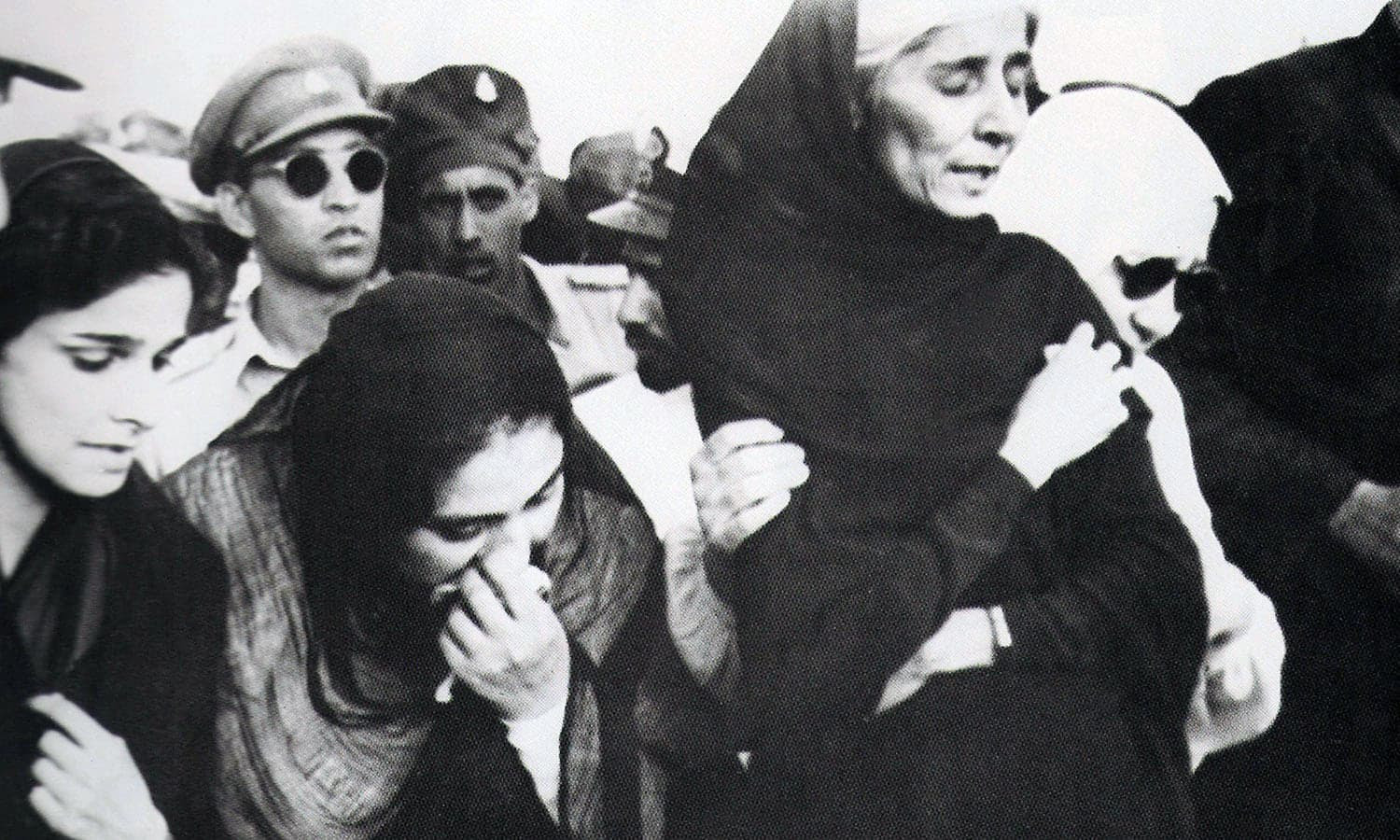
    Dina Wadia (extreme left), Quaid-i-Azam Mohammad Ali Jinnah’s only child, flew in to attend her father’s funeral. Second from right is Jinnah’s sister Fatima. PHOTO/The Press Information Department, Ministry of Information, Broadcasting & National Heritage, Islamabad/Dawn

    Sarojini Naidu (known as “Nightingale of India” or “Bharat Kokila,” a name given by Gandhi), became the governor of Indian state of UP or United Provinces after independence. She had a fatal cardiac arrest on March 2, 1949.

    Fatima Jinnah. (In Pakistan, she is known as Mader-e Millat or Mother of the Nation.) On the first couple of death anniversaries of Jinnah, his sister Fatima was not allowed to make radio speeches. In 1951, she was allowed but was censored. Some pages had disappeared from her book My Brother before it reached the publisher, because they were deemed to be “against the ideology of Pakistan.” (See the pages here for the ideology crap.)

    In 1965, the opposition parties contesting the elections against the US supported military dictator Field Marshall General Ayub Khan persuaded Ms. Jinnah to contest the presidential election against Ayub Khan. Fatima gave a good fight but lost the election because it was rigged. However, she won in both Karachi, Pakistan’s biggest city, and also in Dacca, East Pakistan’s capital. Fatima Jinnah passed away on July 9, 1967.7

    Kanji Dwarkadas was the senior-most personnel officer and labor consultant in India. In 1946 and 1951, he was invited by the United States government to study housing and labour problems. He passed away in the early 1970s.

    Padmaja was the fourth governor of the Indian state of West Bengal from November 1956 to June 1967. Padmaja waited for Nehru to propose but he never did because he wanted to avoid offending his daughter Indira’s feelings. But they lived together. Nehru had affairs with many other women8 too. Padmaja was aware of it. She once said: “Nehru is not a one woman man!”

    Independent India’s first prime minister Nehru’s seventeen year rule deserves high praise; it was good for minorities. Nehru was worried about the majority communalism when he said: “Communalism of the majority is far more dangerous than the communalism of the minority.” He passed away on 27 May 1964. Since Hindu nationalist Modi came to power in 2014, his government never misses a chance to vilify Nehru.

    Padmaja Naidu passed away on May 2, 1975.

    Dina avoided state invitations from Pakistan but did visit again in March 2004 at the invitation of former chairman of the Pakistan Cricket Board Sheharyar Khan to watch India/Pakistan cricket match in Lahore. It was termed “cricket diplomacy” as she and her family, like so many Indians and Pakistanis, wanted to see good relations between both countries. She and her son Nusli Wadia and her grand sons Jehangir and Ness, visited her father’s mausoleum in Karachi. In the visitors’ book, she wrote:

    “This has been very sad and wonderful for me. May his dream for Pakistan come true.”

    Dina passed away on November 2, 2017.9

    ENDNOTES:

    The post The Tragic Tale of a Flower that Wilted too Soon (Part 2 of 2) first appeared on Dissident Voice.
    1    Gandhi’s political power provided him an opportunity to have many girl friends. Whereas his genius let him juggle and manage these relations while having a wife. Madeleine Slade (Mirabehn), Sushila Nayar, Bibi Amtus Salam are some of the females Gandhi was close to. Some of the extracts from Gandhi’s letters:

    You will continue to haunt me in my sleep. No wonder that [your husband] Panditji (Rambhuj Dutt) calls you the greatest shakti. You may cast that spell over him. You are performing the same trick over me.”

    In another letter dated January 23, 1920, Gandhi wrote, “Saraladevi has been showering her love on me in every possible way.”

    The nature of their relationship is further uncovered in a letter dated August 23, 1920: “You are mine in the purest sense. You ask for a reward of your great tender, well, it is its own reward.”

    Acutely aware of how jealous Kasturba was of several of his adoring disciples, Gandhi tried at first to disarm his wife of such feelings by asking Esther “to help Ba in the Kitchen”. But he warned his “Dear Child” that

    “Ba has not an even temper. She is not always sweet. And she can be petty… You will therefore have to summon to your aid all your Christian charity to be able to return largeness against pettiness… To pity the person who slights you… And so, my dear Esther, if you find Mrs. Gandhi trying your nerves, you must avoid the close association I am suggesting to you.”

    It did not work, of course. Kasturba treated his “Dear child” so harshly in her kitchen that Esther soon broke down. “You were with me the whole of yesterday and during the night. I shall pray that you may be healthier in mind, body and spirit,” Bapu wrote to console Dear Child Esther, “with deep love.”… Gandhi was “glad you opened out heart” about his “difficult” wife. He immediately insisted that Esther must have a “separate Kitchen” for herself. “My heart is with you in your sorrow.”
    2    See “Gandhi Kept On …” (Counterpunch, August 14, 2015).
    3    Kanji: “… It has taken me more than thirty years to fulfil this promise. I dedicated to Ruttie my 85 page “Gandhiji through my Diary Leaves” (1915-1948), published in May 1950.” Dwarkadas, p. 58.
    4    Prior to joining Jinnah, Azad used to work as an extra in Bombay film industry. Post Partition, he worked as a character actor in Pakistan film industry.)
    5    Since 2014, Hindu Modi has created internal partition in India by turning Muslims, over 14% of India’s population, into second class citizens. Other minorities are not doing any better either. Modi’s rise to power, i.e., from Gujarat state’s chief minister to India’s premier, was on the Muslim corpses piled under his watch. He was termed the “butcher of Gujarat.”

    Aijaz Ahmad: “… communal violence always leads to very rich electoral dividends for the BJP [Modi’s Bharatiya Janata Party] and its associates …”

    Modi government has banned the recent two part BBC documentary on Gujarat genocide. Many websites, including Elon Musk’s Twitter, have been ordered to take down the documentary; they have complied. Musk, “a free-speech absolutist,” had no qualms in carrying out Modi’s order because India is a huge market. In 2019, the US government overthrew Bolivia’s government. Musk boasted: “We will coup whoever we want! Deal with it.” One is prompted to ask Musk: How about a coup in India.? No way, Musk is waiting for a tax break for Tesla in India. One of opposition politician in India, Mahua Moitra, had posted the video on her twitter account but has been taken off; same with the US actor John Cusack‘s twitter account.
    6    Why was Jinnah transported in a broken ambulance and why was there not a spare vehicle? The question has been raised many times but the people in power are neither in a hurry nor are willing to answer. Just after three years, Liaquat Ali Khan, born in 1895, was shot twice during a public rally on October 16, 1951. He was rushed to a hospital but didn’t survive. Within a few seconds after shooting, the police killed the assassin. Pakistan was just a four year old baby then, but its police was far too mature in this matter. It finished the assassin and thus saved lot of the poor country’s money and time from being wasted on finding the real culprits. (In November 1963, US President John F. Kennedy’s assassin Lee Harvey Oswald was shot dead in the Dallas Police Headquarters, just two days after Kennedy’s murder, by a nightclub owner Jack Ruby.)

    First week of March in 1949 witnessed Allah, Muhammad, and Koran making inroads in Pakistan via Objectives Resolution. Four years later, the Islamists went after one of the Muslim minorities, the Ahmadis, to declare them non-Muslims. They succeeded in 1974. Jogendra Nath Mandal, a Hindu, whom Jinnah had chosen as one of his ministers, had felt insignificant after Jinnah’s death and handed his resignation to Liaquat Ali Khan and migrated to India.

    (Those interested in understanding the tragic condition of minorities in Pakistan should read Mandal’s entire letter.

    Unlike the Hindu parties in India, the Islamic parties in Pakistan have never reached the corridors of power, but then have never been far from the people in power. They have forced politicians to do things in the name of Islam which have done great harm to the country. On the other hand, the army and politicians also use them when needed. On January 17, 2023, the Pakistan’s National Assembly voted to broaden the blasphemy laws by including Prophet Muhammad’s companions which may be a huge number. It seems, pretty soon, the National Assembly will add another clause to the blasphemy laws declaring anyone criticizing the members of the ruling class for their corrupt, criminal, conscienceless actions as blasphemous because they are relatives of Muhammad or of Muhammad’ companions. Nothing is impossible for people in power. (Look at Planet’s Earth’s current Landlord who wants Gaza as “Riviera of the Middle East” which is now in the ruin due to former Landlord‘s genocidal war on Palestinians who are all alone.)

    Pakistan imported 2200 luxury cars in the second half of 2022. A country with more than 232 million people has mere $16 billion in reserves as of February 2025! Every now and then, Pakistani beggars have to rush to China, UAE, Saudi Arabia, or IMF (International Monetary Fund) for either a few billion dollars loan or to extend the payment time. IMF loans are accompanied with harsh conditions — and as usual, the common people bear the brunt.

    S. Akbar Zaidi puts it bluntly:

    “The irony of ironies. An institution which across the globe has been acknowledged as anti-people, elitist and responsible for increasing poverty, misery and destitution across dozens of countries, is now being seen as Pakistan’s only saviour, as it seems the rulers in this country have come round to restarting an agreement which has been in abeyance for almost a year.”

    Another thing the government does, with the blessing of the army, is to apply censorship. In February 2023, access to Wikipedia, a free source of information for students and other people in a country where the government doesn’t provide much, blocked. The reason: Pakistan wants Wikipedia to remove “blasphemous content.” How could you fight this idiocy. After a few days, the ban was lifted. In January 2025, some important amendments were passed to the 2016 Prevention of Electronic Crimes Act (PECA) which has become a tool to harass media people and journalists — more than 200 such incidents have happened. The army is also good at silencing or disappering its critics or people asking for their rights, such as people of Balochistan.

    The main opposition leader and former Prime Minister Imran Khan (a Pakistani version of Jair Bolsonaro, Donald Trump, Narendra Modi, Tayyip Erdogan, and Victor Orban) is not any better.
    7    If common sense had prevailed over the US supported generals and the elite that this was a golden opportunity to repair relations with the eastern wing, which had been turned into West Pakistan’s colony, it would have saved the break up of Pakistan. It didn’t. After a bloody war, fought in East Pakistan with killings, rapes, and devastation, in December 1971, East Pakistan became Bangladesh.
    8    Nehru’s sister Vijayalakshmi Pandit: “Didn’t you know, Pupul?” They lived together for years–for years.” “He felt that Indu [Indira Gandhi] had been hurt enough. He did not want to hurt her further.”

    Pupul Jayakar, Indira Gandhi: A Biography, p. 92.

    Nehru had affairs with some other women too, including Lady Edwina Mountbatten, the wife of Lord Mountbatten, the last Viceroy of India, who presided over India’s partition. Mountbatten’s was an open marriage
    9    In 2007, Dina wrote a letter to India’s then Prime Minister Dr. Manmohan Singh requesting to hand over Jinnah’s Bombay/Mumbai house (South Court, also called Jinnah House) to her with an assurance the house will be used for personal use without any commercial motive.

    “It is now almost 60 years since my father’s death and I have been deprived of my house where I grew up and lived until I married.” “I request you return it to me.”

    Dr. Singh never replied back; had no intention to return back the property.

    This post was originally published on Dissident Voice.
  • I’ve been struggling to write this column for a while now. Obviously there’s been the personal reasons and professional reasons – both of which become more and more blurred every day. This is especially true when you’re a disability rights columnist and activist who is juggling editing a book, supporting the disabled community, and mourning the loss of both your grandparents.

    There’s also the fact that I’m very aware as someone who focuses on media ableism of the amount of vile rhetoric being pushed out by the government via the corporate media. This itself is having more of a toll on disabled people than the lack of policy announcements is.

    For disabled people, the waters are muddy enough

    It seems like every day a senior official is telling the papers that we don’t deserve to live, and I’m really ultra-aware that highlighting every instance of that will not only cause further distress to disabled people, but also put a huge strain on my mental health.

    In a similar vein, whilst there aren’t any concrete policies out yet I’m really conscious that all of this shit-slinging is on purpose to muddy the waters and turn non-disabled people against us – whilst scaring disabled people into limiting their lives. So, I don’t want to add to the dis-and misinformation that’s being spread.

    But I think more than anything the reason I’m really struggling to write at the moment is because I wanted to have hope. I, perhaps naively, wanted to have a glimmer of belief that life would become a tiny bit easier for disabled people once we got the Tories out. I now feel foolish for ever thinking that.

    If they wanted to, they would’ve

    Labour might’ve only been in power for seven months, but there’s so much they could’ve done in that time that they’ve purposefully delayed.

    They could’ve called off the PIP consultation the very first week if they wanted to, but they let it run it’s course. Despite wanting to launch their own consultation in the spring, which will obviously be totally different, they said they would be paying attention to every response. The disability minister, somewhat patronisingly, even praised disabled people for giving them so many responses to read.

    Labour could’ve done a manner of things to reassure disabled people that life won’t be harder under their governance, but it’s time to face facts that it will be, it already is.

    Because whilst they haven’t given us any concrete plans, they have had plenty of time to tell the media that disabled people on benefits are “taking the mickey”, point out that loads of kids are claiming to have mental health problems now (wonder why), and conveniently reveal that 450,000 more people claimed PIP and DLA last year. And that’s just in the last week or so.

    ‘It’s only been seven months’, and we’ve got another 5 years of this shit

    I know, historically, Labour has always been bad for disabled people (trust me I’ve just written a book about it) but I wanted to hope deep down that nothing could be worse than the last fourteen years of the Tories.

    But the Tories were only able to succeed because of the groundwork that Tony Blair had laid down. Now the people who supported Blair’s vile abuse of disabled people are in charge and there’s nobody to oppose them.

    It was staggering to watch the Tories get worse and worse and worse over the years. But perhaps that’s also why this has been so soul-crushing, because Labour have been able to do this in such a short space of time.

    So many people say ‘give them a chance, it’s only been seven months’. Whereas I can’t believe it’s only been seven months.

    If they’ve created this hostile an environment for disabled people in just the first seven months – what do the next five years hold? And how many of us will still be here to tell the tale at the end of it?

    Featured image via the Canary

    By Rachel Charlton-Dailey

    This post was originally published on Canary.

  • Ever since Donald Trump assumed office on 20 January 2025, the mood in the air has felt rather sombre and bleak. It has become apparent that the US is no longer ruled in a traditional way. Now, it is instead governed by the unelected Elon Musk and his duplicitous DOGE team.

    Elon Musk and DOGE: an unelected power grab?

    Just last week, Musk stood in the Oval Office oddly accompanied by his son “X Ash a Twelve” – with critics labelling the event as a coup d’état. In other words, it was a full-scale takeover of the US government which blatantly ignores the constitution and where Trump, for once, wasn’t the centre of attention.

    Taking questions from reporters, Musk denied a hostile power grab.

    However, he has been involved in some of the most disputed decisions made by the Trump administration so far. This includes the removal of regulations and even gaining access to the Treasury Payments Department, which has sparked fear throughout the streets of Washington and beyond.

    It must be said that the world’s richest man standing up in the world’s highest office taking questions from reporters doesn’t exactly make one feel comfortable about the current state of the US. It now resembles an oligarchy rather than a democracy, where the super-rich tech bros of Silicon Valley sit on the throne.

    As a businessman, Musk appears to wield a great deal of power and prowess. His platform X is a mouthpiece that he uses to promote his own tweets and spread misinformation to his over 200 million followers. It almost resembles, and darkly echoes, “Newspeak from 1984”. This along with his new major role in government appears to have gone completely unchallenged, with the only potential guardrails being the courts.

    Musk using his child as PR?

    He truly has taken Washington and the US into his orbit. Musk has caused a meteor storm to last for years to come through the new level of personal control he possesses. He has demonstrated that he is the puppeteer controlling his new puppet (Trump).

    Musk appears to be relishing in this, and his son X is indefinitely aware of this too. The video of him telling Trump that he wanted him to “shush his mouth” whilst his father was speaking has since gone viral.

    “Taking your child to work day” also seems to hit differently when it is in the grandeur of the oval office. Musk used his child as PR tool to falsely enforce to the American public that he is a good and present father who can get on the working person’s level. However, when X appeared to begin to pick his nose and wipe the residue on the resolute desk, this “sweet image” might have changed for MAGA loyalists.

    I believe using your child as a way of humanising you isn’t exactly what I would describe as “cute” or “fatherly” – but rather a public stunt to appear angelic and innocent to the public.

    Despite this, Musk continues to deny a hostile takeover of the US government. He insists that he is simply trying to help the American people, through instigating major government reform and stopping fiscal spending where it isn’t needed.

    Judicial oversight hampered by social media

    However, his power has been challenged by the courts and judges who labelled what he was doing as “unconstitutional”. This led to Musk attacking them online and calling for them to be impeached for “interference”. He took to X to say “these are grounds for impeachment of the judge” because they ordered his proposed spending freeze to be stopped.

    Since these comments, and further abuse of judges on X from both Trump and JD Vance, former judges have expressed grave concerns over potential threats of violence that they could face – particularly from die hard MAGA fans who would clearly stop at nothing in the name of Trump.

    Due to the fact that judges are also defenceless when countering false allegations, this only makes the situation worse. They cannot challenge the Trump administration’s arguments. It is clearly alarming that Musk’s’ power seems to have gone unchecked by both the constitution and the Trump team. He has evidently exceeded his powers at the expense of congress and voters, purely for his own personal gain.

    However, there are some critics of Musk’s’ unchecked power who are brave enough to speak out about it.

    Musk’s takeover a “very dangerous moment”

    For example, Bernie Sanders said in an interview on CNN that “Musk is clearly running the show”. He warned that the country is at a “very dangerous moment” in time, with an oligarchy taking shape in the US.

    Furthermore, Robert Reich – an outspoken critic of Trump and former secretary of labour under President Gerald Ford and Jimmy Carter – believes that there is little that the US can do to constrain Musk and reign him in. However, Reich suggests that a way of stopping him might be to strengthen laws that are applied to social media companies against hate speech as well as disengaging from any further technological endeavours with him.

    Yet Musk appears unbothered by his critics. He believes that he can do whatever he wants due to the mandate that Americans gave to Trump during the 2024 election.

    At several points during interviews with the press he has claimed that he is restoring the “will of the people”. This seems a little hypocritical considering he is an unelected member of the new government.

    But whilst Trump goes off to play golf at Mar a Lago, Musk appears to sit on the golden throne. He continues to spread misinformation online to convince his MAGA cult followers, who show absolute fealty to him, that he is a “man of the people”.

    The bromance is worlds apart from the average working person

    In fact, Musk is worlds apart from the average working person. He is simply pursuing his own personal interests whilst ripping up the constitution in the process. He is doing this through destroying critical federal agencies, firing civil servants en masse, and showing utter disdain for the rule of law.

    Recently, Musk and Trump have sat down with right-wing media outlet Fox News and the journalist Sean Hannity to discuss their relationship. During it, they gushed over each other. In one particularly eery clip, they discussed the Trump campaign and their idea that the media “was trying to drive them apart” by referring to Musk (albeit correctly) as the “President”.

    Musk denied this and continued the cheesy bromance on camera as well as stating his adoration for the president.

    Trump also praised the DOGE department calling it “tremendous”. However, I wouldn’t say “tremendous’ or “groundbreaking” was a fitting way to describe the department.

    Musk’s wrecking ball couldn’t be sending a clearer message

    Many people working for the National Nuclear Security Administration have lost their jobs as Musk has taken a wrecking ball to several key government branches which serve the American people.

    Cuts to jobs have also included firing hundreds of employees at food and medical testing facilities. This could lead to epidemics and health outbreaks.

    Further to this, cuts to USAID and attempts to destroy it seem to have brought a great deal of joy to Musk. He aims to reduce USAID staff from 10,000 employees to just 600.

    All these cuts will inevitably lead to great human costs. There could be outbreaks of epidemics and dangerous viruses. The cuts are cruel and incredibly harmful to those in war zones and low-income countries. These people will now struggle to access vital healthcare and nutritious food.

    After Nazi salutes, the dismantling of the pillars of democracy, and the tearing up of the constitution and virtually the American flag, the message couldn’t be clearer. Elon Musk not only plans to rule the US, but also the skies, the seas, and the stratosphere.

    Featured image via the Canary

    By Megan Miley

    This post was originally published on Canary.

  • What on earth does Keir Starmer think he is doing?

    I’ve gone back through the untold pledges, the impossible missions, the multitude of milestones, the uncosted commitments and plethora of broken promises, and I couldn’t find a single mention of deploying British soldiers to fight a war for a state with a bit of a Nazi problem.

    The British army, made up of 74,000 regular forces personnel and 25,000 reservists, is around half the size of military superpowers such as… erm… Myanmar, Morocco, and Colombia.

    If Starmer was planning to have a shit fight, it’s best not to go armed with little more than a fart.

    Does the prime minister have any children of military service age? When I see a gun-toting Starmer Junior cosplaying on the streets of Mariupol in their Dad’s Army outfit — the one he gets out for the occasional photo-opportunity — I’ll review my stance, but until that time, and not before, the Prime Minister shouldn’t even consider putting someone else’s children in front of one of the most powerful militaries on earth.

    I don’t think that’s particularly controversial, and I certainly have no ill feelings towards any of Starmer’s offspring because that would make me as bad as their pathetic, desperate old man.

    But if you’re not willing to dip your toes into the bath to see how hot the water is you certainly shouldn’t be contemplating the possibility of getting someone else to dip theirs in first.

    Keir Starmer’s jingoism is opportunistic hypocrisy

    Starmer is an opportunistic hypocrite. The attempt to appeal to the often jingoistic British public isn’t entirely dissimilar to Netanyahu’s destruction of Gaza.

    The corrupt, genocidal fugitive Netanyahu has been clinging on to power by a thread for some time. The destruction of Gaza helped him buy more time with the demonstrably racist Israeli public.

    Starmer is in a whole heap of trouble at home. His party is less popular than a bunch of shouty, white, tweed-clad, urine-scented Faragists and the Labour Party still hasn’t recovered from the worst start for a government in living memory. Just this week, voters were asked if they trust the Labour Party. Only 16% said they trust Labour.

    Their immigration policy has alienated more people than it has attracted, pretend-economist Rachel Reeves’ plan for growth only seems to apply to poverty and destitution, the filthy rich continue to get considerably richer, and the ‘moderate’ people that loaned Labour their vote just to get rid of the Tories are wondering when a Labour government will actually take office.

    Meanwhile…

    Just this past week, Labour has confirmed they will be cutting £3 billion from disability benefits. Red Tory minister, Stephen Timms claimed “money is tight”, while somehow managing to keep a straight face, safe in the knowledge his boss has already committed £3 billion a year to Ukraine, for as long as it takes.

    Starmer has been desperately thrashing around for a distraction for some time. Trump, Musk and Gaza didn’t serve the intended purpose, so why not talk up throwing a load of British lives into the lion’s den?

    Starmer’s spinners know they have a far greater chance of causing a significant distraction if their liability of a leader is laughably flexing our red, white and blue muscles on the global stage.

    Isn’t patriotism said to be the last refuge of the scoundrel?

    What next? Conscription?

    Look at it from Starmer’s point of view. The United States’ long withdrawal from Europe has moved up a gear with the arrival of the neofascist Trump. So who is going to step up to the plate?

    The right-wing establishment media will bang the war drum, of course, they still think Britannia rules the waves rather than a shitty little isolated island that prefers to waive the rules, these days.

    But they, and Britain’s biggest arms manufacturers, will be telling Starmer how British boots on the ground in Ukraine will save his chaos-ridden, shambles of a government at home.

    If Starmer honestly believes the British public will tolerate the brutal deaths of hundreds, if not thousands of our children to fight a proxy war against Putinist Russia in a former Soviet state, he’s even more deluded, desperate and dangerous than I ever thought possible.

    What next? Conscription? What worked in 1940 isn’t going to work in 2025.

    Stick to playing Fortnite

    Back in the Forties, young people were ready to sign up to fight against fascism on the continent of Europe. Skip forward eighty-odd years and you will see your average young person prefers to fight ghouls on the PlayStation, or document their every move on TikTok.

    And good for them. Stick to playing Fortnite. Go and get drunk with your friends, share a spliff, start a band, play football, do what young people do and NEVER become a victim of conformity.

    What is it with this government and assisted dying? If they’re not telling disabled people that they are a worthless burden on their loved ones and society as a whole, they are talking up sending young people to face their inevitable, gruesome demise under the guise of “peace keeping”.

    We may as well do a block-booking with Pure Cremation at this rate, as this really will not end well for us.

    Starmer will be on Trident, next

    You keep peace with diplomacy, Mr Starmer, not poorly-equipped British teenagers carrying hand grenades.

    I have no doubt this conversation will soon move on to the apparent importance of our nuclear deterrent, and why we need to further invest in something we are never going to have any use for.

    The hawks have a point though.

    What could be better than the threat of Trident while Russian hackers bring down the IT infrastructure of our NHS?

    “Oi, Nikita, put down that gallon of Novichok or we’ll get on the phone to Trump and ask him if we can nuke your Commie ass, when he’s finished his round of golf”.

    Our nuclear deterrent serves no greater purpose than me standing tall at the very highest point of the White Cliffs of Dover, trying to scare off the Russians with a Care Bear stare.

    You’ll have to Google that one, kids.

    In fact, at least I’d provide you with a laugh or two, and you’d even get a bit of change out of £200 billion.

    Not much though.

    Featured image via Rachael Swindon

    By Rachael Swindon

    This post was originally published on Canary.

  • There has been an awful lot of talk in the last month or so, with the rise of Reform, as to whether former Labour Party leader Jeremy Corbyn will form a new coalition of independents to provide a left alternative to the Keir Starmer government. In a sense one could understand this. After all, Corbyn received a larger amount of the popular vote in 2017 than Starmer did in the recent constituency landslide.

    However, it could be argued that this prayer for a left-wing coalition is incredibly misguided. The sphere of electoral politics played a filthy hand in taking down Corbyn, and the left’s tendency to crawl back into parliamentarism ought to take some time out.

    Jeremy Corbyn was unfairly taken down.

    It is time to get on with our lives and focus energy elsewhere, as he continues to.

    2015 and the rise of Corbynism

    In 2015, the British Labour Party saw the beginning of the leadership of a man who captured the love of many in the country. His base was made up of those living precarious lives, struggling to survive, or see the ascendency others have had, as well as members of many other groups so dismissively ostracised by the Conservative Party of the age.

    The scaffolding of that base was the greying coals of Britain’s trade union movement, which he gained from his history of supporting them through periods of industrial strife.

    His rise was incredible to watch, as men such as Tony Benn seemed to have their ideas in the Labour Party be voiced by a powerful leadership. Accusations of dominance by the more principally left voices have been a staple in the Labour Party, really since its inception at the turn of the last century. Yet it seemed that at this time real change could be implemented by these people.

    The moments of the 2017 election, various campaigning spots such as the infamous Glastonbury moment, and his seeming ability to blend in with cultural figures not often associated with mainstream politics were stunning. Many local activists took time away from grassroots campaigning and took to door-knocking for him. But all of these efforts were wrung out, and the British conservative and liberal establishment took to dismantling his leadership.

    His policies and general approach to politics is also what attracted both the praise and ire of many.

    Policies that empowered grass-roots movements

    In a recent interview, Corbyn ally Andrew Murray discussed the appeals to Corbyn’s particular form of social democracy. The most important and most poignant, given the situation in Gaza, is Corbyn’s anti-imperialism.

    Imperialism, as Murray states, is endemic to British culture and material existence as a modern nation. Those who have either lived it or taken the time to learn its history know it funds our infrastructure, our industry, and our consumption. Corbyn has firmly stood against this since the beginning of his political career, and in a recent march on London by the Palestine Solidarity Campaign, was questioned by the Metropolitan Police.

    Corbyn’s Labour leadership helped to open up discussions on the subjects of British and American imperialism in the UK, that are absolutely vital to cite. After Corbyn’s leadership, grassroots movements like BLM began, Rhodes must fall started its campaign, and the mass protest marches for Palestinian solidarity have been some of the most well attended in London’s history.

    This is not solely due to Corbyn – but having the Leader of the Opposition proudly stand with those oppressed in the Global South helped to spread that conversation to those perhaps without access to that knowledge from life-experience.

    Now that he is out of power, however, the conversation and the campaigning must go on without a dedicated focus on parliament, taking what Corbyn and others helped facilitate in the late 2010s and grow more of that genuine solidarity and opposition from it.

    Times have changed

    The situation seen as it now differs greatly from 2019.

    With his stand as an independent MP in his constituency of Islington North, some have reopened the wilted case for left-wing prominence in the British House of Commons. The assault on Gaza and the movement against it helped to push many away from the Labour Party’s leadership, as even moderates were queasy at the complicit nothingness of Starmer’s cabinet.

    This, combined with terror at Reform’s rise, brought the hopes of a new Corbyn-led coalition after the July election.

    However, this is simply not going to be a successful endeavour, for the same reasons it failed from 2015-2019.

    The reaction to any popular support for a Corbyn campaign will be identical in flavour, because parliamentary politics in the United Kingdom is a racket, moulded by a powerful media who would sweep Corbyn’s legs from him with a stockpile of smears perfected over a decade.

    The answer to this difficult situation is absolutely paramount for tackling the far right and the growing imperialist tirade. Ultimately it comes down to continuing the work that Corbyn’s legacy as leader and MP already helped begin.

    Continuing Corbynism – but not as we know it

    Local community activism should be placed centrally, in order to continue to try to build solidarity with those in our own community and those who suffer because of our governments.

    Trade union campaigning must continue and grow and show its strength – as seen in the industrial action of the last few years.

    Local grassroot work should be done with members of the community facing the sharp end of government policy and business activity.

    And international solidarity networking is of inexpressible importance, as Palestinians, Kurds, and Indigenous peoples everywhere are oppressed by systems of colonial violence.

    Parliamentarism is not the only answer for our world’s growing suffering.

    Featured image via the Canary

    By James Horton

    This post was originally published on Canary.

  • For four days in January, I sat – glued to my computer – as I watched the homes and neighbourhoods of the people I love burning to the ground in Los Angeles. I collated their addresses and I tracked the progress of the fires. I needed to know they were safe – and couldn’t look away. Even though the constant stream of images and videos were deeply upsetting. I was terrified for my friends.

    I cover natural disasters all the time – it’s literally my job to report on the climate crisis. But this time? It hit differently. For the first time, danger was heading directly for the people I love. 

    I was a mess – emotionally, psychologically, and physically. And if you were to ask a mental health professional? They would probably have told you I was in the midst of some sort of mental health crisis and given me a psychiatric diagnosis. The reality though? I was reacting in a pretty understandable way to an ongoing catastrophe. 

    We are only one month into 2025, but we have already seen wildfires destroy over 12,000 homes and kill 29 people in Los Angeles. We’ve also seen Storm Eowyn – a record-breaking cyclone – batter many parts of the UK, an earthquake in Tibet, and floods and landslides in Pekalongan, Indonesia. 

    Research shows that both adults and young people feel like their mental wellbeing is getting worse. In 2024, 15.5% of UK adults reported their mental health as either “bad” or “the worst it’s ever been”. In England alone, over 500 children are referred to mental health services every day for anxiety. Is it any wonder, when the world is literally burning? How could you watch the news and not be filled with anxiety for what is to come?

    Mental Health Bill

    The Mental Health Bill [2025] is making its way through the House of Lords. It is an update to the Mental Health Act [1983]. This is the legal framework for assessing and treating those with severe mental health difficulties. The updated bill aims to give individuals better rights, improve mental health outcomes, and reduce inequalities. The main focus of both pieces of legislation is people who need involuntary hospital admissions.

    Obviously, there is a place for this if someone is an immediate danger to themselves or others. However, the government is spending so much time, money, and energy on dealing with the very end result of poor policies. They are quick to institutionalise. However, they are far less ready to give someone the support and care they might need to recover and thrive. Additionally, cutting someone off from their own community is completely counterintuitive in the long run.

    There is not a single piece of scientific evidence that supports the chemical imbalance theory of mental health problems. Yet still, the crux of government policy on mental health is to wait until people reach crisis point, detain them under the Mental Health Act, and medicate them. They have the ability and the political power to prevent many people from even getting to that point. They choose not to. 

    Instead, Labour could be focusing on the circumstances and conditions that we are all forced to exist in, which are creating and exacerbating mental health problems. 

    Similarly, Calum Miller, MP for Bicester, recently called on the Prime Minister to address the delays children and young people face when trying to access mental health support. He drew attention to the waiting times for Children and Adolescent Mental Health services (CAMHS) in Oxfordshire, and the rest of the country. 

    Again, instead of focusing on reducing waiting times for mental health treatment, why are they not turning their attention to improving the toxic conditions that lead so many young people to struggle with their mental health? 

    A deeply traumatic experience

    The climate crisis is a prime example of this. Thanks to TikTok and other social media platforms, we now have the ability to watch all of these disasters as they unfold. The wildfires in the Pacific Palisades, just like the flooding in Valencia last year, were practically live streamed. How do we expect anyone to watch videos of people running from danger while their houses burn down, and then get a good night’s sleep?        

    Being alive, and paying attention to the world around us has become a deeply traumatic experience. Yet, ask any mental health charity or politician and they will tell you we are in the midst of a mental health crisis. Why are we surprised that people are struggling with their mental health? All you have to do is turn on the TV or social media and a torrent of terrifying – and very real news is there to greet you. 

    James Barnes, Psychotherapist and teaching faculty at Iron Mill College, Exeter told the Canary:

    Barnes suggested that a non medical approach to looking at suffering moves away from biomedical dysfunction, towards an intelligible response – however disabling – to social, political and interpersonal circumstances.

    As the Canary previously reported, this means changing the dominant question. From ‘what’s wrong with you’, to ‘what happened to you’ or, ‘what is happening to you’.

    Barnes Continued:

    There are concrete steps that Keir Starmer’s government could be taking to improve the nation’s mental health. A great place to start would be curbing anxiety around the climate crisis. This means rather than handing out antidepressants and anti-anxiety medications, they should be protecting our planet.

    The point of no return

    Climate scientists identified that 2025 was the deadline limiting global warming to 1.5°C. Passing this threshold means an even greater risk of disastrous floods, droughts, and heatwaves. At the 2015 United Nations Framework Convention on Climate Change (UNFCCC), 196 countries signed the Paris Agreement. This means they agreed to reduce their greenhouse gas emissions by 43% by 2030. The sticking point however, is that they must have peaked before 2025 – which is here. 

    From reducing the burning of fossil fuels and switching to green energy to reducing the emissions from the financial sector, there are many things the UK government could be doing to tackle the climate crisis at the source.

    Instead, it’s tinkering around at the edges of the problem with false climate solutions like carbon capture and storage (CCS) while green-lighting more environmentally-destructive projects like Heathrow’s third runway and the Stansted airport expansion. 

    The climate crisis is also inextricably linked to the cost of living crisis. There is no doubt this is also driving poor mental health. The Office for National Statistics (ONS) found that rates of depression were higher among people who were struggling to afford housing costs and energy bills.

    Surely it’s common sense that struggling to pay their bills would make someone sad, or numb, or anxious – or suicidal. Climate disasters such as flooding and extreme temperatures directly impact energy and food costs, making the cost of living crisis worse. 

    Brainwashing

    The government also pushes cognitive behavioural therapy (CBT). This aims to get people to change their thoughts and behaviours. Sounds great, doesn’t it? But what happens when your thoughts are based upon facts?

    For example, being anxious about your future is completely understandable. After all, we just watched the Pacific Palisades burn down as a direct result of the climate crisis. Humans are hardwired to survive.

    In the UK, waiting lists for mental health treatment are estimated to now be over one million. So professionals are going to tell one million people that their thinking is the problem. Rather than the capitalist system that’s sidelining their wellbeing and destroying the world around them.

    Similarly, asking people to change their thoughts means they believe themselves and their thoughts are the problem, rather than the conditions they are living in. This means they are far less likely to question the status quo. Obviously, the government does not want people questioning their policies – because that creates a problem. 

    What is clear to me is that the world is becoming a harder and harder place to exist in. There is a new climate disaster every week. It is only a matter of time before the nation’s mental health plummets to even greater lows.

    Unless the government starts to think about the causes, instead of putting a plaster on a gaping wound they are adding fuel to an already raging fire – and there’s only one way it can end. 

    Feature image via Tricia Nelson

    By HG

    This post was originally published on Canary.

  • As I noted the other day, most Americans remain unaware that President Barack Obama initiated the war in Ukraine in February, 2014 with the Euromaiden Coup in Kiev. Those with an ounce of integrity who followed subsequent events, understand that every Russian entreaty for peace was ignored and that Russia’s red line was crossed when the US opened the door for Ukraine to join NATO. Politically, Putin has no choice but to intervene.

    This is the critical missing context every time the official mantra “Russia invaded Ukraine” is incessantly repeated in the mainstream media. And the Deep State and its minions will go on resisting peace and undermining improved US-Russia relations. Patrice Greanville (Greanville Post) called my attention to a good example on the CBS Sunday Morning show of February 16, 2025. Marvin Kalb (age 92) was trotted out to warn that a peace agreement with Russia “might betray Ukraine and send a chilling message to the rest of the world about America as a trusted world leader.” On the front page of today’s New York Times, we read that Trump is abandoning efforts to “punish Russia for starting Europe’s most destructive war in generations.” (NYT, 2/19/2025) Sadly, the “intervention lie” has also been reiterated by Democrats, Bernie Sanders and even some of those on the putative left. Sanders has consistently contributed to the disinformation campaign and called Russia’s invasion of Ukraine “a horror that almost embarrasses all of us for being a part of the human race.” (C-Span, March 18, 2022). Again, no context. It seems that, for some, “fighting to the last Ukrainian” was not hyperbole.

    Most readers on this Substack are aware that for at least 30 years, academics and policy makers warned against forward movement by NATO because it would provoke a serious response from Russia. Just a few of these voices include Henry Kissinger, George Kennan, Steven Cohen, Bill Burns (CIA director), Jeffrey Sachs, Col. Douglas MacGregor, and John Mearsheimer. To wit, Russia’s legitimate security concerns were alarmingly ignored by the West as US neocons were intent on inciting a war in order to bleed and weaken Russia, hopefully to the point of a fomenting a coup against Putin. This was all undertaken as prelude to confronting China. BTW, there is no evidence that Russia was planning to invade without US provocations. In countless articles and interviews, Prof. John Mearsheimer (Political Science Department at the University of Chicago) has continued to lay out, chapter and verse — with irrefutable evidence — how NATO expansion to Russia’s eastern border led to the war. For starters, Google: John Mearsheimer, “Why Is Ukraine the West’s Fault?”)

    I mention all this because Americans are the most propagandized people on the globe and it will required seeking out alternative sources of information to unlearn the official narrative, not just about Ukraine but also the “Russian threat.” (Think of the Russia-gate hoax, the effects of which still cloud the minds of ordinary citizens). In order, I expect Ukrainians will be the first to grasp that they’ve been used, conned and in Malcolm’s words, “bamboozed.” One can only imagine the angry reaction that will follow. Citizens in European NATO countries will be next and finally, hopefully, the Americans.

    I despise what Trump is doing domestically and in Gaza and it should be resisted by any means necessary. However, to simply yell “Trump, Trump, Trump” at every turn is to fail taking a more nuanced perspective at what is happening in the larger world. I agree with those analysts who believe that the 80 year old Cold War between Russia and the U.S. empire (850 U.S. bases around the globe) is coming to a close and a possible nuclear war has been avoided. We’re slowly transitioning from a world dominated by the neocons who believed their empire would last as long as one could imagine and that’s no small thing.

    The post “Are You Denying that Russia Invaded Ukraine?” first appeared on Dissident Voice.

    This post was originally published on Dissident Voice.

  • I deplore Trump’s actions domestically and also, so far, on Gaza. However, I trust you’re also experiencing a rare morale boost regarding what Trump has begun doing on Ukraine. One consequence we can expect is hysterical, excoriating commentary from the European and US media as they condemn Trump for “betraying Ukraine and appeasing Putin.” On the front page of New York Times (2/15/2025) we read about the “rising Russian threat.” Also, there may well be false flags from Zelensky as he attempts to disrupt and delay productive talks — and save his own ass. Given the absence of an independent media all this will be confusing to the public because they’ve been so heavily propagandized about the war’s background and learned nothing about US motives in starting it. For example, how many Americans know that the Ukraine war was initiated in February 2014 by President Barack Obama? At that juncture, the Euromaiden coup was portrayed in the American news media as a spontaneous, “democratic” transition.

    I’m also enjoying watching Washington’s EU lackeys squeal and squirm after subserviently going along with Biden and the neocon’s war for three years. The suggestion that they or Zelensky merit a seat at the Trump-Putin talks is hilarious. My sense is that these US allies harbored the illusion that the neocons and the Deep State would be ruling the US indefinitely. Now they’re befuddled, humiliated, cut loose and have no leverage and no cards to play. All they can do is bitch from the sidelines and behave as spoilers. Of course, my feelings of satisfaction (and if I might, vindication) are tempered by the fact that half a million fathers, brothers, sons and uncles were slaughtered on behalf of a U.S. proxy war to weaken Russia before taking on China.

    These discredited European leaders have two choices: One, they must drastically increase “security” spending that will provoke massive social unrest as people watch the already weakened welfare state implode. Two, they must try to establish a post-Ukraine working relationship with Russia in order to obtain energy resources and a trading partner. After exposing their populations to a false narrative about Russia since 1945 in order justify NATO, at Washington’s behest, that’s an unenviable task. We can hope that NATO will soon be toast, U.S. troops begin exiting the continent and Europe becomes sovereign. Finally, I’m encouraged that Trump is proposing trilateral talks with China and Russia as this holds promise for a more peaceful world.

    The post Trump, Ukraine, and the EU first appeared on Dissident Voice.

    This post was originally published on Dissident Voice.

  • For decades, Hong Kong Public Opinion Research Institute, or HKPORI, tracked public attitudes on sensitive political topics that revealed a public perception of disappearing press freedom and poor popularity scores for the city’s leaders.

    But after its premises were searched and the family members of a former director were questioned by police, it has decided to halt all research activities and review its situation.

    The decision is the latest fallout from a crackdown by Beijing on public dissent in Hong Kong under two security laws.

    “HKPORI will suspend all its self-funded research activities indefinitely, including its regular tracking surveys conducted since 1992, and all feature studies recently introduced,” the institute said in a statement on its website.

    The pollster said it will “undergo a transformation or even close down.”

    “HKPORI has always been law-abiding, but in the current environment, it has to pause its promotion of scientific polling,” the statement said.

    The announcement came a few weeks after police took away and questioned the wife and son of U.K.-based pollster and outspoken political commentator Chung Kim-wah, who has a HK$1 million (US$128,500) bounty on his head.

    Chung Kim-wah, deputy chief executive of Hong Kong's Public Opinion Research Institute, during an interview, August 2020.
    Chung Kim-wah, deputy chief executive of Hong Kong’s Public Opinion Research Institute, during an interview, August 2020.
    (RFA)

    President and CEO Robert Chung said “interested parties” are welcome to take over the institute, adding that he plans to “promote professional development around the world” until his current term ends after 2026.

    “The research team hopes there will be another opportunity to resume its work,” the statement said, adding that the Institute will “announce its final decision when the time is right.”

    Accused of incitement

    Chung, 64, a former researcher for the HKPORI and co-host of the weekly talk show “Voices Like Bells” for RFA Cantonese, left for the United Kingdom in April 2022 after being questioned amid a city-wide crackdown on public dissent and political opposition to the ruling Chinese Communist Party.

    He is accused — alongside Carmen Lau, Tony Chung, Joseph Tay and Chloe Cheung — of “incitement to secession” after he “advocated independence” on social media and repeatedly called on foreign governments to impose sanctions on Beijing over the crackdown, according to a police announcement.

    RELATED STORIES

    Hong Kong police question wife, son of wanted exiled pollster

    Hong Kong Police Raid Public Opinion Pollster Linked to Pro-Democracy Primaries

    Hong Kong pollster ‘had no choice’ but to leave city amid crackdown on dissent

    U.K.-based Hong Kong political scholar Benson Wong said the move was a huge loss to the people of Hong Kong.

    “The biggest loss for the people of Hong Kong that of a professional, neutral and scientific polling organization that once played the role of doctor to the political, economic and social aspects of life in Hong Kong,” Wong told RFA Cantonese in a recent interview.

    “If all of that is going to disappear, I think it will do catastrophic damage to Hong Kong’s … political development,” he said.

    Public opinion research viewed as a threat

    Wong said the move is likely linked to the authorities’ view of public opinion research as a threat.

    He said Hong Kong and Macau Affairs Office director Xia Baolong and Beijing’s Central Liaison Office director Zheng Yanxiong don’t seem to want to know what Hong Kong public opinion is.

    Police announced a warrant for Chung Kim-wah’s arrest and a HK$1 million (US$128,400) bounty on his head in December, making him one of 19 overseas activists wanted by the Hong Kong government.

    Since Beijing imposed two national security laws banning public opposition and dissent in the city, blaming “hostile foreign forces” for the protests, hundreds of thousands have voted with their feet amid plummeting human rights rankings, shrinking press freedom and widespread government propaganda in schools.

    Some fled to the United Kingdom on the British National Overseas, or BNO, visa program. Others have made their homes anew in the United States, Canada, Australia and Germany.

    Current affairs commentator Sang Pu said the move would have a “chilling” effect on the rest of society.

    “Public opinion surveys are … are a very important weather-vane,” Sang said. “If those can’t even be done any more, then it blurs the boundaries between what is regarded as political and non-political, or what are seen as sensitive and non-sensitive [topics].”

    “I think this is going to have a chilling effect on a lot more people, and that nobody will dare to do public opinion surveys any more,” he said.

    Translated by Luisetta Mudie. Edited by Malcolm Foster.


    This content originally appeared on Radio Free Asia and was authored by Yam Chi Yau for RFA Cantonese.

    This post was originally published on Radio Free.

  • Asia Pacific Report

    Two independent Jewish Voices groups in Aotearoa New Zealand have written an open letter to the government condemning the Zionist “colonisation” project leading to genocide and criticising the role of the NZ Jewish Council for its “unelected” and “uncritical support” for Israel.

    The groups, Alternative Jewish Voices and Dayenu: New Zealand Jews Against Occupation, have also criticised a scheduled meeting this week between Prime Minister Christopher Luxon and other ministers and the NZJC.

    “The NZJC is an extremist voice. Their politics are harmful, and their actions jeopardise the good standing of Jews in Aotearoa,” the open letter said.

    ALTERNATIVE JEWISH VOICES AND DAYENU

    “We protest in the strongest terms that Israel’s advocates are being given Prime Ministerial access.”

    The alternative voices also appealed to be consulted along with representatives of the Muslim and Palestinian communities “who have lost the most to racism in recent years”.

    “Hear us out before you act,” the open letter said.

    The full letter (dated 16 February 2025):

    We are Jewish New Zealanders, members of Alternative Jewish Voices and Dayenu: New Zealand Jews Against Occupation. We understand that your office has scheduled a meeting this week with the NZ Jewish Council (NZJC) and additional ministers. We object in the strongest terms. The NZJC is unelected coterie, forever uncritically aligned with Israel. That is not the Jewish community.

    We have documented in depth that the NZJC is not representative. They are not elected. Their constitution outlines a regional structure for indirect democracy, but much of that structure does not seem to exist.

    They are not accountable to the community. Their president has broadcast her intention to “disempower as much as possible” Jews like Alternative Jewish Voices (AJV) members who “raise their voices”.

    Several of us attended the Wellington Regional Jewish Council’s last community meeting, in 2021. The meeting roundly disavowed the Jewish Council’s tone and their relentless focus on Israel.

    Indeed, the NZJC’s constitution does not even mention Israel or Zionism. The Wellington Regional Jewish Council dissolved itself after that meeting, acknowledging that they have no community mandate. They haven’t been heard from since. So much for regional representation.

    Through public and private channels, members of the Jewish community have repeatedly asked the NZJC to embrace some positive, rights-based vision of the future.

    Instead, through Israel’s 15-month “plausible genocide” in Gaza, the NZJC’s militarism has only become more overt. Juliet Moses was to share a platform with IDF’s head of infantry doctrine Yaron Simsolo at an Auckland event in March, until Jewish objections drove Simsolo’s session offsite.

    This is not solely an issue for the Jewish community. For years, we have protested that the Jewish Council’s related Community Security Group shares politically slanted information about New Zealanders with Israel’s embassy.

    They interpret objections to Israel’s occupation as a security threat to the New Zealand Jewish community, and they share their views of individual Palestinian, Muslim and other New Zealanders with a regime accused of genocide against Palestinians. This creates particular risk for Palestinian New Zealanders, should they ever travel to Israel or the Occupied Palestinian Territories to visit family and whānau.

    Let us say this clearly: there is nothing essentially Jewish about Zionism. Zionism is a project of colonisation, erasure, apartheid, ethnic cleansing — finally, of genocide. Institutions that wrap their nationalism in our Jewishness are shielding the brutality that we witness daily.

    In this country, the NZJC has been a leading voice in the campaign to confuse Jewish with Zionist, enabling decades of oppression in our names.

    The NZJC does not serve, represent or account to the Jewish community. How many Jewish New Zealanders would choose a representative who, like NZJC president Juliet Moses, retweets defences of Elon Musk’s Nazi salute?

    A Juliet Moses retweeting of the defence of a "Nazi salute" by US billionaire Elon Musk
    A Juliet Moses retweeting of the defence of a “Nazi salute” by US billionaire Elon Musk who is unelected head of the controversial US Department of Government Efficiency (DOGE). Image: Screenshot Alternative Voices

    The NZJC is an extremist voice. Their politics are harmful, and their actions jeopardise the good standing of Jews in Aotearoa. We protest in the strongest terms that Israel’s advocates are being given Prime Ministerial access.

    It’s not hard to guess what the NZJC will be asking for: some special “antisemitism regime” that uses our Jewish identity to shield Israel from the directives of the International Court of Justice (ICJ). They will be asking to divorce the Jewish community from our shared mahi of antiracism and our human rights framework. They will be seeking some exceptional status, suppressing principled protest for Palestinian rights and the criminal accountability of Israeli leaders.

    That conversation should not take place without representation from the Muslim and Palestinian communities. They are the New Zealanders whose voices are being silenced, and frankly they are the communities who have lost the most to racism in recent years.

    Prime Minister, any meeting with the NZJC ought to be recorded in the ministerial diaries as a session with Israel’s ambassadors. And damn it, they will be doing it in our name. We are also the New Zealand Jewish community, and we are so tired of being used this way.

    We would like to join your meeting with the NZJC, bringing Jewish diversity into the room. If you will not open this meeting to the real breadth of the Jewish community, then we wish to schedule a second meeting which includes Muslim and Palestinian representation.

    We work closely with the Muslim and Palestinian communities in Aotearoa, modelling the change that we would like to see in the Middle East.

    Hear us out before you act.

    This post was originally published on Asia Pacific Report.

  • COMMENTARY: By Paul G Buchanan

    Here is a scenario, but first a broad brush-painted historical parallel.

    Hitler and the Nazis could well have accomplished everything that they wanted to do within German borders, including exterminating Jews, so long as they confined their ambitious to Germany itself. After all, the world pretty much sat and watched as the Nazi pogroms unfolded in the late 1930s.

    But Hitler never intended to confine himself to Germany and decided to attack his neighbours simultaneously, on multiple fronts East, West, North and South.

    This came against the advice of his generals, who believed that his imperialistic war-mongering should happen sequentially and that Germany should not fight the USSR until it had conquered Europe first, replenished with pillaged resources, and then reorganised its forces for the move East. They also advised that Germany should also avoid tangling with the US, which had pro-Nazi sympathisers in high places (like Charles Lindbergh) and was leaning towards neutrality in spite of FDR’s support for the UK.

    Hitler ignored the advice and attacked in every direction, got bogged down in the Soviet winter, drew in the US in by attacking US shipping ferrying supplies to the UK, and wound up stretching his forces in North Africa, the entire Eastern front into Ukraine and the North Mediterranean states, the Scandinavian Peninsula and the UK itself.

    In other words, he bit off too much in one chew and wound up paying the price for his over-reach.

    Hitler did what he did because he could, thanks in part to the 1933 Enabling Law that superseded all other German laws and allowed him carte blanche to pursue his delusions. That proved to be his undoing because his ambition was not matched by his strategic acumen and resources when confronted by an armed alliance of adversaries.

    A version of this in US?
    A version of this may be what is unfolding in the US. Using the cover of broad Executive Powers, Musk, Trump and their minions are throwing everything at the kitchen wall in order to see what sticks.

    They are breaking domestic and international norms and conventions pursuant to the neo-reactionary “disruptor” and “chaos” theories propelling the US techno-authoritarian Right. They want to dismantle the US federal State, including the systems of checks and balances embodied in the three branches of government, subordinating all policy to the dictates of an uber-powerful Executive Branch.

    In this view the Legislature and Judiciary serve as rubber stamp legitimating devices for Executive rule. Many of those in the Musk-lead DOGE teams are subscribers to this ideology.

    At the same time the new oligarchs want to re-make the International order as well as interfere in the domestic politics of other liberal democracies. Musk openly campaigns for the German far-Right AfD in this year’s elections, he and Trump both celebrate neo-fascists like Viktor Urban in Hungry and Javier Milei in Argentina.

    Trump utters delusional desires to “make” Canada the 51st State, forcibly regain control of the Panama Canal, annex Greenland, turn Gaza into a breach resort complex and eliminate international institutions like the World Trade Organisation and even NATO if it does not do what he says.

    He imposes sanctions on the International Criminal Court, slaps sanctions on South Africa for land take-overs and because it took a case of genocide against Israel in the ICC, doubles down on his support for Netanyahu’s ethnic cleansing campaign against Palestinians and is poised to sell-out Ukraine by using the threat of an aid cut-off to force the Ukrainians to cede sovereignty to Russia over all of their territory east of the Donbas River (and Crimea).

    He even unilaterally renames the Gulf of Mexico as the Gulf of America in a teenaged display of symbolic posturing that ignores the fact that renaming the Gulf has no standing in international law and “America” is a term that refers to the North, Central and South land masses of the Western Hemisphere — i.e., it is not exclusive to or propriety of the United States.

    Dismantling the globalised trade system
    Trump wants to dismantle the globalised system of trade by using tariffs as a weapon as well as leverage, “punishing” nations for non-trade as well as trade issues because of their perceived dependence on the US market. This is evident in the tariffs (briefly) imposed on Canada, Mexico and Colombia over issues of immigration and re-patriation of US deportees.

    In other words, Trump 2.0 is about redoing the World Order in his preferred image, doing everything more or less at once. It is as if Trump, Musk and their Project 2025 foot soldiers believe in a reinterpreted version of “shock and awe:” the audacity and speed of the multipronged attack on everything will cause opponents to be paralysed by the move and therefore will be unable to resist it.

    That includes extending cultural wars by taking over the Kennedy Center for the Arts (a global institution) because he does not like the type of “culture” (read: African American) that is presented there and he wants to replace the Center’s repertoire with more “appropriate” (read: Anglo-Saxon) offerings. The assault on the liberal institutional order (at home and abroad), in other words, is holistic and universal in nature.

    Trump’s advisers are even talking about ignoring court orders barring some of their actions, setting up a constitutional crisis scenario that they believe they will win in the current Supreme Court.

    I am sure that Musk/Trump can get away with a fair few of these disruptions, but I am not certain that they can get away with all of them. They may have more success on the domestic rather than the international front given the power dynamics in each arena. In any event they do not seem to have thought much about the ripple effect responses to their moves, specifically the blowback that might ensue.

    This is where the Nazi analogy applies. It could be that Musk and Trump have also bitten more than they can chew. They may have Project 2025 as their road map, but even maps do not always get the weather right, or accurately predict the mood of locals encountered along the way to wherever one proposes to go. That could well be–and it is my hope that it is–the cause of their undoing.

    Overreach, egos, hubris and the unexpected detours around and obstacles presented by foreign and domestic actors just might upset their best laid plans.

    Dotage is on daily public display
    That brings up another possibility. Trump’s remarks in recent weeks are descending into senescence and caducity. His dotage is on daily public display. Only his medications have changed. He is more subdued than during the campaign but no less mad. He leaves the ranting and raving to Musk, who only truly listens to the fairies in his ear.

    But it is possible that there are ghost whisperers in Trump’s ear as well (Stephen Miller, perhaps), who deliberately plant preposterous ideas in his feeble head and egg him on to pursue them. In the measure that he does so and begins to approach the red-line of obvious derangement, then perhaps the stage is being set from within by Musk and other oligarchs for a 25th Amendment move to unseat him in favour of JD Vance, a far more dangerous member of the techbro puppet masters’ cabal.

    Remember that most of Trump’s cabinet are billionaires and millionaires and only Cabinet can invoke the 25th Amendment.

    Vance has incentive to support this play because Trump (foolishly, IMO) has publicly stated that he does not see Vance as his successor and may even run for a third term. That is not want the techbro overlords wanted to hear, so they may have to move against Trump sooner rather than later if they want to impose their oligarchical vision on the US and world.

    An impeachment would be futile given Congress’s make-up and Trump’s two-time wins over his Congressional opponents. A third try is a non-starter and would take too long anyway. Short of death (that has been suggested) the 25th Amendment is the only way to remove him.

    It is at that point that I hope that things will start to unravel for them. It is hard to say what the MAGA-dominated Congress will do if laws are flouted on a wholesale basis and constituents begin to complain about the negative impact of DOGE cost-cutting on federal programmes. But one thing is certain, chaos begets chaos (because chaos is not synonymous with techbro libertarians’ dreams of anarchy) and disruption for disruption’s sake may not result in an improved socio-economic and political order.

    Those are some of the “unknown unknowns” that the neo-con Donald Rumsfeld used to talk about.

    In other words, vamos a ver–we shall see.

    Dr Paul G Buchanan is the director of 36th-Parallel Assessments, a geopolitical and strategic analysis consultancy. This article is republished from Kiwipolitico with the permission of the author.

    This post was originally published on Asia Pacific Report.

  • This utterly dishonest and thoroughly inept Labour Party government, just seven months after its victory by way of default against a deeply loathed, corrupt Tory government, has already crashed and burned – in no small part thanks to Keir Starmer.

    If the consequences of Labour’s abject failure to govern with a degree of competence and integrity where not so dire I would enjoy laughing at them, not entirely dissimilar to the way they laughed at us while the pro-Israel Labour right smeared and plotted against the democratically elected former Labour leader, Jeremy Corbyn.

    Distracted at home and abroad

    I must admit, it has been hard not to become distracted by events across the pond. It’s not every day a modern-day tangerine tyrant openly declares his intention to ethnically cleanse an entire population, is it?

    I’ve even heard BBC reporters using the word “relocate” or ‘resettle’ to describe Trump’s plot to shit all over the Middle East and tear up every page in the book of international law.

    A word such as “relocate” would suggest the Gazan population might have some sort of say in their destiny. Being forcibly displaced isn’t optional. Ethnic cleansing is a crime against humanity. This isn’t up for debate on the say so of a neofascist real estate salesman.

    The United States of America is no longer a dependable ally. It hasn’t been for some time. Starmer knows this, all he needs to do now is openly admit it.

    But Starmer is afraid. Being isolated from the EU is one thing, but cutting off ties with the neofascist American government is a whole new shit show altogether for the jellyfish, Starmer.

    Back in the mother of all parliaments, Kemi Badenoch (apparently she’s the Tory leader) and Keir Starmer traded blows over Gazan refugees at PMQs.

    Both of the horrible little racists are more than happy to licence the sale of weapons to the colonial outpost of Israel for the purpose of genocide, but they’re not so happy when a handful of Gazans seek refuge in Britain.

    Spot the diff… Oh.

    What is the difference between a Ukrainian woman and child fleeing a dangerous war zone and a Palestinian woman and child fleeing the same desperately perilous situation?

    In the eyes of a sensible, compassionate human being, absolutely nothing whatsoever. But from the viewpoint of an institutionally racist British elite, defending persecuted genocide victims that just so happen to be Muslim isn’t going to win you many votes in the red wall heartlands of Gammon-upon-Tees.

    Sad, no doubt. But absolutely true.

    I really don’t want to hear about Ukrainian people being more in line with “British values”, because we haven’t had a British government with genuine values for the vast majority of our lifetimes.

    If British values are in-line with a former Soviet state that suffers from a bit of a Nazi problem, and a brutal pariah racist endeavour that suffers from a hell of a Zionist white supremacy problem, we’re probably best not to be shouting about British values from the nearest rooftop.

    Once again, the Assisted Dying Bill has also been in the headlines.

    The ideology is the issue

    There is something particularly ghoulish about seeing parliamentarians putting so much effort into ending people’s lives when they have done so very little to assist people with living.

    I cannot support something that leaves disabled people feeling like they are some sort of burden on society. I cannot support something that will be used to exploit disabled people by unscrupulous individuals whose motivation is purely financial gain.

    A responsible government should be looking at ways to improve the lives of disabled people, not ways to cut their benefits, snoop through their bank accounts and force them into unsuitable, low paid work, before issuing them with a fucking death warrant.

    I’ve said this so many times, and I will most likely keep saying it until I’m blue in the face, via ‘Dignitas UK’.

    The name of the political party is absolutely irrelevant. The ideology is the issue. Look past the name, the colour of the rosette, and look past the leadership.

    I had my epiphany many years ago, and that was one of the key reasons as to why around twelve million of us voted for Jeremy Corbyn’s brand of Labour, back in 2017, several years after the current chancellor of the exchequer, Rachel Reeves, pretended to be a high-flying economist.

    Reeves — predicted by many to replace Keir Starmer when he throws away that huge majority in a few years time — is beginning to make the economy-crushing Kwasi Kwarteng look like John Maynard Keynes.

    Starmer: will he even last that long?

    The Chancellor has always come across as an unlikable careerist with the charisma of a butt plug, and despite her position being utterly untenable in most walks of life, Reeves is most likely to survive whatever is thrown at her, because the establishment will always look after their own.

    The bar of acceptable behaviour in office has been considerably lowered over the last couple of decades. Successive Labour and Tory governments have demeaned the privilege of public service at the very highest level.

    Corruption, incompetence, criminal dishonesty, cronyism, a burning hatred of poor, disabled, and working class people, warmongering, scandalous expenses – I could be talking about any government from any period over the past forty years.

    Political chaos has been normalised by the likes of Blair, Cameron, and Johnson. Truth never shines from hearts filled with corruption and lies.

    If you expected something just slightly better from Keir Starmer and his lightweight government, or maybe you still hold out some hope that things will only get better, I’ll try not to be the one that disappoints you, because you’ve got another four long years of Keir Starmer’s clusterfuckery to do that for you.

    If he actually lasts that long.

    Featured image via Rachael Swindon

    By Rachael Swindon

    This post was originally published on Canary.

  • COMMENTARY: By Saige England

    Mediawatch on RNZ today strongly criticised Stuff and YouTube among other media for using Israeli propaganda’s “Outbrain” service.

    Outbrain is a company founded by the Israeli Defence Force (IDF) military and its technology can be tracked back to a wealthy entrepreneur, which in this case could be a euphemism for a megalomaniac.

    He uses the metaphor of a “dome”, likening it to the dome used in warfare.

    Outbrain, which publishes content on New Zealand media, picks up what’s out there and converts and distorts it to support Israel. It twists, it turns, it deceives the reader.

    Presenter Colin Peacock of RNZ’s Mediawatch programme today advised NZ media to ditch the propaganda service.

    Outbrain uses the media in the following way. The content user such as Stuff pays Outbrain and Outbrain pays the user, like Stuff.

    “Both parties make money when users click on the content,” said Peacock.

    ‘Digital Iron Dome’
    The content on the Stuff website came via “Digital Iron Dome” named after the State of Genociders’ actual defence system. It is run by a tech entrepreneur quoted on Mediawatch:

    “Just like a physical iron dome that scans the open air and watches for any missiles . . . the digital iron dome knows how to scan the internet. We know how to buy media. Pro-Israeli videos and articles and images inside the very same articles going against Israel,” says the developer of the propaganda “dome” machine.

    Peacock said the developer had stated that the digital dome delivered “pro-Jewish”* messages to more than 100 million people worldwide on platforms like Al Jazeera, CNN — and last weekend on Stuff NZ — and said this information went undetected as pro-Israel material, ensuring it reached, according to the entrepreneur: “The right audience without interference.”

    According to Wikipedia, Outbrain was founded by Yaron Galai and Ori Lahav, officers in the Israeli Navy. Galai sold his company Quigo to AOL in 2007 for $363 million. Lahav worked at an online shopping company acquired by eBay in 2005.

    The company is headquartered in New York with global offices in London, San Francisco, Chicago, Washington DC, Cologne, Gurugram, Paris, Ljubljana, Munich, Milan, Madrid, Tokyo, São Paulo, Netanya, Singapore, and Sydney.

    Peacock pointed out that other advocacy organisations had already been buying and posting content, there was nothing new about this with New Zealand news media.

    But — and this is important — the Media Council ruled in 2017 that Outbrain content was the publisher’s responsibility: that the news media in NZ were responsible for promoted links that were offered to their readers.

    “Back then publishers at Stuff and the Herald said they would do more to oversee the content, with Stuff stating it is paid promoted content,” said Peacock, in his role as the media watchdog.

    Still ‘big money business’
    “But this is also still a big money business and the outfits using these tools are getting much bigger exposure from their arrangements with news publishers such as Stuff,” he said.

    He pointed out that the recently appointed Outbrain boss for Australia New Zealand and Singapore, Chris Oxley, had described Outbrain as “a leader in digital media connecting advertisers with premium audiences in contextually relevant environments”.

    The watchdog Mediawatch said that news organisations should drop Outbrain.

    “Media environments where news and neutrality are important aren’t really relevant environments for political propaganda that’s propagated by online opportunists who know how to make money out of it and also to raise funds while they are at it, ” said Peacock.

    “These services like Outbrain are sometimes called ‘recommendation engines’ but our recommendation to news media is don’t use them for the sake of the trust of the people you say you want to earn and keep: the readers,” said Peacock.

    Saige England is a journalist and author, and member of the Palestine Solidarity Network Aotearoa (PSNA).

    * Being “pro-Jewish” should not be equated with being pro-genocide nor should antisemitism be levelled at Jews who are against this genocide. The propaganda from Outbrain does a disservice to Palestinians and also to those Jewish people who support all human rights — the right of Palestinians to life and the right to live on their land.

    This post was originally published on Asia Pacific Report.

  • Quite soon, possibly to coincide with the 50th anniversary of the Khmer Rouge takeover in April, Cambodia will pass a new law making it a jailable offense of up to five years to “deny, trivialize, reject or dispute the authenticity of crimes” committed during that regime’s 1975-79 rule.

    The bill, requested – and presumably drafted – by Hun Sen, the former prime minister who handed power to his son in 2023, will replace a 2013 law that narrowly focused on denial.

    The bill’s seven articles haven’t been publicly released, so it remains unclear how some of the terms are to be defined. “Trivialize” and “dispute” are broad, and there are works by academics that might be seen as “disputing” standard accounts of the Khmer Rouge era.

    Is the “authentic history” of the bill’s title going to be based on the judgments of the Extraordinary Chambers in the Courts of Cambodia? If so, there will be major gaps in the narrative.

    Cambodia’s courts are now so supine that one presumes the “authentic history” will be whatever the state prosecutor says it is, should a case come to trial.

    Khmer Rouge fighters brandish their rifles after seizing the garrison protecting Poipet village on the Thai-Cambodia border, April 19, 1975.
    Khmer Rouge fighters brandish their rifles after seizing the garrison protecting Poipet village on the Thai-Cambodia border, April 19, 1975.
    (AFP)

    There are two concerns about this.

    First, the Cambodian government is not being honest about why it’s pushing through this law.

    There is some scholarly debate about the total number of deaths that occurred between 1975 and 1979, and estimates range from one to three million.

    There also remain discussions about how much intention there was behind the barbarism or how much the deaths were unintended consequences of economic policy and mismanagement.

    No nostalgia

    Yet, in Cambodian society, it’s nearly impossible to find a person these days who is worse off than they were in 1979, so there’s almost no nostalgia for the Khmer Rouge days, and the crude propaganda inflicted on people some fifty years ago has faded.

    There are no neo-Khmer Rouge parties. “Socialism”, let alone “communism,” is no longer in the political vocabulary. Even though China is now Phnom Penh’s closest friend, there is no affection for Maoism and Mao among Cambodians.

    Moreover, as far as I can tell, the 2013 law that covers denialism specifically hasn’t needed to be used too often.

    Instead, the incoming law is quite obviously “political”, not least because since 1979, Cambodia’s politics has essentially been split into two over the meaning of events that year.

    For the ruling party – whose old guard, including Hun Sen, were once mid-ranking Khmer Rouge cadre but defected and joined the Vietnam-led “liberation” – 1979 was Cambodia’s moment of salvation.

    People leave Phnom Penh after Khmer Rouge forces seized the Cambodian capital April 17, 1975.
    People leave Phnom Penh after Khmer Rouge forces seized the Cambodian capital April 17, 1975.
    (Agence Khmere de Presse/AFP)

    For today’s beleaguered and exiled political opposition in Cambodia, the invasion by Hanoi was yet another curse, meaning the country is still waiting for true liberation, by which most people mean the downfall of the Cambodian People’s Party (CPP) of Hun Sen and his family.

    The CPP is quite explicit: any opposition equates to supporting the Khmer Rouge. “You hate Pol Pot but you oppose the ones who toppled him. What does this mean? It means you are an ally of the Pol Pot regime,” Hun Sen said a few years ago, with a logic that will inform the incoming law.

    Crackdown era

    The ruling CPP has finished its destructive march through the institutions that began in 2017 and is now marching through the people’s minds.

    A decade ago, Cambodia was a different sort of place. There was one-party rule, repression, and assassinations, yet the regime didn’t really care what most people thought as long as their outward actions were correct.

    Today, it’s possible to imagine the Hun family lying awake at night, quivering with rage that someone might be thinking about deviations from the party line.

    Now, the CPP really does care about banishing skepticism and enforcing obedience. What one thinks of the past is naturally an important part of this.

    Another troublesome factor is that, with Jan. 27 having been the 80th anniversary of Holocaust Remembrance Day, there is a flurry of interest globally in trying to comprehend how ordinary people could commit such horrors as the Holocaust or the Khmer Rouge’s genocide.

    The publication of Laurence Rees’ excellent new book, The Nazi Mind: Twelve Warnings from History, this month reminds us that if “never again” means anything, it means understanding the mentality of those who supported or joined in mass executions.

    Yet we don’t learn this from the victims or ordinary people unassociated with the regime, even though these more accessible voices occupy the bulk of the literature.

    RELATED STORIES

    Home of notorious Khmer Rouge commander attracts few tourists

    Final Khmer Rouge Tribunal session rejects appeal of former leader Khieu Samphan

    Nuon Chea Dies at 93, Ending Hopes of Closure For Cambodia’s Victims of Khmer Rouge

    Listen only to the outsider, and one comes away with the impression that almost everyone living under a despotic regime is either a passive resister or an outright rebel. There are a few devotees who find redemption after realizing their own sins – as in the main character in Schindler’s List.

    Yet no dictatorship can possibly survive without some input from a majority of the population. Thus, it’s more important to learn not “why they killed,” but “why we killed” – or “why we didn’t do anything.”

    Remembrance is vital

    The world could do with hearing much more about other atrocities, like Cambodia’s.

    For many in the West, there is a tendency to think of the Holocaust as a singular evil, which can lead one down the path of culture, not human nature, as an explanation.

    One lesson of the 1930s was that the people most able to stop the spread of Fascism were the same people least capable of understanding its impulses.

    The left-wing intelligentsia was content to keep to the position until quite late that Fascism was just a more reactionary form of capitalist exploitation, while conservative elites had a self-interest in thinking it was a tamable version of Marxism.

    Their materialism, their belief that life could be reduced to the money in your pocket and what you can buy with it, didn’t allow them to see the emotional draw of Fascism.

    These intense feelings brought the torch parade, the speeches, the marching paramilitaries, the uniforms and symbols, the book burnings, and the transgressiveness of petty revenge and bullying.

    Perhaps the best definition of Fascism came from Russian revolutionary Leon Trotsky, who said: “there lives alongside the twentieth century the tenth or the thirteenth. A hundred million people use electricity and still believe in the magic power of signs and exorcisms.”

    Likewise, the same people now who were supposed to stop the rise of new despotisms have been as equally ignorant about the power of signs and exorcisms.

    Europe kidded itself that Russian strongman Vladimir Putin was as much a rationalist as Germany’s Angela Merkel.

    The notion that all the Chinese Communist Party cared about was economic growth blinded world leaders to its changing aspirations: Han supremacy, jingoism, revenging past humiliations, national rebirth and territorial conquests.

    In Cambodia, it is possible to find books by or about Khmer Rouge perpetrators, yet the curious reader must exert a good deal of effort.

    Those who do that find that a temperament for the transgressive and the cynical motivated the Khmer Rouge’s cadres.

    It won’t be long before the world marks a Holocaust Memorial Day without any survivors present at the commemorations.

    Cambodia’s horror is more recent history, yet anyone who was a teenager at the time is now in their sixties. We haven’t too long left with that generation.

    Even aside from the clear political reasons for introducing the new law, it might give historians pause before writing about the more gray aspects of the Khmer Rouge era – or exploring the motives of the perpetrators.

    Once it becomes illegal to “condone” the Khmer Rouge’s crimes, whatever that means, revealing what one did as a cadre could skirt the border of criminality.

    My fear is that the law will confine history to the study of what the Khmer Rouge did, not why it did it. This would be much to the detriment of future generations worldwide.

    David Hutt is a research fellow at the Central European Institute of Asian Studies (CEIAS) and the Southeast Asia Columnist at the Diplomat. The views expressed here are his own and do not reflect the position of RFA.


    This content originally appeared on Radio Free Asia and was authored by A commentary by David Hutt.

    This post was originally published on Radio Free.

  • In short:  Our species was not “born” stupid, but started to become so late in our   history.  It then started on a downward course, and will “soon” go extinct.[1]

    We are on the brink of an irreversible climate disaster. This is a global emergency beyond any doubt. Much of the very fabric of life on Earth is imperiled. We are stepping into a critical and unpredictable new phase of the climate crisis.[2]

    Preface

    January, 2025, was a busy month for me![3]  First, on January 6, I celebrated my 85th birthday—on what has come to be called Insurrection Day (because of the events of 2021 in support of Donald J. Trump).  Given that Trump supporters were trying to overthrow our government, I prefer to call it Treason Day!

    Second, during my appointment with my nephrologist, on January 15, we jointly decided that it was time for me to begin dialysis, and the plan was to start on Monday, January 27.  Third, on Sunday, January 26, I started to have some intestinal problems, and they became serious enough for my wife to call an ambulance on Tuesday, January 28, and I was taken to St. Luke’s hospital in Milwaukee; after a wait of about 10 hours (!) I was admitted, assigned a room, then another room.  Fourth, while in the hospital, my intestinal problem was treated, and I received three treatments of dialysis, the last one on Wednesday, February 5, after which I was discharged.  My wonderful wife (of almost 59 years!) has been caring for me since, and I had my first dialysis treatment at a clinic that Friday, February 7, my wife driving me there.  While in the hospital, I started creating this paper “in my head,” and when I arrived home on the 7th started writing a little bit each day since, when able to do so,.  I completed a first draft on February 10.

    *****

    Our species—Homo sapiensappeared on the scene about 270,000 years ago, and for most of our existence since then we have been foragers:[4]

    The forager way of life is of major interest to anthropologists because dependence on wild food resources was the way humans acquired food for the vast stretch of human history.  Cross-cultural researchers focus on studying patterns across societies and try to answer questions such as:  What are recent hunter-gatherers generally like?  How do they differ from food producers?  How do hunter-gatherer societies vary and what may explain their variability?

    As our ancestors spread across the globe, they encountered environmental differences, and they adapted to those differences in what they ate (e. g., whether or not they ate aquatic life), whether or not they wore clothes or created shelters for themselves, etc.  But they retained certain similarities as well.  For example, the late anthropologist Colin Turnbull [1924 – 1994] wrote this in 1983:

    If we measure a culture’s worth by the longevity of its population, the sophistication of its technology, the material comforts it offers, then many primitive cultures have little to offer us, that is true.  But our study of the life cycle will show that in terms of a, conscious dedication to human relationships that are both affective and effective, the primitive is ahead of us all the way.  He is working at it at every stage of his life, from infancy to death, while playing just as much as while praying; whether at work or at home his life is governed by his conscious quest for social order.  Each individual learns this social consciousness as he grows up, and the lesson is constantly reinforced until the day he dies, and because of that social consciousness each individual is a person of worth and value and importance to society, also from the day of birth to the day of death.

    In other words, each individual was “born to be good,”  was “good natured,” born to live by the principle “love thy neighbor” (!)

    There’s also this interesting statement by the late anthropologist William E. H. Stanner [1905 – 1981][5] (p. 31) regarding the Aborigines in Australia:

    The Aborigines have no gods, just or unjust, to adjudicate the world.  Not even by straining can one see in such culture-heroes as Baiame and Darumulum the true hint of a Yahveh, jealous, omniscient, and omnipotent.  The ethical insights are dim and somewhat coarse in texture.  One can find in them little trace, say, of the inverted pride, the self-scrutiny, and the consciousness of favour and destiny which characterised the early Jews.  A glimpse, but no truly poignant sense, of moral dualism; no notion of grace or redemption; no whisper of inner peace and reconcilement; no problems of worldly life to be solved only by a consummation of history; no heaven of reward or hell of punishment.  The blackfellow’s after-life is but a shadowy replica of worldly-life, so none flee to inner sanctuary to escape the world.  There are no prophets, saints, or illuminati.  There is a concept of goodness, but it lacks true scruple.  Men can become ritually unclean, but may be cleansed by a simple mechanism.  There is a moral law but, as in the beginning, men are both good and bad, and no one is racked by the knowledge.

    Those of us USans[6] who were raised in Christianity may find it difficult to recognize that the concept of deity is not a universal one.  A fact that suggests that where that concept exists, it may have been invented there—or borrowed, with modifications, from a neighboring society.  With the concept functioning to explain why things exist and why they “behave” as they do.  We have been taught that things exist because a Being “out there” created them; it’s possible, however, is that we created god(s) rather than the other way around!

    Or, it may be that God exists, but is a monster!  How else explain the fact that this omniscient/omni-present Being was aware that the Nazis were killing millions of Jews, but failed to use His omnipotence to stop the slaughter?!

    *****

    We humans have been foragers for over 99% of our existence; it should not, therefore be surprising to learn that we became “designed”[7] for that way of life; so that it’s the way of life that’s natural for us.

    And of particular importance is the fact that we became designed for small-group living:[8]

    Many of our problems seem traceable to Homo sapiens being a small-group animal, most comfortable in collections of under 150 people or so, the so-called Dunbar’s number.[[9]]  It was proposed by anthropologist Robin Dunbar based on studies of primate brain size and group size. That’s roughly the maximum size of most hunter-gatherer groups, as it is today of typical groups of colleagues, lengths of Christmas card lists, and so on.

    From an empirical standpoint:

    The fact that small-group living has become uncommon helps explain many of our problems today—including the likelihood that we are now headed for extinction!

    A shattering collapse of civilisation is a “near certainty” in the next few decades due to humanity’s continuing destruction of the natural world that sustains all life on Earth, according to biologist Prof Paul Ehrlich.

    And what adds to that certainty is the recent election of the clueless Donald J. (“drill baby drill”) Trump as our President!!  (More on the threat of our extinction later.)

    *****

    Let me pause for a moment here to say that I wish that I could say that “I can see clearly now ….”  But when we are born into a society, we learn to see through the “lens” provided to us by that society; what I am trying to do here is see through that lens—which is very difficult to achieve!  I must continue with that effort here, though!

    *****

    Agriculture began to replace foraging in some groups about 12,000 years ago, and that was most certainly our “worst mistake” as humans!!   For the new sedentary way of living associated with a dependence on agriculture fostered a growth in a group’s population size, and that development created a situation in which individuals with a tendency to dominate others were now able to do so.

    While a group was still dependent on foraging it had developed means to control such behavior.

    On the basis of … observations, Christopher Boehm:

    proposed the theory that hunter-gatherers maintained equality through a practice that he labeled reverse dominance.  In a standard dominance hierarchy—as can be seen in all of our ape relatives (yes, even in bonobos)—-a few individuals dominate the many.  In a system of reverse dominance, however, the many act in unison to deflate the ego of anyone who tries, even in an incipient way, to dominate them.

    According to Boehm, hunter-gatherers are continuously vigilant to transgressions against the egalitarian ethos.  Someone who boasts, or fails to share, or in any way seems to think that he (or she, but usually it’s a he) is better than others is put in his place through teasing, which stops once the person stops the offensive behavior.  If teasing doesn’t work, the next step is shunning. The band acts as if the offending person doesn’t exist.  That almost always works.  Imagine what it is like to be completely ignored by the very people on whom your life depends.  No human being can live for long alone.  The person either comes around, or he moves away and joins another band, where he’d better shape up or the same thing will happen again.  In his 1999 book, Hierarchy in the Forest, Boehm presents very compelling evidence for his reverse dominance theory.

    As some in a group began to dominate/exploit the others, the eventual result was the formation of a social class system.  So that one became born into a social class.[10]

    It was within early Hebrew society that there seemingly first arose individuals who objected to what was occurring (that is, the creation of social class systems with their exploitation).  And a Tradition arose within early Hebrew society which began with Law creation, saw the rise of prophets (like Amos), and, finally,[11] the “ministry” of Jesus.[12]

    The basis of those objections seems to have been a remembrance-of-sorts of an earlier way of life, one for which we had become “designed” (or a subsequent one, such as nomadism).  As Warren Johnson has written:[13]

    The Biblical legend of the expulsion from the Garden of Eden seems clearly to describe the invention of agriculture.

    The reference to a Garden of Eden being spedifically to an earlier foraging way of life.  Our ancestors were not, however, expulsed from the Garden; their development of agriculture led “naturally” to their leaving it.[14]

    Although it was likely the abandonment of foraging for agriculture that somehow led to the early Hebrews objecting to the creation of social class systems during the Neolithic Revolution, the Tradition that developed as a result of that abandonment was misguided![15]  As Barrie Wilson notes,[16] the Torah—the Holy Book of the ancient Hebrews—“presupposes the view that people are decision makers and can choose their path in life.”

    What that assumption failed to recognize is that it was the societal system changes that occurred during the Neolithic Revolution that were responsible for the problems that began to arise during that Revolution.  So that—and given that we are designed for a way of life based on foraging—the solution to those problems (if there is one now!) is societal system change in a reversionary direction.[17]

    In a sense, the utopians over the centuries,[18] in recognizing a need for societal system change, sensed this.  But their writings are not notable for recognizing that we humans are a small-group animal.

    *****

    The societal system changes that have occurred since the Neolithic Revolution—described well by Eugene Linden in his Affuence and Discontent (1979)—have been in a downward direction; we have been headed for (p. 178) “apocalypse,” for extinction!  I next, then, present a case for such a conclusion.

    *****

    If “love of neighbor” should be the primary principle that guides our behaviors today—after all, that’s how we are “designed”!—then the Neolithic Revolution made following that principle difficult![19]  For the development of social class systems fostered the development of invidious thinking[20] (of both a qualitative and quantitative nature) which, first, served to perpetuate class systems.

    Second, invidious thinking is incompatible with the “love of neighbor” principle:  If one thinks of another as “below” one, it will be difficult to demonstrate any degree of love for that person.  It will, then, not be surprising if a high degree of inequality arises in one’s society.  With the wealthy establishing residential enclaves for themselves to enable “out of sight, out of mind” so far as the society’s “unfortunates” are concerned.

    Doing so is not only unfortunate—it’s STUPID!!  For there’s this:

    If you’re fortunate to be in reasonably good health, how should you live your life?  I believe there should be a quest behind the question, which is, you should do all you can to maintain your health to live a purposeful life and serve those less fortunate.  Instead of taking your health for granted, it can be an invaluable resource to support a loved one, a friend, a neighbor or your community.  Your efforts to maintain your health and willingness to help those in need become a model of compassion to serve a greater good in society, rather than for self-serving motives. Plus, helping others can improve your own well-being and sense of self-worth.

    Given that we humans are “born to be good,” we go against our nature when we fail to engage in helping behaviors.

    And this:

    Consider the positive feelings you experienced the last time when you did something good for someone else.  Perhaps it was the satisfaction of running an errand for your neighbor, or the sense of fulfillment from volunteering at a local organization, or the gratification from donating to a good cause.  Or perhaps it was the simple joy of having helped out a friend.  This “warm glow” of pro-sociality is thought to be one of the drivers of generous behavior in humans.  One reason behind the positive feelings associated with helping others is that being pro-social reinforces our sense of relatedness to others, thus helping us meet our most basic psychological needs.

    Research has found many examples of how doing good, in ways big or small, not only feels  good, but also does us good.  For instance, the well-being-boosting and depression-lowering benefits of volunteering have been repeatedly documented.  As has the sense of meaning and purpose that often accompanies altruistic behavior.  Even when it comes to money, spending it on others predicts increases in happiness compared to spending it on ourselves.  Moreover, there is now neural evidence from fMRI studies suggesting a link between generosity and happiness in the brain.  For example, donating money to charitable organizations activates the same (mesolimbic) regions of the brain that respond to monetary rewards or sex.  In fact, the mere intent and commitment to generosity can stimulate neural change and make people happier.

    Those facts, reported above, may make one ask:

    Why, then, isn’t loving behavior the norm in societies such as ours.

    My answer to that question is that when one is born and raised in a society—such as ours—in which competition[21] plays such an important role—for example, the Super Bowl today (February 9, 2025—one is virtually forced to “join the crowd” of those who engage in some competition for their very survival.

     *****

    A reason why it’s UTTERLY STUPID to engage in invidious thinking is that it fosters consumption behaviors—“conspicuous consumption,” in fact.  This was enabled especially since the Industrial Revolution, when technological developments enabled an expansion of production efforts.  The use of fossil fuels—coal first, then petroleum—for that production had the unintended effect of affecting the “operation” of Earth System—in the direction of making Earth increasingly unlivable for humans (along with other species[22]).

    Our burning of fossil fuels is causing global warming; and global warming, in turn, is having various consequencesall of them negative:

    Climate change [[23]] affects all regions around the world.  Polar ice shields are melting and the sea is rising.  In some regions, extreme weather events and rainfall are becoming more common while others are experiencing more extreme heat waves and droughts.  We need climate action now, or these impacts will only intensify.

    Climate change is a very serious threat, and its consequences impact many different aspects of our lives.  Below, you can find a list of climate change’s main consequences.  Click on the + signs for more information.

    A current consequence of extreme importance is the thawing of permafrost caused by the warming that we humans have caused:

    A thawing permafrost layer can lead to severe impacts on people and the environment.  For instance, as ice-filled permafrost thaws, it can turn into a muddy slurry that cannot support the weight of the soil and vegetation above it.  Infrastructure such as roads, buildings, and pipes could be damaged as permafrost thaws.4 Infrastructure damage and erosion, due in part to permafrost thaw, has already caused some communities in western and southern Alaska to have to relocate. Additionally, organic matter (like the remains of plants) currently frozen in the permafrost will start to decompose when the ground thaws, resulting in the emission of methane and carbon dioxide into the atmosphere.  This contributes to further global climate change.1

    That latter fact—the decomposition of organic matter—is of particular importance for it causes further warming and global warming then “feeding on itself” and, then, being impossible to halt (“runaway”).  If that is now occurring, warming will continue until most of Earth’s permafrost thaws—and we will go extinct!!  The graph below shows global temperature change over the past 2,000 years:

    Note that since about 1850 the trend has been steeply upward!  There’s no reason to believe that that trend won’t continue—with our extinction “soon” being highly likely!  There are articles “out there” with titles such as these:

    Humans may be extinct in 2026” (during the “reign”of Trump—which would be fitting!)

    Will the human race go extinct by 2030?

    MIT Forecasts Civilization Will Fall By 2040” (but not necessarily go extinct).

    Human civilization faces “existential risk” by 2050 according to new Australian climate change report

    Etc.

    In 1984 (!) I published a strategy for bringing about societal system change, thereby possibly “saving” our species from extinction:  “Ecotopia:  A ‘Gerendipitous’ Scenario.” I lacked the financial means to act on that proposal; and although I have brought it to the attention of literally dozens of individuals and organizations, I’ve yet to receive a response from any of them!!  It’s as if most humans have a death wish (or drive)!!

    A more likely reason, however, is media failure to inform/educate the public about the threat posed by global warming.   That failure is at the height of STUPIDITY!   While also being understandable, though:  The commercial media are dependent on advertising for their existence, and advertisers want people to continue to consume—thereby causing continued production and, as a consequence, continued global warming!

    As one with three wonderful children and five fantastic grandchildren, my hope is that they all will have a future.  I find it virtually impossible, however, to have any degree of optimism regarding the human future!!

    Endnotes:

    [1]     Available upon request (from moc.liamgnull@5743nevs) are these two related papers of mine:  “Ten Reasons Why We are Doomed” and “A More Relevant Gaia Hypothesis.”

    [2]     “The 2024 state of the climate report:  Perilous times on planet Earth,” by William J. Ripple et al. [13 co-authors], 2020.  The authors of this report are more cautious than I would be.  I’m retired, so I cannot be terminated!   I should add that little of my life has been spent in academia, my most recent employer being an avionics company (27 years), from which I retired in 2014.

    [3]     Ph.D. in Urban Economic Geography, University of Cincinnati, 1970.

    [4]     The term “hunter-gatherer” is also used, but I avoid that term because it’s a male chauvinist term:  It suggests that hunting—typically done by males—was more important as a source of food than gathering—done typically by females.  Not true!

    [5]     Author of White Man Got No Dreaming (1979); also see this.

    [6]     A resident of the United States—whether or not a “citizen”!

     [7]     The late anthropologist Alan Barnard [1949 – 2022], Hunters and Gatherers:  What Can We Learn from Them (2020), p. 56.

    [8]     Also of relevance here is this article by the Ehrlichs; in it they state:  “Today’s view of normality is possible because everyday thinking about human history largely ignores its first 300,000 years and does not recognize how extremely abnormal the last few centuries have been, roughly just one-thousandth of the history of physically modern Homo sapiens.  Knowing how genetic and cultural evolution over millennia shaped us helps explain today’s human predicament, how hard that predicament is to deal with, and underlines how abnormal human life is in the twenty-first century.”

    [9]     See this on Dunbar’s number.

    [10]    At a later point in time (during the Commercial Revolution, which began in the 11th century?) one’s position in a society—although still influenced by one’s birth—became based on the wealth one was able to acquire.  Which helps explain Trump’s choice of Elon Musk as an advisor.  (Or did Gaia have a hand in this?!  See the second paper listed in note 1 above.)

    [11]    Christianity did not continue the ministry of Jesus!  And per the normative definition of “religion” given in James 1:27, doesn’t even qualify as a “religion”!  Because its focus (except for Quakerism, as one example) is on orthodoxy and rituals, rather than orthopraxy.

    [12]    See my What Are Churches For? (2011).

    [13]    Muddling Toward Frugality (2010), p. 43.  Here’s a discussion of Hebrew origins.

    [14]    Deuteronomy 26:5 says this about Hebrew origins:  “‘Then you shall declare before the Lord your God: ‘My father was a wandering Aramean, and he went down into Egypt with a few people and lived there and became a great nation, powerful and numerous.’”  And Morris S. Seale (The Desert Bible, 1974) notes the many desert references in the Bible—which suggests that the early Hebrews were nomads—and only earlier foragers.  Here’s an article on Hebrew history.

    [15]    This is not to say, though, that the ethics of Jesus are not as relevant today as they were 2,000 years ago!

    [16] How Jesus Became Christian (2008), p. 28.  I am puzzled by Wilson’s lack of reference to L. Michael White’s slightly earlier (2004), closely related, From Jesus to Christianity.

    [17]    The current Ecovillage Movement can be thought of this way.  Unfortunately, it has been too “weak” to accomplish much!

    [18]    There have AA many!  I used to own a copy of Henry Olerich’s [1851 – 1927] A Cityless and Countryless World (1893); on the inside of the end cover is a list of utopian literature, and it is a long one!

    [19]    But not impossible—as the life of the recently-deceased President Jimmy Carter [1924 – 2024] demonstrates!

    [20]    This sort of thinking played an important role in the writings of Wisconsin-born intellectual Thorstein Veblen [1857 – 1929].  In his classic The Theory of the Leisure Class (1899), for example, “invidious” occurs 104 times!

    [21]    Rather than the cooperation advocated in this book.

    [22]One million species at risk of extinction, UN report warns.”

    [23]    I dislike the use of that term for reasons that I give in my “The Los Angeles Fires ‘Climate Change’ the Cause?”  Available upon request; see note 1 above.

    The post Our Stupid Species first appeared on Dissident Voice.

    This post was originally published on Dissident Voice.
  • In its eagerness to appease supporters of Israel, the media is happy to ride roughshod over due process and basic rights. It’s damaging Australia’s (and New Zealand’s?) democracy.

    COMMENTARY: By Bernard Keane

    Two moments stand out so far from the Federal Court hearings relating to Antoinette Lattouf’s sacking by the ABC, insofar as they demonstrate how power works in Australia — and especially in Australia’s media.

    The first is how the ABC’s senior management abandoned due process in the face of a sustained lobbying effort by a pro-Israel group to have Lattouf taken off air, under the confected basis she was “antisemitic”.

    Managing director David Anderson admitted in court that there was a “step missing” in the process that led to her sacking — in particular, a failure to consult with the ABC’s HR area, and a failure to discuss the attacks on Lattouf with Lattouf herself, before kicking her out.

    To this, it might be added, was acting editorial director Simon Melkman’s advice to management that Lattouf had not breached any editorial policies.

    Anderson bizarrely singled out Lattouf’s authorship, alongside Cameron Wilson, of a Crikey article questioning the narrative that pro-Palestinian protesters had chanted “gas the Jews”, as basis for his concerns about her, only for one of his executives to point out the article was “balanced and journalistically sound“.

    That is, by the ABC’s own admission, there was no basis to sack Lattouf and the sacking was conducted improperly. And yet, here we are, with the ABC tying itself in absurd knots — no such race as Lebanese, indeed — spending millions defending its inappropriate actions in response to a lobbying campaign.

    The second moment that stands out is a decision by the court early in the trial to protect the identities of those calling for Lattouf’s sacking.

    Abandoned due process
    The campaign that the group rolled out prompted the ABC chair and managing director to immediately react — and the ABC to abandon due process and procedural fairness. Yet the court protects their identities.

    The reasoning — that the identities behind the complaints should be protected for their safety — may or may not be based on reasonable fears, but it’s the second time that institutions have worked to protect people who planned to undermine the careers of people — specifically, women — who have dared to criticise Israel.

    The first was when some members — a minority — of a WhatsApp group supposedly composed of pro-Israel “creatives” discussed how to wreck the careers of, inter alia, Clementine Ford and Lauren Dubois for their criticism of Israel.

    The publishing of the identities of this group was held by both the media and the political class to be an outrageous, antisemitic act of “doxxing”, and the federal government rushed through laws to make such publications illegal.

    No mention of making the act of trying to destroy people’s careers because they hold different political views — or, cancel culture, as the right likes to call it — illegal.

    Whether it’s courts, politicians or the media, it seems that the dice are always loaded in favour of those wanting to crush criticism of Israel, while its victims are left to fend for themselves.

    Human rights lawyer and fighter against antisemitism Sarah Schwartz has been repeatedly threatened with (entirely vexatious) lawsuits by Israel supporters for her criticism of Israel, and her discussion of the exploitation of Australian Jews by Peter Dutton.

    Targeted by another News Corp smear campaign
    She’s been targeted by yet another News Corp smear campaign, based on nothing more than a wilfully misinterpreted slide. She has no government or court rushing to protect her.

    Meanwhile, Peter Lalor, one of Australia’s finest sports journalists (and I write as someone who can’t abide most sports journalism) lost his job with SEN because he, too, dared to criticise Israel and call out the Palestinian genocide. No-one’s rushing to his aide, either.

    No powerful institutions are weighing in to safeguard his privacy, or protect him from the consequences of his opinions.

    The individual cases add up to a pattern: Australian institutions, and especially its major media institutions, will punish you for criticising Israel.

    Pro-Israel groups will demand you be sacked, they will call for your career to be destroyed. Those groups will be protected.

    Media companies will ride roughshod over basic rights and due process to comply with their demands. You will be smeared and publicly vilified on completely spurious bases. Politicians will join in, as Jason Clare did with the campaign against Schwartz and as Chris Minns is doing in NSW, imposing hate speech laws that even Christian groups think are a bad idea.

    Damaging the fabric of democracy
    This is how the campaign to legitimise the Palestinian genocide and destroy critics of the Netanyahu government has damaged the fabric of Australia’s democracy and the rule of law.

    The basic rights and protections that Australians should have under a legal system devoted to preventing discrimination can be stripped away in a moment, while those engaged in destroying people’s careers and livelihoods are protected.

    Ill-advised laws are rushed in to stifle freedom of speech. Australian Jews are stereotyped as a politically convenient monolith aligned with the Israeli government.

    The experience of Palestinians themselves, and of Arab communities in Australia, is minimised and erased. And the media are the worst perpetrators of all.

    Bernard Keane is Crikey’s politics editor. Before that he was Crikey’s Canberra press gallery correspondent, covering politics, national security and economics. First published by Crikey.

    This post was originally published on Asia Pacific Report.

  • There are signs that the Ukraine war could be coming to an end, via negotiations. Apart from senseless death and destruction, its only main achievement has been to further empower corporate elites. It unnecessarily boosted human suffering, much like Israel’s genocide in Gaza, in the service of an unempathetic, dystopian order. And as the callous competition between ‘liberal’ and ‘conservative’ leaders to out-racist each other shows, this elitist order has a dangerous stranglehold on British politics today.

    Ordinary people’s wellbeing and futures depend on upending this cold-blooded, manipulative rule of establishment politicians.

    Case study #1: Elites used Ukraine as a battlefield for land and resources

    The Western proxy war with Russia could have ended quickly, if the liberal-conservative alliance of Joe Biden and Boris Johnson hadn’t pushed Ukraine away from a peace deal.

    Instead, the conflict has: killed many tens of thousands of troops, and about 12,300 civilians; opened Ukraine up to increasing privatisation in service of powerful corporate interests; hurt poor people at home and around the world, disrupting food and energy supplies and contributing to inflation, and forced Western nations to commit resources to keep the unwinnable war going rather than investing in the welfare of their own citizens.

    Ukrainian leader Volodymyr Zelenskyy, aware of US counterpart Donald Trump’s interest in ending the proxy war with Russia, has used natural resources to try and ensure Washington’s essential support.

    Speaking to the Guardian, Zelenskyy promised US corporations “lucrative reconstruction contracts and investment concessions”, along with “priority access to Ukraine’s “rare earths””. Offering opportunities for extracting valuable “rare earth mineral resources” and other minerals like uranium and titanium, he insisted that “for American companies it will create profits”.

    Trump has been clear about his interest in these resources.

    Case study #2: Callous establishment politicians emphasise our differences to prevent unified resistance

    Ordinary people in Ukraine were only fortunate in the sense that Western elites tend to operate refugee policies on what is politically convenient. That’s why the British government was happy to welcome around 213,000 Ukrainians to the UK in less than two years – “equivalent to the number of people granted refuge in the UK from all origins, in total, between 2014 and 2021”.

    The scandalous inhumanity of establishment politicians this week, however, saw them oppose one Palestinian family with four children entering the UK in the same way after UK-backed war criminals Israel had destroyed their home during its genocide in Gaza.

    Commentators rightly slammed politicians for their distortion of truth, “racialised hierarchy” and “clear-cut”, “blatant, rotten”, “anti-Palestinian racism”. Activist Andrew Feinstein even called prime minister Keir Starmer’s repulsive stance “racist white supremacy”.

    Starmer was never going to ‘move leftwards in power’. He was and is the establishment – just as Tory leaders are and just as far-right elitist Nigel Farage is. This dominant order doesn’t care if your personal views are liberal or conservative. It only cares that you’re distracted from talking about the corrupt and out-of-control economic order that threatens our current and future wellbeing.

    Want stability? Then resist dystopia, like the Ukraine war.

    We often hear that centrists value stability, moderation, and pragmatism. But what we have now in the world is far from stability. Both Ukraine and Gaza have revealed that the political and economic elites ruling over us have created a callous, cold-blooded, dystopian world right in front of our eyes. And that threatens everyone’s wellbeing, and darkens everyone’s futures.

    Ukraine made some people think the British state was the good guy and the Russian state was the bad guy. But Israel’s genocide in Gaza should have made it clear to most that the British and US governments are the bad guys too.

    The leaders of all these nations have shown disinterest in human suffering, manipulative, antisocial behaviour, and remorselessness. They have openly attacked and undermined an international legal system that ostensibly fostered global stability, in their ruthless quest for territorial control and natural resources.

    After the Cold War, it was perhaps understandable for many to think that stability meant embracing capitalism. But the relentless profit-seeking of economic elites has compromised any possibility of progress ever since.

    Servile politicians divided us according to our personal identities so that the division between ordinary people and our rulers wasn’t the focus. Meanwhile, the rich entrenched their wealth. In 2024 alone, billionaires increased their wealth by $2tn, “three times faster than the year before”. However, “the number of people living in poverty has barely changed since 1990”.

    That’s not ‘stability’. It’s the gradual capture of our political and economic systems by an increasingly empowered super-rich class.

    We must ALL unite to stop billionaire-led global destabilisation

    Without the divisive influence of the super-rich in Western politics and their support for death and destruction, the world would undoubtedly be a stabler place.

    People might be able to talk to each other, coexist peacefully despite our personal, private beliefs and differences, and meet our basic needs.

    When the political will exists, it’s perfectly possible to mobilise massive resources to protect people. Just think of the Covid-19 pandemic. Supporting each other’s wellbeing wasn’t radical. It was just common sense. And so is ensuring a minimum level of living standards for everyone, protecting their wellbeing, environment, and future.

    That is what creates true stability, not the ongoing rule of tiny elites who completely disregard human suffering in search of personal gain.

    Billionaires simply shouldn’t exist. Their existence is “a sign of economic failure” that undermines ordinary people’s power and wellbeing.

    We have the receipts, because the increasing inequality in recent decades and simultaneously increasing power of the super-wealthy has been utterly disastrous for ordinary people. In both Ukraine and Gaza, meanwhile, the absence of super-wealthy influence would almost certainly have pushed people to talk instead or perpetuating unwinnable conflicts, reducing human suffering significantly.

    Stopping the billionaire-led destabilisation of the world isn’t just a fight for socialists, anarchists, or communists. It’s in the interests of humanity as a whole, with all our unique strengths and flaws. And the sooner we unite to challenge the dystopian order our political and economic elites have built up, the sooner we’ll have true stability.

    Featured image via the Canary

    By Ed Sykes

    This post was originally published on Canary.

  • COMMENTARY: By Eugene Doyle

    The country’s leading daily newspaper, The New Zealand Herald, screamed out this online headline by a columnist on February 10: “Should New Zealand invade the Cook Islands?”

    The New Zealand government and the mainstream media have gone ballistic (thankfully not literally just yet) over the move by the small Pacific nation to sign a strategic partnership with China in Beijing this week.

    It is the latest in a string of island nations that have signalled a closer relationship with China, something that rattles nerves and sabres in Wellington and Canberra.

    The Chinese have politely told the Kiwis to back off.  Foreign Ministry spokesperson Guo Jiakun told reporters that China and the Cook Islands have had diplomatic relations since 1997 which “should not be disrupted or restrained by any third party”.

    “New Zealand is rightly furious about it,” a TVNZ Pacific affairs writer editorialised to the nation. The deal and the lack of prior consultation was described by various journalists as “damaging”, “of significant concern”, “trouble in paradise”, an act by a “renegade government”.

    Foreign Minister Winston Peters, not without cause, railed at what he saw as the Cook Islands government going against long-standing agreements to consult over defence and security issues.

    "Should New Zealand invade the Cook islands?"
    “Should New Zealand invade the Cook islands?” . . . New Zealand Herald columnist Matthew Hooton’s view in an “oxygen-starved media environment” amid rattled nerves. Image: New Zealand Herald screenshot APR

    ‘Clearly about secession’
    Matthew Hooton, who penned the article in The Herald, is a major commentator on various platforms.

    “Cook Islands Prime Minister Mark Brown’s dealings with China are clearly about secession from the realm of New Zealand,” Hooton said without substantiation but with considerable colonial hauteur.

    “His illegal moves cannot stand. It would be a relatively straightforward military operation for our SAS to secure all key government buildings in the Cook Islands’ capital, Avarua.”

    This could be written off as the hyperventilating screeching of someone trying to drum up readers but he was given a major platform to do so and New Zealanders live in an oxygen-starved media environment where alternative analysis is hard to find.

    The Cook Islands, with one of the largest Exclusive Economic Zones in the world — a whopping 2 million sq km — is considered part of New Zealand’s backyard, albeit over 3000 km to the northeast.  The deal with China is focused on economics not security issues, according to Cooks Prime Minister Mark Brown.

    Deep sea mining may be on the list of projects as well as trade cooperation, climate, tourism, and infrastructure.

    The Cook Islands seafloor is believed to have billions of tons of polymetallic nodules of cobalt, copper, nickel and manganese, something that has even caught the attention of US Secretary of State Marco Rubio. Various players have their eyes on it.

    Glen Johnson, writing in Le Monde Diplomatique, reported last year:

    “Environmentalists have raised major concerns, particularly over the destruction of deep-sea habitats and the vast, choking sediment plumes that excavation would produce.”

    All will be revealed
    Even Cook Island’s citizens have not been consulted on the details of the deal, including deep sea mining.  Clearly, this should not be the case. All will be revealed shortly.

    New Zealand and the Cook Islands have had formal relations since 1901 when the British “transferred” the islands to New Zealand.  Cook Islanders have a curious status: they hold New Zealand passports but are recognised as their own country. The US government went a step further on September 25, 2023. President Joe Biden said:

    “Today I am proud to announce that the United States recognises the Cook Islands as a sovereign and independent state and will establish diplomatic relations between our two nations.”

    A move to create their own passports was undermined by New Zealand officials who successfully stymied the plan.

    New Zealand has taken an increasingly hostile stance vis-a-vis China, with PM Luxon describing the country as a “strategic competitor” while at the same time depending on China as our biggest trading partner.  The government and a compliant mainstream media sing as one choir when it comes to China: it is seen as a threat, a looming pretender to be South Pacific hegemon, replacing the flip-flopping, increasingly incoherent USA.

    Climate change looms large for island nations. Much of the Cooks’ tourism infrastructure is vulnerable to coastal inundation and precious reefs are being destroyed by heating sea temperatures.

    “One thing that New Zealand has got to get its head round is the fact that the Trump administration has withdrawn from the Paris Climate Accord,” Dr Robert Patman, professor of international relations at Otago University, says. “And this is a big deal for most Pacific Island states — and that means that the Cook Islands nation may well be looking for greater assistance elsewhere.”

    Diplomatic spat with global coverage
    The story of the diplomatic spat has been covered in the Middle East, Europe and Asia.  Eyebrows are rising as yet again New Zealand, a close ally of Israel and a participant in the US Operation Prosperity Guardian to lift the Houthi Red Sea blockade of Israel, shows its Western mindset.

    Matthew Hooton’s article is the kind of colonialist fantasy masquerading as geopolitical analysis that damages New Zealand’s reputation as a friend to the smaller nations of our region.

    Yes, the Chinese have an interest in our neck of the woods — China is second only to Australia in supplying much-needed development assistance to the region.

    It is sound policy not insurrection for small nations to diversify economic partnerships and secure development opportunities for their people. That said, serious questions should be posed and deserve to be answered.

    Geopolitical analyst Dr Geoffrey Miller made a useful contribution to the debate saying there was potential for all three parties to work together:

    “There is no reason why New Zealand can’t get together with China and the Cook Islands and develop some projects together,” Dr Miller says. “Pacific states are the winners here because there is a lot of competition for them”.

    I think New Zealand and Australia could combine more effectively with a host of South Pacific island nations and form a more effective regional voice with which to engage with the wider world and collectively resist efforts by the US and China to turn the region into a theatre of competition.

    We throw the toys out
    We throw the toys out of the cot when the Cooks don’t consult with us but shrug when Pasifika elders like former Tuvalu PM Enele Sopoaga call us out for ignoring them.

    In Wellington last year, I heard him challenge the bigger powers, particularly Australia and New Zealand, to remember that the existential threat faced by Pacific nations comes first from climate change. He also reminded New Zealanders of the commitment to keeping the South Pacific nuclear-free.

    To succeed, a “Pacific for the peoples of the Pacific” approach would suggest our ministries of foreign affairs should halt their drift to being little more than branch offices of the Pentagon and that our governments should not sign up to US Great Power competition with China.

    Ditching the misguided anti-China AUKUS project would be a good start.

    Friends to all, enemies of none. Keep the Pacific peaceful, neutral and nuclear-free.

    Eugene Doyle is a community organiser and activist in Wellington, New Zealand. He received an Absolutely Positively Wellingtonian award in 2023 for community service. His first demonstration was at the age of 12 against the Vietnam War. This article was first published at his public policy website Solidarity and is republished here with permission.

    This post was originally published on Asia Pacific Report.

  • The day I could no longer get out of bed to go to work as a psychiatrist was one of the worst days of my life. For several months I hadn’t been sleeping, couldn’t think clearly, had lost weight, felt exhausted and physically ill, but I’d pushed myself to continue until I finally broke down. My world was caving in on me and thoughts of suicide had seeped into my mind. Everything was hopeless. Like millions of others every single day, I was suffering from depression. I knew that because I’d treated many, many others with the same illness.

    Depression is not a ‘normal response’

    Nearly one in six people in Britain will experience depression in their lifetime, and it’s twice as common in women as men.

    It also kills.

    People suffering from it have 30-times the normal risk of suicide. Depression isn’t just ‘unhappiness’ it is an illness that takes over your daily life and prevents you from functioning. It comes in many forms – from the awful, anxious agitation that I experience through to frank psychosis and from milder despair to severe, dark, horrible, speechless melancholia.

    However, currently there is a vociferous movement made up of critics of psychiatry, including a very small number from within the profession, who take a different view.

    They deny depression is an ‘illness’ and see it as simply a ‘normal response’ to a difficult life. Not surprisingly that’s a very attractive message both for the right-wing bandwagon that wants to cut public spending on mental health, and a government seeking to reduce the cost of Department for Work and Pensions (DWP) sickness benefits.

    Fuelling DWP agendas

    Last spring, the then-work and pensions secretary Mel Stride said that ‘people with depression or anxiety could lose access to sickness benefits’. By January this year, the headline from the Telegraph said:

    More than half a million claiming disability benefits for anxiety and depression: government faces growing pressure to solve worklessness crisis as welfare claims soar since lockdown.

    This coincided with the report Change the Prescription from the Centre for Social Justice (CSJ), founded by former work and pensions secretary Iain Duncan Smith. The report informed us (without guidance from epidemiological experts) that “the line in psychiatry for when distress becomes mental ill health is subjective” and “misunderstood mental ill-health is the leaky bucket draining the nation” – whilst further citing the wisdom of prominent critics of psychiatry.

    Add in Tony Blair telling us all not to “self-diagnose depression” (how can you not when you can’t see a doctor?) and psychiatry critic professor Joanna Moncrieff, in a recent interview in the Times, widening her critique of antidepressants to include the apparent inadequate willpower of those of us who suffer from depression too (“making changes in your life is difficult and scary, so of course it’s easier at some level to be told to take a pill”) and you have the perfect storm.

    DWP benefits for those who are unfit to work because of anxiety and depression, and other mental health problems too, are under greater threat than ever before.

    We all must work instead.

    Really?

    Systemic misogyny

    Given women are twice as likely to suffer it’s hardly surprising that the rise in claiming DWP benefits for depression and anxiety is higher in women. Younger women in their thirties, who’ve struggled through the pandemic as they tried to hold together work, family, and homeschooling, and older women in their fifties, with multiple physical problems too which worsen mental health.

    But Liz Kendall thinks too many are ‘taking the mickey.’

    Primary care used to help many of these women, but now it’s hard to be seen and continuity of care has disappeared. Waiting lists are interminable. Many will have been unwell for a long time, without the kind of complex care that will help them to recover.

    The peak suicide rate for women is age 50-54, and the mean age for the menopause, which can seriously affect our mood is 51. It’s not ‘unhappiness’, it’s illness. We need proper therapy and psychiatric care not workfare and ‘support’.

    We’ve been here before

    Some remember how, in the 1980s, the antipsychiatry brigade – forerunners of the present naysayers and led by people like American psychiatrist Thomas Szasz who called mental ill health a ‘myth’ – attacked spending on mental health.

    His major achievement is what you witness every time you walk through an American city. Severely mentally ill people living on the streets. Forcing people with mental ill health to work is inhumane too. Selecting out those with anxiety and depression to do so will re-stigmatise problems we have been trying so hard to get people to talk openly about.

    In the foreword to Change the Prescription, three privileged, older, white, male members of the establishment tell us that:

    All of us are subject to variations in our mood. Good days and bad days are a fact of life.

    Inequality is a fact of life too where depression is concerned.

    As someone who suffers from recurrent depressive illness, I find their and others’ desire to focus on ‘de-medicalising’ mental health all too conveniently supported by those who seem to want to deny its existence altogether. It could result in real harm and suffering, and even more deaths of people struggling with the DWP.

    Left to the mercy of the DWP

    I returned to work after several months off sick.

    I was lucky, I survived, because I had access to good care and treatment and had supportive employers.  If I had been left to the mercy of the DWP then I think it would’ve been difficult for me to get through this time and the recurrent periods of depression throughout my life.

    Linda Gask’s latest book is Out of Her mind: How we are failing women’s mental health and what must change. It is available from Cambridge University Press here

    Featured image via the Canary

    By Linda Gask

    This post was originally published on Canary.

  • A new world of communication or a virtual void?

    With social media being the modern version of CIA aeroplanes dropping leaflets out of the sky – or even further back in history, the word of mouth that came from town criers’ news – we are now in a new age of information.

    With a collection of online platforms that allows the user to share opinions, information, news, or just what their cat got up to that day, we now live in a world that means we can instantly stay in touch. Using digital technology through virtual communities and networks, we can communicate in a way we never have.

    But is it really as good as it sounds – or have we all been sucked into a virtual void that actually controls free speech?

    Loaded social media…?

    In the UK, with Facebook being the most used, we also have Instagram, Threads, TikTok, WhatsApp, X (formally known as Twitter), YouTube, Snapchat, Pinterest, LinkedIn, and Bluesky – to name a few. The most used platforms are Facebook, WhatsApp, TikTok, and Instagram.

    Current projections put WhatsApp users in the UK by 2025 as being 38.35 million, making it the most popular app used between 16-64 year olds. TikTok is estimated to have around 22.9 million accounts in 2025 (although this figure varies). In January 2025 there was almost 34.71 million Instagram users in the UK, with Facebook having 55.9 million users, and X or Twitter having the lowest users with approximately 17.94 million as of January 2025.

    There are clear age differences on what age group uses what platform, according to YouGov, and also differences in gender usage. With unfortunately absolutely no options on gender types other than male or female, it shows that females use WhatsApp the most at a rate of 87% with males using YouTube the most at a rate of 83%.

    So, with all these different ways to communicate, why have we become so divided? And further more, who’s really controlling what we are seeing?

    Cute cats or controlling capitalism…?

    In 2020 the US government announced it wanted to ban the Chinese social media app TikTok, on the advice of the then-and now-president Donald Trump, due to a national security threat. With Trump now the president that threat continues to grow to the over 170 million and increasing users of TikTok in the US as to whether they can continue to use their social media platform, and who owns it or controls it.

    After being briefly taken down in the US last month (a decision strongly protested against by its users) it’s still unclear as to what will happen to this social media platform. With Trump implying that he wanted to see a bidding war with Microsoft who were in discussions about buy the platform, it is very unsure as to what will happen. Along with Elon Musk as a potential buyer, Trump has now set up a sovereign wealth fund to yep – not support future generations, but to potentially buy TikTok… #Capitalist!

    Whilst this is happening in the US, this unfortunately is affecting us too. With our current Tory-made Online Safety Act, which regulates online speech, facing widespread criticism from economists, Keir Starmer may have to change the law due to backlash from American tech company’s.

    Of course, along with Trump we also have his Nazi-saluting right hand man, Elon Musk.

    Musk’s focus was the social media platform Twitter, now known as X. Beginning in January 2022 Musk started to buy shares in the company, being the largest shareholder in April 2022.

    He then made an offer of $44bn to buy the platform, and after becoming the CEO and sacking a few top executives his transformation of Twitter to X was complete. Which of course being the worlds richest person was all probably small change to him – but how does it affect us?

    Freedom of speech – or hate speech…?

    With Friends star David Schwimmer calling on Elon Musk to remove Kayne West’s account after his antisemitic slurs on X recently, many were left wondering who actually controls what is said on the platform and what are they promoting?

    The account was not shut down by X but was instead deactivated by Kayne West himself after firstly thanking Musk for allowing his rant and secondly his attack on both Taylor Swift and Kendrick Lamar after the US Superbowl.

    So, whilst I’m all for freedom of speech, these social media platforms are now clearly a case of it’s not what you know but who you know – and of course how much money you have.

    And in a world of narcissistic capitalists that border on the psychopathic, is very clear to see where we are going with this level of social media control – which in my opinion puts our free speech at risk and is incredibly dangerous for all of us.

    The danger and influence social media has had, and will continue to have, on our younger generations has too been very clear to see. This has led to a complete social media ban in Australia that starts at the end of 2025 for all 16 year olds and younger.

    So while it’s not going to be accessible in Australia for the under sixteens, where will that leave the rest of us?

    Social media overload…?

    Along with genuinely trying to find the time to keep up with all these different social media platforms and also not be glued to my phone all the time, I like many struggle with “social media overload”.

    The accessibility for many of us who are either neurodivergent, chronically ill, or time poor thanks to our circumstances becomes harder as more platforms are created. Not only does this end up creating bubbles of smaller echo chambers, we end up becoming more divided – controlled by different algorithms and misinformation.

    Along with the race riots last summer that were led by misinformation, in a completely different situation recently a teacher union rejecting a pay offer was later also put down to misinformation on social media.

    With the likes of Musk running the X show and potentially Trump running TikTok, more and more of the voices of individuals trying to fight for their right to be even more visible now – and this is from someone who was shadow banned on Twitter as a disability rights campaigner.

    With the cost of living and the new Labour Party government continuing deprivation for many, we also have the issue of data poverty.

    Do we have a network error…?

    As single mother who couldn’t afford Wi-Fi, I didn’t start using social media until 2015.

    Data poverty, often not spoken about, affects 6.8 million households who can’t afford communication services, 1.9 million households that can’t afford a mobile service, and 3.7 million households with children that can’t afford a fixed broadband service. This leaves many of these people without a voice on any social media platform.

    So while we’re being overloaded with the voices of the rich few, bombarded with misinformation, and taken down the void of different social media platforms, this new age of information technology could be our success or our downfall.

    But either way, we have a “network error” that clearly needs fixing.

    Featured image via the Canary

    By Nicola Jeffery

    This post was originally published on Canary.

  • COMMENTARY: By Sawsan Madina

    I watched US President Donald Trump’s joint press conference with Israeli Prime Minister Benjamin Netanyahu last week in utter disbelief. Not that the idea, or indeed the practice, of ethnic cleansing of Palestine is new.

    But at that press conference the mask has fallen. Recently, fascism has been on the march everywhere, but that press conference seemed to herald an age of naked fascism.

    So the Palestinians have just been “unlucky” for decades.

    “Their lives have been made hell.” Thank God for grammar’s indirect speech. Their lives have been made hell. We do not know who made their lives hell. Nothing to see here.

    Trump says of Gaza: “We’ll own it and be responsible for dismantling all of the dangerous unexploded bombs and other weapons on the site, level the site, and get rid of the destroyed buildings — level it out and create an economic development that will supply unlimited numbers of jobs and housing for the people of the area . . . ”

    I wonder who are those lucky “people of the area” he has in mind, once those “unlucky” Palestinians have been “transferred” out of their homeland.

    Trump speaks of transforming Gaza into a magnificent “Riviera of the Middle East”. Obviously, the starved amputees of Gaza do not fit his image of the classy people he wants to see in the Riviera he wants to build, on stolen Palestinian land.

    No ethnic cleansing questions
    After the press conference, I did not hear a single question about ethnic cleansing, genocide, occupation or international law.

    Under the new fascist leaders, just like under the old ones, those words have become old-fashioned and are to be expunged from the lexicon.

    The difference has never been more striking between the meek who officially hold the title “journalist” and the brave who actually work to hold the powerful to account.

    Now, more than ever, independent journalists are a threatened species. We should treasure them, support them and protest every attempt to silence them.

    Gaza is now the prototype. We can forget international laws and international organisations. We have the bombs. You do as we wish or you will be obliterated.

    Who now dares say that the forced transfer of a population by an occupying power is a war crime under the Geneva Convention? But then again, Trump and Netanyahu are not really talking about “forced transfer”. They are talking about “voluntary transfer”.

    Once the remaining Israeli hostages have been freed, and water and food have been cut off again, those unlucky Palestinians will climb voluntarily onto the buses waiting to transport them to happiness and prosperity in Egypt and Jordan.

    Or to whatever other client state Trump manages to threaten or bribe.

    Can the International Criminal Court (ICC) command a shred of respect when Netanyahu is sharing the podium with Trump? Or indeed when Trump is at the podium?

    Dismantling the international order
    Recently, fascist leaders have been dismantling the international order by accusing its organisations and officials of being “antisemitic” or “working with terrorists”. Tomorrow they will defund and delegitimise these organisations without the need for an excuse.

    I listen to Trump speak of combatting antisemitism and deporting Hamas sympathisers and I hear, “We will combat anti-Israel views and we will deport those who protest Israel’s crimes.

    “And we will continue to conflate antisemitism and anti-Israel’s views in order to silence pro-Palestinian voices.”

    I watch Trump and Netanyahu, the former reading the thoughts of a real estate developer turned into a president’s speech and the latter grinning like a Cheshire cat — and I am gripped by fear. Not just for the Palestinians, but for all humanity.

    If we think fascism is only coming for people on a distant shore, we ought to think again.

    I watch Netanyahu repeating lies that investigative journalists have spent months debunking. Why would he care? The truth about his lies will not make it to mainstream media and the consciousness of the majority of people.

    Lies taking hold, enduring
    And the more he repeats those lies, the more they take hold and endure.

    I wonder how our political leaders will spin our allies’ new, illegal and immoral plans. For years, they have clung to the mantra of the two-state solution while Israel continued to make every effort to render this solution unfeasible.

    What will they say now? With what weasel words will they stay on the same page as our friends in the US and Israel?

    Netanyhu praises Trump for thinking outside the box. Here is an idea that Israel has spent billions on arms and propaganda to persuade people that it is dangerously outside the box.

    Instead of asking Egypt and Jordan to take the Palestinians, why not make Israel end the occupation and give Palestinians equal rights in their own homeland?

    Sawsan Madina is former head of Australia’s SBS Television. This article was first published by John Menadue’s public policy journal Pearls and Irritations and is republished with permission.

    This post was originally published on Asia Pacific Report.

  • COMMENTARY: By Eugene Doyle

    It generally ends badly.  An old tyrant embarks on an ill-considered project that involves redrawing maps.

    They are heedless to wise counsel and indifferent to indigenous interests or experience.  Before they fail, are killed, deposed or otherwise disposed of, these vicious old men can cause immense harm.

    To see Trump through this lens, let’s look at a group of men who tested their cartographic skills and failed:  King Lear and, of course, Hitler and Napoleon Bonaparte, and latterly, George W Bush and Saddam Hussein.

    I even throw in a Pope.  But let’s start first with Benjamin Netanyahu and Donald Trump himself.

    Benjamin Netanyahu and a map of a ‘New Middle East’ — without Palestine
    In September 2023, a month before the Hamas attack on Israel, Benjamin Netanyahu spoke to an almost-empty UN General Assembly.  Few wanted to share the same air as the man.

    In his speech, he presented a map of a “New Middle East” — one that contained a Greater Israel but no Palestine.

    In a piece in The Jordan Times titled: “Cartography of genocide”, Ramzy Baroud explained why Netanyahu erased Palestine from the map figuratively.  Hamas leaders also understood the message all too well.

    “Generally, there was a consensus in the political bureau: We have to move, we have to take action. If we don’t do it, Palestine will be forgotten — totally deleted from the international map,” Dr Bassem Naim, a leading Hamas official said in the outstanding Al Jazeera documentary October 7.

    Hearing Trump and Netanyahu last week, the Hamas assessment was clear-eyed and prescient.

    Donald Trump
    In defiance of UN resolutions and international law, he recognised Jerusalem as Israel’s capital, recognised the Syrian Golan Heights as part of Israel, and now wants to turn Gaza into a US real estate development, reconquer Panama, turn Canada into the 51st State of the USA, rename the Gulf of Mexico and seize Greenland, if necessary by force.

    And it’s only February.  The US spent blood, treasure and decades building the Rules-Based International Order.  Biden and Trump have left it in tatters.

    Trump is a fitting avatar for the American state: morally corrupt, narcissistic, burning down all the temples to international law, and generally causing chaos as he flames his way into ignominy.

    The past week — where “Bonkers is the New Normal” — reminded me of a famous Onion headline: “FBI Uncovers Al-Qaeda Plot To Just Sit Back And Enjoy Collapse Of United States”.

    The Iranians made a brilliant counter-offer to the US plan to ethnically cleanse Gaza and create a US statelet next to Israel — send the Israelis to Greenland! Unlike the genocidal US and Israeli leadership, the Iranians were kidding.

    Point taken, though.

    King Lear: ‘Meantime we will express our darker purpose. Give me the map there.’

    Lear makes the list because of Shakespeare’s understanding of tyrants and those who oppose them.

    King Lear
    Trump, like Lear, surrounds himself with a college of schemers, deviants and psychopaths. Image: www.solidarity.co.nz

    Kent: My life I never held but as a pawn to wage against thy enemies.

    Lear: Out of my sight!

    Kent and all those who sought to steer the King towards a more prudent course were treated as enemies and traitors. I think of Ambassador Chas Freeman, John Mearsheimer, Colonel Larry Wilkerson, George Beebe and all the other wiser heads who have been pushed to the periphery in much the same way.

    Trump, like Lear, surrounds himself with a college of schemers, deviants and psychopaths.

    Napoleon Bonaparte
    I was fortunate to study “France on the Eve of Revolution” with the great French historian Antoine Casanova.  His fellow Corsican caused a fair bit of mayhem with his intention to redraw the map of Europe.

    British statesman William Pitt the Younger reeled in horror as Napoleon got to work, “Roll up that map; it will not be wanted these 10 years,” he presciently said.

    Bonaparte was an important historical figure who left a mixed and contested legacy.

    Before effective resistance could be organised, he abolished the Holy Roman Empire (good job), created the Confederation of the Rhine, invaded Russia and, albeit sometimes for the better, torched many of the traditional power structures.

    Millions died in his wars.

    We appear to be back to all that: a leader who tears up all rule books.  Trump endorses the US-Israeli right of conquest, sanctions the International Criminal Court (ICC) for trying to hold Israel and the US to the same standard as others, and hands out the highest offices to his family and confidantes.

    Hitler
    “Lebensraum” (Living space) was the Nazi concept that propelled the German war machine to seize new territories, redraw maps.  As they marched, the soldiers often sang “Deutschland über alles” (Germany above all), their ultra-nationalist anthem that expressed a desire to create a Greater Germany — to Make Germany Great Again.

    All sounds a bit similar to this discussion of Trump and Netanyahu, doesn’t it?  Again: whose side should we be on?

    Saddam Hussein and George W Bush
    When it comes to doomed bids to remake the Middle East by launching illegal wars, these are two buttocks of the same bum.  Now we have the Trump-Netanyahu pair.

    Will countries like Australia, New Zealand and the UK really sign up for the current US-Israeli land grab?  Will they all continue to yawn and look away as massive crimes against humanity are committed?   I fear so, and in so doing, they rob their side of all legitimacy.

    Pope Alexander VI
    There is a smack of the Borgias about the Trumps. They share values — libertinism and nepotism, to name two — and both, through cunning rather than aptitude, managed to achieve great power.

    Pope Alexander VI, born Rodrigo Borgia, father to Lucretia and Cesare, was Pope in 1492 when Columbus sailed the ocean blue.

    1494. The Treaty of Tordesillas
    1494. The Treaty of Tordesillas hands the New World over to the Spanish and Portuguese. Image: www.solidarity.co.nz

    He was responsible for the greatest reworking of the map of the world: the Treaty of Tordesillas which divided the “New World” between the Spanish and Portuguese empires. Millions died; trillions were stolen.

    We still live with the depravities the Europeans and their heritors unleashed upon the world.

    I’m sure the Greenlanders, the Canadians, the Panamanians and whoever else the United States sets their sights on will resist the unwelcome attempt to colour the map of their country in stars & stripes.

    History is littered with blind map re-makers, foolish old men who draw new maps on old lands.

    Like Sykes, Picot, Balfour and others, Trump thinks with a flourish of his pen he can whisk away identity and deep roots. Love of country and long-suffering mean Palestinians will never accept a handful of coins and parcels of land spread across West Asia or Africa as compensation for a stolen homeland.

    They have earned the right to Palestine not least because of the blood-spattered identity that they have carved out of every inch of land through their immense courage and steadfastness. We should stand with them.

    Eugene Doyle is a community organiser and activist in Wellington, New Zealand. He received an Absolutely Positively Wellingtonian award in 2023 for community service. His first demonstration was at the age of 12 against the Vietnam War. This article was first published at his public policy website Solidarity and is republished here with permission.


    This content originally appeared on Asia Pacific Report and was authored by APR editor.

    This post was originally published on Radio Free.

  • The Cook Islands finds itself in a precarious dance — one between the promises of foreign investments and the integrity of our own sovereignty. As the country sways between partners China and Aotearoa New Zealand, the Cook Islands News asks: “Do we continue to haka with the Taniwha, our constitutional partner, or do we dance with the dragon?”

    EDITORIAL: By Thomas Tarurongo Wynne, Cook Islands News

    Our relationship with China, forged through over two decades of diplomatic agreements, infrastructure projects and economic cooperation, demands further scrutiny. Do we continue to embrace the dragon with open arms, or do we stand wary?

    And what of the Taniwha, a relationship now bruised by the ego of the few but standing the test of time?

    If our relationship with China were a building, it would be crumbling like the very structures they have built for us. The Cook Islands Police Headquarters (2005) was meant to stand as a testament to our growing diplomatic and financial ties, but its foundations — both literal and metaphorical — have been called into question as its structure deteriorated.

    COOK ISLANDS NEWS

    Then, in 2009, the Cook Islands Courthouse followed, plagued by maintenance issues almost immediately after its completion. Our National Stadium, also built in 2009 for the Pacific Mini Games, was heralded as a great achievement, yet signs of premature wear and tear began surfacing far earlier than expected.

    Still, we continue this dance, entranced by the allure of foreign investment and large-scale projects, even as history and our fellow Pacific partners across the moana warn us of the risks.

    These structures, now symbols of our fragile dependence, stand as a metaphor for our relationship with the dragon: built with promises of strength, only to falter under closer scrutiny. And yet, we keep returning to the dance floor. These projects, rather than standing as enduring monuments to our relationship with China, serve as cautionary tales.

    And then came Te Mato Vai.

    What began as a bold and necessary vision to modernise Rarotonga’s water infrastructure became a slow and painful lesson in accountability. The involvement of China Civil Engineering Construction Corporation (CCECC) saw the project mired in substandard work, legal disputes and cost overruns.

    By the time McConnell Dowell, a New Zealand firm, was brought in to fix the defects, the damage — financial and reputational — was done.

    Prime Minister Mark Brown, both as Finance Minister and now as leader, has walked an interesting line between criticism and praise.

    In 2017, he voiced concerns about the poor workmanship and assured the nation that the government would seek accountability, stating, “We are deeply concerned about the quality of work delivered by CCECC. Our people deserve better, and we will pursue all avenues to ensure accountability.”

    In 2022, he acknowledged the cost overruns but framed them as necessary lessons in securing a reliable water supply. And yet, most recently, during the December 2024 visit of China’s Executive Vice Foreign Minister Ma Zhaoxu, he declared Te Mato Vai a “commitment to a stronger, healthier, and more resilient nation. Together, we’ve delivered a project that not only meets the needs of today but safeguards the future of Rarotonga’s water supply.”

    The Cook Islands’ relationship with New Zealand has long been one of deep familial, historical and political ties — a dance with the taniwha, if you will. As a nation with free association status, we have relied on New Zealand for economic support, governance frameworks and our shared citizenship ties.

    And they have relied on our labour and expertise, which adds over a billion dollars to their economy each year. We have well-earned our discussion around citizenship and statehood, but that must come from the ground up, not from the top down.

    China has signed similar agreements across the Pacific, most notably with the Solomon Islands, weaving itself into the region’s economic and political fabric. Yet, while these partnerships promise opportunity, they also raise concerns about sovereignty, dependency and the price of such alignments, as well as the geopolitical and strategic footprint of the dragon.

    But as we reflect on the shortcomings of these partnerships, the question remains: Do we continue to place our trust in foreign powers, or do we reinvest in our own community and governance systems?

    At the end of the day, we must ask ourselves: How do we sign bold agreements on the world stage without consultation, while struggling to resolve fundamental issues at home?

    Healthcare, education, the rise in crime, mental health, disability, poverty — the list goes on and on, while our leaders are wined and dined on state visits around the globe.

    Dance with the dragon, if you so choose, but save the last dance for the voting public in 2026. In 2026, the voters will decide who leads this dance and who gets left behind.

    Republished from the Cook Islands News with permission.

    This post was originally published on Asia Pacific Report.

  • Let’s cut to the chase here. If you plan to resettle an entire ethnic group from an area that is their home, you are guilty of ethnic cleansing. There’s no argument. Donald Trump and his criminal plan to turn the Gaza Strip into the ‘MAGA Strip’ is textbook ethnic cleansing.

    Indeed, the Britannica listing clearly states:

    The attempt to create ethnically homogeneous geographic areas through the deportation or forcible displacement of persons belonging to particular ethnic groups. Ethnic cleansing sometimes involves the removal of all physical vestiges of the targeted group through the destruction of monuments, cemeteries, and houses of worship.

    Sure, you’ll find my column in the section that says “opinion” on the Canary website, but this isn’t a matter of opinion.

    If you (quite rightly) thought genocide Joe was an enemy of the Palestinian people, what do you think about neofascist Donald Trump displacing an entire population from their homes?

    Angry? Horrified? Genuinely disgusted by Trump’s outlandish remarks?

    Maybe, and understandably so, if you believe every single word a renowned liar with a tendency to treat American policy statements as opening gambits in a real estate negotiation.

    But I don’t.

    Donald Trump: in reality TV mode

    What I saw, beyond the sight of a beaming Benjamin Netanyahu close to getting his first erection for several decades, was the President of the United States in full Reality TV star mode.

    You’d think Netanyahu would be happy with rinsing the American people for their tax dollars, while the richest country in the world refuses to afford homes and healthcare for tens of millions of its poorest and most vulnerable people.

    Shouldn’t the American people now be asking why their businesses cannot get a state contract if they haven’t promised to obey Israel — in THIRTY SEVEN states?

    Just imagine the firm that you work for being forced to pledge allegiance to any foreign country, let alone a genocidal pariah state, if they want to be able to afford to pay your wages.

    This is subservient insanity of epic proportions.

    I digress.

    It wasn’t that long ago that Trump was said to fancy getting his micro-hands on a Nobel Peace Prize.

    Can you really imagine the Royal Swedish Academy of Sciences, the Nobel Assembly, and the Norwegian Nobel Committee simultaneously suffering from a momentary lapse of reason and awarding their coveted prize to a trainee ethnic cleanser that once had the brass neck to compare himself to a modern-day Nelson Mandela?

    Not a fucking chance. They’ll be handing out awards to me for contributions to quantum physics before that tangerine twat gets the slightest sniff of a Nobel Peace Prize.

    Furthermore, Trump’s superficial plans for the Gaza Strip require absolute cooperation from neighbouring states such as Egypt and Jordan — both of whom are refusing to entertain the possibility of assisting Trump’s vision of the mass ethnic cleansing of Gaza.

    And why should they? The Palestinians will remain in Gaza until they die.

    Unintended consequences?

    I just don’t think Trump, or at least the real decision makers (such as his pro-settler advisers) would be willing to give Russia the licence to expand their operations in Ukraine, because that would be the obvious and immediate consequence of Trump’s America giving notice of their intention to commit a grave and wicked crime against humanity.

    Perhaps I’m underestimating the ultranationalist maniac, Trump?

    Perhaps he really is foolish enough to think the impunity gifted to Netanyahu by the West as he orchestrated the murder of more than 62,000 humans should also apply to him while he callously attempts to forcibly displace a population of more than two million people.

    “Why would they want to live there?”, asks Trump.

    I’ll tell you why, you fucking awful, tyrannical stain. It is their home.

    Regardless of how many buildings the Israeli terrorists have destroyed, how many innocent lives they have cruelly ended, or how many hospitals, mosques, universities and shops they have completely and utterly levelled, Gaza belongs to the Palestinian people.

    We now find ourselves wondering if Starmer’s fraudulent and deeply unpopular government — currently taking a bit of a battering on the domestic front by the repulsive, toad-faced shithouse, Farage  — will either completely bend over and drop it’s pants for Trump and Israel or completely bend over and drop it’s pants for Trump and Israel while quietly mumbling a few words about respecting international law.

    What started out as Israel’s right to defend itself following 7 October 2023, has somehow ended up being America’s right to forcibly displace more than two million people, just sixteen months later?

    This Zionist ideology is somewhat troublesome, don’t you think?

    Where is Starmer in all this?

    If Keir Starmer truly believes in international law being applied equally and fairly — and I am yet to see anything that suggests that he does — he should be raising serious objections, both publicly and privately at the very highest levels.

    A real leader would get on the phone to that ridiculous orange affront to human decency and tell him we’re not fucking interested in his chlorinated chicken, and we’ll muddle on by without them.

    But I can’t see Starmer’s donors, such as the pro-Israel lobbyists, allowing the already-complicit Prime Minister to go too far with his condemnation of Trump’s impossible plan.

    Even though I don’t think Trump will be able to orchestrate anything like he is suggesting, there is no doubt his provocative comments are likely to have a dangerous impact that stretches way beyond the streets of Rafah.

    And Trump knows that. That’s why he said it.

    Featured image via Rachael Swindon

    By Rachael Swindon

    This post was originally published on Canary.

  • MEDIAWATCH: By Colin Peacock, RNZ Mediawatch presenter

    By the time US President Donald Trump announced tariffs on China and Canada last Monday which could kickstart a trade war, New Zealand’s diplomats in Washington, DC, had already been deployed on another diplomatic drama.

    Republican Senator Ted Cruz had said on social media it was “difficult to treat New Zealand as a normal ally . . .  when they denigrate and punish Israeli citizens for defending themselves and their country”.

    He cited a story in the Israeli media outlet Ha’aretz, which has a reputation for independence in Israel and credibility abroad.

    But Ha’aretz had wrongly reported Israelis must declare service in the Israel Defence Forces (IDF) as part of “new requirements” for visa applications.

    Winston Peters replied forcefully to Cruz on X, condemning Ha’aretz’s story as “fake news” and demanding a correction.

    Winston Peters puts Ted Cruz on notice over the misleading Ha'aretz story.
    Winston Peters puts Ted Cruz on notice over the misleading Ha’aretz story. Image: X/RNZ

    But one thing Trump’s Republicans and Winston Peters had in common last week was irritating Mexico.

    His fellow NZ First MP Shane Jones had bellowed “Send the Mexicans home” at Green MPs in Parliament.

    Winston Peters then told two of them they should be more grateful for being able to live in New Zealand.

    ‘We will not be lectured’
    On Facebook he wasn’t exactly backing down.

    “We . . .  will not be lectured on the culture and traditions of New Zealand from people who have been here for five minutes,” he added.

    While he was at it, Peters criticised media outlets for not holding other political parties to account for inflammatory comments.

    Peters was posting that as a politician — not a foreign minister, but the Mexican ambassador complained to MFAT. (It seems the so-called “Mexican standoff” was resolved over a pre-Waitangi lunch with Ambassador Bravo).

    But the next day — last Wednesday — news of another diplomatic drama broke on TVNZ’s 1News.

    “A deal that could shatter New Zealand’s close relationship with a Pacific neighbour,” presenter Simon Dallow declared, in front of a backdrop of a stern-looking Peters.

    TVNZ’s Pacific correspondent Barbara Dreaver reported the Cook Islands was about to sign a partnership agreement in Beijing.

    “We want clarity and at this point in time, we have none. We’ve got past arrangements, constitutional arrangements, which require constant consultation with us, and dare I say, China knows that,” Peters told 1News.

    Passports another headache
    Cook Islands’ Prime Minister Mark Brown also told Barbara Dreaver TVNZ’s revelations last month about proposed Cook Island passports had also been a headache for him.

    “We were caught by surprise when this news was broken by 1News. I thought it was a high-level diplomatic discussion with leaders to be open and frank,” he told TVNZ this week.

    “For it to be brought out into the public before we’ve had a time to inform our public, I thought was a breach of our political diplomacy.”

    Last week another Barabara Dreaver scoop on 1News brought the strained relationship with another Pacific state into the headlines:

    “Our relationship with Kiribati is at breaking point. New Zealand’s $100 million aid programme there is now on hold. The move comes after President [Taneti] Maamau pulled out of a pre-arranged meeting with Winston Peters.”

    The media ended up in the middle of the blame game over this too — but many didn’t see it coming.

    Caught in the crossfire
    “A diplomatic rift with Kiribati was on no one’s 2025 bingo card,” Stuff national affairs editor Andrea Vance wrote last weekend in the Sunday Star-Times.

    “Of all the squabbles Winston Peters was expected to have this year, no one picked it would be with an impoverished, sinking island nation,” she wrote, in terms that would surely annoy Kiribati.

    “Do you believe Kiribati is snubbing you?” RNZ Morning Report’s Corin Dann asked Peters.

    “You can come to any conclusion you like, but our job is to try and resolve this matter,” Peters replied.

    Kiribati Education Minister Alexander Teabo told RNZ Pacific there was no snub.

    He said Kiribati President Maamau — who is also the nation’s foreign minister — had been unavailable because of a long-planned and important Catholic ordination ceremony on his home island of Onotoa — though this was prior to the proposed visit from Peters.

    On Facebook — at some length — New Zealand-born Kiribati MP Ruth Cross Kwansing blamed “media manufactured drama”.

    “The New Zealand media seized the opportunity to patronise Kiribati, and the familiar whispers about Chinese influence began to circulate,” she said.

    She was more diplomatic on the 531pi Pacific Mornings radio show but insistent New Zealand had not been snubbed.

    Public dispute “regrettable’
    Peters told the same show it was “regrettable” that the dispute had been made public.

    On Newstalk ZB Peters was backed — and Kiribati portrayed as the problem.

    “If somebody is giving me $100m and they asked for a meeting, I will attend. I don’t care if it’s my mum’s birthday. Or somebody’s funeral,” Drive host Ryan Bridge told listeners.

    “It’s always very hard to pick apart these stories (by) just reading them in the media. But I have faith and confidence in Winston Peters as our foreign minister,” PR-pro Trish Shrerson opined.

    So did her fellow panellist, former Labour MP Stuart Nash.

    “He’s respected across the Pacific. He’s the consummate diplomat. If Winston says this is the story and this is what’s happening, I believe 100 percent. And I would say, go hard. Winston — represent our interests.”

    ‘Totally silly’ response
    But veteran Pacific journalist Michael Field contradicted them soon after on ZB.

    “It’s totally silly. All this talk about cancelling $104 million of aid is total pie-in-the-sky from Winston Peters,” he said.

    “Somebody’s lost their marbles on this, and the one who’s possibly on the ground looking for them is Winston Peters.

    “He didn’t need to be in Tarawa in early January at all. This is pathetic. This is like saying I was invited to my sister’s birthday party and now it’s been cancelled,” he said.

    Not a comparison you hear very often in international relations.

    In his own Substack newsletter Michael Field also insisted the row reflected poorly on New Zealand.

    “While the conspiracy around Kiribati and China has deepened, no one is noticing the still-viable Kiribati-United States treaty which prevents Kiribati atolls [from] being used as bases without Washington approval,” he added.

    Kiribati ‘hugely disrespectful’
    But TVNZ’s Barbara Dreaver said Kiribati was being “hugely disrespectful”.

    In a TVNZ analysis piece last weekend, she said New Zealand has “every right to expect better engagement than it has been getting over the past year.”

    Dreaver — who was born in and grew up in Kiribati and has family there — also criticised “the airtime and validation” Kwansing got in the media in New Zealand.

    “She supports and is part of a government that requires all journalists — should they get a visa to go there — to hand over copies of all footage/information collected,” Dreaver said.

    Kwansing hit back on Facebook, accusing Dreaver of “publishing inane drivel” and “irresponsible journalism causing stress to locals.”

    “You write like you need a good holiday somewhere happy. Please book yourself a luxury day spa ASAP,” she told TVNZ’s Pacific Affairs reporter.

    Two days later — last Tuesday — the Kiribati government made percent2CO percent2CP-R an official statement which also pointed the finger at the media.

    “Despite this media issue, the government of Kiribati remains convinced the strong bonds between Kiribati and New Zealand will enable a resolution to this unfortunate standoff,” it said.

    Copping the blame
    Another reporter who knows what it’s like to cop the blame for reporting stuff diplomats and politicians want to keep out of the news is RNZ Pacific’s senior journalist and presenter Lydia Lewis.

    Last year, Australia’s Prime Minister Anthony Albanese questioned RNZ’s ethics after she reported comments he made to the US Deputy Secretary of State at the Pacific Islands Forum in Tonga — which revealed an until-then behind closed doors plan to pay for better policing in the Pacific.

    She’s also been covering the tension with Kiribati.

    Is the heat coming on the media more these days if they candidly report diplomatic differences?

    Lydia Lewis, RNZ Pacific.
    TVNZ Pacific senior journalist and presenter Lydia Lewis . . . “both the public and politicians are saying the media [are] making a big deal of things.” Image: RNZ Pacific

    “There’s no study that says there are more people blaming the media. So it’s anecdotal, but definitely, both the public and politicians are saying the media (are) making a big deal of things,” Lewis told Mediawatch.

    “I would put the question back to the public as to who’s manufacturing drama. All we’re doing is reporting what’s in front of us for the public to then make their decision — and questioning it. And there were a lot of questions around this Kiribati story.”

    Lewis said it was shortly before 6pm on January 27, that selected journalists were advised of the response of our government to the cancellation of the meeting with foreign minister Peters.

    Vice-President an alternative
    But it was not mentioned that Kiribati had offered the Vice-President for a meeting, the same person that met with an Australian delegation recently.

    A response from Kiribati proved harder to get — and Lewis spoke to a senior figure in Kiribati that night who told her they knew nothing about it.

    Politicians and diplomats, naturally enough, prefer to do things behind the scenes and media exposure is a complication for them.

    But we simply wouldn’t know about the impending partnership agreement between China and the Cook Islands if TVNZ had not reported it last Monday.

    And another irony: some political figures lamenting the diplomatically disruptive impact of the media also make decidedly undiplomatic responses of their own online these days.

    “It can be revealing in the sense of where people stand. Sometimes they’re just putting out their opinions or their experience. Maybe they’ve got some sort of motive. A formal message or email we’ll take a bit more seriously. But some of the things on social media, we just take with a grain of salt,” said Lewis.

    “It is vital we all look at multiple sources. It comes back to balance and knowledge and understanding what you know about and what you don’t know about — and then asking the questions in between.”

    Big Powers and the Big Picture
    Kwansing objected to New Zealand media jumping to the conclusion China’s influence was a factor in the friction with New Zealand.

    “To dismiss the geopolitical implications with China . . .  would be naive and ignorant,” Dreaver countered.

    Michael Field pointed to an angle missing.

    “While the conspiracy around Kiribati and China has deepened, no one is noticing the still viable Kiribati-United States treaty which prevents Kiribati atolls being used as bases without Washington approval,” he wrote in his Substack.

    In the same article in which Vance called Kiribati “an impoverished, sinking island nation” she later pointed out that its location, US military ties and vast ocean territory make it strategically important.

    Questions about ‘transparency and accountability’
    “There’s a lot of people that want in on Kiribati. It has a huge exclusive economic zone,” Lewis said.

    She said communication problems and patchy connectivity are also drawbacks.

    “We do have a fuller picture now of the situation, but the overarching question that’s come out of this is around transparency and accountability.

    “We can’t hold Kiribati politicians to account like we do New Zealand government politicians.”

    “I don’t want to give Kiribati a free pass here but it’s really difficult to get a response.

    “They’re posting statements on Facebook and it really has raised some questions around the government’s commitment to transparency and accountability for all journalists . . .  committed to fair media reporting across the Pacific.”

    This article is republished under a community partnership agreement with RNZ.


    This content originally appeared on Asia Pacific Report and was authored by Pacific Media Watch.

    This post was originally published on Radio Free.

  • In the run-up to the Delhi assembly polls to be held on February 5, several opinion polls are viral on social media. Some opinion polls project a landslide win for the incumbent Aam Aadmi Party while some project a win for the BJP.

    Is AAP Projected to Win with 58-60 seats as Claimed by its Leader?

    On February 4, the district president of AAP women wing in Delhi Sakshi Gupta tweeted an opinion poll purportedly released by news outlet ABP, which projected a whopping 58-60 seats for AAP, 10-12 seats for the BJP and zero seats for Congress. “Kejriwal is making a comeback”, remarked Gupta while sharing a video of the purported opinion polls. The video momentarily shows ABP journalist Pooja Sachdeva before tickers detailing the opinion poll show up on screen. (Archive)

    Several other users, noticeably signed with the Aam Aadmi Party, tweeted the video. (Archives- 1, 2, 3)

    Click to view slideshow.

    Fact Check

    It is pertinent to note that opinion polls are usually conducted after the voting ends. Consequently, we did not find any opinion poll officially released by ABP News. Furthermore, ABP News issued a statement wherein they denied having published any such opinion poll.

    Upon a closer look at the video, we also noticed some discrepancies in the viral video. For instance, the audio does not match what Sachdeva says in the beginning. A slowed-down version of this part is attached below.

    Taking cue from this, we took a key frame from the beginning of the viral video where Sachdeva is visible and ran it through Google reverse image search. We were able to trace it back to an ABP news clip. The original clip shows Pooja Sachdeva reporting on Rahul Gandhi’s campaign in Delhi’s Patparganj and Okhla on January 28. A side-by-side comparison of the viral clip and the original clip is attached below. If one compares Sachdeva’s hand gestures, one can understand that the clips are same, only the audio replaced.

    Similar Opinion Poll also Tweeted by AAP Leader, this time Attributed to Aaj Tak

    Sakshi Gupta had put out another opinion poll projecting AAP win, this time attributing it to Aaj Tak. The tweet, now deleted, consisted of a video which predicted AAP would win 56-58 seats while BJP would win 12-14 seats and Congress would win zero seats. Here is an archive of her tweet.

    This has also been tweeted by several users. (Archives- 1, 2, 3)

    A Facebook page named Phir Layenge Kejriwal-फिर लाएंगे केजरीवाल also posted the viral video and garnered 2.6k likes and over 450 shares.

    सबसे बड़ा ओपिनियन पोल, चौथी बार इतिहास रचने जा रही है AAP 😍😍

    Posted by Phir Layenge Kejriwal-फिर लाएंगे केजरीवाल on Sunday 2 February 2025

    Fact Check

    Aaj Tak released a fact-check report of the viral video stating that no such opinion poll had been conducted by them. The report additionally states that the voice of Aaj Tak anchor Saeed Ansari had been modified using AI to make the commentary that can be heard in the background. Ansari also denied announcing any such opinion poll. Moreover, the report noted that certain text seen in the video has overlapping text, which is unusual for news tickers.

    Graphic retrieved from Aaj Tak fact-check report

    Another feature that indicates that the audio may have been AI-generated is that a lot of words have been pronounced in an anglicized manner. For instance, the word Delhi has been pronounced with a ड-sound instead of a द-sound.

    Opinion Poll viral, this time Projecting Landslide Win for the BJP

    A video of a purported opinion poll by ABP News is also viral on social media. According to it, the BJP is projected to win 49 seats while the AAP and Congress parties are projected to win 16 and five seats respectively. User @ManojSr60583090 tweeted the video and garnered 20.5k views and 544 retweets at time of the writing of this article. (Archive)

    Right-wing influencer @JaipurDialogues also tweeted the viral video and garnered close to 27k views. (Archive)

    Another Opinion Poll is also viral which projects the BJP winning 47 seats, 17 seats for AAP and six seats for the Congress. (Archive)

    Fact Check

    As mentioned earlier, ABP News has not conducted an opinion poll for the Delhi elections yet. Taking to Twitter, the outlet categorically denied publishing such opinion polls They issued two consequent statements for the two viral opinion polls.

    “We will take legal action against such people”, read one of their statements. Read here and here.

    Click to view slideshow.

    The trend of politicians and influencers sharing misleading opinion polls on social media often falsely attributing them to reputable media outlets is, however, not a new one. The 2025 Delhi assembly polls have proven to be no exception.

    The post Fake ABP, Aaj Tak opinion polls viral in run-up to Delhi elections; channels issue statement appeared first on Alt News.

    This content originally appeared on Alt News and was authored by Shinjinee Majumder.

  • We all get things wrong from time to time. Okay, perhaps not the Canary editorials because they’re always on the money, and my favourite allotment king, my G, Jeremy Corbyn. But most of us get it completely wrong at some point. Back in 2019, known polyp on the anus of humanity, Peter Mandelson, possibly for the first time in his miserable, snivelling life, got something right.

    Source

    This post was originally published on Canary.

  • Exactly one year ahead of the Communist Party of Vietnam’s 14th Party Congress, the Central Committee convened its 10th Plenum, where General Secretary To Lam further solidified his lock on the party.

    There were a number of personnel changes in the convocation that started Sept. 18, 2024, the most important of which was the elevation of Lam’s longtime protege and former deputy minister of public security, Nguyen Duy Ngoc, to the Politburo.

    Upon his election as general secretary, following Nguyen Phu Trong’s death in July 2024, Lam appointed Ngoc to be the head of the Central Committee Office.

    This is not a sexy position, but it is the absolute nerve center of the Communist Party, responsible for setting up, drafting documents and agenda-setting for party plenums, as well as a host of other personnel issues. If one wanted loyal eyes and ears ahead of a party congress, the Central Committee Office is as good a place as any.

    Lam did meet some resistance when he tried to quickly elevate Ngoc as the standing chairman of the Secretariat, when Luong Cuong was elected president in August 2024. There appears to have been some concern at the time that Lam was amassing too much power. But at the 10th Plenum, Ngoc was elected to the Politburo.

    This is surprising, because under Party rules, one is only eligible to be on the Politburo after one full term on the Central Committee. Ngoc only joined the 13th Central Committee in January 2021.

    That speaks volumes about the trust To Lam has in him, as well as the lock Lam has on the Politburo and the Central Committee.

    RELATED STORIES

    To Lam moves to secure full term at pinnacle of Vietnamese power

    To Lam shakes up Vietnam with a government restructuring plan

    Vietnam’s To Lam throws his drowning rival an anvil

    Lam is governing with a sense of pragmatic urgency, fearful of falling into the middle income trap.

    He is pushing ahead with a major government re-organization that will lead to roughly one-fifth of civil servants losing their jobs and 10 ministries being folded into just five. That shakeup is meant to improve government efficiency, and speed up decision-making.

    But to get all that done, Lam needs to put in place loyal supporters of his agenda, and remove corners of resistance.

    Tran Cam Tu, head of Vietnam’s Party Secretariat, meets with Li Xi, a member of the Chinese Communist Party’s Central Committee in Beijing, Nov. 6, 2023.
    Tran Cam Tu, head of Vietnam’s Party Secretariat, meets with Li Xi, a member of the Chinese Communist Party’s Central Committee in Beijing, Nov. 6, 2023.
    (Yin Bogu/Xinhua via Getty Images)

    Agenda supporters needed

    To that end, another big personnel announcement at the 10th Plenum was that Tran Cam Tu would relinquish his position as standing chairman of the Central Inspection Commission, or CIC, in order to concentrate his time and energy as a head of the Party Secretariat.

    Tu has been seen as a potential impediment to Lam. As the head of the CIC he controls the one investigative apparatus focusing on central-level officials that Lam did not have full control over; and no one used anti-corruption investigations to take down rivals more effectively than Lam, himself.

    Ngoc has assumed control over the CIC, while the Ministry of Public Security is firmly in the grips of another protege, Luong Tam Quang. Now both men are on the Politburo. Lam has control over the two key investigative agencies ahead of the 14th Party Congress, which will allow him to disqualify and neutralize rivals with dispatch.

    The Central Committee’s Organization Commission, which is in charge of personnel issues for the Party, is already in the hands of another Lam loyalist, Le Minh Hung. Hung’s father, was a former minister of public security where he oversaw Lam’s rise.

    Moving to the Secretariat is Deputy Prime Minister Tran Luu Quang, which adds a much needed voice with economic experience to the Party’s day-to-day operations center.

    There are a few other things to note about the personnel choices.

    This increases the number of Politburo members who came out of the Ministry of Public Security, currently seven out of 16, or 44%. That seems to reinforce the inherent insecurity of the Communist Party of Vietnam, or CPV.

    Second, Ngoc hails from Lam’s home province of Hung Yen, creating an even greater concern about a provincial faction. If the Nghe An provincial faction was dominant a few years ago, they have been clearly supplanted by the boys from Hung Yen.

    To Lam recently appointed another protege from Hung Yen to head Dong Nai province, who will likely be elevated to the Central Committee.

    Third, the expansion of the Politburo makes some inherent sense for Lam going into the 14th Congress. The CPV is a conservative body and by tradition, no more than 50% of the body is replaced.

    So we might see the gradual expansion of the Politburo in the coming year so that Lam has more wiggle room to push aside rivals. If he were able to get the Politburo up to 18, then the retirement of eight or nine would create the opportunity to clear out more dead wood.

    Vietnam's former Prime Minister Nguyen Tan Dung waves at the opening of the National Assembly's autumn session in Hanoi on Oct. 20, 2022.
    Vietnam’s former Prime Minister Nguyen Tan Dung waves at the opening of the National Assembly’s autumn session in Hanoi on Oct. 20, 2022.
    (Nhac Nguyen/AFP)

    Courting the South

    Ahead of the 10th Plenum, though, was another event that had important political implications. To Lam awarded the highest party honor to former Prime Minister Nguyen Tan Dung.

    Dung had vied to become the CPV General Secretary at the 12th Congress in January 2016, but lost to Nguyen Phu Trong. The two men despised each other.

    Dung promoted a vision of growth based on market reforms. Trong saw that as not only a betrayal of socialist values, but as a policy that would enhance inequality and corruption, leading to the party’s loss of legitimacy.

    Although out of central decision making, Trong could never make corruption allegations against Dung stick. Meanwhile, Dung quietly positioned his American-educated son for advancement. Now the minister of construction, Nguyen Thanh Nghi, was recently made the deputy party chief of Ho Chi Minh City.

    Lam quickly and publicly courted Nguyen Tan Dung upon being elected general secretary. It was not just the simpatico of former Ministry of Public Security officials.

    While Lam’s lock on the party apparatus is very strong, he has one shortcoming: Southerners are really under-represented on the Politburo and other central-level bodies. In part, this is because Trong really worked to purge the southern party apparatus, which he deemed as too free wheeling.

    At present, only three of the 16 Politburo members are southerners — two are from the central region, while the remainder are northerners. Southerners are demanding greater representation on the 14th Politburo and Central Committee.

    Key to winning southern support is Nguyen Tan Dung, the most politically connected and savvy politician in the south. As such, his son, Nguyen Thanh Nghi is likely to be elevated.

    So while Dung’s Gold Star medal clearly signals the end of the Nguyen Phu Trong era, it also reflects the one key bloc that To Lam is actively courting so that he can put in place a leadership team of his making, not the traditional balances amongst factions and regions.

    Zachary Abuza is a professor at the National War College in Washington and an adjunct at Georgetown University. The views expressed here are his own and do not reflect the position of the U.S. Department of Defense, the National War College, Georgetown University or Radio Free Asia.


    This content originally appeared on Radio Free Asia and was authored by Zachary Abuza.

    This post was originally published on Radio Free.

  • Why has any discussion about Israel, its violations of international law, and the international legal expectations for third party states to hold IDF soldiers accountable not been addressed in Aotearoa New Zealand?

    ANALYSIS: By Katrina Mitchell-Kouttab

    Palestine Solidarity Network Aotearoa national chair John Minto’s campaign to identify Israeli Defence Force (IDF) soldiers in New Zealand and then call a PSNA number hotline has come under intense criticism from the likes of Winston Peters, Stephen Rainbow, the Jewish Council and NZ media outlets. Accusations of antisemitism have been made.

    Despite making it clear that holding IDF soldiers accountable for potential war crimes is his goal, not banning all Israelis or targeting Jewish people, there are many just concerns regarding Minto’s campaign. He is clear that his focus remains on justice, not on creating divisions or fostering discrimination, but he has failed to provide strict criteria to distinguish between individuals directly involved in human rights violations and those who are innocent, or to ground the campaign in legal frameworks and due process.

    Any allegations of participation in war crimes should be submitted through proper legal channels, not through the PSNA. Broader advocacy could have been used to address concerns of accountability and to minimise any risk that the campaign could lead to profiling based on religion, ethnicity, or language.

    While there are many concerns that need to be addressed with PSNA’s campaign, why has the conversation stopped there? Why has the core issue of this campaign been ignored? Namely, that IDF soldiers who have committed war crimes in Gaza have been allowed into New Zealand?

    PSNA's Gaza "genocide hotline"
    PSNA’s controversial Gaza “genocide hotline” . . . why has the conversation stopped there? Why has the core issue about war crimes been ignored? Image: PSNA screenshot APR

    Why has any discussion about Israel, its violations of international law, and the international legal expectations for third party states to hold IDF soldiers accountable not been addressed? Why is criticism of Israel being conflated with racism, even though many Jewish people oppose Israel’s war crimes, and what about Palestinians, what does this mean for a people experiencing genocide?

    Concerns should be discussed but they must not be used to protect possible war criminals and shield Israel’s crimes.

    It is true that PSNA’s campaign may possibly target individuals, including targeting individuals solely based on their nationality, religion, or language. This is not acceptable. But it has also uncovered the exceptionally biased, racist, and unjust views towards Palestinians.

    Racism against Palestinians ignored
    Palestinians have been dehumanised by Israel for decades, but real racism against Palestinians is being ignored. As a Christian Palestinian I know all too well what it is like to be targeted.

    In fact, it was only recently at a New Zealand First State of the Nation gathering last year that Winston Peter’s followers called me a terrorist for being Palestinian and told me that all Muslims were Hamas lovers and were criminals.

    The question that has been ignored in this very public debate is simple: are Israeli soldiers who have participated in war crimes in Aotearoa, if so, why, and what does this mean for the New Zealand Palestinian population and the upholding of international law?

    By refusing to address concerns of IDF soldiers the focus is deliberately shifted away from the actual genocide happening in Gaza. If IDF soldiers have engaged in rape, extrajudicial executions, torture, destruction of homes, or killing of civilians, they should be investigated and held accountable.

    Countries have a legal and moral duty to prevent war criminals from using their nations as safe havens.

    Since 1948, Palestinians have been subjected to systematic oppression, apartheid, ethnic cleansing, violence and now, genocide. From its creation and currently with Israel’s illegal occupation, Palestinian massacres have been frequent and unrelenting.

    This includes the execution of my great grandmother on the steps of our Katamon home in Jerusalem. Land has been stolen from Palestinians over the decades, including well over 42 percent of the West Bank. Palestinians have been denied the right to return to their country, the right to justice, accountability, and self-determination.

    Living under illegal military law
    We are still forced to live under illegal military law, face mass arrests and torture, and our history, identity, culture and heritage are targeted.

    The genocide in Gaza is one of the most horrific atrocities in modern history and follows a decades long campaign of mass murder at the hands of Israel which includes 2008-9 (Operation Cast Led), 2014 (Operation Protective Edge), 2021 (Operation Guardian of the Walls).

    Almost 10 children lose one or both of their legs every day in Gaza according to the UN agency for Palestinian refugees (UNWRA). 2.2 million people are starving because Israel refuses them access to food. 95 percent of Gaza’s population have been forced onto the streets, with only 25 percent of Gaza’s shelters needs being met, according to the Norwegian Refugee Council.

    One out of 20 people in Gaza have been injured and 18,000 children have been murdered. 6500 Palestinians from the Gaza Strip were taken hostage by Israel who also stole 2300 bodies from numerous cemeteries. 87,000 tons of explosives have been dropped on all regions in the Gaza Strip.

    Dr Ghassan Abu-Sittah, a British Palestinian reconstructive surgeon who worked in Al Shifa and Al Ahly Baptist hospital and who is part of Medicine Sans Frontiers, estimates as many as 300,000 Palestinian civilians, most of them children, have been murdered by Israel.

    This is because official numbers do not include those bodies that cannot be recognised or are blown to a pulp, those buried under the rubble and those expected to die and have died of disease, starvation and lack of medicine — denied by Israel to those with chronic illnesses.


    ‘A Genocidal Project’: real death toll closer to 300,000.    Video: Democracy Now!

    As a signatory to the Geneva Convention, the Rome Statute of the International Criminal Court (ICC), and UN resolutions, New Zealand is expected to investigate, prosecute and deport any individual accused of these serious crimes. This government has an obligation to deny entry to any individual suspected of war crimes, crimes against humanity or genocide.

    IDF has turned war crimes into entertainment
    Israel has violated all of these, its IDF soldiers filming themselves committing such atrocities and de-humanising Palestinians over the last 15 months on social media.

    IDF soldiers have posted TikTok videos mocking their Palestinian victims, celebrating destruction, and making jokes about killing civilians, displaying a disturbing level of dehumanisation and cruelty. They have filmed themselves looting Palestinian homes, vandalising property, humiliating detainees, and posing with dead bodies.

    They have turned war crimes into entertainment while Palestinian families suffer and mourn. Israel has deliberately targeted civilians, bombing schools, hospitals, refugee camps, and even designated safe zones, then lied about their operations, showing complete disregard for human life.

    Israel and the IDF’s global reputation among ordinary people are not positive. Out on the streets over 15 months, millions have been demonstrating against Israel. They do not like what its army has done, and rightly so. Many want to see justice and Israel and its army held accountable, something this government has ignored.

    Israel’s state forced conscription or imprisonment, enforced military service that contributes to the occupation, ethnic cleansing, systematic oppression of a people, war crimes and genocide is fascism on display. Israel is a totalitarian, apartheid, military state, but this government sees no problems with that.

    The UN and human rights organisations like Amnesty International and Human Rights Watch have repeatedly condemned Israeli military operations, including the indiscriminate killing of civilians, the use of white phosphorus, and sexual violence by Israeli forces.

    While not all IDF soldiers may have committed direct atrocities, those serving in occupied Palestinian territories are complicit in enforcing illegal occupation, which itself is a violation of international law.

    Following orders not an excuse
    The precedent set by international tribunals, such as Nuremberg, establishes that following orders is not an excuse for war crimes — meaning IDF soldiers who have participated in military actions in occupied areas should be subject to scrutiny.

    This government has a duty to protect Palestinian communities from further harm, this includes preventing known perpetrators of ethnic cleansing from entering New Zealand. The presence of IDF soldiers in New Zealand is a direct threat to the safety, dignity, and well-being of our communities.

    Many Palestinian New Zealanders have lost family members, homes, and entire communities due to the IDF’s actions. Seeing known war criminals walking freely in New Zealand re-traumatises those who have suffered from Israel’s illegal military brutality.

    Survivors of ethnic cleansing should not have to live in fear of encountering the very people responsible for their suffering. This was not acceptable after the Second World War, throughout modern history, and is not acceptable now.

    IDF soldiers are also trained in brutal tactics, including arbitrary arrests, sexual violence, and the assassination of Palestinian civilians. The presence of war criminals in any society creates a climate of fear and intimidation.

    Given their history, there is a concern within New Zealand that these soldiers will engage in racist abuse, Islamophobia, or Zionist hate crimes not only against Palestinians and Arabs, but other communities of colour.

    New Zealand society should be scrutinising not just this government’s response to the genocide against Palestinians, but also our political parties.

    Moral bankruptcy and xenophobia
    This moral bankruptcy and neutral stance in the face of genocide and racism has been clearly demonstrated this week in Parliament with both Shane Jones and Peter’s xenophobic remarks, and responses to the PSNA’s campaign.

    Winston Peter’s tepid response to Israel’s behaviour and its violations is a staggering display of double standards and hypocrisy. Racism it seems, is clearly selective.

    His comments about Mexicans in Parliament this week were xenophobic and violate the principles of responsible governance by promoting discrimination. Peters’ comments that immigrants should be grateful creates a hierarchy of worthiness.

    Similarly, Shane Jones calling for Mexicans to go home does not uphold diplomatic and professional standards, reinforces harmful racial stereotypes and discriminates based on one’s nationality. Mexicans, Māori, and Palestinians are not on equal standing as others when it comes to human rights.

    Why is there a defence of foreign soldiers who may have participated in genocide or war crimes in the occupied Palestinian territories, but then migrants and refugees are attacked?

    “John Minto’s call to identify people from Israel . . . is an outrageous show of fascism, racism, and encouragement of violence and vigilantism. New Zealand should never accept this kind of extreme totalitarian behaviour in our country”. Why has Winston Peter’s never condemned the actual racism Palestinians are facing — including ethnic cleansing, forced displacement, and apartheid?

    Why has he never used such strong language and outrage to condemn Israel’s actions despite evidence of violations of international law? Instead, he directs outrage at a human rights activist who is pointing out the shortcomings of the government’s response to Israels violations.

    IDF soldiers’ documented atrocities ignored
    Peters has completely ignored IDF soldiers’ documented atrocities and distorted the campaign’s purpose for legal accountability to that of violence.

    There has been no mention of Palestinian suffering associated with the IDF and Israel, nor has the government been transparent in admitting that there are no security measures in place when it comes to Israel.

    For Peters, killing Palestinians in their thousands is not racist but an activist wanting to prevent war criminals from entering New Zealand is?

    Recently, Simon Court of the ACT party in response to Minto wrote: “Undisguised antisemitic behaviour is not acceptable . . . military service is compulsory for Israeli citizens . . . any Israeli holidaying, visiting family or doing business in New Zealand could be targeted . . . it is intimidation towards Jewish visitors . . . and should be condemned by parties across Parliament.”

    This comment is misleading, and hypocritical.

    PSNA’s campaign is not targeting Jewish people, something the Jewish Council has also misrepresented. It is about identifying Israeli soldiers who have actively participated in human rights violations and war crimes in the occupied Palestinian territories.

    It intentionally blurs the lines between Israeli soldiers and Jewish civilians, as the lines between Palestinian civilians and Hamas have been blurred.

    Erases distinction between civilians and a militant group
    Even MFAT cannot use the word “Palestinian” but identifies us all as “Hamas” on its website. This erases the distinction between civilians and a militant group, and conflates Israeli military personnel with Jewish civilians, which is both deceptive and dangerous.

    The MFAT website states the genocide in Gaza is an “Israel-Hamas” conflict, denying the intentional targeting of Palestinian civilians and erasing our humanity.

    Israel’s assault has purposely killed thousands of children, women and men, all innocent civilians. Israel has not provided any evidence of any of its claims that it is targeting “Hamas” and has even been caught out lying about the “mass rapes and burned babies”, the tunnels under the hospitals and militants hiding behind Palestinian toddlers and whole generations of families.

    Despite this, MFAT had not condemned Israeli war crimes. This is not a just war. It is a genocide against Palestinians which is also being perpetrated in the West Bank. There is no Hamas in the West Bank.

    The ACT Party has been silent or outright supportive of Israel’s atrocities in Gaza and the West Bank, despite overwhelming evidence of war crimes. If they were truly concerned about targeting individuals as they are with Minto’s campaign, then they would have called for an end to Israel’s assaults against Palestinians, sanctioned Israel for its war crimes, and called for investigations into Israeli soldiers for mass killings, sexual violence and starving the Palestinian people.

    What is clear from Court and Seymour (who has also openly supported Israel alongside members of the Zionist Federation), is that Palestinian lives are irrelevant, we should silently accept our genocide, and that we do not deserve justice. That Israeli IDF soldiers should be given impunity and should be able to spend time in New Zealand with no consequences for their crimes.

    This is simply xenophobic, dangerous and “not acceptable in a liberal democracy like New Zealand”.

    New Zealand cartoonist Malcolm Evans with two of his anti-Zionism
    New Zealand cartoonist Malcolm Evans with two of his anti-Zionism placards at yesterday’s “march for the martyrs” in Auckland . . . politicians’ silence on Israel’s war crimes and violations of international law fails to comply with legal norms and expectations. Image: Asia Pacific Report

    Erased the voice of Jewish critics
    ACT, alongside Peters, Prime Minister Christopher Luxon, Labour leader Chris Hipkins, and the Jewish council have erased the voice of Jewish people who oppose Israel and its crimes and who do not associate being Jewish with being Israeli.

    There is a clear distinction, something Alternative Jewish Voices, Jewish Voices for Peace, Holocaust survivors and Dayenu have clearly reiterated. Equating Zionism with Judaism, and identifying Israeli military actions with Jewish identity, is dangerously antisemitic.

    By failing to distinguish Judaism from Zionism, politicians and the Jewish Council are in danger of fuelling the false narrative that all Jewish people support Israel’s actions, which ultimately harms Jewish communities by increasing resentment and misunderstanding.

    Antisemitism should never be weaponised or used to silence criticism of Israel or justify Israel’s impunity. This is harmful to both Palestinians and Jews.

    Seymour’s upcoming tenure as deputy prime minister should also be questioned due to his unwavering support and active defence of a regime committing mass atrocities. This directly contradicts New Zealand’s values of justice and accountability demonstrating a complete disregard for human rights and international law.

    His silence on Israel’s war crimes and violations of international law fails to comply with legal norms and expectations. He has positioned himself away from representing all New Zealanders.

    While we focus on Minto, let’s be fair and ensure Palestinians are also being protected from discrimination and targeting in New Zealand. Are the Zionist Federation, the New Zealand Jewish Council, and the Holocaust Centre supporting Israel economically or culturally, aiding and abetting its illegal occupation, and do they support the genocide?

    Canada investigated funds linked to illegal settlements
    Canada recently investigated the Jewish National Fund (JNF) of Canada for potentially violating charitable tax laws by funding projects linked to Israeli settlements in the occupied Palestinian territories, which are illegal under international law.

    In August 2024, the Canada Revenue Agency (CRA) revoked the Jewish National Fund of Canada’s (JNF Canada) charitable status after a comprehensive audit revealed significant non-compliance with Canadian tax laws.

    On the 31 January 2025, Haaretz reported that Israel had recruited the Jewish National Fund to illegally secretly buy Palestinian land in the Occupied Palestinian Territories.
    What does that mean for the New Zealand branch of the Jewish National Fund?

    None of these organisations should be funnelling resources to illegal settlements or supporting Israel’s war machine. A full investigation into their financial and political activities is necessary to ensure any money coming from New Zealand is not supporting genocide, land theft or apartheid.

    The government has already investigated Palestinians sending money to relatives in Gaza, the same needs to be done to organisations supporting Israel. Are any of these groups  supporting war crimes under the guise of charity?

    While Jewish communities and Palestinians have rallied together and supported each other these last 15 months, we have received no support from the Jewish Council or the Holocaust Centre, who have remained silent or have supported Israel’s actions. Dayenu, and Alternative Jewish voices have vocally opposed Israel’s genocide in Gaza and reached out to us. As Jews dedicated to human rights, justice, and the prevention of genocide because of their own history, they unequivocally condemn Israel’s actions.

    Given the Holocaust, you would expect the Holocaust Centre and the Jewish Council to oppose any acts of violence, especially that on such an industrial scale. You would expect them to oppose apartheid, ethnic cleansing, and the dehumanisation of Palestinians as the other Jewish organisations are doing.

    Genocide, war crimes must not be normalised
    War crimes and genocide must never be normalised. Israel must not be shielded and the suffering and dehumanisation of Palestinians supported.

    We must ensure that all New Zealanders, whether Jewish, Israeli or Palestinian are not targeted, and are protected from discrimination, racism, violence and dehumanisation.
    All organisations are subject to scrutiny, but only some have been.

    Instead of just focusing on John Minto, the ACT Party, NZ First, National, and Labour should be answering why Israeli soldiers who may have committed atrocities, are allowed into New Zealand in the first place.

    Israel and its war criminals should not be treated any differently to any other country.

    We must shift the focus back to Israel’s genocide, apartheid, and impunity, while exposing the hypocrisy of those who defend Israel but attack Palestinian solidarity.

    Katrina Mitchell-Kouttab is a New Zealand Palestinian advocate and writer.

    This post was originally published on Asia Pacific Report.

  • COMMENTARY: By Barbara Dreaver, 1News Pacific correspondent

    There has rightly been much debate and analysis over New Zealand’s decision to review the aid it gives to Kiribati.

    It’s a big deal. So much is at stake, especially for the I-Kiribati people who live with many challenges and depend on the $100 million aid projects New Zealand delivers.

    It would be clearly unwise for New Zealand to threaten or cut aid to Kiribati — but it has every right to expect better engagement than it has been getting over the past year.

    What has been disturbing is the airtime and validation given to a Kiribati politician, newly appointed Minister of Women, Youth, Sport and Social Affairs Ruth Cross Kwansing.

    It’s helpful to analyse where this is coming from so let’s make this very clear.

    She supports and is currently a minister of a government that in 2022 suspended Chief Justice William Hastings and Justice David Lambourne of the High Court, and justices Peter Blanchard, Rodney Hansen and Paul Heath of the Court of Appeal.

    She supports and is part a government that deported Lambourne, who is married to Opposition Leader Tessie Lambourne — and they have I-Kiribati children. (He is Australian but has been in the Kiribati courts since 1995).

    She supports and is part of a government that requires all journalists — should they get a visa to go there — to hand over copies of all footage/information collected.

    She also benefits from a 220 percent pay rise that her government passed for MPs in 2021.That same year, ministers were gifted cars with China Aid embossed on the side, as well as a laptop from Beijing.

    1News broke story
    This week, 1News broke the story of New Zealand putting aid sent to Kiribati on hold — pending a review — after a year of trying to get a bilateral meeting with the Kiribati President Taneti Maamau, who is also the Minister of Foreign Affairs.

    NZ-Kiribati fallout: A ‘Pacific way’ perspective on the Peters spat

    Amidst a gushing post about a president who recently gave this rookie MP a ministerial post, Cross Kwansing wrote of the “media manufactured drama” and “the New Zealand media, in its typical fashion, seized the opportunity to patronise Kiribati, and the familiar whispers about Chinese influence began to circulate”.

    These comments shouldn’t come as any surprise as blaming the media is a common tactic of politicians and Cross Kwansing is no different.

    Just because the new minister doesn’t like what New Zealand has decided to do doesn’t mean it must be “media manufactured”.

    Her comment that “the New Zealand media, in its typical fashion, seized the opportunity to patronise Kiribati” is also ridiculous.

    The journalist that broke the story — myself — is half I-Kiribati and incredibly proud of her heritage and the gutsy country that she was born in and grew up in, with family who still live there.

    Cross Kwansing has been a member of parliament for less than six months. To not discuss the geopolitical implications with China, given the way the world is evolving and Kiribati’s close ties, would be naive and ignorant.

    Pacific leaders frustrated
    It is not just New Zealand that Maamau has refused to meet. Over the last two years, Pacific Island leaders have spoken of frustration in trying to engage with the president.

    Maamau is known to be a pleasant man and enjoyable to converse with. But, for whatever reason, he has chosen not to engage with many leaders or foreign ministers.

    Cross Kwansing has helpfully shared that the president announced to his cabinet ministers that he would delegate international engagements to his vice president so he could concentrate “intently on domestic matters”.

    Fair enough. Except that Maamau has chosen to hang on to the foreign minister portfolio.

    It is quite right that New Zealand Foreign Minister Winston Peters would expect to engage with his Kiribati counterpart — especially given the level of investment and numerous attempts being made, and then a date finally agreed on by Maamau himself.

    Six days before Peters was meant to arrive in Kiribati, the island nation’s Secretary of Foreign Affairs told the NZ High Commission there that the president was now “unavailable”. In the diplomatic world, especially given the attempts that had preceded it, that is hugely disrespectful.

    There are different strategies the New Zealand government could have chosen to take to deal with this. Peters has had enough and chosen a hardline course that is likely to have negative impacts on New Zealand in the long term, but it’s a risk he obviously thinks is worth taking.

    Cross Kwansing has spoken about prioritising cooperation and mutual respect over ego and political posturing. Absolutely right — except that this piece of helpful advice should also be taken by her own government. It works both ways for the sake of the people.

    Barbara Dreaver is of Kiribati and Cook Islands descent. She was made an Officer of the New Zealand Order of Merit in 2024 for services to investigative journalism and Pacific communities. This TVNZ News column has been republished with permission.


    This content originally appeared on Asia Pacific Report and was authored by Pacific Media Watch.

    This post was originally published on Radio Free.