The committee hearings for the Terminally Ill Adults (End of Life) Bill got started this week, and not without controversy. Mainly that, so determined to keep out any organisations with legitimate concerns, Leadbeater has had to relent not once, but twice to allow experts and disability activists to be able to provide evidence after initially denying them. Many things have been discussed within…
Well today was the day disabled people dreaded. After showboating in all the right-wing rags about Department for Work and Pensions (DWP) cuts, and telling the Sun that “we cannot keep footing the bill for jobless Britain”, Reeves took to the lectern on Wednesday 29 January and delivered her plan for growth. For the last few months disabled people have been once again living in fear that our…
It didn’t come as a surprise to see President Donald Trump sign executive orders to again pull out of the Paris Agreement, or from the World Health Organisation, but the immediate suspension of US international aid has compounded the impact beyond what was imagined possible.
The slew of executive orders signed within hours of Trump re-entering the White House and others since have caused consternation for Pacific leaders and communities and alarm for those operating in the region.
Since Trump was last in power, US engagement in the Pacific has increased dramatically. We have seen new embassies opened, the return of Peace Corps volunteers, high-level summits in Washington and more.
All the officials who have been in the region and met with Pacific leaders and thinkers will know that climate change impacts are the name of the game when it comes to security.
It is encapsulated in the Boe Declaration signed by leaders of the Pacific Islands Forum in 2018 as their number one existential threat and has been restated many times since.
Now it is hard to see how US diplomats and administration representatives can expect to have meaningful conversations with their Pacific counterparts, if they have nothing to offer when it comes to the region’s primary security threat.
The “on again, off again” approach to cutting carbon emissions and providing climate finance does not lend itself to convincing sceptical Pacific leaders that the US is a trusted friend here for the long haul.
Pacific response muted
Trump’s climate scepticism is well-known and the withdrawal from Paris had been flagged during the campaign. The response from leaders within the Pacific islands region has been somewhat muted, with a couple of exceptions.
Vanuatu Attorney-General Kiel Loughman called it out as “bad behaviour”. Meanwhile, Papua New Guinea’s Prime Minister James Marape has sharply criticised Trump, “urging” him to reconsider his decision to withdraw from the Paris agreement, and plans to rally Pacific Islands Forum (PIF) leaders to stand with him.
It is hard to see how this will have much effect.
The withdrawal from the World Health Organisation – to which the US provides US$500 million or about 15 percent of its annual budget – creates a deep funding gap.
In 2022, the Lowy Pacific aid map recorded that the WHO disbursed US$9.1 million in the Pacific islands across 320 projects. It contributes to important programmes that support health systems in the region.
In addition, the 90-day pause on disbursement of aid funding while investments are reviewed to ensure that they align with the president’s foreign policy is causing confusion and distress in the region.
Perhaps now the time has come to adopt a more transactional approach. While this may not come easily to Pacific diplomats, the reality is that this is how everyone else is acting and it appears to be the geopolitical language of the moment.
Meaningful commitment opportunities
So where the US seeks a security agreement or guarantee, there may be an opportunity to tie it to climate change or other meaningful commitments.
When it comes to the PIF, the intergovernmental body representing 18 states and territories, Trump’s stance may pose a particular problem.
The PIF secretariat is currently undertaking a Review of Regional Architecture. As part of that, dialogue partners including the US are making cases for whether they should be ranked as “Strategic Partners” [Tier 1] or “Sector Development Partners [Tier 2].
It is hard to see how the US can qualify for “strategic partner” status given Trump’s rhetoric and actions in the last week. But if the US does not join that club, it is likely to cede space to China which is also no doubt lobbying to be at the “best friends” table.
With the change in president comes the new Secretary of State Marco Rubio. He was previously known for having called for the US to cut all its aid to Solomon Islands when then Prime Minister Manasseh Sogavare announced this country’s switch in diplomatic ties from Taiwan to the People’s Republic of China.
It is to be hoped that since then Rubio has learned that this type of megaphone diplomacy is not welcome in this part of the world.
Since taking office, he has made little mention of the Pacific islands region. In a call with New Zealand Foreign Minister Winston Peters they “discussed efforts to enhance security cooperation, address regional challenges, and support for the Pacific Islands.”
It is still early days, a week is a long time in politics and there remain many “unknown unknowns”. What we do know is that what happens in Washington during the next four years will have global impacts, including in the Pacific. The need now for strong Pacific leadership and assertive diplomacy has never been greater.
Dr Tess Newton Cain is a principal consultant at Sustineo P/L and adjunct associate professor at the Griffith Asia Institute. She is a former lecturer at the University of the South Pacific and has more than 25 years of experience working in the Pacific islands region. This article was first published by BenarNews and is republished by Asia Pacific Report with permission.
What will happen to Australia — and New Zealand — once the superpower that has been followed into endless battles, the United States, finally unravels?
With President Donald Trump now into his second week in the White House, horrific fires have continued to rage across Los Angeles and the details of Elon Musk’s allegedly dodgy Twitter takeover began to emerge, the world sits anxiously by.
The consequences of a second Trump term will reverberate globally, not only among Western nations. But given the deeply entrenched Americanisation of much of the Western world, this is about how it will navigate the after-shocks once the United States finally unravels — for unravel it surely will.
Leading with chaos Now that the world’s biggest superpower and war machine has a deranged criminal at the helm — for a second time — none of us know the lengths to which Trump (and his puppet masters) will go as his fingers brush dangerously close to the nuclear codes. Will he be more emboldened?
The signs are certainly there.
President Donald Trump 2.0 . . . will his cruelty towards migrants and refugees escalate, matched only by his fuelling of racial division? Image: ABC News screenshot IA
So far, Trump — who had already led the insurrection of a democratically elected government — has threatened to exit the nuclear arms pact with Russia, talked up a trade war with China and declared “all hell will break out” in the Middle East if Hamas hadn’t returned the Israeli hostages.
Will his cruelty towards migrants and refugees escalate, matched only by his fuelling of racial division?
This, too, appears to be already happening.
Trump’s rants leading up to his inauguration last week had been a steady stream of crazed declarations, each one more unhinged than the last.
Denial of catastrophic climate consequences
And will Trump be in even further denial over the catastrophic consequences of climate change than during his last term? Even as Los Angeles grapples with a still climbing death toll of 25 lives lost, 12,000 homes, businesses and other structures destroyed and 16,425 hectares (about the size of Washington DC) wiped out so far in the latest climactic disaster?
The fires are, of course, symptomatic of the many years of criminal negligence on global warming. But since Trump instead accused California officials of “prioritising environmental policies over public safety” while his buddy and head of government “efficiency”, Musk blamed black firefighters for the fires, it would appear so.
Will the madman, for surely he is one, also gift even greater protections to oligarchs like Musk?
“…pave the way for my Administration to dismantle government bureaucracy, slash excess regulations, cut wasteful expenditures and restructure Federal agencies”.
So, this too is already happening.
All of these actions will combine to create a scenario of destruction that will see the implosion of the US as we know it, though the details are yet to emerge.
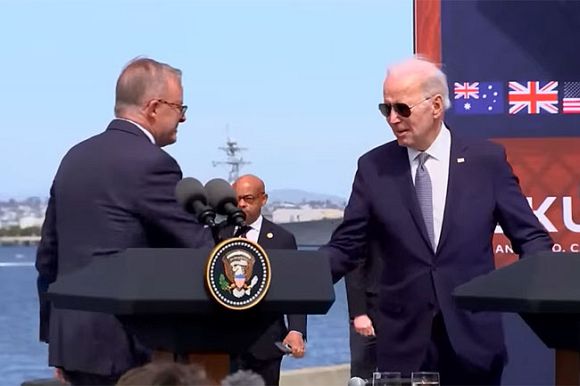
The flawed AUKUS pact sinking quickly . . . Australian Prime Minister Anthony Albanese with outgoing President Joe Biden, will Australia have the mettle to be bigger than Trump. Image: Independent Australia
What happens Down Under?
US allies — like Australia — have already been thoroughly indoctrinated by American pop culture in order to complement the many army bases they house and the defence agreements they have signed.
Though Trump hasn’t shown any interest in making it a 52nd state, Australia has been tucked up in bed with the United States since the Cold War. Our foreign policy has hinged on this alliance, which also significantly affects Australia’s trade and economy, not to mention our entire cultural identity, mired as it is in US-style fast food dependence and reality TV. Would you like Vegemite McShaker Fries with that?
So what will happen to Australia once the superpower we have followed into endless battles finally breaks down?
‘Trump has promised chaos and chaos is what he’ll deliver.’
His rise to power will embolden the rabid Far-Right in the US but will this be mirrored here? And will Australia follow the US example and this year elect our very own (admittedly scaled down) version of Trump, personified by none other than the Trump-loving Peter Dutton?
If any of his wild announcements are to be believed, between building walls and evicting even US nationals he doesn’t like, while simultaneously making Canadians US citizens, Trump will be extremely busy.
There will be little time even to consider Australia, let alone come to our rescue should we ever need the might of the US war machine — no matter whether it is an Albanese or sycophantic Dutton leadership.
It is a given, however, that we would be required to honour all defence agreements should our ally demand it.
It would be great if, as psychologists urge us to do when children act up, our leaders could simply ignore and refuse to engage with him, but it remains to be seen whether Australia will have the mettle to be bigger than Trump.
Republished from the Independent Australia with permission.
This article was written before The Electronic Intifada’s founding editor Ali Abunimah was arrested in Switzerland on Saturday afternoon for “speaking up for Palestine”. He has since been released and deported.
SPECIAL REPORT:By Ali AbunimahIsrael smuggled one of its soldiers out of Cyprus, apparently fearing his detention on charges related to the genocide in Gaza, according to Dyab Abou Jahjah, the co-founder of The Hind Rajab Foundation.
Abou Jahjah, a Belgian-Lebanese political activist and writer, told The Electronic Intifada livestream last week that his organisation was stepping up efforts all over the world to bring to justice Israeli soldiers implicated in the slaughter of tens of thousands of men, women and children over the last 15 months.
Gaza Ceasefire Day 5. Video: The Electronic Intifada
Speaking from Gaza, Electronic Intifada contributor Donya Abu Sitta told us how people there are coping following the ceasefire, especially those returning to devastated homes and finding the remains of loved ones.
She shared a poem inspired by the hopes and fears of the young children she continued to teach throughout the genocide.
Despite the ceasefire, Israel has continued to attack Palestinians in some parts of Gaza. That was among developments covered in the news brief from associate editor Nora Barrows-Friedman, along with the efforts to alleviate the dire humanitarian situation.
Contributing editor Jon Elmer covered the latest ceasefire developments and the resistance operations in the period leading up to it.
We also discussed whether US President Donald Trump will force Israel to uphold the ceasefire and what the latest indications of his approach are.
‘There is an openness to the glee and celebration of genocidal violence in Israel that I think goes beyond anything we saw during the Iraq war or during apartheid in South Africa.’
And this writer took a critical look at Episcopal Bishop of Washington Mariann Edgar Budde.
She has been hailed as a hero for urging Donald Trump to respect the rights of marginalised groups, as the new president sat listening to her sermon at Washington’s National Cathedral.
But over the last 15 months, Budde has parroted Israeli atrocity propaganda justifying genocide, and has repeatedly failed to condemn former President Joe Biden’s key role in the mass slaughter and did not call on him to stop sending weapons to Israel.
Pursuing war criminals In the case of the soldier in Cyprus, The Hind Rajab Foundation filed a complaint, and after initial hesitation, judicial authorities in the European Union state opened an investigation of the soldier.
“When that was opened, the Israelis smuggled the soldier out of Cyprus,” Abou Jahjah said, calling the incident the first of its kind.
“And when I say smuggling, I’m not exaggerating, because we have information that he was even taken by a private jet,” Abou Jahjah added.
The foundation is named after Hind Rajab, a 6-year-old Palestinian girl who was in a car with members of her family, trying to escape the Israeli onslaught in Gaza City, when they were attacked.
The story of Hind, trapped all alone in a car, surrounded by dead relatives, pleading over the phone for rescue, a conversation that was recorded by the Palestinian Red Crescent, is among the most poignant and brazen crimes committed during Israel’s genocide.
According to Abou Jahjah, lawyers and activists determined to seek justice for Palestinians identified a gap in the efforts to hold Israel accountable that they could fill: pursuing individual soldiers who have in many cases posted evidence of their own crimes in Gaza on social media.
The organisation and its growing global network of volunteers and legal professionals has been able to collect evidence on approximately 1000 Israeli soldiers which has been handed over to the International Criminal Court (ICC).
In addition to filing cases against Israeli soldiers traveling abroad, such as the one in Cyprus, and other recent examples in Brazil, Thailand and Italy, a main focus of the foundation is individuals who hold both Israeli and another nationality.
“Regarding the dual nationals, we are not under any restraint of time,” Abou Jahjah explained. “For example, if you’re Belgian, Belgium has jurisdiction over you.”
Renouncing their second nationality cannot shield these soldiers, according to Abou Jahjah, because courts will take into account their citizenship at the time the alleged crime was committed.
Abou Jahjah feels confident that with time, war criminals will be brought to justice. The organisation is also discussing expanding its work to the United States, where it may use civil litigation to hold perpetrators accountable.
Unsurprisingly, Israel and friendly governments are pushing back against The Hind Rajab Foundation’s work, and Abou Jahjah is now living under police protection.
“Things are kind of heavy on that level, but this will not disrupt our work,” Abou Jahjah said. “It’s kind of naive of them to think that the work of the foundation depends on a person.”
“We have legal teams across the planet, very capable people. Our data is spread across the planet,” Abou Jahjah added. “There’s nothing they can do. This is happening.”
Resistance report In his resistance report, Elmer analysed videos of operations that took place before the ceasefire, but which were only released by the Qassam Brigades, the military wing of Hamas, after it took effect.
He also previewed Saturday, 25 January, when nearly 200 Palestinian prisoners were released in exchange for four Israeli female soldiers.
Will Trump keep Israel to the ceasefire? Pressure from President Trump was key to getting Israel to agree to a ceasefire deal it had rejected for almost a year. But will his administration keep up the pressure to see it through?
There have been mixed messages, with Trump recently telling reporters he was not sure it would hold, but also intriguingly distancing himself from Israel. “That’s not our war, it’s their war.”
We took a look at what these comments, as well as a renewed commitment to implementing the deal expressed by Steve Witkoff, the president’s envoy, tell us about what to expect.
As associate editor Asa Winstanley noted, “this ceasefire is not nothing.” It came about because the resistance wore down the Israeli army, and statements from Witkoff hinting that the US may even be open to talking to Hamas deserve close attention.
‘Largely silent’ By her own admission, Bishop Mariann Budde has remained “largely silent” about the genocide in Gaza, except when she was pushing Israeli propaganda or engaging in vague, liberal hand-wringing about “peace” and “love” without ever clearly condemning the perpetrators of mass slaughter and starvation of Palestinians, demanding that the US stop the flow of weapons making it possible, or calling for accountability.
This type of evasion serves no one.
You can watch the programme on YouTube, Rumble or Twitter/X, or you can listen to it on your preferred podcast platform.
I must admit, I have been somewhat distracted by the chaotic events unfolding not just across the pond, but also the dodgy ceasefire deal that doesn’t seem to matter in the slightest when the colonialist outpost of Israel fancies killing some more children for no other reason whatsoever than the fact they’re not Israeli. It’s not hard to become distracted by the world’s richest moron throwing a…
It was a cold day in Washington, DC, on Tuesday when Donald Trump was sworn in for his second stint as President of the United States of America.
On account of freezing temperatures, the inauguration ceremony was moved indoors to the Capitol Rotunda, and the weather became a primary focus of much pre-inauguration media commentary.
The Reuters news agency reported that this was “one of the coldest inauguration days the US has experienced in the past few decades”, while also providing other crucial ceremony updates such as that “Mike Tyson snacked on a banana in the overflow room”.
I, myself, watched the event on my computer in the southern Mexican state of Oaxaca, where it is precisely the opposite of cold and where I have spent the past several days battling the scorpion population that has taken up residence in my house.
By the end of Trump’s swearing-in, however, I was undecided as to what was less pleasant: killing scorpions or watching the next episode of American dystopia unfold.
I tuned in at 11am, meaning I had a full hour before Trump took centre stage; for much of this time, the audience in the rotunda was treated to musical selections befitting a carousel or a circus.
The frigid weather outside was, meanwhile, at least probably good practice for life on Mars, a territory Trump would soon claim for the United States during his inaugural speech: “And we will pursue our manifest destiny into the stars, launching American astronauts to plant the Stars and Stripes on the planet Mars.”
Not the only territorial conquest
This, to be sure, was not the only territorial conquest Trump promised. He also reiterated his determination to rename the Gulf of Mexico as the “Gulf of America” as well as to seize control of the Panama Canal because “American ships are being severely overcharged and not treated fairly in any way, shape, or form”.
President Donald Trump . . . “We will pursue our manifest destiny into the stars, launching American astronauts to plant the Stars and Stripes on the planet Mars.”. Image: The Conversation
But the Mars comments earned a maniacal grin from one person in the audience: the gazillionaire Tesla CEO Elon Musk, known for such ideas as that the “next really big thing is to build a self-sustaining city on Mars and bring the animals and creatures of Earth there”.
Musk was one of various representatives of the earthly super-elite who — unlike poor Mike Tyson — made the cut for a spot in the rotunda. Also present were Meta CEO Mark Zuckerberg, Amazon’s Jeff Bezos, and Shou Zi Chew, the CEO of TikTok.
As Al Jazeera noted the day prior to the inauguration, Apple CEO Tim Cook reportedly donated $1 million to the ceremony, while “Google, Amazon, Microsoft and Meta have said they would donate $1 million, along with Sam Altman, the CEO of OpenAI, who donated $1 million”.
As of January 8, Trump’s inauguration fund had already racked up a record $170 million.
Anyway, what better way to “Make America Great Again” than by supercharging the plutocracy?
Declaring at the start of his speech that “the golden age of America begins right now”, Trump went on to express numerous other hallucinations, including that “national unity is now returning to America”. Never mind that the tyranny of an astronomically wealthy minority is not exactly, um, unifying.
Luckily on Planet Trump, reality is whatever he says it is. And Trump says that “sunlight is pouring over the entire world”.
‘Historic executive orders’
In his speech, Trump announced a “series of historic executive orders” that according to him, will jumpstart the “complete restoration of America and the revolution of common sense”.
Among these executive orders was the declaration of “a national emergency at our southern border”, paving the way for the deportation of “millions and millions of criminal aliens” and entailing the deployment of the US military “to repel the disastrous invasion of our country”.
Under Trump’s command, the US “will also be designating the cartels as foreign terrorist organisations”. Then there’s the new “official policy of the United States government that there are only two genders, male and female”.
And of course, the more emergencies, the better: “[T]oday I will also declare a national energy emergency. We will drill, baby, drill.”
Recoiling at the very thought of environmentalism, Trump proclaimed: “We will be a rich nation again, and it is that liquid gold under our feet that will help to do it.”
And if we happen to destroy Earth in the process, well, there’s always Mars.
As usual, the continuous invocation of God during the inauguration ceremony made a fine mockery of the ostensible separation of church and state in the US, and Trump revealed the reason he had survived a July assassination attempt in the state of Pennsylvania: “I was saved by God to make America great again.”
Overlap with Martin Luther King Jr Day
Last but not least, Trump took advantage of the overlap of his inauguration with Martin Luther King Jr Day, celebrated annually in the US on the third Monday of January, to pledge that “we will make his dream come true” — which would probably be easier if Trump himself weren’t a bona fide racist.
Indeed, Trump’s notion that “our power will stop all wars and bring a new spirit of unity to a world that has been angry, violent and totally unpredictable” would seem to be distinctly at odds with King’s assessment of the US as the “greatest purveyor of violence in the world”.
None of this is to imply that the Democrats have not done their part in terms of purveying global violence or upholding plutocracy, perpetuating brutal inequality, terrorising refuge seekers, and so on.
But Tuesday’s inaugural charade was an exercise in nihilism — and, as I return to my scorpions and Trump goes about making dystopia great again, I think I’ll take Mars over the “golden age of America” any day.
Belén Fernández is the author of Inside Siglo XXI: Locked Up in Mexico’s Largest Immigration Detention Center (OR Books, 2022), Checkpoint Zipolite: Quarantine in a Small Place (OR Books, 2021), and Martyrs Never Die: Travels through South Lebanon (Warscapes, 2016). She writes for numerous publications and this article was first published by Al Jazeera.
Another week, another absolutely bullshit story about what the Department for Work and Pensions (DWP) plans to subject benefits claimants to. This week, “benefits cheats could lose driving licences”. In amongst the launch of the government’s new proposals in their latest CRACKDOWN on benefits fraud, DWP boss Liz Kendall slipped out something truly ridiculous. Explaining the new plans to have…
People get ready
There’s a train a-coming
You don’t need no baggage
You just get on board
All you need is faith
To hear the diesels humming
Don’t need no ticket
You just thank the Lord
You might have seen Bishop Mariann Edgar Budde’s speech at the National Prayer Service in the United States following Trump’s elevation to the highest worldly position, or perhaps read about it in the news.
It’s well worth watching this short clip of her sermon if you haven’t, as the rest of this newsletter is about that and the reaction to it:
‘May I ask you to have mercy Mr President.’ Video: C-Span
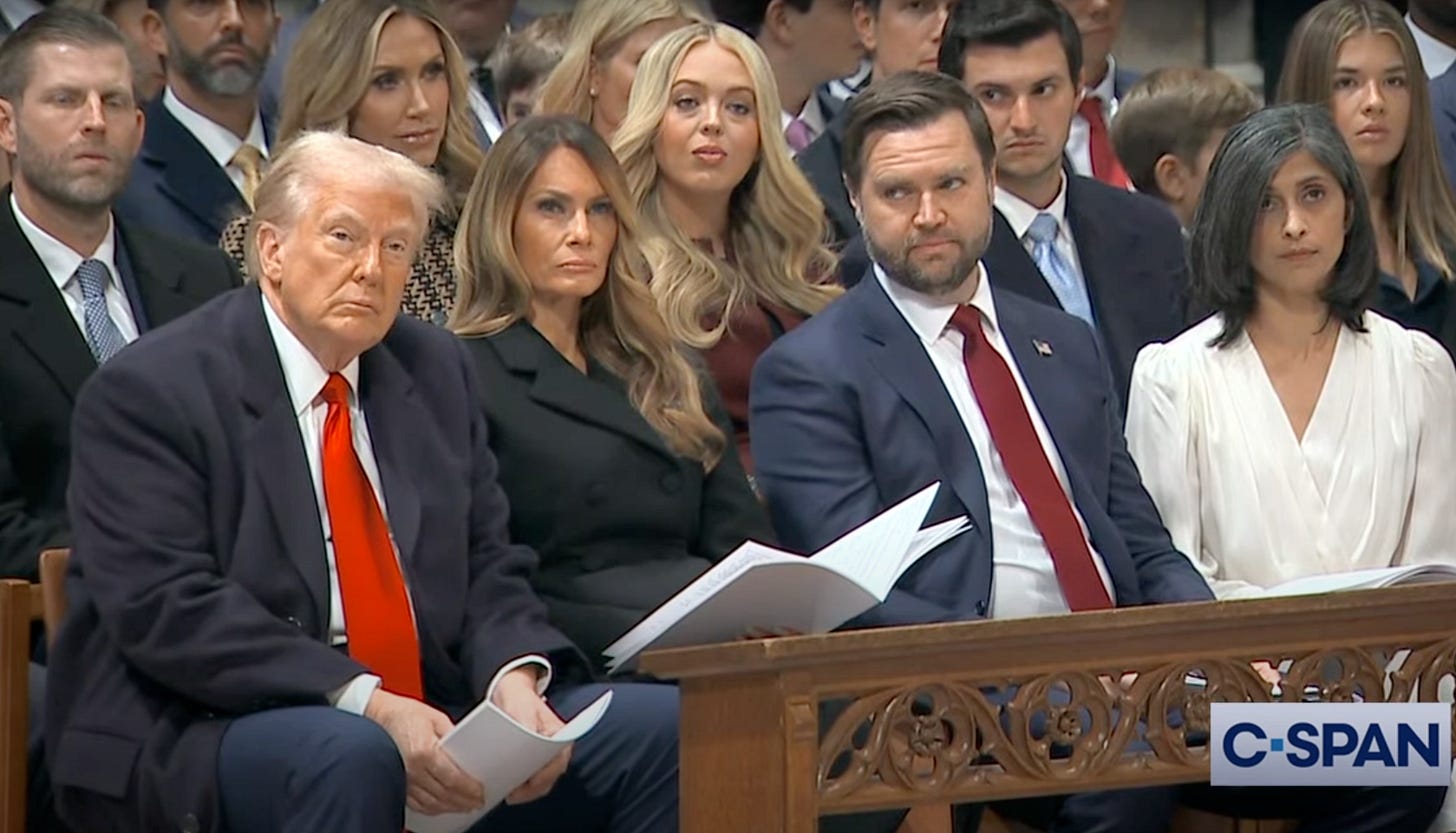
I found the sermon courageous, heartfelt, and, above all, decent. It felt like there was finally an adult in the room again. Predictably, Trump and his vile little Vice-President responded like naughty little boys being reprimanded, reacting with anger at being told off in front of all their little mates.
That response will not have surprised the Bishop. As she prepared to deliver the end of her sermon, you could see her pause to collect her thoughts. She knew she would be criticised for what she was about to say, yet she had the courage to speak it regardless.
What followed was heartfelt and compelling, as the Bishop talked of the fears of LGBT people and immigrants.
Bishop Mariann Edgar Budde’s speaking at the National Prayer Service. Image: C-Span screenshot
She spoke of them as if they were human beings like the rest of us, saying they pay their taxes, are not criminals, and are good neighbours.
The president did not want to hear her message. His anger was building as his snivelling sidekick looked toward him to see how the big chief would respond.
The President didn’t want to hear her message. Image: C-Span screenshot
Vented on social media
So, how did the leader of the free world react? Did he take it on the chin, appreciating that he now needed to show leadership for all, or did he call the person asking him to show compassion — “nasty”?
That’s right, it was the second one. I’m afraid there’s no prize for that as you’re all excluded due to inside knowledge of that kind of behaviour from observing David Seymour. The ACT leader responds in pretty much the same way when someone more intelligent and human points out the flaws in his soul.
Donald then went on his own Truth social media platform, which he set up before he’d tamed the Tech Oligarchs, and vented, “The so-called bishop who spoke at the National Prayer Service on Tuesday morning was a radical left hard-line Trump hater”.
Which isn’t very polite, but when you think about it, his response should be seen as a badge of honour. Especially for someone of the Christian faith because all those who follow the teachings of Christ ought to be “radical left hard-line Trump haters”, or else they’ve rather missed the point. Don’t you think?
Certainly, pastor and activist John Pavlovitz thought so, saying, “Christians who voted for him, you should be ashamed of yourselves. Of course, if you were capable of shame, you’d never have voted for him to begin with.”
Pastor and activist John Pavlovitz responds.“She brought her church into the world of politics in a very ungracious way. She was nasty in tone, and not compelling or smart,” continued the President, like a schoolyard bully.
I thought it was a bit rich for a man who has used the church and the bible in order to sell himself to false Christians who worship money, who has even claimed divine intervention from God, to then complain about the Bishop not staying in her lane.
Speaking out against bigotry
If religious leaders don’t speak out against bigotry, hatred, and threats to peaceful, decent human beings — then what’s the point?
Wow. Bishop Mariann Edgar Budde fearlessly calls out Trump and Vance to their faces. This is heroic. pic.twitter.com/igyKzC8dRo
I admired Budde’s bravery. Just quietly, the church hasn’t always had the best record of speaking out against those who’ve said the sort of things that Trump is saying.
If you’re unclear what I mean, I’m talking about Hitler, and it’s nice to see the church, or at least the Bishop, taking the other side this time around. Rather than offering compliance and collaboration, as they did then and as the political establishment in America is doing now.
Aside from all that, it feels like a weird, topsy-turvy world when the church is asking the government to be more compassionate towards the LGBT community.
El Douche hadn’t finished and said, “Apart from her inappropriate statements, the service was a very boring and uninspiring one. She is not very good at her job! She and her church owe the public an apology!”
It’s like he just says the opposite of what is happening, and people are so stupid or full of hate that they accept it, even though it’s obviously false.
So, the Bishop is derided as “nasty” when she is considerate and kind. She is called “Not Smart” when you only have to listen to her to know she is an intelligent, well-spoken person. She is called “Ungracious” when she is polite and respectful.
Willing wretches
As is the case with bullies, there are always wretches willing to support them and act similarly to win favour, even as many see them for what they are.
Mike Collins, a Republican House representative, tweeted, “The person giving this sermon should be added to the deportation list.”
Isn’t that disgusting? An elected politician saying that someone should be deported for daring to challenge the person at the top, even when it is so clearly needed.
Echoing the teachings of Jesus and calling out Trump’s cruelty, ignorance, and bigotry to his face, Bishop Mariann Edgar Budde delivers a sermon for the ages. Bishop Budde stared down authoritarian fascism and said ‘Not today, motherfucker.’ pic.twitter.com/JDBDa5RAgs
Fox News host Sean Hannity said, “Instead of offering a benediction for our country, for our president, she goes on the far-left, woke tirade in front of Donald Trump and JD Vance, their families, their young children. She made the service about her very own deranged political beliefs with a disgraceful prayer full of fear-mongering and division.”
Perhaps most despicably, Robert Jeffress, the pastor of Dallas’s First Baptist Church, tweeted this sycophantic garbage:
Attended national prayer service today at the Washington National Cathedral during which Bishop Mariann Edgar Budde insulted rather than encouraged our great president @realDonaldTrump. There was palpable disgust in the audience with her words. @POTUS
Those cronies of Trump seem weak and dishonest to me compared to the words of Bishop Budde herself, who said the following after her sermon:
“I wanted to say there is room for mercy, there’s room for a broader compassion. We don’t need to portray with a broadcloth in the harshest of terms some of the most vulnerable people in our society, who are, in fact, our neighbours, our friends, our children, our friends, children, and so forth.”
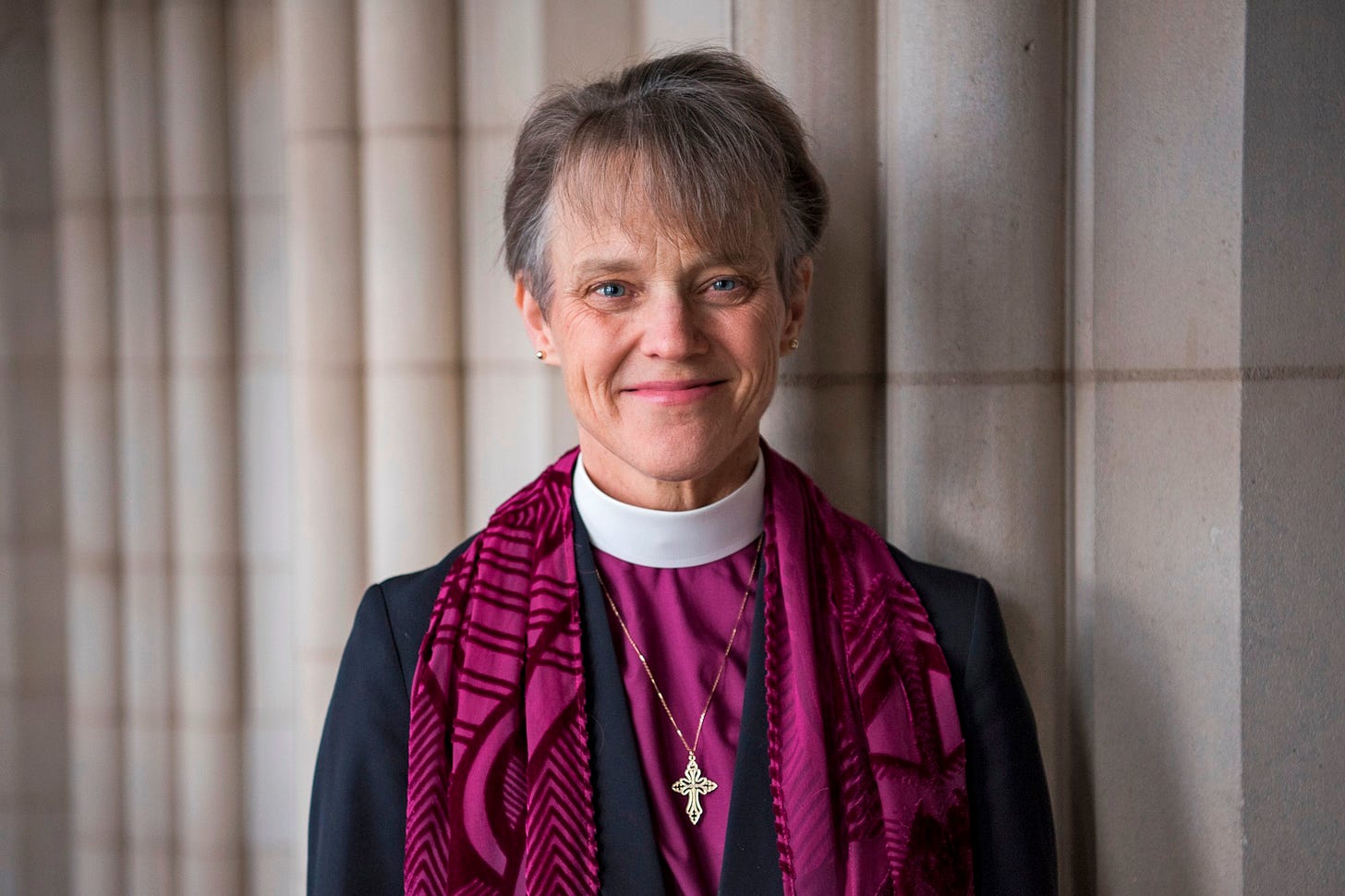
Bishop Mariann Edgar Budde a courageous stand. Image: https://cathedral.org/about/leadership/the-rt-rev-mariann-edgar-budde/Speaking up or silent?
Over the next four years, many Americans will have to choose between speaking up on issues they believe in or remaining silent and nodding in agreement.
The Republican party has made its pact with the Donald, and the Tech Bros have fallen over each other in their desire to kiss his ass; it will be a dark time for many regular people, no doubt, to stand up for what they believe in even as those with power and privilege fall in line behind the tyrant.
Decoding symbolism in Lord of the Flies. Image: https://wr1ter.com/decoding-symbolism-in-lord-of-the-flies So, although I am not Christian, I am glad to see the Church stand up for those under attack, show courage in the face of the bully, and be the adult in the room when so many bow at the feet of the child with the conch shell.
In my view Bishop Mariann Edgar Budde is a hero, and she does herself great credit with this courageous, compassionate, Christian stand
First published by Nick’s Kōrero and republished with permission. For more of Nick Rockel’s articles or to subscribe to his blog, click here.
Canada is also in Trump’s sights with trade tariff threats and claims it should be the 51st US state. Its government has vociferously opposed Trump’s comments, begun back-channel lobbying in Washington, and prepared for trade retaliation.
Both cases highlight the coming challenges for management of the global US alliance network in an era of increased great power rivalry — not least for NATO, of which Denmark and Canada are member states.
Members of that network saw off the Soviet Union’s formidable Cold War challenge and are now crucial to addressing China’s complex challenge to contemporary international order. They might be excused for asking themselves the question: with allies like this, who needs adversaries?
Oversimplifying complex relationships Trump’s longstanding critique is that allies have taken advantage of the US by under-spending on defence and “free-riding” on the security provided by Washington’s global network.
In an intuitive sense, it is hard to deny this. To varying degrees, all states in the international system — including US allies, partners and even adversaries — are free-riding on the benefits of the global international order the US constructed after the Cold War.
But is Trump therefore justified in seeking a greater return on past US investment?
Since alliance commitments involve a complex mix of interests, perception, domestic politics and bargaining, Trump wouldn’t be the deal-maker he says he is if he didn’t seek a redistribution of the alliance burden.
The general problem with his recent foreign policy rhetoric, however, is that a grain of truth is not a stable basis for a sweeping change in US foreign policy.
Specifically, Trump’s “free-riding” claims are an oversimplification of a complex reality. And there are potentially substantial political and strategic costs associated with the US using coercive diplomacy against what Trump calls “delinquent” alliance partners.
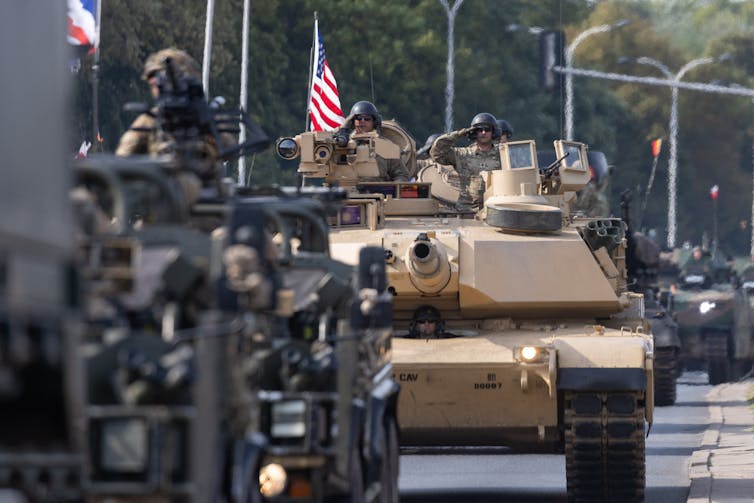
US military on parade in Warsaw in 2022 . . . force projection is about more than money. Image: Getty Images/The Conversation
Free riding or burden sharing? The inconvenient truth for Trump is that “free-riding” by allies is hard to differentiate from standard alliance “burden sharing” where the US is in a quid pro quo relationship: it subsidises its allies’ security in exchange for benefits they provide the US.
And whatever concept we use to characterise US alliance policy, it was developed in a deliberate and methodical manner over decades.
US subsidisation of its allies’ security is a longstanding choice underpinned by a strategic logic: it gives Washington power projection against adversaries, and leverage in relations with its allies.
To the degree there may have been free-riding aspects in the foreign policies of US allies, this pales next to their overall contribution to US foreign policy.
Allies were an essential part in the US victory in its Cold War competition with the Soviet-led communist bloc, and are integral in the current era of strategic competition with China.
Overblown claims of free-riding overlook the fact that when US interests differ from its allies, it has either vetoed their actions or acted decisively itself, with the expectation reluctant allies will eventually follow.
During the Cold War, the US maintained a de facto veto over which allies could acquire nuclear weapons (the UK and France) and which ones could not (Germany, Taiwan, South Korea).
In the 1980s, Washington proceeded with the deployment of US missiles on the soil of some very reluctant NATO states and their even more reluctant populations. The same pattern has occurred in the post-Cold War era, with key allies backing the US in its interventions in Afghanistan and Iraq.
The problems with coercion Trump’s recent comments on Greenland and Canada suggest he will take an even more assertive approach toward allies than during his first term. But the line between a reasonable US policy response and a coercive one is hard to draw.
It is not just that US policymakers have the challenging task of determining that line. In pursuing such a policy, the US also risks eroding the hard-earned credit it earned from decades of investment in its alliance network.
There is also the obvious point that is takes two to tango in an alliance relationship. US allies are not mere pawns in Trump’s strategic chessboard. Allies have agency.
They will have been strategising how to deal with Trump since before the presidential campaign in 2024. Their options range from withholding cooperation to various forms of defection from an alliance relationship.
Are the benefits associated with a disruption of established alliances worth the cost? It is hard to see how they might be. In which case, it is an experiment the Trump administration might be well advised to avoid.
Dr Nicholas Khoo is associate professor of international politics and principal research fellow, Institute for Indo-Pacific Affairs (Christchurch), University of Otago. This article is republished from The Conversation under a Creative Commons licence. Read the original article.
Celebration time. Some Palestinian prisoners have been released. A mother reunited with her daughter. A young mother reunited with her babies.
Still in prison are people who never received a fair trial, people that independent inquirers say are wrongly imprisoned. Still in prison kids who cursed soldiers who walked into their villages wielding guns.
Still imprisoned far too many Palestinians who threw stones against bullets. Still imprisoned thousands of Palestinian hostages.
Many of us never knew how many hostages had been stolen, hauled into jails by Israel before 7 October 2023. We only heard the one-sided story of that day. The day when an offence force on a border was taken by surprise and when it panicked and blasted and bombed.
When that army guarding the occupation did more to lose lives than save lives.
Many never knew and perhaps never will know how many of the Palestinians who were kidnapped before and after that day had been beaten and tortured, including with the torture of rape.
We do know many have been murdered. We do know that some released from prison died soon after. We do not know how many more Palestinians will be taken hostage and imprisoned behind the prison no reporter is allowed to photograph.
Israelis boast over prison crime
The only clue to what happens inside is that Israelis have boasted this crime on national television. The clue is that Israeli soldiers have been tried for raping their own colleagues.
Make no mistake, this is a mean misogynist mercantile army. No sensible rational caring person would wish to serve in it.
No mother on any side of this conflict should lose her child. No father should bury his daughter or son. No grandparent should grieve over the loss of a life that should outlive them.
The crimes need to be exposed. All of them. Our media filters the truth. It does not provide a fair or full story. If you want that switch for pity’s sake go to Al Jazeera English.
The Palestinian people were forced to flee their homes in Gaza. Those who were never responsible for any crime were bombed out of their homes, they fled as their families were murdered, burned to death, shot by snipers. They fled while soldiers mocked their dead children.
They return home to ashes. If we want peace we must face the truths that create conflict. We are all connected in peace and war and peace.
Peace is the strongest greeting. It sears the heart and soars the soul.
It can only be achieved when we recognise and stop the anguish that causes oppression.
Saige England is a freelance journalist and author living in the Aotearoa New Zealand city of Ōtautahi.
COMMENTARY:By Steven Cowan, editor of Against The Current
New Zealand’s One News interviewed a Gaza journalist last week who has called out the Western media for its complicity in genocide.
For some 15 months, the Western media have framed Israel’s genocidal rampage in Gaza as a “legitimate” war.
Pretending to provide an objective and impartial view of “the Gaza War”, the Western media has failed to report on the atrocities that the Israel has committed in Gaza. The true face of Israel’s genocidal assault has been hidden behind the Western media’s determination to sanitise genocide.
Palestinian journalist Abubaker Abed’s appeal to the world and the Western media. Video: Dawn News
Even the deliberate targeting of journalists by the Israeli “Defence” Force (IDF), a war crime, has not moved the Western media to take action. More than 200 journalists have been killed in Gaza and the Western media has remained silent.
The New Zealand and Pacific media also have nothing to be proud of in their coverage of events in Gaza. They, too, have consistently framed Israel’s genocidal rampage as a legitimate war and swept Israel’s war crimes under the carpet.
Some news outlets, like NZ’s Newstalk ZB, have gone as far as to defend Israel’s actions.
With the announcement of a ceasefire in Gaza last week, One News, for the first time since Israel began its murderous assault, chose to talk live to a Palestinian journalist in Gaza. That journalist was 22-year-old Abubaker Abed.
Ignored by Western media
While One News introduced him as a reporter for the Associated Press, most of Abed’s reports have been for Palestinian news outlets like The Electronic Intifida.
On January 11, Abed made a speech condemning the Western media’s complicity in genocide. While the speech has been widely circulated in the social media, it has been ignored by the Western media.
In New Zealand, the important speech has failed to make it to the One News website.
One News interviewing Gaza journalist Abubaker Abed who has called out the Western media for its complicity in genocide.
This article was first published on Steven Cowan’s website Against The Current. Republished with permission.
Trump doesn’t just hate nonbinary Mexicans, he also wants disabled people dead
Okay he didn’t say that specifically, but he came very close to it. Just a few minutes after announcing that anyone who lost their job in the military because they refused to be vaccinated against Covid would reinstated and back paid, he dealt an unusually subtle blow to disabled people
Right in between declaring he’d take back the Panama Canal and that they’d go to fucking Mars was this:
We will end the chronic disease epidemic and keep our children safe, healthy and disease-free.
Of course there’s something glaringly obvious here, you can’t “end” chronic illness, because the clues in the name – they’re chronic. You can however deny support, make it harder for disabled people to get treatment, and actively work to endanger them.
So how is Trump planning to “end chronic disease”? Well it sure as fuck ain’t through support and funding research. As always, Trump didn’t elaborate on his actual plan or concept of a plan for this. But his previous work and pledges give us a pretty clear picture and either way it’s gonna be a shit old time for disabled people in America, again.
Judge Trump by his record
Trump’s own record of wanting to deny children disability benefits and severely reduce disability benefits speaks for itself. But wait, there’s more.
Project 2025, which Trump denies having anything to do with yet attempted to enact 64% of it’s 2016 policies, has some particularly nasty ideas for people with disabilities and chronic conditions.
The biggest of all is that it wants to put “time limits or lifetime caps” on Medicaid, which would kick low income people off their health insurance after an arbitrary amount of time. This means the poorest disabled people would be forced to skip, delay, or all out stop their potentially life saving treatment.
On top of this it also wants to make it easier for drug companies to boost the prices of medication by repealing the Inflation Reduction Act which caps medication costs and makes vaccinations free for those over 65 and with certain disabilities. This means some medication could rise by $4,000 annually and risk not being able to vaccinate themselves against things such as shingles and the flu.
Thankfully though Trump isn’t operating alone. Surely someone level headed will be in charge of the Medicare and Medicaid.
Oh wait it’s fucking Dr Oz off the telly, the guy who claimed there was arsenic in apple juice.
The real threat to disabled lives
Okay, at least the health secretary isn’t a complete conspiracy theorist. Nah wrong again, it’s Robert F Kennedy Jr, he of brain worms and claiming vaccines caused autism fame. He also believes chronic illness only originated in the 1980s.
In November he unveiled the Make America Healthy Again plan, because of course it’s called that. It’s basically all food is poison, you cant trust medication, and instead we should all be drinking raw milk.
I wish I was exaggerating here.
As well as firing all the actual nutritional scientists from the health agency, he thinks all food is “poison”. He’s however, bizarrely against vegetable oils and thinks we should go back to cooking with saturated animal fats. He also thinks kids shouldn’t be eating grains (for some reason) and that we should all be drinking raw milk, which has been linked to the recent bird flu outbreak.
Big surprise, brain worm guy hates medication
RFK Jr is also – big surprise – massively against taking any types of medication. During campaigning, he pledged to criminalise SSRIs and Adderall. It’s okay! It’s not like these are drugs which many people rely on to live.
He is however a massive believer in alternatives to drugs. On Twitter he said the FDA had waged “war on public health”. He then accused the agency of “aggressive suppression” of anything that “advances human health and can’t be patented by Pharma”. This included but is not limited to sunshine (yes really), hydroxychloroquine (which the FDA does regulate and is patented), ivermectin (again regulated and patented), vitamins (yep you guessed it), exercise and psychedelics.
He also of course, thinks you shouldn’t trust the water supply, because – of course he does.
Drugs are bad kids, but not those ones
If hydroxychloroquine sounds familiar to you, that’s because it’s the drug Trump, RFK Jr and many others started touting as a cure to Covid.
What it actually does is prevent malaria and help manage the symptoms of lupus and arthritis. FDA pulled the use of it for Covid due to lack of evidence, but there were also concerns about rich folk buying it in bulk and increasing the price so disabled people who relied on it couldn’t afford it.
If RFK Jr decides to reverse the ruling, whilst stopping companies from hiking up prices, many could be at risk.
His obsession with psychedelics is particularly troubling as there are fears he could push through dangerous drugs whilst limiting those that actually help people with mental health issues. For instance last year the FDA rejected Lykos Therapeutics’ MDMA-assisted therapy for PTSD after some of the participants in the trial participants reported feeling suicidal and even attempting suicide.
The next four years will be life threatening for many
While Trump may claim he wants to end chronic disease, there is no way to do this that would not spell the mass murder of disabled people.
That’s why it felt like a punch in the gut when, during the religious section of the inauguration, was the religious section Father Francis Mann, beseeched god to
inspire our new leaders to be champions for the vulnerable and advocates for those whose voices are often silenced.
Because nothing says championing the vulnerable like making it illegal to be nonbinary, mass deportations, and essentially wiping out disabled people.
I wish there was some sort of hopeful message here. But unfortunately it seems that Trump’s second term is going to be even scarier and more dangerous for marginalised people than the last one.
The following is a short letter from Canary reader Sarah Gale. Mick Lynch, the general secretary of the Rail, Maritime and Transport (RMT) union, has announced his retirement at the age of 63.
Elected in 2021, Lynch led the union through significant industrial actions, notably the extensive rail strikes from 2022 to 2024.
Prior to his tenure at RMT, he worked as a qualified electrician and was blacklisted for union involvement, leading him to co-found the Electrical and Plumbing Industries Union in 1988.
Lynch expressed pride in the union’s resilience against challenges, stating “We can all be proud that our union stood up against the wholesale attacks on the rail industry by the previous Tory government and the union defeated them”.
The RMT has initiated the process to elect a new general secretary, with the election concluding in May 2025.
Possibly the greatest prime minister we never had, is retiring. Mick Lynch, the working class lad from Paddington, left school at 16 and then proceeded to eloquently perform common sense verbal gymnastics with brazen truth twisters, who, when they failed to outsmart him, then resorted to slander and the proverbial grasping at straws.
Mick amplified the voices of poorly paid and precariat workers everywhere and not just his RMT union members.
I was fortunate to meet him twice, once at an ‘Enough is Enough’ rally in 2022 and then on the march to save the ticket offices in 2023 where I saw many hopeful faces proudly holding up placards saying, “Mick Lynch for Prime Minister.” You couldn’t meet a more authentic bloke; he looked chuffed when I gifted him a copy of Tressell’s The Ragged Trousered Philanthropist and informed me, “that’s my bible.”
Mick, like all readers of the Canary I’m sure, refuses to believe that a fairer society is impossible – a society where everyone can and does thrive. Mick epitomises the celebrated quotation from the Welsh thinker and writer, Raymond Williams:
To be truly radical is to make hope possible, rather than despair convincing.
I wish Mick Lynch a well-earned retirement and hope he lives to see the words of another great man, albeit a fictional one, come to fruition:
The acquisition of wealth is no longer the driving force in our lives. We work to better ourselves and the rest of humanity.’
An Al-Jazeera Arabic special report translated by The Palestine Chronicle staff details how Israel’s military strategy in Gaza, aimed at dismantling Hamas and displacing Palestinian civilians, has failed after 470 days of conflict.
ANALYSIS: By Abdulwahab al-Mursi
On May 5, 2024, nearly seven months into Israel’s ongoing genocidal war on Gaza, Israeli Prime Minister Benjamin Netanyahu declared that the main goal of the war was to destroy Hamas and prevent it from controlling Gaza.
However, over 250 days since this statement, and 470 days into the Israeli aggression, it has become clear that Netanyahu’s promises have faded into illusions.
In the early hours of the first phase of the ceasefire on Sunday, Israeli military radio reported that Hamas forces were reasserting their control over Gaza, stating that Hamas, which had never lost control of any part of the territory during the war, was using the ceasefire to strengthen its grip.
This development highlights the gap between Israel’s strategic objectives and the reality on the ground, as images from Gaza continue to reveal widespread devastation and loss of life, yet Hamas remains firmly in control.
Popular Support: The backbone of Hamas Military literature highlights the concept of “Center of Gravity” (COG) for military organisations, a concept that can vary depending on the organisation and context.
In the case of Hamas and Palestinian Resistance, the central element of their strength lies in the support of the local population.
This grassroots support provides Hamas with invaluable social depth, a continuous supply of human resources, and strong strategic backing.
The popular support and belief in the resistance’s strategic choices and leadership have allowed Hamas to maintain its popular mandate to achieve Palestinian national goals.
Recognising this, Israel has targeted Gaza’s civilian infrastructure both militarily and psychologically, aiming to raise the costs of supporting the resistance and weaken Hamas’s popular base.
Israel has treated Gaza’s entire civilian infrastructure as military targets, believing that expanding the death toll among civilians and inflicting maximum suffering would force the population to turn against Hamas.
Yet, despite these efforts, images of celebrations in Gaza, even in areas heavily targeted by Israel, underscore the exceptional nature of the Gaza situation, where resistance culture is deeply rooted and unyielding.
The strategic consciousness of Gaza’s people There appears to be a collective strategic awareness among Gaza’s people to maintain a victorious image at all costs, even in the midst of devastating humanitarian crises.
This desire to project an image of resistance and triumph, despite the overwhelming tragedy, has led to spontaneous public displays of support for Hamas and resistance forces, reinforcing their resolve against the Israeli onslaught.
Failure of forced displacement plans In the initial weeks of the war, Israel revealed its plan to forcibly relocate Gaza’s population.
Israeli media outlets reported in October 2023 that Netanyahu had proposed relocating Gaza’s residents to other countries.
However, after months of war, Gaza’s residents have shown an unshakable determination to remain, with displaced individuals in refugee camps celebrating their return to their homes, despite the widespread destruction they have suffered.
In northern Gaza, particularly in Beit Lahiya, Beit Hanoun, Jabaliya, and Shuja’iyya, Israel’s attempts to prevent the return of displaced residents became a significant obstacle to a ceasefire agreement, delaying it for months.
Israel’s plan, known as the “Generals’ Plan” by former Israeli military advisor Giora Eiland, aimed to create a buffer zone in northern Gaza by applying immense military and living pressures on the population.
However, as evident from the ongoing images from the region, the displaced population continues to resist and return, undermining Israel’s relocation goals.
Hamas’s military structure endures One of Netanyahu’s primary goals was to dismantle Hamas’s military wing, the Al-Qassam Brigades.
However, in the early hours of the first phase of the ceasefire, images showed Hamas fighters organising military parades in southern Gaza, signalling the resilience of Hamas’s military structure even before the ceasefire officially began.
Despite Israeli claims of killing thousands of Hamas fighters and destroying significant portions of Gaza’s tunnel network, the rapid and organized emergence of Al-Qassam forces on the ground suggests that these Israeli claims may have been aimed more at reassuring the Israeli public about the progress of the war, rather than reflecting the true situation on the ground.
Failure of post-war plans In December 2023, Netanyahu rejected Palestinian proposals that Hamas be included in Gaza’s post-war governance, insisting, “There will be no Hamas in the post-war period; we will eliminate them.”
Throughout the war, Israel attempted various unilateral methods to manage Gaza, including direct military administration and creating a new technocratic authority with local leaders, but all efforts failed.
Israeli military attempts to distribute humanitarian aid in Gaza also proved ineffective, as the army struggled to manage these operations.
As the conflict nears what is supposed to be its final phase, the governance structure in Gaza has not changed.
Hamas’s leadership, especially the Al-Qassam Brigades, continues to operate effectively, and the ceasefire agreement has allowed for the resumption of local security forces.
Even after Israel’s targeted assassinations of 723 members of Gaza’s police and security apparatus, the resilience of Gaza’s security forces has remained evident.
This failure of Israel’s post-war vision was highlighted by a comment from a political analyst on Israeli i24 News, who questioned the results of the prolonged military operation: “What have we achieved in a year and five months?
“We destroyed many homes, lost many of our best soldiers, and in the end, the result is the same: Hamas rules, aid enters, and the Qassam Brigades return.”
Republished from The Palestinian Chronicle with permission.
Hamas has claimed victory in their armed conflict with the genocidal state of Israel, following the announcement of the long-overdue ceasefire agreement. The ceasefire, as impossible as it seems, may well bring an end to the killing, but it will not bring an end to the conflict.
Hamas won because they didn’t lose
Hamas arguably did win, because Israel failed to degrade and destroy them — a stated aim that was used to justify the invasion of Gaza and the barbaric murder of tens of thousands of innocent civilians that followed.
Israel didn’t destroy Hamas, it sat round a negotiating table with them. Put simply, Hamas won because they didn’t lose.
Israel, humiliated by homemade hand grenades and rocket launchers built from recycled piping, has lost. Its reputation destroyed, its leader a wanted fugitive, a national conscience irreversibly stained by its vociferous support for its TikTok rapist army and their bloody, unforgivable actions carried out under the false premise of “self-defence”.
The existence of weapons of mass destruction in Iraq, capable of blowing us all to smithereens in a matter of minutes, was built upon a foundation of lies.
The hard-right, Tory-led EU referendum project — remember that extra £350 million a week for our NHS? — and publicly-fronted by some of the most deceitful, loathsome politicians of our generation, was built upon a foundation of lies.
The vilification of former Labour leader Jeremy Corbyn — besmirched, smeared and castigated by the ruling classes for the ‘crime’ of honesty and integrity — was built upon a foundation of lies.
And now we can add the death machine of Israel’s claim of “self-defence” to the list of colossal lies, serving as an unbearably painful reminder of the grave impact that deception can have on the world.
It’s the Palestinian people that have lost
But the greatest losers of Israel’s genocidal reign of terror are undoubtedly the Palestinian people.
As if more than 75 years of brutal oppression and illegal occupation wasn’t enough already?
As if anyone with just a shred of common decency and a semblance of humanity would think it is acceptable to slaughter children in their thousands?
As if anyone would vote for someone that thinks it is.
Keir Starmer’s suspiciously racist response to the news of a potential ceasefire may as well have been written by Labour Friends of Israel, or even Mrs Tzipi Hotoveley, the deranged Israeli ambassador to the UK. How the fuck has that hateful hag miraculously avoided a date with The Hague?
What has the lobby got on Keir Starmer? Nobody would behave quite so callously and recklessly unless they were completely and utterly compromised, would they?
I have to be honest, the thought of a return to apartheid, occupation, and the continuing violence towards the Palestinian people gives me very little reason to celebrate a fragile ceasefire agreement.
A cynical ceasefire
Cynical? You bet I am. Israel has repeatedly violated the 4th Geneva Convention and other acts contrary to its provisions, such as illegal settlements and collective punishment.
Can you really see Israel walking away from Gaza, defeated and humiliated? Their plan was clear enough: release all of the Israeli hostages and destroy Hamas. What a catastrophic failure.
A warts-and-all, independent investigation, backed by Keir Starmer, should be launched into Britain’s pivotal role in the criminality and brutality we have witnessed in Gaza and the West Bank during the past fifteen months.
Israel has always considered itself to be above the law and claims its integrity is beyond reproach.
The International Criminal Court has appeared to be somewhat sanguine about the annihilation of the Palestinian people. They have postured as the lawful solution while failing to stop the barbaric actions of a tiny pariah state that declares itself beyond the reach of international law.
International law itself is on trial alongside Israel. It isn’t unreasonable to ask what value international law holds when it cannot stop the indiscriminate killing, starving, and maiming of an entire population.
Israeli propaganda failed
Israel’s obliteration of institutions such as the Al-Shifa Hospital, the brazen assassination of healthcare workers, and the starvation of Palestinian children are rendered as contested events that should be left open to interpretation, rather than abominable, wicked war crimes that demand accountability at the very highest level of international law.
Britain’s handling of the crisis in Gaza has been absolutely disastrous. From the supply of components that are used to construct weapons of death to the embarrassingly gutless response to the shocking murder of British humanitarian workers, both Rishi Sunak and Keir Starmer have reduced our international stock to the levels of a rogue state such as Belarus
Israeli propaganda has failed to win the hearts and minds of a global audience, thanks to the first ever live-streaming of a genocide. No amount of Eylon Levy TikTok videos was ever going to change that.
Talking of that intolerable lying shit Levy, whatever happened to him? He used to be front and centre of every Israeli lie, then suddenly, he disappeared, just to be replaced by another weird private-schooled British guy
Honestly, nothing would make me happier than not having to write another word about Israel. But their vile colonialist ideology renders this almost impossible.
Will the ceasefire ever be properly implemented?
It remains to be seen if this ceasefire will ever be fully implemented. Israel cannot be trusted. My eternal hope is overshadowed by a hefty dose of past experience.
Israel would quite happily fire rockets at itself if it thought the rest of the gullible imperialist West would swallow up the lies and stand shoulder-to-shoulder with the terrorist regime, once again. Tragically, and without our consent, Britain would be at the front of the queue.
Nelson Mandela once said:
We know too well that our freedom is incomplete without the freedom of the Palestinians…
With current events in mind, never a truer word has been spoken.
A fragile ceasefire is just one small step along a seemingly never-ending road of despair for the oppressed people of Palestine, but let us take a moment to share in their relief, however temporary it may or may not be.
I have wrestled with what to say in this urgent moment, long yearned for and that often appeared beyond reach during these last 15 hideous months.
One of the questions that I grappled with was this: What could I possibly share with readers that would even remotely capture the meaning and profundity of an apparent agreement to stop the wholesale massacre of Palestinians?
I had not suffered. My home is intact. My family and I are alive and well. We are warm, together and safe.
So, the other pressing dilemma I confronted was: Is it my place to write at all? This space should be reserved, I thought, for Palestinians to reflect on the horrors they have endured and what is to come.
Their voices will, of course, be heard here and elsewhere in the days and weeks ahead. My voice, in this context, is insignificant and, under these grievous circumstances, borders on being irrelevant.
Still, if you and, in particular, Palestinians will oblige me, this is what I have to say:
I think that there are four words that each, in their own way, bear some significance to Wednesday’s happy news that the guns are poised to go silent.
The first and perhaps most fitting word is “relief”.
There will be ample time and opportunity for the “experts” to draw up their predictable scorecards of the “winners” and “losers” and the broader short- and long-term strategic implications of Wednesday’s deal.
There will, as well, be ample time and opportunity for more “experts” to consider the political consequences of Wednesday’s deal in the Middle East, Europe and Washington, DC.
My preoccupation, and I suspect the preoccupation of most Palestinians and their loved ones in Gaza and the occupied West Bank, is that peace has arrived finally.
How long it will last is a question best posed tomorrow. Today, let us all revel in the relief that is a dividend of peace.
Palestinian boys and girls are dancing with relief. After months of grief, loss and sadness, joy has returned. Smiles have returned. Hope has returned.
Let us enjoy a satisfying measure of relief, if not pleasure, in that.
There is relief in Israel, too.
The families of the surviving captives will soon be reunited with the brothers and sisters, daughters and sons, mothers and fathers, they have longed to embrace again.
They will, no doubt, require care and attention to heal the wounds to their minds, souls and bodies.
That will be another, most welcomed, dividend of peace.
The next word is “gratitude”.
Those of us who, day after dreadful day, have watched — bereft and helpless as a ruthless apartheid state has gone methodically about reducing Gaza to dust and memory — owe our deepest gratitude to the brave, determined helpers who have done their best to ease the pain and suffering of besieged Palestinians.
We owe our everlasting gratitude to the countless anonymous people, in countless places throughout Gaza and the West Bank, who, at grave risk and at the expense of so many young, promising lives, put the welfare of their Palestinian brothers and sisters ahead of their own.
We must be grateful for their selflessness and courage. They did their duty. They walked into the danger. They did not retreat. They stood firm. They held their ground. They rebuffed the purveyors of death and destruction who tried to erase their pride and dignity.
They reminded the world that humanity will prevail despite the occupier’s efforts to crush it.
The third word is “acknowledge”.
The world must acknowledge the steadfast resistance of Palestinians.
The occupier’s aim was to break the will and spirit of Palestinians. That has been the occupier’s intent for the past 75 years.
Once again, the occupier has failed.
Palestinians are indefatigable. They are, like their brethren in Ireland and South Africa, immovable.
They refuse to be routed from their land because they are wedded to it by faith and history. Their roots are too deep and indestructible.
Palestinians will decide their fate — not the marauding armies headed by racists and war criminals who cling to the antiquated notion that might is right.
It will take a little more time and patience, but the sovereignty and salvation that Palestinians have earned in blood and heartache is, I am convinced, approaching not far over the horizon.
The final word is “shame”.
There are politicians and governments who will forever wear the shame of permitting Israel to commit genocide against the people of Palestine.
These politicians and governments will deny it. The evidence of their crimes is plain. We can see it in the images of the apocalyptic landscape of Gaza. We will record every name of the more than 46,000 Palestinian victims of their complicity.
That will be their decrepit legacy.
Rather than stop the mass murder of innocents, they enabled it. Rather than prevent starvation and disease from claiming the lives of babies and children, they encouraged it. Rather than turn off the spigot of arms, they delivered them. Rather than shout “enough”, they spurred the killing to go on and on.
We will remember. We will not let them forget.
That is our responsibility: to make sure that they never escape the shame that will follow each and every one of them like a long, disfiguring shadow in the late-day sun.
Shame on them. Shame on them all.
Andrew Mitrovica is an award-winning writer and journalism educator at the University of Toronto. He has been an investigative reporter for a variety of news organisations and publications, including the CBC, CTV, Saturday Night Magazine, Reader’s Digest, the Walrus magazine and the Globe and Mail, where he was a member of the newspaper’s investigative unit. He is also a columnist for Al Jazeera.
There should be only one reason why people enter politics. It is for the good of the nation and the people who voted them in. It is to be their voice at the national level where the country’s future is decided.
The recent developments within the Samoan government are a stark reminder that people have chosen politics for reasons other than that. We are at a point where people are guessing what is next.
Will the faction backing Laauli Leuatea Schmidt continue on their path to remove Prime Minister Fiame Naomi Mata’afa or will they bite the bullet and work together for the better of the nation?
The removal of the prime minister and the nation heading to snap elections has far-ranging implications. While the politicians plot and play a game of chess with the nation and its people, at the end of the day it will be people who will feel the adverse effects.
After the 2021 Constitutional Crisis and then the economic downturn from the effects of the measles lockdown and the covid-19 pandemic, the nation had just started recovering. A snap election would impact this recovery and the opportunity cost would be far greater than people have thought.
According to political scientist Dr Christina La’ala’i Tauasa, should the ruling party proceed with a vote of no confidence against the PM. In terms of party unity, a no-confidence vote could deepen internal divisions within the FAST party, potentially leading to a leadership crisis and a weakened government.
“Overall, there is Samoa’s political stability to carefully take into consideration as a successful vote of no confidence will no doubt destabilise the country’s political landscape, prompting more questions about the state of the party’s cohesion, particularly their ability and capacity to effectively govern and lead Samoa given their first term in government. The country and the FAST party cannot afford to go into a snap election, it would be a loss for all except the Opposition party,” she said.
The nation needs leadership that will drive economic growth, the development of infrastructure and basic services.
There is a hospital that is slowly falling apart, there are not enough doctors and nurses, teachers are needed in hundreds, people are unable to send children to school because of high education costs and the disabled population does not have access to equal opportunities in education and employment, better roads are needed, towns are getting flooded whenever it rains, there is a meth scourge which indicates the need for better control at the border, agriculture and fisheries are in dire need of fuel injection, many families are living in poverty, there is a need for an overhaul of the electricity infrastructure and not every household in the country can access clean water.
The list goes on. This should be the focus of the government and if the government is split then this cannot take place. It seems like there is a race to grab power at the expense of the people.
If politicians are concerned about the good of the nation and its people, all efforts should be made to have a government in place that would focus on these issues.
The days leading up to the first parliamentary session and thereafter will bring to light the true colours of the people we have elected. There will be two kinds, one who chose the path to genuinely help improve the lives of the people and prosper the nation and the second who only wants to prosper their needs.
Time will tell.
This Samoa Observer editorial was first published on 16 January 2025. Republished with permission.
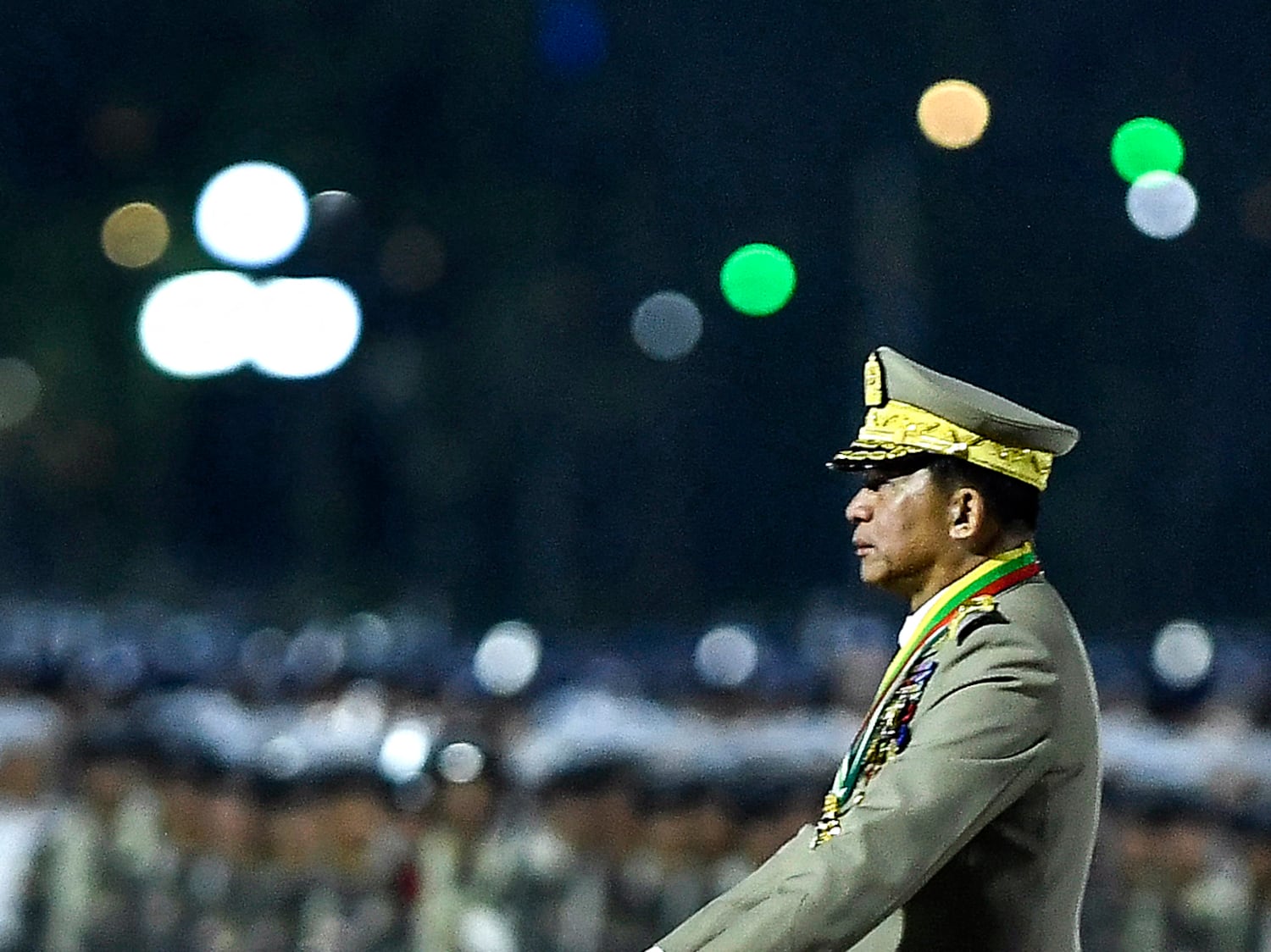
Myanmar’s military approaches the fourth anniversary of the coup d’etat that put them in power in terminal decline.
The economy continues to atrophy, with even more pronounced energy shortages, less foreign exchange, and an even larger share of the budget allocated to the military.
The battlefield losses are staggering, as the opposition has withstood Chinese pressure to stop their offensives, and continues to hand the over-stretched military defeat after defeat. Opposition forces now control two of the 14 military regional commands.
According to the National Unity Government (NUG) Ministry of Defense, the opposition is in full control of 95 of 330 townships, while the State Administrative Council (SAC), as the junta calls itself, had full control over 107 townships.
By the junta’s own admission, they are only able to conduct a census and safely organize elections in 161 of Myanmar’s 330 townships.
Losses on all battlefronts
Having taken 15 of 17 townships in Rakhine state, the Arakan Army is now in almost total control of the key western state. They’ve surrounded the Rakhine capital of Sittwe and come up to the border of Kyaukphyu where China’s special economic zone and port are located.
Although the capture of Buthidaung and Ann were neither quick nor easy, the AA was able to sustain sieges of over a month at each, and in the case of the former, tunneled beneath the last military outpost in a stunning display of grit.
Having captured the southern city of Gwa, the Arakan Army has now crossed into Ayeyarwaddy, taking the fight into the Bamar ethnic majority heartland.
Smoke rises from fires in Kyauk Ni Maw village in Rakhine state, Myanmar, after a Myanmar Air Force bombing raid on Jan 8, 2025.(Arakan Princess Media)
In the north, the Kachin Independence Army (KIA) has shrugged off extensive Chinese pressure, and taken the strategic junction town of Mansi, which will make the overland resupply of the besieged city of Bhamo from Mandalay very hard for the junta.
Fighting is ongoing in Bhamo, Kachin’s second largest city. The KIA is now in control of well over half of Kachin, including most of the resource rich regions.
Although they are known for fractiousness, Chin opposition forces are now in almost full control of that state that borders India and Bangladesh, holding five of nine townships, roughly 85% of the territory.
In Shan state, the Myanmar National Democratic Alliance Army (MNDAA) and the Ta’ang National Liberation Army (TNLA) temporarily succumbed to Chinese pressure to stop their offensive in November, but they’ve neither surrendered Lashio nor ceded territory, despite airstrikes.
Citing a new military offensive in Naungcho township, the TNLA, which controls nine townships, announced an end to the ceasefire on Jan. 9.
A member of the anti-junta Karenni Nationalities Defence Force holds landmines planted by the Myanmar military and removed during demining operations near Pekon township, July 11, 2023.(AFP)
In eastern Myanmar, Karenni resistance have continued to battle, despite concerted military regime efforts and airstrikes, and their acknowledged ammunition shortages. The Karenni National Defense Force and allied People’s Defense Forces (PDFs) militias claim to control 80% of Kayah state.
Further south, the Karen National Liberation Army and allied people’s defense forces (PDFs) are slowly taking pro-junta border guard posts along the frontier with Thailand.
In Tanintharyi, local PDFs have increased their coordination and are pushing west from the Thai border towards the Andaman Sea coast, diminishing the scope of the military-controlled patchwork of terrain in Myanmar’s southernmost state.
Some of the most intense fighting of late has been in the Bamar heartland, including Sagaing, Magway, and Mandalay.
The military has stepped up their bombings, artillery strikes, and arson, intentionally targeting civilians for their support of the opposition forces. A number of PDFs have expanded their operations into the dry zone.
Mounting troubles
The Myanmar military regime faces severe headwinds as the fourth anniversary of the Feb. 1, 2021 coup approaches.
Prisoners of war from multiple fronts have recounted that the military’s ability to resupply and reinforce troops in the field has all but broken down.
They have a limited number of heavy lift helicopters, including three new Mi-17s that entered service in December. But even those are vulnerable: Some six Mi-17s and two other helicopters have been lost since the coup.
In some cases, the military has tried to parachute in supplies, but those often fall into the hands of the opposition forces.
Myanmar’s junta chief Min Aung Hlaing arrives to deliver a speech to mark the country’s Armed Forces Day, in Naypyidaw on March 27, 2024.(AFP)
Nothing demoralizes troops more than the feeling that the headquarters has abandoned them.
The military has always treated Myanmar as a country under occupation, with thousands of remote outposts scattered throughout the country. The NUG claims that opposition forces have captured 741 of these through 2024, and they continue to fall.
The military is increasingly short of manpower. Over a thousand POWs have been taken in recent months, more have surrendered and others have deserted.
The military has now taken in nine tranches of conscripts, amounting to roughly 45,000 troops, and is increasingly dragooning men. But they are deployed almost immediately and are untrained and poorly motivated, in sharp contrast with ethnic resistance organizations (EROs) and PDFs.
That loss of manpower includes senior officers. The NUG claims that in 2024, 53 senior officers, ranked colonel to major general, were killed, captured or injured.
The military is so broke that they recently announced that they would no longer pay death benefits to conscripts. At the same time, the military is often labeling their dead as “MIA”, rather than “KIA”, to avoid paying benefits.
Sittwe township, Rakhine State, Myanmar. is seen May 15, 2023.(Military True News Information Team via AP)
While the junta fumbles, the degree of tactical battlefield coordination between the legacy ethnic armies and the new PDFs is unprecedented.
Every major offensive outside of Rakhine, entails cooperation between them, and even there, the AA was assisted by Chin PDFs who blocked the military’s resupply from Magway.
The increased PDF operations have been made possible by increased assistance from EROs. The AA and Chin PDFs are pushing in from the west and assisting local PDFs in the Bamar heartland.
The AA’s foray into Ayeyarwaddy was done in concert with local PDFs. The United Wa State Army appears to be defying China by arming and equipping the Mandalay PDF and others that are operating in Mandalay, Magway, and Sagaing.
In its favor, the military has finally caught up to the opposition and effectively employed unmanned aerial systems down to the tactical level.
These include drones that can drop munitions, kamikaze drones, and those for intelligence gathering or for more accurate targeting of artillery.
This has proven costly for the opposition and impeded some of their offensives. Nonetheless, their deployment of drones has been too little too late, and will not fundamentally alter the battlefield dynamics.
The military continues to use air power. Indeed, they put their fifth and sixth SU-30 imported from Russia and three more FTC-2000Gs imported from China into service in December.
It’s the economy
But air power is primarily used as a punitive weapon against unarmed civilian targets, not in support of ground forces.
For example, the Jan. 9 bombing in Rakhine’s Yanbye township that killed 52, wounded over 40 and destroyed 500 homes, had no military utility.
Finally, the state of the economy is even more precarious given the loss of almost all border crossings.
Although the SAC technically still controls Muse and Myawaddy, which links them to China and Thailand, respectively, opposition forces control much of the surrounding territory.
While Karen forces have not made a bid to take Myawaddy, the main border crossing, they are pinching in along Asia Highway 1 to Yangon.
On Jan. 11, some 500 reinforcements in 30 armored personnel carriers were deployed from Hpa-An to Kawkareik in Kayan state near the Thai border to keep the last main overland trade artery open.
To sum it up, the junta is entering the fifth year of military rule with its power rapidly slipping away.
Although they still control one-third of the country – land that holds two-thirds of the population – their mismanagement of the economy has left the military regime broke.
Spread too thin across too many fronts simultaneously, it’s hard to see the SAC doing anything to arrest their terminal decline in 2025.
Zachary Abuza is a professor at the National War College in Washington and an adjunct at Georgetown University. The views expressed here are his own and do not reflect the position of the U.S. Department of Defense, the National War College, Georgetown University or Radio Free Asia.
This content originally appeared on Radio Free Asia and was authored by Zachary Abuza.
Israel plays a cynical game. It makes phased agreements with the Palestinians that ensure it immediately gets what it wants. It then violates every subsequent phase and reignites its military assault.
ANALYSIS:By Chris Hedges
Israel, going back decades, has played a duplicitous game.
It signs a deal with the Palestinians that is to be implemented in phases. The first phase gives Israel what it wants — in this case the release of the Israeli hostages in Gaza — but Israel habitually fails to implement subsequent phases that would lead to a just and equitable peace.
It eventually provokes the Palestinians with indiscriminate armed assaults to retaliate, defines a Palestinian response as a provocation and abrogates the ceasefire deal to reignite the slaughter.
If this latest three-phase ceasefire deal is ratified — and there is no certainty that it will be by Israel — it will, I expect, be little more than a presidential inauguration bombing pause. Israel has no intention of halting its merry-go-round of death.
The Israeli Cabinet delayed a vote on the ceasefire proposal while it continues to pound Gaza — but finally agreed to the deal. At least 81 Palestinians have been killed in the first 24 hours after the ceasefire was declared.
The morning after a ceasefire agreement was announced, Israeli Prime Minister Benjamin Netanyahu accused Hamas of reneging on part of the deal “in an effort to extort last minute concessions.”
He warned that his cabinet would not meet “until the mediators notify Israel that Hamas has accepted all elements of the agreement.”
Hamas dismissed Netanyahu’s claims and repeated their commitment to the ceasefire as agreed with the mediators.
The deal includes three phases.
The first phase, lasting 42 days, will see a cessation of hostilities. Hamas will release some Israeli hostages — 33 Israelis who were captured on October 7, 2023, including all of the remaining five women, those aged above 50, and those with illnesses — in exchange for up to 1000 Palestinians imprisoned by Israel.
The Israeli army will pull back from the populated areas of the Gaza Strip on the first day of the ceasefire. On the seventh day, displaced Palestinians will be permitted to return to northern Gaza. Israel will allow 600 aid trucks with food and medical supplies to enter Gaza daily.
The second phase, which begins on the 16th day of the ceasefire, will see the release of the remaining Israeli hostages. Israel will complete its withdrawal from Gaza during the second phase, maintaining a presence in some parts of the Philadelphi corridor, which stretches along the eight-mile border between Gaza and Egypt.
It will surrender its control of the Rafah border crossing into Egypt.
The third phase will see negotiations for a permanent end of the war.
But it is Netanyahu’s office that appeared to have already reneged on the agreement. It released a statement rejecting Israeli troop withdrawal from the Philadelphi Corridor during the first 42-day phase of the ceasefire.
“In practical terms, Israel will remain in the Philadelphi Corridor until further notice,” while claiming the Palestinians are attempting to violate the agreement. Palestinians throughout the numerous ceasefire negotiations have demanded Israeli troops withdraw from Gaza.
Egypt has condemned the seizure of its border crossings by Israel.
Israeli military ground operations in the Gaza Strip in November 2023. Image: IDF Spokesperson’s Unit, Wikimedia Commons, CC BY-SA 3.0
The deep fissures between Israel and Hamas, even with the Israelis finally accepting the agreement, threaten to implode it.
Hamas is seeking a permanent ceasefire. But Israeli policy is unequivocal about its “right” to re-engage militarily.
There is no consensus about who will govern Gaza. Israel has made it clear the continuance of Hamas in power is unacceptable.
There is no mention of the status of the United Nations Relief and Works Agency for Palestine Refugees in the Near East (UNRWA), the UN agency that Israel has outlawed and that provides the bulk of the humanitarian aid given to the Palestinians, 95 percent of whom have been displaced.
There is no agreement on the reconstruction of Gaza, which lies in rubble. And, of course, there is no route in the agreement to an independent and sovereign Palestinian state.
Israeli mendacity and manipulation is pitifully predictable.
Camp David
Egyptian President Anwar Sadat (left), the late US President Jimmy Carter and Israeli Prime Minister Menachem Begin after the Camp David Peace Accords signing ceremony at the White House on September 17, 1978. Image: US National Archives and Records Administration, Wikimedia Commons, Public domain
The Camp David Accords, signed in 1978 by Egyptian President Anwar Sadat and Israeli Prime Minister Menachem Begin, without the participation of the Palestine Liberation Organization (PLO), normalised diplomatic relations between Israel and Egypt.
But the subsequent phases, which included a promise by Israel to resolve the Palestinian question along with Jordan and Egypt, permit Palestinian self-governance in the West Bank and Gaza within five years, and end the building of Israeli colonies in the West Bank, including East Jerusalem, were never honored.
Oslo Or take the 1993 Oslo Accords. The agreement, signed in 1993, which saw the PLO recognise Israel’s right to exist and Israel recognize the PLO as the legitimate representatives of the Palestinian people; and Oslo II, signed in 1995, which detailed the process towards peace and a Palestinian state, was stillborn.
It stipulated that any discussion of illegal Jewish “settlements” was to be delayed until “final’ status talks, by which time Israeli military withdrawals from the occupied West Bank were to have been completed.
Governing authority was to be transferred from Israel to the supposedly temporary Palestinian Authority. The West Bank was carved up into Areas A, B and C.
The Palestinian Authority has limited authority in Areas A and B. Israel controls all of Area C, over 60 percent of the West Bank.
Israeli Prime Minister Yitzhak Rabin, US President Bill Clinton and the PLO’s Yasser Arafat at the Oslo Accords signing ceremony, September 13, 1993. Image: Vince Musi, White House, Wikimedia Commons, Public domain
The right of Palestinian refugees to return to the historic lands seized from them in 1948 when Israel was created — a right enshrined in international law– was given up by the PLO leader Yasser Arafat, instantly alienating many Palestinians, especially those in Gaza where 75 percent are refugees or the descendants of refugees.
Edward Said called the Oslo agreement “an instrument of Palestinian surrender, a Palestinian Versailles” and lambasted Arafat as “the Pétain of the Palestinians”.
The scheduled Israeli military withdrawals under Oslo never took place. There was no provision in the interim agreement to end Jewish colonization, only a prohibition of “unilateral steps”.
There were around 250,000 Jewish colonists in the West Bank at the time of the Oslo agreement. They have increased to at least 700,000. No final treaty was ever concluded.
The journalist Robert Fisk called Oslo …
“a sham, a lie, a trick to entangle Arafat and the PLO into abandonment of all that they had sought and struggled for over a quarter of a century, a method of creating false hope in order to emasculate the aspiration of statehood.”
Israeli Prime Minister Yitzhak Rabin, who signed the Oslo agreement, was assassinated on November 4, 1995, following a rally in support of the agreement, by Yigal Amir, a far-right Jewish law student.
Itamar Ben-Gvir, now Israel’s national security minister, was one of many rightwing politicians who issued threats against Rabin. Rabin’s widow, Leah, blamed Netanyahu and his supporters — who distributed leaflets at political rallies depicting Rabin in a Nazi uniform — for her husband’s murder.
Then Israeli Prime Minister Yitzhak Rabin, on the day he was assassinated, giving a speech in favour of the Oslo Peace agreement in Tel Aviv. Image: Israel Press and Photo Agency, Dan Hadani collection, National Library of Israel, Wikimedia Commons, CC BY 4.0
Israel has carried out a series of murderous assaults on Gaza ever since, cynically calling the bombardment “mowing the lawn”.
These attacks, which leave scores of dead and wounded and further degrade Gaza’s fragile infrastructure, have names such as Operation Rainbow (2004), Operation Days of Penitence (2004), Operation Summer Rains (2006), Operation Autumn Clouds (2006) and Operation Hot Winter (2008).
Israel violated the June 2008 ceasefire agreement with Hamas, brokered by Egypt, by launching a border raid that killed six Hamas members. The raid provoked, as Israel intended, a retaliatory strike by Hamas, which fired crude rockets and mortar shells into Israel.
The Hamas barrage provided the pretext for a massive Israeli attack. Israel, as it always does, justified its military strike on the “right to defend itself”.
Operation Cast Lead (2008-2009), which saw Israel carry out a ground and aerial assault over 22 days, with the Israeli air force dropping over 1000 tons of explosives on Gaza, killed 1,385 — according to the Israeli human rights group B’Tselem — of whom at least 762 were civilians, including 300 children.
Four Israelis were killed over the same period by Hamas rockets and nine Israeli soldiers died in Gaza, four of whom were victims of “friendly fire.” The Israeli newspaper Haaretz would later report that “Operation Cast Lead” had been prepared over the previous six months.
Israeli historian Avi Shlaim, who served in the Israeli military, wrote that:
“the brutality of Israel’s soldiers is fully matched by the mendacity of its spokesman…their propaganda is a pack of lies…It was not Hamas but the IDF that broke the ceasefire. It did so by a raid into Gaza on 4 November that killed six Hamas men.
“Israel’s objective is not just the defense of its population, but the eventual overthrow of the Hamas government in Gaza by turning the people against their rulers.”
A child in Gaza City during the ceasefire after the 2008–2009 conflict. Image: andlun1, Flickr, CC BY-NC 2.0
These series of attacks on Gaza were followed by Israeli assaults in November 2012, known as Operation Pillar of Defence and in July and August 2014 in Operation Protective Edge, a seven week campaign that left 2251 Palestinians dead, along with 73 Israelis, including 67 soldiers.
These assaults by the Israeli military were followed in 2018 by largely peaceful protests by Palestinians, known as The Great March of Return, along Gaza’s fenced-in barrier. Over 266 Palestinians were gunned down by Israeli soldiers and 30,000 more were wounded.
In May 2021, Israel killed more than 256 Palestinians in Gaza following attacks by Israeli police on Palestinian worshippers at the Al-Aqsa Mosque compound in Jerusalem. Further attacks on worshippers at Al-Aqsa mosque took place in April 2023.
And then the breaching of the security barriers on October 7, 2023 that enclose Gaza, where Palestinians had languished under a blockade for over 16 years in an open air prison.
The attacks by Palestinian gunmen [Al-Aqsa Deluge] left some 1200 Israeli dead — including hundreds killed by Israel itself — and gave Israel the excuse it had long sought to lay waste to Gaza, in its Swords of Iron War.
This horrific saga is not over. Israel’s goals remain unchanged — the erasure of Palestinians from their land. This ceasefire is one more cynical chapter. There are many ways it can and, I suspect, will fall apart.
But let us pray, at least for the moment, that the mass slaughter will stop.
Chris Hedges is a Pulitzer Prize–winning journalist who was a foreign correspondent for 15 years for The New York Times, where he served as the Middle East bureau chief and Balkan bureau chief for the paper. He is the host of show “The Chris Hedges Report”. This article is republished from his X account.
Israel plays a cynical game. It makes phased agreements with the Palestinians that ensure it immediately gets what it wants. It then violates every subsequent phase and reignites its military assault.
ANALYSIS:By Chris Hedges
Israel, going back decades, has played a duplicitous game.
It signs a deal with the Palestinians that is to be implemented in phases. The first phase gives Israel what it wants — in this case the release of the Israeli hostages in Gaza — but Israel habitually fails to implement subsequent phases that would lead to a just and equitable peace.
It eventually provokes the Palestinians with indiscriminate armed assaults to retaliate, defines a Palestinian response as a provocation and abrogates the ceasefire deal to reignite the slaughter.
If this latest three-phase ceasefire deal is ratified — and there is no certainty that it will be by Israel — it will, I expect, be little more than a presidential inauguration bombing pause. Israel has no intention of halting its merry-go-round of death.
The Israeli Cabinet delayed a vote on the ceasefire proposal while it continues to pound Gaza — but finally agreed to the deal. At least 81 Palestinians have been killed in the first 24 hours after the ceasefire was declared.
The morning after a ceasefire agreement was announced, Israeli Prime Minister Benjamin Netanyahu accused Hamas of reneging on part of the deal “in an effort to extort last minute concessions.”
He warned that his cabinet would not meet “until the mediators notify Israel that Hamas has accepted all elements of the agreement.”
Hamas dismissed Netanyahu’s claims and repeated their commitment to the ceasefire as agreed with the mediators.
The deal includes three phases.
The first phase, lasting 42 days, will see a cessation of hostilities. Hamas will release some Israeli hostages — 33 Israelis who were captured on October 7, 2023, including all of the remaining five women, those aged above 50, and those with illnesses — in exchange for up to 1000 Palestinians imprisoned by Israel.
The Israeli army will pull back from the populated areas of the Gaza Strip on the first day of the ceasefire. On the seventh day, displaced Palestinians will be permitted to return to northern Gaza. Israel will allow 600 aid trucks with food and medical supplies to enter Gaza daily.
The second phase, which begins on the 16th day of the ceasefire, will see the release of the remaining Israeli hostages. Israel will complete its withdrawal from Gaza during the second phase, maintaining a presence in some parts of the Philadelphi corridor, which stretches along the eight-mile border between Gaza and Egypt.
It will surrender its control of the Rafah border crossing into Egypt.
The third phase will see negotiations for a permanent end of the war.
But it is Netanyahu’s office that appeared to have already reneged on the agreement. It released a statement rejecting Israeli troop withdrawal from the Philadelphi Corridor during the first 42-day phase of the ceasefire.
“In practical terms, Israel will remain in the Philadelphi Corridor until further notice,” while claiming the Palestinians are attempting to violate the agreement. Palestinians throughout the numerous ceasefire negotiations have demanded Israeli troops withdraw from Gaza.
Egypt has condemned the seizure of its border crossings by Israel.
Israeli military ground operations in the Gaza Strip in November 2023. Image: IDF Spokesperson’s Unit, Wikimedia Commons, CC BY-SA 3.0
The deep fissures between Israel and Hamas, even with the Israelis finally accepting the agreement, threaten to implode it.
Hamas is seeking a permanent ceasefire. But Israeli policy is unequivocal about its “right” to re-engage militarily.
There is no consensus about who will govern Gaza. Israel has made it clear the continuance of Hamas in power is unacceptable.
There is no mention of the status of the United Nations Relief and Works Agency for Palestine Refugees in the Near East (UNRWA), the UN agency that Israel has outlawed and that provides the bulk of the humanitarian aid given to the Palestinians, 95 percent of whom have been displaced.
There is no agreement on the reconstruction of Gaza, which lies in rubble. And, of course, there is no route in the agreement to an independent and sovereign Palestinian state.
Israeli mendacity and manipulation is pitifully predictable.
Camp David
Egyptian President Anwar Sadat (left), the late US President Jimmy Carter and Israeli Prime Minister Menachem Begin after the Camp David Peace Accords signing ceremony at the White House on September 17, 1978. Image: US National Archives and Records Administration, Wikimedia Commons, Public domain
The Camp David Accords, signed in 1978 by Egyptian President Anwar Sadat and Israeli Prime Minister Menachem Begin, without the participation of the Palestine Liberation Organization (PLO), normalised diplomatic relations between Israel and Egypt.
But the subsequent phases, which included a promise by Israel to resolve the Palestinian question along with Jordan and Egypt, permit Palestinian self-governance in the West Bank and Gaza within five years, and end the building of Israeli colonies in the West Bank, including East Jerusalem, were never honored.
Oslo Or take the 1993 Oslo Accords. The agreement, signed in 1993, which saw the PLO recognise Israel’s right to exist and Israel recognize the PLO as the legitimate representatives of the Palestinian people; and Oslo II, signed in 1995, which detailed the process towards peace and a Palestinian state, was stillborn.
It stipulated that any discussion of illegal Jewish “settlements” was to be delayed until “final’ status talks, by which time Israeli military withdrawals from the occupied West Bank were to have been completed.
Governing authority was to be transferred from Israel to the supposedly temporary Palestinian Authority. The West Bank was carved up into Areas A, B and C.
The Palestinian Authority has limited authority in Areas A and B. Israel controls all of Area C, over 60 percent of the West Bank.
Israeli Prime Minister Yitzhak Rabin, US President Bill Clinton and the PLO’s Yasser Arafat at the Oslo Accords signing ceremony, September 13, 1993. Image: Vince Musi, White House, Wikimedia Commons, Public domain
The right of Palestinian refugees to return to the historic lands seized from them in 1948 when Israel was created — a right enshrined in international law– was given up by the PLO leader Yasser Arafat, instantly alienating many Palestinians, especially those in Gaza where 75 percent are refugees or the descendants of refugees.
Edward Said called the Oslo agreement “an instrument of Palestinian surrender, a Palestinian Versailles” and lambasted Arafat as “the Pétain of the Palestinians”.
The scheduled Israeli military withdrawals under Oslo never took place. There was no provision in the interim agreement to end Jewish colonization, only a prohibition of “unilateral steps”.
There were around 250,000 Jewish colonists in the West Bank at the time of the Oslo agreement. They have increased to at least 700,000. No final treaty was ever concluded.
The journalist Robert Fisk called Oslo …
“a sham, a lie, a trick to entangle Arafat and the PLO into abandonment of all that they had sought and struggled for over a quarter of a century, a method of creating false hope in order to emasculate the aspiration of statehood.”
Israeli Prime Minister Yitzhak Rabin, who signed the Oslo agreement, was assassinated on November 4, 1995, following a rally in support of the agreement, by Yigal Amir, a far-right Jewish law student.
Itamar Ben-Gvir, now Israel’s national security minister, was one of many rightwing politicians who issued threats against Rabin. Rabin’s widow, Leah, blamed Netanyahu and his supporters — who distributed leaflets at political rallies depicting Rabin in a Nazi uniform — for her husband’s murder.
Then Israeli Prime Minister Yitzhak Rabin, on the day he was assassinated, giving a speech in favour of the Oslo Peace agreement in Tel Aviv. Image: Israel Press and Photo Agency, Dan Hadani collection, National Library of Israel, Wikimedia Commons, CC BY 4.0
Israel has carried out a series of murderous assaults on Gaza ever since, cynically calling the bombardment “mowing the lawn”.
These attacks, which leave scores of dead and wounded and further degrade Gaza’s fragile infrastructure, have names such as Operation Rainbow (2004), Operation Days of Penitence (2004), Operation Summer Rains (2006), Operation Autumn Clouds (2006) and Operation Hot Winter (2008).
Israel violated the June 2008 ceasefire agreement with Hamas, brokered by Egypt, by launching a border raid that killed six Hamas members. The raid provoked, as Israel intended, a retaliatory strike by Hamas, which fired crude rockets and mortar shells into Israel.
The Hamas barrage provided the pretext for a massive Israeli attack. Israel, as it always does, justified its military strike on the “right to defend itself”.
Operation Cast Lead (2008-2009), which saw Israel carry out a ground and aerial assault over 22 days, with the Israeli air force dropping over 1000 tons of explosives on Gaza, killed 1,385 — according to the Israeli human rights group B’Tselem — of whom at least 762 were civilians, including 300 children.
Four Israelis were killed over the same period by Hamas rockets and nine Israeli soldiers died in Gaza, four of whom were victims of “friendly fire.” The Israeli newspaper Haaretz would later report that “Operation Cast Lead” had been prepared over the previous six months.
Israeli historian Avi Shlaim, who served in the Israeli military, wrote that:
“the brutality of Israel’s soldiers is fully matched by the mendacity of its spokesman…their propaganda is a pack of lies…It was not Hamas but the IDF that broke the ceasefire. It did so by a raid into Gaza on 4 November that killed six Hamas men.
“Israel’s objective is not just the defense of its population, but the eventual overthrow of the Hamas government in Gaza by turning the people against their rulers.”
A child in Gaza City during the ceasefire after the 2008–2009 conflict. Image: andlun1, Flickr, CC BY-NC 2.0
These series of attacks on Gaza were followed by Israeli assaults in November 2012, known as Operation Pillar of Defence and in July and August 2014 in Operation Protective Edge, a seven week campaign that left 2251 Palestinians dead, along with 73 Israelis, including 67 soldiers.
These assaults by the Israeli military were followed in 2018 by largely peaceful protests by Palestinians, known as The Great March of Return, along Gaza’s fenced-in barrier. Over 266 Palestinians were gunned down by Israeli soldiers and 30,000 more were wounded.
In May 2021, Israel killed more than 256 Palestinians in Gaza following attacks by Israeli police on Palestinian worshippers at the Al-Aqsa Mosque compound in Jerusalem. Further attacks on worshippers at Al-Aqsa mosque took place in April 2023.
And then the breaching of the security barriers on October 7, 2023 that enclose Gaza, where Palestinians had languished under a blockade for over 16 years in an open air prison.
The attacks by Palestinian gunmen [Al-Aqsa Deluge] left some 1200 Israeli dead — including hundreds killed by Israel itself — and gave Israel the excuse it had long sought to lay waste to Gaza, in its Swords of Iron War.
This horrific saga is not over. Israel’s goals remain unchanged — the erasure of Palestinians from their land. This ceasefire is one more cynical chapter. There are many ways it can and, I suspect, will fall apart.
But let us pray, at least for the moment, that the mass slaughter will stop.
Chris Hedges is a Pulitzer Prize–winning journalist who was a foreign correspondent for 15 years for The New York Times, where he served as the Middle East bureau chief and Balkan bureau chief for the paper. He is the host of show “The Chris Hedges Report”. This article is republished from his X account.
My name is Sean Armstrong and I am a young disabled/Autistic man living in Stoke-on-Trent in Staffordshire. I have had experience of the Department for Work and Pensions (DWP) benefit system since the age of eighteen.
I’ve lived with mild cerebral palsy from birth, and dyscalculia. The latter is similar to dyslexia – only it impacts me working with numbers instead of letters. Recently, I was diagnosed with autism. To me, it explained a lot about my behavior. If I don’t like something, I tend to show it.
Finding work as an autistic disabled man
Over the years, I have had many interviews with many companies and agencies, but the majority haven’t offered me employment. They have always given me the same excuse. They’ve repeatedly told me that I do well conducting myself in the interviews – I answer all of the questions confidently and competently – however, they cannot offer me the role because I lack experience. The question is, how the devil are you supposed to get the experience if no-one gives you a chance?
To gain experience I have had odd jobs. However, these haven’t led to much. They have mainly been in call centres. These tasked me with stupid sales targets for booking as many customers appointments over the phone as possible. The pushy, manipulative nature of sales doesn’t come naturally to me. So unfortunately, due to this, these have lasted a month at most.
I grew tired of going to jobs which are unsupportive or unrealistic, and going for interviews for roles which I had no chance of getting.
Discrimination on the government Remploy programme
In 2014, I found myself on Remploy’s books. The training provider found me a placement at the Community Recycling Consortium (CRC). This was an organisation which offered volunteering and employment experience to disabled people who lived with mental health issues.
As an admin volunteer for many organisations, I have had many years of experience typing letters, dealing with paperwork, and meeting customers in person and over the phone. Therefore, I did quite well with this placement, and the CRC offered me a job as an Admin Apprentice level two.
This however, was a lie. All it involved was manning the phones and calling businesses to ask them if they were willing to donate any sort of IT or other used electrical equipment. In reality, there was no admin in the role besides creating a table as a record for the businesses which I spoke to.
Worse still was the fact that one of the directors and a manager would often bully me and subject me to disability discrimination. He regularly made comments on my telephone manner. But during my time working in call centres, nearly every member of staff had commented on how professional I sounded to customers over the phone. On top of this, the director and my manager would mock my dyscalculia.
The manager would walk into the office every morning saying verbal obscenities, which really put me off work.
However, it wasn’t only verbal bullying and harassment. The company also discriminated against me in my pay. As a result of the bullying, I took a few days off sick. When I returned the following week, the company paid me £25 for my entire weekly wage. The pay there was just £99 a week, cash-in-hand.
The following week, I left the job.
When I made a complaint to Remploy about the company, they closed ranks. My work coach took CRC’s side and it went no further.
The DWP Work Programme and Restart Scheme
The following year, I asked the Job Centre if they could help find me an administration training course. I was keen to do one to increase my chances of finding and securing work. And in March of that year, they found me one with my local college. By April, I had passed my City and Guilds Level Two in Business Administration.
Unfortunately however, it didn’t help me secure employment. Like before, I had many interviews, but all without success.
That was when the DWP put me onto the government’s Work Programme. I participated in this for a full year from September 2017. This was just more job searching and interviews, but still no work. I found the scheme hopeless as no member of staff would help.
Then, in August 2023, the DWP put me on the government’s Restart Scheme. Again, like the scheme before, this one was hopeless. Once more, all this involved was more job searching. I found one work coach very patronising. She would always tell me that I shouldn’t give up in looking for work, but then tell me that they couldn’t convince employers to offer me a role in this short period of time. By August 2024, I was glad to leave the scheme – which had utterly failed to help me find work.
DWP benefit system: not fit for purpose for disabled and autistic people
My experiences within the DWP’s benefit system, and on its work programmes, have only made it harder for me to return to employment.
Now, I am focusing on my writing and photography. I have been working on a 13-book series of young adult Science Fiction novels since 2019. Currently on my final manuscript, I’m looking for an agent to represent them. I also have dreams of pursuing a role in public speaking for disabled/autistic people.
I’m currently claiming Universal Credit, and the Jobcentre continues to pressure me to look for work.
The system for benefits has failed disabled and autistic people like me. It’s therefore not fit for purpose. The government needs to change it, in order to help disabled and autistic people to find employment which is right for them.
A ceasefire in Gaza is not the end of Palestine’s nightmare, but the start of Israel’s. Legal moves will only gather momentum as the truth of what happened in Gaza is uncovered and documented after the war has ended.
ANALYSIS:By David Hearst
When push came to shove, it was Israeli Prime Minister Benjamin Netanyahu who blinked first.
For months, Netanyahu had become the main obstacle to a Gaza ceasefire, to the considerable frustration of his own negotiators.
That much was made explicit more than two months ago by the departure of his Defence Minister, Yoav Gallant. The chief architect of the 15-month war, Gallant said plainly that there was nothing left for the army to do in Gaza.
Still Netanyahu persisted. Last May, he rejected a deal signed by Hamas in the presence of CIA director William Burns, in favour of an offensive on Rafah.
In October, Netanyahu turned for salvation to the Generals’ Plan, aiming to empty northern Gaza in preparation for resettlement by Israelis. The plan was to starve and bomb the population out of northern Gaza by declaring that anyone who did not leave voluntarily would be treated as a “terrorist”.
It was so extreme, and so contrary to the international rules of war, that it was condemned by former Defence Minister Moshe Yaalon as a war crime and ethnic cleansing.
Key to this plan was a corridor forged by a military road and a string of outposts cutting through the centre of the Gaza Strip, from the Israeli border to the sea.
The Netzarim Corridor would have effectively reduced the territory’s land mass by almost one third and become its new northern border. No Palestinian pushed out of northern Gaza would have been allowed to return.
Red lines erased No-one from the Biden administration forced Netanyahu to rethink this plan. Not US President Joe Biden himself, an instinctive Zionist who, for all his speeches, kept on supplying Israel with the means to commit genocide in Gaza; nor Antony Blinken, his Secretary of State, who earned the dubious distinction of being the least-trusted diplomat in the region.
Even as the final touches were being put on the ceasefire agreement, Blinken gave a departing news conference in which he blamed Hamas for rejecting previous offers. As is par for the course, the opposite is the truth.
Every Israeli journalist who covered the negotiations has reported that Netanyahu rejected all previous deals and was responsible for the delay in coming to this one.
It fell to one short meeting with US President-elect Donald Trump’s special Middle East envoy, Steve Witkoff, to call time on Netanyahu’s 15-month war.
In a war of liberation, the weak and vastly outgunned can succeed against overwhelming military odds. These wars are battles of will
After one meeting, the red lines that Netanyahu had so vigorously painted and repainted in the course of 15 months were erased.
Israeli Prime Minister Benjamin Netanyahu in military gear – now a wanted man by the ICC . . . “After one meeting, the red lines that he had so vigorously painted and repainted in the course of 15 months were erased.” Image: AJ screenshot APR
As Israeli pundit Erel Segal said: “We’re the first to pay a price for Trump’s election. [The deal] is being forced upon us . . . We thought we’d take control of northern Gaza, that they’d let us impede humanitarian aid.”
This is emerging as a consensus. The mood in Israel is sceptical of claims of victory.
“There’s no need to sugarcoat the reality: the emerging ceasefire and hostage release deal is bad for Israel, but it has no choice but to accept it,” columnist Yossi Yehoshua wrote in Ynet.
The circulating draft of the ceasefire agreement is clear in stating that Israel will pull back from both the Philadelphi Corridor and the Netzarim Corridor by the end of the process, stipulations Netanyahu had previously rejected.
Even without this, the draft agreement clearly notes that Palestinians can return to their homes, including in northern Gaza. The attempt to clear it of its inhabitants has failed.
This is the biggest single failure of Israel’s ground invasion.
Fighting back There is a long list of others. But before we list them, the Witkoff debacle underscores how dependent Israel has been on Washington for every day of the horrendous slaughter in Gaza.
A senior Israeli Air Force official has admitted that planes would have run out of bombs within a few months had they not been resupplied by the US.
It is sinking into Israeli public opinion that the war is ending without any of Israel’s major aims being achieved.
Netanyahu and the Israeli army set out to “collapse” Hamas after the humiliation and shock of its surprise attack on southern Israel in October 2023. They demonstrably haven’t achieved this goal.
“But after wave upon wave of military operations, each of which was supposed to have ‘cleansed’ the city of Hamas fighters, Beit Hanoun turned out to have inflicted one of the heaviest concentrations of Israeli military casualties.” Image: AJ screenshot APR
Take Beit Hanoun in northern Gaza as a microcosm of the battle Hamas waged against invading forces. Fifteen months ago, it was the first city in Gaza to be occupied by Israeli forces, who judged it to have the weakest Hamas battalion.
But after wave upon wave of military operations, each of which was supposed to have “cleansed” the city of Hamas fighters, Beit Hanoun turned out to have inflicted one of the heaviest concentrations of Israeli military casualties.
Hamas kept on emerging from the rubble to fight back, turning Beit Hanoun into a minefield for Israeli soldiers. Since the launch of the most recent military operation in northern Gaza, 55 Israeli officers and soldiers have perished in this sector, 15 of them in Beit Hanoun in the past week alone.
If any army is bleeding and exhausted today, it is Israel’s. The plain military fact of life in Gaza is that, 15 months on, Hamas can recruit and regenerate faster than Israel can kill its leaders or its fighters.
“We are in a situation where the pace at which Hamas is rebuilding itself is higher than the pace that the [Israeli army] is eradicating them,” Amir Avivi, a retired Israeli brigadier general, told the Wall Street Journal. He added that Mohammed Sinwar, the younger brother of slain Hamas leader Yahya Sinwar, “is managing everything”.
If anything demonstrates the futility of measuring military success solely by the number of leaders killed, or missiles destroyed, it is this.
Against the odds In a war of liberation, the weak and vastly outgunned can succeed against overwhelming military odds. These wars are battles of will. It is not the battle that matters, but the ability to keep on fighting.
In Algeria and Vietnam, the French and US armies had overwhelming military advantage.
Both forces withdrew in ignominy and failure many years later. In Vietnam, it was more than six years after the Tet Offensive, which like the Hamas attack on 7 October 2023 was perceived at the time to be a military failure. But the symbol of a fightback after so many years of siege proved decisive in the war.
In France, the scars of Algeria last to this day. In each war of liberation, the determination of the weak to resist has proved more decisive than the firepower of the strong.
In Gaza, it was the determination of the Palestinian people to stay on their land — even as it was being reduced to rubble — that proved to be the decisive factor in this war. And this is an astonishing feat, considering that the 360 sq km territory was entirely cut off from the world, with no allies to break the siege and no natural terrain for cover.
Hezbollah fought in the north, but little of this was any succour to Palestinians in Gaza on the ground, subjected to nightly bombing raids and drone attacks shredding their tents.
Neither enforced starvation, nor hypothermia, nor disease, nor brutalisation and mass rape at the hands of their invaders, could break their will to stay on their land.
Never before have Palestinian fighters and civilians shown this level of resistance in the history of the conflict — and it could prove to be transformative.
Because what Israel has lost in its campaign to crush Gaza is incalculable. It has squandered decades of sustained economic, military and diplomatic efforts to establish the country as a liberal democratic Western nation in the eyes of global opinion.
Generational memory Israel has not only lost the Global South, in which it invested such efforts in Africa and South America. It has also lost the support of a generation in the West, whose memories do not go back as far as Biden’s.
The point is not mine. It is well made by Jack Lew, the man Biden nominated as his ambassador to Israel a month before the Hamas attack.
In his departing interview, Lew, an Orthodox Jew, told the Times of Israel that public opinion in the US was still largely pro-Israel, but that was changing.
With the enormous cost in lives, every family has been touched by loss. But what Gaza has achieved in the last 15 months could well transform the conflict
“What I’ve told people here that they have to worry about when this war is over is that the generational memory doesn’t go back to the founding of the state, or the Six Day War, or the Yom Kippur War, or to the intifada even.
“It starts with this war, and you can’t ignore the impact of this war on future policymakers — not the people making the decisions today, but the people who are 25, 35, 45 today and who will be the leaders for the next 30 years, 40 years.”
Biden, Lew said, was the last president of his generation whose memories and knowledge go back to Israel’s “founding story”.
Lew’s parting shot at Netanyahu is amply documented in recent polls. More than one-third of American Jewish teenagers sympathise with Hamas, 42 percent believe Israel is committing genocide in Gaza, and 66 percent sympathise with the Palestinian people as a whole.
This is not a new phenomenon. Polling two years before the war showed that a quarter of American Jews agreed that “Israel is an apartheid state”, and a plurality of respondents did not find that statement to be antisemitic.
“The antiwar protests, condemned by Western governments first as antisemitism and then legislated against as terrorism, have created a global front for the liberation of Palestine. The movement to boycott Israel is stronger than ever before.” Image: David Robie/Asia Pacific Report
Deep damage The war in Gaza has become the prism through which a new generation of future world leaders sees the Israel-Palestine conflict. This is a major strategic loss for a country that on 6 October 2023 thought that it had closed down the issue of Palestine, and that world opinion was in its pocket.
But the damage goes further and deeper than this.
The antiwar protests, condemned by Western governments first as antisemitism and then legislated against as terrorism, have created a global front for the liberation of Palestine. The movement to boycott Israel is stronger than ever before.
Israel is in the dock of international justice as never before. Not only are there arrest warrants out for Netanyahu and Gallant on war crimes, and a continuing genocide case at the International Court of Justice (ICJ), but a myriad of other cases are about to flood the courts in every major western democracy.
A court action has been launched in the UK against BP for supplying crude oil to Israel, which is then allegedly used by the Israeli army, from its pipeline from Azerbaijan to Turkiye.
In addition, the Israeli army recently decided to conceal the identities of all troops who have participated in the campaign in Gaza, for fear that they could be pursued when travelling abroad.
This major move was sparked by a tiny activist group named after Hind Rajab, a six-year-old killed by Israeli troops in Gaza in January 2024. The Belgium-based group has filed evidence of war crimes with the UCJ against 1000 Israelis, including video, audio, forensic reports and other documents.
A ceasefire in Gaza is thus not the end of Palestine’s nightmare, but the start of Israel’s. These legal moves will only gather momentum as the truth of what happened in Gaza is uncovered and documented after the war has ended.
Internal divisions At home, Netanyahu will return from war to a country more divided internally than ever before. There is a battle between the army and the Haredim who refuse to serve.
There is a battle between secular and national religious Zionists. With Netanyahu’s retreat on Gaza, the settler far right are sensing that the opportunity to establish Greater Israel has been snatched from the jaws of military victory.
All the while, there has been an unprecedented exodus of Jews from Israel.
Regionally, Israel is left with troops still in Lebanon and Syria. It would be foolish to think of these ongoing operations as restoring the deterrence Israel lost when Hamas struck on 7 October 2023.
Iran’s axis of resistance might have received some sustained blows after the leadership of Hezbollah was wiped out, and after finding itself vastly overextended in Syria. But like Hamas, Hezbollah has not been knocked out as a fighting force.
And the Sunni Arab world has been riled by the Gaza genoicide and the ongoing crackdown in the occupied West Bank as rarely before.
Israel’s undisguised bid to divide Syria into cantons is as provocative to Syrians of all denominations and ethnicities, as its plans to annex Areas B and C of the West Bank are an existential threat to Jordan.
Annexation would be treated in Amman as an act of war.
Deconfliction will be the patient work of decades of reconstruction, and Trump is not a patient man.
Hamas and Gaza will now take a backseat. With the enormous cost in lives, every family has been touched by loss. But what Gaza has achieved in the last 15 months could well transform the conflict.
Gaza has shown all Palestinians — and the world — that it can withstand total war, and not budge from the ground upon which it stands. It tells the world, with justifiable pride, that the occupiers threw everything they had at it, and there was not another Nakba.
Gaza tells Israel that Palestinians exist, and that they will not be pacified until and unless Israelis talk to them on equal terms about equal rights.
It may take many more years for that realisation to sink in, but for some it already has: “Even if we conquer the entire Middle East, and even if everyone surrenders to us, we won’t win this war,” columnist Yair Assulin wrote in Haaretz.
But what everyone in Gaza who stayed put has achieved is of historic significance.
David Hearst is co-founder and editor-in-chief of Middle East Eye. He is a commentator and speaker on the region and analyst on Saudi Arabia. This article has been republished from the Middle East Eye under Creative Commons.
‘In Gaza, only UNRWA has the infrastructure to distribute aid to scale, such as vehicles, warehouses, distribution centres and staff. However, Israeli authorities are making this extremely difficult,’ writes Chris Gunness.
In the last week of January, two Knesset bills ending Israel’s “cooperation” with the United Nations Relief and Works Agency (UNRWA) are scheduled to come into force.
If they do, UNRWA’s activities in the territory of the state of Israel would be illegal under Israeli law and any Israeli official or institution engaging with the agency would be breaking the law.
In a letter to the president of the General Assembly in October, UN Secretary-General, Antonio Guterres, revealed he had written to Prime Minister Benjamin Netanyahu, urging his government to take the necessary steps to avoid the legislation being implemented.
He also expressed concern that these laws would harm UNRWA’s ability to deliver life-saving services in Gaza and the West Bank, including East Jerusalem.
This provoked a detailed response from Israel’s UN Ambassador in New York, Danny Dannon, who responded laying out Israel’s strategic planning pursuant to the Knesset bills.
UNRWA to be expelled from Jerusalem Much about Israel’s strategy was already known, for example its plan to eliminate UNRWA in Gaza and deliver services through a combination of other UN agencies, such as the World Food Programme (WFP) along with the Israeli military and private sector companies.
Dannon made clear that the occupying authorities plan to take over UNRWA facilities in Jerusalem.
According to UNRWA’s website, these include 10 schools, three primary health clinics and a training centre. Students would likely be sent to Israeli schools for the Palestinian population of occupied East Jerusalem, whose curricula have been subject to “Judaisistation” in contravention of Israel’s international humanitarian law obligations to the occupied population.
There is also a major question mark over UNRWA’s massive headquarters in Sheikh Jarrah.
The UNRWA compound, which contains several huge warehouses for humanitarian goods, has been subjected to arson attacks in recent months, which forced it to shut down.
Nonetheless, it seems UNRWA’s Jerusalem HQ may be shut down in the face of Israeli threats, violence and pressure. Staff are being told to relocate to offices in Amman as a result of a performance review and UNRWA says its Jerusalem HQ was only ever temporary.
But a recent communication from UNRWA to its donors makes clear that the agency is ceding to Israeli intimidation: “While the review of HQ functions has been underway for a number of years, the review and decision has been fast-tracked as a result of the administrative and operational challenges experienced by the agency throughout 2024, including visa issuance, visa duration and lack of issuing diplomatic ID cards.
“These challenges have inhibited our effectiveness to work as a Headquarters in Jerusalem.”
De facto annexation If UNRWA is expelled from East Jerusalem, this would have potentially devastating impact on over 63,000 Palestinian refugees who depend on its services.
Moreover, it would have profound political significance, particularly for the global Islamic community because it would set the seal on Israel’s illegal annexation of Jerusalem, home to Al Aqsa Mosque, the third holiest shrine in Islam.
It would also be a violation of the ruling last July by the International Court of Justice (ICJ) demanding that the occupation ends.
The annexation of Jerusalem as the “eternal and undivided capital of the Jewish state” which began with the occupation in 1967, would become another illegal fact on the ground.
Crucially, Jerusalem will have been unilaterally removed from whatever is left of the Middle East Peace Process.
Arab governments, particularly Saudi Arabia and Jordan, must therefore act now, and decisively, to save their holy city. The loss of Jerusalem will undoubtedly provoke a violent reaction among Palestinians and likely lead to calls for jihad more widely. In the context of an explosive Middle East this can only engender further destabilising tensions for governments in the region.
I therefore call on Saudi Arabia to make the scrapping of the Knesset legislation a precondition in the normalisation negotiations with Israel. The Saudi administration must make this clear to Netanyahu and insist that for Muslims, Jerusalem is sacrosanct, and that the expulsion of UNRWA is a step too far.
The Trump transition team has already been warned of the looming catastrophe if Israel is allowed to destroy UNRWA’s operations, and I urge Arab leaders to insist with their Saudi interlocutors that the regional fallout from this feature prominently in the normalisation talks.
Lack of contingency planning Meanwhile, the senior UN leadership has adopted the position that the responsibility to deliver aid is Israel’s as the occupying power. To the consternation of UNRWA staffers, substantive inter-agency discussions across the humanitarian system about a UN-led day-after plan have effectively been banned.
For Palestinians against whom a genocide is being committed, this feels like abandonment and betrayal — a sense compounded by suspicions that UNRWA international staff may be forced to leave Gaza at a time of mass starvation.
Similar conclusions were reached by Dr Lex Takkenberg, senior advisor with Arab Renaissance for Democracy and Development (ARDD), and other researchers who have just completed an as yet unpublished assessment of the implications of Israel’s ban on UNRWA, based on interviews with a large number of UNRWA staff and other experts.
Their study confirms that with the lack of contingency planning, the suffering of the Palestinian population, particularly in Gaza, will increase dramatically, as the backbone of the humanitarian operation crumbles without an alternative structure in place.
Contrary to UNRWA, Israel has been doing a great deal of contingency planning with non-UNRWA agencies such as WFP, which are under strong US pressure to take over aid imports from UNRWA. As a result, the amount of aid taken into Gaza by UNRWA has reduced significantly.
In Gaza, only UNRWA has the infrastructure to distribute aid to scale, such as vehicles, warehouses, distribution centres and staff.
However, Israeli authorities are making this extremely difficult. They claim to be “deconflicting” aid deliveries, but according to UN sources there is clear evidence that Israeli soldiers are firing on vehicles and allowing criminal gangs to plunder convoys with impunity.
Thus Israeli officials are able to say to journalists whom they have barred from seeing the truth in Gaza, that they are allowing in all the aid Gaza needs, but that UNRWA is unfit for purpose. This lie has gone unchallenged in the international media.
Further implications According to Takkenberg, “Mr Guterres’s strategy of calling on Israel as the occupying power to deliver aid has backfired and is inflicting untold suffering on the Palestinians.
“The strategy also feels misplaced, given that Israel is accused of genocide in the UN’s highest court, the International Court of Justice, and is facing expulsion from the UN General Assembly”.
He adds that Israel “has exploited the UN’s strategy as part of its campaign of starvation and genocide.”
In the face of this, I call on the Secretary-General to mobilise the UN system. He has said repeatedly that UNRWA is the backbone of the UN’s humanitarian strategy, that the agency is indispensable and key to regional stability.
It is time for the UNSG to walk the walk.
He must use his powers under Article 99 of the UN charter, granted precisely for these circumstances, to call the Security Council into emergency session and make his demand that the Knesset legislation must not be implemented the top agenda item. The General Assembly which gives UNRWA its mandate must also be called into session.
Though Guterres faces huge pressure from Israel’s powerful allies, he must stand up on behalf of a people the UN is mandated to protect and double down on those who are complicit in genocide.
The UN’s policy in Gaza along with acceptance of Jerusalem’s annexation with impunity for Israel, has major implications for its credibility and I confidently predict it will lead to further attacks by Israel on other UN agencies, such as the UN Office for the Coordination of Humanitarian Affairs (OCHA), which has long been an irritant to the Tel Aviv administration.
The de facto annexation of Jerusalem will also see an erosion of the international rule of law.
In its advisory opinion in July last year, the ICJ concluded that Israel is not entitled to exercise sovereign powers in any part of the Occupied Palestinian Territory on account of its occupation. In addition, the expulsion of UNRWA would be in violation of the Convention on the Privileges and Immunities of the United Nations, which obliges Israel as a signatory, to cooperate with UN Agencies such as UNRWA.
The UN’s historic responsibility to the Palestinians Already, through its attack on UNRWA Israel is attempting unilaterally to remove the Palestinian refugees, their history, their identity and their inalienable right of return from the peace process.
As I have argued many times, this will fail. So must Israel’s unilateral attempt to take Jerusalem off the negotiating table by expelling UNRWA and completing its illegal annexation of the city.
That would see the international community and the UN abandoning its historic responsibilities to the Palestinian people and can only lead to further suffering and instability in a chronically unstable Middle East. The Muslim world must act decisively and swiftly. The clock is ticking.
Chris Gunness served as UNRWA’s Director of Communications and Advocacy from 2007 until 2020. This article was first published in The New Arab.
Aotearoa New Zealand’s coalition government has introduced a bill to criminalise “improper conduct for or on behalf of a foreign power” or foreign interference that echoes earlier Cold War times, and could capture critics of New Zealand’s foreign and defence policy, especially if they liaise with a “foreign country”.
It is a threat to our democracy and here is why.
Two new offences are:
Offence 78AAA — a person thus charged must include all three of the following key elements — they:
know, or ought to know, they are acting for a foreign state, and
act in a covert, deceptive, coercive, or corruptive manner, and
intend to, or are aware that they are likely to, harm New Zealand interests specified in the offence through their actions OR are reckless as to whether their conduct harms New Zealand’s interests.
Offence 78AAB – a person thus charged must commit:
any imprisonable offence intending to OR being reckless as to whether doing so is likely to provide a relevant benefit to a foreign power.
New Zealand’s “interests” include its democratic processes, its economy, rights provisions, as well as its defence and security. A “Foreign Power” ranges from a foreign government to an association supporting a political party; “relevant benefit to a foreign power” includes advancing “the coercive influence of a foreign power over persons in or outside New Zealand”.
New Zealand’s “interests” include its democratic processes, its economy, rights provisions, as well as its defence and security. A “Foreign Power” ranges from a foreign government to an association supporting a political party; “relevant benefit to a foreign power” includes advancing “the coercive influence of a foreign power over persons in or outside New Zealand”.
The bill also extends laws on publication of classified information, changes “official” information to “relevant” information, increases powers of unwarranted searches by authorities, and allows charging of people outside of New Zealand who “owe allegiance to the Sovereign in right of New Zealand” and aid and abet a non-New Zealander to carry out a “relevant act” of espionage, treason and inciting to mutiny even if the act is not in fact carried out.
Why this legislation is dangerous 1. Much of the language is vague and the terms subjective. How should we establish what an individual ‘ought to have known’ or whether he or she is being “reckless”? It is entirely possible to be a loyal New Zealand and hold a different view to that of the government of the day about “New Zealand’s interests” and “security”.
This proposed legislation is potentially highly undemocratic and a threat to free speech and freedom of association. Ironically the legislation is a close copy of similar legislation passed in Australia in 2018 and it reflects the messaging about “foreign interference” promoted by our Five Eyes partners.
How should we distinguish “foreign interference” from the multitude of ways in which other states seek to influence our trade, aid, foreign affairs and defence policies? It is not plausible that the motivation behind this legislation is to limit Western pressure on New Zealand to water down its nuclear free policy.
Or to ensure that its defence forces are interoperable with those of its allies and to be part of military exercises in the South China Sea. Or to host spyware tools on behalf of the United States. Or to sign trade agreements that favour US based corporates.
The government openly supports these activities, so it seems that the legislation is aimed at foreign interference from current geostrategic “enemies”. Which ones? China, Russia, Iran?
The introduction of a bill to criminalise foreign interference has echoes of earlier Cold War times as it has the potential to criminalise members of friendship organisations that seek to improve understanding and cooperation with people in countries such as China, Russia or North Korea.
It is entirely possible that their efforts could be seen as engaging in conduct “for or on behalf of” a foreign power.
There is also real concern is that this legislation could capture critics of New Zealand’s foreign and defence policy, especially if they liaise with a “foreign country”. There is a global movement of resistance to economic sanctions on Cuba and other countries including Venezuela, and North Korea.
Supporters are likely to liaise with representatives of those countries, and perhaps circulate their material. Could that be considered harming New Zealand’s interests? The inclusion of such vague wording (Clause 78AAB) as “enhancing the influence” of a foreign power is chilling in its potential to silence open debate, and especially dissent or protest.
The legislation is unnecessary Existing law already criminalises espionage which intentionally prejudices the security or defence of New Zealand. There are also laws to cover pressurising others by blackmail, corruption, and threats of violence or threats of harm to people and property.
It is true that diaspora critics of authoritarian regimes come under pressure from their home governments. Such governments seek to silence their critics who are outside their jurisdiction by threatening harm to their families still living in the home country.
But it is not clear how New Zealand law could prevent this as it cannot protect people who are not within its jurisdiction. This is something which diaspora citizens and overseas students studying here must be acutely conscious of. This issue is one for diplomacy and negotiation rather than law.
A threat to democracy The terms sedition and subversion have gone into disuse and are no longer part of our law.
They were used in the past to criminalise some and ensure that others were subject to intrusive surveillance.
In essence both terms justified State actions against dissidents or those who held an alternative vision of how society should be ordered. In Cold War times the State was particularly exercised with those who championed communist ideas, took an interest in the Soviet Union or China or associated with Communists.
Those who associated with Soviet diplomats or attended functions at the Soviet Embassy would often be subject to SIS surveillance.
Indonesia officially joined the BRICS — Brazil, Russia, China and South Africa — consortium last week marking a significant milestone in its foreign relations.
In a statement released a day later on January 7, the Indonesian Ministry of Foreign Affairs said that this membership reflected Indonesia’s dedication to strengthening multilateral cooperation and its growing influence in global politics.
The ministry highlighted that joining BRICS aligned with Indonesia’s independent and proactive foreign policy, which seeks to maintain balanced relations with major powers while prioritising national interests.
This pivotal move showcases Jakarta’s efforts to enhance its international presence as an emerging power within a select group of global influencers.
Traditionally, Indonesia has embraced a non-aligned stance while bolstering its military and economic strength through collaborations with both Western and Eastern nations, including the United States, China, and Russia.
By joining BRICS, Indonesia clearly signals a shift from its non-aligned status, aligning itself with a coalition of emerging powers poised to challenge and redefine the existing global geopolitical landscape dominated by a Western neoliberal order led by the United States.
Indonesia joining boosts BRICS membership to 10 countres — Brazil, Russia, India, China, South Africa, Egypt, Ethiopia, Indonesia, Iran and the United Arab Emirates — but there are also partnerships.
Supporters of a multipolar world, championed by China, Russia, and their allies, may view Indonesia’s entry into BRICS as a significant victory.
In contrast, advocates of the US-led unipolar world, often referred to as the “rules-based international order” are likely to see Indonesia’s decision as a regrettable shift that could trigger retaliatory actions from the United States.
The future will determine how Indonesia balances its relations with these two superpowers. However, there is considerable concern about the potential fallout for Indonesia from its long-standing US allies.
The future will determine how Indonesia balances its relations with these two superpowers, China and the US. However, there is considerable concern about the potential fallout for Indonesia from its long-standing US allies. Image: NHK TV News screenshot APR
The smaller Pacific Island nations, which Indonesia has been endeavouring to win over in a bid to thwart support for West Papuan independence, may also become entangled in the crosshairs of geostrategic rivalries, and their response to Indonesia’s membership in the BRICS alliance will prove critical for the fate of West Papua.
Critical questions The crucial questions facing the Pacific Islanders are perhaps related to their loyalties: are they aligning themselves with Beijing or Washington, and in what ways could their decisions influence the delicate balance of power in the ongoing competition between great powers, ultimately altering the Melanesian destiny of the Papuan people?
For the Papuans, Indonesia’s membership in BRICS or any other global or regional forums is irrelevant as long as the illegal occupation of their land continues driving them toward “extinction”.
For the Papuans, Indonesia’s membership in BRICS or any other global or regional forums is irrelevant as long as the illegal occupation of their land continues driving them toward “extinction”. Image: NHK News screenshot APR
The pressing question for Papuans is which force will ultimately dismantle Indonesia’s unlawful hold on their sovereignty.
Will Indonesia’s BRICS alliance open new paths for Papuan liberation fighters to re-engage with the West in ways not seen since the Cold War? Or does this membership indicate a deeper entrenchment of Papuans’ fate within China’s influence — making it almost impossible for any dream of Papuans’ independence?
While forecasting future with certainty is difficult on these questions, these critical critical questions need to be considered in this new complex geopolitical landscape, as the ultimate fate of West Papua is what is truly at stake here.
Strengthening Indonesia’s claims over West Papuan sovereignty Indonesia’s membership in BRICS may signify a great victory for those advocating for a multipolar world, challenging the hegemony of Western powers led by the United States.
This membership could augment Indonesia’s capacity to frame the West Papuan issue as an internal matter among BRICS members within the principle of non-interference in domestic affairs.
Such backing could provide Jakarta with a cushion of diplomatic protection against international censure, particularly from Western nations regarding its policies in West Papua.
The growing BRICS world . . . can Papuans and their global solidarity networks reinvent themselves while nurturing the fragile hope of restoring West Papua’s sovereignty? Map: Russia Pivots to Asia
However, it is also crucial to note that for more than six decades, despite the Western world priding itself on being a champion of freedom and human rights, no nation has been permitted to voice concern or hold Indonesia accountable for the atrocities committed against Indigenous Papuans.
The pressing question to consider is what or who silences the 193 member states of the UN from intervening to save the Papuans from potential eradication at the hands of Indonesia.
Is it the United States and its allies, or is it China, Russia, and their allies — or the United Nations itself?
Indonesia’s double standard and hypocrisy Indonesia’s support for Palestine bolsters its image as a defender of international law and human rights in global platforms like the UN and the Organisation of Islamic Cooperation (OIC).
This commitment was notably highlighted at the BRICS Summit in October 2024, where Indonesia reaffirmed its dedication to Palestinian self-determination and called for global action to address the ongoing conflict in line with international law and UN resolutions, reflecting its constitutional duty to oppose colonialism.
Nonetheless, Indonesia’s self-image as a “saviour for the Palestinians” presents a rather ignoble facade being promoted in the international diplomatic arena, as the Indonesian government engages in precisely the same behaviours it condemns Israel over in Palestine.
Military engagement and regional diplomacy Moreover, Indonesia’s interaction with Pacific nations serves to perpetuate a façade of double standards — on one hand, it endeavours to portray itself as a burgeoning power and a champion of moral causes concerning security issues, human rights, climate change, and development; while on the other, it distracts the communities and nations of Oceania — particularly Vanuatu and the Solomon Islands, which have long supported the West Papua independence movement — from holding Indonesia accountable for its transgressions against their fellow Pacific Islanders in West Papua.
On October 10, 2024, Brigadier-General Mohamad Nafis of the Indonesian Defence Ministry unveiled a strategic initiative intended to assert sovereignty claims over West Papua. This plan aims to foster stability across the Pacific through enhanced defence cooperation and safeguarding of territorial integrity.
The efforts to expand influence are characterised by joint military exercises, defence partnerships, and assistance programmes, all crafted to address common challenges such as terrorism, piracy, and natural disasters.
However, most critically, Indonesia’s engagement with Pacific Island nations aims to undermine the regional solidarity surrounding West Papua’s right to self-determination.
This involvement encapsulates infrastructure initiatives, defence training, and financial diplomacy, nurturing goodwill while aligning the interests of Pacific nations with Indonesia’s geopolitical aspirations.
Indonesia has formally joined the BRICS group, a bloc of emerging economies featuring Russia, China and others that is viewed as a counterweight to the West https://t.co/WArU5O2PfTpic.twitter.com/IQKmPOJqlS
Military occupation in West Papua As Indonesia strives to galvanise international support for its territorial integrity, the military presence in West Papua has intensified significantly, instilling widespread fear among local Papuan communities due to heightened deployments, surveillance, and restrictions.
Indonesian forces have been mobilised to secure economically strategic regions, including the Grasberg mine, which holds some of the world’s largest gold and copper reserves.
These operations have resulted in the displacement of Indigenous communities and substantial environmental degradation.
As of December 2024, approximately 83,295 individuals had been internally displaced in West Papua due to armed conflicts between Indonesian security forces and the West Papua Liberation Army (TPNPB).
Recent reports detail new instances of displacement in the Tambrauw and Pegunungan Bintang regencies following clashes between the TPNPB and security forces. Villagers have evacuated their homes in fear of further military incursions and confrontations, leaving many in psychological distress.
The significant increase in Indonesia’s military presence in West Papua has coincided with demographic shifts that jeopardise the survival of Indigenous Papuans.
Government transmigration policies and large-scale agricultural initiatives, such as the food estate project in Merauke, have marginalised Indigenous communities.
These programmes, aimed at ensuring national food security, result in land expropriation and cultural erosion, threatening traditional Papuan lifestyles and identities.
For more than 63 years, Indonesia has occupied West Papua, subjecting Indigenous communities to systemic marginalisation and brink of extinction. Traditional languages, oral histories, and cultural values face obliteration under Indonesia’s colonial occupation.
A glimmer of hope for West Papua Despite these formidable challenges, solidarity movements within the Pacific and global communities persist in their advocacy for West Papua’s self-determination.
These groups, united by a shared sense of humanity and justice, work tirelessly to maintain hope for West Papua’s liberation. Even so, Indonesia’s diplomatic engagement with Pacific nations, characterised by eloquent rhetoric and military alliances, represents a calculated endeavour to extinguish this fragile hope for Papuan liberation.
Indonesia’s membership in BRICS will either amplify this tiny hope of salvation within the grand vision of a new world re-engineered by Beijing’s BRICS and its allies or will it conceal West Papua’s independence dream on a path that is even harder and more impossible to achieve than the one they have been on for 60 years under the US-led unipolar world system.
Most significantly, it might present a new opportunity for Papuan liberation fighters to reengage with the new re-ordering global superpowers– a chance that has eluded them for more than 60 years.
From the 1920s to the 1960s, the tumult of the First and Second World Wars, coupled with the ensuing cries for decolonisation from nations subjugated by Western powers and Cold War tensions, forged the very existence of the nation known as “Indonesia.”
It seems that this turbulent world of uncertainty is upon us, reshaping a new global landscape replete with new alliances and adversaries, harbouring conflicting visions of a new world. Indonesia’s decision to join BRICS in 2025 is a clear testament to this.
The pressing question remains whether this membership will ultimately precipitate Indonesia’s disintegration as the US-led unipolar world intervenes in its domestic affairs or catalyse its growth and strength.
Regardless of the consequences, the fundamental existential question for the Papuans is whether they, along with their global solidarity networks, can reinvent themselves while nurturing the fragile hope of restoring West Papua’s sovereignty in a world rife with change and uncertainty?
Ali Mirin is a West Papuan academic and writer from the Kimyal tribe of the highlands bordering the Star mountain region of Papua New Guinea. He lives in Australia and contributes articles to Asia Pacific Report.
Even by Cambodian standards, it was a brazen attack on an opposition figure.
Lim Kimya, a 73-year old member of the banned Cambodia National Rescue Party, or CNRP, was gunned down by an assassin in Bangkok on Jan. 7.
The hit was the latest in a growing pattern in which governments in Southeast Asia are complicit in the killing or rendition of opposition figures from neighboring countries –- or at least turn a blind eye to extralegal operations of their security forces within their borders.
This has been going on for years, but with little official accountability, the security forces appear to be acting with more impunity, and often in violation of the international legal norm of non-refoulement.
Central Investigation Bureau members stand near the spot where Lim Kimya, a former Cambodian MP, was shot in Bangkok on Jan. 7, 2025.(Lillian Suwanrumpha/AFP)
At the heart of this is Thailand, a magnet for migrants or refugees from its poorer neighbors whose government is increasingly willing to work with its authoritarian neighbors, or is unable to prevent other security services from conducting operations on its soil.
Chinese security forces have long targeted dissidents in Thailand, such as Gui Minhai, who was snatched from his holiday home in Pattaya in 2015, or Li Xin, who went missing in the country a year later.
In both cases, it’s unclear the degree of Thai government complicity, but Bangkok’s decisions reflect the vast asymmetry in power between China and Thailand.
There’s no such power imbalance among Southeast Asian states, though.
In a recent report, Human Rights Watch has described the traffic in targeted dissidents as a “swap mart.”
There is no evidence that there are formal agreements between and among the countries, but there’s clearly a lot of informal cooperation.
Lao authorities, for example, notoriously disappeared rural development expert Sombath Somphone in December 2012 after taking him into police custody, and attempted to kill Anousa Luangsouphom in April 2023.
Quid pro quo
But less well known is their targeting of Free Lao activists on Thai soil.
In August 2019, a 34-year old Thai-based Lao activist, Od Sayavong, and his housemate went missing from his home in Bangkok. Thai authorities pled ignorance in the case and their investigation has stalled.
Lao democracy advocate Od Sayavong reads a statement at a protest in Bangkok, Thailand, June 16, 2019.(RFA)
In May 2023, Kitiyano Bounsuan, a 56-year-old Thai-based Lao democracy activist who had received UNHCR refugee status, was gunned down in bordering Ubon Ratchathani province.
These incidents may represent a quid pro quo between Bangkok and Vientiane.
Following the Thai military’s May 2014 seizure of power, a number of democracy activists fled to Laos.
During an April 2018 visit to Bangkok, Lt. Gen. Souvone Leuangbounmy, the chief-of-staff of the Lao People’s Armed Forces, pledged assistance to Gen.Prayuth Chanocha in tracking down Thai activists.
Disappearing activists
That help was already ongoing. In June 2016, the Thai anti-monarchy activists Ittapon Sukpaen disappeared; in 2017, Wuthipong Kachathamakul was abducted and never seen again.
In January 2019, the bodies of two other anti-monarchy activists, Chatcharn Buppawan, 56, and Kraidej Luelert, 46, washed up on the Thai bank of the Mekong River.
The two bodies were handcuffed and their feet bound, and they had been disemboweled, with their stomachs filled with concrete in order to sink the corpses.
One other activist, Surachai Danwattananusorn, 78, went missing at the same time, but his body has never been found.
In 2020, a Thai activist, Wanchalearm Satsaksit, was snatched from the streets of Phnom Penh.
An activist holds up a picture of Thai activist Wanchalearm Satsaksit at a protest calling for an investigation, in Bangkok, June 12, 2020.(Athit Perawongmetha/Reuters)
Just last November, Thailand deported six members of the CNRP — four women and two men, along with a child — back to Cambodia. The six had escaped Cambodia in 2022, and were immediately charged with treason upon their return.
There is less cooperation between Kuala Lumpur and Bangkok.
Malaysian security forces have become displeased with the human rights abuses, extrajudicial killings, and overall lack of accountability of Thai security forces in Thailand’s deep south, where ethnic Malay separatists have been waging a low-level insurgency for 21 years.
Nonetheless, sometimes there is a bit of Thai-Malaysian cooperation.
In September 2021, Thai authorities arrested and returned Nur Sajat, a Malaysian transgender entrepreneur, who was wanted by authorities for failing to appear before a sharia court on charges of insulting Islam.
Nur Sajat, a transgender woman wanted in Malaysia for allegedly insulting Islam, is seen in a photograph on her social media page.(nursajat23 via X)
This is all the more surprising given Thailand’s very progressive attitudes and laws on LGBTQ issues, and Malaysia’s draconian policies, including forced conversion therapy.
Helping Hanoi
No country has benefitted more from Thai cooperation or a blind eye in recent years than Vietnam.
In January 2019, Thai authorities detained Radio Free Asia blogger Truong Duy Nhat, who was in the process of applying for refugee status, and turned him over to Vietnamese police, who spirited him across the border to Laos and then Vietnam.
In March 2020, a Vietnamese court sentenced Nhat to 10 years for fraud, dating back to a nearly two-decade old investigation into the purchase of land for the newspaper’s office when he was editor at Dai Doan Ket, a state-owned paper in Danang.
Nhat had fled to Thailand in 2016 after serving a two-year prison term for “abusing democratic freedoms,” after writing blog posts that were critical of the Communist Party.
In April 2023, Vietnamese security forces allegedly abducted an exiled journalist, Duong Van Thai, 41, from outside of his house in northern Bangkok. Security cameras captured his shrieks.
Thai had fled to Thailand in 2019 fearing persecution, and like Nhat, was in the process of applying for refugee status.
Thailand’s ostensible democracy
While Vietnamese authorities may be chastened about trying more snatch-and-grabs from the streets of Germany, they clearly feel they can act with impunity or tacit approval in Southeast Asia.
Vietnamese authorities have also pursued legal extraditions.
In mid-2024, Thailand returned an ethnic minority Montagnard activist to Vietnam. Y Quynh Bdap, 32, had been living in Thailand since 2018 and had received UN refugee status.
Last October, a Thai court authorized his extradition, despite the fact that he faced a 10-year sentence after being tried and convicted in absentia of “terrorism” charges.
Trinh Xuan Thanh, a former Vietnamese state oil executive, is led to court in Hanoi on Jan. 22, 2018. Thanh was kidnapped from Germany.(VIETNAM NEWS AGENCY, Lillian Suwanrumpha/Vietnam News Agency via AFP)
Even more alarming, last March, a group of police from the Central Highland provinces of Dan Lak and Gia Lai were in Thailand conducting interviews in Montagnard refugee communities, trying to learn of Bdap’s whereabouts and to pressure the asylum seekers to return to Vietnam.
It is unlikely that Vietnamese police could have operated so overtly without the approval and support of Thai security forces.
In January 2024, nearly 100 Montagnard suspects were put on trial and convicted for riots that killed nine people, including four policemen, and resulted in the burning of commune offices. Some 53 of them were convicted on charges of “terrorism against the people’s government.”
While we should not be surprised by the actions of Lao, Cambodian or Vietnamese security forces, Thailand is ostensibly a democracy.
Since the 2014 military coup in Bangkok, however, Thai authorities have either been complicit or turned a blind eye to the actions of the security forces of neighboring authoritarian countries.
The elected Thai government of Paetongtarn Shinawatra is already on its back feet after the courts ousted her predecessor Srettha Thavsin.
Under military pressure, no Thai government can afford to be seen as anti-monarchy in any way.
To ensure access to exiled Thai anti-monarchists, Thailand has chosen to remain at the center of this informal compact to target neighboring dissidents.
Zachary Abuza is a professor at the National War College in Washington and an adjunct at Georgetown University. The views expressed here are his own and do not reflect the position of the U.S. Department of Defense, the National War College, Georgetown University or Radio Free Asia.
Out of the rubble of last year’s 7.3 magnitude earthquake that hit Vanuatu’s capital Port Vila on December 17 and the snap election due next week on January 16, a new leadership is required to reset the country’s developmental trajectory.
Persistent political turmoil has hampered the Pacific nation’s ability to deal with a compounding set of social and economic shocks over recent years, caused by climate-related and other natural disasters.
The earthquake is estimated to have conservatively caused US$244 million (VUV29 billion) in damage, and the Vanuatu government’s ability to pay for disaster response, the election, and resume public service delivery will require strong, committed and stable leadership.
Prior to the devastating quake and dramatic dissolution of Parliament on November 18, economist Peter Judge from Vanuatu-based Pacific Consulting warned of an evolving economic emergency.
Vanuatu’s US$1 billion economy faced a concerning decline in government revenue from value-added tax, down 25 percent on the previous year.
This was a ripple effect from the decline in economic activity after the collapse of national airline Air Vanuatu last May, as well as the falling revenues from the troubled Citizenship by Investment Programme.
Both were plagued by lack of oversight by parliamentarians.
Struggling economy
In 2024, Vanuatu is expected to record about 1 percent economic growth, as it struggles to climb out of the red and back to pre-pandemic levels.
Conversely, Vanuatu has a much more positive, although somewhat contradictory democratic profile.
According to the Global State of Democracy Initiative, Vanuatu is one of the more democratic states in the Pacific islands region, and currently ranks as 45th in the world.
But this performance comes with a significant price. Leadership turnover is frequent, with 28 prime ministerial terms in just 44 years of statehood, 20 of those in the last 25 years — the highest frequency of change in the Melanesian region.
The impacts of disrupted leadership and political instability are highly visible. Government decision-making and service delivery is grindingly slow.
In Vanuatu’s Parliament, the legislative process is frequently deferred due to regular motions of no confidence, with several critical bills still awaiting MPs’ attention.
Last October, for example, the Vanuatu government proposed a 2025 budget 10 percent smaller than 2024’s, due to reduced economic activity and declining government revenue.
Sudden dissolution
Parliament was unable to approve this year’s budget due to its sudden dissolution on November 18, only two-and-a-half years into a four-year political term.
This is the second consecutive presidential dissolution of Parliament, the previous one in 2022 also occurring barely two-and-a-half years into its term.
The Bill for the appropriation of the 2025 budget now awaits the formation of the next legislature for approval. In the meantime, earthquake recovery and election management costs accumulate under a caretaker government.
With deepening economic hardship and industries facing slow economic growth across multiple sectors, voters are looking for leadership that can stabilise the compounding cost of living pressures.
The new government will need to urgently tackle overdue, unresolved issues pertaining to reliable inter-island transport and air connectivity, outstanding teacher salaries and greater opportunities for the nation’s restive youth.
Democracy with political stability is the holy grail for Vanuatu. But attaining this legendary and supposedly miraculous prize comes with costs attached.
Rules come into force
In response to civic and youth activism in late 2023 calling for political stability and transparency, the last Parliament approved a national referendum to make political affiliation more accountable and end party hopping.The rules come into force in the next parliamentary term for the first time.
The referendum passed successfully on May 29, 2024, but cost US$2.9 million. The 2022 snap election required US$1.4 million and the 2025 poll is expected to require another US$1.6 million.
While revenue from candidature fees of US$250,000 does cover part of these costs, each legislature transition also weighs on the public purse.
The current crop of outgoing 52 parliamentarians were paid out US$1.62 million in gratuities and benefits — around US$31,000 per MP — even though most did not see out their full terms.
Whatever the outcome of the 2025 snap election, the incoming government will need to refocus attention on stabilising the trajectory of Vanuatu’s economy and development.
The next legislature — the 14th — will need to commit to stability in the interests of Vanuatu’s people and the nation’s development.
Budget, earthquake recovery priorities
The most immediate priorities for a new government should be the passage of the 2025 national budget and the implementation of an earthquake recovery and reconstruction plan.
In the 45 years since throwing off the British and French colonial yoke, citizens have enthusiastically done their duty at elections in the expectation of a national leadership that will take Vanuatu forward.
Now their faith appears to be waning, after the 2022 poll saw voter turnout — a key indicator of the health of a democracy — dropped below 50 percent for the first time since independence.
This election therefore needs to see a return on the considerable investment made in Vanuatu’s democratic processes, both in terms of financial cost to successive governments and donors, and more to the point, a political dividend for voters.
Anna Naupa is a ni-Vanuatu scholar and currently a PhD student at the Australian National University. Republished from BenarNews with permission.
An open letter to Facebook CEO Mark Zuckerberg in response to the social media giant’s decision to abandon its fact-checking regime protection in the US against hoaxes and conspiracy theories. No New Zealand fact-checkers are on the list of signatories.
Nine years ago, we wrote to you about the real-world harms caused by false information on Facebook. In response, Meta created a fact-checking programme that helped protect millions of users from hoaxes and conspiracy theories. This week, you announced you’re ending that programme in the United States because of concerns about “too much censorship” — a decision that threatens to undo nearly a decade of progress in promoting accurate information online.
The programme that launched in 2016 was a strong step forward in encouraging factual accuracy online. It helped people have a positive experience on Facebook, Instagram and Threads by reducing the spread of false and misleading information in their feeds.
We believe — and data shows — most people on social media are looking for reliable information to make decisions about their lives and to have good interactions with friends and family. Informing users about false information in order to slow its spread, without censoring, was the goal.
Fact-checkers strongly support freedom of expression, and we’ve said that repeatedly and formally in last year’s Sarajevo statement. The freedom to say why something is not true is also free speech.
But you say the programme has become “a tool to censor,” and that “fact-checkers have just been too politically biased and have destroyed more trust than they’ve created, especially in the US.” This is false, and we want to set the record straight, both for today’s context and for the historical record.
Meta required all fact-checking partners to meet strict nonpartisanship standards through verification by the International Fact-Checking Network. This meant no affiliations with political parties or candidates, no policy advocacy, and an unwavering commitment to objectivity and transparency.
Each news organisation undergoes rigorous annual verification, including independent assessment and peer review. Far from questioning these standards, Meta has consistently praised their rigour and effectiveness. Just a year ago, Meta extended the programme to Threads.
Fact-checkers blamed and harassed Your comments suggest fact-checkers were responsible for censorship, even though Meta never gave fact-checkers the ability or the authority to remove content or accounts. People online have often blamed and harassed fact-checkers for Meta’s actions. Your recent comments will no doubt fuel those perceptions.
But the reality is that Meta staff decided on how content found to be false by fact-checkers should be downranked or labeled. Several fact-checkers over the years have suggested to Meta how it could improve this labeling to be less intrusive and avoid even the appearance of censorship, but Meta never acted on those suggestions.
Additionally, Meta exempted politicians and political candidates from fact-checking as a precautionary measure, even when they spread known falsehoods. Fact-checkers, meanwhile, said that politicians should be fact-checked like anyone else.
Over the years, Meta provided only limited information on the programme’s results, even though fact-checkers and independent researchers asked again and again for more data. But from what we could tell, the programme was effective. Research indicated fact-check labels reduced belief in and sharing of false information. And in your own testimony to Congress, you boasted about Meta’s “industry-leading fact-checking programme.”
You said that you plan to start a Community Notes programme similar to that of X. We do not believe that this type of programme will result in a positive user experience, as X has demonstrated.
Researchshows that many Community Notes never get displayed, because they depend on widespread political consensus rather than on standards and evidence for accuracy. Even so, there is no reason Community Notes couldn’t co-exist with the third-party fact-checking programme; they are not mutually exclusive.
A Community Notes model that works in collaboration with professional fact-checking would have strong potential as a new model for promoting accurate information. The need for this is great: If people believe social media platforms are full of scams and hoaxes, they won’t want to spend time there or do business on them.
Political context in US
That brings us to the political context in the United States. Your announcement’s timing came after President-elect Donald Trump’s election certification and as part of a broader response from the tech industry to the incoming administration. Mr Trump himself said your announcement was “probably” in response to threats he’s made against you.
Some of the journalists that are part of our fact-checking community have experienced similar threats from governments in the countries where they work, so we understand how hard it is to resist this pressure.
The plan to end the fact-checking programme in 2025 applies only to the United States, for now. But Meta has similar programmes in more than 100 countries that are all highly diverse, at different stages of democracy and development. Some of these countries are highly vulnerable to misinformation that spurs political instability, election interference, mob violence and even genocide. If Meta decides to stop the programme worldwide, it is almost certain to result in real-world harm in many places.
This moment underlines the need for more funding for public service journalism. Fact-checking is essential to maintaining shared realities and evidence-based discussion, both in the United States and globally. The philanthropic sector has an opportunity to increase its investment in journalism at a critical time.
Most importantly, we believe the decision to end Meta’s third-party fact-checking programme is a step backward for those who want to see an internet that prioritises accurate and trustworthy information. We hope that somehow we can make up this ground in the years to come.
We remain ready to work again with Meta, or any other technology platform that is interested in engaging fact-checking as a tool to give people the information they need to make informed decisions about their daily lives.
Access to truth fuels freedom of speech, empowering communities to align their choices with their values. As journalists, we remain steadfast in our commitment to the freedom of the press, ensuring that the pursuit of truth endures as a cornerstone of democracy.
Editor: Fact-checking organisations continue to sign this letter, and the list is being updated as they do. No New Zealand fact-checking service has been added to the list so far. Republished from the International Fact-Checking Network at the Poynter Institute.
To be Jewish does not mean an automatic identification with the rogue state of Israel. Nor does it mean that Jews are automatically threatened by criticism of Israel, yet our media and Labor and Liberal politicians would have you believe this is the case.
We are seeing a debate in Australia about the so-called rise of antisemitism which includes rally chants for Gaza at a time when we are witnessing the most horrific Israeli genocide of Palestinians in which our government is complicit.
Jewish peak bodies here and internationally have continually linked their identity to that of Israel.
Why? Can generations of Jews in this country still believe that Israel represents anything like the myths that were perpetrated at its inception?
The Executive Council of Australian Jewry, the Zionist Federation of Australia, the Jewish Board of Deputies and others, all staunchly defend this apartheid state that is accused of plausible genocide by the UN International Court of Justice and confirmed by dozens of human rights and legal NGOs, UN Rapporteurs, medical organisations and holocaust scholars.
Israel’s Prime Minister and former Defence Minister have been charged as war criminals by the International Criminal Court and must be arrested and tried in the Hague, yet Australia maintains a cosy relationship with Israel and our media dutifully repeats its outright lies verbatim.
Conflating criticism of Israel with antisemitism has been the main focus of the Israeli state and its defenders for decades. With the emergence of the Palestinian-led Boycott Divestment and Sanctions movement in 2005, Israel’s narrative was countered, leading to a persistent Israeli directed campaign to link BDS with antisemitism.
Colonial, occupying power
BDS focuses on the actions of Israel as a colonial, occupying power violating international law against the indigenous people of Palestine. It is anti-racist and human rights-centred.
On December 11, we heard Prime Minister Albanese at the Jewish Museum in Sydney combining his support for Jewish people with his ongoing condemnation and active campaigning against BDS.
He referred to the Marrickville Council BDS motion, (which I proposed back in 2010 along with my Greens councillor colleague, Marika Kontellis), and again repeated the bald-faced mistruths that were spread back then about BDS and the intent and focus of the Marrickville motion.
“I was part of a campaign against BDS in my own local government area. At the time I argued that if you start targeting businesses because they happen to be owned by Jewish people, you’ll end up with the Star of David above shops.
“And that ended in World War II, during the Holocaust, with six million lives lost, murdered. We need an end to antisemitism.”
In one sentence we see Albanese’s extremely offensive equation of the horror of the Holocaust and antisemitism, directly linked to BDS. Why would a prime minister and local federal member deliberately mischaracterise BDS, given the movement has always been clear that its targets are global companies and corporations that are complicit in the Israeli state’s apartheid and genocidal actions, as well as Israeli government bodies and arms companies?
What is in it for Albanese, Wong, Plibersek or Dutton and all of the politicians back in 2010/2011 who appeared to think there was political advantage in scapegoating BDS by jumping on the frenzied anti-BDS campaign?
Fawning support for Israel
It was obvious back then, as it is now, that their fawning support for the rogue Israeli state knows no bounds. Lock step in line with the United States outlier position, Australia has maintained its repugnant inaction in the face of 15 months of Israel’s genocide in Gaza despite continued condemnation by the UN and a majority of states.
But Australia has, however, appointed a public supporter of Zionism and the Israeli state, as its special envoy on antisemitism.
The inaction by all states since 1948 to apply sanctions has gifted Israel the impunity that’s led to its industrial scale slaughter of innocents in Gaza and its continuing violence and killing of civilians in the West Bank and East Jerusalem. All governments must bear responsibility for this.
At the time of the Marrickville BDS, he used the situation to attempt to discredit the Greens who were challenging the incumbent Labor state member, Carmel Tebbutt (his former wife). He fanned the national media frenzy that was fed by pro-Israel Jewish lobbyists who were the long-time custodians of the “reputation” of Israel.
Marrickville Council and the Greens were characterised as antisemites who would be pulling Jewish books out of the local library.
This insanity was akin to what is happening today. The legitimate opposition to the worst, most egregious, brutality of the Israeli state has somehow been cleverly morphed into so-called expressions of antisemitism.
Absurd claims on protest
In the media conference of December 11, Albanese also made absurd claims that the peaceful 24-hour protest outside his electorate office in Marrickville was displaying Hamas symbols in a vile attempt to discredit the constituents he had refused to meet for more than eight months.
He and his colleagues in Canberra continue to appease the powerful Israel lobby at the expense of our rights and the rights and visibility of the whole Palestinian population here and in the Occupied Palestinian Territories who are now literally on death row.
Back then, we heard locally that he and the party had bullied the four Labor councillors to vote to rescind the Marrickville BDS motion that they had all previously wholeheartedly supported. Some months earlier these same councillors had also supported a motion condemning the latest Israeli strike against Palestinian civilians in Gaza.
The meaning of BDS was no secret to them — they appreciated that it was important for a council to check its ethical purchasing guidelines to ensure that it was not supporting companies that were in violation of international human rights law by operating in the illegal Israeli settlements or by providing technology or services that maintained Israel’s apartheid and dispossession of Palestinians.
They knew then, as we know now, that this is not antisemitic. They knew then that no Jewish businesses per se were the target of this peaceful civil rights movement. And they knew then that the Labor Party was lying for political gain.
Now, as for far too many decades, political parties in power in this country have failed Palestinians for political gain and at the behest of Israel lobby groups which dare to speak on behalf of anti-Zionist Jews like me.
Despite all the gratuitous rhetoric, these politicians have failed to uphold the basic precepts of human rights law — rights they regularly give lip service to, but rights they will never defend by taking the action required of them as signatories to numerous UN conventions.
Australia must sanction Israel
To act with humanity and to act as required by international law, Australia must sanction and end all economic and military ties with the Israeli state.
We must expel the Israeli ambassador and bring our ambassador back and we must prosecute any Australian citizen or resident who has joined the IDF to kill Palestinians. We must also support Palestinian refugees and take all action necessary to assist those in Gaza for as long as it takes.
But as we have seen so clearly this year, most governments have not acted to pressure Israel to end its barbaric colonial project. To protest as allies and to call out the hypocrisy of governments and politicians that speak of a rules-based order while enabling a state that has continually breached fundamental human rights laws, is to be called antisemitic.
The pressure applied to governments, universities and the like in recent years to adopt the discredited IHRA definition of antisemitism is precisely because it equates criticism of Israel with antisemitism.
It’s the perfect tool for shutting down condemnation of Israel’s grave human rights violations. We’ve seen some universities and parliaments endorse it in deference to this pressure, despite the serious flaws that have been identified, including from Jewish Israeli experts.
Now more than ever BDS is imperative.
BDS campaigns will work to isolate Israel as it should be isolated until it complies with international law. Multinational companies are increasingly loath to be associated with this terror state.
Major pension funds are divesting from companies that are complicit in Israel’s human rights violations and local councils, unions and universities are taking steps to ensure they divest from any partnerships or investments that would make them part of the chain of complicity and liable for prosecution by the International Court of Justice as enabling Israel’s genocide.
The facts are indisputable. Australia’s complicity with Israel’s genocide and colonisation of Palestine can be countered by individuals, churches, unions, councils and students taking immediate and urgent BDS action.
Do not wait for Labor or Liberal politicians in this country to act, as they are doing their best to shut us down and to appease Israel. Their complicity will never be forgotten.
Cathy Peters is a former Greens councillor on the Marrickville Council from 2008-2011 and the co-founder of BDS Australia. She worked as a radio producer and executive producer for the ABC for 30 years making some documentaries on the Israeli occupation. She is Jewish and her grandparents and other relatives perished in the Holocaust. She has travelled to Gaza and throughout the Occupied Palestinian Territories on a number of occasions and is a long-time advocate for Palestinian rights and justice. First published in the Australia social policy journal Pearls and Irritations and republished with permission.