Silicon Valley start-up PsiQuantum is set to build its second quantum computer in Chicago by 2028 following a $760 million investment from the US State of Illinois. The US$500 million incentive package, negotiated with the Illinois government, Cook County, and the City of Chicago, will flow directly to the company over 30 years. It comes…
Palestinians walk along a street covered with stagnant wastewater near tents sheltering displaced people in Deir al-Balah, central Gaza Strip, 22 July. Omar AshtawyAPA images)
As Prime Minister Benjamin Netanyahu traveled to Washington, where he will deliver a speech to Congress on Wednesday, the Israeli military massacred Palestinians throughout Gaza and forced a new wave of mass displacement in the south of the territory.
The World Health Organization meanwhile warned that there was a high risk of the polio virus spreading within and beyond Gaza due to the public health crisis borne of Israel’s destruction and siege.
The highly infectious virus, mainly affecting children under the age of 5, “can invade the nervous system and cause paralysis,” according to Reuters.
“There is a high risk of spreading of the circulating vaccine-derived polio virus in Gaza, not only because of the detection but because of the very dire situation with the water sanitation,” Ayadil Saparbekov, an official with WHO, said on Tuesday.
“It may also spill over internationally, at a very high point,” Saparbekov added.
WHO director Tedros Adhanom Ghebreyesus said on Friday that “no paralytic cases have been detected” so far in Gaza. Prior to Israel’s current offensive, “polio vaccination rates in Gaza were optimal,” he added.
He warned, however, that the “decimation of the health system” in the territory, as well as the “lack of security, access obstruction, constant population displacement, shortages of medical supplies, poor quality of water and weakened sanitation are increasing the risk of vaccine-preventable diseases, including polio.”
A group of Israeli public health professors called for a ceasefire to allow for a “multi-pronged, coordinated and comprehensive” response to stop the disease from spreading, with babies in Gaza and Israel who have not completed their vaccinations at greatest risk.
The detection of remnants of the polio virus in sewage samples tested in Gaza is only the latest indicator of the severe deterioration of public health conditions in the territory.
The catastrophic situation is a predictable if not intentional outcome of Israel’s actions in Gaza. In an op-ed published in Ynet in November, Giora Eiland, a former Israeli military operations chief and head of the National Security Council who is currently serving as an adviser to defense minister Yoav Gallant, called for the deprivation of life essentials in Gaza as a means of biological warfare.
The official death toll in Gaza since 7 October surpassed 39,000 this week, including 16,000 children, though the actual number is likely much higher.
Israeli forces have killed at least 16,000 Palestinian children in Gaza since October 7, according to the latest update from the Governmental Media Office. At least 34 children have starved to death, and the true death toll is feared to be much higher. pic.twitter.com/5SZwYgsL9x
— Defense for Children (@DCIPalestine) July 23, 2024
Thousands of Palestinians remain missing in the rubble or in the streets, or their deaths as a result of secondary mortality such as hunger, thirst and disease resulting from Israel’s military campaign are not reflected in the fatality count.
In a letter published by The Lancet earlier this month, three public health experts conservatively projected “that up to 186,000 or even more deaths could be attributable to the current conflict in Gaza.”
Death and displacement in Khan Younis
Israeli tanks rolled back into Khan Younis on Monday and at least 70 Palestinians were killed and 200 injured in artillery shelling and airstrikes in the eastern areas of the southern Gaza district.
Israel had ordered nearly half a million Palestinians in parts of Khan Younis to leave the area, “forcing residents to flee under fire,” Reuters reported. One survivor told the news agency that the situation was “like doomsday” with many “dead and wounded on the roads.”
New evacuation orders today in Khan Younis mean more suffering and displacement. Families had to pack what is left of their belongings and run, amid bombardment, and with nowhere safe to go.
Nasser Medical Complex, the largest hospital in southern Gaza, struggled to cope with the influx of casualties, warning of dire conditions at the facility and issuing an urgent appeal for blood donations.
The new Israeli orders encompassed part of the so-called “safe zone” that the military had unilaterally declared in al-Mawasi, a coastal area west of Khan Younis where some 1.7 million people displaced from other areas of Gaza are currently concentrated.
This is yet another example of what Special Rapporteur @FranceskAlbs calls ‘humanitarian camouflage’: Israel's use of IHL terminology—such as ‘evacuation orders’ and ‘humanitarian area’—subverting their protective purpose and legitimising genocidal violence in #Gaza. https://t.co/vhwSbCv0Wy
The new evacuation orders showed the “safe zone” to now be around 50 square kilometers, down from just under 59 square kilometers, reducing the area by some 15 percent.
“As of 22 July, nearly 83 percent of the Gaza Strip has been placed under evacuation orders or designated as ‘no-go zones’ by the Israeli military,” the UN Office for the Coordination of Humanitarian Affairs stated.
The office added that the “frequent evacuation orders and relentless hostilities continue to further devastate Gaza’s health system and make it increasingly difficult for repeatedly displaced populations to access essential services, particularly people suffering from chronic diseases.”
Only 60 dialysis machines are available to more than 1,500 patients requiring kidney dialysis in Gaza. “As a result, patients are undertaking only two dialysis sessions of two hours per week, instead of the required treatment of three four-hour sessions a week,” the UN office said.
Meanwhile, only eight partially functioning hospitals and four field hospitals are currently “providing maternal services with more than 500,000 women in reproductive age lacking access to antenatal and postnatal care, family planning and management of sexually transmitted infections,” the UN office added.
Israel tightens vise on Gaza’s north
The UN Human Rights Office condemned the latest displacement of Palestinians in Khan Younis, saying that the new evacuation order “was issued in the context of ongoing attacks … and gave no time for civilians to know from which areas they were required to leave or where they should go.”
“The evacuation order also covered parts of Salah al-Din Road, which has been one of two main routes vital for the transport and distribution of aid,” the UN office added, “raising concerns that delivery and provision of desperately needed humanitarian assistance will be further reduced or prevented.”
The office said that the supposed “safe zone” in al-Mawasi “has little or no infrastructure to support the masses of civilians who have been already displaced there” and has been repeatedly subjected to Israeli artillery fire and airstrikes.
The Israeli military killed at least 90 Palestinians in al-Mawasi on 13 July, in one of the single deadliest incidents in Gaza since October, while claiming to target Hamas’ military chief Muhammad Deif.
The supposed assassination attempt on Mohammed Deif was, as so many Israeli massacres in Gaza are, a test balloon to see how the West would respond to another encroachment on supposed red lines. Now, even the humanitarian zone is getting openly invaded. None of it matters. https://t.co/vYLWgzsDOi
Israel launched a ground offensive in Khan Younis earlier this year, ordering residents out of the area and wreaking widespread destruction. At that time, many people fled Khan Younis to Rafah, which came under evacuation orders in early May.
Meanwhile, “the Israeli military is escalating its targeting of all aspects and basic elements of life in the Gaza [City] and North Gaza governorates, in an attempt to render them uninhabitable and force their citizens to evacuate to the southern governorates,” the Euro-Med Human Rights Monitor said on Saturday.
The group added that on Saturday morning, “the Israeli army opened fire on several women who were cooking and filling water containers in their home” in the Zarqa neighborhood in northern Gaza, killing 28-year-old Noura al-Sabbagh and injuring several others, one critically.
Earlier in the month, on 2 July, 10 Palestinians including a child and a disabled person were killed by Israeli artillery fire while they gathered to fill water containers in al-Zaytoun, south of Gaza City.
And in late June, three Palestinians were killed when Israel attacked a group of vendors in downtown Gaza City, according to the Euro-Med Monitor.
Journalist killed, UN vehicles hit by live fire
Also on Monday, an Israeli airstrike hit a tent used by journalists in the grounds of Al-Aqsa Hospital in Deir al-Balah, central Gaza, killing one and injuring two others. The deadly strike brought the number of Palestinian journalists killed in Gaza since 7 October to 163, according to the government media office in the territory.
On Tuesday, two UN-marked vehicles were hit with live fire while waiting at a holding point near a checkpoint in Gaza, causing no casualties.
“They were en route to reunite five children, including a baby, with their father,” said Adele Khodr, a regional director with the UN children’s fund.
“This is the second shooting incident involving UNICEF cars on humanitarian duty in the past 12 weeks and on both occasions, the humanitarian consequences could have been severe, for both our teams and the children they serve,” Khodr added.
On Sunday, Israeli forces opened fire toward a UN convoy heading to Gaza City in the north, piercing a UN-marked armored vehicle carrying UNRWA spokesperson Louise Wateridge five times while it was stopped at a checkpoint, causing no casualties.
#Gaza Heavy shooting from the Israeli Forces at a UN convoy heading to Gaza city. While there are no casualties, our teams had to duck and take cover.
This took place yesterday. The teams were traveling in clearly marked UN armoured cars & wearing UN vests.
More than 200 UN staff members are among the at least 278 aid workers killed in Gaza since October.
On Monday, a bill declaring UNRWA, the UN agency for Palestine refugees, to be a terrorist organization passed a first reading in Israel’s parliament, the Knesset.
Two other bills aimed at preventing UNRWA’s ability to conduct its work already passed the first of three votes required by the Knesset before being enshrined in law.
I am not sure how many other countries have designated through parliamentary law a UN agency as a “terrorist organization” and thus a legitimate military target. This is also the agency that keeps Gaza survivors alive, so genocidal intent is being inscribed in national law. https://t.co/QayABaEBVq
Israel has long sought to shut down the agency, which provides government-like services to millions of Palestinian refugees in Gaza, the West Bank, Jordan, Lebanon and Syria.
Several donor countries halted funding to UNRWA in late January after Israel made unsubstantiated allegations that a handful of its staff in Gaza were involved in the 7 October attack led by Hamas.
Francesca Albanese, the UN special rapporteur on the West Bank and Gaza Strip, warned at the time that countries defunding UNRWA could be doing so in violation of the Genocide Convention.
Yemen
While some countries have defunded UNRWA, the organization with the largest humanitarian footprint in Gaza, groups in Yemen and Lebanon upped the pressure on Israel in their support for the Palestinian people and resistance.
On Sunday, Israel said that it had shot down a missile fired from Yemen, where Ansarullah, the resistance group also known as the Houthis, said it had fired several projectiles toward the port city of Eilat.
Israel bombed the Yemeni port of al-Hudayda on Saturday, killing six people, all of them reportedly civilians, and injuring dozens more, after a drone launched by Ansarullah on Friday hit a building in Tel Aviv, killing one.
Breaching Israel’s air defenses and hitting the heart of Tel Aviv marks a major achievement for the Yemeni armed forces and a severe failure for Israel. It served as a reminder that if a drone fired from some 1,400 miles away could target Israel’s economic capital undetected, then the capabilities of Lebanese resistance group Hizballah are likely to be far more lethal.
The exchange of attacks represents an escalation in the regional spillover from Israel’s military offensive in Gaza.
For months, Ansarullah has maintained a maritime blockade disrupting global trade to pressure Israel to end the genocide in Gaza.
The US had launched strikes on Yemen in response to the Red Sea blockade but the Israeli attack represents the first direct hit by Tel Aviv in response to Ansar Allah.
The Yemeni strike on Tel Aviv comes after Hizballah pledged to ramp up military deterrence against Israel.
During a speech marking the annual Shia commemoration of Ashura, Hasan Nasrallah, the secretary-general of Hizballah, threatened to strike areas deeper in Israel than it has previously reached.
“If Israeli tanks come to Lebanon, they will not only have a shortage in tanks but will never have any tanks left,” Nasrallah said.
Following days of deadly strikes in southern Lebanon, Nasrallah said that Hizballah, which has so far carefully calibrated its response to avoid a full military confrontation with Israel, would respond more forcefully than it has in the past if the attacks continued.
“The resistance missiles will target new Israeli settlements that were not targeted before,” he said.
UN Secretary-General Antonio Guterres was “deeply concerned about the risk of further escalation in the region and continues to urge all to exercise utmost restraint,” the office of his special envoy for Yemen stated after the exchange of fire between Israel and Ansarullah.
But Amal Saad, an expert on Hizballah, observed that the Houthis – as Ansarullah are also known – “are not constrained in the same way other actors in the Resistance Axis are, nor do they subscribe to the same rules of engagement or red lines as Iran or Hizballah.”
“Their retaliation will potentially target non-military sites in Israel, mirroring Israel’s targeting of civilian infrastructure today,” she said on Saturday.
If #Israel doesn't reach a ceasefire deal soon, it will face significant attacks on several fronts. The "support front" to #Gaza is about to end and is expected to turn into a "full front".
Important context :#Yemen’s targeting of #TelAviv today is independent of #Hezbollah, which has yet to carry out its own response/retaliation to the three assassinations yesterday. But, there is also a deeper message being sent to the Israelis, to the effect that the axis is in…
On Monday, Israel declared dead two Israelis, including a Polish dual national, who were taken captive during Hamas’ military operation on 7 October and held in Gaza ever since.
Some 120 captives are believed to remain in Gaza after around 100 were released during a week-long truce and prisoner exchange in November.
Around one-third of the captives remaining in Gaza have been declared dead by Israel in absentia.
Netanyahu met with the families of Israelis being held in Gaza while in Washington on Monday, telling them that “the conditions to get them back are ripening, for the simple reason that we are applying very, very strong pressure, very strong, on Hamas.”
According toThe Times of Israel, “Netanyahu indicated that he would like more time to squeeze Hamas further in order to improve Israel’s negotiating position.”
That should be understood as Netanyahu wanting more time to massacre Palestinian civilians in the absence of a battlefield victory in order to maximize pressure on Hamas, which seeks guarantees that a truce and exchange of captives would lead to a permanent ceasefire – conditions that the Israeli prime minister rejects.
Mati Dancyg, the son of one of the Israeli men declared dead in absentia on Monday, said that his father Alex “didn’t just die – he died for the sake of [Benjamin] Netanyahu’s government of destruction.”
Dancyg accused Netanyahu of sabotaging “any chance for a deal” in order “to save his rotten government,” adding that the “sacrificing of the hostages out of political motives is a much, much greater failure than the failure of 7 October.”
Noa Argamani – an Israeli woman who was freed by the Israeli military along with three other captives in a raid that killed at least 274 Palestinians – told Netanyahu during a meeting on Monday that those remaining in Gaza “must be brought home as quickly as possible, before it is too late.”
She reportedly told the Israeli prime minister that “the hardest moment I had in captivity was when I listened to the radio and heard you say the war will be long.”
“I thought, ‘I won’t get out of here.’ It was a breaking point for me,” she said, according to Israeli media.
While Netanyahu is expected to meet US President Joe Biden this week, and a delegation from Tel Aviv is due to arrive in Cairo to resume talks on Wednesday evening, a senior Hamas official said that the Israeli prime minister “is still stalling and he is sending delegations only to calm the anger of Israeli captives’ families.”
If you want to get ahead in Washington, devise the most dangerous, reckless, merciless and destructive plan for US world domination. If it kills millions of people (especially if they are mostly women and children), you will be called a bold strategist. If tens of millions more become refugees, it will be even more impressive. If you find a way to use nuclear weapons that would otherwise be gathering dust, you will be hailed as brilliant. Such is the nature of proposals for dealing with Russia, China and Iran, not to mention smaller nations like Cuba, Syria, Yemen, Venezuela, North Korea, etc. Can a plan to decimate humanity and scorch the earth be far behind?
How did we get here? This is not the world that was envisioned in the years following the greatest war in history.
If you consider yourself a hammer, you seek nails, and this seems to be the nature of US foreign policy today. Nevertheless, when WWII ended in 1945, the US had no need to prove that it was by far the most powerful nation on the planet. Its undamaged industrial capacity accounted for nearly half the economy of an otherwise war-torn and devastated world, and its military was largely beyond challenge, having demonstrated the most powerful weapons the world had ever known, for better or worse.
That was bound to change as the world recovered, but even as the rebuilding progressed, it did so with loans from the US and US-dominated institutions like the World Bank and the International Monetary Fund, which added international finance as another pillar of US supremacy. The loans built markets for US production, while creating allies for its policies in the postwar period.
It wasn’t all rosy, of course. But the war and its immediate aftermath introduced greater distribution of wealth, both in the US and much of the world, than had hitherto been the case. Highly graduated income taxes – with rates greater than 90% on the highest incomes – not only funded the war effort, but also assured relative social security and prosperity for much of the working class in the postwar period. In addition, the GI Bill provided funds for college education, unemployment insurance and housing for millions of returning war veterans. Although a main purpose of the legislation may have been to avoid the scenes of armed repression against unemployed and homeless war veterans, as occurred with a much smaller number of veterans after WWI, it had the effect of ushering many of them into middle class status. Another factor was the introduction of employee childcare and health insurance benefits during the war, in order to entice women into the work force and make it possible for them to devote more of their time to war production. These benefits (especially health insurance) remained widespread and even increased after the war, contributing to higher living standards compared to the prewar era.
Internationally, wider distribution of wealth was seen as a means of deterring the spread of Soviet-style socialism by incorporating some of the social safety net features of the socialist system into a market economy that nevertheless preserved most of the power base in capitalist and oligarchical hands.
Unfortunately, many of the wealthy and powerful may have seen these developments as temporary measures to avoid potential social disorder, and a means of fattening the cattle before milking, shearing and/or butchering. One of the earliest rollbacks was the income tax structure, which saw a decades-long decline in taxation of corporations and the wealthy, as well as features in the tax code that allowed many of the wealthy to dodge income taxes altogether.
Similarly, savings and loan institutions, designed to serve the financial needs of the middle class, became a means to exploit them, thanks to changes in chartering rules engineered by the lobbyists of the wealthy to profit from speculative trade in mortgage securities. The most egregious consequence of this was the crash of 2008, resulting in the greatest transfer of wealth in US history to the top 1% (or even 0.1%) in such a short time. By then the neighborhood savings and loan was a memory, having been devoured by investment bankers to satisfy (unsuccessfully) their insatiable appetites.
In the international dimension, another important development was the uncoupling of the US dollar from the gold standard in 1971. This ended the Bretton Woods agreement of 1944, and made the untethered dollar the standard, rendering its value equivalent to whatever purchasing power it might possess at any given time, and placing the United States in unprecedented control of international exchange.
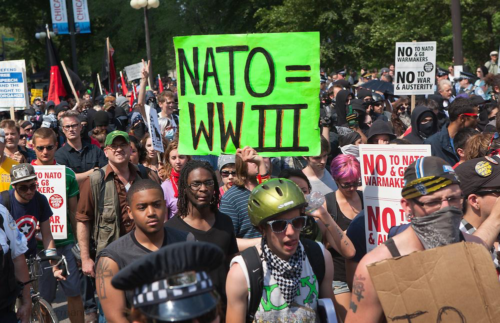
A further instrument of postwar power was NATO, an ostensibly voluntary defensive alliance of nonsocialist western European and North American nations, to which the socialist countries reacted with their own Warsaw Pact. Both were voluntary to roughly the same imaginary degree, and justified each other’s existence. But both were also a means for the great powers of the US and the USSR to dominate the other members of their respective alliances. The defensive function of these alliances became obsolete with the dissolution of both the Soviet Union and the Warsaw Pact in 1991. NATO then became an offensive alliance, functioning to preserve, enhance and expand US hegemony and domination in the face of its descent into internal dysfunction and external predation.
These transfers of wealth and power, both domestically and internationally took place even as US industrial and manufacturing power waned. This was due not only to competition from the expected postwar recovery of powers destroyed during the war (as well as newly rising ones), but also to the unmanaged voracious appetites of US speculators and venture capitalists, who replaced vaunted US industrial capacity with cheap foreign (“offshore”) sources. This eventually converted the US from a major production economy to a largely consumer one. It also helped to transfer middle and lower class wealth from the American masses to its upper echelons, as well-paying union and other full-time jobs were replaced by menial minimum wage and part-time ones, or by unemployment, welfare and homelessness. The service industries, construction, entertainment, finance, military, government and agriculture usually remained relatively stronger than industry and export, but less so than during the 1950s, and were increasingly funded by expansion of the national debt, rather than a strong economic base.
Of course, concentration of wealth is commensurate with concentration of power, and although the wealthy always have greater political power than the less wealthy, the transition to an increasingly oligarchical US society got a major boost in 2010 with the Supreme Court decision Citizens United v. Federal Election Commission, which granted corporations and other associations unprecedented power to use their vast financial resources to control the outcome of elections. It was a bellwether: despite the fact that Supreme Court justices are unelected officials, it is hard to imagine such a decision taking place a half century earlier (during the Warren Court, for example), when popular power in the US (though never as great as proclaimed) was perhaps at its peak, and which was reflected in the composition of the court and its decisions in that era. Citizens United gave corporations and well financed interest groups virtually unlimited control over US domestic and international policy.
The coalescing of these trends has resulted in a power structure and decision-making procedure (or lack thereof) that accounts for the astonishing headlong rush toward Armageddon described in the introductory paragraph of this article. The US is currently considered the only remaining superpower, but what is the basis of that power? It is not industrial or economic power, which the US abandoned for the sake of short-term profits in “offshore” manufacturing, as previously stated.
It is not even military power, much of which has been invested in extremely expensive air and sea forces that are now becoming obsolete, as second and third tier powers like Russia and Iran develop cheaper mass drone architecture, untouchable hypersonic missiles and electronic systems that make traditional weaponry less relevant. An extreme example of such irrelevance can be seen in the strategies of Hamas and its Palestinian allies, armed largely with low-tech self-developed weapons designed to exploit the vulnerabilities of massively armed Israeli forces laying waste to the Palestinian population and infrastructure above ground, while the resistance forces remain relatively invulnerable below ground, and able to attack effectively and indefinitely from their hundreds of miles of deep reinforced tunnels.
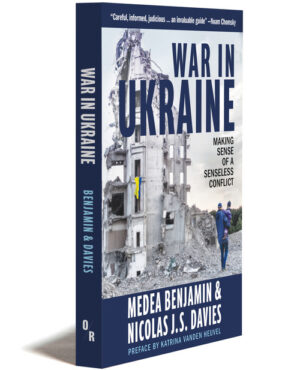
Similarly, the irrelevance and obsolescence of US arms became evident in the Ukraine war, as the US, and indeed all of NATO, proved themselves incapable of manufacturing more than a fraction of the artillery, shells and armored vehicles that Russia produces, with a military budget hardly more than a tenth that of the US, much less the combined NATO budget.
The US aim in the Ukraine war was and is ostensibly to defeat Russia. But it will consider the war a success even if (as seems certain) this objective fails. This is because the more immediate US goal is to assure and reinforce the subjugation of the western NATO countries, as well to expand to the rest of Europe. In effect, the Ukraine war solves the problem perceived by US policymakers that the dissolution of the USSR removed much of the justification for a defensive alliance which was no longer facing a threat of the sort against which it was created to defend.
But that question was apparently raised mainly if at all by academics at the time, not diplomats. Perhaps a partial explanation was inertia: why change what seemed to be keeping both peace and prosperity (for its members)? The US also found missions for NATO from the Balkans to 9/11 response to West Asia to Afghanistan and North Africa. But all of these paled in comparison to its previous function of deterring the Soviet Union. In order to justify the continued existence of NATO, a new, similar threat was needed, not merely “police actions”. This was manufactured by the US, starting with expansion of NATO to eastern Europe, in violation of its promises in 1991 to the leadership of the dissolving Soviet Politburo not to expand “an inch beyond the eastern border of [East] Germany.” Poland, Hungary and the Czech Republic joined in 1999. Bulgaria, Estonia, Latvia, Lithuania, Romania, Slovakia, and Slovenia in 2004. In 2009, Albania and Croatia also joined, followed by Montenegro in 2017 and North Macedonia in 2020. Finland joined in 2023 followed by Sweden in 2024.
The purpose of the expansion, while giving the appearance of relevance, was not so much to respond to a perceived threat as to manufacture one, and Russia was selected to be the threat, despite the fact that it had posed no apparent strategic threat to NATO for more than two decades after the end of the Soviet Union. It even discussed the possibility of joining the Alliance. But the US had other intentions. Without a credible common threat, NATO might cease to be a defensive military alliance, with the eventual possibility of defections by members that no longer saw a significant benefit to their otherwise exorbitant and oppressive membership. Furthermore, many western European nations were finding common interests with Russia, most notably the Nordstream pipelines providing cheap, plentiful and reliable Russian natural gas to the European economies.
Obviously, this was intolerable for the US and its plan to dominate all of western and eastern Europe combined. Russia soon understood that the expansion of NATO was intended as a strategic threat to Russia’s security. As successor of, and inheritor to, the Soviet nuclear arsenal and its delivery systems, Russia could not afford to have NATO nuclear strike systems sitting on its doorstep any more than the US could accept nuclear missiles in Cuba in 1962. The US therefore chose to threaten Russia’s existence through Ukraine.
Ukraine was the perfect weapon to prod the Bear. It was poor and corrupt, and it had a substantial racist and ultranationalist anti-Russian Nazi and Fascist minority, with origins dating to collaboration with Nazi Germany. These elements hated Ukraine’s large ethnically and linguistically Russian population, who had a strong traditional link with Russia and its history, including Ukrainian cities founded by Russia. With well-placed undercover money, arms and expert CIA covert manipulation, a small but violent uprising, a coup d’état and civil war might turn Ukraine into a security threat to Russia that could be used to seal NATO under US control.
Under the stewardship of Hillary Clinton’s handmaiden, Victoria Nuland, laden with $5 billion (actually, with unlimited funds), this is exactly what happened in 2013-14. The newly installed Ukrainian coup government promptly began the repression of its ethnically Russian population, which mounted a resistance movement to defend itself, as intended by the US/NATO covert operators. Over the next eight years, the US funded, armed and trained its Ukrainian puppet, all the while amplifying the repression against the ethnic Russians, whose resistance groups Russia supported with arms and training. Negotiated agreements in 2014 and 2015 (the Minsk accords) to end the fighting were only partially and temporarily effective, and as German Chancellor Angela Merkel admitted in an interview with Die Zeit in 2022, they were only an attempt to gain time [to strengthen the Ukrainian military until they were ready to take on Russia].
That time was February, 2022, when – on cue from its US puppeteers – Ukraine escalated its attacks on its Russian minority in Lugansk and Donetsk oblasts (provinces), instantly raising the daily casualty toll from dozens to hundreds. As intended, this prompted Russia to intervene directly with a “Special Military Operation”, ostensibly limited mainly to ending the massacres and defending the population that was under attack, but also to driving Ukraine to the negotiating table.
It worked. At the end of March, the two countries reached a ceasefire agreement at negotiations in Istanbul, under the auspices of the Turkish government. But this was not what the US had in mind, so British Prime Minister Boris Johnson was promptly dispatched to Istanbul, to remind the Ukrainians that puppets are controlled by the hands of their masters. From then on, the war escalated until it engaged more than a million armed combatants and resulted in more than a half million casualties. And in case some NATO member might be tempted to explore reconciliation with Russia, the US destroyed the Nordstream pipelines, breaking a major foundation of Russia’s peaceful economic bonds with the rest of Europe, and with them much of Europe’s heretofore economic success, on the assumption that weaker partners are more dependable than strong ones (and constitute weaker economic competition, as well).
The US thus became the undisputed hegemon of Europe by means of a conventional proxy war with Russia. But their original plan included the defeat of Russia, as well, both militarily and economically, the latter by means of sanctions that would deny markets and world trade to the Russian economy. This part of the plan was a miserable failure, as Russia found prosperity in new markets, and invested in an astonishingly productive, innovative and efficient strategic defense industry, mainly at its robust defense complex in the Ural mountains. No matter. War, destruction and wanton slaughter had nevertheless proven to be effective strategies for European domination, even without defeating Russia. In addition, the US had shown that, despite its industrial limitations, it could impose its will through proxies bought, trained and supplied with its most powerful weapon, which it had in unlimited supply: the mighty US dollar.
I therefore return to the question of the basis of US power. What enables a country with a declining industrial base and stagnating military production, a shrinking working and middle class and an expanding homeless population to expend vast sums of money to hire and arm proxy fighting forces, purchase and develop foreign political parties, overthrow governments, maintain a military budget that is the equal of the next nine countries combined, and an intelligence budget that is larger than the entire defense budget of every other country except China and Russia?
Part of the answer is that the US increases its national debt by whatever amount it wishes, usually paying low but reliable rates of interest, depending on the market for US Treasury notes. Currently, the debt is roughly $35 trillion, more than the annual US GDP. The only other time in history that debt has exceeded GDP was in WWII, which hints at profligate borrowing. But the US is not worried about the size of the debt or about finding takers for its IOUs. As mentioned earlier, the dollar was uncoupled from the value of gold in 1971. The untethered dollar is therefore the basis for most currencies in the world. As a result, the entire world is heavily invested in the dollar and in maintaining its value, and will buy US Treasury notes as needed to assure that it remains stable and valuable. This enables the US to outspend all other countries to maintain and augment its power throughout the globe. Some have accused the US of treating this system of funding as “the goose that lays the golden egg”.
Others have accused it of coercing or “shaking down” other countries to participate in this financing scheme or face unpleasant consequences. The same accusation has sometimes been leveled with respect to the purchase of US “protection services” and expensive military hardware as part of the NATO member “contributions” that bring US installations and personnel to those countries, and to other US satellite countries around the globe.
The other major basis of US power is the use of unlimited dollar resources to visit extreme violence, death, war and destruction upon countries and societies that do not accept subordinate status, or even those who do, but whose destruction may be seen as a necessary object lesson to those who might otherwise step out of line. This is a commitment to use totally disproportionate force with little or no effort at diplomatic efforts to reach strategic goals. The Israelis call this the “Dahiyeh Doctrine”, in reference to turning entire suburbs (“dahiyeh” in Arabic) or cities and their populations into smoldering ruins for the sake of intimidation. In the case of Ukraine, the US/NATO, has raised the stakes in the destructiveness of the weapons being used against Russia, as well as the choice of increasingly deeper targets inside Russia, while refusing negotiated diplomatic solutions. Threats to use low yield nuclear weapons have also been suggested.
This is, in effect, the insanity ploy, “We are unreasonable and capable of anything. Do what we say or accept terrible consequences.” It is the Armageddon strategy, “We are willing to go to any lengths.” It is the strategy of those who think they are invincible, and who demand complete obedience from, and dominance of, potential rivals. It is the strategy of those who think that they can do whatever they want without serious consequence to themselves. The direct origin of this strategy is the Wolfowitz Doctrine, first issued by Under Secretary of Defense Paul Wolfowitz in 1992, and submitted to his superior, Defense Secretary Dick Cheney. The basis of the doctrine is that any potential rival to US power must be destroyed or reduced to size.
Cheney and Wolfowitz are part of the neoconservative political movement that began during the Vietnam war. It is a movement of warmongers and autocrats who believe that the control of US foreign policy must be kept in the hands of “experts” (themselves) and out of the hands of elected officials who don’t support them. The dissolution of the Soviet Union was in their eyes a vindication of their influence in the Reagan and George H.W. Bush administrations, and their “success” led to the founding of the short-lived Project for a New American Century think tank during the latter part of the Clinton presidency.
The Project for a New American Century in turn became a springboard for neocon saturation of the George W. Bush administration in the major foreign policy arms of the government – the cabinet, the National Security Agency, the State Department, the intelligence services, and eventually the military. Since then, neoconservative control has only broadened and deepened in the U.S. To a large extent they are the unelected cabal that run US foreign policy and related agencies, with support from the interests that profit from war and exploitation, including weapons manufacturers, petroleum and mineral companies, and, of course, the similarly-minded Israel Lobby.
It is in these circles that arrogance knows no bounds, that no risk is too great, and that no amount of death and destruction is inconceivable, because you are not invited to participate unless you consider yourself too intelligent and powerful to make a mistake, and because Armageddon can only happen if you will it so.
Industry groups have backed the exclusion of strict ‘green’ rules from billions of dollars in hydrogen tax incentives under the Future Made in Australia program, despite such rules featuring in equivalent programs overseas. The proposed rules avoid complex requirements that could inhibit early-stage projects, experts say, with some confident the incoming Guarantee of Origin emissions…
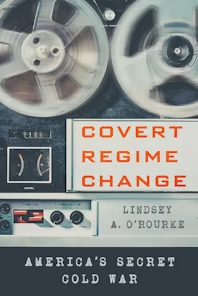
This is the list of U.S. coups during the Cold War that’s presented in the highly regarded 2018 academic book Covert Regime Change, by Lindsey O’Rourke.
(Only the start-date for each coup is shown here, but some of these coups went on for years; 39% succeeded at Government-overthrow, 61% did not. This list is taken from “Table 1.1: U.S.-backed regime change attempts during the Cold War (1947-1989)”):
France 1947
Italy 1947
Albania 1949
Belarus 1949
Bulgaria 1949
Czechoslovakia 1949
East Germany 1949
Estonia 1949
Latvia 1949
Lithuania 1949
Poland 1949
Romania 1949
Hungary 1949
Russia 1949
Ukraine 1949
North Korea 1950
Guatemala 1952
Iran 1952
Japan 1952
Indonesia 1954
Syria 1955
Lebanon 1957
Tibet 1958
Laos 1959
Dominican Republic 1960
Congo 1960
Guyana 1961
Dominican Republic 1961
North Vietnam 1961
Cuba 1961
Chile 1962
Haiti 1963
Bolivia 1963
Angola 1964
Mozambique 1964
Somalia 1964
Brazil 1964
Dominican Republic 1965
Haiti 1965
Thailand 1965
South Vietnam 1967
Bolivia 1971
Iraq 1971
Italy 1972
Portugal 1974
Angola 1975
Afghanistan 1979
South Yemen 1979
Grenada 1979
Nicaragua 1979
Nicaragua 1980
Chad 1981
Ethiopia 1981
Poland 1981
Cambodia 1982
Suriname 1982
Libya 1982
Liberia 1983
Chile 1964
Philippines 1984
Angola 1985
Haiti 1986
Panama 1987
That list is incomplete. For two examples: it omits Thailand 1948 when the CIA cut itself in on the profits from the international opium trade, and Indonesia 1965 when President Johnson helped organize the extermination of at least 500,000 land-reform proponents there and helped to install General Suharto (who then embezzled $15-35 billion from the country). Including just those two additional cases, they total to 64 U.S. coups during those 42 years 1947-1989. Also not included are coups that the author felt were only supported by the U.S. Government but not planned by the U.S. Government, such as allegedly “the 1967 Greek coup or the 1976 Argentine coup.” The author recognized that there might have been coups she didn’t know about. Furthermore, she was explicit that her study was aimed at supporting “a theory regarding the security motives driving America’s Cold War interventions.” That is clearly a false theory (that America’s foreign coups were done in order to protect U.S. national security — which was virtually never the case). Two examples showing it to be false were the two I mentioned that she had excluded: the 1948 CIA Thai coup to install a regime that would cut the CIA in for off-the-books funding of the CIA from the drug underworld (kickbacks, basically protection-money aid to the CIA), and the 1965 Indonesian coup to benefit U.S. owners of rubber plantations there. Routinely, scholars are willing to start with false assumptions in order to support an unrealistically favorable view of their Government. It’s myth-preserving scholarship, not science; and it is common; it’s routine in the social ‘sciences’.
A realistic presumption would be that ever since Truman became President in 1945 and started (in 1947, the year he started the CIA) America’s coups outside the Western hemisphere (O’Rourke also mentions that there had been U.S. coups in “Nicaragua (1909, 1910, and 1926), Honduras (1911, the Dominican Republic (1912, 1914, and 1916), Mexico (1914), Haiti (1915), and Costa Rica (1919)”), there have been around 80 of them since Truman came into office in 1945. During that same period, there have been at least 130 U.S. military invasions, plus countless illegal sanctions, in order to conquer countries it covets adding to its empire. After WW2, the vast majority of the world’s international aggressions — coups, invasions, subversions, and sanctions — have come from, or been initiated by, the U.S. Government. Rather than policing the world to maintain peace such as it claims, the U.S. has been the world’s biggest organized-criminal operation and source of wars, with no close second.
O’Rourke’s book studiously ignores that the post-1944 U.S. Government that has been mega-imperialistic and is driven by greed for evermore power and wealth by America’s billionaires, who benefit from these coups, wars, etc., which expand their mega-corporate empire.
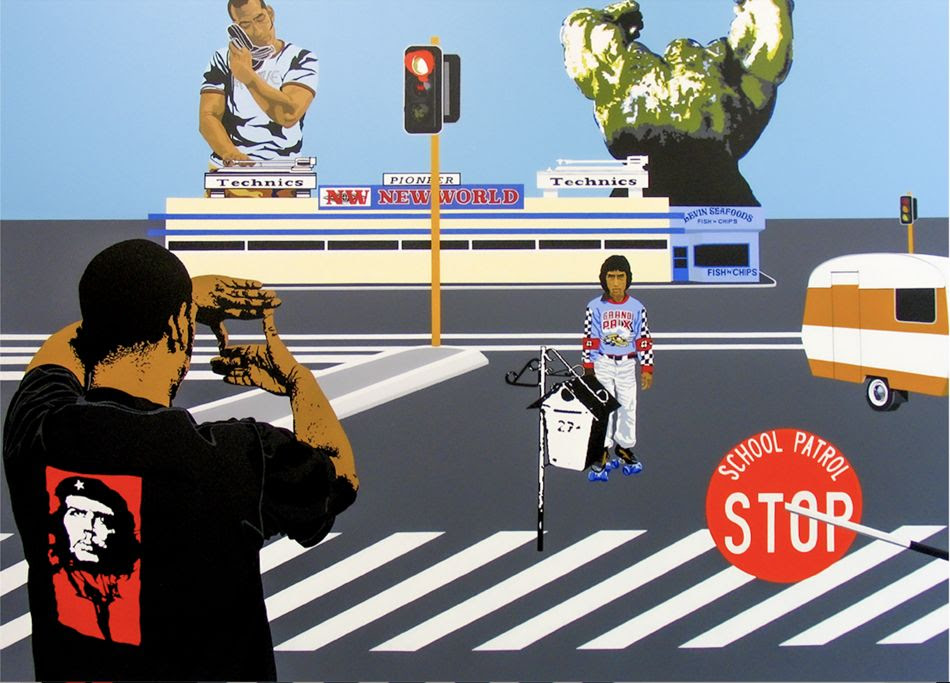
Mahiriki Tangaroa (Kūki ’Airani), Blessed Again by the Gods (Spring), 2015.
Since May, a powerful struggle has rocked Kanaky (New Caledonia), an archipelago located in the Pacific, roughly 1,500 kilometres east of Australia. The island, one of five overseas territories in the Asia-Pacific ruled by France, has been under French colonial rule since 1853. The indigenous Kanak people initiated this cycle of protests after the French government of Emmanuel Macron extended voting rights in provincial elections to thousands of French settlers in the islands. The unrest led Macron to suspend the new rules while subjecting islanders to severe repression. In recent months, the French government has imposed a state of emergency and curfew on the islands and deployed thousands of French troops, which Macron says will remain in New Caledonia for ‘as long as necessary’. Over a thousand protesters have been arrested by French authorities, including Kanak independence activists such as Christian Tein, the leader of the Coordination Cell for Field Actions (Cellule de coordination des actions de terrain, or CCAT), some of them sent to France to face trial. The charges against Tein and others, such as for organised crime, would be laughable if the consequences were not so serious.
The reason France has cracked down so severely on the protests in New Caledonia is that the old imperial country uses its colonies not only to exploit its resources (New Caledonia holds the world’s fifth largest nickel reserves), but also to extend its political reach across the world – in this case, to have a military footprint in China’s vicinity. This story is far from new: between 1966 and 1996, for instance, France used islands in the southern Pacific for nuclear tests. One of these tests, Operation Centaure (July 1974), impacted all 110,000 residents on the Mururoa atoll of French Polynesia. The struggle of the indigenous Kanak peoples of New Caledonia is not only about freedom from colonialism, but also about the terrible military violence inflicted upon these lands and waters by the Global North. The violence that ran from 1966 to 1996 mirrors the disregard that the French still feel for the islanders, treating them as nothing more than detritus, as if they had been shipwrecked on these lands.
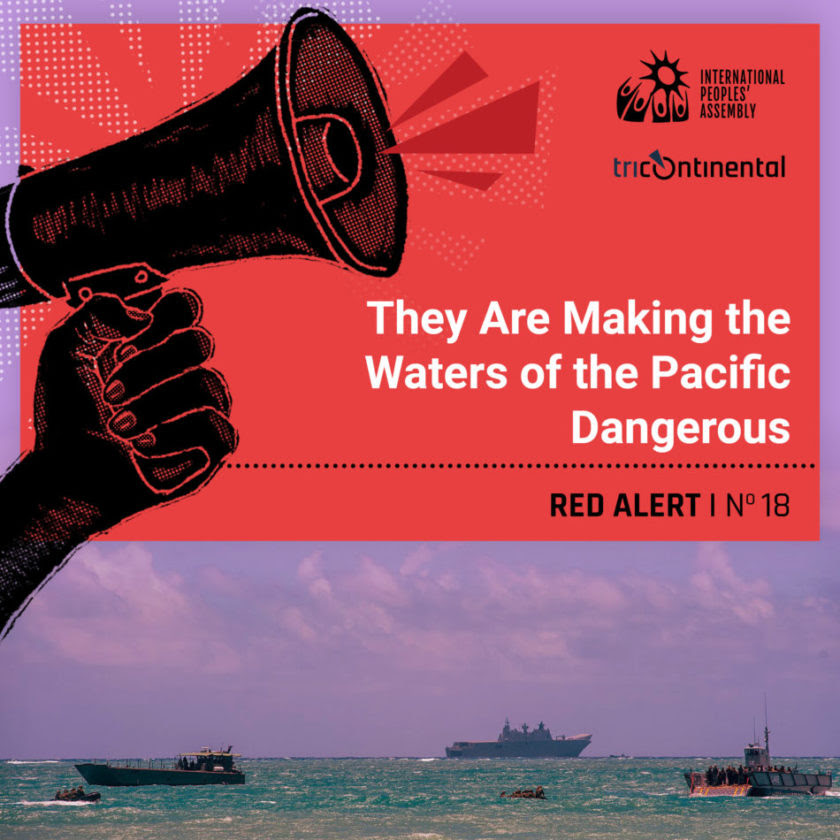
In the backdrop of the current unrest in New Caledonia is the Global North’s growing militarisation of the Pacific, led by the United States. Currently, 25,000 military personnel from 29 countries are conducting Rim of the Pacific (RIMPAC), a military exercise that runs from Hawai’i to the edge of the Asian mainland. Tricontinental: Institute for Social Research worked with an array of organisations – a number of them from the Pacific and Indian Oceans – to draft red alert no. 18 on this dangerous development. Their names are listed below.
They Are Making the Waters of the Pacific Dangerous
What is RIMPAC?
The US and its allies have held Rim of the Pacific (RIMPAC) exercises since 1971. The initial partners of this military project were Australia, Canada, New Zealand, the United Kingdom, and the United States, which are also the original members of the Five Eyes (now Fourteen Eyes) intelligence network built to share information and conduct joint surveillance exercises. They are also the major Anglophone countries of the North Atlantic Treaty Organisation (NATO, set up in 1949) and are the members of the Australia-New Zealand-US strategy treaty ANZUS, signed in 1951. RIMPAC has grown to be a major biennial military exercise that has drawn in a number of countries with various forms of allegiance to the Global North (Belgium, Brazil, Brunei, Chile, Colombia, Ecuador, France, Germany, India, Indonesia, Israel, Italy, Japan, Malaysia, Mexico, the Netherlands, Peru, the Philippines, Republic of Korea, Singapore, Sri Lanka, Thailand, and Tonga).
RIMPAC 2024 began on 28 June and runs through 2 August. It is being held in Hawai’i, which is an illegally occupied territory of the United States. The Hawai’ian independence movement has a history of resisting RIMPAC, which is understood to be part of the US occupation of sovereign Hawai’ian land. The exercise includes over 150 aircraft, 40 surface ships, three submarines, 14 national land forces, and other military equipment from 29 countries, though the bulk of the fleet is from the United States. The goal of the exercise is ‘interoperability’, which effectively means integrating the military (largely naval) forces of other countries with that of the United States. The main command and control for the exercise is managed by the US, which is the heart and soul of RIMPAC.
Fatu Feu’u (Samoa), Mata Sogia, 2009.
Why is RIMPAC so dangerous?
RIMPAC-related documents and official statements indicate that the exercises allow these navies to train ‘for a wide range of potential operations across the globe’. However, it is clear from both US strategic documents and the behaviour of the US officials who run RIMPAC that the centre of focus is China. Strategic documents also make it clear that the US sees China as a major threat, even as the main threat, to US domination and believes that it must be contained.
This containment has come through the trade war against China, but more pointedly through a web of military manoeuvres by the United States. This includes establishing more US military bases in territories and countries surrounding China; using US and allied military vessels to provoke China through freedom of navigation exercises; threatening to position US short-range nuclear missiles in countries and territories allied with the US, including Taiwan; extending the airfield in Darwin, Australia, to position US aircraft with nuclear missiles; enhancing military cooperation with US allies in East Asia with language that shows precisely that the target is to intimidate China; and holding RIMPAC exercises, particularly over the past few years. Though China was invited to participate in RIMPAC 2014 and RIMPAC 2016, when the tension levels were not so high, it has been disinvited since RIMPAC 2018.
Though RIMPAC documents suggest that the military exercise is being conducted for humanitarian purposes, this is a Trojan Horse. This was exemplified, for instance, at RIMPAC 2000, when the militaries conducted the Strong Angel international humanitarian response training exercise. In 2013, the United States and the Philippines cooperated in providing humanitarian assistance after the devastating Typhoon Haiyan. Shortly after that cooperation, the US and the Philippines signed the Enhanced Defence Cooperation Agreement (2014), which allows the US to access bases of the Philippine military to maintain its weapons depots and troops. In other words, the humanitarian operations opened the door to deeper military cooperation.
RIMPAC is a live-fire military exercise. The most spectacular part of the exercise is called Sinking Exercise (SINKEX), a drill that sinks decommissioned warships off the coast of Hawai’i. RIMPAC 2024’s target ship will be the decommissioned USS Tarawa, a 40,000-tonne amphibious assault vessel that was one of the largest during its service period. There is no environmental impact survey of the regular sinking of these ships into waters close to island nations, nor is there any understanding of the environmental impact of hosting these vast military exercises not only in the Pacific but elsewhere in the world.
RIMPAC is part of the New Cold War against China that the US imposes on the region. It is designed to provoke conflict. This makes RIMPAC a very dangerous exercise.
Kelcy Taratoa (Aotearoa), Episode 0010 from the series Who Am I? Episodes, 2004.
What is Israel’s role in RIMPAC?
Israel, which is not a country with a shoreline on the Pacific Ocean, first participated in RIMPAC 2018, and then again in RIMPAC 2022 and RIMPAC 2024. Although Israel does not have aircraft or ships in the military exercise, it is nonetheless participating in its ‘interoperability’ component, which includes establishing integrated command and control as well as collaborating in the intelligence and logistical part of the exercise. Israel is participating in RIMPAC 2024 at the same time that it is waging a genocide against Palestinians in Gaza. Though several of the observer states in RIMPAC 2024 (such as Chile and Colombia) have been forthright in their condemnation of the genocide, they continue to participate alongside Israel’s military in RIMPAC 2024. There has been no public indication of their hesitation about Israel’s involvement in these dangerous joint military exercises.
Israel is a settler-colonial country that continues its murderous apartheid and genocide against the Palestinian people. Across the Pacific, indigenous communities from Aotearoa (New Zealand) to Hawai’i have led the protests against RIMPAC over the course of the past 50 years, saying that these exercises are held on stolen ground and waters, that they disregard the negative impact on native communities upon whose land and waters live-fire exercises are held (including areas where atmospheric nuclear testing was previously conducted), and that they contribute to the climate disaster that lifts the waters and threatens the existence of the island communities. Though Israel’s participation is unsurprising, the problem is not merely its involvement in RIMPAC, but the existence of RIMPAC itself. Israel is an apartheid state that is conducting a genocide, and RIMPAC is a colonial project that threatens an annihilationist war against the peoples of the Pacific and China.
Ralph Ako (Solomon Islands), Toto Isu, 2015.
Te Kuaka (Aotearoa)
Red Ant (Australia)
Workers Party of Bangladesh (Bangladesh)
Coordinadora por Palestina (Chile)
Judíxs Antisionistas contra la Ocupación y el Apartheid (Chile)
Partido Comunes (Colombia)
Congreso de los Pueblos (Colombia)
Coordinación Política y Social, Marcha Patriótica (Colombia)
Partido Socialista de Timor (Timor Leste)
Hui Aloha ʻĀina (Hawai’i)
Communist Party of India (Marxist–Leninist) Liberation (India)
Federasi Serikat Buruh Demokratik Kerakyatan (Indonesia)
Federasi Serikat Buruh Militan (Indonesia)
Federasi Serikat Buruh Perkebunan Patriotik (Indonesia)
Pusat Perjuangan Mahasiswa untuk Pembebasan Nasional (Indonesia)
Solidaritas.net (Indonesia)
Gegar Amerika (Malaysia)
Parti Sosialis Malaysia (Malaysia)
No Cold War
Awami Workers Party (Pakistan)
Haqooq-e-Khalq Party (Pakistan)
Mazdoor Kissan Party (Pakistan)
Partido Manggagawa (Philippines)
Partido Sosyalista ng Pilipinas (Philippines)
The International Strategy Center (Republic of Korea)
Janatha Vimukthi Peramuna (Sri Lanka)
Tricontinental: Institute for Social Research
Communist Party of Nepal (Unified Socialist)
CODEPINK: Women for Peace (United States)
Nodutdol (United States)
Party for Socialism and Liberation (United States)
When the political protests began in New Caledonia in May, I hastened to find a book of poems by Kanak independence leader Déwé Gorodé (1949–2022) called Under the Ashes of the Conch Shells (Sous les cendres des conques, 1974). In this book, written the same year that Gorodé joined the Marxist political group Red Scarves (Foulards rouges), she wrote the poem ‘Forbidden Zone’ (Zone interdite), which concludes:
Reao Vahitahi Nukutavake
Pinaki Tematangi Vanavana
Tureia Maria Marutea
Mangareva MORUROA FANGATAUFA
Forbidden zone
somewhere in
so-called ‘French’ Polynesia.
These are the names of islands that had already been impacted by the French nuclear bomb tests. There are no punctuation marks between the names, which indicates two things: first, that the end of an island or a country does not mark the end of nuclear contamination, and second, that the waters that lap against the islands do not divide the people who live across vast stretches of ocean, but unite them against imperialism. This impulse drove Gorodé to found Group 1878 (named for the Kanak rebellion of that year) and then the Kanak Liberation Party (Parti de libération kanak, or PALIKA) in 1976, which evolved out of Group 1878. The authorities imprisoned Gorodé repeatedly from 1974 to 1977 for her leadership in PALIKA’s struggle for independence from France.
During her time in prison, Gorodé built the Group of Exploited Kanak Women in Struggle (Groupe de femmes Kanak exploitées en lutte) with Susanna Ounei. When these two women left prison, they helped found the Kanak National Liberation and Socialist Front (Front de Libération Nationale Kanak et Socialiste) in 1984. Through concerted struggle, Gorodé was elected the vice president of New Caledonia in 2001.
Stéphane Foucaud (New Caledonia), MAOW! (2023).
In 1985, thirteen countries of the south Pacific signed the Treaty of Rarotonga, which established a nuclear-free zone from the east coast of Australia to the west coast of South America. As French colonies, neither New Caledonia nor French Polynesia signed it, but others did, including the Solomon Islands and Kūki ‘Airani (Cook Islands). Gorodé is now dead, and US nuclear weapons are poised to enter northern Australia in violation of the treaty. But the struggle does not die away.
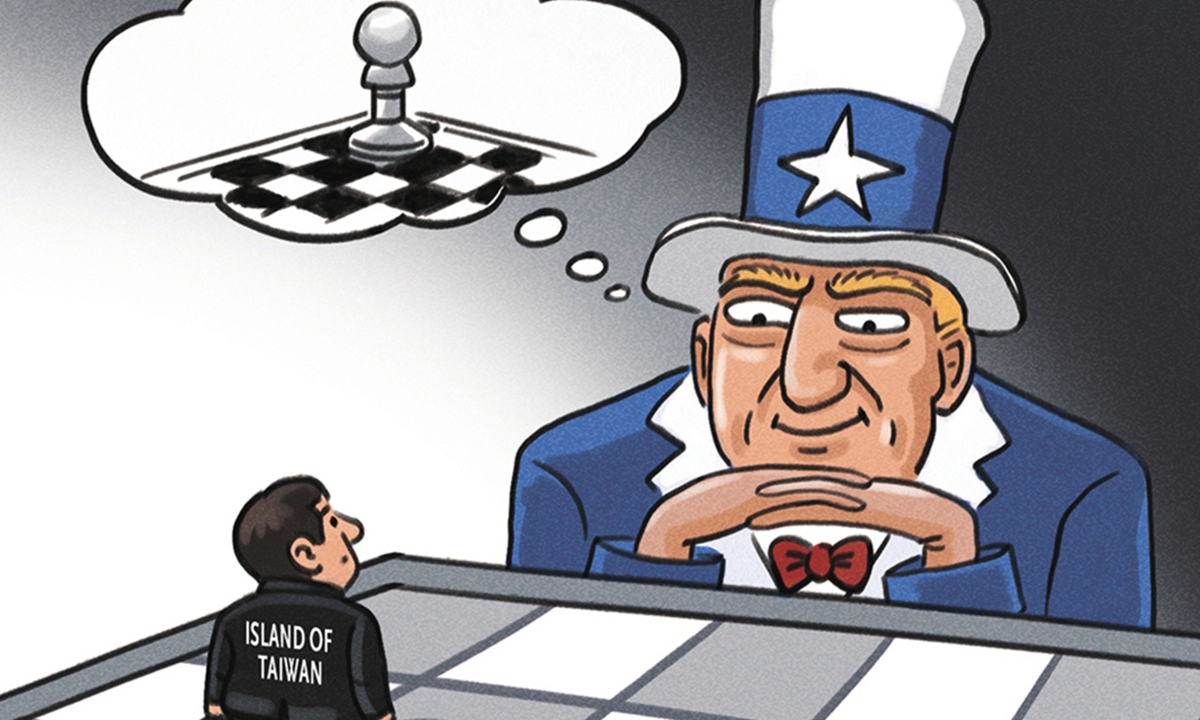
The Democratic Progressive Party (DPP) authorities of Taiwan should be trembling now. Former US president Donald Trump, who is the Republican Party’s official 2024 presidential nominee, accused Taiwan of stealing US chip business and claimed that Taiwan “should pay” for US protection, according to Bloomberg on Tuesday.
Trump’s words reflect the strong intention of many US politicians who attempt to replenish the US economy by exploiting the Taiwan island. We wonder how the DPP authorities, who rely on the US to seek “independence,” feel when they heard Trump’s comment. They must be feeling on edge, terrified.
In fact, Taiwan has been paying “protection fees” to the US, a large portion of which is spent on purchasing expensive American weapons that Taiwan can’t bargain for. The US has sold arms to Taiwan over 100 times in the past more than four decades. Statistics indicate that the total arms sales from the US to the Taiwan island have surpassed $70 billion up to now. This $70 billion could have been utilized to improve the livelihoods of the people on the island and boost the economy, but instead it was used to procure American weapons and pay “pro-tection fees” to the US. “US-Taiwan collusion” not only seriously impedes Taiwan’s economic development and harms the interests of people on the island, but also creates instability in the Taiwan Straits and escalates tensions.
Even so, US politicians, like Trump, are far from being satisfied. Trump mentioned in his in-terview with Bloomberg that the US is no different from “an insurance company” and Taiwan doesn’t give the US anything.
Trump and his likes want to exploit Taiwan for more “protection fees,” but once a conflict occurs across the Taiwan Straits, will the US really defend Taiwan because of the “protection fees” paid by Taiwan?
The US has maintained strategic ambiguity when it comes to defending Taiwan. There is currently no formal agreement requiring the US to send troops to defend Taiwan once there is a conflict in the Taiwan Straits. It would be a strategic gamble by the US to break through this framework and engage in war with another major power. The so-called US’ commitment to Taiwan is not even an insurance policy.
Xin Qiang, director of the Taiwan Studies Center at Fudan University, told the Global Times that “an ‘insurance company’ must be responsible for repayment as long as the conditions are met. But the so-called protection of Taiwan by the US has no legal binding force, and it is entirely based on the interests of the US, not for the benefit of Taiwan.” The “protection” the DPP authorities are seeking from the US with enormous money is an utterly expensive joke, and no matter how much money Taiwan spends, it will be a waste.
As those secessionists try to seek ‘Taiwan independence’ backed by the US, the island will have to pay further “protection fees” to satisfy the desire of the US if requests, Yuan Zheng, deputy director and a senior fellow of the Institute of American Studies at the Chinese Academy of Social Sciences, told the Global Times. Taiwan has either the room nor the ability for bargaining if it continues to rely on the US to seek “independence.”
Trump’s remarks reflect the shameless but true thoughts of many US politicians. The US wants to maximize its exploitation of the Taiwan island’s interests, use it to contain the mainland geopolitically, and gain economic benefits as much as possible. With the ambiguous “pro-tection” promises, the US tightly controls the DPP authorities and exploits endlessly.
The DPP authorities are obsessed with the “protection” of the US. If the DPP authorities regard the wealth that Taiwan has accumulated for decades as a tribute to the US, and totally believe the US’ empty promises, it is tantamount to drinking poison to quench its thirst.
We must remind the DPP authorities not to dream of achieving “Taiwan independence” by relying on the US. When the time comes for a showdown, the US will not take huge risks to “defend Taiwan.” Just as Trump said in the interview: Why are we [the US] doing this?
Trump’s near assassination this weekend represents an incredibly important reminder of the stakes going into the 2024 election amidst a vast systemic collapse and heightened threat of a thermonuclear war. At this stage, despite the cast of compromised characters among Trump’s support network, no one has displayed so consistent a quality of leadership that qualifies them for dealing with the current crisis as Trump has displayed.
I thought it fitting to revisit the recent Canadian Patriot Review film (based upon the essay “Why Assume There Will be a 2024 Election?“) where we are introduced into this dense period of history from the orchestrated demolition of the financial system in 1929, the Wall Street/London fueled “economic miracle solution” of fascism and eugenics between 1930-1934, and the story of FDR’s war with the financier oligarchy’s London and Wall Street tentacles. From this vantage point, we are then thrust into a deep dive into the person of Smedley Butler and his courageous defense of the republic.
When the Monroe Doctrine was declared, in 1823, it was aimed at European colonial powers. It told them to butt out: the US “sphere of influence” included all of Latin America and the Caribbean. During the past two centuries,virtually every Latin American and Caribbean country has had to endure US intervention and interference in their internal affairs. The coups, political manipulation and aggression directed by Washington have been relentless.
One of the most victimized countries has been Nicaragua. In this article, I will review the different types of aggression used by Washington against Nicaragua. This is not ancient history; the interference continues to today. The methods change but the purpose remains the same: to subjugate nominally independent countries and use them in the interests of US corporations, elites and government. When nations resist domination and insist on independence, the US goal becomes to prevent them from succeeding.
July 19, 2024
On July 19 Nicaragua will celebrate the 45th anniversary of the Sandinista revolution. On that day, Nicaraguans overthrew the US backed Somoza dictatorship. In Managua, Nicaraguans will honor the day and re-assert their sovereignty and independence. Nicaraguan leaders will likely denounce US interference and their right to have friendly relations with any country they choose to. At the same time, we will surely see negative comments about Nicaragua from Washington and US media.
There have been eight distinct types of US interference and aggression against Nicaragua.
1 – Conquest 1855-56
In 1855, with a small army of US and European soldiers, William Walker arrived in Nicaragua. The country was in the midst of a civil war and the foreign military turned the tide. When Walker’s forces seized control of the Nicaraguan city of Grenada, he declared himself President of Nicaragua. Walker’s presidency was quickly recognized by US President Franklin Pierce. Supported by southern slave holding US states, one of Walker’s early actions as Nicaraguan president was to re-legalize slavery which had been outlawed in 1832. Nicaraguans did not accept this. Within a couple years, Walker’s forces were defeated, and in 1857 he was executed in neighboring Honduras.
2 – Military occupation 1909-1933
Beginning in 1909, US Marines invaded and occupied Nicaragua when US financial interests were not being considered paramount. Nicaraguans were considering borrowing money from European countries to finance a canal running across the isthmus. For the next three decades, the US Marines were ever present to ensure Washington and Wall Street controlled major decisions. USMC Major General Smedly Butler later reflected on his role: “I spent 33 years and four months in active military service and during that period I spent most of my time as a high class muscle man for Big Business, for Wall Street and the bankers. In short, I was a racketeer, a gangster for capitalism…. I helped in the raping of half a dozen Central American republics for the benefit of Wall Street. I helped purify Nicaragua for the International Banking House of Brown Brothers.” Beginning in 1927, US foreign military dominance was increasingly challenged by a peasant army led by Augusto Cesar Sandino. Sandino’s July 1, 1927 manifesto denounces the collaborators and commits to “defend the national honor and redeem the oppressed.” By 1930, Sandino’s army was 5,000 strong and inflicting serious blows. In 1933 the last US Marines left Nicaragua following the election of Juan Batista Sacasa.
3 – US-backed dictatorship 1934-1969
The US Marines departed but left behind trained surrogates. In 1934, the “National Guard” reneged on a peace agreement with Sandino and murdered him, his brother and two generals. They proceeded to destroy Sandino’s army and then overthrew the elected government. With US support, the Somoza family dominated the country for the next forty-five years. Poverty and illiteracy were widespread while corruption was rampant. In 1961, armed opposition to the Somoza dictatorship was formed under the banner of the Sandinista Front for the Liberation of Nicaragua (FSLN). After fifty thousand deaths, the Somoza dictatorship was overthrown on 19 July 1979.
4 – Terrorism 1969-1980
Under the FSLN, Nicaragua made huge improvements with land reform and a very successful literacy campaign. For the first time, medical help was made available in remote communities and schools were open to all children. But in Washington, the Reagan administration could not accept an independent Nicaragua. US President Reagan was obsessed with overthrowing the Sandinista government. They tried to do this by creating a “Contra” army which attacked community clinics, bombed gas pipelines and infrastructure and killed healthcare and rural cooperative members. They even killed foreign aid workers such as young US engineer Ben Linder who was constructing a small hydroelectric dam to provide electricity to a remote village.
In the face of such obvious crimes, Nicaragua filed charges against the United States before the International Court of Justice (ICJ). They won their case and the US was ordered to pay compensation for the damages caused. Flaunting the ruling of the highest court in the world, the Reagan administration refused to pay damages to Nicaragua and continued to support the terrorist army. Under popular pressure, Congress passed the Boland amendment outlawing US assistance to the terrorist Contras. The Reagan administration ignored this as well, funding the Contras through a scheme where weapons were sent to the Contras in small private airplanes. The same planes were used to bring Colombian cocaine into the US. The profits went to the Contras while crack cocaine flooded poor and largely Black communities. A recent book from a CIA “Black Ops”agent documents the creation, training and financing of the terrorist Contras.
5 – Economic warfare 1985 to 1990
In 1985, an economic embargo was applied by the US against Nicaragua. US products could no longer be exported to Nicaragua and Nicaraguan products were barred from entering the US. The goal was clearly to hurt the Nicaraguan economy and pressure the Nicaraguan people to turn against the government. The justification stated: “I, Ronald Reagan, President of the United States of America, find that the policies and actions of the Government of Nicaragua constitute an unusual and extraordinary threat to the national security and foreign policy of the United States and hereby declare a national emergency to deal with that threat.” (underline added) The truth was the exact opposite: the policies of aggression by the United States was an extreme threat to Nicaragua.
6 – Election interference 1984 to today
The first democratic election in Nicaragua’s history took place in 1984. The FSLN won against a very divided opposition. Chuck Kaufman analyzed what happened then and afterward:
Already in 1984, we saw the United States place itself as the final judge and jury as to whether or not an election was legitimate… Delegitimizing elections is one of the primary overt tools used by the United States to subvert democracy around the world…. The 1990 election is where the US game plan for election intervention was written, perfected and victorious…. Through the use of money and pressure, the US took advantage of Nicaragua’s lack of laws controlling foreign money in its elections to create a unified 14 party anti-Sandinista coalition … The US then spent more money per Nicaraguan voter than George H W Bush and Michael Dukakis combined spent per US voter in our 1988 presidential election. At the same time the US warned Nicaraguan voters that the Contra War, which had cost them 40,000 sons and daughters, would continue if Daniel Ortega won reelection.
US intervention was “successful” in bringing the US-supported team into power in Managua. A slim majority of Nicaraguans cried uncle in the face of US aggression and threats. The US and western media was surprised when Daniel Ortega and the FSLN peacefully left office and passed on the leadership.
Neoliberal policies reigned for the next 16 years. While they were good for the wealthy and elites, they were a disaster for the majority of Nicaraguans. Health care and education was again privatized. Land reform measures and the literacy campaign were ended. Illiteracy again became widespread. State controlled infrastructure including roads, water and electricity was not improved. It was in disrepair and decline.
In the elections of 2006, Daniel Ortega and the FSLN won a plurality. There were multiple reasons: first, the economy and deteriorating infrastructure was a disaster. Second, the US failed to unite the right. Third, US election interference was publicly revealed after the US ambassador unwisely told some visiting activists how many millions were allotted for interfering in the election.
7 – Subversion through NGOs and “color revolution”
After 16 years in opposition, the FSLN came back to power in 2007 under the leadership of Ortega. With ever increasing electoral support, they have governed since then. The reasons for their popularity are practical. Healthcare and education are provided free. Roads and highways have been greatly improved and now extend across the country to the Caribbean. Electricity and running water have been continuously expanded and are now available throughout 98% of the country. Nicaragua is in the world top 10% in gender equality and renewable energy. Nicaragua actively assists small farmers and is 90% food sovereign.
Washington has not rushed to congratulate Nicaragua on their successes. On the contrary, this success has been noted with displeasure and Nicaragua has returned to the list of countries targeted for destabilization.
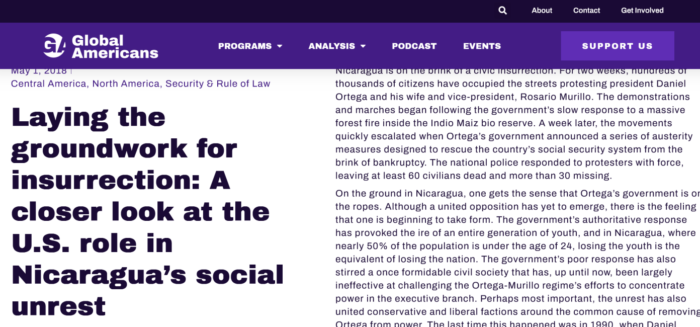
Over the past decades, the US has developed a softer approach to undermining governments which are deemed to be “adversary”. A key component of this is funding “non-governmental organizations” (NGOs). These organizations may have innocuous or even progressive sounding purposes but inevitably serve US goals. The NGOs receive much of their funding from US government related organizations such as USAID and the National Endowment for Democracy. As documented by Max Blumenthal in June 2018, the NGOs proudly boasted of their role in “laying the groundwork for insurrection” and “nurturing the current uprisings”.
With salaries which are high in comparison to local standards, the NGOs attract and influence ambitious students and youth. The directors of the NGOs learn which youth are promising to their objectives and what issues motivate them. In Nicaragua there were dozens of NGOs with a mission of “democracy promotion”. In essence, these were training sessions in anti-government activism. Other focal points were journalism and the use of social media. There was little or no monitoring of these foreign funded activities.
In the spring of 2018, there was an attempt to overthrow the elected Sandinista government. The coup attempt was driven by youth influenced by US funded NGOs with muscle provided by mercenary thugs and gangs. The coup attempt, from beginning to end, is described in a series of articles by Nicaraguan resident and journalist John Perry and author Dan Kovalik. This was similar to “color revolutions” carried out in numerous other countries on US target list. The common characteristics are: youth mobilized by US funded NGOs, heavy use of social media, false or exaggerated accusations of government violence, false claims that the protests are strictly “peaceful” when there are actually widespread provocations and violence.
Nicaragua passed through this stage from April to July 2018. The insurrection died when it became clear the violence was instigated by the protesters and the average Nicaraguan was being deeply hurt by the continued disruption and roadblocks. Dozens of police and hundreds of civilians were killed in the confrontations. Hundreds of government buildings, police stations and schools were attacked and the economy severely disrupted.
Ultimately, the insurrection and coup attempt collapsed. With police ordered to stay in their barracks, it was clear who was responsible for the violence. The public became increasingly angry at the protesters because their roadblocks and violence were ruining lives and the economy. The silver lining is that it sparked a realization in the FSLN that they needed to be more vigilant about education of youth and monitoring foreign funded organizations.
8 – Information warfare and extreme sanctions
Beginning with the 2018 coup attempt in Nicaragua, the US information war on Nicaragua escalated dramatically. In 2020, Nicaragua started regulating foreign-backed organizations. Given that foreign supported organizations played a big role in the insurrection resulting in hundreds of deaths and billions in economic damage, the need to do this was clear. The new regulations require foreign-backed organizations to document where their funding comes from and how it is spent. The US has the same requirement known as the Foreign Agents Registration Act (FARA), but that does not stop western media from claiming that these laws are “dismantling civil society”. On the contrary, many NGOs registered and continued as before. Those who refused to register were denied a permit, just as they would be in the United States.
US government influence extends to many “human rights” groups and some branches of the United Nations. For example, the UN’s Human Rights Council established a “Group of Human Rights Experts on Nicaragua” to investigate alleged Nicaraguan human rights violations and abuses since April 2018. Their mandate was extended until February 2025 but they have issued two preliminary reports that claim Nicaragua is committing crimes, violations and abuses including “persecution of any dissenting voice”, torture and the “deprivation of Nicaraguan nationality.”
The reports by three “experts”, none of whom is Nicaraguan, are extremely biased. They have been rebutted in a detailed article co-written by international legal scholar Alfred de Zayas. It is endorsed by 85 different organizations and over 450 individuals including Nicaraguan citizens and residents. The article reveals that the “experts” failed to comply with their own mandate to gather information from all sides. The report of the Group of Human Rights Experts on Nicaragua (GHREN) is solely based on the opinions and accusations of the dissidents and is a mockery of what should be an objective report based on evidence from all sides.
Along with the drumbeat of negative accusations based on subjective or no evidence, the US keeps adding more and more sanctions on Nicaragua. Unknown to most Americans, sanctions (called ‘unilateral coercive measures’) have been repeatedly condemned by the United Nations General Assembly. They are considered to be in violation of international law and the UN Charter. Ignoring the opinions of 75% of the world, the US Treasury Department has recently issued a slew of sanctions on Nicaraguan officials, state corporations, judges, mayors and attorney general.
In late 2021, three years after the coup attempt, Nicaragua held its national election. Western criticisms of the election were refuted in this article. International observers were impressed with organization, large turnout and enthusiasm. The US administration and media falsely claimed the main opposition candidates had been imprisoned. In fact, the few imprisoned individuals represented no parties or significant base of support. They claimed to be “precandidates” not because they were viable contenders but because they sought to avoid prosecution while slandering the Nicaraguan government.
On the contrary, there were five opposition candidates representing genuine parties and movements. The voters had a real choice. With 66% of the electorate voting, 75% voted for Daniel Ortega and the FSLN over the competitors. The theme of the election was “Soberania”, beautifully sung by a young Nicaraguan patriot at the house where Cesar Augusto Sandino grew up.
Nicaragua continues to assert its sovereignty and pursue its own foreign policy. In September 2021, Nicaragua cut ties with Taiwan and established diplomatic relations with China. In October 2022, Nicaragua refused to condemn Russia for its intervention in Ukraine, blaming the US and NATO for having provoked the conflict. On Oct 24 2023, Nicaragua called for an emergency session of the UN General Assembly to consider “protection of the Palestinian civilian population.” Later, Nicaragua’s Foreign Minister Denis Moncada said the Palestinian cause is one of the most just causes of our times. In January 2024, Nicaragua filed charges at the International Court of Justice against Germany for being an accomplice to genocide in Gaza.
In June the results of an extensive poll conducted by the independent and well regarded M&R Consultants were released. They indicate high satisfaction with the direction and leadership of the country. Confidence in the “stability, security, and economic progress” of the country has risen from 36.8% in 2018 to 74.8% today.
Nicaragua has good reason to be wary of the United States. In the eight different ways described above, the US has interfered with Nicaragua’s independence for 170 years. The vast majority of Nicaraguans continue to resist, calmly insisting on their independence and sovereignty. As the song “Soberania” says, “Respect my flag or go away.”
Bodies of Palestinians who were killed in Israel’s attack on al-Mawasi are brought to a hospital in Khan Younis, southern Gaza, 13 July (Omar AshtawyAPA images)
Israel massacred dozens of Palestinians in airstrikes in al-Mawasi, the supposed “safe zone” along the coast in southern Gaza, and in Beach refugee camp near Gaza City on Saturday.
At least 90 Palestinians were killed and 300 injured in the attack on al-Mawasi, according to the health ministry in Gaza, and at least 20 Palestinians were killed after Israel bombed worshippers gathered for noon prayers outside the ruins of a mosque in Beach refugee camp.
?The Palestine Red Crescent teams retrieved six martyrs and three injured individuals following the Israeli occupation targeting a prayer room in the Al-Shati refugee camp west of #Gaza City. ?Filmed by volunteer: Yousef Khader pic.twitter.com/zsagChjsYg
On Friday, the Israeli military killed four workers at an aid warehouse in Gaza, claiming that it had targeted Husam Mansour. Israel alleged that Mansour was a militant who worked at an aid organization to raise money for Hamas – an unsubstantiated claim similar to those made by Israel against other humanitarians in Gaza working for international charities who were killed and jailed with impunity.
The Al-Khair Foundation, a UK-based charity, stated that Mansour was a “cornerstone” of its team in Gaza and that his death “is not just a loss to our organization but a devastating blow to the humanitarian efforts in the region.”
The deaths of the aid workers came one day after Samantha Power, the head of the State Department agency USAID, said that Israel promised to improve safety for humanitarian workers in Gaza, where famine has taken hold as a result of Israel’s blockade.
At least 38,345 Palestinians have been killed in Gaza since 7 October, though the actual tally is likely substantially higher. Thousands remain missing in the rubble or their deaths as a result of secondary mortality such as hunger, thirst and disease resulting from Israel’s military campaign are not reflected in the fatality count.
Saturday’s deadly attacks came as Israeli Prime Minister Benjamin Netanyahu appeared to be sabotaging what may be a final push to reach a deal with Hamas that would see an exchange of captives and lead the way for a permanent ceasefire in Gaza.
Hamas condemned the “horrific massacre” in densely populated al-Mawasi, the open area where Israel ordered Palestinians to move after declaring one-third of Gaza a combat zone last week.
Four Israeli captives were freed by the military in the Nuseirat raid, during which Israeli forces posed as civilians and gunned down Palestinians in the camp’s crowded market and streets. The office of the UN human rights chief said it was “profoundly shocked” by that operation in which the basic principles of the laws of war were blatantly disregarded.
“False victory”
Israel attempted to justify the massacre in al-Mawasi on Saturday by claiming that it targeted Muhammad Deif, the elusive head of the Qassam Brigades, the armed wing of Hamas, and the commander of Qassam’s Khan Younis Brigade.
One of Israel’s most wanted figures, Deif survived several previous attempts on his life, including a 2014 attack that killed the military leader’s wife and their two young children.
Israel claims its target was Al Qassam leader Mohammed Deif, which justified blanketing a civilian “safe” area with tons of bombs. Deif has survived 5 similar assassination attempts. I was in Rimal in Gaza City when Israel bombed a building one neighborhood away in 2014 with a…
Netanyahu acknowledged during a press conference on Saturday evening that it was unclear whether Deif and the Qassam Brigades commander were killed, which Hamas denied.
Khalil al-Hayya, deputy chair of Hamas, said in response that Netanyahu had hoped to “announce a false victory” and said that the blood of Deif is no more precious than that of the youngest Palestinian child.
Hamas official Khalil al-Hayya tells al-Jazeera tonight that Mohammad Deif is alive and that he "mocks [Netanyahu's] false statements." pic.twitter.com/ztYFtHmOez
Al-Hayya suggested that Israel was killing more people in Gaza to undermine negotiations with Hamas and that Netanyahu was grasping for an illusion of victory before his address to US Congress later this month.
Earlier in the day, following the al-Mawasi attack, Hamas said that this was “not the first time the occupation has claimed to target Palestinian leaders, and later it is proven to be a lie.”
“These false claims are merely a cover-up for the scale of the horrific massacre,” the resistance group added in a statement published on Telegram.
“Justification always the same”
Francesca Albanese, the UN special rapporteur for the West Bank and Gaza Strip, observed that “the justification is always the same: ‘targeting Palestinian militants.’”
Hamdah Salhut, an Al Jazeera correspondent, said that the Israeli military repeatedly employs such claims, “saying civilians are being used as ‘human shields’ for Hamas figures, using that as justification for killing dozens of civilians.”
Assal Rad, an academic who closely observes the Western media’s framing of the genocide in Gaza, said that the Israeli justification is used by media outlets to treat the massacre of civilians in a “safe zone” as “an afterthought in their headlines,” if they are even mentioned at all:
Open your timeline to see another Israeli massacre of civilians in a “safe zone,” then look at Western media to see that’s an afterthought in their headlines (if mentioned at all).
This framing is deliberate, it’s meant to justify the slaughter of children, again. pic.twitter.com/5gqSqEG7v8
Amjad al-Shawa, director of the Palestinian NGOs Network, told Al Jazeera that the al-Mawasi massacre was “the message from Israel to the world that again and again and again they are targeting Palestinian civilians wherever they are.”
“Massive attack on the north”
Following the massacre in al-Mawasi, the UN human rights office condemned Israel’s continued use of “weapons with area effects in populated areas of Gaza.”
A statement from the office noted that the deadly strikes on Saturday came “right after another massive attack on the north, which lasted for a week, resulting in further destruction and casualties.”
Israel laid waste to Shujaiya, on the eastern outskirts of Gaza City, in a two-week raid during which it claimed to have killed a Hamas battalion deputy chief and commander in the area and uncovered a command center in a facility belonging to UNRWA, the UN agency for Palestine refugees.
Following the military’s withdrawal, residents returned to find that troops had destroyed the majority of buildings in the area, including residences, schools and medical clinics.
This is the rubble of Sabha Clinic — the last health facility in Al Shuja’yia..
It used to serve over 50,000 people.. It was destroyed by the Israeli occupation forces during their last ground invasion into Al Shuja’yia! pic.twitter.com/APENV06zSY
A spokesperson for the civil defense in Gaza said that the bodies of more than 60 people had been recovered in Shujaiya, and that many more were missing under the rubble of destroyed homes.
Dozens of people were also killed in Tal al-Hawa in southern Gaza City, the civil defense spokesperson said on Thursday.
On Wednesday, Israel once again ordered residents of Gaza City to evacuate. Many Palestinians vowed to stay in Gaza City, no matter the cost.
“We are not leaving until death. We are staying on our land.”
Despite Israel’s orders to evacuate Gaza City, some Palestinians refuse to leave. pic.twitter.com/PtvQMKGPsI
Itay Epshtain, an international law expert, said that “this is not a permissible evacuation but an act of forcible transfer” that “shows the open-ended nature of hostilities in Gaza.” Epshtain noted that “Israel appears interested as ever in a protracted conflict.”
The Euro-Med Human Rights Monitor said that its field workers “are investigating reports that the Israeli army forces committed extrajudicial killings and unlawful executions of numerous residents, the majority of whom were women” during its incursion into areas of western Gaza City between Monday and Friday.
Quadcopters fired on rescue workers
The UN office said that the strikes on al-Mawasi on Saturday allegedly hit tents housing displaced people, a food kitchen and a desalination plant where people had gathered to collect water, “leading to tens of fatalities.”
Israeli military “quadcopters reportedly targeted emergency rescue workers, killing at least one civil defense worker and injuring several others,” the human rights office added.
The UN office once again pointed to “a pattern of willful violation of the disregard of [international humanitarian law] principles of distinction, proportionality and precaution” and “a rampant disregard for the safety of civilians.”
Even if Palestinians belonging to armed groups were present among civilians, “this would not remove [the Israeli military’s] obligations” to comply with the fundamental principles of the laws of war, the UN office said.
Video of the immediate aftermath of the Israeli attack in al-Mawasi shows injured and dead people who appear to be civilians, including someone wearing a civil defense vest, lying in the streets as a black plume of smoke rises from an area adjacent to a tent encampment:
?? Graphic content ??
More horrific scenes coming out of the deadly Israeli massacre in al-Mawasi region, the area designated as a humanitarian zone by the Israeli army. pic.twitter.com/Iv7TnglvaK
Another video shows people attempting to dig victims out of a massive crater with their bare hands. A man’s left arm and shoulder is seen protruding from the sandy soil as a child says, “that’s my father, has he been martyred?”
A massacre occurred in Mawasi Khan Yunis this morning (13.07.2024) after F-16 jets bombarded a displacement camp filled with tents. The attack has resulted in significant casualties and devastation, leaving many families in deep mourning and despair. pic.twitter.com/i7rNsRnYfG
A witness says in the same video that “all of Gaza is wanted” by the occupation.
The man adds that there was a fire belt – a series of heavy bombs dropped in the same place – without warning on the tent encampment. When rescuers arrived, F-16 jets “bombed the paramedics and civil defense team,” he says.
Israel killed civil defense teams that were trying to rescue Palestinians in Mawasi Khanyounis. pic.twitter.com/ucjRPXVV4n
The PRCS #AlAmalHospital in Khan Yunis has received dozens of injuries from the displaced who were targeted by the Israeli occupation in the (Al-Nus) area in Muwasi Khan Yunis. Some of them are from the displaced in the PRCS's shelter camp in the targeted area. #Gazapic.twitter.com/iGjBAGwEzF
Amjad al-Shawa, director of the Palestinian NGOs Network, told Al Jazeera that the al-Mawasi massacre was “the message from Israel to the world that again and again and again they are targeting Palestinian civilians wherever they are.”
“Massive attack on the north”
Following the massacre in al-Mawasi, the UN human rights office condemned Israel’s continued use of “weapons with area effects in populated areas of Gaza.”
A statement from the office noted that the deadly strikes on Saturday came “right after another massive attack on the north, which lasted for a week, resulting in further destruction and casualties.”
Israel laid waste to Shujaiya, on the eastern outskirts of Gaza City, in a two-week raid during which it claimed to have killed a Hamas battalion deputy chief and commander in the area and uncovered a command center in a facility belonging to UNRWA, the UN agency for Palestine refugees.
Following the military’s withdrawal, residents returned to find that troops had destroyed the majority of buildings in the area, including residences, schools and medical clinics.
This is the rubble of Sabha Clinic — the last health facility in Al Shuja’yia..
It used to serve over 50,000 people.. It was destroyed by the Israeli occupation forces during their last ground invasion into Al Shuja’yia! pic.twitter.com/APENV06zSY
A spokesperson for the civil defense in Gaza said that the bodies of more than 60 people had been recovered in Shujaiya, and that many more were missing under the rubble of destroyed homes.
Dozens of people were also killed in Tal al-Hawa in southern Gaza City, the civil defense spokesperson said on Thursday.
On Wednesday, Israel once again ordered residents of Gaza City to evacuate. Many Palestinians vowed to stay in Gaza City, no matter the cost.
“We are not leaving until death. We are staying on our land.”
Despite Israel’s orders to evacuate Gaza City, some Palestinians refuse to leave. pic.twitter.com/PtvQMKGPsI
Itay Epshtain, an international law expert, said that “this is not a permissible evacuation but an act of forcible transfer” that “shows the open-ended nature of hostilities in Gaza.” Epshtain noted that “Israel appears interested as ever in a protracted conflict.”
The Euro-Med Human Rights Monitor said that its field workers “are investigating reports that the Israeli army forces committed extrajudicial killings and unlawful executions of numerous residents, the majority of whom were women” during its incursion into areas of western Gaza City between Monday and Friday.
Quadcopters fired on rescue workers
The UN office said that the strikes on al-Mawasi on Saturday allegedly hit tents housing displaced people, a food kitchen and a desalination plant where people had gathered to collect water, “leading to tens of fatalities.”
Israeli military “quadcopters reportedly targeted emergency rescue workers, killing at least one civil defense worker and injuring several others,” the human rights office added.
The UN office once again pointed to “a pattern of willful violation of the disregard of [international humanitarian law] principles of distinction, proportionality and precaution” and “a rampant disregard for the safety of civilians.”
Even if Palestinians belonging to armed groups were present among civilians, “this would not remove [the Israeli military’s] obligations” to comply with the fundamental principles of the laws of war, the UN office said.
Video of the immediate aftermath of the Israeli attack in al-Mawasi shows injured and dead people who appear to be civilians, including someone wearing a civil defense vest, lying in the streets as a black plume of smoke rises from an area adjacent to a tent encampment:
?? Graphic content ??
More horrific scenes coming out of the deadly Israeli massacre in al-Mawasi region, the area designated as a humanitarian zone by the Israeli army. pic.twitter.com/Iv7TnglvaK
Another video shows people attempting to dig victims out of a massive crater with their bare hands. A man’s left arm and shoulder is seen protruding from the sandy soil as a child says, “that’s my father, has he been martyred?”
A massacre occurred in Mawasi Khan Yunis this morning (13.07.2024) after F-16 jets bombarded a displacement camp filled with tents. The attack has resulted in significant casualties and devastation, leaving many families in deep mourning and despair. pic.twitter.com/i7rNsRnYfG
A witness says in the same video that “all of Gaza is wanted” by the occupation.
The man adds that there was a fire belt – a series of heavy bombs dropped in the same place – without warning on the tent encampment. When rescuers arrived, F-16 jets “bombed the paramedics and civil defense team,” he says.
Israel killed civil defense teams that were trying to rescue Palestinians in Mawasi Khanyounis. pic.twitter.com/ucjRPXVV4n
The PRCS #AlAmalHospital in Khan Yunis has received dozens of injuries from the displaced who were targeted by the Israeli occupation in the (Al-Nus) area in Muwasi Khan Yunis. Some of them are from the displaced in the PRCS's shelter camp in the targeted area. #Gazapic.twitter.com/iGjBAGwEzF
The head of the World Health Organization said that Nasser Medical Complex in Khan Younis, which received 134 people severely injured in the al-Mawasi attack, “is extremely overwhelmed by the influx of patients.”
Netanyahu stalls negotiations
After the deadly attack in al-Mawasi, Ghassan Abu Sitta, a British Palestinian surgeon who was working in Gaza during the first weeks of the genocide, said that “Israel committed this massacre to foil the ceasefire negotiations.”
Israel commited this massacre to foil the ceasefire negotiations. Neither Israel nor its US, UK and German accomplaces want the genocide to stop until the FINAL SOLUTION is achieved.
— Ghassan Abu Sitta (@GhassanAbuSitt1) July 13, 2024
There is no end to the genocide for one reason alone: Genocide @JoeBiden and the other murderous psychopaths in the White House don’t want it to. They can make “Israel” stop any time they want to. But they want the massacres, the baby-murder to continue.
Egypt officials told Reuters on Saturday that the indirect talks between Hamas and Israel “have been halted after three days of intense negotiations failed to produce a viable outcome … blaming Israel for lacking a genuine intent to reach an agreement.”
Earlier in the week, an unnamed “former senior Egyptian official with knowledge of the negotiations” told The Washington Post that “Netanyahu does not want peace. That is all.”
The official added that Netanyahu “will find excuses … to prolong this war” until the US elections, in which Republican candidate and former president Donald Trump, who was lightly injured after gunshots rang out during a campaign event on Saturday, may be voted into a second term.
Whatever Netanyahu’s motivation, Israeli defense officials have told the Haaretz newspaper that the prime minister has “repeatedly torpedoed” progress towards a deal with Hamas to free the remaining captives held in Gaza since 7 October.
The officials said that “in his attempt to derail negotiations, Netanyahu relied on classified intelligence and manipulated the sensitive information.”
In recent days, an unnamed senior official told Hebrew-language media that Netanyahu’s new demand to build “a mechanism to prevent the movement of armed operatives” within Gaza threatened to derail a deal.
“This is the moment of truth for the hostages,” the official told Channel 12 news. “We can reach an agreement within two weeks and bring the hostages home.”
But Netanyahu’s new demand “will stall the talks for weeks and then there may not be anyone to bring home,” the official said.
US resumes weapons shipments
While US President Joe Biden said on Thursday that he was “determined to get this deal done and bring an end to this war, which should end now,” his national security adviser Jake Sullivan told reporters that “there’s still miles to go before we close, if we are able to close” on an agreement.
With the US putting no real pressure on Israel, and continuing to supply weapons, more massacres of Palestinians in Gaza are all but guaranteed.
The US said in recent days that it will resume the shipments of 500-pound bombs to Israel after pausing a transfer of those weapons and 2,000-pound munitions in May to deter a major Israeli offensive in Rafah, southern Gaza, which went ahead anyway.
A clarification on POTUS tweet re: Gaza ceasefire.
Current signs suggest we are weeks away from a deal. Also: Netanyahu's unlikely to give Biden a win before coming to DC.
With Israel still getting overwhelming US support, bombing+Palestinian suffering+hostage anguish continue. https://t.co/aUMnpVHRf0
The Washington-based human rights watchdog DAWN said that the “partial lifting of the one solitary pause on munitions to the [Israeli military] in the face of overwhelming evidence of war crimes is a criminal offense under international law.”
The group’s advocacy director called on the International Criminal Court to investigate US officials for their complicity in “genocidal atrocities in Gaza.”
Karim Khan, International Criminal Court’s chief prosecutor, announced in May that he was pursuing arrest warrants for Netanyahu and Israeli defense minister Yoav Gallant, as well as Hamas leaders Muhammad Deif, Yahya Sinwar and Ismail Haniyeh.
As a nation, the United States, as if we did not already know, is convulsed. Paranoid and divided, giddy with conspiracy and deranged by a fear of totalitarian seizure, hyper partisan and hostile to debate and any loose definition of facts (this condition afflicts the entire political spectrum), the only thing missing so far was this: an assassination attempt on a presidential candidate.
Till now, we were seeing the cruel spectacle of an aged president visibly and publicly being mauled, a wounded beast let out on safari in order to be hunted by all manner of trophy hunting punditry. Joe Biden has mumbled and fumbled his way through a haze, even as his stage managers desperately try to operate the strings. With each day, another Democratic lawmaker is expressing concern that he voluntarily yields to a fitter model.
In this whole business, the presumptive Republican nominee, Donald Trump, has remained unusually reticent. Let the Democrats keep finding the rope, and the rest will follow. Then came the shots at a rally held in Pennsylvania on July 13.
Cue to the event. Videos aplenty to choose from. Faint gunshots register in the background. Trump seems to grab his head and proceeds to fall to the ground. Secret Service agents form a scrum. Trump is then lifted, blood streaking his head, seemingly from a grazing wound. A moment of near martyred glory follows: Trump, pausing the agents, salutes to the crowd.
“I knew immediately that something was wrong in that I heard a whizzing sound, shots, and immediately felt the bullet ripping through the skin,” he stated in a post on Truth Social. “Much bleeding took place, so I realized what was taking place.”
The shooter in question is said to have been shot by the Secret Service, making this the first attempt to assassinate either a president or presidential candidate since an effort was made on Ronald Reagan’s life in 1981. One spectator was also killed, with two others “critically injured”. “It is incredible that such an act can take place in our Country. Nothing is known at this time about the shooter, who is now dead,” stated Trump.
President Biden, in condemning the attack, told reporters that “the idea – the idea – that there’s political violence, or violence in America like this, is just unheard of, it’s just not appropriate.”
Far from this being incredible, such acts of violence speckle and blood US politics. Candidates have been previously gunned down in cold blood. Presidents, whether going to the theatre or appearing in public motorcades, have been very publicly assassinated.
Within minutes, the metre on the political gauge was ticking, making Trump sound like an oppressed jihadi warrior. These are the effusive words of Texan Gov. Greg Abbott: “They try to jail him. They try to kill him. It will not work. He is indomitable.” The state’s Attorney General Ken Paxton sounded forbiddingly biblical: “The world is evil. Praise God that President Trump was able to walk away on his own. Praying for his complete healing and that this person is captured immediately.”
Republican Florida Senator Rick Scott also gave an inkling about how the shooting will be processed in the political mix. “Democrats and liberals in the media have called Trump a fascist. They’ve compared him to Hitler. They’ve tried to lock him up. They tried to remove his Secret Service protection.” This was nothing less than “an assassination attempt by a madman inspired by the rhetoric of the radical left.”
While the US is a republic proud of overthrowing a supposedly tyrannical monarch, it sports one unassailable kingdom: that of conspiracy. With its vast court, it exercises a curious tyranny over the mind. All can fall for it. There are those who will assume, and already have, that Trump staged his own shooting for the sheer convenience of it all. Nothing he will say will convince them otherwise, seeing that his relationship with truth is estranged beyond repair.
On the other side, there will be a narrative that lone shooters in these instances never exist. Behind the gun is a long cast shadow of the Establishment: the intelligence community, law enforcement, and other dark annexes of the Deep State.
As both Trump and Biden have been seen by their respective detractors as satanic guarantors of doom should they return to the White House, the moderates have a mere sliver to work with. The tedious words of “existential threat” are used as wounding weapons to excoriate opponents.
Despite such cheap language, the United States has previously endured an effort to constitutionally and tangibly divide it, leading to a Civil War that continues its haunting reach. It has also survived the assassination of its political figures, in large part because the Republic, at some point, took less interest in representative politics than politics bought. It was a point Gore Vidal proved relentless on: Why run for office when you can buy its occupants?
A mad patient, an inspired experiment, a cruel manifestation, a sprawling empire, the republic will continue surviving, even in decline, overseen by corporate boardrooms and unelected figures. “The lesson,” the Financial Reviewremarked optimistically, “is that American democracy has proven itself resilient.” Despite making the usual error about a political system that is distinctly not democratic – the Founding Fathers hated the idea of a fully represented demos – the paper is unlikely to be proved wrong. A spell of febrile lunacy, however, is likely to follow first.
In a sign of major geopolitical realignment, Saudi Arabia and other Gulf Arab states sent warm congratulations to Iran on its newly elected President Masoud Pezeshkian.
Saudi King Salman welcomed the news of Iran’s election winner last weekend and said he hoped that the two Persian Gulf nations would continue developing their relations “between our brotherly people”.
That olive branch from Saudi Arabia to Iran is an unprecedented diplomatic development – one that will trigger alarm in Washington whose primary goal in the Middle East has been to isolate Iran from its neighbors.
There were similar cordial official messages from Kuwait, Qatar, the United Arab Emirates, Oman and Bahrain. Together with Saudi Arabia, these oil-rich states comprise the Gulf Cooperation Council (GCC). There is much talk now of the Gulf Arab bloc normalizing relations with its Persian neighbor.
For his part, President Pezeshkian – a heart surgeon by profession – says he wants to prioritize peaceful regional relations.
For decades, since the Iranian revolution in 1979, the Gulf Arab states have viewed the Islamic Republic with deep suspicion and hostility. For one thing, there is the sectarian tension between Shia Islam as professed mainly by Iran and the Sunni Islam that dominates the Gulf Arab states.
There is also the visceral fear among the Arab monarchies that the revolutionary politics espoused by Iran might infect their masses thereby threatening the rigid autocracies and their system of hereditary rule. The fact that Iran holds elections stands in stark contrast to the Gulf kingdoms ruled by royal families. So much for President Joe Biden’s mantra about the U.S. supposedly supporting democracy over autocracy.
The United States and its Western allies, in particular, the former colonial power Britain, have exploited the tensions in the Persian Gulf to exercise a divide-and-rule policy. The British are past masters at playing the sectarian game in all their former colonies from Ireland to Myanmar and everywhere in between, including the Middle East.
Taking a leaf out of that imperialist playbook, Washington has historically fuelled fears of Iranian expansionism. This has ensured Saudi Arabia and its Gulf neighbors remain under U.S. “protection” which is vital for maintaining the petrodollar system that underpins the American dollar as the international reserve currency. Without the petrodollar privileges, the U.S. economy would implode.
Secondly, the Gulf is an eye-watering huge market for American weapons exports, from overrated Patriot air defense systems to overpriced fighter jets.
In short, the policy of the U.S. and its Western allies was and is to promote a Cold War in the Gulf between the Arab states and Iran.
The schismatic animosity cannot be overstated. The Arab monarchies were habitually paranoid about Iran infiltrating their societies. Saudi Arabia and the other Sunni rulers conducted severe repressive policies towards their Shia populations.
In 2010, an explosive exposé by Julian Assange’s Wikileaks organization showed the then Saudi ruler King Abdullah pleading with the United States to launch military attacks on Iran. The Saudi monarch described Iran as “the head of the snake” and he implored the U.S. to decapitate the Islamic Republic.
Fast forward to the present Saudi ruler, King Salman, a half-brother of the deceased Abdullah, who is now calling for fraternal relations with Iran – as are other Gulf Arab states.
Saudi heir to the throne, Crown Prince Mohammed bin Salman, also extended his congratulations to Iran’s new president and went further to propose regional security cooperation. The Saudi heir reportedly told President Pezeshkian: “I affirm my keenness on developing and deepening the relations that unite our countries and peoples and serve our mutual interests.”
This is an astounding turnaround for positive relations. Crown Prince MbS was the main instigator of Saudi’s disastrous war on Yemen in 2015 which was prompted by his fear of Iran’s alliance with the Houthis in Saudi’s southern neighbor following the landmark international nuclear deal with Tehran.
Saudi Arabia and the Gulf Sunni states were also instrumental in pursuing the U.S.-led covert war for regime change in Syria against Iranian ally Bashar al Assad. That proxy war effort was a defeat for the U.S. side after Russia and Iran stepped in to defend Syria.
What’s happening here is a major geopolitical realignment. Russia, Iran, China and others have put a decisive marker down spelling the end of U.S. and Western hegemony.
It is clear that the U.S.-led so-called “rules-based global order” is nothing more than a dead-end scam imposed on the rest of the world. All empirical evidence shows that the primary enemy of international peace and security is the U.S. hegemon and its Western vassals.
The U.S.-instigated proxy war against Russia in Ukraine is recklessly pushing the world to the abyss of a nuclear catastrophe. Elsewhere, in the Middle East with the Western-backed Israeli genocide in Gaza and the relentless belligerence of NATO in the Asia-Pacific toward China, it is increasingly evident what is the source of international conflict and chaos – U.S.-led Western imperialism.
The Gulf Arab leaders may not be reacting out of democratic sensibilities. But they must surely know that the writing is on the wall for American hegemony and its destructive death wish to survive at all costs.
The world is changing dramatically to a new multipolar order where the majority of nations are trying to come to a peaceful coexistence.
Last year, China brokered a historic rapprochement between Saudi Arabia and Iran. All of these parties know that the U.S. disorder of hegemonic Cold War division is unsustainable and ultimately self-defeating for those who adhere to it.
The Saudis know that the Eurasian economic engine is driving the world economy and the embrace of the Global South of a multipolar order is hammering nails into the coffin of Western hegemony.
Saudi Arabia and the other Gulf Arab states are signing up as new members of the Shanghai Cooperation Council which also includes Russia, China, Iran, India and Pakistan, among others.
King Salman and other Arab leaders are finally realizing that Uncle Sam’s patronage is like putting a loaded gun to your head. As that old American war criminal Henry Kissinger once reputedly remarked with his trademark cynicism: being an enemy of the U.S. can be dangerous but to be an ally of Uncle Sam is absolutely fatal.
The days of Washington and its Western minions playing divide and rule are over because they have discredited themselves irreparably.
As the evening of June 27, 2024 approached, I wondered if the debate was really going to happen. For months now, we’d been seeing videos of President Joe Biden spacing out, drifting off into a fog at official events. At the G7, he’d wandered off and Italian PM Meloni had to gently guide him back; that was only two weeks before this debate, and the video of it went viral. Donald Trump would demolish him, some predicted, a spectacle Democratic Party power brokers could not allow; they’d cancel the debate with some face-saving excuse, and gracefully usher Biden off into retirement. His replacement would be another apologist for Palestinian mass-slaughter, somebody just as vicious as Genocide Joe, but clear-headed.
If the debate did actually take place, it would be an historical event. My friends and I wanted to watch it together with an audience and see the responses of people around us. The day came, and we headed off to the New Parkway Theater in Oakland.
People were lining up at the snack bar for popcorn and drinks as we went in to take our seats. Within minutes two CNN moderators, Jake Tapper and Dana Bash, appeared on the screen and explained the format. There was no studio audience, they told us. So in effect, we and the whole world in dozens of countries around the globe had virtual ringside seats to this event, now being broadcast live.
Seconds later candidates President Joe Biden and former President Donald Trump appeared on the screen in front of us. Okay, so it was really happening.
Biden took the first question, one about the economy. He started off well, far better than I had ever expected.. I was impressed at how he could rattle off (alleged) facts, figures, and policies at such amazing speed that I could barely follow.
Wow! I thought to myself. He’s really cranking that stuff out!
Another round of questions. A moderator had asked Trump about the national debt, and after his response, turned to Biden.
“He (Trump) had the largest national debt of any president’s four-year period,” Biden said, and reminded us of Trump’s tax cut which “benefited the very wealthy. What I’m going to do is fix the taxes.”
Great! I thought, but he’d already had nearly four years without doing much about it. Well, that’s Biden. Promises, promises. He went on, promising to correct the tax inequalities and do “all those things we need to do, childcare, elder care, . . . strengthen our healthcare system. . .”
There he seemed to skip a beat, then picked up again. “With dealing with everything we have to do with –.” Having gotten that far, he froze up went silent.
He stood there, zombie-like, a vertical cadaver; he seemed to be struggling, agonizing to come back to the studio, back to the audience. Seconds ticked by, seeming like hours.
“See there!” came a voice from the audience. It was a guy sitting in the row in front of me, off to the right. “He’s zoning out!” Some others were also saying, “Biden’s lost it!”
Till then he’d been soaring through the sky as though on automatic pilot — but woops, a device made by Boeing, perhaps. Now he was stalling out. This lasted only about two or three seconds, but long enough for us in the theater — along with the rest of the worldwide audience — to see and know that the guy who nominally runs the U.S. empire might be non compos mentis. It was an eternal moment that few of us will ever forget.
It got even worse as he partially reconnected and gasped out the words:
“We finally beat Medicare!”
“Thank you, President Biden,” said the moderator, and turned to Trump who gleefully pounced on Biden’s misspoken words, saying:
“Well, he’s right! He did beat Medicaid. He beat it to death. And he’s destroying Medicare.”
Poor Biden had pulled himself out of a nosedive, only to crash into a mountainside.
This was only about ten minutes into the event. There was almost another hour and a half yet to go. Biden did not attempt to correct his “beat Medicare” slip; whether he was even aware of having said it is not certain. He seemed to come out of it and went on for the rest of the debate as though nothing strange had happened, though he continued to have a slightly cadaver-like appearance. Nevertheless, at times he did quite well, and drew occasional loud applause from about a third of the New Parkway audience.
I’m guessing that most of the people here were Democrats, though not necessarily Biden supporters. It isn’t only Biden’s senility which causes people to consider him unfit; there was also his role in the Iraq invasion, and now his policy of supplying arms to the Israelis, which has earned him the epithet “Genocide Joe.” (Trump promises to be even worse on that issue. “Let [Israel] finish the job,” he said.)
Biden’s not the first president who became senile, Ronald Reagan did too, but that didn’t seem to disturb anyone. Perhaps Journalist Caitlin Johnstone was right when she said: “A dementia patient can be president because it doesn’t matter who the president is.” The government is run by unelected empire managers who are chosen undemocratically by the power elite. “Biden is just the official face on the operation,” she wrote. Well it sure does look that way, though I do think there have been some exceptional presidents who took the reins of power into their hands — JFK for one, and we saw what happened to him when he refused to carry out the wishes of the power elite.
The debate went on. Both Biden and Trump both scored some points, though not many. Mostly they were regurgitating stuff we’ve been hearing for years. Biden boasted his achievements, and Trump told us what a great job he did and is going to do again after he’s elected. “I’m going to make America great again!”
Among the New Parkway audience, nobody cheered for Donald Trump, or booed him either. To the contrary, Trump’s preposterous lies occasionally drew explosions of laughter.
This non-support for Trump was to be expected since Oakland, and the San Francisco Bay Area in general, is generally progressive. We can assume that in other parts of the country, there would’ve been many screen-viewing gatherings where Donald Trump was being applauded as hero of the evening.
Trump’s default talking point was to hammer on immigrants, and accuse Joe Biden of letting them in. “He allowed millions of people to come in here from prisons, jails and mental institutions to come into our country and destroy our country,” Trump asserted. He repeated that several times in the course of this debate.
I wonder how anybody can forget that except for Native Americans we’re all immigrants in this country. But when Trump says “immigrants,” it sounds like he’s really using that as a code word meaning non-white.
Nevertheless, Biden has continued some of Trump’s policies that abuse immigrants. And this spring Biden supported a Border Act which he said would be “the toughest, most efficient, most effective border security bill this country’s ever seen.” When Republicans come up with some odious thing that seems to gain them popularity, Biden seems all too ready to borrow it.
For about an hour and a half, they each got their turns, blasting away at each other, trading insults. Biden called Trump a criminal, “The only person on this stage that is a convicted felon is the man I’m looking at right now!” Biden said. Trump countered with reminding Biden of the criminal activities of his son Hunter Biden, and of Joe Biden’s role in supporting his son’s Burisma affair.
“You have the morals of an alley cat!” Biden said, mentioning Trump’s affair with a porn star. Throughout the event the called each other liars and other names. “You are a child,” Biden declared. He also called Trump a “whiner,” and even hinted that Trump was too fat.
People in the audience around me were munching popcorn and sipping soft drinks, beer and wine. My friends and I ordered a pizza.
Some of this was funny. Some was not. On the topic of the Middle East, Trump used ‘Palestinian’ as a pejorative, and said, “He’s become like a Palestinian. But they don’t like him, because he’s a very bad Palestinian. He’s a weak one.”
“I’ve never heard so much foolishness!” Biden shot back.
And that was foolishness. After all, Joe Biden has been supporting the Israeli genocide with weapons and diplomatic cover. We need to give discredit where discredit is due.
Regarding Gaza Biden said:
“Hamas cannot be allowed to be continued. We continue to send our experts and our intelligence people to how they can get Hamas like we did Bin Laden.”
Was Biden referring to our 20-year-long adventure in Afghanistan? The empire lost that war, and the Taliban is back in charge. Or maybe he meant that the U.S. and Israel working together can achieve anything they set out to do and all will turn out well? In reality Israel is now in the ninth month of its war on a rag-tag militia, and though it has massacred some 40,000 civilians, it doesn’t seem to be winning. Does Biden know that? Haaretz is available in English, but maybe he doesn’t read it.
Biden didn’t really explain exactly what he meant, but further on he told us:
“We are the most admired country in the world. We’re the United States of America. There’s nothing beyond our capacity. We have the finest military in the history of the world.
Nobody cheered. Nobody laughed either.
“We’re the strongest country in the world,” he reiterated a few minutes later.
Really? Looking at declining U.S. fortunes in the forever-wars and proxy-wars — eastern Europe, the Middle East, and above all in Palestine — we gotta wonder if those glory days aren’t about over.
“We’re a country in the world who keeps our word and everybody trusts us.” Biden went on. “. . . Right now, we’re needed. We’re needed to protect the world.”
Was Biden debating Trump? — or was he fending off some ghostly voices of doom?
Our pizza arrived. But what were we watching? — an end-of-empire drama? We were sitting in a movie theater, but this was not a movie. It was history being played out, presented live, on the screen in front of us.
For these 90 minutes, Biden continued on at full speed except for that one blackout. Some of what he said was a bit scrambled and out of sequence, but in general I felt he did much, much better than I had ever expected, though I do hope they’ll revoke his driver’s license.
The debate ended, and the moderator announced, “Stay with us because we have full analysis of this debate.”
A panel of pundits came up on the screen, and immediately they laid into Biden’s performance, mercilessly ripping the poor guy to shreds. Their evaluation was so instantaneous, so unanimous, I was totally caught by surprise. I could hardy believe what I was hearing. Was the pundits’ response pre-planned? My first thought was to suspect that Biden had stumbled into an ambush. Although Biden had called for this debate, it was strange that his Democratic Party handlers had let him go through with it. Maybe they’d decided this was the only way they could get rid of their candidate who was unlikely to win the upcoming election.
I almost felt sorry for Joe Biden — even though he’s not some kindly old gentleman who deserves a lot of sympathy. “Don’t feel sorry for him,” a friend chided me. “He’ll be remembered as ‘the genocide president,’ and not only that, he makes elderly people look incompetent.”
• Virginia Browning and Steve Gilmartin contributed to this article
In an enthusiastically received speech on July 10 to the Washington DC 75th Anniversary NATO Summit, U.S. Secretary of Defense and ‘former’ Raytheon Corporation board member Lloyd Austin strung together lies by the U.S. empire in order to reverse the imperialistic guilt of the U.S. Government for starting the Cold War in order to conquer and take over the entire world, and to pretend that instead the Cold War was and remains an ideological communist-versus-capitalist war in which the Soviet Union was the aggressor, but has now become after 2000 a war between nations that Austin calls “democracies” (which today’s America clearly is not), on the one hand, and nations that he simply assumes are not, on the other.
Twice in recent years, nations have felt the sickening blow of unprovoked aggression. Our peoples, to whom our governments are responsible, demand that these things shall not happen again.
We are determined that they shall not happen again.
In taking steps to prevent aggression against our own peoples, we have no purpose of aggression against other peoples. To suggest the contrary is to slander our institutions and defame our ideals and our aspirations.
Anti-communist insurgencies in Central and Eastern Europe[citation needed]
Guerrilla war in Ukraine (Part of World War II from 1944 to 1945)
Guerrilla war in the Baltic states
Anti-communist resistance in Poland (1944–1953)
Listed as the aggressors in them were:
Soviet Union East Germany Polish People’s Republic Czechoslovak Socialist Republic Hungarian People’s Republic Socialist Republic of Romania People’s Republic of Bulgaria Socialist Federal Republic of Yugoslavia
Those were the nations that the Soviet Union had liberated from Hitler.
Listed as the defenders (not the aggressors) in these wars were:
Ukrainian Insurgents
Polish Insurgents
Estonian Insurgents
Latvian Insurgents
Lithuanian Insurgents
Bulgarian Insurgents
Those ‘insurgents’ (or ‘guerillas’) were predominantly — and in some nations almost entirely — the forces that were fighting on Hitler’s side in his Operation Barbarossa to conquer the Soviet Union.
When Truman, in his 4 April 1949 “Address on the Occasion of Signing the North Atlantic Treaty”, asserted that “Twice in recent years, nations have felt the sickening blow of unprovoked aggression,” he never made clear which of those wars by the Soviet Union defending itself against Hitler’s Operation Barbaross invasion constituted those “Twice in recent years, nations have felt the sickening blow of unprovoked aggression.” It wasn’t Hitler who had done the “unprovoked aggression.” That was America’s President right after the passionate opponent of Hitler, FDR, died.
Already at the founding of NATO, this creation by the Nazi Truman was an extension from Operation Barbarossa by Truman’s United States Government, in order to take over the world, starting with taking over the Soviet Union, which had been America’s most important ally during WW2 under President FDR.
Both FDR and Churchill acknowledged that the coming victory against Hitler was more by the Soviet Union than it was by even the entirety of The West. Near the beginning of FDR’s lengthy fireside chat to the nation on 28 April 1942, he said:
On the European front the most important development of the past year has been without question the crushing counteroffensive on the part of the great armies of Russia against the powerful German Army. These Russian forces have destroyed and are destroying more armed power of our enemies — troops, planes, tanks, and guns — than all the other United Nations [by which he at that time was referring only to the U.S. and the UK’s empire, because he hadn’t yet even met Stalin] put together. (NOTE: He was already using the phrase “United Nations” with the objective in mind for all of the world’s nations to view themselves as having been saved by the U.N. that FDR was intending ultimately to replace all empires and to be the sole source of international laws.)
Near the War’s end, on 19 September 1944, Churchill telegrammed to Stalin “that it is the Russian army that tore the guts out of the German military machine and is at the present moment holding by far the larger portion of the enemy on its front.” As the History Channel’s article “Operation Barbarossa” summed-up: “On 22 June 1941, German forces began their invasion of the Soviet Union, … the most powerful invasion force in history, … 80% of the German army … [plus] 30 divisions of Finnish and Romanian troops. … By the time Germany officially surrendered to the Allies on 8 May 1945, 80% of its casualties during WW2 had come on the Eastern Front [the Soviet Union].” Even Wikipedia’s “Operation Barbarossa” said “The failure of Operation Barbarossa reversed the fortunes of the Third Reich.[30]” However, on 8 May 2020, U.S. President Donald Trump tweeted “On May 8, 1945, America and Great Britain had victory over the Nazis! America’s spirit will always win. In the end, that’s what happens.” So goes the myth (which is cited by both Democratic and Republican politicians), but certainly not the history.
Furthermore: what was Truman referring to by his “Twice in recent years, nations have felt the sickening blow of unprovoked aggression”? He never said, but why did he call the Soviet Union’s victories against Hitler “unprovoked aggression”? It had been Hitler — and not Stalin — who invaded in Operation Barbarossa, and Stalin — not Hitler — who were defending there. This is how much of an American Nazi Mr. Truman had become so soon after he had made the decision on 25 July 1945 for the U.S. Government to take over the entire world. If anything is “sickening” in that statement by him, it is Truman himself.
On that date, 25 July 1945, Truman told the Soviet Union’s leader Joseph Stalin that the U.S. Government would not recognize the legitimacy of its control over the countries that it had conquered from Hitler unless the U.S. Government is granted veto-power over the Soviet Union’s decisions regarding those Governments (both their internal and external affairs); and, in Truman’s letter that night to his wife, Bess, he even gloated over this, by saying:
Russia and Poland have gobbled up a big hunk of Germany and want Britain and us to agree. I have flatly refused. We have unalterably opposed the recognition of police governments in the Germany Axis countries. I told Stalin that until we had free access to those countries and our nationals had their property rights restored, so far as we were concerned there’d never be recognition. He seems to like it when I hit him with a hammer.
Suddenly, the amicable relationship between the U.S. and U.S.S.R., which had prevailed throughout FDR’s three terms in office, and which had won WW2 for the Allies, and which FDR had been planning to continue afterward under the U.N. that FDR had been carefully planning during August 1941 till his death on 12 April 1945, ended in a crash of mutual hostility, because Stalin couldn’t accept Truman’s demand, any more than Truman would have accepted a similar demand from Stalin about the nations that America and its colonies such as the UK had conquered in Europe. Stalin (like FDR would have done if he had survived) made no such demand upon Truman or anyone else, and from that date forward Stalin recognized that unless he could change Truman’s mind on this (which never happened), the U.S. Government would be at war against the Soviet Government. It turned out to be (on the American side at least) a war not actually between capitalism versus communism (as Truman propagandized it to be) but instead between the U.S. against the entire world — to take all of it — as was made clear when U.S. President GHW Bush started, on 24 February 1990, secretly instructing his stooge leaders, such as Helmut Kohl and Francois Mitterrand, that their war against the soon-no-longer-communist Russia would secretly continue until it too becomes a part of the U.S. empire.
The current war inside Ukraine — about which Mr. Austin’s speech largely focuses — started with U.S. President Barack Obama’s coup there in 2014, but had been in preparation ever since the Truman Administration. I detailed that fact here.
Austin’s speech was loaded with lies, but I will stop here, because that’s enough to demonstrate his propagandistic intent.
It is only right that we all take a moment to celebrate the victory of Julian Assange’s release from 14 years of detention, in varying forms, to be united, finally, with his wife and children – two boys who have been denied the chance to ever properly know their father.
His last five years were spent in Belmarsh high-security prison as the United States sought to extradite him to face a 175-year jail sentence for publishing details of its state crimes in Iraq, Afghanistan and elsewhere.
For seven years before that he was confined to a small room in the Ecuadorian embassy in London, after Quito awarded him political asylum to evade the clutches of a law-breaking US empire determined to make an example of him.
His seizure by UK police from the embassy on Washington’s behalf in 2019, after a more US-aligned government came to power in Ecuador, proved how clearly misguided, or malicious, had been those who accused him of “evading justice”.
Everything Assange had warned the US wanted to do to him was proved correct over the next five years, as he languished in Belmarsh entirely cut off from the outside world.
No one in our political or media class appeared to notice, or could afford to admit, that events were playing out exactly as the founder of Wikileaks had for so many years predicted they would – and for which he was, at the time, so roundly ridiculed.
Nor was that same political-media class prepared to factor in other vital context showing that the US was not trying to enforce some kind of legal process, but that the extradition case against Assange was entirely about wreaking vengeance – and making an example of the Wikileaks founder to deter others from following him in shedding light on US state crimes.
That included revelations that, true to form, the CIA, which was exposed as a rogue foreign intelligence agency in 250,000 embassy cables published by Wikileaks in 2010, had variously plotted to assassinate him and kidnap him off the streets of London.
Other evidence came to light that the CIA had been carrying out extensive spying operations on the embassy, recording Assange’s every move, including his meetings with his doctors and lawyers.
That fact alone should have seen the US case thrown out by the British courts. But the UK judiciary was looking over its shoulder, towards Washington, far more than it was abiding by its own statute books.
Media no watchdog
Western governments, politicians, the judiciary, and the media all failed Assange. Or rather, they did what they are actually there to do: keep the rabble – that is, you and me – from knowing what they are really up to.
Their job is to build narratives suggesting that they know best, that we must trust them, that their crimes, such as those they are supporting right now in Gaza, are actually not what they look like, but are, in fact, efforts in very difficult circumstances to uphold the moral order, to protect civilisation.
For this reason, there is a special need to identify the critical role played by the media in keeping Assange locked up for so long.
The truth is, with a properly adversarial media playing the role it declares for itself, as a watchdog on power, Assange could never have been disappeared for so long. He would have been freed years ago. It was the media that kept him behind bars.
The establishment media acted as a willing tool in the demonising narrative the US and British governments carefully crafted against Assange.
Even now, as he is reunited with his family, the BBC and others are peddling the same long-discredited lies.
Those include the constantly repeated claim by journalists that he faced “rape charges” in Sweden that were finally withdrawn. Here is the BBC making this error once again in its reporting this week.
In fact, Assange never faced more than a “preliminary investigation”, one the Swedish prosecutors repeatedly dropped for lack of evidence. The investigation, we now know, was revived and sustained for so long not because of Sweden but chiefly because the UK’s Crown Prosecution Service, then led by Sir Keir Starmer (now the leader of the Labour party), insisted on it dragging on.
Starmer made repeated trips to Washington during this period, when the US was trying to find a pretext to lock Assange away for political crimes, not sexual ones. But as happened so often in the Assange case, all the records of those meetings were destroyed by the British authorities.
The media’s other favourite deception – still being promoted – is the claim that Wikileaks’ releases put US informants in danger.
That is utter nonsense, as any journalist who has even cursorily studied the background to the case knows.
More than a decade ago, the Pentagon set up a review to identify any US agents killed or harmed as a result of the leaks. They did so precisely to help soften up public opinion against Assange.
And yet a team of 120 counter-intelligence officers could not find a single such case, as the head of the team, Brigadier-General Robert Carr, conceded in court in 2013.
Despite having a newsroom stuffed with hundreds of correspondents, including those claiming to specialise in defence, security and disinformation, the BBC still cannot get this basic fact about the case right.
That’s not an accident. It’s what happens when journalists allow themselves to be spoon-fed information from those they are supposedly watching over. That is what happens when journalists and intelligence officials live in a permanent, incestuous relationship.
Character assassination
But it is not just these glaring reporting failures that kept Assange confined to his small cell in Belmarsh. It was that the entire media acted in concert in his character assassination, making it not only acceptable but respectable to hate him.
It was impossible to post on social media about the Assange case without dozens of interlocutors popping up to tell you how deeply unpleasant he was, how much of a narcissist, how he had abused his cat or smeared his walls in the embassy with faeces. None of these individuals, of course, had ever met him.
It also never occurred to such people that, even were all of this true, it would still not have excused stripping Assange of his basic legal rights, as all too clearly happened. And even more so, it could not possibly justify eroding the public-interest duty of journalists to expose state crimes.
What was ultimately at stake in the protracted extradition hearings was the US government’s determination to equate investigative national-security journalism with “espionage”. Whether Assange was a narcissist had precisely no bearing on that matter.
Why were so many people persuaded Assange’s supposed character flaws were crucially important to the case? Because the establishment media – our supposed arbiters of truth – were agreed on the matter.
The smears might not have stuck so well had they been thrown only by the rightwing tabloids. But life was breathed into these claims from their endless repetition by journalists supposedly on the other side of the aisle, particularly at the Guardian.
Liberals and left-wingers were exposed to a steady flow of articles and tweets belittling Assange and his desperate, lonely struggle against the world’s sole superpower to stop him being locked away for the rest of his life for doing journalism.
The Guardian – which had benefited by initially allying with Wikileaks in publishing its revelations – showed him precisely zero solidarity when the US establishment came knocking, determined to destroy the Wikileaks platform, and its founder, for making those revelations possible.
For the record, so we do not forget, these are a few examples of how the Guardian made him – and not the law-breaking US security state – the villain.
Marina Hyde in the Guardian in February 2016 – four years into his captivity in the embassy – casually dismissed as “gullible” the concerns of a United Nations panel of world-renowned legal experts that Assange was being “arbitrarily detained” because Washington had refused to issue guarantees that it would not seek his extradition for political crimes:
BBC legal affairs correspondent Joshua Rozenberg was given space in the Guardian on the same day to get it so wrong in claiming Assange was simply “hiding away” in the embassy, under no threat of extradition (Note: Though his analytic grasp of the case has proven feeble, the BBC allowed him to opine further this week on the Assange case).
Or how about this one from Hadley Freeman, published by the Guardian in 2019, just as Assange was being disappeared for the next five years into the nearest Britain has to a gulag, on the “intense happiness” she presumed the embassy’s cleaning staff must be feeling.
Anyone who didn’t understand quite how personally hostile so many Guardian writers were to Assange needs to examine their tweets, where they felt freer to take the gloves off. Hyde described him as “possibly even the biggest arsehole in Knightsbridge”, while Suzanne Moore said he was “the most massive turd.”
The constant demeaning of Assange and the sneering at his plight was not confined to the Guardian’s opinion pages. The paper even colluded in a false report – presumably supplied by the intelligence services, but easily disproved – designed to antagonise the paper’s readers by smearing him as a stooge of Donald Trump and the Russians.
This notorious news hoax – falsely claiming that in 2018 Assange repeatedly met with a Trump aide and “unnamed Russians”, unrecorded by any of the dozens of CCTV cameras surveilling every approach to the embassy – is still on the Guardian’s website.
This campaign of demonisation smoothed the path to Assange being dragged by British police out of the embassy in early 2019.
It also, helpfully, kept the Guardian out of the spotlight. For it was errors made by the newspaper, not Assange, that led to the supposed “crime” at the heart of the US extradition case – that Wikileaks had hurriedly released a cache of files unredacted – as I have explained in detail before.
Too little too late
The establishment media that collaborated with Assange 14 years ago in publishing the revelations of US and UK state crimes only began to tentatively change its tune in late 2022 – more than a decade too late.
That was when five of his former media partners issued a joint letter to the Biden administration saying that it should “end its prosecution of Julian Assange for publishing secrets”.
But even as he was released this week, the BBC was still continuing the drip-drip of character assassination.
A proper BBC headline, were it not simply a stenographer for the British government, might read: “Tony Blair: Multi-millionaire or war criminal?”
On June 26th, the Committee on Oversight and Accountability sat down for a Congressional Hearing titled, “Defending America from the Chinese Communist Party’s Political Warfare.” This was one of many Congressional hearings aimed at tackling the “China threat.”
As a general premise, I didn’t have a lot of hope for the hearing. Language is crucial, and the title says it all: any action by the US is merely “defense” against acts of political warfare committed by China. And still, I was disappointed. Not only was it filled with racist, paranoid rhetoric, but it was supremely unjust, lacking any level of self-awareness, and almost certainly operated solely as an agenda-pushing cover for whatever act of warfare our government sought to commit next.
Three witnesses took to the stands. The first was Erik Bethel, a finance professional selected to represent the US at the World Bank. He was followed by Mary Kissel, Former Senior Advisor to the US Secretary of State Mike Pompeo. Third was James E. Fanell, the Former Director of Intelligence and Information Operations for the US Pacific Fleet and current Government Fellow.
Big people with big titles. That is the usual order of things: a few “experts” are selected to “teach” members of Congress about complex subjects they may lack background in. The Committee of Oversight and Accountability certainly lacks China expertise. Representative Lisa McClain spent ten years working for American Express before she was elected to represent the state of Michigan. Chairman James Comer was a Kentucky farmer. Representative Paul Gosar was a dentist in Arizona. Marjorie Taylor Green was a part-time CrossFit gym coach. Many of them have never traveled to China, let alone held a productive conversation with a member of China’s government.
Their lack of expertise didn’t stop them from sounding their opinions. I listened carefully, hoping to give them the benefit of the doubt. It was a fruitless endeavor.
Representative McClain spoke about her district: “In Michigan, we have the Gotion plant… We have a Chinese-owned company and the only spot they can figure out that is feasible for them to build is next to a university and next to a military base. Anybody think that’s a coincidence?”
In the audience, the new summer Hillterns listened with rapt attention.
“I’m not much for coincidences,” McClain continued. “We talk about, well it’s gonna create jobs. Jobs for who? I’m very concerned, and I’m not much for coincidences.”
She was talking about the plans to build a new plant in Michigan for electric vehicle components under the company Gotion, which has headquarters in Shanghai. The plan is speculated to bring thousands of jobs to the area, with wages about 150% of the current average. McClain, having no substance on which to defend her opposition to the plant, instead decided to speculate on its geographic location, implying the company is purposefully building near a university and military installation. Clearly, the plant is a spy base for the Chinese government, as surely as any 18 to 26-year-old Chinese immigrant is an undercover Chinese soldier sent to wreak havoc upon our country– all baseless, unfounded claims that promote Asian American hate and shift public perception to support anti-China policies.
The military base she’s talking about is Camp Grayling, which is actually over 100 miles away from Big Rapids, where the EV plant will be built. As for the proximity to Ferris State University, the relevance of that statement is questionable. There are around 77 colleges and universities in the entire state– 198 if you include community colleges and trade schools. It would be difficult not to build near one. But that’s beside the point. This is merely one example of the outlandish and absurd claims made in the hearing, backed by anecdotal and unreliable “evidence” based on feelings and a strange paranoia that anything with links to China has malicious intentions.
In response to McClain’s statements, Mary Kissel said, “Let’s not give them too much credit as long-term thinkers. Let’s remember they almost destroyed their country several times over.” The words were spoken derisively, reaffirming my suspicion that Ms. Kissel boasts severe negative prejudices towards China and Chinese people. She continued to cite the Cultural Revolution, the debt crisis, and “etcetera.” In truth, the US is a mere baby in comparison to China’s 5,000 years of history. As for Ms. Kissel’s claims, to say Chinese people nearly destroyed their country is misleading and tinged with a disturbing colonialistic self-superiority that the West does everything better.
Ms. Kissel also stated her opinion of how China operates: “China is a party state. The function of China is not to better the interests of the Chinese people– it is to promote, strengthen, and expand the power and influence, and reach of the Chinese Communist Party.”
I challenge this claim, not just for its wrongful absolutism, but because China has repeatedly shown immense interest in improving the everyday lives of its citizens. China is unparalleled in its developmental growth aimed at providing infrastructure and opportunities to the people. Housing, public transportation, health care, and education are all convenient and affordable. The average retirement age is 54 years old. Over the past few decades, the government has been working ceaselessly to eradicate extreme poverty with tremendous success. Over 800 million people have been taken out of poverty and afforded a better quality of life. Not only that, but China continues to emphasize the importance of green energy in building a sustainable future. Shenzhen, one of the country’s biggest high-tech cities, has even switched over all public transportation to electric vehicles. This isn’t pro-China propaganda, it’s simply fact.
Along with forged criticism of China’s internal dynamics and history, the hearing also challenged China’s position when it comes to the US.
The overall goal of China, Ms. Kissel proclaimed, is to “upend our way of life and to dominate and change our way of life.” They are “committed to destroy(ing) us.”
At first glance, it sounds absurd that an individual so ostensibly high up on the policy advisory hierarchy would make such a condemnatory and extreme claim. But considering that Ms. Kissel served under Mike Pompeo during Donald Trump’s presidential term, it is not so surprising. It was not an administration known for its truth-telling.
First and foremost, China has no plans to destroy the United States. We can easily cipher this through both statement and action. To claim otherwise is false and promotes a dangerous narrative that guides our policy-makers down a one-way path to war.
Erik Bethel’s claim that “China is encircling us” is also highly deceptive. Adversely, it is the US that has encircled China with over 300 military bases and countless troops. China has no military bases in the entire Western hemisphere. There is no “encircling” occurring.
Former US Representative Tom Malinowski criticized China for trying to make the US “look bad to the rest of the world.” This is, at best, overwhelmingly hypocritical. Just recently it was uncovered that the US launched a secret anti-vax operation in the Philippines during the deadliest months of the COVID-19 pandemic to undermine China’s influence in the region. According to a senior US military official, “We weren’t looking at this from a public health perspective. We were looking at how we could drag China through the mud.”
As the hearing drew on, the claims grew more and more unhinged.
“They’re teaming up with the Mexican drug cartels and they’re killing Americans,” Congressman Fallon told everyone, backing his claim that China is killing nearly as many Americans per day as died during WW2.
“They know how many paperclips you all are using in the Longworth building,” Representative Tim Burchett said, reminiscing on a Mike Pompeo quote.
“What if they were to develop some kind of biological entity that can, say, wipe out females of child-bearing ages or something?” Burchett queried.
“If you’re using this app (Tiktok), they can listen to you,” Another added.
“We should do the opposite of what China wants us to do,” Malinowski put forth as a general solution.
“We need to construct not just a defensive strategy, but an offensive strategy,” Ms. Kissel spoke decisively. Twice it was mentioned that her last name rhymes with missile– nominative determinism perhaps.
It was as if the hearing took lines straight out of an SNL skit. It’s unfathomable that these are the people sitting in our Congressional hearing rooms, talking about war. These are the people voting on legislation that could propel us into a conflict with China that would bring death and destruction to millions, and most likely end in nuclear catastrophe or total destruction of the planet.
Our politicians, although ignorant and lacking expertise, are willing cogs in the war machine. They bring the most anti-China and pro-military witnesses to the stands to reaffirm their own paranoid delusions about an all-knowing, all-hateful “other” across the sea that seeks to destroy everything bright and beautiful about the world. This is happening on a weekly basis.
The truth is that it is not China gearing up for war, but our very own government. Our politicians are pumping billions of dollars into hyper-militarizing the Asia Pacific and writing it off as “deterrence.” They’re spouting lies and fear-inducing narratives at Congressional hearings in a bid to garner support for anti-China legislation. These stories are trickling down through the media and infecting the minds of the general public, priming the US military for its next conquest. Why? Because the US is self-interested and directed solely by its desire to maintain global hegemony, even at the expense of all others. China is not a threat because it’s threatening our security– China is a threat because it’s successful.
Tucked securely in their offices, our politicians will sign bill after bill funding proxy conflicts around the world, but they will never know the many hideous faces of war. They’ll point fingers and make accusations, but they will never turn the mirror around to acknowledge their own hypocrisies. They’ll stand there saluting when bodies come home in boxes and claim it was for the greater good, but they will never face the consequences of their actions– they will never be forced to die for another’s deceptions.
MOSCOW — American, British and Canadian troops in NATO’s forward bases in Poland, Latvia, and Lithuania are being told to prepare for deployment to the Ukraine next year. They are also being warned to expect to fight under heavy Russian artillery, missile, guided bomb, and drone strikes.
This message is also intended to slip into the hands of Russian military intelligence and find its way to the Kremlin. There, Moscow sources believe, the intelligence is interpreted as provocation — part of the US and NATO scheme to escalate NATO attacks in the Black Sea and deep into Russian territory, in order to encourage Russian counter-attacks against NATO targets, triggering thereby Article Five of the NATO Treaty and collective NATO force intervention to follow.
Additionally, Russian sources interpret the intelligence as confirming that the US will not allow capitulation and replacement of Vladimir Zelensky and his regime in Kiev — so no denazification, which is one of the two main objectives of the Special Military Operation. Also, no peace terms will be countenanced short of Russian withdrawal from Crimea and the four regions of Novorossiya, and the military defeat of the Russian Army. So, no demilitarization, the second of Russia’s long-term security objectives.
The immediate General Staff response has been to devise “soft” measures to combat the US, UK and other NATO airborne electronic warfare units which are providing guidance, targeting, launch timing and flight manoeuvre of Storm Shadow and ATACMS missiles, as well as coordination of Ukrainian aerial and naval drone strikes. The Russian command has also unleashed a new round of missile attacks against Ukrainian airfields – Voznesensk and Mirgorod – where the bombers launching long-range Storm Shadow cruise missiles are based, and where the NATO-supplied F-16s are planned for deployment in a few weeks’ time.
Under growing domestic pressure to counter attacks as damaging to civilians as the Sevastopol beach strike of June 23, President Vladimir Putin has been making a sequence of statements of calculated ambiguity, if not of strategic deception. One interpretation of this by security analysts in Moscow is that the president is avoiding the provocation trap, creating instead a record of peace terms he is offering, confident they will be dismissed in Kiev, Brussels, London, and Washington. This is to reserve Russian freedom of action for now, reverse the blame later on.
On Friday, in Putin’s remarks to the press after meeting at the Kremlin with Hungary’s Prime Minister Victor Orban – currently the rotational president of the European Union Council – Putin repeated his peace terms offer and his expectation of their rejection: “We remain open for a discussion on a political and diplomatic settlement. However, the opposite side only makes clear its reluctance to resolve this issue in this manner. Ukraine’s sponsors continue using this country and its people as a ram, making it a victim in the confrontation with Russia.”
“We outlined our peace initiative quite recently at my meeting with the senior officials of the Ministry of Foreign Affairs of the Russian Federation. We believe that its implementation would make it possible to end hostilities and begin negotiations. Moreover, this should not just be a truce or a temporary ceasefire, nor should it be a pause that the Kiev regime could use to recover its losses, regroup and rearm. Russia advocates a full and final end to the conflict. The conditions for that, as I have already said, are set out in my speech at the Ministry of Foreign Affairs. We are talking about the complete withdrawal of all Ukrainian troops from the Donetsk and Lugansk People’s Republics and from the Zaporozhye and Kherson regions. There are other conditions as well.”
Putin is not alone in the war staff – the Stavka – in suspecting provocation by the Americans and British while they prepare for escalation to direct war. Also, the Stavka recognizes this was Stalin’s problem interpreting intelligence from Tokyo and Berlin, especially Richard Sorge’s cables from December 1940 through the early days of June 1941, warning of Hitler’s preparations to invade across the Soviet border.
Moscow sources are sure that avoiding Stalin’s catastrophic misjudgement of Hitler’s timing is a priority of Putin’s and of the General Staff. Misjudging the timing of the US coup in Kiev of February 21, 2014, almost cost the loss of Sevastopol and Crimea; misjudging the readiness of Ukrainian forces at Hostemel on February 24, 2022, cost the lives of at least 300 Russian paratroopers, failed at triggering regime change in Kiev, and doomed the peace negotiations in Istanbul of March 30.
“We told you so” is not a refrain the Kremlin is hearing now from the General Staff for the first time.
Putin’s reluctance to act is criticized in Moscow as the pace of the Ukrainian missile and drone raids increases. “I know for a fact that General Staff fully anticipated NATO’s involvement from the start and contingency planning has been done accordingly,” reported the US-based military analyst Andrei Martyanov on July 3. “It was clear from the first day of SMO [Special Military Operation] not now. The only issue was how Russia will approach escalation and the gradual involvement of NATO until it becomes clear that it is between combined West and Russia.”
“What happened to no NATO, and de-Nazification?” a military source asks. “The Americans, Ukrainians, British have been escalating and the president has been temporizing in response,” he answers. “I don’t believe Orban is just making overtures in Hungary’s interests either. He’s an emissary for Trump’s end-the-war plan”.
The source is referring to Orban’s boostering for Trump’s election in November. “You can criticize [Trump] for many reasons,” Orban has said, “but the best foreign policy of the recent several decades belongs to him. He did not initiate any new war, he treated nicely the North Koreans, and Russia and even the Chinese … and if he would have been the president at the moment of the Russian invasion [of Ukraine], it would be not possible to do that by the Russians. Trump is the man who can save the Western world.”
No other NATO member but Orban, the US ambassador said in Budapest last week, “not a single one — that similarly, overtly and tirelessly, campaigns for a specific candidate in an election in the United States of America, seemingly convinced that, no matter what, it only helps Hungary, or at least helps him personally.”
Moscow sources suspect Orban told Putin he is Trump’s go-between on terms for ending the war in the Ukraine. Orban openly hinted at this himself, telling the press after their meeting “we will not achieve peace without diplomacy, without channels of communication.” As Trump’s channel, Orban then repeated Trump’s recent claims that he will end the war the day after he wins the election on November 5. “I wanted to know what the shortest road to end the war is. I wanted to hear Mr President’s opinion on three important questions, and I heard his opinion. What does he think about the current peace initiatives? What does he think about a ceasefire and peace talks, and in what succession can they be carried out? And the third thing that interested me was Mr President’s vision of Europe after the war.”
For analysis of Trump’s claims and the staff plan he authorized for release in April, click to read this.
For Orban’s repeat version of what he claims to be doing, and his omission of everything which has transpired before he arrived on the scene by “secret message”, “under the carpet”, and “surprise”, watch this interview with the owner of a Swiss German magazine.
“Next surprise on Monday morning”, Orban told his Weltwoche interviewer. “You will see – follow the path”. This was no surprise in Moscow because Orban had told Putin he was planning to fly to Beijing to meet President Xi Jinping, and the Russian milbloggers were briefed hours before the western propaganda agencies, Reuters, Deutsche Welle, and the Voice of America picked up the story. The first Moscow report on Sunday evening commented that Orban is performing “cynical antics”. “Orban is advertising his trip to Moscow. Tomorrow morning [Monday July 8] Orban is waiting in Beijing, where negotiations are expected with Comrade Xi Jinping.”
There is no Russian military confidence in Trump’s proposals, or in Orban’s version of them, or in the Russian oligarchs also presenting themselves to the Kremlin as go-betweens. Instead, there is suspicion that Trump and his intermediaries are attempting to hoodwink the Kremlin with a repeat of the “October surprise” with Iran of Ronald Reagan’s first election campaign in 1980.
To support their case for reciprocal measures, the General Staff are making sure the military bloggers in Moscow report each day on the escalation of frequency, range, and damage of Ukrainian raids, directed by manned aircraft and drones directed from the Black Sea by the US and the UK.
The map shows Ukrainian (AFU) strikes by air-fired missile, aerial and naval drones over July 5 and 6, as well their launch points west of the current line of contact, and Russian air defence interceptions. “At night, Ukrainian formations again attacked the oil infrastructure with drones in the Krasnodar Krai [Territory] off the coast of the Sea of Azov. Several settlements were hit. The work of the air defence was noted in Yeysk, Pavlovskaya, Leningradskaya. The drones were shot down by 51 air defence divisions, but some of the debris from the warheads fell on to the territory of power facilities, but did not cause serious damage.”
“However, this is the second day in a row when the enemy is attacking the coastal zones of the Sea of Azov. Yesterday, Primorsko-Akhtarsk became the target of the Armed Forces of Ukraine, in the direction of which 20 drones were launched. Almost all of them were shot down by air defence calculations and units of the 4th Army. However, one UAV hit a local [power] substation, which caused problems with electric lighting. After that, the Ukrainian Armed Forces struck again: this time three Neptune anti-ship missiles were launched from the territory of the Zaporozhye region, which are increasingly being observed along the entire line of contact, starting from Belgorod and ending with Crimea. Two missiles were shot down by air defence units; one went off course and hit a residential building, which injured civilians. A little later, seven Ukrainian drones were shot down between Rostov-on-Don and Bataisk. The ultimate objective remains unclear: this could be oil depots, or maybe the drones were flying further in the direction of the Morozovsk airfield. And there was trouble in Crimea yesterday [July 5]. During the day, missile and unmanned drones were introduced at least 5-6 times, and in most cases due to deception missile launches and false targets. However, at one point, a Ukrainian Su-24M bomber launched two Storm Shadow cruise missiles, which were shot down near Tarkhankut and south of Yevpatoria by MiG-31 fighters of the Russian Aerospace Forces.”
The milbloggers leave no doubt that the USAF Global Hawk (RQ-4B) electronic war drone has returned to Black Sea airspace from its new base in Romania to direct the new Ukrainian raids.
Zvinchuk’s Rybar has also reposted a report on NATO preparations for basing NATO ground forces, manned aircraft, and drones on Romanian territory, as well as for repairing HIMARS and other artillery units salvaged from the Ukrainian battlefield, in order to return them to action.
For a list of the eight forward battlegroups NATO is preparing for direct NATO war against Russia, click to read.
On the fareastern front which Russia shares with China, Vzglyad has just published a warning that “NATO is approaching Russia’s borders from the other side.” The author, Gevorg Mirzoyan, is a regular writer for the semi-official security medium Vzglyad and an academic at the state Finance University in Moscow.
Source: https://vz.ru/

Days after the publication, a Ukrainian military publication reported the first ever Chinese Army deployment in Belarus for exercises described as “anti-terrorist training”.
NATO is approaching Russia’s borders from the other side By Gevorg Mirzayan July 4, 2024
The NATO bloc will become a global one in the medium term, the experts say. They are referring to the possible advance of the alliance in the Pacific region – directly at the borders of China and the Far Eastern borders of Russia. How will this happen and how can it affect relations between Russia and China?
The leadership of the North Atlantic Alliance has announced its readiness to participate more actively in East Asian affairs. This is ostensibly a response to China’s actions.
Firstly, because of its cooperation with Russia. “The growing rapprochement between Russia and its authoritarian friends in Asia makes our work with friends in the Indo-Pacific region even more important,” says NATO Secretary General Jens Stoltenberg. Western states are looking for the culprits in this – and find them in the person of the Chinese comrades, who, they say, have provided Russia with everything necessary to confront the “civilized world.”
Secondly, because China’s actions allegedly threaten the security of Europe. “Publicly, President Xi pretends that he avoids the conflict in Ukraine in order to avoid sanctions and maintain trade relations. However, in fact, China supports the largest military conflict in Europe since World War II, while wishing to maintain good relations with the West,” continues Stoltenberg.
In China, of course, they deny all the accusations. “NATO is a product of the Cold War and the largest military force in the world. Instead of denigrating China and attacking it with all sorts of statements, NATO should realize the role that the alliance has played in the Ukrainian crisis,” said the Chinese Foreign Ministry spokesman, Lin Jian (right). According to him, China is neither the initiator nor a party to the Ukrainian crisis. “I advise the parties concerned to stop shifting responsibility and sowing discord, to refrain from adding fuel to the fire and provoking an inter-bloc confrontation. And instead do something useful for a political solution to the crisis,” the diplomat explained.
Moreover, the Chinese claim NATO has no place in East Asia, if only because the organization will bring with it only conflicts and wars. “All countries of the Asia-Pacific region are committed to promoting peace and development. Americans need to respect this commitment and also work for peace and development, and not bring block confrontation and conflict with them to the region,” the Chinese Embassy in Washington has said in a statement.
However, the Americans seem to ignore these accusations. The arrival of NATO in East Asia has already been resolved for them — it will be implemented under whatever administration comes next. And the statement about China’s partisan involvement in the Ukrainian crisis is just an excuse, as well as a rhetorical device in order to put pressure on the European countries and convince/force them to support the expansion of NATO to the Far East.
“The fact is that Europe is trying to avoid genuine participation in the military confrontation with China. And it motivates this by the fact that the confrontation with Russia is already difficult enough. Europe is ready to support the United States verbally, but at the same time it is not even ready to allocate money for the fareast confrontation, not to mention sending the military to the shores of China,” Vadim Trukhachev, associate professor at the Russian State University, explains to Vzglyad.
“The Americans are really creating a global planetary player or a police organization out of NATO. And they’re not shy about talking about it – to argue that not only American bases, but also European and other bases should restrain China. All this has already been implemented in the form of small missions, and now the Americans are pushing the topic of creating NATO rapid reaction forces. Now these troops consist of 30,000 people, but they want to increase them to 300,000,” Andrei Klintsevich, head of the Center for the Study of Military and Political Conflicts, explains to Vzglyad.
Left to right: Gevorg Mirzayan of the Finance University; Vadim Trukhachev of the Russian State University for the Humanities; and Andrei Klintsevich, Trukhachev’s assesment of Orban’s “peacemaking” mission can be read here.
Such international forces, Polish, German, French and Italian, would operate outside national command and control. “That is, at any moment, the NATO general picks up the phone and, on instructions from Washington, issues a directive to certain units without the approval of their national parliaments. And the troops are flying away to carry out the multinational task,” Klintsevich continues.
Europe’s sluggish resistance to the prospects of such a deployment is the last problem on the way to the Far Eastern expansion of the alliance. Moreover, there are already enough countries in the Far East which are ready to support the arrival of NATO in the region.
Australia, Japan, New Zealand and South Korea are seen as the key partners of the alliance here. Countries that are very much afraid of China’s growth. Which are much more dependent on the United States than India, and will attend the NATO summit in Washington. According to US Deputy Secretary of State Kurt Campbell, the Indo-Pacific region is “now more connected to Europe than ever before.”
Finally, the United States has already made certain preparations – for example, the AUKUS bloc (consisting of Australia, United Kingdom, and the United States), which was conceived precisely as a weapon to deter the PRC. “The AUKUS bloc is likely to expand – additional countries will be included, most likely Japan and South Korea. And then this bloc will sign some kind of unification agreement with NATO, after which the alliance will become a global one,” Klintsevich explains.
Australian Prime Minister Albanese meeting NATO Secretary-General Stoltenberg at the NATO summit of July 2023. For the Australian version of joining NATO’s war in the Uklraine, click to read: https://www.afr.com/ NATO’s version of the Australian role in NATO: https://www.nato.int/
China understands the high probability of NATO’s arrival, as well as the fact that they will have to change their policy somewhat. Militarily, Beijing is, of course, ready. “The Chinese have already turned on their full military-industrial machine. They are laying down aircraft carriers in series, creating hypersonic weapons, building bases on landfill artificial islands in areas that they would like to control. The Chinese have imposed an arms race on the Americans – and this process will continue even without NATO moving there,” says Klintsevich.
But Chinese foreign policy will have to be modified. More recently, Beijing used the Ukrainian crisis to score international points. And not only through their peace initiatives.
For example, the Chinese accuse NATO of “nuclear blackmail” (based on Stoltenberg’s statements about the possible deployment of nuclear weapons in Europe). Thus, Beijing not only plays the role of a peacemaker, but also appears to be a kind of spokesman for the opinions of the Global South – non-nuclear countries which look with fear at the games of their nuclear colleagues. Such a position will also help the Chinese to divert the world’s attention somewhat from their own build-up of the nuclear arsenal (to which Beijing, not being a signatory to any START, has every right).
We are now talking about a confrontation already in the traditionally Chinese sphere of influence. Not on other people’s shores, but on their own. Which can be defended only with the support of Moscow – resource, infrastructure, political, and all other forms of support.
“This reduces the Chinese room for manoeuvre – it will be more difficult for them to push us into discounts on hydrocarbons and other aspects of Sino-Russian economic cooperation. The realization of a real confrontation with America will force them to build relations with us in a slightly different way. Just because, one by one, we are all just being pushed around,” Klintsevich sums up.
As a result, NATO’s expansion into the Far East could lead to what expansion in Europe has led to already. To bring together and unite the opponents of the United States.
The original of the lead image was this cartoon of August 1939, showing Hitler wrestling with the Russian bear. This was a comment on the non-aggression pact agreed between Hitler and Stalin and signed on August 25, 1939, by foreign ministers Joachim von Ribbentrop and Vyacheslav Molotov. It was known officially as the Treaty of Non-Aggression between Germany and the Union of Soviet Socialist Republics. On December 17, 2021, Putin authorized the Russian Foreign Ministry to present to Biden the Treaty between the United States of America and the Russian Federation on Security Guarantees. Biden dismissed it without negotiations.
By a crushing majority, the 17 judges of the International Court of Justice (ICJ) ruled more than five months ago that Israel was “plausibly” committing genocide in Gaza.
The highest court in the world put Israel on trial, accused of the ultimate crime against humanity.
Much has happened since that decision – and all of it is even more incriminating against Israel than the evidence considered by the World Court back in January.
Tens of thousands more Palestinian civilians are dead or missing, most likely under rubble. Gaza is now a wasteland, one that will take many decades to rebuild.
Till then, the population has nowhere to live, nor institutions such as hospitals, schools, universities and government offices to care for them, nor infrastructure like functioning electricity and sewage systems to rely on.
In violation of a second ICJ ruling, Israel has invaded and repeatedly bombed Rafah, a small “safe zone” into which Gaza’s population had been herded by Israel, supposedly for their own protection.
And Israel has intensified its blockade of aid, now to the point where there is famine across much of the enclave. Children, the sick and the vulnerable are dying in growing numbers from an entirely man-made catastrophe.
Presented with so much evidence, how is the World Court dealing with Israel’s genocide trial?
The answer: it is moving at a snail’s pace.
Most experts agree that the ICJ is unlikely to issue a definitive ruling for at least a year. Until then, it seems, the western powers will continue giving Israel a licence to shed far more of Gaza’s blood – that is, to continue much further on the trajectory of a plausible genocide.
At this rate, the court will determine conclusively whether Israel is guilty of genocide only when that genocide is all but finished.
Eyes tight shut
Back in the mid-1990s, the world was confronted by another genocide, in Rwanda.
Then, the West vowed that it and the legal institutions supposedly there to uphold international law and protect the weakest should never drag their feet again, permitting a crime of such monstrous proportions to unfold without hindrance.
But 30 years on, the West is not just dragging its feet in addressing the crimes against the people of Gaza. Washington and its closest allies, including Britain, are actively arming Israel’s slaughter, and assisting with its starvation of the population.
In ruling against Israel, the ICJ would, by implication, also be finding the sole global superpower and its allies guilty of complicity in genocide.
In the circumstances, the reasons for caution at the World Court, rather than urgency, are all too obvious.
The ICJ’s sister court, the International Criminal Court (ICC), showed late last month that it too was in no hurry to stop the slaughter and mass starvation in Gaza.
Whereas the World Court judges the behaviour of states, the ICC judges the actions of individuals. It is empowered to identify and put on trial those who carry out crimes on behalf of the state.
In May, the ICC’s chief prosecutor, Karim Khan, incensed western capitals by announcing that he was seeking an arrest warrant for Israel’s prime minister, Benjamin Netanyahu, and his defence minister, Yoav Gallant, along with three Hamas leaders.
All five were accused of war crimes and crimes against humanity. In Netanyahu and Gallant’s case, that included the crime of exterminating Gaza’s Palestinians, using starvation as a “weapon of war”.
In truth, the ICC swung into action very late indeed – some eight months after Israel began its war crimes spree.
Nonetheless, Khan’s decision offered a brief moment of hope to Gaza’s bereaved, destitute and starving.
While the World Court’s lengthy genocide trial offers the prospect of a remedy potentially years away, arrest warrants from the ICC pose a far more direct and pressing threat to Israel.
Once signed, those warrants would obligate all parties to the Rome Statute, including Britain and other European states, to arrest Netanyahu and Gallant should they step on their soil.
Israeli media have reported on panicked army commanders worried about carrying out orders in Gaza for fear they may be charged next with war crimes.
For a moment, it looked as though Israel might have to weigh whether it could afford to continue the slaughter of Palestinians.
Superpower bullying
But the ICC’s judges agreed to lift the sword from Netanyahu and Gallant’s necks – while leaving Gaza’s women and children, the sick and elderly, exposed once again to the full force of Israel’s bombs and starvation policy.
Rather than approving, as expected, the arrest of Netanyahu and his defence minister for war crimes, the ICC caved into pressure from the United States and Britain.
It revealed that it was willing to revisit the question of whether it had jurisdiction over Gaza – in other words, whether it had the authority to put Netanyahu and Gallant on trial for crimes against humanity.
It was an extraordinary moment – and one that confirmed quite how dishonest the West’s professions of humanitarianism are, and quite how feeble are supposedly independent institutions like the ICC and ICJ when they run up against Washington.
The question of jurisdiction in Gaza and the other occupied Palestinian territories was settled by the ICC long ago. Were that not the case, Khan would never have dared to request the arrest warrants in the first place.
Nonetheless, the ICC’s judges accepted submissions, secretly made by the outgoing British government, that question the legal body’s jurisdiction powers. The UK was undoubtedly waging this campaign of intimidation against the war crimes court in coordination with the US and Israel.
Neither have standing at the ICC because they have refused to ratify the war crimes statute that founded the court.
The UK’s move was a transparent delaying tactic, relying on a piece of standard Israeli sophistry: that the Oslo Accords, from 30 years ago, did not give Palestinians criminal jurisdiction over Israeli nationals, and therefore Palestine cannot delegate that power to the ICC.
The flaw in this argument is glaring. Israel violated the terms of the Oslo Accords decades ago and no longer considers itself bound by them. And yet it now insists – via Britain – that the Palestinians still be shackled by these obsolete documents.
Even more to the point, the Oslo Accords were long ago superseded by a new legal and diplomatic reality. In 2012, the United Nations General Assembly voted overwhelmingly to recognise Palestine as a state.
Three years later, Palestine was allowed to become a member of the ICC. After a long delay, the court finally ruled in 2021 that it had jurisdiction in Palestine.
Since then, and again at a snail’s pace, the ICC has been investigating Israeli war crimes, including atrocities against Palestinians and the building of armed, exclusively Jewish settlements on Palestinian territory, denying the Palestinians any chance to exercise their right to statehood.
In a properly functioning system of international law, arrest warrants against Netanyahu and Israel’s top brass would have been issued years ago, long before the current plausible genocide in Gaza.
Buying time
The question of jurisdiction is no longer a matter of legal debate. But revisiting it unnecessarily does buy time, time in which Israel can kill more Palestinians, level even more of Gaza, and starve more Palestinian children.
It is just such delays that lie at the heart of the matter. It is the endless deferments of accountability that directly enabled the current genocide in Gaza.
Israel’s cynical evasions in implementing the Oslo Accords of the mid-1990s led to a growing backlash from Palestinians, culminating in the eruption of a violent uprising in 2000.
The endless postponements by western powers, led by Washington, in recognising Palestinian statehood destroyed the credibility of the Palestinian Authority, the Palestinians’ government-in-waiting.
The obvious futility of the Oslo process drove many Palestinians into the arms of militant rival groups like Hamas that promised to let Palestinians take back control of their fate.
The reluctance in the West to put any kind of pressure on Israel to end its occupation of the Palestinian territories gave Israeli leaders the confidence to tighten their stranglehold: through settlement building and ethnic cleansing in the West Bank and East Jerusalem, and a blockade that led to the isolation and immiseration of Gaza.
Inaction in addressing Gaza’s increasingly dire conditions motivated Hamas to smash apart the status quo, one that was quietly suffocating the Palestinian population there. Hamas did so by carrying out a surprise and bloody attack on Israel on 7 October.
And the West’s refusal to intervene after 7 October opened the door to Israel’s current slaughter in Gaza, an extermination campaign designed to drive the people of Gaza out of the enclave, becoming someone else’s – ideally Egypt’s – problem.
The World Court’s delay in ruling on genocide, and the ICC’s delay in issuing arrest warrants, presage yet more, unpredictable disasters down the road.
One certainty, however, is that, through more bloodletting, Israel will be entirely unable to realise its professed goal of “eliminating” Hamas.
The most Israel can achieve by inflicting mass death and destruction in Gaza is to prove to Palestinians that Hamas is right: that Israel is unwilling to allow any form of Palestinian statehood, and has been since it belligerently occupied the Palestinian territories 57 years ago – long before Hamas even existed.
In killing tens of thousands of Palestinians, Israel has served as Hamas’ biggest recruiting sergeant. More young Palestinian men in Gaza are throwing their lot in with armed resistance, if only to avenge the deaths of their loved ones.
Israel’s approach is obviously self-defeating – but only if the goal is truly to live in peace with their neighbours, and not to be engaged in permanent war with the region.
Abuse to continue
Responding to the ICC’s latest delay, Clive Baldwin, a legal adviser at Human Rights Watch, observed that the UK had to end its “double standards in victims’ access to justice”.
He added: “The next government will need to immediately decide if it supports the ICC’s essential role in bringing accountability and defending the rule of law for all.”
That next government is now led by Sir Keir Starmer, who won last week’s general election with a landslide of seats based on a paltry share of the votes.
Starmer benefited massively from a split in the right-wing vote. But a near-record low turn-out and a fall in votes for Labour compared to his predecessor, Jeremy Corbyn, hinted at the profound lack of enthusiasm both for Starmer and his evasive platform.
Throughout his election campaign, Starmer was keen to send signals to Washington and the establishment media that – in keeping with the outgoing Conservative government’s stalling tactics – he would buy time for Israel too.
He paid a price for that at the election: he alienated many party workers and lost seats to a handful pro-Palestine candidates running as independents, including Corbyn himself, on huge swings of the vote. Several senior Labour MPs also found themselves within a hair’s breadth of losing their seats.
That may explain why Labour officials lost no time emphasising that Starmer had called Netanyahu to talk tough with him and was distancing himself from the previous government’s efforts to openly run interference for the US and Israel at the ICC.
According to a report this week in the Guardian, Starmer is expected to drop the current move to stall at the ICC over issuing arrest warrants.
Important decisions remain, however. Will Labour quickly restore funding to Unrwa, the UN refugee agency that is best placed to tackle the Israeli-engineered famine in Gaza? And will it halt arms sales?
But most crucial of all, will it recognise Palestine, sending a signal both to the ICJ and ICC and to Israel that a ruling protecting the Palestinians from genocide will be enforced by a major western power and close ally of Washington’s?
No good signs
Back in January, days before the World Court announced it was plausible that Israel was committing a genocide in Gaza, Starmer quietly tore up the Labour Party’s long-standing policy on recognising Palestine as a state.
More than 140 other countries have already recognised Palestine, including recently Spain, Ireland and Norway.
Instead, Starmer declared that Palestine could only come into being once Israel agreed to such recognition. In other words, Israel – the serial abuser – will be the one to decide whether it will ever end its serial abuse of the Palestinian people.
Starmer, let us note, made his name as a human rights lawyer.
Next, in the final stages of the election campaign, Starmer’s aides briefed The Times of London of a further obstacle in the way of recognition of Palestinian statehood.
The paper reported that Starmer would refuse to recognise a Palestinian state until he had received the blessing of the United States, reportedly to avoid the risk of a diplomatic falling out. Israel is Washington’s most favoured client state.
Such a delay would once again reassure Israel that it can do as it pleases to the Palestinians.
And as should be all too clear by now, buying time for Israel means allowing it to carry out a genocide in Gaza and intensify ethnic cleansing policies begun decades ago.
Tissue of lies
Starmer’s own political trajectory suggests an uncomfortable truth about international power politics. The closer western leaders move to power, the more pressure they feel to do Washington’s bidding – and that invariably means casting aside principle.
Devotion to Israel – and a willingness to abandon the Palestinians to the death camp Gaza has become – has been one of the major conditions of entry into the West’s power club.
During the election campaign, Starmer passed that test with flying colours. Which is why he – unlike his predecessor – received an easy ride from the British establishment, including its public relations arm, the corporate media.
Ultra-rich donors, including those with close ties to Israel, have been lining up to throw money at Starmer’s Labour party, at the same time as membership numbers have plummeted.
The reality is that we live in a world where the powerful pay lip service to human rights and international law, a world where they profess to aid the weak even as they assist in their slaughter.
Oppression flourishes, obscured by their empty promises and endless dithering.
For three decades, the West has advertised its benevolence and humanitarianism. It has launched invasions and waged wars supposedly to protect the weak and vulnerable – from Kosovo to Ukraine, from Afghanistan and Iraq to Libya. Democracy and women’s rights have supposedly been the West’s watchwords.
But in truth, as Gaza demonstrates only too clearly, those claims were a tissue of lies. It was always about treating the world as a giant chessboard, and one where Washington’s right to achieve “full-spectrum dominance” was the driving principle, not protection of the weak.
Talk of humanitarianism was there to obscure a deeper, more savage truth: might still makes right. And no one is stronger than the US and those it favours.
The Palestinians, unlike Israel, have no weight in the international system. They are denied an army, and have no warplanes. They are denied control over their borders and their airspace. They have no real economy or currency – they are entirely reliant on the goodwill of Israeli financial institutions. They have no freedom to move from their slivers of territory, their ghettoes, unless Israel first agrees.
They cannot even stop Israel from bulldozing their homes, or arresting their children in the middle of the night.
No one on the international stage, least of all governments in Washington and London, really needs to take account of Palestinian interests.
Abusing Palestinians comes at minimal political cost. Protecting them would offer few tangible political gains. Which is precisely why their abuse continues day after day, month after month, year after year, decade after decade.
We live in a world of deceit, hypocrisy and bad faith. Britain’s new prime minister has shown he is already an arch-exponent of those dark political arts. Listen not to what he says, but watch closely what he actually does.
Ever since October 7, 2023, NBC, ABC, CBS, FOX, CNN, PBS, along with BBC, DW, NHK other Western-aligned entertainment/news conglomerates and wire services like AP, UPI, Reuters and Israeli media have sought to keep their viewers, readers, and listeners attention on the hostages and away from any explanation, reason, or justification of Palestinians seeking to exchange the hostages for some of the thousands of Palestinians held in Israeli prisons.
This is of course consistent with the under-reporting of the Palestinians suffering the illegal military occupation, subjugation, and often murderous treatment from the Israeli military which operates largely with impunity within Gaza, the West Bank, East Jerusalem, the Golan Heights, and elsewhere.
Western media focus on the hostages is even more important in justifying Israel’s wholesale annihilation of much of the population of Hamas governed Gaza, homes, apartment buildings, mosques, schools, stores, bakeries, playgrounds all claimed by Israel to be in defence of the Palestinian guerrilla attack of Israel on October 7, 2023.
However, since the U.S. has built up the Israel military to be one of the most powerful in the world and perfectly capable of defending itself against any subsequent Hamas resistance attack, the Israeli obliteration of Gaza’s cities and its people is obviously not defensive, and after Israel’s generations of crimes against Palestinians, the October 7 invasion was hardly unexpected. UN Secretary General António Guterres said as much right after the October 7, 2023 event. Guterres noted that “these attacks did not happen in a vacuum”—highlighting the impact of 56 years of occupation on the Palestinian people. (United Nations Press).
Israel’s Responsibilities as an Occupying Power Under International Humanitarian Law
Francesca Albanese, the UN Special Rapporteur for the Palestinian Territories, regarding Israel’s right to self-defense in the context of Israel’s (illegal) military occupation of Palestinian lands and people:
“Israel has the right to defend itself, but it cannot invoke this right to perpetrate acts that violate international law against a people it is occupying.”
In her report to the UN General Assembly in October 2022, Rapporteur Albanese noted,
“An occupying power has a duty to protect the occupied population and cannot invoke self-defense to justify the use of force against its own protected persons.”
Western news outlets refer to Palestinian freedom fighters as “terrorists” constantly reporting that some Western governments list Hamas and other armed groups fighting the Israeli occupation as terrorist organisations; however, China, as a permanent member of the Security Council, has backed the right of the Palestinian people to use arms. Zhang Jun, China’s UN ambassador, stated in an address to the International Court of Justice concerning Israel’s decades-long occupation of Palestinian land, February 22, 2024:
The struggle waged by peoples for their liberation, right to self-determination, including armed struggle against colonialism, occupation, aggression, domination against foreign forces should not be considered terror acts.
Beijing’s envoy said there were “various people (who) freed themselves from colonial rule” and they could use “all available means, including armed struggle.” (This seemed an indirect reference to the American War of Independence from Britain.)
As a conscientious peoples historian activist, I have allowed myself to be subjected to anti-Chinese, anti-UN, anti-Hamas, pro-Israeli news slants in the interest of knowing just how the average mainstream media addict comes to accept genocide as an inevitable condition of modern warfare and wars as an unpreventable source of financial gain.
Therefore NBC’s very poignant, even painful to look at and read, coverage of the Israeli Defence Force killing of 64 children during its freeing of 4 hostages on June 8, 2024, came as a surprise to this writer and life long sympathiser of the Palestinian inhuman predicament. This sorrowful coverage of the horrendous head wound and death of a lovely, four-year-old boy and the sight of a seven-year-old girl alive but with more than half her face gone, is perhaps one indication that just perhaps even the CIA overseen media of the hegemonic Western nations can no longer tolerate Israeli genocide in its ever more outrageously gruesome aspects.
Readers are invited to share some grief with Arab Palestinian families suffering soul crushing amount of anguish for the sheer numbers of the dead and dying children and the catatonic state of surviving kids. Just click on the hyperlink below:
NBC News June 8, 2024
Gazan families mourn children killed during IDF’s hostage rescue
WEB Gaza’s Health Ministry says at least 64 children were killed by Israeli fire during the June 8 raid to rescue four hostages being held by Hamas.
The four hostages — Noa Argamani, Almog Meir Jan, Shlomi Ziv and Andrey Kozlov — were safely extracted from the Gaza Strip and cameras captured their emotional reunions with their families after eight months of captivity.
The joy experienced by both Palestinians and Israelis during the first hostage exchange as they fell into the loving arms of waiting family and friends could have been repeated instead of this horrific bloodbath of some 270 Palestinians, among them 64 precious children on June 8, 2024
Noa Argamani, Almog Meir Jan, Shlomi Ziv and Andrey Kozlov will most likely never forget that their homecoming was one sided. No Palestinian got to welcome home family members long imprisoned with or without having been charged as seems to the case for so many incarcerated and more being seized every day.
Actually, how shall any of us ever forget that Americans have been backing and supplying these abominations of using weapons of mass destruction upon fellow human beings and their children in full knowledge of the profits being made by U.S. corporations.
Twas brillig, and the slithy toves
Did gyre and gimble in the wabe:
All mimsy were the borogoves,
And the mome raths outgrabe.
— Lewis Carroll, Through The Looking-Glass, December 1871
Once you understand that profound poem, you are ready to fathom the great debate between our dumb and dumber candidates for the Highchair in the Oval Office.</
In light of Julian Assange’s release from an English prison and President Biden’s dementia-riddled debate performance against dumb-mouthed Donald Trump – Tweedledum and Tweedledee, whom Alice, when through the looking-glass, said looked exactly like a couple of schoolboys – I have been thinking about a famous proverb – “acta, non verba” (action, not words). Like most platitudes and effective propaganda, it contains both truths and contradictions and can therefore be spun in multiple ways depending on one’s intent.
Killing people is an action that needs no words to accompany it. It can be done silently. Even when it is the killing of millions of people, it can be carried out without fanfare or direct responsibility. Without a whisper, with plausible deniability, as if it were not happening. As if you were not responsible. The playwright Harold Pinter, in his Nobel Prize Address, wrote truthfully about U. S. war crimes:
It never happened. Nothing ever happened. Even while it was happening it wasn’t happening. It didn’t matter. It was of no interest. The crimes of the United States have been systematic, constant, vicious, remorseless, but very few people have actually talked about them. You have to hand it to America. It has exercised a quite clinical manipulation of power worldwide while masquerading as a force for universal good. It’s a brilliant, even witty, highly successful act of hypnosis.
I put to you that the United States is without doubt the greatest show on the road. Brutal, indifferent, scornful and ruthless it may be but it is also very clever. As a salesman it is out on its own and its most saleable commodity is self-love. It’s a winner. Listen to all American presidents on television say the words, ‘the American people’, as in the sentence, ‘I say to the American people it is time to pray and to defend the rights of the American people and I ask the American people to trust their president in the action he is about to take on behalf of the American people.’
Trust, of course, is a sick joke when it comes from the mouths of U.S. presidents, just as the two bloodthirsty debaters want the American people to trust them and agree with their support for the US/Israel genocide of Palestinians, as does Robert Kennedy, Jr., another aspirant for the position of Killer-in-Chief.
“I know what you’re thinking about,” said Tweedledum, “but it isn’t so nohow.”
“Contrariwise,” said Tweedledee. “if it was so, it might be; and if it were so, it would be; but as it isn’t, it ain’t. That’s logic.”
And the boys continue to battle over Tweedledum’s “nice new rattle” that he accused Tweedledee of spoiling.
The spectacle of presidential politics and people’s addiction to it is a depressing commentary on people’s gullibility. To think that the candidates are not puppets manipulated by the same hidden powerful elite forces is a form of illiteracy that fails to grasp the nature of the fairy tale told through the looking-glass. The real rattle is not a toy, but the sound of the rattling of the marionettes’ chains. In the 2020 presidential election, more than 155 million Americans voted for Tweedledum and Tweedledee, the highest voter turnout by percentage since 1900. More so than the population at large, these voters are dumb and getting dumber by the day. They think they live in a democracy where to get into the Highchair candidates will spend 10 billion dollars or so.
“Ditto,” said Tweedledum.
“Ditto, ditto!” cried Tweedledee.
Like the voters in 2020, those this year will echo the boys in illusionary expectations of political change – “Ditto, ditto, ditto – as they look in the mirror of their cell phones and hope to take selfies with the candidates to mirror the narcissistic mendacious marionettes of their illusions.
Julian Assange killed no one, but he suffered greatly at the hands of the U.S. military-industrial-security state and its evil accomplices because he used words and images to reveal their atrocities. In other words, his words were his courageous actions to counteract the murderous actions of the U.S. government. He gave voice to the previously unspeakable, a void in confronting systematic evil that seems beyond imagining or words to convey. Assange’s words were his deeds and therefore reversed the proverb or turned it on its head or upside down. He showed that the words of denial from the U.S. government were lies, language used to obscure thought about its war crimes. That is why they tortured him for so many years.
Despite such treatment, he never bowed to their violence, remaining steadfastly true to his conscience. A true individual. He was betrayed by the corporate mainstream media such as The New York Times, The Guardian, and others who published what Julian published, then trashed him and ignored him, and finally hypocritically supported him to save their own asses after he suffered for fourteen years. It is a very typical tale of elite betrayal.
Those who serve and wish to serve as American presidents are so lacking in Assange’s moral conscience that one should never expect truth from them, neither in words nor actions. Assange stands head and shoulders above these craven creeps. Here, as recounted by Marjorie Cohn, are some of their atrocities that journalist Assange, a free man, published for all the world to read and see.
The relationship between words and actions is very complex. Even Shakespeare compounds the complexity by having a character say that words are not deeds. But they are.
Neither Biden nor Trump ever personally killed a Syrian or Palestinian, but they gave orders to do so. They made sure as young men that they would never serve in the military and kill with their own hands, having received between them nearly ten deferments. What’s the term for such Commanders-in-Chief? Pusillanimous armchair warriors? Jackals with polished faces who know ten thousand ways to order others to kill and torture while keeping their hands clean but their souls sordid?
Obama had his Tuesday kill list that included American citizens whom he chose for death; Trump gave the orders to “terminate” Iranian General Qasem Soleimani; we can only imagine what orders Biden (or his handlers) has given, while Ukraine, Russia, and Gaza have suffered terribly from them. Now Tweedledum, desperate to retain his rattle, pushes the world closed to nuclear war.
But notice the expensive suits these boys wear, the crisp white shirts and pocket handkerchiefs, the elegant watches and shiny shoes. But they are killers whose orders to kill are whispered, action words, passed down the line. With a smile, a grin, a shrug, or completely indifferently, as if they were ordering a bagel with cream cheese to go.
Yet true it is, as the forgotten but great American poet Keneth Rexroth wrote in his 1955 poem Thou Shall Not Kill: “You killed him! You killed him./ In your God damned Brooks Brothers suit,/ You son of a bitch.”
Like many writers, I am politically powerless. My words are my only weapon. Are they actions? I believe they are. They are deeds. I move my pen across the paper and try to write something meaningful. Sometimes I succeed in this action; at others, I fail. Who can say? I surely can’t. As my father used to always remind me, “Quien sabe?” (Who knows?)
There are those who claim that wordsmiths are all full of shit. Why don’t they just shut up and do something, is what they say. They fail to grasp the paradoxical relationship between action and words. For writers who write to defend humanity from the predations of the ruthless ruling classes, their words are not orders to kill. Just the opposite.
Our words are reminders that killing is wrong, that waging wars are wrong, that genocide is wrong, that assassinating people is wrong – simple truths that almost everyone knows but forgets when they get caught up in the antics of the Tweedledums and Tweedledees who come and go with the breezes as the system that creates them rolls merrily along.
So if words, contrary to the famous proverb – action, not words – are a form of action, we are caught in a paradox of our own making. This is not uncommon. For there are silent and wordy acts as well as words as actions, some noisy, others sotto voce. There are violent deeds and violent words; and there are peaceful words meant to encourage peaceful deeds.
Tweedledum Biden and Tweedledee Trump are prime examples of how far my country (I write that with a lump in my throat), the United States of America, has descended into illiteracy, evil, and delusion.
The philosopher Frederick Nietzsche once wrote that the “Greeks were superficial out of profundity.” Too many Americans have become superficial out of stupidity by believing the words and deeds of con men battling over a rattle.
No Way! We landed on the moon!
– Jim Carrey, playing Lloyd in Dumb and Dumber, 1994
Australia’s space treaty with the United States will be ratified and come into force later this year after winning broad support from lawmakers during a five-month parliamentary inquiry. A joint committee examining the Technology Safeguards Agreement (TSA) has recommended “binding treaty action be taken” despite residual concerns from some industry players. The TSA provides a…
According to CCTV’s latest investigative report, the US troops in Syria have been smuggling local wheat crops out of Syria, using more than 10 trucks every day. To cover the smuggling activity, local checkpoints would stop all passers-by and check their phones to delete any related photos. What’s your comment?
Mao Ning: Once a wheat exporter, Syria now finds around 55 percent of its population facing food insecurity. The US is undeniably responsible for this. The US says it’s there to fight terrorism, but the reality says it’s there to plunder. The US keeps emphasizing human rights, but the reality abounds with US violations of people’s rights to subsistence and life in other countries. The US brands itself as a guardian of democracy, freedom and prosperity, but the reality shows its true identity as a manufacturer of humanitarian crises.
The US needs to earnestly respect Syria’s sovereignty and territorial integrity, immediately end its illegal military occupation in Syria, stop plundering Syria’s resources, and take concrete actions to make up for the damages done to the Syrian people.
Most geopolitics’ nerds know George C. Marshall as President Harry S. Truman’s Secretary of State, 1947-49, and Secretary of Defense, 1950-51, credited with initiating $13 billion Marshall Plan for rebuilding European economies devastated by the war.
But few people know that as Chief of Staff of the US Army during World War II, Gen. George C. Marshall organized the largest military expansion in the US history, inheriting an outmoded, poorly equipped army of 189,000 men that grew into a force of over eight million soldiers by 1942, a forty-fold increase within the short span of three years.
Rumors circulated by the end of the war that Marshall would become the Supreme Allied Commander for the Allied invasion of Normandy in June 1944. However, Franklin D. Roosevelt selected relatively modest Gen. Dwight D. Eisenhower for the momentous march to victory, because Roosevelt felt threatened by Marshall’s power and ambitions.
Thus, after the war, Eisenhower was hailed as liberator of Europe from the Nazi occupation who subsequently rose to prominence as the president, whereas the principal architect of the US deep state and a military genius who was instrumental in making the United States a global power died in relative obscurity.
Ever since Marshall, however, the United States has been ruled by the top brass of the Pentagon while presidents have been reduced to the ceremonial role of being public relations’ representatives of the deep state, pontificating and sermonizing like priests to gullible audiences at home and abroad on the virtues of supposed American democracy, rule of law and civil liberties.
Though a clarification is required here that US presidents indeed have the power to order withdrawal of troops from inconsequential theaters of war, such as the evacuation of US forces from Iraq as directed by former President Obama in 2011 or the withdrawal of troops from Afghanistan as ordered by President Biden in 2021, as the perceptive military brass is courteous enough to bow to sane advice of purported chosen representatives of the people and ostensible commander-in-chief of the armed forces in order to maintain the charade of democracy in the eyes of the public.
But in military oligarchy’s perpetual conflict with other major world powers deemed existential threats to the US security interests, such as arch-rivals Russia and China, as in the Ukraine War, civilian presidents, whether Biden or Trump, don’t have the authority to overrule the global domination agenda of the Pentagon.
In fact, the deep state has murdered US presidents in cold blood for appeasing adversaries and daring to stand up to the deep state, for instance the assassination of the Kennedy brothers in the sixties after the Cuban missile crisis in 1962.
Though credulous readers of mainstream media designate alternative media’s erudite writers casting aspersions over perfectly “natural murders” of John and Robert F. Kennedy that were nothing more than “coincidences” as cynical “conspiracists.”
The gullible sheeple believe the Kennedy brothers didn’t die at all. In fact, they were raised from the dead by the Almighty and ascended alive into heaven like Jesus Christ and will be resurrected on the Day of Judgment to give credible testimony regarding their real executioners. Religiously held beliefs regarding the purported strength of American democracy are just beliefs, no matter how absurd, hence there is no cure for “the united state of denial.”
Sarcasm aside, it’s noteworthy the national security and defense policies of the United States are formulated by the all-powerful civil-military bureaucracy, dubbed the deep state, whereas the president, elected through heavily manipulated electoral process with disproportionate influence of corporate interests, political lobbyists and billionaire donors, is only a figurehead meant to legitimize militarist stranglehold of the deep state, not only over the domestic politics of the United States but also over the neocolonial world order dictated by the self-styled global hegemon.
All the militaries of the 32 NATO member states operate under the integrated military command led by the Pentagon. Before being elected president, General Dwight Eisenhower was the first commander of the Supreme Headquarters Allied Powers Europe (SHAPE).
The commander of Allied Command Operations has been given the title Supreme Allied Commander Europe (SACEUR), and is always a US four-star general officer or flag officer who also serves as the Commander US European Command, and is subordinate to the Chairman Joint Chiefs of Staff.
The incumbent Godfather of the Cosa Nostra is Gen. Charles Q. Brown since October 2023 following the retirement of Gen. Mark Milley who completed his tenure of four tumultuous years, including the Ukraine War and the Capitol riots, in September as the Chairman Joint Chiefs of Staff.
Although officially the CIA falls under the Department of State, the FBI under the Department of Justice and the NSA under the Department of Defense, all of these security agencies take orders from the Pentagon’s top brass, the de facto rulers of the imperial United States.
Moreover, it’s worth pointing out that although the Pentagon is officially headed by the Secretary of Defense, who is typically a high-ranking retired military officer, the Secretary is simply a liaison between the civilian president and the military’s top brass, and it’s the Chairman Joint Chiefs of Staff who calls the shots on military affairs, defense and national security policy.
In Europe, 400,000 US troops were deployed at the height of the Cold War in the sixties, though the number has since been brought down after European clients developed their own military capacity following the devastation of the Second World War. The number of American troops deployed in Europe now stands at 50,000 in Germany, 15,000 in Italy and 10,000 in the United Kingdom.
Since the beginning of Ukraine War in 2022, the United States has substantially ramped up US military footprint in the Eastern Europe by deploying tens of thousands of additional NATO troops, strategic armaments, nuclear-capable missiles and air force squadrons aimed at Russia, and NATO forces alongside regional clients have been provocatively exercising so-called “freedom of navigation” right in the Black Sea and conducting joint military exercises and naval drills.
Regarding the global footprint of the United States troops, 275,000 US military personnel are currently deployed across the world, including 45,000 in Japan, 28,500 in South Korea and 36,000 in the Middle East, in addition to the aforementioned number of US troops deployed in Europe.
Clearly, through the transatlantic NATO military alliance, the overseas deployment of US forces in client states and the presence of aircraft-carriers in the international waters that are similar to floating air bases, the deep state rules not only the imperial United States but the entire unipolar world.
Anti-NATO protest in Chicago, 2012. Photo credit: Julie Dermansky.
After NATO’s catastrophic, illegal invasions of Yugoslavia, Libya and Afghanistan, on July 9th NATO plans to invade Washington DC. The good news is that it only plans to occupy Washington for three days. The British will not burn down the U.S. Capitol as they did in 1814, and the Germans are still meekly pretending that they don’t know who blew up their Nord Stream gas pipelines. So expect smiling photo-ops and an overblown orgy of mutual congratulation.
The details of NATO’s agenda for the Washington summit were revealed at a NATO foreign ministers’ meeting in Prague at the end of May. NATO will drag its members into the U.S. Cold War with China by accusing it of supplying dual-use weapons technology to Russia, and it will unveil new NATO initiatives to spend our tax dollars on a mysterious “drone wall” in the Baltics and an expensive-sounding “integrated air defense system” across Europe.
But the main feature of the summit will be a superficial show of unity to try to convince the public that NATO and Ukraine can defeat Russia and that negotiating with Russia would be tantamount to surrender.
On the face of it, that should be a hard sell. The one thing that most Americans agree on about the war in Ukraine is that they support a negotiated peace. When asked in a November 2023 Economist/YouGov poll “Would you support or oppose Ukraine and Russia agreeing to a ceasefire now?,” 68% said “support,” and only 8% said “oppose,” while 24% said they were not sure.
However, while President Biden and NATO leaders hold endless debates over different ways to escalate the war, they have repeatedly rejected negotiations, notably in April 2022, November 2022 and January 2024, even as their failed war plans leave Ukraine in an ever worsening negotiating position.
The endgame of this non-strategy is that Ukraine will only be allowed to negotiate with Russia once it is facing total defeat and has nothing left to negotiate with – exactly the surrender NATO says it wants to avoid.
As other countries have pointed out at the UN General Assembly, the U.S.and NATO’s rejection of negotiation and diplomacy in favor of a long war they hope will eventually “weaken” Russia is a flagrant violation of the “Pacific Settlement of Disputes” that all UN members are legally committed to under Chapter VI of the UN Charter. As it says in Article 33(1),
The parties to any dispute, the continuance of which is likely to endanger the maintenance of international peace and security, shall, first of all, seek a solution by negotiation, enquiry, mediation, conciliation, arbitration, judicial settlement, resort to regional agencies or arrangements, or other peaceful means of their own choice.
But NATO’s leaders are not coming to Washington to work out how they can comply with their international obligations and negotiate peace in Ukraine. On the contrary. At a June meeting in preparation for the Summit, NATO defense ministers approved a plan to put NATO’s military support to Ukraine “on a firmer footing for years to come.”
The effort will be headquartered at a U.S. military base in Wiesbaden, Germany, and involve almost 700 staff. It has been described as a way to “Trump proof” NATO backing for Ukraine, in case Trump wins the election and tries to draw down U.S. support.
At the Summit, NATO Secretary General Jens Stoltenberg wants NATO leaders to commit to providing Ukraine with $43 billion worth of equipment each year, indefinitely. Echoing George Orwell’s doublethink that “war is peace”, Stoltenberg said, “The paradox is that the longer we plan, and the longer we commit [to war], the sooner Ukraine can have peace.”
The Summit will also discuss how to bring Ukraine closer to NATO membership, a move that guarantees the war will continue, since Ukrainian neutrality is Russia’s principal war aim.
As Ian Davis of NATO Watch reported, NATO’s rhetoric echoes the same lines he heard throughout twenty years of war in Afghanistan: “The Taliban (now Russia) can’t wait us out.” But this vague hope that the other side will eventually give up is not a strategy.
There is no evidence that Ukraine will be different from Afghanistan. The U.S. and NATO are making the same assumptions, which will lead to the same result. The underlying assumption is that NATO’s greater GDP, extravagant and corrupt military budgets and fetish for expensive weapons technology must somehow, magically, lead Ukraine to victory over Russia.
When the U.S. and NATO finally admitted defeat in Afghanistan, it was the Afghans who had paid in blood for the West’s folly, while the US-NATO war machine simply moved on to its next “challenge,” learning nothing and making political hay out of abject denial.
Less than three years after the rout in Afghanistan, US Defense Secretary Austin recently called NATO “the most powerful and successful alliance in history.” It is a promising sign for the future of Ukraine that most Ukrainians are reluctant to throw away their lives in NATO’s dumpster-fire.
In an article titled “The New Theory of Ukrainian Victory Is the Same as the Old,” the Quincy Institute’s Mark Episkopos wrote, “Western planning continues to be strategically backwards. Aiding Kyiv has become an end in itself, divorced from a coherent strategy for bringing the war to a close”.
Episkopos concluded that “the key to wielding [the West’s] influence effectively is to finally abandon a zero-sum framing of victory…”
We would add that this was a trap set by the United States and the United Kingdom, not just for Ukraine, but for their NATO allies too. By refusing to support Ukraine at the negotiating table in April 2022, and instead demanding this “zero-sum framing of victory” as the condition for NATO’s support, the U.S. and U.K. escalated what could have been a very short war into a protracted, potentially nuclear, war between NATO and Russia.
Turkish leaders and diplomats complained at how their American and British allies undermined their peacemaking, while France, Italy and Germany squirmed for a month or two but soon surrendered to the war camp.
When NATO leaders meet in Washington, what they should be doing, apart from figuring out how to comply with Article 33(1) of the UN Charter, is conducting a clear-eyed review of how this organization that claims to be a force for peace keeps escalating unwinnable wars and leaving countries in ruins.
The fundamental question is whether NATO can ever be a force for peace or whether it can never be anything but a dangerous, subservient extension of the U.S. war machine.
We believe that NATO is an anachronism in today’s multipolar world: an aggressive, expansionist military alliance whose inherent institutional myopia and blinkered, self-serving threat assessments condemn us all to endless war and potential nuclear annihilation.
We suggest that the only way NATO could be a real force for peace would be to declare that, by this time next year, it will take the same steps that its counterpart, the Warsaw Pact, took in 1991, and finally dissolve what Secretary Austin would have been wiser to call “the most dangerous military alliance in history.”
However, the world’s population that is suffering under the yoke of militarism cannot afford to wait for NATO to give up and go away of its own accord. Our fellow citizens and political leaders need to hear from us all about the dangers posed by this unaccountable, nuclear-armed war machine, and we hope you will join us—in person or online—in using the occasion of this NATO summit to sound the alarm loudly.
Anti-NATO protest in Chicago, 2012. Photo credit: Julie Dermansky.
After NATO’s catastrophic, illegal invasions of Yugoslavia, Libya and Afghanistan, on July 9th NATO plans to invade Washington DC. The good news is that it only plans to occupy Washington for three days. The British will not burn down the U.S. Capitol as they did in 1814, and the Germans are still meekly pretending that they don’t know who blew up their Nord Stream gas pipelines. So expect smiling photo-ops and an overblown orgy of mutual congratulation.
The details of NATO’s agenda for the Washington summit were revealed at a NATO foreign ministers’ meeting in Prague at the end of May. NATO will drag its members into the U.S. Cold War with China by accusing it of supplying dual-use weapons technology to Russia, and it will unveil new NATO initiatives to spend our tax dollars on a mysterious “drone wall” in the Baltics and an expensive-sounding “integrated air defense system” across Europe.
But the main feature of the summit will be a superficial show of unity to try to convince the public that NATO and Ukraine can defeat Russia and that negotiating with Russia would be tantamount to surrender.
On the face of it, that should be a hard sell. The one thing that most Americans agree on about the war in Ukraine is that they support a negotiated peace. When asked in a November 2023 Economist/YouGov poll “Would you support or oppose Ukraine and Russia agreeing to a ceasefire now?,” 68% said “support,” and only 8% said “oppose,” while 24% said they were not sure.
However, while President Biden and NATO leaders hold endless debates over different ways to escalate the war, they have repeatedly rejected negotiations, notably in April 2022, November 2022 and January 2024, even as their failed war plans leave Ukraine in an ever worsening negotiating position.
The endgame of this non-strategy is that Ukraine will only be allowed to negotiate with Russia once it is facing total defeat and has nothing left to negotiate with – exactly the surrender NATO says it wants to avoid.
As other countries have pointed out at the UN General Assembly, the U.S.and NATO’s rejection of negotiation and diplomacy in favor of a long war they hope will eventually “weaken” Russia is a flagrant violation of the “Pacific Settlement of Disputes” that all UN members are legally committed to under Chapter VI of the UN Charter. As it says in Article 33(1),
The parties to any dispute, the continuance of which is likely to endanger the maintenance of international peace and security, shall, first of all, seek a solution by negotiation, enquiry, mediation, conciliation, arbitration, judicial settlement, resort to regional agencies or arrangements, or other peaceful means of their own choice.
But NATO’s leaders are not coming to Washington to work out how they can comply with their international obligations and negotiate peace in Ukraine. On the contrary. At a June meeting in preparation for the Summit, NATO defense ministers approved a plan to put NATO’s military support to Ukraine “on a firmer footing for years to come.”
The effort will be headquartered at a U.S. military base in Wiesbaden, Germany, and involve almost 700 staff. It has been described as a way to “Trump proof” NATO backing for Ukraine, in case Trump wins the election and tries to draw down U.S. support.
At the Summit, NATO Secretary General Jens Stoltenberg wants NATO leaders to commit to providing Ukraine with $43 billion worth of equipment each year, indefinitely. Echoing George Orwell’s doublethink that “war is peace”, Stoltenberg said, “The paradox is that the longer we plan, and the longer we commit [to war], the sooner Ukraine can have peace.”
The Summit will also discuss how to bring Ukraine closer to NATO membership, a move that guarantees the war will continue, since Ukrainian neutrality is Russia’s principal war aim.
As Ian Davis of NATO Watch reported, NATO’s rhetoric echoes the same lines he heard throughout twenty years of war in Afghanistan: “The Taliban (now Russia) can’t wait us out.” But this vague hope that the other side will eventually give up is not a strategy.
There is no evidence that Ukraine will be different from Afghanistan. The U.S. and NATO are making the same assumptions, which will lead to the same result. The underlying assumption is that NATO’s greater GDP, extravagant and corrupt military budgets and fetish for expensive weapons technology must somehow, magically, lead Ukraine to victory over Russia.
When the U.S. and NATO finally admitted defeat in Afghanistan, it was the Afghans who had paid in blood for the West’s folly, while the US-NATO war machine simply moved on to its next “challenge,” learning nothing and making political hay out of abject denial.
Less than three years after the rout in Afghanistan, US Defense Secretary Austin recently called NATO “the most powerful and successful alliance in history.” It is a promising sign for the future of Ukraine that most Ukrainians are reluctant to throw away their lives in NATO’s dumpster-fire.
In an article titled “The New Theory of Ukrainian Victory Is the Same as the Old,” the Quincy Institute’s Mark Episkopos wrote, “Western planning continues to be strategically backwards. Aiding Kyiv has become an end in itself, divorced from a coherent strategy for bringing the war to a close”.
Episkopos concluded that “the key to wielding [the West’s] influence effectively is to finally abandon a zero-sum framing of victory…”
We would add that this was a trap set by the United States and the United Kingdom, not just for Ukraine, but for their NATO allies too. By refusing to support Ukraine at the negotiating table in April 2022, and instead demanding this “zero-sum framing of victory” as the condition for NATO’s support, the U.S. and U.K. escalated what could have been a very short war into a protracted, potentially nuclear, war between NATO and Russia.
Turkish leaders and diplomats complained at how their American and British allies undermined their peacemaking, while France, Italy and Germany squirmed for a month or two but soon surrendered to the war camp.
When NATO leaders meet in Washington, what they should be doing, apart from figuring out how to comply with Article 33(1) of the UN Charter, is conducting a clear-eyed review of how this organization that claims to be a force for peace keeps escalating unwinnable wars and leaving countries in ruins.
The fundamental question is whether NATO can ever be a force for peace or whether it can never be anything but a dangerous, subservient extension of the U.S. war machine.
We believe that NATO is an anachronism in today’s multipolar world: an aggressive, expansionist military alliance whose inherent institutional myopia and blinkered, self-serving threat assessments condemn us all to endless war and potential nuclear annihilation.
We suggest that the only way NATO could be a real force for peace would be to declare that, by this time next year, it will take the same steps that its counterpart, the Warsaw Pact, took in 1991, and finally dissolve what Secretary Austin would have been wiser to call “the most dangerous military alliance in history.”
However, the world’s population that is suffering under the yoke of militarism cannot afford to wait for NATO to give up and go away of its own accord. Our fellow citizens and political leaders need to hear from us all about the dangers posed by this unaccountable, nuclear-armed war machine, and we hope you will join us—in person or online—in using the occasion of this NATO summit to sound the alarm loudly.
Give me your tired, your poor, Your huddled masses yearning to breathe free, The wretched refuse of your teeming shore, Send these, the homeless, tempest-tost to me, I lift my lamp beside the golden door!
— Emma Lazarus’s inscription on the Statue of Liberty
The contestants squared off in the first of the US presidential debates of 2024. Both wore identical white shirts and navy suits with American flag lapel pins. One wore a red tie; the other a blue one. There were other differences, but none quite so substantive.
The immigration issue dominated the debate. The challenger claimed that the country was being menaced by immigrants – marauding hordes of rapists, murders, and mentally ill. They were the ruination of the nation. Social Security and Medicare were jeopardized by the alien element. Immigrants endangered the jobs of blacks and Hispanics. There was nothing good and a lot bad about the threat of the foreign-born, who should be deported in large numbers according to Mr. Trump.
According to the US Census Bureau, the percent foreign-born in the US increased 15.6% from 2010 to 2022, comprising 13.9% of the total population. A significant one in seven people in the US were not born here.
Some of our past presidents celebrated that we are a “nation of immigrants”:
+ Ronald Reagan said, “If we ever closed the door to new Americans, our leadership in the world would soon be lost.”
+ George H.W. Bush said, “Immigration is not just a link to America’s past; it’s also a bridge to America’s future.”
+ George W. Bush said, “People around the world…come to America. Their talent and hard work and love of freedom have helped make America the leader of the world.”
And incumbent President Biden said…well, nothing to counter Trump’s chauvinistic slander. Not a peep could be heard in defense of immigrants. There was no contesting of the calumny heaped upon immigrants nor was there any recognition of their humanity from Mr. Biden. Rather, his silence – his failure to confront Trump’s pandering to nimby nativism – was complicity by default.
Trump-Biden immigration policy and practice compared
On the issue of immigration, there was no substantive debate on June 27. Drilling deeper, the political practice of the former president and the current president bear more similarities than differences.
Earlier in June, Biden made what the press characterized as a “drastic crackdown” on immigration “closing” the southern border by issuing an executive order to partially ban asylum proceedings. Under Biden, NPR observed, the southern border has been further reinforced, with more military operations and “expedited removals,” than ever before. NPR concluded, “Biden’s asylum restrictions mirror those implemented by Trump.”
While president, Trump had used the excuse of the Covid pandemic to invoke the controversial Title 42 public health measure to allow the expulsion of some 400,000 from the border and deny asylum appeals. Despite his campaign promise for a more humane immigration policy, Biden continued Title 42 until May 2023, when the Covid emergency was officially ended. Two million people were ejected under Biden’s watch.
Thus Biden expelled five times as many migrants as Trump, although that partially reflects more migrants on the border. Overall, Biden has been slightly less draconian than Trump, allowing greater use of humanitarian parole and ending holding families in ICE detention. Biden also reinstated an older version of the citizenship exam after Trump had made the test more difficult.
In the debate, Biden defended his immigration policies, claiming that the Republicans had his hands tied. But as researcher Laura Carlson observed from Mexico, Biden has adopted the Republican framework of immigration as a threat to national security. Neither candidate offered anywhere near a humane solution for the “huddled masses” on the border. Neither did they address why so many risk so much and endure such hardship to mass on the border. (Spoiler alert: it’s not because they crave “our democracy.”)
Alternative views on immigration excluded
Presumptive Green Party presidential candidate Jill Stein presented a different perspective on immigration. Barred from the CNN debate, she appeared in a Zoom meeting following the main event. Stein certainly qualified to be included in the nationally-televised debate, because she would be on the ballot in enough states to theoretically win the presidency. But her stances on global warming, peace in Ukraine, no war on China, and against genocide in Palestine would have been against the grain of the two major parties and the corporate media.
Stein was not only excluded from the debate, but the Democrats are trying to keep her from contending in the election. Per a recent Green Party post: “The dirty trick Dems slapped us with legal action to try to keep Jill off the ballot. They’re making good on their threats to sue us off the ballot everywhere and keep our time and resources tied up in frivolous litigation.”
Had Stein been in the debate, she would have implicated US foreign policy as a significant driver of migration to the US. Washington’s promotion and in some cases imposition of a neoliberal economic model, which fails to meet people’s material needs, pushes immigration. Export of the “war on drugs” and sanctioning some one third of humanity are related push factors fueling immigration.
Among the Latin American source countries, immigration has spiked from Venezuela, Cuba, and Nicaragua precisely because these states, striving for socialism, have been targeted for regime change by Washington. US-imposed unilateral coercive measures punish citizens with the misfortune to have leaders not to Washington’s liking.
These measures, euphemistically called sanctions, are designed to make life miserable. According to Switzerland-based international human rights lawyer Alfred de Zayas, sanctions are used by the US “to blackmail, bully and intimidate states that do not readily accept US hegemony.” He adds, “the US has no legal or moral right to sanction or ‘punish’ other states.”
From Nicaragua, journalist John Perry observes, “blaming migration on ‘repressive dictatorships’ allows Washington to pretend that its policies are helping Nicaraguans, when in fact they are impoverishing them.”
Ending the illegal US sanctions would not stop all migration from the impacted countries, but it would be a step in reducing the pressure on the US border. Although Trump and Biden bickered over addressing the symptoms, they remained seemingly clueless about what causes immigration.
Future of US immigration policy
For partisan US politics, the immigration issue is a political football. For a different perspective, a recent Chinese report on human rights in the US is instructive: “Political strife has become a defining feature of US immigration policy. Politicians have forsaken the rights and welfare of immigrants, engaging in divisive attacks on each other over immigration issues…The immigration issue has thus fallen into a vicious circle without a solution.”
Jill Stein’s presence at the debate would surely have elevated it. Toward the end of the two-man slime fest, Biden mumbled – but with great conviction – something about his “handicap.” One would have thought that the incumbent would not have broached the question of his competence. But it turned out to be a golf thing. Trump immediately claimed greater prowess on the links. On the positive side, the debate did not get into pickleball. Nor did they get into immigration causes or solutions, demonstrating the vacuousness of the debate and the impoverished choices offered by the two-party system come November.
Give me your tired, your poor, Your huddled masses yearning to breathe free, The wretched refuse of your teeming shore, Send these, the homeless, tempest-tost to me, I lift my lamp beside the golden door!
— Emma Lazarus’s inscription on the Statue of Liberty
The contestants squared off in the first of the US presidential debates of 2024. Both wore identical white shirts and navy suits with American flag lapel pins. One wore a red tie; the other a blue one. There were other differences, but none quite so substantive.
The immigration issue dominated the debate. The challenger claimed that the country was being menaced by immigrants – marauding hordes of rapists, murders, and mentally ill. They were the ruination of the nation. Social Security and Medicare were jeopardized by the alien element. Immigrants endangered the jobs of blacks and Hispanics. There was nothing good and a lot bad about the threat of the foreign-born, who should be deported in large numbers according to Mr. Trump.
According to the US Census Bureau, the percent foreign-born in the US increased 15.6% from 2010 to 2022, comprising 13.9% of the total population. A significant one in seven people in the US were not born here.
Some of our past presidents celebrated that we are a “nation of immigrants”:
+ Ronald Reagan said, “If we ever closed the door to new Americans, our leadership in the world would soon be lost.”
+ George H.W. Bush said, “Immigration is not just a link to America’s past; it’s also a bridge to America’s future.”
+ George W. Bush said, “People around the world…come to America. Their talent and hard work and love of freedom have helped make America the leader of the world.”
And incumbent President Biden said…well, nothing to counter Trump’s chauvinistic slander. Not a peep could be heard in defense of immigrants. There was no contesting of the calumny heaped upon immigrants nor was there any recognition of their humanity from Mr. Biden. Rather, his silence – his failure to confront Trump’s pandering to nimby nativism – was complicity by default.
Trump-Biden immigration policy and practice compared
On the issue of immigration, there was no substantive debate on June 27. Drilling deeper, the political practice of the former president and the current president bear more similarities than differences.
Earlier in June, Biden made what the press characterized as a “drastic crackdown” on immigration “closing” the southern border by issuing an executive order to partially ban asylum proceedings. Under Biden, NPR observed, the southern border has been further reinforced, with more military operations and “expedited removals,” than ever before. NPR concluded, “Biden’s asylum restrictions mirror those implemented by Trump.”
While president, Trump had used the excuse of the Covid pandemic to invoke the controversial Title 42 public health measure to allow the expulsion of some 400,000 from the border and deny asylum appeals. Despite his campaign promise for a more humane immigration policy, Biden continued Title 42 until May 2023, when the Covid emergency was officially ended. Two million people were ejected under Biden’s watch.
Thus Biden expelled five times as many migrants as Trump, although that partially reflects more migrants on the border. Overall, Biden has been slightly less draconian than Trump, allowing greater use of humanitarian parole and ending holding families in ICE detention. Biden also reinstated an older version of the citizenship exam after Trump had made the test more difficult.
In the debate, Biden defended his immigration policies, claiming that the Republicans had his hands tied. But as researcher Laura Carlson observed from Mexico, Biden has adopted the Republican framework of immigration as a threat to national security. Neither candidate offered anywhere near a humane solution for the “huddled masses” on the border. Neither did they address why so many risk so much and endure such hardship to mass on the border. (Spoiler alert: it’s not because they crave “our democracy.”)
Alternative views on immigration excluded
Presumptive Green Party presidential candidate Jill Stein presented a different perspective on immigration. Barred from the CNN debate, she appeared in a Zoom meeting following the main event. Stein certainly qualified to be included in the nationally-televised debate, because she would be on the ballot in enough states to theoretically win the presidency. But her stances on global warming, peace in Ukraine, no war on China, and against genocide in Palestine would have been against the grain of the two major parties and the corporate media.
Stein was not only excluded from the debate, but the Democrats are trying to keep her from contending in the election. Per a recent Green Party post: “The dirty trick Dems slapped us with legal action to try to keep Jill off the ballot. They’re making good on their threats to sue us off the ballot everywhere and keep our time and resources tied up in frivolous litigation.”
Had Stein been in the debate, she would have implicated US foreign policy as a significant driver of migration to the US. Washington’s promotion and in some cases imposition of a neoliberal economic model, which fails to meet people’s material needs, pushes immigration. Export of the “war on drugs” and sanctioning some one third of humanity are related push factors fueling immigration.
Among the Latin American source countries, immigration has spiked from Venezuela, Cuba, and Nicaragua precisely because these states, striving for socialism, have been targeted for regime change by Washington. US-imposed unilateral coercive measures punish citizens with the misfortune to have leaders not to Washington’s liking.
These measures, euphemistically called sanctions, are designed to make life miserable. According to Switzerland-based international human rights lawyer Alfred de Zayas, sanctions are used by the US “to blackmail, bully and intimidate states that do not readily accept US hegemony.” He adds, “the US has no legal or moral right to sanction or ‘punish’ other states.”
From Nicaragua, journalist John Perry observes, “blaming migration on ‘repressive dictatorships’ allows Washington to pretend that its policies are helping Nicaraguans, when in fact they are impoverishing them.”
Ending the illegal US sanctions would not stop all migration from the impacted countries, but it would be a step in reducing the pressure on the US border. Although Trump and Biden bickered over addressing the symptoms, they remained seemingly clueless about what causes immigration.
Future of US immigration policy
For partisan US politics, the immigration issue is a political football. For a different perspective, a recent Chinese report on human rights in the US is instructive: “Political strife has become a defining feature of US immigration policy. Politicians have forsaken the rights and welfare of immigrants, engaging in divisive attacks on each other over immigration issues…The immigration issue has thus fallen into a vicious circle without a solution.”
Jill Stein’s presence at the debate would surely have elevated it. Toward the end of the two-man slime fest, Biden mumbled – but with great conviction – something about his “handicap.” One would have thought that the incumbent would not have broached the question of his competence. But it turned out to be a golf thing. Trump immediately claimed greater prowess on the links. On the positive side, the debate did not get into pickleball. Nor did they get into immigration causes or solutions, demonstrating the vacuousness of the debate and the impoverished choices offered by the two-party system come November.
Politicians in the small Caucasian nation of Georgia have been sanctioned by Washington for “undermining democracy” and depriving Georgian people of “fundamental freedoms,” simply because its parliament has passed a law to control foreign influence over Georgian politics.
Politicians in another small country, Nicaragua, were subjected to U.S. sanctions for doing the same. Although the two countries are very different, there are striking similarities in the ways that Washington and its allies have striven to undermine their sovereignty.
In both cases, legislation to limit foreign influence followed coup attempts against popularly elected governments. The governing Georgian Dream Party, having won three elections since 2012, has survived two U.S.-orchestrated coup attempts since 2020.
Nicaragua’s ruling Sandinista Party had also won three elections in 12 years when a coup was thwarted in 2018 (it has since won another election, in 2021). Both countries’ governments found that non-governmental organizations (NGOs) financed from abroad were heavily involved in these insurrections and moved to control them. And both modeled their legislation—not on Russia as is claimed—but on longstanding U.S. federal law.
The Foreign Agents Registration Act (“FARA”) came into force in the U.S. in 1938. It requires NGOs and other organizations and individuals who receive funding from abroad to register as “foreign agents.” FARA-style legislation now exists in many other countries.
In recent years the U.S. has used FARA to crack down on what TheNew York Timescalled “prominent Washington research groups [receiving] tens of millions of dollars from foreign governments,” creating a “muscular arm of foreign governments’ lobbying in Washington.”
The Times article is replete with arguments for taming the influence of foreign governments on U.S. politics. Indeed, Washington’s most recent concern has been to expose what have been dubbed “Trojan horse” charities, those NGOs that have political objectives behind their charitable work.
However, neither Washington nor its allies abroad or in the corporate media approve of countries outside the West adopting similar powers. The reason is, of course, that they might expose the very Trojan horses created by Washington or by European capitals to interfere in those countries’ politics or even to provoke regime change.
Both Georgia and Nicaragua want to protect their sovereignty and try to limit foreign influence over their national affairs—aims that are uncontroversial in Western countries.
Before implementing its equivalent of FARA, Nicaragua’s population of under seven million sustained no less than 7,000 NGOs, most of which were likely to have been dependent on foreign funding. Georgia’s current position is far more extreme: A country of just 3.8 million people hosts around 26,000 NGOs, the vast majority funded from abroad.
Of course, in both countries these non-profits have often been involved in worthwhile humanitarian work. But, again in both cases, Washington and its allies have also been financing bodies that can legitimately be called Trojan horses.
And as Kit Klarenberg points out in The Grayzone, NGOs in Georgia have until now benefited from lax rules about foreign funding—as indeed those in Nicaragua did before its 2020 legislation took effect.
What do Trojan horse NGOs actually do? Their websites typically have mission statements and programs aimed at “promoting democratic values,” “capacity building,” “strengthening civil society,” advocating “good governance,” “raising civic awareness” and finding “a new generation of democratic youth leaders.”
These are essentially labels for what is really pro-Western propaganda, often directed at young people who are simultaneously encouraged to adopt “modern,” “liberal” values and lifestyles and be critical of their governments for failing to toe Washington’s line.
There are prizes: salaried jobs, training courses (perhaps overseas) for NGO recruits, opportunities to learn English, and more. As Jacobinputs it, “working in an NGO is a fast track to high incomes, perks like foreign travel and embassy receptions, and being part of the elite.”
Georgians wave U.S. and Ukrainian flags as they protest the government’s proposed “foreign influence transparency law.” [Source: thegrayzone.com]
Unmentioned in public documents might be training in organizing “non-violent” anti-government protests and exploiting social media to foster discontent. In the Georgian context, this is called a “color revolution” which, as The Nation puts it, “has become a byword for pro-Western, protest-driven regime change.” In Nicaragua, Yorlis Luna talked to young people who explained how Trojan horse NGOs schooled them to prepare for the “peaceful protests” that quickly became a violent coup attempt in 2018.
When well-funded NGOs join forces with local “human rights” bodies and with local media that are also foreign-funded, the combined effects can be powerful. In Georgia, The Nationquotes labor activist Sopo Japaridze as saying that there does not appear to be a single major foreign-funded civil society or media organization that is not fervently opposed to the elected government. “The entire ecosystem is against them,” he says, “and the NGOs have more power and influence than the government does internationally.” Similar words could have been used to describe Nicaragua in 2018.
While regime change was the U.S. objective in both countries, the motivation differed. Nicaragua was targeted because it poses the “threat of a good example”—a socialist-oriented country in a region which the U.S. views as its “backyard.”
Georgia is being targeted because of its balanced political position, moving toward future membership of the European Union while maintaining peaceful relations with its next-door neighbor, Russia. As its prime minister points out, both Washington and its EU allies want Georgia firmly in the anti-Russia camp, a new “frontline against Russia.”
Where does a Trojan horse NGO get its funding for its regime-change work? The foreign funding of Nicaraguan NGOs was little known-about before the coup attempt in April 2018, but within a month an article in Global Americans, “Laying the groundwork for insurrection,” highlighted Washington’s role.
Then on June 14, Kenneth Wollack, now chairman of the federally funded National Endowment for Democracy (NED), bragged to the U.S. Congress that NED had trained 8,000 young Nicaraguans to take part in the uprising. USAID later launched a specific program aimed at influencing the outcome of the 2021 elections. I have documented the role of U.S.-funded NGOs in the coup attempt and in subsequent regime-change efforts in Nicaragua.
Klarenberg reports that, in 2023, when Georgian Dream made a previous attempt to bring in a FARA-style law, it had to capitulate when vast, violent crowds, with the Shame Movement “in the vanguard,” threatened to overrun parliament and bring about a color revolution.
Members of Shame Movement speaking outside of Georgia’s parliament. [Source: rferl.org]
The “outsized role” played by foreign-funded bodies has, according to Jacobin, “led the country into a chronic democratic crisis.” It is therefore hardly surprising that the government continues to push ahead with legislation to control them.
What is such a law and what happens when it is implemented? FARA-style laws generally do not prohibit foreign funding, they simply require it to be declared, so that the way it is used can be documented and made transparent. NGOs that are really Trojan horses can then be identified. Closures of NGOs inevitably result—but usually only a small minority are identified as Trojan horses.
Most closures come about because NGOs cannot or will not comply with more stringent accounting requirements, or the change brings to light redundant NGOs that exist in name only.
In Australia, more than 10,000 non-profits were closed when its FARA-style law was implemented. The equivalent authorities in the U.S. and UK close thousands of NGOs each year for non-compliance or because they cease to operate.
Nicaragua has closed about half of the NGOs it had before its FARA-style law took effect, and while the initial closures were Trojan horses the vast majority have lost their NGO status through non-compliance or because they are effectively defunct.
The Trojan horse role of NGOs was perhaps most obvious in Russia, a developed country which nevertheless had many foreign-funded charities before it introduced a FARA-style law in 2012. Scott Ritter reports that the law “proved to be the death knell for U.S., UK, and EU-funded non-governmental organizations (NGOs) that had spent more than two decades trying to, according to their leaders, shape Russian civil society along Western lines.”
When the foreign funding of NGOs comes under threat from an equivalent to FARA, it is hardly surprising that the NGOs protest.
This happened in the U.S. when it toughened foreign agent rules in 2022, provoking a response from NGOs across the political spectrum.
It happened in Australia in 2018 and in the UK in 2023 when they announced similar laws. Protests from NGOs in Georgia were to be expected, just as they were in Nicaragua, because the NGO sectors are heavily dependent on foreign funding and fear its loss, job cuts and possible closures.
What distinguishes the protests in Georgia and Nicaragua, and indeed other non-Western countries such as Thailand where controls on NGOs have been tightened, is that the threat of FARA-style legislation is used to create a sort of moral panic by human rights bodies, the corporate media and the spokespeople for Western governments.
According to this narrative, such a law would not just bring over-zealous regulation of one sector of society, but threaten the whole society’s freedom of expression and its democratic values. This claim is used to justify the mobilization of well-publicized anti-government protests, ostensibly non-violent, but which can rapidly provoke a response from police that can justify violence in return.
As political scientist Glenn Diesen points out, “the media shows some pictures of protests and we are ready to redefine democracy as the rule of a loud Western-backed minority to support intimidations, sanctions and a coup.”
While the cases of Georgia and Nicaragua differ somewhat, because in Georgia “non-violent” protests responded to the impending legal changes while in Nicaragua they were ostensibly about minor changes in state-funded pensions, in both cases the regime-change motivation of the protesters quickly became apparent.
Diesen notes that the same occurred in Ukraine in 2014: Western governments and NGOs “backed an unconstitutional coup against a democratically elected government and the coup was only supported by a minority of Ukrainians. Yet, it was sold to us as ‘pro-Ukrainian’ and a ‘democratic revolution’ so we supported it without any critical debate.”
The unconstitutional coup in Ukraine was, from Washington’s viewpoint, a success. But similar actions in Georgia and Nicaragua have – so far – been counterproductive. To alleviate the damage being done by US sanctions, Nicaragua is developing close relations with both China and Russia. Meanwhile, after passing the legislation to control NGOs this month, the Georgian Dream party is reported to be “actively working” to restore the country’s diplomatic relations with Russia.
One final intriguing connection between Georgia and Nicaragua is the presence of a global NGO called the Center for Applied NonViolent Actions and Strategies (CANVAS), headed by Slobodan Djinovic, which claims to have trained regime-change activists in 52 countries. CANVAS, supported by USAID, had been training activists in Georgia at the end of 2023 when the “color revolution” appeared to be imminent.
Whether CANVAS had a role in Nicaragua’s 2018 insurrection is unclear, but the NGO has certainly been active in Venezuela and a CANVAS official visited Nicaragua in the aftermath of the coup attempt. Djinovic uses Nicaragua’s failed coup as a case study in a course on “non-violence” that he teaches at Harvard.
Sanctions imposed by the White House on Georgian officials who are promoting FARA-style legislation mirror the steps taken against the Nicaraguan government when it did the same in 2020. Instead of admitting that laws to oversee the foreign funding of non-government organizations have been adopted by many Western-aligned countries, Georgia’s plan has been dubbed “Russian Law,” just as—at the time—Nicaragua’s equivalent was labeled “Putin Law.”
Corporate media such as the BBC have repeated Washington’s line and quote Secretary of State Antony Blinken at length, without pointing out his hypocrisy in criticizing a country for adopting legislation that is, in reality, based on U.S. law, not Russia’s.
The irony is that FARA was originally sold as a means of defending democracy when it was introduced in the U.S. more than 80 years ago. But if a similar law is used by a country which Washington or its allies regard as disobedient, such use is painted as an attack on democracy and as a step on the road to authoritarian government.
Dubbing the legislation as “Russian law” or “Putin law” makes the message clear.
Erik Bulatov (USSR), People in the Landscape, 1976.
There was a time when calls for a nuclear-free Europe rang across the continent. It began with the Stockholm Appeal (1950), which opened with the powerful words ‘We demand the outlawing of atomic weapons as instruments of intimidation and mass murder of peoples’ and then deepened with the Appeal for European Nuclear Disarmament (1980), which issued the chilling warning ‘We are entering the most dangerous decade in human history’. Roughly 274 million people signed the Stockholm Appeal, including – as is often reported – the entire adult population of the Soviet Union. Yet, since the European appeal of 1980, it feels as if each decade has been more and more dangerous than the previous one. ‘It is still 90 seconds to midnight’, the editors at the Bulletin of the Atomic Scientists (the keepers of the Doomsday Clock) wrote in January. Midnight is Armageddon. In 1949, the clock sat at three minutes to midnight, and in 1980 it had retreated slightly from the precipice, back to seven minutes to midnight. By 2023, however, the clock’s hand had moved all the way up to ninety seconds to midnight, where it remains, the closest we have ever been to full-scale annihilation.
This precarious situation is threatening to reach a tipping point in Europe today. To understand the dangerous possibilities that could be unleashed by the intensified provocations around Ukraine, we collaborated with No Cold War to produce briefing no. 14, NATO’s Actions in Ukraine Are More Dangerous than the Cuban Missile Crisis. Please read this text carefully and circulate it as widely as possible.
For the past two years, Europe’s largest war since 1945 has been raging in Ukraine. The root cause of this war is the US-driven attempt to expand the North Atlantic Treaty Organisation (NATO) into Ukraine. This violates the promises the West made to the Soviet Union during the end of the Cold War, such as that NATO would move ‘not one inch eastward’, as US Secretary of State James Baker assured Soviet President Mikhail Gorbachev in 1990. Over the past decade, the Global North has repeatedly snubbed Russian requests for security guarantees. It was this disregard for Russian concerns that led to the outbreak of the conflict in 2014 and the war in 2022.
Today, a nuclear-armed NATO and a nuclear-armed Russia are in direct conflict in Ukraine. Instead of taking steps to bring this war to an end, NATO has made several new announcements in recent months that threaten to escalate the situation into a still more serious conflict with the potential to spill beyond Ukraine’s borders. It is no exaggeration to say that this conflict has created the greatest threat to world peace since the Cuban Missile Crisis (1962).
This extremely dangerous escalation confirms the correctness of the majority of US experts on Russia and Eastern Europe, who have long warned against the expansion of NATO into Eastern Europe. In 1997, George Kennan, the principal architect of US policy in the Cold War, said that this strategy is ‘the most fateful error of American policy in the entire post-Cold War era’. The Ukraine war and the dangers of further escalation fully affirm the seriousness of his warning.
Elif Uras (Turkey), Kapital, 2009.
How Is NATO Escalating the Conflict in Ukraine?
The most dangerous recent developments in this conflict are the decisions by the US and Britain in May to authorise Ukraine to use weapons supplied by the two countries to conduct military attacks inside Russia. Ukraine’s government immediately used this in the most provocative way by attacking Russia’s ballistic missile early warning system. This warning system plays no role in the Ukraine war but is a central part of Russia’s defence system against strategic nuclear attack. In addition, the British government supplied Ukraine with Storm Shadow missiles that have a range of over 250 km (155 miles) and can hit targets not only on the battleground but far inside Russia. The use of NATO weapons to attack Russia risks an equivalent Russian counter-response, threatening to spread the war beyond Ukraine.
This was followed by NATO Secretary-General Jens Stoltenberg’s June announcement that a NATO headquarter for operations in the Ukraine war had been created at the US military base in Wiesbaden, Germany, with 700 initial staff. On 7 June, French President Emmanuel Macron said that his government was working to ‘finalise a coalition’ of NATO countries willing to send troops to Ukraine to ‘train’ Ukrainian forces. This would place NATO forces directly in the war. As the Vietnam War and other conflicts have shown, such ‘trainers’ organise and direct fighting, thus becoming targets for attacks.
Why Is Escalation in Ukraine More Dangerous than the Cuban Missile Crisis?
The Cuban Missile Crisis was the product of an adventurist miscalculation by Soviet leadership that the US would tolerate the presence of Soviet nuclear missiles only 144 km from the nearest US shore and roughly 1,800 km from Washington. Such a deployment would have made it impossible for the US to defend against a nuclear strike and would have ‘levelled the playing field’, since the US already had such capabilities vis-à-vis the Soviet Union. The US, predictably, made it clear that this would not be tolerated and that it would prevent it by any means necessary, including nuclear war. With the Doomsday Clock at 12 minutes to midnight, the Soviet leadership realised its miscalculation and, after a few days of intense crisis, withdrew the missiles. This was followed by a relaxation of US-Soviet tensions, leading to the first Nuclear Test Ban Treaty (1963).
No bullets flew between the US and the USSR in 1962. The Cuban Missile Crisis was an extremely dangerous short-term incident that could have ignited large-scale – including nuclear – war. However, unlike the Ukraine war, it did not flow from an already existing and intensifying dynamic of war by either the US or the USSR. Thus, while extremely dangerous, the situation could also be, and was, rapidly resolved.
The situation in Ukraine, as well as the growing conflict around China, are more structurally dangerous. Direct confrontation is taking place between NATO and Russia, where the US just authorised direct military strikes (imagine if, during the 1962 crisis, Cuban forces armed and trained by the Soviet Union had carried out major military strikes in Florida). Meanwhile, the US is directly raising military tensions with China around Taiwan and the South China Sea, as well as in the Korean Peninsula. The US government understands that it cannot withstand erosion to its position of global primacy and rightly believes that it may lose its economic dominance to China. That is why it increasingly moves issues onto the military terrain, where it still maintains an advantage. The US position on Gaza is significantly determined by its understanding that it cannot afford a blow to its military supremacy, embodied in the regime that it controls in Israel.
The US and its NATO partners are responsible for 74.3% of global military spending. Within the context of the US’s increasing drive for war and use of military means, the situation in Ukraine, and potentially around China, are, in reality, as dangerous, and potentially more dangerous, than the Cuban Missile Crisis.
Tatiana Grinevich (Belarus), The River of Wishes, 2012.
How Are the Warring Parties to Negotiate?
Hours after Russian troops entered Ukraine, both sides began to talk about a drawdown of tensions. These negotiations developed in Belarus and Turkey before they were scuttled by NATO’s assurances to Ukraine of endless and bottomless support to ‘weaken’ Russia. If those early negotiations had developed, thousands of lives would have been spared. All such wars end in negotiations, which is why the sooner they could have happened, the better. This is a view that is now openly acknowledged by Ukrainians. Vadym Skibitsky, deputy head of Ukraine’s military intelligence, toldThe Economist that negotiations are on the horizon.
For a long time now, the Russia-Ukraine frontline has not moved dramatically. In February 2024, the Chinese government released a twelve-point set of principles to guide a peace process. These points – including ‘abandoning the Cold War mentality’ – should have been seriously considered by the belligerent sides. But the NATO states simply ignored them. Several months later, a Ukraine-driven conference was held in Switzerland from 15–16 June, to which Russia was not invited and which ended with a communiqué that borrowed many of the Chinese proposals about nuclear safety, food security, and prisoner exchanges.
Velislava Gecheva (Bulgaria), Homo photographicus, 2014.
While a number of states – from Albania to Uruguay – signed the document, other countries that attended the meeting refused to sign on for a range of reasons, including their sense that the text did not take Russia’s security concerns seriously. Among the countries that did not sign are Armenia, Bahrain, Brazil, India, Indonesia, Jordan, Libya, Mauritius, Mexico, Saudi Arabia, South Africa, Thailand, and the United Arab Emirates. A few days before the Switzerland conference, Russia’s President Vladimir Putin stated his conditions for peace, which include a guarantee that Ukraine will not join NATO. This view is shared by those countries of the Global South that did not join the Switzerland statement.
Both Russia and Ukraine are willing to negotiate. Why should the NATO states be allowed to prolong a war that threatens world peace? The upcoming NATO summit in Washington from 9–11 July must hear, loudly and clearly, that the world does not want its dangerous war or decadent militarism. The world’s peoples want to build bridges, not blow them up.
Maxim Kantor (Russia), Two Versions of History, 1993.
Briefing no. 14, a clear assessment of current dangers around the escalation in and around Ukraine, underscores the need, as Abdullah El Harif of the Workers’ Democratic Way party in Morocco and I wrote in the Bouficha Appeal Against the Preparations for War in 2020, for the peoples of the world to:
Stand against the warmongering of US imperialism, which seeks to impose dangerous wars on an already fragile planet.
Stand against the saturation of the world with weapons of all kinds, which inflame conflicts and often drive political processes toward endless wars.
Stand against the use of military power to prevent the social development of the peoples of the world.
Defend the right of countries to build their sovereignty and their dignity.
Sensitive people around the world must make their voices heard on the streets and in the corridors of power to end this dangerous war, and indeed to set us on a path beyond capitalism’s world of unending wars.
Erik Bulatov (USSR), People in the Landscape, 1976.
There was a time when calls for a nuclear-free Europe rang across the continent. It began with the Stockholm Appeal (1950), which opened with the powerful words ‘We demand the outlawing of atomic weapons as instruments of intimidation and mass murder of peoples’ and then deepened with the Appeal for European Nuclear Disarmament (1980), which issued the chilling warning ‘We are entering the most dangerous decade in human history’. Roughly 274 million people signed the Stockholm Appeal, including – as is often reported – the entire adult population of the Soviet Union. Yet, since the European appeal of 1980, it feels as if each decade has been more and more dangerous than the previous one. ‘It is still 90 seconds to midnight’, the editors at the Bulletin of the Atomic Scientists (the keepers of the Doomsday Clock) wrote in January. Midnight is Armageddon. In 1949, the clock sat at three minutes to midnight, and in 1980 it had retreated slightly from the precipice, back to seven minutes to midnight. By 2023, however, the clock’s hand had moved all the way up to ninety seconds to midnight, where it remains, the closest we have ever been to full-scale annihilation.
This precarious situation is threatening to reach a tipping point in Europe today. To understand the dangerous possibilities that could be unleashed by the intensified provocations around Ukraine, we collaborated with No Cold War to produce briefing no. 14, NATO’s Actions in Ukraine Are More Dangerous than the Cuban Missile Crisis. Please read this text carefully and circulate it as widely as possible.
For the past two years, Europe’s largest war since 1945 has been raging in Ukraine. The root cause of this war is the US-driven attempt to expand the North Atlantic Treaty Organisation (NATO) into Ukraine. This violates the promises the West made to the Soviet Union during the end of the Cold War, such as that NATO would move ‘not one inch eastward’, as US Secretary of State James Baker assured Soviet President Mikhail Gorbachev in 1990. Over the past decade, the Global North has repeatedly snubbed Russian requests for security guarantees. It was this disregard for Russian concerns that led to the outbreak of the conflict in 2014 and the war in 2022.
Today, a nuclear-armed NATO and a nuclear-armed Russia are in direct conflict in Ukraine. Instead of taking steps to bring this war to an end, NATO has made several new announcements in recent months that threaten to escalate the situation into a still more serious conflict with the potential to spill beyond Ukraine’s borders. It is no exaggeration to say that this conflict has created the greatest threat to world peace since the Cuban Missile Crisis (1962).
This extremely dangerous escalation confirms the correctness of the majority of US experts on Russia and Eastern Europe, who have long warned against the expansion of NATO into Eastern Europe. In 1997, George Kennan, the principal architect of US policy in the Cold War, said that this strategy is ‘the most fateful error of American policy in the entire post-Cold War era’. The Ukraine war and the dangers of further escalation fully affirm the seriousness of his warning.
Elif Uras (Turkey), Kapital, 2009.
How Is NATO Escalating the Conflict in Ukraine?
The most dangerous recent developments in this conflict are the decisions by the US and Britain in May to authorise Ukraine to use weapons supplied by the two countries to conduct military attacks inside Russia. Ukraine’s government immediately used this in the most provocative way by attacking Russia’s ballistic missile early warning system. This warning system plays no role in the Ukraine war but is a central part of Russia’s defence system against strategic nuclear attack. In addition, the British government supplied Ukraine with Storm Shadow missiles that have a range of over 250 km (155 miles) and can hit targets not only on the battleground but far inside Russia. The use of NATO weapons to attack Russia risks an equivalent Russian counter-response, threatening to spread the war beyond Ukraine.
This was followed by NATO Secretary-General Jens Stoltenberg’s June announcement that a NATO headquarter for operations in the Ukraine war had been created at the US military base in Wiesbaden, Germany, with 700 initial staff. On 7 June, French President Emmanuel Macron said that his government was working to ‘finalise a coalition’ of NATO countries willing to send troops to Ukraine to ‘train’ Ukrainian forces. This would place NATO forces directly in the war. As the Vietnam War and other conflicts have shown, such ‘trainers’ organise and direct fighting, thus becoming targets for attacks.
Why Is Escalation in Ukraine More Dangerous than the Cuban Missile Crisis?
The Cuban Missile Crisis was the product of an adventurist miscalculation by Soviet leadership that the US would tolerate the presence of Soviet nuclear missiles only 144 km from the nearest US shore and roughly 1,800 km from Washington. Such a deployment would have made it impossible for the US to defend against a nuclear strike and would have ‘levelled the playing field’, since the US already had such capabilities vis-à-vis the Soviet Union. The US, predictably, made it clear that this would not be tolerated and that it would prevent it by any means necessary, including nuclear war. With the Doomsday Clock at 12 minutes to midnight, the Soviet leadership realised its miscalculation and, after a few days of intense crisis, withdrew the missiles. This was followed by a relaxation of US-Soviet tensions, leading to the first Nuclear Test Ban Treaty (1963).
No bullets flew between the US and the USSR in 1962. The Cuban Missile Crisis was an extremely dangerous short-term incident that could have ignited large-scale – including nuclear – war. However, unlike the Ukraine war, it did not flow from an already existing and intensifying dynamic of war by either the US or the USSR. Thus, while extremely dangerous, the situation could also be, and was, rapidly resolved.
The situation in Ukraine, as well as the growing conflict around China, are more structurally dangerous. Direct confrontation is taking place between NATO and Russia, where the US just authorised direct military strikes (imagine if, during the 1962 crisis, Cuban forces armed and trained by the Soviet Union had carried out major military strikes in Florida). Meanwhile, the US is directly raising military tensions with China around Taiwan and the South China Sea, as well as in the Korean Peninsula. The US government understands that it cannot withstand erosion to its position of global primacy and rightly believes that it may lose its economic dominance to China. That is why it increasingly moves issues onto the military terrain, where it still maintains an advantage. The US position on Gaza is significantly determined by its understanding that it cannot afford a blow to its military supremacy, embodied in the regime that it controls in Israel.
The US and its NATO partners are responsible for 74.3% of global military spending. Within the context of the US’s increasing drive for war and use of military means, the situation in Ukraine, and potentially around China, are, in reality, as dangerous, and potentially more dangerous, than the Cuban Missile Crisis.
Tatiana Grinevich (Belarus), The River of Wishes, 2012.
How Are the Warring Parties to Negotiate?
Hours after Russian troops entered Ukraine, both sides began to talk about a drawdown of tensions. These negotiations developed in Belarus and Turkey before they were scuttled by NATO’s assurances to Ukraine of endless and bottomless support to ‘weaken’ Russia. If those early negotiations had developed, thousands of lives would have been spared. All such wars end in negotiations, which is why the sooner they could have happened, the better. This is a view that is now openly acknowledged by Ukrainians. Vadym Skibitsky, deputy head of Ukraine’s military intelligence, toldThe Economist that negotiations are on the horizon.
For a long time now, the Russia-Ukraine frontline has not moved dramatically. In February 2024, the Chinese government released a twelve-point set of principles to guide a peace process. These points – including ‘abandoning the Cold War mentality’ – should have been seriously considered by the belligerent sides. But the NATO states simply ignored them. Several months later, a Ukraine-driven conference was held in Switzerland from 15–16 June, to which Russia was not invited and which ended with a communiqué that borrowed many of the Chinese proposals about nuclear safety, food security, and prisoner exchanges.
Velislava Gecheva (Bulgaria), Homo photographicus, 2014.
While a number of states – from Albania to Uruguay – signed the document, other countries that attended the meeting refused to sign on for a range of reasons, including their sense that the text did not take Russia’s security concerns seriously. Among the countries that did not sign are Armenia, Bahrain, Brazil, India, Indonesia, Jordan, Libya, Mauritius, Mexico, Saudi Arabia, South Africa, Thailand, and the United Arab Emirates. A few days before the Switzerland conference, Russia’s President Vladimir Putin stated his conditions for peace, which include a guarantee that Ukraine will not join NATO. This view is shared by those countries of the Global South that did not join the Switzerland statement.
Both Russia and Ukraine are willing to negotiate. Why should the NATO states be allowed to prolong a war that threatens world peace? The upcoming NATO summit in Washington from 9–11 July must hear, loudly and clearly, that the world does not want its dangerous war or decadent militarism. The world’s peoples want to build bridges, not blow them up.
Maxim Kantor (Russia), Two Versions of History, 1993.
Briefing no. 14, a clear assessment of current dangers around the escalation in and around Ukraine, underscores the need, as Abdullah El Harif of the Workers’ Democratic Way party in Morocco and I wrote in the Bouficha Appeal Against the Preparations for War in 2020, for the peoples of the world to:
Stand against the warmongering of US imperialism, which seeks to impose dangerous wars on an already fragile planet.
Stand against the saturation of the world with weapons of all kinds, which inflame conflicts and often drive political processes toward endless wars.
Stand against the use of military power to prevent the social development of the peoples of the world.
Defend the right of countries to build their sovereignty and their dignity.
Sensitive people around the world must make their voices heard on the streets and in the corridors of power to end this dangerous war, and indeed to set us on a path beyond capitalism’s world of unending wars.