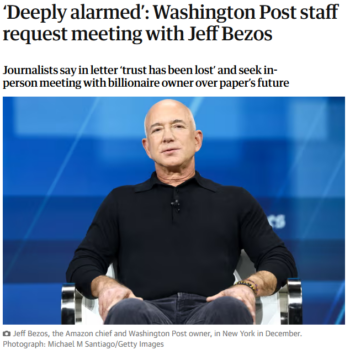
The Washington Post won’t say why it cancelled a six-figure ad buy calling for Elon Musk to be fired, but it’s likely the same reason the Post insisted Musk wasn’t Nazi-saluting on Inauguration Day, and why the paper killed its endorsement of Kamala Harris: because that’s what Jeff Bezos wants.
In addition to owning the Post, Bezos is the founder of Amazon and currently the world’s third-richest human. At best, the Post is a side-hustle for Bezos, while Amazon and his other business pursuits are what truly animate him. “With Jeff, it’s always only about business,” a former employee of Bezos’s space company, Blue Origin, told the Post (10/30/24). “That’s how he built Amazon. That’s how he runs all of his enterprises.”
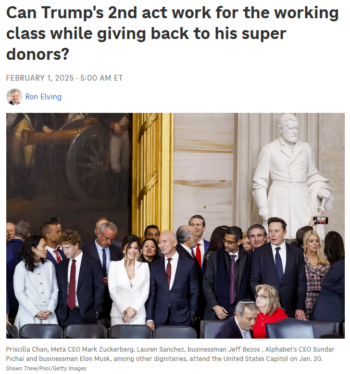
To ensure Trump II will be more amenable, Bezos has gone to lengths to grease the wheels, lavishing praise and millions of dollars on Trump and his family. He joined Musk and other tech billionaires in flanking Trump at his inauguration. (Bezos’s presence signaled “anything but independence for the Washington Post,” said Marty Baron, the paper’s former executive editor.)
Meanwhile, with Musk’s hand now on the public money spigot—thanks to Trump ceding much of the US government to him—Bezos is also busy doing favors for Musk (FAIR.org, 2/14/25), the richest person alive.
From a business perspective—the only perspective that really matters to Bezos—pissing the temperamental Musk off at a moment when he commands unprecedented power in the public and private spheres is a bad idea. So Bezos is being careful not to—as is his paper. Which brings us back to that rejected ad.
‘You can’t do the wrap’
The flipside of the Common Cause/SPLCAF ad.
The bright red ad was to wrap around the front and back pages of some print editions of the Post, including those going to subscribers on Capitol Hill, the Pentagon and the White House, ensuring top officials would lay eyes on it. Featuring a laughing Musk hovering over the White House, the ad asks, “Who’s running this country: Donald Trump or Elon Musk?”
But even though the groups had signed a $115,000 contract with the Post, the paper canceled the wrap at the 11th hour, even as it said it could run the inside ad, which hit on the same themes.
“They said, ‘You can have something inside the paper, but you can’t do the wrap,’” Common Cause president Virginia Kase Solomón told The Hill (2/16/25). “We said ‘Thanks, no thanks,’ because we had a lot of questions.”
Among them: Was the ad killed
because we’re critical of what’s happening with Elon Musk? Is it only OK to run things in the Post now that won’t anger the president, or won’t have him calling Jeff Bezos asking why this was allowed?
Kase Solomón asked the Post to explain its willingness to run the inside ad, but not the wrap. “They said they were not at liberty to give us a reason,” she told the New York Times (2/17/25).
Tellingly, in providing guidance to Common Cause on how to comply with the Post’s ad standards, Kase Solomón said the paper sent a sample ad paid for by a Big Oil group. “It was a ‘thank you Donald Trump’ piece of art,” Kase Solomón told The Hill.
The pulled ad directed readers to FireMusk.org, which states:
Musk, an unaccountable and unelected billionaire, is pushing to control public spending, dismantle the safety net and reshape our way of life to suit his interests. It’s clear what’s happening here: Musk and Trump aim to replace qualified civil servants with political allies whose loyalty lies solely with them.
‘Unacceptable business practices’
An ad from Ekō rejected by Facebook for “unacceptable business practices.”
The Post’s ad cancellation comes on the heels of Meta pulling an ad critical of Musk earlier this month. The yanked Facebook ad was purchased by the watchdog group Ekō, which had two other anti-Musk ads taken down by Meta—at least until the outlet Musk Watch made inquiries. The two other ads “were removed in error and have now been restored,” Meta told MuskWatch (2/18/25).
Meanwhile, Musk Watch noted, “Ads that were supportive of Musk and Trump were not impacted by similar errors.”
Still, one Ekō ad remains banished, with Meta citing “unacceptable business practices” as the reason.
That explanation makes a certain kind of sense. After all, alongside Bezos and Musk at Trump’s inauguration, was the world’s second richest person, Meta’s Mark Zuckerberg. And as Bezos’s Post has made clear, pissing off your fellow billionaires is indeed an unacceptable business practice.
Selling “freedom fries” at the Nebraska state fair in 2004 (Creative Commons photo: E Egan).
If you are younger than 30, you probably don’t remember there was a time in the United States when we were practically ordered to hate France. After the country’s oldest European ally voiced its opposition to the US-led push to invade Iraq (Guardian, 1/22/03; Brookings, 2/24/03), right-wing pundits called the French “surrender monkeys,” urging Americans to boycott French products (New York Post, 3/15/03; Guardian, 3/31/03).
At the same time, pro-war media urged a purge of the word “French” from our vocabulary, starting with renaming French fries to “freedom fries” (New York Times, 8/4/06; LA Times, 2/11/19; Washington Post, 2/11/19). We even got a new breakfast: freedom toast (CNN, 3/12/03). No federal language police were deployed to local communities, although the renaming did reach the House of Representatives cafeteria menu (Daily News, 2/12/19).
Revisionist maps
Google Maps adopts the Newspeak terminology for the Gulf of Mexico.
When President Donald Trump renamed the Gulf of Mexico as the Gulf of America via executive order (USA Today, 2/10/25), the days of “freedom fries” flashed back for many of us. Once again, the country’s woes were placed on another country; everything from drugs to economic anxiety could be blamed on our neighbor to the south, now run by a woman, left-wing, Jewish climate scientist (FAIR.org, 6/4/24). Like the neocons in the post-9/11 moment flexed their imperialist muscle against “old Europe” (RFE/RL, 1/24/03), renaming the gulf is another way for this revanchist and expansionist Republican administration to assert that the Monroe Doctrine is back in a big way, and the rest of the hemisphere had better get used to it.
Much like “freedom fries,” the whole “Gulf of America” show feels like the lunacy of a dictator who’s off his rocker, akin to the fictional Latin American president in the Woody Allen movie Bananas who declares that his country’s official language will now be Swedish. But sadly, it’s not funny.
Google Maps renamed it the “Gulf of America” for those reading from the US, and Google “appears to have deleted some negative reviews left in the wake of its name change” (BBC, 2/13/25). Apple made the same change to its maps service, although the move failed to gain trust from the White House, which still views the company with suspicion (New York Post, 2/13/25). Incidentally, oil companies like Trump’s move (Wall Street Journal, 2/15/25).
The capitulation of Apple and Google validates a widespread fear that it isn’t just Elon Musk who is doing Trump’s dirty work to undo democracy, but that the Big Tech community generally has lined up to stay in the good graces of executive power. Apple CEO Tim Cook and Google each donated $1 million to this year’s presidential inauguration (Axios, 1/3/25; CNBC, 1/9/25).
‘Smearing and penalizing’
AP (2/15/25): “The body of water in question has been called the Gulf of Mexico for hundreds of years.”
Contrast that with the AP, whose reporters have been barred from official White House briefings because the agency continues to call the body of water the Gulf of Mexico (AP, 2/15/25). In a statement (2/11/25), AP executive editor Julie Pace said:
It is alarming that the Trump administration would punish AP for its independent journalism. Limiting our access to the Oval Office based on the content of AP’s speech not only severely impedes the public’s access to independent news, it plainly violates the First Amendment.
Said Aaron Terr of the Foundation for Individual Rights and Expression (2/14/25), “When the government shuts out journalists explicitly because it dislikes their reporting or political views, that violates the First Amendment.” Committee to Protect Journalists CEO Jodie Ginsberg (2/14/25) agreed: “These actions follow a pattern of smearing and penalizing the press from the current administration and are unacceptable.”
That pattern includes the recent Federal Communications Commission investigations into NPR and PBS funding (All Things Considered,1/30/25), and into San Francisco’s KCBS for having “shared the live locations and vehicle descriptions of immigration officials” (KQED, 2/6/25).
Placenames have politics
The Ukraine War highlighted the political choices involved in naming places (USA Today, 4/13/22).
The critics of AP‘s banning couldn’t be more correct. As silly as the spat sounds, this is government authority using its muscle to dictate what media can and cannot stay, something people of all political stripes in the United States would normally find contrary to our constitutional ideals. If the president can compel media outlets not to call bodies of water what everyone else in the world calls them, then forcing them to assert that Greenland or the Panama Canal belong to the US isn’t so far fetched (All Things Considered, 2/17/25). Direct government force and official censorship, or the threat of it, are filters through which consent can be manufactured.
Generally, in journalism, the names of places and institutions carry a particular political connotation, and making a style choice for a media outlet can be difficult. Is that city in Northern Ireland called Derry, according to Irish Republicans, or Londonderry, as pro-British Loyalists have it (Irish Post, 7/24/15)? The choice to spell Ukraine’s capital either Kyiv or Kiev can tell the world which side of the war you’re more sympathetic toward (USA Today, 4/13/22).
During the Indonesian occupation of East Timor, it was common for US outlets to dateline reports from East Timor’s capital as “Dili, Indonesia” (Extra!, 11–12/93). This reflected Washington’s acceptance of Indonesia’s conquest; you would not have found US reports during Saddam Hussein’s occupation of Kuwait datelined “Kuwait City, Iraq.”
For some observers (China Media Project, 3/30/23), referring to China’s ruling party as the Chinese Communist Party indicates that you don’t like it (NBC News, 10/13/23). Those who prefer to call it the Communist Party of China suggest that the CCP choice indicates that you somehow view the party as global, inorganic and not distinctively Chinese.
These can be hard choices for a media outlet that wants to be both accurate and impartial, but the choice to avoid indulging in Trump’s idiocy is simple. There has never been a “Gulf of America” movement, or a general belief in the US that the Gulf of Mexico was somehow misnamed, until this order came out of the blue. What the Trump administration has done has created a fake controversy in order to bully the media, and the public, to go along with what it says, no matter how strange, giving the executive branch the opportunity to censor those who do not comply.
Sympathy for the White House
The New York Post (2/12/25) declares AP a “left-wing organization, staffed by left-wing employees, and intent on pushing left-wing narratives.”
The only way a democratic society can keep from falling into authoritarianism is if people refuse to comply, even with the little things. Google and Apple have already failed that test. Others in the corporate media are also failing, by not standing up for AP. David Brooks, a conservative columnist at the New York Times, appeared on Fox News (2/16/25) to sympathize with the White House, dismissing the affair as the usual antagonistic attitude the White House has with the press.
Isaac Schorr of the New York Post (2/12/25) called the AP’s response “snooty,” saying the wire service has its own language problem, citing its choice to abandon the phrase “late-term abortion.” Schorr is free to take issue with that, but there’s a difference: The AP made that decision on its own, not because the government specifically threatened it unless it made such a change.
The Atlantic (2/15/25), while admitting that “denying access to a media outlet because of its choice of words violates the First Amendment,” said this is a “fight that the AP probably should never have picked in the first place,” indicating that the media should simply give up when it comes to an autocrat’s insane demands. In fact, the centrist Atlantic seemed to be in tune with the tribune of American conservatism, the National Review (2/14/25), which admitted that Trump was being “silly and Big Brother-ish,” but that “AP journalists suffer from an obnoxious entitlement mentality.”
As the Washington Post’s Erik Wemple reported (2/14/25):
How outraged is the White House press corps regarding this naked violation of the First Amendment? Not sufficiently: In her press briefing Wednesday, Leavitt faced questions from only one reporter—CNN’s Kaitlan Collins—about the matter. As Leavitt recited her position, she might as well have been stomping on a copy of the Bill of Rights under the lectern: “If we feel that there are lies being pushed by outlets in this room, we are going to hold those lies accountable. And it is a fact that the body of water off the coast of Louisiana is called the ‘Gulf of America,’” Leavitt said, noting that major tech firms have acknowledged the change.
AP continues to stand firm on this issue, and that’s a positive sign, but the rest of the media class should be standing united with the wire service. It’s easy for media outlets (some, anyway) to editorialize about the horrorshow of this administration. But they need to stand up to the administration, and refuse to comply with attempts to silence outlets or dictate how they should report.
AP (2/4/25) concludes with Elon Musk describing his government takeover as a card game: “If we don’t take advantage of this best hand of cards, it’s never going to happen.”
Associated Press (2/4/25) evidently needed the work of ten reporters to produce “Elon Musk Tightens Grip on Federal Government as Democrats Raise Alarms.”
At first blush, the story might seem to convey concern, but look closer: We see Musk matter-of-factly described as a “special government employee, which subjects him to less stringent rules on ethics and financial disclosures than other workers.”
He’s also described as “in charge of retooling the federal government.” Is that a thing? AP suggests we believe that it is.
The debate, AP tells us, is just between Republicans who “defend Musk as simply carrying out Trump’s slash-and-burn campaign promises,” and Democrats who, “for their part, accused Musk of leading a coup from within the government by amassing unaccountable and illegal power.” Tomato, to-mah-to, you understand.
Musk locking federal workers out of internal systems, denying them access to their own personnel files, with their pay history, length of service and qualifications: Why, that’s just “Musk’s penchant for dabbling.” He’s been “tinkering with things his entire life,” the wire service says. He learned to code as a child in South Africa, you see, and “now Musk is popping open the hood on the federal government like it’s one of his cars or rockets.”
Popping open the hood of democratic processes to tinker with them? If you rely on reporting from nominally neutral outlets like Associated Press, you might imagine that’s only a concern of partisan Democrats, not regular folks like you and me.
You can send a message to Associated Presshere (or via Bluesky@APnews.com).
Adam Johnson (Column, 2/3/25): “The New York Times, Washington Post and CNN ran with the framing that ‘DOGE’ was some good-faith, post-ideological effort to ‘cut costs,’ ‘find savings’ and ‘increase efficiencies.’”
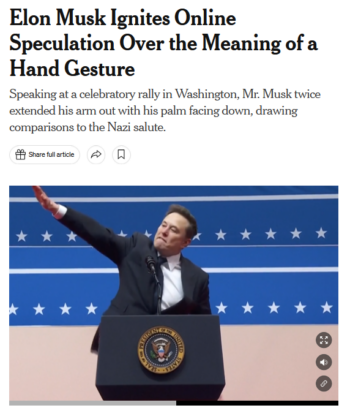
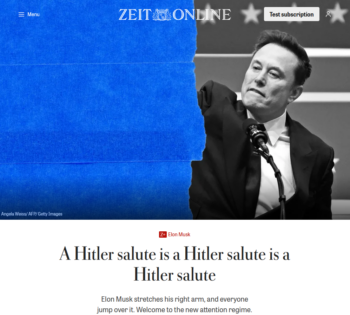
Having spent nearly $300 million to purchase the US presidency for Donald Trump, Elon Musk now feels entitled to do with it as he pleases. Just how radically Musk plans to remake the country was conveyed to the American people only after the election, when Musk stood behind the presidential seal on Inauguration Day and gave a Nazi salute. Then did it again. Maybe that sort of thing was OK to do in apartheid South Africa, where Musk grew up, but it’s jarring to see here in the United States.
Reporters initially struggled to meet the moment (FAIR.org, 2/4/25), downplaying Musk’s salute (the Washington Post described a “high-energy speech“), as well as his broader agenda, which Musk now openly declares a “revolution,” and consists of an unelected billionaire wresting control of nearly the entire executive branch of government. Early media reports went along with Musk’s “efficiency” mantra (Column, 2/3/25), but more recently reporters have started to find their footing, and the dangers of Musk’s project are being conveyed. Sort of.
“Reporters on the battlefield are doing what they can” to expose the radical nature of Trump’s second term, writes media columnist Oliver Darcy (Status, 2/5/25). “The news generals back in the command center, however, are largely abdicating their duties.”
‘Musk’s audacious goal’
Nowhere is this discrepancy more apparent than at the Washington Post, a newspaper famed for opposing a prior Republican president with an expansive view of executive power. These days, however, even as Post reporters like Jeff Stein are busy breaking stories (e.g., 1/28/25, 2/8/25) about the Trump power grab, the paper’s higher-ups are careful not to offend the president or Musk. The Post is even, incredibly, calling on the Constitution-defying billionaire duo to push further.
As Elon Musk seizes extraconstitutional control of the federal budget, Washington Post editors (2/7/25) urge him to use that power to go after Social Security and Medicare.
“To have any chance of achieving Musk’s audacious goal of $2 trillion in cuts,” the Post editorial board (2/7/25) wrote, “Trump will need to work with elected representatives in Congress to reform entitlement programs such as Social Security and Medicare before they become insolvent.”
While claiming it wants Trump to “erect guardrails” for Musk, the Post urges the president to abandon one of the only guardrails he established—the cutting of Social Security and Medicare, which Trump repeatedly said he wouldn’t do, but recently started waffling on.
To be clear, the Post has long called for cutting so-called entitlements (FAIR.org, 11/1/11, 6/15/23). But to do so at this moment—by encouraging a coup attempt to push further—is quite extraordinary.
The Post’s move comes as its billionaire owner, Amazon founder Jeff Bezos, is lavishing praise and millions of dollars on Trump and his family, while coaching his paper to take a less critical approach in its coverage (FAIR.org, 1/22/25). Bezos’s ingratiation toward Trump started prior to the election, when Bezos personally spiked the Post’s endorsement of Kamala Harris (FAIR.org, 10/30/24).
Good news for X from Amazon
The Washington Post (2/4/25) reports on “divergent views among Jewish leaders in how to respond to Musk”: Some object to his ” Nazi-esque salute and Holocaust jokes,” others appreciate his censorship of criticism of Israel.
Bezos has also been busy making nice with Musk, his longtime rival for most powerful man on Earth and in space. On both fronts, Musk now has a decided edge, aided by his control over much of the US government, which both men’s sprawling empires rely on for billions of dollars in contracts.
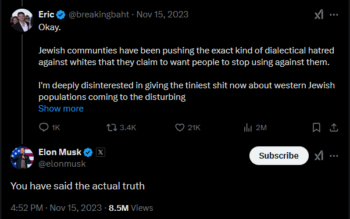
With Musk’s hand on the public-money spigot, Bezos apparently did him a favor. After Musk openly heiled Hitler, Jewish leaders renewed calls to boycott Musk’s social media platform, X (Washington Post, 2/4/25). “To advertisers—including Google, Amazon and the ADL: Pull your ads now,” the Jewish leaders wrote. “The pressure is working. X’s financial difficulties prove it.”
But the boycott’s pressure was countered by Bezos’s company. “[X] got good news last week, with Amazon reportedly planning to hike its advertising on the site,” the Post (2/4/25) reported, without mentioning Bezos.
While X’s finances “were once so bad that Musk floated the idea of filing for bankruptcy,” things are suddenly looking up, the Financial Times (2/12/25) reported:
Musk famously admitted to overpaying for Twitter after he bought the social media platform known now as X for $44 billion in 2022. But the billionaire’s foray into government has coincided with a turnaround in X’s fortunes, as advertisers, including Amazon, flock back to the platform.
‘Lemmings leaping in unison’
Kathleen Parker (Washington Post, 1/24/25) likened those who condemned Musk’s Nazi gesture to “lemmings leaping in unison from a cliff”—because it’s suicidal to notice fascism in high places?
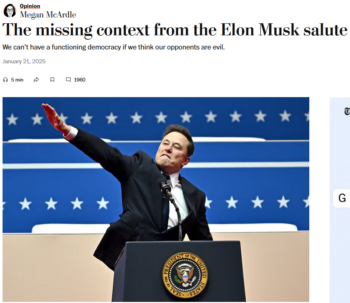
It wasn’t just Bezos’s company that threw Musk a lifeline, but also his newspaper. An initial Post headline (1/20/25), which omitted mention of Musk’s Nazi salute, read “Elon Musk Gives Exuberant Speech at Inauguration.” The following day, Post columnist Megan McArdle, echoing the ADL, downgraded Musk’s salute to an “awkward gesture,” the same phrase Post columnist Kathleen Parker used to dismiss those who saw something more sinister as “lemmings leaping in unison from a cliff” (Washington Post, 1/24/25).
Interestingly, one of the most vociferous “lemmings” was Post columnist Catherine Rampell, who brilliantly called out Musk’s Nazi salute, but on CNN, and noticeably not in the Post, except once in passing (1/30/25).
Musk responded to Rampell’s CNN appearance by threatening to sue her in a post (1/27/25) to his over 200 million X followers.
I noted at the top that Musk spent nearly $300 million to elect Trump, but that’s only part of the story. Musk also provided inestimable support by transforming X into a pro-Trump bullhorn. Personally, when I logged onto X during the campaign, I routinely saw Musk’s pro-Trump tweets at the top of my feed, even though I didn’t follow Musk at the time.
Since the election, Musk ’s gifts to Trump have continued. X recently agreed to pay Trump $10 million to settle Trump’s 2021 lawsuit against the company, even though the case was dismissed in 2022. Trump was still appealing the ruling two-and-a-half years later when a deal was cut. “The settlement talks with X began after the election and were more informal, with both Trump and Musk personally involved in hammering out the $10 million number,” the Wall Street Journal (2/13/25) reported.
‘Cheering for change’
New York Times (2/11/25): Many of the federal agencies targeted by Musk “were leading investigations, enforcement matters or lawsuits pending against Mr. Musk’s companies.”
It’s quite something for Elon Musk—the world’s richest human and one of the largest government contractors—to gleefully slash public spending benefiting others. Especially when, by one measure, “virtually all of his net worth can be pinned to government help,” CNN (11/20/24) reported.
While Musk claims to wield a populist’s pitchfork as he attacks “the bureaucracy,” a closer look reveals the work of an oligarch’s scalpel. Musk’s coup team—called DOGE, and consisting mostly of twentysomething male engineers, several of whom appear to share Musk’s racist ideology (New York Times, 2/7/25)—is targeting the federal agencies investigating Musk’s companies, which in addition to X, include Tesla and SpaceX.
“President Trump has been in office less than a month, and Elon Musk’s vast business empire is already benefiting—or is now in a decidedly better position to benefit,” read the opening lines of a New York Times story (2/11/25):
At least 11 federal agencies that have been affected by [Trump’s] moves have more than 32 continuing investigations, pending complaints or enforcement actions into Mr. Musk’s six companies.
While Trump claims Musk is “not gaining anything” from the arrangement, and Musk says the same, Wall Street sees things differently. Even as Musk says he’s turning his “efficiency” revolution to the Pentagon—the only federal agency never to pass an audit, and where any honest attempt to rein in government spending would begin—stocks for armsmaking companies associated with Musk are surging, while those without ties to him languish. “Palantir, as well as Musk’s SpaceX, OpenAI and robotics and AI specialist Anduril Industries, are cheering for change,” the Wall Street Journal (2/10/25) reported.
In other words, having seized control of the levers of government, an oligarch will now be directing funding to himself and his cronies. That’s Wall Street’s view, anyhow.
It seems to be Bezos’s as well. With Amazon and Blue Origin, Bezos’s space company, competing for billions in government contracts, it makes perfect business sense for Bezos to cozy up to Musk and Trump. From a journalistic perspective, however, it’s nothing short of a disaster, one that’s playing out daily in the pages of the WashingtonPost.
Three Israeli men held by Hamas in the Gaza Strip were freed on Saturday, February 8, in exchange for 183 Palestinian prisoners held by Israel. It was the latest round of captive releases stipulated by the January ceasefire deal that ostensibly paused Israel’s genocide in Gaza, launched in October 2023, the official Palestinian death toll of which has now reached nearly 62,000—although the true number of fatalities is likely quite a bit higher (FAIR.org, 2/5/25).
In all, 25 Israeli captives and the bodies of eight others were slated to be released over a six-week period, in exchange for more than 1,900 Palestinians imprisoned in Israel—the disproportionate ratio a reflection both of the vastly greater number of captives held by Israel and the superior value consistently assigned to Israeli life.
Hamas halted releases on Monday on account of Israel’s violations of the ceasefire agreement, with Reuters (2/10/25) oh-so-diplomatically noting that the “ceasefire…has largely held since it began on January 19, although there have been some incidents in which Palestinians have been killed by Israeli forces.”
But Saturday’s exchange offered a revealing view of the outsized role US corporate media play in the general dehumanization of the Palestinian people—an approach that conveniently coincides with the Middle East policy of the United States, which is predicated on the obsessive funneling of hundreds of billions of dollars in assistance and weaponry to Israel’s genocidal army. And now that President Donald Trump has decided that the US can take over Gaza by simply expelling its inhabitants, well, dehumanizing them may serve an even handier purpose.
Granted, it’s a lot easier for a news report to tell the individual stories of three people than to tell the stories of 183. But the relentless empathetic media attention to the three Israeli men—who, mind you, are not the ones currently facing a genocide—deliberately leaves little to no room for Palestinian victims of an Israeli carceral system that has for decades been characterized by illegal arbitrary detention, torture and in-custody death.
So it is that we learn the names and ages of the three Israelis, the names of their family members, and empathy-inducing details of their captivity and physical appearance, while the 183 Palestinians remain at best a side note, and at worst a largely faceless mass of newly freed terrorists.
‘Like Holocaust survivors’
Deep into this story, the New York Times (2/8/25) admits that many released Palestinian prisoners were also “in visibly poor condition”—but it doesn’t explain that both the Israeli and Palestinian prisoners were emaciated for the same reason: because Israel had deliberately deprived them of food.
Take, for example, the Saturday New York Times intervention (2/8/25) headlined “Hamas Makes Gaunt Israeli Hostages Thank Captors Before Release,” which recounts the plight of the “three frail, painfully thin hostages” who elicited the following comparison from Israeli foreign minister Gideon Saar: “The Israeli hostages look like Holocaust survivors.”
When we finally get around to the Palestinian prisoners, we are immediately informed that “at least some were convicted of involvement in deadly attacks against Israelis, who view them as terrorists.” Needless to say, such media outlets can rarely be bothered to profile Palestinian prisoners with less sensational biographies—like all the folks arbitrarily swept up in raids and never charged with a crime.
The article does acknowledge, more than 20 paragraphs later, that “many of the released Palestinian prisoners were in visibly poor condition,” too—albeit not meriting a comparison to Holocaust survivors—and that “Palestinian prisoners have recounted serious allegations of abuse in Israeli jails.” It also mentions that “Israeli forces raided the West Bank family homes of at least four of [the] men before their release, warning their relatives not to celebrate their freedom”—evidence, according to the Times, that Israel has simply been “particularly assertive in suppressing celebrations for detainees.”
And yet all of this “assertiveness” is implicitly justified when we are supplied with the biographical details of a handful of released detainees, who unlike the three Israelis are categorically ineligible for pure and unadulterated victimhood, consisting instead of the likes of 50-year-old Iyad Abu Shkhaydem, who “had been serving 18 life sentences, in part for planning the 2004 bombings of two buses in Beersheba, in central Israel, that killed 16 people.”
Of course, the corporate media are more interested in obscuring rather than supplying context, which is why we never find the New York Times and its ilk dwelling too critically on the possibility that Palestinian violence might be driven by, you know, Israel’s usurpation of Palestinian land, coupled with systematic ethnic cleansing and regular bouts of mass slaughter.
In the media’s view, the Hamas-led October 7, 2023, attacks that killed some 1,200 Israelis and saw more than 250 taken captive was just about the most savage, brutal thing to have ever happened. Never mind Israel’s behavior for the past 77 years, which includes killing nearly 8,000 Palestinians in the Gaza Strip from September 2000 through September 2023, according to the Israeli human rights group B’Tselem.
But that’s what happens when one side is appointed as human and the other is not—and when the US media takes its cues from a genocidal state whose officials refer to Palestinians as “human animals.”
‘Shocked Israelis’
This New York Times story (2/9/25) is not matched by one in which Palestinian captives “Give Glimpses of Ordeal”—but then, the Times doesn’t have a correspondent who’s married to a Palestinian PR agent, or who has a son who’s a fighter for Hamas.
On Sunday, the New York Times ran another article (2/9/25) on the “torment” the Israeli hostages had endured. Times Jerusalem correspondent Isabel Kershner managed to find space in it to discuss the “bright magenta track suit” worn by a female Israeli hostage released last month, but not much space to talk about Palestinians, aside from specifying that “some” of the prisoners slated for release were “convicted of killing Israelis.” (Kershner, it bears recalling, was called out by FAIR back in 2012 for utilizing her Times post to provide a platform for her husband’s Zionist propaganda outfit. In 2014, it was revealed that her son was in the Israeli military.)
While Kershner described the three Israelis released on Saturday as being in “emaciated condition,” many other media outlets opted for “gaunt.” Reuters (2/8/25) announced that the “gaunt appearance” of the three hostages had “shocked Israelis”—and reminded its audience that “some” of the 183 released Palestinians were “convicted of involvement in attacks that killed dozens of people.”
NBC News (2/9/25) also went with “gaunt,” as did CNN (2/9/25). But aside from common vocabulary, a recurring theme throughout media coverage of the prisoner exchanges is the sheer humanity infused into the Israeli characters: their suffering, their weepy reunions with their families, their heart-rending discoveries that certain loved ones have not survived. This same humanity is blatantly denied to Palestinians; after all, emotionally conditioning audiences to empathize with Israel’s enemies would run counter to US machinations abroad and the Orientalist media traditions that help sustain them.
Again, many of the media reports do acknowledge that quite a few released Palestinians were looking worse for the wear, had difficulty walking, or had to be transferred to hospital. But such information is not presented as “shocking” to anyone—perhaps because maltreatment and abuse of Palestinian prisoners is business as usual in Israel.
Conspicuously, the continuous invocation of the factoid that “some” released Palestinians had been convicted of killing Israelis is never accompanied by the corresponding note that “some” of the released Israelis happen to be active-duty soldiers in an army whose fundamental purpose is to kill and displace Palestinians. When individual hostages’ army service is mentioned, it is done so in a positive light—as in Kershner’s recounting the uplifting aftermath of the January 25 release of 20-year-old soldier Daniella Gilboa: “Days later, she was singing at a party marking the discharge of the army lookouts from Beilinson Hospital near Tel Aviv.”
Weaponization of empathy
CNN‘s article (2/9/25) acknowledged that Israel “intentionally reduc[ed] food servings to Palestinian prisoners in what’s been described as the minimum required for survival”—but there’s no headline about “gaunt” Palestinian captives.
To be sure, the media’s effective weaponization of empathy is crucial given that Palestinians are killed by Israelis at an astronomically higher rate than Israelis are killed by Palestinians. Any objective comparison of fatalities or consideration of history unequivocally establishes Palestinians as victims of Israeli aggression—hence the need for the US politico-media establishment’s re-education campaign.
Meanwhile, speaking of “humanity,” a Telegraph article (2/8/25) published on the Yahoo! News website quoted Israeli President Isaac Herzog as detecting a “crime against humanity” in the appearance of the three men released on Saturday, who had returned from captivity “starved, emaciated and pained.” This from a leader of a country that has just bombed an entire territory and a whole lot of its people to bits, while also utilizing starvation as a weapon of war. Starvation is furthermore par for the course in Israeli prisons; as even CNN (2/9/25) observed in one its articles on Saturday’s “pale, gaunt Israeli hostages”:
The Israeli prison system has come under fire for intentionally reducing food servings to Palestinian prisoners in what’s been described as the minimum required for survival, on the orders of then National Security Minister Itamar Ben Gvir last year.
It brings back memories of that time in 2006 that Dov Weisglass, an adviser to the Israeli government, offered the following rationale for restricting food imports into Gaza: “The idea is to put the Palestinians on a diet, but not to make them die of hunger.”
In November 2023, the Associated Pressreported that a 78-year-old female hostage released by Hamas had “said in an interview that she was initially fed well in captivity until conditions worsened and people became hungry.” In this case, the AP semi-connected the dots: “Israel has maintained a tight siege on Gaza since the war erupted, leading to shortages of food, fuel and other basic items.”
In other words, there’s no one but the Israeli government to thank for those shockingly “gaunt” faces—the Israeli ones in headlines and the Palestinians relegated to the bottom of stories. And with Israel gearing up to renew its genocidal onslaught with fanatical US encouragement, there are no doubt plenty of crimes against humanity yet to come.
This week on CounterSpin: A number of federal agencies rushed to make clear they would be scrubbing activities and events that “celebrate cultural awareness” in an effort to stay on the good side of the weird new White House. Trump and his abettors’ anti-anti-discrimination agenda is as subtle as a sledgehammer. “DEI hire,” for instance, is super-complicated code for the idea that if a person who isn’t white, cis and male got a job, that can only mean a better qualified white cis man was unfairly denied it. That’s just, Trump says, “common sense.”
The irony is not lost that history itself is seen as being manipulated for political purpose when it comes to Black History Month—because we know that history is constantly invoked, if implicitly, as a way of justifying present-day unfairness. White supremacy can be presented as natural if white people invented everything, discovered everything, created all the wealth, and defined civilization. That lies back of many public and media conversations…so just saying Charles Drew invented blood banks is disruptive! What if Black people aren’t subhuman?
What people try to silence tells us what they fear. So what is so scary about everyone, not just Black people, acknowledging the particular circumstances and responses to those circumstances of Black people in these United States—our experience, challenges, accomplishments? Is it that history—real history, and not comforting tall tales—connects the past with the present in ways that are powerful, grounding and inspiring?
In March 2021, a hitherto no-name right-wing activist openly declared an intention to mislead around racism and to vilify any questioning of enduring racial inequities: “The goal,” wrote Manhattan Institute’s Christopher Rufo, “is to have the public read something crazy in the newspaper and immediately think ‘critical race theory.’” He bragged that he had “successfully frozen” the “brand” of critical race theory, and was “steadily driving up negative perceptions. We will eventually turn it toxic as we put all of the various cultural insanities under that brand category.”
A self-respecting press corps would have taken that as a shot across the bow. The corporate news media we have dutifully signed on to present a campaign openly defined as uninterested in truth or humanity and concerned only with rolling back the clock on racial equity as a totally valid, “grassroots” perspective, deserving respectful inclusion in national conversation.
That was a jumping-off point for our conversation with law professor Luke Charles Harris, co-founder with Kimberle Crenshaw of the African American Policy Forum. We’ll hear that important conversation again this week.
Plus Janine Jackson takes a quick look back at recent press coverage of Venezuela, Elon Musk and ICE.
This post was originally published on CounterSpin.
The murder of UnitedHealth Group executive Brian Thompson, and the subsequent arrest of Luigi Mangione, focused media and policymakers’ attention on the savage practices of private US health insurance. In the immediate aftermath, major media outlets scolded social media posters for mocking Thompson with sarcastic posts, such as “I’m sorry, prior authorization is required for thoughts and prayers.”
As public fury failed to subside, it began to dawn on at least some media organizations that the response to Thompson’s murder might possibly reflect deep, widespread anger at a healthcare system that collects twice as much money as those in other wealthy countries, makes it difficult for half the adult population to afford healthcare even when they’re supposedly “insured,” and maims, murders and bankrupts millions of people by denying payment when they actually try to use their alleged benefits. As Rep. Ro Khanna (D.–Calif.) said to ABC News (12/8/24), “There is no justification for violence, but the outpouring afterwards has not surprised me.”
Any reporter, editor or pundit who writes regularly about healthcare and professes to be mystified or outraged by the public reaction to Thompson’s murder should take a deep look at their own assumptions, sources and professional behavior.
FAIR reviewed coverage of healthcare in the presidential election by the New York Times, Wall Street Journal and Washington Post, as well as KFF Health News (KHN), the leading outlet specializing in the healthcare issue, whose reporting is often picked up by corporate media. The coverage by these outlets amounts to little more than sophisticated public relations for this corporate healthcare killing machine and, especially, the Republican and Democratic politicians who created and nurture it.
The coverage was marred by many of the media failings FAIR has exposed since its inception. These outlets:
took false major-party “facts” at face value and published candidates’ platitudes without challenging their substance;
anointed former President Donald Trump and Vice President Kamala Harris as the only legitimate horses in the race, blacking out the content of third-party candidate proposals like “Medicare for All”; and
added insult to injury by legitimizing their own failed coverage with analysis asking why there were no major healthcare reform proposals to cover.
Tsunami of fake good news
In March 2024, I reported (Healing and Stealing, 3/23/24) that Democrats were preparing to unleash a “tsunami of fake good news” about healthcare and the Affordable Care Act to try to influence media coverage of the campaign.
Major media fell for it hook, line and sinker. No campaign tactic and media failure did more to lengthen the distance between a public brutalized by a failing healthcare system and an out-of-touch corporate media.
President Joe Biden (until he dropped out) and Harris spun a narrative of “progress” under the Affordable Care Act to attract voters. The progress narrative relied on two new healthcare policy “records”: a record-low uninsurance rate and record-high Obamacare enrollment.
In a story on why “big, prominent plans for health reform are nowhere to be seen,” the New York Times’Margot Sanger-Katz (9/13/24) explained that the “overall state of the health system” is different than in 2019 for several reasons, including that the “uninsured rate is near a record low.”
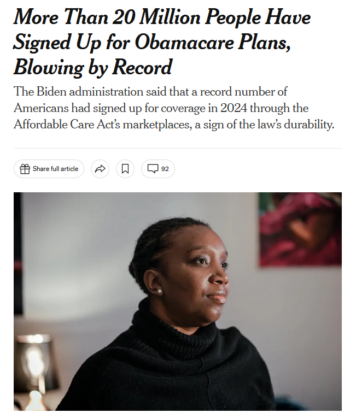
The New York Times (1/10/24) reported that signups for the ACA set a “record”—but not that this was less than the number of people who had been kicked off Medicaid.
Before Congress passed the ACA in 2010, the uninsured rate had been in double digits for decades. The rate fell steadily under Barack Obama but reversed under President Donald Trump, only to come down again under President Joe Biden.
Meanwhile, insurance plans sold on the Affordable Care Act exchanges reached a record enrollment of 21 million in early 2024, or, as the Times’ Noah Weiland (1/10/24) put it, “blowing by the previous record and elevating the health and political costs of a repeal.”
The two “facts” are both distorted and largely irrelevant to people’s actual experience of the healthcare system. As Galewitz acknowledged, because of survey lags, the uninsurance data don’t reflect the 2023–24 disenrollment of some 25 million from Medicaid, the joint federal/state insurance program for low-income Americans, which had been temporarily expanded under Covid.
But the Medicaid disenrollment is reflected in the record signups to Obamacare, where some of those who lost Medicaid coverage fled in 2024. Yet according to KHN, 6 million of the 25 million people who lost Medicaid coverage became uninsured. Most of them haven’t yet been captured in uninsured data, allowing the Democrats to have their cake and eat it too.
The fact that the uninsured data likely understate uninsurance by as much as 6 million people escaped most political coverage—the Washington Post’s Dan Diamond (9/11/24), for example, added no caveats when reporting that the Biden administration
had released data showing that nearly 50 million Americans have obtained health coverage through the Affordable Care Act’s health insurance exchanges since they were established more than a decade ago, helping lower the national uninsured rate to record lows in recent years.
The Times‘ Sanger-Katz (9/13/24) likewise failed to mention it.
Private insurance ≠ healthcare
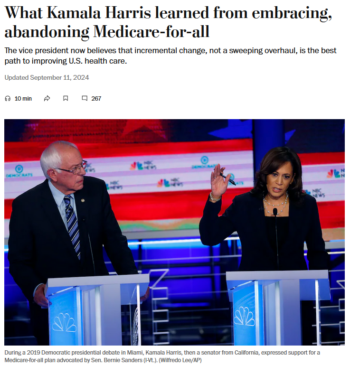
The lesson Kamala Harris learned, according to the Washington Post (9/11/24), is that “incremental change, not a sweeping overhaul, is the best path to improving US healthcare.”
Far more importantly, the rate of uninsurance no longer measures whether or not people have adequate healthcare, or are protected from financial ruin if they get sick or injured. Data show that people who supposedly have insurance can’t get healthcare, rendering the raw uninsurance rate a relatively meaningless measure of the burden of the crisis-stricken US healthcare system.
National surveys by the Commonwealth Fund every two years include one of the few comprehensive attempts to measure underinsurance, and the impact of medical costs on people nominally “covered.” In 2022, Commonwealth found that 46% of adults aged 19–64 skipped needed medical treatment due to out-of-pocket costs. That number included 44% of adults buying insurance through ACA exchanges or the individual insurance market—even with the much-hyped expanded premium subsidies in place.
Commonwealth didn’t release its 2024 surveys until November 21, well after Election Day. During the last two years of the Biden/Harris administration, the percentage of working age adults skipping medical care due to costs increased from 46% to 48%, no matter the source of coverage (Healing and Stealing, 11/21/24).
When people with private insurance do attempt to get healthcare, their insurers often refuse to pay for care. The slain Brian Thompson was CEO of UnitedHealth Group’s insurance subsidiary. According to an analysis of federal data by ValuePenguin (5/15/24), a consumer website run by online lender LendingTree, UnitedHealthcare denied 32% of claims submitted to its ACA and individual market plans in 2022, the highest rate in the industry.
Corporate media political reporters usually delivered the misleading progress narrative “facts” without reference to this critical context. The Washington Post’s Dan Diamond (9/11/24), explaining that Harris learned “the importance of incremental progress” as vice president after retreating from support for Medicare for All, noted the administration’s achievement of “record levels of health coverage through the Affordable Care Act,” with no reference to the Medicaid purge or underinsurance.
Substance-free coverage of a substance-free campaign
New York Times (9/13/24): “After years of crises and emergencies, no part of the system is currently ablaze.”
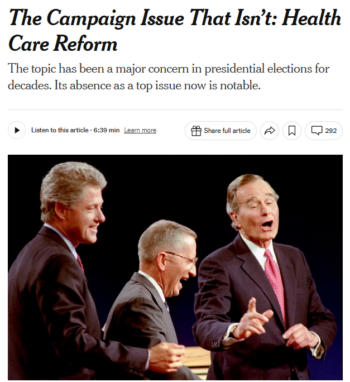
The NewYork Times’ Margot Sanger-Katz wrote in “The Campaign Issue That Isn’t: Healthcare Reform” (9/13/24):
As you may have noticed, with less than two months until Election Day, big, prominent plans for health reform are nowhere to be seen. Even in an election that has been fairly light on policy proposals, healthcare’s absence is notable.
It’s true that neither Harris nor Trump offered any concrete proposals for improving US healthcare. Harris campaigned on “strengthening” the ACA, but her only specific “improvement” was a promise to support keeping the expanded subsidies that help people pay their ACA health insurance premiums—passed in the first year of Biden’s term—from expiring as scheduled next year. In other words, “strengthen” the ACA by maintaining its dismal status quo.
As for Trump, the Times’ Weiland (8/12/24) reported that the authors of Project 2025, the consensus right-wing NGO blueprint published by the Heritage Foundation, “were not calling for a repeal of the Affordable Care Act.” At the debate, Trump said he wouldn’t repeal unless he had a better plan, and drew mockery for saying he had “concepts of a plan.”
Ultimately, mass deportation was his primary healthcare policy (Healing and Stealing, 10/16/24, 9/10/24); the RNC Platform maintained that undocumented immigrants were the cause of high healthcare costs. (It’s nonsense. Undocumented taxpayers actually paid more in taxes that were earmarked specifically for healthcare in 2022 than the estimated total cost of healthcare for all undocumented immigrants in the US.)
What you see depends on where you look
One reason Sanger-Katz and colleagues had a hard time finding “big” plans for healthcare is that she and her colleagues chose to look for them only in the two major parties’ platforms.
Whether Eugene Debs campaigning for Social Security from prison in 1920, Henry Wallace fighting for desegregation after walking out of the 1948 Democratic convention, or Cynthia McKinney proposing an end to the Afghan War in 2008, third-party candidates have a long track record of promoting policies dismissed as unrealistic ideological fantasies that later become consensus policy. Yet corporate media outlets repeat the same failure to pay attention every four years (FAIR.org, 10/23/08).
Green Party candidate Jill Stein, the only medical doctor in the race, supported Medicare for All as a
precursor to establishing a British-style National Healthcare Service which will replace private hospitals, private medical practice and private medical insurance with a publicly owned, democratically controlled healthcare service that will guarantee healthcare as a human right to everyone in the United States.
Stein placed special emphasis on taking “the pharmaceutical industry into public ownership and democratic control.”
Justice for All Party candidate Cornel West’s Health Justice agenda also envisioned a system “Beyond Medicare for All,” including “nationalization of healthcare industries.”
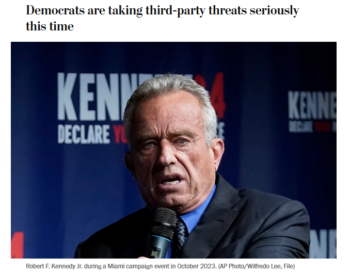
Prior to suspending his campaign and endorsing Trump, Robert F. Kennedy Jr. told Jacobin (6/9/23) he would keep private insurance for those who want it, but also have a public program “available to everybody.” Although he used the phrase “single-payer,” Kennedy described a program most similar to a voluntary “public option,” an untested idea whose ultimate impact on the breadth, depth and cost of coverage remains speculative.
Outside the world inhabited by elite media, Medicare for All is a fiscally modest proposal that receives consistent support among large segments of the US population, reaching majorities depending on the wording of poll questions (KFF, 10/26/20). In 2022, the Congressional Budget Office (2/22) estimated that a single-payer system with no out-of-pocket costs for doctor visits or hospital care, minimal copays for prescription drugs, and doctor and hospital prices at the current average would cover everyone for all medical conditions—including services that are almost never fully covered, like vision, dental and hearing—and still lower expected total national health expenditures by about a half a percent.
Even with candidates in the race proposing even broader expansion of the public role in healthcare, through nationalizing hospitals and drug manufacturing, Medicare for All remains beyond the boundary of acceptable corporate media debate. This has been true for 30 years, when FAIR (Extra!, 1–2/94) reported on media coverage of the failed Clinton administration healthcare reform effort.
Just one election cycle back, during the Democratic primaries, multiple candidates—led by Vermont Sen. Bernie Sanders, but also including Kamala Harris—supported Medicare for All, and media were forced to cover it, generally with considerable hostility (FAIR.org, 3/20/19, 4/29/19, 10/2/19). But with Harris backing away from it entirely, media found themselves returning to a place of comfortably ignoring the popular proposal.
Missing Medicare for All
Leading papers covered third parties as potential spoilers, but not as potential sources of new ideas (Washington Post, 3/14/24).
FAIR searched the Nexis, ProQuest and Dow Jones databases, and the websites of the New York Times, Washington Post, Wall Street Journal and KFF Health News, for election or healthcare policy stories and podcasts mentioning different iterations of “Medicare for All,” “single-payer” and “universal healthcare,” between January 1 and Election Day 2024. We found 89 news and 107 opinion pieces.
Ninety percent of the news articles came after Biden dropped out of the race. The coverage overwhelmingly focused on Harris’s reversal of her brief support for Medicare for All in 2019, with 96% of these stories mentioning her shift.
The ubiquitous Republican claim that Harris sought to give undocumented people free Medicare was based on the obviously false premise that Harris had not abandoned support for Medicare for All. Asked in 2019 whether her support for universal health insurance would include eligibility for undocumented immigrants, she said yes (New York Times, 10/30/24). Since that time, Harris has repudiated Medicare for All, and no Democrat has advocated enrolling the 11 million undocumented immigrants in Medicare, let alone for “free.”
KHN (8/1/24) and the New York Times (10/30/24) corrected this GOP distortion, but all four outlets left readers hard-pressed to learn any other details of Medicare for All, or other meaningful alternatives to the status quo, especially not any proposed by other candidates.
All four outlets wrote frequently about whether third-party candidates might siphon votes from Trump or Harris (e.g., Wall Street Journal, 11/10/23; Washington Post, 3/14/24; New York Times, 10/14/24). However, they blacked out the content of those parties’ healthcare policy positions, leaving readers with no information to help them decide if voting for a candidate other than Trump or Harris might benefit them.
Voters in the dark
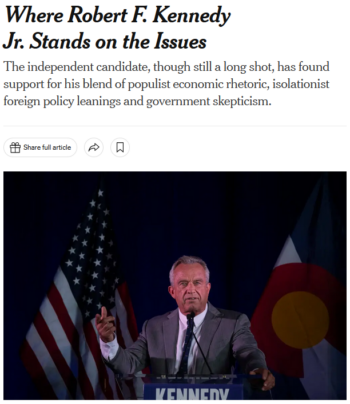
In 2,000 words on “Where Robert F. Kennedy Jr. Stands on the Issues,” the New York Times (6/14/24) avoided any discussion of where he stands on major healthcare reform issues.
The New York Times, Washington Post, Wall Street Journal and KHN frequently mentioned one or more of the third-party candidates in other political coverage as a threat to the major-party candidates. But out of the 89 news articles bringing up Medicare for All, single-payer or universal healthcare, only three included third-party candidates at all, each one in passing as possible spoilers. Exactly zero offered any information at all about the candidates’ healthcare proposals.
For example, the New York Times published 34 news articles and podcasts mentioning a version of Medicare for All or single-payer, without a single word on the healthcare proposals of the third-party candidates who remained after Kennedy’s endorsement of Trump. One article (10/24/24) included a passing Stein spoiler reference. Another (8/22/24), on Harris’s commitment to “the art of the possible,” quoted West’s vice presidential running mate, Melina Abdullah, criticizing Harris for shifting many of her policy positions, but again without reference to West and Abdullah’s proposals for healthcare.
Times readers were more likely to get news about the healthcare reform positions of foreign political leaders than non–major-party candidates running for president of the United States. The paper ran six stories about Indonesia (2/12/24, 2/15/24, 10/19/24), Thailand (2/18/24) and South Africa (6/3/24, 6/7/24) that mentioned a politician’s position on “universal healthcare,” while blacking out discussion of third-party candidates’ healthcare proposals, except to some degree for Robert F. Kennedy Jr.
Before leaving the race, Kennedy’s half-baked notions about vaccines, activism on environmental health and food safety, and criticism of Covid lockdowns received frequent mention, but as with the other third-party candidates, his views on major healthcare reform issues went missing, including from a 2,000-word Times analysis of “Where Robert F. Kennedy Jr. Stands on the Issues” (6/14/24).
The third-party healthcare blackout was even tighter in the Washington Post. The 38 Post news articles mentioning Medicare for All or single-payer had only one reference to Stein or West—a quote from West unrelated to healthcare (8/21/24). The Post never reported either candidate’s healthcare proposals. A webpage on which reporters tracked third-party ballot access offered a short “Pitch to Voters” for each party that included no healthcare policy.
Medicare for All spin and bad facts
Like Democrats, the New York Times‘ Noah Weiland (8/22/24) largely avoided talking about what Medicare for All would do.
The four outlets’ descriptions of Medicare for All, single payer and universal healthcare were nearly as sparse as coverage of third-party candidates’ healthcare positions, and as distorted as reporting on the ACA. Only 23 of the 89 news stories included any description at all of these policies, the overwhelming majority of them a brief phrase in the reporter’s own words.
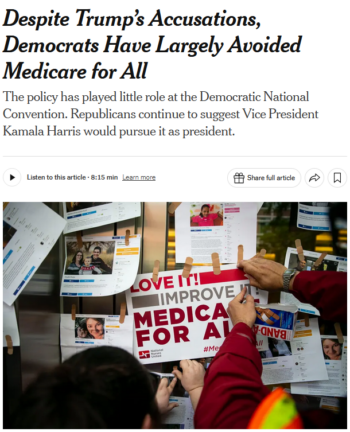
Only three New York Times stories included any Medicare for All substance, and these were barely intelligible. The most extensive was an article debunking Trump’s claims that Harris continued to support the policy, in which Noah Weiland (8/22/24) wrote nearly 1,300 words without explaining what the Medicare for All is or would do. Readers wouldn’t know that the current Medicare for All bills before Congress would cover everyone in the country with no out-of-pocket costs, and free choice of doctors and hospitals. They would, however, have learned that Harris “proposed a less sweeping plan” in 2019, which would include “a role for private plans.”
Weiland treated readers to what may be the most emphatic recitation of the ACA progress narrative. Biden’s pursuit of a “more traditional set of healthcare priorities” has yielded “explosive growth” in the ACA exchanges, he wrote. According to unnamed experts, that growth, and changes to Medicare and Medicaid, have “complicated” pursuit of Medicare for All.
Times readers would also have learned that expanding Medicaid is an incremental step toward Medicare for All, what bill supporter Rep. Ed Markey says is part of the policy’s “DNA.” In reality, Medicaid’s eligibility standards are literally the opposite of Medicare for All—means-tested coverage that requires you to prove you’re appropriately impoverished every year, and which disappears if you get a big enough raise at your job.
The vast majority of Times coverage of Medicare for All included no content whatsoever, simply mentioning it as a policy that Harris once supported, with the occasional political characterization (7/24/24) that it was one of her since-abandoned “left-leaning positions that can now leave her vulnerable to attack from Republicans.”
‘A proposal that worried many Americans’
Washington Post factchecker Glenn Kessler (9/9/24) said it was mostly true that Medicare for All would “raise taxes [and] increase national debt,” citing studies of Bernie Sanders’ plan that “estimated that national health expenditures would rise over 10 years.” He didn’t note that CBO found that under most single-payer plans, national health expenditures would rise—but much less than they would under the status quo.
Eleven of the 36 Washington Post stories in our sample published after Biden’s withdrawal made some substantive policy comment about Medicare for All, all but three in a single passing phrase. Every article except one said that Medicare for All would “abolish” or replace private insurance, sometimes noting private insurance would be replaced by a “government” plan—using the industry-preferred framing instead of the more neutral descriptor “public.” In the majority of stories, this was the only substantive point made about Medicare for All.
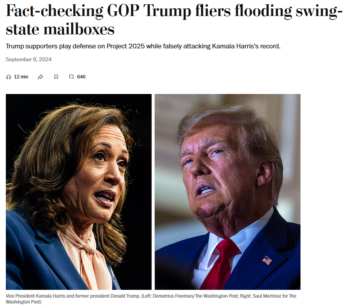
The Post‘s Glenn Kessler (9/9/24) “factchecked” Republican claims that Medicare for All would “raise taxes, increase national debt and functionally eliminate private health insurance.” Calling it “mostly true,” Kessler cited the figure of $32.6 trillion over 10 years, and claimed that “four of the five key studies on the effect of the Sanders plan estimated that national health expenditures would rise over 10 years.”
Kessler skipped a big fact. When the CBO insisted that raising the minimum wage would cause 1.4 million lost jobs, his editors (4/18/21) indignantly defended the agency as “admirably apolitical.” But Kessler neglected to mention that the “nonpartisan scorekeepers” at the CBO (12/10/20) found that four of the five versions of single-payer healthcare that they analyzed would raise national health expenditures, but by significantly less than preserving the status quo.
Healthcare reporter Dan Diamond (9/11/24) wrote the Post’s most detailed take on Harris’s about-face on a plan “to eliminate private insurance, a proposal that worried many Americans who feared losing access to their doctors.” Diamond managed not to let readers know that, in contrast to private insurance plans that penalize patients for seeing “out-of-network” doctors, Medicare for All would free patients to see any doctor they want without financial penalty.
Diamond added that Harris pulled back from Medicare for All because “polls across 2019 found that many Americans were worried that shifting to a national government-run health system could delay access to care,” without mentioning that half of all American working adults already skip treatments altogether every year (Commonwealth, 11/24).
Voters’ 2019 “worries” were likely stimulated in part by a multi-million-dollar lobbying and advertising blitz by the hospital, insurance and pharmaceutical industries, reported on by the Post‘s Jeff Stein (4/12/19), and based on the same distortions and inaccuracies Diamond and Kessler repeated five years later (Public Citizen, 6/28/19).
In a story (Washington Post, 4/3/20) on Sen. Bernie Sanders supporting the Biden/Harris administration’s drug cost control policies, Diamond reported that during the 2020 primaries, Sanders “argued that Medicare for All would help rein in high drug costs by forcing pharmaceutical companies to negotiate with the government.” It was the only positive framing of Medicare for All we could find in the Post’s coverage. Biden and Harris have done exactly what Sanders proposed, although to date they’ve only negotiated lower prices for 10 drugs, the prices won’t take effect for another year, and they only apply to our current “Medicare for Some.”
Expert content suppression
KFF’s website limited its discussion of candidates’ healthcare proposals to the “viable contenders”—a choice that excluded virtually all ideas for improving the US healthcare system.
No outlet ignored the third-party candidates’ healthcare proposals more firmly, or took the tiny increments proposed by the major parties more seriously, than the one best equipped to inform the public about the state of US healthcare: KFF Health News.
KHN is a subsidiary of what used to be known as the Kaiser Family Foundations, but now goes by the acronym KFF. Founded with money from the family of steel magnate Henry Kaiser, tax-exempt KFF occupies a unique role as both news outlet and major source for healthcare information, calling itself “a one-of-a-kind information organization.”
KFF’s research and polling arms publish a large volume of detailed data and analysis of healthcare policy, covered widely in the media. This work lends additional credibility to KHN’s respected and widely republished news reporting.
With a staff of 71 reporters, editors, producers and administrators, as of November 1, KHN is devoted entirely to healthcare. Unlike taxpaying competitors like Modern Healthcare and Healthcare Dive—which regularly cover KFF’s research output—KHN publishes without a paywall, and permits reprints without charge. KHN forms partnerships with outlets of all sizes and focus, from an in-depth investigative series on medical debt with NPR and CBS News, to providing regular policy and political reporting to the physician-targeted website Medscape.
Excluding opinion articles, letters to the editor and brief daily newsletter blurbs linking to other outlets’ content, FAIR’s searches yielded just five KHN news stories from January 1 to Election Day that referred to Medicare for All, single-payer or universal healthcare. Two were state-focused—a one-paragraph mention of a proposed California single-payer bill in a broader legislative round-up (4/24/24), and a profile (7/15/24) of Anthony Wright, newly appointed executive director of the DC nonprofit Families USA.
The remaining three (7/21/24, 8/1/24, 9/11/24) were passing mentions without substance. KHN went the entire year without once mentioning Jill Stein or Cornel West.
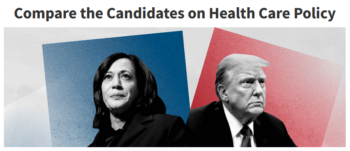
KHN’s news coverage appeared to follow the lead of its affiliated research entity. KFF published a web page to “Compare the Candidates on Healthcare Policy,” last updated October 8, that declared
the general election campaign is underway, spotlighting former President Trump, the Republican nominee, and Vice President Harris, the Democratic nominee, as the viable contenders for the presidency.
The comparisons highlighted the differences rather than the similarities, and included without context the standard claim that the Biden/Harris “administration achieved record-high enrollment in ACA Marketplace plans.”
KFF had long since decided that discussion of Medicare for All is over. President Drew Altman told the New York Times (8/22/24) that KFF stopped polling on Medicare for All after the 2020 primaries because “there hasn’t been debate about it.” Yet pollsters regularly ask voters about healthcare issues that have no immediate chance of passage. The AP has asked people for a quarter century if they think it’s the federal government’s responsibility to “make sure all Americans have healthcare coverage,” and the Pew Research Center and other organizations have polled on abortion for decades, even when federal legislation was extremely unlikely.
The lack of “debate” about Medicare for All or single-payer is a flimsy excuse for blinkered coverage. In fact, KHN and the other outlets all ignored major healthcare reform stories with looming deadlines for action by the incoming president—federal approval for state-level reform (Healthcare Dive, 4/24/24). California and Oregon passed laws in 2023 instructing their governors to seek federal permission to dramatically restructure their state healthcare systems, including formation of a single-payer system in Oregon. Negotiations were supposed to begin in the first half of this year. None of these four agenda-setting outlets asked 2024 presidential candidates whether they planned to flex White House power to help major state-level reforms.
Complicit in mass death
All four of these outlets have done detailed reporting on some aspects of the extraordinarily expensive mass-killing machine that passes for the US “healthcare system.” Claims denials, aggressive collections, medical debt and massively inflated prices have all graced their pages.
But when it comes to political coverage, reporters and editors refuse to use their knowledge to challenge candidates effectively. The public’s experiences disappear, as journalists regurgitate bad facts and focus on self-evidently meaningless “proposals” framed by corporate power within their insular Beltway cultural bubble.
UnitedHealth Group executive Brian Thompson’s murder exposed the degree to which that behavior makes them complicit in mass death.
Donald Trump is back in the White House, and faux opposition is once again the order of the day for the Western media and the Democratic Party. Whether it comes to criminalizing migrants (FAIR.org, 1/25/25), maintaining US “soft power” via USAID, downplaying anti-democratic power grabs (FAIR.org, 2/4/25) or whitewashing Nazi salutes (FAIR.org, 1/23/25), the centrist establishment seems quite content to normalize Trump or even outflank him from the right.
There is, of course, no area of greater consensus than US imperial grand strategy, from waging genocidal war in Palestine (FAIR.org, 1/30/25) to recolonizing Washington’s “backyard” south of the Rio Grande. Accumulation by laying waste to the societies of the global South via carpet bombing and/or economic siege warfare is, according to anti-imperialist political economist Ali Kadri, the name of the game.
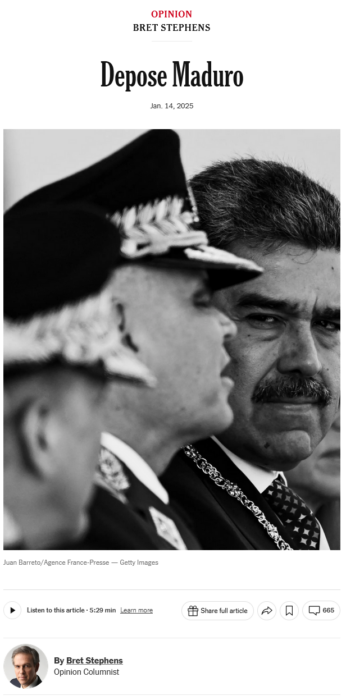
Venezuela is no exception to this multi-pronged onslaught. And the US empire’s “paper of record,” the New York Times, proudly leads the charge, most recently advocating the overthrow of Venezuelan President Nicolás Maduro “through coercive diplomacy if possible or force if necessary.”
High on his own (imperial) supply
Bret Stephens (New York Times, 1/14/25): “Ending Maduro’s long reign of terror is a good way to start [the Trump] administration—and send a signal to tyrants elsewhere that American patience with disorder and danger eventually runs out.”
In a column belligerently titled “Depose Maduro,” New York Times columnist Bret Stephens (1/14/25) made an overt case for US military intervention to topple Venezuela’s government. He hailed this textbook crime of aggression as “overdue, morally right and in our national security interest.”
For the Times’ self-described “warmongering neocon,” that last point is characteristically paramount. Specifically, he asserted that US “national security” requires “putting an end to a criminal regime that is a source of drugs, mass migration and Iranian influence in the Americas.”
The irony that during the 1980s, the Central Intelligence Agency actually facilitated the trafficking of cocaine to working-class Black communities in the context of the Iran/Contra scandal (FAIR.org, 12/29/24) was evidently lost on the Times columnist.
Then as today, the principal drug routes to the United States cut across the Pacific rather than the Gulf of Mexico (FAIR.org, 9/24/19). A 2017 DEA report found that less than 10% of US-bound cocaine flowed through Venezuela’s eastern Caribbean corridor, with WOLA reaching a similar conclusion in a 2020 study.
Not only does the bulk of drug trafficking flow through US-allied countries, but the US government itself is broadly complicit in the perpetuation of the multi-billion dollar contraband, as evidenced in its support for narco puppet regimes in Afghanistan (New York Times, 7/27/08) and Honduras (FAIR.org, 3/20/24; Covert Action, 3/14/24).
In marked contrast, the US has levied “narco-terrorism” charges against top Caracas officials, going as far as to place a bounty on Maduro’s head, without providing a shred of evidence, since Western outlets are happy to take US officials’ word, no questions asked (BBC, 1/10/25; New York Times, 1/10/25; Washington Post, 1/10/25; AP, 1/10/25).
Stephens lamented that Washington’s murderous economic sanctions “didn’t work” and that its bounty “also won’t work.” The columnist conveniently ignored that the unilateral coercive measures, described aptly by US officials as “maximum pressure,” were quite effective in deliberately gutting Venezuela’s economy, in the process killing at least tens of thousands, and spurring the migrant exodus he pointed to as justification for his proposed military adventure.
Such omission regarding US responsibility for Venezuelan migration is by now a staple of corporate media coverage (New York Times, 1/31/25; PBS, 1/31/25; CBS, 2/2/25). Indeed, support for Washington’s economic terrorism against Venezuela has been fairly uniform across the US political spectrum for years (FAIR.org, 6/4/20, 6/4/21, 5/2/22, 6/13/22).
Common tactics include describing sanctions as merely affecting Maduro and allies (New York Times, 1/6/25; NPR, 1/10/25; Al Jazeera, 1/6/25; Financial Times, 1/31/25) or portraying their consequences as merely the demonized leader’s opinion (New York Times, 1/31/25; BBC, 1/10/25; Reuters, 1/27/25).
The Iranian bogeyman
Stephens cites a story (Infobae, 1/10/25) about an Iranian “drone development base” in Venezuela that offers as its only source for the claim that “there is information” about such a base.
It is no surprise, either, that in Stephens’ casus belli, Iran appears alongside the familiar conservative tropes of Latin American migrant hordes and narcotics threatening the US (white settler) body politic.
Stephens’ Orientalist fixation with the Iranian bogeyman is notable, if hardly novel. Western media have in recent years circulated baseless rumors of Iran covertly shipping military equipment to Venezuela (FAIR.org, 6/10/20), and the Times in particular has promoted equally evidence-free claims of drug trafficking by Iranian ally Hezbollah (FAIR.org, 5/24/19, 2/4/21).
In the latest whopper, Stephens cited Iran having “reportedly established a ‘drone development base’” at a Venezuelan air base. However, this story comes from rabidly anti-Venezuelan government outlet Infobae (1/10/25), which did not even bother describing its anonymous source. The report only vaguely stated that “there is information” about this purported base.
Regardless of whether there is any truth to the alleged defense cooperation between the two sovereign nations, the perceived threat is, following the late Edward Said, symptomatic of Western imperialism’s enduring obsession with the “loss of Iran” in the wake of the 1979 overthrow of the Shah. Like the Chinese Revolution before it, Iran’s Islamic Revolution is still decades later portrayed as a global civilizational menace.
But the effort to update the “axis of evil” with a revised cast of rogue states from Venezuela to Iran also crucially serves to manufacture consent for military aggression against Tehran, which has long been the ultimate dream of significant segments of the US political class and intelligentsia, including Stephens (FAIR.org, 10/25/24).
On elections and ‘tropical despotisms’
In Stephens’ tropical gunboat diplomacy redux, there was something for everyone, even bleeding-heart “liberals” horrified that Venezuelan President Maduro supposedly “stole the election, terrorizes his opponents and brutalizes his people.”
As always, US imperialist intervention ideologically hinges on denying the Bolivarian government’s democratic credentials, most recently regarding the outcome of the July 28, 2024, presidential vote (Venezuelanalysis, 8/22/24, 7/29/24). However, Washington’s blockade ensured that the elections would never be free and fair. As the main factor driving economic hardship and migration, US sanctions meant Venezuelans headed to the polls with a gun to their heads, not unlike Nicaraguans in 1990.
It is the height of hypocrisy for US officials and their corporate media stenographers to claim the right to arbitrate other sovereign nations’ democratic legitimacy, even as they advance fascism at home and genocidal war across the globe. That sectors of the Western “compatible left” echo Stephens and his ilk, caricaturing the Maduro government as a “corrupt” and “repressive” regime, is unfortunate but not surprising (Ebb, 10/3/24).
The core racial assumption, going back to the 19th century, is that Global South states that refuse to bow to Western imperialist diktat constitute “tropical despotisms” to be toppled in a never-ending “civilizing mission,” with its anti-Communist, “war on terror” and neo-Orientalist mutations.
Demolishing the Death Star
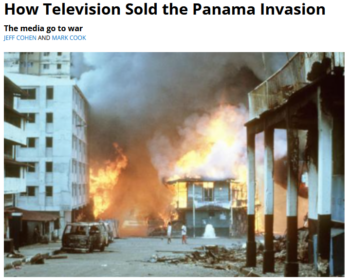
Extra! (1–2/90): “In covering the invasion of Panama, many TV journalists abandoned even the pretense of operating in a neutral, independent mode.”
It is noteworthy that the script for Stephens’ Rambo sequel is over 35 years old: Stephens argued for “US military intervention of the sort that in 1990 swiftly ended the regime of the Panamanian strongman Manuel Noriega.” Formerly US-backed narco dictator Noriega was, not incidentally, an ex-CIA agent involved in Iran/Contra (Extra!, 1–2/90; FAIR.org, 12/29/24).
The New York Times warmonger-in-chief’s rendering of the intervention is fantastically selective, forgetting that the Central American nation was already “pre-invaded” by US military bases, and that the savage bombing of the Afro-Panamanian neighborhood of El Chorrillo transformed it into “Little Hiroshima.”
But the sober reality is that Venezuela is not Panama. Venezuela’s Bolivarian Armed Forces, alongside other corps, like the Bolivarian Militia, have spent a quarter of a century preparing for a “prolonged people’s war of resistance” against the US empire at the level of doctrine, organization, equipment and training.
If the US and its Zionist colonial outpost failed to defeat the heroic Palestinian resistance in Gaza after nearly 500 days of genocidal war, an asymmetric conflict with a significantly larger and stronger force, across a territory more than 2,000 times as large, is not likely a serious proposition.
Nonetheless, it is the duty of all those residing in the imperialist core to grind Washington’s industrial-scale death machine to a definitive halt. This paramount strategic objective demands systematically deposing the New York Times’ Goebbelsian propaganda.
This post was originally published on CounterSpin.
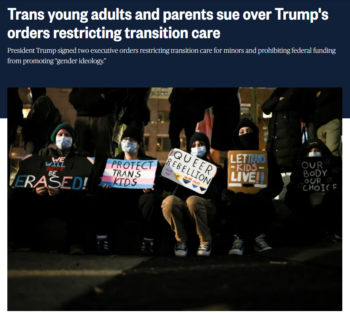
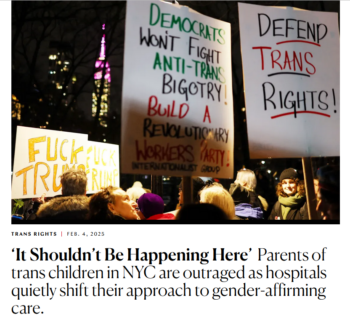
Janine Jackson interviewed TLDEF’s Ezra Young about trans rights law for the February 7, 2025, episode of CounterSpin. This is a lightly edited transcript.
Janine Jackson: Transgender youth, families and advocates are filinglawsuits, pushing back on Trump executive orders that define sex as biological and “grounded in incontrovertible reality,” and that prohibit federal funding of transition-related healthcare for those under 19, including by medical schools and hospitals that receive federal research or education grants. According to a report by Jo Yurcaba at NBCOut, that latter order contained language claiming that “countless children soon regret that they have been mutilated,” and that they wind up “trapped with lifelong medical complications” and “a losing war with their own bodies.”
This accompanies orders prohibiting trans people from joining the military, and from receiving transition care while incarcerated, and then just yesterday, a move to ban trans women from women’s sports. It’s evident what Trump and his ilk want to do, but is it legal? And even if it’s not, what impacts could it still have?
Ezra Young is a civil rights attorney whose litigation and scholarship center on trans rights. He’s been visiting assistant law professor at Cornell Law School, director of impact litigation at the Transgender Legal Defense and Education Fund, and legal director at African American Policy Forum, among other things. He joins us now by phone from Charlottesville, Virginia. Welcome back to CounterSpin, Ezra Young.
Ezra Young: Thank you so much for the invitation.
JJ: Ground us, please, with some basic understanding. Discrimination based on gender identity is illegal. That’s established, isn’t it?
EY: Yes, it is. Gender identity is a newer term, but is essentially equivalent to sex. Federal law prohibits discrimination on the basis of sex, both under our Constitution, as well as under many statutes.
JJ: And it’s also established that the White House or Trump doesn’t have, really, the legal power or the authority to carry out these moves that these orders indicate, right?
EY: Correct. So this is just basic constitutional law, like I would teach my first-year law students; any one of them would be able to spot this. Under our Constitution, our government is one of limited powers. Those powers for the presidency are delineated in Article Two. The responsibility of the US president is to execute and enforce laws that are passed by Congress, not to make up new laws, and most definitely not to infringe upon the rights that are protected by the United States Constitution.
JJ: Right. Well, we know that the law saying they can’t do something doesn’t necessarily mean—we can already see that it hasn’t meant—that nothing happens, including things that can deeply affect people’s lives, even if they aren’t legal. So accepting that grayness, what should we be concerned about here?
EY: Well, first and foremost, I’d push back on the sense that there’s grayness. This is a situation where there’s black and white. Our Constitution, which I firmly believe in, enough so that I’m an expert in constitutional law and I teach it, limits what a president can do.
So let me contrast this with the president’s power when it comes to immigration. There’s a lot of power in the president when it comes to immigration, because that’s an issue over which our Constitution gives him power. But our Constitution is one of the government of limited powers, meaning if power isn’t expressly provided via the Constitution, the president can’t just make up that power. So for folks who think the president is doing something unconstitutional, or insists he has powers he doesn’t have, the best thing to do is to push back and say absolutely no.
Part of what we’re seeing right now, with some local hospitals in New York and elsewhere essentially trying to comply in advance, in the hope to appease Trump if one day he does have the power to do what he says he’s doing, that’s absolutely wrongheaded. We don’t, and no one should. That was why our country was founded. Despite all the sins on which it was founded, a good reason why we were founded was to make sure that the people retained the vast majority of the power. And when politicians, including the United States president, pretend they have more power than they do, it’s our responsibility as citizens and residents of this nation to push back and say no.
JJ: I appreciate that, and that the law is not itself vague, but that with folks complying in advance, as you say, and with this just sort of general confusion, we know that a law doesn’t have to actually pass in order for harms to happen, in order for the real world to respond to these calls, as we’re seeing now. So it’s important to distinguish the fact that the law is in opposition to all of this, and yet here we see people already acting as though somehow it were justified or authorized, which is frightening.
EY: It is frightening, and I think, again, that goes to our responsibility as Americans. Citizens or not, if you’re here, you’re an American, and you’re protected by the Constitution. It’s our responsibility to push back people who are all too ready to take steps against the trans community, against trans people, just like all of the other minority groups President Trump is trying to subjugate, and to insist: “Hey, stop. You’re not required to do this. If you’re choosing to do this, that’s a problem.”
JJ: We are seeing resistance, both these lawsuits and protests in the street, I feel like more today than yesterday, and probably more tomorrow than today. Do you think that folks are activated enough, that they see things clearly? What other resistance would you like to see?
Ezra Young: “If Trump were to put out an executive order today declaring the sky is purple, that doesn’t change the reality that the sky is not purple.”
EY: I think protests are a great way for folks who might not know a lot of these issues, or might have limited capacities, so they’re not lawyers, they’re not educators, they’re not doctors, but they’re people who care. That’s a great way to push back, put your name and faith and body on the line, and to show you don’t agree with this.
In addition to that, I would suggest that people read these executive orders and know what they say and know what they don’t say. When I say, right now, for the trans community, complying in advance is one of the biggest problems we’re seeing, I mean it. I’ve been on dozens of calls with members of the trans community, including trans lawyers at large organizations and law firms, people who work for the federal government, who are not what my grandfather would call “using their thinking caps” right now. They’re thinking in a place of fear, and they’re not reading. They’re not thinking critically.
If Trump were to put out an executive order today declaring the sky is purple, that doesn’t change the reality that the sky is not purple. We don’t need to pretend that is the reality. We can just call it out for what it is, utter nonsense.
Beyond that, I would say people should not change anything about the way they live their life or go about the world, simply out of fear that something will be done to them that no one has the power to do.
I can say—it’s kind of funny—I was at a really conservative federal court last year, and I lost my passport. I thought I was going to find it again, but I didn’t, and then I got busy with work, and Trump came into office. So I finally got my stuff together, and applied for a new passport. A lot of people in my community were concerned that I wasn’t going to get a passport, and all I could think was: “I read all of the rules. I read all of the executive orders. There’s nothing that says I can’t get my passport.” I’m not home in Ithaca, New York, right now, but my understanding is my passport was delivered yesterday.
JJ: OK, so just going forward, people think media critics hate journalists, when really we just hate bad journalism, which there has been a fair amount of around trans issues; but there are also some brighter spots and some improvements, like one you saw out of what might seem an unlikely place. Would you tell us a little about that?
EY: One of my friends, Brittany Stewart, of an organization called Gender Justice, which is based in Minnesota, brought a lawsuit against the state of North Dakota, challenging a ban on minors accessing trans healthcare. This case was filed about two years ago, and it just went to a bench trial, meaning it was heard by only a judge in North Dakota last week.
Very lucky to the people of North Dakota, there’s a wonderful local journalist by the name of Mary Steurer who has been following the case for the last two years, and attended each and every day of the seven day bench trial. And each day after court, she submitted a story where there were photographs taken straight from the courtroom of the witnesses that were not anonymous, and describing what happened for the day.
And it’s not just passive recording that Mary did; it’s really critical reporting. She picked up on reporting in other states where the same witnesses testified. She shared long summaries of witness testimonies for the day. And my understanding is her reporting was so good that the two other major newspapers in North Dakota ran all of her daily reports on their front pages.
JJ: Yeah, Mary Steurer writes for the North Dakota Monitor. I looked through that reporting on your recommendation, and it really was straightforward, just being there in the room, bringing in relevant information. It just was strange, in a way, how refreshing it was to see such straightforward reporting. She would mention that a certain person made a statement about medical things, and she’d quote it, but then say, “Actually, this is an outlying view in the medical community,” which is relevant background information that another reporter might not have included. So I do want to say, just straightforward reporting can be such sunlight on a story like this.
EY: Yes, and especially I appreciate that Mary is local to North Dakota. She’s not an outsider parachuting in for a trial that might otherwise be overly sensationalized. This is a North Dakotan covering a North Dakota case in Bismarck, and she’s really speaking to the sensibilities of North Dakotans, and what they want to know about a case like this, not what outsiders like me from New York might think.
JJ: Let me just ask you, Ezra, while I have you, forward-looking thoughts. I’ve heard you say these moves are not legal, these executive orders are not legal, they can be stopped, people are engaged in stopping them. Are there things you’d look for journalists to be doing right now, or for other folks to be doing right now, that can make sure that goes forward in the way that we want it to?
EY: For journalists, I’d recommend that you cast a wide net to understand all of the actions that are happening, and all of the lawsuits that are happening. A lot of journalists at the national level, at the very least, do really reactive reporting. So within a few minutes of an executive order coming out, they’ll talk to the same activists that they always talk to on both sides. They’ll talk to a lawyer who has no idea what this area of law is, just to get a quote in, and then they move on.
I think it would be helpful for Americans, and trans Americans especially, to know there’s more going on in our fight than being reactive to nonsense executive orders.
As one example, I filed suit against the US Office of Personnel Management yesterday, on behalf of my client Manning, a former federal employee challenging the federal government’s health benefits plans’ decades-long trans exclusions in healthcare. This is a case that captures the long arc of the struggle for trans rights. It started 10 years ago, and ironically enough, the only administration that was supportive of Mr. Manning’s bid was Mr. Trump.
JJ: That is odd.
EY: But here we are in court again.
JJ: All right then, so cast a wide net, and don’t just look at the most recent thing that’s come down the pike, because that will just have all of our heads spinning, and take our eyes off the prize.
EY: And talk to different voices, not just the same activists, not just the same lawyers, not just the same parents, not just the same kids. There are a lot of trans people. We’re not a monolith. We have different views and interests, and different experiences, and you won’t capture that if you just talk to the same talking heads.
JJ: All right, then. We’ve been speaking with civil rights attorney Ezra Young. You can follow his work at EzraYoung.com. Thank you so much for joining us this week on CounterSpin.
Janine Jackson interviewed Dartmouth-based Anne Sosin about Robert F. Kennedy Jr. and rural health for the February 7, 2025, episode of CounterSpin. This is a lightly edited transcript.
Janine Jackson: A Senate panel voted narrowly this week to advance the nomination of Robert F. Kennedy Jr. for secretary of the Department of Health and Human Services. Kennedy has been emphatically opposed by a range of public health experts for reasons including, but not limited to, his stated belief that vaccines have “poisoned an entire generation of American children.” Yes, his children are vaccinated, but he wishes he “could go back in time” and undo that.
Also, that Covid-19 is targeted to attack Caucasians and Black people, while Ashkenazi Jews and Chinese are most immune; that the HPV vaccine causes a higher death risk than the cancer it prevents; that fluoride causes IQ loss; that Vitamin A and chicken soup are cures for measles; that AIDS is not caused by HIV; and that we had almost no school shootings until the introduction of Prozac.
Nevertheless, Kennedy may soon be overseeing Medicare, Medicaid and the Affordable Care Act, coordinating the public health response to epidemics, as well as the approval process for pharmaceuticals, vaccines and supplies.
Our guest says RFK Jr is absolutely a threat to public health, but nixing his nomination is not the same thing as meaningfully engaging the problems that lead people to support him.
Anne Sosin is a public health researcher and practitioner based at Dartmouth College. She joins us now by phone. Welcome to CounterSpin, Anne Sosin.
Anne Sosin: Thank you so much for having me on the show.
JJ: There are a number of people, in lots of places, who have centered their lives perforce on concerns around food and health and medicine. And they see a guy who seems to be challenging Big Pharma, who’s saying food additives are problematic, who’s questioning government agencies. There are a lot of people who are so skeptical of the US healthcare and drug system that a disruptor, even if it’s somebody who says a worm ate his brain—that sounds better than business as usual. And so that’s leading some people to think, well, maybe we can pick out some good ideas here, maybe. But you think that is the wrong approach to RFK Jr.
AS: I think that that’s misguided. Certainly, there are some people who see RFK as a vehicle for championing their causes. And there are other people who think that we should seek common ground with RFK, that we should acquiesce, perhaps, on certain issues, and then work together to advance some other causes.
And I think that that’s misguided. I think we need to recognize what’s given rise to RFK and other extreme figures right now, but we need to make common cause with the communities that he’s exploiting in advancing his own personal and political goals.
JJ: And in particular, you’re thinking about rural communities, which have played a role here, right? What’s going on there?
AS: Yes. My work is centered in rural communities right now, and I think we need to understand the political economy that’s given rise to RFK and other figures—the social, economic, cultural and political changes that have given him a wide landing strip in rural places, as well as some of the institutional vacuums that RFK and other very extreme and polarizing figures are filling.
JJ: Expand on that, please, a little.
Anne Sosin: “Resistance to public health measures often, in my view, reflects unmet need.”
AS: So we’re seeing growing resistance in some places, including rural communities, to public health and interventions that have long been in place, including vaccination and fluoridation. And resistance to public health measures often, in my view, reflects unmet need.
Sometimes those needs are material. We see that people resist or don’t follow public health programs or guidance because they don’t have their material needs met. And those material needs might be housing, paid leave or other supports that they need. But the unmet need might also be emotional or affective, that some people may resist out of a sense of economic or social dislocation, a feeling of invisibility, or something else. And those feelings get expressed as resistance to public health measures that are in place.
And so understanding and recognizing what those unmet needs are is really important. And then thinking about how do we address those needs in ways that are productive, and don’t undermine public health and healthcare, is really important.
JJ: Vaccinations are obviously a big concern here, particularly as we may be going into another big public health concern with bird flu. So the idea that vaccines cause disease is difficult to grapple with, from a public health perspective. Vaccines can’t be a “choose your own adventure” if they’re going to work societally. And it almost seems like, around vaccination, we’re losing the concept of what public health means, and how it’s not about whether or not you decide to eat cheese, you know? There’s kind of a public understanding issue here.
AS: I think you’re correct. I think we’ve seen, just in the US, an increasing DIYification of public health, a loss of the recognition that public health means all of us. Public health is the things that we do together to advance our collective health. And the increased focus on individual decision-making really threatens all of us.
And we look for it around vaccination: We have seen very well-funded initiatives to undermine public confidence in vaccination over the last several years. There has been a lot of money spent to dismantle public support and public confidence in vaccination and other lifesaving measures. And it really poses a grave threat, as we think about not only novel threats like H5N1, but also things that have long been under control.
JJ: Finally, I took a quick look at major national media and rural healthcare, and there wasn’t nothing. I saw a piece from the Dayton Daily News about heart disease in the rural South, and how public health researchers are running a medical trailer around the area to test heart and lung function. I saw a piece from the Elko Daily Free Press in Nevada about how Elko County and others are reliant on nonprofits to fill gaps in access to care, and that’s partly due to poor communication between state agencies and local providers.
And I really appreciate local reporting; local reporting is life. But some healthcare issues, and certainly some of those that would be impacted by the head of HHS, are broader, and they require a broad understanding of the impact of policy on lots of communities. And I just wonder, is there something you would like to see news media do more of that they’re missing? Is there something you’d like them to see less of, as they try to engage these issues, as they will, in days going forward?
AS: Certainly local coverage is essential, and I’m really pleased when I see local coverage of the heroic work that many rural healthcare providers and community leaders are delivering. We see very creative and innovative work happening in our rural region, in our research, in our community engagement. And so it’s very encouraging when I see that covered.
But all of the efforts on the ground are shaped by a larger policy landscape and a larger media landscape, larger political landscape. And what we see, often, is efforts to undermine the policies that are critical to preserving our rural healthcare infrastructure. We see well-funded media efforts to erode social cohesion, to undermine our community institutions, to sow mistrust in measures such as vaccination. We see other work to harden the divisions between urban and rural America, and within rural places.
And so I hope that media will pay attention to the larger forces that are shaping the landscape of rural life, and not just see the outcome. It’s easy to take note of the disparities between urban and rural places, but it’s much harder to do the deep and complex work of understanding the forces that generate those uneven outcomes across geographic differences.
JJ: All right, well, we’ll end on that important point.
We’ve been speaking with Anne Sosin, public health researcher and practitioner based at Dartmouth College. Anne Sosin, thank you so much for joining us today on CounterSpin.
These are hypothetical headlines of the sort you run if you want to drive home the point that mass deportations would not only be a humanitarian outrage, but an economic disaster. Which, according to economists, they very much would be.
As of 2022, undocumented immigrants constituted approximately 5% of the US workforce. Deporting all or a large number of them would substantially reduce the supply of labor in the US economy and would concurrently reduce aggregate demand by eliminating the spending of anyone deported. GDP could, as a result, drop as much as 7.4% below a baseline forecast by the end of 2028, per the Peterson Institute for International Economics.
Rather than opening up more job opportunities for American workers, past research tells us that the opposite will occur. As Michael Clemens from Peterson puts it:
The disappearance of migrant workers…dries up local demand at grocery stories, leasing offices, and other nontraded services. The resulting blow to demand for all workers overwhelms the reduction in supply of foreign workers.
The supply shock induced by mass deportations of undocumented workers would have the additional effect of spiking inflation, perhaps several points above baseline. In short, beyond being a humanitarian nightmare, mass deportations would be an economic self-own of epic proportions.
Rather than sound unfamiliar or strange, as it may to readers of corporate media, this sort of expert analysis of the economic effects of deportation could become conventional wisdom if outlets ran headlines like those above. After all, those are the type of headlines you run if you are dedicated to objectivity in reporting, to informing your audience of what the research says, no matter whether it might offend their sensibilities.
‘Warning of a fiscal crisis’
Writing about the prospect of mass deportation in New York City, the Washington Post (1/28/25) highlighted Mayor Eric Adams’ “warning of a fiscal crisis.”
They are not, of course, the headlines you run if your paper is committed to bending over backwards to avoid offending Trump and his supporters. So at the Washington Post, such headlines are hard to come by. In fact, if you look through the “Immigration,” “Economy” and “Economic Policy” sections on the Post’s website, you will find a grand total of zero articles since the start of the year with headlines directly addressing the negative economic impact of Trump’s proposed mass deportation policy.
Some articles published over this period have addressed the economic effects of mass deportations, but only in a marginal way. For instance, in an article (1/31/25) published at the end of January about an ICE raid at a workplace in Newark, New Jersey, the Post included the following quote from Newark mayor Ras Baraka:
“How do you determine…who is undocumented and who is criminal?… In this community, you might pull everybody over, because this is a city full of immigrants,” Baraka, who is running for governor of New Jersey, said in an interview. “You got everybody on edge around here. And it’s going to hurt the economy.”
What would the economic damage look like? The Post declined to elaborate.
Similarly, a piece (1/28/25) from a few days earlier about an ICE raid in New York City had little to say about the impacts of mass deportations on the economy. It did, however, take some space to highlight negative economic effects of illegal immigration on the city, explaining that “the largest influx [of migrants] since the Ellis Island era…left New York Mayor Eric Adams (D) warning of a fiscal crisis.” The only economic figure cited in the piece was the figure for the cost of the migrant influx, apparently over $5 billion since 2023.
Cautiously ‘wonky’
“So much recent political rhetoric has succeeded in portraying undocumented people as driven to crime rather than contribution,” the New York Times‘ Ginia Bellafante (1/31/25) noted.
Contrast this coverage with that of the Post’s competitor, the New York Times. At the end of January, the Times published a piece (1/31/25) headlined “What Mass Deportations Would Do to New York City’s Economy.” A far cry from the hypothetical headlines provided at the top of this article, the headline nonetheless signaled an intention to seriously analyze the economic effects of mass deportations. The first economic figure cited in the piece, coming in the third paragraph, highlighted the tax contributions of undocumented immigrants:
As a group, undocumented immigrants paid $3.1 billion in New York state and local taxes in 2022, for example, a sum equal to the city’s early education budget for the current fiscal year.
Not wanting to come off as too activist for citing data on the positive contributions of undocumented immigrants to New York City’s tax base, the Times felt obliged to clarify that this figure did not come
from a left-leaning human rights group intent on fostering sympathy for people who crossed the border illegally, but rather from the wonky Institute on Taxation and Economic Policy, a nonpartisan Washington think tank.
An odd way of presenting data, but a way that evidently feels comfortable for a paper that has no intention of seriously rocking the boat, even if it is willing, on this occasion, to stand up from its seat rather than clinging to the captain’s feet for dear life.
Despite some apparent hesitancy, the piece went on to examine the loss in local and state tax revenue that could result from deportations of even a fraction of the undocumented population, and to explain the centrality of undocumented workers to key industries in the city, from food services to childcare to construction. None—I repeat, none—of this information could be gleaned from the Post’s coverage of the immigration situation in New York City.
‘Recast the US economy’
A Washington Post subhead (11/6/25) said that Trump’s deportation plans might “recast the US economy”—which turns out to mean shrinking it by as much as 6%.
In a major piece on Trump’s approach to the immigration system published just before Trump’s inauguration, the WashingtonPost (1/19/25) likewise failed at its basic task of informing its readers. The Post at least mentioned that mass deportations could hurt the economy—“By rounding up immigrants who fill otherwise vacant jobs, [Trump] could hurt the US economy he has pledged to supercharge”—but that’s where the analysis ended. No reference was made to research showing that mass deportations could lead to complete stagnation of GDP during Trump’s time in office, or that it could lead to a several percentage point spike in inflation.
Prior to the start of the year, the Post had published more about the economic effects of mass deportations. For instance, an article (12/27/24) from the end of December headlined “The 2025 Economy: Five Things to Watch” included “Deportations” as the second thing to watch. It nonetheless featured only a small discussion of the topic—four short paragraphs—and no hard numbers were cited regarding the effects on employment, GDP and inflation, despite these numbers existing in reputable research from a nonpartisan think tank.
A Post piece (11/6/25) from a day after the election, meanwhile, had discussed how mass deportations could “recast the US economy and labor force”—what a verb! Towards the end of the article, the reporters touched on the effects of mass deportations on inflation and GDP, citing concrete numbers for the second variable:
Many economists also say that mass deportations on the scale proposed by Trump would trigger inflation in the short term—by forcing employers dealing with labor shortfalls to raise prices. A major deportation program would also shrink the economy by 2.6% to 6.2% a year, according to a recent review of projections published by the University of New Hampshire.
This paragraph, however, was all that was given for a concrete discussion of the economic impact of mass deportations.
Amazingly, before the election, the Post editorial board (10/24/24) did take the time to weave in commentary on Trump’s mass deportation policy in yet another editorial fearmongering about Social Security. The board wrote:
Whatever you think about its merits as immigration policy, a crackdown on undocumented workers, including mass deportations, could also hurt Social Security’s finances because undocumented workers contribute payroll taxes without collecting benefits for decades—if ever.
No other economic effects of mass deportations were mentioned by the editorial board. A substantial hit to GDP, though relevant to the discussion of public finances, was not discussed. Concerns about the effects of mass deportations were merely looped into apparently more pressing concerns about the sustainability of Social Security, which the Post wants to cut (FAIR.org, 6/15/23).
‘Not about wages’
NPR (1/17/25) looked at the economic problems posed by mass deportation through the eyes of employers who depend on exploiting immigrant labor.
The Post has been particularly egregious in ignoring the topic of the economic impact of mass deportations, but it certainly hasn’t been alone in covering it poorly. NPR, for example, decided to let employer propaganda slide unchecked in a recent piece (1/17/25) about the contributions of immigrants to Nebraska’s economy.
The piece started by centering the experience, not of immigrants, but of the executive director of the Nebraska Pork Producers Association, Al Juhnke, whose main concern appears to be maximizing the availability of cheap labor for the agricultural industry in Nebraska. An early paragraph read:
Juhnke says attracting workers to Nebraska is not about wages. The average pay for a meat trimmer is close to $18 an hour—well above the state minimum of $13.50. “These are good paying jobs in the plants,” he says. “People say, ‘Well, just double or triple the pay [and] you’ll get United States citizens to work.’ No, you won’t.”
There is no follow up on this point; it is simply accepted as fact by NPR. But there’s little reason to trust an executive of an organization advocating for pork producers on this.
Responsible coverage might at the very least entail bringing in an independent researcher to comment on this claim. For instance, it could be noted that, according to the MIT Living Wage Calculator, the living wage in the county of Nebraska where much of the meat processing occurs is $18.64 per hour for a single adult with no children. For a family with one working adult and one child, it’s $32.27. Such information immediately undermines the executive’s claim that a wage of “close to $18 an hour” is a good wage, and in turn should raise eyebrows at the idea that raising the wage would have no effect on the attractiveness of employment to US citizens.
Survey results from the Manufacturing Institute and Colonial Life, furthermore, indicate that manufacturing companies have seen success in recent years in attracting workers by increasing pay and benefits. Why should we assume meat processing plants face different dynamics from other manufacturing plants?
More to the point, for an article focused on undocumented immigrants’ plight, it would be worth following up this claim, and the surrounding text discussing Nebraskan employers’ search for cheap immigrant labor, with an analysis of the exploitation of immigrant labor.
A follow-up question to the executive might be: Can employers afford to pay workers, immigrant or not, substantially more? And if so, why are they not doing that?
All that the piece gives, however, is a quote from a civil rights advocate lamenting the dehumanization of immigrants: “It’s dehumanizing—‘Let’s harness immigrant labor.’ Like an animal.” This is a powerful quote, but it’s not a substitute for basic factchecking of an empirical claim.
‘Real economic crisis’
Even while pointing out the inflation threat posed by mass deportation, Politico (1/20/25) allowed the Trump team to promote dubious numbers from an anti-immigrant hate group.
Though also better than the Post, in that it has actually prominently covered the negative economic effects of mass deportations in the “Economy” section of its website recently, Politico has similarly engaged in sloppy reporting, failing to provide skepticism where it is needed. In an article headlined “Americans Hate High Prices. Mass Deportations Could Spark New Surges,” Politico (1/20/25) did highlight how much of a disaster Trump’s deportation policy could be for the economy. But it quickly turned the issue into a both-sides debate and, crucially, left unchecked a particularly wild claim:
Some Trump allies say the doomsaying over the incoming president’s pledges to deport as many as 20 million undocumented immigrants is overblown. Karoline Leavitt, a spokesperson for Trump’s transition team, said in a statement that the “real economic crisis is the $182 billion American tax dollars spent each year to cover the costs of 20 million illegal immigrants that have flooded our communities and replaced American workers.”
This claim—that undocumented immigrants impose a $182 billion cost on American taxpayers—was not discussed further. Politico just let it sit. It appears the figure comes from an organization called the Federation for American Immigration Reform, a far-right advocacy group, which was claiming 15 years ago that undocumented immigrants cost American taxpayers over $100 billion per year.
A later estimate from 2013 by the Heritage Foundation, the conservative think tank that’s behind Project 2025, put the figure closer to $50 billion. But even that number is controversial—it includes, for example, the cost of government-provided educational services received by the children of undocumented immigrants, many of whom are US citizens. Educational services, in fact, constitute the majority of the costs associated with undocumented immigrant households in the Heritage analysis.
The amount spent on direct transfer payments to such households is only a small fraction of the estimated overall cost. Other categories of cost include spending on police, fire and public safety, as well as transportation services and administrative support.
The liberties that conservative researchers take in deciding what to count as a cost imposed by undocumented immigrants on US taxpayers make one question the utility of this accounting exercise in the first place. As one researcher has commented:
Fundamentally I think it’s the wrong question…. You’re talking about people who work for very low wages and are excluded from nearly all social services. It takes a real act of will to say they’re exploiting us.
Yet for Politico, none of this context is worth bringing into the piece. Even a basic attempt at factchecking the claim from a Trump ally is absent.
Support declines with details
When respondents were asked about worker shortages, support for mass deportation went from net 7 points positive to 5 points negative (ABC, 1/29/25).
If this sort of coverage—ignoring the issue at the Post, shying away from hard-hitting coverage at the Times, and allowing the story to be warped at NPR and Politico—is going to be the norm for coverage of the economic impact of Trump’s extremist immigration policies, there is little hope for an informed US public on this issue.
Currently, the public appears broadly supportive of mass deportations—that is, if you ask them directly and provide no further details. However, once more details are given, support for mass deportations declines.
One poll from about a month ago gauged support for the following policy: “Detain and deport millions of undocumented immigrants.” It found 52% of Americans in favor and 45% opposed. But with the addendum “even if it means businesses will face worker shortages,” the result changed to 46% in favor, 51% opposed. The effect of including other information about the negative economic effects of mass deportations was not tested, but it seems highly probable that other information—like the potential for a hit to GDP or a spike in inflation—would similarly turn Americans against mass deportation policy.
The problem is, the details about the potentially disastrous economic effects of mass deportations are likely known by only a small minority of the population. If corporate media outlets took their job seriously, they would make those details very well known. That could have major political effects, and could help turn the tides against extremist immigration policies.
Failing to inform the public likewise has major political effects. Passivity means greater leeway for Trump and his backers to shape public opinion, with their claims perhaps continuing to go unchallenged by outlets like Politico. Elon Musk, for one, is known as a prolific propagator of anti-immigrant conspiracy theories, and has frequently used X to amplify his message in the past. If corporate media fail to confront such misinformation, they effectively acquiesce to its corruption of the popular consciousness.
Ultimately, it’s up to corporate media to make a decision about what journalism means to them. They can’t escape making a decision with significant political consequences—political consequences are coming no matter what. But they can decide whether they care more about not appearing political to Trump supporters, or about protecting millions of people—and the health of the US economy.
This week on CounterSpin: We know that once corporate news label something “controversial,” we’re in for reporting with a static “some say/others differ” frame—even if one “side” of the “controversy” is a relatively small group of people who don’t believe in science or human rights or democracy. So as the Trump White House comes out fast and furious against transgender people, their weird hatefulness lands in a public arena that generally rejects discrimination, but also in an elite media climate in which the very lives of transgender people have long been deemed “subject to debate.” We’ll hear about the current state of things from civil rights attorney Ezra Young.
Also on the show: When the New York Times reported Robert F. Kennedy Jr.’s revelation that parasites have eaten part of his brain, Kennedy, running for president at the time, offered to “eat five more brain worms and still beat President Trump and President Biden in a debate.” We’re reminded of such “jokes” now, as Kennedy looks likely to be head of Health and Human Services, along with his claims that vaccines cause autism and chicken soup cures measles. But to resist Kennedy, we need to understand what fuels those who, even if they don’t like him, believe he might be a force for good in their lives. Anne Sosin is a public health researcher and practitioner based at Dartmouth College, who encourages looking around RFK Jr. to the communities that imagine he’s speaking for them.
As Gazans return under a ceasefire, the official death toll has risen beyond 60,000, including almost 18,000 children (Middle East Monitor, 2/2/25).
The official death count of Israel’s genocide is climbing as hundreds of thousands of displaced Palestinians resolutely march back to the north of Gaza. That’s in part because those returning to their demolished homes have been unearthing the remains of their missing loved ones whose deaths went unconfirmed for months.
Discoveries like these were anticipated by a study published in the prestigious British health journal Lancet (1/9/25) earlier this year. It estimated that the Gaza Health Ministry may have undercounted the deaths caused directly by the Israeli assault by 40%, placing the real toll closer to 65,000. This is before taking into account the indirect causes of death resulting from the onslaught, like disease, malnutrition and lack of clean water or adequate healthcare.
The study’s findings came as no surprise to experts, who for months havewarned that Israel’s attacks on first responders, journalists and infrastructure, as well as its refusal to let in international human rights monitors and media organizations, were causing an undercount. But if all you read are major Western media outlets like the New York Times or CNN, their reports on the study (New York Times, 1/14/25; CNN, 1/9/25) may well have surprised you.
That’s because, over the course of Israel’s genocide, Western media have actively avoided investigating—and even downplayed—the true human costs of the war by eagerly parroting Israeli officials who cast doubt on the claims of the Gaza Health Ministry. Despite those supposed doubts, Western media default to citing the health ministry tally in day-to-day coverage of the war, while making little mention of the long-heldconsensus among health experts that far more Palestinians were dying than were being recorded (New York Times, 12/27/24; CNN, 8/16/24).
The downplaying can be seen in Western media’s repeated refrain that the health ministry is “Hamas-run” or “Hamas-controlled” (BBC, 12/3/23; New York Times, 10/19/23; CNN, 12/4/23) and therefore not to be trusted. More than adding doubt, labeling civilian infrastructure as “Hamas-controlled” puts Palestinians in harm’s way. Israel’s desire to paint anything Palestinian as Hamas is “an implicit association of Palestinians with evil, essentially making Palestinian lives dispensable,” writes Noora Said in Mondoweiss (12/29/23).
No more pressing task
The phrase “Hamas-run” (CBS, 9/21/24) was used to insinuate that death numbers might be exaggerated, when experts knew the official toll was certainly an undercount.
It stretches the mind to imagine a more pressing task for journalism than accurately reporting on an unfolding genocide. For US audiences, whose tax dollars are bankrolling the slaughter, news outlets should be making every effort to help them appreciate the full consequences of their government’s foreign policy.
That’s undoubtedly a difficult job. The sheer scale of destruction in Gaza, and its status as an open-air death camp walled off from the rest of the world, means outsiders don’t have the ability to get a complete picture of the devastation. That would require an exhaustive cross-referencing of Gaza Health Ministry documents and (Israeli-controlled) population registers, as well as a broad collection of witness testimonies that international observers just don’t have unfettered access to. But major Western media outlets need to ask themselves a question similar to what the International Court of Justice asked in January 2024: “What’s plausible?”
In addition to the most recent direct death estimate, a letter in the Lancet (7/20/24) by public health researchers took a stab at answering the broader question of all attributable deaths last July. Taking into account historical wartime data, the researchers suggested that for each death directly caused by Israeli weaponry, there could be four or more indirect deaths. “It is not implausible to estimate that up to 186,000 or even more deaths could be attributable to the current conflict in Gaza,” they wrote.
In October, 99 American medical practitioners who served in Gaza wrote a letter to then-President Joe Biden, estimating that at least 118,908 Palestinian had already been killed, directly or indirectly, by Israel. The physicians used a variety of methods, including a calculation of the minimum number of deaths likely to result from the number of civilians classified as facing catastrophic and emergency-level starvation.
Ideally, the vast resources of an outlet like the Times could be used to begin to corroborate these estimates from public health and medical researchers. At the very least, the fact that researchers estimate the true scale of death in Gaza to be three or more times the official tally should bear constant repetition in paragraphs that add context to daily news stories on the topic.
Sana Saeed, a leading critic of Western media’s coverage of Israel’s genocide, noted:
If your article can include a line about how the IDF denies yet another war crime that it’s very clearly committed, then your article can include how leading health studies are estimating that the number of slaughtered Palestinians exceeds 100,000.
‘Debate over credibility’
When the UN’s Office for the Coordination of Humanitarian Affairs sought more identifying information about the list of Palestinians killed by Israel, the New York Times (5/15/24) leapt on this to insist that it “added fuel to a debate over the credibility of the Gazan authorities’ tallies of fatalities in the war.”
Western outlets haven’t just failed to consistently convey the full extent of the carnage in Gaza to their readers, they’ve actively downplayed it.
Take the Times story (5/15/24) headlined “How Many of Gaza’s Dead Are Women and Children? For 10,000, the Data Is Incomplete.” The article used the United Nation’s exclusion of some 10,000 confirmed casualties from the tally of women and children killed in Gaza, due to incomplete information, as an opportunity to launder Israeli claims discrediting the health ministry.
The UN’s acknowledgement that some data is incomplete has “added fuel to a debate over the credibility of the Gazan authorities’ tallies of fatalities in the war,” the article says. But who’s on either side of this “debate,” according to the Times? Affirming the tally’s credibility, we have Biden, the civilian casualty monitoring group Airwars and researchers from the London School of Hygiene and Tropical Medicine, according to the Times. On the other side, only Israel and the infamous neoconservative Elliott Abrams are credited.
The article acknowledged that the number of women and children dead can be used as an “indication of how many civilians have been killed, a question that lies at the heart of the criticism of Israel’s conduct of the war.” But nowhere in the piece was it mentioned that the UN secretary general has called Gaza a “graveyard for children,” or that just the month before, doctors in Gaza reported “a steady stream of children, elderly people and others who were clearly not combatants with single bullet wounds to the head or chest” (Guardian, 4/2/24), suggesting a practice of Israeli snipers targeting noncombatants.
In another article (1/22/24), headlined “The Decline in Deaths in Gaza,” the Times noted that “the daily death toll in Gaza has fallen in half over the past month, reflecting a change in war strategy.” Set aside that the article neglected to actually mention how many Palestinians had been killed by then. Instead, consider all the other factors that went unmentioned in the report: Had Israel’s devastating rampage up until then created new challenges to reporting fatalities? Was Israel’s strategy shifting focus to imposing a devastating blockade on humanitarian aid, eventually causing more starvation-related deaths? The answers are yes and yes.
‘Arguing for caution’
Credulously accepting Israeli and US claims that they were not responsible for the destruction of the Al-Ahli Arab Hospital, CNN‘s Oliver Darcy (10/26/23) demanded of media outlets that quoted the Gaza Health Ministry: “Was there any regret repeating claims from the terrorist group?”
CNN similarly exemplifies Western media’s inclination to discredit the Gaza Health Ministry and downplay the death toll in Gaza. In February 2024, the Guardian (2/4/24) published the testimony of six CNN employees confirming that the network’s coverage of Israel’s war on Gaza is shaped by its management’s biased edicts that include restrictions on “quoting Hamas and reporting other Palestinian perspectives,” while “Israeli government statements are taken at face value.”
As FAIR (11/3/23) previously covered, after an Israeli strike on al-Ahli Hospital in Gaza City killed hundreds of Palestinians, CNN (10/26/23) published an op-ed from its media reporter Oliver Darcy chastising Western outlets, including his own, for relying on health ministry claims about the strike. Instead, he demanded they retract their reporting, because Israel and the US had investigated the strike—a crime in which they were both implicated—and found no wrongdoing.
When CNN has published stories about the human consequences of Israel’s war, such as its coverage (8/16/24) of the health ministry’s toll surpassing 40,000, it has only made passing mention of the impact beyond the immediate death toll, referring to “the daily suffering, malnutrition and volatility in Gaza.” While in that report CNN apparently found no reason to bring up the Lancet letter published just one month earlier, it found plenty of space to uncritically state that “Israeli military officials have said they try to minimize harm to civilians in Gaza, and that Hamas bears the blame for using civilians as ‘human shields.’”
When Western outlets do publish the rare reports that convey a broader impact than just the health ministry tally, they still leave much to be desired. Take the Times’ coverage (7/11/24) of the Lancet letter projecting some 186,000 Palestinians killed by Israel. It started off by introducing the concept of excess deaths—which, almost a year into the genocide, may be the first time Times readers have been exposed to the concept—and explained that it “can provide a truer indication of the toll and scale of conflicts and other social upheaval.”
But right after mentioning the Lancet’s estimate, the Times said that it “immediately generated debate, with other researchers arguing for caution in any such projection.” What reason for caution did the Times provide? That any estimate would necessarily be tricky, because it would have to start with the health ministry’s data—which they acknowledged is imperfect, given the health system in Gaza’s almost total collapse. So instead of stressing a need for investigating the true cost of Israel’s war on Gaza, given the difficulty Palestinians are having reporting the toll, the Times found itself parroting urges against such inquiries, for the very same reason.
Israel’s assault on Gaza has been the first genocide live-streamed for the world to see. Journalists have more tools at their disposal than ever before to glean what information they can. Western media’s failure to do so will be recorded in history.
CNN (1/31/25) framed Elon Musk’s extra-constitutional power grab as part of “the war over federal spending.”
When President Donald Trump announced an unprecedented freeze on federal grants and loans last week, some of the most prominent US news outlets proved themselves largely uninterested in whether it was legal. Meanwhile, a few braver journalists called out the move as the constitutional crisis that it was (FAIR.org, 1/29/25).
When Democratic attorneys general rushed to challenge the move in court, with positive results, Trump rescinded the order. But the crisis is hardly over.
On the contrary: Elon Musk, the unelected centibillionaire who threw Nazi salutes at the inauguration, has wrested control of the Treasury Department’s payment system, after forcing out its most senior career civil servant, David Lebryk. As CNN (1/31/25) reported, the Treasury takeover happened after Trump’s team had repeatedly asked about the department’s ability to stop payments, to which Lebryk had insisted, “We don’t do that.”
These payments include everything from Social Security checks to tax refunds, federal employee salaries to contractor payments. It’s over $5 trillion a year, a fifth of the US economy. The database Musk and his tech bro allies in the non–congressionally approved “Department of Government Efficiency” (DOGE) have access to also contains enormous amounts of sensitive personal information for most Americans, including Social Security numbers. And Musk and a 25-year-old former X employee have access to the code that controls the payment systems, allowing them to make irreversible changes to it, according to Wired (2/4/25).
At the same time, Musk has infiltrated the General Services Administration and the Office of Personnel Management—two other rather obscure and nonpolitical but hugely consequential agencies that manage federal offices, technology and employees (Wired, 1/28/25, 1/31/25).
‘An idea that crosses party lines’
The New York Times (1/31/25) put its seal of approval on Trump’s illegal attempt to freeze federal spending, calling the idea behind it “bipartisan.”
Instead of appropriately pushing the increasing lawlessness and opacity to the forefront of their reporting, the New York Times and Washington Post largely buried these stories, downplaying their earth-shattering break from democratic norms.
As Musk took over the Treasury system, the Times (1/31/25) did point out:
Control of the system could give Mr. Musk’s allies the ability to unilaterally cut off money intended for federal workers, bondholders and companies, and open a new front in the Trump administration’s efforts to halt federal payments.
And yet somehow this story struck editors as page 13 material.
Meanwhile, a piece (1/31/25) by the Times‘ Michael Shear published online the same day was deemed front-page material, causing even seasoned media critics to spit out their morning beverage at its breathtaking ability to bothsides the situation: “Beneath Trump’s Chaotic Spending Freeze: An Idea That Crosses Party Lines.”
Shear wrote that Trump is simply “continuing a mostly failed effort by a long series of presidents and Congress” to “somehow reverse the seemingly inexorable growth of the federal government, an issue that resonates with some Democrats as well as most Republicans.” He thus clearly communicated that he is not up for the task of reporting on this administration.
The Times published Musk’s Treasury takeover on page 18, under the rather nonchalant headline: “Elon Musk’s Team Now Has Access to Treasury’s Payments System.” The subhead read:
Treasury Secretary Scott Bessent gave Mr. Musk’s representatives at the so-called Department of Government Efficiency a powerful tool to monitor and potentially limit government spending.
And hey, don’t worry, the article suggests:
Mr. Musk’s initiative is intended to be part of a broader review of the payments system to allow improper payments to be scrutinized, and is not an effort to arbitrarily block individual payments, the people familiar with the matter said.
At the Post, readers got language like, “The clash reflects an intensifying battle between Musk and the federal bureaucracy” (1/31/25), and “it is extremely unusual for anyone connected to political appointees to access” the payment systems (2/1/25). (In fact, it appears to be unprecedented—Independent, 2/3/25.)
‘Reminiscent of Stalin’
Wired (1/31/25): Musk’s team is “attempting to use White House security credentials to gain unusual access to GSA tech, deploying a suite of new AI software, and recreating the office in X’s image.”
There is another way to do journalism. It’s called connecting dots, asking questions, not accepting anonymous claims of benevolent intent—and helping people understand the gravity of the situation when unprecedented end-runs around democracy are happening before our very eyes. And it’s heartening to see quite a few news outlets engaging in it.
For instance, Wired has been doing a tenacious job following Musk’s assault on the government, connecting the dots between his actions and explaining the dangers to the country. It broke the news (1/28/25) that Musk workers from his various companies had taken over management positions at the Office of Personnel Management—well before Trump’s nominee to take over the OPM has even had a confirmation hearing. Its subhead noted: “One expert found the takeover reminiscent of Stalin.”
Wired explained that the installation of AI experts at OPM suggests a forthcoming effort to use AI on the reams of data it has access to in order to target federal employees for removal.
Regarding the GSA infiltration, Wired reported (1/31/25):
The access could give Musk’s proxies the ability to remote into laptops, listen in on meetings, read emails, among many other things, a former Biden official told Wired on Friday.
“Granting DOGE staff, many of whom aren’t government employees, unfettered access to internal government systems and sensitive data poses a huge security risk to the federal government and to the American public,” the Biden official said. “Not only will DOGE be able to review procurement-sensitive information about major government contracts, it’ll also be able to actively surveil government employees.”
Wired again put that danger (“the potential [for Musk minions] to remote into laptops, read emails, and more”) into its subhead—unlike the Times‘ muted headlines.
‘Incredibly dangerous’
Rolling Stone (2/3/25) pointed out that “the danger of operational access to the payments system is precisely that there are very little safeguards for its improper use or manipulation.”
Others are also raising alarms in their headlines, as at Rolling Stone (2/3/25): “Elon Musk’s Attempt to Control the Treasury Payment System Is Incredibly Dangerous.” The subhead explained: “Trump and Musk could use sensitive Treasury information to punish their enemies. Worse yet, they could break America’s payment system entirely.”
The piece, by Nathan Tankus, pointed out that there are glaring reasons to disbelieve administration claims about this being about “improper payments,” such as:
At 3:14 a.m. Sunday, Musk pledged to shut down supposedly “illegal payments” to Global Refuge, a faith-based organization that exists to provide “safety and support to refugees, asylum seekers and immigrants from across the world.”
Tankus also points out what the Post and Times won’t, which is that the seizure of the payment system means Trump and Musk
can just impound agency payments themselves. They could also possibly stop paying federal employees they have forced on paid administrative leave, coercing them to resign.
Even in bigger media, some critical voices could be heard. CNN‘s Zachary Wolf (2/1/25) asked some appropriate journalistic questions: “Has [Musk] taken an oath, like the federal workers he apparently has plans to fire, to uphold the Constitution?…. What are Musk’s conflicts of interests?”
Accessories to the coup
The Washington Post (2/4/25) assures readers that “the Education Department was created by Congress, and only Congress can eliminate it.”
The WashingtonPost put news about Musk’s takeovers on the front page today (2/4/25), as it reported on Trump preparing an executive order to dismantle the Department of Education, which Musk has apparently also infiltrated. But it still managed to sound rather sanguine about the threat: “The expected executive order would not shut down the agency, as there is widespread agreement in both parties that doing so would require congressional action.” Despite reporting daily on actions Trump and Musk have taken that have usurped congressional authority, the paper still seems to believe—and want readers to believe—against all evidence that our Constitution’s constraints on executive power continue to hold.
And the New York Times finally published an article (2/3/25) taking a deeper look “Inside Musk’s Aggressive Incursion Into the Federal Government,” as the headline stated. Still, it seemed to find it difficult to use language in its early framing paragraphs any stronger than to say that Musk’s actions “have challenged congressional authority and potentially breached civil service protections,” as it explains in the third paragraph. These moves are “creating major upheaval,” the fifth paragraph allowed, and the sixth said it “represented an extraordinary flexing of power by a private individual.”
The piece was not published in the print newspaper the next day; FAIR has yet to see it rise to the top of the paper’s homepage.
As Musk and Trump continue to behave like kings, it’s incumbent upon news media to not just report on their actions, but put them in the proper context for the public to understand the threat level they represent; otherwise, we can’t respond appropriately.
That kind of reporting takes real bravery in the kind of moment we are in: Musk has already (falsely) called it a crime to reveal the names of those working for him at the agencies DOGE is targeting, which Wired and others have done. The Trump-installed DC attorney general has obsequiously promised Musk to go after those who identify his underlings—and to prosecute “anyone who impedes your work or threatens your people” (New Republic, 2/3/25).
While that might sound laughable, media outlets have already paid Trump handsome settlements to settle lawsuits that should have been seen as similarly laughable (FAIR.org, 12/16/24; PBS, 1/29/25; New York Times, 1/30/25). When prominent news outlets won’t summon the courage to vigorously oppose this descent into autocracy, they are accessories to the coup. We must demand better from them, and support the outlets and journalists doing the critical work we as citizens require to defend our democracy.
ACTION: Tell the New York Times and Washington Post to treat Musk’s actions like the existential threat to democracy that they are.
Janine Jackson interviewed Americans for Tax Fairness’s David Kass about billionaire election-buying for the January 31, 2025, episode of CounterSpin. This is a lightly edited transcript.
Janine Jackson: In October of last year, our guest’s organization reported that 150 billionaire families had broken the record for billionaire campaign spending, putting some $1.9 billion in the coffers of presidential and congressional candidates, with the 10 biggest billionaire family contributors providing almost half of that total. This dystopian situation is an indication, not just of the spiraling power and wealth of the super rich, but of the relative weakness of the forces set up to countervail that power.
David Kass is executive director of Americans for Tax Fairness. He joins us now by phone. Welcome to CounterSpin, David Kass.
David Kass: Thank you so much. I’m really glad to be here.
JJ: Tell us a little bit more about what you found in this research on “billionaire clan,” as you call it, spending on the 2024 elections. It was an unprecedented amount of money, yes?
DK: It really is. So we did an analysis of how much billionaire families gave in political contributions to the election, and we found that $1.9 billion have been given in this cycle. And that is really just a shocking amount of money. It is unprecedented, it is a record amount.
And we see the impact of that. Just the inauguration, I think that picture where you had a number of these billionaires in front of the cabinet, you had Musk and Bezos and these other folks who made massive contributions to the campaign, and now they’re enjoying the fruits of that, which is really building this incredible amount of influence in this new administration.
JJ: We’re going to talk about that influence and that impact, but just some details. First of all, this billionaire spending, it’s very concentrated. It’s a relatively small group of super-wealthy folks we’re talking about, right?
DK: Yeah, exactly. There are 800 billionaires in the country, and we say 150 billionaire families. And really just a handful of folks gave an enormous amount of that money. So it really is incredibly concentrated.
JJ: Right. And it seems worth saying that this isn’t, I don’t know why I need to say this, but it isn’t families digging deep to show support for candidates they believe in, and putting all their resources towards them. The numbers are huge, but for these people, it’s like it’s a lunch tab.
DK: It really is. I mean, it’d be like you and I maybe getting something at Starbucks. And we found that the amount of the $1.9 billion, it’s $700 million more than we found in the entire 2020 campaign. So the escalation of the money, the amount of money the billionaires are giving, is going dramatically up.
JJ: It’s not just that the numbers are bigger because they’re richer. It does represent an intensified focus on campaign spending from these billionaires.
DK: That’s true. But they also are significantly richer, too. I mean, they really have even more money. The total billionaire wealth has surged by $3.8 trillion since the passage of the Trump tax law in 2017, and it surged even since the election. So they do have an incredible amount of money, and the money keeps going up.
JJ: It’s all intertwined, all of these things. But, again, if the question is the super wealthy’s ability to buy power, well, then, the corollary question is, why can’t we stop what we see happening? So I guess I would ask why, legally, are we where we are right now?
DK: No, that’s a great question. And the Supreme Court, unfortunately, in the Citizens United case, said that people could spend an unlimited amount of money, as long as it wasn’t, as they say, coordinated with the candidates. So that just opened the floodgates. And we’ve really seen this incredible flow of billionaire money, of corporate money, into campaigns because of it. And I think the solution there is to make sure that we change Citizens United, that there needs to be a constitutional amendment to really roll that back, so that we can make sure that: the richer you are, the bigger your voice is, that’s not democracy.
JJ: And lawmakers will always say, “Oh, well yeah, they gave me millions of dollars, but I still just vote the way I want to vote anyway.” And I think a lot of folks buy that narrative, unfortunately. But appearance of conflict of interest is itself a conflict of interest, isn’t it? I mean, there’s a reason to study these relationships, even as lawmakers are saying, “Oh, I don’t care who gives me money, I just vote what’s in my heart.”
DK: I wish it were true that everyone was so pure and did that, but we know that’s not the case, right? I mean, if you’re getting a huge amount of money from somebody, they’re going to have power over you. That is just the facts. And somebody like Elon Musk, who gave more than $250 million to Donald Trump in this past presidential election, you can see what that bought him, right? I mean, from his point of view, he’s the world’s richest man, and that’s a good investment. He’s buying access, because he has lots of government contracts, and this protects his interests, at the expense of everyday Americans.
JJ: I guess I would lift up here that, maybe people have assumed it, but still your research bore it out, that the majority of this billionaire spending went to Republicans and to Trump. We should just point that out.
DK: That is right.
JJ: Americans for Tax Fairness follows the money to its impacts, its already evident and its easily foreseeable impacts on public policy. So let’s move you on to what fallout can we expect to see, with not just the billionaire campaign spending, but then I know you’ve also worked on the billionaires now in and around the White House. They feel they’re buying something. So what can we regular folks expect?
DK: I think what they expect is that these billionaires who are going to be having enormous influence are going to be enriching themselves and making decisions that benefit the wealthiest people. We did an analysis that looked at the Trump nominees, and people who are worth a billion or more, and the average worth of the Trump proposed economic policy aides is over $500 million. So half a billion dollars. I mean, the guy proposed for the commerce secretary, Howard Lutnick, is worth $2 billion. The guy who’s the treasury secretary is worth $1 billion.
You just have to ask yourself, are people who are that wealthy, are they going to really understand the everyday needs of that firefighter, of that single mom, of that teacher, of that plumber? It’s just such a rarefied, extraordinary wealth, and they’re not going to understand the needs of everyday people.
And they may have their own conflict of interest. For example, Lutnick, who’s the proposed commerce secretary, he has interests in cryptocurrency. Is he going to be able to promote his private business interests, or what’s really best for the American people? And I think we see these conflicts up and down the line of these people.
JJ: In terms of news media, it’s very rankling to me how, if the story is something like retail theft, we get alarm and outrage, folks boosting baby formula from the CVS is a public concern, and it’s maybe the reason that things cost so much. But then a story will blandly note that billionaires or billionaire corporations are getting “favorable tax policy,” as though there were no human harm in that, as though that were the natural order.
Where do you see the role of journalism? Are there things that you would like to see more or less of, in terms of reporting around this set of issues?
DK: Absolutely. I think the media really has a responsibility to help tie these pieces together. So what we see is the Republicans are proposing these massive cuts, trillions of dollars in cuts, in programs that families count on, healthcare, education, housing. So taking money, really, out of the pockets of families, to give huge tax cuts to the very wealthy. So giving millions to people who have billions.
And I think the media really has a responsibility to make sure that people understand that this isn’t just these cuts to get government more efficient. That’s, of course, what they say. The reality is that they’re cutting these programs to pay for tax cuts for billionaires. So I think that narrative is really important.
And I think the other thing is, there was a study done by the Center for American Progress that showed that 57% of the growth in the federal debt this century is due to the Trump and the Bush tax cuts passed by Republican congresses. So there’s this narrative that somehow spending by Democrats was out of control. Well, the truth is that the majority of the debt in this century is due to Trump and Bush tax cuts, which overwhelmingly benefit the rich. So what’s driving our debt is tax cuts for the very rich. That’s really the problem. And now they’re trying to make cuts to pay for this. If it weren’t true, it would almost be humorous.
JJ: Right. And I wish the storyline weren’t so simplistic, but we sometimes see elite news media present campaign finance reform or regulation or even just fair tax policies the same way that billionaires do: It’s kind of like it’s punishment for people who worked really hard, you guys. And it’s just such a silly storyline. And I feel like the fact that so many people are walking around thinking that the government only helps some people, and other people do it all on their own–that’s a failure of news media that also lets down public understanding, and that leads to inadequate public policy.
David Kass: “That’s the real problem here, is that workers pay taxes every two weeks and billionaires can basically never pay taxes.”
DK: I think that’s exactly right. And the truth is, and again, what the facts are, is that there are two tax codes. There’s one for workers. If you’re that firefighter, if you’re that teacher, you get a paycheck every two weeks, and you pay taxes on it. But if you’re a billionaire, if you’re super wealthy, basically you cannot pay taxes on almost any of it, because so much of your stuff is really these investments and stocks and things, which, if you don’t sell them, can never be taxed.
And that’s why the White House did a study showing that the wealthiest 400 billionaire families paid an average of 8.2% of their income, when you include their wealth that goes largely untaxed. But average Americans, they pay 13%, so close to double the rate of America’s 400 wealthiest families.
So that’s the real problem here, is that workers pay taxes every two weeks and billionaires can basically never pay taxes. And that’s crazy. For example, if you paid a single penny in taxes this year, you’ve paid more than Elon Musk did in 2018, or that Jeff Bezos did in 2007 or 2011. So that’s a crazy system that we really have to fix.
JJ: And let’s talk about fixing it. And I think it’s been made clear enough to listeners that your concern about billionaire campaign spending isn’t just, billionaires spend a lot of money. It’s that they are drowning out the voices and concerns of ordinary Americans. And that’s the point. If we have a so-called representative democracy, then this is a problem. So let me ask you, what can we do to change things?
DK: I think there’s a number of things. Obviously, people need to share their concerns with their representatives, and to talk about how we shouldn’t be cutting key programs that families rely on to pay for tax cuts for the wealthy. So right now, the Republicans are trying to pass this big tax bill, and they’re meeting at one of Trump’s fancy resorts in Florida to talk about what they’re going to do. So this thing is coming, we know it’s coming, and we really need to talk about that they’re going to spend $4 trillion, $4 trillion, for tax cuts that overwhelmingly benefit the rich. And that is just crazy. That is really crazy.
JJ: Yeah. And are there policies, I mean, it seems like folks are saying, “Why can’t we bring back the world before Citizens United?” But maybe we just need a whole new vision. Is there anything in the works, legislatively or policy-wise, apart from vigilance and reporting, that we can look to to support?
DK: There are really great things that we can do to make sure that your average family is treated fairly. So the first thing is to let these Trump tax cuts expire for people who are wealthy. I mean, just let this stuff go. They passed in 2017 and for the wealthy, they shouldn’t get any more tax cuts.
And then there’s lots of other things that we can do. President Biden, and also the top Democrat on the finance committee, Ron Wyden, had these proposals to make sure that we were taxing billionaires, so that their wealth, just like when you pay every two weeks, you pay taxes on your paycheck, that they would have to pay taxes on their wealth. And I think that would be a very important change to make sure that we had a much more fair tax system.
And I think the other part of this is, we’ve talked about, but it is just so undemocratic to have this extreme wealth gap, where billionaires can use this wealth to be able to make a much louder voice than your average American.
So those are some of the things. I think there are things we can do. We’ve got to stop this bill from passing. People thought when Trump came into office in 2017 that the ACA, Obamacare, was going to be gone, that Republicans would get rid of it, and they didn’t, weren’t able to. They tried, but because there was so much backlash, because so many people protested, they lost.
And this is an uphill battle, but we really have to work and organize and fight to show that more tax cuts for the wealthy coming out of the pockets of families is the wrong approach.
JJ: All right then, we’ll end on that note. We’ve been speaking with David Kass from Americans for Tax Fairness. Their work is online at AmericansForTaxFairness.org.
Thank you so much, David Kass, for joining us this week on CounterSpin.
DK: Thank you so much. It was great talking to you.
NPR (2/1/25) investigates how a politician who surrounds himself with fellow billionaires can “work for the working class.” NPR‘s suggestion: tax cuts for the very wealthy.
“Can Trump’s Second Act Work for the Working Class While Giving Back to His Super Donors?” asks NPR.com (2/1/25). The answer, from NPR senior editor and correspondent Ron Elving, is a resounding—maybe!
Elving presents the politics of the second Trump administration as a perplexing paradox:
Today we are confronted with an alliance between those whom political scientists might call plutocrats and those who are increasingly labeled populists. The contrast is stark, but the symbiosis is unmistakable. And we all await the outcome as the populist in Trump tries to co-exist with his newfound ally Musk, the world’s richest man with abundant clout in the new administration.
After a meandering tour of US history from Andrew Jackson to William Jenning Bryan to Ross Perot, Elving concludes: “We may only be at the beginning of an era in which certain political figures can serve what are plausibly called populist causes by calling on the resources of the ultra-rich.” Huge, if true!
Elving’s evidence that Trump is a “populist”—or at least has a populist lurking inside him—is remarkably thin, however:
Trump has shown a certain affinity with, and owes a clear debt to, many of the little guys—what he called in 2017 “the forgotten men and women.”… With his small town, egalitarian rallies and appeals to “the forgotten man and woman,” he has revived the term populism in the political lexicon and gone further with it than anyone since Bryan’s heyday.
Trump “made a show of working a shift at a McDonald’s last fall,” Elving notes. And he “used his fame and Twitter account to popularize a fringe theory about then-President Obama being foreign born and thus ineligible to be president,” which “connected him to a hardcore of voters such as those who told pollsters they believed Obama was a Muslim.” Elving suggests that this is the sort of thing populists do.
But when it comes to offering examples of actual populist policies from the first Trump administration, Elving admits that there aren’t many to speak of:
If Trump’s rapid rise as a Washington outsider recalled those of 19th century populists, Trump’s actual performance as president was quite different. In fact it had more in common with the record of President William McKinley, the Ohio Republican who defeated Bryan in 1896 and again in 1900 while defending the gold standard and representing the interests of business and industry.
In fact, says Elving, “Trump in his first term pursued a relatively familiar list of Republican priorities,” with “his main legislative achievement” being “the passage of an enormous tax cut…that greatly benefited high-income earners and holders of wealth.” For genuine journalists, for whom politicians’ actions are more significant than their words, that would be the most meaningful predictor of what Trump is likely to do going forward.
But Trump’s second term, Elving suggests on the basis of nothing, could be quite different: “As Trump’s second term unfolds, the issues most likely to be vigorously pursued may be those where the interests of his populist base can be braided with those who sat in billionaire’s row on Inauguration Day.” Such as? “The renewal of the 2017 tax cuts is an area of commonality, as is the promise to shrink government.”
So—a restoration of the same tax cuts that “greatly benefited high-income earners and holders of wealth”? That how NPR thinks Trump in his second term “can serve what are plausibly called populist causes”?
All hail the unmistakable symbiosis!
ACTION ALERT: You can send a message to NPR public editor Kelly McBride here. or via Bluesky: @kellymcb.bsky.social. Please remember that respectful communication is the most effective. Feel free to leave a copy of your message in the comments thread of this post.
FEATURED IMAGE: NPR depiction of candidate Donald Trump as a tribune of the working class.
Janine Jackson interviewed Detention Watch Network’s Silky Shah about the attack on immigrants for the January 24, 2025, episode of CounterSpin. This is a lightly edited transcript.
Janine Jackson: The Trump administration surprised none but the gullible by coming out of the gate with a spate of hateful, discriminatory and anti-democratic measures. Immigrants—that’s to say, mainly brown and Black immigrants—have been in the sights of those who oppose the democratic project for years now. But with Day One orders and directives threatening roundups and mass deportations and curtailing sanctuary, the new White House looks to be defining “terrorizing people” as policy.
I wonder if major news media, day in and day out, reported immigration, not through politicians trying to outdo one another with hysterical claims, and perverse stunts like buses out of town, not through pundits whose ignorance of history and economics is matched only by their indifference to human rights, but instead through the voices of immigrants and their communities and advocates, would we be where we are today?
Silky Shah is executive director at Detention Watch Network. She joins us now by phone from Washington state. Welcome back to CounterSpin, Silky Shah.
Silky Shah: It’s great to be back with you. Thanks for having me.
JJ: The Department of Homeland Security’s directives to rescind the Sensitive Locations Memo is so exemplary of the comic book cravenness: “There is no safe place. This chaotic routing out of human beings, this is really what we want to do.” If people don’t know, or if they somehow think this is about isolating criminal actors, what should we understand as some of the key and foreseeable impacts of this slew of orders on communities, whether or not they or a family member is ultimately actually deported?
SS: I think the whole intention here is to cause fear and instability in people’s lives, and the strategy of forced attrition, forced self-deportation. So it’s like a combination of all the different orders that have been put in place. Some of them are being blocked, like the birthright citizenship order, again, [it’s] just to cause panic in people, but it’s very much unconstitutional. And there’s other things that people are filing litigation against.
But we have a lot of the system in place already. There are thousands of ICE agents and thousands of CBP (Customs and Border Protection) agents, and they’ve already started doing roundups, and we’ve seen that across the country.
But we also know they work really closely with law enforcement at every single level, at the local level, at the state level, at the federal level. And so much of what people have done for many years to protect communities is by doing that work to get ICE out of those particular locations, out of churches, out of schools, out of hospitals, and also do that work to make it so that ICE and police aren’t collaborating, because that’s actually how we saw a lot of people funneled into deportation proceedings, and into the detention system, especially during the Bush and Obama years.
For many years, we’ve been doing that, and everything this administration is trying to do is to undo a lot of that work, so that they can target people more easily. And so even now, we’ve seen that they’ve directed DoJ to start potentially looking into prosecution for states and counties and cities that aren’t complying, which is also going to be challenged.
But I think that is the intent. The intent is to undo so much of the work we’ve done to protect immigrant communities and stop the really severe deportations we’ve seen.
JJ: You’re sort of touching on it, but it seems worth pulling out: Elite media won’t do it, but we can, ourselves, shift this idea that Democrats are by definition anti-Republicans, and that we’re really in a Trump versus anti-Trump situation. And it’s not to ignore partisan dynamics, but just to recognize bad ideas, whoever is pushing them.
SS: Yeah, I think one thing that was so challenging for us, coming into 2025, we were all bracing ourselves for what was going to happen a few days ago on January 20, but already, within the first days of the year, we saw the Democrats, both in the House and the Senate, capitulating and now officially passing the Laken Riley Act, which Trump is going to sign soon. And it’s really disturbing, because it’s a bill that was really created around a moral panic which exacerbates all these questions and scapegoats immigrants as the problem, around this really horrific tragedy, but saying, “Oh, we’re going to apply these really harsh policies to all immigrants because of this one incident,” which we saw in the ’80s with the story of Willie Horton. And then that was one of the things, of the many things, that led to the US being one of the world’s leading incarcerated and the growth of mass incarceration.
And now we’re seeing that again, where Democrats are capitulating because of the moral panic that was created around this one incident, and saying that immigrants are the problem, and equating them with criminality.
And I think that is something that was really hard to stomach, to see how much the Democrats accepted this really harsh bill that will require mandatory detention for people who are just charged with theft-related crimes. It would expand the number of people who would be forced to be in detention without any due process, without any ability to stand before a judge, “These are the reasons why I shouldn’t be in here.”
And so we are really, really concerned, especially, that so many Democrats capitulated on this. It’s the same old story. It’s the moral panic that they capitalize on to gain political legitimacy. And then we see these really harsh policies in place that just balloon incarceration, balloon policing.
JJ: Yeah, and it’s such a circle, because, for example, Associated Press, in reporting the House approving Laken Riley, notes matter of factly, well, yes, there was this crucial faction of 46 “politically vulnerable” Democrats who joined with Republicans. Why are they politically vulnerable? Because of this situation in which they feel themselves being pushed to align with Republicans in order to stay in office, which apparently is job one, and job only, for many folks.
SS: And one of the things around that that’s so frustrating is that part of the reason they are feeling the need to do that is because the Democratic Party has really failed to offer any countervision to the Republicans, failed any countervailing vision. In fact, Harris ran a campaign where she was positioning herself as more hardline than Trump on immigration, and that opened up space for us to be in this place.
And so I think that is really one of the most important lessons right now is that, no, we have to offer something else. We have to not just throw immigrants under the bus, as the Democrats did in this election cycle, that have led us to this point, and enabled Trump and all of these other Republicans to move these policies. And yeah, no, I think absolutely there’s no question that the Democrats also deserve equal blame for where we’re at.
JJ: Right. I’m going to bring you back in a second to what we can be for, but I did want to step out and just say: A key part of your concern and your work is that, for many people, because it’s how media frame it, the idea is, “Well, in one way or another, we’re going to catch lawbreakers, or even spread a net that catches up some folks who aren’t breaking the law, but then we’re going to…do something with them.” And the story sort of ends there. And I wonder, what does your understanding of the actual immigrant detention system as it exists tell you about that as a solution, that maybe most people don’t even know?
SS: The thing about detention is that it exists to warehouse immigrants. That’s what it exists to do. And whether they have had interaction with the criminal legal system or not—yes, many people have, some people haven’t, some people are there because they’re seeking asylum. But it tells you that’s the bigger picture of the US, again, being so committed to incarceration, still having some 2 million people in jails and prisons and detention centers. And what we saw for many, many years is the growth of these systems, because there was this incentive to have some economic viability for rural communities. There was a prison boom that happened, and there was also the destruction of the welfare state, and many people being caught up in the system. And so people became more and more eligible for prison time. There was longer sentences, truth in sentencing and mandatory minimums and all these things where we balloon the system. And all those things started applying to immigration, and that’s what we saw with the detention system.
And even to this day, when we try to make the case against immigrant detention and local officials can conveniently say, “Well, actually, we hear you. We don’t think people should be in detention because they’re just awaiting a hearing on their immigration case, or they’re awaiting deportation,” but then they’re still hesitant to end the contract, largely because they are still getting federal money to hold people in the detention system.
Even if they have a private prison in their community, they might be getting a dollar a day to hold a person in that facility. And so there are a lot of perverse incentives to the system, that include both the private prison industry, but also county jails, and just the way law enforcement works across the country. And so I think that’s a really important piece of it.
And the other thing I would say is that there’s just this constant lie that’s told to us, that immigration is a issue of public safety and national security. And of course now we’re hearing this a lot, in what the executive orders have put out.
But it’s not true, actually. Immigration is about labor, of course. And I think that’s going to become more of an issue as the crackdown happens, and people feel the impacts of losing that labor. But also, it’s about family relationships, and it’s about seeking refuge. And so we have to go back to that conversation of what is immigration about? What can we do instead of reinforcing these ideas that people are lawbreakers? Well, what does that mean in the context of the law right now, and how has the system changed to round up and warehouse more and more people, mostly people who are Black and brown?
JJ: Right? Well, we are seeing and we will see a lot of rightful and righteous “against” energy, and I wonder, what can we be for? What ideas can we shape conversations around that both resist the worldview of the MAGA set and their media enablers, but also maybe have nothing to do with them? What are some other ideas that can be coherent that we can work around, going forward?
Silky Shah: “Moving more away from the scarcity mindset, and making conditions for people in the US better, I think is going to be an important part of our strategy to make the case for immigration.”
SS: I think what was so evident about how the 2024 election worked out was, and largely part of the reason that the Democrats capitulated, was that, actually, Gov. Greg Abbott, of my home state of Texas, really, really played the game, and positioned immigrants as a problem. A lot of people focused on Trump, but I think Abbott, with the scheme where he was bussing migrants to cities like New York and Chicago, and “bringing the border” to those cities, it exacerbated and revealed all the fractures in the social safety nets that exist in those places, especially in light of the pandemic, and how there was more of a housing crisis. There’s obviously an opioid crisis. There’s so many other things that communities are negotiating. And because there was that anxiety in those places and that fear around economic insecurity, immigrants became a really easy scapegoat.
And so from my perspective, I think, again, this goes back to this question of the Democrats failing to offer any countervailing vision. It wasn’t just on immigration, but it was just generally [not] offering something about, what is the public good and what can we do for people and how can we help people? And how do we get to a place where people aren’t feeling nervous about paying rent, and anxious about all the other things, and the price of goods in the grocery store, and all the other things that were happening? And how can we make sure that Democrats are responding?
And so I think, from my perspective, we’ve had a lot of conversations with people on the ground, especially in light of the fact that people are worried about a detention center closing down and not having those jobs. It’s like, “Well, what is the economy you want in those communities? What is a just transition to that? What are more healthy economies than having incarceration or a military base or something like that?” And so moving more away from the scarcity mindset and making conditions for people in the US better, I think is going to be an important part of our strategy to make the case for immigration.
Also, of course, even I think sometimes this continues to get lost, as the root causes of migration aren’t always a part of the conversation. And so also, what is the role of the US, and the US across the world, and how have they exacerbated these conditions, and what can we do around that?
JJ: I wanted to just draw out one point of information, which is that just because the US outsources detention to Mexico, for example, doesn’t mean it’s not on our watch, right? That’s just as a point of information.
SS: Yeah. I think actually the last time I talked to you, it was after a really big fire that happened in one of the facilities on the other side of the border in Mexico. And I think that’s the reality, is that, in so many ways, Mexico absolutely has the second-highest rate of detention in the world. And it might look a little bit different, I think, in the US context, because it’s been such a society that’s obsessed with imprisonment. We have detention centers that actually are mostly jails or former prisons that are used, but I think there you might have different types of facilities.
But yeah, absolutely. I mean, I think that externalization that we’ve seen is also on the US. So it’s not just that they’re doing it here, but they’re doing it abroad. I think the concern for us, we’ve done some research on this, is that when you have a detention center close to a location, so for instance in Southern California, in San Bernardino County where the Adelanto Detention Center is, when it was built and started holding people in 2010, 2011, I believe, San Bernardino County ended up having the second-highest ICE arrests in the country. And so just by having the capacity there, more people are going to get detained. And so that’s a lot of the reason why we do the work to shut down detention centers, to stop expansion here. But I do absolutely agree that a lot of our work also needs to be making sure that the US is not just outsourcing a lot of the same policies and tactics to other parts of the world.
JJ: Finally, even as the internet connects us in many ways, there’s still this atomism in modern US life, and we’re inundated with this notion that, to put it very crudely, success means starting your own thing, inventing something new and selling it. And that whole mindset works against the collective action that we need so much now, and that we know works.
Detention Watch Network, as the name suggests, is a coalition, and that formation shapes the work. And that seems very much like a way forward. It’s less media-friendly: “So many voices, so many groups, who do we quote?” But that kind of work, coalitional work, is really where we need to be, don’t you think?
SS: For so many years, it’s been organizers and lawyers, people who are detained, their family members, policy folks in DC, all of them coming together, and we’ve actually won a lot of our campaigns in the last many years. Some 20 detention centers are no longer in use, because of local and state and federal-level campaigns to stop their use. And a lot of that is because a lot of different people from different sectors came together, and ordinary people in their communities, who’ve said, “No, we don’t want this.”
And so I think that’s absolutely true. There is no single way, and I’m so grateful to all the people who are doing litigation to stop those executive orders right now.
And I also know that ICE already has the tools it needs to target people. And so we have to do work at all the different levels, and make sure we’re doing everything we can to protect communities.
We also saw recently that ICE finally started putting out announcements about how they’re going to expand detention. They’re saying they’re going to build four new 10,000-bed facilities, which is just absolutely unheard of, but we’re doing the work to research that, figure that out, and do everything we can to block those. And we blocked it before, and I think we can do it again.
And so just holding onto that spirit of resistance, and knowing that this is going to be a tough time, but also there’s a lot of people who are ready to do the work, and to make sure we can protect our communities as much as possible.
JJ: We’ve been speaking with Silky Shah, executive director at Detention Watch Network. Follow their work online at DetentionWatchNetwork.org. Silky Shah, thank you so much for joining us this week on CounterSpin.
Tech billionaires at Trump’s second inauguration: Amazon‘s Jeff Bezos, Google’s Sundar Pichai and X‘s Elon Musk (image: C-SPAN)
This week on CounterSpin: You may remember the testimony: former Starbucks CEO Howard Schultzpouting to a Senate hearing on the company’s union-busting in which he was referred to as a billionaire that using that “moniker constantly is unfair”: “Yes, I have billions of dollars—I earned it. No one gave it to me. And I’ve shared it constantly with the people of Starbucks.”
The delusion that a billionaire “earned” every penny of it, or that it is shared equitably with workers, may be special to billionaires, but the broader notion—that “the government only helps some people; other people do it on their own” is conveyed throughout corporate media’s narrative, even as it’s corrosive to an understanding of democracy, much less the fight for it. The increasing influence of not merely the rich, but the super rich, on the politics and policy we all have to live with is an urgent story, if not a new one. Yet somehow, elite media seem less and less interested in it.
We’ll talk with David Kass, executive director of the Americans for Tax Fairness campaign, about that on this week’s show.
Plus Janine Jackson takes a quick look at some recent press coverage of Trump’s illegal funding freeze, immigration raids and the Gaza death toll.
This post was originally published on CounterSpin.
Thomas Friedman has what Edward Said (Village Voice, 10/17/89) called “the special combination of disarming incoherence and unearned egoism.”
It is not often that I check the New York Times Opinion page to see what the paper’s three-time Pulitzer Prize–winning and mansion-dwelling foreign affairs columnist Thomas Friedman is up to. After all, I feel I’ve already exceeded my quota for masochism by wasting a full year of my life writing a book about the man, source of such ideas as that McDonald’s is the key to world peace, and that Iraqis needed to “Suck. On. This” as punishment for the 9/11 attacks—an event Friedman himself admitted Iraq had nothing to do with.
Employed in various posts at the United States’ newspaper of record since 1981—including as bureau chief in both Beirut and Jerusalem—Friedman has just entered his 30th year as foreign affairs columnist. His imperial imperiousness and pompous dedication to Orientalism came under fire from the get-go from none other than Edward Said, who remarked in a 1989 Village Voice intervention (10/17/89), titled “The Orientalist Express”:
It is not just the comic philistinism of Friedman’s ideas that I find so remarkably jejune, or his sassy and unbeguiling manner…. It is rather the special combination of disarming incoherence and unearned egoism that gives him his cockily alarming plausibility.
Noting that Friedman had “internalized the norms, if not the powers, of the secretary of state not just of the United States, but of all humanity,” Said called our journalist out on his habit of offering “advice to everyone about how much better they could be doing if they paid attention to him.” Had everyone been paying attention, they would have learned Friedman’s “moronic and hopelessly false dictum”—Said’s words—according to which “the Arab political tradition has produced only two types: the merchant and the messiah.”
Just for the hell of it, I checked up on Friedman on January 21, the day after Donald Trump’s reinauguration. Sure enough, there was his very first column of 2025, headlined: “President Trump, You Can Remake the Middle East if You Dare.” In other words, it was the latest version of how much better everyone could be doing if they paid attention to the self-appointed secretary of humanity.
‘Reborn as a strong region’
Friedman (New York Times, 1/21/25) counsels Trump: “The more credibly we threaten” Iran, the more likely you will get a Nobel Peace Prize.
You couldn’t ask for a more Orientalist ambition than “remaking” the Middle East, and Friedman has various suggestions for Trump on that front. First, he instructs the president that “your interest is to bring Israel and Saudi Arabia into a US-led alliance with our other Arab partners”—which basically boils down to rewarding the party that has since October 2023 been conducting straight-up genocide in the Gaza Strip with a normalization of relations with Arab countries led by Saudi Arabia, whose bloodthirsty ruler Mohammed bin Salman has long occupied a special place in Friedman’s heart.
Friedman continues with his roadmap:
Gaza, like the West Bank under the Oslo agreement, should be divided into Areas A and B for a four-year transition period. Eighty percent would be Area A (under the international force/Palestinian control), and 20% (basically the perimeter) would remain under Israeli military control until Israel’s security is assured.
Never mind how the old Oslo Accords panned out—the 1993 US-brokered agreement that was supposedly designed to pave the way for Israeli/Palestinian peace and Palestinian self-governance, i.e. a two-state solution. Friedman might do well to revisit his own assessment in 2000 that “the Israeli propaganda that the Palestinians mostly rule themselves in the West Bank is fatuous nonsense,” and that “Israeli confiscation of Palestinian land for more settlements is going on to this day—seven years into Oslo.”
Friedman warns Trump that
the Middle East is either going to be reborn as a strong region where normalized relations, trade and cooperation are defining objectives, or disintegrate into a few solid nation-states surrounded by vast zones of disorder, warlordism and terrorists who are chillingly expert at using drones.
Lest anyone jump to the conclusion that Friedman has at last gotten something right, rest assured that the drone-happy terrorists to which he is referring are not in fact the Israelis—despite the Israeli military’s established chilling expertise in said field.
‘Birth pangs of a new Middle East’
Friedman claimed that in Iraq, the US was “a well-armed external midwife, whom everyone on the ground both fears and trusts” (Jacobin, 7/26/12).
As for the alleged necessity that the Middle East “be reborn,” murderous obstetrics have long factored into the United States’ Orientalist approach to Arab and Muslim regions of the world; just recall then–Secretary of State Condoleezza Rice’s favorable assessment of Israel’s summer 2006 slaughter-fest in Lebanon as the “birth pangs of a new Middle East.”
That particular assault, which killed approximately 1,200 people in 34 days, was subsequently invoked by Friedman in 2009 as a positive precedent when Israel was once again ravaging the Gaza Strip. Declaring that Israel’s decision in 2006 to “exact enough pain on the civilians” of Lebanon was “not pretty, but it was logical,” Friedman prescribed the same “logical” approach to Gaza—to hell with the pesky Geneva Conventions, as well as Friedman’s own ostensible opposition to, um, terrorism.
Of a piece with the whole rebirth-by-mass-killing theme is the Orientalist exploitation of infantilizing terminology. And in that realm, too, Friedman has long excelled, including in his repeated references to Afghanistan—a nation decimated by the US with Friedman’s enthusiastic encouragement—as a “special needs baby.” Then there was the time he complained that the US was “babysitting a civil war” in Iraq—a baby-sitting job that, mind you, happened to have been unleashed by the very 2003 US invasion extensively cheer-led by Friedman, who in 2002 argued that such a war was the “most important task worth doing.”
As I note in my book, Friedman’s reliance on childish condescension is
merely one manifestation of a tradition of unabashed Orientalism that discredits Arabs and Muslims as agents capable of managing their own destinies and sets up a power scheme in which the United States and its military simultaneously occupy the positions of killer/torturer, liberator, educator and parent/babysitter.
As is the case with the 2006 “birth pangs” and the current Middle East that Trump has now been tasked with rebirthing, the Arab/Muslim world is often portrayed as having not even yet made it into infant form, instead awaiting violent expulsion from the imperial womb—as in Friedman’s eloquently cogent 2012 proclamation that Syria was in need of a “well-armed external midwife.”
‘Animal Planet’
As FAIR (2/6/24) noted, “The comparison of official enemies to vermin is a hallmark of propaganda in defense of genocide.”
Of course, Friedman’s Orientalist repertoire goes beyond infantilizing rhetoric and fetal fantasies. There was that time in 1988 that he decided that Palestinians could be collectively referred to as Ahmed—“I believe that as soon as Ahmed has a seat in the bus, he will limit his demands”—after which Noam Chomsky questioned whether journalists could also be promoted to chief diplomatic correspondent at the New York Times by suggesting that Hymie or Sambo be given a seat in the bus.
And just last year in the midst of Israel’s genocide in Gaza, Friedman undertook to outdo himself with a column headlined “Understanding the Middle East Through the Animal Kingdom,” which as I observed at the time would have already been sufficiently grotesquely bonkers had the Israeli military establishment not taken the liberty of classifying its Palestinian victims as “human animals.”
The column hosted some nonsensical babble about parasitoid wasps and sifaka lemurs, along with the following information about our columnist’s investigative modus operandi: “Sometimes I contemplate the Middle East by watching CNN. Other times, I prefer Animal Planet.”
Anyway, Friedman is now clearly the best candidate to help Trump “Remake the Middle East if You Dare.” No matter that Friedman purports to be at odds with Trump’s nasty worldview; the two conveniently share a haughty and snotty antagonism vis-à-vis those “animal planet” parts of the world that need a “well-armed external midwife” as a mission civilisatrice.
If only Friedman himself could be rebirthed into something more human.
New York‘s headline (1/28/25) was accurate—but was it “riveting storytelling”?
When President Donald Trump ordered an unprecedented freeze on all federal grants and loans, a few news outlets responded with at least some degree of appropriate alarm and scrutiny.
“Trump’s Massive Power Grab,” read the headline for Politico‘s Playbook newsletter (1/28/25). “Trump’s Blatantly Illegal Funding Freeze Causes Nationwide Chaos,” announced the headline over a column by New York magazine’s Ed Kilgore (1/28/25).
The order, both sweeping and confusingly worded, called for a halt to disbursement of federal funds that Congress has already authorized. The memo required all such funding to be reviewed to make sure it aligns with Trump’s “policies and requirements,” including his barrage of executive orders. (After a federal judge temporarily blocked the order, the White House rescinded it.)
The memo specifically highlighted “financial assistance for foreign aid, nongovernmental organizations, DEI, woke gender ideology and the green new deal.” But no funding was excluded from the freeze, aside from Social Security, Medicare and “assistance directly received by individuals.”
Politico described “the first big question” as being: “Is this legal?” The answer provided by most legal scholars appeared to be, “hell, no.”
Unfortunately, that wasn’t the information offered by some in corporate media—with the multibillionaire-owned Washington Post among the worst offenders.
‘Democrats contend’
The New York Times (1/27/25) offered its readers agnosticism: “It is uncertain whether President Trump has the authority to unilaterally halt funds allocated by Congress.“
As competent and useful reporting explained, Trump has long declared his interest in impoundment, or the executive’s ability to cancel funding that Congress has approved. It’s something presidents had done on occasion in the past, but Richard Nixon took it to an extreme, attempting to cancel billions in federal spending. Congress responded by passing the Impoundment Control Act in 1974, which requires congressional permission for presidents to impound funds (Forbes, 1/28/25).
In other words, there’s been a clear law on the books for over 50 years that expressly prohibits what Trump was attempting here. It should have been an easy call for journalists, then, to answer Politico‘s basic and central question. Some failed this basic task.
The New York Times report (1/27/25), while raising the question of the move’s legality in paragraph four, didn’t even attempt to answer it, only offering a quote from Senate Minority Leader Chuck Schumer, who argued, “Congress approved these investments and they are not optional; they are the law.“ The article gave readers no other information by which to judge “whether President Trump has the authority to unilaterally halt funds allocated by Congress.”
In its follow-up on the state-led lawsuit to challenge the funding freeze, the Times (1/28/25) briefly described the Impoundment Control Act, but then wrote that “Democrats contend” that Trump can’t unilaterally block funds that have already been approved, as if it were simply a partisan claim whether the law just described exists.
At Axios, co-founder Mike Allen’s brief report (1/28/25) didn’t even address legality, taking the “Why it matters” of Trump’s memo to be that it
will provide the administration with time to review agency programs and determine the best uses of funding for those programs consistent with the law and Trump’s priorities.
‘Generally allowed under the law’
The Washington Post‘s first takeaway (1/28/25): “The feared disruption highlighted the extent of the new Trump administration’s determination to target long-standing functions of the federal government.”
But the Washington Post took craven reporting to another level. In its report on the directive (1/28/25), by reporters Jeff Stein, Jacob Bogage and Emily Davies, the Post‘s headline and lead focused on the “confusion” in Washington. After describing the order and what it appeared to target, the reporters’ first attempt to make meaning of the order came in the eighth paragraph: “The feared disruption highlighted the extent of the new Trump administration’s determination to target long-standing functions of the federal government.”
The president tried to usurp Congress’s power of the purse by fiat, and the Beltway paper’s biggest takeaway was that it “highlights” the Trump administration’s “determination”—not to shred US democracy, but to “target long-standing functions of the federal government.”
But it gets worse. It took another eight paragraphs (that’s the 16th paragraph, if you’re counting) to find the Post‘s first mention of Politico‘s No. 1 question—is this legal? That came in the same Schumer quote the Times used, about how these expenditures “are not optional; they are the law.”
And the Post quickly cast doubt on that idea:
The order’s legality may be contested, but the president is generally allowed under the law to defer spending for a period of time if certain conditions are met, according to budget experts.
The article went on to note that the order “may not have given sufficient grounds under the law to pause the funding,” and that a “left-leaning” expert says that “pausing it over policy disagreements is not legal.” Meanwhile an expert from a “bipartisan” group was offered to argue that Trump “should be legally able to pause the money temporarily,” even if there might be some formal hoops to jump through to extend it.
In other words, the Post‘s framing of the story gave the impression that the memo was “confusing,” but probably mostly legal.
This comes shortly after the announcement of the Post‘s new mission statement, “Riveting Storytelling for All of America,” which owner Jeff Bezos hopes will expand the Post‘s conservative audience (FAIR.org, 1/22/25). As for holding the powerful to account? Well, you might want to look to a media outlet not owned by a toadying oligarch.
ACTION:Please tell the Washington Post not to downplay illegal actions when they are committed by a president its owner is trying to curry favor with.
CNN (6/10/24) on Tren de Aragua: “The scale of its operations is unknown, but crimes attributed to alleged members of the gang have worried elected officials.”
A CNN headline (6/10/24) last June menacingly warned readers about the United States’s latest dial-a-bogeyman, guaranteed to further whip up anti-immigrant vitriol in the country and justify ever more punitive border fortification: “This Is the Dangerous Venezuelan Gang Infiltrating the US That You Probably Know Nothing About But Should.”
The gang in question was Tren de Aragua, which formed in Tocorón prison in the Venezuelan state of Aragua, and spread to various South American countries before allegedly setting its sights on the US. Now the organization that you probably knew nothing about has achieved such a level of notoriety that President Donald Trump issued an executive order on his first day of returning to office, declaring the group (along with other regional drug cartels and gangs) to be a “foreign terrorist organization.”
Although there is approximately zero evidence of a smoking gun on the old terror front, the corporate media are doing their best to bring fantasy to life. And as usual, it’s the average refuge seeker who will suffer for it.
‘Invading criminal army’
Fox News (12/20/24): “The vicious gang has taken advantage of a lax southern border under the Biden-Harris administration, with many of its foot soldiers swarming the US and unleashing hell on unsuspecting communities.”
In the course of educating its audience about the little-known peril last year, CNN quoted a March letter to then-President Joe Biden from a group of Republican congressmembers, led by Florida’s Marco Rubio and María Elvira Salazar (incorrectly identified by CNN as Ana María Salazar). The letter sounded the alarm that the “invading criminal army” Tren de Aragua was positioned to “unleash an unprecedented reign of terror” across the US.
Rubio—the xenophobic son of Cuban immigrants to the United States and Trump’s new Secretary of State—took to social media (X, 6/17/24) to declare that Tren de Aragua was already “causing terror across America as a result of President Biden’s open border policy.” Rubio linked to Salazar’s post from the same day, in which she cast the outfit as a “vicious gang that the dictator Maduro is dumping into America through our open southern border”—a reference to current Venezuelan president and US enemy extraordinaire Nicolás Maduro. Maduro has himself accused the exiled right-wing Venezuelan politician Leopoldo López of being behind the gang.
Of course, the fact that Biden deported more migrants than Donald Trump did during his first term undermines the whole “open border” argument. Then again, racist propaganda has always been more useful than reality in crafting US policy. In July, the Biden administration bowed to pressure from Rubio et al. and designated Tren de Aragua a transnational criminal organization, thus elevating the gang “you probably know nothing about but should” into a supposed existential threat to the homeland.
In the months following the designation, the US corporate media fell into line with breathless reports on the “bloodthirsty” Tren de Aragua, as Fox News (12/20/24) put it in a December would-be exposé on how the gang has allegedly “immersed itself among the general population in the sanctuary city” of New York. As per Fox’s calculations, “many” of Tren de Aragua’s “foot soldiers” have also busied themselves by “swarming the US and unleashing hell on unsuspecting communities.” The article vaguely accused the gang of “all sorts of violent crime,” including (nonfatal) shootings of police officers and “gun smuggling into migrant shelters.”
‘Feared criminal organization’
“Its widening presence in the United States has become a political lightning rod for Republicans,” the New York Times (9/22/24) reported, “as they seek to blame the Biden administration’s border policy for allowing criminals into the country”—and the Times was happy to help them out by running a feature on a group responsible for 50 arrests nationwide, in a country that arrests 7 million people a year.
But it’s not just the predictable likes of Fox News that have permitted the Tren de Aragua hype to fuel a general persecution of migrants by implying that migrant shelters are gang hotbeds and that any undocumented person could be an “immersed” foot soldier. In back-to-back items in September, the New York Times (9/22/24, 9/23/24) explored how, in New York City, Tren de Aragua—a “feared criminal organization focused on sex trafficking, human smuggling and the drug trade”—is “believed to recruit Tren de Aragua members arriving in the United States from inside the city’s migrant shelters,” where gang members also reportedly “live, or have lived.” According to New York City police,
one of the largest challenges…is how quickly gang members have blended into the city’s fabric, not just among asylum seekers in shelters, but also by posing as delivery drivers on mopeds, in some cases transporting firearms inside food delivery packs.
The Times reported that Tren de Aragua members are said to “have similar identifying marks,” such as tattoos with clocks, anchors or crowns, as well as “Michael Jordan brand clothing and Chicago Bulls apparel.”
Given the widespread popularity of such apparel among certain demographics, and the NYPD’s notorious track record of racial profiling and selective stop-and-frisk harassment, such wardrobe analysis is a pretty good recipe for the further trampling of civil liberties. I myself have observed a disproportionate affinity for Jordan and the Chicago Bulls among young Venezuelan refuge seekers I personally know, all of whom happen to be quite opposed to Tren de Aragua—for reasons including the blanket vilification of Venezuelan immigrants that has attended the hullabaloo over the gang.
But what, precisely, does Tren de Aragua’s “unprecedented reign of terror” consist of? Well, the Times tells us that the NYPD
says the gang has primarily focused on snatching cellphones; retail thefts, especially high-end merchandise in department stores; and dealing a pink, powdery synthetic drug, known as Tusi.
Plus, in June, a 19-year-old Venezuelan migrant who might have been affiliated with Tren de Aragua was accused of shooting two police officers, who survived.
‘Expanding its deadly reach’
Wall Street Journal (9/12/24): “Tren de Aragua members are difficult to identify and track because they have entered the US through the southern border”—as opposed to gang members who are either homegrown or entered through the Canadian border, who are apparently easy to identify and track.
A September Wall Street Journal article (9/12/24), headlined “A Venezuelan Gang Is Expanding Its Deadly Reach to the US,” similarly warned that Tren de Aragua is
accused of robberies at Macy’s, Sunglass Hut and upscale stores, and moped-riding gang members also have been blamed for snatching phones from unsuspecting pedestrians.
While it is certainly shitty to have your phone stolen, it is quite a bit less “deadly” than the behavior exhibited by many police officers in the US, who can’t seem to kick the habit of killing Black people and Native Americans.
Never mind, too, that there are plenty of things it’s more rational to be afraid of in the land of the free than Tren de Aragua, such as the regularity of mass shootings in schools and the lethal for-profit healthcare system. A 2023 University of California, Riverside paper published in the Journal of the AMA (4/17/23) found poverty to be the fourth leading cause of death in the United States—hence the political utility, perhaps, of distracting Americans from actual problems with visions of marauding Venezuelan gangbangers.
Tempered by disclaimers
CBS New York (11/24/24): “Undocumented criminals as young as 11 years old are carrying out retail robberies and committing crimes on scooters.”
In reporting on Tren de Aragua, many media outlets purport to temper their sensationalism with the disclaimer that they are not in fact participating in a universal indictment of migrants. A November CBS New York intervention (11/24/24) on Tren de Aragua’s alleged attempts “to recruit children from migrant families” in shelters, while “blend[ing] in with the asylum seekers who began to arrive in the Big Apple in 2022,” held the following information until the very last line: “[Police] say it’s important to know that only a small portion of the migrant community is committing the majority of the crimes.”
In the midst of its own fearmongering, the New York Times (9/23/24) cautioned that “it’s important to note that overall crime in New York City has gone down as the number of migrants in the city has gone up.” NBC News (6/12/24) buried the observation that “criminologists have consistently found that immigrants commit crimes at a lower rate than native-born Americans” at the tail end of its June rant on “‘Ghost Criminals’: How Venezuelan Gang Members Are Slipping Into the US.”
In the NBC piece, journalists Laura Strickler, Julia Ainsley, Didi Martinez and Tom Winter complained that “the cases involving the Tren de Aragua gang show how hard it is for US border agents to vet the criminal backgrounds of migrants from countries like Venezuela that won’t give the US any help” in providing individual criminal records. The huffiness of such statements might be amusing, were the US itself not guilty of a quite lengthy criminal background in Venezuela itself; ongoing US sanctions against the South American nation are literally deadly, and in 2017–18 alone reportedly caused more than 40,000 deaths, according to a study by the Washington, DC–based Center for Economic and Policy Research.
Sanctions are also a keydriver of the migration from Venezuela to the US. But the preponderant role of US efforts to financially asphyxiate Venezuela in fueling mass Venezuelan migration is not a subject corporate media like to dwell on (FAIR.org, 6/13/22)—and even less, it seems, in reporting on their new favorite bogeyman. A fleeting reference to the relevance of US machinations appears in the Wall Street Journal piece on the “deadly reach” of Tren de Aragua:
The gang is looking for better opportunities than those in Venezuela, where the economy has capsized under Maduro’s rule, leading to hyperinflation and poverty made worse by US sanctions.
Given that poverty and economic oppression are traditionally known to be driving forces behind gang membership, the sanctions factor would seem to merit a bit more journalistic investigation—that is, were the US politico-media establishment interested in explaining criminal phenomena rather than casting gang members as organically and inexplicably savage.
The New York Times (9/22/24) lamented that, as Venezuela’s economic woes intensified, Tren de Aragua “began to profit off the millions of fleeing Venezuelans, exploiting, extorting and silencing vulnerable migrants.” Of course, such opportunities for profit would not exist if not for the twin US policies of sowing havoc worldwide while simultaneously criminalizing migration—but, again, revealing to readers how the world works is not the objective here.
‘Violent animals of MS-13’
Justin Anderson (FAIR.org, 7/22/18): The growth of MS-13 “from a small street gang in the US to a transnational criminal organization…provides an illuminating case study of how US foreign policy choices can backfire spectacularly.”
The media’s decontextualized coverage of Tren de Aragua brings back memories of the apocalyptic hype surrounding the presence in the US of the predominantly Salvadoran gang Mara Salvatrucha, or MS-13, which reached a peak during Trump’s first term and was aided by apparent mediatic amnesia as to how it was that MS-13 came to exist.
As Justin Anderson wrote in a 2018 article for FAIR (7/22/18), the gang had “become a major scapegoat for Donald Trump and right-wing media in rationalizing harsh immigration policies.” Anderson wasn’t exaggerating; that same year, the White House released a handy memo titled “What You Need to Know About the Violent Animals of MS-13,” in which the word “animals” appeared no fewer than nine times—as though a country responsible for bombing and otherwise terrorizing civilians across the globe were the arbiters of humanity. But as Anderson detailed, media coverage of the immigration debate largely obscured the fact that MS-13 was “Made in USA” in the first place.
Indeed, the origins of MS-13 are pretty straightforward. Once upon a Salvadoran civil war, which killed more than 75,000 people from 1979–92, the US in typical fashion backed the right-wing military that was ultimately responsible—along with allied paramilitary groups and death squads—for the overwhelming majority of “serious acts of violence,” as per the United Nations Truth Commission on El Salvador.
Fleeing this violence, many Salvadorans ended up in Los Angeles and environs, where the going was not exactly easy, either; as Anderson noted, LA
In the Salvadoran community, gangs formed as a means of communal self-defense.
Following the end of the civil war, the US decided to deport a mass of prison-hardened gang members back to a country it had just helped destroy, where the ensuing US-backed neoliberal assault left many Salvadorans with few options for economic and social survival aside from gang membership. The double whammy of neoliberal violence and gang violence in turn fueled more US-bound migration, and voilà: Enter the “violent animals of MS-13” to make xenophobia great again, and justify any and all sociopathic border-fortification measures.
As Anderson pointed out at FAIR, the media could scarcely be bothered to delve into such relevant history—although
one article in the DC Metro Weekend section [of the Washington Post] (6/14/18) did mention immigration in relation to the civil war, but only in the context of where to get some tasty Salvadoran food in Maryland.
Perhaps some future article on Venezuelan arepa establishments will offer an insight or two as to Washington’s outsized hand in Venezuela’s decimation. In the meantime, a 2023 infographic on the “deadly consequences” of US-led sanctions on the country—published by the Venezuelanalysis website, using statistics from the US Government Accountability Office, the UN Food and Agriculture Organization and other sources—revealed that coercive economic measures had thus far made some 2.5 million people food insecure. As of 2020, more than 100,000 deaths were attributed to sanctions.
‘Total elimination’
As with fabricated claims that immigrants were eating pets, the idea that Tren de Aragua had taken over a Colorado housing project didn’t have to be true to have a political impact (Washington Post, 9/6/24).
At an October rally in New York, Trump announced that, if elected president, he would “expedite removals of Tren de Aragua and other savage gangs like MS-13, which is equally vicious.” Earlier that month, he had expanded on rumors that Tren de Aragua had taken over an apartment complex in Aurora, Colorado, a suburb of Denver: “I will rescue Aurora and every town that has been invaded and conquered.”
Now that America is safely back in Trump’s hands, a surge in Tren de Aragua–centered propaganda will no doubt facilitate his pledge to carry out the “largest deportation operation in American history.” The brand-new designation of Tren de Aragua, MS-13 and other outfits as foreign terrorist organizations was accompanied by Trump’s declaration that it is the “policy of the United States to ensure the total elimination of these organizations’ presence in the United States”—whatever sort of action, military or otherwise, that may entail. The accompanying media offensive will surely be streamlined with the help of the reductionist “terrorist” label that has now been added to the linguistic arsenal.
Meanwhile, over on the frontlines of the invasion in Aurora, the Washington Post reported in September (9/6/24) that “some tenants” of the apartments in question had
held a news conference…and disputed the notion that the gang has taken over the complex. Instead, they said, the problem is that the apartment block has fallen into disrepair and is infested with bedbugs, cockroaches and rats.
The New York Times‘ Jess Bidgood (1/17/25) suggests Democrats should be wary of criticizing Donald Trump’s wealthy friends, “given the popularity of some of those billionaires.” (Elon Musk, pictured, is viewed unfavorably by 52% of poll respondents, with 36% having a positive opinion.)
Sometimes the headline says it all, as with the New York Times on January 17: “If Democrats Attack Trump’s Rich Pals as ‘Oligarchs,’ Will It Stick?”
The piece presents Elon Musk’s influence on the new administration as something “Democrats…have suggested”; the role of Trump’s billionaire allies is something Democrats “plan to invoke” in the fight over tax cuts; and the idea that Musk, Mark Zuckerberg and Jeff Bezos might be front and center at the inauguration isn’t meaningful in itself, so much as something Democrats saw as “an irresistible opportunity to further highlight those connections.”
Is it true that the Trump administration, slated to be the richest presidential administration in history, not even counting Elon Musk, represents “oligarchy“? Not the point. The important question is: Will such a charge (clearly defined as partisan) “stick”? What it means for a charge to “stick,” and what role media like themselves have in making it stick, are not things the Times would have you consider.
For its part, AP went with the headline (1/20/25): “Trump, a Populist President, Is Flanked by Tech Billionaires at His Inauguration,” over a piece noting it as a “shift from tradition, especially for a president who has characterized himself as a champion of the working class.” Is it a wacky juxtaposition—or a sign that elite media see the story as, not whether Trump actually is a champion of the working class, but whether he characterizes himself that way?
It would be work enough to counter the actual things actually happening without news media dedicating themselves to putting up a rhetorical scrim between us and the things we need to understand and resist.
ACTION ALERT: You can send a message to the New York Times at letters@nytimes.com. Please remember that respectful communication is the most effective. Feel free to leave a copy of your communication in the comments thread.
Shadi Hamid (Washington Post, 1/16/25): “Donald Trump might seem like a madman. But it turns out that might be a good thing—at least for the moment.”
Many leading US media outlets were quick to attribute the suspension of hostilities in Gaza to incoming president Donald Trump’s intervention. Ariel Kahana argued in the Wall Street Journal (1/15/25) that “Trump Forced Netanyahu to Make a Deal With the Devil”—Satan, in this formulation, being Hamas, as opposed to the parties responsible for more than 15 months of genocide. In the Washington Post (1/16/25), a Shadi Hamid column contended that “Trump’s ‘Madman Theory’ Worked in Gaza When All Else Failed.”
Other coverage highlighted how Trump’s team coordinated with the Biden administration in its final weeks. The Journal (1/15/25) foregrounded the “pointed debate over who deserves the credit” while the New York Times (1/15/25) marveled at the “remarkable collaboration between President Biden and President-elect Donald J. Trump, who temporarily put aside mutual animosity to achieve a mutual goal.” The Post (1/18/25) emphasized
how incoming and outgoing administration teams with little ideological affinity—and considerable political enmity—embarked on a virtually unprecedented collaboration to seal the ceasefire deal.
I ran a search using the news media aggregator Factiva and found that the New York Times, Washington Post and Wall Street Journal ran a combined 19 articles containing the words “Gaza” and “ceasefire” in the five-day period from when the ceasefire was agreed upon, January 15, until it took effect on January 19. Yet these newspapers consistently ignored other crucial features of the environment in which the ceasefire came together.
‘Heavy losses on Israeli forces’
Foreign Policy (4/9/24): The Biden administration warned Israel not to “get bogged down in an endless quagmire with no way out.”
A major overlooked factor is that Israeli occupation forces faced fierce resistance from Hamas and other Palestinian militant groups in Gaza. Israeli media and former Israeli officials have described Israel as being in a “quagmire” in Gaza (Haaretz, 8/15/24, 9/16/24). International media reached the same conclusion (Irish Times, 4/7/24; Foreign Policy, 4/9/24).
As it became likely that a ceasefire would come to pass, Haaretz military analyst Amos Harel (1/14/25) wrote that
until a deal is signed, Israel is bleeding in Gaza…. The number of fallen soldiers in the area has risen to 15 in less than a week. It’s not just that time is running out for the hostages. Soldiers, too, are dying without any clear reason in a prolonged operation in Northern Gaza….
In practice, despite the heavy losses sustained by Hamas, it is clear that the operation has not yielded decisive results. The fighting in Jabaliya has subsided, but an estimated several dozen active [Palestinian fighters] remain there. A similar number are also active in Beit Hanoun and have managed to inflict relatively heavy losses on the Israeli forces.
Despite using nearly apocalyptic force against Gaza and inflicting incomprehensible suffering on its civilian population, the US/Israeli alliance could not vanquish Palestinian resistance forces, and Israel was forced to absorb substantial casualties.
However, the 19 Journal, Post and Times articles make only one mention of Israeli losses in Gaza. That occurred in the final sentence of a Post article (1/15/25), which read, “[Israel] says 405 soldiers have been killed during its military operation in Gaza”—a figure that cannot be verified because the Israeli military is secretive and censorious (+972, 5/20/24).
Economic toll
CNN (10/4/24): “As the conflict spills over into the wider region, the economic costs will spiral too.”
Other costs were also exacted from Israel. For months, 68,000 Israelis living near the Israel/Lebanon armistice line have been evacuated from their homes because of rockets Hezbollah has fired, which the group consistently said it did to pressure Israel into a Gaza ceasefire. Although Hezbollah has stopped since it signed a “ceasefire” with Israel (that Israel has ignored—FAIR.org, 1/9/25), Israelis have not gone back to their homes in the north, and are not expected to until March at the earliest (Haaretz, 1/1/25).
None of the 19 Journal, Times and Post pieces I examined make any reference to these almost 70,000 Israelis who have been driven from their homes by the Palestinians’ Lebanese allies.
The drawn-out genocide exacted economic costs on Israel as well. In October, CNN (10/4/24) said that Israelis’ living standards are declining and that, prior to the events of October 7, 2023,
the International Monetary Fund forecast that Israel’s economy would grow by an enviable 3.4% [in 2024]. Now, economists’ projections range from 1% to 1.9%. Growth [in 2025] is also expected to be weaker than earlier forecasts…. Inflation is accelerating, propelled by rising wages and soaring government spending to fund the war….
The conflict has caused Israel’s budget deficit—the difference between government spending and revenue, mostly from taxes—to double to 8% of GDP, from 4% before the war….
To shrink the fiscal hole, the government can’t rely on a healthy flow of tax revenue from businesses, many of which are collapsing, while others are reluctant to invest while it’s unclear how long the war will last.
A Reuters headline (10/15/24) the next day noted that Israeli GDP growth for April–June 2024 had to be “Revised Down to 0.3% as Gaza War Takes Economic Toll.”
Nevertheless, the 19 Journal, Times and Post articles in my data set contained zero references to Israel’s economic problems.
‘Costs piling up for importers’
New York Times (12/11/24): Yemeni attacks on cargo traffic in the Red Sea were “one of the most significant challenges that shipping has faced in a long time.”
Along similar lines, the Yemeni group Ansar Allah (usually referred to in Western media as the Houthis) has been intercepting commercial ships in the Red Sea since October 2023, promising to stop once there is a Gaza ceasefire. Ansar Allah’s commandeering the vessels has had a substantial impact on the global economy. A Defense Intelligence Agency report said that Red Sea shipping usually accounts for 10–15% of international maritime trade, and container shipping through those waters declined by roughly 90% from December 2023 to February 2024.
A December 2024 article in the New YorkTimes (12/11/24) explained that Ansar Allah’s actions forced shipping companies to take a route “that is some 3,500 nautical miles and 10 days longer.” While “Western-led naval fleets were sent to the Red Sea…the attacks continued, and commercial vessels have, for the most part, stayed away.”
According to the report, “the costs are piling up for importers,” as shipping “rates have surged,” and economists say that “the Houthi attacks have contributed to inflation around the world.” The Times said that “the cost of shipping a container from China to a West Coast port in the United States is up 217% over 12 months.”
Meanwhile, AP (1/3/25) reported that “Houthi attacks on shipping in the Red Sea have all but shuttered an Israeli port in the city of Eilat.”
Nor have Ansar Allah’s activities been limited to the seas. As AP pointed out:
In recent weeks, missiles and drones from Yemen have struck nearly every day…setting off air raid sirens in broad swaths of Israel…. The rocket fire is posing a threat to Israel’s economy, keeping many foreign airlines away and preventing the country from jump-starting its hard-hit tourism industry.
The 19 Gaza ceasefire articles in the Journal, Times and Post said nothing about the economic and military impact of Ansar Allah’s operations.
An accounting of the ceasefire is incomplete if it excludes how anti-Zionist and anti-imperialist forces in the Middle East thwarted US/Israeli designs for over 15 months, levying considerable battlefield and financial losses. Palestinians are protagonists in their own history, whether the US media like it or not.
This week on CounterSpin: Those with a beating heart can see the horror of Trump’s plans to deputize wannabe vigilantes to denounce community members they suspect “don’t belong here,” to send ICE into schools and churches to round folks up—police records or no—and ship them to detention centers, to ride roughshod over time-honored concepts of sanctuary. But on immigration, as on other things, corporate news media have shaped their narrative around right-wing frames, such that immigration itself is now not a human rights story, or even an economic one, but yet another story about “their” crimes and “our” safety. Sure, it serves racist xenophobes and will harm all of us, but: horrible crimes attachable to brown and Black people? You don’t have to ask the press corps twice! It was bad enough when the narrative was about distinguishing “good” immigrants from “bad” immigrants; we’ve now gone beyond that to “all immigrants” vs. “everyone else”—and if MAGA is now driving that train, elite media have been fueling it up for years.
We’ll talk about the attack on immigrants—and about the resistance to it—with Silky Shah, executive director at Detention Watch Network.
Plus Janine Jackson takes a quick look at recent press coverage of oligarchs and the Washington Post‘s new mission statement.
Elon Musk was not the first supporter to celebrate a Trump victory by evoking Nazi Germany (PBS, 11/22/16).
There’s something about the start of a Trump presidency that makes grown men do strange things, like heiling Hitler.
Eight years ago, after Trump’s first election, white nationalist Richard Spencer couldn’t resist flashing a Nazi salute as he addressed a rally just blocks from the White House (PBS, 11/22/16).
This time around, a more prominent Trump supporter gave a Nazi salute in a bigger forum. “I never imagined we would see the day when what appears to be a Heil Hitler salute would be made behind the presidential seal,” Rep. Jerrold Nadler wrote on Twitter/X (1/20/25).
Nadler was referring to Elon Musk, the world’s richest person and Trump’s major patron. Having spent over $275 million backing Trump, Musk secured a speaking slot at Trump’s Inauguration Day rally at Capital One Arena.
Addressing the crowd from the same podium Trump would soon speak from, Musk gave a passionate Nazi salute. Then he did it again.
‘A Hitler salute is a Hitler salute’
The New York Times (1/20/25) reported “speculation” that Musk had given a Nazi salute at Trump’s inauguration.
The New York Times (1/20/25) described the moment:
[Musk] grunted and placed his hand to his heart before extending his arm out above his head with his palm facing down. After he turned around, he repeated the motion to those behind him.
“My heart goes out to you,” Musk then said. “It is thanks to you that the future of civilization is assured.”
The Times story was headlined, “Elon Musk Ignites Online Speculation Over the Meaning of a Hand Gesture.”
But speculation wasn’t needed. “Whoever on a political stage, making a political speech in front of a partly far-right audience, elongates his arm diagonally in the air both forcefully and repeatedly, is making a Hitler salute,” wrote journalist Lenz Jacobsen. His story for the German newspaper Die Zeit (1/21/25) is headlined “A Hitler Salute Is a Hitler Salute Is a Hitler Salute.”
NYU history professor Ruth Ben-Ghiat was no less certain. “That was a Nazi salute—and a very belligerent one too,” she wrote on X (1/20/25).
Ben-Ghiat was commenting on a widely shared video posted by PBS’s NewsHour, which reported that “Musk gave what appeared to be a fascist salute.”
In a sign of the dangers that lie ahead for media, particularly public media, Republican Rep. Marjorie Taylor Greene gave Musk a pass for his racist salute, and instead took aim at PBS for posting video of it. Greene wrote on X (1/20/25):
I look forward to PBSNewsHour coming before my committee and explaining why lying and spreading propaganda to serve the Democrat party and attack Republicans is a good use of taxpayer funds.
We will be in touch soon.
Meanwhile, the axe has already fallen on a Milwaukee meteorologist. CBS 58—whose call letters, coincidentally, are WDJT—dropped Sam Kuffel the day after she posted about Musk’s salute on her personal Instagram account (Milwaukee Journal Sentinel, 1/22/25). Over a picture of Musk, Kuffel’s post read: “Dude Nazi saluted twice. TWICE. During the inauguration.”
‘The actual truth’
The idea that “Western Jewish populations” are “pushing…dialectical hatred of whites” is at the core of Nazi ideology. Musk declared it “the actual truth” (X, 11/15/23).
Reared in apartheid South Africa, Musk is no stranger to extremism. Like many on the far right, a favorite target of Musk’s is George Soros, the Jewish billionaire who funds lefty candidates and causes.
Much of Musk’s criticism centers around Soros’ supposed role in the racist “great replacement theory,” whose proponents allege that Soros is funding waves of immigration that are meant to deliberately dilute the white population in order to reshape society and its politics. This conspiracy has been cited by white nationalists who have perpetrated deadly attacks in Charlottesville, Pittsburgh, El Paso and Buffalo.
Soros is bent on “destroying Western civilization,” says Musk, who after making his Nazi salute thanked Trump’s supporters for assuring “the future of civilization.”
Musk has endorsed explicitly antisemitic conspiracy theories. He responded “You have said the actual truth” (X, 11/15/23) to a user who posted:
Jewish communities have been pushing the exact kind of dialectical hatred against whites that they claim to want people to stop using against them. I’m deeply disinterested in giving the tiniest shit now about Western Jewish populations coming to the disturbing realization that those hordes of minorities that [they] support flooding their country don’t exactly like them too much.
Trump, of course, is also fluent in far-right ideology. His first wife, Ivana, said Trump kept a book of Hitler’s speeches near his bed (ABC, 12/20/23). As president, after white nationalists romped through Charlottesville chanting “Jews will not replace us” in 2017, Trump famously said that some of them were “very fine people.”
And Musk isn’t just backing Trump; he’s also voiced support for far right candidates in Europe. “He has made recent statements in support of Germany’s far-right AfD party and British anti-immigration party Reform UK,” reported the BBC (1/21/25), which noted Musk’s “politics have increasingly shifted to the right.”
‘Musk stirs controversy’
Megan McArdle (Washington Post, 1/21/25) argues that democracy requires us to pretend that those who openly promote Nazi ideology are not actually doing so.
The only word my wife could utter as she handed me her phone Monday night was “watch.” And we did. Again and again, with our stomachs in knots.
My only comfort was knowing that Musk would be excoriated in the coming news cycle. But when I searched our hometown newspaper, the Washington Post, all I saw was a headline that read, “Elon Musk Gives Exuberant Speech at Inauguration.”
The post consisted of a one-minute video of Musk’s “high-energy speech,” and left out the jaw-dropping part: Musk, head on, eagerly giving a Nazi salute for all the world to see. The Post video only showed Musk’s second, comparatively lackluster salute, with his back to the cameras.
By late Tuesday morning, the Post had uploaded a new video that included a straight-on shot of Musk’s first salute, but under the anodyne headline: “Elon Musk Stirs Controversy Over Hand Gesture at Trump Rally.”
By Tuesday night, the Post had finally published its own story, as well as republished an AP story. The latter began:
Right-wing extremists are celebrating Elon Musk’s straight-arm gesture during a speech Monday, although his intention wasn’t totally clear.
Meanwhile, Post columnist Megan McArdle claimed Musk’s salute may have been nothing more than “an awkward attempt to embody what he said next: ‘My heart goes out to you.’” In her column—headlined “The Missing Context From the Elon Musk Salute” (1/21/25)—McArdle wrote that Musk “made other awkward gestures” in his speech:
That may just be how he moves when he’s excited. Musk has said he is mildly autistic, and even high-functioning autistic people struggle with reading, and sending, accurate social cues.
A mogul with prime seating
Jeff Bezos (X, 1/20/25) posted this close-quarters view of Donald Trump’s inauguration, declaring himself “excited to collaborate.”
For the Post, its weak coverage of Musk’s salute comes at a time when the paper’s owner, Jeff Bezos, has been busy supplicating himself before Trump (FAIR.org, 1/22/25).
Just ahead of the election, Bezos personally killed the Post’s endorsement of Trump’s opponent, Kamala Harris (FAIR.org, 10/30/24). Since Trump’s win, Bezos and the company he founded, Amazon, have lavished Trump and his family with millions of dollars. And the Post recently spiked a drawing by Pulitzer Prize–winning cartoonist Ann Telnaes, which depicted Bezos and other tech billionaires groveling before Trump (FAIR.org, 1/7/25).
That groveling is what enabled Bezos to view Trump’s inauguration up close. “Donald Trump did everything but invite the tech moguls to join him in taking the oath,” wrote the Post’s Ruth Marcus (1/20/25):
The scene—moguls with prime dais seating inside the cozy Rotunda, while lawmakers and governors and other luminaries were relegated to watching on screens—could not have been more revealing.
Amid Bezos’s politicking, the Post is in freefall, hemorrhaging talent and readers—yet another gift to Trump.
‘Pure propaganda’
Zeit Online (1/21/25) masked an image of Musk’s gesture in deference to Germany’s anti-Nazi laws.
Musk, notably, hasn’t denied that he made a Nazi salute. Instead, he’s lashed out on X (1/21/25, 1/22/25), the platform he owns, blaming the “pure propaganda” media and “radical leftists” for stirring up controversy. Musk also wrote on X (1/20/25) that “the ‘everyone is Hitler’ attack is sooo tired.”
But as Vanity Fair’s Kase Wickman (1/21/25) noted, “people weren’t calling him Hitler”:
They were saying that he made a gesture that people who really dig Hitler typically make. It would be very easy to just plainly say that that wasn’t the intention, but Musk just let that pass.
Still, Musk has defenders, most notably Israeli Prime Minister Netanyahu (X, 1/23/25) and the Anti-Defamation League. The latter claimed Musk “made an awkward gesture in a moment of enthusiasm, not a Nazi salute.” Let’s all “take a breath,” the ADL posted on X (1/20/25).
Despite billing itself as a defender of civil rights and the final arbiter on antisemitism, the ADL has long prioritized its right-wing agenda above all (In These Times, 7/21/20).
With its defense of Musk, “ADL opted to gaslight,” Haaretz’s Ben Samuels wrote on X (1/21/25). Samuels’ recent story (1/21/25) is headlined “Musk’s ‘Fascist Salute’: US Jewish Establishment Failed Its First Test With Trump 2.0.”
Much of US corporate media also failed that first test.
In its message declaring the platform unavailable, TikTok played to Donald Trump’s vanity by saying it was “fortunate” to have his assistance.
So here we are. After both houses of Congress approved it, the president signed it and government attorneys successfully argued for it in federal court, the ban on TikTok went into effect for a few hours, which for some might have seemed like an eternity.
The law bans the social media platform used by 170 million Americans unless its Chinese parent company, ByteDance, sells it. While the ban took effect the day before Donald Trump’s presidential inauguration, the site was restored as Trump vowed to extend the app’s life by 90 days (AP, 1/19/25).
I have covered the move to ban TikTok for years (FAIR.org, 8/5/20, 5/25/23, 11/13/23, 3/14/24, 9/27/24), so I’ll summarize the problem: Anti-China hysteria (and Israel boosterism) led lawmakers in both parties to allege that TikTok harvests user data—which sounds sinister, but is actually par for the course with social media. A ban would hurt millions of people who rely on the app for their personal business and for news consumption, and would set a terrible anti–free speech precedent, forcing us all to ask what other foreign-owned media products could also face federal censorship.
Commercial realities
For the Hollywood Reporter (1/18/25), what made TikTok unique was that it “allowed any user, regardless of their social clout or level of fame, to reach millions at the click of the button.”
While many have rightfully protested the ban, it surely wasn’t any left-wing outcry that has caused Trump, who originally started the anti-TikTok sentiment (NPR, 8/6/20), to attempt to save the app’s life in the US.
Shutting down the platform would negatively impact a number of important US business sectors, including the music industry (Guardian, 1/18/25) and advertising (Adweek, 1/3/25). Small businesses, often lauded as the purest form of American entrepreneurialism in the conservative imagination, are acutely at risk (CBS News, 1/17/25); imagine upstart companies several decades ago losing their phone or mail service.
By 2023, TikTok was playing a major role in our economy. Thousands of retailers came to rely on TikTokShop to reach customers, and by the following year TikTok was just as much of an ecommerce platform as a social network. TikTok claims it contributed $24.2 billion to the GDP in 2023, and supported some 224,000 American jobs, according to Oxford Economics, a research firm.
The state wanted to curb people’s access to Chinese apps, yet the ban fails to do that, as many TikTok users flocked to another Chinese app, RedNote (Global Times, 1/14/25; Slate, 1/16/25). (The right has alleged, with little or no evidence, that TikTok is used to advance Chinese state ideology—Fox News, 7/31/23; Free Press, 1/5/25).
‘Warm spot’ for TikTok
TikTok restored service on January 20 (Reuters, 1/20/25), but as of January 23, the app was still unavailable from Google and Apple‘s app stores.
Trump, ever the vain showman, found his own success on the app (Reuters, 6/3/24). “Trump has said he has a ‘warm spot’ for TikTok and has vowed to ‘save’ a platform on which his campaign generated ‘billions of views,’” reported USA Today (1/15/25). TikTok’s CEO is feeding Trump’s ego at an opportune time in hopes that Trump could save the app (Washington Post, 1/16/25).
Others on the right are seeing the problems with banning TikTok. The Murdoch-owned New York Post (1/18/25) ran an op-ed saying, “just because the anti-TikTok legislation is legal”—the word the authors are looking for is constitutional, not legal, but you get the idea—“doesn’t necessarily make it wise.” It reminded readers, “We must also grapple with an uncomfortable truth: Despite its Chinese Communist ties, TikTok became an unlikely bastion of free speech during the 2024 election season”—in contrast to “Meta’s Orwellian content moderation.”
Former GOP Wisconsin Rep. Mike Gallagher, a key architect of the ban, took to the Wall Street Journal (1/9/25), also Murdoch-owned, to defend the ban in a piece called “Congress Didn’t Ban TikTok,” which smelled more like last-minute damage control than a policy victory lap.
In other words, after federal lawmakers spent hours pushing through the ban and arguing for it in media outlets, and lawyers used precious resources to craft careful arguments in the court, it was all a waste of time.
TikTok could still go dark
Some US investors who hope to take over TikTok in a gun-to-the-head sale say that they don’t need to buy the algorithm—a claim some social media observers find dubious (CNN, 1/9/25).
But free speech advocates shouldn’t celebrate just yet. First of all, this could very well be merely a delay in a ban, rather than long-term preservation of the platform. TikTok could very well go dark eventually.
Meanwhile, Elon Musk, whose acquisition of Twitter (now known as X) has crushed free speech on that platform (El País, 5/24/23), created a cesspool of bigotry (Rolling Stone, 1/24/24; Guardian, 9/5/24) precipitated the site’s overall decline (Nieman Reports, 1/31/24; CNN, 9/5/24; NBC News, 11/13/24), is a potential buyer for TikTok (Bloomberg, 1/14/25). Such a move would consolidate social media under far-right billionaire control.
On Trump’s own social media network, Truth Social (1/19/25), Trump said of a future deal to save TikTok: “I would like the United States to have a 50% ownership position in a joint venture. By doing this, we save TikTok, keep it in good hands and allow it to stay up.” Translation: state control. As is always the case with Trump, it’s hard to say how much he believes this.
Many believe it is unlikely ByteDance would spin off TikTok to another party. “ByteDance would prefer to shut down TikTok rather than sell it if the Chinese company exhausts all legal options,” Reuters (4/26/24) reported, citing several sources, as this would be tantamount to selling its trade secrets to rivals. It would also be
impossible to divest TikTok with its algorithms, as their intellectual property license is registered under ByteDance in China and thus difficult to disentangle from the parent company.
“Separating the algorithms from TikTok’s US assets would be an extremely complicated procedure,” Reuters said.
Power to censor
Putting the lie to the Supreme Court’s claim that the anti-TikTok law was “content agnostic, the New York Post (1/17/25) pointed to the platform’s “enormous potential to sway public opinion” as a “prime reason” to force a takeover.
The bipartisan ban on TikTok impacts any app with ties to its Chinese company ByteDance, so other less popular apps, like the video editor CapCut, are also feeling the pinch (USA Today, 1/19/25). The ban’s power to censor is still very much in effect.
Even if Trump simply chooses not to enforce the ban against TikTok, the law remains on the books, and the Supreme Court has provided politicians with judicial justification that free speech concerns can be subverted if you say the words “national security” and “foreign adversary” enough times (New York Times, 1/17/25). With journalists already fearing how Trump might retaliate against the press (FAIR.org, 11/14/24), this Supreme Court precedent will be another legal arrow in the executive branch’s quiver.
RedNote’s popularity has already put it in the crosshairs of the national security state. CBS News (1/16/25) reported that an unnamed US official said “RedNote, just like TikTok, could face an ultimatum to divest, or be banned.” Capitalizing on US government anxiety about RedNote, the Global Times (1/17/25), owned by China’s Communist Party, said, “Those malicious hypes won’t deter the momentum of positive engagement between Chinese and the US netizens.” It’s a cheeky little jab at anti-China demagogues, but that attitude could only encourage more US censorship of anything deemed in control of Beijing.
The lesson of this episode is that jingoistic paranoia is a dangerous disease. The New York Post editorial board (1/17/25), as if channeling George C. Scott in Dr. Strangelove, said the US “must not kowtow to the commies and let China retain control of the company or its app.” The Post and other Trumpists clearly want Washington to snatch TikTok from ByteDance to kick dirt in China’s face in a would-be show of hegemonic dominance.
More tariffs, and war talk about so-called Chinese control of the Panama Canal, have negative consequences for everyday Americans (CounterSpin, 1/10/25). For example, the impending tariffs on Mexico, Canada and China could mean higher prices for consumers (CNBC, 1/20/25), especially for generic drugs (NBC News, 11/22/24), and they could alienate the US from global cooperation to “improve the resilience of supply chains, decarbonize production patterns, or increase workers’ rights” (Center for American Progress, 12/18/24).
And, of course, one of the prime victims of anti-Communist fervor has always been free speech; think HUAC and McCarthyism. TikTok has a little more time, and could remain a media service for millions of Americans after all, but the battle to defend free speech under the second Trump administration is just beginning.
As the Washington Post faces a staff rebellion and plummeting subscription rates, billionaire owner Jeff Bezos has introduced a new mission statement: “Riveting Storytelling for All of America.”
The Washington Post‘s new slogan, “Riveting Storytelling for All of America,” is “meant to be an internal rallying point for employees,” the New York Times (1/16/25) reported.
The new path forward, as introduced in a slide deck to staff by Suzi Watford, the paper’s chief strategy officer, demands that the paper “understand and represent interests across the country,” and “provide a forum for viewpoints, expert perspectives and conversation” (New York Times, 1/16/25). It will do this as “an AI-fueled platform for news” that delivers “vital news, ideas and insights for all Americans where, how and when they want it.”
This appears to mean shifting resources toward opinion, specifically opinions from the right. According to the New York Times report:
Bezos has expressed hopes that the Post would be read by more blue-collar Americans who live outside coastal cities, mentioning people like firefighters in Cleveland. He has also said that he is interested in expanding the Post’s audience among conservatives.
The Post has already begun to consider ways to sharply increase the amount of opinion commentary published on its website, according to two people with knowledge of the talks. An adviser to the Post, Lippe Oosterhof, has conducted brainstorming sessions about a new initiative that would make it easier to receive and publish opinion writing from outside contributors.
How AI is meant to play into this is unclear.
The Post already has more columnists than you can shake a stick at. This new direction sounds like the Foxification of the Washington Post, a move away from any attempt to hold the powerful to account, toward inexpensive clickbait punditry.
‘Make money’
The red area represents the proportion of Jeff Bezos’s total wealth that would be required to cover the Washington Post‘s losses for a year.
Watford’s slide deck presented three pillars of the Post‘s new model: “great journalism,” “happy customers” and “make money.” The Postlost roughly $77 million in 2023. (It also lost some 250,000 subscribers after Bezos killed the paper’s planned endorsement of Kamala Harris—FAIR.org, 10/30/24.)
In order to make money, its new “Big Hairy Audacious Goal” (yes, that’s what the Post slide deck apparently called it) is to reach 200 million “paying users.” The paper currently has about 3 million subscribers, making it an “audacious” goal indeed. As the Times pointed out, even if the Post could achieve the impossible task of monetizing every visit to its website, no major corporate media outlet has been getting more than 100 million monthly unique visits—paying and non-paying—outside of the spike in traffic around the election.
Back in 2019, the Post was claiming 80–90 million unique visitors per month. Those visits peaked in November 2020 at 114 million, but quickly and steadily dropped after Biden’s inauguration. The Post stopped posting its audience numbers online after January 2023, when they were down to 58 million.
Of course, most online corporate media have been struggling. The thing about the Post is that its absurdly wealthy owner, the second-richest person on Earth, can easily afford to lose $77 million a year. That’s 0.03% of Bezos’s current net worth.
‘We are deeply alarmed’
Guardian (1/15/25): “The plea from staff…comes a week after the Post laid off roughly 100 employees…roughly 4% of the publication’s staff.”
No doubt the Post needs help. Just days before the new mission statement was revealed, over 400 staff members signed a letter to Bezos asking for a meeting (Guardian, 1/15/25). The letter read:
We are deeply alarmed by recent leadership decisions that have led readers to question the integrity of this institution, broken with a tradition of transparency, and prompted some of our most distinguished colleagues to leave, with more departures imminent.
Bezos’s response—a slide deck about “riveting storytelling” on “an AI-driven platform” that prioritizes churning out opinions to draw in conservatives—is hardly likely to ease the mind of any serious journalist at the paper.
Nor is trying to “expand the Post audience among conservatives,” while still paying lip service to “great journalism,” likely to solve the Post‘s problems. As CNN‘s former CEO Chris Licht discovered (FAIR.org, 6/8/23), you can’t do good journalism while trying to appeal to both sides in the context of an increasingly radical right, because that side demands acceptance of lies and conspiracy theories that are incompatible with actual journalism.
When Bezos bought the Post (Extra!, 3/14), he assured the paper’s employees that “the paper’s duty will remain to its readers and not to the private interests of its owners.” That sentiment was repeated in Watford’s slide deck this week. But Bezos’s actions in the past months—including the killing of the Harris endorsement, Amazondonating $1 million donation to Trump’s inaugural fund and paying Melania Trump $40 million for her self-produced documentary, and, most recently, Bezos appearing onstage with other multibillionaires at Trump’s inauguration—make clear that the principle is as meaningless to Bezos as the slogan that debuted after Trump’s first election: “Democracy Dies in Darkness.”
That slogan will continue to adorn the front page for the time being, perhaps in the hope that readers searching for an actual news organization that holds those in power to account will be fooled into subscribing.
ACTION ALERT: You can send a message to the Washington Post at letters@washpost.com.
Please remember that respectful communication is the most effective. Feel free to leave a copy of your message in the comments thread here.
Ten months before the 2024 election, high-profile news outlets were already sounding the alarm: If Trump were to win another term, widespread fatigue, despair and activist burnout would probably minimize resistance.
Exhaustion and burnout are real phenomena that pose a significant challenge to political movements (Psychology Today, 6/24/20). But articles that focus on feelings of burnout, and exclude or downplay questions of changes in strategy amid shifting conditions, often have the effect—and occasionally the goal—of making everyday people seem and feel less powerful than they are.
A year ago, Politico‘s Michael Schaffer (1/26/24) was predicting that a Trump victory might “be met with avoidance, listlessness and apathy.”
Politico writer Michael Schaffer (1/26/24) noted a year ago that the shock of Trump’s 2016 victory “sparked a burst of activity that profoundly altered Washington”:
Donations to progressive advocacy groups soared. Traffic to political media spiked. Protests filled the calendar…. But now, as a second Trump term becomes an increasingly real possibility, there’s no consensus that anything similar would happen in January 2025.
While acknowledging that the post-2016 burst of activity had profoundly altered Washington, Politico warned Trump opponents that pioneering new strategies would only get them so far, since passivity in the face of a second Trump term “has as much to do with psychology as it does with the tactics or organizational skill of the activist class.”
Humans “respond to a sudden threat with a fight-or-flight instinct,” Schaffer observed, and for many, “the string of jolts that accompanied the first Trump months of 2017—the Muslim ban, the firing of James Comey, Charlottesville—spurred an impulse to fight.” The same was unlikely to be true of a second Trump win, he speculated, because for many it would amount to proof that fighting back “wasn’t enough,” and could “just as easily be met with avoidance, listlessness and apathy.”
Good journalists don’t pretend an energetic and cohesive resistance exists when it does not. But presenting opposition to authoritarians like Trump as pointless, ineffectual and doomed is journalistically irresponsible and historically illiterate, particularly when it’s clear that the initial backlash to Trump had an effect (New York Times, 12/18/17).
‘A weary shrug’
After the election, Politico again predicted a muted response to Trump’s second term. A Politico EU story (11/13/24) characterized the 2024 Trump resistance as “flaccid” (“Toto, we’re not in 2016 anymore,” read the subhead), and proclaimed that while Trump’s 2016 win had “sparked a global revolt,” his recent triumph has been “met with a weary shrug.”
The outlet suggested that Trump’s latest win had been inevitable—
part of a broader, inexorable rightward trend on both sides of the Atlantic, leaving a dejected liberal left to helplessly scratch their heads as the fickle tide of political history turns against them.
Which might leave anti-Trump readers wondering: Don’t humans have a role to play in turning history’s tide?
After the election, Politico‘s Schaffer (11/15/24) presented the exodus from the far-right X (formerly Twitter) as a sign that “the post-election progressive ferment that in 2016 gave us the resistance is going to be a lot quieter this time.”
A couple of days later, Schaffer (Politico, 11/15/24) wrote a column headlined “The Resistance Is Not Coming to Save You. It’s Tuning Out.” Noting a decline in critical coverage of Trump, Schaffer wrote that for a nation
wondering whether the return of Trump will drive an immediate return of the public fury and journalistic energy triggered by his first win, it makes for an early hint that the answer will be: Nope.
Where Trump’s first victory “triggered Blue America’s fight instinct,” he added, “the aftermath of this year’s win is looking a lot more like flight.” The question of why so many Americans are now in “fight or flight” mode went largely unexamined. Schaffer’s main takeaway was that Blue America cannot credibly blame a “feckless pre-election press” for “bungl[ing] the coverage” of the race this time around, as if alarmist corporate media coverage of crime, immigration, the economy and transgender issues didn’t contribute to Trump’s narrow victory in 2024.
He also faulted the initial resistance to Trump for being “organized around issues of identity,” citing as examples the 2017 Women’s March, the backlash to the Muslim ban, the 2017 counter-protest against a white supremacist rally in Charlottesville, and the 2020 racial justice protests. But the fact that the Women’s March drew people of all genders, most participants in the 2020 racial justice protests were white, and Black Lives Matter may have been the largest protest movement in US history suggests that many Americans find issues of “identity” galvanizing rather than alienating.
And it is likelier that direct threats to people’s lives—say, those posed by mass deportations and abortion bans—will inspire more re-engagement than vague appeals to issues like preserving democracy.
Reformulated opposition
Truthout (11/16/24): “As we step out of our grieving and look ahead, there are reasons to believe that a new social movement cycle to confront Trumpism can emerge.”
It’s true that while Trump’s 2016 victory came as a horrific shock to millions, in part because Hillary Clinton was widely expected to win, the outcome of the 2024 election was less surprising, since no candidate seemed assured of victory. But torpor is just one aspect of an unfolding story; opposition to Trump’s agenda is not muted so much as it is being reformulated in response to changing conditions.
Thousands continue to protest Israel’s ongoing genocide, despite elite media outlets’ and universities’ war on free speech and student protesters. Two days after the 2024 election, more than 100,000 people joined a call organized by a coalition of 200 progressive groups, including the Working Families Party, Indivisible, United We Dream and Movement for Black Lives Action, and thousands signed up for follow-up actions.
As it did in and after 2016, Trump’s recent election has spurred thousands to join organizations like the Democratic Socialists of America, to which I belong. Public support for organized labor remains extremely high—70% of Americans approve of labor unions—and the US continues to experience an uptick in militant labor actions, including recent strikes at major companies like Starbucks and Amazon. Finally, many organizers are focused on developing strategies to combat Trump policies, like mass deportations, as soon as he attempts to impose them.
‘Get somebody else to do it’
“How Powerful Leaders Crush Dissent, Demobilizing Millions,” might have been a more appropriate headline for this New York Times piece (11/20/24).
The New York Times has also been obsessed with the allegedly neutered 2024 resistance. “In 2017, [anti-Trump voters] donned pink hats to march on Washington, registering their fury with Donald J. Trump by the hundreds of thousands,” reporter Katie Glueck (2/19/24) wrote, adding, “This year, [they] are grappling with another powerful sentiment: exhaustion.”
Weeks after the election, the paper published “‘Get Somebody Else to Do It’: Trump Resistance Encounters Fatigue” (11/20/24). The subhead read, “Donald J. Trump’s grass-roots opponents search for a new playbook as they reckon with how little they accomplished during his first term.”
In the piece itself, reporter Katie Benner offered a balance of voices of both the exhausted and the motivated, accompanied by a fairly nuanced assessment of the situation facing the anti-Trump resistance, describing “a sharp global reversal in the power of mass action” that may be partly due to governments’ authoritarian drift and declining willingness to change course in response to public pressure. But the paper’s headline writers erased that nuance and the role of repression, leaving only a sense that activists are personally failing. As headlines go, “How Powerful Leaders Crush Dissent, Demobilizing Millions” might have been more accurate.
In December, New York Times columnist and Trump critic Charles Blow (12/18/24) offered weary progressives absolution: “Temporarily Disconnected From Politics? Feel No Guilt About It.” Though he cautioned that it would be “a mistake for anyone to confuse a temporary disconnection for a permanent acquiescence,” he suggested that there were, at the moment, few ways to fight back.
After all, Blow wrote, “there is very little that average citizens can do about the way the administration takes shape”—seeming to forget that cabinet members must be confirmed by the Senate, which is an elected representative body. Even efforts to counter Trump’s agenda led by groups like the American Civil Liberties Union (ACLU), he noted, are “largely beyond the involvement of average citizens.” (That would probably be news to the ACLU, which is often seeking volunteers, and always seeking donations.)
Even columnists like Blow, who has called Trump an “aberration and abomination,” are apparently more interested in chronicling progressive fatigue than in contending with two troubling shifts noted by the New York Times: a global decline in the power of mass action, and self-proclaimed champion of democracy President Joe Biden’s refusal to respond to the majority of Americans who oppose Israel’s war.
When large groups of Americans cannot sway their leaders via forceful dissent, mass action or electoral campaigns—when participating in politics feels, and often is, useless—some degree of disengagement is inevitable.
‘In no mood to organize’
The Washington Post (11/10/24) presented the mood of today’s activists: “I’m feeling like I want to curl up in the fetal position.”
The WashingtonPost (11/10/24), under the headline, “A ‘Resistance’ Raced to Fight Trump’s First Term. Will It Rise Again?” noted in its subhead that some who had been a part of that resistance were “exhausted and feeling hopeless,” and “say they need a break.” The piece described an activist, who’d been “shocked into action” by Trump’s 2016 victory, as “in no mood to organize” in 2024. Although many had been “jolted” into opposing Trump in 2016, today’s resistance leaders “must contend with a swirl of other feelings: exhaustion, dejection, burnout.”
Yet despite their exhaustion, ordinary people around the country and world are still organizing, because they know how much worse things can get if they don’t—and because it’s their bodies, families and communities on the line. Having seen how hard it is to make change, even when a policy or cause has majority popular support, it’s no wonder that some are taking a short- to long-term break from politics.
This week on CounterSpin: While the New York Timesrolls out claptrap about how both “the left and the right” have ideas about causes behind the devastating Los Angeles wildfires—the right blame DEI hires, while the left blame climate change—many people have moved beyond that sort of stultifying nonsense to work that directly confronts the fossil fuel companies, and their political enablers, for the obvious role that fossil fuels play in climate disruption, and that climate disruption plays in extreme weather events. Many are also now calling out insurance companies that take folks’ money, but then hinder their ability to come out from under when these predictable and predicted crises occur.
Would you be surprised to hear that these powerful industries—fossil fuels and insurers—are intertwined? We talked about it last year with writer and historian Derek Seidman. We’ll hear that conversation on this week’s show.
Also on the show: Did you see the coverage of how people with disabilities are dealing with the California fires’ impact? Probably not, given that the place of people with disabilities in elite media coverage ranges roughly from afterthought to absent. We talked about that last year with disability rights advocate and policy analyst Ariel Adelman, in the wake of a Supreme Court case that considered dismantling civil rights protections for people with disabilities, by criminalizing the ways that we learn about whether those protections are actually real. We’ll hear that too.
This post was originally published on CounterSpin.
Janine Jackson interviewed CEPR’s Dean Baker about China trade policy for the January 10, 2025, episode of CounterSpin. This is a lightly edited transcript.
Janine Jackson: New York Times columnist Thomas Friedman’s December 17 piece, headlined “How Elon Musk and Taylor Swift Can Resolve US/China Relations,” contained some choice Friedmanisms, like “more Americans might get a better feel for what is going on there if they simply went and ordered room service at their hotel”—later followed, quaintly, by “a lot of Chinese have grown out of touch with how China is perceived in the world.”
But the big idea is that China has taken a “great leap forward in high-tech manufacturing” because of Donald Trump, who, a source says, “woke them up to the fact that they needed an all-hands-on-deck effort.” And if the US doesn’t respond to China’s “Sputnik” moment the way we did to the Soviet Union, Friedman says, “we will be toast.”
The response has to do with using tariffs on China to “buy time to lift up more Elon Musks” (described as a “homegrown” manufacturer), and for China to “let in more Taylor Swifts,” i.e., chances for its youth to spend money on entertainment made abroad. Secretary of State Tony Blinken evidently “show[ed] China the way forward” last April, when he bought a Swift record on his way to the airport.
Okay, it’s very Thomas Friedman. But how different is it from US media coverage of China and trade policy generally?
Dean Baker is senior economist and co-founder of the Center for Economic and Policy Research, where Beat the Press, his commentary on economic reporting, appears. He’s the author of, among other titles, Rigged: How Globalization and the Rules of the Modern Economy Were Structured to Make the Rich Richer. He joins us now by phone from Utah. Welcome back to CounterSpin, Dean Baker.
Dean Baker: Thanks for having me on, Janine.
JJ: We will talk about news media, of course, but first, there is Trump himself. It’s not our imagination that Trump’s trade ideas, his actions and his stated plans—about China, but overall—they just don’t make much consistent or coherent sense, do they?
DB: Obviously, consistency isn’t a strong point for him, but it does obviously matter to other people. So before he is even in office, he’s threatening both Mexico and Canada. It wasn’t even that clear, at least to me, maybe they got the message what he wants them to do, but if they don’t stop immigrants coming across the border with fentanyl, then he’s going to impose 25% tariffs—I’m going to come back to that word in a second—on both countries.
Now, we have a trade deal with both countries—which, as far as I know, and he certainly didn’t indicate otherwise, they’re following. And it was his trade deal. So what exactly is he threatening with? He’s going to abrogate the trade deal he signed four years ago, because of what, exactly?
And they actually have cooperated with the US in restricting immigrants from coming across the border. Could they do more? Yeah, well, maybe. Canada tries to police fentanyl. So it’s not clear what exactly he thought they would do. Now he’s just said he wants to annex Canada anyhow, so I guess it’s all moot.
But the idea of making these threats is kind of incredible. And, again, he’s threatening, coming back to the word tariff, because a lot of people, and I think including Donald Trump, don’t know what a tariff is. Tariffs are a tax on our imports, and I’ve been haranguing reporters, “Why don’t you just call it a tax on imports?” I can’t believe they can’t use the three words, one of them is very short, instead of tariff, because a lot of people really don’t understand what it is.
And the way Trump talks about it, he makes it sound like we’re charging Canada or Mexico or China, he’s imposing his tariff on, we’re charging them this money, when what we’re actually doing is, we’re charging ourselves the money.
And there’s an economics debate. If we have a 25% tariff on goods from Canada, how much of that will be borne by consumers in the US? How much might be absorbed by intermediaries, and how much might be the exporters in Canada? In all cases, it’s not zero, but almost all, and there’s a lot of work on it, finds that the vast majority is borne by consumers here.
So he’s going to punish Canada, going to punish Mexico by imposing a 25% tax on the goods we import from them, which I think to most people probably wouldn’t sound very good, but that is what he’s doing, and it’s kind of a strange policy.
Now, getting to China, I’m not sure what his latest grievance is with China. I’m sure he’s got a list. But he’s talking about a 100% tax on imports from China, and following on the Friedman article, China is at this point, I’m not going to say a rich country, in the sense that, if you look at the average income, it is still considerably lower than the US, and you have a lot poor people in rural areas in China. But in terms of its industrial capacities, it’s huge, and it actually is considerably larger than the United States. So the idea that somehow he’s going to be bringing China to its knees, which seems to be what he thinks—I’m not going to try and get in his head, but just based on what he says, that seems to be what he thinks—that’s a pretty crazy thought.
JJ: And, certainly, we have learned that tariffs are a misunderstood concept by many in the public, and some in the media, as well as some in political office. But that whole picture of Trump threatening to pull out of a deal, in terms of Canada and Mexico, that he made himself, all of that sort of stuff gets us to what you call your “best bet for 2025,” which is improved and increased trade relations between Europe and China. Let’s not be surprised if that happens, for the very reasons that you’re laying out about Trump’s inconsistencies.
Dean Baker: “Trump is saying he doesn’t care about whatever agreements we have, including the ones he signed.” (image: BillMoyers.com)
DB: Basically, Trump is saying he doesn’t care about whatever agreements we have, including the ones he signed. And this has been the way he’s done business throughout his life: He signs a contract, and he doesn’t make good on it. So he has contractors that do things for him, build a building or put in a heating system, whatever it might be. He just says, “no, I’m not going to pay you, sue me.” And maybe he pays half, maybe he pays nothing. He’s prepared to go to court, and spend a lot of money on lawyers. It’s come to be the pattern that most people, including lawyers, insist on getting paid in advance, because they know if they do their work and then come to collect from Trump, they’re not going to get it.
And that’s his approach to international relations as well. So treaties don’t mean anything to him.
And we could have lots of grounds for being unhappy with China. They have a bad human rights record. I’m not going to try to defend it. I don’t think anyone would try to defend it. There are other things you could point to that are not very pretty about China, but just from the standpoint of doing business, they largely follow through on their commitments. Trump doesn’t.
So from the standpoint of Europe, if you want to have trading partners that are reasonably reliable, and won’t pull things out of the air and say, “I want you to do this, I want you to do that,” China looks a hell of a lot better than the United States.
JJ: And so we shouldn’t be surprised, or immediately begin assigning nefarious intentions to European countries who would rather make a deal with China, at this point, than with the US under Trump. It doesn’t make them sketchy or anti-US, necessarily.
DB: That’s right. I mean, I don’t really think they have an alternative, in the sense he takes pride in it. He seems to, at least he says, “I like to be unpredictable.” Well, that’s fine, but if you’re a company in Germany and France, you’re trying to plan for the next five years, ten years: Where’s your market? Where should you build a factory? Where should you look to expand your business? You don’t want to deal with someone who changes everything every day of the week. So China just looks much better from that point.
And also, again, we’re talking about respect for international law. We just saw Donald Trump yesterday saying he doesn’t care about NATO. He’s threatening military force against Greenland and Denmark, implicitly also Canada and Panama, kind of incredible.
So, in that sense, this is not a guy who respects commitments. So I think it’s just kind of common sense from the standpoint, if I were operating a major business in Europe, I would certainly be looking much more to China than the United States right now.
JJ: I did want to say I was hipped to that Friedman piece by CODEPINK’s Megan Russell, who wrote about it, and she had trouble with the idea, among others, that China’s investment in its manufacturing was a recent development that was solely in response to Trump toughness. And that’s what led to what he’s calling their “Sputnik moment.” What do you make of that claim?
DB: Well, first off, the investment in manufacturing is longstanding. Because, I saw the Friedman piece, I assumed he was referring to their move into high tech. I think he’s, again, I don’t have access to the inner workings of China’s leadership, I think he is almost certainly exaggerating the extent to which its move was a response to Trump, but they did certainly recognize that they were dealing with a different world with Donald Trump in the White House than Obama, previously.
But the hostilities to China, I mean… Obama, the last couple years of his administration, at least, he was selling the Trans Pacific Partnership, the trade deal that we ended up not completing, as a way to isolate China. I don’t recall if he used that term. “Marginalize” China, I think that was the term they had used.
So the fact that the United States was becoming increasingly anti-China, or hostile to China, that began under Obama. Trump clearly accelerated that. I’m quite sure China would have moved in a big way into high tech in any case, but I suspect this was an accelerant there, that they could say, “Here’s more reason to do it.”
But they’ve been increasing the sophistication of their manufacturing and their technical skills for a long time. They have many, many more computer scientists, engineers, go down the list, than we do. So the idea that it wouldn’t have occurred to them that it’d be good to develop high-tech industries—no, that wasn’t Trump.
JJ: Let me ask you to just unpack, to the extent you feel like it, the big idea that we get from the US press, which is that, No. 1, China is worrisome. Their economy’s growth is inherently troubling and dangerous to the US. And, No. 2, we should consequently insist on, among other things, trade policy that is “tough” on China, somehow, and that will be good for “us.” I mean, there can be nuance, of course, but that seems like the frame a lot of outlets place their China trade coverage within: China is inherently frightening and dangerous to the US, and so we have to somehow use trade policy to beat them back. How useful is that framing?
DB: I think it’s very wrong-headed in just about every possible way. Obviously, the US has been the leading economy in the world for a long time, so we would always say, well, other countries should recognize that we grow together, so that by having access to cheaper products, better technology, they benefit, trade benefits everyone. That’s the classic story, and economists have been pushing that for centuries. And there’s more than a little bit of truth to that. And that continues to hold true when we talk about China.
So the idea that somehow China growing wealthier is a threat to us is, to my view, kind of wacky. Now, you could raise military issues, and there can be issues, but as far as the economics of it, we benefit by having China be a wealthier country. And we could—I just was tweeting on this—China is now selling electric cars, which are as good as most of the cars you’d get here, for $15,000, $16,000. I think it’d be fantastic if we can get those.
I’m sympathetic to the auto industry, particularly the people in the UAW. I mean, those are still some good-paying jobs. But, damn, you’re looking at Elon Musk, who is charging $40,000 for his cars. I don’t drive an electric car, but I’ve heard people say that the Chinese cars are every bit as good as his cars, and they’re less than half the price. We can’t buy them, though; we have a 100% tariff on them.
So this idea that we’re going to compete—why don’t we talk about cooperating? Why don’t we look for areas where we can cooperate?
And there are clearly some big ones. The two obvious, to my mind, are healthcare and climate. If we had more sharing of technology, think of how much more rapidly we could develop our clean technology, clean industries, electric vehicles, batteries, if we had shared technology more freely.
And in terms of healthcare, again, the pandemic’s not ancient history. If we had shared all of our technology, first and foremost vaccines, but also the treatments, the tests, we could have been far more effective containing the pandemic earlier, and probably saved millions of lives.
And that would apply more generally, obviously, going forward. Hopefully we won’t have another pandemic like that, but we obviously have a lot of diseases we have to deal with, and sharing technology and healthcare would be a fantastic way to do it. But that doesn’t seem to be on the agenda right now. Almost no one is talking about that, from anywhere in the political spectrum, and I just think that’s incredibly unfortunate.
I’ll also add—obviously, I have material interest here—that if you talked about sharing technology, our drug companies might not get patents, and might not make as much money, and they’re not happy to see that. But if the point is to advance public health—and also, for that matter, of the economics; we waste a lot of money on drugs with the current structure—sharing technology would really be a great thing to do.
And I’ll also throw in one more point. This is obviously speculative, but if we want to talk about promoting liberal democracy, seems to me having more contact with people in China, having our technicians or scientists working side by side with them, developing better technology, better ways to deal with disease, better ways to advance clean energy—that’s a really good way to try and influence views in China, because the odds are that a lot of scientists, the technicians who are going to be working side by side with people in the United States are going to be brothers and sisters and children and parents of people who were in the Communist Party, people who were actually calling the shots there.
So when we first opened up to China, allowed them into the WTO in 2000, there was a line that was pushed by proponents of that, saying, “Oh, this is the way to promote democracy.” And I and others said, “I don’t quite see that. We’re going to promote democracy by having people work in shoe factories for two bucks an hour? I don’t quite see that.” And that doesn’t seem to have been the case.
But I think it’s a very different story if we say, “We’re going to have your best scientists working side by side with our scientists, and if you believe in liberal democracy, if you really think that’s a good thing, I think there’s a good chance that will rub off.” So that’s speculative, but I’d like to see us try.
JJ: And I think that’s where a lot of people’s heads are at. A lot of people have family in other countries. They just see things in a global way. It’s weird to be talking, in 2025, it lands weird to talk about “foreign adversary nations,” and how we have to have “trade wars,” in part because of what you’re saying, the positive aspect of working together, in particular by sharing technology, but also it lands weird because Boeing isn’t at war with China. There are conflicts, in other words, but as you’re explaining, the lines aren’t drawn where media suggest they are, at national borders. So that misrepresentation of who the fight is between is part of what obscures these more positive visions.
DB: Yeah, exactly. And Boeing’s at war with Airbus, too. No one’s suggesting—well, I shouldn’t say that; Trump might be suggesting—but most people wouldn’t say that France and Germany are our enemies because Airbus is competing with Boeing. That’s a given. They’re going to compete.
And, again, I’m enough of an economist, I’ll say we benefit from that. So if Airbus produces a better plane, I think that’s great that we’re going to fly on it. If it’s a more fuel-efficient, safer plane than what Boeing has, that’s fantastic. Hopefully Boeing will turn around and build a better one next year.
But it’s supposed to be, we like a market economy. At the end of the day, I do think a market economy is a good thing, so we should think of it the same way with China.
And, again, there are conflicts. Europe subsidizes the Airbus. No one disputes that. China has subsidies for its electric cars. And those are things to discuss, to work out in treaties, but it doesn’t make them an enemy.
JJ: And it doesn’t improve our understanding of our own interest, as individuals, in what’s going on, to have there be this kind of “us and them,” when media are not breaking down exactly who the “us” are. And if we had, in this country, a policy where we wanted to protect workers, or we wanted to ensure wages, well, nothing’s stopping us from doing that on its own.
I think we can expect all of this to amp up, as Trump finds utility in identifying enemies, everywhere and anywhere, that call for conquering, in such ways that enrich his friends. But to the extent that that bellicosity is going to show itself in economic policy, are there things you think we should be looking out for in coverage, being wary of, things to seek out as antidote to maybe the big story that we’re going to be hearing about the US and China?
DB: First and foremost, I am declaring war on the word “tariff.” Given the confusion that word creates, I don’t understand how any reporter could in good faith use the term, at least without adding in parentheses, “taxes on imports,” because it’s not a difficult concept.
And, again, I’m an economist. I’ve known what a tariff is. Obviously many people do know what a tariff is, but the point is a lot of people don’t. So taxes on imports, taxes on imports, taxes on imports. When Donald Trump says he wants to tariff someone, he’s saying he wants to put a tax on the goods we import from them; that’s what he’s doing. And that’s not an arguable point. That’s simply definitional. So that’s one thing, front and center.
The second thing, I really wish people would understand what’s at stake. And the reporting, I think, does not do a good job of it. And when we talk about putting taxes on the imports, particularly with China, that we’re making items that would otherwise be available to us at relatively low cost, at ridiculously high cost.
So cars first and foremost, but we’re doing with the batteries from China, a lot of other things. If we’re concerned about global warming, we should want to see this technology spread as quickly as possible.
I wrote a piece on this a while back. So let’s say that the US had a plan to subsidize the adoption of clean technologies around the world. We’d all applaud that, wouldn’t we, say that was a great thing. Well, China’s doing that, and we’re treating them like it’s an act of war.
So, again, I’m sympathetic to auto workers. I have a lot of friends over the years who were auto workers, and I respect enormously the United Auto Workers union, but it’s not an act of war for them to make low-cost cars available to us.
And just the third thing, when we talk about protectionism, I’ve made this point many, many times over the years. The most extreme protectionism we have are patent and copyright protections. These are government-granted monopolies.
Now, I understand they’re policies for a specific purpose. They promote innovation, they promote creative work, understood. But they’re policies, they’re protectionism, they’re not the market.
And that’s something we should always be aware of, in trade and other areas, even domestically; we’re raising the price of items that are protected enormously, and treating this as just the market. So drugs that cost thousands, or even tens of thousands of dollars, almost invariably cost $10, $20, $30 in the absence of patent protection.
And people should understand that this is a really big deal. It’s a big intervention in the market, and also a huge source of inequality. I like to make the joke, Bill Gates would still be working for a living—he’d probably be getting Social Security now, he’s an old guy—but he’d probably still be working for a living if the government didn’t threaten to arrest anyone who copies Microsoft software without his permission. And it really does make a big difference, and it’s literally never discussed.
So those are some items. I can give you a longer list, but those would be my starting point.
JJ: All right, then; we’ll pause at your starting point, but just for now.
We’ve been speaking with Dean Baker, co-founder and senior economist at the Center for Economic and Policy Research. You can find their work, and Dean’s Beat the Press commentary, at CEPR.net. Dean Baker, thank you so much for joining us this week on CounterSpin.
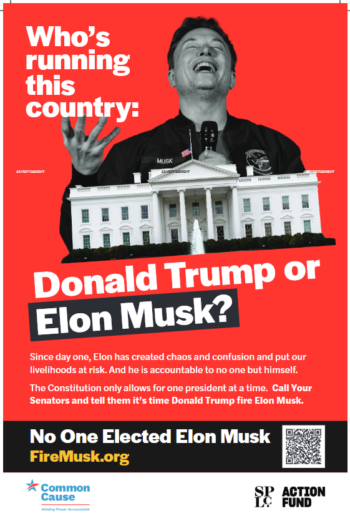
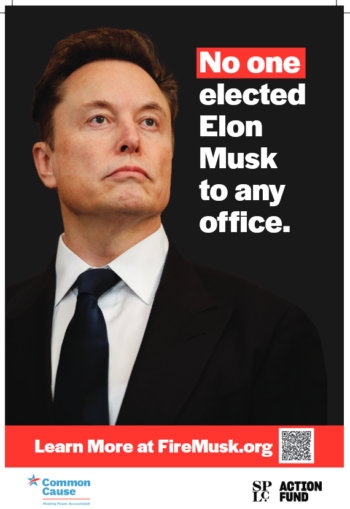




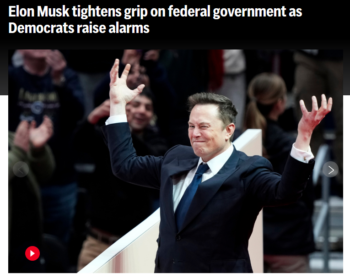

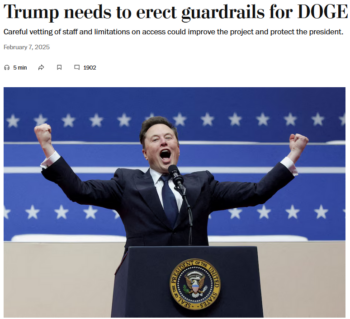
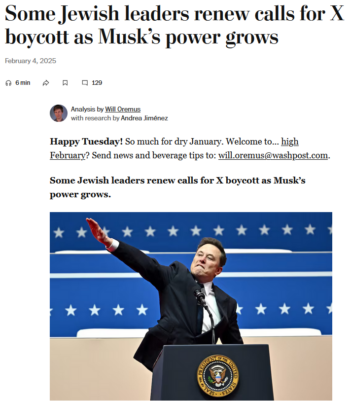
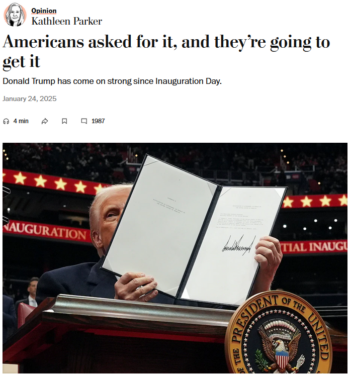
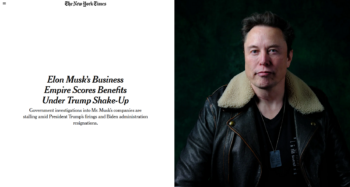




 The murder of UnitedHealth Group executive Brian Thompson, and the subsequent arrest of Luigi Mangione, focused media and policymakers’ attention on the savage practices of private US health insurance. In the immediate